1 Introduction
In this paper, we provide an acoustic analysis of Nuuchahnulth (aka ‘Nootka’) labialization based upon phonetic data drawn from an early recording of Edward Sapir's native-speaker consultant, Alex Thomas. Thomas was responsible for gathering much of the original Nuuchahnulth material subsequently used in a number of publications by Sapir and Swadesh. He also featured centrally in Sapir's famous article on the ‘Psychological Reality of Phonemes’ (Sapir Reference Sapir and Mandelbaum1933).
Nuuchahnulth is presently in a highly endangered state with very few speakers, the majority of whom are over the age of 60. Children have been attending English-only schools since the end of the nineteenth century, resulting in mainly English-dominant semi-speakers over succeeding generations (cf. Dorian Reference Dorian1980, Schmidt Reference Schmidt1985, Evans Reference Evans, Newman and Ratliff2001), so data of the kind discussed here, from a native Nuuchahnulth speaker, are very important for our understanding of the language.
There are several reasons for examining labialization in greater phonetic detail. First, this process is an important aspect of Nuuchahnulth phonetics and deserves careful treatment. There has been a certain amount of confusion regarding the facts of Nuuchahnulth labialization as presented in the linguistic literature (Pullum Reference Pullum1976, Klokeid Reference Klokeid1977, McCarthy Reference McCarthy1999, Reference McCarthy, Féry and van de Vijver2003) and this issue deserves further scrutiny. We will discuss these ambiguities and provide phonetic evidence for our position with respect to labialization. Detailed phonetic analyses of various other aspects of Nuuchahnulth phonetics have recently appeared in the literature, including Stonham (Reference Stonham1999), Wilson (Reference Wilson2000), Carlson, Esling & Fraser (Reference Carlson, Esling and Fraser2001), Carlson & Esling (Reference Carlson and Esling2003), Esling (Reference Esling, Solé, Recasens and Romero2003), Esling, Fraser & Harris (Reference Esling, Fraser and Harris2005), and this paper makes a contribution to this growing body of phonetic literature.
Second, this study will confirm the reliability of Sapir's original fieldwork transcriptions of Nuuchahnulth data by demonstrating the relationship between his phonetic transcriptions and the phonetic facts as recorded on disk in the early 1930s, probably by Sapir or perhaps his student, Morris Swadesh. This also provides us with an opportunity to demonstrate the importance and utility of early recordings of linguistic materials, especially in the context of endangered languages, for an understanding of phonetic processes cross-linguistically.
Finally, Ladefoged & Maddieson (Reference Ladefoged and Maddieson1996) note that final labialized consonants are typologically rare. We hope to contribute to the body of literature on this topic with the aim of providing a better understanding of the nature of such labialized consonants and their acoustic correlates.
We will begin by introducing the underlying contrasts involved in Nuuchahnulth labialization, providing data relevant to this issue in section 2. In section 3, we will provide information on the sources of data and the methodology employed in our analysis. We will discuss both the phonetic and phonological consequences of labialization, as well as the phonetic properties of this process, analyzing the data from Thomas (Reference Thomas1931) and comparing it with more recent data in section 4. In section 5, we will discuss the implications of this study, in particular, its relevance for Sapir's early work and the consequences of both Sapir's and our findings for recent theoretical accounts of labialization.
2 Labialization
Labialization is usually described as a secondary articulation involving lip rounding and an accompanying raising of the tongue back, most commonly, although not exclusively, occurring with dorsal consonants (Maddieson Reference Maddieson1984, Ladefoged & Maddieson Reference Ladefoged and Maddieson1996). With reference to the occurrence of labialization cross-linguistically, Ladefoged & Maddieson (1996: 356) state that ‘[l]abialization is the most widely found secondary consonantal articulation, both with respect to the number of different types of segments with which it co-occurs, and the number of languages in which it is found’. They go on to note that final labialization is rare (ibid: 357). Maddieson (Reference Maddieson1984) cites 38 languages in the UPSID database with labialization.
Nuuchahnulth has contrastive labialization of dorsal consonants, both morpheme-initially, illustrated in (1a), and morpheme-finally, illustrated in (1b).Footnote 1
(1)


Rose (Reference Rose1981:14) notes for Kyuquot Nuuchahnulth that ‘[l]abialized consonants are characterized by velarization as much as by rounding. Lips are much less rounded for consonants such as /kw/ than they are for the glide /w/ or the vowel /u/’. This appears to be an impressionistic observation rather than the results of acoustic analysis and should be taken as such.
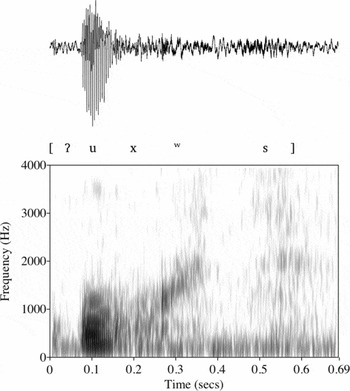
We wish to draw the reader's attention here to the fact that there are very few instances of morpheme-final labialized uvular consonants, /qw, χw/ in Nuuchahnulth, and so the majority of examples in this paper will involve velar stop consonants. The only example of a final dorsal fricative preceded by /u/ in the Sapir fieldnotes involves the personal name transcribed qw  'nituxu (= IPA [qw
 ːn'ituxw]), ‘a man's name’ (Sapir n.d. XV: 23) (but see the example in Appendix 2 from the related Ditidaht language).
In addition to the underlying labial/non-labial contrast of dorsal consonants, there is also a conditioned contrast that arises following a high back rounded vowel, i.e. /u/. This process of labialization has been discussed in various places, including Sapir (Reference Sapir1924), Jacobsen (Reference Jacobsen1969), Jenkins (Reference Jenkins1981) and Rose (Reference Rose1981).
The following illustrates underlyingly non-labial consonants, (2), which become round, (3), due to this contextual rounding.Footnote 2
(2)
(3)
The contextual labialization of dorsal consonants may persist subsequent to the deletion of the conditioning vowel, /u/, a situation that may arise as a consequence of certain rhythmic vowel deletion rules. This results in cases where derived labialized consonants that, on the surface, possess no conditioning /u/ vowel, exhibit labialization. Cases of this kind appear in (4), where the morpheme /-n'uk/ ‘in/at the hand [r]’ undergoes the loss of the /u/ and subsequent change of the glottalized nasal /n'/ to a plain /n/ when in the coda of a syllable. See Kim (Reference Kim2003) for discussion of the constraint against glottalized ([c.g.]) consonants appearing in the coda.
(4)
Evidence of the underlying presence of /u/ in the morpheme /-n'uk/ ‘in/at the hand’ is readily available in contexts where the rhythmic vowel deletion does not apply, as shown in (5).
(5)
The application of reduplication, associated with the morpheme /-n'uk/, supports the conclusion that the cases in both (4) and (5) involve the same morpheme. As should now be evident, labialization is an active process that rounds dorsal consonants when they are preceded by /u/.
This completes the presentation of the basic properties of labial consonants and labialization in Nuuchahnulth.
3 Methodology
The principal source of the data for this study originates from a recording of Alex Thomas (AT), one of Edward Sapir's principal consultants and collaborators in the gathering of Nuuchahnulth data. Thomas was born in December 1891 in Port Alberni and was a speaker of Tsishaath, a southern Nuuchahnulth dialect. The recording is lodged in the Indiana University Archives of Traditional Music (Accession number 85-547-F ATL). It consists of an analog, 78 rpm, mono 12-inch sound disc. The source is described as ‘[r]ecorded in the 1930s in Vancouver, B.C. by an unknown collector, possibly Edward Sapir’. It was deposited by F. M. Voegelin at the Archives of Traditional Music in 1985, as part of the C. F. and F. M. Voegelin Archives of the Languages of the World. We refer to this recording here as Thomas (Reference Thomas1931).
If the attribution is accurate, then it is most likely that it was Morris Swadesh, on his field trip with Mary Haas in 1931 to study the Ditidaht (aka Nitinat) language on Vancouver Island, who made the recording. Alternatively, it may have been made in 1933, during Thomas' visit to Sapir at Yale in New Haven.
The quality of the recording is patchy, reasonably good in some places, completely uninterpretable in others. On the other hand, it contains natural, idiomatic speech by a native speaker from a time when the language was not endangered. The entire recording was digitized at a sample rate of 44,100 Hz from a cassette tape copy of the original made in the early 1990s. This was then transcribed in broad phonetic form and indexed for ease of searching and then segmented into small 16-bit WAV files for analysis using Praat version 4.4.24 under Macintosh OSX. This served as the original source for the research.
Subsequently, with the assistance of Marilyn Graf of the Indiana University Archives of Traditional Music, we obtained a redigitized version in CD-ROM format, which provided a significant improvement to the original cassette dubbing. This was also digitized at 44,100 Hz and was again segmented into small 16-bit WAV files for analysis using Praat.
Acoustic information above 4000 Hz was limited due to the recording techniques available at the time of the original recording (see Plichta & Kornbluh Reference Plichta and Kornbluh2002 for discussion of recordings of this era) and even F3 and F4 formants of vowels were often weak or not visible. In addition, there were the inevitable clicks and hiss that are a regular accompaniment to old recordings, although these were significantly reduced in the second version obtained. In spite of the shortcomings, there was a substantial amount of useful information in the 169 short utterances analyzed.
Because of the uneven quality of this early recording and to support our claims with independent acoustic evidence, we provide additional spectrographic results in an up-and-down format at crucial junctures throughout the exposition. These data are extracted from a CD-ROM recording of a speaker of Ahousaht, a central Nuuchahnulth dialect, George Louie (GL), born in 1912 in Opnit, Manhousaht. This recording, accompanying Nakayama (Reference Nakayama2003), was made in the early 1990s, approximately 60 years after the Thomas recording, and is a naturalistic account of the speaker's life and culture. The quality of this recording is somewhat better than the Thomas recording and, as with the Thomas recording, this one was digitized at a sampling rate of 44,100 Hz and analyzed using Praat 4.4.24 under Mac OSX.
In all the following figures where two spectrograms are provided, the upper example is from AT and the lower example from GL, unless otherwise noted. Where there is only one spectrogram, it is from AT unless otherwise specified.
4 Acoustic properties of labialization
4.1 Introduction
The acoustic correlates of labialization have not been widely discussed in the literature, other than in very general terms. They typically involve a lowering of the second formant, as observed by Ladefoged & Maddieson (1996: 357f.):
Labial consonants are accompanied by a low second formant transition in adjoining vowels. When they are labialized the second formant is even lower. In accord with our observation that the stronger effect of labialization is seen at the release of the consonant, the lowest formant values . . . are seen after the release of a labialized consonant.
Jakobson, Fant & Halle (1951: 50) note with respect to the labialization of the glottalized [p'w] in /p'wa/ ‘shell’ in Circassian that the ‘comparison with the corresponding plain (unrounded) consonant /p'a/ . . . shows the decrease in the intensity of the high frequencies and the concomitant lowering of the second formant in the following vowel [in the labialized case] despite the intervening silence’.
Hence, it would appear that the acoustic correlates of labialization include a lower than expected second formant accompanied by a gradual rise in the frequency of the concentrations of acoustic energy into the following vowel, if there is one. If not, as we will see in the latter part of this paper with regard to final labialization, the effects are more subtle. With respect to labialization of a word-final consonant, Ladefoged & Maddieson (1996: 357f.) remark:
Although it is rare, final labialization does occur. Pohnpeian, for example, has a contrast between plain and labialized bilabial stops and nasals in both initial and final position. . . . The final labialized consonants have releases which are audibly quite distinct from the plain counterparts.
Given its cross-linguistically rare distribution, we have not found any work which clearly demonstrates the acoustic correlates of word-final labialized consonants, and one of the aims of this paper will be to propose certain characteristics worth considering from our examination of this phenomenon in Nuuchahnulth.
4.2 Labialization in Nuuchahnulth
In this section, we will examine the various acoustic contexts of labialization in Nuuchahnulth in order to establish the domain of application of this phenomenon and to provide evidence of the scope of the process. As there has been little previous acoustic analysis of labialization in Nuuchahnulth, we go into some detail concerning the data and analysis.
Labialization in its most basic form occurs between vowels. However, one caveat is in order at this point: there is a competing process of delabialization in Nuuchahnulth that involves a following /u/. For example, while the /k/ in /nuːkwiːs/ ‘canoe song’ (from /nuːk/ ‘song’ and /-iːs/ ‘going along’), is labialized, the first /k/ in /nuːkukma/ ‘it is his song’ (from /nuːk/ ‘song’, /-uk/ poss, and /-ma/ 3.ind) is not labialized due to the following /u/ of /-uk/ (see Stonham Reference Stonham1999, Kim Reference Kim2003 for detailed discussion). For this reason, when referring to intervocalic environments, we restrict the domain to the context where the second vowel is not /u/. In Nuuchahnulth, this limits the possibilities to /a/ and /i/. In referring to the lowering effect on the second formant of the following vowel discussed above, the second formants of the vowels for both AT and GL provided in the vowel plots in Appendix 1 will be useful.
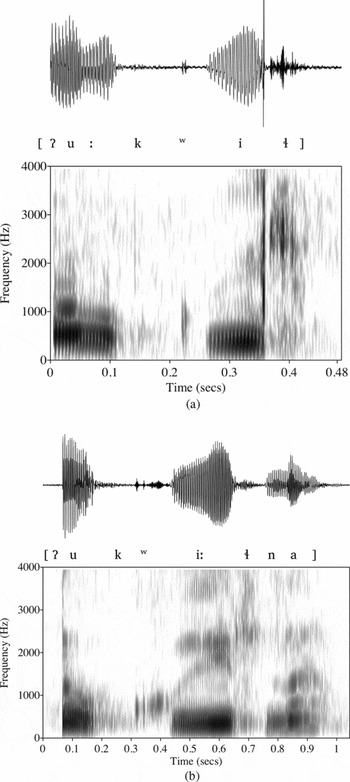
An example of labialization between vowels is the word /ʔuːkwiɬ(na)/ ‘to do, make’ in figures 1(a)–(b), which has a labialized /kw/ triggered by a preceding /uː/. In the acoustic signal the labialization is evident from several indicators: (i) the acoustic energy through the stop burst from approximately 850 Hz up to about 1000 Hz preceding the second vowel;Footnote 4 (ii) the rising of the F2 of the vowel /iː/ from approximately 1000 Hz up to its steady state at 1900 Hz, atypical of such a vowel following a velar consonant; and (iii) the energy in the waveform following the stop burst.Footnote 5
Labialization of /k/.

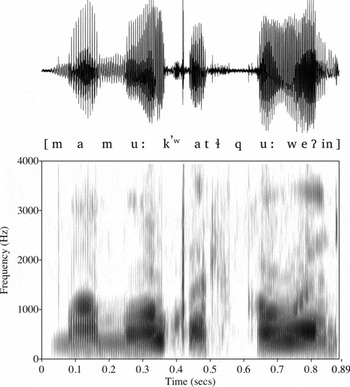
An example of the same effect with a glottalized labialized consonant is provided in figure 2. Here, the word /mamuːk'watɬquːweʔin/ ‘she would now work, it is said’ exhibits very similar properties to the previous example. Just as with the previous example, there is a rise in the frequency of the concentrations of energy across the stop burst and into the following vowel, which exhibits a rise from approximately 1000 Hz to 1400 Hz, the latter within the typical range for the F2 of AT's /a/.
Glottalized labialized [k'w].

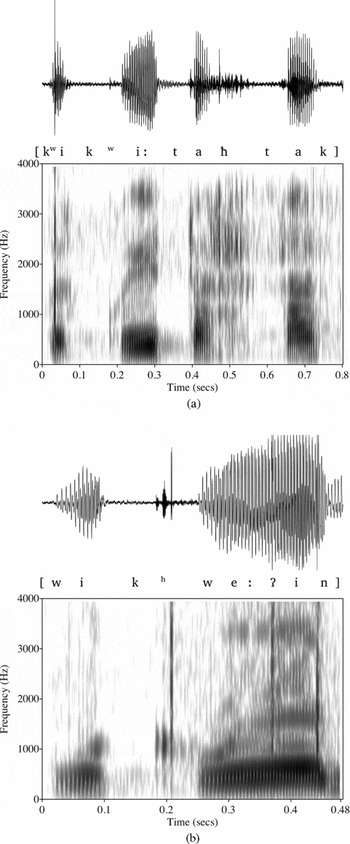
For comparison we provide figure 3, which contains the words (a) /kwikwiːtaħtak/ ‘glued at the end’ with the labialized stop /kw/ and (b) /wikweːʔin/ ‘did not, it is said’ with a /k/ followed by a /w/-initial morpheme. This shows a clear difference between (a) a /kw/ and (b) a sequence of /k/ followed by /w/. With the sequence /k w/, there is a voicing bar after the stop burst, from 250–300 ms on the time axis (figure 3(b)), showing the sonorancy of the /w/, with the typical formant transition of a labio-velar approximant onset to a vowel. On the other hand, with the labialized velar stop (figure 3(a)), there is no voicing bar, although there is some formant-like noise transition around 1000 Hz, which is distinct from the vowel formant transition. Hence, the labiality phase of a labialized consonant should not be considered to be the same as the sonorancy phase of a /w/.
/kw/ versus /k/ followed by /w/ (both AT).

Another characteristic that helps to distinguish labialized dorsal consonants from sequences of stop followed by labio-velar approximant is the aspiration which appears on stops in the coda, as first noted by Sapir (Reference Sapir1924). The case of the labialized dorsal consonant is exemplified in figure 3(a), where there is a rising frequency in the release from 190 ms, indicating that labialization is present. On the other hand, a /k/ followed by a /w/ (figure 3(b)) exhibits a much longer aspiration phase (from 180 ms to 250 ms in figure 3(b)) which falls from the release, indicating a transition into the /w/.
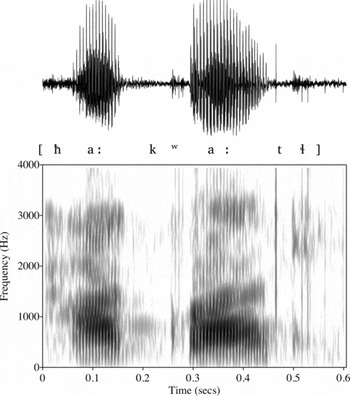
Figure 4 provides a spectrogram of the underlyingly labial /kw/ in the word /ħaːkwaːtɬ/ ‘young woman’, which contains no labialization-trigger. Here again one can see the gradual incline of F2 in the /aː/ following the round consonant, /kw/, from around 1000 Hz up to 1300 Hz, along with the concomitant energy in the waveform. Thus, whether there is a conditioning round vowel, /u/, or an inherently round dorsal consonant, the phonetic characteristics of labialization are basically the same.
Spectrogram of /ħaːkwaːtɬ/ ‘young woman’.

One further important point, clearly illustrated by this latter example, is the typical ‘velar pinch’ of the F2 and F3 of the first vowel, which precedes the velar stop, /kw/, and the rising F2 of the second vowel, due to the labiality of the velar stop.
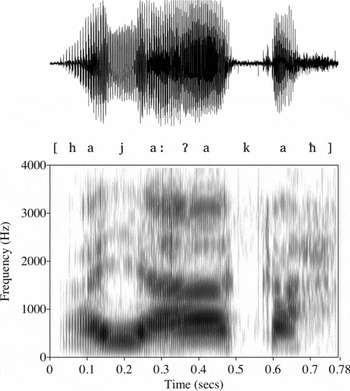
These examples exhibit evidence of labialization, with a formant-like energy transition through the stop burst and a very clear rising profile for the F2 of the following vowel. Note that this rising profile is not what one would expect given a preceding plain velar consonant, as illustrated in figure 5, for /hajaːʔakaħ/ ‘I don't know’, where the last vowel shows a flat or somewhat declining F2 and a rising F3, as one might expect of a vowel following a velar consonant.
Plain dorsal consonant between vowels.

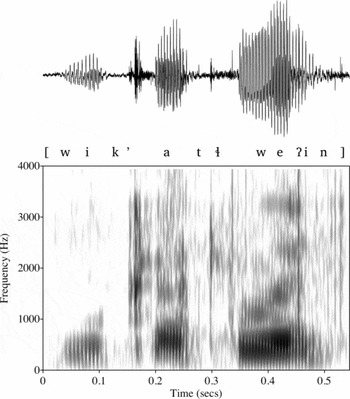
Another non-labialized case is /wik'atɬweʔin/ ‘not now, it is said’, in figure 6. Here the glottalized /k'/ shows no indication of rounding and there is no effect on the F2 of the following /a/ vowel, which remains basically steady at around 1400 Hz, within the typical range of /a/ for AT.
Glottalized dorsal consonant between vowels.

Up to this point we have focused on labialized/plain dorsals in the most basic environment, i.e. intervocalically. Interestingly, when either an underlying or derived labial consonant is immediately followed by a consonant, labialization is suppressed, resulting in a neutralization to plain dorsal consonant, as indicated by the examples in figures 7 and 8. As Sapir (1924: 89) put it: ‘labializations regularly disappear in syllabically final position’.
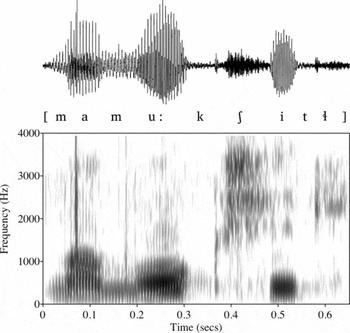
Absence of labialization before the consonant /ʃ/.

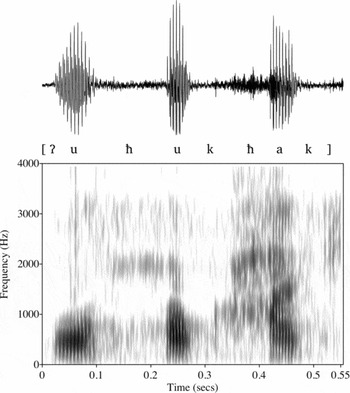
Absence of labialization before the consonant /ħ/.

In figure 7, the stem-final consonant appears as plain /k/ on the surface: /mamuːkʃitɬ/ ‘work (prf)’ (< [mamuːkw-ʃitɬ]). Similarly, a suffix such as /-uk/, ‘possessive’, exhibits no labialization in figure 8, /ʔuħukħak/ ‘is it his?’. Both cases are delabialized due to a following consonant, in the first case the alveo-palatal fricative, /ʃ/, which appears as onset to the final syllable, /-ʃitɬ/ ‘perfective aspect’ and in the second case, the pharyngeal fricative, /ħ/, in the inflectional suffix /-ħak/ ‘2s.interrogative’. In both cases, there is no formant-like energy across the stop burst and no additional energy in the waveform.
4.3 Word-final labialization
Previous accounts (e.g. McCarthy Reference McCarthy1999, Reference McCarthy, Féry and van de Vijver2003; Kim Reference Kim2003) have attributed the deletion of labiality mentioned at the end of the previous section to a process of delabialization in the coda, which is accurate word-internally, as far as it goes. However, these analyses do not take into account the facts word-finally, where labialization persists, at least in those cases where it is conditioned by a preceding /u/.
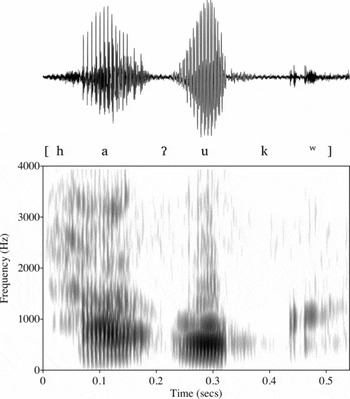
Take, for example, the word /haʔuk/ ‘eat’ (figure 9). In this context, after the stop burst, there is some rising formant-like energy starting at 450 ms at 900 Hz rising to around 1100 Hz at 550 ms, which plain /k/ does not show. These characteristics are also exhibited in word-internal contexts, as discussed above.
Final labialization in /haʔuk/ ‘eat’.

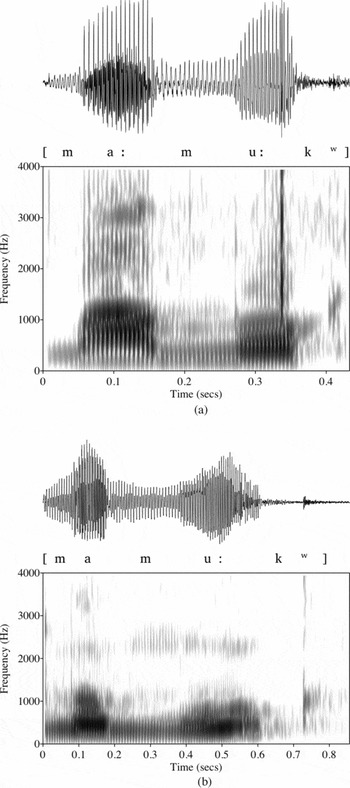
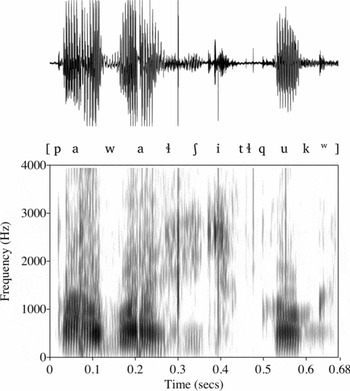
Word-final labialization also appears in the word /mamuːk/ ‘working’, illustrated in figures 10(a)–(b), and /pawaɬʃitɬquk/ ‘his was wandering’ in figure 11, as well as in five other words in the AT recording. Again, note the increased energy in the waveforms, the lowered F2 of the preceding /u/ (∼800 Hz), and the energy transition across the stop burst at around 1000 Hz.
Final labialization in /mamuːk/ ‘working’.

Final labialization in /pawaɬʃitɬquk/ ‘his was wandering’.

What is crucial here is that in word-final position dorsal consonants labialized by a preceding /u/ retain that labialization, which is both audible and visible in the acoustic display in terms of the rise in the frequency of the concentrations of acoustic energy following the stop burst in figures 9–11, as compared to final /k/ preceded by an unrounded vowel.
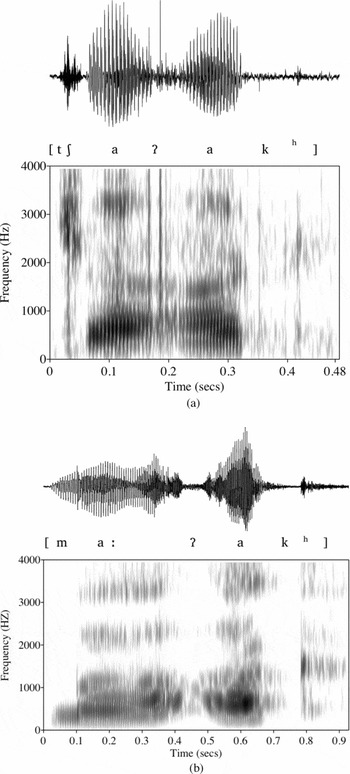
Compare this with a word-final non-labial consonant /k/ in /tʃaʔak/ ‘water’ or /maːʔak/ ‘California whale’ in figures 12(a)–(b), which show stable acoustic energy after the stop burst with no indication of an energy transition. In addition, in keeping with the Jakobson et al. (Reference Jakobson, Gunnar, Fant and Halle1951) observation cited in section 4.1 above, we note that the aspiration/intensity after a plain stop burst is higher (roughly above 1500 Hz) than after a labialized /kw/.
No labialization with /tʃaʔak/ ‘water’ and /maːʔak/ ‘California whale’.

4.4 Opaque labialization
Opaque labialization consists of the labialization of a dorsal consonant by a preceding /u/, followed by subsequent deletion of the /u/, due to a rhythmic vowel deletion process, as discussed above with respect to the examples in (4) in section 2. In such cases, labialization remains intact, as in (6).
(6)
Rose (Reference Rose1981: 24) observes that ‘[t]he one case in which the labialization rule is obligatory is when a u which causes labialization of an adjacent segment is absent from surface structure by a vowel deletion rule’.
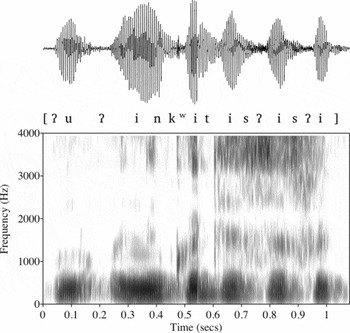
Figure 13 provides acoustic evidence of the labialization in this example. That is, the labiality phase of the velar stop actually substantiates the fact that there used to be a /u/ preceding the stop, which triggers the labialization of the stop. Hence, it assists with the reconstruction of the underlying form of the morpheme /-n'uk/ ‘in/at the hand’.
Persistent labialization: /ʔuʔinkwitisʔisʔi/ ‘the small branches’ (GL).

Note that similar collocations with unrounded vowels do not result in labialization of the dorsal consonant, as indicated by the following example of /-n'iˑq/ ‘down a slope’.
(7)
4.5 Glottal transparency
A final aspect of labialization meriting discussion here is the persistence of labialization across glottal stops. We have seen, in figure 2, a vowel following a glottalized labialized consonant that exhibits labialization effects. We assume that a secondary articulation, whether it is glottal or some other aspect, does not block labialization on the following vowel. In this section, a glottal stop, as a primary articulation, shows a transparency effect in terms of labialization. We suppose that this effect is a property of the glottal stop itself, rather than a phonetic property such as a glottal phase. Hence we do not discuss why a glottalized consonant and a glottal stop show similar effects in terms of labialization, an issue which is beyond the scope of this paper.
In all previous accounts of labialization in Nuuchahnulth, it has been claimed that a following consonant blocks the application of the process (Pullum Reference Pullum1976, Rose Reference Rose1981, McCarthy Reference McCarthy1999). This was also noted in section 4.2. However, a dorsal consonant may retain its rounding when preceding a glottal stop which is followed by a vowel. It seems that a glottal stop behaves as a transparent consonant for the purpose of labialization, so the following vowel gives a context for maintaining the labiality.
We should note here that it is theoretically conceivable that /h/ might also exhibit this glottal transparency, but it does not occur word-internally in Nuuchahnulth and the only context where it might apply is if there were a root /hVkw/ which subsequently underwent full reduplication, giving /hVkwhVkw/. However, no such case is available in any data encountered to date.
Nuuchahnulth labialization across a glottal stop appears to constitute a case of ‘glottal transparency’ (see Steriade Reference Steriade1987, Stemberger Reference Stemberger1993 for theoretical implications), as in (8) (from Nakayama Reference Nakayama2003).
(8)
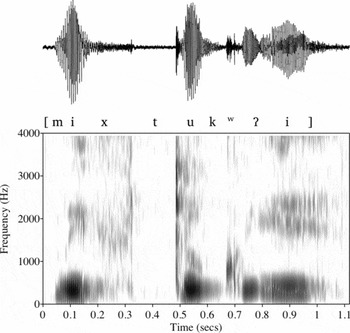
Figure 14 provides a spectrogram of (8a) indicating the rising energy across the stop burst and /ʔ/, continuing into the following /i/ vowel, as well as the energy in the waveform immediately preceding the vowel.
Labialization across /ʔ/ (GL).

As should be evident from such examples, labialization may persist across glottal stops although it is blocked by all other consonants. In fact, Swadesh (Reference Swadesh1948: 107f.) has suggested a broader scope for this generalization, claiming that: ‘[l]abialized palatals and velars are preserved only before vowels and glottal consonants (ʔ ħ ʕ) of formative suffixes’. We have been unable to substantiate this further claim concerning the transparency of pharyngeal consonants /ħ/ and /ʕ/; in fact, figure 8 appears to constitute a counterexample to the claim with regard to /ħ/.
4.6 Other labialized dorsals
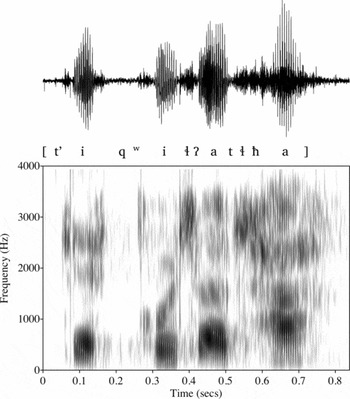
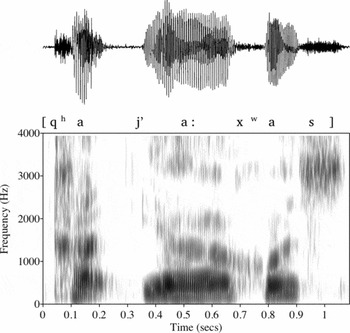
As we stated earlier in this article, final labialized dorsal consonants other than the velar stops are quite rare and we have no examples in the Thomas (Reference Thomas1931) recording or even in the later recording of GL. In order to demonstrate that the basic properties of other labialized consonants are similar, we provide examples of word-internal labialized uvular stop (figure 15) in the word /t'iqwiɬʔatɬħa/ ‘is he sitting?’, and velar fricative (figure 16) in the word /qaj'aːxwas/ ‘adze’.
Labialized uvular stop [qw].

Labialized velar fricative [xw] (GL).

As can be readily observed in figure 15, the properties of the labialized uvular stop are quite similar to those of the labialized velar stop, showing the rising transient on the burst and the following vowel F2, which rises from around 1000 Hz at 300 ms to 1600 Hz at 370 ms.
The example of a word-internal labialized velar fricative, /xw/, demonstrates that this labialization also exhibits very similar characteristics to the labialized velar and uvular stops.
As can be seen quite clearly in this spectrogram, the velar fricative, /xw/, behaves in a very similar fashion, affecting the F2 of the following vowel (900 Hz going up to 1400 Hz), but without the concomitant effects exhibited on the burst, since there is none.
In sum, we have demonstrated the contrastive underlying labialization of dorsal consonants, both initially and finally, in Nuuchahnulth. Also, we discussed an active process of labialization of dorsal consonants conditioned by a preceding /u/ in the appropriate environment. This labialization has been shown to persist after deletion of the /u/. Finally, we have demonstrated the persistence of labialization in general across /ʔ/ due to the effects of glottal transparency.
5 Discussion and conclusions
As we mentioned above, one of the goals of our study is to demonstrate that Sapir's phonetic transcription system for Nuuchahnulth is reliable and that he was fully aware of the extent of labialization and noted it carefully and accurately in his fieldnotes, among other phonetic details.
Sapir noted labialization in his fieldnotes in one of two ways: (i) as [w] in line with the other segments, as in (9a–c), or (ii) as [u] in examples such as (9d). In these examples we provide as close an approximation as possible of the original published form of his fieldnotes for one text ‘the Rival Whalers’, where he was still employing a broad phonetic representation of the data. This is followed, in the second column, by an IPA rendering of this form and then, in the third column, the phonemicized form of the words as employed in Sapir & Swadesh (Reference Sapir and Swadesh1939, Reference Sapir and Swadesh1955) and most later work by other scholars.
(9)
These are the examples of labialization from the Sapir (Reference Sapir1924) text, but there are numerous handwritten examples with very similar form in the 24 volumes of fieldnotes gathered by Sapir between 1910 and 1914. With respect to labialization, Sapir (1924: 87) states only: ‘-okw- (final form -ok‘, -ok‘u; k-sounds are labialized after o)’. There appears to be a systematic use of /w/ versus /u/ in these cases. /w/ is used word-internally, whether followed by a vowel or a consonant, and /u/ is used in word-final position.
With regard to the later phonemicization of Sapir's transcriptions, McCawley (Reference McCawley1967) has already discussed this issue in some detail. What is relevant to the issue here is that Sapir, in collaboration with Morris Swadesh, arrived at a phonemicized orthography of Nuuchahnulth in which both underlying and conditioned labialization were not represented in the coda, as can be seen in the third column in (9) above. This is the source of later linguists' confusion over the nature of conditioned labialization in Nuuchahnulth. In this study we have demonstrated that Sapir's original transcriptions are far closer to the phonetic facts, confirming the existence of final labialization in Nuuchahnulth.
As for the acoustic correlates of labialization in Nuuchahnulth, we separate these into two classes, word-internal and word-final, based on the different environments where it occurs. The characteristics of labialization include: (i) F2 effects on the following vowel, (ii) acoustic energy effects on the burst and aspiration of the consonant itself, and (iii) energy in the waveform.
With respect to F2 effects, we confirm the previous generalizations for intervocalic labialized consonants that there is a lowering influence on the following vowel. This is realized as a rising profile towards the expected F2 steady-state of the vowel concerned. In the case of Nuuchahnulth, this may be either /i/ or /a/: we see this for /i/ in figure 1 and for /a/ in figure 4.
The remaining two characteristics apply to either word-internal or word-final labialization. Both contexts exhibit acoustic energy in the burst and following aspiration, if present, of labialized consonants in the region of 800–1000 Hz. Obviously, both bursts and aspiration are properties of stop consonants.
With respect to waveform energy, there appears to be some indication of a transition in the frequency of acoustic energy carrying over into the following vowel in the case of word-internal labialization. In the case of word-final labialization, there is also an indication of energy detectable in the waveform, again not as prominent as with the word-internal case.
To conclude, this paper provides a comprehensive phonetic characterization of Nuuchahnulth labialization. It has demonstrated the existence of word-final labialization of dorsal consonants in Nuuchahnulth, confirming Sapir's original phonetic transcriptions of the materials he gathered in the early 20th century. This evidence proves contradictory to certain previous accounts of Nuuchahnulth labialization, at least with respect to the word domain. Moreover, this study provides details of several additional properties of labialized consonants in Nuuchahnulth, including opaque labialization, glottal transparency and aspiration.
Postscript
The data for this paper have been drawn from two speakers of two different dialects, one from the Southern and one from the Central branch of Nuuchahnulth. Both were born before 1915, at a time when the language was alive and well. We have also confirmed the existence of the same properties in both the Northern branch (Kyuquot) and in the related Ditidaht language, spoken south of Nuuchahnulth on Vancouver Island, again with speakers of roughly the same age (see Appendix 2 for examples). What we have not yet studied, and what awaits further investigation, is the status of this process among younger speakers.
Acknowledgements
We would like to thank John Esling, Ewa Jaworska and the anonymous reviewers for their many helpful comments and suggestions on the manuscript. The first author would also like to acknowledge the financial support of the British Arts and Humanities Research Council (AHRC) for the Nuuchahnulth Project (No. B/RG/AN7953/APN12323, 2001-2006). We thank all the Nuuchahnulth people who have helped advance our understanding of the language in one way or another over the years.
Appendix 1: Vowel formant plots
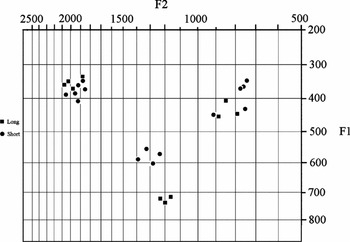
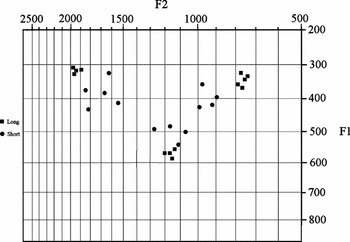
The vowel formant plots below are based on the analysis of vowels taken from between non-post-velar consonants in order to avoid any undue influence. /w/ and /j/ were also avoided for similar reasons. Formants were measured with the functions available in Praat 4.5.14, using a combination of software calculations and visual measurement of the formants at the approximate center point of each vowel. Long vowels are represented by a square and short vowels by a circle. The top left cluster represents the high front vowel, the top right one the high back vowel, and the lower cluster the low vowel.
Vowel Formant Chart for AT.

Vowel Formant Chart for GL.

AT's short vowels range from around 40–80 ms while his long vowels vary from 100–130 ms, in general. There are occasional instances of additional rhethorical lengthening in the recording. George Louie's short vowels range from 40–100 ms and his long vowels extend from 100–200+ ms, substantially longer than AT's. It is not yet clear if this is due to dialect variation, age difference, or other effects.
Appendix 2: Further data
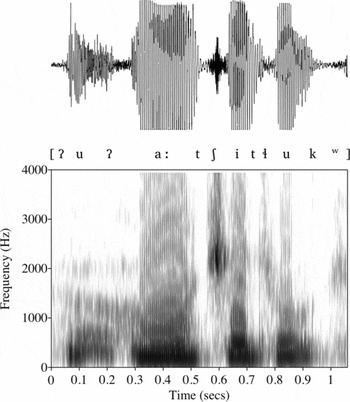
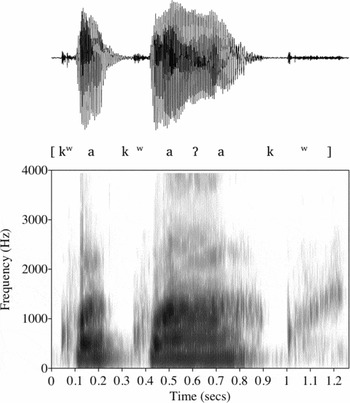
This appendix provides data from two other varieties of Southern Wakashan to confirm the pervasiveness of labialization in the family. The first example comes from the northernmost variety of Nuuchahnulth, Kyuquot, provided by Mr. Robert Peter, born in 1916. The other two examples come from Ditidaht, the southernmost variety spoken on Vancouver Island. The first comes from Mr. John Thomas, born circa 1915, and the second from Mrs. Flora Joseph, born circa 1920. All examples demonstrate the existence of final labialization, and in fact, it appears to be even more widespread in these varieties, appearing finally even when not conditioned by a preceding round vowel. Figures A2.1 and A2.3 show the conditioned cases, where the velar consonant is labialized due to the preceding /u/, [ʔuʔaːtʃitɫukw] ‘his went out to sea’, [ʔuxws] ‘it is me’, respectively. Figure A2.2 demonstrates that final labialization is persistent in Ditidaht, even when not conditioned by a preceding rounded vowel, /kwakwaʔakw/ ‘going backwards’.
/ʔuʔaːtʃitɬuk/ ‘his went out to sea’ Robert Peter (Kyuquot).

/kwakwaʔakw/ ‘going backwards’ John Thomas (Ditidaht).

/ʔuːxs/ ‘it is me’ Flora Joseph (Ditidaht).