In the year 2000 David Román's article ‘NOT-ABOUT-AIDS’ was published in GLQ: A Journal of Lesbian and Gay Studies.Footnote 2 Referencing two dance pieces, the article details the decline in representations of HIV/AIDS in performance and a simultaneous move towards marriage and the military as the twin foci of lesbian, gay, bisexual and transgender (LGBT) representation in the US. While the ‘don't-ask–don't-tell’ military policies are specific to the US, the more transnational focus of LGBT-rights organizations on marriage and the family over the past fifteen years (certainly with regard to Ireland, the UK and Australia) can be seen to epitomize what Lisa Duggan has called ‘the new homonormativity . . . a politics that does not contest dominant heteronormative assumptions and institutions but upholds and sustains them’.Footnote 3 As Julian Carter notes, most critiques of homonormativity draw attention to its relationship with neoliberal politics.Footnote 4 For example, queer/crip theorist Robert McRuer, whose work draws connections between queer and disability studies, uses the framework of neoliberalism to describe our contemporary moment as a ‘normalizing historical period that insistently domesticates . . . disruptive queer forces’.Footnote 5 The political strategy of ‘normalizing’ lesbian and gay life according to mainstream/heteronormative values is decidedly a move away from the queer strategies of the 1980s and early 1990s that, as Michael Warner has elucidated, set out to expose and challenge the institutions and discourses of heteronormativity precisely through ‘resistance to regimes of the normal’.Footnote 6 Instead, an embrace of the homonormative results in what Warner identifies as a new hierarchy of ‘Good Gays’ and ‘Bad Queers’,Footnote 7 the former of which are notably ‘white, monogamous, gender-conforming, and middle-class’.Footnote 8 To this I would add the able-bodied and ‘healthy’. As a strategy, it occludes the non-white, the financially dependent, the sick, the disabled and those whose sexualities fall outside the framework of gay ‘goodness’.
This hierarchy clearly has ramifications for which gay subjectivities are ‘celebrated’ through representation and which are hidden away. As Rosemary Hennessy states, ‘for a lesbian and gay political project that has had to combat the heteronormative tyranny of the empirical in order to claim a public existence at all, how visibility is conceptualized matters’.Footnote 9 Over the past decade, since Román's article, this normalization process has been reflected in mainstream media representation – a visibility – that aims to show, above all, how ‘normal’ gays are. The most obvious examples include television's Queer Eye for the Straight Guy, The L Word, Ellen/Ellen and her marriage to Portia de Rossi, and most recently the film The Kids Are All Right (and totally normal).Footnote 10 Analysing Queer Eye for the Straight Guy, McRuer notes that ‘routinizing a particular cultural construction and making it seem ordinary’ is in the ‘realm of ideology’.Footnote 11 Thus the routinized visibility of the ‘good gay lifestyle’ is problematic because, as Dana Collins argues, despite the intervention that positive images of marginalized subjectivities can make,
liberatory and representational models still reproduce the key dichotomies of positive and negative representations, silenced and liberated sexualities, and fantasy and real life.
The emphasis on visibility implies that the reality of gay life is positive, or at least coherent enough to be represented, which presents a dilemma for those who intentionally use representation politically.Footnote 12
The desire to challenge negative images of LGBT experience, therefore, brings with it a homogenizing and sanitizing visibility that seeks to hide away the ‘bad gay lifestyles’.
Picking up from this context and set of queer theories, this article will argue that a dangerous but logical result of this ‘fetish of normativity’ is the distancing of HIV/AIDS from LGBT representation.Footnote 13 Needless to say, HIV/AIDS subjectivities are problematic for the project of homonormativity. While the strategy of breaking an assumed link between gay people and HIV/AIDS has been vital, and at times urgent, a by-product created by this ‘degaying’ is a diminished attention to the continued presence of HIV/AIDS.Footnote 14 This lack of focus produces an amnesia, which can be identified not only in representational practices that can be seen to sideline, or conveniently ‘forget’, about HIV/AIDS, but also in what Gregory Tomso argues has been a general ‘decline in scholarly attention to HIV/AIDS in the humanities’.Footnote 15 Tomso insists that ‘despite the apparent normalization of HIV/AIDS in contemporary Western societies, the need for an invigorated response to the pandemic is grave’.Footnote 16
While situated amongst a wide field of queer contestations of (homo)normativity, then, this article responds most directly to both Román's 2000 and Tomso's 2010 articles, and focuses on two particular examples of HIV/AIDS in theatre performance. The choice of performances emerges from an unexpected symmetry to my work as a director: one of the earliest jobs I had was as assistant director to avant-garde, queer auteur Reza Abdoh on his play Bogeyman at the Los Angeles Theatre Center (LATC, 1991), and one of my most recent has been directing Sydney playwright Lachlan Philpott's Bison for Belfast's OUTburst Queer Arts Festival (Queen's University Drama Studio, November 2009).Footnote 17 Despite very different dramaturgies, working methods and historical contexts, there is a thematic and political connection that unites the work, as both plays respond to the occurrence and experience of HIV/AIDS amongst gay men, at their particular social moment. Yet while Abdoh's play emerged at the height of AIDS activism, the representation of AIDS on stage, and the public discussion of this representation, Philpott's play goes against the grain by trying to reinsert HIV/AIDS into what has been called the ‘post-AIDS’ economy.Footnote 18
The article is structured in three main sections dealing, firstly, with the dramaturgical mechanics of Abdoh's production and its relation to the sociohistorical context in terms of HIV/AIDS awareness and governance. The second section picks up Román's argument that this period of ‘AIDS as crisis’ was followed by a waning of interest in HIV/AIDS discourses and representation in Western, anglophone culture and enlists Tomso's more recent article to argue that a continued lack of interest is misplaced. The final section focuses on Philpott's play Bison as a recent cultural representation resisting the urge to forget about HIV/AIDS within the culturally conservative environment of Northern Ireland. The article is written, I should stress, from the subjective perspective of a director working, largely retrospectively, through the cultural and political implications of dramaturgical choices, rather than from the perspective of an HIV/AIDS theorist, or even as a specialist in HIV/AIDS performance histories.Footnote 19 Working from the material situations in which these productions took place, it is, inevitably, partial and personal: its emphasis is on the US, Northern Ireland and Australia because that is where the plays were produced or written. From this somewhat aleatory starting point, the article draws some parallels in the dramaturgy of the two pieces, despite their different contexts. Crucially, both locate their politics not in the dramatic dialogues of realism, often held up – certainly in British critical practices – as the epitome of ‘political theatre’, but in idiosyncratic queer dramaturgies that often work affectively rather than immediately cognitively.Footnote 20 Through analysis of the affective and experiential impact of Abdoh and Philpott's dramaturgical strategies, the article argues, ultimately, that along with the continued need for the representation of HIV/AIDS subjectivities on the contemporary Western stage, there needs to be a continual reimagining of a queer dramaturgy that can find forms to reflect the complexities of these subjectivities.
Bogeyman: ‘About-AIDS’
Working on Abdoh's Bogeyman at LATC, the social context was one of paranoia and the labelling of HIV/AIDS as a ‘gay plague’.Footnote 21 Public advertisements at the time ranged from terrifying images of grim reapers, and the suggestion that unsafe sex – and this meant sex without a condom – would almost certainly be lethal, to gay-activist campaigns trying to counteract the hysterical homophobia that had emerged through this discourse. The immediate context in the theatre was that Reza was HIV+, as was one of the cast. Bogeyman, the middle part of his Bogeyman Trilogy, starting with The Hip Hop Waltz of Eurydice (LATC, 1990) and ending with The Law of Remains (Diplomat Hotel, New York City, 1992), was born partly out of Reza's rage at his own HIV+ status, but mostly at the social and medical discursive construction of the disease as punishment of the immoral, (‘bad’) gays. Structured predominantly through fragmentation and montage, there is a multiplicity of overlapping narrative forces. Going through my rehearsal script – a messy, literally cut up and pasted and multiply corrected working document that, twenty years on, I find almost impossible to navigate – narrative themes are clear: the idea of being tested, the pervasion of illness, of pill-popping, of corporal punishment by the state in a ‘branding of butts’, of committing suicide – or trying to – and the dysfunctional all-American family.Footnote 22 This is nominally and tenuously held together by the plot of a terrorist, Hilda (played by Tom Pearl), who aims to blow up the ‘Central Committee’ in response to their failure to provide drugs to his sick lover Blake. The most directly signifying political references are to the failure of the US health system and the corporate control of drugs and treatments:
tom f: I'm the chairman of a pharmaceutical conglomeration.
I'm a virus engineer.
I'm the reincarnation of J. Edgar Hoover.Footnote 23
However, the narrative strands are only one single element in terms of the dramaturgy. Experiencing it in the theatre, the piece was a massive, multilayered, technological juggernaut; a ninety-minute relentless visual and aural attack on the body and senses played at a furious pace. It had a structure of five ‘acts’, a prologue and an epilogue (set on Mars), and was staged with eleven actors and a cellist. It took place on a set that required the main stage of the LATC to be ripped out to make room for a three-storey tenement ‘building’ with nine separate rooms, including one with a working shower. Daniel Mufson notes that in Abdoh's stage work ‘there is extensive use of horizontal or sequential montage, and vertical or simultaneous montage’.Footnote 24 He explains the latter as ‘scenes and actions that remain separated spatially yet comment on one another in their simultaneity’.Footnote 25 While he equates verticality with simultaneity, this verticality was also realized literally and taken to new levels in the extravagance of Bogeyman's set design. Its density, dizzying speed and deafening volume produced an overwhelming affective intensity and ferocity.
Despite the apparent counterintuitiveness of this, it is the density and experiential intensity that makes Abdoh's work so politically effective. While critics complained of overload to the point of meaninglessness – for example Michael Feingold on Tight Right White (1993): ‘None of it makes sense,’ and ‘the absence of any context from Abdoh's work is its most alarming element’Footnote 26 – it is precisely Abdoh's experiential or affective dramaturgy that is crucial to its sociopolitical efficacy in intervening in discourses of HIV/AIDS (or racism in the case of Tight Right White).Footnote 27 As I have argued in terms of Sarah Kane's late work, an affective dramaturgy relies more on ‘what theatre feels like’ than on what it signifies on a cognitive level, and is committed to producing its own playworld rather than sitting in a referential (and implicitly inferior) position to the ‘world outside’.Footnote 28 As Sylvie Drake notes in her review of Abdoh's 1989 play Minamata, ‘This event is to be experienced . . . it compels attention by hurling images and sounds at its audiences like an automatic tennis server gone berserk . . . Leitmotifs, counterpoint and eclecticism are keys to Abdoh's staggering creation’.Footnote 29 It is not without ‘meaning’ ultimately, but that meaning may not immediately be obvious during the experiencing of the performance, where various strategies – in Abdoh's case multiplicity of narrative, sound and visuals to the point of overload – work to resist an easy interpretation. As affect theorist Brian Massumi has argued, however, it is the strength or ‘intensity’ of the (non-signifying) image that ultimately affects how meaning is made. The embodied, affective impact does not remain outside the signification loop but eventually becomes meaningful as the mind consciously qualifies the affect of the image retrospectively in a ‘backward referral in time’.Footnote 30 Thus while reviews and analyses of Abdoh's work highlight the sensory overload, the most astute recognize that he has not set out to obfuscate or make a ‘meaningless’ theatre but one that works in a particular way to make its meaning. Thus, as Drake continues,
It is only on second viewing that the show's beauty, communicated by osmosis rather than apprehension, begins to set in . . . In time, it is the sum of the disparate parts that works. In time, we realize that, our own frustrations notwithstanding, this is a breakthrough for the artist.Footnote 31
Drake's repetition of the qualifier ‘in time’ conveys Massumi's backward referral in time at work on the spectator. The immediate impact takes on meaning as it is processed cerebrally after the event. While affect is hard to quantify, the value Abdoh places on affective impact can be seen in an example of his compositional arrangement of monologue for performance. Tom Fitzpatrick delivers the text in a southern accent, his voice amplified massively to be heard as one track in a multitrack score of music by the Butthole Surfers, with live cello, static on the video and the cast tap-dancing and snapping their fingers:
All elements work to fill the stage with movement and to punctuate the text. Pauses and stillness arrest multiple tracks, serving to bracket out, in phenomenological terms, short pieces of text or a single movement.
But, still, it is frustrating to quote an excerpt from the script because one only has the horizontal or linear experience of reading, while this is a dramaturgy of repetition, juxtaposition, acceleration, simultaneity and, above all, accumulation: layer upon layer of text, voice, music, sound effect, gesture, dance, all adding up to a series of affective climaxes. Above all, when I look at the script now, I can still hear the way actors delivered certain lines and how the punctuation of the live cello or the tension-building of the recorded music was used to create a nervousness in the body and a sense that the whole theatre would explode along with Hilda's bomb. In this way the composition of the performance text works on the spectator far beyond the reach of the signifying qualities of the spoken text. And it is this that allows Abdoh in Bogeyman to respond to HIV/AIDS and its discourses in a dramaturgy that, while it may not be instantly recognizable as ‘political theatre’, Nikolaus Müller-Schöll would describe as theatre done ‘in a political way by questioning the frame – questioning theatre as such’.Footnote 33
Abdoh, HIV/AIDS and its discourses
John Bell argues that the arrival of AIDS produced a move away from an American postmodern theatre that had been politically disengaged since the end of the Vietnam war:
The AIDS epidemic changed the nature of avantgarde performance irrevocably, forcing artists to consider and analyze not only the horror of the killing disease, but the social and political implications of government and corporate responses to the epidemic, as well as questions of homophobia and racism inevitably linked with the AIDS crisis.Footnote 34
Román concurs, arguing that the ‘driving force behind performances and plays about AIDS may be neither rage nor remembrance, as some critics argue, but the attempt to intervene in a dominant AIDS ideology as it takes shape and is sustained instead’.Footnote 35 In fact, there was definitely rage driving Abdoh's work, a point made repeatedly in reviews and critical analyses,Footnote 36 but he himself notes that anger acts as ‘an agent that propels you to take action’.Footnote 37 Abdoh channelled his rage to do exactly what Tomso is calling for now: to produce a cultural riposte to the hegemonic discourses of AIDS that prevailed at that point in time. Thus Bell posits Abdoh's work as a ‘brilliant theatrical response to what Simon Watney has called “The Spectacle of AIDS”’. Watney's argument was that this ‘didactic’ spectacle, performed through the European and North American mass media and AIDS ‘education’, ‘expunged’ the ‘diseased bodies of gay men’ in order to shore up the ‘patriarchal family’.Footnote 38 In this analysis, it is seen that the diseased gay body not only threatens other – normative – bodies, but also ‘metaphorically threatens State, Family and Society’.Footnote 39 Abdoh's post-HIV+ plays resolutely staged the diseased gay body, using his queer dramaturgy to tackle neoliberal discourses of AIDS governance. The dramaturgy is ‘queer’ rather than ‘gay’ because it moves from an identity politics of representation to a resistance to dominant theatrical notions of character and plot development that tend to ‘fix’ visions.Footnote 40 As Gautam Dasgupta notes, ‘Abdoh is not one to search after fixed identities’.Footnote 41 Rather, the open and fluid form resists both normative dramaturgical frameworks and normative discourses of ideology and power. In his experiential, queer dramaturgy, Abdoh staged gay HIV/AIDS subjectivities without ‘normalizing’, without ‘degaying’, and without apology.
The ‘end-of-AIDS’ discourse
Writing in the year 2000, Román argues that the discourses of the late 1980s and early 1990s – resolutely ‘about AIDS’ – gave way to what was called ‘the end-of-AIDS’ discourse. Emerging from medical advances in the treatment of HIV/AIDS, this discourse produced an ‘understanding of AIDS as a manageable condition rather than a terminal one’.Footnote 42 These advances in turn produced a ‘lack of media interest in AIDS and . . . calls from gay figures for “post-AIDS” identities and cultures’.Footnote 43 This is a highly problematic position: first, because, as scholarship dealing with the discursive construction of the ‘end of AIDS’ has shown, it is ensconced in issues of race, class and access.Footnote 44 Second, as noted, it has produced a cultural climate in both mainstream and LGBT media that has, to a very large extent, occluded HIV/AIDS from public discourse and representation (beyond discussion of HIV/AIDS in ‘other’ countries; that is, the developing world). Román argues,
The social, cultural, and medical problems that structure this moment in AIDS history have been rendered invisible by this discourse. This invisibility is supported by the gay and lesbian media, which have positioned marriage and the military as the two main political sites of the late 1990s at the expense of AIDS.Footnote 45
As noted, this focus is predicated on producing ‘desirable’, ‘post-AIDS’ identities through the strategy of distancing gay subjectivity from AIDS and anything that marks the LGBT ‘community’ as non-normative and unhealthy.Footnote 46 Duggan notes that ‘alongside radical and progressive AIDS activism a new strain of gay moralism appeared – attacks on “promiscuity” and the “gay lifestyle” accompanied advocacy of monogamous marriage as a responsible disease-prevention strategy’.Footnote 47 Taking Patton's term ‘degaying’ beyond the context of mid-1980s AIDS education's attempts to reduce the homophobia surrounding AIDS (which Patton argues simply pushed homophobia underground), the longer-term result, arguably, has been an LGBT ‘community’ that has ‘degayed’ itself.Footnote 48 Reading Román alongside Tomso, it is sobering to realize that in the decade since the former wrote his piece, and the almost two decades since Bogeyman, the normalizing focus on marriage and the family appears to have increased. As Philpott puts it in Bison, ‘Things are different now gay's gone mainstream. Gays on big brother, sitcoms and shit. Rainbow flags everywhere. People like gays. Gays are funny’.Footnote 49 At the same time, the ‘undesirable’ gay HIV/AIDS subjectivity has been ushered away out of sight along with other ‘bad queers’. In terms of AIDS discourses and governance this is evidenced in what Tomso formulates as
a new wave of conservative backlash against those infected with HIV: the criminalization of HIV transmission from one person to another is on the rise . . . racist stereotypes of primitive, hypersexual ‘natives’ who supposedly exacerbate the pandemic have resurfaced . . . and a neoliberal exhortation to take ‘personal responsibility’ in managing one's HIV serostatus now competes with older public-health approaches that look to the state, rather than the individual, to stem the tide of the pandemic.Footnote 50
Román argues for the continued need for ‘AIDS performance’, while acknowledging that this is problematic if contemporary culture is ‘not-about-AIDS’. If this was true in 2000 it is, as Tomso argues, as pressing now, when it is clear that in very real terms, according to HIV/AIDS statistics, contemporary Western society is still about AIDS. According to the AVERT website, ‘there is mounting evidence that prevention activities in several high-income countries are not keeping pace with the spread of HIV and that in some places they are falling behind’.Footnote 51 Román notes Michaelangelo Signorile's warning that ‘we are headed towards an unqualified disaster . . . in which a new generation of gay men become as immersed in the horrors of AIDS, disease and death as previous generations’, a disaster Román puts down to ‘the message and belief that AIDS is over’.Footnote 52 This new generation is also identified by anthropologist Benjamin Junge, who outlines three generations of gay men: those who watched their peers die and subsequently have been processing the idea that they have survived (despite having ‘years of sexual activity without HIV seroconversion’); a second cohort who ‘came of age subsequent to the installation of safer sex as the guiding principle of HIV prevention [and to whom] condoms were normative’; and finally, emerging in the mid-1990s, a third cohort ‘of young gay men who had little or no personal experience with AIDS’.Footnote 53 It is this third generation, and the one that will follow it, that are clearly most at risk from the cultural absence of HIV/AIDS representation. Current statistics indicate that in ‘recent years there has been a significant increase in new infections among men who have sex with men [MSM] in higher-income countries’.Footnote 54 Tomso notes that the failure of current prevention activities can be traced to the ‘obvious limit of the one-size-fits-all HIV-prevention mantra “Use a condom every time.” . . . [T]he supposedly rational subject of HIV prevention, who dutifully and routinely adheres to safe-sex practices after learning the routes of HIV transmission, has not fully materialized.’Footnote 55 Successful treatments have raised new ‘ethical and epidemiological questions’ and ‘the very act of survival in the midst of the pandemic has led to new sexual identities (such as “barebackers”), new valuations of life and health, and new modes of subjectivity’.Footnote 56 This vastly more complex understanding of (gay) HIV/AIDS subjectivity is difficult but vital for contemporary performance to engage with, and requires a new fearlessness in resisting the urge to present yet more easily consumed, funny, pretty gays. Indeed, there is still a deliberate resistance to dealing with it in new gay plays, as an article in the New York Times (in 2010) attests:
A new breed of plays and musicals this season is presenting gay characters in love stories, replacing the direct political messages of 1980s and '90s shows like ‘The Normal Heart’ and ‘Angels in America’ with more personal appeals for social progress.Footnote 57
The combination of a desire to normalize gay life and, rightly, to move the AIDS discourse away from a ‘gay disease’ to a universal pandemic has produced a mainstream/‘gaystream’ cultural output which is reluctant to reflect the plurality of emerging gay (male) sexualities. Evidence of increasing engagement in unsafe sex habits and contemporary theorizations of the complexity of ‘economies of pleasure and risk’Footnote 58 mark a new moment that demands precisely a more directly political representation of embodied gay life that refuses to conform to the myth that we in the West are ‘post-AIDS’.
Bison: ‘About-AIDS’
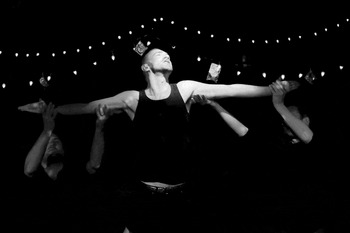
Bringing this argument to the UK, while some performance artists have insistently kept HIV/AIDS on the agenda in non-mainstream venues – such as David Hoyle at the Royal Vauxhall Tavern in London – in a non-urban, conservative environment such as Northern Ireland this type of subcultural performance is extremely rare, compounding a lack of mainstream, or even fringe, theatre representation of gay subjectivities (of any kind).Footnote 59 In 2007 the OUTburst Queer Arts Festival in Belfast was established precisely in response to this absence, not only in theatre but across art forms.Footnote 60 Deciding to stage Australian playwright Lachlan Philpott's Bison in Northern Ireland as the main theatre performance of OUTburst 2009 was a direct response, then, to the absence of a plurality of gay subjectivities on the Northern Irish stage (see Fig. 1). However, more specifically, it was galvanized by the public assertions of elected Democratic Unionist Party (DUP) politician Iris Robinson that, according to the teachings of her church, homosexuality is an ‘abomination’ and that homosexuals should avail themselves of her ‘lovely psychiatrist’ to help them ‘turn away from what they are engaged in’.Footnote 61 What is less publicly sensational, but became clear while the play was being worked on, is that there has been a political failure of the power-sharing executive of the devolved legislature of Northern Ireland to deal with the issue of HIV/AIDS. While the latest statistics from the Public Health Agency document that ‘the number of people in Northern Ireland living with HIV has quadrupled over the past decade’, there has been little public discussion of HIV/AIDS, whether in political, social or cultural fields.Footnote 62 In a sense, Northern Ireland does not have the history of crisis that has permeated the HIV/AIDS narratives of urban, particularly US, sites. Here there is not so much a ‘forgetting’ of a generation that was decimated, but a general lack of ever coming to terms with the pandemic in any cultural or legislative way. Northern Ireland is an extremely conservative society where politics is overwhelmingly driven by religious affiliation. The statistics on homophobia illustrate this conservatism powerfully, with 23 per cent of people confirming in a 2008 poll for the Equality Commission for Northern Ireland that they ‘would have a problem with a gay, lesbian or bisexual person’.Footnote 63 This context was the backdrop for the Belfast production of Bison, and it is fair to say that, as with Reza, rage played a part in its genesis.
Publicity image for Lachlan Philpott's Bison at Queen's University Belfast and Oval House Theatre London. Photo courtesy of Daniel Holfeld.

I had directed Bison with the playwright in its first incarnation in 2000 (Melbourne, Australia) and, true to Román's chronology of AIDS discourses, the first version was definitely ‘not-about-AIDS’. Autobiographical, and written in the wake of the end of Philpott's first serious relationship, it conveyed a highly personal experience of the anonymity of gay male sex and the desire for love and fulfilment. Having worked with Philpott since 2000, I had sometimes wondered if the work remained textually beautiful – full of the most stunning metaphors, similes, rhythms and alliteration – but somehow shirking political engagement. The original version of Bison engaged poignantly and humorously with the herd-like repetitions and patterns of gay male experience by way of a central protagonist's attempts to negotiate this, without straying into any overtly socially political stance. However, when he came to rewrite the play for 2009, Philpott noted five major areas he wanted to explore, given the changes he perceived in gay lifestyle over the decade: ‘the racism and ageism of the subculture’, ‘the shift imposed by technology and virtual sex’, ‘the culture of not committing’, the ‘generic nature of the global gay scene’ and, most prominently, the ‘forgetting that has occurred about HIV’:
Out of sight out of mind it seems and so everyone goes and fucks bareback and thinks it's ok . . . My feeling is that it is like some huge unspoken suicide mission of the next generation because common sense has been thrown aside for a hedonistic lifestyle and the assumption that PEP will save them and if that doesn't work it hardly matters anyway cause nobody gets ugly lesions and dies from it now anyway.Footnote 64
Echoing Signorile, Philpott is adamant that, amongst the younger gay demographic, HIV/AIDS is regarded with a dangerous, collective amnesia that runs counter to the actual rates of HIV infection in Western societies.Footnote 65 The figure of young, newly ‘out’ Jason personifies this forgetfulness in Bison when, in a conversational exchange with an older man, he ‘samples the word [AIDS] . . . like he's trying to recollect some fact from his History GCSE exam’.Footnote 66 The current script of Bison attempts to represent the complex subjectivities Tomso delineates in terms of unsafe sex, risk and pleasure, while not underestimating that there are whole sets of problems to do with ‘identifying, representing and treating the human subjects of HIV/AIDS’.Footnote 67 This is addressed through Philpott's complex, non-linear dramaturgy that, although aesthetically very different from Abdoh's, shares a queer resistance to fixing identity. Thus while there are four named ‘characters’, who are each embodied by a different member of the cast and sometimes have straightforward dialogue with another figure or deliver monologues in that role, the performers spend more time functioning as a chorus, or as other figures who populate this ‘gaytown’, or verbally describing the scene unfolding in what I have called Philpott's ‘scene-setting voice’.Footnote 68 This plurality and fluidity of ‘roles’ resists ‘mainstream attempts to fix and render transparent the identity of the person with [HIV]/AIDS’.Footnote 69 Aesthetically, rather than simultaneity and assaultive overload, Philpott's emphasis falls on the affective impact of the materiality of language, and his strength is in the orchestration of voices and wordplay. In staging, this linguistic corporeality tests the materiality of the stage, forcing the creation of an open, unfixed space that can move with the same fluidity and pace as the spoken words. Described ‘scenes’ do not need to be duplicated visually; what they do need is to appear and disappear in an instant with just a change of light, or a particular placement onstage, or a gesture to indicate that suddenly we are somewhere new.
Within this labile structure, Tomso's call for ‘a renewed attention to sexual subjectivity vis-à-vis HIV/AIDS’ is embodied in the figure of Simon.Footnote 70 Despite Philpott's clear personal frustration at practices of unsafe sex (coming as he does from that middle generation that Junge identifies as growing up with the safe-sex message), he creates in Simon a complex picture of gay male sexual desire and subjectivity. This is conveyed in the imagery of Simon walking a metaphorical tightrope of unsafe sex in a ‘Pornoland’ circus of gay porn and ready sex (see Fig. 2):
S: Let's go somewhere?
3: Where?
S: Somewhere we can go a bit further. You know what I want to do?
3: You Poz?/
2: It's show time in the big top!/
3: You're poz right?
4: a syringe and a mask a hose and a slap/
S: Poz. Are you?/
2: a big wide smile like an animal trap/
3: Yeah.
2: Go on, go/
4: Give it all up and go/
S: What you into?
3: No holes barred action?
2/4/S: Yeah/
2: Because in this moment/
4: At this moment you don't want anything else/
2: Veer away run wild. All you want/
2/4: GO.
3: You fuck raw, right?
S: At the top of the tent, the wire shines in the light. Drummer picks up his sticks. All the men stop. One by one they turn they look up they see me, arse gapes cock drips balls throb hearts thump/ready set go.
2/3/4: ready set go.Footnote 71
In this extract we see the complicated structure of Philpott's dramaturgy: on one level there is the dialogue in ‘real time’ between two men (S and 3). However, this is intercut with voices (2 and 4) narrating both Simon's internal desire and setting his imaginary scene using the metaphor of the tightrope walker that has been set up. This creates a dramaturgy of suspension, or delay: it stalls moments and stretches them out. Affectively, this moment works in performance by building up layers of voice through overlapping and chorus, supported by visual and sonic realization of the metaphor with lighting, movement and the sound of drumming. As with Abdoh's work, this resists the more clearly emotional or empathetic device of a realist dialogue, the usual dramaturgical architecture of ‘political theatre’; like Abdoh's, the politics is in the experience of that moment in the theatre.
Simon, in Bison, goes to ‘Pornoland’, a fantasy world of ready gay sex. Jonny McMillen-Patterson, Christopher Sutton and Miche Doherty. Photo courtesy of Ludovic Des Cognets and Oval House Theatre.

Simon's monologue is the most confrontational scene in the play, dealing with his desires for violent, risky sex and his disregard for the consequences of this sex:
Things crashing but I don't feel them things crashing but when they smash I can't feel them hit my skin. The blood looks pretty as it drips in a puddle on the floor below and finally I make you pull it out and stand up dizzy that puddle of blood pretty as if it's what? That blood dripping from inside me. What? As if it's what?
This is as far as we have gone.
But we keep going. You keep pushing gently but with force you know what you want and I want it too you keep shoving things up my nose inside my arse you keep pushing me and I keep shouting yes push me push me harder and I want it and I don't want it and I want to burst right there and shower over the floor and have you pick me up and glue the fragile little pieces back together I want to burst and fall all over the floor and scatter and get left as you go find someone else to break.Footnote 72
Perhaps this sexual subjectivity makes such an impact in performance because, in portraying a desire for dangerous sex, Simon embodies onstage the lack of ‘rationality’ that Tomso indicates in the complexity of identifying a single universal HIV/AIDS subjectivity. It raises questions in individual spectators about moral judgements and ethical concerns, placing the ideologies of public discourses of HIV/AIDS governance into stark relief. It highlights the very potent and ambivalent feelings about ‘personal responsibility’ that both the playwright and, I assume, members of the audience share. Simon's long, graphic monologue also exemplifies Tomso's insistence on ‘being heard as we express our ongoing struggles with loss and survival, even if – especially if – what we have to say strikes others as repugnant or distasteful’.Footnote 73 In light of Tomso's problematizing of ‘knee-jerk condemnations of barebacking [which] frequently stem from traditional, behaviorist approaches to HIV prevention’, as a director I was wary of demonizing either Simon or barebacking per se, and was aware that the smallest choices in the delivery of the monologue and its staging could work to limit or open up interpretation.Footnote 74 If the monologue overwhelmingly produces pity, for example, this undermines the exploration of those ethical questions Tomso urges artists to engage with. A queer dramaturgy will always seek to leave room for ambivalence. Simon, and in different ways the other figures in Bison, do not fill the neoliberal profile, or reproduce representations, of the desirable, commercially viable gay. In a period when homonormativity is inscribed as liberatory strategy, Philpott critiques notions of a homogeneous, unitary gay male sexuality/subjectivity, and offers, ultimately, a ‘queerworld’ in which the subjectivities staged are imperfect, multiple, conflicted and endlessly shifting.Footnote 75 As in Abdoh's stageworld, HIV/AIDS is part of gay experience and the play insists that we do not separate the two.
To conclude
If, in the moment of Bogeyman, Abdoh refused to ‘degay’ HIV/AIDS, with Bison Philpott ‘re-gays’ HIV/AIDS discourses by suggesting to contemporary audiences that HIV/AIDS is not separate from gay experience, no matter how necessary it once was to provide this separation. Philpott assumes that theatre can provoke a more complex discussion than the whiting-out of sexual subjectivities that fall outside the hetero-/homonormative matrix and, in doing so, responds to Tomso's plea for new cultural provocations in a post-post-AIDS economy. Not to do so is to be complicit in creating another generation living the lie that AIDS is ‘history’. If he struggles with a younger generation's forgetfulness of HIV/AIDS and its legacies, Philpott's queer dramaturgical strategies, like Abdoh's, ensure that he does not offer ‘solutions’ in the form of an idealized – fixed (in both senses) – gay masculinity. While it seems somehow contradictory to want to raise awareness of the presence and dangers of HIV/AIDS and yet stage ambiguous sexual subjectivities, it is imperative to avoid the same old representational economies of good gays and bad queers. Philpott's updated version of Bison is angrier, more clearly political in thrust, yet retains the elliptical and fluid style that is as much a part of its ‘doing theatre in a political way’ as Abdoh's assaultive dramaturgy. With his own queer dramaturgy, Philpott is able to reignite Abdoh's cause and bring an unsettling but urgently timely reimagining of gay subjectivities onto the stage.