INTRODUCTION
Recent analyses of longitudinal micro data have found that real wages are much more procyclical than they appear in aggregate time series data.1
Early studies by Raisian (1979) and Stockman (1983) point out that aggregated time series on real wages are countercyclically biased by their tendency to weight low-skilled workers more heavily in expansions than in recessions. Solon et al. (1994) rigorously demonstrate how important this composition bias is. The latter study also presents a detailed summary of the time series evidence and a nice discussion of how this time series evidence has influenced macroeconomic theory.
See Azariadis (1975) and Baily (1974) among others for the theoretical underpinnings of the implicit contract theory.
An early work by Okun (1973) explains the large wage procyclicality among job changers based on interindustry wage differentials and cyclical upgrading of labor.
However, recent empirical findings suggest that even the wages of job stayers are procyclical, although they are less so than those of movers. For example, on the basis of the Panel Study of Income Dynamics (PSID) for men in the period from 1968–1969 to 1986–1987, Solon, Barsky, and Parker (henceforth SBP, 1994) found that a one-percentage-point reduction of the unemployment rate leads to a rise in the real wage rate of stayers by 1.2%. Similar estimates are found in Bowlus (1993), Shin (1994), and Devereux (2001).
The primary goal of this paper is to explain why real wages are procyclical even for job stayers. In fact, despite the repeated findings, little study has been conducted to account for this.4
Two papers are related to the current issue. First, using personnel records from the companies Ford and Byers, Solon et al. (1997) found some supporting evidence for the old hypothesis that a portion of firms' cyclical adjustment of labor costs is achieved not by changing the wages paid in particular jobs, but by changing the quality of labor assigned to those jobs. Second, Devereux (2001) found that the wage procyclicality within employer–employee matches is driven mostly by those who receive incentive-based pay, such as piece-rate pay, overtime, or commissions, and that the hourly wage rates from hourly and salaried workers are not responsive to the business cycle.
At first, the finding of substantial wage procyclicality among stayers seems at odds with the theoretical prediction of implicit contracts, as risk-averse workers prefer complete wage smoothing, to be shielded from productivity shocks. This paper, however, finds that a reinterpretation of BD's modified implicit contract model implies the procyclicality of job stayers' wages in a way consistent with the data. BD demonstrated that, once the conventional implicit contract theory is enriched to encompass free labor mobility across jobs, wages need to be renegotiated upward whenever economic conditions improve sufficiently enough to prevent the worker from being bid away by other firms. Hence wages are procyclical only for this specific period, which we later call a renegotiation period. However, because the primary focus of BD's empirical work is on developing testable hypotheses of implicit contract models based on the link between wages and past labor market conditions, we believe that the nature of the procyclicality of the stayers' wages has not been explicitly uncovered even in their work.
A seemingly puzzling aspect of these recent studies lies in their conclusions. Whereas BD conclude that current wages are primarily determined by the minimum unemployment rate, SBP find that current wages are strongly correlated with contemporaneous unemployment rates. We observe that this happened because of the different methodologies adopted by the two sets of empirical studies. Whereas empirical evidence of the procyclicality of stayers' wages focuses on the relationship between current wages and current unemployment rates, BD's test procedure is based on the link between current wages and past as well as current labor market conditions. To be specific, BD regressed the wage rate on the unemployment rate at the starting point of the current tenure, the minimum unemployment rate observed since the start of the current tenure, and the current unemployment rate and found that only the minimum rate is significant. Our strategy is, therefore, to develop a test procedure equivalent to the BD's test procedure but using only the current unemployment rate. This is a necessary step toward bridging the two sets of studies and thereby explaining the puzzle, which in turn allows us to understand why the wages of job stayers are procyclical. In addition, as will be shown in Section 2, our newly developed procedure is more robust than BD's even for the purpose of obtaining BD's results.
Our test procedure essentially divides the entire period of each individual's job stay into three phases: (1) the recession period, (2) the expansion period without renegotiation, and (3) the expansion period with renegotiation, and checks the degree of procyclicality in each phase. The recession period corresponds to the period when the unemployment rate increases. Although the second and the third phases have in common that the unemployment rate decreases, the latter distinguishes itself from the former by the fact that the unemployment rate in this phase reaches the historical minimum level from the start of the current tenure. The third period is particularly called the “renegotiation period.” Because the minimum unemployment rate since the start is equivalent to the current rate only in the renegotiation period, if BD's argument is correct, the wage rate should be adjusted and hence be procyclical during this period only and acylical otherwise. On the other hand, if an implicit contract model with costly mobility is dominant, wages since the start of the current job should be acyclical, implying no correlation of wages and contemporaneous unemployment rates. Finally, if wages are primarily determined on the standard spot market, then the correlation between current wages and contemporaneous unemployment rates is expected to be as great for the period when wages are not renegotiated as for the renegotiation period. Hence BD's model is equivalently tested by focusing on the different nature of procyclicality in each of the three phases.
When the sample period is extended to 1974–1991, which includes one more business cycle than the sample period considered by SBP or BD, we replicate their results almost identically. For example, wages of stayers are found to be quite procyclical. BD's estimation results are also confirmed. Further, we find that the wage adjustments of stayers are not uniform over the course of the entire job tenure. The wage adjustments are much higher when the unemployment rate is decreasing (the expansion period) than when the unemployment rate is increasing (the recession period). Whereas most studies find asymmetric adjustments of nominal wages over the business cycle, our results indicate that this is also true for real wages. Most importantly, we find that wage adjustments are not uniform even in the expansion period but are actually concentrated in a special phase of the expansion period, called the period of renegotiation. In contrast, wages are not adjusted much even when the unemployment rate decreases as long as it does not dip below the historical minimum. In short, stayers' substantial wage procyclicality, as well as asymmetric adjustments of real wages, is mostly accounted for by great wage adjustments during the renegotiation period, as implied by the costless mobility version of implicit contracts suggested by BD.
This paper is organized as follows. Section 2 develops an alternative test procedure that is identical to BD's test procedure but uses only the contemporaneous unemployment rate. Section 3 explains data used in our analyses. Section 4 reports our main empirical results. We state our major conclusions in Section 5.
TEST PROCEDURE
Beaudry and DiNardo (1991) modified Harris and Holmstrom's (1982) theory to develop testable hypotheses for implicit contract models based on the link between wages and past labor market conditions. According to BD, if mobility is costless, contractual wage payments depend on the most favorable labor market condition observed since one has begun one's job. This implies that the wage rate of an individual should depend on the minimum unemployment rate in his or her entire job tenure. In contrast, if mobility is costly, contractual wage payments should be fixed for his or her entire job tenure. In this case the wage rate of an individual should depend upon the unemployment rate at the start of his or her current job. Finally, if wages are determined on the spot market, wages should depend on the current labor market conditions. In testing these hypotheses, BD augmented the standard Mincerian wage function by including the starting unemployment rate at the start of a job, the minimum unemployment rate observed since the start, and the current unemployment rate and examined the significance of these variables. More specifically, the equation they estimated is

where Wit is the ratio of the nominal wage of individual i in year t to the Consumer Price Index (CPI) in that year,5
We have also tested the GDP deflator and found little difference in the conclusion.
Of course, when OLS is applied to equation (1), unobservable time-invariant variables are not controlled for.
It is worth noting that their measures of the starting and the minimum unemployment rate are critically dependent on the duration of the current tenure. As emphasized by McDonald and Worswick (1999), an incorrect measurement of tenure is directly translated into an incorrect measurement of the minimum unemployment rate as well as of the starting unemployment rate. As already pointed out by many researchers, tenure responses for the PSID and the National Longitudinal Survey (NLS) data are often inconsistent with calendar time.7
For example, Topel (1991) reports that, in the recorded tenure data for the period 1968–1983 of PSID white males, the year-to-year changes in job tenure range from −31 to 7.5 years, and measured tenure declines between years of a job in 3.8% of all cases. Our calculations show that, in the recorded tenure data for the period 1975–1991 of PSID men, a little over 20% of all job spells have an initial reported tenure of “more than 14 months.” All these figures suggest that (1) extreme care should be taken when using these error-ridden tenure variables and (2) other test procedures that are not critically dependent upon the duration of tenure are desirable.To overcome these difficulties and, more importantly, to make our estimates comparable to estimates of the stayers' wage procyclicality, we use the following alternative test procedure, which depends only on the contemporaneous unemployment rate. If, as concluded by BD, an implicit contract with costless mobility governs the relationship between wages and past labor market conditions, wages should be adjusted to the contemporaneous unemployment rate whenever it goes below the historical minimum unemployment rate since the start of the current tenure. This is the period when renegotiation takes place under BD's theory. Note that this renegotiation period is defined differently across individuals depending on the starting point of the current tenure, and that the unemployment rate is monotonically decreasing over the “individual-specific” renegotiation period. If BD's conclusion is valid, the partial correlation of wages and contemporaneous unemployment rates would be high for this renegotiation period, but not for the rest of the period. On the other hand, if an implicit contract model with costly mobility is dominant, wages since the start of the current job will be acyclical, implying no correlation of wages and contemporaneous unemployment rates. To put it conversely, the stayers' wage procyclicality itself rejects the hypothesis of an implicit contract with costly mobility. Finally, if wages are primarily determined on the standard spot market, then the correlation is expected to be as great for the period when wages are not renegotiated as for the renegotiation period.
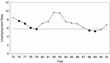
Figure 1 illustrates these points. Suppose a person has a job as of 1991, which began in 1975. The BD model implies that, in each year for the period 1976–1979, wages are renegotiated as the unemployment rate is historically lowered. This happens because employers want to retain quality workers in cyclical upturns. Renegotiations do not take place as the unemployment rate goes up for the period 1980–1982. The BD-specific feature of implicit contracts is that renegotiation does not take place even when the unemployment rate goes down, as long as it is not lowered below the historical minimum level. This corresponds to the period 1983–1987. In 1988, as the unemployment rate goes below the 1979 level, they revise the old “contract,” and they do it again in 1989. As the labor market starts to deteriorate in 1990, wages are set at the 1989 level. Therefore, we consider three sample subperiods: the entire sample period since the start of the current job, the subperiod when renegotiations take place (marked by large squares), and the subperiod when renegotiations do not take place. Then, for each subsample period, we estimate the correlation of real wages and contemporaneous unemployment rates. What we want to measure for each subsample period is the direction and the magnitude of composition-corrected and detrended mean wage changes associated with one unit change in the unemployment rate.
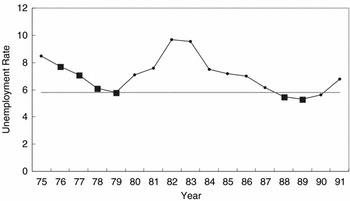
Renegotiations take place whenever the unemployment rate reaches a historical minimum level from the start of a job.
If wages are determined on the spot market, they are procyclical for the entire sample period since the start of a job, and wage adjustments are as great for the nonnegotiation period as for the renegotiation period. If an implicit contract with costly mobility explains the data, wages will be noncyclical for the entire period since the start of a job. Finally, if an implicit contract with costless mobility describes the data, large upward wage adjustments will be made for the renegotiation period, not for the other. Note that, if the last hypothesis is true, little wage adjustment takes place even for the period of falling unemployment as long as the rate does not reach the historical minimum.
Compared with BD's, our test results are expected to be less sensitive to incorrect measurement of tenure. In our test procedure, incorrect measurement of tenure changes subsample periods slightly, with relatively little change in the mean wage adjustment within each subsample period. For example, in Figure 1, if the start of the current tenure is incorrectly recorded as either 1976 or 1977, the period 1988–1989 is still considered as part of the negotiation period and just a few periods around the start of the tenure are excluded. In contrast, as previously mentioned, mismeasurement of tenure always affects the starting unemployment rate and possibly the minimum unemployment rate as well. Measurement errors in the starting and the minimum rates generally attenuate the corresponding estimated coefficients.
To estimate wage cyclicality for stayers, we estimate the augmented Mincerian wage function

where Wit is again the ratio of the nominal wage of individual i in year t to the Consumer Price Index (CPI) in that year. Work experience EXit is measured simply as the number of years since individual i completed schooling. Zi is a vector of individual-specific, but time-independent, characteristics such as years of schooling, race, gender, ability, and motivation. URt is the civilian unemployment rate in year t and is used as a cycle indicator. Both individuals' wages and the unemployment rate are expressed as deviations from quadratic time trends to focus on cyclical components of the two variables. Equation (2) is precisely the same specification used by SBP (1994) and many other longitudinal studies that investigate the cyclicality of real wages.
First-differencing equation (2) eliminates observable and unobservable characteristics, Zi,

where β1=γ2−γ3+γ4−γ5, β2=2γ3, and β3=2γ5. β4=γ7 is greater than, equal to, or less than zero as real wages are countercyclical, noncyclical, or procyclical.
Applying OLS to equation (3) produces inefficient estimates of β coefficients. The differenced error term is cross-sectionally correlated, because different workers share common time effects. Usual standard error estimators are biased downward by neglecting this effect. Moreover, the differenced error term may be serially correlated. To correct this, we apply a two-step estimation procedure that has been adopted by SBP (1994) and Shin (1994) among others. In the first step, we apply OLS to the regression of the logarithm of real wage growth on experience and a vector of year dummies. In the second step, we apply generalized least squares (GLS) to the regression of the estimated year effects on a time trend and changes in the unemployment rate. As proved by Amemiya (1978), the two-step estimator that corrects for the nonsphericality of the second-stage error term is identical to the GLS estimator applied to the first-differenced equation in a single stage. We use this two-step method in estimating the cyclicality of stayers' wages.
For the purpose of estimating the correlation of real wages and contemporaneous unemployment rates for various subsample periods previously defined, we modify the above two-step procedures. In the first step, we apply OLS to the regression of the logarithm of real wage growth on experience and vectors of year dummies for those subsample periods. In the second step, we apply a system of seemingly unrelated regressions with the coefficients on the intercept and the time trend restricted to be equal across equations. We correct for serial correlation within each equation. The unemployment coefficient of each equation represents the composition-corrected and detrended mean wage change for each subsample period that the equation stands for associated with one unit change in the unemployment rate. For the sake of simplicity, estimated coefficients only on the unemployment rate are reported and discussed.
DATA
We choose to use the PSID data for the following reasons. First, as noted by many researchers, tenure responses from survey-based data are often inconsistent with calendar time. Therefore, it is essential to make tenure series internally consistent at least within job duration using longitudinal surveys such as the PSID. Second, among existing longitudinal surveys, the PSID is preferable to the NLS mainly because the former represents the entire working age population better than the latter. Third, because BD and many existing empirical studies on stayers' wage procyclicality used the PSID, we use the same data set to avoid any possible outcome that may result from using different samples.
We do not use data prior to 1975 because tenure has been recorded as a continuous measure only since 1975. The tenure variable needs to be continuous because we need to know the starting point of a current job in order to divide the entire period of stay with the same employer into various subperiods. As in most studies in this literature, we focus on men and exclude the self-employed because they are less likely to be affected by implicit contracts. To check the robustness of the results, we also test an extended data set with female heads included. However, we do not use data for wives because the self-employed cannot be excluded until 1979.
Like BD, we work with the average hourly earnings variable, which is computed as the ratio of total earnings from all labor income sources for the preceding calendar year to annual hours worked in that year. Therefore, the data from the 1976–1992 interviews include labor income and hour measures for 1975–1991.8
We use 1974 data only for the purpose of obtaining data on 1974–1975 wage changes.
Numerous algorithms have been developed by Altonji and Shakotko (1987), Topel (1991), Altonji and Williams (1992), Brown and Light (1992), and Altonji and Devereux (2000) to generate internally consistent tenure variables. Our method is very close to those of Altonji and Williams (1992) and Altonji and Devereux (2000).9
We also tried the method adopted by Beaudry and DiNardo (1991) and the ‘Partition P’ method developed by Brown and Light (1992). Although different tenure-generating algorithms produce somewhat different tenure levels, the current conclusions are robust to these exercises. Our conclusions still preserve even when reported tenure variables are used.
See Altonji and Williams (1992) for generating weights.
The fourth step is not applicable to jobs that were in progress as of 1975, the first year of our sample period, because we cannot determine the starting point of a job spell following the first step. For these “left-censored” jobs, we apply the same procedure up to the third step.11
At least three yearly observations are required to calculate the weighted average.
If the predicted starting point of a job is before 1968, the first year of PSID surveys, we assume an equal interval of 12 months between interviews.
EMPIRICAL FINDINGS
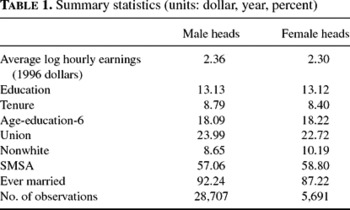
Table 1 reports sample means of selected variables. In general, our sample means are somewhat different from those of BD (Table 1, p. 673, 1991) and very similar to those of Devereux (Table A1, p. 849, 2001). The latter two tables are based on PSID male heads for 1976–1984 and 1971–1991, respectively, in comparison with our sample of PSID male heads for the period 1975–1991. The differences between our sample means (or Devereux's) and BD's are largely attributed to the fact that, whereas BD included the SEO sample in their analyses, the current study and the Devereux's use only the SRC random sample.

Female heads constitute approximately 19.8% of the entire sample of heads; they have lower wages, tenure, union membership rate, and proportion of marriage experience. There is no gender difference in educational level. Therefore, the greater level of potential experience for women indicates that women are on average older than men in our sample, which in turn implies that the tenure gap between genders would be greater if the age difference between genders were controlled for. As will be demonstrated in subsequent Sections, however, our conclusions hold whether or not female heads are included in the sample.
The average tenure on the current job, which is the most important variable, because the starting and the minimum unemployment rates are critically dependent on it, is 8.79 years in our sample of male heads. This figure is somewhat greater than BD's estimate (6.92 years with the SEO included), but smaller than those of Topel (1991: 9.98 years) and Devereux (2001: 10.11 years). The difference in average tenure between our sample and BD's leads us to check first whether BD's results hold even in our extended sample period, which includes one more business cycle than the sample period considered by BD.
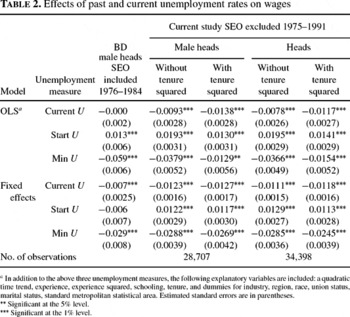
Table 2 reports estimated coefficients of various unemployment variables in equation (1) and compares them with BD's. For the sake of simplicity, we present only the estimated coefficients of three unemployment measures, the starting, the minimum, and the contemporaneous unemployment rate. Comparing the numbers in the first two columns reveals that BD's estimates are successfully replicated. Most importantly, for both the OLS and fixed-effects estimates, the minimum unemployment rate variable clearly dominates the other two variables in both studies.13
A trend variable is not included in the BD's specification. At first, we suspected that the effects of the minimum unemployment rate on wages might be overstated due to this omission. The reason is as follows. For the period 1947–1984, the local minimum unemployment rate as well as the overall unemployment rate has been increasing. Therefore, the elapsed time since the minimum rate is negatively correlated with the minimum rate. Because wages grow over time, omitting the variable, the elapsed time since the minimum, would exaggerate the effect of the minimum rate. However, omitting the trend variable purposefully in our specification makes little difference due to the weak correlation of the minimum rate and the elapsed time since the minimum rate.
When we restrict our sample to the period 1976–1984 as in BD, the replication is almost exact in terms of magnitudes of estimated coefficients and their statistical significance. To summarize, as in the extended period, the minimum unemployment rate clearly dominates the other two variables in explaining the current wage rate. Moreover, as in BD, although the estimated coefficient on the contemporaneous unemployment rate is virtually zero and is imprecise from OLS, the estimate from the fixed-effects model is a small negative number and statistically significant. Finally, the coefficient on the starting unemployment rate is positive and significant from OLS, but insignificant from the fixed-effects model. Inclusion or exclusion of the SEO sample does not change any of the results, which is also noted by BD.

We suspect that the large negative coefficient of the minimum unemployment rate may be due to nonlinearities in the effect of tenure. Especially if the effect of tenure on the wage rate is intensified when the unemployment rate is very low, BD's results can be obtained. As an easy way to check this possibility, we include squared tenure as an additional regressor and reestimate equation (1). The results are reported in the third and fifth columns of Table 2. The addition of the squared tenure variable has different effects depending on the econometrics model adopted. In OLS, the role of the minimum unemployment rate is dramatically reduced when squared tenure is included. For example, for the male heads, the estimated coefficient on the minimum rate is reduced from 0.0379 to 0.0129 in absolute value. OLS estimates seem to suggest that the large coefficient on the minimum unemployment rate in Beaudry and DiNardo's results was at least partly picking up nonlinearities in the effect of tenure. However, when we use the fixed-effects model, the effect becomes more or less negligible. For male heads, the estimated coefficient is reduced in absolute value from 0.0288 to 0.0269. Therefore, once unobservable individual fixed effects are controlled for, the nonlinearities in the effect of tenure observed on the OLS estimates are no longer important in explaining the large negative effect of the minimum unemployment rate on wages. Overall, BD's conclusion that the minimum unemployment rate is dominant in explaining current wages is still preserved even in our extended sample with more recent years and female heads.
Are Real Wages Procyclical among Job Stayers?
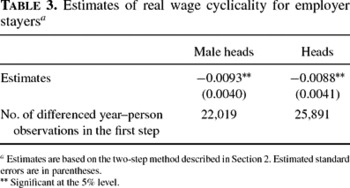
On the basis of equation (3), this section investigates whether our extended sample produces substantial wage procyclicality among job stayers as well. The results are reported in Table 3. For the period from 1974–1975 to 1990–1991, the estimate turns out to be −0.0093 for male heads, which is statistically significant at the 5% level. This implies that a one-percentage-point increase in the unemployment rate reduces stayers' real wages by 0.93%. When female heads are included in the sample, the estimate falls slightly to −0.0088. This reflects the fact that real wages are less procyclical for women than men.15

Comparison of our estimates with those of existing studies is in order. At first, our estimate of −0.0093 seems to be smaller than SBP's estimate in absolute value. Using the PSID male heads for the period from 1968–1969 to 1986–1987, SBP estimated the stayers' wage procyclicality as −0.0124. The gap between our estimate and SBP's is explained by, among other factors, the following two. First of all, our sample period covers only part of the 1970s, whereas SBP's sample period is dominated by the 1970s. This tendency is mentioned by Kniesner and Goldsmith (1987, p. 1257), among others. Extending the sample to the period from 1970–1971 to 1990–1991 increases the estimate up to −0.0107 with an estimated standard error of 0.0024. Second, SBP included self-employed stayers in their sample, whereas our sample does not. As observed by Carrington et al. (1996), among others, hourly wages are much more procyclical for the self-employed than for “wage and salary” workers. In fact, including self-employed stayers in the above extended sample period increases the estimated procycliclaity further to −0.0121 with estimated standard error 0.0029, which is virtually identical to SBP's estimate. Our estimate of −0.0107 for the period from 1970–1971 to 1990–1991 is slightly greater than Devereux's estimate of −0.0081, which is also based on the PSID male heads who are not self-employed for the same sample period, and Shin's estimate of −0.0095, which is obtained from the NLS young men data for the period from 1966–1967 to 1980–1981.16
On the basis of the NLSY data for the period from1978–1979 to 1996–1997, we redo the above analyses and find that estimated wage procyclicality for stayers is −0.0114 (s.e. = 0.0051) for males and −0.0037 (s.e. = 0.0043) for females.
Asymmetric Effects of Unemployment on Wages
Although Section 4.1 confirms the previously established finding that stayers' real wages are procyclical, we believe that the conventional approach has a major drawback. The conventional approach implicitly assumes that composition-corrected mean wage changes following a one-point change in the unemployment rate are uniform during the entire period of a job tenure. However, as suggested in Section 2, the two versions of the implicit contract model and the spot market model can be distinguished from each other by different degrees of wage adjustment for different subsample periods. However, before we further investigate this important implication of the models, we first examine if the wage adjustment is asymmetric in expansions and recessions. This is needed because there is a long tradition of Keynesian economics that asserts that the nominal wage is downwardly rigid, and there is a possibility that this is also true for the real wages of stayers.17
For recent empirical studies on nominal wage rigidity, see McLaughlin (1994) and Card and Hyslop (1997).
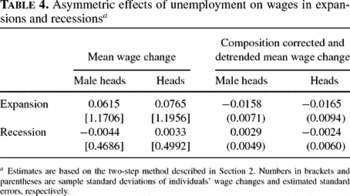
Before running regressions based on equation (3), we can do the following simple exercise to get a flavor of asymmetry. A real wage change for an individual (in logarithm) is divided by a corresponding change in the unemployment rate. Then the cycle-adjusted wage changes are averaged over individuals and years for the expansion and for the recession period. These figures present roughly how wage adjustments to a unit change in the unemployment rate differ between expansions and recessions, although they are contaminated by differences in worker composition between the two sample periods and by secular components of wage growth. They are reported in the first two columns of Table 4. Two interesting patterns emerge. First, among male heads, wage growth in expansions (0.0615) is much greater than wage reduction in recessions (−0.0044). Second, the standard deviation of wage changes is much greater in expansions (1.1706) than in recessions (0.4686). These findings seem to suggest that there may be downward rigidity even in real wages. The gap in mean wage changes between expansions and recessions becomes greater when female heads are included in the sample.

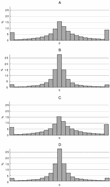
To see these points more clearly, Figures 2A through 2D display percent distributions of real wage changes in expansions and recessions, respectively. Figures 2A and 2B correspond to male heads, whereas Figures 2C and 2D include female heads. Each cell width is 0.09, and tails of the distribution are massed at the extremes. The latter allows a better view of the intermediate categories. First, comparison of the first two figures reveals that the sample proportion of wage increases in expansions is greater than the proportion of wage decreases in recessions. In fact, the distribution is quite skewed to the right in expansions, but is more or less symmetric in recessions, implying that adjustments in wages are on the average made in expansions only. Second, the sample proportion of “relatively negligible wage changes,” that is, wage changes between −0.045 and 0.045, is 15.6% in expansions but 27.9% in recessions. These findings imply that, for a given change in unemployment, wage changes are more sizable in expansions than recessions. To put it another way, there seems to be downward rigidity even in real wages. The same patterns are observed even when female heads are included, as demonstrated in Figures 2C and 2D.

Distribution of real wage changes for male heads in expansions (A) and recessions (B) and forheads in expansions (C) and recessions (D).
Now we investigate more formally the possibility of asymmetry based on equation (3) by including expansion and recession dummies and their interaction terms with the unemployment rate. The results are reported in the third and fourth columns of Table 4. Unlike the figures in the first and the second columns, these numbers represent mean wage changes for a unit change in the unemployment rate obtained by controlling for cyclical changes in worker composition and secular components of wages. For the sample of male heads, the estimated wage change in expansions is −0.0158 and that in recessions is 0.0029, which clearly shows that there is strong evidence of asymmetrical wage adjustment. Corresponding numbers for the sample of heads are −0.0165 and −0.0024 in expansions and in recessions, respectively. In short, asymmetry of wage adjustment is still preserved even when we focus on the cyclical components of wages and control for unobservable as well as observable individual characteristics. This finding is consistent with Hines et al.'s (2001) finding that the impact of a given unemployment change on real hourly wages is larger in expansions than in recessions.18
Their CPS-based analyses for the period 1976–1999 period report comparable estimates as −0.0057 and −0.0020 for expansions and recessions respectively, with respective standard errors 0.0022 and 0.0028. For hours and total earnings, however, the impact of a change in unemployment rates is larger in recessions.
The finding of little real wages adjustment in recessions may surprise some because there is a common notion that wages are adjusted downward when the recession is severe, as in 1982. It should be noted, however, that the current conclusion is based only on job stayers. In fact, as noted by Barlevy (2001), a significant portion of the decrease in aggregate wages in recessions comes from wage losses among workers changing into lower-wage jobs.19
Bleakley et al. (1999), among others, report that worker flows into unemployment and into employment are simultaneously high (particularly in manufacturing) in severe recessions, as in 1982. Moreover, as concluded by Ruhm (1991) and Jacobson et al. (1993), displaced workers suffer from long-term earnings losses.
Why Are Wages So Greatly Adjusted during Expansions?
In Section 4.2, we have found that stayers' real wages are procyclical mainly due to significant wage adjustment in expansions. As noted in Section 2, however, the implicit contract model with costless mobility can be entirely consistent with the findings in Section 4.2 as well as with an overall procyclicality estimate of stayers' real wages. In addition, the implicit contract model with costless mobility holds another important implication that distinguishes it from the implicit contract model with costly mobility, the spot market model, as well as the downward rigidity model. According to the implicit contract model with costless mobility, large upward wage adjustments are to be concentrated in the renegotiation period, which is a subsample period of expansions. In other words, wages are adjusted when and only when the unemployment rate records the historical minimum level. This peculiar pattern of real wage adjustments can create a fair degree of wage procyclicality for the entire period of staying with the same employer and, at the same time, some degree of asymmetry of wage adjustments. The purpose of this section is to examine if the implicit contract model with costless mobility explains all these empirical regularities in a unified way.
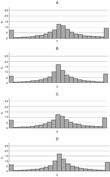
As emphasized, our test is implemented by dividing the entire period of job stay into various subsample periods. Before running regressions based on equation (3), we draw figures similar to Figure 2's. Whereas Figures 2A through 2D illustrate asymmetric wage adjustment in expansions and recessions, Figures 3A through 3D focus only on expansions and display percentage distributions of real wage changes for the renegotiation period and for the period of falling unemployment without renegotiation. Figures 3A and 3B correspond to male heads, whereas 3C and 3D include female heads in the sample. A glance at the figures is enough to see that cycle-adjusted wage adjustments are not uniform between the two subsample periods, as the two distributions look different. More specifically, the proportion of wage increase is much greater for the renegotiation period than for the other period. In fact the distribution is quite skewed to the right for the renegotiation period, suggesting that the skewness in expansions in Figures 2A and 2C is due mostly to the skewness in the renegotiation period. Calculations show that, for male heads, the average wage increase in the renegotiation period (0.073) is greater than that in the nonnegotiation period during expansions (0.056). Again, the same patterns are preserved even in the sample of heads.

Distribution of real wage changes for male heads forthe renegotiation period (A) and for the period of expansion withoutrenegotiation (B) and for heads for the renegotiation period (C) and for theperiod of expansion without renegotiation (D).
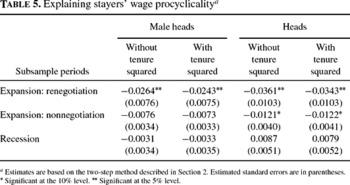
Now, we test more formally the three competing hypotheses proposed by BD in the alternative way described in Section 2, which focuses on the relationship between wages and contemporaneous unemployment rates. We compute composition-corrected and detrended mean wage changes for the three subsample periods: the renegotiation period, the period of falling unemployment without renegotiation, and the recession period. The two-step estimation results are reported in Table 5. The most important finding is that wages are much more greatly adjusted during the renegotiation period than during the other expansion period. For the sample of male heads, the estimated coefficient on the unemployment rate is −0.0264, implying that a one-percentage-point reduction in the unemployment rate is associated with a 2.64% rise in real wages for the renegotiation period. The estimate for the period of falling unemployment without renegotiation is −0.0076 percent, which is much smaller in absolute value and statistically insignificant. Finally, in recessions, the estimate is −0.0031, which implies that little wage adjustment is made. Hence, the substantial wage procyclicality of stayers' wages is mostly accounted for by the great upward wage adjustment during the renegotiation period only. When female heads are included in the sample, the estimate for the period of falling unemployment without renegotiation is −0.0121. Although this estimate is somewhat large, it is significantly smaller than that for the renegotiation period (−0.0361).

Although the findings in Section 4.2 suggest that there is strong evidence of asymmetry, this asymmetric adjustment in real wages is due to significant upward movement of real wages in the renegotiation period. In fact, the estimates for the nonnegotiation period during expansions are insignificant among male heads and marginally significant at the 10% level when female heads are included. These findings reject the possibility that the downward rigidity in real wages drives the asymmetric effects because, if the downward rigidity holds, then upward wage adjustment for the period of falling unemployment without renegotiation should be as great as for the renegotiation period. This peculiar pattern of real wages adjustment is consistent with the prediction of the implicit contract model with costless mobility suggested by BD.
Figures in the second and the fourth columns of Table 5 represent estimates obtained by including squared tenure as an additional regressor in equation (2). That corresponds to including the tenure variable itself as an additional regressor in equation (3). Inclusion of the variable also reduces the magnitude of upward wage adjustment slightly for the renegotiation period, but the magnitude is minor. That is exactly the same conclusion as with the fixed-effects estimates of the coefficient of the minimum unemployment rate in Table 2. To repeat, once individual-specific fixed effects are fully controlled for, estimated upward wage adjustment for the renegotiation period is not biased by not controlling for nonlinearity in the effect of tenure.
CONCLUSIONS
Our major conclusions are as follows. First, as with previous studies, we find that real wages are substantially procyclical. This large magnitude of wage procyclicality among stayers itself rejects the implicit contract model with mobility cost that hypothesizes that wages are primarily determined by labor market conditions at the start of the current tenure and never change thereafter. Evidence in the many current existing studies shows that wages are substantially adjusted from the start of a current job. Second, the effects of unemployment on wages are asymmetric in expansions and in recessions: most of the substantial procyclicality of stayers' wages is attributed to the expansionary period and little real wage adjustment is made during recessions. This finding rejects the spot market hypothesis because, under the spot market model, wage adjustments are to be symmetric across expansions and recessions in terms of direction and magnitude. Third, asymmetric adjustments of real wages mostly occur during the renegotiation period, and therefore, this adjustment solely explains procyclicality of real wages for stayers. Therefore, the substantial wage procyclicality and the peculiar pattern of asymmetric wage adjustments for job stayers are consistent with an implicit contract theory with costless mobility, as developed and concluded by Beaudry and DiNardo (1991).
Our findings imply that, for an “average” stayer, real wages are a convex function of the unemployment rate; that is, wages tend to be adjusted greatly when the unemployment rate is relatively low, and little wage adjustment occurs during the period of high unemployment. This happens because the falling unemployment rate increases the probability of recording the best labor market conditions since the start of the current job, which in turn makes the chance of renegotiation greater. Previous research analyzing the wage–unemployment relationship either presumes linearity or, as in the Blanchflower–Oswald-type wage curve [Blanchflower and Oswald (1994)], explores how wages are nonlinearly dependent upon the current unemployment rate assuming that wages are determined at the spot market. The current study departs from those studies by examining how wages of a given worker respond nonlinearly at different phases of the business cycle and why wages of different individuals respond differently to the same unemployment change. In this sense, our paper goes beyond simply exploring functional forms of the wage–unemployment relationship and uncovers sources of the nonlinearity.
This paper has greatly benefited from thorough readings and comments made by John DiNardo and Gary Solon. The authors also thank seminar participants at the Korean Labor Economic Workshop and the Korean Macroeconomic Workshop for helpful discussions. All errors and omissions are ours. This work was supported by the research fund of Hanyang University (HY-2005-I).