Introduction
Empirical research on the height–wage relationship has mushroomed over the past decade. For example, Gao and Smyth (Reference Gao and Smyth2010) investigated the effect of height on earnings using data from twelve Chinese cities. They found that ‘an additional centimetre of adult height is associated with wages being 1.1 per cent higher for males and 0.9 per cent higher for females’ (p. 466). In a similar vein, Judge and Cable (Reference Judge and Cable2004) tested a theoretical model that conjectured height is instrumental to career success. Using data from four large-sample studies, they found that height positively predicts income (β = 0.26), even after taking into account the effect of gender, age, human capital and other height-irrelevant dimensions of physical appearance. In general, the existing research reports that there is a discernible height–earnings premium within the labour market (Schultz, Reference Schultz2002; Rashad, Reference Rashad2008; Böckerman & Vainiomäki, Reference Böckerman and Vainiomäki2013). The majority of studies that have explored the link between height and earnings in developed countries have been based on data collected in Germany (Heineck, Reference Heineck2005), the UK (Case et al., Reference Case, Paxson and Islam2009), the USA (Case & Paxson, Reference Case and Paxson2008), Sweden (Lindqvist, Reference Lindqvist2012) and Australia (Kortt & Leigh, Reference Kortt and Leigh2010). A small but growing strand of research has investigated the height–wages phenomenon in developing countries (e.g. Dinda et al., Reference Dinda, Gangopadhyay, Chattopadhyay, Saiyed, Pal and Bharati2006; Yamamura et al., Reference Yamamura, Smyth and Zhang2015; Sohn, Reference Sohn2015).
Surprisingly, no study has investigated the link between height and earnings in Russia. To the best of the authors’ knowledge, the only study exploring the link between appearance and wages in Russia focused on the impact of obesity on the labour market (Huffman & Rizov, Reference Huffman and Rizov2014). The present study aimed to fill this gap in the empirical literature by investigating the height–wages nexus using the 24th (the most recent) wave from the Russian Longitudinal Monitoring Survey (RLMS) conducted in 2015.
Height can theoretically affect the earnings of an individual through several channels. Firstly, it is predominantly predicted by genetic and environmental factors, mainly nutrition (Ahmad & Gilbert Reference Ahmad and Gilbert1985; Hasle & Boldsen, Reference Hasle and Boldsen1991; Silventoinen, Reference Silventoinen2003). As a result, people became taller in societies that progress economically (Heineck, Reference Heineck2005; McEvoy & Visscher, Reference McEvoy and Visscher2009, Schwekendiek, Reference Schwekendiek2009). Since height is a quantitative characteristic, it is a good visual proxy for health, as it captures investment in health during childhood (Krzyżanowska & Umławska, Reference Krzyżanowska and Umławska2010; Samaras, Reference Samaras2012; Wronka, Reference Wronka2013). In the labour market, when it is hard to measure the fitness and power of a job applicant, height is easy to assess; therefore, it probably signals the health status of the individual to employers (Dinda et al., Reference Dinda, Gangopadhyay, Chattopadhyay, Saiyed, Pal and Bharati2006).
Ability is another way in which height can be linked to earnings. There is empirical evidence that height is a significant predictor of educational attainment, that ‘taller children are more likely to enroll in Gymnasium, the most academic secondary school track, and that primary school teachers provide more favourable school track decisions to taller students’ (Cinnirella et al., Reference Cinnirella, Piopiunik and Winter2011, p. 407). In a similar vein, the development of better-than-average cognitive ability in those who are taller is observed in the extant research, especially in children (Spears, Reference Spears2012). For example, Case and Paxson (Reference Case and Paxson2008), using data from several British and American longitudinal surveys, documented that height was a robust antecedent of scores obtained on tests of cognitive abilities among 3-year-olds.
Research also suggests that the effect of height on income is stronger in positions that demand diplomacy, persuasiveness and bargaining skills, such as among administrators, executives or controllers (Lindqvist, Reference Lindqvist2012). This could be caused by various interpersonal abilities or by a predisposition for taller employees. Other studies focusing on the role of stature in labour market outcomes, notably wages, have also inferred that taller people are more likely to possess better interpersonal skills relative to their peers of shorter stature (Persico et al., Reference Persico, Postlewaite and Silverman2004). In turn, Gowin (Reference Gowin1915) noted that business executives and managers in the United States were taller than average men at the beginning of the twentieth century. Indeed, research also shows the probability of being self-employed increases with an individual’s height, with taller people tending to have higher earnings whether self-employed or in salaried positions (Case et al., Reference Case, Paxson and Islam2009).
Methods
Participants and procedure
The data for this study were obtained from the Russian Longitudinal Monitoring Survey–Higher School of Economics (RLMS-HSE). The RLMS-HSE is a series of nationally representative surveys designed to monitor the effects of Russian reforms on the health and economic welfare of households and individuals in the Russian Federation for the year 2015. Data from the latest 24th wave of the RLMS survey were used. The sample consisted of more than 5700 respondents, of which nearly 45% were males and 55% females. The average heights of the two genders differed: 176 cm and 164 cm, respectively. For the purpose of this study, the sample was restricted to the working-age population. The study used the most recent wave, as it has a number of new questions that are relevant for the current research. Moreover, the study relied on cross-sectional data, as height is stable over time.
Variables
Wages
The dependent variable ‘average monthly income’ was assessed using question J10 of the RLMS. Respondents were asked: How much money [in roubles] did you receive in the last 30 days from your primary job after taxes? In order to address right-skewness of wages (median 20,000 roubles, arithmetic mean 24,139 roubles), monthly wages were log-transformed (Benoit, Reference Benoit2011).
Height
Respondent’s height was assessed using question M2 from the Health Evaluation section of the RLMS. Respondents were asked: What is your height in centimetres? Approximately 5773 respondents provided self-reported information on height and earnings.
Personal characteristics
Considering wages are determined by other factors, the analysis also included a set of personal characteristics in the empirical model. The covariates included were: gender (0 = male, 1 = female), marital status (1 = married, 0 = otherwise), age, education and place of residence (federal districts).
Job-related covariates
Job-related covariates included tenure, managerial status, workload (hours worked per week), public (government) job and self-employment because these variables have been found to be correlated with earnings in previous studies (Heineck, Reference Heineck2005; Hubler, Reference Hubler2009; Mohanty, Reference Mohanty2012). A respondent’s managerial status was assessed using question J6: Do you have subordinates at this job? (1 = yes, 0 = no).
Analysis
The following equation was estimated to see the association between earnings and height:
 $${\rm{log}}\left( {{\rm{Wage}}} \right) = \alpha + {\beta _{{\rm{Height}}}} + {X_\gamma } + {Z_\delta } + {\varepsilon _i}$$
where log(Wage) represents log-transformed monthly earnings in roubles. Height is a main predictor, X is a set of personal characteristics, Z is a set of job-related characteristics and ϵ is an error term satisfying normality assumptions.
Results
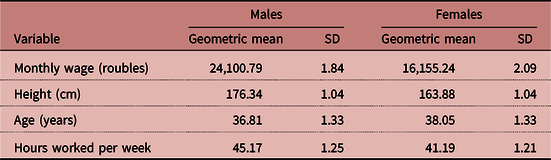
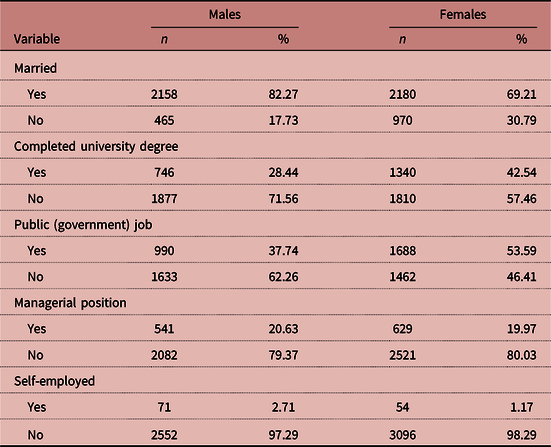
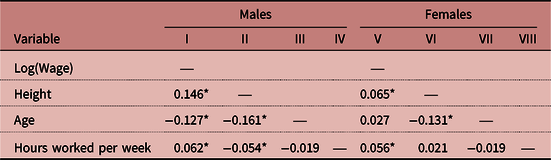
The descriptive statistics for the main variables are reported separately for males and females in Tables 1 and 2. Overall, men had higher earnings than women: 24,100 and 16,155 roubles, respectively. Average height was approximately 176 cm for males and 164 cm for females. Table 3 reports the correlation matrix for continuous variables separately for males (columns I–IV) and females (columns V–VI). As anticipated, height was positively correlated with the individual earnings at individual level for both males (r = 0.146, p < 0.01) and females (r = 0.065, p < 0.01).
Descriptive statistics of study respondents

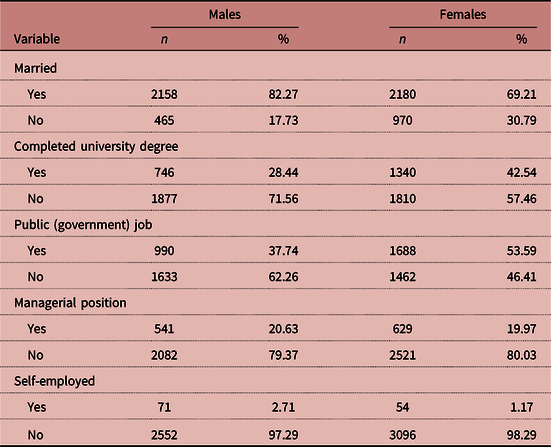
Descriptive statistics of study respondents by categorical variables
Correlation matrix for continuous variables

* p < 0.01.
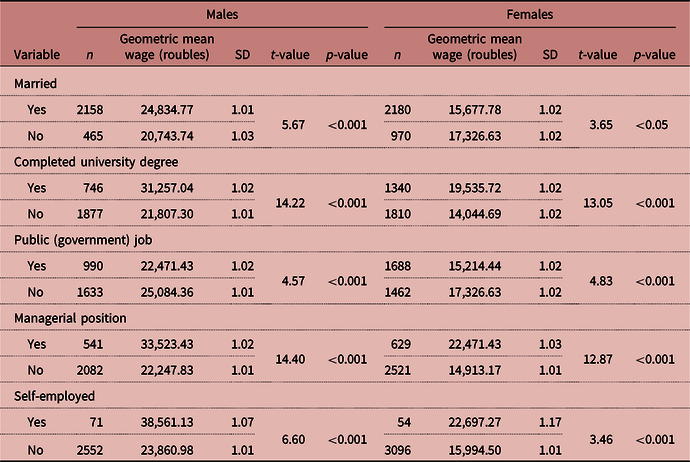
Table 4 reports the geometric mean wages and standard deviations separately for male and female respondents. Married men had higher earnings than unmarried men: approx. 24,835 and 20,744 roubles, respectively (p < 0.001). The results were different for women: married women had lower earnings than unmarried women: around 15,678 and 17,327 roubles, respectively (p < 0.001). As expected, respondents with completed university degree, a managerial position or self-employment status were likely to have higher earnings for both genders. The results were statistically significant (p < 0.001). The geometric mean wages of cohorts working for public (government) organizations were lower for both genders (p < 0.001).
Geometric mean monthly wages of men and women by categorical variables

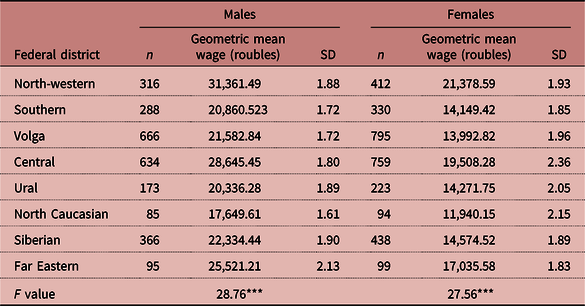
The one-way analysis of variance (ANOVA) showed that the geometric mean monthly wages for both male (F = 28.76, p < 0.01) and female (F = 27.56, p < 0.01) respondents differed significantly by place of residence (Table 5). The highest earnings were observed in the North-western and Central Federal districts, while North Caucasian respondents had the lowest earnings for both genders.
Geometric mean monthly wages of men and women by place of residence (ANOVA)

*** p < 0.01.
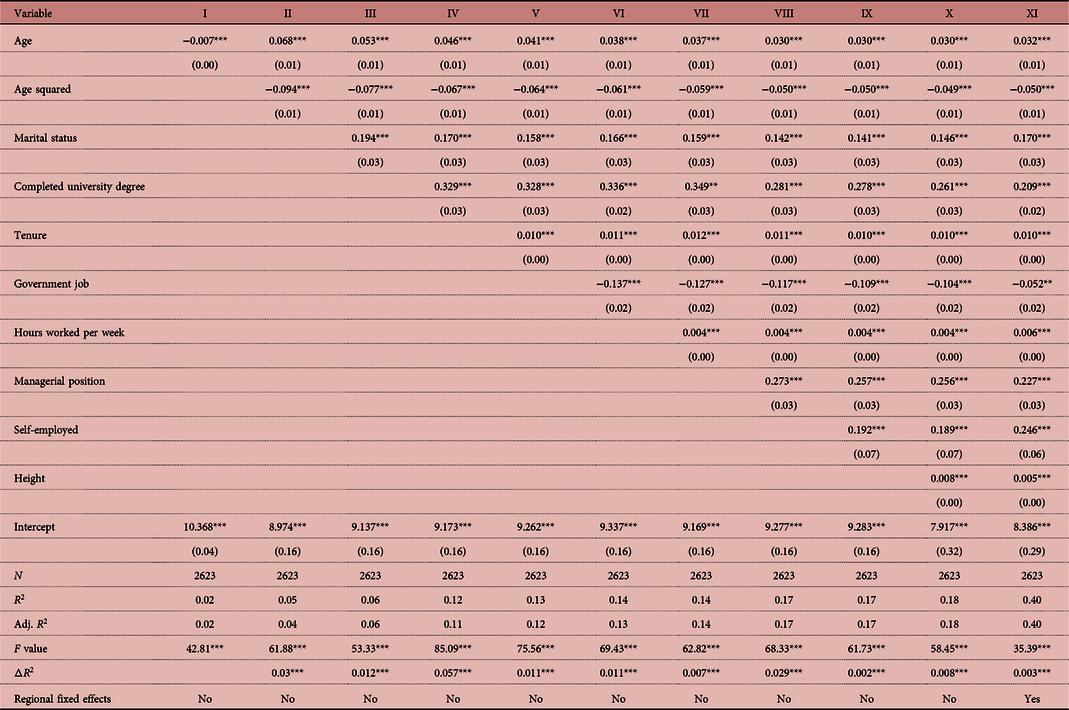
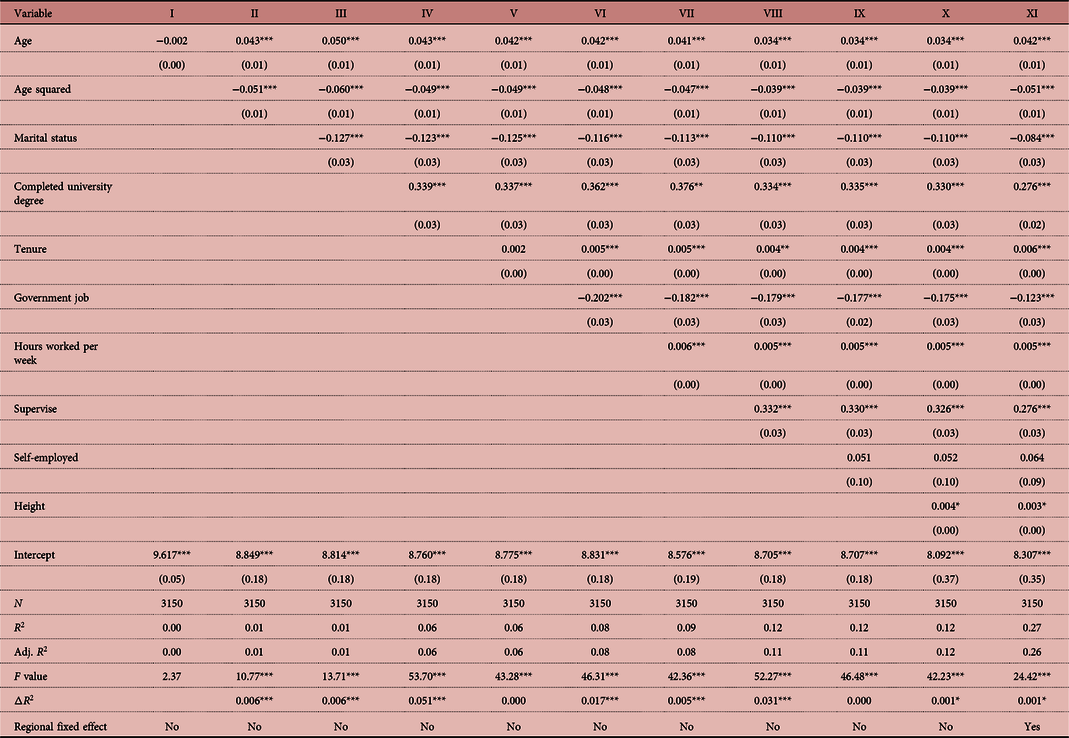
In Table 6, sequential multiple regression analysis confirmed the association between height and earnings. The sequential analyses were performed separately for male (Table 6) and female (Table 7) respondents. These were run in order to evaluate the contributions of predictors above and beyond previously entered predictors, as a means of statistical control, and to examine incremental validity. In this study, sequential regressions involved the entry of predictor variables into the analysis in steps, in order to isolate the effect of one predictor from the previous entered regressors on monthly earnings (Tables 6 and 7).
Multiple sequential analysis, male subsample

Standard errors in parentheses. *p < 0.1; **p < 0.05; ***p < 0.01.
Multiple sequential analysis, female subsample

Standard errors in parentheses; *p < 0.1; **p < 0.05; ***p < 0.01.
For male respondents, each chosen control variable had a statistically significant effect on earnings (columns I–XI, Table 6). Table 6 shows that the differences of R 2 between the following and previous models were statistically significant, meaning the added variables in each model explain the earnings above and beyond the variables in previous models (columns I–XI, Table 6). As expected, height was a positive significant predictor and explained an additional 0.3% of the variance in earnings for male respondents (ΔR 2 = 0.003, p < 0.01). That is, an additional 10 cm of height raised earnings by 5% (β = 0.005; p < 0.01).
For female respondents, tenure and self-employment status did not explain the variance in earnings (Models I and IX, Table 7). Although at the 10% significance level, height was a positive and significant predictor and explained an additional 0.1% of the variance in earnings for female respondents (ΔR 2 = 0.001, p < 0.1). That is, an additional 10 cm of height brought nearly 3% of wages (β = 0.003, p < 0.1).
Marital status had a different effect on earnings for the two genders. Married men had higher earnings by 18.53% (β = 0.170, p < 0.01), while marriage had a significant negative association with the earnings of female respondents (β=–0.084, p < 0.01). Age had a non-linear inverted U-shaped association with monthly wages for females and males. In line with literature on human capital (Wiles, Reference Wiles1974; Card, Reference Card, Ashenfelter and Card1999), respondents with a completed university degree reported higher monthly wages. In particular, male and female respondents with a completed university degree tended to earn 23.24% and 31.78% more, respectively, than those who did not.
Managerial position, workload, tenure and a binary variable for self-employment positively predicted wages, whilst working for the public (government) sector had a negative correlation with earnings.
Discussion
The study revealed that overall height was positively and significantly associated with earnings in Russia in 2015 at the individual level, and that taller respondents enjoyed a so-called ‘beauty premium’ in the Russian labour market. This was also shown by the comprehensive effect in all models of Tables 6 and 7, which captured both direct and indirect effects. It is important to stress that the estimate for height remained significant, even when a rich set of individual and job-related characteristics was included. As previous research suggests, the effect of height on wages may differ by gender (Tyrrell et al., Reference Tyrrell, Jones, Beaumont, Astley, Lovell and Yaghootkar2016), and this study also found the effect of height on wages to be stronger for men. In short, these results suggest that gender is a moderator in the link between height and wages in Russia.
The results for the height and wage relationship may have wide-ranging implications for societies in developing countries, as height has been linked to reproductive success (Mueller & Mazur, Reference Mueller and Mazur2001), longevity (Özaltin, Reference Özaltin2012), social dominance (Melamed, Reference Melamed1992), success (Hamstra, Reference Hamstra2014), job promotion (Melamed & Bozionelos, Reference Melamed and Bozionelos1992), earnings (Harper, Reference Harper2000) and life satisfaction (Salahodjaev & Ibragimova, Reference Salahodjaev and Ibragimova2018). This research further contributes to ongoing global research into the height–earning nexus, suggesting a significant link between height and wages in Russia.
Another noteworthy result of this study is that, in line with the literature on human capital (Wiles, Reference Wiles1974; Card, Reference Card, Ashenfelter and Card1999; Szklarska et al., Reference Szklarska, Koziel, Bielicki and Malina2006), education (human capital component) had a significant and positive link with earnings. In addition, it was found that age had an inverted U-shaped association with earnings. One explanation for why, in Russia, earnings decline as individuals become older is that there is an increasing motivation to reduce labour supply as leisure becomes relatively less expensive. Indeed, Charni and Bazen (Reference Charni and Bazen2017, p. 16) suggested that ‘older workers who are laid-off may experience labour market disadvantage in terms of finding jobs at a similar level, spending time in unemployment and being forced to accept lower-paid jobs’. The negative effect of marriage on earnings for female respondents may be explained by the specialization hypothesis (Becker, Reference Becker1973), which postulates that ‘marriage allows the husband and wife to specialize in either market or domestic production … [and] … a negative coefficient on this variable would support the specialization hypothesis’ (Bardasi & Taylor, Reference Bardasi and Taylor2008).
Interestingly, the study found that the coefficient for marriage was also negative and significant for women. This may suggest that married women are more likely to shift their focus to parental responsibilities and to traditionally female responsibilities within the household, which in turn affects their labour supply and decreases wages.
Funding
This research received no specific grant from any funding agency, commercial entity or not-for-profit organization.
Conflicts of Interest
The authors have no conflicts of interest to declare.
Ethical Approval
The authors assert that all procedures contributing to this work comply with the ethical standards of the relevant national and institutional committees on human experimentation and with the Helsinki Declaration of 1975, as revised in 2008.