Introduction
Choice of manuring strategy is an essential factor in all farming systems. The strategy has to consider climate, crop rotation and both short-term and long-term objectives. Within the framework of organic agriculture (OA), many different manuring systems have evolved to meet different demands. Previous studies on the long-term consequences of OA systems have shown that differences between manuring strategies are mainly manifested in soil properties rather than in crop quality traits (Mäder et al., Reference Mäder, Fliessbach, Dubois, Gunst, Fried and Niggli2002). Some differences in crop quality have been reported (Woese et al., Reference Woese, Lange, Boess and Bögl1997), but these are not consistent. Increased understanding of how different OA manuring systems influence crop development and quality is important when striving to grow nutritious and tasty organic crops to an acceptable yield.
The carrot plant is biennial and root growth continues as long as external circumstances permit, with no distinct period of winter dormancy (Nilsson, Reference Nilsson1987). Deciding when to harvest a carrot crop is thus a balance between yield, nutritive quality, storability and harvesting conditions.
The morphological features of the carrot taproot are suggested to be correlated to different quality and chemical parameters (Rosenfeld, Reference Rosenfeld2003). The shape of the carrot taproot is mainly determined by the relationship between its extension in length and its increase in thickness. This gives rise to different root types, from round to conical or more cylindrical. The initial length increase of the taproot is rapid and after the first third of the growth period root weight also begins to increase more rapidly and this continues until harvest (Rubatzsky et al., Reference Rubatzsky, Quiros and Simon1940). The increase in root thickness is initiated by secondary growth along the length of the taproot, normally starting at the upper end (Esau, Reference Esau1940). There are no distinct outer signs of maturation of the taproot (Fritz and Habben, Reference Fritz and Habben1975; Nilsson, Reference Nilsson1987). A pointed root tip is more common in early stages of development and the tip often becomes blunter later in the season (Rubatzsky et al., Reference Rubatzsky, Quiros and Simon1940; Rosenfeld, Reference Rosenfeld1998). A more cylindrical shape of the root as a whole has been suggested as a useful criterion for comparing the shape of carrot roots (Bleasdale and Thompson, Reference Bleasdale and Thompson1963), and also a useful indicator of harvest (Rosenfeld, Reference Rosenfeld2003).
The accumulation of soluble sugars in the taproot is essential when discussing the quality and taste of carrots. The sugars are mainly stored in vacuoles in the parenchymatic tissues (Nilsson, Reference Nilsson1987). The total sugar content does not differ greatly between different parts of the carrot, but the amount of sucrose is higher in the upper part and in the phloem (Rosenfeld, Reference Rosenfeld2003). Monosaccharides, especially fructose, are more common in the center and tip parts of the carrot root and in the xylem (Rosenfeld, Reference Rosenfeld2003). The development of a carrot crop as regards accumulation of sugars is often divided into three phases: A phase with no soluble sugar storage, a phase in which only reducing sugars are stored, and a phase in which mainly sucrose is stored in the taproot (Steingröver, Reference Steingröver1983). The accumulation of sucrose in the taproot seems to be more influenced by environmental factors than does the accumulation of reducing sugars (Rosenfeld, Reference Rosenfeld2003). The ratio between sucrose and hexoses normally increases during the growing season and this ratio has been suggested as a useful indicator of when to harvest, mainly with respect to the storability of the carrots (Goris, Reference Goris1969; Nilsson, Reference Nilsson1987).
Beside sugars, a variety of different substances are involved in establishing quality traits of carrots. During the past decade a group of bioactive aliphatic C17-polyacetylenes has attracted increasing interest (Christensen and Brandt, Reference Christensen and Brandt2006). Three falcarinol-type polyacetylenes (FaTP) are most frequently found in carrots (Bohlmann et al., Reference Bohlmann, Burkhardt and Zedero1973): Falcarinol (FaOH), which has been shown to have cytotoxic activity as well as exerting anti-cancer activity (Matsunaga et al., Reference Matsunaga, Katano, Yamatoto, Fujito, Mori and Takata1990; da Silva Dias, Reference da Silva Dias2014), stimulating cell differentiation and exerting toxic effects above 1000 ng mL−1 (Hansen et al., Reference Hansen, Purup and Christensen2003). Falcarindiol (FaDOH) is reported to be bitter-tasting (Czepa and Hofmann, Reference Czepa and Hofmann2004) and toxic to different fungal infections (Garrod et al., Reference Garrod, Lewis and Coxon1978). Falcarindiol-3-acetate (FaDOAc) is reported to be associated with different fungal infections and to act as an inhibitor of breast cancer resistance protein together with FaDOH (Tan et al., Reference Tan, Killeen, Li, Paxton, Birch and Scheepens2014). Earlier studies found no differences concerning the amounts of FaTP in carrots when comparing conventional and organic manures (Söltoft et al., Reference Söltoft, Eriksen, Brändholt Träger, Nielsen, Laursen, Husted, Halekoh and Knutsen2010). No data are available on how different organic manuring systems influence the amounts of polyacetylenes in carrots.
The field trial presented in this paper was originally designed to study the influence of different manuring strategies within the framework of ecological recycling agriculture (ERA), where the number of animals kept on the farm is balanced against the amount of feed the farm can produce (Granstedt et al., Reference Granstedt, Schneider, Seuri and Thomsson2008). One kind of ERA agriculture is biodynamic agriculture (BDA) which mainly differs from other ERA systems by the use of herbal ‘biodynamic preparations’ added to the manure and field preparations spread directly on the field (Koepf et al., Reference Koepf, Pettersson and Schaumann1976; Raupp and König, Reference Raupp and König1996; Turinek et al., Reference Turinek, Grobelnik-Mlakar, Bavec and Bavec2009).
The aim of this study was to evaluate how carrot root morphology, sugar content and FaTP content are influenced by long-term use of different OA manuring systems.
Materials and Methods
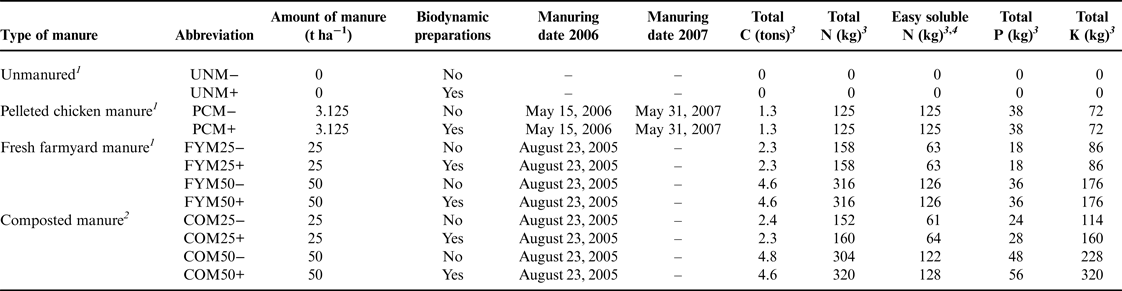
The carrot cultivar ‘Kämpe’, an open-pollinated carrot of the Chantenay type, was grown from seed obtained from Lindbloms Frö, Sweden and harvested three times per season in 2006, 2007 and 2008. However, due to extreme weather and soil conditions leading to very uneven plant establishment and growth, the results from 2008 had to be excluded from the analysis. The carrots were grown within a long-term field experiment at Skilleby research farm in Sweden (59.2°N; 17.4°E). This field experiment was established in 1991 in order to compare the influence of different organic manures on the properties of soils and crops. The different treatments are listed in Table 1, together with the abbreviations used. Each treatment had four replicates. A 5-year crop rotation consisting of winter wheat, oats with clover and a 3-year grass ley has been used in the field trial since its establishment. Carrots were sown after ley in 2006 and after winter wheat in 2007.
Treatments and abbreviations used in the field trial in 2006 and 2007.

Chemical properties of the manures used: figures for FYM and COM based on analysis, for PCM based on information from the manufacturer.
1 Biodynamic compost preparations applied to UNM, PCM+, FYM25+ and FYM50+ at manuring, biodynamic field preparations 500 and 501 applied according to common standards.
2 Compost heap established in April 2005, biodynamic compost preparations added to COM25+ and COM50+ on establishment, biodynamic field preparations 500 and 501 applied according to common standards.
3 Amount given at each manuring occasion.
4 Calculated as 40% of total N in FYM and COM, according to Granstedt (Reference Granstedt1992).
The effects of pelleted chicken manure (PCM), fresh farmyard manure (FYM) and composted farmyard manure (COM) were compared against unmanured control plots (UNM). FYM and COM were applied to the carrots grown in 2006, but not to those grown in 2007, as these manures are applied only once per crop rotation. Due to the design of the field trial, FYM and COM were applied already in August 2005 (Table 1). Two applications of FYM and COM were used, corresponding to 25 tons (FYM25, COM25) and 50 tons (FYM50, COM50) of manure per hectare. Plots treated with PCM were fertilized each year. The amount of PCM corresponded to 50 t ha−1 of FYM in terms of the amount of easily available nitrogen it provided (125 kg N ha−1) (Table 1). PCM was applied in plots previously left unmanured since 1995. The field trial has a split-plot design, in order to compare some biodynamic measures with other OA farming systems. Plots in all treatments were therefore divided into two parts, with (+) or without (−) biodynamic preparations. In total, the field trial consisted of 12 different treatments (Table 1), distributed over 48 split-plots, each measuring 4.0 × 15 m2.
Soil and manures
Samples of soil and the manures were sent to Agrilab (Sweden), where they were analyzed according to common standards:
Soil
Total carbon and nitrogen content were measured with a LECO CHN 600 element analyzer (SS-ISO 11464). Available P, K, Ca, Mg, Na were analyzed after extraction in ammonium lactate (AL) solution (SS 028310) and pH was determined according to SS-ISO 10390. The soil consisted of a clayish loam with a rather large proportion of silt. Analyses of soil samples taken in all 48 plots after the last harvest in 2006 revealed some small differences: Total carbon content was higher in samples from COM50 and FYM50 (2.45%) than in UNM samples (2.2%). Soil samples from COM50 and FYM50 had higher amounts of easily soluble P (2.7–2.9 mg/100 g) than all other treatments (1.8–2.2 mg/100 g), and also higher amounts of easily soluble K (16.1–16.7 mg/100 g) than samples from PCM (13.4–14.0 mg/100 g). The soil pH was about 6 and total nitrogen content was 0.24–0.28%, with no significant differences between the treatments.
Manures
The composition of FYM and COM was analyzed using the following methods: pH: SS-ISO 10390; Total P, K, Mg, Ca and S: SS 028311; Total C: SS-ISO 10694; Total N: SS-ISO 13878; NH4-N: ISO 11732. The chemical composition of PCM was as stated by the manufacturer. Chemical traits of the manures used are listed in Table 1.
Sampling and analysis of carrots
At all harvests, 40–60 carrots from each plot were collected from 6–7 spots distributed all over the plot, with the exception of the outer 50 cm along the sides of each plot, where no sampling was carried out. The carrots were brought to the laboratory in cold-storage boxes within 24 h. After morphological analysis, the upper and lower ends of each carrot were removed and the remains of the root were cut into 0.5–1 cm cubes. Finally, approximately 60 g of each sample were deep-frozen and kept at −80°C. Before chemical analysis, all samples were freeze-dried and milled to a powder using an Ika-werke Yellow line-type A10 mill from Staufen, Germany.
Size and shape
The length of the root was marked out in tenths, counting from the root top, and weight, length, maximum diameter and thickness were measured at 2-, 4-, 6-, 8- and 9-tenths on each root from all samples. The cylindricity of the carrot root was calculated using a model developed by Bleasdale and Thompson (Reference Bleasdale and Thompson1963).
Sugars
Analysis of fructose, glucose and sucrose was performed by first extracting 300 mg of each sample with 4 mL of 70% ethanol for 14 days at −20°C. After centrifugation (Universal 30RF, Hettich GmbH & Co. KG, Tuttlingen, Germany) at 10,500 g for 2 min, 1 mL of extract was transferred to a glass vial and analyzed in an HPLC system (HPLC Technology Ltd, Welwyn Garden City, UK) equipped with an R14 IR detector and an Asahipac Shodex NH2P-50 4E column (4.6 × 250 mm2; Showa Denko K.K., Tokyo, Japan). The eluents were acetonitrile (Merck KGaA, Darmstadt, Germany) and water (70:30 v/v) in a continuous loop at a flow rate of 1 mL min−1. Each sample was extracted and analyzed in triplicate. Data were evaluated using Prime for Windows (PW-500, HPLC Technology Ltd, UK). The integrated area from the samples was compared with that from external standards (Merck KGaA) for fructose, glucose and sucrose and determined as mg/g DW. All reagents used in the analysis of sugars were of HPLC grade. The water used was of Ultra-Pure 18.2 MΩ cm quality, produced by a Milli-Q system (Millipore, Molsheim, France).
Polyacetylenes
Samples were analyzed for their falcarinol-type polyacetylenes content by HPLC using a 100 mm 3 mm, particle size 3 μm, Luna C18 (Woese et al., Reference Woese, Lange, Boess and Bögl1997) column (Phenomenex, CA, USA) at 40°C combined with a Agilent 1100-HPLC system equipped with a diode-array detector (Agilent Technology, USA) according to methods described elsewhere (Zidorn et al., Reference Zidorn, Johrer, Ganzera, Schubert, Sigmund, Mader, Greil, Ellmerer and Stuppner2005; Christensen and Kreutzmann, Reference Christensen and Kreutzmann2007) with modifications described previously (Kjellenberg et al., Reference Kjellenberg, Johansson, Gustavsson and Olsson2010). The analyses of polyacetylenes were performed directly after milling. The amounts of falcarinol-type polyacetylenes were expressed as μg g−1 DW by using an external certified standard of FaDOH from Atomax Chemicals Co. (Shenzhen, China). By dividing the linear constant of the internal standard, 4-chlorobenzophenone, at 205 nm by the corresponding constant for FaDOH at 205 nm, a factor of 1.235 was obtained and used to express the amounts of polyacetylenes. Each sample was extracted and analyzed in triplicate. All reagents used in the analysis were of HPLC grade. The water was of Ultra-Pure 18.2 MΩ cm quality, produced by a Milli Q system from Millipore, France.
Statistical analyses
The computer programmes Excel 2003 (Microsoft Corp. USA), Minitab 16.0 (Minitab Inc. USA) and SPSS 16.0 (SPSS Inc. USA) were used for calculations and statistical evaluations. One-way ANOVA analysis together with the Duncan post hoc test at a significance level of P ≤ 0.05 was used to determine differences between subjects. Principal component analysis (PCA) was used to describe interactions between subjects. Data on temperature and precipitation were obtained from a weather station at the field trial and are given in Table 2.
Date of sowing and harvesting, long-term temperature and precipitation (1962–2008), sum of precipitation and temperature sum 2006 and 2007.

1 Sum of precipitation and temperature sum from April 1 until harvest. Data from weather station at field site.
Results
The mean weight of the carrot roots at the final harvest, independent of OA manuring system, was close to 120 g root−1, corresponding to a yield of approximately 45–50 t ha−1, which can be considered moderate.
Interactions between treatments, harvests and seasons
The loading plot from the PCA analysis indicated a first component more correlated to the development of growth and size among the carrots, and a second component more correlated to properties connected with the bluntness of the root tip, the amount of FaOH and the dry matter content of the carrots (Fig. 1a). Together, these two components explained 78% of the variation between samples. The score plot from the PCA analysis revealed six well-defined groups of samples, representing each of the six harvest occasions (Fig. 1b). The samples harvested during 2006 (grouped within the dotted line) were also well-differentiated from samples harvested during 2007 (grouped within the solid line) (Fig. 1b). The differences between years were expressed more in the second component, while the differences between harvest occasions within years were expressed more along the first component, although samples from the second harvest in each year displayed slightly lower values of the second component compared with samples from the first and third harvests (Fig. 1b). The PCA analysis also revealed more general differences between the different treatments. Within the same harvest, the UNM samples were positioned more to the left along the first component, while the PCM samples were more to the right (Fig. 1b). In comparison with other manuring treatments, samples fertilized with PCM exhibited higher amplitude along the second component (Fig. 1b). Carrots manured with FYM25 were outliers at the final harvest in each year (Fig. 1b).
(a) Loading plot from principal component analysis (PCA), mean of carrot samples from all six harvests 2006–2007. (b) Score plot from PCA, mean of carrot samples from all six harvests 2006–2007. Samples within the dotted line are from the three harvests in 2006, samples within the solid line are from the three harvests in 2007. For abbreviations see Table 1.

Size and shape
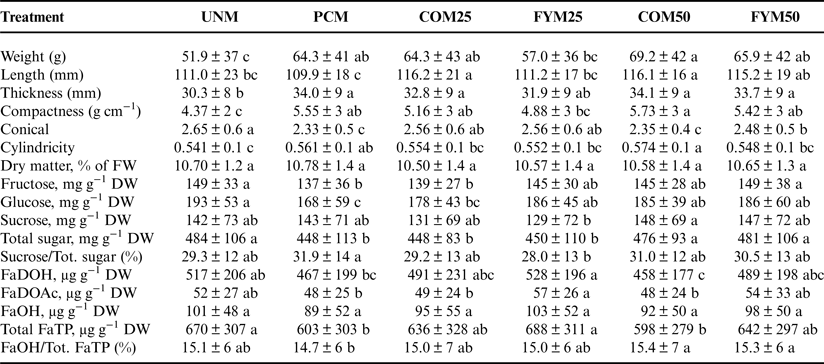
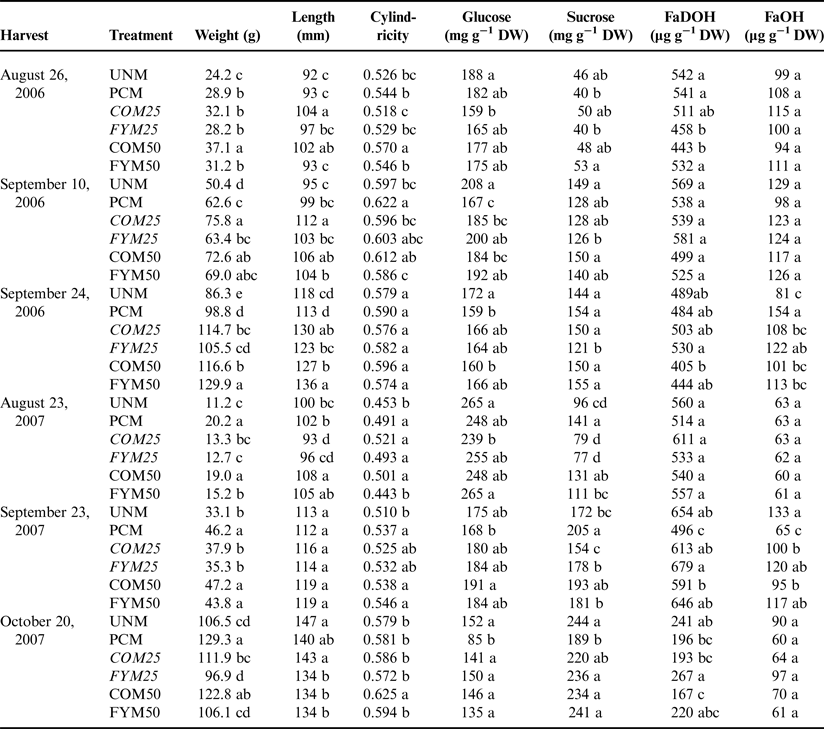
In general, carrots manured with COM25 or COM50 were longer than carrots from UNM, PCM or FYM25 (Table 3). At the first harvest in 2006, after all manures had been applied, carrots manured with COM50 were heavier, longer and more cylindrical in shape than carrots manured with FYM50 or PCM, and also heavier and more cylindrical in shape than carrots manured with COM25 (Table 4). At the second harvest in 2006, carrots manured with COM25 or COM50 were heavier than carrots fertilized with PCM (Table 4). At the final harvest in 2006, carrots manured with FYM50 were heavier and longer than carrots manured with COM50, FYM25 or PCM, and carrots manured with COM25 or COM50 were heavier than carrots fertilized with PCM (Table 4). At the first harvest in 2007, when only PCM had been applied, carrots from COM50 and PCM were heavier and more cylindrical in shape than carrots from FYM50, and carrots from COM50 were longer than carrots fertilized with PCM (Table 4). Carrots from COM50 or FYM50 were heavier and longer than those from COM25 or FYM25 (Table 4). At the second harvest in 2007, carrots fertilized with PCM, FYM50 or COM50 were heavier than carrots from COM25 and FYM25 (Table 4). At the final harvest in 2007, carrots fertilized with PCM and COM50 were heavier than those from FYM25 or FYM50, and carrots from COM50 were more cylindrical than those from PCM or FYM50 (Table 4).
Root size, shape, amounts of soluble sugars and amounts of FaTP in carrots from the different treatments.

For abbreviations see Table 1.
Mean of samples from all six harvest occasions 2006–2007, N = 24. Values within rows followed by different letters are significantly different, P ≤ 0.05.
Root size, shape and amounts of soluble sugars and FaTP in carrot samples from each of the six harvest occasions 2006–2007 for the different treatments.

For abbreviations see Table 1.
Values from the same harvest occasion followed by different letters are significantly different, P ≤ 0.05. N = 8.
Sugars
In general, carrots manured either with FYM50 or with COM50 had higher total amounts of soluble sugars than carrots fertilized with PCM, COM25 or FYM25 (Table 3). At the first harvest in 2006, after all manures have been applied, carrots manured with FYM50 had higher amounts of glucose than carrots fertilized with PCM, and higher amounts of sucrose than carrots manured with FYM25 (Table 4). At the first harvest in 2007, when only PCM had been applied, carrots fertilized with PCM had higher amounts of sucrose than those from FYM50, FYM25 and COM25, whereas carrots from COM50 or FYM50 had higher amounts of sucrose than those from COM25 or FYM25 (Table 4). At the second harvest in 2007, carrots from COM50 exhibited higher amounts of glucose than carrots fertilized with PCM, and carrots from FYM50 contained lower amounts of sucrose than carrots fertilized with PCM (Table 4). At the final harvest in 2007, carrots fertilized with PCM had lower amounts of both glucose and fructose than those from FYM25, FYM50 or COM50 (Table 4).
Polyacetylenes
In general, carrots manured with PCM had lower total amounts of FaTP than UNM carrots and also a lower FaOH/FaTP ratio compared with carrots from COM50 or FYM50, as a mean of all six harvests (Table 3). At the first harvest in 2006, after all manures had been applied, carrots manured with COM50 contained less FaDOH than carrots manured with FYM50 or PCM, and carrots manured with FYM50 had higher amounts of FaDOH than carrots manured with FYM25 (Table 4). At the final harvest in 2006, the amounts of FaOH were higher in carrots fertilized with PCM than in carrots manured with FYM50 or COM50 (Table 4). At the second harvest in 2007, when only PCM had been applied, carrots fertilized with PCM contained lower amounts of both FaDOH and FaOH than carrots from FYM25, FYM50, COM25 or COM50 (Table 4). At the final harvest in 2007, carrots from FYM25 contained higher amounts of FaDOH than carrots from PCM, COM25 or COM50 (Table 4).
Biodynamic preparations
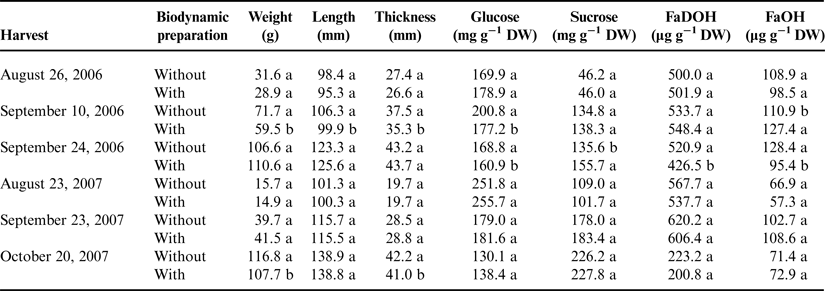
No interaction was found between biodynamic preparations and type of manure or harvest occasion when using PCA or GLM methods (data not shown). The influence of the biodynamic preparations was therefore analyzed by comparing all 24 split-plots treated with the preparations with the 24 split-plots left untreated at each harvest occasion. At the second harvest in 2006, carrots from plots treated with the biodynamic preparations had lower weight and length and also lower amounts of glucose than carrots not treated with the biodynamic preparations (Table 5). At the third harvest in 2006, carrots treated with the biodynamic preparations contained more sucrose, but less FaDOH and FaOH, than samples not treated with the biodynamic preparations (Table 5). At the third harvest in 2007, carrots from plots treated with the biodynamic preparations were smaller both in weight and in thickness than the corresponding samples from plots left untreated (Table 5).
Influence of biodynamic preparations on size, amount of soluble sugars and FaTP in carrot samples from six harvest occasions 2006–2007.

Mean of all samples. N = 24. Values from the same harvest occasion followed by different letters are significantly different, P ≤ 0.05.
Discussion
The results obtained show that manuring strategy influences the growth and development of organic carrot crops. However, the differences between carrots manured with different types of organic manure were moderate compared with the variation between harvest years and between harvest occasions within years. For example, at the final harvest in 2006, the root weight of carrots grown in soils left unmanured for 16 years was only 13% lower than that of carrots fertilized with PCM corresponding to 125 kg N ha−1. At the same harvest occasion, carrots manured with 50 t ha−1 of compost did not differ in root weight from roots manured with only 25 t ha−1 of compost. One contributing factor to these moderate differences between manuring strategies is probably the crop rotation used in the field trial since its establishment in 1991. A clover-grass ley had been grown in the field trial in 12 years out of 16 before the start of the present experiment. Growing a legume-including ley in the crop rotation has previously been reported to level out the effects of different manuring systems on crop growth, at least under Scandinavian conditions (Dlouhy, Reference Dlouhy1981; Pettersson, Reference Pettersson1982). The long-term use of this type of crop rotation seems to have a stronger impact on the soil's own ability to mineralize nutrients and support carrot growth than the fertilization system used in OA. This confirms earlier findings on the importance of ley as a preceding crop (Granstedt and Bäckström, Reference Granstedt and Bäckström2000).
Root morphology was not influenced by the manuring strategy in a general way. The results indicated that morphological traits, such as cylindricity, were more suitable for describing differences in growth between years, or development during the growing phase, than for differentiating manuring systems from each other.
The accumulation of soluble sugars was influenced by the type and the amount of manure used. Unmanured carrots had the highest total amounts of soluble sugars, together with samples manured with 50 t ha−1 of FYM or COM. Using PCM, or reducing the amounts of FYM or COM by half, decreased the total sugar content in carrot roots. The lower sugar content when reducing the amount of COM or FYM was more obvious at the first two harvests in each year, indicating that the decrease in sugar content could be correlated to slower development in the carrots. The lower sugar content in samples fertilized with PCM is discussed later.
The FaTP content in carrots is reported to follow a seasonal rhythm (Kjellenberg et al., Reference Kjellenberg, Johansson, Gustavsson and Olsson2010; Kramer et al., Reference Kramer, Bufler, Nothnagel, Carle and Kammerer2012). In the present study, this rhythm was expressed through an increase in the amounts of FaTP between the first and second harvests, followed by a decrease between the second and third harvests. This rhythm was more pronounced in carrots harvested from soil left unmanured and least pronounced in carrots fertilized with PCM. The lack of increase in the amounts of FaTP at the second harvest might be due to the fact that the carrots fertilized with PCM had already passed this stage of development. However, this assumption is contradicted by the fact that these carrots did not exhibit higher levels of FaTP in comparison with other treatments at the first harvest. Our earlier findings of a seasonal rhythm in FaTP content (Kjellenberg et al., Reference Kjellenberg, Johansson, Gustavsson and Olsson2010) were all based on analyzing carrots manured either with compost or farmyard manure. According to the present results, this seasonal rhythm may be less pronounced when fertilizing the carrots with more easily soluble fertilizers such as PCM and probably also mineral fertilizers.
FaDOH has been linked with a bitter taste in carrots (Czepa and Hofmann, Reference Czepa and Hofmann2003) and FaOH is reported to be positively correlated with different health beneficial properties (Brandt and Christensen, Reference Brandt, Christensen, Johnson and Fenwick2000; Hansen et al., Reference Hansen, Purup and Christensen2003; Brandt et al., Reference Brandt, Christensen, Hansen-Moller, Hansen, Haraldsdottir, Jespersen, Purup, Kharazmi, Barkholt, Frokiaer and Kobaek-Larsen2004; Kobaek-Larsen et al., Reference Kobaek-Larsen, Christensen, Vach, Ritskes-Hoitinga and Brandt2005; Zidorn et al., Reference Zidorn, Johrer, Ganzera, Schubert, Sigmund, Mader, Greil, Ellmerer and Stuppner2005; Purup et al., Reference Purup, Larsen and Christensen2009; Zaini et al., Reference Zaini, Brandt, Clench and Le Maitre2012; Tan et al., Reference Tan, Killeen, Li, Paxton, Birch and Scheepens2014). A high FaOH/FaTP ratio should therefore be taken as positive. Here, this ratio differed between manuring systems, with the highest values among carrots manured with COM or FYM and lower values among carrots fertilized with PCM. The contents of FaDOH and FaDOAc in carrots are reported to decrease significantly with increasing root size, while the content of FaOH stays almost the same regardless of size (Kidmose et al., Reference Kidmose, Hansen, Christensen, Edelenbos, Larsen and Norbaek2004). The differences observed in the FaOH/FaTP ratio could be attributable to differences in root size. However, as the carrots sampled from these three treatments were more or less the same size, the differences must derive from the physiology of the carrots due to differences in development. It remains to be determined whether FaOH/FaTP ratio is correlated to bitter taste or human health benefits.
Increasing the amount of manure from 25 to 50 t ha−1 had a greater impact when using FYM than when using COM. Using more manure increased root growth, especially in the early stages of development, leading also to higher amounts of soluble sugars, especially sucrose. However the differences were small, at least when manuring the carrot crop directly.
Carrots fertilized with PCM had a higher sucrose to hexose ratio but a lower total sugar content than the other treatments. During the latter part of the season, especially in 2007, when the carrots were harvested very late, the content of soluble sugars decreased considerably in carrots fertilized with PCM than in carrots from all other manuring system. A plausible explanation is that the respiration rate was higher in carrots fertilized with PCM, and that the soluble sugars were consumed. This indicates that the carrots were not fully in phase with the surrounding environment.
Carrot is regarded as a crop with moderate nutrient demands. In organic farming, the carrot crop is therefore sometimes grown in the year after manure application in the crop rotation. According to the results presented here, such a manuring strategy is more applicable when using compost. When using more easily soluble manures, and probably also when using a crop rotation poor in ley, it seems more advisable to fertilize each year, i.e., directly to the crop.
At three harvest occasions out of six studied, there were differences between carrots treated or not treated with biodynamic preparations. Regardless of the manure used, carrots treated with biodynamic preparations were lighter than their untreated counterparts. This could indicate that the use of biodynamic preparations reduces growth in carrots. It has been suggested that the biodynamic preparations have a regulatory effect on crop growth, i.e., in situations where carrots grow strongly, a treatment with biodynamic preparations reduces growth, whereas in the opposite situation it increases root growth (Raupp and König, Reference Raupp and König1996). This conclusion was reached after compiling and analyzing significant results from different sources (Raupp and König, Reference Raupp and König1996). When arranging the results presented here in the same way, i.e., setting the differences between treated and untreated samples as a dependent variable and using the absolute values from the untreated samples as an independent variable, the same pattern was found; for example for the amounts of glucose at the third harvest in 2006 (R 2 = 0.625, F-value 115). Arranging two randomized sets of numbers in this way, with same mean and the same standard deviation as in the example with glucose, gave a similar result (R 2 = 0.521, F-value 74). Thus it is questionable whether a regulatory effect can be claimed after this kind of analysis. The number of occasions on which there were significant differences between samples treated or not treated with the biodynamic preparations was too large to be completely neglected, but on the other hand too low and too dispersed to exhibit a clear pattern.
In conclusion, when using a crop rotation rich in ley under the field conditions tested here, composted manure provided the best combination of yield and beneficial composition of sugars and falcarinol-type polyacetylenes in an organic carrot crop.
Acknowledgements
This research was supported by the Ekhaga Foundation, Stockholm and the Software Foundation, Darmstadt.