Introduction
In the Internet era, the development of information technologies such as mobile terminals, networking and cloud computing has provided more innovative elements for the organizational change (Puranam, Alexy, & Reitzig, Reference Puranam, Alexy and Reitzig2014). In particular, with the support of Web 2.0 applications, people's initiative has been stimulated in an unprecedented manner, and once again, the strategic position of human resources in enterprise management has been enhanced (Azeem & Yasmin, Reference Azeem and Yasmin2016). New economic characteristics, such as open sharing, cross-border integration and virtual cooperation, make it increasingly difficult to obtain massive information through centralized ways. Employees are pushed to the forefront of enterprise operations and are becoming the main body of daily decision-making. To fully exploit the value creation function of employee initiative, the mode of human resource management (HRM) inevitably integrates with emerging Internet technologies, develops into electronic human resource management (E-HRM) and shapes a new strategic function (Marler & Parry, Reference Marler and Parry2015). In contrast to traditional HRM information systems, which focus on improving the automation function of the human resource (HR) department's own transaction processing, E-HRM expands the service object to all employees based on realizing network interactive participation, it promotes the transformation of the organizational structure into a distributed mode, and it gives more decision-making autonomy to employees to better adapt to the fast changing business environment in the Internet era (Azeem & Yasmin, Reference Azeem and Yasmin2016). With the development of the Internet economy, the main position of employees in enterprises has been comprehensively promoted. Whether employees can be motivated to carry out proactive behaviors conducive to the development of enterprises has become an important focus of realizing the strategic value of E-HRM.
E-HRM refers to the comprehensive integration of HRM activities and information technology in terms of the mechanism and content to create value for target employees and management activities (Bondarouk & Ruel, Reference Bondarouk and Ruel2009). As a new management reform intended to cope with the development of the times, the success or failure of E-HRM largely depends on the effectiveness of the change in employees' behavioral pattern. Existing research focuses on performance results at the enterprise level and improving the efficiency of HR department activities. It explores the implementation effect of E-HRM and finds that it has the functions of efficiency improvement, relationship improvement and change promotion (Bondarouk, Parry, & Furtmueller, Reference Bondarouk, Parry and Furtmueller2017). However, in addition to the relevant models adopted by information technology, research on employee behavior uses E-HRM only as an information technology tool to analyze employee acceptance or outward intention (Bondarouk, Ruel, & Looise, Reference Bondarouk, Ruel, Looise, Bondarouk, Ruel and Looise2011). There are relatively few studies on the behavioral change of employees from the perspective of management change. Research finds that if employees do not show the expected behavioral change, then there will be an inconsistency between the design objectives and the implementation results of E-HRM (Parry & Tyson, Reference Parry and Tyson2011). E-HRM improves the main status of employees in the Internet environment, but whether employees can respond to this management change and then carry out proactive behavior conducive to organizational development has not been covered by existing research.
According to work adaptation theory, when the external work environment changes, employees' sense of matching with the new environment will be reduced, which will trigger their own adaptive behavioral response mechanism and remold self-directed work to reconstruct the sense of matching (Bayl-Smith & Griffin, Reference Bayl-Smith and Griffin2015). E-HRM implementation attempts to stimulate the individual initiative of employees through network interactive self-organizing management. Faced with the change in the information environment owing to E-HRM, to meet their adaptive needs, employees will actively shape the matching nature of their work based on their own characteristics and reconstruct their adaptability to the new organizational environment (Petrou, Demerouti, & Schaufeli, Reference Petrou, Demerouti and Schaufeli2015). Different from traditional work design theory, job crafting considers that job attributes are not simply limited by objective conditions; rather, they are limited more by employees' initiative in resetting them. During the period of organizational change, employees' response strategies with regard to change determine the direction of behavioral change. Active job crafting can help employees effectively complete the adaptive process. Based on meeting their matching needs, employees are further motivated to act in accordance with organizational goals, that is, to respond to the initiative of organizational management change. From the perspective of employee job crafting and following Niessen, Weseler, and Kostova, this study analyzes the mediating role of employee job crafting between E-HRM and employee's proactive behavior based on three dimensions: task crafting, relational crafting and cognitive crafting. At the same time, the relevant literature on job crafting points out that due to the self-directed characteristics of job crafting, employees' behavioral outcomes are not necessarily responsible for organizational goals. We suggest that individual motivation should be positioned as a moderator variable to analyze its impact on employees' behavioral orientation (Wrzesniewski & Dutton, Reference Wrzesniewski and Dutton2001). Combined with the specific situation of this study, E-HRM implementation is supported by Internet technology, and employees' motivation to use Internet technology is further introduced as a moderator variable that influences the relationship between employee job crafting and proactive behavior. We believe that regarding self-development motivation, employees will adjust their self-behavior more actively to obtain more opportunities in the organization. Thus, they will be more inclined to carry out proactive behavior, which is consistent with the development direction of E-HRM.
From the job crafting perspective and based on the theory of job adaptation, this paper discusses the influence of E-HRM on employee's proactive behavior and the moderating role of employees' Internet use motivation. Additionally, this paper analyzes the following specific issues: (1) whether E-HRM can effectively promote employee's proactive behavior; (2) the explanatory power of employees job crafting activities in the path of influence of E-HRM on employee's proactive behavior, that is, the intermediary effect and (3) the moderating effect of employees' motivation to use the Internet for self-development between job crafting and proactive behavior, with its moderating effect then being tested on the intermediary effect.
Theoretical basis and hypotheses
E-HRM and employee's proactive behavior
Employee proactive behavior refers to the spontaneous, predictable, long-term oriented and continuous work behavior of employees, which reflects the degree of actively taking responsibility within responsibility and actively contributing to work outside responsibility. Proactive behavior can help organizations and individuals form positive results (Frese, Fay, & Hilburger, Reference Frese, Fay and Hilburger1997). Particularly, in the complex and changeable environment, the lack of initiative behavior of employees will directly lead to the lack of competitive advantage of enterprises (Fay & Sonnentag, Reference Fay and Sonnentag2010).
The implementation of E-HRM has promoted the transformation of three functions after the combination of HRM and network technology, namely, efficiency improvement, relationship improvement and strategic transformation. With the help of information technology, the traditional HRM information system improves the automatic processing ability of HR department in order to improve the efficiency of one-way information transmission from the HR department to employees and transaction processing within department responsibilities. Based on network technology, mobile communication technology and social media, E-HRM not only implements its three functions within HR department, but also permeates its value to all employees. The traditional centralized management module is distributed and diffused to employees, which endows employees with new self-management functions. Especially in the era of Web 2.0, the autonomous service function of E-HRM is realized on various mobile terminals, which breaks the inherent spatial layout and maximizes the space–time range of employees' autonomous activities, enabling employees to self-manage and make independent decisions. Moreover, E-HRM has changed the traditional work mode to a certain extent, giving employees more opportunities to participate, enabling them to carry out bottom-up independent activities. E-HRM provides operational technology application in efficiency improvement, backstage resource support in relationship improvement and guiding value support in strategic transformation. In a word, the working conditions provided by E-HRM reflect the characteristics of spontaneity, support and foresight required by employees' initiative behavior to the environment and provide both organizational and technical support for employees to form initiative behavior conducive to enterprise development.
Hypothesis 1: E-HRM can effectively promote employee's proactive behavior.
The mediating role of job crafting
During the period of HRM reform, the effectiveness of employee behavior is particularly important for the organization. However, the primary purpose of employees' stress activities in the face of change may not be to pursue organizational goals, but to maintain their adaptability in the rapidly changing environment, and actively construct the matching with the new environment through job crafting, so as to promote the formation of positive work behavior (Petrou et al., Reference Petrou, Demerouti and Schaufeli2015).
Wrzesniewski and Dutton describe the meaning of job crafting based on three dimensions: task crafting, relational crafting and cognitive crafting. Task crafting involves changes in the number, scope and type of tasks; relational crafting involves changes in the quality and quantity of interactions in work and cognitive crafting involves employees' re-understanding of their job representation (Wrzesniewski & Dutton, Reference Wrzesniewski and Dutton2001). E-HRM integrates ‘Internet+’ thinking into HRM, and remote landing and flexible time systems expand the choice of staff work style, subsequently stimulating task remolding activities. Cross-border integration and instant communication expand the scope and efficiency of information exchange among employees, and relationship remolding activities occur successively. With the support of Web 2.0 and other applications, employees are induced to remodel their work cognition. In the reform of E-HRM, the new network environment stimulates the basic psychological needs of employees to acquire control, maintain interpersonal relationships and maintain a positive image. Therefore, the motivation of job crafting is promoted (Niessen, Weseler, & Kostova, Reference Niessen, Weseler and Kostova2016) to stimulate employees to carry out active self-adaptation activities in the new environment. Overall, as an effective management change that aims to actively respond to the impact of the Internet, E-HRM increases employees' motivation for the adaptive process, and it provides immediate and autonomous services that enhance employees' perception of opportunities for job crafting (Wingerden & Poell, Reference Wingerden and Poell2017). Thus, in the implementation process, especially in the initial period of change, employees' job crafting activities will be further stimulated.
Hypothesis 2: E-HRM stimulates employees' job crafting activities.
Hypothesis 2a: E-HRM plays a positive role in employees' task crafting.
Hypothesis 2b: E-HRM plays a positive role in employees' relational crafting.
Hypothesis 2c: E-HRM plays a positive role in employees' cognitive crafting.
Relevant studies confirm that job design is one of the main factors affecting employee's proactive behavior, but most studies focus on analyzing the objective attributes of work, ignoring the subjective sources of job attributes. Job crafting supplements the theory of work design. It is believed that work attributes come not only from the design of the top-down structure, but also from bottom-up crafting processes initiated by individual employees, which may have a more direct impact on their behavior. Especially in the period of change, job crafting replaces traditional work design methods and becomes the main basis for the source of work characteristics (Rudolph, Katz, & Lavigne, Reference Rudolph, Katz and Lavigne2017).
Work adaptation theory pays attention to the matching of individual needs and supply and emphasizes the problem of employee adaptation in work (Bayl-Smith & Griffin, Reference Bayl-Smith and Griffin2015). Employees strive to find a match between themselves and new environments. Job crafting is a process in which employees interact with contextual cues and seek a sense of matching to meet their adaptive needs (Berg, Wrzesniewski, & Dutton, Reference Berg, Wrzesniewski and Dutton2010). First of all, implementing E-HRM will help enhance employee work autonomy through information upgrade and promote employees' initiative to assume work responsibilities and improve work efficiency (Marler & Parry, Reference Marler and Parry2015). The factors such as autonomy, discretion and decision-making range have important positive effects on job crafting (Wrzesniewski & Dutton, Reference Wrzesniewski and Dutton2001). Employees will increase or reduce their work tasks, expand or narrow the scope of tasks and change the way of work and they will choose the tasks they think are more important or valuable, reduce unimportant or trivial tasks, which will make them more identify with their own work (Wrzesniewski & Dutton, Reference Wrzesniewski and Dutton2001) and then promote the employees to have higher initiative. Second, E-HRM uses network technology to carry out employee participatory interactive management, so as to get timely feedback from colleagues and organizations. Tims and Bakker (Reference Tims and Bakker2010) believe that an organization or manager can make employees understand what changes should be made by giving them feedback on job requirements and resource capabilities they need, and take corresponding measures to reshape their work. Frequent interaction and timely feedback can improve the quality of the relationship between employees and others, establish closer emotional ties and promote employees' initiative behavior. Third, the E-HRM emphasizes employee-centered organizational philosophy (Azeem & Yasmin, Reference Azeem and Yasmin2016), trying to satisfy the motivation of employees' self-development, so that employees have a new understanding of the meaning of work, actively reconstruct the meaning of work, achieve the goal of consistency of work with their own preferences and motivation and then guide the future behavior pattern (Rudolph et al., Reference Rudolph, Katz and Lavigne2017).
However, according to the theory of job adaptation, changes in employees' work behavior will not happen immediately, and employees will inevitably go through a process of seeking adaptability first. Job crafting enables employees form a better match between their own preferences, talents, needs and work. At the same time, this proactive adaptive process also improves employees' cognitive level of work significance and identity. Previous studies have pointed out that job crafting can effectively promote employees' positive work behavior, improve work performance and enhance their sense of happiness (Tian et al., Reference Tian, Du, Xu, Yuan and Yu2019). A series of research results show that job crafting helps employees maintain positive work enthusiasm and form a close emotional bond with their work (Wingerden & Poell, Reference Wingerden and Poell2017). Employees reshape and reconstruct the sense of fit in their work, and the positive emotions formed are constantly strengthened. In the promotion of positive emotions, they are more active in facing various requirements and problems in their work, so they tend to show a higher level of proactive behavior. Accordingly, this study believes that E-HRM stimulates employees' job crafting activities, thus further promoting employee's proactive behavior.
Hypothesis 3: Employee job crafting plays a mediating role in the impact of E-HRM on employee's proactive behavior.
Hypothesis 3a: Task crafting mediates the role of E-HRM in promoting employee's proactive behavior.
Hypothesis 3b: Relational crafting mediates the role of E-HRM in promoting employee's proactive behavior.
Hypothesis 3c: Cognitive crafting mediates the role of E-HRM in promoting employee's proactive behavior.
The moderating role of self-development motivation by using the Internet
This study suggests that the self-development motivation of employees using the Internet may play a moderating role between job remodeling and proactive behavior. Because of self-orientation of employees' job crafting (Niessen et al., Reference Niessen, Weseler and Kostova2016), the primary purpose of employees' job crafting is to meet their own psychological needs, and the resulting behavioral outcomes may not be entirely consistent with the expectation direction of the organization; furthermore, even negative defensive behaviors that evade job requirements may occur (Petrou, Demerouti, & Peeters, Reference Petrou, Demerouti and Peeters2012). Brenninkmeijer and Hekkert-Koning believe that individuals concerned with self-development tend to form a facilitative regulatory focus and hence are more likely to integrate self-directed goals with organizational goals in a positive way to achieve satisfaction and accomplishment (Brenninkmeijer & Hekkert-Koning, Reference Brenninkmeijer and Hekkert-Koning2015). Although employees with a strong motivation for self-development are thought to actively expand their work content, their essence is not to remodel their work but, rather, to reflect the process of self-crafting (Wrzesniewski & Dutton, Reference Wrzesniewski and Dutton2001). Thus, self-development motivation, as a motivation orientation, will not directly affect the content of job crafting but will guide the direction of job crafting. The stronger the self-development motivation of employees, the greater the positive self-orientation that will be displayed, thus promoting the integration of the direction of job crafting and organizational goals and facilitate the creation of proactive behavior in favor of organization.
In the information work environment formed by E-HRM, the existing pattern of resource allocation and of relationships has been changed, and the new environment provides new opportunities for employees' self-development. Roy pointed out that one of the motivations for individuals to use the Internet is self-development motivation. He believes that the effective use of the Internet is conducive to individuals' effective control of the development process of affairs and that it helps individuals improve their coping ability (Roy, Reference Roy2009). The Internet has become an unavoidable element in work. When employees use the Internet in their work with a high self-development motivation, the job crafting activities stimulated by the change of E-HRM are more likely to be actively guided and to develop in a direction consistent with organizational goals, showing a high level of initiative. That is, employees' self-development motivation to use the Internet in their work plays a positive moderating role between their job crafting and proactive behavior.
Hypothesis 4: Employees' self-development motivation to use the Internet in their work regulates the relationship between job crafting and proactive behavior. The stronger the motivation to use the Internet for self-development is, the stronger the role of job crafting in promoting proactive behavior.
Hypothesis 4a: Employees' self-development motivation to use the Internet in their work regulates the relationship between their task crafting and proactive behavior. The stronger the motivation to use the Internet for self-development is, the stronger the role of task crafting in promoting proactive behavior.
Hypothesis 4b: Employees' self-development motivation to use the Internet in their work regulates the relationship between their relational crafting and proactive behavior. The stronger the motivation to use the Internet for self-development is, the stronger the role of relational crafting in promoting proactive behavior.
Hypothesis 4c: Employees' self-development motivation to use the Internet in their work regulates the relationship between their cognitive crafting and proactive behavior. The stronger the motivation to use the Internet for self-development is, the stronger the role of cognitive crafting in promoting proactive behavior.
Based on the hypothesis that job crafting mediates the relationship between E-HRM and employee's proactive behavior, this study further argues that employees' motivation to use the Internet for self-development may play a moderating role in the mediating effect of job crafting. Self-development motivation regulates the relationship between job crafting and employee's proactive behavior. Driven by high self-development motivation, job crafting has a more positive impact on employee's proactive behavior. Because job crafting plays a certain role in the transfer effect between E-HRM and employee's proactive behavior, with the strengthening of the relationship between job crafting and employee's proactive behavior, the transfer effect of job crafting is enhanced. When employees have a high self-development motivation, the relationship between E-HRM and employee's proactive behavior linked by job crafting will be stronger and more positive; in contrast, when employees have a low self-development motivation, the relationship between E-HRM and employee's proactive behavior will be weakened due to the weakening of the relationship between job crafting and employee's proactive behavior. In other words, employees' self-development motivation to use the Internet in their work regulates the use of mediation in job crafting. Therefore, this study further proposes the mediation hypothesis.
Hypothesis 5: Employees' self-development motivation to use the Internet in their work regulates the mediating role of job crafting. The stronger the motivation to use the Internet for self-development is, the more obvious the mediating role of job crafting.
Hypothesis 5a: Employees' self-development motivation to use the Internet in their work regulates the mediating role of task crafting. The stronger the motivation to use the Internet for self-development is, the more obvious the mediating role of task crafting.
Hypothesis 5b: Employees' self-development motivation to use the Internet in their work regulates the mediating role of relational crafting. The stronger the motivation to use the Internet for self-development is, the more obvious the mediating role of relational crafting.
Hypothesis 5c: Employees' self-development motivation to use the Internet in their work regulates the mediating role of cognitive crafting. The stronger the motivation to use the Internet for self-development is, the more obvious the mediating role of cognitive crafting.
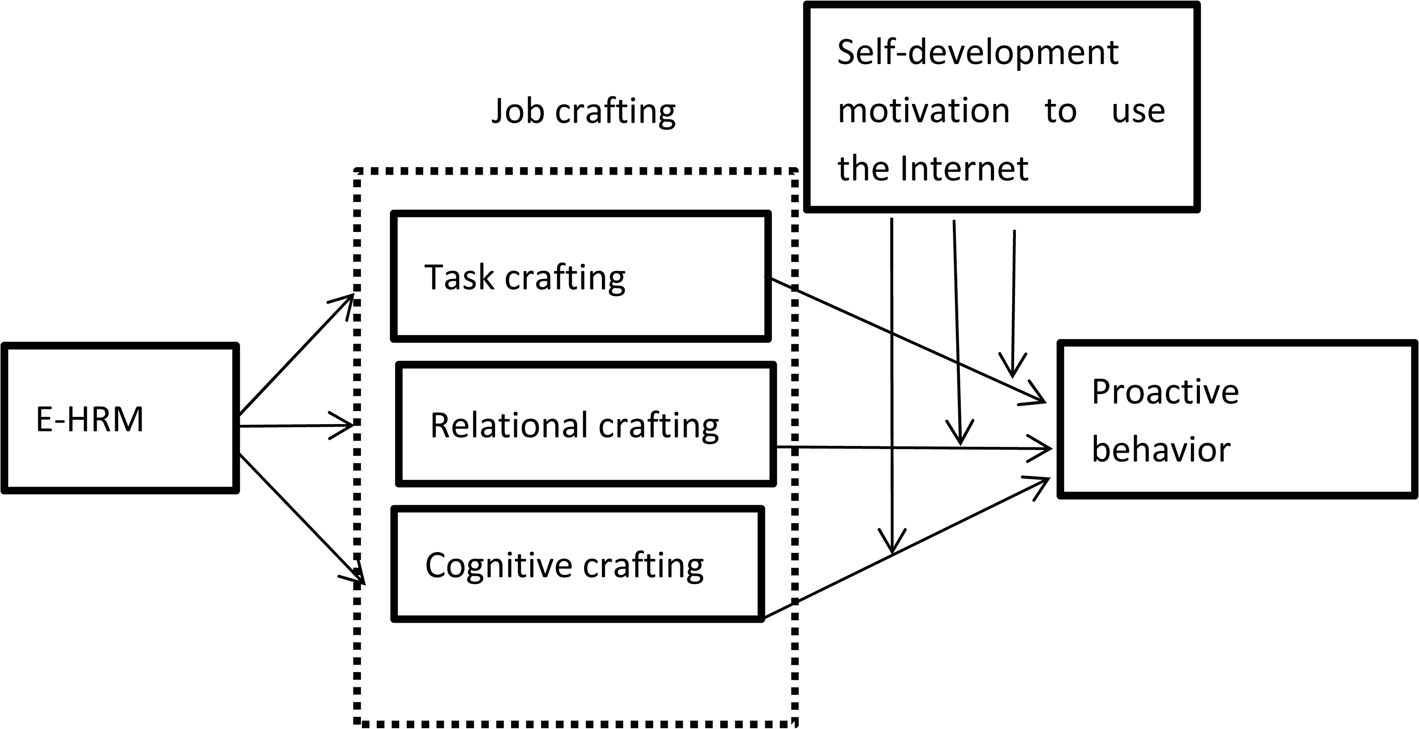
Thus, the moderating mediation model between E-HRM and employee's proactive behavior is constructed in this study, as shown in Figure 1.
Research model.

Method
Procedure and participants
Using a random sampling method, we selected 34 enterprises in China that were known to our friends and that implemented HRM informatization. A total of 1,021 questionnaires were sent to employees of these companies. The employees reported their perception of the company's electronic human resources, and they reported their self-development motivation with regard to crafting their work and using the Internet. Fifteen days after the questionnaires were collected, a paired questionnaire was distributed to direct supervisors to evaluate the proactive behavior of the corresponding employees. All questionnaires were paired by electronic questionnaires and coded to prevent any personal identity information from appearing on the questionnaires and to ensure that the requirement of anonymity was met. A total of 722 questionnaires were collected at the employee level, 746 were collected at the supervisor level, and 706 questionnaires were collected after matching. No significant deviation was found between the returned questionnaires and the non-returned questionnaires in terms of gender, educational level or job tenure.
Measures
E-HRM: According to Parry's suggestion (Parry, Reference Parry2011), E-HRM is measured based on the combination of these HRM activities and information technology. Employees evaluate the informatization of HRM activities; the following is an example item: ‘How do you think the company uses network information technology in wage management?.’ Ratings are made using a 7-point scale, where 1 represents very low and 7 represents very high; the alpha value is .890.
Employee job crafting: The scale used by Niessen et al. (Reference Niessen, Weseler and Kostova2016) contains nine items to measure job crafting, including task crafting, relational crafting and cognitive crafting. For task crafting, the following is an example item: ‘ l concentrate on specific tasks’; the alpha value is .931. For relational crafting, the following is an example item: ‘ I invest in relationships with people whom get along with the best’; the alpha value is .882. For cognitive crafting, the following is an example item: ‘ I try to look upon the tasks and responsibilities l have at work as having a deeper meaning than is readily apparent’; the alpha value is .933. Ratings are made using a 7-point scale, where 1 represents complete disagreement and 7 represents complete identification; the alpha value of the questionnaire is .831.
Employees' self-development motivation in using the Internet at work: Roy proposed that individuals have self-development motivation in using the Internet and developed four items to measure this motivation (Roy, Reference Roy2009). The following is an example item: ‘A reasonable application of network technology at work will help me better control the process of work.’ Ratings are made using a 7-point scale, where 1 represents complete disagreement and 7 represents complete identification; the alpha value is .938.
Employee's proactive behavior: Using Frese's 7 items (Frese et al., Reference Frese, Fay and Hilburger1997) and following Hong, the self-assessment questionnaire was transformed into a leadership evaluation questionnaire (Hong, Liao, & Raub, Reference Hong, Liao and Raub2016). Employee's proactive behavior is evaluated by the direct supervisor of the employee under testing. The following is an example item: ‘Whenever there is a problem in the work process, the employee will immediately take the initiative to explore solutions.’ Ratings are made using a 7-point scale, where 1 represents total disapproval and 7 represents total approval; the alpha value is .915.
The control variables include the following: gender (0 = female, 1 = male), job tenure and educational level (1 = junior college and below, 2 = undergraduate, 3 = master, 4 = doctor). In addition, following Hong, when studying employee's proactive behavior, we should control employees' proactive personality (Hong et al., Reference Hong, Liao and Raub2016). Six items of Claes, Beheydt, and Lemmens (Reference Claes, Beheydt and Lemmens2005) are used for the employee self-evaluation. The following is an example item: ‘If I find something I don't like, I will actively take measures to deal with it.’ Ratings are made using a 7-point scale, where 1 represents total disapproval and 7 represents complete identity; the alpha value is .885.
Empirical analysis and results
Measurement model
Employees' job crafting includes three dimensions: task crafting, relational crafting and cognitive crafting. The first-order three-factor measurement model was compared with the second-order measurement model. We found that there is no significant difference between the first-order three-factor model and the second-order three-factor model. According to Niessen, Weseler, and Kostova, although the higher-order factor of employee job crafting can better explain the variability of the three dimensions and aggregate the three dimensions, that is, task crafting, relational crafting and cognitive crafting, as different job crafting activities reflect different behavioral orientations of employees (Niessen et al., Reference Niessen, Weseler and Kostova2016). Therefore, this study draws lessons from Niessen, Weseler, and Kostova. On the one hand, employee job crafting is regarded as a combination factor to analyze the impact of overall crafting activities. At the same time, task crafting, relational crafting and cognitive crafting are taken as three factors to test the relevant research hypotheses and to conduct a comprehensive analysis of employee job crafting activities from the whole to the specific dimensions. We also compared the model fit, and the three-factor models are clearly better than the two-factor models, indicating that the three dimensions can be effectively distinguished, representing different conceptual meanings.
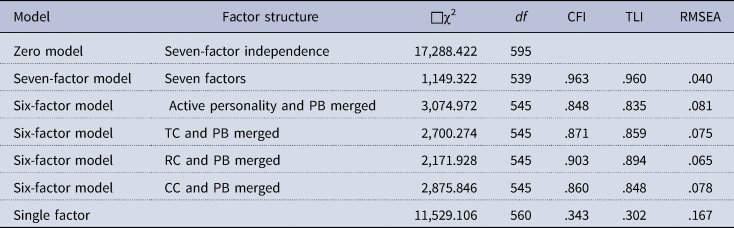
All variables involved in this study were included in the measurement model, including 7 variables and 35 items. The seven-factor model and four six-factor model are constructed. The results are shown in Table 1. In the seven-factor model, the factor load is above .628. E-HRM (average variance extracted [AVE] = .508, composite reliability [CR] = .902), task crafting (AVE = .822, CR = .933), relational crafting (AVE = .716, CR = .883), cognitive crafting (AVE = .871, CR = .953), self-development motivation in using the Internet (AVE = .791, CR = .938), employee's proactive behavior (AVE = .619, CR = .919) and proactive personality (AVE = .570, CR = .888) have good convergence validity, and the fitting index of the seven-factor model is clearly better than that of the six-factor models. To analyze the discriminant validity of the seven factors more comprehensively, the 95% confidence interval of the correlation coefficient between the factors was used for testing; it did not contain 1. The mean AVE between the factors was higher than the square of the correlation coefficient by AVE comparison. Additionally, the strict model between the two factors (the correlation coefficient between the factors was set at 1) and the free model (the phase between the factors) were analyzed by model comparison. A free estimation of the relational number and 21 pairs of comparative models were constructed; the free models were superior to the strict models.
Confirmative factor analysis of all variables

Note: AP, active personality; TC, task crafting; RC, relational crafting; CC, cognitive crafting; JC, job crafting; SDM, self-development motivation; PB, proactive behavior.
Descriptive analysis
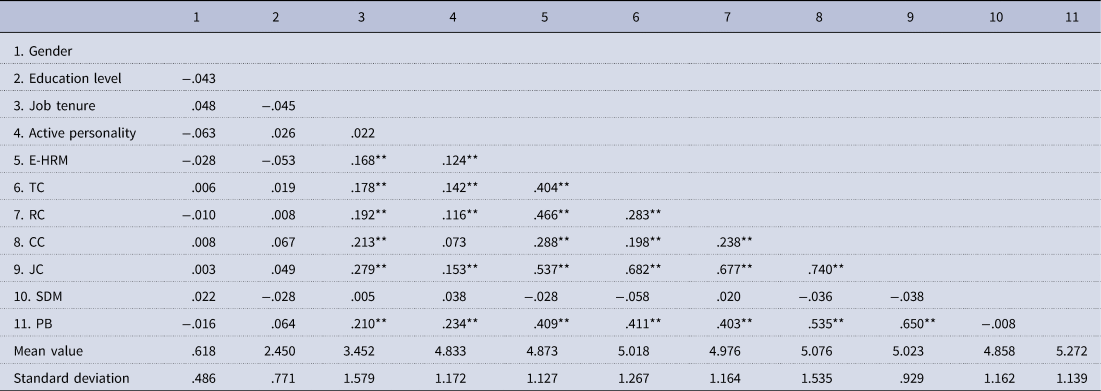
Table 2 shows the results of the descriptive statistics of the variables. There is a positive correlation among task crafting, relational crafting and cognitive crafting. The three dimensions are combined to form a new variable; this new variable has a higher positive correlation with job crafting (r = .682, p < .01; r = .677, p < .01; r = .740, p < .01), which can explain the common variation of the three dimensions to some extent. E-HRM is positively correlated with employee's proactive behavior (r = .409, p < .01); task crafting (r = .404, p < .01), relational crafting (r = .466, p < .01), cognitive crafting (r = .288, p < .01) and job crafting with combined variables (r = .537, p < .01) are significantly positively correlated. Moreover, there were positive correlations among task crafting, relational crafting, cognitive crafting, job crafting and employee's proactive behavior (r = .411, p < .01; r = .403, p < .01; r = .535, p < .01; r = .650, p < .01). After integrating the three dimensions of the job crafting concept, the correlation between job crafting and employee's proactive behavior was significantly higher than that of any single dimension.
Descriptive statistics and correlation coefficient table
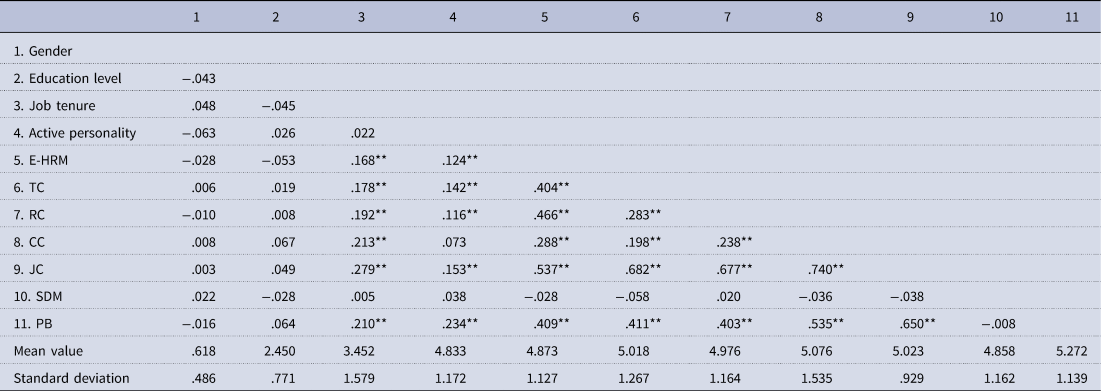
Note: *p < .05; **p < .01.
Hypothesis testing
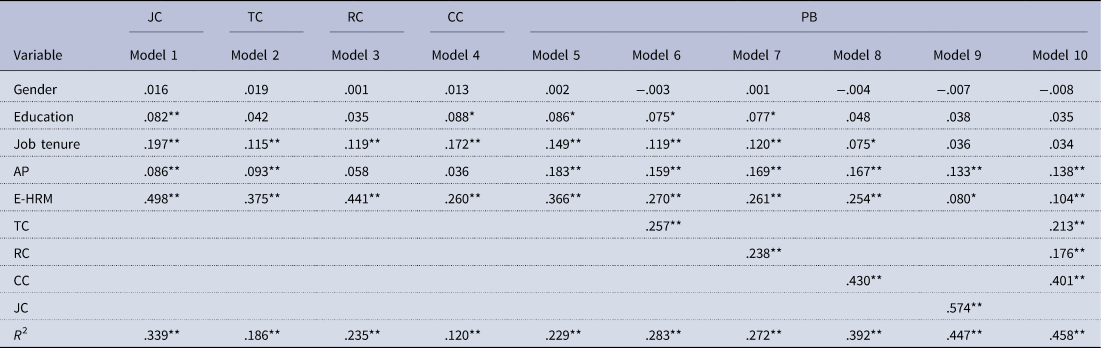
As shown in model 5 in Table 3, E-HRM has a positive effect on employee's proactive behavior (β = .366, p < .01), showing that E-HRM is indeed conducive to motivation. Hypothesis 1 on the formation of employee's proactive behavior is verified. Models 1–4 give the regression results of the effect of E-HRM on employee job crafting. The regression coefficients are significant, and hypothesis 2 is verified.
Hierarchical regression results of mediating effects
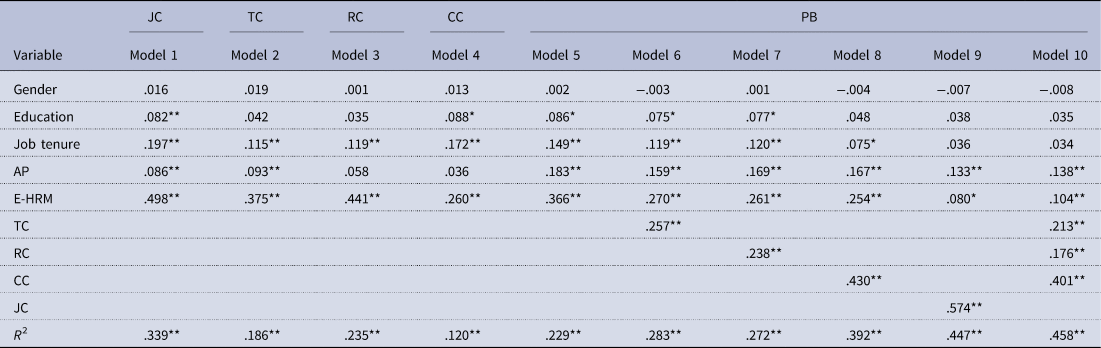
Note: *p < .05; **p < .01 .
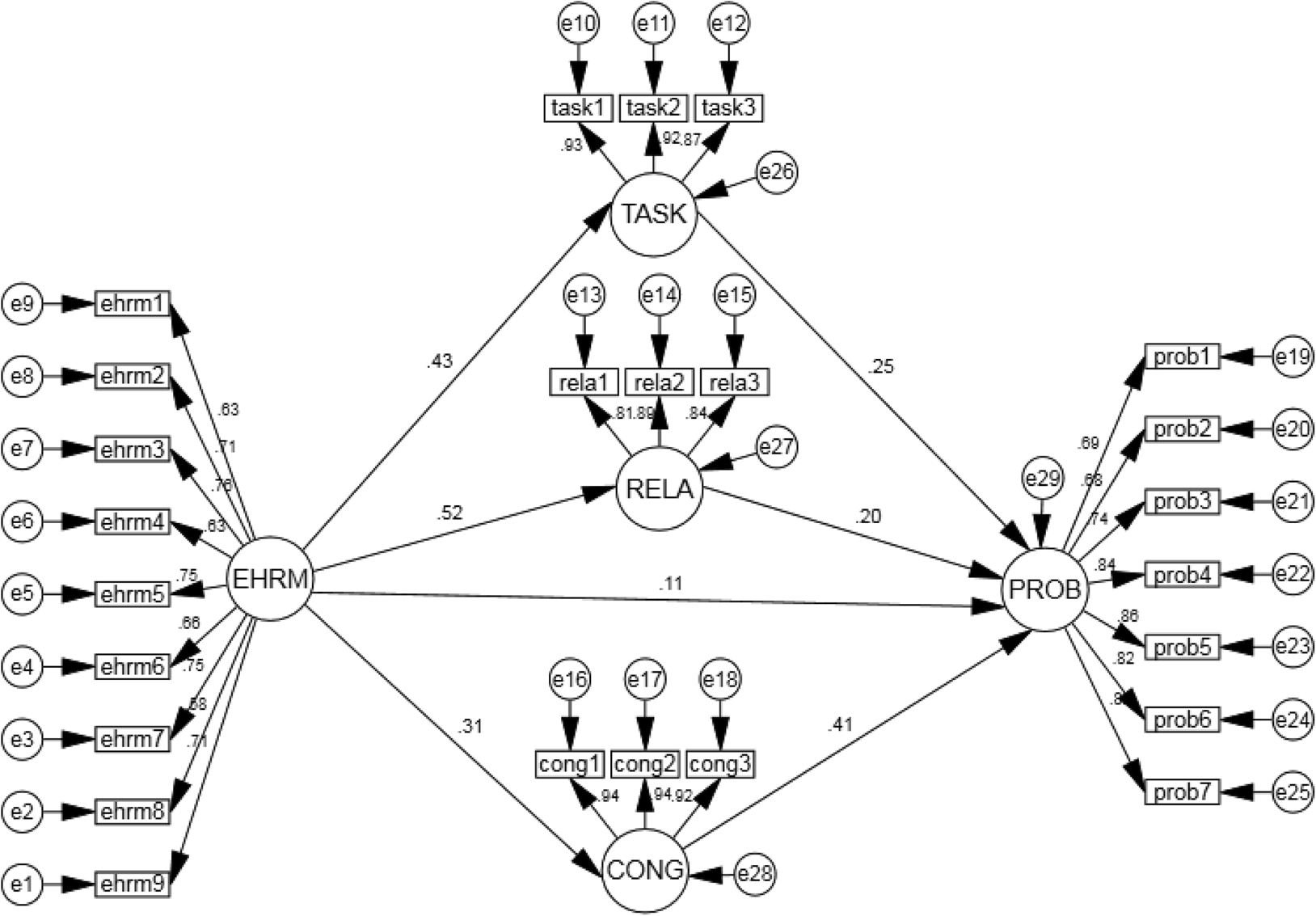
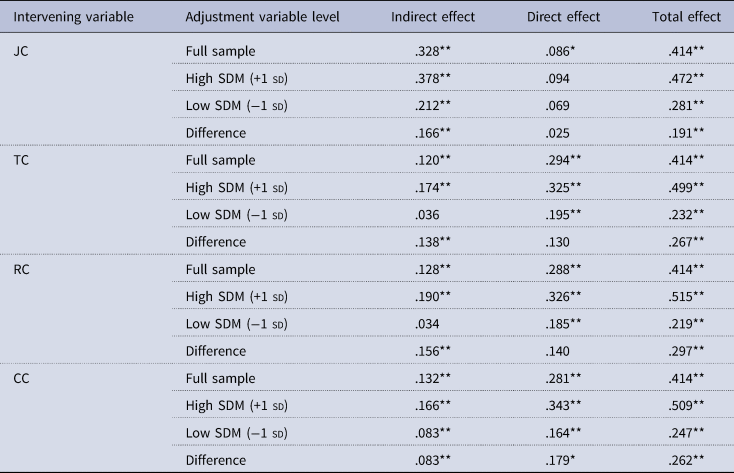
Accordingly, the formation process of employee's proactive behavior is analyzed. Hypothesis 3 considers that employee job crafting activities play an intermediary role in it. The combination concept of job crafting and the intermediary effect of the three dimensions of job crafting are verified. As shown in models 1–4, E-HRM stimulates employees' job crafting activities (β = .498, p < .01), which have significant stimulating effects on task crafting (β = .375, p < .01), relational crafting (β = .441, p < .01) and cognitive crafting (β = .260, p < .01). In model 9, job crafting has a significant effect on employee's proactive behavior (β = .574, p < .01), and the effect of E-HRM on employee's proactive behavior is reduced from .366 (unstandardized coefficient β = .370, p < .01) in model 5 to .08 (unstandardized coefficient β = .081, p < .05) in model 9. Similarly, in models 6 and 7, the task crafting (β = .257, p < .01), relational crafting (β = .238, p < .01) and cognitive crafting (β = .430, p < .01) of employees all show a positive effect on their proactive behavior, and the influence coefficient of E-HRM on employee's proactive behavior is lower than that of model 5, which is .270 (unstandardized coefficient β = .273, p < .01) in model 6 and .261 (unstandardized coefficient β = .264, p < .01) in model 7. In model 8, it was reduced to .254 (unstandardized coefficient β = .257, p < .01). Model 10 also incorporates the three dimensions of job crafting into the model. The influence of the three dimensions on employee's proactive behavior remains significant. After controlling the influence of the three dimensions, the impact coefficient of E-HRM is reduced to .104 (unstandardized coefficient β = .105, p < .01). Combined with models 5–10, the influence coefficient of E-HRM is reduced after adding the intermediary variables, which preliminarily verifies Hypothesis 2 about the intermediary effect. To more fully analyze the mediation effect, bootstrapping (1,000) is conducted to estimate the indirect effect of E-HRM on employees' job crafting and proactive behavior; Mplus 7.0 is used, and the results are shown in Table 5. Based on the data of the whole sample, the indirect effects of job crafting (θ = .328, p < .01), task crafting (θ = .120, p < .01), relational crafting (θ = .128, p < .01) and cognitive crafting (θ = .132, p < .01) are significant, indicating that the mediating effects considered in Hypothesis 3 exist. Furthermore, AMOS24 was used to validate the full model, and results are shown in Figure 2 (χ2 = 816.54, df = 268, GFI = .912, CFI = .954, TLI = .949, RMSEA = .054). The indirect effect between E-HRM and employee proactive behavior is .317 (p < .01), which better explains the mediating role of job crafting.
Test results of structural equation model. Note: task stands for task crafting, rela stands for relational crafting, cong stands for cognitive crafting and prob stands for proactive behavior.
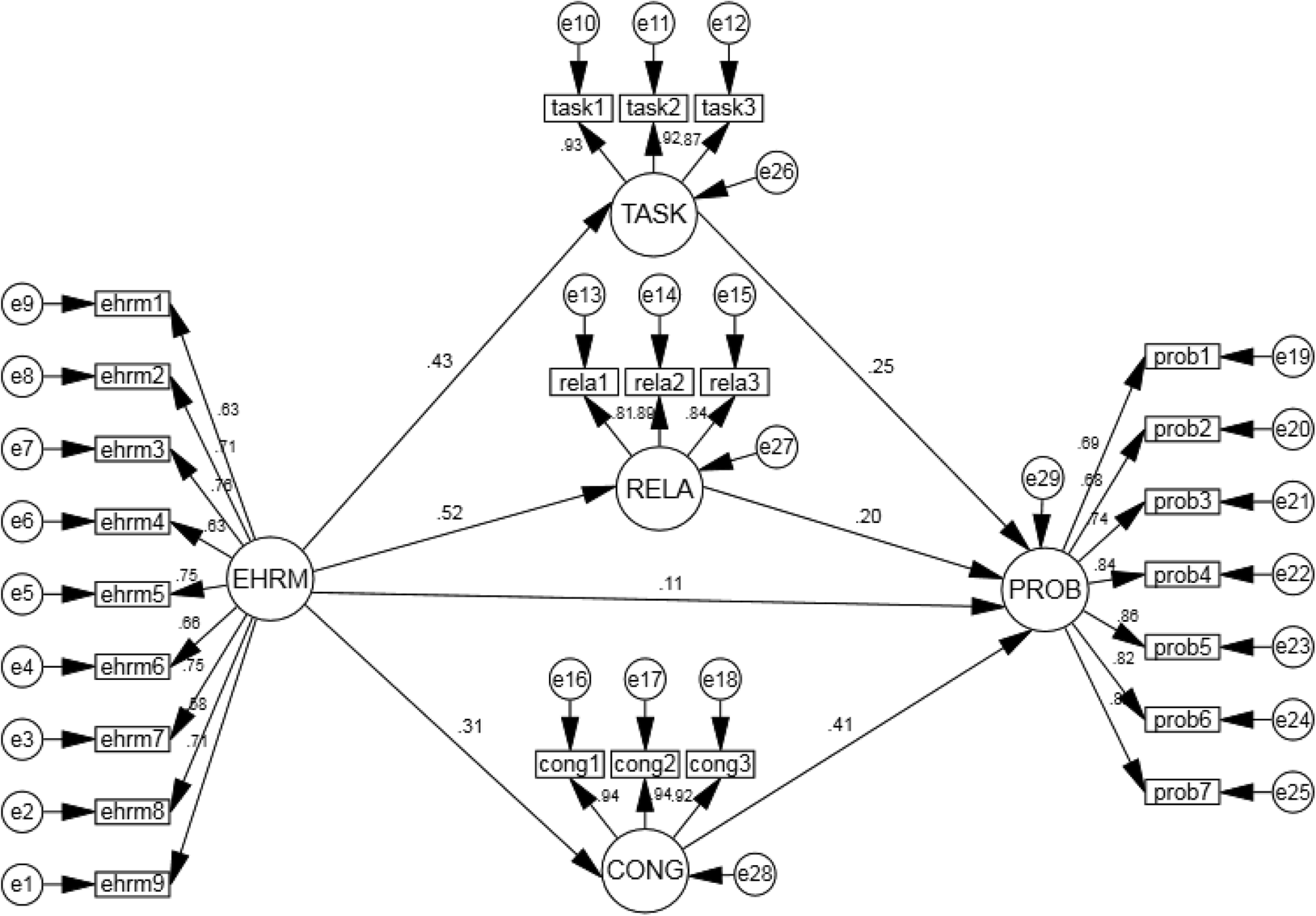
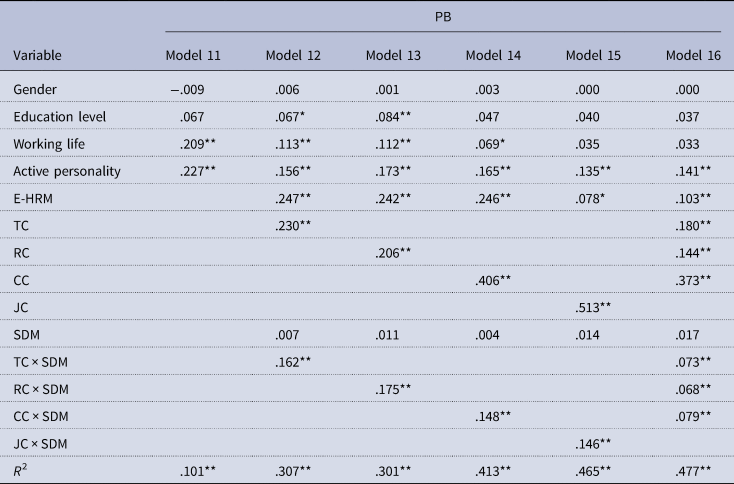
Table 4 shows the results for Hypothesis 4 with regard to the moderating effect. Self-development motivation had significant moderating effects on task crafting (β = .162, p < .01), relational crafting (β = .175, p < .01), cognitive crafting (β = .148, p < .01) and job crafting (β = .146, p < .01). Model 16 incorporates task crafting, relational crafting and cognitive crafting into the model. Considering the moderating effect of employees' self-development motivation to use the Internet on the three dimensions, the moderating effect is still significantly positive.
Moderated mediation regression results
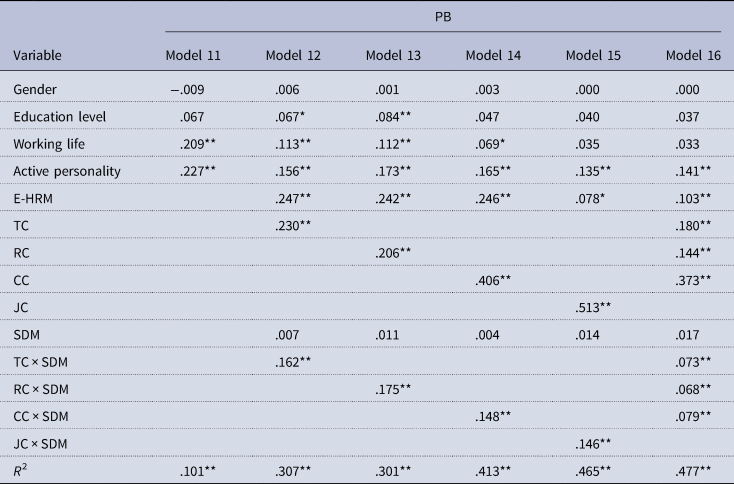
Note: *p < .05; **p < .01.
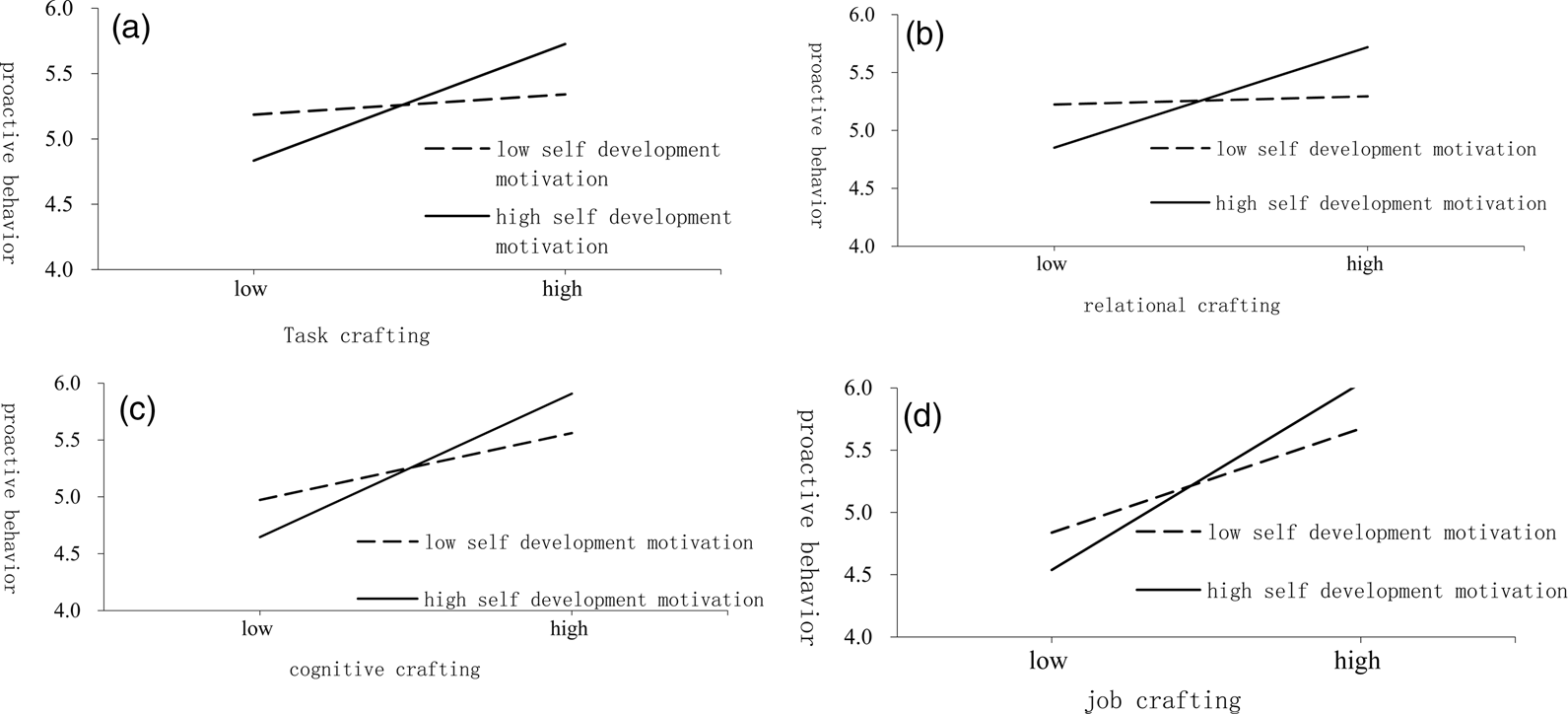
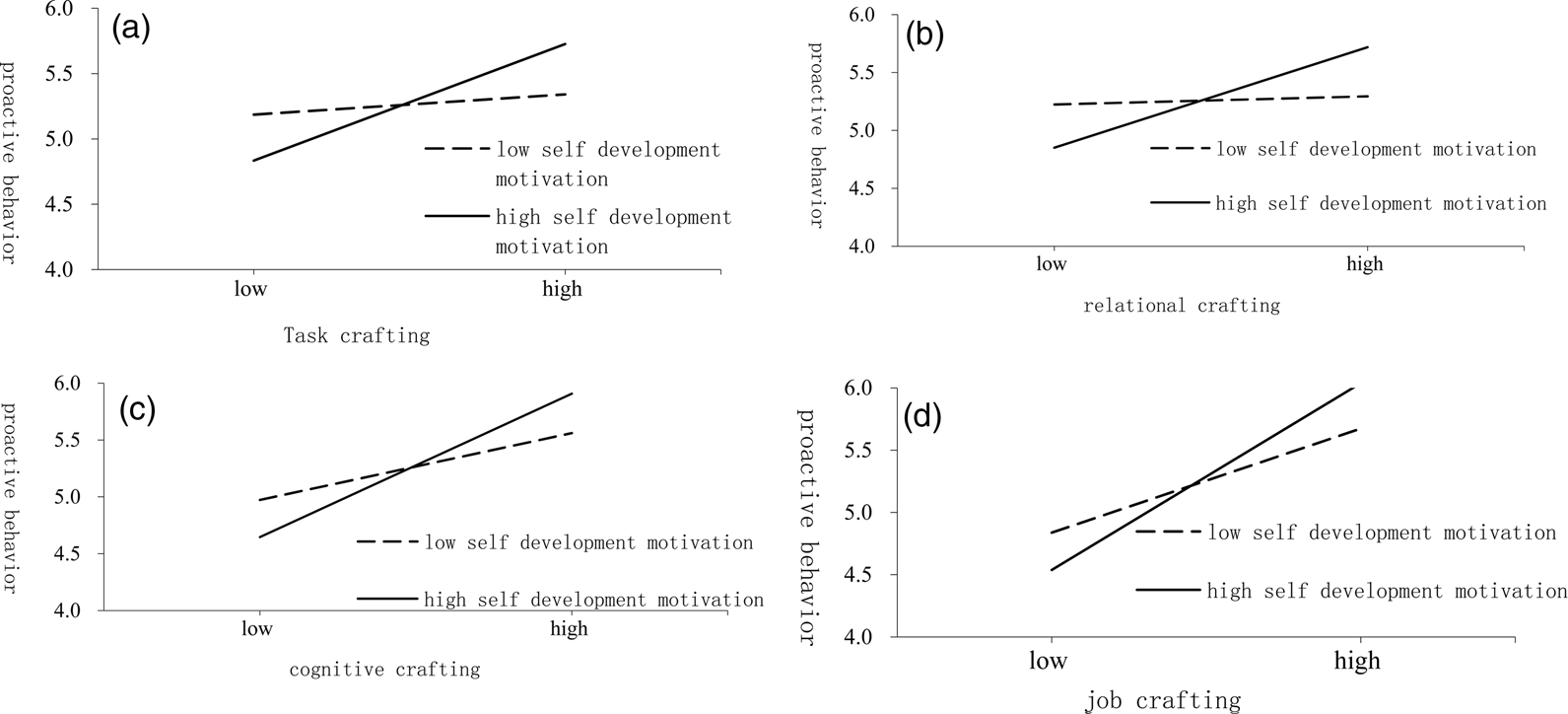
This paper illustrates the moderating effect of self-development motivation in Figures 3a–3d. Based on a standard deviation higher than the mean and a standard deviation lower than the mean, it depicts the promotion effect of job crafting on employee's proactive behavior at different levels of self-development motivation. Figures 3a–3d show that when employees use the Internet with a high level of self-development motivation, the three specific job crafting activities and the overall job crafting of employees show a stronger promotion effect than a low level of self-development motivation. Hypothesis 4 is verified. However, Figures 3a–3d also show that although a high level of self-development motivation can strengthen the role of job crafting in promoting employee's proactive behavior, in the case of a low level of work job activities, the proactive behavior of employees with a high level of self-development motivation is lower than that of employees with a low level of self-development motivation. Perhaps this result is because the job crafting involved in this study is an adaptive process of employee self-orientation. In the process of enterprises' E-HRM reform, if employees do not make the corresponding adaptive adjustment, the stronger their self-development motivation is, the easier will be because they cannot match the new environment, thus strengthening their discomfort in the work process, and the more unfavorable it will be to showing positive work behavior.
(a) Moderating effect of self-development motivation on the relationship between task crafting and proactive behavior. (b) Moderating effect of self-development motivation on the relationship between relational crafting and proactive behavior. (c) Moderating effect of self-development motivation on the relationship between cognitive crafting and proactive behavior. (d) Moderating effect of self-development motivation on the relationship between job crafting and proactive behavior.
Using Mplus 7.0, this paper conducted bootstrapping (1,000) to estimate the mediating effect of Hypothesis 5. The results in Table 5 show the mediating effect of the three specific activities of job crafting on the relationship between E-HRM and employee's proactive behavior under different levels of employee self-development motivation, namely, the indirect effect shown in Table 5, and the difference in this indirect effect in the comparison of different levels of self-development motivation. The indirect effects of job crafting activities and the three specific activities on employees' different self-development motivation levels were significantly different, and the indirect effects of job crafting (Δθ = .166, p < .01), task crafting (Δθ = .138, p < .01), relational crafting (Δθ = .156, p < .01) and cognitive crafting (Δθ = .083, p < .01) were significantly positive, indicating that employees used the Internet in their work. Self-development motivation positively regulates the mediating effect of job crafting, which is consistent with Hypothesis 5 and verified by Hypothesis 5.
Effects of different levels of self-development motivation
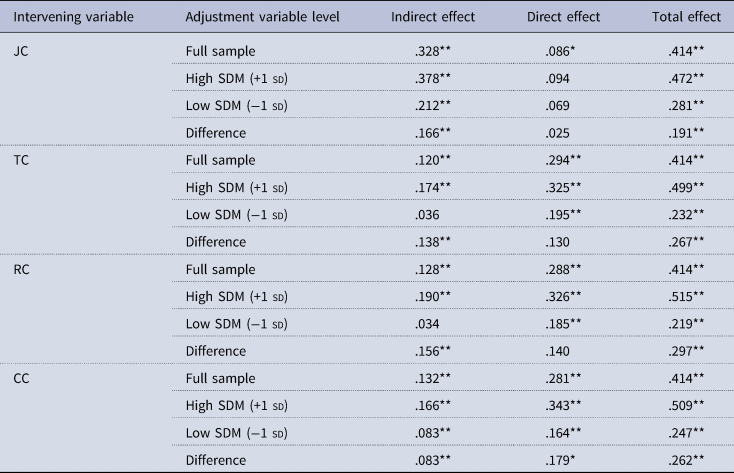
Note: *p < .05; **p < .01.
All coefficients are estimated by bootstrap (1,000).
Discussion
The essence of E-HRM is employee participatory interactive management with the help of network technology, which reflects the distribution and cooperation of employees and self-service (Grant & Newell, Reference Grant and Newell2013). This study considers that the effectiveness of employee behavior is an important basis for enterprises to successfully realize the strategic value of E-HRM. Accordingly, this study explores the impact of E-HRM on employee's proactive behavior in the Internet age from the employee job crafting perspective. This study found that (1) E-HRM can stimulate employees' initiative; (2) employees' job crafting plays a greater mediating role in the process of this impact and (3) employees' self-development motivation to use the Internet in their work plays a regulatory role and can guide self-oriented job crafting in a more positive direction in line with organizational expectations.
Theoretical contributions
Given the development of the ‘Internet+’ era, E-HRM has responded to the new requirements of HRM in the Internet economy. Based on the existing literature, this study considers that employees are the key subjects of the successful implementation of E-HRM in enterprises, and it makes three theoretical contributions.
First, it focuses on the specific management functions of enterprise Internet transformation research and analyzes the impact of the Internet on the transformation of HRM informatization. Although E-HRM is a research field closely related to information technology, there is no specific view on E-HRM in the existing information technology research (Geffen, Ruel, & Bondarouk, Reference Geffen, Ruel and Bondarouk2013). E-HRM has both technical and organizational characteristics. Almost all the existing studies tacitly approve that the introduction of information technology will directly produce positive effects. Although it affirms the contribution of information technology to the development of HRM, it ignores the management changes in organizational factors accordingly. This study analyzes the change of E-HRM and its positive impact on the formation of employee behavior, integrating the original technical perspective with the perspective of organizational factors.
Second, we measure the effectiveness of employee behavior from the perspective of employee's proactive behavior and analyze the special subjectivity and value creation function of employees in the Internet era. Based on the background of the Internet economy, this study explores the formation of E-HRM and its role in promoting changes in the traditional work mode. However, if E-HRM is not specifically implemented, its potential advantages cannot be automatically translated into value realization. Most existing studies combine the technology acceptance model to analyze employees' intention to use or user satisfaction. However, in the ‘Internet+’ context, which emphasizes open innovation and cross-border integration, E-HRM is the key to motivating employee initiative. More importantly, in addition to strengthening the means of information technology, E-HRM has brought into full play the main role of employees in the network era. E-HRM emphasizes the organizational concept of the employee as the core. Combining the needs of the times and the characteristics of E-HRM, studying employee's proactive behavior is more meaningful than studying employees' general technology acceptance behavior.
Third, the concept of job crafting is introduced to analyze the role of employee self-adaptive activities in management change. Previous studies on change mostly regard it as a system design to analyze the top-down impact results, but the success of change lies not only in the organization itself but also in employees' response to change. Based on the theory of job adaptation, this study considers that the new network environment and management mode created by E-HRM will inevitably trigger employees' adaptive response mechanism. Although some studies have analyzed employees' response to change based on organizational learning, resource acquisition and other aspects (Xie, Yao, Jinghua, & Xuehua, Reference Xie, Yao, Jinghua and Xuehua2016), they neglect employees' adaptive needs and corresponding response process. This study introduces the concept of job crafting, highlights the self-directed characteristics of employees' job crafting activities, explores the mediating role of job crafting and combines the moderating role of employees' self-development motivation to analyze the consistency between employees' individual development goals and organizational strategic goals. The introduction of the job crafting concept combines the top-down design of management change with the bottom-up self-adaptation of employees and supplements research on employees' change coping behavior.
Implications for managerial practice
This study has the following implications for management practice.
First, enterprises should carefully design the E-HRM mode to meet the needs of the initiative of employees in the new era by integrating organizational and technical factors. In the Internet age, employees have a stronger tendency to use information network technology. This study confirms that E-HRM helps to stimulate employees' positive behavior. The development of E-HRM activities may involve enterprise level, management process, management flexibility, knowledge management, etc. In view of this, when designing the E-HRM mode, enterprises should consider the above aspects in combination with their own actual situation, so as to more effectively implement the positive role of E-HRM in the specific behavior of employees.
Second, although improving the work autonomy of employees, the collection and management of work information should be strengthened by taking the advantage of data visualization. The advantages of E-HRM lie both in that it can enhance the autonomy of employees, and in that it can greatly reduce the cost of information collection and processing. Employees need to have strong self-orientation to deal with the job crafting triggered by changes. On the premise of not infringing employees' privacy, the rapid collection and timely processing of work information can help enterprises effectively control the behavior deviation caused by employee self-orientation. Moreover, the visualization and availability of information also help to provide useful information for employees to make correct autonomous decisions.
Third, in the process of HRM information transformation, employees are needed to be actively guided. The management mode consistent with the employees' own development needs is easier to stimulate the employees' positive reaction and make the behavior change consistent with the organizational goals. The study validated the positive moderating effect of employees' self-development motivation. By the ways of knowledge sharing, information communication and training, employees can be guided to understand the essence of E-HRM, which is to provide more opportunities for their personal so as to meet their needs of self-development motivation.
Limitations and future research directions
This study verifies the mediating role of job crafting based on three dimensions: task crafting, relational crafting and cognitive crafting. However, this study does not distinguish the different mechanisms that may exist in the three dimensions. Follow-up studies can analyze the differences among task crafting, relational crafting and cognitive crafting according to different change situations, as well as the possible internal logical relationships among them. In addition, Wrzesniewski and Dutton suggest combining individual motivation to analyze the impact of job crafting on behavioral outcomes (Wrzesniewski & Dutton, Reference Wrzesniewski and Dutton2001). This study selected self-development motivation as a moderator variable, and further research can be conducted to explore the impact of other types of individual motivation.
Acknowledgements
We would like to acknowledge funding from the National Natural Science Foundation of China (Nos. 71872042 and 71702077), the National Social Science Foundation of China (No. 20AGL020), and the Fundamental Research Funds for the Central Universities (2242019K40169).