During the 1990s and early 2000s technology-related payments and receipts—e.g., license fees and patent royalties—increased sharply in OECD countries. In 2005 the average value of imports and exports of technology equaled about 0.55 percent of GDP. This is, compared to the value of trade in goods and services of about 25 percent of GDP in 2005, a small, but still significant amount, representing a value of circa $190 billion. This exchange of technology should make all participants better off since standard arguments as in the case of trade in goods and services are at work: division of labor and specialization of production foster growth and efficiency. Beyond standard gains from trade arguments, however, trade in technology has a significant additional effect on welfare. The public good character of innovations allows multiple users to combine research and development (R&D) efforts and to employ the same innovation. Consequently, trade in technology enables producers to draw the best innovation from a larger pool of inventions. This, in turn, shifts the production possibility frontier of all participants outwards and increases per capita income.Footnote 1 This argument also applies to technology transfer within countries. A thriving exchange of technology within a country should increase per capita income and productivity. Investigating this link requires information about within-country technology flows. Such a data set is presented and described in this article.
Historical studies of within-country technology transfer and studies of patent transfers within countries mainly use U.S. data. B. Zorina Khan and Kenneth L. Sokoloff, Khan as well as Naomi Lamoreaux and Sokoloff showed that a patent market already existed in the United States during the mid-nineteenth century.Footnote 2 In particular, Lamoreaux and Sokoloff demonstrated that one-third of U.S. patents were fully or partially assigned after issue by the inventor.Footnote 3 During the 1870s inventors commercialized their ideas themselves, but at the same time they often granted geographically bounded licenses to producers in distant regions. At the turn of the century, innovation and commercialization were increasingly separated activities and specialized inventors sold or licensed their patents to firms.Footnote 4 The processes culminated with the outsourcing of research tasks and close collaboration between in-house researchers of manufacturing firms and specialized free-standing research laboratories.Footnote 5 The complementarity of outside inventors and in-house research and the transfer of technology over larger geographic distances are also highlighted by Tom Nicholas.Footnote 6 He shows that the distance between assignee and assignor was often too large to reflect patent assignments of employed inventors.Footnote 7 Inventors living outside commuting distance to firms were most likely freestanding innovators selling patents to firms. This indicates a specialization between inventors and producers.
This article offers new evidence of technology transfer outside the United States by analyzing the patent transfer register of Germany's Imperial Patent Office. Until now, there has been only scattered evidence that a market for patents existed in Imperial Germany. For example, on 1 August 1908, the Darmstadt-based pharmaceutical firm E. Merck and Dr. M. K. Hoffmann, a chemist from Leipzig, sealed a contract regulating the transfer of patent number 185,600. After signing the contract, Merck paid a fixed amount of 500 marks to Hoffmann. Moreover, after successful clinical trials and in case of a successful market launch, the inventor would receive 900 marks plus a profit share of 20 percent.Footnote 8 But apart from these scattered case studies, little is known. We, however, can demonstrate that many patents were transferred in Germany between the enactment of the first national patent law in 1877 and the Great War. Transfer activity grew over time, in absolute numbers as well as in relation to the number of patents in force. The dominant actors were firms: some two-thirds of all patents transferred were acquired by firms. In contrast, only about one-third of transferred patents originated in firms. About two-thirds of all transfers were arranged within the first three years after the issue of a patent, giving potentially a long period of monopoly protection to the acquirer.
Germany is a particularly promising area of research for several reasons. First of all, professional R&D management by corporations emerged at about the same time in Germany as in the United States and much earlier than in most other countries. Corporate R&D laboratories were founded in the 1870s and 1880s in the German chemical and pharmaceutical industry, about the same time they were established in the same industries in the United States, whereas the British chemical and pharmaceutical industries lagged well behind.Footnote 9 In electrical engineering, centralized R&D facilities were set up during the interwar period in the United States and Germany and decentralized experimental stations and product development laboratories existed before 1913 in both countries.Footnote 10 Second, the German patent law enacted in 1877 most likely fostered the development of a market for technology. German patents represented secure property rights, since the patent office thoroughly evaluated the innovativeness of the patent and patent infringements were mostly settled between the publication of a patent application and the issue of the patent.Footnote 11 The security of property rights was a major precondition for the emergence of the American patent market, and we can expect a similar effect in Germany.Footnote 12 Furthermore, a German patent had to be put into use within three years after issue, meaning that the owner of a patent had to supply the patented product or process at a reasonable price if demand appeared.Footnote 13 In addition, comparatively high patent fees gave cash-constrained inventors an incentive to transfer their patents. The fee for the first year of protection was higher than the monthly income of an average worker and the fees for the following years were even higher.Footnote 14 Finally, patents were issued to the person registering the patent at the patent office, and not necessarily to the true inventor. Consequently, inventions made by employed inventors were registered by the firms employing them and not by the employees.Footnote 15 Thus, the German patent transfer data do not include the transfer of patents within firms and potentially give a much more precise picture of technology market transactions than U.S. data.
The German patent system differs from the United States and United Kingdom systems in several respects.Footnote 16 In the United States, a stringent technical examination of the patent and the issue of the patent to the true inventor was the norm, whereas the German patent was, after a detailed technical examination, registered for the first person or firm filling a patent application. There were no patent fees in the United States, whereas patent fees were substantial in Germany. Britain, on the other hand, did not implement a technical examination of patents and raised patent fees. The fees for the maximum length of protection were 154 pounds (about 3,100 marks), substantially less than in Germany, where the maximum fee for 15 years of protection amounted to 5,300 marks. Assessing the technical feasibility and novelty of the patent implied a minimum technical standard of U.S. and German patents— in contrast to British patents. Comparatively high annual patent fees quickly separated valuable from worthless patents in Germany, but not in the United States and Britain, since patent fees were absent in the United States and since they had to be paid in multi-year intervals in Britain. These two features of the German patent system should assure potential buyers of a relatively high quality of the patents offered.
This research gives us a potential glimpse at the microeconomic foundation of the knowledge spillovers in Imperial Germany that have been highlighted in the recent literature.Footnote 17 The research on knowledge spillovers is based on a data set of all “valuable patents” (meaning those in force for at least ten years) and their distribution over different regions and industries. Spatial and sectoral correlations are interpreted as knowledge spillovers. In Germany, interindustry knowledge spillovers between technologically, economically, and geographically related industries were a major source for further innovative activity during the German industrialization: regions close to innovative regions became more innovative, industries close to technological similar industries became more innovative.Footnote 18 Case studies for Baden and the dyestuff industry have been put forward to support the general finding.Footnote 19 Patent data thus suggest a significant impact of knowledge spillovers on innovation in Germany at the turn of the twentieth century. But these findings do not reveal how technology spilled over from one agent to another: new technology might have been embodied in products, it might have worked through the labor market, or it might have functioned via the observation of new products and processes. Patent transfers are yet another possible channel for spillovers of knowledge—and that is the channel we analyze.
HISTORICAL AND INSTITUTIONAL BACKGROUND
Germany's rise to one of the leading industrial economies during the second half of the nineteenth century is often ascribed to its ability to innovate. Indeed, the growth of total factor productivity (TFP) accounts for about one-quarter of the output growth in German industry between 1851 and 1913. Moreover, TFP growth in the industrial sector accelerated substantially during the 1890s and the structure of the economy changed such that industries with surging labor productivity increased their employment share.Footnote 20 Inventions played a particularly significant role in the success of Germany's chemical and electrical engineering industries and in general the inventive activity of the modern sector was fostered by Germany's excellent system of higher education, substantial governmental support for science, and the emergence of industrial research laboratories.Footnote 21 The increasing innovative capacity of the German economy is reflected in the rising number of patents granted as well as in the rising number of economically valuable, long-living patents granted (see Figure 1).
NUMBER OF PATENTS GRANTED IN GERMANY, 1877–1913, AND SHARE OF VALUABLE PATENTS

The innovations behind TFP and labor productivity growth can be developed by firms, by nonprofit organizations such as universities, or by individual inventors. In general, innovations are used by firms and it thus seems important for growth that valuable patents be transferred to firms. The transfer can be carried out in different ways. An existing firm can generate patents in-house or acquire them on the technology market. Some firms in the German chemical, pharmaceutical, and electrical engineering industries, for example, hired researchers to produce innovations in-house. In their work contracts, these researchers transferred the property rights of innovations in their working contracts to the firms.Footnote 22 Moreover, firms acquired innovations from outside inventors using licensing contracts.Footnote 23 The licensing contracts were only a partial transfer of the patent, whereas the patent transfers analyzed in this article transferred the full patents rights. Alternatively, a new firm can be created to exploit the patent, which will be easier if financial markets are efficient and if the legal costs of establishing a new firm are not high. Furthermore, an existing firm can change its legal organization to facilitate access to finance and reduce the risks for the firms’ owners. A partnership, for example, can be transformed into a joint stock company. From a legal perspective, such a change in the legal form of the enterprise involves a transfer of all patents from the old to the new firm.
Secure property rights are essential if markets for technology are to emerge. Khan and Sokoloff and Khan highlight this point for the emergence of a patent market in the United States during the first half of the nineteenth century and we can expect a similar relevance of secure property rights for late-nineteenth-century Germany.Footnote 24 Fortunately, intellectual property rights in Germany were highly secure from 1877 onwards. First of all, each patent application was assessed by the patent office regarding novelty, potential conflicts with existing patents, and technical feasibility. In a next step, the patent application was published and an appeal against the patent could be made during a period of six weeks. Only if no convincing appeal was made, the patent was finally granted.Footnote 25 Between 1877 and 1913 about 60 percent of the patent applications did not pass the technical examination by the patent office. In addition, 1.5 percent of the published patent applications were appealed and not granted. Once the patent was granted, it represented a very secure intellectual property right: only 0.3 percent of the patents were repealed by the patent office. Moreover, the number of patent infringements was extremely low and only a few dozen cases were brought to the court each year.Footnote 26 Consequently, a large number of secure patents were available for transfers.
Furthermore, two features of the German patent law may have stimulated the transfer of patents. First, the law stipulated the application of a patent within three years after issue. If the patent was not put into use by the patentee and if consumers demanded the protected product or process, the patent office had to annul the patent. Second, the patentee had to pay an annual fee to keep the patent active. This fee was 50 marks for the first year and 50 marks for the second year of protection, but thereafter the fee increased substantially by 50 marks per year up to the maximum annual fee of 700 marks for the fifteenth and final year of protection. Thus, the cumulated fee over the maximum period of patent protection of 15 years was 5,300 marks, about 6.5 times the annual per capita income in 1913. Both regulations were disadvantageous for cash-constrained patent holders, since they needed cash to pay the patent fees and since some investments were presumably necessary to put a patent into use. The financing of innovations is obviously closely related to the organization of innovation, but it is a topic beyond the scope of the current study.Footnote 27
DATA SOURCES
Patent transfer data were published annually by Germany's Imperial Patent Office for the years 1884–1887 and 1889–1913.Footnote 28 We collected transfer data using the annual Verzeichnis der vom Kaiserlichen Patentamt im Jahre […] erteilten und noch in Wirkung stehenden Patente. This annual register includes a table of patent transfers containing the name and place of residence of the new patent holder. Using the patent number, we identified the year of issue of the patent and—but only for a random subsample of 4,014 of the transferred patents—the name and place of residence of the original patent holder. We also employed the patent number to determine the total lifetime of the patent via the same annual registers.
While the data contain a lot of information, four potential shortcomings should be kept in mind. First, the annual register of patent transfers did not contain all transferred patents. More specifically, a patent transfer agreed upon between issue of the patent and the publication of the next patent yearbook (usually in March of the following year) was not listed in the transfer register. Consequently, transfers at the time when the patents were first issued, which were important in the United States, are not covered by my data. In contrast to the United States, inventions of employed inventors, which account for more than half of all transfers when patents were first issued in the United States, were registered by the firms employing the inventor in Germany.Footnote 29 Thus, they should be less relevant in Germany.Footnote 30
The second drawback of my data set is the fact that some transfers were done for legal reasons: patents were regularly transferred if the legal form of the firm holding the patent changed. Such patent transfers are, however, not necessarily caused by an economic motive related to the patent itself. It is possible, however, that the change in the legal form was done to improve the access to financial capital needed to put the patent into use. Whatever the reason for the transfer, we coded it as a transfer due to change in the legal form of enterprise. Furthermore, transfers from an individual to another individual as an inheritance were registered by the patent office and coded accordingly.
Third, we have to address a standard issue in empirical investigations of patents, namely the question about the economic value of patents. In an ideal world, we would like to know the social and private returns of a patent. However, this information is generally unavailable. In particular, we do not observe prices paid for patent transfers—notwithstanding some examples from archival sources. Standard proxies for the value of patents are the number of years a patent is in force, the patent fees paid, and the number of citations received.Footnote 31 Citations are unavailable for late-nineteenth- and early-twentieth-century German patents. In contrast, the two other proxies for the value of a patent are available: the number of years a patent was in force and the fees paid. My preferred proxy is the patent fee, since it is a more precise lower-bound estimate of the private value of a patent. The design of patent fees implies that the costs of keeping a patent in force for a fixed number of years after a transfer depended on the number of years the patent was in force before the transfer. If, for example, a patent was kept in force for a period of five years after the transfer, the cumulated fee for a patent transferred three years after issue was 1,250 marks, whereas the cumulated fee was 1,750 marks if the patent was transferred five years after issue.
Censoring is a final drawback of my data. Patent transfer data were not published for the years after 1913. Consequently, statements regarding the fraction of patents issued during a year and transferred later on are downward biased for all patents granted after 1899, because the maximum lifetime of a patent was 15 years and hence these patents could have been transferred after 1914. In practice, about 80 percent of all patent transfers were accomplished during the first four years after issue. Therefore, censoring may be problematic for patents issued during and after 1910.Footnote 32
DATA ANALYSIS
During 1884–1887 and 1889–1913, 219,513 patents were granted in Germany. Out of those patents, 18,135 (8.3 percent) were transferred at least once, making the rate of transfers close to that (13.5 percent) in the United States between 1983 and 2002.Footnote 33 But the German patent market was much less liquid than the historical U.S. patent market: data collected by Lamoreaux and Sokoloff for a sample of patents issued in 1870/71, 1890/91, and 1910/11 show, for example, that 34 percent of American patents were assigned after issue.Footnote 34
Figure 2 shows the evolution of the number of transactions over time. The total number of transactions carried out during 1884–1887 and 1889–1913 was 20,657.Footnote 35 Moreover, at least 505 transactions were accomplished between 1877 and 1883. The number of patent transfers not only increased in absolute terms, but also relative to the number of patents in force. A total of 68.4 percent of patents were transferred within three years of the patents’ issue: 30.9 percent during the first year after issue, 21.6 percent during the second year, and 15.9 percent during the third year. The reason for this is clear. First, the patent law dictated that all patents had to be put into use within three years after issue. Consequently, inventors without the ability to use the patent themselves had an incentive to transfer it within the first three years after issue. Second, the number of years with patent protection is declining in the age of the patent: if a patent had an economic value, it paid to put it to use as soon as possible.
PATENT TRANSFERS IN IMPERIAL GERMANY, 1884–1913

The patent transfer data also show that the average lifetime of transferred patents was higher than that of patents which were not transferred. On average, patents granted between 1891 and 1913 had an average lifetime of 4.6 years, whereas patents granted and transferred during this period had an average lifetime of 7.7 years. The market for patents was thus not a market for lemons.
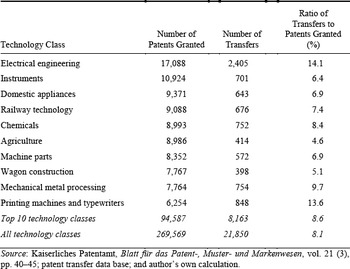
Table 1 contains the ten technology classes with the largest number of patents granted as well as the number of patent transfers, and the ratio of the two. About 35 percent of all patents were granted in these ten technology classes and more than 37 percent of all transfers were registered in these ten technology classes. Thus, the most innovative branches were only slightly more likely to experience technology transfer.
INTENSITY OF PATENT TRANSFER

Source:
Kaiserliches Patentamt, Blatt für das Patent-, Muster- und Markenwesen, vol. 21 (3), pp. 40–45; patent transfer data base; and author's own calculation.
The largest number of transfers was registered in electrical engineering with 2,405 transfers, equal to 14.1 percent of all patents granted in this technology class during this period. Another active technology field was printing machines and typewriters with 848 transfers (13.6 percent of all patents granted). Other technology fields do not display high levels oftransfer activity. The least active of the larger technology fields were agriculture and wagon construction with transfer ratios of 4.6 and 5.1 percent, respectively. Moreover, one should note that firms from the dyestuff industry, which was prominent for the early establishment of in-house R&D capacities, were less active on the market for technology than the average: just 7.3 percent of the dyestuff patents were transferred.
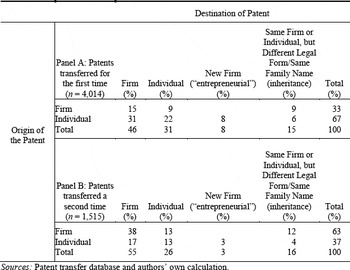
Who then participated in the patent transfers (Table 2, Panel A)? For a random subsample of 4,014 transferred patents, the names of the original patent owners were collected to see whether the patents were issued to firms or individuals. If two individuals or two firms involved in the two sides of the patent transfer bore the same name, we coded the transaction as a change in legal form or inheritance. It turned out that 31 percent of all patents were transferred from individual inventors to firms not bearing the individuals’ names, 22 percent to other individuals with a different family name, 6 percent to individuals bearing the same family name, and 8 percent to firms with a same name as the individual. This last type of transfer was classified as “entrepreneurial.” The remaining transferred patents originated in firms and concerned transfers to other firms (15 percent), to individuals (9 percent), and to firms with the same name, but a different legal form (9 percent). My findings are similar to those of Lamoreaux and Sokoloff using U.S. data for 1870/71, 1890/91, and 1910/11.Footnote 36 In the United States, all patents were issued to individuals, but 39 percent of all transfers of patents after issue were transfers from individuals to firms. In Germany, we observe a substantial transfer of patents from individual inventors to firms: only one-third of all transferred patents originated from firms, but two-thirds of all transferred patents ended up in firms.
ORIGIN AND DESTINATION OF PATENTS

Sources:
Patent transfer database and authors’ own calculation.
In addition, we collected information about the names of firms and persons offering and receiving one of the 1,515 patents that were transferred twice (Table 2, Panel B). These transfers were clearly dominated by firms: 63 percent of these patents originated in firms and 70 percent ended up in firms.
Carlos Serrano's extension of the seminal patent renewal model proposed by Mark Schankerman and Ariel Pakes offers some ideas for evaluating patent transfers.Footnote 37 In the classical patent renewal model, the owner of a patent is faced with the choice between renewing and not renewing the patent for another period of protection. Extending the protection comes at the cost of the renewal fee, whereas not extending the protection implies forgoing potential future monopoly profits. A patent owner will extend the protection if the expected return is higher than the fees. Serrano extends this model by a third dimension: selling the patent to another person. Obviously, the buyer of the patent must differ in some respect from the seller of the patent: he may have different expectations regarding the future profits or he may own complementary assets needed to exploit the patent. A key prediction of the model is a negative relationship between the age of a patent and its trading probability. Intuitively, a newer patent offers a longer period of monopoly protection and should thus be more valuable on average. In addition, Serrano highlights a lemons problem in the patent market: why should an inventor sell a valuable patent instead of exploiting it himself? Thus, only lemons might be offered by inventors and the patent market might break down. Consequently, sellers of patents should signal the quality of their intellectual property right. We explore one signaling mechanism: the fee paid by the initial owner before the transfer.
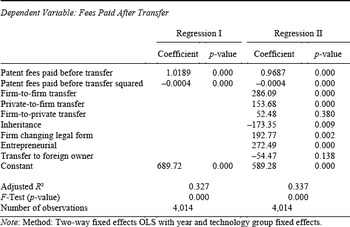
The regression results presented in Table 3 are based on information about transferred patents only. The dependent variable is the fees paid after the transfer of the patent. They should reflect the minimum private value of the patent for the new owner. If a patent has a value for the acquiring agent, he will be willing to pay the patent fees after the transfer to keep the option for future monopoly profits. A key explanatory variable are the patent fees paid before the transfer. It is a lower bound for the price demanded by the seller. The sign of the coefficient of this explanatory variable is an empirical question. On the one hand, the fee paid before the transfer is a costly signal, since the seller has already invested the fees before the transfer. On the other hand, the higher the fees paid before the transfer, the longer the patent is already in force and the shorter is the remaining time span of potential monopoly protection. In addition, this trade off may be nonlinear. Thus, we use the square of the patent fee paid before the transfer as an explanatory variable to evaluate if the effects becomes stronger or weaker.
THE VALUE OF TRANSFERRED PATENTS

Note:
Method: Two-way fixed effects OLS with year and technology group fixed effects.
In regression II, a set of dummy variables are also included as explanatory variables, to indicate whether the transfer was firm-to-firm, firm-to-private, private-to-firm, or entrepreneurial. Patents transferred from an individual inventor to a firm or from one firm to another firm should have a higher value than the average transferred patent since the patent should be transferred to an agent possessing better complementary assets. Furthermore, patents transferred in course of the change of the legal type of enterprise should have a significantly higher value since the new type of enterprise typically has better economic characteristics. For example, a joint stock company offers limited liability and easier access to finance compared to a partnership. It is important to note that my results are correlations, not causal effects: a patent may become valuable or a patent may be valuable per se. Moreover, one should note that the right-hand-side variables may be endogenous.
Table 3 displays the results of the regressions based on 4,014 observations of patents granted and transferred between 1884 and 1913. The regression results show that my estimation approach yields a jointly significant result and explains about one-third of the variation in the data. A Hausman test rejects the random effects model in favor of a fixed effects model. Likelihood ratio tests and F-tests show that a two-factor fixed effects model including year-of-issue and technology group fixed effects is superior to one-way fixed effects models or simple OLS without technology- and/or period-specific fixed effects. Consequently, we present only the two-way fixed effects model.
Both regressions support the hypothesis that the quality signal send by paying fees before the transfer are more important than the shorter period of potential monopoly profits earned from older patents: paying 1 percent more patent fees before the transfer is associated with about 1 percent more fee payments after the transfer. The relationship between patent fees paid before and after the transfer follows an inverse U-shape relationship, as indicated by the significantly negative effect of the squared fees paid before the transfer. However, the U-shape is quite flat, and the more important result here is the signal sent by paying fees before the transfer. Furthermore, regression II supports the hypothesis that valuable patents tend to be transferred to entities owning better complementary assets. If a patent is transferred from a firm to another firm, from an individual inventor to a firm, or from an individual to his own firm, the patent fees paid after the transfer are higher than the fees paid for the average transferred patent after the transfer. Finally, firms changing their legal form transfer patents of an above-average quality.
CONCLUSION
After the enactment of the first unified German patent law in 1877, more than 18,000 patents were transferred between 1884 and 1913. This equals about 8 percent of all patents issued during this period, which is close to the rate of patent transfers (13.5 percent) in the United States between 1983 and 2002. By contrast, the fraction of German patents transferred at the turn of the twentieth century was substantially smaller than in the United States during the same era. In Germany, about two-thirds of the patent transfers occurred during the first three years after issue of a patent, and the patents transferred were—on average—substantially more valuable than the average patent issued in Germany. Patents were transferred in most technology fields at similar rates, and patent fees paid before the transfer seem to have been a costly signal sent by the seller to indicate the quality of his patent. Finally, valuable patents were transferred from individual inventors to firms, from one firm to another firm, and from individual inventors to newly created, entrepreneurial firms. That suggests that patent transfers improved the allocation of knowledge capital in the economy and were perhaps a source of economic growth and rising productivity.