

Introduction
The 2014 crisis in Ukraine marked a tipping point in NATO’s relationship with Russia. That relationship had been difficult for many years and particularly fraught since the Russo-Georgia war of 2008. Russia’s annexation of Crimea, however, summarily ended a prolonged period of cooperation dating back to the end of the Cold War. At its September 2014 summit, NATO declared that ‘Russia’s aggressive actions … [have] fundamentally challenged our vision of a Europe whole, free, and at peace.’ The allies pledged to ‘reverse the trend of declining defence budgets’ and adopted a package of measures designed to reassure its eastern allies and reconfigure its ‘military strategic posture.’Footnote 1
How do we account for NATO’s abandonment of partnership and consequent strategic reorientation? It could be argued that over Ukraine NATO simply reverted to type – emphasising its core military purpose in the face of Russian aggression. The suddenness and persistence of NATO’s action is puzzling, however, in three respects. First, NATO had not reacted similarly to previous episodes of Russian bellicosity. Russia’s war with Georgia in 2008, and the Russia-Belarus Zapad 2009 and 2013 military exercises (the former culminating in a simulated nuclear strike on Warsaw) caused alarm in Poland and the Baltic States but did not lead the US and the major European allies to shift NATO toward countering Moscow. Such reluctance could have reflected political complacency or a residual belief in the necessity of partnership.Footnote 2 Either way, NATO avoided placing Russia and collective defence centre-stage. In fact, Alliance policy since the early 1990s had given equal standing to cooperative security and conflict management (hence, force projection and expeditionary missions in the Balkans, Afghanistan, and Libya). Its reorientation from 2014 was, therefore, a signal shift of purpose. That reorientation, second, was unprecedented in its decisiveness. Given NATO’s earlier unwillingness to confront Russia, one might have anticipated an allied response limited to political declarations and a suspension of practical cooperation (as had happened after the Russo-Georgian war). The differentiated exposure of the Allies to Russia also made such a course appear likely. Robust action corresponded to the preferences of Poland and the Baltic States, but not necessarily those of NATO’s southern and Balkan states or of the powerful quartet of France, Germany, the UK, and the US. In the event, these issues were put aside and consensus was joined on a military response. Third, NATO moved toward collective defence in response to the destabilisation of a non-member. Such a move might seem explicable in precautionary terms, as a means of ameliorating the concerns of allies near to Ukraine. However, that NATO elevated a regional problem to one of existential significance bears some scrutiny.
Our positing of NATO’s reaction to the Ukraine crisis as a puzzle may seem counter-intuitive. After all, would one not expect an alliance to respond robustly to aggression near its borders? Such a supposition is not, however, as sound as it might appear. The balancing logic upon which it is based may smack of conventional wisdom but (as we show below) that logic is flawed. The puzzle, therefore, remains: why did NATO act in such a manner on this occasion when comparable precedents for balancing existed? Why, in other words, is the Ukraine crisis distinct from previous episodes of NATO-Russia discord to the extent that Russia assumed the status of a threat to the Alliance as such? Attending to that question, further, allows us to say something of significance about NATO and regional security institutions more broadly: how is it that such bodies assume actorness or agency in response to a threat that is collectively defined?
Securitisation theory (ST) offers a productive framework to address these issues. From 2014 NATO unambiguously adopted language and policies that positioned Russia as a clear threat. As we show in the next section, standard International Relations (IR) theories cannot account for this shift satisfactorily because their consideration of threat is too narrowly drawn or too detached from their core theoretical claims. ST, by contrast, makes the conceptualisation and reaction to threat the direct object of analysis utilising the concept of referent object, a malleable categorisation of those social and political units that are threatened and have ‘a legitimate claim to survival.’Footnote 3 For NATO, the Crimean annexation undermined the European and international order, an order that the Alliance regarded itself as custodian. Russian behaviour also held implications for NATO directly, for the security of its eastern members and thus for the credibility of NATO’s core functions of deterrence and reassurance. Viewed this way, the referent object for NATO was not the integrity of Ukraine. Expressions of concern in this regard belied the fact that something more important was at stake: European security governance – a system of order with NATO as the presumptive core – was seen to be threatened.
Through the NATO-Russia case, we consider an overlooked aspect of ST. In its original formulation, ST did not regard securitising actors (those who speak security) as limited to the state.Footnote 4 We extend this position by suggesting that collectives of states can be construed as both the actor and referent of security. As such, we demonstrate the relevance of a phenomenon we label collective securitisation. In the military domain, such an approach has been left unexplored because here ST assumes that expressions of security are reducible to the state acting alone. Collective securitisation relaxes that assumption and so advances ST in four novel ways.
First, through the conceptual apparatus of the most influential variant of ST, the Copenhagen School (CS), we offer a fresh take on the core concepts of securitising actor and audience. In doing so, we are able to account for a neglected class of phenomena: securitisation within a formal institutional setting. Here, the organisation in question articulates security discourse and policy but derives its ability to do so from repeated interactions with its member states. That process (what we refer to later as recursive interaction) means the member states serve as the validating audience of a securitisation move and provide an organisation with agency in responding to threats. We show thereby that a body like NATO can successfully initiate and define the securitisation process. Second, we correct a thematic bias of ST. The delimitation of ‘security sectors’ to the political, societal, economic, environmental (but all too rarely the military) has led ST to overlook both defence policy and regional security alliances as subjects of enquiry.Footnote 5 Analysing collective securitisation within NATO begins to make good that neglect. Third, our focus on NATO illustrates how securitisation is a dynamic and reversible process. ST had always allowed for desecuritisation but the recent history of NATO-Russia relations reveals a process of resecuritisation, a return to Cold War policies and discourse, albeit shaped by the experience of the intervening decades. Lastly, while our empirical analysis of collective securitisation is tailored to NATO post-Crimea, our model is generalisable to other institutional settings and different security sectors.
The article proceeds as follows. The first section considers the limitations of IR theory in accounting for NATO’s actions in light of the Crimea/Ukraine crises. The second examines issues within ST in order to establish the continuing relevance of CS. The third section then amends ST and so opens the analytical space for an international organisation to engage in securitisation on behalf of states. The fourth section presents a stylised model of collective securitisation to illustrate how such a process occurs. That model is then applied in an empirical section that traces the post-Cold War desecuritisation of the Soviet Union/Russia and the subsequent resecuritisation of Russia precipitated by the annexation of Crimea. In the conclusion we consider three caveats to our argument.
NATO-Russia and the limitations of IR theory
NATO’s reorientation after 2014 might be susceptible to explanations drawn from established theories of alliances. Each, however, is deficient in important regards.
A first, seemingly straightforward, approach rests with realism. There is no single realist voice upon which one can draw in reference to the Ukraine crisis. Certainly, prominent realists have commented on the events surrounding Ukraine, John Mearsheimer most notably. Mearsheimer’s position on Ukraine is, however, useful only up to a point in that he is more concerned with Russian threat perceptions than those held by the Alliance (arguing that Moscow acted in order to pre-empt Ukraine joining NATO and being converted into a ‘Western bastion’).Footnote 6 His earlier, more general argument that great powers will balance in order to contain ‘a dangerous opponent’ could, however, have some traction in NATO’s case – at least, if we accept Mearsheimer’s view of NATO as an instrument of American hegemony.Footnote 7 The logic of this position is that Russia’s revisionist behaviour in regard to Ukraine has been met by the US, with its NATO allies in tow, in order to close off avenues for further expansion.Footnote 8
This preoccupation with balancing is, of course, common to realism,Footnote 9 but it is perhaps best typified by Stephen Walt’s ‘balance of threat’ proposition.Footnote 10 Walt’s argument that alliances such as NATO mobilise to counter threats seems well suited to the Ukraine crisis. If Russia’s seizure of Crimea marked the return of ‘geopolitical rivalries … to centre stage’Footnote 11 then the repercussion for NATO is obvious: heightened threat required of the Alliance a turn toward renewed balancing as a means of protecting its newly exposed eastern allies.Footnote 12 However, there are at least three limitations to this argument. Even accepting balancing by NATO can be demonstrated empirically, these limitations lead us to reject realism’s explanation of it.
First, Walt’s is a theory of alliance formation not alliance behaviour. This distinction matters because an alliance of long duration such as NATO will respond to threats in a manner that is influenced by established modes of practice, norms of behaviour, and received understandings of its threat environment. Second, even if we transplant balance of threat theory to established alliances it remains an awkward fit. The four sources of threat (aggregate power, geographic proximity, offensive power, and aggressive intentions) that Walt identifies as bearing upon alliance formationFootnote 13 do not all pertain when applied to NATO’s reaction to Russia after March 2014. Since 2008, Russia had registered both quantitative and qualitative improvements in its armed forces including the development of force-projection assets.Footnote 14 However, as Walt himself has pointed out, aggregate power (population, economic resources, and military capability) has not moved in Russia’s favour when compared to the combined power of NATO.Footnote 15 The objective level of threat to NATO did not, therefore, shift as a consequence of the Ukraine crisis. Perceptions of aggressive intent are, however, a different matter. Those NATO allies in proximity to Russia – the Baltic States and Poland – did register a heightened sense of threat, one rooted in their experience of aggression and occupation during the Soviet period. It should come as no surprise, therefore, that these states have been loudest in calling for measures to counter Russia. But this takes us to a third caveat. Realist positions (and this applies to Mearsheimer as well as Walt) draw inferences on alliance behaviour from the material environment (the distribution of capabilities and the balance of power or threat) within which the alliance in question is situated. Walt allows that perceptions of threat will influence this process but a crucial causal mechanism is left unspecified. No theoretical space is given to how perceptions of offensive intent are aggregated within alliances or how such perceptions are converted into policy.Footnote 16
Institutionalist explanations are similarly deficient. In its rationalist form, institutionalism has offered a persuasive account of NATO’s resilience and adaptability, but it has done so largely without reference to NATO’s external threat environment.Footnote 17 Institutionalism, in other words, identifies how NATO has changed but not why. If the policy shift from 2014 was made possible by the possession of flexible institutional assets (in the same way that such assets facilitated NATO’s operational evolution in the first two decades after the Cold War),Footnote 18 we still need to ask what prompted the use of those assets in the first place? Inferentially, the shift can be explained either functionally (NATO remained possessed of assets of collective defence and so function followed form) or by recourse to state preferences (NATO was the optimal format for collective action to counter Russian behaviour). However, it is not clear from such accounts why collective defence was elevated to high importance and why so suddenly. Indeed, on institutional grounds one might have expected the opposite – NATO being slow to act and doing so inconclusively. As Robert McCalla has argued, an alliance that assumes a multiplicity of tasks will become ‘less responsive … to changes in the threats it faces.’Footnote 19 Change is confounded because state and bureaucratic interests coalesce around competing priorities and institutional resources are stretched across different tasks.
Sociological institutionalism differs markedly from its rationalist variant. Here, institutions are not primarily functional in nature, but rather normative. They embody a common identity and condition their members toward appropriate modes of behaviour based on shared values and social norms reinforced by practice. NATO, accordingly, is less a functional organisation concerned with managing its members’ security problems and more a ‘self-defined institutional expression of the Western liberal-democratic community.’Footnote 20 Such an interpretation overlaps with analyses that view NATO as part of a broader, normatively-defined security community. Certainly, such a view sits readily with how the Alliance developed during the Cold War, a period when the threat NATO faced was cultural and civilisational as much as military.Footnote 21 In the years since, the absence of a single, animating Other has necessarily directed attention to NATO’s interior character – the habits or practices of its members, the identity and norms that bind them together, and NATO’s ability to persist and enlarge.Footnote 22 This is not to say that external threat is missing from the analysis or, indeed, that threat is assumed to be fixed. NATO has been seen, for instance, as preoccupied with managing ‘shared security risks’ (rather than with deterring a single common threat).Footnote 23 Yet whether defined as threat or risk, a distinct logic is at play. As an expression of security community, NATO’s norms and identity determine how it acts upon the outside world. Thus, the Alliance intervened in the Balkans in the 1990s because conflicts there challenged ‘Atlantic sensibilities’ on human rights.Footnote 24 It acted in Libya in 2011 for similar reasons.Footnote 25 As for Russia, security community analysis has viewed it, even prior to the Ukraine crisis, as at odds with NATO ‘over the rules of the international security game.’Footnote 26 Yet Russia was still positioned as a conditional partner, beyond the reach of integration but still susceptible to security management. The lurch from partnership to antagonism from 2014 marked Russia’s departure from this ‘security game’ and confirmation of its outsider status. Security community is the benchmark against which separation can be judged. The concept lacks, however, an analytical tool that specifies how the separation occurred. For that, we now turn to ST.
Securitisation theory
From ST certain core assumptions can be elicited relevant to the process of collective securitisation. To that end, we draw upon CS, still the most influential (and debated) contribution to the securitisation literature. Two considerations dictated our choice. First, given the near absence of securitisation scholarship in relation to NATO an underlying task of this article is to establish the appropriateness of ST as such. There is no unified or ‘grand theory’ of securitisation upon which we can call in this respect,Footnote 27 but CS occupies the ‘city-centre’ of securitisation scholarship. Its foundational concepts thus have a justified claim to be the starting point of application.Footnote 28 Second, the ‘neighbourhoods’ of ST (to continue the analogy) are less suited to the object of our concern. The so-called Paris School, for instance, does not view securitisation primarily through rhetorical performance,Footnote 29 a weakness in the case under consideration given that the rupture in NATO-Russia relations from 2014 was occasioned most obviously by a marked shift of discourse.
In its original formulation, CS viewed ST as having a twofold purpose. First, ST explained how issues moved from the realm of ‘normal’ politics to the realm of security where the state could bypass democratic discourse and procedure. Second, ST isolated the mechanisms whereby such a move was enacted. Securitisation is initiated by a speech act, a ‘securitizing move’ ‘through which an intersubjective understanding is constructed within a political community to treat something as an existential threat to a valued referent object, and to enable a call for urgent and exceptional measures to deal with the threat.’Footnote 30 The alternative, desecuritisation process, shifts ‘issues off the “security” agenda and back into the realm of public political discourse and “normal” political dispute and accommodation.’Footnote 31 Three issues – state-centrism, threat construction, and audience role – have been contested within ST. Our preliminary purpose here is to introduce the CS approach as relevant despite these concerns. The further amendments necessary for a theory of collective securitisation are then considered in the next section.
The first issue revolves around the ‘Westphalian straitjacket’ that embeds the CS in Eurocentric understandings of state capacity and which privileges the role of authoritative governing elites in threat definition.Footnote 32 This charge of state-centrism is only partially justified. Barry Buzan and Ole Wæver have argued that the CS is ‘not dogmatically state-centric in its premises’ even if for ‘contingent, empirical reasons … securitization theory is … somewhat state-centric in its findings.’Footnote 33 In fact, a not insignificant literature exists informed by ST in which both intergovernmental and non-governmental actors are given due consideration.Footnote 34 In a recent intervention, ST has been explicitly applied to NATO,Footnote 35 and there is a body of work of longer-standing which, informed by ST, regards NATO through a discursive lens.Footnote 36 These studies are not, however, about collective securitisation, insofar as they simply swap one actor (the state) for another (an international or non-governmental organisation) as the focus of analytical attention. What interests us, rather, is the neglected question of how a group of states undertakes securitisation in concert and how, at the international level, that process is expressed and institutionalised. CS initially held out this possibility in relation to the EU.Footnote 37 We see no reason why it cannot be extended to NATO.
As for threat construction, the initial and influential claim of the CS was that the speech act itself constituted ‘security’ not the ‘something more real’ that the act described.Footnote 38 Such a position is now seen as untenable. The speech act is not separate from reality; it only interprets it in a particular way.Footnote 39 What threats become subject to securitisation is, in fact, a matter of political choice.Footnote 40 Both national and system-wide dynamics are relevant here. States will out of necessity respond to threats that impact upon them directly (when their territorial integrity, national identity, or constitutional order is infringed). Acting collectively in the face of such threats cannot be excluded (acts of solidarity are possible), but collective securitisation is more likely to occur when a threat has a systemic referent (impinging upon international and collective identities, or the rules and norms governing interstate interactions).Footnote 41 NATO’s character as a military alliance bound by a mutual defence pledge and as a community of norms means it embraces both these dynamics.
The third contested issue concerns the precise relationship between the securitising actor and its audience. In their original formulation, Buzan, Wæver, and Jaap de Wilde suggested ‘an issue is securitized only if and when the audience accepts it as such.’Footnote 42 The act of acceptance, however, was left unexplored thus leaving the audience marginalised as an analytical category.Footnote 43 More recently, Wæver has argued that securitisation involves political interaction between both actor and audience through which agreement is reached on what constitutes the source of insecurity.Footnote 44 Viewing securitisation in this manner has two advantages. First, it points to a process that is ongoing, one that entails dialogue, negotiation, and compromise rather than a single, unidirectional transaction by the securitising actor. Here, the audience becomes more than a passive recipient of a securitising move; it empowers that move and may even initiate it. This process within an international organisation we define as recursive interaction: repeated bargaining procedures and substantive exchanges between a security actor (the organisation) and its audience (the organisation’s constituent members) over the content and form of threats as well as the policy responses appropriate to mitigating them. In collective securitisation this means the audience takes on a particular form and meaning; it is not external to the securitising actor but constitutive of it. Second, an active understanding of audience helps explain policy choice: why some issues (and not others) are securitised and, thus, why certain policies are formulated in response.Footnote 45 The outcome here remains dependent on the balance of positional power between actor and audience. In a national setting the former will always have an advantage (even in democracies) given its association with government and access to the resources of the state. The latter (whether defined as public opinion, the electorate, political elites, or interested minorities) will be more constrained in its ability to mobilise political resources. Collective securitisation (particularly in the military sector) gives rise, however, to a quite different dynamic: the empowering audience is itself comprised of states and the securitising actor (that is, NATO) does not enjoy default positional power. Such a dynamic affirms the need to take the role of audience, and recursive interaction, seriously.
Amendments to securitisation theory
Notwithstanding the departure from state-centrism noted above, ST has been concerned largely with tracing the mechanisms and consequences of securitisation within and by states. With the exception of Jürgen Haacke and Paul WilliamsFootnote 46 (to whom we return below) there has been no systematic effort to apply ST to relations among states in a process of collective securitisation. Five amendments to ST are necessary to support such an approach, rendering it relevant to NATO (and, by extension, to other regional security organisations).
A first amendment centres on the need to differentiate between private and public security goods. ST assumes that security is, in effect, a private good, subject to a national policy programme with national repercussions, even in those cases where the securitised threat is transnational, for example terrorism or a communicable disease. Although Buzan and Wæver’s understanding of ‘macrosecuritisation’ suggests that securitisation does not stop at the water’s edge,Footnote 47 ST has paid too little attention to the problem of how system-level, public goods are securitised. The necessary shift of focus here would see securitisation as the outcome of a shared threat perception across states followed by agreement on the appropriate policy response. International organisations (and regional security organisations specifically) are the obvious framework within which to observe this process. This contention may lack purchase in many regions of the world. However, in the densely institutionalised European and transatlantic security space, it is persuasive both conceptually and empirically.Footnote 48
Even if we accept that NATO is an important actor in this space, a second amendment becomes necessary. This relates to the notion of agency. ST risks essentialising the security actor, a potential problem if NATO is regarded as a unitary actor or agent of securitisation. To avoid this, our previous observations on the role of audience are relevant but need extending. Recursive interaction we suggested involves both the securitising actor (the organisation) and its members (who constitute the audience), but recognition needs to be given to the fact that members may be so powerful as to blur the actor-audience distinction. Indeed, within a strictly intergovernmental body such as NATO only members have the power to validate a securitisation move and the policies that flow from it, and certain members (in NATO’s case, the US) may exert a decisive influence. This need not, however, render security organisations mere ciphers for the ‘atomistic pursuit’ of individual member interests.Footnote 49 NATO, specifically, is the repository of a common strategic language as well as a set of practices and norms built up over decades. NATO aggregates material power but also embodies symbolic power, assuming in its own right an authority to speak and act in the security field. By this view, there is no neat distinction between the organisation and its membership. Those inside organisations, Michael C. Williams has suggested, ‘must work within the parameters of the prevailing institutional form … organizations wield power over their members, but it is a power which these members will upon themselves.’Footnote 50 Applied to ST this insight suggests that individual allies can initiate a demand for securitisation, but it is the Alliance that renders the securitisation process authoritative by providing a common language and set of policies. NATO’s significance in securitisation can, therefore, only be understood if a priori we regard it as a site of recursive interaction where the Alliance is simultaneously a securitising actor and a framework of audience participation.
A third amendment stems from the assertion inherent in ST that a threat, to be regarded as such, must endanger the integrity of the referent object – hence, the standard CS definition that threats are ‘existential’ in nature. The integrity of the state as referent is too narrow a means of thinking about securitisation, however. States assess their security with an eye to how their concerns are shared with others – and so, the referent object can take an organisational form (as in an alliance). Securitisation is also conditioned by a broader institutional context. In densely institutionalised security spaces, well-developed rules and norms regulate interstate interactions, frame appropriate mechanisms of conflict resolution, and ensure compliance with issue specific regimes, treaties, and law.Footnote 51 A necessary amendment for a theory of collective securitisation, therefore, is to give due weight to instances when this institutional context is itself undermined. The breaking of rules (a violation of the principle of territorial integrity, for example) challenges not only the specific arena in which the action occurs, but the broader edifice of international order, or governance, of which it is part. Collective securitisation, in short, reflects a layering of referent objects: state, international organisation, and international order.
This amendment to how threats are securitised requires (and this is our fourth amendment) a concomitant consideration of how measures are taken in response. Two points are worth making here. The first is to go beyond the CS’s emphasis on the speech act. As Rita Floyd has pointed out, the securitising move and its acceptance by the audience is only part of what constitutes securitisation. To the performative act of speech it is necessary to add the practical one of policy.Footnote 52 Second, in accepting that policy matters, emergency ought not be the defining criterion of securitisation. A securitised issue (immigration for instance) can become routinised in domestic policy. And that state of affairs is just as relevant when applied to collective securitisation. An international organisation such as NATO enjoys precisely the legal and political authority (through its founding treaty and, on occasion, UN Security Council Resolutions) to initiate military measures when called upon; it is part of its modus operandi, not an exception to it.
A fifth and final amendment relates to the largely absent concept of resecuritisation. Desecuritisation, as already noted, entails the removal (or downgrading) of an issue from the security agenda. Equally, it might involve a mutual willingness to alter the terms of an adversarial relationship. Resecuritisation is effectively a unilateral process that can be initiated by either party to such a desecuritisation effort. Resecuritisation has not featured prominently in ST, but is distinct from the process of securitisation owing to the presence of a number of factors, foremost among them the existence of a ready-made security grammar, or set of ‘master signifiers’ that make it easier for an actor to initiate a resecuritisation move and to encourage an audience to accept it without reservation.Footnote 53
Collective securitisation
Haacke and Williams were the first to explore collective securitisation. They conceive of it as occurring when ‘one or more securitizing actors within [a regional] arrangement identif[ies] a particular development or issue as an existential threat to a security referent.’Footnote 54 Their analysis assumes that a state will initiate a securitising move that will then be generalised within a regional arrangement or organisation. There is no assumption here that the organisation possesses the authority necessary to initiate this move itself or that it engages in a recursive interaction with its members. The organisation is little more than a site of bargaining between its member states. Our focus, by contrast, is the role of regional security organisations as both a site and agent of collective securitisation. Building on the amendments to ST in the previous section, we see such a role as plausible when an international organisation is possessed of legal and political authority, has agenda-setting powers, is the framework for formulating and implementing common policies, and is the repository of a common security narrative. Collective securitisation, meanwhile, is most likely when a threat is posed to a public security good (shared material interests or commonly-held rules and norms).
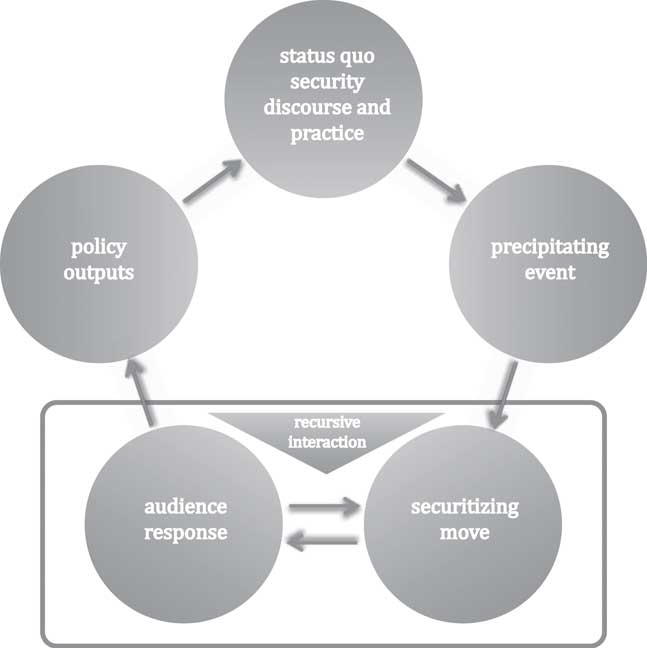
Set out as a model, there are six distinct stages in the process of collective securitisation by a regional security organisation (see Figure 1). The first stage represents the status quo security discourse and concomitant policies premised upon received notions of threat. The second is constituted by a precipitating event (or inter-related series of events) of gravity sufficient to disrupt this status quo and prompt a perception by the securitising actor (and its audience) that the qualitative character of the external security environment has altered for the worse.
A model of collective securitisation.

The third and fourth stages – the securitising move and audience response – are separated analytically but are codependent through the process of recursive interaction. The precipitating event initiates the securitising move. For a theory of collective securitisation it is necessary to show how such a move is detectable first at the collective level. Hence, the third stage isolates collective expressions of threat even if we accept that these are not entirely autonomous of the audience to which they are directed and which facilitate their generation. The securitising (or resecuritising) move will take the form of a speech act, which, in NATO’s case, will consist of statements by authoritative actors, including the Secretary General, the SACEUR, the Chair of the Military Committee, and others. These figures act in NATO’s name but bring with them other institutional preferences (the SACEUR, for instance, is also head of US European Command). Greater authority, therefore, resides in statements endorsed by the membership, most authoritatively at ministerial or head of state and government level. Such statements express the will of the Alliance and epitomise recursive interaction among NATO members as well as between those members and the NATO bureaucracy.Footnote 55 The speech act signifies the presence of a threat to a referent object (i.e. NATO itself) and to the systemic properties that sustain it (that is, international norms and a preferred international order). The speech act is thus replete with allusions to how that order has been subverted (and who is to blame) and how this degrades NATO’s own sense of security. A regional security institution can only act as a securitising actor if the member states grant it the legal and political authority to do so and if it represents ‘normal politics’ within the institution. The fourth stage of the process is thus the empowering audience’s involvement in the securitising move and validation of it.
The next two stages in the collective securitisation process revolve around the formulation and execution of policies that address the securitised threat. Consistent with the position staked out earlier, successful collective securitisation occurs when a securitising actor obtains audience acceptance, and consequent adoption, of appropriate common policies. The final stage of collective securitisation, meanwhile, is the routinisation of the amended or new strategic vocabulary, agenda, and practice. A disrupted external environment gives rise to a new status quo meaning this final stage effectively becomes a new stage one of a future securitisation process.
While the process of collective securitisation unfolds sequentially, we nonetheless depart from the ‘decisionistic’ bias of the CS, which sees securitisation as occurring at specific moments in time.Footnote 56 For us, the stages in this sequence are overlapping rather than separate. A precipitating event can occur in one compelling and concentrated moment, but its consequences are felt over an extended period; other related events, furthermore, may follow and reinforce it. The upshot is that the discourse of threat runs in parallel with (not simply in reaction to) the events it is narrating. That discourse will also run alongside policy (discourse does not cease once a relevant policy is initiated). Further, the stages of securitisation need not be seen as occurring ex nihilo. A precipitating event may occur of such suddenness as to be truly without parallel (the 9/11 attacks, for instance) but it may also be the culmination of a manifest trend. The issue here then becomes one of scale as much as of surprise – with the event confirming in dramatic form an already known and emerging threat. By the same token, the securitising move may be a repeat of a previous sequence – a resecuritisation in other words.
In the following section, the model of collective securitisation is given empirical content. Models can have many purposes. That used here serves an ‘explicative function’, by which the model in question ‘explores the putative causal mechanisms underlying phenomena of interest.’Footnote 57 To that end, the data we present is intended to show how and why NATO resecuritised Russia. We are aware that not all statements emanating from NATO’s members states conform to the securitising narrative. By excluding these we are open to the charge of underplaying contingency and contestation while, at the same time, overplaying consistency and coherence. Our approach is, nonetheless, sound for two reasons. The first relates to the nature of models themselves. Models in the social sciences are meant to be a representation of reality, not its faithful reproduction. They aim, following Patrick Jackson, ‘not to capture the whole of actuality, but instead to help … bring some analytical order to our experiences.’Footnote 58 A model needs to ‘fit the facts’ but not every fact needs to fit the model.Footnote 59 The second reason relates to the nature of NATO. While stubbornly intergovernmental (reflective, therefore, of a variety of views), it is also the consensus-based organisation par excellence. Its statements once agreed are thus expressive of a meaningful and authoritative organisational voice.
NATO and the collective (re)securitisation of the Russian Federation
We now turn to NATO’s role as an agent of collective securitisation utilising the six stages previously outlined. The context is the events prior to, and then consequent upon, Russia’s annexation of Crimea in the spring of 2014. From that point onward, NATO articulated an explicit discourse of threat and adopted a raft of measures in response. Securitisation then ran in parallel with the extension of the Ukrainian crisis as war erupted in the east of the country. That conflict reached a stalemate by the autumn of 2015; even so, concerns over Russia continued to preoccupy NATO. Taking our case up to NATO’s Warsaw summit in July 2016, it becomes clear that the securitisation of Russia had become routine within NATO.
Status quo security discourse and policy
During the Cold War, NATO subjected the Soviet Union (Russia’s predecessor) and the Warsaw Pact to a sustained securitisation process. The qualifications of détente and the systemic stability of bipolarity notwithstanding, the view dominant within the Alliance was that its fundamental purpose was to deter Soviet aggression. The material evidence for this lay, first, in NATO’s military organisation (along with attendant strategic and doctrinal assumptions) and, second, in the minimal role NATO played in contingencies not involving the Soviet bloc (hence, the absence of an ‘out-of-area’ role).Footnote 60
Importantly, evidence also existed in NATO discourse. During the Cold War, the Alliance adopted four authoritative Strategic Concepts (in 1949, 1952, 1957, and 1968), all of which identified the Soviet Union as a threat.Footnote 61 These documents were classified, but publically available statements conveyed an identical point. The Report of the Committee of Three of 1956 pointed out that NATO’s formation had resulted from ‘the fear of military aggression by the forces of the USSR and its allies.’Footnote 62 The 1974 Ottawa Declaration noted that ‘the nature of the danger’ posed by the Soviet Union had changed but that the members of the Alliance ‘remain[ed] vulnerable to attack.’Footnote 63 Ten years on, a NATO statement on East-West relations stated that ‘a massive [Soviet] military build-up’ posed ‘a continuing threat to Alliance security and vital Western interests.’Footnote 64 NATO did not take the view that a Soviet attack would happen at any minute, but the threat was regarded as both substantive (the military strategy of the Warsaw Pact was directed at fighting NATO) and severe (in Europe, Warsaw Pact capabilities exceeded those of NATO).
NATO’s military concerns were underpinned by a systemic referent in that the Soviet Union was seen as exemplifying a form of social, political, and economic organisation utterly at odds with the value system of ‘the West.’Footnote 65 An end to the Cold War thus only became possible once this fundamental incompatibility was resolved. The changes when they did come were profound (the dissolution of the Warsaw Pact, the unification of Germany within NATO and, ultimately, the collapse of the Soviet Union itself) and led NATO to desecuritise the Soviet Union in two senses. First ‘a non-adversarial and cooperative relationship’ was seen to be in the offing. Second, and connected, that relationship was posited as being outside of the realm of mutual insecurity.Footnote 66 These assumptions were transferred to Russia as the continuing state of the Soviet Union and up until the Ukraine crisis an assumption of partnership constituted the post-Cold War status quo. This was evident in three regards: the privileged status accorded to Russia by NATO, practical interaction between the two sides, and NATO’s changed strategic posture.
On the first point, NATO’s post-Cold War Strategic Concepts refer to Russia in positive terms: as the component of a ‘strong, stable and enduring partnership’ according to the 1999 document, and of a ‘strong and constructive partnership’ according to that of 2010.Footnote 67 Partnership with Russia, furthermore, was seen as distinct from the many other relationships NATO developed during this period. Russia, the 1997 Founding Act on Mutual Relations noted, stood alongside the Alliance in building ‘a lasting and inclusive peace in the Euro-Atlantic area’ (a phrase subsequently repeated in the NATO-Russia 2002 Rome Declaration).Footnote 68 Such language did not go without qualification. Throughout the 2000s, NATO communiqués referred with increasing regularity to specific issues of concern and, in the case of Russia’s intervention in Georgia, to major differences of principle.Footnote 69 NATO was also unresponsive to suggestions in Moscow that Russia be admitted to the Alliance, that NATO be subordinated to a new pan-European security arrangement, and that formal relations be established with the Russia-led Collective Security Treaty Organization.Footnote 70 These qualifications ran in parallel, however, with an ongoing claim that, in the words of the 2012 Chicago summit declaration, ‘strategic partnership’ with Russia still mattered for ‘creating a common space of peace, stability and security’ in Europe.Footnote 71
As for practical cooperation, this was hardly extensive. It was also subject to periodic interruption (Russia broke off contacts in the wake of NATO’s intervention in Kosovo in 1999, and relations were mutually curtailed in the wake of the Russo-Georgian war). Yet periods of downtime were matched by equally significant uptakes.Footnote 72 The break over Kosovo was set aside by increased cooperation after 9/11, while the rupture over Georgia underwent repair after NATO’s 2010 Lisbon summit (Russia cooperated with the ISASF mission in Afghanistan by allowing it access to the Northern Distribution Network and abstained on two crucial votes in the U.N. Security Council in early 2011 thus facilitating Operation Unified Protector, NATO’s mission in Libya).
NATO’s strategic posture also reflected an investment in partnership with Russia. While the Alliance retained collective defence as a core mission, this was reconceived to encompass terrorism, cyber warfare, and WMD proliferation – contingencies not necessarily made with Russia in mind.Footnote 73 Indeed, NATO went to some lengths not to take measures against Russia. The Founding Act indicated that NATO would refrain from stationing nuclear weapons or ‘additional permanent … [and] substantial combat forces’ on the territory of new members.Footnote 74 Following the enlargements of 1999 and 2004, NATO thus avoided providing reinforcement capabilities to the east European allies and it was not until 2010 that the Alliance began contingency planning for the defence of the Baltic states. Throughout the 2000s, NATO was, in fact, preoccupied with force projection out-of-area. Its signature mission, ISAF, was in Afghanistan, its most symbolic military innovation was the NATO Response Force (NRF)Footnote 75 and its most noteworthy statement of purpose (the 2006 Comprehensive Political Guidance) placed ‘unpredictable challenges … far from member states’ borders’ on a par with collective defence.Footnote 76 At the 2012 Chicago summit, NATO considered itself satisfied with its ‘existing mix of [military] capabilities’,Footnote 77 and gave the impression that Russia was not of pressing concern.Footnote 78
The precipitating event
The details of the Ukraine crisis are well-known and need not be repeated at length here.Footnote 79 Ukraine had experienced political turmoil over several years, particularly following the ‘Orange Revolution’, which saw the coming to power of a reformist government under President Viktor Yushchenko in January 2005. Yushchenko was replaced, in turn, by Viktor Yanukovych in February 2010, a president whose decision in late 2013 to forge closer ties with Russia rather than sign an Association Agreement with the EU sparked the Euromaiden protests in Kiev. This volte face triggered escalating violence that culminated in February 2014 with Yanukovych’s removal from office. Two sets of events then followed, which marked a significant deterioration of the situation.
The first concerned Crimea, an autonomous republic within Ukraine with a majority ethnic Russian population. During March 2014, Russia effectively annexed the territory against a backdrop of destabilisation by pro-Russian militias. The formal process entailed a referendum in Crimea on union with the Russian Federation, a treaty of accession signed by the Crimean authorities and the Russian president, and that treaty’s ratification by the Russian parliament.
The second set of events occurred in the Donbas region of eastern Ukraine immediately after the Crimea episode. Here, armed militias of the self-declared republics of Donetsk and Luhansk seized territory and strategic locations. This prompted a counter-offensive by Ukrainian forces and then a series of battles of increasing severity. Rebel advances in Ukraine’s southeast were such that by August the prospect loomed of a land corridor being established with Crimea. A ceasefire agreed in September (the Minsk Agreement) forestalled it. That agreement was subsequently violated but a further text was concluded in February 2015 (Minsk II). This second agreement reduced but did not halt the fighting; it also failed to bring a political settlement any closer.
There were many notable aspects of this twin crisis although it was the events of Crimea that presented the most far-reaching challenge to international order, despite the greater human toll of the conflict in eastern Ukraine. As Thomas Grant notes, the Russian action represented ‘the first formal act of annexation following the use and threat of force against a state in Europe since 1945.’ Parallels are few: Crimea was unlike the partition of Cyprus in 1974 (the Turkish north declared independence but was not incorporated into Turkey proper) or Russia’s recognition of the breakaway regions of Abkhazia and South Ossetia after the 2008 Georgia war (Russia absorbed neither into the Federation). According to Grant, the only postwar comparison is ‘Iraq’s invasion and annexation of Kuwait’; both that event and the Crimea crisis involved one UN member acting against another with the aim of ‘eradicating an international boundary’ and seizing territory.Footnote 80 The Russian government saw matters rather differently and mounted an elaborate legal defence of Crimea’s change of status.Footnote 81 Its arguments were dismissed, however, whenever put before an international forum. In mid-March 2014, a draft Security Council resolution rejecting the referendum in Crimea was supported by 13 of the Council’s 15 members (China abstained and Russia exercised its veto). A vote before the General Assembly later that month upholding Ukraine’s territorial integrity was supported by 100 members with 11 against and 58 abstaining. The Parliamentary Assembly of the Council of Europe, meanwhile, passed resolutions on three separate occasions (April 2014, January 2015, and June 2015) condemning the ‘illegal annexation of Crimea.’Footnote 82
Roy Allison has described Russia’s annexation of Crimea as ‘an affront to the core principles of contemporary interstate conduct’ thereby raising ‘the question [of] whether Putin is mounting a wider challenge to what he regards as a western-dominated international system and legal order.’Footnote 83 Attending to that question is a matter of controversy because some influential observers have viewed Russian behaviour as an understandable reaction to NATO (and EU) influence building in and around Ukraine.Footnote 84 What matters in the current discussion, however, is not a value judgment on Russian actions but a sense of how its conduct has provided a pretext for (re)securitisation. In this sense, the legal context (noted above) matters, as do two other significant aspects of the Ukraine crisis.
The first is its obvious military character. While Moscow maintained a narrative of deniability, it is clear beyond reasonable doubt that Russian armed formations took up position on the Russo-Ukrainian frontier, provided the separatists with sophisticated military equipment (including surface-to-air missiles, one of which downed a Malaysia Airlines flight in July 2014), and sent military advisers to the conflict zones. Russian troop detachments and Special Forces also intervened directly on the battlefield at key points (the second battle for Donetsk airport in September 2014 and for Debaltseve in February 2015 being the most significant).Footnote 85 Beyond the Ukrainian theatre, meanwhile, Russia undertook several shows of strength. The Russian navy and air force increased their activities in the Baltic region, the high north and the North and Black Seas (resulting in numerous infringements of NATO air and maritime space as well as that of Sweden and Finland),Footnote 86 increased the scale and tempo of military exercises (some premised on war with NATO’s northern members), and engaged in nuclear signaling (with President Putin and Foreign Minister Sergei Lavrov both alluding to the strategic importance of Russia’s nuclear capability).Footnote 87
The second aspect of note concerns Russia’s claims to propriety around its borders along with accompanying anti-NATO sentiment. As the Ukraine crisis unfolded, Putin suggested that Crimea’s union with Russia was necessary to prevent the territory falling into NATO’s hands in the event of Ukrainian accession to the Alliance.Footnote 88 The Ukraine crisis, he suggested in September 2014, was ‘engineered … by certain of our western partners’ with the aim of ‘reinvigorating’ the NATO ‘military bloc.’Footnote 89 In this vein, Putin would go on to suggest that the Ukrainian army was ‘a NATO foreign legion’ motivated by ‘the geopolitical aim of containing Russia.’Footnote 90
The (re)securitising move
Prior to the annexation of Crimea, the Alliance had expressed concern at the deteriorating political situation in Ukraine but had refrained from identifying events in the country as in any sense threatening.Footnote 91 From March 2014, however, the focus shifted. Russian action was not only a violation of Ukrainian sovereignty but also ‘challenged’ the stability of the Euro-Atlantic region, contravened international law, and ‘gravely breached the trust upon which cooperation’ with NATO had been premised.Footnote 92 The then NATO Secretary General Anders Rasmussen suggested that Crimea was a ‘game-changer’ for NATO and concluded in late March that ‘we live in a different world than we did less than a month ago.’Footnote 93 Russia’s ‘present path of aggression, confrontation and escalation’, Deputy Secretary General Alexander Vershbow declared, meant that it was now ‘less of a partner and more of an adversary.’Footnote 94
The war in eastern Ukraine reinforced this perspective. In the face of protestations in Moscow, NATO charged Russia with a ‘continued and deliberate destabilization’ of the region.Footnote 95 NATO’s Wales summit of September 2014 concluded that Russian action had undone efforts at partnership stretching back over two decades,Footnote 96 while incoming Secretary General Jens Stoltenberg described it as a ‘challenge to the international order we have built since the fall of the Berlin Wall.’Footnote 97 The Minsk II agreement de-escalated fighting in eastern Ukraine, but ‘Russia’, NATO defence ministers declared in June 2015, continued to challenge ‘Euro-Atlantic security through military action, coercion and intimidation of its neighbours.’Footnote 98 Speaking in November 2015, Vershbow accused Russia of ripping ‘up the international rule book’ and plunging relations with NATO ‘to their lowest point in decades.’Footnote 99
This concern for international order had a particular focus. Ukraine’s fate was viewed as a possible precursor to a Russian assault on neighbouring countries, particularly Moldova, Georgia, Armenia, and Azerbaijan,Footnote 100 and more worryingly on NATO’s own Baltic member states.Footnote 101 In light of what a NATO discussion document referred to as ‘Russia’s multiple naval and airspace incursions in the Nordic-Baltic region’,Footnote 102 so Alliance officials held out the possibility of NATO being caught unprepared by Russia. According to the Deputy SACEUR, Sir Adrian Bradshaw, Russian conventional forces could be deployed ‘not only for intimidation and coercion but potentially to seize NATO territory’; the attendant danger of war, ‘however unlikely’ was, nonetheless, ‘an existential threat to our whole being.’Footnote 103
Over the two-year period surveyed here, NATO officials went to great lengths to detail (often with the help of photographic and satellite imagery) the destabilisation of Ukraine. Here, as the SACEUR General Philip Breedlove suggested in July 2014, Russia was employing covert military tactics as well as ‘the most amazing information warfare blitzkrieg we have ever seen in the history of information warfare.’ These methods of ‘hybrid war’ posed particular problems for the Alliance (fuzzy attribution, escalation by stealth, and the need to combine military and civilian instruments in response) all of which required NATO to rethink how it defended its eastern flank.Footnote 104 Breedlove would repeat these points more than a year later, describing Russia as ‘aggressive and coercive in [its] use of diplomatic, military and economic tools.’Footnote 105 Comparison of two keynote NATO documents show just how significant was this shift in language. Hybrid warfare barely merited mention in NATO’s 2013 Strategic Foresight Analysis. It loomed large, however, in the 2015 successor, Framework for Future Alliance Operations. The latter included among its threat scenarios a conflict ‘in the Euro-Atlantic region’ involving ‘hybrid actors’, ‘expansionism at NATO’s borders’, ‘internal instability of a NATO member’, and a ‘large-scale insurgency within the Alliance’ – events all based on how the experience of Ukraine might transfer to NATO’s eastern members.Footnote 106 Hybrid tactics were not NATO’s only concern. Russia’s militarisation of Crimea extended Russian anti-access and area denial (A2/AD) capabilities in the Black Sea thereby enhancing its ability to interfere with NATO aerial and naval forces and so escalating tensions with Bulgaria, Romania and Turkey, NATO’s littoral states in the region.Footnote 107
Audience response
NATO’s securitising audience, as argued above, is its member states. As states, they are not passive recipients of the securitising move; in a process of recursive interaction they are also responsible for its generation. Empirically, therefore, the speech acts of NATO’s members will approximate those issued in the name of the Alliance. Such an understanding does not require that all members are equally vocal or that there is a uniformity of views – we would expect NATO’s eastern members, understandably, to be more concerned with Russian action than its southern ones. That said, the Baltic States and Poland are excluded from the analysis for even before the Ukraine crisis, they had securitised Russia without effect on NATO policy.Footnote 108 What is more important in the present context is how NATO’s most influential states (the US, the UK, Germany, and France), where such securitisation was not so evident, moved toward a language of threat.
In the case of the US, relations with Russia prior to the Ukraine crisis were comparable to the oscillations of the broader NATO-Russia relationship. Major disagreements repeatedly challenged the rhetorical commitment to partnership. Some issues overlapped with Alliance concerns (Kosovo, enlargement, missile defence, the Russia-Georgia war), whereas others played out bilaterally (Iran, Russian nuclear capabilities, the Edward Snowden affair). Nonetheless, during both the Clinton and Bush administrations, Russia was not positioned explicitly as a threat to American vital interests or to those of NATO. The Obama administration’s effort to ‘reset’ relations with Russia during its first term replicated this pattern.Footnote 109 Into the second term, that outlook persisted – at a summit meeting with Putin in June 2013, Obama referred to the ongoing possibilities of a ‘constructive, cooperative relationship that moves us out of a Cold War mindset.’Footnote 110
The Ukraine crisis, however, resulted in a distinct shift of emphasis. Here, according to one Pentagon official, Russia had demonstrated ‘a very sophisticated capacity for asymmetric, unattributed aggression.’Footnote 111 Russia’s ‘alarming’ behaviour in Ukraine, incoming Chair of the Joint Chiefs of Staff Joseph Dunford claimed in July 2015, had endangered NATO’s eastern borders. Dunford also used the pretext of Ukraine to focus attention on Russia’s military, and particularly nuclear, capabilities. These, he argued, presented the ‘greatest threat to (US) national security’, indeed an ‘existential’ one.Footnote 112 The 2015 National Military Strategy prepared by the Joint Chiefs of Staff was more measured (Russia was not ‘seeking a direct military conflict with the United States or its allies’). It noted, nonetheless, that ‘Russia’s military actions’ were ‘undermining regional security’ and that Russia was ‘acting in a manner that threatens [America’s] national security interests.’Footnote 113 Senior administration figures shared some of these concerns. President Obama, while holding out hope of Russian participation in a diplomatic solution, took the view that Russia had challenged ‘the most basic principles of our international order’ (he referred to the annexation of Crimea as an ‘invasion of Ukraine’), had encouraged ‘violent separatists’ in eastern Ukraine, and was complicit in the downing of Malaysian Airlines flight 17.Footnote 114
Official British views of Russia mirrored those of the US. Bilateral relations had been troubled well before the Ukraine crisis (over issues such as Litvinenko affair) and the UK was a prominent critic of Russian action against Georgia in 2008. British officials, however, retained a language of cooperation, evident as late as March 2013 in the launch of a new UK-Russia Strategic Dialogue. The Crimea crisis prompted a change of direction. Prime Minister David Cameron described Russian action as a ‘flagrant breach of international law’; an action with (unspecified) consequences for the UK as ‘Britain’s own future depends on a world where countries obey the rules.’Footnote 115 Defence Secretary Phillip Hammond argued that Russia was ‘very significantly misaligned with the interests of ourselves and our Western allies.’Footnote 116 His successor Michael Fallon would subsequently suggest that Russia was now ‘as much a threat to Europe as Islamic State’; it posed ‘a real and present danger’ to the Baltic States and, by extension, was ‘testing NATO.’Footnote 117 ‘Russia’, a keynote UK government statement declared in November 2015, ‘has become more aggressive, authoritarian and nationalist … [and willing] to undermine wider international standards of cooperation in order to secure its perceived interests.’Footnote 118
The German and French positions were more circumscribed, a consequence of the direct involvement of Berlin and Paris in diplomatic efforts to contain the crisis. A sense of threat nonetheless emerged. Russian action, German Chancellor Angela Merkel suggested in November 2014, called ‘the entire European peaceful order into question’ with possible repercussions for Moldova, Georgia, and even Serbia and the western Balkans.Footnote 119 Finance Minister Wolfgang Schäuble stated that Russia’s annexation of Crimea was comparable to the Nazi occupation of the Sudetenland.Footnote 120 Even the more diplomatically inclined Foreign Minister Frank-Walter Steinmeier charged Russia with ‘flouting the central foundations of the peaceful order in Europe.’Footnote 121 The French position was similar. Foreign Minister Laurent Fabius argued at the 2015 Munich Security Conference that ‘[s]ecurity on the European continent today’ had been defined by events in Ukraine with Europe now divided between ‘a country with huge military capabilities …, which does not act according to … the core principles’ of international order ‘and a community of states committed to the rule of law and eschewing the use of military means as a preferred option’ of policy.Footnote 122 President Francois Hollande, meanwhile, argued that Ukraine’s territorial integrity was ‘non-negotiable’ and that Russian designs on Crimea posed a broader problem – ‘[t]here are lot of countries which could get worried if a precedent were set for breaching borders and territorial integrity.’Footnote 123
Policy output
Successful securitisation requires a response to the securitising move (the speech act), one that revises policies previously pursued toward the (re)securitised source of threat. NATO responded immediately to the annexation of Crimea by suspending ‘all practical civilian and military cooperation’ with Russia.Footnote 124 It had done the same over the 2008 Russian-Georgian war but the Ukraine case marked a more decisive break, for here sustained follow-on measures were pursued. These fall into two categories, defined by NATO as ‘assurance’ and ‘adaptation’. Both were consolidated within the Readiness Action Plan (RAP) approved at the Wales summit, in turn, underpinned by a common commitment to increase allies’ defence spending.Footnote 125
Assurance commenced as early as mid-March 2014 with increased NATO AWAC flights over Poland and Romania. In mid-April, agreement was reached on air policing over the Baltic States, maritime patrols in the Baltic Sea and eastern Mediterranean, a review of NATO ‘defence plans’ and the preparation of a greater number of exercises.Footnote 126 These measures were not new as such – NATO had, for example, initiated the Baltic air-policing mission in 2004. What was notable was the scaling-up of the activity: the number of aerial and maritime patrols was increased as was the number of participating allies.Footnote 127 Similarly, NATO having in 2012 already shifted the purpose of its exercises toward collective defence took that process a significant step further. During the course of 2014, the Alliance mounted 162 exercises (double the number originally scheduled) and in 2015 some 280, half of which were ‘dedicated to Assurance Measures in the [e]astern part of NATO.’Footnote 128 2015 also saw the largest NATO exercise for a decade (Trident Juncture), the largest ever NATO exercise in the Baltic Sea (BALTOPS 2015) and the biggest anti-submarine warfare exercise ever mounted by the Alliance (Dynamic Mongoose). Through 2016 the pace and scale of exercises was maintained: Operation Anakonda, a Polish-led national exercise held in June, was the biggest field exercise mounted by NATO allies in Eastern Europe since the end of the Cold War.
As for adaptation, the key measure here has been a reinvigoration of the NRF. Following agreement in principle at the Wales summit, more forces were made available (from 13,000 to a projected 40,000) and a new ‘spearhead’ component created – the Very High Readiness Joint Task Force (VJTF). This was supplemented by the establishment (from September 2015) of seven new multinational headquarters (so-called NATO Force Integration Units) in the Baltics and Eastern Europe, an enhancement of Headquarters Multinational Corps Northeast (in Szczecin Poland) and the creation of a new Divisional Headquarters Southeast in Romania as well as a Standing Joint Logistics Headquarters within the Alliance command structure.Footnote 129 NATO Defence Ministers in February 2016 agreed on ‘an enhanced forward presence in the eastern part of … the Alliance’,Footnote 130 and in June to the stationing of four multinational battalions in Poland and the Baltic states. Additionally, NATO’s Warsaw summit the following month announced plans to develop a ‘tailored forward presence’ in Romania and the Black Sea region.Footnote 131 Individual allies took measures in support. Most significantly, the US through Operation Atlantic Resolve (and its main funding instrument, the European Reassurance Initiative) increased its commitment to training, exercises, military construction, and rotational troop presence in NATO’s eastern allies. It also provided ‘enabling capabilities’ for the VJTF and augmented the prepositioning of equipment in the Baltic States, Poland, Romania, Germany, and Bulgaria.Footnote 132 At Warsaw, the US along with Canada, the UK and Germany agreed to serve as framework nations for the NATO build up in the Baltics and Poland.
NATO, which prior to 2014, had been mainly concerned with expeditionary and out-of-area contingencies was, Defence Ministers concluded in mid-2015, undertaking a ‘far-reaching adaptation of [its] military strategic posture … with a renewed emphasis on deterrence and collective defence capabilities.’Footnote 133 This was, Secretary General Stoltenberg pointed out, ‘the biggest reinforcement of [NATO] collective defence since the end of the Cold War.’Footnote 134 In less diplomatic language, Deputy Secretary General Alexander Vershbow noted in October 2015, ‘[w]e want to deter Russia from even thinking of messing with us.’Footnote 135
The new security status quo
Secretary General Stoltenberg noted in December 2015 that the ‘[c]hallenges posed by Russia’s actions in the Euro-Atlantic area will be with us for a long time.’Footnote 136 SACUER General Breedlove has suggested similarly that ‘[t]he Russia problem set is not going away.’ Some two years after the Crimea crisis, ‘a resurgent aggressive Russia’ had enforced ‘a permanent redrawing of sovereign boundaries in Europe’, posed ‘an ongoing challenge to Western efforts aimed at assuring … NATO allies’ in the Baltics and so constituted a ‘long-term existential threat’ to NATO.Footnote 137 Notwithstanding the challenge of Russia, a debate has emerged within the Alliance, consequent upon the rise of ISIS and the war in Syria, on the need to rebalance to NATO’s south.Footnote 138 As NATO prepared for its July 2016 summit in Warsaw, NATO’s eastern and southern flanks were both enveloped within what Deputy Secretary General Vershbow referred to as a ‘comprehensive, 360 degree approach [… to] threats.’Footnote 139 The evidence to date, however, is that instability in the Middle East and North Africa has been insufficient to initiate a new NATO-framed securitisation, one in which a narrative of threat is translated into policy. Indeed, at the time of writing, other than limited measures in support of Turkey and the provision of AWAC surveillance aircraft, NATO has no formal role in the Syria/Iraq theatre of operations. The resecuritisation of Russia, meanwhile, has become routine. In the run-up to the summit in Warsaw, the language from NATO officials thus continued to be that of deterrence, defence, and resolveFootnote 140 – even a contemplation of hostilities. NATO, the incoming SACEUR General Curtis Scaparrotti declaimed in May 2016, should be ‘ready to fight should deterrence fail.’Footnote 141
Conclusion: Collective securitisation in context
In this article we have argued that NATO performs the act of collective securitisation. In response to Russian action in Ukraine, the Alliance has translated successfully a resecuritising move evident in discourse into concrete policy measures. The robustness of our case is, however, subject to three broad qualifications, respectively theoretical, methodological, and normative.
Theoretically speaking, the CS has often been seen as content to describe the process of securitisation rather than explain it. This does not, however, render the CS atheoretical – a constructivist logic, after all, underpins it.Footnote 142 CS also confirms the proposition that theory is about ‘what’ as well as ‘why’ questions.Footnote 143 Our contribution has been to ask ‘what’ constitutes securitisation in collectives where states still matter. If, as Thierry Balzacq suggests, ‘[t]he ways in which securitization occurs is ultimately an empirical question’Footnote 144 then a framework that delineates that process is essential. The reasons for securitisation and resecuritisation can be drawn from the model as presented. Like Stefano Guzzini, our concern is with causal mechanisms that lead to an ‘empirical theory of securitization’, one focused on the unfolding of historical processes in which pre-existing policy discourses, ‘repositories of common meanings and self-other understandings’ interact with events to ‘trigger’ (re)securitisation in its various forms.Footnote 145
The methodological point relates to issues set aside in our analysis. Our focus on NATO as actor has meant analytical compromise in three regards. First, the mutually dependent status of actor (NATO) and audience (its members) in the generation of discourse meant it was necessary to highlight the shift of language on Russia among important allies. But while national discourses were examined, little consideration was afforded to national policies. Yet NATO is, in policy terms, almost entirely dependent upon the contributions of its members. We acknowledge this omission but do not regard it as problematic analytically. The US, NATO’s most powerful member and the one state whose national policy was referenced, has channelled its efforts through, and in concert with, NATO. Had we space for detail, the same would also have been shown for important European allies and, indeed, Canada. It is that choice which is important in policy terms. Rather than engaging in a random set of actions, the allies have combined in an act of collective purpose that renders our analytical treatment of NATO entirely appropriate.
A similar point concerns the shades of emphasis evident among the allies. Some positions – the sympathy shown toward Putin by Hungarian Prime Minister Victor Orban or Czech President Milos Zeman – are idiosyncratic.Footnote 146 Others, however, suggest seemingly substantive differences. Poland and the Baltic States have been the most insistent that NATO reorient itself to the task of collective defence; France and Germany have invested heavily in diplomacy; and the US and the UK have championed the cause of increased defence expenditure. These differences are bracketed in our analysis not because they have been inconsequential in debate, but simply because they have not prevented a NATO consensus. Indeed, what has been notable about the Ukraine crisis is precisely the extent of allied agreement. There has been no debate on offering Ukraine a path to membership (an issue that divided NATO in 2008), and even differences of opinion on providing arms to Kiev conceal more than they reveal. The US, often seen as at odds with France and Germany on the issue, has itself been cautious: the demand to arm Ukraine has come from the Republican-dominated Congress, not from the Obama administration.Footnote 147
Further, in considering NATO views of Russia, we have given only indirect consideration to related issues that sit outside Ukraine. Some are of long pedigree (ballistic missile defence), others coincident in time with the Ukraine crisis (Moscow’s support of the Assad regime in Syria, Russia’s heightened military expenditure, snap military exercises, and alleged infractions of the INF Treaty). The full logic of Russia’s securitisation would need to survey this broader canvas. Yet our contention remains that the Ukraine crisis has a singular importance. Up until that precipitating event, NATO-Russia relations survived in a reasonably amicable form, if increasingly marred by mutual fits of pique. They deteriorated rapidly thereafter. It is that break which merits a particular treatment.
The normative qualification relates to the concern that the process of securitisation courts numerous dangers. It privileges a discourse of threat over that of partnership and so gives rise to policies that ramp up tensions. It is for this reason that CS favours desecuritisation ‘where compromise, solutions and debate is made possible.’Footnote 148 That position has been challenged by Rita Floyd who has suggested that there are instances when securitisation can be regarded as morally acceptable.Footnote 149 Floyd’s categories of ‘moral securitization’ would repay serious attention in Russia’s case. Does Russia pose an objective and intersubjectively acknowledged existential threat to NATO? Does the Alliance have the authority to respond to that threat once defined? And how appropriate are the policies that NATO has pursued in addressing it? Answers to such questions have been addressed, in part, in our analysis. One enduring theme that ties them together is, however, worthy of final reflection.
Inherent in a critical view of securitisation is a sense that it has counter-productive effects. Here we are in the realm of two well known but still intractable problems of international politics: misperception of malign intent and the security dilemma. The latter has assumed a worrying quality in NATO-Russia relations. Measures that NATO might justify as precautionary are construed in Moscow as evidence of influence wielding and preparation for aggression. Russian actions are similarly regarded by NATO. On both sides, policies that may seem ‘tactically prudent’ thus ‘invite strategic misinterpretation.’Footnote 150 That danger has been compounded by the shrinkage of dialogue. NATO and Russia have, since the Ukraine crisis, talked to one another primarily ‘through military signaling and by taking military actions’ according to one former US ambassador to the Alliance. The ‘chances’ consequently ‘of an accident that could escalate are greater than at any time since the 1960s.’Footnote 151
Before writing NATO off as culpable in a slide to war, however, certain qualifications are in order. First, the dangers of a reignited security dilemma are recognised. Germany has expressed a particular sensitivity in this regard. Berlin has taken a firm line in opposing NATO membership for Ukraine; it has also led on the construction of an EU sanctions policy that nullifies the need for a more robust military response.Footnote 152 NATO has also been open to a return to dialogue (the NATO-Russia Council met, albeit unproductively, in April 2016) in order to promote ‘transparency’, ‘predictability’, and ‘strategic stability.’Footnote 153 Second, NATO has itself demonstrated a certain restraint. While the reorientation of the Alliance has been clear since 2014, NATO has given no indication that it is prepared to reverse Russian behaviour in Ukraine through force of arms. The Alliance is not bound to Ukraine by any formal treaty commitment and has stayed well clear of referencing any other sort of security assurance (those, for instance, the UK and US extended to Kiev in the 1994 Budapest Memorandum). Throughout 2014–16, NATO did upgrade its assistance to Ukraine, but this has been limited to military career management, cyber defence, logistics, and command, control and communications. Merkel, Obama, and others are on record that there is no military solution to be had in Ukraine.Footnote 154 Third, and of greatest significance, is NATO’s collective defence posture. Here, the Alliance has demonstrated a certain caution. Its nuclear policy has remained (in public at least) unchanged and the conventional reinforcement of its eastern flank has been justified as remaining within the terms of the NATO-Russia Founding Act. During 2014–15 it was possible to argue that NATO’s shift in policy had had only a negligible effect on the military balance in Europe – owing to long-term reductions in both European defence spending and the US military presence on the continent.Footnote 155 Both trends have now been reversed. Defence spending in NATO Europe in 2016 was projected to increase for all but three allies (Italy, Greece, and Luxembourg),Footnote 156 and the US has committed to position an additional armoured brigade in Eastern Europe from early 2017. The impact of these decisions is, however, open to interpretation. There is ‘no hard evidence’ a recent study has suggested ‘that the upward trend’ of defence budgets ‘is going to endure.’Footnote 157 The American initiative, meanwhile, would if carried out, result in a modest increase of 4,200 American troops in Europe, a fraction of the approximate 165,000 US army personnel withdrawn from the continent since the late 1980s.Footnote 158
The qualifications described here suggest that NATO still carries a certain ‘security dilemma sensibility.’ As such, the logical next step is a move toward ‘modalities of mitigation.’Footnote 159 Historical perspective here gives pause for thought. Russia’s current resecuritisation was preceded by a desecuritisation of both its Soviet predecessor and of Russia itself. The logic of securitisation is not, therefore, unbending, it can be undone.
Biographical information
James Sperling is Professor of Political Science at Akron University. His recent publications include as co-author (with Martin Smith and Mark Webber), NATO’s Post-Cold-War Trajectory: Decline or Regeneration? (Palgrave, 2012) and as editor Handbook on Governance and Security (Edward Elgar, 2014).
Mark Webber is Professor of International Politics and Head of the School of Government and Society at the University of Birmingham. He is co-author (with James Sperling and Martin Smith) of NATO’s Post-Cold-War Trajectory: Decline or Regeneration? (Palgrave, 2012) and co-editor (with Adrian Hyde-Price) of Theorising NATO: New Perspectives on the Transatlantic Alliance (Routledge, 2016). Webber and Sperling are, along with Martin Smith, currently working on a book entitled What’s Wrong with NATO and How to Fix It (Polity Press).
Acknowledgements
Several individuals (not least the journal editors and reviewers) provided invaluable comments on earlier versions of this article. The authors would like to thank Rita Floyd, Ulrich Krotz, Sonia Lucarelli, Adam Quinn, and Stefan Wolff for their input. The initial drafting of the piece overlapped with visiting fellowships undertaken by James Sperling at the European University Institute and by Mark Webber at New York University. The authors would like to thank these two institutions for providing a fruitful academic environment to undertake this work.