Introduction
Usnea Adans. is a fruticose lichen genus from the family Parmeliaceae (Lecanoromycetes), comprising more than 350 species (Clerc Reference Clerc1998) widely distributed in polar, temperate and tropical regions. The genus is readily distinguished by the shrubby to pendulous thallus, branches holding a central axis and the presence of usnic acid in the cortex. At the species level, the extreme plasticity of morphological characters, in response to environmental parameters, considerably challenges the delimitation of species (Clerc Reference Clerc1998).
Eumitrioid Usnea species are characterized by a tubular central axis throughout the entire thallus, sometimes filled with loose internal hyphae. These species were circumscribed as the genus Eumitria (Stirton Reference Stirton1882), then under the genus Usnea subgenus Eumitria (Motyka Reference Motyka1936; Ohmura Reference Ohmura2001, Reference Ohmura2002). Articus (Reference Articus2004) attempted to re-elevate Eumitria to the genus level based on phylogenetic lineages, but other authors agreed to keep Eumitria as a subgenus (Ohmura & Kanda Reference Ohmura and Kanda2004; Wirtz et al. Reference Wirtz, Printzen, Sancho and Lumbsch2006), since the backbone of the phylogeny of Usnea s. lat. remained unresolved and phenotypic characters used to circumscribe the lineages were ambiguous. For example, only one species with a tubular central axis (U. baileyi) was included in the phylogeny and it clustered in a highly supported clade with a species with a solid central axis (U. pectinata). More eumitrioid species need to be added to the phylogeny to understand the circumscription and phylogenetic significance of Eumitria. Until that time, we prefer to use the term ‘eumitrioid’ for these species with a tubular central axis throughout the whole thallus, until the monophyly of these species is tested.
Motyka (Reference Motyka1936) described several eumitrioid species that are now recognized as morphological variants of the same species, and the diversity of eumitrioid species has been drastically reduced over the years (Swinscow & Krog Reference Swinscow and Krog1974; Rogers & Stevens Reference Rogers and Stevens1988; Ohmura Reference Ohmura2001). Comprehensive revisions of Eumitria species have been completed in Central and East Africa (Swinscow & Krog Reference Swinscow and Krog1974, Reference Swinscow and Krog1986; Krog Reference Krog, Seyani and Chikuni1994), Australia (Rogers & Stevens Reference Rogers and Stevens1988; Stevens Reference Stevens1999, Reference Stevens, McCarthy and Mallett2004) and East Asia (Ohmura Reference Ohmura2001, Reference Ohmura2012). Today, c. 8 species are known to occur in East Africa (Swinscow & Krog Reference Swinscow and Krog1974), one also occurring in Japan (Ohmura Reference Ohmura2001, Reference Ohmura2012), and two in Australia (Rogers & Stevens Reference Rogers and Stevens1988) and in North America (Brodo et al. Reference Brodo, Sharnoff and Sharnoff2001; Clerc Reference Clerc, Nash, Gries and Bungartz2008). South America exhibits a high diversity of Usnea species and ongoing taxonomical investigations have been started recently in continental South America and the Galapagos (Rodriguez et al. Reference Rodriguez, Estrabou, Truong and Clerc2011; Truong et al. Reference Truong, Bungartz and Clerc2011; Truong & Clerc Reference Truong and Clerc2012). This study is a further step towards the complete revision of Usnea in tropical South America, treating the species with a tubular central axis.
Materials & Methods
This study is based mainly on material collected by the authors in Bolivia, Ecuador (including the Galapagos) and Peru. For a detailed description of the collection sites see Truong et al. (Reference Truong, Bungartz and Clerc2011). In addition, herbarium specimens from the collections of A. Spielmann (SP) and K. Kalb (private hb.) in Brazil, H. Sipman (B) in Colombia and M. E. Hale, Jr. (US) in Venezuela were examined, as well as the Galapagos collections from CDS and COLO. Specimens and types from the following herbaria were included: BM, G, LBL, S and TUR. Table 1 indicates the number of specimens studied for each species, their distribution per country and their altitudinal range. The complete list of specimens examined, including geographical coordinates and ecology, is available upon request to the author.
Distribution per country and altitudinal ranges of the species in tropical South America and the Galapagos.

*BOL, Bolivia; BRA, Brazil; COL, Colombia; ECU, Ecuador (continental); GAL, Galapagos; PAR, Paraguay; PER, Peru; VEN, Venezuela; SAM, continental South America; n, number of specimens studied; +, presence; ** newly described species; †altitudes in [m].
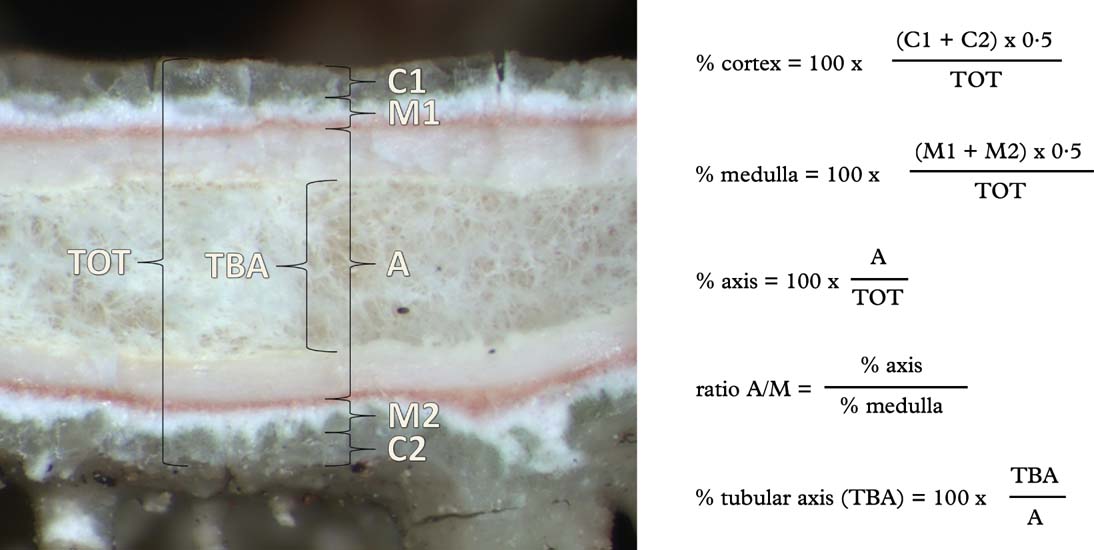
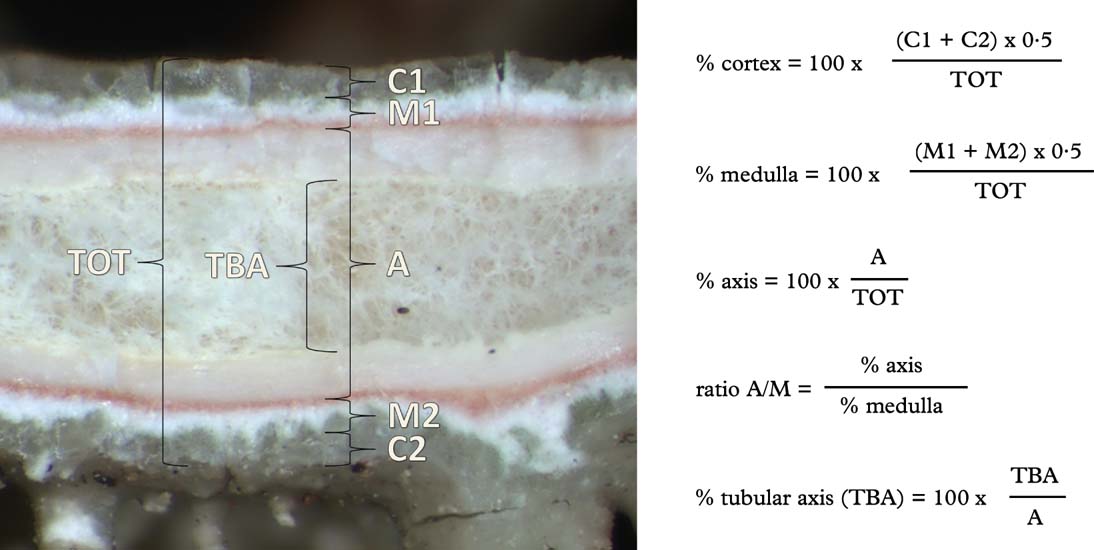
Morphology of specimens was examined using a stereomicroscope Leica MS5. For a description of characters used in the taxonomy of Usnea, see Clerc (Reference Clerc1987a , Reference Clerc1998, Reference Clerc, Thell and Moberg2011), Herrera-Campos et al. (Reference Herrera-Campos, Clerc and Nash1998) and Ohmura (Reference Ohmura2001). The shape of branches and branch segments in longitudinal and cross-section is a difficult character to understand and illustrations to clarify this are available in Clerc (Reference Clerc, Thell and Moberg2011, figs 1–5). Thickness of cortex/medulla/axis was measured in longitudinal sections of branches at ×40 magnification (on the largest branch above the trunk). The percentage ratio of cortex/medulla/axis of the total branch diameter (CMA) was calculated according to Clerc (Reference Clerc1987b ). The tubular part of the axis had been used to characterize species (Motyka Reference Motyka1936), but it was not expressed numerically in a formula to enable comparisons among species. Therefore we measured the tubular part of the axis (TBA) and developed a formula to calculate its percentage over the total axis diameter (Fig. 1).
Measurements and calculations of % cortex/medulla/axis (CMA), ratio A/M and % tubular axis (TBA) in longitudinal section of branch (at the widest branch diameter above first ramification). In colour online.
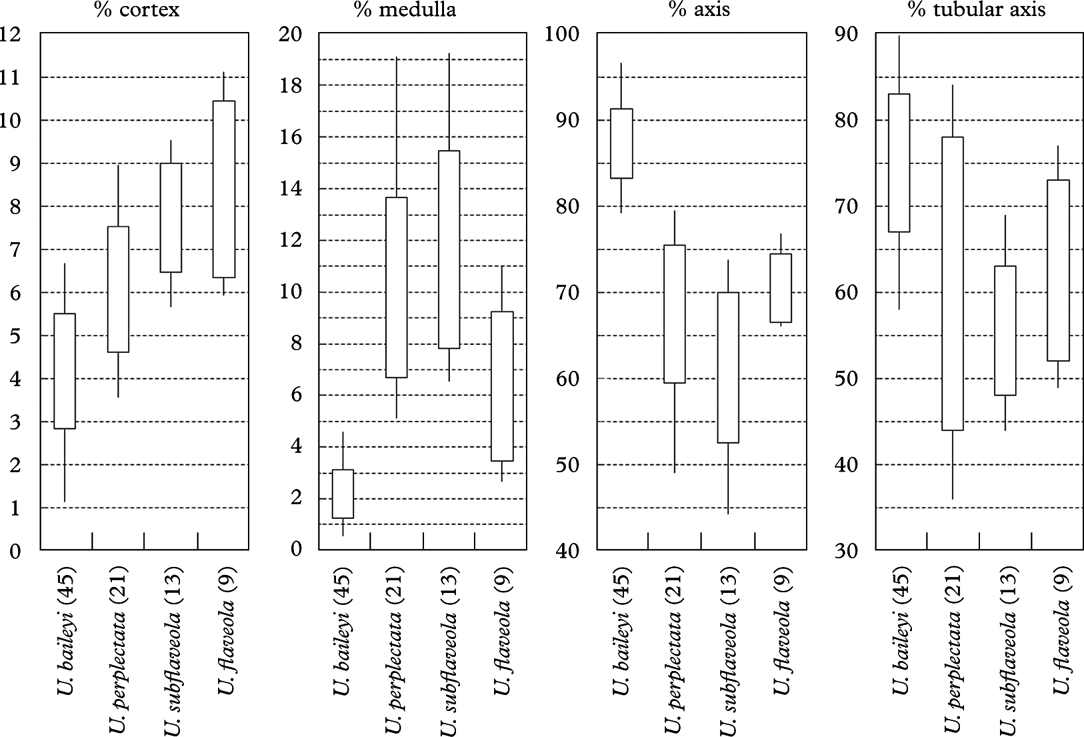
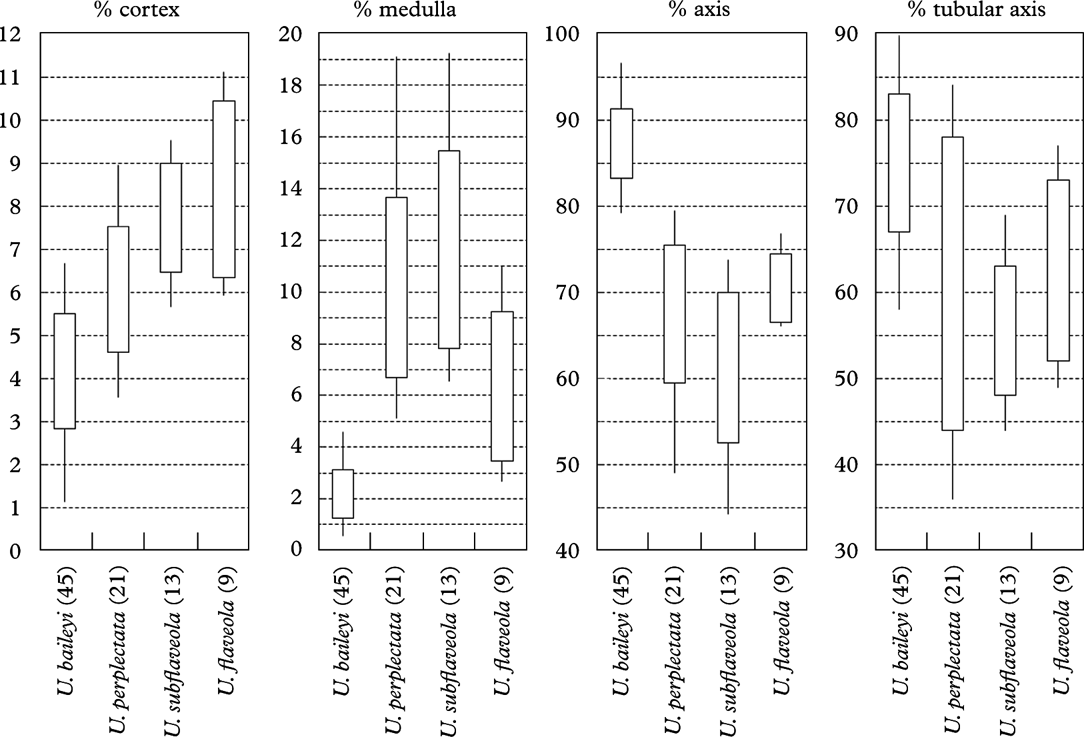
In the description of species, CMA and TBA values are given with their standard deviations and CMA values follow the categories described by Clerc (Reference Clerc, Thell and Moberg2011). A synthesis of CMA and TBA values for each species is presented in Fig. 2. Spores were observed under a Leica DM 2000 microscope and at least 10 spores per specimen were measured at ×1000 magnification.
% cortex/medulla/axis of total branch diameter and % tubular axis of total axis diameter. Standard deviations as wide bars; extreme values as lines; numbers in parentheses=number of specimens measured.
Chemical analyses were performed by thin-layer chromatography (TLC) in solvents A, B and C, following the method of Culberson & Ammann (Reference Culberson and Ammann1979), with solvent B modified according to Culberson & Johnson (Reference Culberson and Johnson1982). A summary of chemotypes detected for each species is presented in Table 2, with major metabolites highlighted. Metabolites were considered major if their presence was constant within the specimens studied of a given species.
Secondary metabolites (columns) detected by TLC in the medulla of eumitrioid species.

*DIF, diffractaic; EUM, eumitrins; NOR, norstictic; SAL, salazinic acid; ZEO, zeorin; UT8, unidentified tri-terpenoid UT8 (RF classes A/B/C: 1-2/4-5/2, UV+ white after charring); n, number of specimens studied; +, presence constant within species; ±, presence variable among specimens within a species; grey boxes indicate major metabolites, in which presence was constant within the specimens studied of a given species.
The Species
Usnea baileyi (Stirt.) Zahlbr.
Denkschr. Kaiserl. Akad. Wiss., Math.-Naturwiss. Kl. 83: 182 (1909).—Eumitria baileyi Stirt., Scott. Natur. 6: 100 (1882); type: Australia, Queensland, near Brisbane, Bailey 164 (BM!—lectotype). % C/M/A/TBA: 3.5/3/87/85. Chemistry: usnic, eumitrins A2 and B, zeorin, salazinic and norstictic acids (Ohmura Reference Ohmura2001).
Usnea antillarum (Vain.) Zahlbr., Cat. Lich. Univ. 6: 536 (1930).—Eumitria antillarum Vain., Ann. Acad. Sci. Fenn., Ser. A 6 (7): 9 (1915); type: Antilles, Ins. St. Thomas, Signalhill, 1876, Eggers (TUR V00328!—holotype, LBL!—isotype). % C/M/A/TBA: 3.5/1.5/90/68. Chemistry: usnic, norstictic and salazinic acids and eumitrins (Rogers & Stevens Reference Rogers and Stevens1988).
Usnea implicita (Stirt.) Zahlbr., Denkschr. Kaiserl. Akad. Wiss., Math.-Naturwiss. Kl. 83: 182 (1909).—Eumitria implicita Stirt., Scott. Natur. 6: 100 (1882); type: Madeira, W. Funchal, Payne (BM!—lectotype). % C/M/A/TBA: 5.5/2.5/84/63. Chemistry: usnic and norstictic acids, eumitrins A1, A2 and B, zeorin (Ohmura Reference Ohmura2001).
Usnea inanis Motyka syn. nov., Lich. Gen. Usnea Stud. Monogr. Pars Syst. 1: 58 (1936); type: Brazil, Matto Grosso, Serra da Chapada, Buriti, 1894, Malme (S!—holotype, LBL!—isotype). % C/M/A/TBA: 4.5/3.5/85/77. Chemistry: usnic, eumitrin A, zeorin and norstictic acid.
(Figs 3A & B, 4A–C)
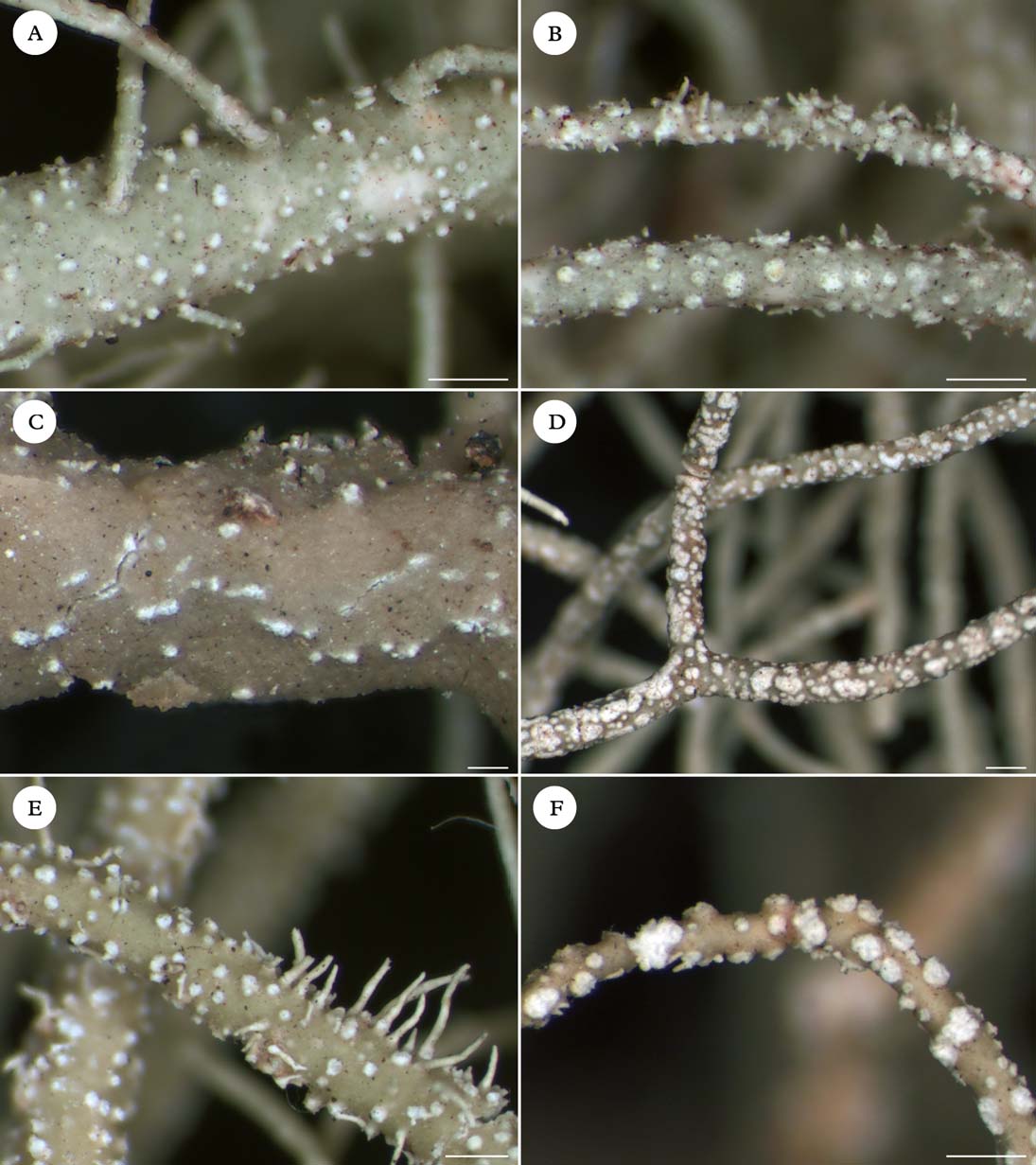
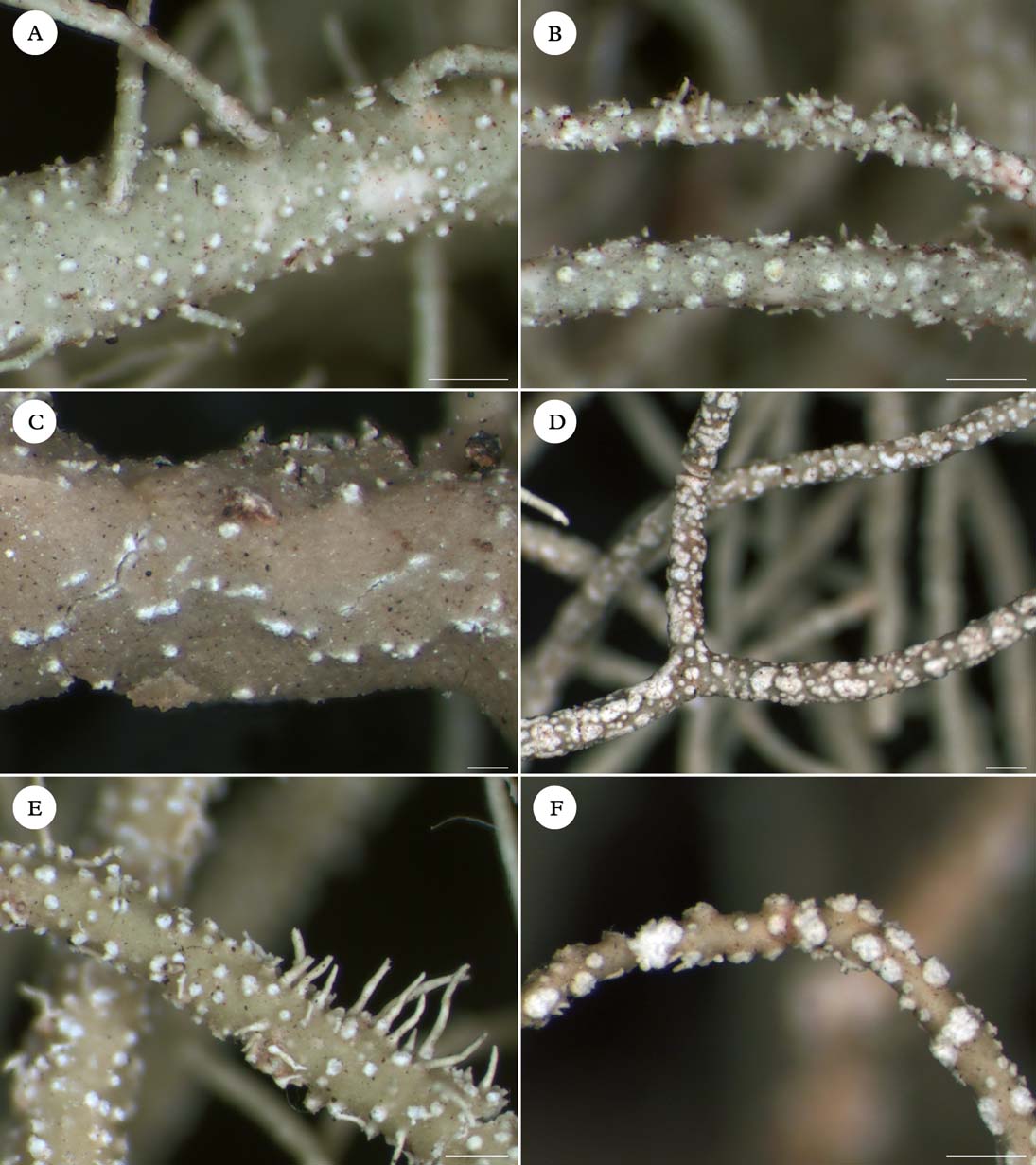
A & B, Usnea baileyi (Truong 1446); A, tubercles turning into minute and slightly raised soralia; B, soralia circular and plane, without a cortical margin, crowded on terminal branches but without fusing. C & D, Usnea perplectata; C, minute to slightly elongated soralia bursting along cracks and ridges of branches (Ferrero 1062); D, soralia of irregular outline, plane to slightly capitate, without a cortical margin, crowded and fusing on terminal branches (Bach 373). E & F, Usnea subflaveola; E, fibercles abundantly distributed on the branches (Truong 1783); F, soralia distinctly stipitate, circular and often capitate at maturity, with a distinct cortical margin, crowded on terminal branches but without fusing (Truong 1707). Scales: A–F=500 µm. In colour online.
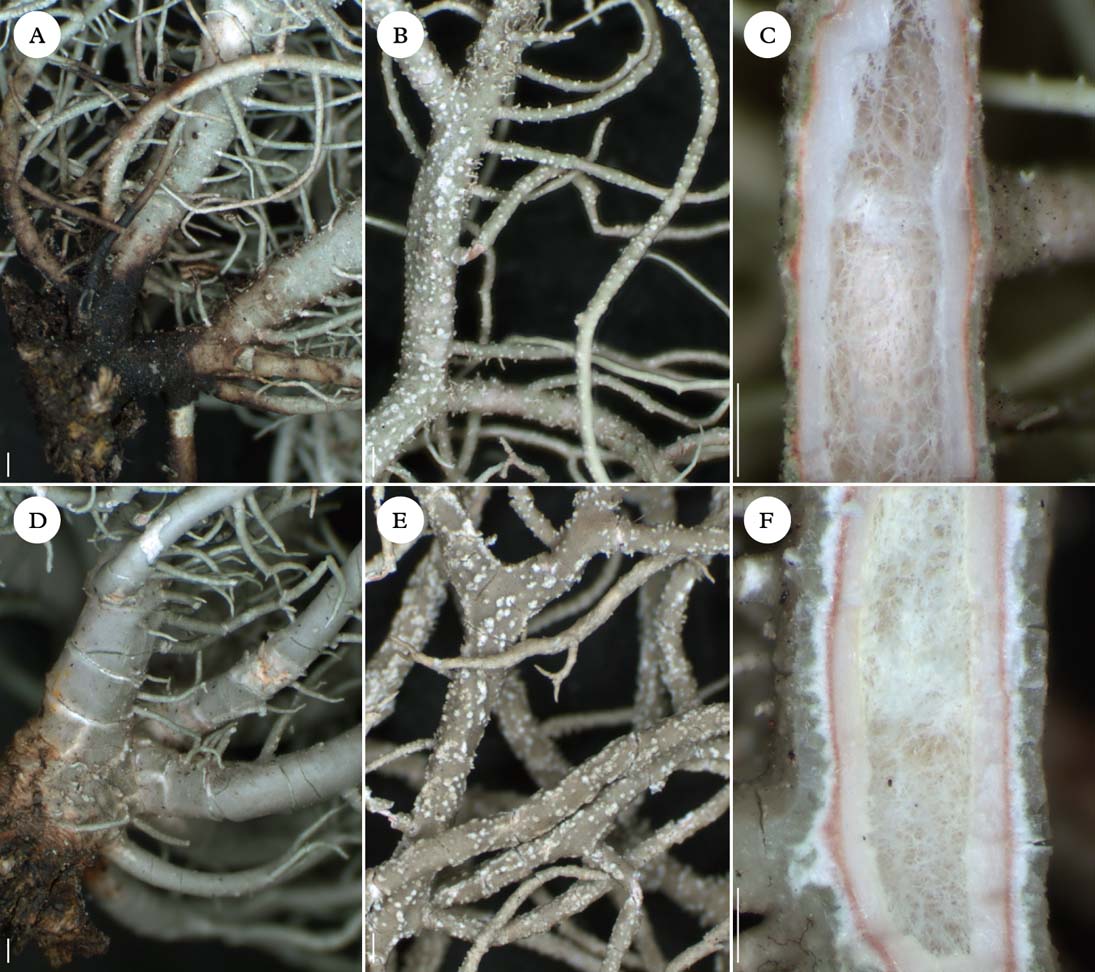
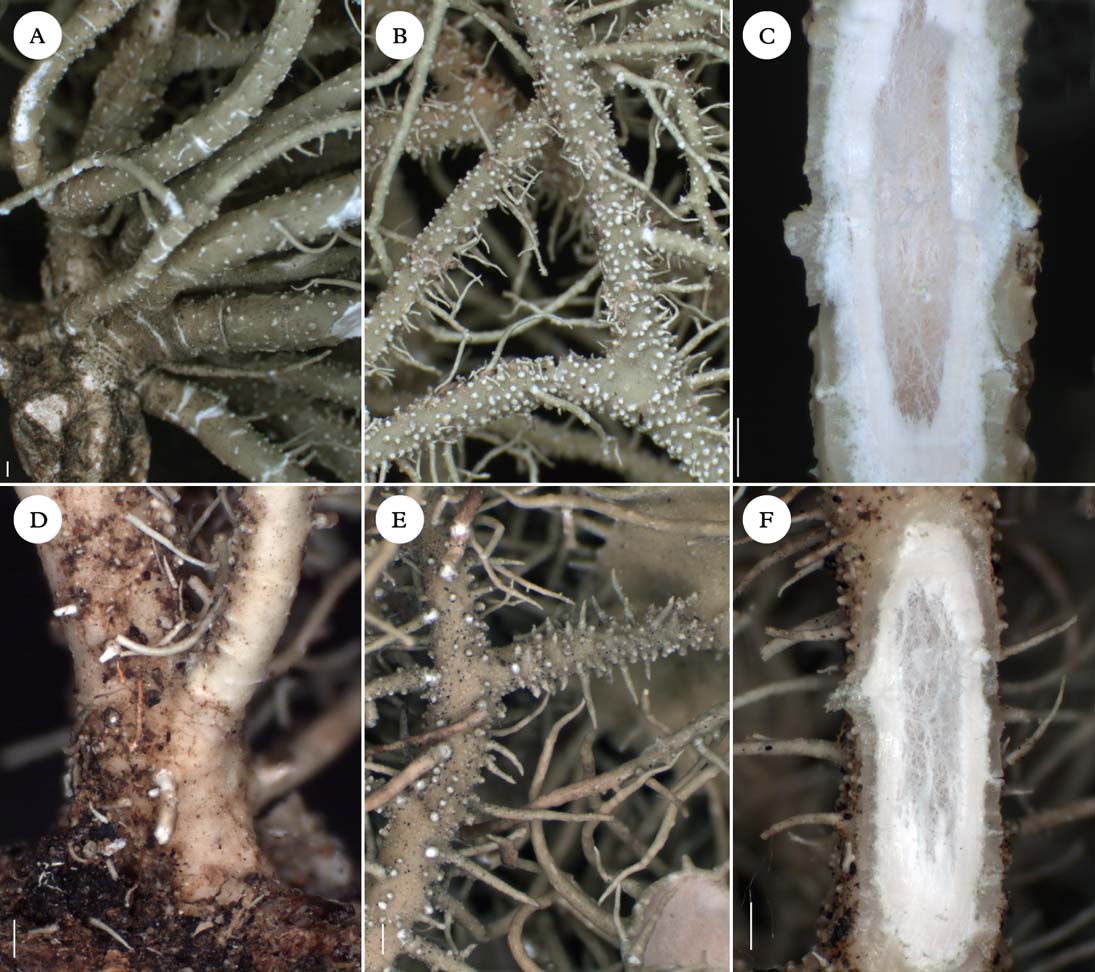
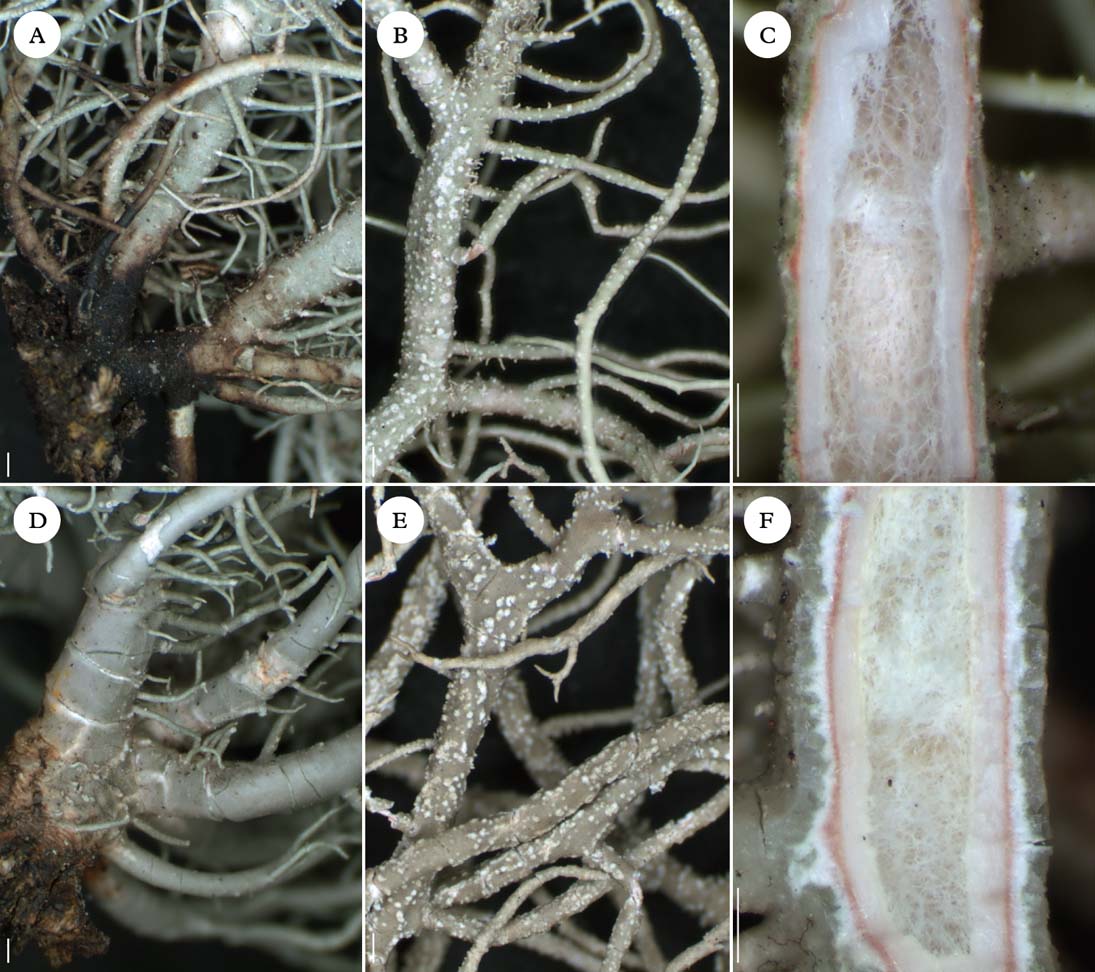
A–C, Usnea baileyi; A, trunk blackish (Truong 1446); B, flattened branches abundantly covered by minute soralia (Clerc 08-319); C, thin cortex; extremely thin medulla, pigmented throughout; very large axis with large tubular section (Clerc 08-319). D–F, Usnea perplectata; D, trunk concolorous with thin annular cracks (Rodriguez 0261B); E, ridged branches abundantly covered by soralia of irregular outline (Ferrero 1062); F, cortex thicker than (C); medulla thicker than (C) with periaxial pigmentation; large axis with large tubular section (Bach 373). Scales: A–F=500 µm. In colour online.
Nomenclatural notes. Three specimens are represented on the herbarium sheet containing the holotype specimen of U. inanis Motyka: we marked them as (a), (b) and (c). Thallus (a) was designated by Motyka's handwriting as the holotype and corresponds well morphologically and chemically to U. baileyi (eumitrins), whereas thallus (c) corresponds to U. perplectata (diffractaic acid). An isotype specimen found in LBL also corresponds to U. baileyi.
Only names that have been cited for South America are included in the above list of synonyms. For a complete list of synonyms, see former publications (Swinscow & Krog Reference Swinscow and Krog1974; Rogers & Stevens Reference Rogers and Stevens1988; Ohmura Reference Ohmura2001).
Diagnostic notes
For a detailed description of this taxon, see Ohmura (Reference Ohmura2001). Usnea baileyi is a sorediate species characterized by a stiff, erect-shrubby to subpendulous thallus, branches ± irregular, often sinuous towards the apices, with slightly to strongly flattened segments (Fig. 4B). The base is concolorous or blackish on the first mm below the first ramification (Fig. 4A). Branches are abundantly covered by minute soralia growing from the cortex ad initio or from low tubercles (Fig. 3A). Soralia are slightly raised, remaining plane, crowded on terminal branches, usually without fusing, with numerous short isidiomorphs (Fig. 3B). The cortex is very thin (3·0–5·5%), matt on the thallus surface but sometimes shinier in section. The medulla is extremely thin (1·5–3·0%), almost invisible except for the pink-red pigmentation throughout (Fig. 4C). The axis is extremely large (83·0–91·5%), with a large tubular section (67–83%) filled with loose hyphae. Usnea baileyi is characterized by the presence of eumitrins and zeorin detected by TLC in the medulla.
Variation
The density of ramifications, fibrils and isidiomorphs varies among individuals. Rarely, soralia may fuse in an irregular ‘soralium’ on terminal branches, from the aggregation of several minute soralia. In addition to eumitrins and zeorin, norstictic acid (n=44) and rarely salazinic acid (n=5) were also detected by TLC in the medulla of South American specimens and, as a consequence, the K reaction in the medulla is variable.
Differentiation
Usnea perplectata differs in the branch anatomy in longitudinal section (Fig. 2): it has a thinner axis than U. baileyi and a larger medulla, with a distinctly periaxial pigmentation. In addition, it has a somewhat thicker cortex and a thinner tubular section of axis, although these values overlap in the two species. Usnea perplectata also has slightly ridged branches (flattened in U. baileyi), with few to numerous fibercles, especially visible on basal branches. Diffractaic acid is detected by TLC in the medulla instead of eumitrins in U. baileyi.
Ecology and distribution
This is primarily a corticolous species, growing on a wide variety of trees and shrubs (including Rhizophora and cacti), occasionally also lignicolous (fencepost) or saxicolous. It is very frequent in the Galapagos, occurring from the arid to the humid zone (150–1100 m). In continental South America, it is one of the few Usnea species occurring at low altitudes (0–2300 m). It is found in open pastures, humid evergreen forests and mangroves, but also in the semi-arid climate of seasonally dry tropical forests and savannas of Brazil, Colombia and Venezuela. In Australia, this species was reported to be restricted to warm and moist places (Rogers & Stevens Reference Rogers and Stevens1988). From these observations we can deduce that U. baileyi has a rather wide ecological range from humid to arid places. This species has a worldwide distribution in (sub-) tropical regions of Asia (Ohmura Reference Ohmura2001), Australia (Rogers & Stevens Reference Rogers and Stevens1988), East Africa (Swinscow & Krog Reference Swinscow and Krog1974) and North and South America (Brodo et al. Reference Brodo, Sharnoff and Sharnoff2001; Clerc Reference Clerc, Nash, Gries and Bungartz2008).
Selected specimens examined. Bolivia: Beni: 20 km al SW del km 12 Yucumo – Rurrenabaque, 900 m, 1997, Bach et al. (B).—Brazil: Minas Gerais: Bei Lagoa Dourada etwa 50 km nordöstlich von São João del Rei, 1000 m, 1978, Kalb & Plöbst (private hb.). Rio Grande do Sul: Herveiras, 570 m, 2004, Spielmann & Putzke 6308 (SP). São Paulo: near Praia de Pernibe, near Itanhaéna, 0 m, 1979, Sipman 13501 (B).—Colombia: Amazonas: Araracuara, on S-side of river Caquetá, 350 m, 1988, Sipman & Duivenvoorden 27856 (B). Cauca: Los Robles, campus of Fundacion Universitária, 1750 m, 1986, Sipman et al. 32738 (B). Cundinamarca: Laguna de Pedro Palo, 2000 m, 1984, Aguirre & Sipman 5640 (B).—Ecuador: Galapagos Islands: Isabela, mirador el Mango, 161 m, 2008, Truong 1191 (G, CDS); Pinta, along the trail up to the summit from the S-coast, 369 m, 2007, Bungartz 5850 (CDS); Pinzón, on the W-slope of the highest mountain, 310 m, 2006, Aptroot 64105 (CDS); San Cristobal, Cerro Colorado summit, 159 m, 2008, Truong 1420 (G, CDS); Santa Cruz, dirt road to Mina Granillo, 547 m, 2008, Truong 1302 (G, CDS); Santiago, Cerro Gavilan, 680 m, 2006, Bungartz 4686 (CDS).—Peru: Cusco: Valle de Lacco, 1928, Herrera 2066 (US).—Venezuela: Amazonas: en la cumbre de la laja de Carestía, bajo Sanariapo, 150 m, 1942, Williams 16038 (US). Aragua: Arriba de Guanitas, parque nacional, 950 m, 1939, Williams 12213 (US). Distrito Federal: Silla de Caracas, 1700 m, 1951, Vareschi 57 (LBL). Lara: Morán, bordeando a las cabeceras del río Tocuyo, 1900 m, 1974, Steyermark & Carreño Espinoza 111081 (US). Merida: La Carbonera, sector San Rafael del Macho, 2200 m, 1976, Hale 46631 (US). Miranda: Los Guayabitos, 1400 m, 1955, Vareschi 3935 (LBL). Sucre: Peninsula de Paria, Cerro de Río Arriba, 700 m, 1966, Steyermark y Rabe 96276 (US).
Usnea flaveola Motyka
Lich. Gen. Usnea Stud. Monogr. Pars Syst. 1: 52 (1936); type: Peru, Sandia, 2100 m, 1902, Weberbauer (LBL!—holotype, isotype). % C/M/A/TBA: 7/7.5/71.5/75. Chemistry: usnic acid and unknown triterpenoids UT8.
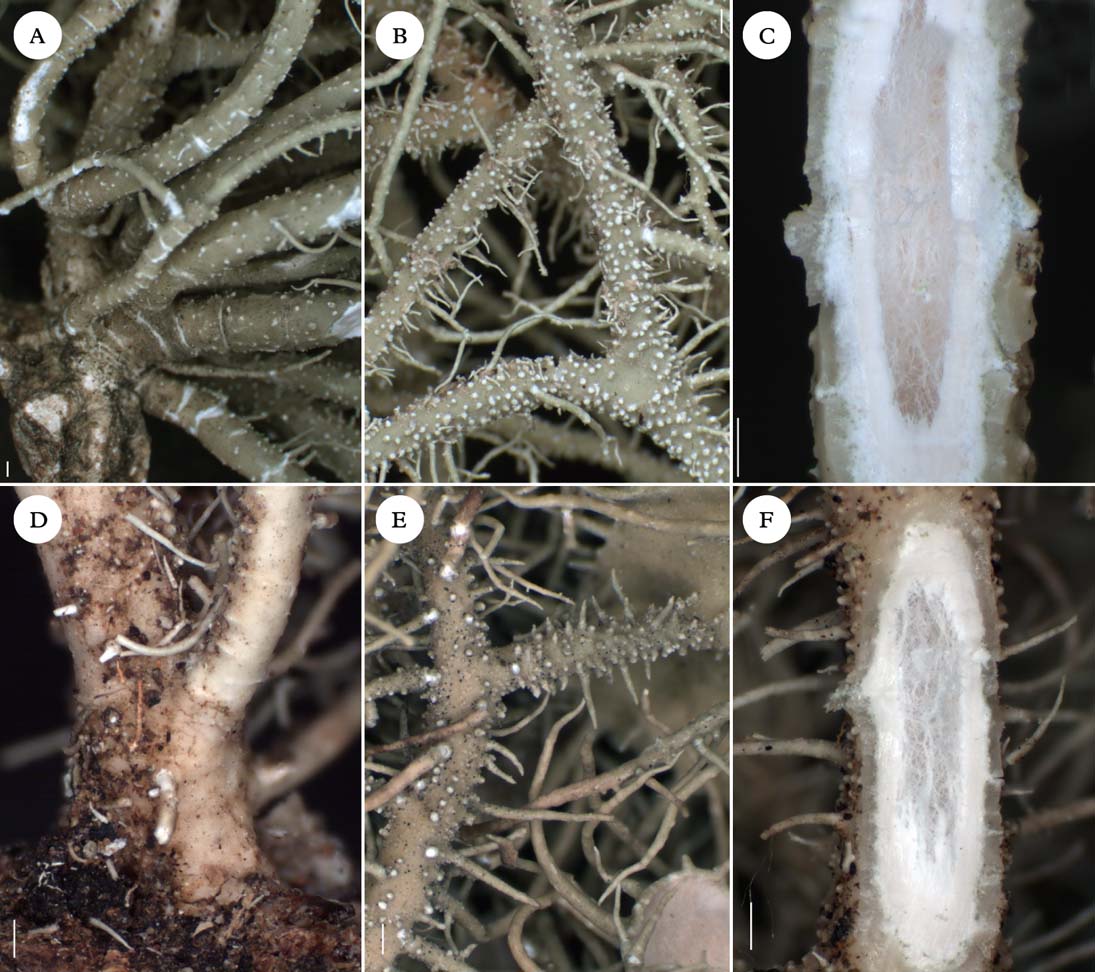
A–C, Usnea subflaveola; A, trunk concolorous, sometimes with thin annular cracks; branch segments almost angular (Truong 2783); B, tapering branches abundantly covered by fibercles (Truong 1783); C, cortex moderately thin; medulla thin, without pigmentation; axis large, with a moderately large tubular section (Truong 1707). D–F, Usnea flaveola; D, trunk concolorous, without annular cracks (Truong 3140); E, branches covered by fibrils and fibercles, holding apothecia (Bach 325); F, cortex moderately thin; medulla thinner than (C), without pigmentation; axis large, with a moderately large tubular section (Truong 3140). Scales: A–F=500 µm. In colour online.
Nomenclatural note. Motyka (Reference Motyka1936) mentions that the holotype specimen of U. flaveola was deposited in B, but we found it within his collections in LBL.
Thallus stiff, erect-shrubby to subpendulous (to c. 10 cm long); ramifications ± anisotomic-dichotomous; trunk concolorous with the branches, without annulations or rarely with very thin annular cracks (Fig. 5D); branches tapering to irregular; branch segments terete to flattened or ridged, sometimes almost angular; lateral branches not constricted at ramification; foveoles and maculae absent; papillae and tubercles absent or scarce (not to be confounded with young fibrils); fibrils slender (to 5 mm long), abundantly and regularly distributed on the branches, looking like cylindrical papillae crowded on the cortex surface at a juvenile stage; fibercles usually numerous (Fig. 5E), especially on basal branches; soralia absent; cortex shiny in section, moderately thin to moderately thick (6·5–10·5%); medulla white (Fig. 5F), compact and thin (3·5–9·0%); axis thick (66·5–74·5%) with a moderate tubular section (52–73%) loosely filled with thin hyphae and often also chondroid strands of hyphae, axis rarely solid (not tubular) on thin terminal branches.
Apothecia usually present and often numerous, (sub-) terminal, large at maturity (to c. 15 mm diam.), with few to numerous long cilia; spores hyaline, obovoid, 8·5–10·5×5–7 µm (n=45).
Pycnidia rare, usually visible when apothecia are absent, appearing as small hemispherical protuberances on terminal branches.
Diagnostic notes
Usnea flaveola is a non-sorediate species (usually with apothecia) characterized by an erect to subpendulous thallus, with somewhat irregular branches abundantly covered by fibrils and fibercles. Clerc & Herrera-Campos (Reference Clerc and Herrera-Campos1997) described fibercles as stipitate scars left by the breaking away of fibrils, probably functioning as sterile propagules, sometimes exposing the central axis of the fallen fibril. The axis is large with a moderately large tubular section and the medulla is thin and white (without pigmentation), reacting K− (unidentified triterpenoids UT8: RF classes A/B/C: 1-2/4-5/2, UV+ white after charring). Triterpenoids seem to be frequent in Neotropical Usnea specimens and are useful for identifying several species, for example U. rubricornuta Truong & P. Clerc and U. steineri Zahlbr. (Truong et al. Reference Truong, Bungartz and Clerc2011).
Variation
The irregularity of branch diameter, as well as the shape of branch segments (terete to flattened or ridged, sometimes even angulate) vary mostly with the development stage of the thallus. The abundance of fibrils and fibercles also vary among individuals; nevertheless, fibercles are always present and characteristic of this species.
Differentiation
The tubular axis, the absence of medullar pigmentation and the absence of soralia readily distinguish this species. It is the only non-sorediate eumitrioid species occurring in South America so far (see also U. trullifera Motyka in the paragraph treating doubtful species).
Ecology and distribution
This is mostly a corticolous species, occasionally also found on rocks. It occurs in humid and somewhat open places within evergreen forest, mountain cloud forest or in the vicinity of the forest. It is so far endemic to the Neotropical Andes, at moderate altitudes (1100–2500 m).
Selected specimens examined. Bolivia: La Paz: 15 km de Charazani hacia Apolo, 2400 m, 1997, Bach et al. 252 (B). Cochabamba: Parque Nacional Carrasco, Sehuencas hasta Monte Puncu, 2500 m, 2007, Truong 3140 (G).—Peru: Junin: Distrito de San Ramon, carretera arriba de la catarata Tirol, 1139 m, 2007, Truong 2676 (G).
Usnea perplectata Motyka
Lich. Gen. Usnea Stud. Monogr. Pars Syst. 1: 55 (1936); type: Paraguay, Gran Chaco, ad Rio Negro e ad Capernicians, 1883, Malme (S!—holotype). % C/M/A/TBA: 6.5/16/55/41. Chemistry: usnic, diffractaic, traces of 4-O-demethylbarbatic acids and associated compounds.
Usnea elata Motyka syn. nov., Lich. Gen. Usnea Stud. Monogr. Pars Syst. 1: 57 (1936); type: [Congo], Mpala, ad litus occid. Lacus Tanganjika, 1898, Guillemé (TUR!—holotype). C/M/A/TBA: unknown (small fragment of branch). Chemistry: usnic and diffractaic acids (Rogers & Stevens 1988).
Usnea subcavata Motyka syn. nov., Lich. Gen. Usnea Stud. Monogr. Pars Syst. 1: 57 (1936); type: Brazil, Sao Paulo, prope S. Amaro in circuito urbis S. Paulo, 800 m, 1901, Schiffner (W—holotype, LBL!—isotype). % C/M/A/TBA: 4.5/8.5/73.5/67. Chemistry: usnic, diffractaic, traces of barbatic, 4-O-demethylbarbatic acids and associated compounds.
(Figs 3C & D, 4D–F)
Nomenclatural note. Clerc (Reference Clerc, Nash, Gries and Bungartz2008) synonymized U. perplectata into U. baileyi. However, the current study treats U. perplectata as a distinct species.
Thallus relatively stiff, subpendulous to pendulous (to c. 25 cm long); ramifications ± anisotomic-dichotomous; trunk concolorous with the branches or rarely blackish on the first mm (below first ramification), usually with thin annulations extending along the basal branches (Fig. 4D); branches of slightly to strongly irregular diameter; branch segments terete to slightly ridged (Fig. 4E); lateral branches not constricted at ramification; foveoles and maculae absent; papillae absent or scarce; tubercles few to abundant on main branches; fibrils slender (to 5 mm long), scattered on the thallus; fibercles few to abundant on basal branches; soralia growing from the cortex ad initio (cracks, along ridges of branches, Fig. 3C) or from tubercles, at once slightly raised, usually remaining minute to slightly enlarging (less than the branch half-diameter), often elongated (along ridges of branches) or of irregular outline, without a cortical margin, plane to slightly capitate at maturity, often crowded on terminal branches and aggregating in irregular ‘soralium’ (Fig. 3D), with few to numerous isidiomorphs, rarely growing into isidiofibrils; cortex shiny in section, thin to moderately thin (4·5–7·5%); medulla compact and thin (6·5–13·5%), with a pink to orange, periaxial pigmentation (Fig. 4F); axis large (59·5–75·5%), with a moderately large tubular section (44–78%) loosely filled with thin hyphae that are often yellow pigmented and reacting C+ yellow-orange.
Apothecia rare (n=1), lateral.
Pycnidia not seen.
Diagnostic notes
This species is characterized by a stiff thallus with slightly ridged branches and minute to slightly elongated soralia, crowded and aggregating on terminal branches, with few to numerous isidiomorphs. The medulla is thin and compact, with a characteristic pink to orange pigmentation, located at the periphery of the axis. Diffractaic acid was detected by TLC in the medulla.
Variation
The density of tubercles, fibrils, fibercles and isidiomorphs varies among individuals. The trunk is usually concolorous and distinctly annulated, but it is rarely brownish to blackish (below first ramification) and without annulations.
Differentiation
See under U. baileyi.
Ecology and distribution
This is mostly a corticolous species, occasionally also found on rocks. It occurs in continental South America, mainly on the Eastern range. As U. baileyi, it is one of the few Usnea species occurring at low altitudes (0–1500 m). It is found in humid places, within evergreen forest, coastal forest (restinga) or in the vicinity of the forest, but also in drier places such as the Brazilian cerrado. It also occurs in North America (Brodo et al. Reference Brodo, Sharnoff and Sharnoff2001), East Africa and Australia (sub U. elata).
Selected specimens examined. Argentina: Corrientes: Capital San Cayetano, 1976, Ferraro 1062 (G). Formosa: Dpto. Lahisi, ruta nacional 11, 2007, Rodriguez 281B (G). Misiones: Bei den Wasserfällen Victoria am Rio Iguazu, 1933, Hosseus (LBL).—Bolivia: Beni: 16 km al SW del km 12 Yucumo–Rurrenabaque, 750 m, 1997, Bach et al. 373 (B).—Brazil: Mato Grosso: Serra dos Coroados, Naturschutzgebiet der evangelischen Schule von Buriti, 600 m, 1980, Kalb (private hb.). Santa Catarina: Ilha de Santa Catarina, Praia do Forte, 3 m, 1980, Kalb (private hb.). São Paulo: Reserva biologica de Mogi-Guaçu, fazenda Campininha, 610 m, 2008, Jungbluth 1755 (SP).—Tanzania: Sud-Pale Gebirge, bei Vudu, 1800 m, 1958, Schüz (LBL).—Paraguay: In vicinity urbis Assuntion, Aminsris (LBL).—USA: Florida: Standford, 1924, Rapp (LBL).—Venezuela: Aragua: Choroni, Peñon Blanco, 1200 m, 1954, Vareschi 3603 (LBL). Zulia: Selva de Geonema, 1500 m, 1954, Vareschi 3172 (LBL).
Usnea subflaveola Truong & P. Clerc sp. nov.
MycoBank No.: MB 564913
Thallus sorediate, fibrils and fibercles abundant, medulla unpigmented, reacting K− (triterpenoids), axis tubular to the apices.
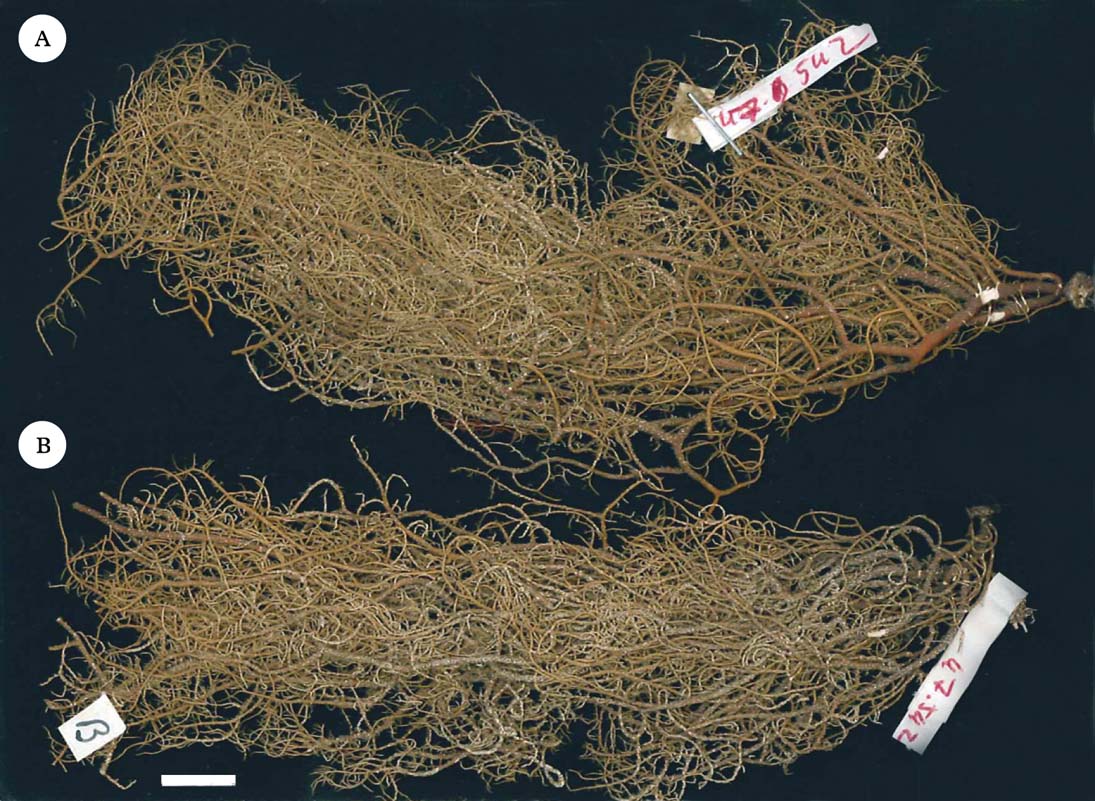
Type: Venezuela, Merida, La Carbonera, Merida–La Azulita road, 2200 m, remnants of forest in open pasture, fence post, 1976, Hale 47542 (USM—holotype; G—isotype). % C/M/A/TBA: 6.5/18.5/54. Chemistry: usnic and norstictic acids, unidentified triterpenoids UT8.
(Figs 3E & F, 5A–C, 6)
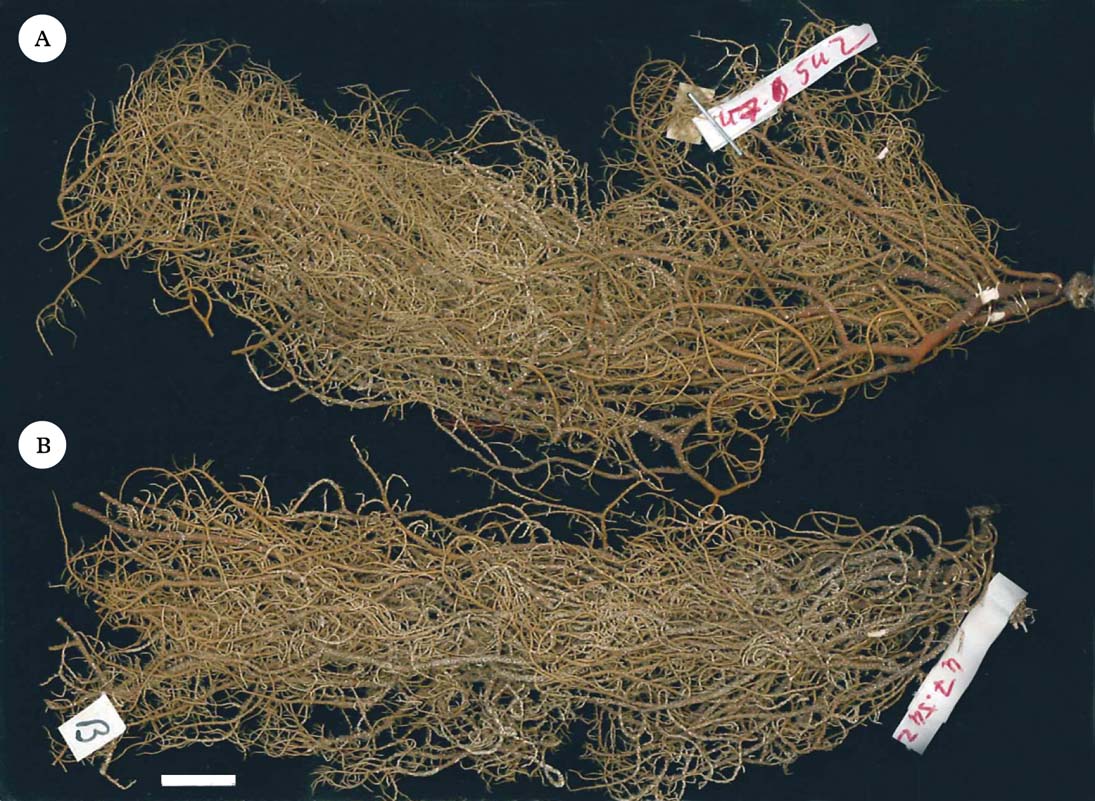
Usnea subflaveola; A, holotype; B, isotype. Scale=1 cm. In colour online.
Thallus subpendulous to pendulous (to c. 30 cm long), rarely erect-shrubby; ramifications mostly anisotomic-dichotomous; trunk concolorous with the branches, without annulations or rarely with thin annular cracks (Fig. 5A); branches tapering to slightly irregular; branch segments terete to slightly ridged or angular, sometimes slightly inflated; lateral branches not constricted at ramification; foveoles and maculae absent; papillae and tubercles absent or scarce (not to be confounded with young fibrils); fibrils slender (to 5 mm long), scattered (mainly on basal branches) to abundantly distributed on the branches; fibercles usually numerous (Fig. 3E & 5B), especially on basal branches; soralia developing at the top of fibercles thus being distinctly stipitate, minute to circular, circular, enlarging almost to the branch diameter on terminal branches, convex or rarely slightly excavate at maturity, often crowded on terminal branches but remaining well-delimited with a thin cortical margin (Fig. 3F), with numerous isidiomorphs, sometimes growing into isidiofibrils; cortex shiny in section, moderately thin to moderately thick (6·5–9·5%); medulla white (Fig. 5C), compact and thin (8·0–15·5%); axis large (52·0–69·5%) with a moderate tubular section (47–62%), loosely filled with thin hyphae and sometimes chondroid strands of hyphae, axis rarely solid (not tubular) on small terminal branches.
Apothecia and pycnidia not seen.
Diagnostic notes
This is a sorediate species characterized by a (sub)pendulous thallus, with tapering to slightly irregular branches abundantly covered by fibrils and fibercles, from which arise stipitate soralia, often crowded on terminal branches but remaining well-delimited with a distinct cortical margin. The medulla is thin and white (without pigmentation), reacting K− (unidentified triterpenoids UT8), rarely faintly K+ (norstictic acid).
Variation
The abundance of fibrils and fibercles may vary among individuals, but fibercles are conspicuously present, at least towards the basal branches. The development of soralia and isidiomorphs varies among individuals or in response to infestation by parasitic fungi, as is often the case in Usnea. In addition to UT8, norstictic acid (n=6) was sometimes detected by TLC in the medulla.
Differentiation
The absence of medullar pigmentation and the presence of circular soralia growing from fibercles readily distinguish this species. Apart from the presence of soralia, it shares with U. flaveola a similar morphology (presence of fibercles, absence of medullar pigmentation) and the same chemotype. CMA values show slight differences between the two species, U. subflaveola having a thicker medulla and a thinner axis than U. flaveola, although these values overlap in the two species (Fig. 2). The corroboration of molecular tools will be needed to distinguish these two taxa.
In East Africa, U. cristata Motyka is another sorediate eumitrioid species without medullary pigmentation. The holotype specimen of U. cristata deposited in W is apparently missing (Swinscow & Krog Reference Swinscow and Krog1974), but we found an isotype in Motyka's collections in LBL. It doesn't correspond to U. subflaveola: in U. cristata, branches are deformed, with strongly ridged segments and the presence of foveoles. Soralia arise irregularly along the ridges of branches or from thick fibercles. They remain minute to slightly elongated, with an irregular outline and numerous isidiomorphs.
Ecology and distribution
This is mostly a corticolous species, occasionally also found on dead wood (fence post). It occurs in humid places within mountain cloud forest or in open places in the vicinity of the forest, such as deforested zones of matorral, remnants of forest within pastures or isolated trees. It is so far endemic to the Neotropical Andes, at a moderately high altitude (2000–3100 m).
Selected specimens examined. Peru: Cajamarca: Ruinas de Kuelap, 3100 m, 2007, Truong 1870 (G). Huanuco: Bosque de Carpish, 2424 m, 2007, Truong 2738 (G). Pasco: Parque Nacional Yanachaga-Chemillén, camino hasta el refugio El Cedro, 2309 m, 2007, Truong 2444 (G).—Venezuela: Merida: La Carbonera, sector San Rafael del Macho, 2200 m, 1976, Hale 46603 (US). Tachira: Slopes of Pico Banberas, páramo de Tama, 2600 m, 1975, Hale & Lopez-Figueiras 45208 (US).
Doubtful Species
Usnea trullifera Nyl.
Lich. Gen. Usnea Stud. Monogr. Pars Syst. 1: 65 (1936); type: Tahiti, 1875, Moseley (BM!—holotype). % C/M/A/TBA: 4/3.5/85/71. Chemistry: usnic, salazinic and norstictic acids, zeorin.
This is a non-sorediate species (usually with apothecia), characterized by the presence of high tubercles abundantly covering the branches and often eroded at the top. CMA values are similar to U. baileyi, with a very thin and pale pink to orange pigmented medulla. In his description, Motyka (Reference Motyka1936) mentions specimens from Tahiti, East Africa and Brazil, most of which were hosted in B and are probably lost today. We found one Brazilian specimen identified by Motyka in LBL. It is composed of a small fragment of branch, holding apothecia (without soralia), but lacking the trunk and basal branches. Apart from the presence of apothecia, this specimen resembles U. baileyi, but it is too small to be accurately identified. Despite studying more than 100 South American specimens of U. baileyi, we have never observed apothecia in this species. In addition, protocetraric acid and zeorin were detected by TLC in the medulla of this Brazilian specimen. Protocetraric acid has been detected in Asiatic U. baileyi specimens (Ohmura Reference Ohmura2001), but we have never found it in South American specimens.
Selected specimens examined. Brazil: Mato Grosso: Caracas, 1908, Hoehne (LBL).—Cameroon: Kamerunberg, 1800 m, 1958, Knorr (LBL).—Tahiti: 1847, Vesco (LBL).—Uganda: Kasatoro Forest Kigezi, 1800–2500 m, 1947, Dale 39 (LBL).
-
1 Medulla with a pink, orange or red pigmentation ... 2
Medulla white (not pigmented) ... 3
-
2(1) Medulla extremely thin (<5%); pigmentation pink-red throughout the entire medulla; branch segments terete to flattened ... U. baileyi
Medulla thicker (>5%); pigmentation pink to orange, distinctly periaxial; branch segments terete to ridged ... U. perplectata
-
3(1) Soralia present, developing at the top of fibercles, distinctly stipitate, often crowded on terminal branches, remaining well-delimited with a distinct cortical margin ... U. subflaveola
Soralia absent and apothecia usually present, if not pycnidia often visible as hemispherical protuberances on terminal branches; fibrils and fibercles abundantly distributed on the branches ... U. flaveola
Key to eumitrioid Usnea species from tropical South America and the Galapagos
Fieldwork was supported by the Conservatoire et Jardin Botaniques de la Ville de Genève, a grant “Augustin Lombard” from the Société de Physique et d'Histoire Naturelle de Genève and a grant from the Amazon Conservation Association. Fieldwork was realized with the collaboration of the herbaria CDS, LPB, QCNE, USM and the Wayqecha Biological Station (Peru). F. Bungartz, M. Herrera-Campos, C. Aldana Munguia, A. Cuba Villena, M. F. Collaguazo, Y. Manami, A. Ramirez-Ordaya, P. Rodriguez, L. Salcedo Valdez and A. X. Shuguli participated in the field trips. The Ministries of Environment of Bolivia, Peru, Ecuador and the Galapagos provided collection permits. The staff in national parks kindly supported our investigation by providing guides and/or lodging. A. Tehler and W. Mulenko gave us a warm welcome during our visits to S and LBL, and curators of the cited herbaria kindly sent specimens on loan. Florian Visentin helped with TLC analysis and M. Price corrected the English.