


First published in March 1934 in Hollywood John Reed Club journal The Partisan, Tillie Lerner Olsen's “I Want You Women up North to Know” protests the working conditions of Tejana seamstresses in San Antonio, Texas. The women, employed by local offices of a New York firm, Juvenile Mfg. Corp., work from home, morning till night, and each produces dozens of embroidered children's dresses per week. The dresses, labelled “handmade,” are then sold in northern department stores. Such is the demand for paid work of any kind amongst the marginalized, non-unionized populations of San Antonio that the company is ruthlessly driving prices – and therefore wages – down. In the poem, Olsen's poetic “I” draws a gnarly contrast between physical forms, between the “fat little prairie-roll bodies” of the northern children the dresses are intended for, and the poor shape of a seamstress's own “brood”: “the bony ridge that marks hunger's landscape.” Bodies here – not without some semantic tension – are made to stand in for geographical regions, and as the “I” interpellates one of the women by name this impossibly expansive figurative scope implodes:
If the thread connecting those bony ridges to the whole continent proves a little too fragile, this is perhaps because the reductive binaries of northern consumer/southern producer, complacent bourgeois/worthy proletarian, are a little too mired in the workerist politics of the radical writing of the 1930s to spark much interest nowadays as much more than period detail. What does bear the weight of analysis, on the other hand, is this next image, a kind of haptic zoom in on the texture of the everyday. Its value, I think, lies along the curve of an elegant dialectic. The warp and weft of imperfection and repair on the children's clothing appears handmade in the sense of being complex and singular, irregularity implying a high level of dexterity, of self-conscious skill. At the same time, this sense of order is illusory, just another form mapped by analogy onto the purely contingent, a Jamesean figure in the carpet. The idea of agency is retained, on some higher or deeper level, though, in the personification of “Poverty herself.” Design – “multitudinous, complex” – it turns out, is after all predetermined, but here by material lack rather than manual skill. This negative determination, finally, reflects back on the initial object, the handmade dresses sold up North, now understood not as beautiful artefacts in their own right but rather in terms of the material deprivation by means of which they are produced and which, in being consumed, they sustain.
This moment is absolutely characteristic of a certain strand within American modernism, a lineage spun out through Whitman's interminable lists to William Carlos Williams's “no ideas but in things” and here connecting the proletarian avant-garde with both New York Dada and Objectivism. Hopelessly diverse though these schools of thought and practice may at first sight seem, each speaks in some sense to the downplaying of the role of ego in the creative process. As critic John Roberts notes, Objectivism and Marcel Duchamp's art of the readymade overlap insofar as artists' and poets' struggles with prior determination in the form of recalcitrant materials – whether these be words, images, even plumbing – lead to “an intellectualisation of perception.”Footnote 2 The agency of the cultural producer is no longer purely originary as such, but rather profoundly dependent on the social: making it new, perhaps; making it strange, no doubt; but also all about making connections. In the poetic practice of Louis Zukofsky and George Oppen, for instance, the interruption of conventional sentence structures, the awkward placing of nouns, a conscious “rejection of syntactic disclosure,” shatter the illusion of the “integrated voice of the poet.”Footnote 3 Language is brought in onto the page from outside.
Zukofsky and Oppen were both committed Marxists, but their artistic scruples prevented them from placing their work in the service of the American Communist Party (CPUSA). And yet writers openly associated with CPUSA-sponsored proletarian networks sometimes shared the Objectivists' sense of the materials of writing as external to the institutions of literature, and this conviction – at times pointedly so – left ideological concerns to one side. “The worker may never have heard of Marx,” Joseph Freeman put it, in his introduction to the anthology Proletarian Literature in the United States (1935), “but he knows the facts.”Footnote 4 The documentary impulse behind proletarian writing allows us to put some distance between our twenty-first-century selves and the ideological ghettoes of the Depression era. My method is to assert the relative autonomy of the artwork; I am far more interested in the aesthetic strategies employed by 1930s radicals than in their often totalizing politics. Whether it makes sense, on the other hand, to look to the radical writing of the period without recourse to left cultural politics at all seems a rather more unlikely proposition.
As with the fate of the handmade dresses, there is more at stake in Olsen's deployment of imagery than the integrity of the artefact itself. Here the investigation into the prior determination of poetic materials is complicated and deepened insofar as this poem is in a real, material sense itself almost entirely predetermined. The most celebrated instance of the 1930s practice of “worker correspondence,” Olsen's free verse composition refigures a letter from New Masses reader Felipe Ibarro. Though by no means a widespread phenomenon, this habit of re-presenting readers' letters as if they were poems has warranted some attention in critical re-evaluations of the proletarian writing of the period. Carried out largely in the pages of the Daily Worker, found poetry disrupted the model of poet as seer, operating instead a desacralized version of author as witness, as recorder of history, a role which, as Cary Nelson has noted, was later to find its potential fully realized in Charles Reznikoff's sequence culled from legal documents, Testimony.Footnote 5 Objectivist poetics is political in its emphasis on the material and social basis of language: a textual politics in which, even in the absence of explicit political statement, “preoccupation with the accuracy of detail” leads to a kind of shape, a “rested totality,” in which meaning and material coalesce.Footnote 6 Worker correspondence, however, invoked less contemplative encounters. Placing nonprofessional, nonmetropolitan, working-class voices directly onto the page was a form of activism, an attempt to dismantle the institutional boundaries squeezing literary production in the Depression decade.
Whilst “I Want You Women up North to Know” deals as subject matter in the materials of handcraft, as a found poem it works a lot like a readymade. At its most basic the use of the readymade is a statement about transgression; something that belongs in some other place is brought out into the open. Olsen's choice of source material, even the fact that the poem has source material as such, issues a challenge to the gatekeepers of literary standards. For Roberts, the use of readymades destabilizes the relation between cultural production and labour. The readymade was “a kind of mimetic short-circuit,” an art object “that didn't need to persuade you it was something else.”Footnote 7 The explanatory function of the readymade lies in its capacity to overlap the seamless, homogenized procedures of the production line or office with the sensuous, deregulated processes of non-alienated creativity: art is demystified, democratized and expanded; work becomes the equal of creativity. In what follows I will argue that the practice of worker correspondence remodels this agenda on the political far left. To do this requires attention to what Joseph Harrington defines as the “social form” of poetry: that poetry does not reside in poems as such, but rather in those institutions and discourses that legitimate it.Footnote 8 But it will also require close reading of the poems themselves. Lawrence Hanley has shown that proletarian writing's tone of unease with itself, a distinctive reflexivity born of anxiety in the face of ingrained cultural hierarchy, is irreducible to the aesthetic choices of individual writers: “a structural effect of the class organization and institution of culture.”Footnote 9 If the Duchampian readymade was a commodity somehow bent out of shape through contextual reconfiguration, and the Objectivist poem language refracted through the lens of intense depersonalization, then the proletarian readymade was writing distorted by social inequality.
WRITE. PERSIST. STRUGGLE
It is unsettling to received notions of the development of modernism to read, in the same March 1927 edition of New Masses, Michael Gold eulogize skyscrapers and just a few pages later Ezra Pound extol the virtues of “the clatter, the grind, the whang-whang, the gnnrrr, in a machine shop.”Footnote 10 For one thing, the former writer is more usually associated with a kind of messianic denunciation of capitalism rather than the celebration of its most visible monuments. For another, since when did the latter ever step foot inside a factory, and what was he doing publishing his observations in the pages of the totemic publication of the 1930s literary left? David Peck notes that Cold War-era misrepresentations of New Masses as a CPUSA organ pushing a monolithic Stalinist line were sustainable in their day: “People busy burning or throwing away their collections of the magazine in the 1950s were in no position to argue.”Footnote 11 Since then, however, critical reconsiderations of the literary left by authors such as Nelson, Barbara Foley, Walter Kalaidjian and Paula Rabinowitz have altered understandings of American culture between the wars.Footnote 12 Thus Kalaidjian has edited The Cambridge Companion to American Modernism, in which he defines the latter as characterized by “multiplicity, diversity, complexity, anarchy and chaos,” and in which Rabinowitz argues, “Modernism in America links a demotic urge to represent the plebeian, the everyday, the regular Joe, through experiments with diverse forms.”Footnote 13 A new field has emerged, a left modernism rebuilt from below. As John Lowney points out, “one only has to examine the journals that transported cubism, futurism, vorticism, dada, and surrealism to American social contexts in the 1920s and early 1930s … to dispel the presumed dichotomy of experimental modernism and social radicalism.”Footnote 14
Gold's writings in New Masses during the late 1920s were not only placed alongside surprisingly disparate works, but also contained within themselves wildly incongruous groupings of topics. In “Loudspeaker and Other Essays” a forewarning of imminent global catastrophe sits next to a review of the latest edition of Pepys, and a report on college suicides rubs up against an anecdotal account of the generosity of Mexico City flower sellers. As the piece unfolds, the separate subheaded sections break down into series of fragmented sentences, and reading the article as a cohesive whole becomes increasingly hard work. In the section “Lower Broadway” skyscrapers “are not minor poems of love and tenderness … but rip the soft clouds to tatters.” A hundred typewriters drum out manifestos and, following the invocation of a “great organized Purpose,” the roof of the world cracks “and messages rain through.”Footnote 15
What this organized purpose or message might actually be only emerges in a final section headed “Announcement.” Writers and artists in America are in flight from modernity, and this is “[s]trange; in semi-peasant Moscow, they have boldly converted typewriters, radios, jazz, skyscrapers, revolution and machinery into art.” Equally idiosyncratic – a revealing contradiction in terms, surely – Pound's article, “Workshop Orchestration,” shares this sense of the aesthetic potential of the everyday. The proposal that factory work be transformed into a kind of musical performance extends Pound's mission to aestheticize the modern world, applying the principles of composition to the project of “governing the noise we've got.”Footnote 16 Behind the hyperbole, onomatopoeia and bluster, though, each of these pieces serves a basically promotional function: Gold's to bolster the constructivism of the New Playwright's Theatre (of which he was a founder member); Pound's to advertise the New York opening of his protégé George Antheil's Ballet Mécanique, which boasted orchestral arrangement for electric bells, a siren and an industrial fan. If Pound's vicarious attempt to impose formal order on the chaos of production – derided in the mainstream press – proved a transient interest, Gold remained firm in his conviction of the value of the already to hand. In a January 1929 editorial headed “Go Left, Young Writers!” he set the template for the proletarian readymade, soliciting contributions to New Masses in terms which elevated the humble reader's letter to the status attributed more usually to the work of past masters: “Do not be passive. Write. Your life in mine, mill and farm is of deathless significance in the history of the world. Tell us about it in the same language you use in writing a letter. It may be literature – it often is. Write. Persist. Struggle.”Footnote 17
It is hardly surprising that critical eyebrows have been raised at the androcentric language Gold uses to summon his idealized vision of the proletarian writer, “a wild youth of about twenty-two … [who] writes in jets of exasperated feeling and has no time to polish his work.” For Rabinowitz this model excludes women writers, who “cannot write ‘in jets of exasperated feeling,’ as Gold had claimed his new writer would.”Footnote 18 For Kalaidjian, given the everyday participation of women in industrial production at the time, symbolic investment in fetishized images of male authority “stand not so much as phallic icons of working-class hegemony but as uncanny symptoms of its absence.” Gold's proletarian is thus a doubly conflicted figure, the locus of antagonistic investments. At stake here, alongside the innuendo, are what Olsen referred to as “the cost of discontinuity” and Douglas Wixson dubs “the proletarian night”: the time-bound material constraints that worker–writers – writers actually working at manual jobs – faced in also somehow finding the space and energy to produce literary work.Footnote 19 If Gold's editorial ostensibly celebrates working life, by implication it shows work as the enemy of creativity. Political and literary struggle are overlapped and imagined, moreover, as forms of work in themselves.
For Marx the abolition of “the antithesis between mental and physical labour” would be a prerequisite of any future communist organization of society.Footnote 20 To solicit material explicitly thematizing work brings social labour into alignment with the intellectual labour of writers, critics and publishers. The call out to mine, mill and farm pulls into focus the institutional networks supporting the proletarian avant-garde. “[W]hen work speaks,” as Jeff Allred notes, “it does so in a particular medium, through a particular set of institutions, and to particular publics.” New Masses editorials such as Gold's, in striving to bring together disparate populations regardless of the constraints of literary expectations, sought to create “new maps of social reality.”Footnote 21 In the series of seven short fragments Gold published under the heading “Workers' Correspondence” in his regular “Change the World!” column in the Daily Worker in January 1934, the inclusion of a place name at the beginning of each piece underscores this sense of deterritorialization (literally in the following example):
Whether this is to be read as a discrete poem or as one verse paragraph in a longer poem about workers' letters is something of an open question. As with Gold's writing in New Masses, it can be difficult to piece together the presuppositions guiding the selection of disparate strands. A column titled “Worker Correspondence” was in fact a regular feature in the CPUSA-run Daily Worker. Poised somewhere between problem page and whistle-blowers' charter, it featured anonymous – hence the stand-alone datelines – exposés of exploitative working conditions. A January 1933 column headed “Driven Like Slaves in Brooklyn City Park” named and shamed in its detailing of the rationalization of casual labour in the city:
In order to keep us slaving all day without rest, Mr. Stokes, the chief foreman, has devised a new scheme. Instead of having us fill up the wheel barrows and then cart them to trucks, they have divided up the work so that we have to keep on digging all day, while another bunch do all the wheeling all day without a stop.Footnote 23
Rationalization, as the theorist and activist Harry Braverman observed, leads inevitably to deskilling, an “atrophy of competence,” a perfect illustration of which would be men reduced to the state where their sole function in life is to dig holes.Footnote 24 The matter-of-fact tone of the letter is plainly at odds with the heightened sensibility of a piece such as “Indianapolis, Ala.” Rewriting the above with line breaks where the commas and stops naturally fall would create an entirely different text; the resulting “poem,” with its halting, jagged structure
could now be read as a formal enactment of the division of labour, the final, long line echoing the stepped-up intensity of the new work pattern. That this does not happen in “Driven Like Slaves” is easily understood in terms of the sheer instrumentality of the writing. Identified only as “A Worker in Oak Park,” the writer of the letter goes on to make a specific accusation of brutality against Stokes, and voices the wish that “some organisation … would interest themselves and put up a fight against these slave conditions.” To present this appeal in the form of free verse would seem a little extraneous, to say the least, if not frankly baffling, and the column closes not with critical plaudits but with the address of the local branch of the Unemployed Council.
Perhaps it was this necessary condition of anonymity that both enabled and motivated the attempt to transform such material into works of art, and this raises immediate, proprietary concerns. In addition to Gold, both Freeman and Harry Alan Potamkin put their name to worker correspondence in the Daily Worker in 1934, and the idea seems to have originated with Potamkin.Footnote 25 “Excuse, if you must, our style,” Freeman has his Soviet collective-farm workers plead in “Peasant Correspondence,” printed in the “Change the World!” column on 30 June. A comparably internationalist flavour to Potamkin's “Merchant Marine,” published on 22 August, is reflected in some awkward syntax:
Viewed in a certain light, the alliterative apposition in these lines echoes the “rejection of syntactic disclosure” evidenced in Objectivism. But how seriously can we take such efforts? According to Michael Folsom, Gold's experiments with worker correspondence were essentially an inventive way of dealing with the pressures of writing a daily column.Footnote 27 Frequently, however, Gold handed over his “Change the World!” spot to correspondence from activists, party workers and others, printed verbatim, so there was more to these found poems than the need to fill column inches alone. Selections from the January 1934 presentation, including “Indianapolis, Ala.,” were included in Proletarian Literature in the United States and later in Jack Salzman and Leo Zanderer's Social Writings of the 1930s (1978).Footnote 28 But this transplantation from broadsheet to anthology disguises the bold, stark visual statement of the original, where the fragments, unannounced other than by the heading, frame the baroque weirdness of outsider art within the minimalist aesthetic of imagism:
Worker correspondence answered to the understanding that modernism was about the here and now, that writing should be determined by historical and geographical realities. Freeman wrote that modern poetry had “abandoned the pose of moving freely in space and time … [and] focused its attention on New York, Chicago, San Francisco, Iowa, Alabama in the twentieth century.”Footnote 30 Still, there is a troubling sense of depersonalization in the reduction of individual agency to what is in effect a post code. From the point of view of the emergent New Criticism this kind of thing was exactly what poetry did not need. According to Cleanth Brooks, the editors of Proletarian Literature in the United States were “blinded” by propaganda.Footnote 31 Freeman, for his part, mocked the scientistic pretensions of the literary establishment in the person of “the Man in White,” who, “Wrapping himself in linen, donning rubber gloves, and lifting his surgical instruments – all stage props … proceeds to lecture the assembled boys and girls on the anatomy of art.”Footnote 32 However, the prognoses for “Indianapolis, Ala.” or “Ashtabula, Ohio,” etherized upon the table, as it were, look grim, to say the least. Material deprivation is matched by a poverty of the expressive imagination: the hackneyed, even for the day, contortions of symbolism involving the colour red, the unwarranted hyperbole, the wasted pathos. But to insist on reading these pieces in this way is – wilfully in this case – entirely to miss the point if they were never intended to satisfy the institutionalized criteria of the imaginative faculty so much as to challenge them. The horror of the starving baby, disgust at the toad-slavering hound, reach in to us from outside the domain of art, and compel us in some shape or form to account for our own dealings with them.
YES, BUT IS IT ART?
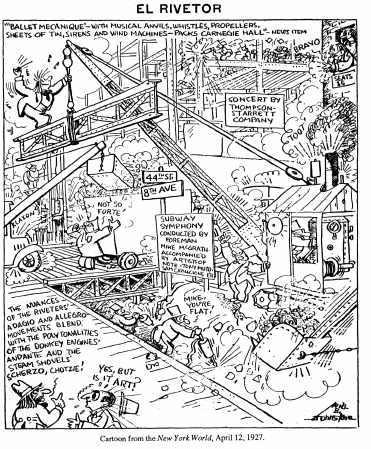
When Antheil's Ballet Mécanique opened at Carnegie Hall the audience made paper aeroplanes out of the programmes and launched them back at the stage, and the debut was critically panned. “Yes, but it art?” mused a particularly scathing cartoon in the New York World the next day.Footnote 33 The suspicion that experimental art is simply bad art is pervasive, and the proletarian writing of the 1930s was doubly vulnerable in this respect. Where Marxist poets made knowing use of the techniques of high modernism, as in Sol Funaroff's sprawling, Eliot-inflected “Fire Sermon,” published in New Masses in August 1932, they opened themselves to the same accusations of obscurantism levelled against their political opponents. The fact that, technically, Funaroff clearly knew what he was doing does not diminish the pretentiousness or abstraction of lines such as “We are at once the makers and the made, / the mechanic and the mechanism of marx–leninism!”Footnote 34 Gold had great fun at the expense of the empty-phrasemakers in his caricature, the venal “modern” poet Hart Pringle, “a babyface with a beard,” whose “O Day of Concrete Peace” invokes a search – for what, exactly, Gold's latter-day Virgil neglects to say – ” In the insomnia of forgotten gutters / In the river beds interrupted by the silent rubbish heaps.”Footnote 35 The problem was, however, that it was not always too easy to distinguish, one from another, avant-gardiste and fraud, and this made a viable labour politics of the word nigh-on impossible.
“The larger part of the labour of an author in composing his work is critical labour,” writes Eliot in “The Function of Criticism.”Footnote 36 The nostrum that writers are the first readers of their own work serves as a reminder of the perceived need to maintain high standards as a matter of personal integrity. Eliot's literary labour is a highly skilled, artisanal activity, where the producer maintains ownership of the tools of the trade, and these include, both implicitly and explicitly – as in the layers of allusion in The Waste Land (1922) – a good working knowledge of literary history. In modernist poetics the capacity of both author and reader to place themselves critically in relation to the mediations of form is given prior status over productive capacity per se, and not without good reason. The principal quality put forward by Pound in his (unpublished) “How to Write” is the ability to read, to formulate opinion on one's own terms, and the object – “to prevent oneself from being bamboozled” – is essentially heuristic.Footnote 37 This sense that life can be read in much the same way as poetry, however, implies a distinct circularity.
As Peter Bürger points out, the precondition supporting an “adequate” reading of the organic work of art is the willingness to trace meaning through the movement of the hermeneutic circle: “the parts can be understood only through the whole, the whole only through the parts.”Footnote 38 Eliot's gesture towards musical form in Four Quartets (1944) is thus paradigmatic, each of the poems in the collection functioning as a movement, self-contained yet never wholly freestanding, all the way down to the level of the phrase or the sentence “where every word is at home, / Taking its place to support the others.”Footnote 39 The problem with this privileging of the aesthetic object over and above the gaze that fixes it is that reading strategies themselves are in real ways predetermined. Objectivist poetics move this problematic on by emphasizing the social nature of language, focussing on the painstaking mediation of language and meaning as an exemplary procedure, an investment in, as Zukofsky had it, “the power of the individual word in a culture.”Footnote 40 The readymade takes this knowledge of the social origin of the materials of art to an extreme. By introducing readymade elements drawn from outside the range of objects and forms conventionally taken to count as art – “reality fragments,” as Bürger designates them – the model of cultural production suggested by the practice of worker correspondence purports to blast hermeneutics apart.Footnote 41 Like much of Gold's work, the “Change the World” worker correspondence is dialogic in structure.Footnote 42 The issue for criticism is not so much the formal unity (or not) of the work, but rather that mimetic short-circuit testing the institutional frameworks within which “art” as such is received.
Behind the presupposition of the ability to read critically lies the prior assumption of basic literacy. Published titles such as Gertrude Stein's How to Write (1931) and Pound's ABC of Reading (1934) gesture towards functional skills with barely disguised aristocratic hauteur, condescending to elucidate their own esoteric hermeneutics as matters of common sense. Not only is there little requirement in worker correspondence for the initial producer – the “worker” – to have read much literary history, there is a strong implication that had they read anything at all the integrity of the work would be lost. That enforced division of labour described by “A Worker in Oak Park” is mirrored in the structural logic of Gold's work of relocation. To translate the problem into terms that Gold, perhaps, would have found more amenable, what he is either unwilling or unable to surrender is his share in the fixed capital – inert value, embedded in raw materials and technology – bound up in literary production. The newspaper columnist – self-elected expert in what counts as “literature” – effectively holds up his own artisanal production, the judicious placement of end stops, against the alienated agency of his worker correspondents. In an instance of literary deskilling taken to its limit, in “Flint City Jail, Mich.” the “I” narrates the experiences of a cell-mate, Chief John Thunder:
Here bathos and pathos sit side by side in equal measure, the quiet dignity of the chief's voiceless complaint matched by the absurdity of the closing statement. Yet this negative appraisal of the proletarian readymade is only sustainable when the writing is abstracted from its immediate discursive context. This is not the only reference to Lenin on page 9 of the Daily Worker, 19 June 1934: two days before the tenth anniversary of his death.
“Move over, Comrade Lenin, / And give me some room,” writes Langston Hughes in his “Ballad of Lenin,” also printed at the bottom of a page dominated by an image of the late Soviet leader, under the headline “Lenin on Culture.”Footnote 44 In an extract from Clara Zetkin's Reminiscences of Lenin, brought out by International Publishers that year, Lenin, who has earlier declared the need to “retain the beautiful,” professes himself nevertheless a “barbarian … [who] cannot value the works of expressionism, futurism, cubism and other isms as the highest expressions of artistic genius.” For Lenin the revolution would be incomplete with art production left in the hands of a minority. Genius is equated with universality; culture with education. The absence of mass education in pre-Revolutionary Russia determines the need for, alongside the development of the arts, “a vigorous campaign against illiteracy.” In Lenin's aggressively secular and yet wholly pragmatic formulation of the priorities of nation-building, the three Rs take their place as the cornerstones of a progressive society. When Zetkin objects – apparently without irony – that illiteracy served a revolutionary purpose in “preventing the minds of the workers and peasants from being stopped up and corrupted with bourgeois ideas and conceptions,” Lenin concedes the point, only to note that building a society requires administration, that bureaucracy “corrupts from above and below,” and that “the most important weapon in overcoming and uprooting bureaucracy is the widest possible popular education and instruction.”Footnote 45
In State and Revolution (1917) Lenin had argued that in the transition to communism the machinery of the state would need to be retained. The key to this radicalized “accounting and control” would be participation by all.Footnote 46 Lenin thus places – anterior to the space of the aesthetic – the ability to read as a form of political agency, a crucial step on the road to the abolition of the division of mental and physical labour. But in pre-Revolutionary US society it is precisely the relatively deregulated discursive space of the little magazines and suchlike that allows something like a radical democracy to emerge. Gold's target in the parodic “O Day of Concrete Peace” was never really the vacuity of the lines themselves but that this emptiness was specifically designed to “hypnotize.” It was rather Hart Pringle's cynicism in posing as a representative of the new school of “the magic of the material object,” his willingness to “spin the literarious hoopla,” purely in order to receive patronage from “foggy, chronic cultist” Mrs. Jessup, that was the focus of Gold's satire.Footnote 47 At the same time Gold had no problem with presenting readymade poems as poems principally because, in breaking down the divide between writer and reader, what he rejected was the exclusion of whole swathes of the population from access to the privileged space of the aesthetic. This is what distinguishes worker correspondence from reportage and other forms of 1930s documentary modernism. A readymade is an artwork in which the labour of the artist enters into dialogue with or even becomes indistinguishable from heteronomous types of production. Yet it claims the status of art nonetheless.
“Would you judge workers' correspondence by the standard of James Joyce or Walter Pater?” Gold challenged composer Charles Seeger.Footnote 48 But how to take seriously the socially transformative, critical potential of art whilst suspending the critical faculty in relation to the artwork itself? One way is for art to be self-conscious; another is for criticism to be. Self-consciousness is by no means the be-all and end-all of textual politics, but there are instances where reflexivity acts as a lens, bringing into alignment disparate points in a field, unsettling the sense of background and foreground. Even within the space of “Flint City Jail, Mich.” the layering of perspective – the chief's complaint, the anonymous worker's relaying of it, Gold's versification – allows what feel like substantive contours to emerge. Reading across the page as a whole, a picture builds up of a network of discourse either on or embodying the relation of culture to general education and politics as represented over geographical distance and time: Alabama to Ohio, New York to Moscow, World War I to the Depression. This busy discursive space has irregular newsprint edges, adverts in boxes slotted together seemingly at random, some even shaded to add the illusion of depth. And this space is explicitly open-ended; the “Change the World” worker correspondence, with its place-name headings, is mirrored, or mirrors, the “What's On” column on the opposite side of the page, where lectures and dances, and Lenin memorial meetings held by both the Bronx and Coney Island Workers' Clubs, are mapped out into the future.
The readymade never carries across its source material intact; even the naming of a readymade alters our understanding of the original in some way. Olsen's “I Want You Women up North to Know” is a far more self-conscious production than most. Partly this is because its source material, Ibarro's letter, was already in the public domain, and this brings Olsen's work of transformation into open view:
What is striking about Olsen's transformation of Ibarro's letter into a free verse composition is the extent to which the poem deforms the original. Ibarro's letter contains none of the erratic punctuation evident in Olsen's treatment:
I want the women of New York, Chicago and Boston who buy at Macy's, Wannamaker's, Gimbel's and Marshall Field to know that when they buy embroidered children's dresses labeled “handmade” they are getting dresses made in San Antonio, Texas, by women and girls with trembling fingers and broken backs.Footnote 50
Olsen's poetic “I” is initially an “i” and this abstracts from the particularities of authorship, representing a self-consciously deskilled marker of identity. It is as if Olsen, in adopting the (un)conventions of modernist typographical freedom, moves through Ibarro's plain-spoken eloquence towards an imagined subjectivity determined by real, involuntary limitations: where, by implication, the lower case “i” speaks for them rather than us. Moreover, what for Ibarro are communicable as – metaphorically speaking – “bloody facts,” are here filtered through an elaborate figurative scheme which conflates a turn of phrase with actuality:Footnote 51
For Ibarro, Catalina Rodriguez “is a 24-year-old Mexican girl but she looks like 12,” and the details of her working hours and pay are presumably accurately recorded. But no “bright red blood embroiders the floor of her room.” It's Olsen, exercising what used to be called poetic license, revelling, in other words, in the privileged space of the aesthetic, who embroiders the “bloody facts” of Ibarro's letter with excessive, grotesque imagery. The pieceworkers' “trembling fingers,” choreographed into an “esthetic dance,” are inspired by Ibarro but considerably embellished. So much so, indeed, that the only way to read this is as heavily ironic: hence the rather leaden reference to “the bourgeois poet.” This is not just a kind of sneering ressentiment directed towards those women up North and their imagined tastes in literature – although it is that, too. The ironic tone is also reflexive, channelled onto the act of aestheticization itself, a kind of fumbled apology for that avant-gardiste/fraudster dilemma so problematic for any modernism from below. It is not just that metaphorical allusions are woven throughout the fabric of Ibarro's source material; because so much in literature depends upon the negotiation of the quality of literariness itself, all literature is in some sense stitched from the inert remnants of past works. Literary value – as such – is measured against materials and standards already in place: in the institutions, in the marketplace, in the language itself.
“I Want You Women up North to Know” is no more nor less a product of literariness than anything by Pound or Eliot; by the standards of the Man in White, indeed, there is much to recommend it. Attention might be drawn to the alliterative pairings of the title: to the median position of the dactyl beginning “women”; to the way in which towards the end of the piece the fronting of the phrase “women up north” – ”Women up north, I want you to know” – introduces a caesura, effectively inducing a triple meter, and that this lends urgency to the proceedings. But it is impossible in the final analysis to deny that this urgency is more the product of a kind of reading than a measure of the skill of the author. Certainly these effects are not Ibarro's, and so in that sense they could be seen as Olsen's handcraft: the non-alienated skill of the poet. However, there is no way of knowing whether or not Olsen intended them. Just as, in the metaphor unpacked at the beginning of this essay, what initially appears as handmade soon begins to appear instead as purely contingent, so poetic agency here can begin to seem merely haphazard, the product of prior determination not through skill but simply through the arbitrary materiality of language.
Attention to the material, institutional contexts within which worker correspondence was framed enables the recovery of dialogic interpenetration between the literary and nonliterary, the poetic, the polemic and the promotional, invisible to the isolation of texts as discrete aesthetic entities. The figures in the carpet of Olsen's form are produced by reading practices just as socially predetermined as the weft and weave of the children's clothes; by New Critical close reading practices, to be sure, but also by a kind of epistemological model in which reading subject meets textual object in a dialectical movement following the arc of the hermeneutic circle. “I Want You Women up North to Know” breaks the hermeneutic circle not because it reaches outside itself to highlight the injustice of capitalist expansion into the everyday lives of marginalized populations. What is at stake, rather, is a mimetic short circuit whereby the artwork is unable to convince you it is anything other than that which it already is. The epiphanies the proletarian readymade offer up are materialist epiphanies, moments where it becomes clear that situations will not resolve all by themselves. If, in the early experiments by Potamkin, second-language acquisition was reflected in gnarled syntax, in worker correspondence by Olsen and Gold the conventions of poeticizing are mangled. Form in this context serves far less as a test of sincerity, as Pound had claimed, or as as a “test of truth,” as Oppen was to claim, than as an obstacle, as something in the way.Footnote 53
Oppen was fond of quoting his colleague Reznikoff's lines, “Among the heaps of brick and plaster lies / a girder, still itself among the rubbish.”Footnote 54 This conviction of an inviolable core to things in themselves led him to dismiss placing poetry in the service of party politics as fundamentally inauthentic.Footnote 55 There are some realities that cannot be spirited away by the play of a dialectic, the invention of an apposite image, or any other spin of literarious hoopla. The pathos of the proletarian readymade pulls into sharp focus, at least, the presuppositions either constraining or enabling, depending on one's point of view, aesthetic work during the period: that poetry should embody experiences or perceptions that are singular, that expression should be fluid and nuanced, that the individual could somehow encompass a totality rather than become subsumed within one. The politics here are difficult. For it becomes clear that the materialist epiphany brought into focus through the employment of the proletarian readymade stops at the recognition of the intractability of language. Here is the overlap with Objectivist poetics: Zukofsky's “rested totality,” Reznikoff's “girder, still itself,” represent moments within poetry where language is brought onto the page from outside – and stops there. The proletarian readymade reverses this trajectory. By bringing the promise of the aesthetic into the discursive space of the political press – naively, perhaps – it opens a window onto an imaginative space where the word need no longer serve as an obstacle to action.