Introduction
An examination of casual conversations of older Japanese women with peers and acquaintances reveals an interesting discourse strategy of “reframing” a painful event to “quotidian.” Through such quotidian reframing, conversations on topics such as illness and the death of a husband are often highly engaging, lively exchanges and are frequently accompanied by humor and laughter among the participants (Matsumoto Reference Matsumoto, Ettlinger, Fleisher and Park-Doob2005, Reference Matsumoto, Mori and Ohta2008, Reference Matsumoto2009a, Reference Matsumoto2009b).
The phenomenon of shared humor in recounting painful events contrasts with the findings of the seminal sociolinguistic study of language and the elderly by N. Coupland, J. Coupland, & Giles (Reference Coupland, Coupland, Giles; and Henwood1991), which found that older people who engaged in short intergenerational and peer conversations with first-time acquaintances often exhibited painful self-disclosure (PSD), revealing unhappy personal information on ill health, immobility, bereavement, or troubles, characterizing themselves as “disengaged” or “grumbling.”Footnote 1
The contrast between the findings may be due to an aggregate of factors, including methodological differences. Unlike the more controlled studies by N. Coupland and colleagues (Reference Coupland and Grainger1991), my observations were based on free-flowing, unplanned, natural conversations among participants who were already friends or acquaintances, and who conversed over an hour at each recording.
In a previous qualitative investigation of the juxtaposition of painful disclosure and humor, I have suggested that “disclosure of age-related personal matters does not necessarily carry negative import,” and that by “focusing on and shifting the frame of the narrative to quotidian events, the elderly speakers can convert lifetime painful events to everyday matters that they can laugh about” (Matsumoto Reference Matsumoto2009a:929). The humor in painful topics such as death does not imply that death is taken to be an everyday event by the conversation participants. Rather, as detailed in this article, focusing on and presenting potentially humorous aspects of ordinary life in grave and serious circumstances is a means to reduce the heightened psychological intensity felt among affected persons and in conversations about that event.
The repeated occurrence in the data of the discourse strategy of reframing a painful eventFootnote 2 and its possible general applicability prompted this study. Through considering more extensively the mechanism and implications of what I call quotidian reframing, I identify linguistic devices—quotidian framing cues—that signal the narrative in the quotidian frame and consider the speaker's identity—quotidian self—that is represented by the use of such a frame. In pursuing this task, I draw on and extend the ideas of frame developed by Bateson (Reference Bateson1972/2000), Goffman (Reference Goffman1974, Reference Goffman1981), Tannen (Reference Tannen and Freedle1979), and others (e.g. Tannen & Wallat Reference Tannen, Wallat and Tannen1993; Gordon Reference Gordon2008), as well as related ideas such as lamination, footing (Goffman Reference Goffman1974, Reference Goffman1981), and positioning (Davies & Harré Reference Davies and Harré1990; Bamberg Reference Bamberg1997; Schiffrin Reference Schiffrin2006).
While the focus of this article is on quotidian reframing, the general area of the verbal interaction of the elderly deserves further study. Researchers in communication and social psychology have contributed substantially, mostly based on survey studies that focus on intergenerational communication (see N. Coupland & Nussbaum Reference Coupland and Nussbaum1993; Williams & Nussbaum Reference Williams and Nussbaum2001; Nussbaum & J. Coupland Reference Nussbaum and Coupland2004 for further references). Hamilton (Reference Hamilton, Schiffrin, Tannen and Hamilton2001) provides a comprehensive overview of studies on discourse and aging that range from methodologies to areas of investigation. With regard to studies based on actual discourse of older adults, in addition to N. Coupland and colleagues (Reference Coupland, Coupland and Giles1991) and a series of studies conducted by them arguing against ageist views, notable studies include, for example, Hamilton's (Reference Hamilton1994) longitudinal interaction with an Alzheimer's patient as an equal partner, and accounts of patronizing speech by younger caregivers to elderly residents in nursing homes (e.g. Ryan, Giles, Bartolucci, & Henwood Reference Ryan, Giles, Bartolucci and Henwood1986; Ryan, Hummert, & Boich Reference Ryan, Hummert; and Boich1995). Among recent discourse studies of older adults that focus on interactions between caregivers and care recipients, three notable studies discuss the use of humor in the interaction (Grainger Reference Grainger2004 in English, Backhaus Reference Backhaus2009 in Japanese, Heinemann Reference Heinemann2009 in Dutch). Using narratives collected in speakers’ homes and in a retirement home in Indiana, Norrick (Reference Norrick2009) describes multiple identities originating in the past experiences of elderly speakers. Hamaguchi's work (Reference Hamaguchi2001, Reference Hamaguchi and Matsumoto2011), based on casual conversations with her grandmother, emphasizes the importance of personal relationships over apparent linguistic (dis)ability of the elderly. Matsumoto (Reference Matsumoto2009c) illustrates verbal interactions that go beyond the stereotypes of old Japanese women, and the possibility of different interpretations of linguistic behavior often categorized as the performance of old age is discussed in Matsumoto (Reference Matsumoto, McGloin and Mori2007, Reference Matsumoto, Mori and Ohta2008). Humor and laughter in Japanese women's verbal interactions are the topic of Matsumoto's work (2005, 2009a, 2009b). Despite the large and growing number of the elderly population, studies of verbal interactions in Japan remain rare. It is hoped that this article will show how discourse of older speakers is an important resource for further understanding of strategies in verbal interaction in Japanese and other languages, and will encourage more engagement in this area of study.
In the following pages, I first overview the relevant theoretical background regarding frame and reframing, including Goffman's accounts of lamination and footing. I also touch upon the concept of positioning in discourse. I then discuss the main points about quotidian (re)framing along with its linguistic cues and conveyed identities, prior to more detailed examination of conversational excerpts that follow. Finally, I summarize the findings of this study and suggest their implications.
Frame-Related Concepts in the Analysis of Discourse
Frames and reframing
The concept of frame has been employed in various fields of study including psychology, sociology, artificial intelligence, cognitive linguistics, and interactional sociolinguistics. The same general concept has been referred to by different but related terms such as scene, script, schema, and idealized cognitive model. Tannen (Reference Tannen and Freedle1979) offers a concise overview of ideas associated with frame that have been adopted or proposed in various fields of study. A comprehensive summary of frame-related concepts and issues that are relevant in analyzing discourse is found in Gordon's (Reference Gordon2008) study.Footnote 3
The concept of frame that is most relevant to this study is traced to Bateson (Reference Bateson and Foerster1953, Reference Bateson1972/2000), who emphasizes the frame's “metacommunicative” function and its characterization as psychological. Pointing out that “human verbal communication can operate and always does operate at many contrasting levels of abstraction” (1972/2000:177–78), he notes that metacommunicative signs (or signals) are used by humans, and even by monkeys and other animals, to convey a message such as “This is play” (rather than real combat or aggression) to establish a “play frame.” For Bateson, “every metacommunicative message is or defines a psychological frame,” and conversely, “a frame is metacommunicative” (Reference Bateson1972/2000:188). He insists that frame is a “psychological concept” (1972/2000:186) and describes the functions and uses of psychological frames as both exclusive and inclusive, in that “by excluding certain messages certain others are included,” and like picture frames, they direct viewers to “attend to what is within and do not attend to what is outside” (1972/2000:187).
Similar to Bateson's frame is the concept of “scene” proposed by Hymes (Reference Hymes, Gumperz and Hymes1972), who emphasizes the psychological aspect. A scene is the psychological setting in Hymes’ speaking model. Hymes states that “in daily life the same persons in the same setting may redefine their interaction as a changed type of scene, say, from formal to informal, serious to festive, or the like” (1972:60). Hymes's concept points to how frames may shift, or how an interaction may be reframed.
A number of studies have employed concepts related to redefining interaction, or reframing. Tannen, for example, uses “reframing” to mean “a change in what the discussion is about” (2006:601). Examining parents’ verbal interaction with young children when attempting to control the children's behavior, Gordon (Reference Gordon2008) uses the term “reframe” to point to a situation in which parents transform their literal interaction (i.e. an attempt to control) to play; that is, “they change the definition of the social situation as they use utterances to signal play” (2008:320). Gordon's subject matter is a social interplay rather than verbal representation of past experience, but it focuses on a change in perspective regarding a verbal or social situation.
Reframing can be motivated by the different social roles that the participants of an utterance situation may assume, as demonstrated by Tannen & Wallat (Reference Tannen, Wallat and Tannen1993) in their discussion on verbal interactions during pediatric exams; or it may be motivated by different production and participation (or recipient) roles (see e.g. Goffman Reference Goffman1974; Hoyle Reference Hoyle and Tannen1993). What seems more relevant in reframing to a play frame as well as to a quotidian frame, however, is the participants’ perspective toward the ongoing interaction. We consider reframing further in detail with extracts from older Japanese women's discourse.
Reframing with lamination and changes of footing
A change of frame (or “definition of a situation” in Goffman's (1974:10) terms) may occur multiple times. Goffman, inspired by the well-known question posed by William James, “Under what circumstances do we think things real?,” realized that there can be a wide range of experience between the actual event, or what Goffman calls “literal” experience, and various presentations of that event. The literal experience can be transformed indefinitely, each transformation adding a “layer” or lamination. The transformations that create the lamination arise from changes in “key” or in footing. The literal experience can be keyed as, for example, a staged plot or nonserious play. The keying can be expressed from a different footing, that is, “the alignment we take up to ourselves and the others present as expressed in the way we manage the production or reception of an utterance” (1981:128).
In his article on footing, Goffman teases out the different functions included in the “primitive notions of speaker and hearer” (1981:128). As Goffman points out, the speaker can take an alignment towards the speech activity as the “animator” (i.e. “the sounding box”), as the “author” (i.e. “the agent who puts together, composes, or scripts the lines that are uttered”), or as the “principal” (i.e. “the party to whose position, stand, and belief the words attest” (1981:226). Utterances of the “figure,” or protagonist in a described scene, are “embedded” when they are represented in recounting. The person who uttered reported words in the described scene and the person who utters those words in the speech situation have a different footing, even if both utterances were made physically by the same person. The former is the source of the speech (the figure) and the latter is the animator. This embedding of speech increases lamination. Goffman notes that “conversation is certainly vulnerable to such lamination. And each increase or decrease in layering—each movement closer to or further from the ‘literal’—carries with it a change in footing” (1981:154).
Changes in footing, which Goffman describes as “another way of talking about a change in our frame for events” (1981:226), allow conversations to present a cognitively enriched story that is distant from both the “literal” experience and the current speech situation. The effect of lamination, especially in quotidian reframing, is examined in the discourse of older Japanese speakers in this article.
Reframing and identity
A change in footing, or reframing, affects not just the speaker (whether figure, animator or principal) but the position of the speaker relative to others. The relational effect can be described using the concept of positioning (e.g. Davies & Harré Reference Davies and Harré1990), especially the version of positioning theory that was proposed and adopted by Bamberg (Reference Bamberg1997) and others (e.g. Schiffrin Reference Schiffrin2006) to better account for storytelling. Bamberg's version differentiates three levels of positioning formulated in the following three questions: “How are the characters positioned in relation to one another within the reported events?” (Level 1); “How does the speaker position him- or herself to the audience?” (Level 2); and “How do narrators position themselves to themselves?” (Level 3) (Bamberg Reference Bamberg1997:337). In other words, positioning at Level 1 concerns the footing of the figures in the event described in the conversation; positioning at Level 2 involves the footing of the participants in the conversation; and positioning at Level 3 reflects the relationship between conversational footing and identity.
Quotidian Reframing
The quotidian frame
In the conversational data of elderly Japanese speakers that is analyzed in this article, there is a detectable reconceptualization of the verbal interaction, or a shift in the way in which the narratives are framed, from a serious life-changing event (e.g. death of husband) to a minor and quotidian event that can induce and allow laughter (e.g. “complaints” about the husband's behavior) (Matsumoto Reference Matsumoto2009a), and back again to the serious narrative. The main question investigated in this article concerns the mechanism and effect of this sort of shifting or reframing in conversational narratives, especially reframing to what I call the quotidian frame in the context of recounting a psychologically intense experience. The quotidian frame includes and enhances those aspects of a scene that are reminiscent of everyday life and excludes aspects that signal heightened psychological intensity. Often, a quotidian segment that is inserted within a narrative of a serious event adds a detailed description of a situation that is mentioned in the narrative. The metacommunicative message of the quotidian frame is to ground the event participants in everyday experiences. By including and focusing on matters in the described scene that are reminiscent of everyday life, participants in the conversational narratives can be said to redefine their interaction and psychological position from grave and serious to less intense and less stressful.
As the examples discussed below illustrate, the mechanism of reframing an account of a psychologically loaded experience to a quotidian frame can be described in terms of lamination of that event in the conversational narrative. It may sound puzzling to suggest that layers of lamination between an event and the speaker's presentation of that event could function as a means of regrounding a conversation as quotidian. However, as I discuss with examples below, layers of lamination create a story world that is transformed from the actual events and that is also distant from the world that the narrator (or animator) inhabits. Through embedding, the animator effectively stands back with her listeners and lets the figures in the story act out a created drama through her words. In recounting selected details of the created scene, the speaker presents a version of quotidian life—one that is distant from the psychologically weighty event. As Goffman states:
A tale or anecdote, that is, a replaying, is not merely any reporting of a past event… A replaying will therefore, incidentally, be something that listeners can empathetically insert themselves into, vicariously reexperiencing what took place. A replaying, in brief, recounts a personal experience, not merely reports on an event. (Goffman Reference Goffman1974:504)
Quotidian framing cues
Various linguistic elements signal that the narrative is being reframed to a quotidian frame. Following Gumperz's (Reference Gumperz1982) term “contextualization cues,” I refer to the linguistic elements that signal quotidian reframing as quotidian framing cues. Some quotidian framing cues mark the transition away from a more grave and serious narrative frame; others indicate (or are compatible with) the quotidian character of the conversation. The transition to quotidian framing may be cued by more frequent use of pragmatic particles in short spurts of utterances and laughter. Cues that indicate quotidian character also include the use of informal referential terms and predicate ending forms, as well as onomatopoeic expressions.
The quotidian self
Quotidian reframing in the context of narratives of psychologically loaded events may be viewed relationally in terms of positioning theory. In Bamberg's terms (1997), we can say that quotidian details described at Level 1 (characters’ positioning within the reported events) are presented at Level 2 (speaker's positioning to the audience) as part of a tellable (Ochs & Capps Reference Ochs and Capps2001) and frequently humorous story. The effect, at Level 3 (narrator's self-positioning), is to contribute to the speaker's reconnection with “normal” aspects of her life, which may be summarized as her quotidian self, a term that is not intended to imply a static identity at any moment in life, but merely indicates those aspects of one's identity that contrast with the sense of oneself as a participant in a special occasion or as one who plays a special role. The quotidian self is not singularly tied to the specific speech context in the sense that we usually consider a “situated identity” to be (e.g. Zimmerman Reference Zimmerman, Antaki and Widdicombe1998), but it is still “situated” in what one presents as ordinary. Depending on the context, the quotidian self can overlap with various other types of identity, for example, as a doctor, as a wife, and as a happy person.
By reframing and focusing on the quotidian details found in a serious situation, the speaker is able to at least partially decouple herself from the person (or aspect of herself) she was presenting in the serious frame, and to focus on and present herself in what she regards as her quotidian aspect. In this way, the speaker and participants of the conversation can regain “normality,” although this is a laminated identity, as Goffman might say, over a grave event (e.g. a husband's death), which can be seen through a lamination of the quotidian description.
The Conversational Data for the Study
The observations in this article are based on approximately thirty-three hours of audio-recorded natural conversational data of older Japanese women in their late sixties to early eighties at the time of recording (from 2001 to 2006). The majority of these conversations were recorded by four women (in their seventies) when each met with friends at various occasions that had been set independently of the research purposes, such as a gathering to share photographs from a past trip, a dinner during a trip with people in the same activity club, or a meeting with fellow volunteers. To avoid dictating the direction of talk or manner of interaction, no prearranged topic was assigned. Consequently, their conversations included a wide variety of topics such as travel, shopping, books, sports, and food, as well as topics related to life changes associated with old age, such as illness and death of family and acquaintances. Included in the observed data are natural (unplanned) conversations between some of these older female speakers and a younger researcher (the author). I contacted the participants about one-and-a-half years after their recorded peer conversations and arranged to speak with them individually while I was visiting Japan. By that time, I was well acquainted with each one, either from the past or through this project. The elderly individuals took the initiative in these conversations equally in terms of topic choices and in the length of contributed speech. The context of interaction in the conversations with peers and with the researcher was not an interview with a set of prepared questions, but a free conversation. In that way, the interactions differed from discourse and narrative studies (e.g. Labov & Waletzky Reference Labov, Waletzky and Helm1967; Schiffrin Reference Schiffrin2006; Tannen Reference Tannen2008) that yielded focused responses from the narrators. The method used to collect conversations in this study also differed from that of N. Coupland and colleagues’ (Reference Coupland, Coupland and Giles1991) study in that the participants in the latter were told that they would speak with a person of a different generation or the same generation and instructed to get to know each other. Their conversations ended in ten minutes, whereas conversation sessions in the present data lasted over an hour on average. The method of data collection in this study was chosen to obtain conversations that are close to “real-life” situations as described by Hamilton (Reference Hamilton, Schiffrin, Tannen and Hamilton2001) in comparison to other more controlled methods in order to gain insight into the contents and manner of older people's verbal interaction in naturalistic situations.
Like the data in N. Coupland et al. (Reference Coupland, Coupland and Giles1991), my collected conversations also showed instances of painful self-disclosure, but their manner was different from those reported there. The painful self-disclosures were accompanied by humor and laughter, not only when a speaker disclosed a potentially painful matter and lightly laughed as if to mitigate the weight of her speech act, but also when laughter was shared by both the speaker and the listeners. Given that neither the speaker nor the listeners welcomed these painful conditions, the co-occurrence of painful self-disclosure with the participants’ jocular responses is contradictory. It is also in notable contrast to Jefferson's (1984) finding that the recipients of troubles-talk do not generally join in the laughter except for added pleasantries (see Matsumoto Reference Matsumoto2009a, Reference Matsumoto2009b for more discussion regarding my findings on laughter in painful self-disclosures and Jefferson Reference Jefferson, Atkinson and Heritage1984 on the organization of laughter in troubles-talk). Painful self-disclosures with laughter among the interlocutors comprise the examples that are most crucial to the investigation in this article. Among such painful self-disclosures, we focus on topics concerning illness and death of the speaker's husband.
Analysis of the Conversational Data
Reframing to quotidian in bereavement narratives
In the first excerpt from the conversational data, the main speaker, Akiko,Footnote 4 describes the last moment of her husband's life. The excerpted dialogue started about sixty minutes into a ninety-minute conversation with the researcher. Since the conversation was conducted in a completely unplanned manner (see Chafe Reference Chafe1994 on planned and unplanned discourse), topics shifted quite abruptly as they usually do in spontaneous casual conversations. Each part crucially contributed to the composition of the entire story, and like a strand of a braid, any part could submerge and resurface as a topic. This resurfacing is consistent with Goffman's observation that
the easiest improvement on the traditional paradigm for talk is to recognize that any given moment of it might always be part of a talk, namely, a substantive, naturally bounded stretch of interaction comprising all that relevantly goes on from the moment two (or more) individuals open such dealings between themselves and continuing until they finally close this activity out. (1981:130)
The concept of resurfacing of topics is similar to “recycling” as discussed by Tannen, which refers to “situations where a topic is closed, then arises again later in the same or a different conversation” (Tannen Reference Tannen2006:597).
The topic of Akiko's husband's death had been briefly mentioned earlier in the conversation; the unprompted first mention of his recent death (seven months before the recording was made) occurred twenty minutes prior to the segment quoted below. The first instance of painful self-disclosure in this example and others is given without laughter (see Matsumoto Reference Matsumoto2009a on narrative structure of the disclosure). Ten minutes later, Akiko returned to a topic related to her husband's death and, in response to my question asking whether his death was sudden, stayed on the general topic of her husband's passing, retelling various “sub-events” that occurred in his last days and describing his long-term health issues and kidney problems, interactions with the doctor and nurses, his past experience with liver cancer, and his unwillingness to undergo dialysis. Akiko recounted her experience of these events in a solemn tone of voice. In the same serious tone, Akiko mentions at the beginning of the segment in (1) that her husband had passed away quietly in his sleep in a hospital room while she and his doctor were watching the heart monitor. This description of his passing appears to mark the end of the story about the last moment of his life.
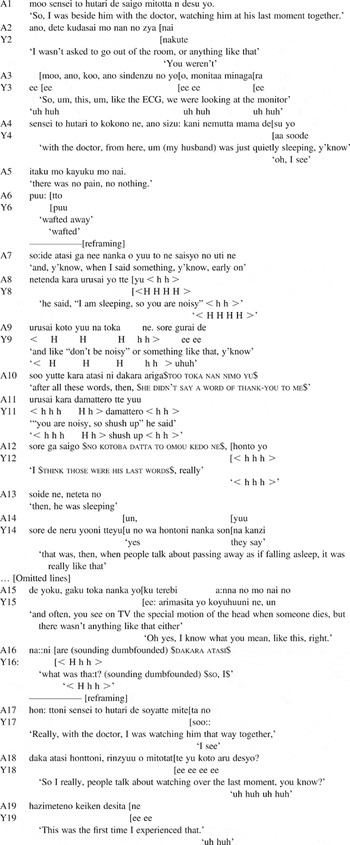
At that point, however, Akiko starts to retell (in lines A7–A16) her experience of the same moment, this time elaborating details of the scene with reported speech or “constructed dialogue” (to use Tannen's (1989) term) and repetition, which are common devices to reflect and create interactional involvement among talk participants (Tannen Reference Tannen1989). Her tone switches to one of everyday light talk as she recounts that, unlike comparable scenes in television dramas, there were neither sweet words of thanks from her husband nor any clear sign of the exact moment of his death. His last words were telling her to shush while he tried to fall asleep. Strikingly, both the narrator and the hearer laugh uninhibitedly throughout this section in which Akiko appears to complain about her husband's behavior. Laughter is certainly not ordinarily expected during a narrative about someone's death, especially on the part of a widow who has just told the sad story (see e.g. Jefferson Reference Jefferson, Atkinson and Heritage1984), but there is no apparent indication that the laughter causes awkwardness; on the contrary, it seems to mix naturally in the conversation. After this segment, the conversation resumes its somber tone in the last few lines (A17–A19) as Akiko sums up her experience by stating that this was her first time to closely experience the moment of someone's death. In the transcript below, Akiko's utterances are given in boldface, and utterances spoken simultaneously with laughter are in small capitals bracketed with a $. Laughter is indicated as < H > and light laughter (or aspiration) is marked as < h>. The utterances and laughter by speakers are grouped together and have the same numbering following the speaker's initial when there are overlaps, similar to a musical score. This method of transcription was chosen to visually represent involvement as evidenced by overlaps and laughter.
The last moment of Akiko's husband's life (A: Akiko, Y: Author)

The detectable divisions between serious and quotidian frames are shown by dotted lines in the above excerpt. The same “complaint-sounding” narrative could have a different effect in other contexts, but being juxtaposed with the serious narrative of her husband's death, Akiko's description of her husband's behavior suggests the feeling of everyday life, which is incongruous to the gravity of this once-in-a-lifetime situation. Such incongruity generates humor as well as making the atmosphere less tense.
It is notable that Akiko's narratives at the beginning in lines A1–A6 and at the end in A17–A19, which are all told with a serious tone, together could have made one continuous and complete story without the middle section (A7–A16) in which laughter is heard. However, Akiko chooses to include the ordinary details of verbal interaction between the long-married couple (such as her husband's abrupt remark, urusai kara damattero ‘you're noisy, so shush up’ in line A11, and her disappointment at the anticlimactic ending of her husband's life, expressed in a dumbfounded tone like a conventional complaint in casual conversations among friends). In other words, in the middle segment, Akiko reframes her painful bereavement narrative as quotidian complaints of less gravity by focusing on events and emotions that are reminiscent of ordinary life. This stretch of narrative with seemingly trivial and quotidian details, in fact, plays an important role within a larger narrative of psychologically weighty experience. This reframing has the effect of redirecting attention to the perspective of ordinary life to reground the narrative participants there and arguably to reduce the psychological intensity of the serious situation related in the surrounding conversation.
The lamination of the event through changes in footing can be seen in the first few lines of the quotidian segment (lines A7–A8 in (1) above). In line A7, Akiko plays multiple roles in what Goffman called the “production format” of the utterance, including the roles of animator, author, and principal. There is also an embedding of the figure, represented by atasi (‘I’ [informal]), the referent of which should be viewed as a character in the described story world rather than the animator in the world of speaking. The embedding creates distance between the Akiko who speaks line A7 and the Akiko who was talking with her husband in the described story world.
The situation in line A8 presents a more complex lamination and change in footing. The quotative expression tte yu(u) (lit. ‘say that’), a “laminator verb” (Goffman Reference Goffman1974:505), implies that the remainder of A8 should be is understood as the words uttered by Akiko's husband. Akiko is the animator of the utterance, while the animator of the embedded statement netenda kara urusai yo ‘I'm sleeping, so you're noisy’ is Akiko's husband, another figure in the story world, with Akiko as the “ratified receiver” (or addressee) of his utterance. The husband is also presented as the author and principal, and therefore made accountable for his utterances. The current animator of the story, Akiko, is presenting a story in which she and her husband participated. Although the described scene was part of her husband's dying moment, she is keying it as a quotidian scene that is reminiscent of her everyday life with her husband—in particular, Akiko's husband's complaint that she is too noisy and should shush up. The husband's complaints are not courteous, but are innocuous enough for Akiko to safely complain about them to her friends. Her husband did not behave differently even at the last moment, which was not what Akiko had imagined as the last moment of his life, and she was dumbfounded enough to mention this to her conversation partner. Aligning to such a quotidian aspect of her relationship with her husband, Akiko could return to her “normal” life, at least for a moment, away from the tense event she was recounting and the state of being a wife in bereavement.
The above account points to an aspect of footing that is usually described as management of alignment to production and reception roles in utterances. This additional aspect concerns the psychological/conceptual states of the participants in the story world and the current utterance world. Shifting conceptual alignment to (a figure in) a scene associated with ordinary life and low psychological intensity, in the middle of a conversational narrative on a psychologically intense topic, gives an opportunity for the participants of the conversation to be relieved of the gravity of the surrounding narrative and speech situation, and frees them to talk in a more relaxed manner and even to laugh. Such reframing is temporary, and as indicated in (1), the narrative is again reframed back to the more serious frame of a bereavement narrative. Goffman describes this temporary nature of embedding in the same way:
it seems that when we change voice—whether to speak for another aspect of ourselves or for someone else, or to lighten our discourse with a darted enactment of some alien interaction arrangement—we are not so much terminating the prior alignment as holding it in abeyance with the understanding that it will almost immediately be reengaged. (1981:155)
The linguistic cues of quotidian framing
As illustrated in Matsumoto's (2009a) study, in painful self-disclosures with humor and laughter, elderly Japanese women exhibit strategies that reflect and create a high level of interactional involvement, such as the use of repetition, constructed dialogues (or reported speech), and details (Tannen Reference Tannen1989). These discourse strategies are also found in Tannen's (2008) interview data on women's accounts of relationships with their sisters. Tannen observed that these strategies “work together to create scenes” (Tannen Reference Tannen2008:206), with accounts of specific events or interactions to support the theme of a narrative that the speaker is developing. The elderly women's conversations under discussion here are a different type of data than interviews with a specific topic for elaboration, but exhibit the same strategies and effects as those found by Tannen. We can illustrate the use of such strategies in the context of example (2) given below.
The main speaker in (2), Naoko, a widow in her late seventies, was having a casual conversation with three fellow volunteers during their free time. Unlike other peer conversation recordings, I was present in the room as I was asked to operate the tape recorder. I sat at the edge of the table, which happened to be close to Naoko. I played the role of a passive listener to the extent that this was natural. Speakers M and T are Naoko's fellow volunteers, while Y is the researcher.
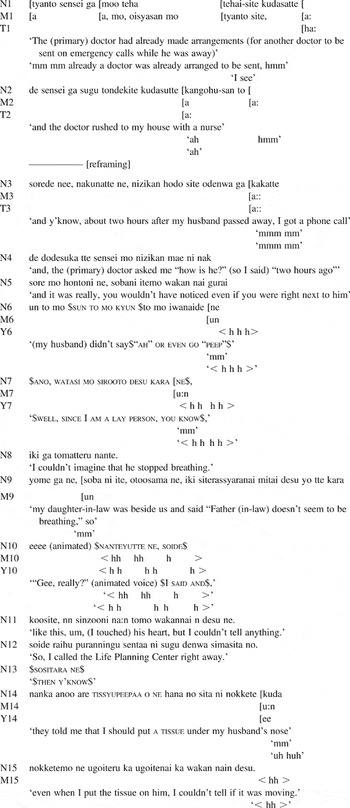
The topic of Naoko's husband's death was disclosed about five minutes earlier when she mentioned that he had passed away ten years before. The topic resurfaced and, just prior to the excerpt in (2), Naoko was calmly expressing her gratitude toward the eminent doctor who provided helpful medical and moral support to her husband during his illness. Naoko started recounting the scene of her husband's last moment with specific details in an animated storytelling tone from line N3. There were humorous expressions and laughter. Like Akiko in example (1), Naoko did not notice exactly when her husband died. Unlike Akiko's husband, however, Naoko's husband did not say anything or make a sound, which she described using the onomatopoeic expression kyun to mo iwanaide ‘didn't even make a peep’ in line N6. Naoko said that she placed a tissue on her husband's face, as suggested by a nurse, to determine whether he was still breathing. As with Akiko's retelling, Naoko focused on a detail of the scene and reframed an account of a serious life-changing experience into a frame of quotidian happenings that make one feel silly or not in control. By regrounding in a quotidian perspective, the episode was disclosed and received humorously and with laughter.
Naoko's husband's death

Various linguistic devices are used in quotidian reframing to signal the transition and the quotidian perspective. Two types of linguistic devices act as cues signaling the transition to quotidian reframing in the examples. One type, seen in line N3 in (2) and in line A7 in (1), is bracketed by short spurts of utterances segmented by the particle ne(e). The original pragmatic function of this particle is to invite empathic acknowledgement and agreement on the part of the listener. It is often used to involve the listener in the content of the conversation. In this sense, its function is similar to the English expression y'know (e.g. Schiffrin Reference Schiffrin1987). It is notable that both Naoko in (2) and Akiko in (1) started the new segment with two variations of the same word sorede ‘and then’ along with the particle ne, as in sorede nee ‘and then, y'know’ by Naoko (line N3), and so(o)ide atasi ga nee ‘and then I, y'know’ by Akiko (line A7). In fact, this and other similar expressions such as ano ne ‘well, y'know; listen’ were almost always found, at least in these two speakers’ narratives, to flag the start of a new segment, which is often reframed as quotidian, within an involved account of past experience. Laughter also functions as a reframing cue. It seems that laughter frequently marks the transition from a frame of grave events to a quotidian framing; conversely, the reframing as quotidian makes laughter possible.
Onomatopoeic and mimetic expressions can cue quotidian context, especially when their presentation is similar to a sound effect. The mimetic expression gaku, used by Akiko in line A15 to depict a sudden loss of physical control, is such an example. In (2), Naoko's uses of un, sun, and kyun (in line N6) represent the faint sounds produced by a person or a small animal. The expression of surprise eeee ‘oh, really?!; gee!’ (line N10), which could be interpreted as either an onomatopoeic expression or a fragment of speech, also indicates that the scene is depicted in an informal fashion. Casual laughter also marks informality or a release or absence of tension.
Narrative content also clearly signals the quotidian perspective. It is easy to imagine that Akiko's husband in (1) had frequently called her noisy and told her to keep her mouth shut, since Akiko is indeed a great conversationalist who might seem excessively verbal to an old-fashioned, reticent husband. This implication is more relevant to their everyday relationship than to this critical moment. Akiko's dumbfounded attitude about her husband's behavior is also reminiscent of everyday conversational situations in which women compete to “one-up” each other in disclosing the hardships they endure as wives.
Other quotidian framing cues are linguistic expressions that are typical of informal situations, including referential expressions and predicate endings. For example, Akiko uses an informal first-person referential expression, atasi ‘I’ (lines A7 and A16 in (1)), in contrast to more formal variations, such as watasi and (w)atakusi ‘I’, which occur more often in serious frames in the data.Footnote 5 Such informal referential expressions do not conclusively cue the frame as quotidian, but are factors pointing in that direction. It is important to remember that there was no change in Akiko's conversation partner or in the external context or setting of the conversation that could have influenced the choice of referential forms. What changed was the speaker's psychological stance on how to present a certain experience.
Another example of informal expressions that signal the quotidian frame in (1) is the casual and direct form of predicates used in constructed dialogues, such as the direct imperative damattero ‘shush up’ (line A11) that is attributed to Akiko's husband. Not everyone uses this most informal form in daily conversation; the choice reflects the speaker's presentation of his or her social identity and persona. The depicted speaker's informal diction cues a lesser degree of gravity in the scene.
Collaborative reframing
In my data of older Japanese women's conversations, humor and laughter are sustained interactionally during painful self-disclosure, as I have discussed elsewhere (Matsumoto Reference Matsumoto2009a, Reference Matsumoto2009b). This was contrastive to previous findings (Jefferson Reference Jefferson, Atkinson and Heritage1984) in which normally only the speaker laughed during talk about troubles, and the listeners did not join in, unless there was a buffer topic or a pleasantry involved. We can view the shared humor and laughter as licensed by the reframing of the grave event as quotidian.
In the data that I examined, when there were more than two conversationalists, reframing was clearly more collaborative, and signals for quotidian reframing were given not only by the narrator of the painful self-disclosure but also by other participants. Interestingly, the manner in which this was achieved resembled co-constructed playful talk among intimate women (e.g. Coates Reference Coates2007), including the presence of shared laughter. Examples (3)–(5), from a tea-time conversation among four elderly women in their seventies who share artistic interests, show reframing mechanisms similar to those observed in (1) and (2), but the reframing is done collaboratively, that is, the listeners also engage in reframing.
The topics of the excerpted conversations related to the health of the participants’ husbands and acquaintances. One participant, Tamako (T), started talking about her husband's serious lung condition, including asthma attacks. The conversation began in a somber frame of painful self-disclosure, as observed in (1) and (2), and the other participants gave sympathetic comments. Then Tamako begins telling about medical equipment that her husband obtained through his doctor to measure the oxygen in his lungs. Quotidian-framing cues include detailing the scene in which her husband expressed his desire to have the equipment just as if wanting a toy, with constructed speech (reported speech) of her husband's utterance and laughter, and the mention of his childish behavior of trying out the equipment on anyone who visited him. The collaborative signaling of quotidian reframing by others is noticeable in various little questions about the equipment. In (3) below, one participant, Kimiko (K), asks how oxygen measurements were taken. Tamako has to confess that she does not know how to operate the equipment, causing laughter among the participants.
Oxygen measurement

After a few turns similar to the above, Kimiko (K) teasingly wonders out loud (in (4)) whether “his wife,”—Tamako—would not help him in measuring his oxygen count. Note that the referred scene is part of the serious illness of Tamako's husband, but Kimiko reframes it as a scene where a wifely duty is more at issue, focusing on the daily life of a traditional couple such as Tamako's. Kimiko's teasing about Tamako's behavior brought about everyone's laughter.
Does “his wife” help?

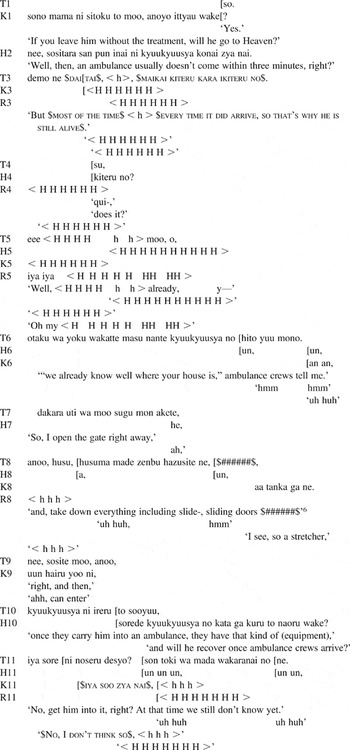
Continuing the talk of her husband's life-threatening asthma attacks and oxygen measuring equipment, Tamako contributes to maintaining the quotidian frame in (5) while talking about a lifesaving medical procedure that had to be administered within three minutes of the occurrence of a particular symptom. In response to one of the participants’ comment that ambulances usually do not arrive so quickly, Tamako explains the reason by reconstructing the crew's words: “we know well where your house is,” implying that they had been called to assist Tamako's husband as often as if they were a delivery service. Tamako animatedly describes how, on these frequent emergency occasions, she took down the sliding doors so that the stretcher could be carried quickly into the ambulance. In spite of the serious life-and-death situation, everyone's tone is noticeably jocular as indicated by the amount of laughter.
Arrival of ambulance

The playfulness in conversations reframed as quotidian was most clearly observable in the collaborative reframing excerpts (3) through (5) above, but shared laughter and a jocular atmosphere were also present in all of the other examples. We can conclude then that utterances in a quotidian frame are compatible with playfulness, similar to “talk in a play frame” as discussed by Coates (Reference Coates2007). A play frame, as introduced by Bateson (Reference Bateson1972/2000) and discussed in numerous studies (notably by Goffman Reference Goffman1974, and more recently Gordon Reference Gordon2008, for example), indicates that utterances are to be understood as “play” and not completely real. Similarly, a quotidian frame indicates that the ongoing interaction is understood from an everyday perspective rather than that of a psychologically weighty or tense situation. Both play and quotidian framing involve a metacommunicative message pertaining to participants’ attitudes toward the interaction, or, using terminology employed by Rom Harré and his coauthors, Bamberg (e.g. 1997), Schiffrin (Reference Schiffrin2006), and others, a metacommunicative message pertaining to participants’ positioning to the interaction and among themselves.
Indexing identities in a quotidian frame
We have considered the details of quotidian reframing in conversational narratives of painful self-disclosure, especially on a husband's death and illness. In this section, I turn my focus more specifically to the effect or implication of such quotidian reframing in the expression of personal and social identities by elderly speakers in discourse on life changes.
I have mentioned one of the effects of the quotidian frame as making a narrative less weighty and more compatible with humor and laughter, and allowing the narrator to align herself to a quotidian point of view and thereby regain the “normal” aspect of her life. Under quotidian framing, the speaker presents herself from the perspective of how she believes herself to be, or wishes to present herself, in everyday situations rather than in extraordinary and high-tension situations. I call this aspect of personal identity the quotidian self.
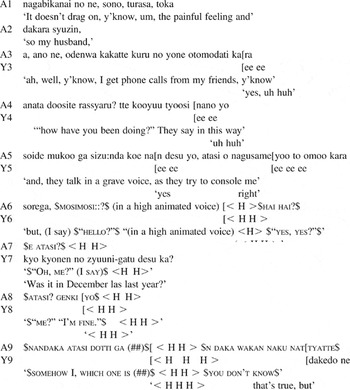
The display of quotidian self embedded in a stream of conversation on topics of bereavement and illness-related predicaments is assisted by shared laughter and the collaboration of other participants. The presentation of such identity seems to be a conscious performance at times. In the following passage (from the extended conversation excerpted in (1)), Akiko illustrates her ability to get back to normal by recounting the time she received phone calls of sympathy from friends after her husband's passing. When her friends inquired in a grave voice how she had been doing, she responded in her usual cheerful way, which she emulated in her recounting. Akiko prefaces this account of her telephone dialogue by saying (in line A1) that she does not prolong grief of any kind.
Condolence calls from friends

What Akiko says in line A1 (nagabikanai no ne, sono, turasa, toka ‘It doesn't drag on, y'know, um, the painful feeling and’) certainly gives the impression that she was more conscious of presenting her quotidian and cheerful self here than in excerpt (1), in which she was complaining about her husband. In this stretch of conversation, Akiko may have wished to show her resilience and indicate that she did not dwell on bereavement but believed in getting back to the ordinary life that she led. It is important to note that Akiko's resilience is not straightforwardly presented as a sign of resistance to a trouble by laughing at the content of the disclosure (i.e. husband's death), but through a quotidian reframing.
The personal identities presented locally in this and the other excerpts have implications as to how social identities of older people are understood by people of different age groups. The display of one's quotidian self with humor and laughter in recounting old-age-related life changes is not typically expected of the elderly. At least some older speakers, such as those in my data, consciously or unconsciously subvert the socially given images of the elderly as being negative and disengaged, and project a different type of social and individual identity. The data discussed here illustrate that, just as talking about old-age-associated predicaments such as forgetfulness or health problems itself does not categorize the speaker as an old person (Matsumoto Reference Matsumoto, Mori and Ohta2008), painful self-disclosure or talking about the grave topic of death and illness at old age does not mean that the speakers are absorbed by an “old person” identity.
Conclusion
The data that I gathered of natural conversational narratives of older Japanese women recounting their experiences with husbands’ deaths and illnesses to friends and acquaintances often included segments that were presented in a highly involved manner and that precipitated laughter. The laughter was not of the sort offered only by the speaker to mitigate the force of the speech act (or to indicate that she can take the hardship) as discussed by Jefferson (Reference Jefferson, Atkinson and Heritage1984), but was shared among the participants, similarly to what is commonly heard when talk is humorous and playful. This finding is striking at least on two accounts: the nature of the topics was sensitive and grave rather than light and humorous, and the involvement and cheerfulness contrasted with the typical view of elderly communication as “disengaged” and “grumbling.”
The common feature of the various instances in which painful events were recounted with humor was that they involved apparently trivial details of specific scenes that were reminiscent of ordinary life in the context of recounting an extraordinary and psychologically intense experience. The speaker focused on quotidian details of the scene or described the scene from a quotidian perspective, despite the gravity of the overall event of which the described scenes were part. I coined the term “quotidian reframing” to refer to this phenomenon and discussed linguistic and paralinguistic “quotidian framing cues” that mark a segment of utterances framed as such. Concepts developed in frame theory, such as lamination and footing (Goffman Reference Goffman1974, Reference Goffman1981), were useful for understanding the fine mechanism of utterances in the quotidian frame.
There are important implications to reframing narratives of grave events as quotidian. One relates to humor and laughter. Details of scenes reminiscent of ordinary life, such as the familiar ill-mannered behavior of an old husband, a reference to sounds of a small animal, and an allusion to frequent delivery service, are not what would usually be expected in extraordinary and psychologically tense situations. Some “incongruity” between the expected and the unexpected has long been recognized as a source of humor and laughter, starting from the time of Kant and Schopenhauer (Norrick Reference Norrick2003), and elaborated by numerous scholars (e.g. Bergson Reference Bergson1899/1911; Bateson Reference Bateson and Foerster1953, Reference Bateson1972/2000; Koestler Reference Koestler1964; Raskin & Attardo Reference Raskin and Attardo1994).Footnote 7 Because of the incongruity inherent in reframing extraordinary and tense events as quotidian, the speaker and listeners in the conversations presented in this article could laugh together about the humor of the story. In this sense, we can say that, when used in narratives of psychologically intense experiences, quotidian reframing—whose metacommunicative message is “This is grounded in quotidian events”—establishes an “incongruous” frame as much as the metacommunicative message “This is play,” discussed by Bateson (Reference Bateson1972/2000:184), establishes a “paradoxical” frame.
Another important implication of quotidian reframing relates to the presentation of identity. Quotidian framing has the function of allowing a character (or a figure, Goffman Reference Goffman1981) to be presented with her or his quotidian self, which usually differs from the identity of one situated in the tense and extraordinary context. Evoking and describing the details of events that are reminiscent of ordinary life, the identity of the narrator as a figure in the story is lifted, or dissociated, from the context of psychologically weighty situations. As discussed earlier, one's quotidian identity is not a specific identity, but can be described as an identity that is not affected by the extraordinary occasion. Having quotidian moments in emergencies is incongruous and may be funny, and at the same time, may provide a perspective that is not intrinsic to the event and, thus, can help to reduce psychological tension, at least temporarily. It can therefore let participants regain the feeling of what they consider normal. In dealing with difficult life changes, quotidian reframing provides a chance for the elderly to feel that they can ground themselves while gradually adjusting their lives.
My discussion has focused on quotidian reframing in verbal presentations of older Japanese women's painful experiences about their husbands’ illnesses and death. However, it is likely that quotidian reframing is found in other linguistic and social contexts. It may indeed be applicable, for example, in similar narratives of painful events by speakers of other cultural backgrounds, although this is not to say that cultural variability is nonexistent. Older adults may face life-changing experiences such as the death of a spouse more often than other age cohorts, but people of any generation with life-changing or difficult (or traumatic) experiences could employ the same strategy.Footnote 8 Quotidian reframing, since it regrounds to the ordinary, may be used in various verbal and nonverbal contexts to decrease psychological intensity,Footnote 9 just as the play frame is a useful concept at both levels.