An Introduction to Confucian Healthcare Policy and Bioethics
Healthcare systems in Singapore, Hong Kong, and mainland China are strikingly distinct from those in the West. Economically speaking, each of the aforementioned Eastern systems relies in great measure on private expenditures supplemented by savings accounts. Western nations, on the other hand, typically exhibit government funding and wariness about healthcare savings accounts. This essay argues that these and other differences between Pacific Rim healthcare systems and Western systems should be assessed in light of background Confucian commitments operating in the former.Footnote 1 In the Confucian context, bioethics and healthcare policy have a unique content, texture, and set of implications that often affront Western assumptions about the appropriate individual autonomy of patients and the appropriate character of social safety nets for healthcare.
Despite the depth of these differences, they are nevertheless difficult for Westerners to appreciate. In part, this is because many influential accounts of Confucian thought have reframed Confucian theory to make it fit more congenially with modern Western moral and political commitments.Footnote 2 Moreover, a frank acknowledgment of fundamental differences between Eastern and Western bioethics would embarrass efforts to enshrine Western commitments in a canonical global bioethics.Footnote 3 Moral differences between East and West are obscured from the Eastern side as well, because approval-conscious Pacific Rim bureaucracies often engage in moral double-bookkeeping. Like those who wish to recast Confucian thought and commitments, local legislators recognize that much of Confucian moral and political theory invites Western criticism. In response, the official law on the books is often different from what is applied in actual practice.Footnote 4 Finally, there is on-going debate about the trajectory of development in mainland China: Whereas a group of Confucian scholars call for a reconnection with China's Confucian cultural heritage,Footnote 5 others argue for a continuous dilution and adjustment of Confucian values in accommodation to the “global ethics” advocated by Western liberal social democracies.
Approaches to Confucian theory that discount its moral distinctiveness deprive both those in the Pacific Rim and those outside of an adequate understanding of the moral and political assumptions that shape healthcare policy in many parts of East Asia.Footnote 6 This essay seeks to aid in the correction of this deficiency by employing the concept of a “directed benevolent market polity” to summarize the complex ways in which Confucian ideas inform governing elites and shape healthcare policy in the Pacific Rim.
Beyond Social Democracy and Limited Democracy: A Directed Benevolent Market Polity in the Pacific Rim
Though social and political cultures in the Pacific Rim are complex and diverse, many countries (especially Singapore) exhibit what I have called a directed benevolent market approach.
These polities are directed in the sense that they are controlled by a ruling group, who are endorsed through some form of election. The election, in these contexts, is a public ritual of legitimization (i.e., a form of community ritual affirmation of the political status quo), but not a mode of actual citizen rule as it is understood in the West. Within a Confucian framework, the polity is viewed as a family of families. Polarization among competing moral and political factions is discouraged because it is detrimental to family harmony. Ritual elections underscore the obligation of the established elite not to be exploitative of its position, but rather to exercise authority in a benevolent manner so as to secure and maintain important social structures and goods, most particularly the flourishing of individuals within the family.Footnote 7 Formal examinations held to select civil servants in Singapore, Taiwan, and contemporary mainland China are an inheritance from the Confucian tradition and have no direct counterpart in Western countries.
Such polities have a market orientation grounded in the conviction that the market can be trusted to increase wealth and that property is integral to human flourishing. Property rights are held to more fully reflect the dignity of persons than do civil libertarian rights, such as rights to political protest and dissident political commentary. Hence, the market is taken to be the proper means for people to increase their wealth and enrich their lives.
The moral and political character in such polities expresses the cardinal Confucian virtue of benevolence (ren). Benevolent governance (ren zheng) requires the acquisition of people's safety and welfare. But this objective cannot be achieved by establishing egalitarian welfare rights, because such rights are in tension with the Confucian family-oriented ideals and values. Indeed, many East Asian regions draw elements from Confucian philosophy that are, at their core, familist in two decisive ways. First, political structure and governance are understood neither in terms of a Rawlsian hypothetical rational contract nor in terms of a Lockean actual historical contract, but rather in terms of a comprehensive moral vision where society is regarded as a large family of families. Just as claims of civil liberty and equality and participation in active protests should not be central to family life, or at least to the functioning of traditional families, so, too, such behaviors are regarded as out of place in a directed benevolent market polity. Second, political theory and governance are aimed at recognizing and nurturing families as entities that are responsible for the welfare of their members. Normally, individuals should rely on their families, rather than government, to secure their welfare in general and healthcare in particular.
Indeed, a focus on families lies at the root of a number of bioethical practices that distinguish many Asian societies. First, patients are presumed, unless proven otherwise, to wish to be treated within the nurturing concerns of their family members.Footnote 8 The burden of proof, unlike that in North America and Europe, is on patients to show if and when they wish to be considered as isolated individuals, rather than as integrated members of a family.Footnote 9 As a consequence, prognoses that might be emotionally difficult for a patient immediately to accept are mediated first and foremost through family members.Footnote 10 Moreover, consent to treatment is acquired via a family-oriented model, which avoids the harmful effects of approaching patients in isolation from the support and direction of their families.Footnote 11
Second, there is an appreciation that families should bear primary responsibility for the costs of healthcare for their members. The best public policy example is the Central Provident Fund of Singapore, which compels citizens to accumulate wealth within families by establishing savings accounts and to learn free and responsible choice in the use of these resources. These savings accounts not only provide resources for healthcare, but because they can be transferred without tax consequences for the needs of other members and can, in addition, be given to heirs and assigns, they have the effect of increasing the wealth of families that act responsibly.Footnote 12 Moreover, they contribute to an ethos of mutual propriety within families.
Finally, given the commitment of directed benevolent market polities to property rights and to improving the standard of living through creating wealth, humanitarian concerns are primarily pursued through a leveling up of the circumstances of citizens through increasing wealth, rather than a leveling down through heavy progressive taxation or restrictions on the free-market purchase of better basic healthcare, as in Canada. The income tax rates in areas such as Singapore and Hong Kong are significantly lower than those in the Western social democratic countries.
The Confucian Perspective: Why It Is So Different
The Confucian worldview is grounded in a moral experience of benevolence (ren) cultivated and sustained in rightly directed ritual behavior (li). This understanding is complex and includes the following salient features.Footnote 13
First, Confucianism is not a social-democratic account or theory and, in distinction from such theories, is not primarily concerned with liberty, equality, human dignity, or human rights.Footnote 14 Instead, Confucian thought has its own cardinal moral concepts such as li and ren. Li identifies proper rituals and ren identifies the realized full humanity, human heartedness, or benevolence required to discipline oneself through proper rituals (li) so that one can become an authentic moral agent and appropriately engage in right action. As the cardinal Confucian virtue, ren is a type of human love naturally rooted in family relations, especially in the parent–child relation (Analects 1.2; Mencius 7A.15; The Doctrine of the Mean 20.5). Confucianism sees the foundation of morality in the cultivation of this natural benevolence and its gradual extension to other people (Analects 12.12; Mencius 4B.28) through the observation of proper rituals (Analects 12.1). To become a virtuous person, one must first take care of one's family members; then one should endeavor to assist people outside of one's family. Finally, one who aids a great number of people by increasing their standard of living is considered not only a benevolent ruler, but a sage of the highest moral rank (Analects 6.28).
Although everyone is encouraged to cultivate the virtue of benevolence, only the gentleman can fully devote his mind to it (Analects 15.13) and be versed in it (Analects 4.16). Accordingly, only the virtuous should be selected to rule society, and they must govern people not by the force of punishment, but by the power of virtue (Analects 12.19) in line with proper rituals (li) (Analects 2.3). Confucians use li metaphorically to denote normal behavior patterns that manifest authentic human existence. Although every tradition has li in the sense of ceremonies or rites, Confucianism emphasizes the formation of moral character through proper Confucian rites. For Confucians, virtue can be cultivated through rites because rites embody a sense of solemnity or sacredness that can inspire and maintain the attitude of reverence in the hearts of participants, helping them to control their passions and live in an appropriate, rule-governed manner. In short, Confucian concerns with li differ radically from the cardinal, secular commitments of Western morality and political thought.Footnote 15 Confucianism employs a unique moral epistemology linking virtue with ritual, so that, for instance, a one-party democratic election of a ruling group is appreciated as a morally authorizing act in conformity with public propriety, elastic politics, and civic virtue.Footnote 16
Second, Confucian thought affirms the market as well as the institution of private property. As Mencius argues, a government that deprives people of private property does not manifest benevolence. For Confucians, people deprived of private property will not have a fixed heart. In the absence of fixed heart, morality and social order lose their ultimate sanction. A government that deprives people of private property and then punishes them for trying to acquire it entraps its citizens (Mencius 3A3: 3).Footnote 17 Moreover, Confucian thought does not support an egalitarian pattern of redistribution through heavy taxation. Instead, Confucians emphasize that governments must leave resources to families so they may care for the welfare of their members (Mencius 1A5.3). Confucius clearly states that government should not tax people for more than 10% of their income (Analects 12.9). Finally, Confucian thought is anti-egalitarian in that it emphasizes the necessity of a division of labor in the exchange of goods and services along with the different levels of social status this produces (Mencius 3A4; Xunzi 9). Because different types of labor and services are of unequal social value (Mencius 3A4; Xunzi 9), a fair and fruitful society must realize that better work receives higher remuneration through the market mechanism (Mencius 3B4; Xunzi 10).
Finally, the Confucian moral point of view does not seek a disinterested regard of individuals, but instead the moral flourishing of families. The values of families cannot be reducible to the total sum of the interests of their individual members.Footnote 18 Because Confucian understandings of ren and li are located within the perspective of the family, the profit motive, or, for that matter, the greed that moves many if not most engagements in the classical market, is domesticated by being placed within a benevolent familial context. The profit motive is further moderated by forms of ritual propriety that direct resources toward the support of families.Footnote 19 The family savings-account strategy adopted in Singapore is exemplary in this regard.
This Confucian account of benevolence, politics, and governance is alien to both the secular character of social-democratic thought as well as the sparse claims of libertarian, limited-democratic theory. Undeniably, this account is often characterized as supporting authoritarian capitalism. However, such descriptions typically ignore the content and force of Confucian moral–political commitments to the maintenance of socially and ritually sustained virtue. In light of these commitments, one can appreciate the moral and political–constitutional differences shaping healthcare policy in the Pacific Rim.
Chinese Healthcare Reforms: Toward a Confucian Healthcare Policy
The People's Republic of China maintained a socialist ideology from the early 1950s to the late 1970s, but since that time has gradually moved toward a market economy. The world has witnessed enormous changes in almost every aspect of Chinese social life, healthcare included. How should we characterize the ethics and politics of such changes? How should we properly evaluate Chinese healthcare reforms? This section argues that China not only could but also should formulate a healthcare policy that manifests Confucian values on the model of a directed benevolent market polity.
In its formal principles, the Chinese socialist approach to healthcare mimicked the liberal egalitarian social-democratic ideology prevalent in contemporary Western states. It required that equal basic care for all people be ensured by the government through public resources. The Chinese government pursued this ideal by establishing a series of strictly government-controlled, but differentially funded, healthcare projects. First, private ownership was abolished in the 1950s, and all significant productive means and wealth were confiscated by the government and became “public.” The government gradually set up three different types of healthcare project. The first was “public-fee medical care” (gong fei yi liao), financed directly by government revenues and providing free healthcare for government officials and the employees of governmental institutions. The second was “labor-protection medical care” (lao bao yi liao), financed by state-owned enterprises and companies to provide medical care for their employees with only token personal copayments. The final project was “cooperative medical care” (he zuo yi liao), in which each collective-owned village provided peasants with the services of barefoot country doctors—financed through premiums paid by the peasants and supplemented by small government subsidies.Footnote 20 At least ostensibly, most Chinese were covered in these public healthcare projects in the early 1970s.
The cooperative medical care project dissolved in the early 1980s when the economic reforms began. At that time the families of the Chinese peasants won back a right to determine their production and appropriate their income as they saw fit, no longer being strictly controlled by the village collective and the government. The cooperative medical care project collapsed because the peasants were no longer interested in contributing resources to it. Some critics lament this collapse because peasants have returned to the traditional way of purchasing medical care out of their family savings. However, the project failed to gain the peasants' support because of several important shortcomings. First, it was built on the mandatory “collective” economy, which deprived citizens not only the private property, but also of familial financial autonomy. Second, it offered very low-quality medical services through the barefoot doctors because they were not adequately educated or trained. Finally, although it claimed to offer equal care for all the peasants, cadre-favoring corruptions were not uncommon. Village chiefs received better medications and treatments, whereas ordinary peasants were treated poorly.Footnote 21
Labor protection medical care fared better, at least initially, insofar as it exploited peasant labor and benefited from a centrally planned system that focused on industrial development. This policy generated a huge economic gap, including a gap in access to quality healthcare, between the urban and rural areas. The policy was challenged in 1953 by the so-called last Confucian, Liang Shu-ming, but the challenge was ruthlessly suppressed.Footnote 22 Nothing much changed until the market-based reforms of the 1980s brought state-owned enterprises into competition. Their economic viability and that of the labor-protection medical care project were no longer guaranteed by governmental revenues. Moreover, as medical markets developed and advanced technologies were imported, healthcare costs in governmental hospitals escalated. As a result, many state-owned enterprises could no longer afford the medical care project for their employees, and many urban workers, like peasants, had to pay directly for healthcare. At the same time, however, the public-fee medical care project for governmental employees remained intact, eliciting charges of unfairness from aggrieved citizens.
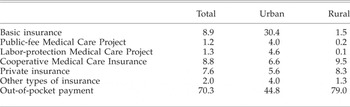
These circumstances led to the State Council's 1998 decision to recast basic insurance for urban citizens.Footnote 23 This new insurance plan requires that both employers and employees contribute so as to establish both savings accounts (which are tax free and inheritable) for every employee and a united fund for catastrophic insurance. Covered individuals contribute about 2% of their salary to the medical savings account. Medical costs must first be paid through the savings accounts before the united fund can be used for reimbursement. According to a survey made by the Ministry of Health in 2003, the basic insurance covered about 30% of the urban population (about 9% of the total population). It had not fully developed as the original plan required because a great number of governmental officials and employees (accounting for 4% of the urban population and 1.2% of the total population) wanted to maintain the privilege of enjoying the vested benefits of their public-fee medical care project and were not willing to join the basic insurance.
Meanwhile, the government began to rebuild cooperative medical care for the peasants. A cooperative medical care insurance plan was launched in 2003 for every peasant through a tripartite annual financing plan—10 yuan from central government, 10 yuan from local government, and 10 yuan from the peasant. Table 1 summarizes the percentages of the Chinese people covered in different types of healthcare insurance in the urban and rural areas in 2003.Footnote 24
Percentages of the Chinese People Covered by Healthcare Insurance

How best to evaluate the Chinese healthcare reforms (1980s–2005) has recently become a topic of hot debate. In July 2005, the State Council Development Research Centre publicized a report on the Chinese healthcare reforms,Footnote 25 judging the reforms as a failure as a whole and seeing much of the problem as rooted in the reduction of government funding to the medical sector and in the introduction of market mechanisms to the healthcare area.Footnote 26 In particular, the report argues that using savings accounts is not a good idea for healthcare because it does not conform to the basic principle of insurance and reduces the function of mutual benefit through insurance. This evaluation is misleading because it imposes Western notions about how to cultivate “mutual benefit” on Pacific Rim healthcare economies. In any case, the debate is still going on in current China regarding what is a proper Chinese healthcare system in the market economy.
The moral and political assumptions that distinguish the approach to healthcare in Singapore, Hong Kong, and current mainland China from that of the United States and the United Kingdom sustain, as we have observed, different frameworks of personal and family responsibility. In Singapore, from 6% to 8% of one's salary must be paid into a medical savings account. In Hong Kong, a 5% payment must be paid into a savings fund that at retirement can be used for income maintenance as well as healthcare expenditures. From a Confucian perspective, the establishment of such savings accounts can be appreciated as integral to both the nurturing of ren and engagement in li. Importantly, the problem with savings accounts in the current Chinese basic insurance scheme does not lie in its rationale for funding healthcare, but rather in its not being sufficiently family oriented, as it is in the Singaporean scheme. Unlike the Singaporean system, the Chinese savings accounts cover only individual employees, not their family members.
Family healthcare savings accounts provide social structure that avoids two hazards:
1. The political hazard of politicians promising entitlements that must be funded through future taxation, thus encumbering the future with the political rhetoric of the past.
2. The individual moral hazard of persons overusing healthcare entitlements, once they are created, thus undermining the long-term financial sustainability of such entitlement programs.
Because such savings accounts are tax-free and can be transferred among family members without tax consequences, they not only avoid the political and moral hazards usually involved in insurance systems, but achieve a number of important moral goods. They nurture individual responsibility regarding the purchase of healthcare, pharmaceuticals, and medical devices. When such funds can be shared without tax consequences among family members, an incentive is created for families to recognize themselves as a social unit and to work together as an integrated whole. Accordingly, rather than abolishing the savings accounts in the basic insurance, China should extend them to cover all family members.
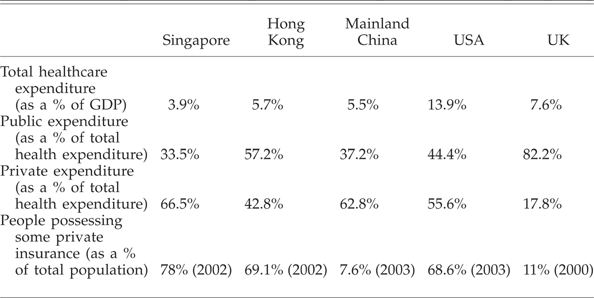
Such family-oriented policies have produced striking results in the Pacific Rim, where successful programs have effected a shift toward private healthcare financing.Footnote 27 In Singapore, governmental healthcare expenditures amount to only around 30% of healthcare financing. Though people admire Hong Kong's quasi-free medicine for all residents via its public hospitals, most Hong Kong people, in fact, use family savings to visit private clinics for their ordinary healthcare. This is why the percentage of Hong Kong's health expenditures from public coffers is less than 60%, making Hong Kong more analogous to the United States in its relatively low reliance on public funds for healthcare expenditures (in the United States only about 44% of the healthcare dollar is publicFootnote 28). Social-democratic polities of Western Europe and Canada, on the other hand, depend primarily on government funding (the percentage of the public covered by governmental insurance ranges from 92% in Germany to 100% in Sweden and Canada).Footnote 29
Table 2 indicates relevant healthcare information on Singapore, Hong Kong, mainland China, the United States, and the United Kingdom (in 2001, unless otherwise marked).Footnote 30
Comparative Healthcare Expenditures
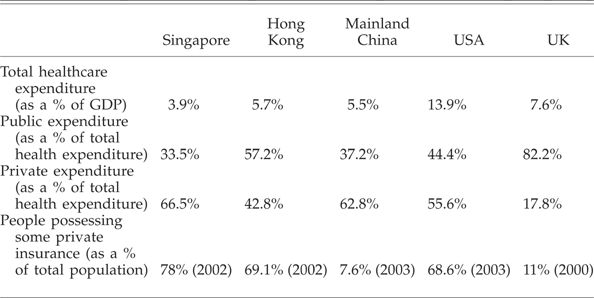
The contrasts between Singapore and Britain are striking. In Britain only about 18% of the total health costs were paid by individuals and their families, whereas in Singapore the figure was about 67%. This indicates that individuals and their families in Singapore took more financial responsibility than those in Britain—and probably avoided the entitlement-induced moral hazard of overspending. Singapore spent only 3.9% of its GDP on healthcare, whereas Britain spent almost double that figure. Evidently, the Singaporean medical savings accounts played a very positive role in taking care of people's healthcare while controlling financial costs.
Before the reforms in mainland China, government controlled nearly all economic resources. There was no private medical sector or private insurance. People were compelled to participate in one of three medical care projects, which, in the name of equal basic care for all, offered healthcare of quite different quality. A small group of people enjoyed unfair privileges from the public-fee medical care project and up to the present they still want to maintain it by refusing to join the basic insurance. The reforms have brought in private clinics and hospitals and promoted competition between the public and private sectors. The Chinese people have obtained choices for their healthcare financing based on their family circumstances. As the Table 1 shows, even in the countryside about 8% of the peasants have secured private health insurance of some type, which would have been unimaginable before the reforms.
Of course, it is an enormous challenge for China to build quality basic care for its peasants, who constitute about 60% of the Chinese population. But the problem is by no means only a healthcare problem. Strikingly, there is still a huge income gap between the rural and urban residents, with urban residents earning three times as much per capita.Footnote 31 Correction cannot be achieved by offering bits and pieces of welfare to the peasants. A robust Confucian benevolent policy must be formulated to benefit the peasants. Healthcare reform is, in fact, only a facet of the needed reforms—more robust property rights are perhaps even more crucial.Footnote 32 The fundamental point is that China should develop a directed benevolent market polity in which the Confucian teaching of enriching the people (Analects 13.9) should be enacted by securing their private property ownership and using the market to meet their various healthcare needs through effective family financial responsibilities.
Finally, blaming the market as the dirty hand, distorting and corrupting Chinese healthcare, is simply misleading. The problem was not generated by the introduction of the healthcare market. To the contrary, Chinese healthcare markets are far from being sufficiently developed. There are only about 1500 private hospitals throughout the country, because most local governments require those covered in the basic insurance to use only governmental hospitals to spend their savings accounts or reimburse their medical costs from the united fund. Moreover, the government maintains a cluster of public policies originating from the past centrally planned system and generates only improper incentives in current healthcare markets. For instance, physicians in governmental hospitals are not rewarded for providing better care. Accordingly, economic incentives are generated only by paying physicians under the table (so-called red packets) in order to get access to better basic care. It is such improper policies that have distorted the normal operation of the market and induced the corruptions of Chinese healthcare.Footnote 33
A View from Asia: Not Bioethics as Usual
This essay takes moral difference seriously, while focusing on the substantive particular moral commitments that define Confucian bioethics and healthcare policy. In important ways, the healthcare policy of Singapore, Hong Kong, and even current mainland China reflects moral commitments and an understanding of bioethics other than that of the established bioethical views of Western Europe or even the United States. Core to these differences is the Confucian recognition of the centrality of the family and its understanding of society as appropriately a family of families. Core as well is the central role played by ren (benevolence) and li (ritual propriety) in sustaining the meaning of the family and of political activities. Because there are family resemblances between Confucian concerns with benevolence and families and Western moral concerns with benevolence and families, appeals to ren do not at once produce a clear recognition that one is encountering a fundamentally different set of moral understandings.
However, the Confucian appreciation of benevolence and families cannot be fully grasped without understanding the Confucian concept of li. Concerns with ritual behavior or ritual propriety are not central to much of moral life in the West, much less to its moral theory. In the light of Confucian concerns, however, ritual behavior is understood not merely as expressing social conventions, but as achieving virtue and moral knowledge. Ritual does not merely create social reality, it is a means of appreciating moral structures and commitments. Family-oriented rituals in the Confucian tradition not only provide opportunities for individuals to cultivate a benevolent heart, but also direct government to enhance solidarity through the cultivation of caring and responsible families. Only by first acknowledging these distinctions is it possible to effect appropriately critical comparative analyses between Western and Pacific Rim healthcare policies.