INTRODUCTION
The repeated use of perches, roosting sites, reproductive sites and sleeping sites over time by frugivorous vertebrates promotes the deposition and aggregation of copious amounts of seed in these sites (Russo & Augspurger Reference RUSSO and AUGSPURGER2004, Wenny Reference WENNY2001). These behaviours have key implications for seed dispersal and forest regeneration (Jordano & Schupp Reference JORDANO and SCHUPP2000), particularly in tropical forests where up to 94% of woody plant species are dispersed by frugivorous animals (Jordano Reference JORDANO and Fenner1992). The importance of this spatially aggregated pattern of seed deposition for seed dispersal is largely dependent on site fidelity, that is, on the frequency of use of these sites over time (Russo & Augspurger Reference RUSSO and AUGSPURGER2004, Russo et al. Reference RUSSO, PORTNOY and AUGSPURGER2006); yet, empirical evidence about this relationship is scarce.
Site fidelity is particularly common in territorial animals (Börger et al. Reference BÖRGER, DALZIEL and FRYXELL2008), such as Geoffroy's spider monkey (Ateles geoffroyi) (Chapman et al. Reference CHAPMAN, WRANGHAM and CHAPMAN1995). This primate is a highly specialized frugivore (González-Zamora et al. Reference GONZÁLEZ-ZAMORA, ARROYO-RODRÍGUEZ, CHAVES, SÁNCHEZ-LÓPEZ, STONER and RIBA-HERNÁNDEZ2009, Russo et al. Reference RUSSO, CAMPBELL, DEW, STEVENSON and SUAREZ2005) that defends stable home ranges, within which the spider monkey concentrates its activities in areas of higher quality (i.e. the so-called ‘core areas’; Asensio et al. Reference ASENSIO, SCHAFFNER and AURELI2012a). As multi-central place foragers (sensu Chapman et al. Reference CHAPMAN, CHAPMAN and MCLAUGHLIN1989), they feed on several plants located near sleeping trees (STs), and return to the same or different STs after their feeding excursions. An important fraction of seeds swallowed by these primates are defecated in latrines located beneath these STs (González-Zamora et al. Reference GONZÁLEZ-ZAMORA, ARROYO-RODRÍGUEZ, ESCOBAR, RÖS, OYAMA, IBARRA-MANRÍQUEZ and STONER2014, Russo & Augspurger Reference RUSSO and AUGSPURGER2004, Russo et al. Reference RUSSO, PORTNOY and AUGSPURGER2006), particularly beneath in those located within core areas, and hence, variation in sleeping-tree fidelity (STF) is expected to alter patterns of seed rain within latrines.
Here, we evaluated the frequency of use of 60 STs by A. geoffroyi and the seed-rain patterns produced by this primate during a 13-mo period in two continuous forest sites (CF) and three forest fragments (FF) in the fragmented Lacandona rain forest, Mexico. Because the potential variation between continuous and fragmented forests in STF has not been previously evaluated, we first tested whether STF (operationally defined as the number of months each ST is used) differed among the five study sites and between forest types (continuous and fragmented forests). For each study site and forest type, we assessed the association between STF and six community-level attributes of seed assemblages (Tuomisto Reference TUOMISTO2010): abundance of seeds, species diversity of seeds (i.e. species richness, exponential of Shannon's entropy and inverse Simpson concentration), community evenness, and seed species turnover (β-diversity) between STs. This information has critical ecological implications, as A. geoffroyi are increasingly forced to inhabit fragmented landscapes (Ramos-Fernández & Wallace Reference RAMOS-FERNÁNDEZ, WALLACE and Campbell2008), but we do not know if their seed-dispersal services may be altered in forest fragments (but see Chaves et al. Reference CHAVES, STONER and ARROYO-RODRÍGUEZ2011, González-Zamora et al. Reference GONZÁLEZ-ZAMORA, ARROYO-RODRÍGUEZ, ESCOBAR, RÖS, OYAMA, IBARRA-MANRÍQUEZ and STONER2014).
STF of spider monkeys is expected to be higher in forest fragments (González-Zamora et al. Reference GONZÁLEZ-ZAMORA, ARROYO-RODRÍGUEZ, OYAMA, SORK, CHAPMAN and STONER2012), as the home ranges of these primates in fragments are smaller than in continuous forest sites (Chaves et al. Reference CHAVES, STONER and ARROYO-RODRÍGUEZ2012). Although it is reasonable to expect that the abundance and diversity of seeds increase with STF, such associations largely depend on food availability within the home range. Because the STs most frequently used are expected to function as key nodes within foraging networks routes that connect core areas (Di Fiore & Suarez Reference DI FIORE and SUAREZ2007, Suarez et al. Reference SUAREZ, KARRO, KIPER, FARLER, MCELROY, ROGERS, STOCKWELL and TAYLOR2014), we predicted STF to be positively associated with seed abundance and with all four diversity metrics. Thus, differences between STs in re-use are expected to result in significant differences in species turnover (i.e. increasing β-diversity) between STs. Moreover, because the spider monkey shows high selectivity towards the consumption of a few genera of plants (Chapman Reference CHAPMAN1988, Milton Reference MILTON1980, Russo et al. Reference RUSSO, CAMPBELL, DEW, STEVENSON and SUAREZ2005) and a large number of species are used opportunistically (González-Zamora et al. Reference GONZÁLEZ-ZAMORA, ARROYO-RODRÍGUEZ, CHAVES, SÁNCHEZ-LÓPEZ, STONER and RIBA-HERNÁNDEZ2009, Nunes Reference NUNES1998), we predicted STF to be negatively associated with community evenness (i.e. with higher STF the seed rain will be dominated by fewer species).
METHODS
Study sites
The Lacandona rain forest constitutes the south-western sector of the Mayan forest in Mexico, and represents a priority area for biodiversity conservation in Mexico and Mesoamerica (Myers et al. Reference MYERS, MITTERMEIER, MITTERMEIER, DA FONSECA and KENT2000). The area is located in the north-eastern portion of the state of Chiapas, and is delimited by the Guatemalan border on the south and east, and by the Chiapas highlands on the north and west. Annual precipitation averages 2850 mm, and average monthly temperatures range between 24°C and 26°C. This region was originally covered by over 1.4 million ha of rain forest, but deforestation between 1960 and 1990 resulted in the loss of 70% of the original forest cover (Arizpe et al. Reference ARIZPE, PAZ, VELÁZQUEZ and Miguel1993).
Within this region the Montes Azules Biosphere Reserve (MABR) was created in 1978 to protect biodiversity. Adjacent to the southern extreme of MABR, the Marqués de Comillas Region (MCR) was colonized by humans about 40 y ago and since then MCR has suffered the rapid loss and fragmentation of the original rain forest (Mora Reference MORA2008). Currently, MCR is dominated by different-sized rain forest patches, embedded in a matrix of cattle pastures, agricultural lands (e.g. corn, oil palm, rubber) and human settlements. The study was conducted in MCR (eastern side of the Lacantún River; 2039 km2) and MABR (western side; 3312 km2).
Experimental design
Based on a recent study on the density and spatial distribution of sleeping sites, STs and latrines of the spider monkey (Ateles geoffroyi) in the region (González-Zamora et al. Reference GONZÁLEZ-ZAMORA, ARROYO-RODRÍGUEZ, OYAMA, SORK, CHAPMAN and STONER2012, Reference GONZÁLEZ-ZAMORA, ARROYO-RODRÍGUEZ, ESCOBAR, RÖS, OYAMA, IBARRA-MANRÍQUEZ and STONER2014), we selected 60 sleeping sites, each composed by one single ST, in two continuous-forest sites within MABR and three forest fragments in MCR (12 STs per study site). To increase the independence between the two continuous-forest sites, they were separated by 5 km from each other. The forest fragments FF1, FF2 and FF3 have an area of 1125, 33 and 30 ha, respectively, and were isolated ≥ 24 y ago and were immersed in an anthropogenic matrix of pastures and agricultural lands. The average distance between two fragments was 4.2 km (see further details in Gonzalez-Zamora et al. Reference GONZÁLEZ-ZAMORA, ARROYO-RODRÍGUEZ, OYAMA, SORK, CHAPMAN and STONER2012, Reference GONZÁLEZ-ZAMORA, ARROYO-RODRÍGUEZ, ESCOBAR, RÖS, OYAMA, IBARRA-MANRÍQUEZ and STONER2014). We do not have accurate information on the home range, population size/density and core area size of each primate's community. Yet a recent study in the same study sites reports that FF1 is occupied by a community of approximately 40 spider monkeys using a home range of 63 ha, whereas the communities from FF2 and FF3 have 30 and 39 individuals, respectively, and use the entire fragment area (Chaves et al. Reference CHAVES, STONER and ARROYO-RODRÍGUEZ2012). The average home-range size and community size in the continuous forest of the Lacandona rain forest is 68.4 ha and 40 individuals (Chaves et al. Reference CHAVES, STONER and ARROYO-RODRÍGUEZ2012). Unfortunately, we do not have data about the size of core areas in the study sites, but in Santa Rosa National Park, Costa Rica, Asensio et al. (Reference ASENSIO, LUSSEAU, SCHAFFNER and AURELI2012b) estimated that spider monkeys use five core areas of 9.2 ha on average (range = 3.4–19.2 ha) that totalled 46.1 ha out of the 304 ha of the entire home range.
Seed-rain patterns
Each selected ST had a single latrine (Gonzalez-Zamora et al. Reference GONZÁLEZ-ZAMORA, ARROYO-RODRÍGUEZ, OYAMA, SORK, CHAPMAN and STONER2012, Reference GONZÁLEZ-ZAMORA, ARROYO-RODRÍGUEZ, ESCOBAR, RÖS, OYAMA, IBARRA-MANRÍQUEZ and STONER2014). The STs had a mean crown projection of approximately 21 ± 21 m2 (mean ± SD). This indicates that each trap covered c. 3% of the tree crown. Nevertheless, because we located the trap in the centre of the latrine, which had an average diameter of 1.5 m (González-Zamora et al. Reference GONZÁLEZ-ZAMORA, ARROYO-RODRÍGUEZ, ESCOBAR, RÖS, OYAMA, IBARRA-MANRÍQUEZ and STONER2014), each trap covered approximately 60% of the latrine's area. Traps consisted of a circular 1.5-m-diameter PVC frame supporting a 0.5-m-deep open-topped nylon mesh bag suspended 1 m above the ground on three steel posts to prevent the possible predation of seeds by terrestrial vertebrates. In fact, we did not detect signs of seed predation (i.e. open husks, teeth marks) in the dispersed seed pool. Although seed traps also captured some fruits and seeds dispersed by wind or gravity, and would also capture seed dispersed by bird and bats, we only considered seeds completely immersed within monkey faeces. These seeds were easily identified in the field based on their typically stained appearance and characteristic adhesion of faecal matter (González-Zamora et al. Reference GONZÁLEZ-ZAMORA, ARROYO-RODRÍGUEZ, ESCOBAR, RÖS, OYAMA, IBARRA-MANRÍQUEZ and STONER2014), thus limiting greatly the erroneous inclusion of seeds dispersed by wind, gravity, or other animals. Furthermore, we did not consider seeds < 5 mm in length, which are known to be dispersed by a wider variety of seed dispersers, including small-to-medium terrestrial mammals, bats and birds (Janson Reference JANSON1983, Stoner et al. Reference STONER, RIBA-HERNÁNDEZ, VULINEC and LAMBERT2007), whereas seeds ≥ 5 mm in length are frequently dispersed by primates (Arroyo-Rodríguez et al. Reference ARROYO-RODRÍGUEZ, ANDRESEN, BRAVO, STEVENSON, Kowalewski, Garber, Cortés-Ortiz, Urbani and Youlatos2015, Chaves et al. Reference CHAVES, STONER and ARROYO-RODRÍGUEZ2011, González-Zamora et al. Reference GONZÁLEZ-ZAMORA, ARROYO-RODRÍGUEZ, ESCOBAR, RÖS, OYAMA, IBARRA-MANRÍQUEZ and STONER2014).
During a 13-mo period (1 February 2011–28 February 2012) each trap was emptied once monthly, and the seeds were collected and afterwards washed for subsequent identification in the laboratory. All seeds were counted and identified to the species level based on (1) our own experience with the local flora (from seeds to adults) (Chaves et al. Reference CHAVES, STONER and ARROYO-RODRÍGUEZ2011, Reference CHAVES, STONER and ARROYO-RODRÍGUEZ2012; González-Zamora et al. Reference GONZÁLEZ-ZAMORA, ARROYO-RODRÍGUEZ, OYAMA, SORK, CHAPMAN and STONER2012); (2) assistance from a botanical expert familiar with the flora of the region (G. Ibarra-Manríquez, Universidad Nacional Autónoma de México, Morelia, Mexico) and a local parataxonomist; and (3) information from seed catalogues (Ibarra-Manríquez & Cornejo-Tenorio Reference IBARRA-MANRÍQUEZ and CORNEJO-TENORIO2010).
Sleeping-tree fidelity
Following Reichard (Reference REICHARD1998), STF was defined as the number of months each ST was used during the study period. Given that all traps were checked at the end of each month, the presence of faeces in the traps was used as an indicator of sleeping-tree use by spider monkeys during that month. Since all traps were completely emptied each month, we considered both fresh and old faeces as indicators of sleeping-tree use, thus avoiding the possibility of overestimating STF. Although our definition of STF does not reflect accurately the intensity of use of STs (i.e. it would be better to assess STF on a daily or weekly basis), our results suggest however that our assessment of STF is an appropriate approximation of the intensity of use, as all community attributes of the seed rain were significantly related to STF.
Sample completeness
To assess the sample completeness within each ST, we employed the coverage estimator ( $\hat C$) suggested by Chao & Jost (Reference CHAO and JOST2012), which is a less biased estimator of sample completeness:
 \begin{equation*}
\hat C = 1 - \frac{{f_1}}{n}\left[ {\frac{{(n - 1)f_1}}{{(n - 1)f_1 + 2f_2}}} \right]
\end{equation*}
where f 1 and f 2 are the number of species represented by one (singletons) and two (doubletons) individuals in the sample, respectively, and n is the total number of individuals in the sample. Sample completeness did not differ between sites (Kruskal–Wallis test, H = 6.7, P = 0.14; mean ± SE: 99% ± 1%, range: 93–100% per ST). This indicates that the seed sample was accurate with our sampling effort, and that our results are not biased by differences in sample completeness among sites (Chao & Jost Reference CHAO and JOST2012).
Composition and structure of seed assemblages
Based on our hierarchically nested sampling design (i.e. 60 STs in five sites within two forest types), we calculated the total abundance and species diversity of seeds for each ST during the 13-mo period. Patterns of species diversity were analysed using true diversity measures (i.e. number equivalents, qD). This analytical approach has been recognized as the most appropriate for diversity comparisons (Chao et al. Reference CHAO, CHIU and HSIEH2012, Jost Reference JOST2006, Reference JOST2007; Tuomisto Reference TUOMISTO2010). The formulae are detailed elsewhere (Chao et al. Reference CHAO, CHIU and HSIEH2012, Jost Reference JOST2006). We considered true diversities 0D (species richness), 1D (exponential of Shannon's entropy) and 2D (inverse Simpson concentration). 0D is not sensitive to species abundances and so gives disproportionate weight to rare species (Jost Reference JOST2006, Tuomisto Reference TUOMISTO2010). 1D weights each species according to its abundance in the community, and therefore can be interpreted as the number of ‘common’ (or typical) species in the community (Chao et al. Reference CHAO, CHIU and HSIEH2012). Finally, 2D favours very abundant species, and can be interpreted as the number of ‘dominant’ species in the community (Chao et al. Reference CHAO, CHIU and HSIEH2012, Jost Reference JOST2010). These three diversity measures were calculated using raw estimators with the ‘entropart’ package for R (v. 3.1.1) (R Core Team Development).
We also assessed differences in species dominance among latrines using the evenness factor proposed by Jost (Reference JOST2010): EF 0,2 = 2D/0D. We used this measure because: (1) it is calculated from true diversity measures; (2) it is independent of the number of species in the sample; and (3) it is very easy to interpret. It ranges between 1 (when all species are equally common) and nearly 1/0D (when the community is totally dominated by one species), and can be interpreted as the proportion of dominant species in the community (Jost Reference JOST2010).
Statistical analyses
To assess whether STs can be considered independent samples, we used Mantel tests to correlate the distance between STs with the difference in STF (i.e. differences in the re-use of different STs). The P-values were calculated using the distribution of the R coefficients obtained from 10000 permutations. Because the Mantel tests did not detect a significant spatial autocorrelation of datasets within the continuous forest sites (CF1: r = −0.23, P = 0.05; CF2: r = −0.16, P = 0.17), nor within the forest fragments (FF1: r = 0.14, P = 0.24; FF2: r = 0.02, P = 0.87; FF3: r = 0.10, P = 0.41), we considered the STs as replicates in the following analyses.
We first tested for differences in STF among sites and between forest types using analyses of deviance (ANODE) with generalized linear models (GLM). As suggested for count dependent variables (i.e. number of months), we used a Poisson error and a log link function, and corrected for data overdispersion (Crawley Reference CRAWLEY2002). We then used analyses of covariance (ANCOVA) with GLMs to assess the association between each community-level variable (abundance of seeds, 0D, 1D, 2D, and EF; the dependent variable) and forest type (categorical factor) and STF (continuous cofactor). The interaction of these two explanatory variables (forest type × STF) was included in the models to test if the slope of the association between each response variable and STF differed between forest types. We also used Mantel tests to evaluate if seed species turnover between STs within each sampling site was related to the differences between STs in STF. The species turnover between STs was calculated using multiplicative diversity decomposition of Hill numbers: qDβ = qDγ/qDα (Jost Reference JOST2007). These metrics were calculated using the ‘entropart’ package for R (<http://CRAN.R-project.org/package=entropart>) to implement a function to construct a matrix containing β-diversity values of each pairwise comparison within each sampling site. Thus, for each ST pair, qDγ was the total (gamma) diversity of the two STs, and qDα was the average alpha diversity per ST. This beta can be interpreted as ‘effective number of completely distinct communities’ (Jost Reference JOST2007). In our case, it ranged between 1 (when both STs showed identical seed rains) and 2 (when the two STs were completely different from each other).
RESULTS
Sleeping-tree fidelity in continuous and fragmented forests
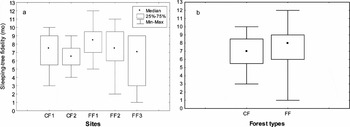
Overall, STF of spider monkeys was highly variable among sites. It ranged from 3 to 10 mo in continuous forest sites, and from 1 to 12 mo in forest fragments, but it did not differ among sites (GLM; χ2 = 5.55, df = 4, P = 0.23; Figure 1a) or between forest types (χ2 = 0.56, df = 1, P = 0.45; Figure 1b).
Sleeping-tree fidelity of Ateles geoffroyi in continuous (CF) and fragmented (FF) forests in the Lacandona region, Mexico. Differences among sites (a) and between forest types (b) are shown.

Association between STF and seed-rain patterns
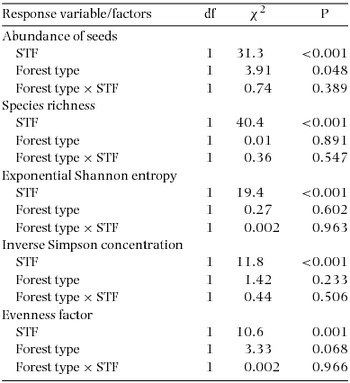
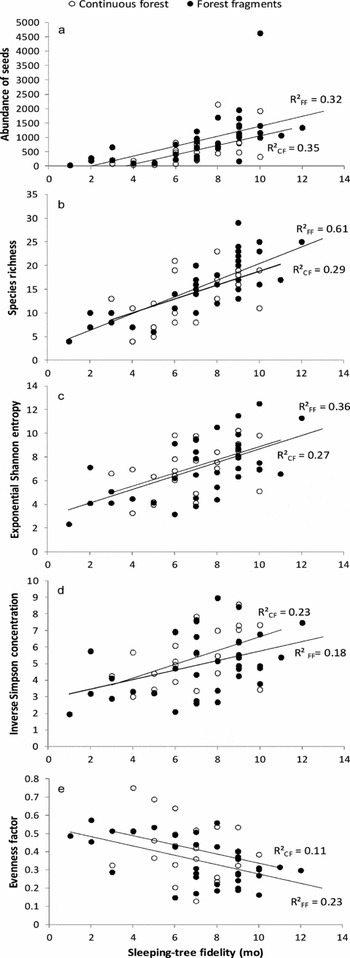
The generalized linear models showed that STF was positively related to all community attributes of the seed rain (Table 1; Figure 2). The interaction in the models (forest type × STF) was not significant, indicating that this positive association was similar in both continuous and fragmented forests (Figure 2).
Effect of sleeping-tree fidelity (STF) of Ateles geoffroyi on five community-level seed-rain patterns produced by this primate below sleeping trees located in two forest types (continuous forest and forest fragments) in the Lacandona rain forest, Mexico. The effect of STF, forest type and the interaction between the two was tested with Generalized Linear Models.

Effects of sleeping-tree fidelity of Ateles geoffroyi on five community-level attributes of seed assemblages in continuous (CF, open dots) and fragmented forests (FF, black dots) in the Lacandona region, Mexico. Abundance of seeds (a), Species richness (b), Exponential Shannon's entropy (c), Inverse Simpson concentration (d) and Evenness factor (e).

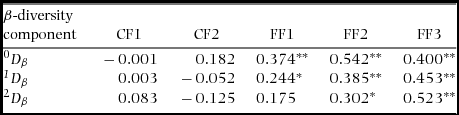
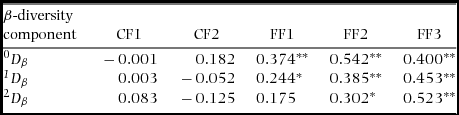
The Mantel tests showed that, in the smallest forest fragments (FF2 and FF3), species turnover of seeds among STs increased with increasing inter-ST differences in STF (Table 2). This association was also significant in FF1, but only when considering β-diversity of order 0 and 1 (i.e. 0Dβ and 1Dβ). Yet, the Mantel tests did not detect a significant correlation between inter-ST differences in STF and β-diversity for all order q (Table 2).
Correlations between species β-diversity of seeds between sleeping trees of Ateles geoffroyi and inter-tree differences in sleeping tree fidelity in two continuous forest sites (CF) and three forest fragments (FF) in the Lacandona rain forest, Mexico. The correlation coefficients were calculated with Mantel tests (*P < 0.05;** P < 0.001, after applying a stringent Bonferroni correction to reduce the likelihood of type I statistical errors). qDβ represents the species turnover between sleeping trees, considering three orders q (0, 1 and 2), which determine the sensitivity of each β-diversity component to the relative abundances.
DISCUSSION
Contrary to our prediction, STF was similar in all study sites and did not differ between continuous and fragmented forests. This was due to the large variation among STs. Although STs were used by spider monkeys on average for 7 out of 13 mo, there was a substantial variation across trees (range = 1–12 mo), which was relatively higher in forest fragments than in continuous forest sites (Figure 1). Previous studies on the spider monkey (Chapman et al. Reference CHAPMAN, CHAPMAN and MCLAUGHLIN1989, Russo & Augspurger Reference RUSSO and AUGSPURGER2004, Russo et al. Reference RUSSO, PORTNOY and AUGSPURGER2006) and other primate species (Brachyteles arachnoides: Bueno et al. Reference BUENO, GUEVARA, RIBEIRO, CULOT, BUFALO and GALETTI2013; Hylobates lar: Reichard Reference REICHARD1998; Gorilla gorilla: Rogers et al. Reference ROGERS, VOYSEY, MCDONALD, PARNELL and TUTIN1998; Lagothrix lagothricha: Stevenson Reference STEVENSON2000) also indicated that the use and re-use of STs can be highly variable, with some trees used for long periods, while others are only used occasionally (Anderson Reference ANDERSON1984, Reference ANDERSON2000; Reichard Reference REICHARD1998, Teichroeb et al. Reference TEICHROEB, HOLMES and SICOTTE2012). In the case of the spider monkey, this pattern results from its temporal and spatial foraging behaviour in different areas with a high concentration of food trees within the home range (Asensio et al. Reference ASENSIO, LUSSEAU, SCHAFFNER and AURELI2012b, Ramos-Fernández et al. Reference RAMOS-FERNÁNDEZ, SMITH AGUILAR, SCHAFFNER, VICK and AURELI2013), and then routinely returning at night to the same or different STs located in proximity to these areas with greater food density (i.e. multiple central-place foraging; sensu Chapman et al. Reference CHAPMAN, CHAPMAN and MCLAUGHLIN1989). This behaviour allows the monkey to monitor the resources for future usage (Asensio et al. Reference ASENSIO, SCHAFFNER and AURELI2012a) and to move back to its STs using route-based mental maps (Di Fiore & Suarez Reference DI FIORE and SUAREZ2007, Ramos-Fernández et al. Reference RAMOS-FERNÁNDEZ, MATEOS, MIRAMONTES, LARRALDE, COCHO and AYALA-OROZCO2004, Suarez et al. Reference SUAREZ, KARRO, KIPER, FARLER, MCELROY, ROGERS, STOCKWELL and TAYLOR2014), thus minimizing travel time (Asensio et al. Reference ASENSIO, LUSSEAU, SCHAFFNER and AURELI2012b, Chapman Reference CHAPMAN1989, Teichroeb et al. Reference TEICHROEB, HOLMES and SICOTTE2012). Yet, during territorial defence (Chapman et al. Reference CHAPMAN, WRANGHAM and CHAPMAN1995, Wallace Reference WALLACE2008), or exploration to monitor feeding sites at a great distance (Di Fiore & Suarez Reference DI FIORE and SUAREZ2007, Ramos-Fernández et al. Reference RAMOS-FERNÁNDEZ, MATEOS, MIRAMONTES, LARRALDE, COCHO and AYALA-OROZCO2004, Valero & Byrne Reference VALERO and BYRNE2007) males of A. geoffroyi can use STs for short periods because they usually do not return to the same ST (Ramos-Fernández et al. Reference RAMOS-FERNÁNDEZ, MATEOS, MIRAMONTES, LARRALDE, COCHO and AYALA-OROZCO2004), possibly explaining the low fidelity found for some STs in our study. Therefore, as reported for other primate species (Heymann Reference HEYMANN1995, Pontes & Soares Reference PONTES and SOARES2005, Reichard Reference REICHARD1998, Sigg & Stolba Reference SIGG and STOLBA1981, Silva Júnior et al. Reference SILVA JÚNIOR, MEIRA-NETO, DA SILVA FLÁVIA, RODRIGUES DE MELO, SANTANA MOREIRA, FERREIRA BARBOSA, DIAS and SILVA PERES2009, Smith et al. Reference SMITH, KNOGGE, HUCK, LÖTTKER, BUCHANAN-SMITH and HEYMANN2007), the high variation in STF in the Lacandona rain forest is most likely related to the spatial and temporal changes in the concentration and distribution of food resources and sex differences in the use of space by the spider monkey.
The relatively higher variation in STF in forest fragments than in continuous forest sites can be related to food scarcity in forest fragments (Arroyo-Rodríguez & Mandujano Reference ARROYO-RODRÍGUEZ and MANDUJANO2006, Chaves et al. Reference CHAVES, STONER and ARROYO-RODRÍGUEZ2012). In particular, fruit availability is known to be lower in forest fragments than in continuous forest because of the combination of both a lower density of large food trees (dbh > 60 cm), which represent larger fruit patches (Chapman et al. Reference CHAPMAN, CHAPMAN, WRANGHAM, HUNT, GEBO and GARDNER1992), and smaller home-range sizes in fragments (Chaves et al. Reference CHAVES, STONER and ARROYO-RODRÍGUEZ2012). Thus, the spatial variation in resource availability is expected to be higher in forest fragments than in continuous forest. As a consequence, in forest fragments, the STs that are located in areas with higher availability of resources would be used relatively more often than in continuous forest sites, whereas the STs that are located in areas with lower availability of resources would be used relatively less intensively than in continuous forest sites. Consistent with this idea, we found that in forest fragments 15 out of 36 STs were used for 9–12 mo and five were only used for 1–3 mo. In continuous forest, however, all STs were used for between 3 and 10 mo (Figure 1).
The lower variation in STF in continuous than in fragmented forest can explain why seed β-diversity between STs did not increase with increasing inter-tree differences in STF in continuous forest sites. It is well known that the lack of variation in explanatory variables (STF in our case) result in weaker associations between explanatory and response variables (species turnover in our case) (Eigenbrod et al. Reference EIGENBROD, HECNAR and FAHRIG2011). As discussed above, the lower variation in STF in continuous forest sites may be associated with higher availability of resources in this sites when compared with the smallest fragments, which in turn can contribute to reduce β-diversity between STs within the continuous forest. In contrast, higher spatial variations in the availability of food resources may contribute to increase the differences in STF in fragments, and also to significant compositional differentiations in seed assemblages between sleeping trees (González-Zamora et al. Reference GONZÁLEZ-ZAMORA, ARROYO-RODRÍGUEZ, ESCOBAR, RÖS, OYAMA, IBARRA-MANRÍQUEZ and STONER2014).
In agreement with our predictions, STF was positively related to the abundance and species diversity of seeds in all sites, indicating that the more often a ST is used, the more seeds from a larger variety of species are deposited under it. Such associations can be explained by the changes in the frugivorous diet along the year (Chaves et al. Reference CHAVES, STONER and ARROYO-RODRÍGUEZ2012, González-Zamora et al. Reference GONZÁLEZ-ZAMORA, ARROYO-RODRÍGUEZ, ESCOBAR, RÖS, OYAMA, IBARRA-MANRÍQUEZ and STONER2014) and by the spatial location of the STs in relation to foraging routes used by spider monkeys (Di Fiore & Suarez Reference DI FIORE and SUAREZ2007, Suarez Reference SUAREZ2003, Suarez et al. Reference SUAREZ, KARRO, KIPER, FARLER, MCELROY, ROGERS, STOCKWELL and TAYLOR2014), resulting in an increase in the abundance and species diversity of seeds. In conclusion, our results suggest that the spatial configuration of seed communities deposited in latrines depends on the specific location of STs in foraging paths (Di Fiore & Suarez Reference DI FIORE and SUAREZ2007), and by the spatial and temporal variation in territory quality (Asensio et al. Reference ASENSIO, SCHAFFNER and AURELI2012a, Reference ASENSIO, LUSSEAU, SCHAFFNER and AURELIb).
STF was negatively related to community evenness in all study sites. As expected, this finding can be related to the fact that the seeds in the latrines below more frequently used STs reflect the common feeding pattern of the species, i.e. there is a high selectivity towards the consumption of a few genera of plants (Chapman Reference CHAPMAN1988, Milton Reference MILTON1980, Russo et al. Reference RUSSO, CAMPBELL, DEW, STEVENSON and SUAREZ2005) and the opportunistic use of a large number of other fruit species (Dew Reference DEW and Campbell2008, González-Zamora et al. Reference GONZÁLEZ-ZAMORA, ARROYO-RODRÍGUEZ, CHAVES, SÁNCHEZ-LÓPEZ, STONER and RIBA-HERNÁNDEZ2009, Link et al. Reference LINK, GALVIS, MARQUEZ, GUERRERO, SOLANO and STEVENSON2012, Nunes Reference NUNES1998, Russo et al. Reference RUSSO, CAMPBELL, DEW, STEVENSON and SUAREZ2005), thus reducing the number of common and dominant species, as well as the seed community evenness.
Conclusions and implications for seed dispersal
Our study demonstrates that STF is a key factor shaping the seed-rain patterns produced by the spider monkey below STs. Therefore, changes in STF (e.g. those associated with logging or habitat fragmentation) could have important implications for seed dispersal and forest regeneration. Of course, this constitutes a very important avenue for future research, as we still do not have data on seed germination, and seedling recruitment and growth in and around spider monkey latrines differing in re-use.
Although we found no differences in STF between continuous and fragmented forests, further studies in highly fragmented landscapes are required to accurately test if STF can be altered in more fragmented landscapes. Deforestation in the study region is moderate (c. 40% of remaining forest cover), and forest remnants still maintain most of their original vegetation composition and structure (Hernández-Ruedas et al. Reference HERNÁNDEZ-RUEDAS, ARROYO-RODRÍGUEZ, MEAVE, MARTÍNEZ-RAMOS, IBARRA-MANRÍQUEZ, MARTÍNEZ, JAMANGAPE, MELO and SANTOS2014), which may contributed to the apparent lack of differences in STF between forest types.
If STF is higher in fragmented forests, our results indicate that the effectiveness of the spider monkey as a seed disperser (sensu Schupp Reference SCHUPP1993) would change as a result of the increased aggregation of seeds in latrines found in our study. Nevertheless, this will depend on the impact that such an increase in seed/seedling aggregation has on seed germination and seedling recruitment. We can anticipate two alternative scenarios. First, because we found that STF is negatively related to community evenness, higher STF would result in a seed rain dominated by a few seed species. Thus, based on the Janzen–Connell model (Connell Reference CONNELL, den Boer and Gradwell1971, Janzen Reference JANZEN1970), we would expect higher seed predation (e.g. by rodents, insects, and/or pathogens) toward the most dominant species, which could reduce predation pressure on less abundant species allowing the recruitment of rare species in latrines that are more frequently used. Second, an alternative scenario suggests that the low rate of seed arrival in STs less frequently used may allow seeds to avoid the presence of biotic mortality agents, offsetting the lower seed/seedling survival that is expected in such conditions (Bravo Reference BRAVO2012, Russo & Augspurger Reference RUSSO and AUGSPURGER2004). Since the seed community structure and composition can be decisive for the initial stages of recruitment (Russo & Augspurger Reference RUSSO and AUGSPURGER2004, Schupp et al. Reference SCHUPP, JORDANO and GÓMEZ2010, Wang & Smith Reference WANG and SMITH2002), our results call for further studies to assess the persistence of seeds and recruitment of seedlings under different levels of evenness in the seed bank of latrines and to determine which of these two scenarios occurs with increasing STF.
ACKNOWLEDGEMENTS
We are grateful to Sabrina Russo and two anonymous reviewers for the constructive comments on an earlier version of this manuscript. This research was funded by the Consejo Nacional de Ciencia y Tecnología, CONACyT grants (CB-2005-51043 and CB-2006-56799) and the Dirección General de Asuntos del Personal Académico, DGAPA, Universidad Nacional Autónoma de México, UNAM (project IA-203111). AGZ thanks the scholarship (Apoyos Complementarios para la Consolidación Institucional de Grupos de Investigación) provided by CONACyT. KS thanks the UC MEXUS project. We thank Rafael Lombera and Ana M. González-Di Pierro for their invaluable help in the field. The Instituto de Investigaciones Biológicas, UV, and Instituto de Investigaciones en Ecosistemas y Sustentabilidad, UNAM, provided logistical support. This study would not have been possible without the collaboration of Natura y Ecosistemas Mexicanos A.C. and the local people in Chajul, Reforma Agraria and Zamora Pico de Oro ejidos. We are grateful to M. Lobato, H. Ferreira, A. Valencia and A. Lopez for technical support and to G. Ibarra-Manriquez for help with seed identification.