Introduction
Italy presents a very complex linguistic situation. Alongside the national language, Italian, a number of dialects are spoken throughout the peninsula. In the conventions of Italian research, the label dialect applies not to geographical or social varieties of the national language, but rather to independent language systems (see Maiden & Parry Reference Maiden and Parry1997); hence, the “dialects of Italy” (i.e. the dialects spoken within the political borders of Italy) are not varieties of Italian, but languages separate from Italian. According to Pellegrini's (Reference Pellegrini1977) map, the dialects of Italy may be divided into two broad categories: Italo-Romance dialects and the so-called minority languages (“historical linguistic minorities” in Iannàccaro & Dell'Aquila Reference Iannàccaro and Vittorio2011). While Italo-Romance dialects are sister dialects of Italian, that is, they evolved in parallel with the Florentine dialect from which Standard Italian developed (as of the fourteenth century), most minority languages do not belong to the same Italo-Romance branch as Italian and its sister dialects, and some of them are not Romance languages at all (e.g. Albanian, Croatian, and Germanic). The distinction between Italo-Romance dialects and minority languages, however, is less straightforward than it would appear, since some Italo-Romance dialects (e.g. Friulian and Sardinian) are also traditionally considered minority languages (see for instance Marcato Reference Marcato2007:176–78). For the sake of simplicity, we use the label “minority language” here only to refer to those varieties recognised as such by the Italian State (Norms in defence of historical linguistic minorities, Law 482, approved on December 15, 1999).
At the time of Italian Unification (1861), less than 10% of the Italian population could speak the national language; 150 years later, according to the most recent ISTAT survey (2006), the linguistic picture has changed dramatically, as only 16% of the population declared that they spoke exclusively or primarily in dialect with family members (13.2% when talking to friends, 5.4% when talking to strangers). The spread of Italian and the parallel decline of dialects led to the emergence of regional varieties of Italian, which resulted from the geographical differentiation of Italian after its social diffusion (see Cerruti Reference Cerruti2011); the awareness that most Italian dialects are in fact endangered languages has also led, in recent years, to a host of standardization proposals (see for instance Coluzzi Reference Coluzzi2007; Regis Reference Regis2012a).
Piedmont, a northwestern region of Italy, shows all the complexities of the Italian context. Alongside (a regional variety of) Italian, various dialects are traditionally present in the area:
(i) Italo-Romance dialects: Piedmontese and, in bordering areas, Lombard, Ligurian, and Emilian;
(ii) Gallo-Romance dialects: Occitan and Franco-Provençal;
(iii) Alemannic (Germanic) dialects: Walser.
This article addresses issues related to the standardization processes at work in three languages spoken in Piedmont—Italian, Piedmontese, and Occitan—specifically within the framework of dialect/standard convergence.
Regional Standards and Restandardization in Italian
In the process of vertical convergence—more precisely, advergence (Mattheier Reference Mattheier1996:34)—from Italo-Romance dialects towards Italian, regional varieties of Italian have stabilized and standard regional varieties have emerged.
Occurrences of dialect features in Italian can be found from as early as the sixteenth century, but they became increasingly more frequent starting from Italian Unification. After a probable phase of idiosyncratic and/or unsystematic transfers, the conventionalization of certain interference features—in various areas depending on the different substrata—gave rise to the stabilization of different regional varieties of Italian. At that stage of the process, datable to the period between the two World Wars (cf. De Mauro Reference De Mauro1970:143–44), the vertical convergence between Italo-Romance dialects and Italian thus resulted in the divergence of regional varieties of Italian both from one another and from standard Italian; hence, the amount of variation within the repertoire increased (as normally happens at the beginning of an asymmetrical relationship between converging languages and a converged-to language; see for instance Røyneland Reference Røyneland, Auer and Schmidt2010).Footnote 1
In recent years, we have instead witnessed some dynamics of horizontal convergence among regional varieties of Italian. The amount of variability along the geographic dimension is generally decreasing. On the one hand, regionally marked nonstandard features tend to become noticeably less frequent, while on the other, especially among the younger generations, there is a tendency for regional varieties to include some features coming from other regional varieties (see Berruto Reference Berruto2012:57–60).
Auer & Hinskens (Reference Auer and Hinskens1996) propose three different scenarios for the process of vertical and horizontal convergence, with particular reference to the European dialect/standard constellations. With respect to these scenarios, which can be seen as three developmental stages, the “language space” (in the sense of Berruto Reference Berruto, Auer and Schmidt2010) of contemporary Italian can be said to pertain grosso modo to the second one:Footnote 2 after a phase of increasing intralinguistic variation, “more or less clearly demarcated intermediate varieties have emerged,” which are “characterized linguistically by a certain amount of rigidity of the co-occurrence restrictions holding among the typical features of each variety in the repertoire” (Auer & Hinskens Reference Auer and Hinskens1996:6).
Moreover, as mentioned above, there have emerged standard regional varieties, that is, varieties of Italian which, in spite of their geographic markedness, are commonly mastered both by more educated and less educated speakers and constitute accepted norms, coexisting with the standard national one. The emergence of standard regional varieties of Italian was already noticed in the mid-1980s (see Berruto Reference Berruto1987:19). It can be said that the latter half of the twentieth century witnessed a crucial step in the transition from a more “focused” set of norms to a more “diffused” one (in the sense of Le Page & Tabouret Keller Reference Le Page and Tabouret-Keller1985; cf. the concept of “standardization cycle” in Ferguson Reference Ferguson and Lowenberg1988; Greenberg Reference Greenberg, Fishman, Tabouret-Keller, Clyne, Krishnamurti and Abdulaziz1986).
The emergence of standard regional varieties must be placed in a more general context. Contemporary Italian is undergoing a restandardization process, which is caused by the mutual interrelation between spoken and written language; it consists both in the progressive acceptance of nonstandard spoken informal features into the standard variety and in the reduction of social markedness of traditionally nonstandard, socially marked Italian features, some of which now also occur in the spoken varieties of educated speakers. A process of “downward convergence” (see Auer & Hinskens Reference Auer and Hinskens1996; Røyneland Reference Røyneland, Auer and Schmidt2010; cf. the notion of Demotisierung ‘demotization,’ introduced by Mattheier Reference Mattheier, Mattheier and Radtke1997 and recently discussed by Auer & Spiekermann Reference Auer, Spiekermann, Kristiansen and Coupland2011) of the standard variety towards spoken informal varieties and “low” social varieties is now taking place. Such a restandardization process has led to an emerging new standard variety, which has been termed neo-standard Italian (Berruto Reference Berruto1987).
What relationship exists between regional standards and neo-standard Italian? Neo-standard Italian is made up both of linguistic features shared by the whole country (see above) and linguistic features that characterize different standard regional varieties. Similar dynamics are quite frequent in contemporary Europe, where diaglossia (Auer Reference Auer, Delbecque, van derAuwera and Geeraerts2005; cf. Bellmann Reference Bellmann1997; dilalia in Berruto Reference Berruto and Ammon1989)Footnote 3 seems to represent the most widespread type of linguistic repertoire; indeed, in a diaglossic repertoire, “the standard variety may … increasingly tolerate regional features” (Auer Reference Auer, Delbecque, van derAuwera and Geeraerts2005:25).
Following Deumert & Vandenbussche (Reference Deumert, Vandenbussche, Deumert and Vandenbussche2003a:4–5), we may argue that the standardization of Italian is changing over from a monocentric selection of features (“the selection of an existing (or also archaic) … dialectFootnote 4 as the basis of the emerging standard language;” Deumert & Vandenbussche Reference Deumert, Vandenbussche, Deumert and Vandenbussche2003a:4) to a relatively polycentric one (“most standard languages are composite varieties which … include features from several dialects;” Deumert & Vandenbussche Reference Deumert, Vandenbussche, Deumert and Vandenbussche2003a:5),Footnote 5 a tendency which seems to be rather common throughout Europe (cf. Auer Reference Auer, Kortmann and van der Auwera2011).
In this respect, it is also worth considering the case of Swiss Italian, which actually displays a national standard variety different in some details from the one written and spoken in Italy; it is a standard variety exhibiting a number of peculiar (mainly lexical) features and undergoing its own evolution, due both to contact with the other Swiss national languages and to the political and administrative organization of the state body. (It has thus been suggested that Italian may be considered as a partially pluricentric language;Footnote 6 see Berruto Reference Berruto, Overbeck, Schweickard and Volker2011). Therefore, different sets of norms do exist simultaneously both at the supra-regional and at the supra-national level.
In the following section we address the issue of the relationship between neo-standard Italian and regional standards from a single vantage point represented by the standard variety of Piedmontese Italian spoken (and written) in Turin, a variety that displays its own peculiarities at different levels of the language system. The relationship between neo-standard Italian and regional standards is dealt with here at the morphosyntactic level.
Dynamics of Convergence
We can begin by examining the results of a recent study on Piedmontese Italian carried out in Turin (Cerruti Reference Cerruti2009, to which we refer the reader for its methodological aspects). This investigation has revealed that a set of morphosyntactic features of Piedmontese Italian—each having a counterpart in Piedmontese dialect—has turned out to be attested without any apparent social markedness, both among younger and older speakers, as well as among more educated and less educated speakers. Subsequent research has shown that this set of features currently appears not only in casual speech but also in rather formal situations, even in written contexts; Cerruti (Reference Cerruti2012), for instance, reports some occurrences of these features found in La Stampa, a national daily newspaper edited and published in Turin.Footnote 7 We can therefore maintain that this set of features constitutes the standard variety of Piedmontese Italian (henceforth SPI) as it is observable in Turin.
A distinguishing characteristic of this set is that its features reflect restandardization tendencies ongoing in neo-standard Italian. Below are examples of three such features.
(1) lei vede solo lei in concorso
‘she sees only herself [lit. her] in competition’
(2) abituandomi loro a parlare italiano, il dialetto non lo parlo praticamente mai
‘since they have got me used [lit. using me] to speaking Italian, I almost never speak dialect’
(3) il nuoto almeno una volta su tre stia sicuro che è lì che lo salta
‘you can be sure that at least one time out of three he is skipping [lit. he is there that he skips] the swimming lesson’
As for (1), Italian is undergoing processes of simplification affecting the set of personal pronouns; one of these concerns reflexive pronouns, which tend to be replaced by nonreflexive pronouns conveying a reflexive meaning (lui/lei/loro instead of sé ‘himself, herself, themselves’). The tendency is currently occurring both in neo-standard and in various regional standards, including SPI. Notwithstanding, the tendency can display different distributional restrictions depending on the standard variety in question. Recent descriptions state, for instance, that it does not usually affect a reflexive pronoun with the function of a direct object (see Cordin Reference Cordin and Renzi2001:610–11); in SPI, instead, the same tendency seems to affect even a direct-object reflexive pronoun, as in (1), demonstrating a more generalized distribution. Hence the tendency seems to be at a more advanced stage in SPI than in other regional standards.
Something very similar can be said for (2). Processes of simplification of the verbal system through the reduction of tenses and moods are currently under way in Italian. In particular, there is a tendency to avoid the compound gerund and to replace it with the simple gerund. The latter tends instead to be used with a growing range of senses, among which anteriority and causation (both of which are traditionally prerogatives of the compound gerund). This tendency is taking place in neo-standard Italian (recent grammars take it into account; see Salvi & Vanelli Reference Salvi and Vanelli2004:245–46), as well as in various regional standards, although with distributional differences. In SPI, for instance, the simple gerund can be used with a sense that cumulates both anteriority and causation, as in (2), which is not a nationwide characteristic (cf. Golovko Reference Golovko2012:133).
As for (3), the use of the progressive periphrasis stare + gerund is undergoing a restandardization process in contemporary Italian, consisting in its increased acceptance both in progressive and in habitual contexts; this tendency mirrors the stages of grammaticalization reached by such periphrasis, which in various regional varieties is evolving from a progressive construction to a purely imperfective form. The SPI progressive periphrasis essere lì che + verb is undertaking the same grammaticalization path as stare + gerund and seems to have attained an even more advanced stage, essere lì che + verb being more compatible with a habitual reading (see e.g. utterance (3)) than stare + gerund. Essere lì che + verb can occur in habitual contexts even in rather formal situations (see again utterance (3), which encompasses a V-form: stia).
These few examples alone may suffice to show how the same tendencies work in both neo-standard Italian and SPI (as well as in other regional standards), although with possible distributional differences. Moreover, such tendencies are often widely shared by European languages (cf. Bertinetto, Ebert, & de Groot Reference Bertinetto, Ebert, de Groot and Dahl2000 regarding the imperfective “drift” of European progressive periphrasis).
By contrast, linguistic features which are not consistent with restandardization tendencies are considered to belong to the so-called italiano popolare (‘popular Italian’ in Lepschy Reference Lepschy2002), that is, the social variety of Italian mastered by less educated speakers, most of whom were previously almost monolingual dialect speakers. Every regional variety of Italian has its “popular” variety, comprising both nationwide shared features as well as region-specific “popular” ones. Particular features of italiano popolare appear to be resistant to absorption into neo-standard Italian (cf. Berruto Reference Berruto, Piparo and Ruffino2005a). A case in point is the doubly filled complementizer, shown in (4), which is widely attested in many “popular” regional varieties of Italian.
(4) quando che dice “mi sono divertita”
‘when [lit. when that] she says “I had fun”’
This example violates the so-called doubly filled comp filter, which excludes the co-occurrence of a wh-phrase and a complementizer in a Comp position, a restriction that is operative in (neo-)standard Italian but not in many Italo-Romance dialects, including Piedmontese.
To return to SPI, this standard variety displays another peculiar characteristic in that some of its features fill structural gaps in the inventory of standard Italian; that is, they express meanings for which there are no grammaticalized constructions in standard Italian. An example can be found in the focus adverbial solo più, lit. ‘only more,’ for example, ci sono solo più due libri ‘there are only two books left,’ a feature of SPI that has its counterpart in Piedmontese dialect (mach pì, lit. ‘only more’) and does not match any single construction in standard Italian. Solo più occurs both among “common” people and among professional speakers and writers; moreover, it is not restricted to Piedmont-born speakers. The following examples are taken from La Repubblica, Italy's second largest circulation daily newspaper (edited and published in Rome).
(5) Clinton ha solo più dieci giorni di tempo (Ennio Caretto, born in Turin, Piedmont)
‘Clinton has only ten more days’
(6) a questo punto è solo più lavoro di routine (Alvise Sapori, born in Rome, Lazio)
‘at this point, there is only routine work left to do’
A regional standard can of course include forms that in actual fact do not occur in other regional varieties. In SPI, for example, the adverb già ‘already’ can be used in interrogative contexts as a pragmatic marker, signalling that the speaker is asking for the repetition of information that he knew but cannot retrieve at the time of speaking, as in example (7) from La Stampa (reported in Fedriani & Miola Reference Fedriani, Miola, Molinelli and Ghezzi2014).
(7) «Scusa Laura», chiede alla moglie, «come si chiamava già quel pittore famoso…?» (Bruno Gambarotta, born in Asti, Piedmont)
‘“Sorry Laura,” he asks his wife, “what was the name of that famous painter again?”’
Here we are dealing with a pragmaticalized use of già, which affects the counterparts of this adverb in different languages (such as again in English, as shown in the translation of (7) or déjà in French, e.g. quel était son nom, dejà?) but does not occur in regional varieties of Italian apart from Piedmontese (cf. Squartini Reference Squartini2011).
As is often the case with features of a given (standard) regional variety of Italian, speakers of Piedmontese Italian are not aware of the regional markedness of this pragmaticalized use of già. Fedriani & Miola (Reference Fedriani, Miola, Molinelli and Ghezzi2014) report the following example.
(8) «Ehi, mani di fata!» Siccome non rispondeva chiese ad Adam: «Come si chiama già?» (Giovanni Del Ponte, Acqua tagliente, Ch. 9)Footnote 8
‘“Hey, Light–Touch!” Since he didn't answer, he asked Adam: “What's his name again?”’
This example is taken from the preprint version of a sample chapter of a novel written by Giovanni Del Ponte, a Turin-born writer. What is relevant here is that this use of già was edited out of the novel prior to its distribution on a national scale, thus constituting evidence for the fact that it is not a feature shared nationwide. Nevertheless, it should be added that in different (standard) regional varieties of Italian other adverbs display the same pragmaticalized use of SPI già; such is the case with più in Ligurian Italian and pure in Emilian Italian (cf. Fedriani & Miola Reference Fedriani, Miola, Molinelli and Ghezzi2014). The fact that different forms convey the same specific pragmatic meaning, for which there are no grammaticalized constructions in standard Italian, can be deemed a further case of convergence between different (standard) regional varieties of Italian.
The language space of Italian in a diaglossic repertoire: A proposed model
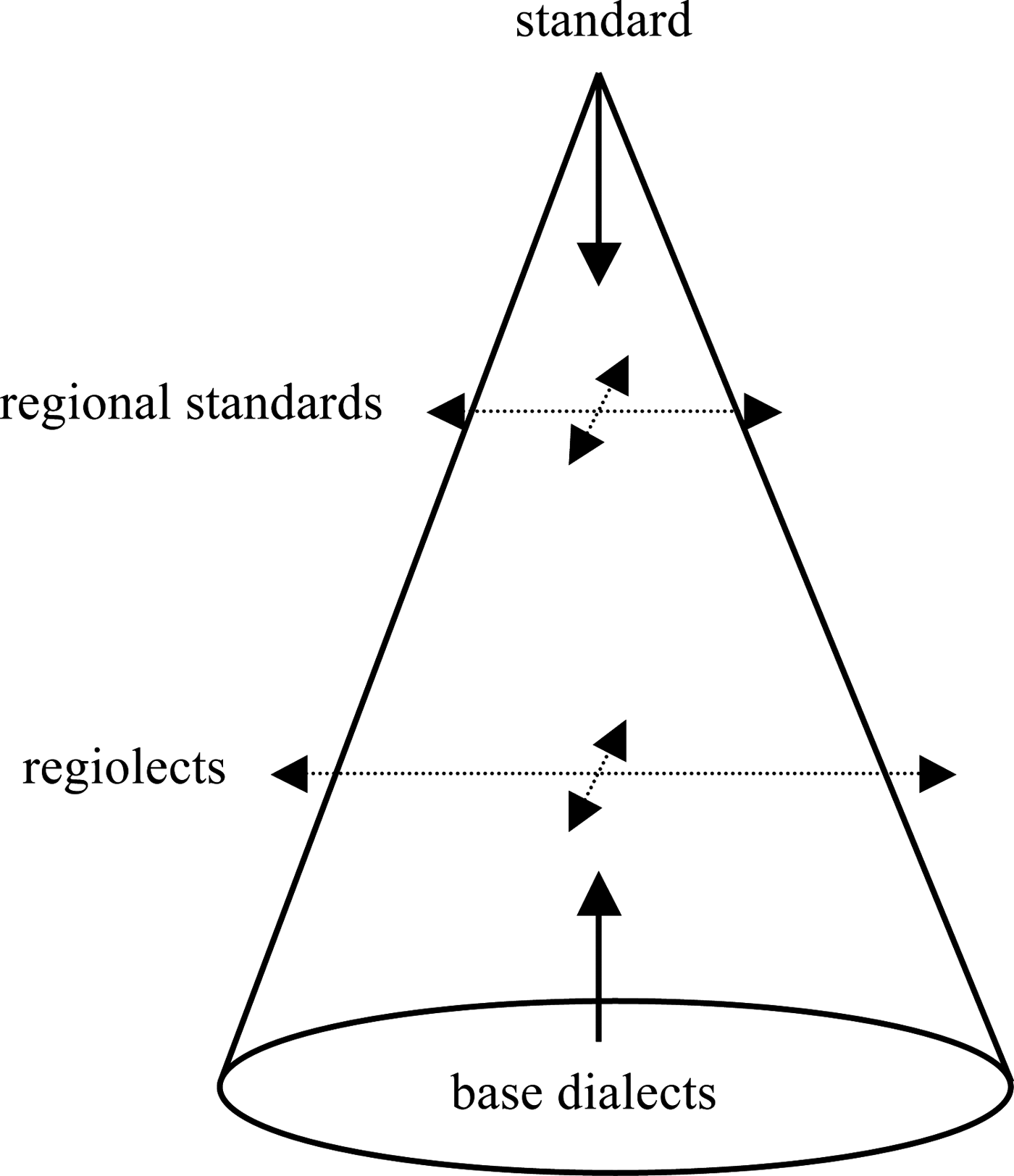
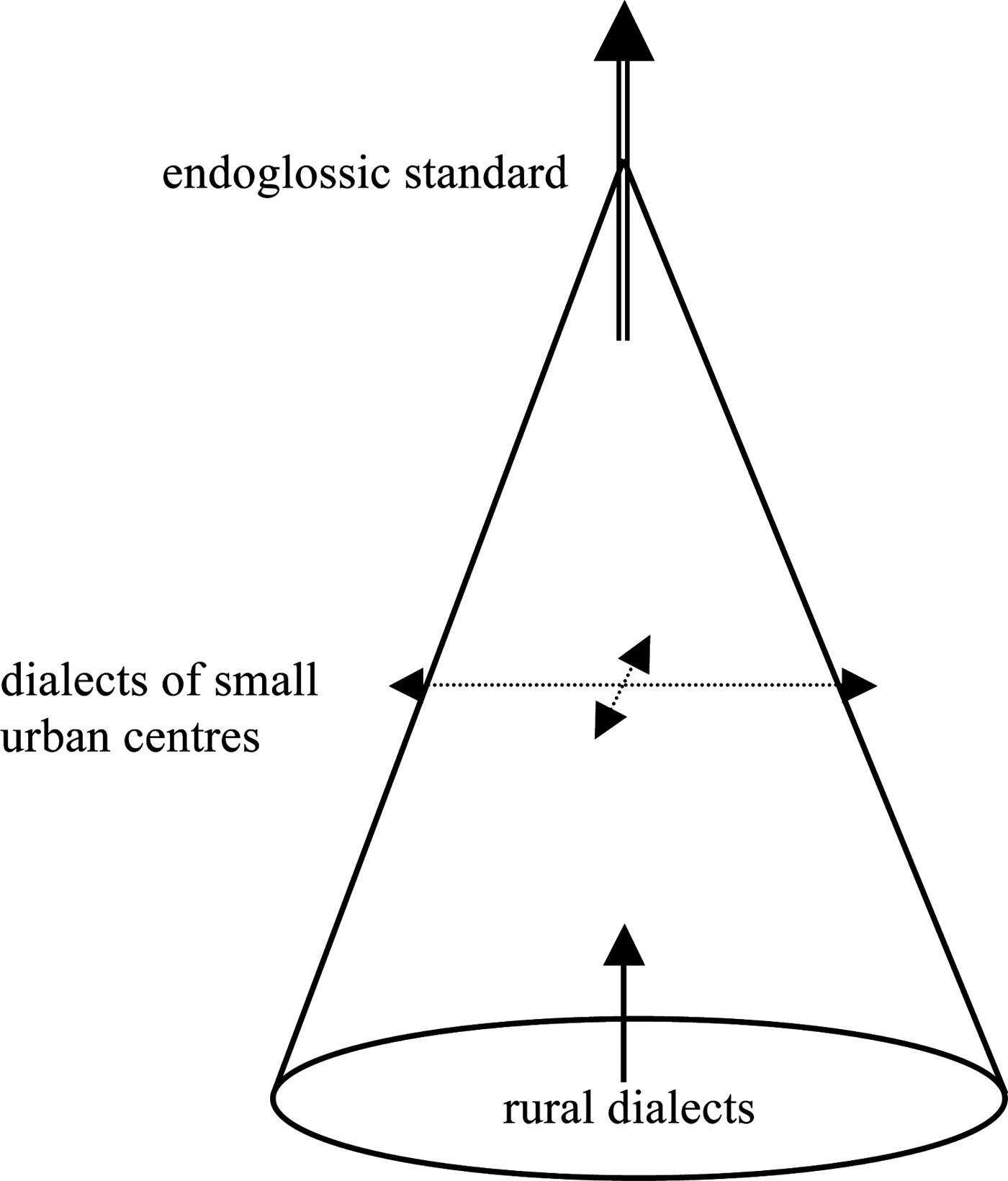
Thus far, we have examined some dynamics that characterise the language space of Italian with respect to the dialect-standard dimension. As mentioned above (see Regional standards and restandardization in Italian), similar dynamics characterize diaglossia, the type of linguistic repertoire that seems to be the most widespread in Europe, Type C in Auer (Reference Auer, Delbecque, van derAuwera and Geeraerts2005, Reference Auer, Kortmann and van der Auwera2011), as shown in Figure 1.
Diaglossia, Type C (Auer Reference Auer, Delbecque, van derAuwera and Geeraerts2005, Reference Auer, Kortmann and van der Auwera2011).

Consistent with Coseriu (Reference Coseriu, Göschel, Ivić and Kehr1980), the model depicts dialect “as a purely relational concept” (Auer Reference Auer, Delbecque, van derAuwera and Geeraerts2005:2), generically referring to a language variety that has less geographical reach than the standard variety; according to the Coserian conception, the term “dialect” covers not only primary dialects (that is, coeval geographical varieties of the dialect from which the standard language derives, for example, Italo-Romance dialects), but also secondary and tertiary dialects (the latter resulting from the geographical differentiation of the standard language after its social diffusion, e.g. regional varieties of Italian). By contrast, the term “base dialects” (“traditional dialects” in Auer Reference Auer, Kortmann and van der Auwera2011:491) denotes “the most ancient, rural, conservative dialects” (Auer Reference Auer, Delbecque, van derAuwera and Geeraerts2005:2).
In a diaglossic repertoire, dialect-to-standard advergence leads to the formation of intermediate varieties between the dialects (in particular, the base dialects) and the standard variety; these intermediate varieties are referred to by the term regiolects. The language space between the base dialects and the standard can be depicted as a continuum, or to be more precise, a Kontinuum mit Verdichtungen. Footnote 9 Finally, the standard variety tends to adopt linguistic features of the regiolects, resulting in the emergence of regional standards. “The convergence of dialects towards the standard language sometimes has as its corollary the convergence of the standard variety towards the dialects” (Auer & Hinskens Reference Auer and Hinskens1996:12; see also Deumert & Vandenbussche Reference Deumert, Vandenbussche, Deumert and Vandenbussche2003b:458–59; van Marle Reference van Marle, Cheshire and Stein1997:14–20).
The model allows one to detect common dynamics in the European dialect-standard constellations despite their vast heterogeneity. Given the broad outline of the model, though, attempts have been made to better adapt it to specific sociolinguistic situations (see for instance Nilsson & Svahn (Reference Nilsson and Svahn2009), in relation to West Sweden; Golovko (Reference Golovko2012), with respect to Salento, and more generally to Italy). In a similar fashion, we too have chosen to make some adjustments to the model.
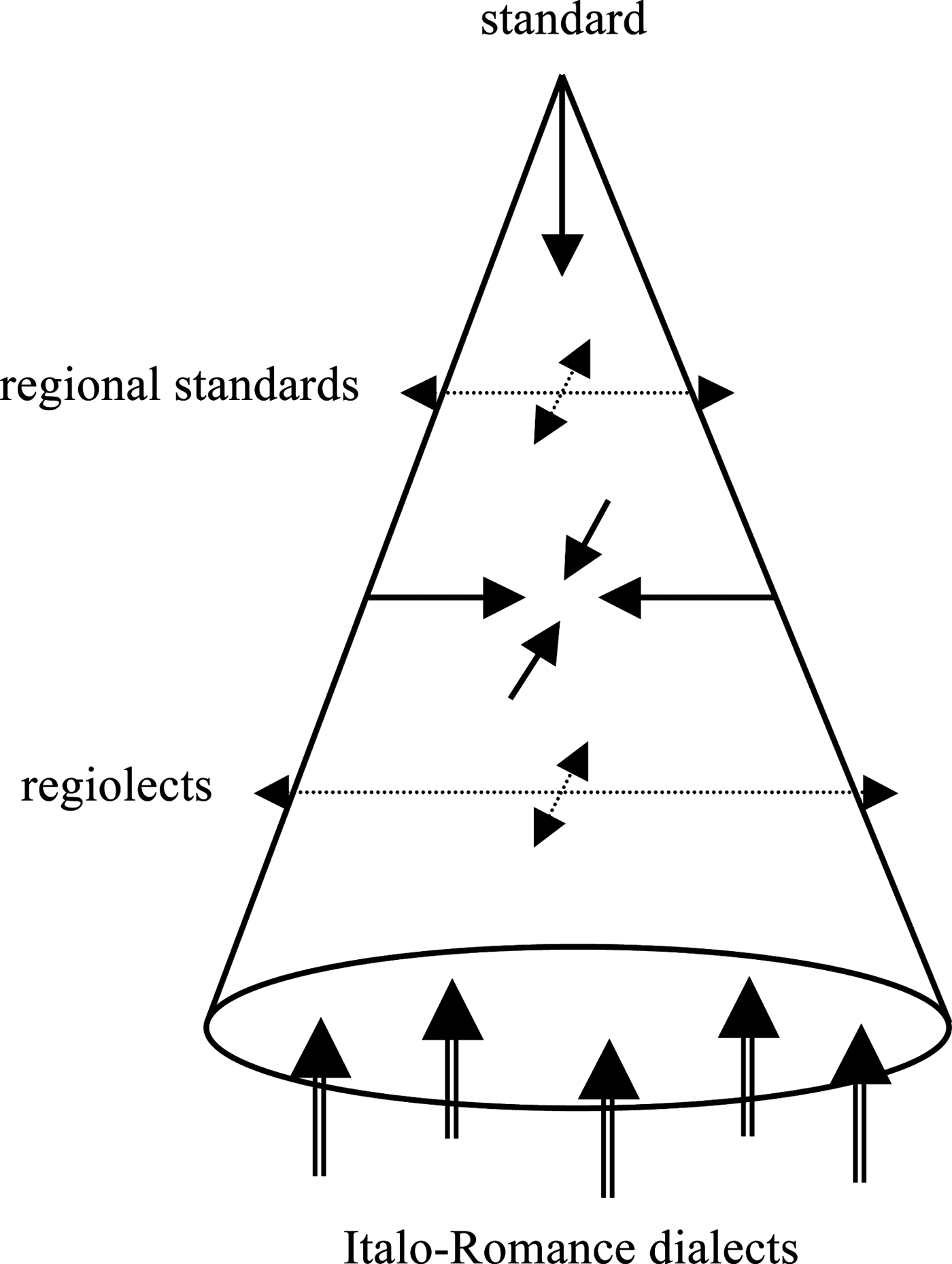
As mentioned above in the introduction, Italo-Romance dialects are not varieties of Italian; Italo-Romance dialects and Italian are separate linguistic systems. The continuum of intermediate varieties between the base dialects and the standard is actually composed of two separate (sub)continua: the dialect continuum and the Italian continuum, each displaying intermediate varieties. For example, in the dialect continuum we can single out the so-called dialetto italianizzato ‘Italianized dialect,’ resulting from a long-term process of “Italianization of the dialects” (see Berruto Reference Berruto, Holtus, Kramer and Schweickard1997; Sobrero Reference Sobrero, Maiden and Parry1997), while in the Italian continuum, we recall the case of italiano popolare, resulting from a process of “dialectization of (varieties of) Italian” (Berruto Reference Berruto, Auer, Hinskens and Kerswill2005b:83). It is rare for intermediate varieties not to be ascribable to either the Italian continuum or to the dialect continuum. The linguistic boundary that exists between these two (sub)continua is a boundary between two different linguistic systems; therefore, in our opinion, these different languages should be dealt with separately. The diagram of the model would hence require two different cones, one depicting the language space of the dialect (in the sense of the Coserian “primary dialect”) and the other the language space of Italian.
Moreover, in light of the foregoing, we suggest distinguishing between intralinguistic (i.e. within the Italian or Piedmontese continuum) and interlinguistic (between the Italian and Piedmontese continua) convergence, the former taking place at the level of the Architektur der Sprache ‘architecture of the language,’ in the Coserian sense), and the latter at the level of the linguistic repertoire. Intralinguistic convergence basically consists in a change of the sociolinguistic markedness of a given (set of) linguistic feature(s) or, in other words, in a transfer of features from the grammar of one language variety to another. Broadly, we may speak of intralinguistic downward convergence when previously nonstandard features tend to be included into the standard variety, that is, when the standard variety converges towards nonstandard varieties. Instead, intralinguistic upward convergence occurs when non–standard varieties tend to adopt linguistic features of the standard variety, that is, when nonstandard varieties converge towards the standard variety. As for interlinguistic convergence, if we focus on languages within the same linguistic repertoire we may speak of interlinguistic downward convergence when the H-language converges towards the L-language, while interlinguistic upward convergence is at work when the L-language converges towards the H-language. Therefore, to better suit the model to Italo-Romance, we suggest various adjustments to the diagram, as shown in Figure 2 below.
The Italian continuum.
The cone in Figure 2 only represents the language space of the Italian continuum.Footnote 10 Nonstandard varieties are located in the lower part of the cone, while the standard variety occupies the tip of the cone. The upper part of the cone also contains neo-standard Italian, which tends to include features of both the national and regional standards. The downward arrow in the upper part symbolizes the intralinguistic downward convergence of the standard variety towards nonstandard varieties, the foremost dynamic in the restandardization process affecting contemporary Italian (cf. Regional standards and restandardization in Italian). The horizontal (rightward and leftward) continuous arrows signal that the dynamics of horizontal convergence between regional varieties of Italian are under way (cf. Dynamics of convergence). Finally, the upward double arrows in the lower part of the cone, which cross the boundary of the Italian continuum, represent the interlinguistic upward convergence of the dialects towards Italian, a convergence resulting both in the “Italianization of the dialects,” on the dialect side, and in the “dialectization of Italian,” on the Italian side.
Lastly, it is worth recalling that the dynamics represented by the model and the linguistic features involved concern the dialect-standard dimension. The model singles out diatopia among the three main synchronic dimensions of variation and deals with dynamics affecting geographically marked features—hence typically resulting from substratum influence—which vary in their sensitivity to social and style variation. This entails that linguistic features that are sensitive to social and style variation but neutral with respect to the dialect-standard dimension are omitted;Footnote 11 moreover, the relationship between the degree of substratum influence and the degree of nonstandardness could be argued to be directly proportional.
As for the Italian continuum, it must be said that: (i) although the amount of variation along the geographic dimension is decreasing (cf. introduction), diatopia is still considered the primary dimension of variation (see e.g. the bibliography in Cerruti Reference Cerruti2011); especially at certain levels of the language system (phonetics, phonology, and prosody), a minority of linguistic features is actually geographically unmarked; (ii) substratum features are scarcely subject to the pressure of normative prescriptivism (once again, especially in phonetics and phonology), and nonstandard varieties (italiano popolare, in particular) are definitely the ones most directly and heavily affected by substratum influence.
Standardization of dialects
Dialects in Piedmont: An overview
When we draw our attention to dialects, an outline of their current sociolinguistic status is needed.
The use of dialects in Piedmont is below the Italian average. According to ISTAT data (2006), 9.8% of the population living in Piedmont claim they use a dialect when speaking with family members; these percentages reduce further to 5.6 and 1.4 when talking to friends and talking to strangers. Unfortunately, ISTAT does not offer separate figures for different dialects; thus, as far as Piedmont is concerned, “dialect” has to be understood as a macro-category covering Piedmontese, Occitan, Franco-Provençal, and Walser, as well as immigrant varieties (e.g. Apulian, Sicilian, and Sardinian). At any rate, it comes as no surprise that, referring to the UNESCO (2003) parameters, Berruto (Reference Berruto, Raimondi and Revelli2007b:139) assigns to Piedmontese a vitality score of 2.4/2.8 (considering that 5 = safe, 4 = unsafe, 3 = definitely endangered, 2 = severely endangered, 1 = critically endangered, 0 = extinct); Piedmontese thus lies halfway between a definitely endangered language and a severely endangered one. The number of active Piedmontese speakers has recently been calculated at 700,000 units (Regis Reference Regis2012a:94). Occitan shows a vitality score comparable to that of Piedmontese (ca. 2.4), while the number of speakers amounts to 45,000 units according to Berruto (Reference Berruto and Gregory2009:341), and to less than 40,000 units according to Regis (Reference Regis and Simone2010:1181). Moseley's (Reference Moseley2010) ratings are consistent with the above-mentioned ratings (both Piedmontese and Occitan are considered “definitely endangered” languages), whereas the number of speakers provided by the Atlas turns out to be too large (two-million speakers for Piedmontese and 200,000 speakers for Alpine Occitan, spanning France and Italy; Salminen (Reference Salminen and Brenzinger2007) estimates that 100,000 Occitan speakers live in Italian territory).
Piedmontese
The term “Piedmontese” is used here to refer to a cluster of dialect varieties spoken in the central part of the Region; among them, during the eighteenth century, Turinese (i.e. the dialect of the main centre of Piedmont, Turin) began to count as a reference dialect for the surrounding varieties. It is in fact worth recalling that in 1563 Turin became capital of the Duchy of Savoy, and in 1720, capital of the Kingdom of Sardinia; it is thus not surprising that the prestige of Turin as a political, administrative, and cultural centre would soon be attached to its dialect. As a result, both dialects of smaller urban centres and rural dialects ended up being more similar to Turinese (intralinguistic upward convergence). To outline this process, we may firstly mention the diffusion of the fourth person ending -oma ['uma] (present indicative tense) (It. -iamo), which spread from Turin to other varieties of Piedmontese; the dialect of Mondovì, a small town situated eighty kilometers to the south of Turin, changed its original verbal ending –mà (such verbal forms as portmà [port'ma] ‘we bring’ and tenmà [ten'ma] ‘we keep’ were still attested in the mid-nineteenth century) to -oma (portoma [pur'tuma] and tenoma [te'numa] respectively, just as in Turinese). Another interesting fact is the disappearance of palatalized plurals in the varieties spoken in small urban centres: such plural forms as tucc ([tytʃ]; sing. tut [tyt]) ‘all’ and tancc ([tantʃ]; sing. tant [tant]) ‘many,’ well attested in the urban dialects of Asti, Mondovì, and Vercelli from the eighteenth to the early twentieth centuries, have mostly been replaced by Turinese forms (tuti ['tyti] and tanti ['tanti] respectively).
Due to its prestige, an already existing dialect (in this case, the one spoken in Turin) was then chosen by Piedmontese speakers as a leading variety (and, when needed, as a lingua franca); it is a well-known sociolinguistic pattern, which involves a high variety (Turinese) and a series of low varieties (both dialects of small urban centres and rural dialects), the latter being variously influenced by the former. The influence of Turinese first reached the dialects of small urban centres, the rural dialects second, so that the dialects of small urban centres seem to have played, in most cases, a sort of mediating role between Turinese and the rural dialects. Although many Italian scholars speak of a “Piedmontese regional koine,” it is clear that in past centuries no koine formation actually took place in Piedmont, if we keep in mind Siegel's (Reference Siegel, Smith and Veenstra2001:175) classic definition:
A koine is a stabilized contact variety which results from the mixing and subsequent levelling of features of varieties which are similar enough to be mutually intelligible, such as regional or social dialects. This occurs in the context of increased interaction or integration among speakers of these varieties.
A better label for describing the relationship between Turinese and the other varieties of Piedmontese seems to be that of “feature diffusion.” As the results of koine formation and feature diffusion are often similar (although differing in onset times: see Kerswill Reference Kerswill, Chambers, Trudgill and Schilling-Estes2002), we propose to name the former “primary koineization” (i.e. a koineization stricto sensu; see Regis Reference Regis2012b), and the latter “secondary koineization” (or “apparent koineization”).
It is quite normal that Turinese experienced an early codification, its central position in the region having never been questioned until recent years; as of the late eighteenth century, dictionaries and grammars began to appear, followed in the nineteenth century by many others. Though dictionaries and grammars (codices in Ammon's Reference Ammon and Ammon1989 and Reference Ammon2003 terminology) were formally devoted to “Piedmontese,” the variety they described was just Turinese, thus representing a thoroughly centripetal codification pattern resulting from the synecdoche Turinese (pars)/Piedmontese (totum) (see Joseph Reference Joseph1982, Reference Joseph1987).
Piedmontese-Turinese also underwent a certain degree of elaboration (Ausbau in Kloss's Reference Kloss1967 terms), given its widespread use in written form (especially in poetry and drama). Piedmontese can be said to have developed a sort of endoglossic standard (Auer Reference Auer, Delbecque, van derAuwera and Geeraerts2005, Reference Auer, Kortmann and van der Auwera2011), “naturally” modelled on the most prestigious variety, the one spoken in Turin; nevertheless, as both dialects of small urban centres and rural dialects oriented themselves towards Turinese, Turinese oriented itself towards Italian. In fact, the aforementioned codices were never monolingual, but rather bilingual (Piedmontese-Italian, for the most part), serving mainly as a means to learn or improve Italian (through Piedmontese) rather than as a way to describe (and set a standard variety for) Piedmontese.
The role played by Italian in Piedmont cannot be fully understood without some historical references. In 1560 and 1561, two edicts issued by Emmanuel Philibert, Duke of Savoy, stated that Italian and French were to replace Latin in all of the administrative documents of the Duchy of Savoy: Italian in the cisalpine territories (except the Aosta Valley) and French in the transalpine areas. From that moment onwards, Italian became the official written language in Piedmont, even if among the upper classes French would continue to be widely used for another three centuries. As a matter of fact, until the beginning of the twentieth century, Italian remained an élite and institutional language, mastered by a very scant minority; nevertheless, though scarcely used in speech, it was an unavoidable touchstone for the codification of Piedmontese. This explains why already in the early nineteenth century many lexical and morphological borrowings from Italian had entered the regional dialect. While French was gradually abandoned after the Unification of Italy (1861), Italian would not become a language for daily use until the middle of the twentieth century. In Piedmont, from the 1950s, the usual means of diffusion of the national language (education, compulsory military service and the media: see De Mauro Reference De Mauro1970) combined with the far-reaching linguistic effects of massive immigration from northeastern and southern Italy. These two factors led to a dramatic reduction in the use of Piedmontese; in consequence, the role of Turinese as a reference variety was doomed to fade.
What is often referred to as the crisi del dialetto ‘crisis of dialects’ provoked two kinds of reaction in Piedmont. First of all, it created a centrifugal movement, leading to a sort of destandardization/microstandardization policy. The loss of importance of Piedmontese, hence of Turinese as a reference variety, resulted in an increased attention to peripheral varieties. This development responded, on the one hand, to the need to “fix” previously neglected varieties, and on the other, to the widespread practice of local documentation (which, nevertheless, often reveals a sort of “antiquarian approach”). Therefore, the fact that such varieties as those of Alessandria, Asti, and Cascinagrossa have recently been codified is not to be automatically taken as a sign of their good health, but rather as a sign of the bad health of Turinese.
The considerable loss of speakers of Piedmontese has also led to the opposite reaction, that is, a restandardization of Turinese, representing a typically centralizing pattern. The new attitude towards the dialect is inherently puristic in nature, its main goal being to deepen the surface distance between Italian and Piedmontese. In this view, dictionaries and grammars have become a means to preserve the dialect in its purest form; it is thus no coincidence that the first monolingual grammar of Piedmontese appeared in the late 1960s (Brero Reference Brero1967), at a time when the dialect was already severely threatened by Italian.
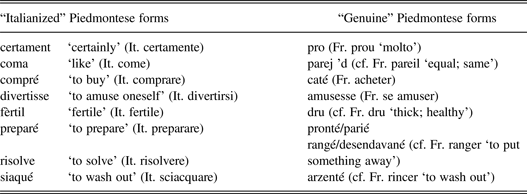
Some years later, a short vade-mecum of “good Piedmontese” was proposed by Gianrenzo P. Clivio (Reference Clivio, Clivio and Pich1990:176–79). In it, Clivio first enounces the following lexical principle: when choosing between two words, one closer to Italian and the other genuinely Piedmontese, preference should be given to the latter. Some examples are collected in Table 1.
“Italianized” and “genuine” Piedmontese forms.
An addendum to this principle is that when a word has been replaced in Turinese by an Italian borrowing but is still used in the surroundings, it is recommended that the speaker resort to rural alternatives: for example, eva ‘water’ instead of aqua (It. acqua), ciòrgn ‘deaf’ instead of sord (It. sordo), litra ‘letter’ instead of lètera (It. lettera) and por ‘fear’ instead of paura (It. paura).
The second principle regards phonetics: when choosing between two possible pronunciations of the same word, preference should be given to the more conservative one. Thus, a dventa ([a 'dvɛnta]) ‘it becomes’ should be preferred to a diventa ([a di'vɛnta]; It. diventa), sërché ([sər'ke]) ‘to look for’ to cerché ([ʧer'ke]; It. cercare), sempe (['sɛmpe]) ‘always’ to sempre (['sɛmpre]; It. sempre), scond ([skund]) ‘second’ to second ([se'kund]; It. secondo), and so on.
Afterwards, a specific morphosyntactic phenomenon is mentioned in the list: the postposition of subject clitic pronouns in interrogative sentences. Since this construction, which has completely disappeared from Turinese, is still widespread in rural varieties, Clivio suggests restoring it in standard Piedmontese/Turinese. For instance, (9a) should be used instead of (9b).Footnote 12
(9)
a. Cò ‘t fas–to?
b. What 2p.sub.cl do-2p.sub.cl.int?
c. ‘What do you do?’
d. Cò ‘t fase?
e. What 2p.sub.cl do?
f. ‘What do you do?’
Note that the same pattern of inversion is mandatory in formal French (quoi fais-tu?).
Clivio's scattered recommendations are not an exception. In discussing what he calls the Ausbauization (i.e. functional elaboration) of Piedmontese, Mauro Tosco (Reference Tosco2008:7–13, Reference Tosco, Miola and Ramat2011) correctly underlines the relationship of Ausbauization to the policy of increasing the distance between a dialect and its dominating language (i.e. Abstandization, derived from the term Ausbauization). As far as the lexicon is concerned, Tosco cites an ample list of examples in which distancing from Italian has been carefully cultivated; thus, for instance, adressa ‘address’ (< Fr. adresse) is preferred to indiriss (< It. indirizzo), alman ‘German’ (< Fr. allemand) to tedesch (< It. tedesco), anvlòpa ‘envelope’ (< Fr. enveloppe) to busta (< It. busta) and avion ‘airplane’ (< Fr. avion) to aeroplan (< It. aeroplan).
As a matter of fact, many of the examples cited by Clivio and Tosco contribute not only to distancing Piedmontese from Italian, but also, for the most part, to nearing Piedmontese to French. A “Frenchified” Piedmontese is hence on the way.
Occitan
The label “Occitan” is generally used to cover a group of Gallo-Romance dialects spoken from the Pyrenees to the Italian Alps, formerly known primarily as Provençal; referring to the varieties spoken in Italy, the names Cisalpine Occitan, Eastern Alpine Occitan, or Alpine Provençal are most frequently used. Putting aside purely terminological matters, the case of Occitan as a whole is particularly relevant to our purposes, as it is a language that has significantly changed status over the centuries.
In the Middle Ages (particularly in the twelfth to thirteenth centuries), Occitan seemed to have developed a literary koine. Thanks to the excellence of troubadour poetry, which deeply influenced the emerging Italian literature, attempts at codifying the language had already been made in the early thirteenth century. Codification would have led to a standard Occitan if the Albigensian Crusade (1209–1229) had not deeply damaged the cultures and languages of Southern France. The marginalization of Occitan was clearly dictated by the Edict of Villers-Cotterêts (1539), which prescribed the use of French in official legislation and acts; this fundamental change automatically downgraded all the other languages of France—Occitan included—to the sociolinguistic status of dialects (Fr. patois).
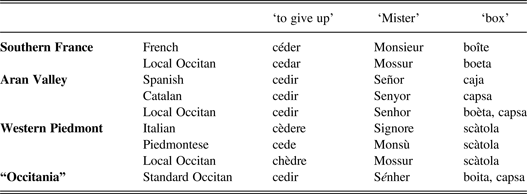
After a long period of silence (and leaving aside the foundation of the Felibrige movement in the middle of the nineteenth century), a crucial step towards the codification of modern Occitan was taken in 1945 with the creation of the Institut d’Études Occitanes (IEO), which pursued a two-fold linguistic policy: on the one hand, the “construction” of a reference variety (i.e. a variety that would ensure wide-range communication throughout the Occitan territory), and on the other, the elaboration of sub-norms for some main dialects (e.g. Provençal and Gascon). Within the IEO, a detailed corpus planning project has recently been proposed by Domergue Sumien (Reference Sumien2006). In Sumien's view, the best way to manage the great dialectal variability of “Occitania” is what he calls standardisation pluricentrique. Footnote 13 In short, a general standard (Occitan Larg General or Occitan Estandard, mainly based on the central variety of “Occitania,” Lengadocian) should cover all formal written uses, while a crown of six regional standards (Auvernhat, Gascon, Lemosin, Niçard, Provençau, and Vivaroalpenc) should be meant for more local and informal purposes. This “unity in diversity” is embodied in the graphic system, the so-called grafìa classica ‘classic spelling’. Sumien's attention has been chiefly dedicated to lexicon, which proves to be an extremely difficult matter to solve, given the presence of various standard languages in contact with Occitan: French in Southern France, Spanish and Catalan in the Aran Valley, and Italian, Piedmontese, and sometimes French in Western Piedmont. Some examples of interference due to these languages are presented in Table 2 (adapted from Sumien Reference Sumien2006:36); they have been divided into three geographical domains (Southern France, Aran Valley and Western Piedmont). Note that the last line provides the Standard Occitan solution.
Occitan and its surrounding varieties.
At first glance, Standard Occitan seems to be in line with Catalan lexical solutions, and this may be ascribed to both linguistic and cultural factors. The linguistic proximity between Catalan and Standard Occitan (based on Lengadocian) is unquestionable, and it is a well-known fact that from the Middle Ages to the beginning of the twentieth century Catalan was usually considered an Occitan dialect. Nevertheless, we believe that the promotion of Catalan-like forms may also, and perhaps above all, be due to cultural reasons; in fact, Catalan has undergone a massive standardization process in the last thirty to thirty-five years (Fishman Reference Fishman1991:ch. 10, passim), and it has been promoted to the status of official language in Catalonia, the Balearic Islands, and the Valencian community (as well as in the small principality of Andorra). To put it simply, Catalan is a language that “has made it,” becoming a feasible model for Occitan (see Paulston Reference Paulston1987; Priest Reference Priest2008).
Occitan in Piedmont
The Occitan dialects spoken in the valleys of Piedmont underwent some degree of local standardization starting in the 1980s, whereby “local standardization” is to be understood as a (mainly lexical) codification based on a single variety. A unitary standardization policy (involving cisalpine Occitan as a whole) began only in recent years, leading to a bilingual Italian-Eastern Alpine Occitan (EAO) dictionary (CINLOA 2008), promoted by the association Espaci Occitan; it is worth noting that this dictionary is said to be based on the varieties spoken in the central valleys of the Occitan area (see CINLOA 2008:iv). An overview of spelling norms and morphological rules precedes the dictionary stricto sensu. Though conceived independently of Sumien's standardisation pluricentrique, CINLOA (2008) fits in with an Occitanist approach, as it overlaps for the most part with Sumien's and makes use of the same spelling system (the aforementioned grafia classica); it is important to point out that this “general” standardization pattern has not replaced “local” standardization, but has simply added to it. Table 3 provides some lexical examples taken from CINLOA (2008).
Eastern Alpine Occitan and lexical choices.
The capital P, which appears near some EAO items, stands for “proposal,” that is, a neologism suggested by CINLOA (2008). Aerenc, which involves the typical Occitan suffix -enc (of Germanic origin), is an “internal” neologism based on Occitan lexical and morphological elements. Entraa and Intraa, the latter form being the more cultivated of the two, aim to express the meaning of ‘dish served before a meal’; the term seems to reproduce Fr. entrée, which, however, has a slightly different meaning (‘dish served before roast meat’). It can be regarded as a sort of disguised Gallicism. Adaptacion [adapta'sjuŋ] reveals the same lexical type as Catalan and French, but differs from them in pronunciation, [adapta'sjo] and [adaptɑ'sjõ] respectively. Annexar carries the same spelling in Occitan and Catalan but is pronounced differently, [anːe'sar] and [anːe'ksa] respectively. As for alludir, the language planner has here preferred the cultivated form with the -ir ending to the popular form with the -er or -re ending; once again, the result is close to Catalan, but not exactly matching in pronunciation (Occ. [alːu'dir] vs. Cat. [alːu'di]). The proposal of ierarquia ([jerar'kia]) instead of jerarquia ([ʤerar'kia]) achieves two goals: on the one hand, [jerar'kia] is different from the Italian gerarchia and the Catalan jerarquia (both pronounced [ʤerar'kia]); on the other, it more closely resembles the Greek etymology of the word, hierarchía. Aliança is written and spelled just as it is in Catalan [a'ljansa]. These examples highlight different planning issues, but a common feature may be outlined: the language planner aims at distancing Occitan at the same time from Italian, French, and Catalan; however, when a reference standard language is needed, Catalan seems to be the preferred choice (at least in terms of spelling).
The treatment of single consonant clusters clearly shows an etymological orientation. In fact, EAO maintains original bl-, cl-, and pl- clusters (see blanc ‘white,’ clau ‘key,’ plaser ‘pleasure’), though they are minority features in the area (blanc is normally realized as [bjaŋk], clau as [kjaw], plaser as [pja'zer]). An interesting phono-morphological feature is represented by the plural marker -s; this feature (reflecting the Latin plural accusative endings -as and -os) is usually maintained in words ending with a vowel sound—the plural of Occ. [ʤa'lino] ‘hen’ is thus [ʤa'lines] (< Lat. gallinas)—but rarely preserved in words ending with a consonantal sound—Occ. [lup] ‘wolf’ is an invariable word (Lat. lupos > [lup]), except in a very restricted area. Following the principle of etymological loyalty, CINLOA (2008) recommends the use of the final -s in written Occitan for both jalina and lup (which should be written jalinas and lups, respectively). Once again, conservation of bl-, cl-, and pl- clusters, as well as of the plural marker -s, makes EAO closer, when not identical, to Catalan (see Cat. blanc, clau, plaer, gallinas, llops).
Piedmontese, Occitan, and their roofing languages
Though they share a current sociolinguistic status, Piedmontese and Occitan have different historical backgrounds. A useful way to identify these differences is via the concept of “roofing” (Überdachung); we consider “roof language” (Dachsprache) in Heinz Kloss’ (Reference Kloss1978) original and narrow sense, that is, a standard language that covers a number of genetically related dialects in the same nation in which it is both the official written language and the one taught at school (see Berruto Reference Berruto, Iliescu, Plangg and Videsott2001:24–25).
While efforts to standardize Piedmontese over the past centuries have followed a “natural” (“historically motivated”) tendency, in terms of both variety selection (Turinese being commonly regarded, until recent times, as a prestigious variety) and roof language choice (Italian being the roofing language of all Italo-Romance dialects, including Piedmontese), more recent efforts have provided us with a different picture: variety selection is still “natural,” but roof language choice seems to be somewhat “artificial” and “ideological.” At the present time, the choice of French as a reference language, though not lacking in historical justification, seems rather anachronistic; though it may be true that for centuries French was the preferred language of the Piedmontese aristocracy and that it is sometimes difficult to distinguish French borrowings from words of directly Latin descent, we cannot maintain that the orientation towards French mirrors an actual tendency of present-day Piedmontese. There is no doubt that today Piedmontese is moving towards Italian and that the Italianization of dialects is indeed a common issue in contemporary Italian sociolinguistics.
According to the “Frenchified” Piedmontese supporters, French would offer Piedmontese a cultural roofing, playing the role of a faraway, longed-for language (Wunschsprache; Dal Negro & Iannàccaro Reference Dal Negro, Iannàccaro, Valentini, Molinelli, Cuzzolin and Bernini2003). A slightly different matter is the restoration of words once also common in Turinese and now marked as rural, which may actually be a way of distancing Piedmontese from Italian (and sometimes from French) by using “internal” (i.e. in no way foreign) material; the same holds true for the “relaunching” of syntactic devices typical of Piedmontese (see subject clitic pronouns in interrogative clauses), although also common in French.
The case of Occitan is far more complicated. First of all, after the Middle Ages Occitan never had a prestigious and generally accepted reference variety. The variety on which Standard Occitan (be it General Occitan or EAO) is based has been chosen following criteria that are geographical and linguistic in nature, and not sociolinguistic or historical. Pivotal to this choice is the notion of geographical and linguistic centrality. As we have already seen, General Standard Occitan is based on Lengadocian, a variety spoken in the centre of “Occitania,” while EAO is said to follow the varieties of the central valleys of the Occitan-speaking area (in Piedmont). So, unlike Piedmontese standardization, Occitan standardization is based on an “artificial” variety selection. As for the roofing language, according to the Klossian definition, the role of roofing Occitan should be attributed to a strictly related standard language; moreover, the roofing language X and the roofed varieties (Occitan dialects, in this case) should be spoken in the same national territory in which language X is the official (or co-official) language of schooling and administration. This is an easy task in France and Catalonia, where both French and Catalan meet Kloss's criteria; on the contrary, the task is not so easy in Italy, where Occitan is a typical example of a roofless dialect (properly a dachlose Auβenmundart). Occitan dialects spoken in Piedmont must thus resort to an “artificial” or “ideological” solution, that is, external reference language; as we have seen, this role seems to have been mostly assigned to Catalan, a Wunschsprache for EAO, just as French is for contemporary written Piedmontese.
The language space of dialects in Piedmont: A two-model proposal
The cases of Piedmontese and Occitan fit Joseph's (Reference Joseph1984:88) hypothesis that a standard language may result either from a “circumstantial” emergence (“a secondary consequence of more imposing social, political, economic, racial, religious, military, literary factors”) or an “engineered” emergence (“attained through direct, conscious effort”). Though, as Joseph points out, “neither type exists in a ‘pure’ state” (ibid.), it is undeniable that (i) the Piedmontese of previous centuries is mostly a product of circumstantial emergence, and (ii) EAO is based mostly on an engineered approach, as well as contemporary “Frenchified” Piedmontese. These remarks must be taken into account when we try to represent the way in which Piedmontese and EAO relate to their spoken/rural/local varieties.
First, regarding the question of whether the diaglossic model sketched for Italian (see Figure 2) may also be applied to Piedmontese and Occitan, we believe that it can only be extended to the “circumstantial” developments of Piedmontese (Figure 3). As emphasized above, starting in the eighteenth century an intralinguistic upward convergence (represented by simple arrows in Figure 3) took place from rural dialects to Turinese, which soon evolved into endoglossic standard Piedmontese (however, no leveling among rural Piedmontese dialects is supposed to have occurred: see Piedmontese); in this view, dialects of small urban centres can be considered as transition or mediating varieties between rural dialects (base of the cone) and standard Piedmontese/Turinese (tip of the cone): innovations coming from Turinese touched firstly the dialects of small urban centres, then the rural dialects, the former often acting as a “local” model for the latter (see again Piedmontese). In parallel to this intralinguistic upward convergence, all varieties of Piedmontese are generally involved in an interlinguistic upward convergence (represented by a double arrow in Figure 3).
The Piedmontese dialect continuum.
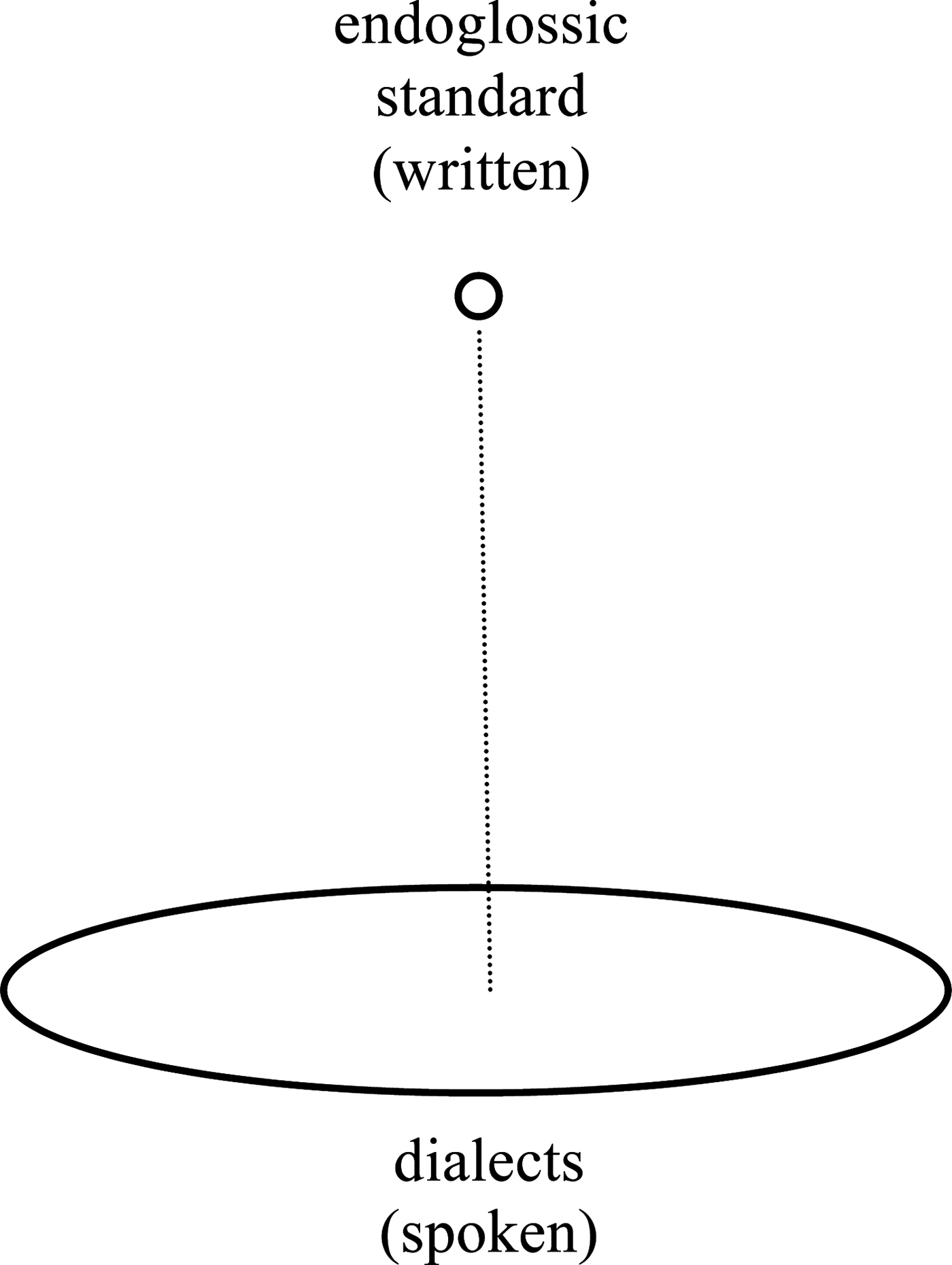
As for “engineered” developments (“Frenchified” Piedmontese and EAO), the hypothesis of endoglossic medial diglossia, Type A in Auer (Reference Auer, Delbecque, van derAuwera and Geeraerts2005:12–13, Reference Auer, Kortmann and van der Auwera2011:489), seems to be more plausible; “Frenchified” Piedmontese and EAO are moving towards, or already display, an endoglossic standard that is restricted to written domains. In spite of their clear genetic relationship, the written standard and the colloquial varieties work as separate entities; note that, while Auer's original Type A repertoire appears to imply an upward convergence from dialects to endoglossic standard, neither upward nor downward convergence is under way in Figure 4.
Endoglossic medial diglossia, Auer's Type A adapted to “Frenchified” Piedmontese and Eastern Alpine Occitan.
Conclusions
Starting from the types of repertoires outlined in Auer (Reference Auer, Delbecque, van derAuwera and Geeraerts2005, Reference Auer, Kortmann and van der Auwera2011), we have revisited some of them to better fit in with a specific situation observable in northwestern Italy, that of Italian, Piedmontese, and Occitan in Piedmont.
As for the relationship between Italian and Piedmontese, we have made some adjustments to the cone-shaped representation of Auer's Type C. Since Italo-Romance dialects and Italian are separate linguistic systems, we have argued for a separate depiction of the Italian continuum and the dialect continuum, drawing on two different cones.Footnote 14 Consequently, we suggest distinguishing between intralinguistic convergence (at the level of the architecture of language) and interlinguistic convergence (at the level of the linguistic repertoire). Each continuum exhibits intermediate varieties and displays its own peculiar dynamics of intralinguistic convergence. At the same time, each continuum interacts with the other; interlinguistic convergence results both in the “Italianization of the dialects” and in the “dialectization of Italian.”
As for the Italian continuum, we have sketched some convergence dynamics broadly referable to the ones depicted in Auer's Type C, which seem to be shared by many other European national languages in diaglossic repertoires (see for instance Røyneland (Reference Røyneland, Auer and Schmidt2010) for the case of Danish). As for the dialect continuum, the model proposed can be extended to sociolinguistic situations in which what we have termed “secondary koineization” (i.e. the influence of a leading urban dialect over the surrounding dialects) has taken place; in Italo-Romance situations, similar cases can be seen in Venetian, Genoese, and Milanese, all of which variously influence their respective surrounding dialects.
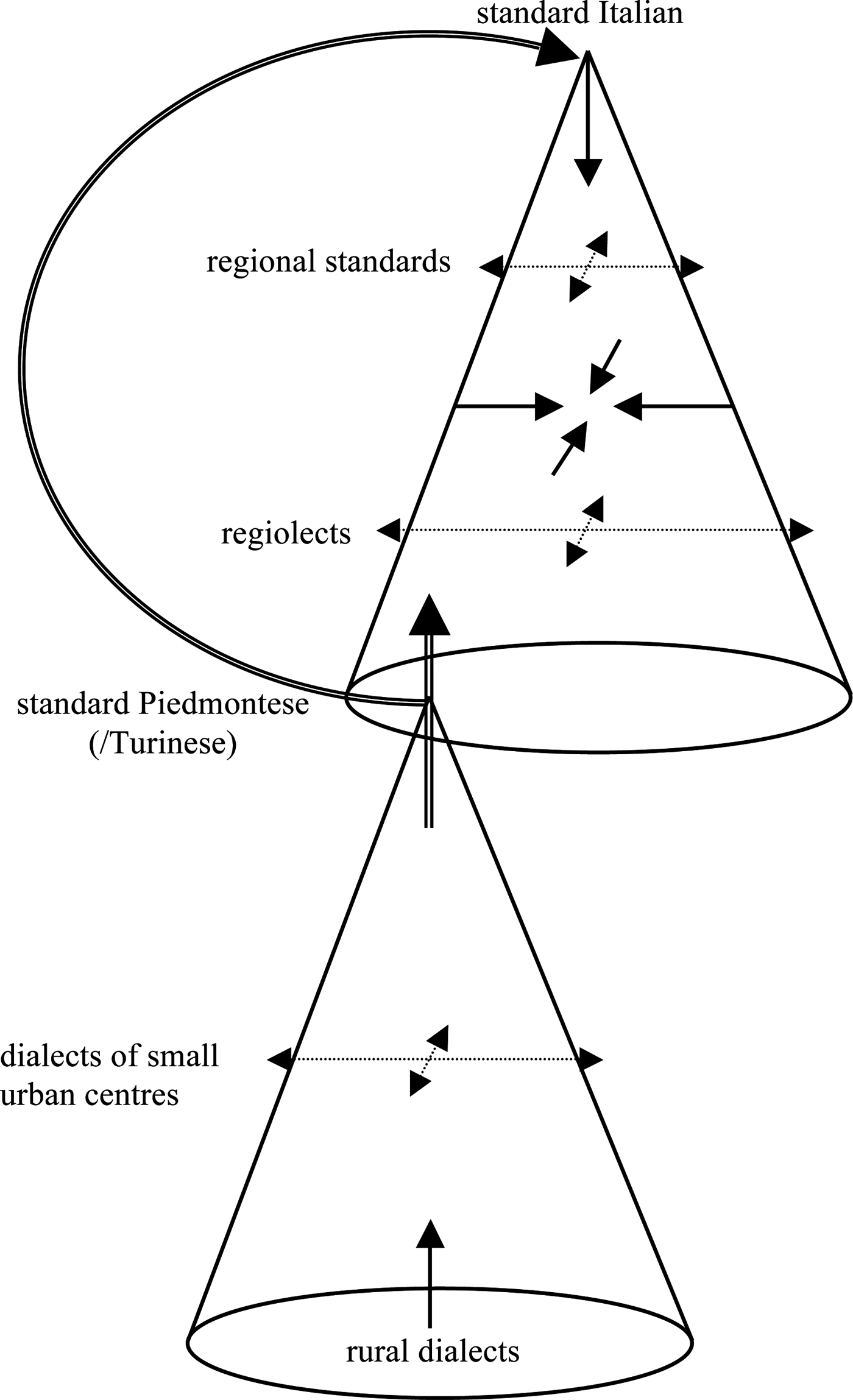
Given the Überdachung relationship between Italian (roofing language) and Piedmontese (roofed dialect), an attempt can be made to put the Italian continuum and the Piedmontese continuum together, as in Figure 5.
Diaglossia, Auer's Type C revisited: Italian/Piedmontese continuum.
The Italian cone is situated above the Piedmontese cone. Once again, in order to depict different kinds of convergence, we have drawn on double arrows and simple arrows to mean “interlinguistic convergence” and “intralinguistic convergence” respectively. The point of contact between the two cones is supposed to have taken place at the tip of the Piedmontese cone; indeed, on the basis of historical evidence, Turinese has been a sort of “foot in the door” for the influence of Italian on dialects. Compared to Figure 3, a double curved arrow has been added, connecting Turinese directly to the tip of the Italian cone; we may call it a “codification arrow,” that is, a linkage showing that diachronically and throughout the codification process, Turinese has looked to standard Italian as a privileged model language. As in Figure 3, the double arrow starting from the tip of the Piedmontese cone accounts for the synchronic interlinguistic convergence between Italian and Piedmontese (i.e. Turinese, dialects of small urban centres, and rural dialects); this is a way to underline the fact that Turinese is no longer the only conduit for Italianization. The Italian/Piedmontese continuum in Figure 5 seems to be applicable to secondary koineization scenarios when a roofing relationship between a full-fledged language and a dialect is clearly discernible.
Instead, a roofing relationship does not exist between a given dialect and its planned standard variety, or obviously between a given dialect and its exoglossic standard variety. For this reason, a similar two-cone representation is not suitable for “Frenchified” Piedmontese and Eastern Alpine Occitan. Conversely, we have opted for a medial diglossia representation (a slightly modified version of Auer's Type A), which is also shared by other planned standard varieties and their related dialects, for example, the case of Dolomite Ladin.