

Introduction
The private prison industry is a multibillion dollar a year industry that includes a conglomerate of private prison corporations, security firms, and construction companies that are in the business of incarcerating citizens and detaining undocumented immigrants for profit. The two largest companies, CoreCivic and The GEO Group, own and operate more than 200 facilities nationwide and have generated more than $4 billion in revenue in the last fiscal year combined. In more recent years, though, both companies have increasingly profited from the detention of undocumented immigrants by securing lucrative government contracts with US Immigration and Customs Enforcement (ICE). In 2014, ICE-related contracts accounted for the largest share of all federal contracts, surpassing the Bureau of Prisons (BOP) and the US Marshals Office (USMS), for the first time. Today, ICE accounts for 29 percent of CoreCivic's 2019 annual revenue. The share of revenue is 12 percentage points higher than USMS and 24 percentage points higher than BOP. As for GEO, the government agency accounted for 22 percent of its total revenue—11 percentage points higher than USMS and 10 percentage points higher than BOP.Footnote 1, Footnote 2
As a government contractor, the private prison industry has a natural interest in decision making at various levels of the federal government, including federal legislation that can affect its expansion into immigrant detention. In fact, both CCA and The GEO Group have admitted that government demand for detention facilities could be adversely affected by immigration reform laws that reduce the number of immigrant detainees.Footnote 3 Although the private prison industry claims that it does not “lobby for or against any policies or legislation that would determine the basis for an individuals’ incarceration or detention,”Footnote 4 more recent evidence indicates that private prison companies, by virtue of having prisons within representative's districts, can influence legislative outcomesFootnote 5 as well as legislative behavior over immigration policy more specifically.Footnote 6 Yet it remains unknown if the private prison industry can influence legislative outcomes by employing other forms of political influence, such as contributing to representatives’ campaigns.
We examine the relationship between campaign donations made on behalf of the private prison industry and legislative behavior in the US House of Representatives. Following Mahyew's (1974) reward argument, we hypothesize the private prison industry will reward House members for taking positions that benefit the industry. However, we add to this discussion by also arguing that the reward amount depends on the risk House members incur by taking a position on policy. Specifically, party members who take positions out of sync with the party brand are likely to hold more value because they are politically risky and consequently infrequent. We thus expect position taking to have a greater substantive effect on campaign donations when party members defect from the party than those who do not.
To test our argument, we focus on bill cosponsorship of punitive immigration legislation in the US House of Representatives and Political Action Committees (PACs) contributions from three major private prison corporations: CoreCivic, The GEO Group, and Management & Training Corporation (MTC). We focus exclusively on bill cosponsorship compared to other forms of position taking, such as bill sponsorship, for two reasons. First, although bill cosponsorship is arguably a more difficult test of Mayhew's (Reference Mayhew1974) original argument, the effects of bill cosponsorship on campaign contributions are relatively unknown. Second, sponsorship is a relatively limited occurrence in our data, yielding modeling unreliable. Yet bill cosponsorship is an important form of position taking since members of Congress (MCs) can signal both direction and intensity of their policy preferences at a comparatively lower cost.Footnote 7 We find support for our second hypothesis. Private prison corporations are more likely to reward House Democrats who cosponsor punitive immigration legislation. Moreover, further robustness checks investigating this relationship suggest that the causal arrow is most likely in the correctly predicted direction.
In all, these findings lend greater support for Mayhew's (Reference Mayhew1974) contention that MCs are rewarded for taking positions on policy. While these results fit with research on position taking and campaign contributions,Footnote 8 they are the first to demonstrate such a connection between immigration legislation and the private prison industry. The findings have important implications regarding Congress's role in immigrant detention. So long as some House Democrats continue to attract donations from private prison companies, some House Democrats will continue to support legislation that criminalizes undocumented immigrants despite growing opposition within the party's voting base, and indirectly support the financial interests of the private prison industry.
In the pages that follow, we first review the relevant literature on private prisons and interest groups, which highlights the endogenous relationship between campaign contributions and position-taking activities in legislative bodies. Building on the work of Mayhew (Reference Mayhew1974), Rocca and Gordon (Reference Rocca and Gordon2010), and others, we next present our theoretical framework regarding position taking and the effect of bill cosponsorship on campaign donations. Third, we review our data and methods. Finally, we present our results and discuss the implications of our research.
Background
There is much debate over the role of money in politics. Perhaps the most well-known perspective is the interest group perspective, which posits that interest groups make political donations with the expectation that MCs will advance their policy interest either through roll-call votes or some other legislative activity. Although MCs can potentially renege from such agreements because there is very little—if anything—interests can do to compel MCs to follow through on an exchange of goods, interest groups can encourage cooperation by making long-term investments to encourage trustFootnote 9 or by making a down payment with a promise of an additional payment after.Footnote 10
Research on interest groups and campaign donations, however, has produced mixed results when it comes to voting (e.g., Wawro [Reference Wawro2001]). Moreover, the exchange model has produced more questions than answers. For example, Hall and Deardorff (Reference Hall and Deardorff2006) outline two key objections. First, among those that find evidence of vote buying, the payoff amount is not commensurate with the policy benefits that interest groups potentially receive. In his study of farm subsidies, Stratmann (Reference Stratmann1992) finds that farm groups donated less than $200 to legislators to encourage support for the 1985 omnibus and 1990 farm bills. Second, research suggests that interest groups are more likely to make campaign donations to political allies in Congress. Yet it is unclear why PACs tend to give to political allies who need the least amount of coaxing.Footnote 11
Rather than envisioning money and legislative behavior as an exchange of goods, Hall and Wayman (Reference Hall and Wayman1990) contend that interest groups purchase access and time with their campaign donations to lobby policy. Thus, money serves as a signal that permits legislators and staff to identify allied interest. For example, in a field experiment, Kalla and Broockman (Reference Kalla and Broockman2016) find that congressional offices were between three and four times more likely to make themselves available to interest groups after being informed of their donation history. Although there is some debate over “who” is likely to be lobbied, interest groups have a tendency to lobby ideological or partisan allies,Footnote 12 those with influence over policy making, such as incumbents,Footnote 13 legislators belonging to policy-relevant committee assignments,Footnote 14 and those with leadership positions and access to more resources.Footnote 15 However, a key criticism is that money as a signal to legislators may be watered down by other competing interests vying for attention.Footnote 16
The congressional perspective, by contrast, envisions campaign contributions as a reward for legislative behavior.Footnote 17 According to this view, MCs—who are primarily motivated by the goal of reelectionFootnote 18—engage in a number of position taking activities to signal preferences on policy and attract campaign donations—not from the general public but rather from more attentive groups, such as interest groups and lobbyists. According to Mayhew (Reference Mayhew1974), position taking is defined as a legislator's “public enunciation of a judgmental statement on anything likely to be of interest to political actors” (16). Although MCs can take positions in various ways, more recent work places greater emphasis on non-roll-call voting behavior, such as bill sponsorship. For example, Rocca and Gordon (Reference Rocca and Gordon2010) examined the effect of bill sponsorship on contributions from the labor and gun lobbies in 103rd and 104th Congresses. Even after accounting for potential endogeneity between sponsorship and campaign contributions, the authors found a strong relationship between non-roll-call behavior and contributions. Rocca and Gordon (Reference Rocca and Gordon2012) also find a significant relationship between congressional earmarks and PAC contributions from defense PACs in the 111th Congress. Interest groups utilize financial contributions to encourage legislative earmarks, which furthers the group's policy goals. In turn, legislators utilize legislative earmarks to attract financial donors’ attention.
These findings dramatically challenge our current understanding of PAC contributions within the literature. As Rocca and Gordon (Reference Rocca and Gordon2010) suggest, the causal arrow may simply be in the wrong direction. While the previously referred to literature advances our understanding of position taking and its influence on election outcomes, we contend there is still room for improvement. First, the extant research has yet to fully examine “who” is doing the rewarding. Because the research is limited to the defense, labor, and gun industries, it is unclear whether these findings hold for other industries that are also heavily affected by government regulation or rely on winning government contracts as the basis of their business model. Second, prior scholarship on position taking as a strategy to attract campaign donations is limited to a single position-taking activity—bill sponsorship. However, this begs the question of whether other position-taking activities, including those that are arguably less costly by MCs, can influence campaign donations.
Cosponsorship as a tool to attract campaign donations
As noted, MCs can engage in various kinds of position-taking activities showing formal support for a bill, such as speech making, bill sponsorship, writing a bill, and cosponsorship. There are two notable features that make sponsorship and cosponsorship not only distinct from roll-call voting but also an attractive tool for MCs to use. First, unlike roll-call voting, which relegates MCs to three options: yes, no, and abstain, non-roll-call forms of position taking allows members “to take multidimensional positions on complicated issues.”Footnote 19 Second, “it gives members of Congress greater discretion to take positions because there is no formal requirement to do so.”Footnote 20 Thus, non-roll-call behavior is considered to be more of a voluntary act in which MCs can pursue their goals.
Our research focuses on bill cosponsorship for several reasons. Most notably, it serves as a more difficult test of Mayhew's contention that MCs are rewarded for the positions they take on the Hill. In comparison to bill sponsorship, cosponsorship arguably entails fewer political costs (opposition from legislators, interest groups, and constituents), fewer opportunity costs (ignoring other issues that may promote reelection), and fewer resource costs (e.g., time and energy that's expended by MCs and staff).Footnote 21 Given these lower costs, MCs cosponsor hundreds of bills each legislative session.Footnote 22 Still, cosponsorship is not a costless activity as some suggest.Footnote 23 As with any legislative activity, it is certainly possible for MCs to devote some resources, such as time and energy, before making a decision on whether to support a bill—especially if a bill is considered to be salient, is politically contentious, or requires additional information or expertise. Moreover, the decision to cosponsor bills can often depend on a host of other considerations, such as seniority, leadership positions, and other institutional factors that influence legislative activity.Footnote 24
Despite having relatively lower costs than bill sponsorship, cosponsoring legislation is a valuable position-taking activity. According to Koger (Reference Koger2003), MCs cosponsor bills to pursue a combination of policy and election-oriented goals. On the one hand, “co-sponsorship can send low-cost information about the political benefits of a bill, as well as the time and leadership effort required to pass it.”Footnote 25 For example, Kessler and Krehbiel (Reference Kessler and Krehbiel1996) find that ideologically liberal and conservative MCs cosponsored legislation earlier rather than later during the legislative process to signal positions to their House colleagues. Party leaders can also rely on cosponsorship as a strategic tool to determine the likelihood of a bill's success based on the number of cosponsors, diversity of cosponsors (e.g., cosponsors with diverse positions on policy issues), and quality of cosponsors (e.g., cosponsors with quality reputations, seniority).
On the other hand, MCs can also utilize cosponsorship as a position-taking tool to pursue the primary goal of reelection, which entails the generation of campaign contributions. Although there is little evidence to support the claim that cosponsorship promotes electoral margins,Footnote 26 there is good reason to expect that cosponsorship promotes reelection by attracting campaign donations from attentive interests. Similar to bill sponsorship, MCs can cosponsor legislation to send signals to attentive publics by showing their support for legislation, regardless of a bill's outcome. As Koger (Reference Koger2003) observes, “Cosponsorship is a chance to show that a member has taken action to support a bill. Even if a bill doesn't move, cosponsoring helps clarify your message. That way, people know where you stand, pro or con” (232). This is a particularly important point because it highlights the personal and voluntary nature of cosponsorship as a legislative activity.
In addition to signaling support for legislation, MCs can utilize cosponsorship to signal the intensity of their preferences to interest groups and lobbyists. As Koger (Reference Koger2003) notes, “Cosponsorship means you recognized early on that the bill is good public policy and that it has merit and should be acted on. If a member cosponsors, that implies he or she contributed to its success; the member's cosponsorship may have made the difference. If you just vote yes, you had no role in bringing the bill to the floor. There's more credit in cosponsoring a bill then voting for it” (231–32). In comparison to bill sponsorship, the overall level of intensity may not be as high as writing a bill given the political, opportunity, and resource costs. However, as research demonstrates, the high resource cost associated with bill sponsorship means that MCs have fewer opportunities to signal their preferences than if one were to cosponsor a bill.
Overall, the extant literature suggests that MCs can utilize bill cosponsorship as a low-cost tool to signal both direction and intensity of preferences to attentive interests. We, therefore, expect the private prison industry to reward MCs for cosponsoring favorable legislation. Thus, we establish our baseline hypothesis:
• H1: Prison Donation (Baseline) Hypothesis: Legislators who cosponsor punitive immigration bills will receive larger prison PAC donations compared to legislators who do not cosponsor punitive immigration bills.
Rewards, counterpositions, and communicating risk to attentive publics
The value of cosponsorship may also vary by who is taking the position. Here, our primary argument is that MCs are more likely to benefit monetarily from position-taking activities when they adopt positions that are out of sync with their own party. For example, a Democrat might disproportionately benefit from the NRA (in terms of campaign contributions) for supporting pro-NRA legislation and a Republican might disproportionately benefit from Labor for supporting prolabor legislation. Our logic is based on a simple supply-and-demand principle, which suggests that the value of goods increases when demand exceeds supply.Footnote 27 Although MCs are more likely to take positions that follow their ideological, partisan, or electoral preferences,Footnote 28 such positions may be worth comparatively less to interest groups because MCs can be “counted on” to support particular positions. By contrast, out-of-sync positions occur with less frequency given the higher political and electoral costs of doing business.Footnote 29 As such, compensation for out-of-sync positions may be comparatively higher than those that are not.
The key mechanism is the ability to signal a higher degree of risk to attentive publics. MCs can signal greater risk by taking counterpositions that potentially result in punishment from party leaders. A key goal of party leaders is to maintain policy control and build majorities to pass legislation.Footnote 30 To achieve this end, party leaders can reward and punish rank-and-file members with several institutional, policy, and financial sticks and carrots.Footnote 31 For example, they can “offer favorable committee assignments and leadership positions, donate campaign funds, and expedite favorable legislation.”Footnote 32 Conversely, they can also strip its members of valuable positions, withdraw campaign funds, and prevent sponsored legislation from getting on the agenda. Party leaders are also strategic when enforcing party discipline. While at times they may permit some degree of latitude for defection, party leaders are more likely to enforce discipline during procedural votes, when legislative outcomes are uncertain, and—most relevant to our discussion here—when issues are salient and help define the party to voters.Footnote 33
Growing evidence indicates that party leaders monitor multiple forms of position taking. Party leaders, for instance, place a great deal of emphasis on roll-call voting because it is a necessary activity to pass legislation.Footnote 34 Consequently, defection from the party may constitute a much higher payoff given the weight of activity. More recent evidence also indicates that party leaders monitor floor speeches. For example, Pearson (Reference Pearson2015) finds that party leaders, in exchange for floor speeches that promote the party's agenda, reward (or not) the rank and file with opportunities to amend legislation and make resolutions. Thus, there is reason to believe that party leaders may also monitor other forms of legislative activity, such as cosponsorship because it serves as an early sign of support for legislation.
In addition to party discipline, MCs can signal risk to attentive publics by taking counterpositions that potentially result in punishment at the polls. Voters, who tend to rely on partisan cues to make voting decisions, may be more likely to act retrospectively on a MC's record. The media, interest groups, and challengers can also expose incumbents for taking positions that are inconsistent with the party label. For example, Bovitz and Carson (Reference Bovitz and Carson2006) and Carson et al. (Reference Carson, Koger, Lebo and Young2010), in their study of roll-call votes, find that incumbents can lose their electoral gains by taking counterpositions on issues that have been controversial, salient, or a catalyst for intraparty disagreement. Although incumbents tend to win reelection, the results nevertheless highlight an element of electoral risk.
Finally, the extant literature highlights potential party and electoral punishment when MCs take positions counter to the party brand. Among the various policy issues that distinguish the two political parties (e.g., economy and healthcare), immigration is perhaps one of the most salient. Over the years, immigration policy has increasingly become an important wedge issue in US politics.Footnote 35 Republican MCs and their base have been in general agreement over the issue of immigration by showing support for hardline immigration policies, such as enhancing border security and enforcement, detention, and deportation. Democrats meanwhile have shifted left on the issue by supporting more inclusive policies, such as comprehensive immigration reform with a pathway to citizenship and sanctuary cities.Footnote 36 Given the parties’ divergent stances on immigration policy, we can expect Democratic MCs who take counterpositions on punitive immigration policies in line with the private prison industry's interests to incur a potentially greater political or electoral cost. Thus, we hypothesize the following:
• H2a: Counterposition Hypothesis: Democrats who cosponsor punitive immigration bills will receive higher payouts from private prison PACS than will Democrats who do not.
• H2b: Republicans who cosponsor punitive immigration bills will not receive higher payouts from private prison PACS than will Republicans who do not.
Research design
To test our expectations, we constructed an original dataset to examine the relationship between House representatives’ cosponsorship of punitive immigration policy and campaign donations from the private prison industry during the 111th–114th congressional years (or 2009–16). Following previous research,Footnote 37 the unit of analysis is the individual legislator per congressional year. Because individual legislators appear multiple times in the dataset, we clustered standard errors around the individual legislator in our regression models. In all, the dataset includes a total of 1,745 observations after subsetting out party leaders from the analyses.Footnote 38 The period of inquiry is not only timely, but it is also preferable because it provides an opportunity to examine the influence of legislative behavior on private prison during a single presidential administration—the Obama administration. Consequently, we can control for any potential effects that the executive branch may have on donation activity.
Dependent variable
Given our case selection, our primary dependent variable captures the sum of all PAC contributions from three major private prison companies (CoreCivic, The GEO Group, and Management and Training Corporation) during the 2010, 2012, 2014, and 2016 election cycles. All four election cycles overlap with each of the four congresses that existed during these years. The three companies are representative of the private prison industry, as they accounted for nearly 90 percent of all private prison contributions to House members during the period of inquiry—or $834,919 of $939,820 total contributions between 2010 and 2016. All private prison company contributions are available at Opensecrets.org.Footnote 39
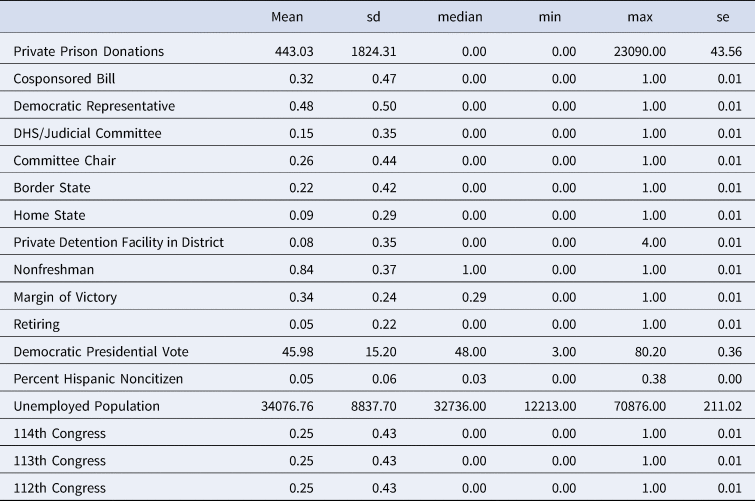
Table 1 provides the dependent variable's distribution. Eighty-five percent of the observations score 0, whereas 15 percent of legislators in our data receive payouts.Footnote 40 The mean donation is $443, the median is $0, and the max is $23,090 (a donation made to Rep. Henry Cuellar [D-TX]).Footnote 41, Footnote 42
Dependent variable distribution—Prison PAC

Independent and control variables
The main independent variable measures whether an individual legislator cosponsored punitive immigration legislation that has the potential to increase the supply of immigrant detainees. A coding of 1 indicates cosponsorship of at least one punitive immigration bill that has the potential to increase the supply of immigrant detainees for the private prison industry and a coding of 0 indicates otherwise. Alternatively, we also considered a count variable that captures variation among legislators who cosponsor bills. However, we opted to use a dummy variable because very few Democrats cosponsored more than one punitive immigration bill. The inclusion of a count variable, moreover, would make it impossible to test our second hypothesis.Footnote 43
We accessed all immigration related bills at the Congressional Bills Project.Footnote 44 There are several punitive immigration bills that have the potential to increase the supply of immigrant detainees. They include those that (1) enhance the power of local, state, and federal law enforcement agencies to enforce immigration laws; (2) increase cooperation among local, state, and federal law enforcement agencies to enforce immigration laws as well as impose penalties on sanctuary localities; (3) impose penalties on undocumented immigrants and nonpermanent residents; and (4) create new procedures to facilitate detainment and deportation of undocumented immigrants. In this case, HR-2848 “amend[s] the Immigration and Nationality Act to penalize aliens who overstay their visas, and for other purposes,” and HR-1901 “amend[s] the Immigration and Nationality Act to provide for extensions of detention of certain aliens ordered removed, and for other purposes”—fits into categories 3 and 4. Importantly, we exclude bills that are less likely to increase the supply of immigrant detainees, such as “English Only” laws, bills that end birthright citizenship, and bills that restrict the number of immigrants entering into the United States. Our data include n = 67 total bills that have at least one cosponsor (we dropped bills that had 0 cosponsors). Although none of these bills made it out of committee due to a divided government, they nevertheless are important pieces of legislation because they provide House members opportunities to take positions on a salient wedge issue that defined two political parties during the period of inquiry. We provide a list of all punitive immigration bills in appendix B.
Overall, 32 percent of our observations record a cosponsorship of a punitive immigration bill. But, as table 2 indicates, Republican MCs are much more likely to cosponsor punitive immigration legislation, suggesting greater alignment with Republicans than Democrats. Fifty-five percent (n = 496) of Republican party identifiers in our data cosponsor punitive immigration legislation, whereas just 8 percent (n = 67) of Democrats do. A closer inspection of DW-Nominate Dimension 1 scores, which measure legislators’ ideology, also reveals that Democrats who cosponsor punitive immigration bills tend to be more ideologically moderate (μ = -.201) compared to noncosponsors (μ = -.392, t = -12.803, p < 0.001) and the Democratic Party's highest-ranking member, Nancy Pelosi (–.4915). Thus, Democratic members who cosponsor punitive legislation are not only out of sync with party's position on immigration but they also face a greater risk of party discipline.
Independent variable distribution—punitive immigration bill cosponsorship, by MC Party (Republican/Democrat)

We also include a dummy variable for Democrat (1 = yes, 0 = Republican) and interact the variable with our primary independent variable to test our second hypothesis. In our data, 842 observations are coded as Democrat, whereas 903 are coded as Republican. We exclude DW-Nominate scores—as a measure of legislator ideology—from our models because our partisanship dummy variable and DW-Nominate scores are highly correlated (0.95). Nevertheless, in table C2 in appendix C, we present models switching party with DW- Nominate scores and find no substantive changes to our analysis.
Additionally, we control for a host of variables found to have a significant influence on campaign donations. Descriptive statistics for all control variables are available in table A1 in appendix A. First, we account for legislators’ committee assignments and leadership roles because committees and chairs have greater control over the legislative agenda. It may be the case that legislators in policy-relevant committees (i.e., committees that focus on immigration) and are high up on the committee ladder have more opportunity to signal ideological preferences to interest groups. DHS/Judicial Committee measures whether a legislator is a member of the Department of Homeland Security (DHS) or Judiciary committees. This is a relevant measure because lots of bills relevant to ICE—the agency charged with capturing and detaining undocumented immigrants—emerge here. Committee chair measures whether a legislator is a subcommittee or full committee chair. Both variables mentioned in the preceding text are dichotomous. A coding of 1 indicates committee membership in at least one of the two committees and having a chair position in either a full or subcommittee during the period inquiry. A coding of 0 indicates otherwise.Footnote 45 Third, we account for constituents’ preferences by including several variables that measure legislators’ home state and district demographics. It may be that private prison companies and their lobbyists may be more likely to contribute to legislators who reside along the US-Mexico border and their own state representatives. Border State is a dichotomous variable where a coding of 1 indicates whether a legislator represents a district in a state that is along the US-Mexico border. Home State is also a dichotomous measure, where a coding of 1 indicates that a private prison company's main headquarters is in a legislators’ home state. Following Collingwood, Morín, and El-Khatib (Reference Collingwood, Morín and El-Khatib2018), we also include a dummy variable for whether an ICE-contracting private detention center is in a legislator's district (1 = yes, 0 = no).Footnote 46
In addition, we account for seniority, legislators who are electorally secure, and retirement status. Research indicates seniority and electoral vulnerability to be positively associated with campaign donations. Meanwhile, we expect House members who announce their retirement to be less likely to receive donations. To account for seniority status, we include a variable that measures House members’ nonfreshman status. A coding of 1 indicates nonfreshman and a coding of 0 indicates freshman. We also control for representatives’ margin of victory, which is calculated as the difference in percentage vote between the winner and second-place candidate. In the absence of a challenger, representatives were coded as 1. Retiring is a dichotomous variable. Representatives who announced their retirement were coded as 1 and 0 if otherwise.
Regarding district demographics, we control for the size of the unemployed population—measured as the number of unemployed individuals within a district, presidential vote—measured as the percentage of the presidential vote for the Democratic candidate in the most recent election, and the percent of Hispanic noncitizen population. Finally, we include several dummy variables that account for congressional years 112, 113, and 114 (with 111 held out as our comparison group).
Bill cosponsorship and campaign contribution sequence
Before we begin our analysis, we first examine the sequence of legislative activity and campaign contributions. If Mayhew's (Reference Mayhew1974) argument is correct, then one would expect the private prison industry to generally make campaign contributions after a legislator cosponsor's a bill in line with the industry's interests. To determine the timing of the relationship, we identified only those punitive immigration bills in which its cosponsor also received a donation from the private prison industry within the same congressional year.Footnote 47 According to table 3, 65 percent of campaign contributions occurred after a legislator cosponsored a punitive immigration bill, 13 percent occurred before and after, and 22 percent occurred before. This pattern is also consistent among Democrats and Republicans.Footnote 48
Bill cosponsorship, campaign contribution sequence

At least for the private prison industry, the results are suggestive of a general pattern that is in line with Mayhew's (Reference Mayhew1974) argument. Although campaign contributions do not “always” follow bill cosponsorship, the percentage of donations that occur after bill cosponsorship is relatively large. Still, we apply caution to the interpretation of our initial results. Based on the sequence of events alone, we cannot say for sure that campaign contributions are in fact rewards for specific legislative activities. In the next section, therefore, we begin our analytical section by examining the relationship between the decision to cosponsor punitive immigration bills and campaign contributions from the private prison industry.
Results
We begin the analysis with a presentation of simple difference of means tests. Our analysis broadly finds (1) legislators who cosponsor punitive immigration legislation receive more donation money than legislators who do not; (2) Republican legislators overall receive more money than do Democratic MCs; and (3) however, only Democratic MCs are disproportionately financially rewarded when they cosponsor punitive immigration legislation.
At a very basic level, not accounting for confounders, we expect a bivariate association between punitive immigration bill cosponsorship and donations from the prison industry (H1). Table 4 shows general support for this baseline assumption ($569.22 to $383.96, t-stat = –1.92, p < 0.10). Legislators who cosponsor punitive immigration legislation do, on average, record larger donations from private prison PACS. Thus, with this test, we find initial support for hypothesis 1.
T-tests between PAC amounts and punitive immigration bill cosponsorship

Next, given the GOP's more traditional ally of prison privatization and hard line on immigration, we might anticipate that on average prison PACs make larger donations to Republican MCs—regardless of members’ propensity to cosponsor punitive immigration legislation. Table 5 provides evidence that private prison companies are likely aligned with the Republican Party ($575.14 to $302.81, t-stat = 3.14, p < 0.01).Footnote 49
T-tests between PAC amounts and legislator partisanship (Republican vs. Democrat)

Furthermore, the previously mentioned findings are not simply due to the notion that prison PACS only give to GOP MCs. Indeed, prison PACs balance their giving to both party members (PACS often give to members on both sides of the aisle but give less to their nonideologically preferred side [Brunell, Reference Brunell2005]). Table 6 demonstrates this basic arrangement: of the 903 Republicans in our data, 144 (16.0%) received prison PAC contributions, whereas 112 of 842 (13.3%) Democrats did. These party count distributions are not statistically different (χ 2 = 2.44, p = 0.12). Thus, despite giving to both parties (in terms of count) somewhat equally, private prison companies disproportionately give more money overall to Republicans than to Democrats.
Financial contributions from prison political action committees to legislators, by party. χ 2 = 2.435, p = 0.119

We next turn to the initial test of our second hypothesis. Because the political costs to Democratic legislators for supporting punitive immigration legislation is likely higher than it is for Republican legislators, should prison PACs wish to curry political favor in the form of punitive immigration bill cosponsorship, then the contribution to Democratic MCs must be higher. In a very basic sense, legislators are getting paid more for greater risk (H2a). However, because GOP MCs are broadly aligned with the punitive immigration agenda, prison company PACs may strategize to give equally to GOPers regardless of whether the MC ultimately cosponsors punitive legislation (H2b). Table 7, row 1, provides broad support for H2a, whereas row 2 provides support for H2b (if anything, prison companies give more to Republicans who do not cosponsor punitive immigration legislation but the difference is not statistically significant). Compared to Democratic MCs who do not cosponsor punitive immigration legislation, Democratic MCs who do receive more prison PAC money ($260.15 vs. $796.27, t = -2.14, p < .05). However, Republican MCs notch similar amounts of money from the industry, regardless of whether they cosponsor punitive immigration legislation ($619.74 vs. $538.55, t = 0.60, p = 0.55). Overall, these findings support hypothesis 2.
T-tests between PAC amounts and legislator partisanship × punitive immigration bill cosponsorship

Multivariate analysis
With our initial analysis, confirming hypotheses 1 and 2, we now turn to a more comprehensive method to assess whether the relationship between bill cosponsorship, party, and financial contributions. We estimate our models with OLS regression.Footnote 50 Our key independent variables are cosponsorship, Democrat (1 = yes, 0 = Republican), and their product. To support hypothesis 1, we must observe a positive and statistically significant term on cosponsorship. To support hypothesis 2, we must observe a statistically significant and positive product term.
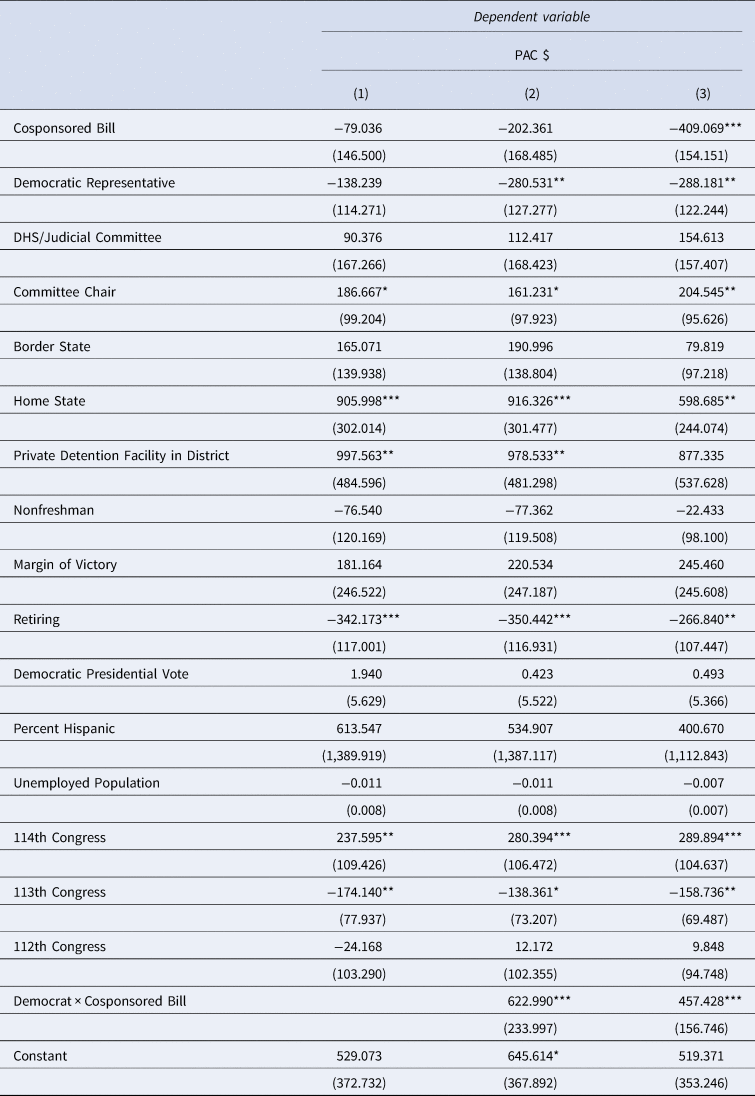
We present both our base and product models, located in table 8. Model 1 (column 1) tests hypothesis 1—whether punitive immigration bill cosponsorship is associated with prison PAC financial contributions. Different from our bivariate analysis, we do not find support for H1. To test hypothesis 2, we focus on our interaction term in model 2 (column 2). Our key independent variables are cosponsorship, Democrat (1 = yes, 0 = Republican), and their product. Here, we observe a positive and statistically significant coefficient of 622.990. This model provides clear support for H2.
OLS Results. Punitive immigration bill cosponsorship and contributions from private prison political action committees

Note: *p < 0.1; **p < 0.05; ***p < 0.01.
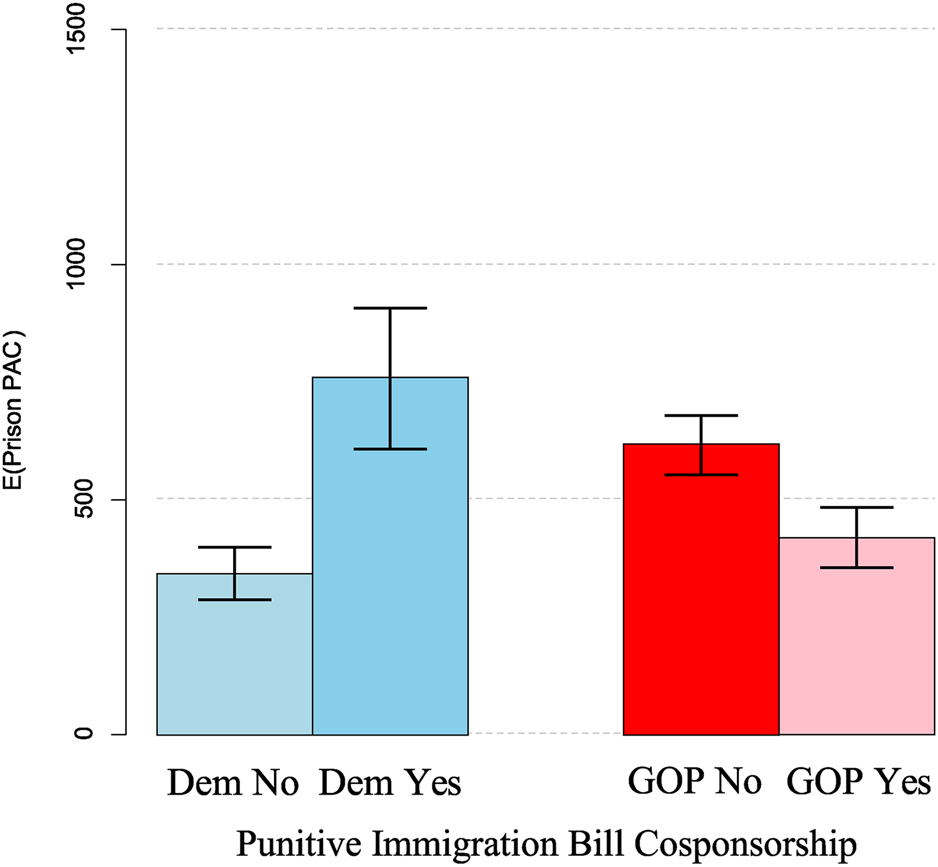
To clarify the relationship, we simulate a Monte Carlo distribution of expected cash payouts (expected values). To do this, postregression, we hold all covariates at their means and respectively adjust our interaction terms from their minimum to maximum values (i.e., Republican (0) who does not cosponsor (0) to Democrat (1) who does cosponsor (1)). The resulting simulated distribution estimates expected values of cash payouts for varying combinations of our key independent variables. Figure 1 presents results simulated from model 2 in table 8. Fitting with the earlier analysis, Democratic MCs who cosponsor punitive immigration bills clearly receive higher campaign contributions than Democrats who do not cosponsor. Republicans, though, do not monetarily benefit from cosponsoring punitive immigration bills because they incur less risk for supporting punitive immigration bills. In fact, Republicans who cosponsor legislation receive fewer dollar contributions than Republicans who do not cosponsor—though the difference is smaller compared to Democrats. Taken together, the findings mentioned in the following text provide a visual confirmation of both H2a and H2b. Despite the smaller expected value of cash payouts to both Democrats and Republicans, the reward amount may be commensurate with the relatively lower risk of bill cosponsorship as a position-taking activity. Still, it is worth noting that cash rewards have the potential to increase over time as House members gain seniority and influential committee assignments in Congress. The reasons behind this are twofold. First, seniority allows for the opportunity for PACs to learn about House members and develop cooperation between them across time.Footnote 51 Second, “seniority is valued directly because of the norm of accession to leadership positions on committees by longevity.”Footnote 52 Thus, it is reasonable to suggest that even smaller contributions, including rewards from the private prison industry, remain important to legislators.
Expected values of PAC contributions to legislators fitting different partisan and bill cosponsorship criteria.

The results in model 2, however, include all instances in which a legislator cosponsored a bill, regardless of bill-contribution sequence. Therefore, it may be possible that the results may have been biased to some degree by the inclusion of House members who (1) received contributions after cosponsoring a bill and (2) received contributions before and after cosponsoring a bill. As a robustness check, therefore, we examine whether the relationship continues to hold after excluding the two groups of legislators in model 3 (column 3).Footnote 53 The results remain unchanged with regards to our main interaction term, though the substantive effects somewhat decrease.
Finally, the results demonstrate several important findings. Compared to the 111th Congress, House members receive larger dollar contributions in the 114th Congress but not in the 113th Congress. Taken together, the two findings indicate that House Representatives are more likely to receive PAC contributions during general election cycles than in the congressional midterms. Additionally, committee chairs are more likely to receive PAC contributions, which is consistent with some literature on PACS and campaign contributions (Grenzke, Reference Grenzke1989). In the unrestricted model, legislators in leadership positions receive $161 more in campaign contributions than House back-benchers. Finally, and most relevant to our study, Home State is positive and significant, indicating that private prison companies contribute $916 more to those who reside in the same state as the companies’ headquarters. Likewise, legislators with private detention facilities in their district attract more prison PAC donations ($978). Finally, outgoing House members are statistically less likely to receive PAC money, which makes sense because these members cannot do anything for PACs in the next Congress. Overall, the findings add an additional layer to our understanding of private prisons and their political influence in campaigns and elections. While legislators are signaling to private prisons for money, private prison companies are also heavily contributing to House members in their own state. All other control variables fail to achieve statistical significance in the models.
Matching analysis
So far, the analysis demonstrates that cosponsorship influences interest group behavior in the form of PAC donations. However, it is also possible that money influences the decision to cosponsor legislation. To address possible endogeneity, we estimate a full match. The procedure has two general steps. The first step aims to equate or balance the distribution of covariates in the treated and control groups such that the treatment is independent of the covariates. The second step involves outcome analysis.Footnote 54 The method is particularly advantageous in its ability to reduce model dependency and improve the validity of causal inference in observational studies.Footnote 55 We adopt this approach from Nyhan et al. (Reference Nyhan, McGhee, Sides, Masket and Greene2012), who utilized matching to isolate the effect of roll call votes on support for Democratic incumbents. This strategy, moreover, is in line with scholarship examining the extent to which voters electorally reward representatives for taking positions and passing policyFootnote 56 as well as research that investigates corporate spending and firm performance more generally.Footnote 57 In this setup, legislators who cosponsor punitive immigration legislation become our “treatment group” whereas those who do not become the “control group.” The match generates a dataset of comparable legislators in both treatment groups where the primary difference is legislators in the treatment have cosponsored punitive immigration legislation. We can then compare prison PAC donations across the two comparable groups. To achieve this end, we matched our treatment and control groups on key political, electoral, and demographic variables to isolate our treatment effect. These variables include ideology, committee status, leadership status, state characteristics, nonfreshman status, congressional year, margin of victory, retiring, district presidential vote, district percent Hispanic noncitizen, and presence/absence of a private detention facility in the district. Finally, we subset the data to Democrats and Republicans, respectively, to test for differences in financial prison PAC payouts between cosponsors and noncosponsors among partisans.Footnote 58 Table D1 and D2 in appendix D show covariate balance tables pre-/postmatch for Democratic MCs. The mean covariate distance prematch is 0.40, postmatch this number reduces to 0.01. Tables D3 and D4 show covariate balances pre-/postmatch for Republican MCs. A similar pattern emerges as with the Democratic dataset: prematch distance = 0.18, whereas postmatch distance = 0.
Postmatch, among Democrats, the results once again show support for Mayhew's argument—MC are rewarded for the positions they take. Specifically, the findings indicate that Democrats who cosponsor punitive immigration legislation are more likely to receive prison PAC campaign contributions than Democrats who do not ($796 vs. $310, p < 0.06). Cosponsoring Republicans, however, are not statistically more or less likely to receive cash payouts compared to Republicans who do not cosponsor ($539 vs. $725, p = 0.16).
Discussion and conclusion
This article set out to investigate how legislators rely on a particular brand of position taking—cosponsorship—to reap rewards from attentive publics. While previous research has often conceptualized money in politics as an independent variable, we argued that MCs take positions to attract campaign contributions from attentive interests.Footnote 59 We also argued that MCs who take counter positions from their own party will likely benefit from taking positions that benefit interest groups. Our results demonstrate that private prison companies tend to make political donations after House members cosponsor punitive immigration legislation. Private prison companies also disproportionately donate to House Democrats when they support punitive immigration legislation. Importantly, if these bills are enacted, immigrant detainee supply/demand for greater immigrant detention is expected to rise.
In all, the findings add to existing literature in at least three key ways. First, this article lends further support to Mayhew's (Reference Mayhew1974) argument that interest groups reward MCs for taking positions on relevant policies. This is especially important given that prior scholarship is relatively limited to a handful of industries, such as the gun and labor industries. Second, the relationship between position taking and financial payoff depends on “who” is taking the position, as MCs receive payoffs that are seemingly commensurate with the political risks they incur. Finally, we also demonstrate that MCs can rely on other forms of position-taking activities to attract campaign donations from interest groups. While prior scholarship has exclusively focused on bill sponsorship, cosponsorship can also be an effective signaling tool. Moreover, MCs may prefer bill cosponsorship to sponsorship because it poses arguably lower political, opportunity, and resource costs.
The findings also have important implications regarding Congress's role in immigrant detention. So long as MCs continue to attract donations from private interests, they will continue to support legislation that criminalizes undocumented immigrants. It has been well-documented, for example, that efforts to criminalize undocumented immigrants has led to increased instances of hate crimes and most recently family separation.Footnote 60 And among those held in captivity, many have suffered from abuse, neglect, and even death.Footnote 61 Meanwhile, MCs will continue to indirectly support the financial interests of the private prison industry. Punitive immigration policies that increase the supply of immigrant detainees will likely cause federal government to further its interests in the private prison industry by granting more contracts to add bed space to existing detention facilities as well as construct new immigrant detention centers. We think this a likely scenario especially given Donald Trump's conservative and hardline stance on immigration policy.
However, our work isn't without its limitations. As discussed at the beginning of this article, there has been much debate over the direction of the causal arrow. At least within congressional years, our preliminary analysis finds that campaign contributions tend to follow bill cosponsorship. We also find additional support for our main hypothesis in our robustness checks. Still, we cannot fully rule out the potentially endogenous relationship between PAC donation and bill cosponsorship. This is because our data precludes a time 1 (cosponsor), time 2 (payout) analysis. However, we take solace that previous work found no relationship between prison industry donations made before the beginning of a congressional session and punitive immigration bill cosponsorship.Footnote 62
Future research should continue to investigate the relationship between position-taking and campaign donations. We hope researchers will replicate our analysis by focusing on other industries as well as other actors related to the private prison industry, such as construction and security firms. Additionally, we hope that future research analyses will test the extent to which private prison companies reward MCs for taking positions on other policies salient to the private prison industry, such as crime and appropriations legislation. Finally, future research should investigate whether private prison companies reward state legislators. Given the recently documented role of groups like ALEC in state immigration policy diffusion and Stand Your Ground legislation,Footnote 63 there is strong reason to suspect that private prison companies have expanded their reach into state immigration policy making and criminal justice more broadly. While the data-collection process might be extensive, the wider variance of state policy making might perhaps provide greater insights into the role of position taking and money related to immigration-related legislation.
Supplementary material
To view supplementary material for this article, please visit https://doi.org/10.1017/bap.2021.6
Acknowledgments
We thank the reviewers for their helpful feedback. We also thank Matthew Gunning for providing comments on an earlier draft of the manuscript at the 2019 Western Political Science Association meeting.
Appendix A: Summary Statistics
Summary statistics