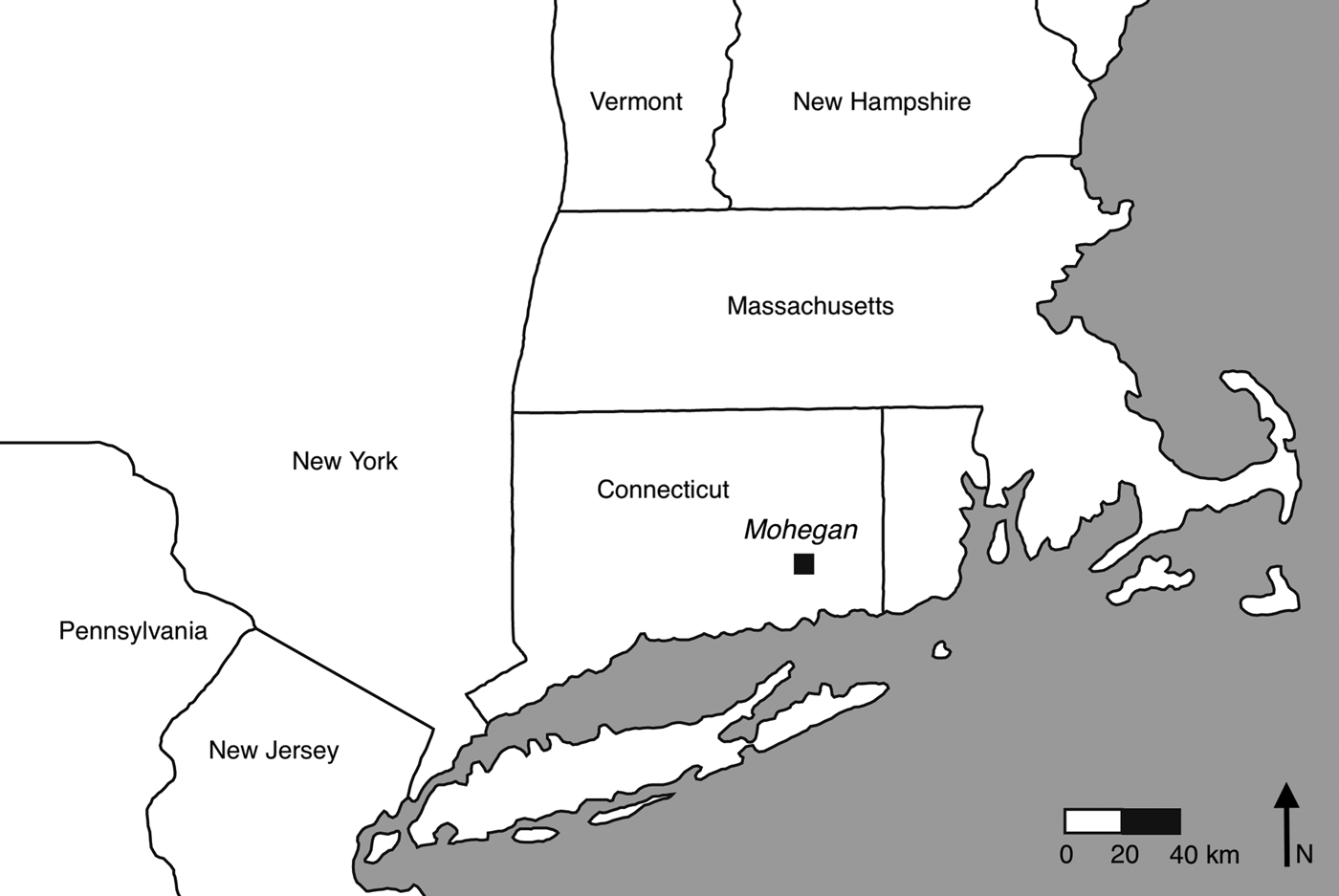
The Mohegan Archaeological Field School is a long-running collaborative teaching and research project run by the Mohegan Tribe of Connecticut in collaboration with a non-Indigenous archaeologist (Cipolla and Quinn Reference Cipolla and Quinn2016; see also Bendremer and Thomas Reference Bendremer, Thomas and Silliman2006). The project currently focuses on eighteenth- and nineteenth-century households on the Mohegan Reservation in Uncasville, Connecticut (Figure 1). Through the study of such sites, the field school seeks to both teach via and conduct research on collaborative Indigenous archaeology. There is particular interest in the ways in which this diverse form of archaeology integrates Indigenous knowledge, sensitivities, and interests (Cipolla Reference Cipolla2017a). The project seeks to help train a new generation of students who are aware of—and sensitized to—efforts to decolonize archaeology. A related goal is to expand and diversify archaeology's audience and community of practitioners so that it includes more Indigenous perspectives and participants.
Map of New England showing the location of the Mohegan Reservation. Map by Craig N. Cipolla.

Each summer that we run the field school, questions related to the relationship between Indigenous knowledge, archaeological theory, and interpretation present themselves as we discuss readings, interpret features and artifacts, and plan future work. In this article, we—the current leaders of the Mohegan Archaeological Field School—explore how we think through such questions. On occasion, other archaeologists have explored similar themes (e.g., see Bruchac Reference Bruchac, Wobst and Smith2005; Colwell-Chanthaphohn Reference Colwell-Chanthaphohn and Hodder2012; McNiven Reference McNiven2016), but few examine these issues in the context of specific collaborative relationships. For us, the best way to consider the impact of collaboration on archaeological interpretation and theory is to engage in long-term dialogue and to coauthor publications like the present article. To respect the different views, orientations, and ontologies that are part of our collaboration, below we occasionally separate our authorial voices.
The diversity of this collaboration and coauthorship provides a unique opportunity to discuss, debate, and compare multiple perspectives on research and teaching at Mohegan. As with our conversations in the woods, the present project takes shape from the convergence of multiple perspectives, some of which overlap and intersect.
The first author, Craig Cipolla, is not Indigenous; he is a descendant of settler-colonists and has practiced collaborative archaeology in New England for 15 years, directing the Mohegan Archaeological Field School in partnership with the Mohegan Tribe for the past eight years. For him, this work offers new perspectives on his own general heritage as a settler colonist, including his role in the discipline of archaeology. The second author, James Quinn, is a Mohegan tribal member and a descendant of the Tantaquidgeon family, a prominent Mohegan family who have long played an integral role in the preservation of the tribe's heritage (see Fawcett Reference Fawcett1995, Reference Fawcett2000). He is the Mohegan tribal historic preservation officer (THPO) and archaeology program manager and has worked in the tribe's archaeology program for over a decade. Quinn sees the project's focus on colonial sites as a valuable learning experience, through which he has opportunities to gain new, detailed information about the struggles faced by his ancestors (cf. McNiven Reference McNiven2016:32–33). For him, this work provides great insight into how his ancestors adapted to an ever-changing world of settler-colonialism while holding on to certain traditions. The third author, Jay Levy, is an Indigenous person from Colombia who grew up with the Indigenous people of New England (Levy Reference Levy2017). He has worked in the Cultural Department of the Mohegan Tribe for 19 years. For Levy, the project allows him to ask questions about the complicated relationship between oral history and archaeology of the eighteenth and nineteenth centuries. Archaeological sites provide detailed information on how traditions evolved, what practices and beliefs were potentially kept silent to protect their value, and how different groups and cultures influenced one another through trade and interaction.
Below, we concentrate on four themes: 1) how we know the past, 2) how we define archaeological data, 3) how we frame humans and their relations to the world around them, and 4) how we understand and value shared aspects of our histories and worlds. In exploring these themes and their connection to the broader process by which Indigenous-led and collaborative work serves to remake archaeology, it is important to emphasize a commitment to exploring multiple meanings (Atalay Reference Atalay, Habu, Fawcett and Matsunaga2008) and ontologies (Harris and Robb Reference Harris and Robb2012). Just as there is a diversity of archaeological approaches to the past (e.g., human behavioral ecology versus new materialisms), there is a diversity of Indigenous orientations to archaeology. Some Indigenous peoples accept aspects of archaeology, while others reject it outright. For this reason, we largely restrict our discussion to collaborative archaeological research and teaching at Mohegan. Despite its specificity, however, the discussion should resonate with archaeologists interested in collaborative, community-based, and Indigenous research and teaching. Very little work in this area compares collaborative Indigenous archaeological frameworks with key themes in contemporary archaeological theory. Unlike most publications in collaborative Indigenous archaeology, we move beyond issues of praxis, consultation, and research design (see Cipolla and Quinn Reference Cipolla and Quinn2016) to consider the potentially deep impacts that collaborative Indigenous archaeology has on archaeological theory. As Chip Colwell-Chanthaphohn (Reference Colwell-Chanthaphohn and Hodder2012:274) wrote, “The transformation of Indigenous peoples from objects of study to participants of study of their own past has contributed to archaeology's theoretical agenda.” We agree fully with this point and seek to further explore the theories that inform and emerge from collaborations.
Collaborative Indigenous Archaeology and Theory
Drawing on the vast literature on the topic and his first-hand experiences collaborating with Indigenous Australians, Ian McNiven (Reference McNiven2016) recently described a potential theoretical agenda for Indigenous archaeology. Central concerns of Indigenous archaeologies include issues related to praxis, colonialism, politics, ethics, and repatriation (e.g., Atalay Reference Atalay2012; Colwell-Chanthaphohn Reference Colwell-Chanthaphohn and Hodder2012; Colwell-Chanthaphohn and Ferguson Reference Colwell-Chanthaphohn and Ferguson2008; Nicholas Reference Nicholas2010; Nicholas and Andrews Reference Nicholas and Andrews1997; Silliman Reference Silliman2006; Watkins Reference Watkins2000). Archaeological theory has received considerably less attention (although see Atalay Reference Atalay, Habu, Fawcett and Matsunaga2008; Colwell-Chanthaphohn Reference Colwell-Chanthaphohn and Hodder2012; Silliman and Sebastian Dring Reference Silliman, Sebastian Dring and Silliman2006). This dearth in the literature is understandable because Indigenous archaeologies take shape from a diversity of participants, including Indigenous practitioners and students who may not find the latest literature in archaeological theory accessible or meaningful. This is one of the many challenges of collaborative archaeology but not one that is entirely insurmountable. In our view, the more that participants respectfully engage with one another, the better. Such engagements undoubtedly take time, patience, and trust. In this regard, we recognize the good fortune of the Mohegan project. With its own THPO and archaeology department, the Mohegan Tribe has a full-time staff of archaeologists and preservationists involved in every aspect of research and teaching. This means we have the time and resources to engage in intense discussions that cut to the level of theory.
These discussions show us that recent debates in archaeological theory (see Cipolla Reference Cipolla and Cipolla2017b), particularly those related to post-human critiques and ontological concerns (e.g., Harris and Cipolla Reference Harris and Cipolla2017), articulate productively with Mohegan archaeology. The same might be true for many other Indigenous archaeology projects. Métis anthropologist Zoe Todd (Reference Todd2016) pointed to this close and often overlooked connection between recent post-human turns in anthropology and Indigenous knowledge. Todd began her critique of the academic structures that encourage practitioners to readily cite Western philosophers instead of Indigenous thinkers with a personal anecdote about attending a lecture by Bruno Latour. Not far into the presentation, Todd recognized distinct parallels between the ideas Latour discussed and an Inuit concept (i.e., sila); yet, he cited no Indigenous thinkers. Based on experiences like this one, Todd asserted that practitioners must strive to transform academia by discouraging writers from appropriating Indigenous concepts without giving Indigenous thinkers their due. We fully agree with this point. But we also have interest in understanding better the relationships between Western and Indigenous theories. In regard to Todd's example, we wonder if the theories she referred to (i.e., Latour's versus those of Inuit people) are exactly the same or if there is ground for further comparison.
Though not focused on collaboration, María Nieves Zedeño's work (Reference Zedeño2008, Reference Zedeño2009, Reference Zedeño and Watts2013) offers much in the way of comparing Indigenous worldviews with those of Western thinkers, specifically archaeologists. Her research on Blackfoot and broader Native American ontologies looks at the ways in which Indigenous perspectives on bundles, index objects, and animism, for instance, present challenges to standard archaeological epistemologies and taxonomies. For Zedeño, differences between Indigenous and Western ways of being and knowing begin with a fundamental distinction concerning relations between different entities in the world. Compared with some Indigenous outlooks, Western forms of archaeology tend to frame all entities (including humans and nonhumans) as bounded, stable, and static. This view of the world divides it up in terms of oppositions (Harris and Cipolla Reference Harris and Cipolla2017) that partition nature from culture, individuals from collectives, and humans from everything else. In contrast, some Indigenous people see the world as relational, emphasizing the dense sets of relations that bind things, people, and landscapes together. This perspective challenges Western views that assume a level of stability and boundedness for objects, humans, and landscapes (Zedeño Reference Zedeño2008:367–368, Reference Zedeño2009:409). It is through these relations that such entities change, becoming animate or vibrant by acting together or affecting one another. Zedeño illustrates this point well with her discussion of index objects and bundling, showing how Indigenous understandings of these phenomena challenge standard, taken-for-granted aspects of archaeological method and theory—particularly taxonomy.
In exploring theory in Mohegan archaeology, we also draw influence from Oliver Harris and John Robb's (Reference Harris and Robb2012) recent insights on multiple ontologies. Recognizing the ways in which people have multiple context-dependent ways of being helps archaeologists avoid essentialism and remain open to possibilities for change and dynamism, especially in cases of cross-cultural interaction (Harris and Robb Reference Harris and Robb2012:672; see also Keane Reference Keane2013). Similarly, in his exploration of archaeology's incorporation of Indigenous knowledge and sensibilities, McNiven (Reference McNiven2016) rightly notes that, with efforts to describe different perspectives and ontologies, practitioners must use caution to avoid essentialism (e.g., Said Reference Said1978). Essentialist paths often lead back to rigid, dualistic modes of thought where Indigenous and non-Indigenous are diametrically opposed, along with modern/nonmodern and dynamic/static. Following these insights, it is important to emphasize that both Indigenous and non-Indigenous participants in the Mohegan field school operate via multiple ontologies. This is to say that Indigenous or not, participants tack between various dualistic and relational ways of being and knowing. The field school's ability to work together and discuss archaeology indicates that some of these orientations are highly intelligible if not the same. If we only focus on the similarities or the differences, we lose important nuance, both in the past and in the present.
Keeping the above points in mind, it is still possible to provide a concise summary of what we see as the main differences between collaborative work at Mohegan and more traditional forms of archaeology. Similar to the worldviews discussed by Zedeño (Reference Zedeño2008, Reference Zedeño2009, Reference Zedeño and Watts2013), relations are important at Mohegan. There is a distinct focus on how people, earth, air, and artifacts, for instance, connect through energy flows—both material and spiritual. These connections hang in balance and disruptions have potentially weighty and harmful results. As discussed further below, however, not all relations are equal; relations with certain types of material, like crystal, and certain types of practice, like creation or ceremony, are more powerful or influential than others. The people enmeshed in these relations hold special responsibility to do their part in maintaining balance and equilibrium. Following Levy (Reference Levy2017), we use the term the sacred to refer to the equilibrium of the world, including human relationships with Mother Earth. Humans have the ability to help strengthen or balance out the sacred. This is accomplished by speaking their language, by sharing their oral traditions, by singing their songs, by giving back when they take, and potentially by practicing careful and respectful archaeology. In the context of the Mohegan field school, we pay particular attention to how this balance is threatened by certain archaeological activities, by sharing restricted information with outsiders, and by humans generally forgetting their place in these relations and acting with hubris and self-interest. Below we explore how these views mesh with others in the collaborative context of the field school; we emphasize how these perspectives reshape archaeological theory.
Theorizing the Past
The status and nature of the past as conceived in archaeological circles varies significantly across the field of practitioners. For some, the past is dead and gone. Matthew Johnson (Reference Johnson2010:14) discussed this idea in his excellent introduction to archaeological theory. He provided an illustration of the gulf between past and present, with evidence on one side (including ruins, stones, and sherds) and past processes on the other (including living people, practices, and social dynamics; see McNiven Reference McNiven2016:30). Johnson used the illustration to begin a discussion of how different archaeological theorists wrestled with the problem of bridging the gulf. For other archaeologists, the past is here with us in the present. For instance, certain theorists now call for a move beyond the “representational” fascination that ran amuck in archaeology since the 1990s (Alberti et al. Reference Alberti, Jones and Pollard2012; Olsen Reference Olsen2003, Reference Olsen2012). These critiques often appear under banners such as “symmetrical archaeology,” one part of our field's varied engagement with post-humanist philosophy. In his manifesto for symmetrical archaeology, now over a decade old, Christopher Witmore (Reference Witmore2007) critiqued archaeology's artificial division and opposition of past and present. “Something of the past exists in the material here and now,” he insisted (Witmore Reference Witmore2007:556; emphasis added). He illustrated this point with a fascinating discussion of how Roman road networks of western Europe continue to channel people today. This argument presents challenges to standard notions of the gulf just described and to the “archaeological record,” sometimes conceived of as an archive that objectively and statically awaits human discovery and interpretation. Still others tell us that the past is a foreign country, following novelist L. P. Hartley's quotation, on which historian David Lowenthal (Reference Lowenthal1985) elaborated. Archaeologist Chris Gosden (Reference Gosden, Ferris, Harrison and Wilcox2014:481), for instance, emphasized the importance of treating colonial histories as “made up of a number of intersecting dimensions of strangeness” in which archaeologists must avoid mapping their own sensibilities onto certain peoples while potentially othering “subaltern” peoples as radically different.
As we bring debates and discussions like those described above into conversation with Mohegan sensibilities and knowledges, we find productive tensions and convergences, some that crosscut the Indigenous/non-Indigenous binary that sits at the heart of many collaborative projects. Although we reject the assertion that the past is dead and gone, each of us do so for slightly different reasons. McNiven (Reference McNiven2016:30) emphasized how assertions about the absent past define it primarily in terms of living human bodies, often placing less or no emphasis on other nonhuman and immaterial traces. This view operates on oppositions of past/present, archaeology/archaeologist, data/interpretation, tangible/intangible, and people/world. At Mohegan, we find numerous challenges to these assumed dualisms and thus see the past as with us in the present. Yet, we also find some distinctions between our collaborative approach and the models presented by thinkers like Witmore.
For Quinn and Levy, ancestors and past prayers are still present on Mohegan landscapes. Even an unmodified stone that was used as an offering carries a certain energy. Quinn stresses that Mohegan people often refer to stones as “grandfathers,” especially those stones used in sweat lodges. When used as part of a sweat, hot stones are much more than sources of heat. The stones add an energy to the ceremony that is more than material; it helps elicit visions and guide prayers. Especially in settings such as this, stones are respected ancestors. The stones’ energies come from the past but are still felt, used, and respected in the present and should continue to be felt, used, and respected in the future if we are to maintain the balance and equilibrium discussed above. Archaeological practices in the present can impact the sacred and intercept this energy that we stand to inherit. Removing the stone from Mohegan lands, for instance, could alter its protective energy and have potentially negative impacts on Mohegan people. When the Mohegan speak their language or sing their songs, they reinforce this energy and their connection with the past. This means that what many consider to be the “past” is an active part of daily life on the reservation. As preservationists and archaeologists, Quinn and Levy must consider how their actions will affect Mohegan ancestors who are still with them in the present and who play an active role in their lives. Ancestors remind them to think of more than themselves, and this shapes the ways that they view archaeology. While we do excavate and study archaeological sites, the Mohegan field school also aims to preserve sites so they can guide future generations.
Compared with the views of symmetrical archaeologists like Witmore (Reference Witmore2007), who see the past as primarily emerging from things (i.e., archaeological materials) in the present, Mohegan archaeological frameworks emphasize the connections that archaeological practice and study strengthens between past and present. In the collaborative context, the term “strengthens” (in contrast to “creates”) is important because, for Quinn and Levy, the connections (and the past) are already spiritually present before archaeology begins; for them, archaeology is just another tool—like the songs and language mentioned above—that helps maintain and grow the connection. As described further below, epistemologically, this means that when combined, spiritual and material connections offer new perspectives on the past. Although Cipolla does not approach the archaeology in terms of Indigenous or Mohegan spirituality and metaphysics, his understanding of the past coexists productively with Mohegan perspectives in the field school. One is more material focused, while the other recognizes both spiritual and material connections.
As with the project's diverse composition in the present (Cipolla and Quinn Reference Cipolla and Quinn2016), the eighteenth- and nineteenth-century pasts on which we focus involved more than one type of person bearing a timeless and monolithic culture. Following Gosden's point above, we seek to avoid mapping our own sensibilities onto certain people of the past. This means staying open to learning about different pasts, as well as strengthening and sharpening those connections discussed above. Broad-brush assertions that focus only on the distinctions between Indigenous and Western views—a critique sometimes levied on Indigenous archaeologies—maintain a binary between Indigenous/non-Indigenous (Matthews Reference Matthews2014; see also McGhee's Reference McGhee2008 controversial characterization of Indigenous archaeology). In reality, we find that these different orientations to the past are not limited to any one “type” of person involved in our project. This is because the field school operates in a shared space that makes room for multiple ontologies (cf. Harris and Robb Reference Harris and Robb2012).
Rethinking Data
Several challenges to standard archaeological approaches, including how we define data, arise from the views of the past just described. Archaeological data are conventionally defined through practices that seek out, collect, and study human-modified things (i.e., “artifacts”) and landscape features. Typically, when archaeologists find no evidence of human interventions in the landscapes where they work, they move along and keep looking. In most instances, archaeologists use the term “sterile” to refer to the places that lack visible, materialized human traces. Such places are generally thought of as lacking opportunities through which we can learn as archaeologists (e.g., projectile points for identification or subsurface features to map).
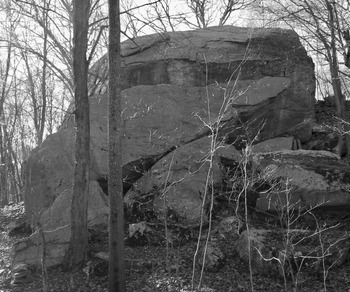
Although certain Mohegan landscapes lack conventional artifacts and features, these “sterile” areas sometimes have things to teach us. This is certainly the case at Cochegan Rock, a well-known Mohegan site (Fawcett Reference Fawcett1995:52, Reference Fawcett2000:21–22). The site sits on a 90-acre parcel of woodland that includes a complex array of archaeological materials and deposits. The most notable and imposing feature of the land is Cochegan Rock, one of the largest glacial erratic boulders in New England (Figure 2). As we worked at Cochegan Rock, several issues with standard archaeological practice and interpretation came to the fore. These began with a rejection of conventional archaeological terminology and led to deeper critiques of standard archaeological epistemologies and ontologies. We completed a shovel test pit survey that covered a minimum perimeter of 50 m around the rock on a 10 m grid, including pits dug in a shelter under the south side of the rock. Altogether, we uncovered a single white ball clay smoking pipe fragment along with debris from the last two to three decades. In standard archaeological terms, we found this part of the landscape to be “sterile.” The rock itself shows evidence of human modification, but these changes likely occurred in the last half century, including modifications by rock climbers and Boy Scouts. In her youth, Gladys Tantaquidgeon (1899–2005), a former Mohegan medicine woman, recalled seeing six stone seats on top of the rock. At the time, the Mohegan elders told her that the stones were former seats of the Mohegan Council (Fawcett Reference Fawcett2000:21). Mohegan oral traditional states that the first Mohegan sachem, Uncas, met with his council on top of the rock in the first part of the seventeenth century (Fawcett Reference Fawcett1995:52). Today, the seats and any traces of them are gone, meaning that the rock too would be considered sterile and unmodified using a standard archaeological rubric.
Cochegan Rock. Photograph by Jay Levy.

In contrast to these absences on and around the rock, we interpret this area as more than sterile. Oral tradition and history tell us that the rock and its surrounding areas were always important for the Mohegan. From this information, it seems that Cochegan Rock has long drawn people to it—including Mohegans and others. For Quinn in particular, the landscape as a whole drew his ancestors there and continues to draw his people there today. In this sense, he does not need archaeology to tell him that those connections existed. He does, however, find value in the ways in which archaeology can contribute information on the nature of past connections. Here, material and spiritual energies come together to shed new light on history. It is within the juxtaposition of oral and written history of the rock, along with the archaeological patterns at the site, where we obtain new information about the past. Oral and written evidence insist on the importance of the place; yet, archaeological survey reveals a lack of artifacts and modifications. Taken together, these different forms of evidence suggest that the rock was an important place for gatherings and possible ceremonies, but these practices did not involve leaving artifacts behind. When archaeology is practiced without communities and without community insights, values, and knowledge, it becomes vulnerable to missing important lessons like this one.
This critique of standard approaches to archaeological data extends beyond human or cultural history. It also concerns the ways in which archaeology segregates cultural and natural histories. We find it useful to rethink how archaeological data cleaves these two categories apart (e.g., Edgeworth Reference Edgeworth2011:21). We draw on an example from archaeological survey techniques employed at Mohegan that problematizes the divide between nature and culture and, by extension, natural history and cultural history. In addition to conventional training in artifact and feature identification, field students and technicians at Mohegan receive training in the identification of local endangered plant species, some of which are medicinal for Indigenous groups of the area. For example, in 2016, Levy noticed a grove of plants, endangered in the state of Connecticut, located directly next to a shovel test pit grid. Some of the plants were medicinal and possibly represented remnant vegetation from past Indigenous land management practices (see Glaza Reference Glaza2003).Footnote 1 Oral tradition tells us that the Little People (see Fawcett Reference Fawcett2000:83–85) use and protect such plants as they watch over the hills at Mohegan. For Levy, these stories offer valuable lessons on how to be human and how to respect the world around us. Levy is always careful to scan for endangered and medicinal plants during the survey phase of archaeological fieldwork. In this case, his team had missed the grove of plants because they completed the pedestrian survey during a time of year when the plants were dormant and therefore much less visible. In the end, the team chose not to dig test pits in the grove to avoid disturbing the sensitive roots systems of the plants and their symbiotic relationship with the surrounding landscape. After the discovery of the grove, the pipe carrier of the Mohegan Tribe visited the site and conducted a plant survey to better assess the area's significance. Quinn aspires to register such locations as he would register standard archaeological sites, allowing the Mohegan Tribe to protect these areas for future generations. In this particular case, the archaeologists learned how they could plan pedestrian and other forms of survey around seasonal rhythms, particularly plant cycles. This is not the same as avoiding fieldwork because of inclement weather. It is about preserving plants that are important and endangered. This means allowing environmental and ecological cycles to shape how and when archaeologists work at Mohegan.
The above example challenges standard archaeological notions of the boundary between nature and culture. Quinn and Levy often point out that the Creator gives people many gifts, including rocks, shells, and plants that remain unmodified or “natural” in standard archaeological nomenclature. Others are modified by people in ways that archaeologists easily recognize. For all authors, this basic division of modified/unmodified denies the deeply entangled status of natural and cultural histories. For Quinn and Levy, all of these gifts (modified or not) carry potential energy—always spiritual but sometimes also material—depending on their association with creation or ceremony. This is because of the connections they share with the world around them, including other powerful, living gifts like the plants discussed above. The plants are important because of the relations that they share with other living beings, including—but not exclusive to—their connections to past people. It is about relationships rather than objects/plants/animals isolated from a landscape or site. Isolated things can lose power once they are extracted from their relationships, especially if they are removed for the wrong reasons. For Levy, if certain gifts are used in ways other than their intended purpose or not left in situ, it could lead to imbalances. Archaeological collection practices are one possible cause of such imbalances. Thus, when we collect archaeological samples at Mohegan, we are careful to do so in a culturally appropriate manner. Following this reasoning, all archaeological materials collected at Mohegan remain on the reservation in the THPO and archaeology facility. As Levy recently wrote, “When we take from it [the land], we always give back. We should never take from the land without giving thanks” (Reference Levy2017:24). When uncovering something that could be culturally significant and carry energy, a tribal representative decides whether to remove it or leave it in situ. If it is removed and separated from the sacred (see above), it could potentially lose its purpose. In the context of the field school, Levy teaches students about the significance of offering tobacco to areas of the land that we disturb by temporarily removing materials and samples deemed archaeologically important.
For the reasons presented here, the term “sterile” does not work for the Mohegan field school. Its use impedes archaeology's ability to understand human histories that do not significantly change the land, and it treats nature and culture as wholly distinct categories. Sterility implies that a place is not historically or culturally important. Within a standard archaeology, a place of sterility may exist for the non-Indigenous archaeologist, who is trained to steadfastly separate culture from nature, but this might not be the case for Indigenous peoples or for practitioners of collaborative Indigenous archaeology (see McNiven Reference McNiven2016:31). For them, a site or landscape may contain connections to Indigenous ancestors in non-artifactual forms, to the natural world, and to the power of the earth (an agent in and of itself, see Cipolla Reference Cipolla2018). While many of these forces could be written off as “natural” in typical archaeologies, some participants in the Mohegan project see them as vital connections that keep the earth, as a living entity, in balance (Levy Reference Levy2017). Here Levy points to the work of Vine Deloria Jr. and his discussion of a Crow Indian chief in the early twentieth century who refused to sell any more of his land, noting that the earth was the dust of the blood, flesh, and bones of his ancestors (Deloria Reference Deloria2003 [1973]:146). For Levy and Quinn, from the beginning of creation through tens of thousands of years of existence until today, the land contains the dust of their ancestors; this presence is both spiritual and material. In addition to this, at Mohegan, it has always been understood that there is a ubiquitous spiritual energy on the land.
We refrain from using the term sterile in our recordation practices. Instead of discussing “sterile” versus “fertile” archaeological landscapes, we discuss our work in terms of what we do on the landscape, usually typifying areas in terms of our collecting and recording practices. When we collect, we avoid categorizing the collected materials as either natural or cultural. When we opt not to collect or record, this decision does not necessarily imply a lack of history or cultural importance in that area. In fact, there have been several instances where we avoided sampling from certain areas because they were important from Mohegan perspectives. These alterations to everyday archaeological terminology and practice allow us to subvert problematic archaeological semantics while challenging some of the dualisms at the heart of a good deal of archaeological method and theory.
Situating Humans
In this article, we challenge several implicit notions operating within and informing standard archaeological approaches. These include ideas that the past is gone because the people who populated it are now absent, and that visible, human modifications to “nature” are the key traces that archaeologists follow and read. Lurking behind these assertions is an Enlightenment-inherited model of what it is to be human. This model often places humans at the center of their world, as unique and remarkable organisms. It also typically glosses over human relations or entanglements with the world (Edgeworth Reference Edgeworth2011; Watts Reference Watts2013). It is to these issues that we now turn, but in so doing, we recognize many other anthropological or archaeological works that deal with the challenges of decentering humans and better understanding their relationality with the world around them. These projects are already underway in many archaeological calls to renounce anthropocentrism and to give things their due (e.g., Olsen Reference Olsen2010). Archaeologists embracing this stance hope to decenter human beings as the only or most important makers of history (as “agents”; cf. Strang Reference Strang2014). They also strive to move beyond approaches to history that artificially separate humans from everything else.
There are clear connections between these arguments and our collaborative archaeological framework at Mohegan. Paralleling some of our thoughts on the culture/nature binary discussed above, these new archaeological approaches target dualistic thinking. Inspired by Todd (Reference Todd2016), we find it pertinent to emphasize that these archaeological lines of thought echo long-standing Indigenous views. Deloria (Reference Deloria2003 [1973]), for instance, compared Christianity with Indigenous viewpoints and found two very different orientations to nature. He noted how Christianity frames people in opposition to nature, whereas many Indigenous perspectives make no such distinction.
According to these viewpoints, humans are not at the center of the world, and they are connected to it through a dense set of relationships. For Quinn and Levy, humans are part of the natural world in that they are vitally linked through the energy discussed above. For some Mohegan people, rocks are “the bones of Mother Earth. … They are the hidden messages that guide generation after generation of those who listen well” (Fawcett Reference Fawcett2000:21). Deloria (Reference Deloria1995:40) wrote of a similar vitality: “The major difference between American Indian views of the physical world and Western science lies in the premise accepted by Indians and rejected by scientists: the world in which we live is alive.” Of course, like the (living) earth, seemingly inert “things” also exhibit their own forms of vitality and vibrancy (e.g., Bennett Reference Bennett2010; DeLanda Reference DeLanda1997; Kohn Reference Kohn2013), characteristics often reserved for living entities—particularly humans.
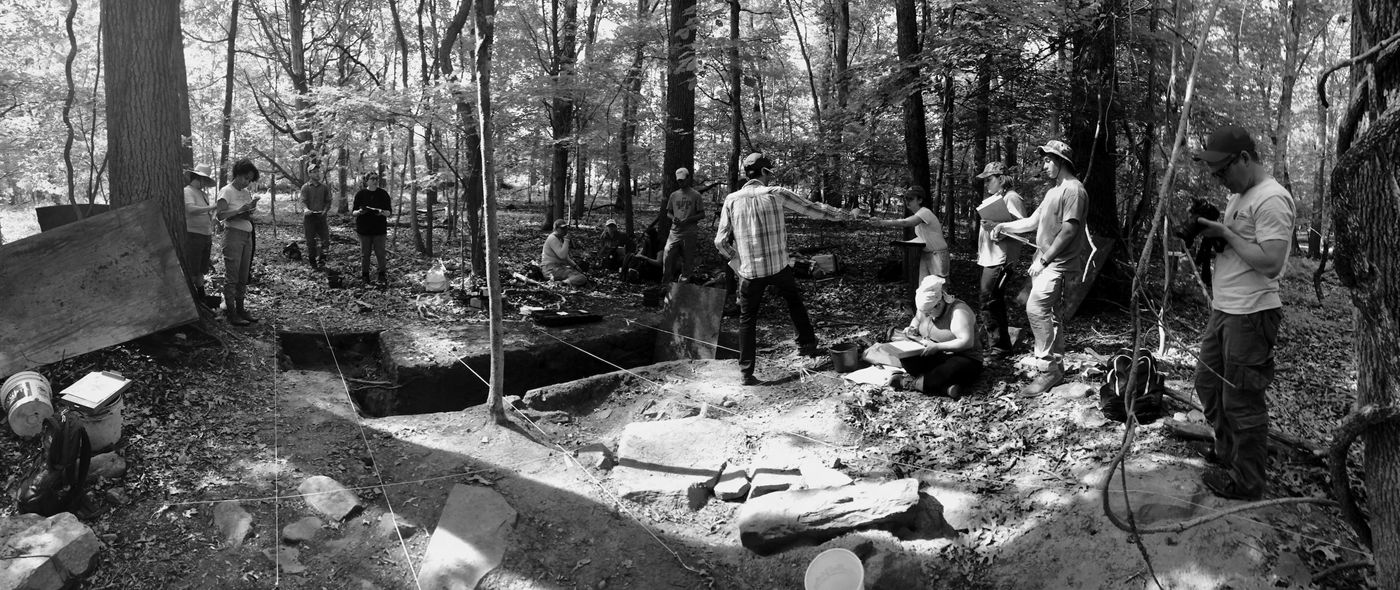
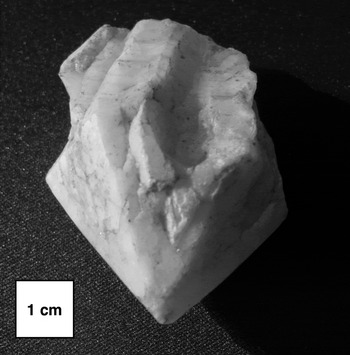
A small collection of quartz recovered from a late eighteenth-century Mohegan household known as the Miller-Fielding site (Figure 3) exemplifies how Enlightenment-inspired models of humanity fall short when it comes to understanding Mohegan archaeology. The assemblage includes four quartz crystals that were almost certainly moved to the site by people in the eighteenth century or later but were otherwise unmodified. All of the crystals were found in direct association with eighteenth-century debris, usually with soil matrices that included eighteenth-century materials capping the quartz both above and below. The largest crystal encountered at the site (Figure 4) was recovered approximately 2 m to the north of the dry-laid stone foundation of the structure. The smallest crystal (Figure 5) occurred on top of the rock-fall layer associated with a destruction event. It is possible that this crystal was deposited after the main structure burned down and collapsed.
The 2017 Mohegan archaeological field school excavating an eighteenth-century Mohegan household site. Ceramics from the site yield a mean ceramic date of 1786; smoking pipe stems from the site yield a date of 1760. Photograph by Kelly Ferguson.

Large quartz crystal uncovered 2 m north of foundation corner. Photograph by Craig N. Cipolla.

Small quartz crystal uncovered on top of foundation rock fall. Photograph by Craig N. Cipolla.

Stephen Mrozowski and his colleagues (Reference Mrozowski, Herbster, Brown and Priddy2009, Reference Mrozowski, Gould, Cipolla and Hayes2015; see also Mrozowski Reference Mrozowski2017) provided a similar example of buried crystals from one of John Eliot's seventeenth-century “Praying Indian” villages in Massachusetts. The archaeologists found crystals buried underneath three corners of what they interpreted as a communal structure. For Mrozowski and colleagues, the crystals showed the ways in which two different spiritual worlds—Eliot's world versus the world of Indigenous Christians living at his settlements—came together in ways that at least some Indigenous occupants saw as perfectly logical. This view almost certainly contrasted sharply with that of Eliot, who would have seen the practice of burying crystals as antithetical to the Christian values he sought to instill through his villages. Ethnohistoric observations of local Indigenous use and value of certain trade objects complement these interpretations. Historians Miller and Hamell (Reference Miller and Hamell1986:316–318), for example, argued that Indigenous trading partners valued mirrors and other glass things because they shared physical properties with crystal and water (i.e., they are reflective). These findings connect with Mohegan knowledge and values related to crystals, discussed next.
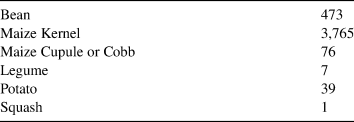
For the Mohegan, quartz has healing qualities and protective energies. It is alive and important for keeping balance in the world. Combining this information with the archaeological finds, we suggest that Mohegan people of the eighteenth century intentionally placed the crystals around the house for protection and balance. The eighteenth century was a time of colonial violence, during which private reservation households, such as the one under consideration, possibly served as some of the only places where Mohegan people felt comfortable enough to engage in traditional practice and ceremony. For Quinn, this site carries a message of what Gerald Vizenor (Reference Vizenor1999, Reference Vizenor and Vizenor2008; ed. Reference Vizenor2008) referred to as “survivance.” Vizenor's work inspires us to merge notions of survival and resistance and to consider all aspects of Indigenous-colonial histories. This means focusing on the assemblage as a whole, not just singling out certain aspects that relate to ancient traditions or that starkly contrast with ideas of Western practices and sensibilities of the time. We must also take seriously the elements at the site that were relatively new to Mohegan people and that were adapted from Europeans and Euro-Americans (Silliman Reference Silliman2009). The European-produced ceramics, smoking pipes, and items of personal adornment, as well as select architectural details, point to change at the site. Yet, the crystals show the maintenance of tradition in certain forms despite colonial violence. When considering the assemblage as a whole, it is possible that the site's occupants used the crystals to protect the contents of a pit feature uncovered directly adjacent to the dry-laid stone foundation. This feature contained an abundance of carbonized corn, beans, squash, and other plant remains (Ferguson Reference Ferguson2016). Corn is by far the most abundant botanical find (Table 1). Mohegan people used corn for subsistence purposes, but it also had spiritual significance for them (Fawcett Reference Fawcett2000:47). In addition to these interpretations, we remain open to the possibility that after the central structure at the site burned down and collapsed, offerings were made. The presence of the small crystal on top of the rock-fall layer supports this interpretation. Here, Mohegan views of crystal combine with archaeological patterns to reveal important perspectives on daily life on the reservation; neither Indigenous knowledge nor Western archaeology could provide this nuanced perspective alone.
Frequencies of Crop Seeds from the Miller-Fielding Site, 2014 Field Season.

Source: Ferguson Reference Ferguson2016:16
These interpretations assume a close and entangled relationship between the site's occupants, crystal, corn, and more. Above, we pointed to the general kinship shared between Earth, stone, and humans for many Indigenous people in the area. For some Mohegan, quartz crystals have the ability to perform in extraordinary ways. Through their relations with humans, crystals at the site potentially helped to protect the area and maintain the sacred. Therefore, humans were not the only history makers and agents at the site. For us, archaeological finds like the crystals carry important lessons in humility. They reveal a world that was recognized as clearly relational and partially out of the hands of the site's human occupants. The crystals illustrate how the site's users emphasized their relations with the world and with nature, not in a hierarchical sense, but on a more even field of play. We see these lessons as important in today's world, which we characterize by staunch beliefs in the “atomic” individual, environmental commodification and exploitation, and intolerance toward diversity and cultural difference.
Shared Histories, Shared Futures
The diversity of our project offers unique viewpoints on the complexities and gray areas (Cipolla Reference Cipolla2013) of Mohegan-colonial historyFootnote 2 and on archaeology's future. One such gray area concerns the roles of European-made material culture in Indigenous-colonial households. For example, the Miller-Fielding site included several wound glass “seed” beads. These beads are well documented at colonial-era sites (see Hayes Reference Hayes1983; Karklins Reference Karklins1985; Kidd and Kidd Reference Kidd and Kidd1970; Sprague Reference Sprague1985; Woodward Reference Woodward1932). Beads of similar shape and color as those recovered from the Miller-Fielding site appeared in New England as early as the 1620s and were in use throughout the eighteenth century (Bradley Reference Bradley and Hayes1983:31–32; Kidd and Kidd Reference Kidd and Kidd1970:52). Although the process used to make and distribute these beads across the globe is well-known, comparatively less is written on how these once-foreign objects (Cipolla, ed. Reference Cipolla2017) became socialized in their new cultural settings. We value these types of questions and use Mohegan households, combined with Mohegan oral tradition and knowledge, to help provide answers.
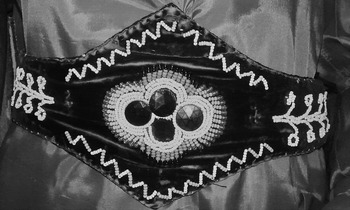
For example, Levy is interested in how bead colors relate to shifting Mohegan preferences and traditions. As shown on many splint baskets from the colonial era (cf. McMullen and Handsman Reference McMullen and Handsman1987), changes in design and color represent changes in lifestyle and land loss. The color of the dyes used on baskets helped to record some of these changes. The color of beads uncovered at archaeological sites might relate to these changes. Beads served decorative purposes, but they were also used to express religious perspectives. A beaded belt (ca. 1770; Figure 6) owned by a Mohegan woman named Martha Uncas illustrates this point. The belt includes imagery pertaining to the sacred, including the tree of life, a spiritual entity that connects one generation to the next. Its roots are embedded in the earth, which contains the bodies of ancestors, and its branches reach into the sky, toward future generations (Fawcett Reference Fawcett1995:37). As noted earlier, archaeological sites at Mohegan provide information on practices, beliefs, and materials potentially kept out of sight of colonial observers. As with the belt, the beads might have helped to covertly express or record traditional beliefs through their colors.Footnote 3
Martha Uncas's beaded belt, showing the tree of life motif. Photograph by Jay Levy.

Equally important to these novel perspectives on settler colonialism are the insights that the project offers on the discipline of archaeology itself. In comparing our respective orientations and understandings of the discipline, we learn valuable lessons. Perspectives on archaeology discussed in the field school are certainly not radically different or mutually unintelligible. We all agree, for instance, that archaeology is flawed but worth improving. Those differences that do exist, however, serve as important teaching and learning tools. For instance, participants in the field school benefit from learning about different Mohegan perspectives on—and experiences with—archaeology and archaeological collecting practices of the recent past. Conversations between Indigenous and non-Indigenous participants about improving and transforming the discipline are important factors to consider before archaeology slips too far into ontological projects in search of radical difference (e.g., Alberti Reference Alberti, Hallam and Ingold2014; Alberti and Marshall Reference Alberti and Marshall2009; Descola Reference Descola and Lloyd2013; Viveiros de Castro Reference Viveiros de Castro2015). In emphasizing radical and exotic differences (Cipolla Reference Cipolla and Cipolla2017b), such arguments run the risk of overlooking shared aspects of the worlds that come together in collaborative archaeology.
Conclusions
Since Indigenous-led research and collaboration are methods that could potentially reshape the discipline, we argue that theoretical issues like those explored in this essay are important areas of reflection for collaborative Indigenous archaeologies. The potential for remaking is greatly amplified when archaeologists strive to move beyond simply seeking approval from Indigenous communities or consulting with them. Deep collaborations such as the project we describe at Mohegan transform many aspects of the archaeological process and cut to the bedrock of the discipline. For these reasons, we suspect that theory is very much alive in collaborative Indigenous archaeology.
Collaborative Indigenous archaeology fosters important dialogue and debate, often kindled by the meeting of Indigenous perspectives with the underlying modernist, Eurocentric sensibilities that undergird archaeological thought and practice. These sensibilities are typically cloaked as universal and timeless (i.e., default). As Harris and Cipolla (Reference Harris and Cipolla2017:3) recently stated, for them, archaeology's power comes from its ability to “grab the assumptions you hold dearest and shake them until they fall apart.” Comparing them with the Eurocentric sensibilities we aim to shake, Indigenous traditions and worldviews are often framed in a similar light (see Deloria Reference Deloria2003 [1973]); they are often couched as timeless and monolithic. Collaborative work involves challenging these essences and exploring nuances through respectful dialogue. The value of collaborative dialogue and debate for archaeological practice and being lies in the ways in which they serve to help identify the arbitrariness and challenge the timelessness of the “default” sensibilities that we inherit from our world. Thus, a major challenge that emerges out of collaborative archaeology concerns how to balance and represent the similarities and differences between collaborators. In this article, we showed the synergies of collaborative Indigenous archaeology at Mohegan and outlined the ways in which the collaborative whole is greater than the sum of its parts. For us, this means that the archaeology we practice together and the pasts that emerge out of our collaboration would not be the same as the archaeologies or pasts that would emerge with any one isolated group doing the archaeology (cf. Atalay Reference Atalay, Habu, Fawcett and Matsunaga2008). The collaborative whole transforms its component parts in interesting and important ways. This is not to say, however, that these relational transformations take away the differences between parts. The component collaborators are not fully determined by the relationships that they share with one another (DeLanda Reference DeLanda2016:88). With interest in emphasizing what is new about collaborative Indigenous archaeology, practitioners occasionally frame cultural differences in essentialist terms. While monolithic statements such as these certainly serve a purpose, they also run the risk of reducing the complexities of collaboration and of the complicated archaeological histories that we study at places like Mohegan. We showed that there are differences between us, but we did so by speaking and writing together, demonstrating that we do not occupy radically different worlds that are mutually unintelligible. Differences remain, but we occupy a world in which we can productively discuss theory and the future of our discipline.
Acknowledgments
All archaeological research reported on in this article was conducted with the consent of the Mohegan Council of Elders and in collaboration with the Mohegan THPO. Funding for this research was provided by the Mohegan Tribe, the DCB Research Grants Fund through the Royal Ontario Museum, the Wenner-Gren Foundation (grant 9401), and the Institute for Field Research. We thank Amélie Allard for generously translating our abstract. We are also grateful to Lynn Gamble, Maria Nieves Zedeño, and two anonymous reviewers for offering excellent advice on how to improve the manuscript. We offer special thanks the Mohegan Tribe, colleagues in the Mohegan THPO and field school, our students and field technicians, and our families.
Data Availability Statement
All data reported on in this article are housed at the Mohegan THPO.