Do nuclear weapons offer coercive advantages in international crisis bargaining? Scholars and policymakers have long maintained that nuclear weapons can deter aggression by dissuading adversaries from taking actions that might invite retaliation. Yet there has been comparatively little discussion about whether nuclear weapons help states compel their adversaries to make concessions or change their behavior.Footnote 1 Are nuclear weapons useful tools of compellence?
An increasingly common view asserts that nuclear weapons enable states to make more effective compellent threats in international crises.Footnote 2 The basic logic is straightforward: because nuclear states have the ability to impose extraordinary levels of punishment, they can more easily intimidate crisis opponents into submitting to their compellent demands. States with a nuclear advantage over their adversaries are particularly well-positioned, in this view, because they can afford to escalate further and run a higher risk of conflict than their nuclear-inferior (or nonnuclear) opponents. Moreover, this advantage is thought to persist even when coercers do not explicitly threaten nuclear attack. The mere possession of nuclear weapons is believed to cast a coercive shadow over crisis bargaining whenever a nuclear state issues a threat, even if nuclear weapons are never mentioned. In short, according to this logic, compellent threats are more likely to succeed when they come from nuclear-armed states.
We argue that this view misunderstands the utility of nuclear weapons in crisis bargaining. As instruments of compellence, nuclear weapons have two important limitations. First, nuclear weapons are not very useful for taking and holding territory or other disputed objects. They therefore do not enhance a state's ability to simply seize possessions that a target refuses to relinquish. Second, the costs of imposing nuclear punishment for reasons other than self-defense likely would be high. A state that used nuclear weapons to punish a recalcitrant target would risk an international backlash, with potentially serious military and economic consequences. The possession of nuclear weapons therefore is not likely to bolster the effectiveness of a challenger's compellent threats.
Using a new data set of more than 200 militarized compellent threats,Footnote 3 we evaluate whether nuclear-armed states are more likely to make successful threats than nonnuclear states. Our analysis finds that nuclear weapons carry little weight as tools of compellence. We find that states possessing nuclear weapons are not more likely to make successful compellent threats, even in high-stakes crises. While nuclear weapons may provide leverage in a deterrent context, these effects do not extend to compellent threats.
Our study attempts to remedy two important limitations of existing literature on nuclear coercion. First, many studies examine nuclear states only, while mostly ignoring nonnuclear coercers. Such “no-variance” research designs cannot answer a central question in the study of nuclear coercion: namely, whether possessing nuclear weapons is comparatively better (from a coercive standpoint) than not possessing them. Second, studies of nuclear compellence have been constrained by a lack of appropriate data. Quantitative studies in particular tend to employ data sets that conflate crisis victories achieved by coercive diplomacy with those achieved by brute force. These studies therefore tell us little about whether coercive threats issued by nuclear states are more effective. Our research design aims to correct these problems by employing a data set that includes both nuclear and nonnuclear challengers and codes coercive—rather than military—crisis outcomes.
The analysis proceeds as follows. First, we review the dominant school of thought on the compellent effects of nuclear weapons and develop our theory about why nuclear weapons might be able to deter but not compel. Second, we discuss the inferential limitations of existing research on the subject. The third section describes our research design, data, and variables. Fourth, we present empirical tests, using a variety of probit models to evaluate the compellent utility of nuclear weapons. Finally, we discuss potential objections and explore the implications of our findings.
Compellent Threats and the Bomb
The coercive utility of nuclear weapons has been the subject of contentious debate for several decades. Since the beginning of the nuclear age, scholars and policymakers have debated whether nuclear weapons might allow states to compel adversaries to make concessions that they otherwise would not make. The debate continues today, as policymakers speculate whether nascent nuclear states such as Iran will be able to bully their neighbors if they acquire nuclear weapons.
A Looming Shadow
Nuclear weapons are the most destructive weapons known to man. The prospect of facing an attack with nuclear weapons therefore ought to be sobering for any leader engaged in a diplomatic confrontation. This basic logic underlies a common perspective on nuclear weapons and compellence: that a leader faced with a coercive threat is more likely to capitulate peacefully if the adversary has nuclear weapons at its disposal.Footnote 4
The view that nuclear weapons can compel as well as deter has been pervasive among U.S. policymakers throughout the nuclear era.Footnote 5 Prior to negotiations with the Soviet Union at the end of World War II, for example, officials in the administration of President Harry S. Truman expressed confidence that the Soviets would have little choice but to acquiesce to the United States because of its atomic monopoly.Footnote 6 Presidents Truman and Dwight D. Eisenhower also believed that nuclear weapons had helped the United States compel the Soviet Union and China to make concessions during crises in Azerbaijan and the Taiwan Strait.Footnote 7 More recently, this view has emerged in policy discussions about the effects of nuclear proliferation: President George W. Bush, for example, warned that adversaries such as Iran, Iraq, and North Korea would be able to “blackmail” the United States and its allies if they obtained nuclear weapons.Footnote 8
The compellent effects of nuclear weapons are thought to be particularly powerful when nuclear capabilities are one-sided—that is, when a challenger possesses nuclear weapons but the target does not. Since the target cannot threaten nuclear retaliation in response to the threat, it cannot match the challenger's bargaining leverage. When a nuclear-superior state issues a compellent threat, the logic goes, it will be more likely to prevail because it can escalate with impunity until the adversary submits.
Some empirical evidence appears to support the notion that nuclear states can more easily compel their adversaries during crises. Betts and Trachtenberg each investigated several Cold War crises and found that nuclear superiority was associated with—although did not clearly cause—coercive success.Footnote 9 Snyder and Diesing reached a similar conclusion, finding “some empirical grounds” to believe that nuclear weapons convey a coercive bargaining advantage.Footnote 10 And a recent quantitative study found that the simple possession of nuclear weapons helps states “win” crises more often.Footnote 11
An important aspect of this view is that nuclear states possess a coercive advantage even when they do not make explicit nuclear threats. Indeed, the use of nuclear weapons has rarely, if ever, been threatened explicitly in conjunction with a compellent threat.Footnote 12 Yet many scholars argue that nuclear weapons exert implicit crisis bargaining leverage even when they are not invoked. Kissinger, for instance, warned in 1956 that “overt threats have become unnecessary; every calculation of risks will have to include the Soviet stockpile of atomic weapons and ballistic missiles.”Footnote 13 Beardsley and Asal recently argued along similar lines, asserting that “the possession of nuclear weapons helps states to succeed in their confrontations with other states even when they do not ‘use’ these weapons.”Footnote 14
What are the testable implications of these arguments? One hypothesis is straightforward: compellent threats from nuclear states will succeed more often because of the looming shadow of nuclear punishment.
H1A: Compellent threats from nuclear states are more likely to succeed, on average, than compellent threats from nonnuclear states.
A second hypothesis is more qualified, suggesting that the compellent leverage of a nuclear arsenal will be neutralized if the target also possesses nuclear weapons.
H1B: Compellent threats from nuclear states are more likely to succeed, on average, than compellent threats from nonnuclear states only if they are issued against nonnuclear states.
The Futility of Nuclear Blackmail
This research note argues that beliefs about the coercive utility of nuclear weapons are misguided. Even if nuclear weapons might be effective for defending against threats to national survival, they generally are not useful for compelling adversaries to relinquish possessions or change their behavior. Nuclear weapons have two inherent limitations as tools of compellence.
First, nuclear weapons are not useful for seizing objects. Compellent threats often center on disputed cities and territories that a challenger seeks to obtain from the target state. Coercive demands for these objects would be more effective if the challenger could threaten to seize the item by force, since the target might decide to forgo costly fighting if it expects to lose the object anyway. Nuclear weapons, however, contribute little to a challenger's ability to seize possessions.Footnote 15 Although nuclear weapons can destroy enemy forces that stand in the way of an invading military, an offensive nuclear attack could destroy the very object that prompted the dispute in the first place. It is implausible, for example, that Pakistan would try to seize Kashmir by launching an offensive nuclear strike against Indian forces there, since the attack itself would likely kill thousands of Muslims and render large swaths of the region potentially uninhabitable. Except in rare conditions, it will be difficult for a nuclear state to use its arsenal to physically wrest away an item that the target refuses to relinquish.
Instead, a nuclear state might hope to coerce a target by threatening to attack the target's valued possessions. A challenger could threaten to incinerate a target state's capital city, for example, unless it relinquished a disputed territory. But this possibility highlights a second limitation of nuclear weapons: the costs of executing nuclear punishment likely would be tremendous. A state that launched a nuclear attack to achieve compellent objectives would provoke an international backlash, potentially triggering economic sanctions and international isolation, encouraging nuclear proliferation, and provoking other states to align against it.Footnote 16 Faced with such costs, crisis challengers will find it difficult to threaten nuclear punishment credibly except under extreme circumstances.
This is not to say that nuclear threats can never be credible: a state facing imminent conquest, for example, probably would be willing to pay the costs of inflicting nuclear punishment in order to defend itself. Nuclear deterrent threats therefore may be credible, particularly when one's survival is at risk. For compellence challengers, however, the stakes are so rarely high. Instead, the objective of compellent threats typically involves a disputed piece of territory, reversal of an unfavorable policy, payment of reparations, or another issue that the challenger considers valuable but not vital to its survival. Indeed, the fact that the challenger has already lived without the item for some period of time suggests that it could continue to do so, even if it would rather not.Footnote 17 A challenger's willingness to launch a costly nuclear attack in support of a compellent demand thus is likely to be in doubt.
Indeed, in the vast majority of crises, the possibility of nuclear attack is not even mentioned by leaders. Scholars have observed a strong inhibition among government officials against even the suggestion of nuclear escalation, especially in the United States.Footnote 18 When the United States threatened Serbia over ethnic cleansing in Kosovo in 1999, for instance, no senior U.S. official (to our knowledge) suggested that the use of nuclear weapons might be considered if Serbia did not comply. It strains credulity to suggest that the United States was implicitly “bidding up” the risk of nuclear war during the crisis simply because it possessed nuclear weapons.
Several empirical studies appear to support the view that nuclear weapons add little clout to compellent threats. In 1984, Bundy reviewed the U.S. record of “atomic diplomacy” and concluded that it was surprisingly poor. In his view, nuclear superiority did not even contribute to the success of U.S. compellent threats in the Cuban missile crisis, during which he had served as national security adviser. Indeed, Bundy echoed the views of several other participants in that crisis, who argued that “the Cuban missile crisis illustrates not the significance but the insignificance of nuclear superiority.”Footnote 19 Halperin's Reference Halperin1987 review of nineteen U.S. crises reached a similar conclusion, finding that “nuclear weapons have never been central to the outcome of a crisis.”Footnote 20 Some recent quantitative evidence also suggests that nuclear states are no more likely to win interstate crises once one accounts for such factors as conventional military power and the balance of interests.Footnote 21
In sum, the theory outlined here suggests that nuclear weapons provide challengers with little, if any, additional compellent leverage in crises.
H2: Compellent threats from nuclear states are no more effective, on average, than threats from nonnuclear states.
Inferential Problems in Existing Studies
The vast literature on nuclear coercion has contributed tremendously to our understanding of the potential coercive dynamics of nuclear weapons. However, empirical studies of nuclear coercion share two important limitations.
Indeterminate Research Designs
A common approach to evaluating the effectiveness of nuclear coercion is to conduct in-depth case studies of crises in which nuclear weapons appeared to play a significant role. Bundy, Betts, Halperin, and Trachtenberg, for example, all consider Cold War crises—almost always involving the United States—in which the use of nuclear weapons was threatened or discussed.Footnote 22 While these studies reach different conclusions, their methodological assumption is the same: to understand the political effects of nuclear weapons, we must focus our attention on nuclear crises.Footnote 23 Yet this kind of research design cannot adequately test the hypotheses described earlier, for three reasons.Footnote 24
First, an exclusive focus on nuclear crises does not allow us to generalize about the relative benefits of nuclear possession. In other words, this approach cannot tell us whether coercive threats from nuclear states are more effective, on average, than threats from nonnuclear states. Without first establishing a nonnuclear basis for comparison, we cannot ascertain whether nuclear possession conveys an advantage during crisis bargaining.
Second, many studies of nuclear coercion focus on high-profile crises—in other words, crises that resulted in wars, war scares, or otherwise became protracted affairs. The problem is that these also tend to be crises in which threats were not very successful, because successful threats ideally would have brought these crises to an end before they escalated and captured public attention. Studying only well-known crises might therefore cause unsuccessful threats to be overrepresented in the study sample, in turn biasing the results toward the conclusion that nuclear weapons cannot compel.
Third, studies of nuclear compellence often emphasize episodes in which nuclear weapons appeared to play a prominent role, either because nuclear forces were alerted or because leaders or the media hinted at the possibility of nuclear attack. Yet many scholars argue that the coercive value of nuclear weapons in crises persists even when their use is not explicitly threatened. Studying only crises in which nuclear weapons appear to have been invoked therefore might not offer an adequate measure of their utility.
Inappropriate Quantitative Data
A more recent development in the study of nuclear coercion is the use of quantitative data to ascertain the effects of nuclear weapons on crisis outcomes. For example, several studies have used the International Crisis Behavior (ICB) data set to evaluate whether nuclear states win crises more often than nonnuclear states.Footnote 25 Recent research, however, has revealed several problems with these data sets, calling into question their appropriateness for studying nuclear coercion.
First, the most commonly used quantitative data sets in the study of nuclear coercion do not actually contain many coercive threats. A recent analysis found that roughly 84 percent of the crisis observations in the ICB data set do not contain coercive threats.Footnote 26 The Militarized Interstate Dispute (MID) data set, also commonly used to evaluate crisis outcomes, fared even worse: the same analysis found that barely 10 percent of the disputes in the MID data set contain threats.Footnote 27 Instead, most episodes in these data sets revolve around trespassing fishing boats, minor border clashes, and other trivial events in which no coercive diplomacy was attempted. For example, the ICB data set lists the 1964 Congolese hostage crisis as a victory for the United States because Belgian paratroopers used U.S. military transports to rescue hundreds of civilians taken captive by Congolese rebels.Footnote 28 The data set also lists the crisis as a defeat for the Soviet Union because the Soviets publicly denounced the rescue operation. Quantitative models using the ICB data set therefore consider this a case of one nuclear state achieving “victory” over another.Footnote 29 This interpretation, however, is misleading. The United States did not coerce the Soviets in any way during this crisis: the United States did not make any threats and the Soviets did not make any concessions. The case therefore has little relevance for theories of nuclear coercion. Unfortunately, because the ICB and MID data sets do not identify which cases contain coercive threats, researchers studying nuclear coercion cannot readily exclude (or recode) such cases in their empirical analyses.
Second, these data sets often conflate military and coercive outcomes. In other words, they do not distinguish between victories achieved by brute force from those achieved through successful coercive diplomacy. For instance, the MID and ICB data sets code the 1991 Gulf War as a “crisis victory” for the United States and its coalition partners on the grounds that the U.S.-led coalition ultimately won the war. Yet the compellent threat associated with this crisis was a clear failure: the U.S. ultimatum demanding Iraq's evacuation from Kuwait was rejected, thus prompting the war in the first place. This case—like dozens of other military victories in these data sets—should not be classified as a success for coercive diplomacy because the central purpose of making a threat is to achieve one's objectives without large-scale military action. As Schelling has noted, “successful threats are those that do not have to be carried out.”Footnote 30 With so many military victories coded as successes, it is unclear whether these data sets can tell us anything about the effectiveness of coercive threats.Footnote 31
Research Design
We address these inferential problems by using a new data set to evaluate the comparative effectiveness of threats made by nuclear-armed states. The Militarized Compellent Threats (MCT) data setFootnote 32 contains information about 210 interstate compellent threats—that is, episodes in which one or more challengers issued a compellent demand against a target and threatened to use force if it did not comply—comprising 242 challenger-target dyads overall.Footnote 33 The data set, which spans the years 1918 to 2001, contains both well-known superpower crises (for example, the 1956 Suez crisis), as well as lesser-known disputes between small states (for example, the 1995 Hanish Islands crisis between Eritrea and Yemen). Likewise, it includes crises in which nuclear weapons seemed to play a central role (for example, the Cuban missile crisis) as well as episodes in which the possibility of nuclear attack was never mentioned (for example, the 1993–94 Bosnian crises).
The structure of the MCT data set helps resolve the two inferential problems described here. First, each case in the data set contains a compellent threat, defined as a demand to change the status quo that is backed by the threat of military force.Footnote 34 Episodes in the MCT data set have two components: a coercive demand and a threat to use military force. While threats to use force are often transmitted verbally, they may also be communicated implicitly through militarized actions such as troop maneuvers or exercises. Both varieties are included in the MCT data set. However, the data set excludes military clashes and raids in which coercive demands were not made. It therefore allows us to distinguish coercive diplomatic successes from military victories.
Second, the MCT data set is not restricted to nuclear crises only; it contains threats made by nuclear and nonnuclear challengers alike. This variation is essential because it allows us to answer a central question in the study of nuclear coercion: do nuclear challengers succeed more often than nonnuclear challengers? Studies that examine nuclear crises alone cannot answer this question because they have no baseline against which nuclear states can be compared. The research design employed here corrects this omission, thus allowing us to draw inferences about the relative benefits of nuclear possession.Footnote 35
The dependent variable in our analysis measures the target's level of compliance with the challenger's demands. compellence success is a dichotomous variable that is coded 1 if the target voluntarily complied with all demands of the challenger and the challenger did not have to use military force to achieve its desired outcome; the variable is coded 0 otherwise. We observe success in roughly 30 percent of the compellent threats in the data set, suggesting that successful compellent threats are quite common, even if compellence is indeed “harder” than deterrence.Footnote 36
Measuring Nuclear Possession
We use three primary independent variables to evaluate the empirical relationship between nuclear possession and successful coercive diplomacy. The dichotomous variable nuclear challenger is coded 1 if the challenger in a dyad possesses at least one nuclear weapon in a given year, and 0 otherwise.Footnote 37 However, as H1B notes, the coercive advantages of nuclear possession might diminish if the target is also a nuclear power. To test this conditional hypothesis, we include the dichotomous variable nuclear target and the interaction term nuclear challenger × nuclear target.
Control Variables
We control for several confounding factors traditionally emphasized in the literature on coercive diplomacy and international conflict.Footnote 38 First, states that possess superior levels of conventional power might have an easier time coercing their adversaries, regardless of whether they possess nuclear weapons. To control for this possibility, the variable capability ratio measures the proportion of nonnuclear material capabilities controlled by the challenger in each dyad.Footnote 39
Second, many scholars emphasize the importance of relative stakes in explaining crisis outcomes. States with critical interests at stake in a dispute should be more tolerant of costs and less likely to back down without a fight. Specifically, issues related to territory and leadership tend to be more important to states than matters of policy and ideology. Challengers therefore might have a harder time succeeding when they demand disputed land or regime change, compared to threats over trade policy or other comparatively minor issues. stakes is a dichotomous variable that is coded 1 if the challenger made a demand over territory or leadership, and 0 otherwise.
Third, signals of resolve during a crisis could improve a threat's credibility. resolve is a dichotomous variable that is coded 1 if the challenger employed demonstrations of force or conspicuous military mobilizations during a threat episode, addressing the possibility that challengers who aggressively signal their willingness to use force are more likely to prevail.Footnote 40
Finally, the history of conflict within a dyad could influence coercive diplomacy outcomes. Frequent militarized disputes could suggest highly contested, unresolved issues between states, implying that threats over these issues will be less likely to succeed. Thus, we include the variable dispute history, which measures the total number of militarized interstate disputes that the challenger and target experienced over the previous fifteen years.Footnote 41
Method
We employ probit regressions designed to estimate the probability that a compellent threat will succeed. Some country pairs—such as the Soviet Union and China—are included in the MCT data set multiple times, which could artificially deflate the estimated standard errors due to interdependence among cases. We address this potential problem by using robust standard errors clustered by dyad.
Empirical Findings
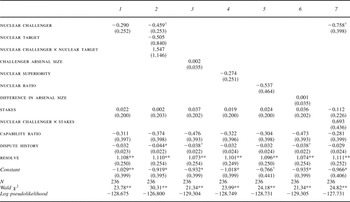
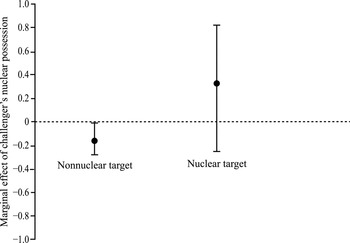
Is nuclear possession correlated with successful coercion? Table 1 contains the results of multivariate statistical tests designed to estimate the effect of nuclearpossession on compellent threat outcomes. The statistically insignificant coefficient for nuclear challenger in Model 1 indicates that there is no support for the argument that nuclear-armed challengers make more effective compellent threats, thus contradicting H1A. Model 2, which adds nuclear target and the relevant interaction term, represents the core test of H1B, which asserts that the compellent effects of nuclear weapons depend on the target's nuclear status. Figure 1 illustrates the findings from this model. It depicts the change in the predicted probability of compellence success—against both nuclear and nonnuclear targets—that results from increasing nuclear challenger from 0 to 1.Footnote 42 For threats against nuclear targets, the large 90 percent confidence interval around the marginal effect estimate indicates that the effect of nuclear challenger is statistically indistinguishable from 0. Against nonnuclear targets, compellent threats are actually somewhat less likely to succeed if they are made by nuclear challengers, as indicated by the negative marginal effect of nuclear challenger. These findings refute the conditional hypothesis, demonstrating that possessing nuclear weapons does not reliably improve the observed effectiveness of compellent threats, even when the target is nonnuclear.
Probit estimates of compellent threat success

Note: Robust standard errors in parentheses, clustered by dyad.
** p < .01;
* p < .05;
† p < .10.
The marginal effect of nuclear challenger0→1 on the probability of successful compellent threats (Model 2 estimates; 90% confidence intervals shown)

These results support our argument that nuclear weapons are not useful for compellence. It could be the case, however, that the size of one's nuclear arsenal, rather than the mere fact of nuclear possession, influences compellent threat outcomes. We therefore employ several alternative ways of measuring nuclear capabilities.Footnote 43 First, we use a continuous variable that measures the total number of nuclear weapons possessed by the challenger (Model 3). Second, to account for the nuclear balance, we employ the dichotomous variable nuclear superiority, which is coded 1 if the challenger has more nuclear weapons than the target, and 0 otherwise (Model 4). Third, nuclear ratio measures the proportion of nuclear capabilities controlled by the challenger in each dyad, capturing more nuanced disparities in nuclear arsenal sizes (Model 5). However, nuclear ratio does not necessarily account for large numerical disparities in nuclear arsenal sizes.Footnote 44 We therefore use a fourth alternate measure, difference in arsenal size, which measures how many more (or fewer) nuclear weapons the challenger possesses than the target (Model 6).Footnote 45 None of these alternate measures of nuclear status achieve conventional levels of statistical significance, reaffirming our theory that nuclear weapons are not credible tools of compellence.Footnote 46
We also repeated all six regressions using more lenient measures of compellence success. We employed two such measures. First, whereas our original coding scheme defined a successful threat as one that achieved compliance with no military force, we created a new dependent variable that reclassified compellent threats as successful even if the challenger used limited military force, as long as the target suffered fewer than 100 fatalities. A second reclassification adopted this 100-fatality threshold in addition to a more lenient standard for compliance, coding threats as successful if the target complied with any (as opposed to all) of the challenger's demands. Regressions using these new measures yield substantively similar results.Footnote 47
If possessing nuclear weapons does not help states coerce their enemies, then what explains the effectiveness of compellent threats? Our findings support the notion that demonstrations of resolve play an important role in coercive diplomacy. In particular, we find that challengers who conduct military demonstrations or mobilizations during a crisis are more likely to succeed. Indeed, the coefficient for resolve is positive and highly statistically significant (p < 0.01) in all of the models reported in Table 1. The effect of resolve is also substantively significant: based on the findings from Model 1, challengers who signal their willingness to use force during a threat episode are nearly five times as likely to succeed as states that do not. The other controls are generally statistically insignificant, with the exception of dispute history, which is significant and negative in some regressions, suggesting that threats within high-conflict dyads may be less likely to succeed.
Selection Effects
These results suggest that neither nuclear possession nor nuclear superiority are associated with more effective compellent threats. However, it is possible that this finding is due to a selection effect in the data.Footnote 48 Specifically, it could be the case that nuclear states tend to issue threats over more valuable issues, thus selecting themselves into crises in which threats are inherently less likely to work. If true, then the coercive benefits of nuclear weapons might be obscured in the crises we observe. To definitively test this possibility, one would need to conduct a controlled experiment, randomly assigning nuclear weapons to compellence challengers while holding other crisis conditions—in particular, the issues at stake—constant. Since this is obviously an unrealistic solution, we use three alternative techniques to evaluate the severity of selection effects in our data.
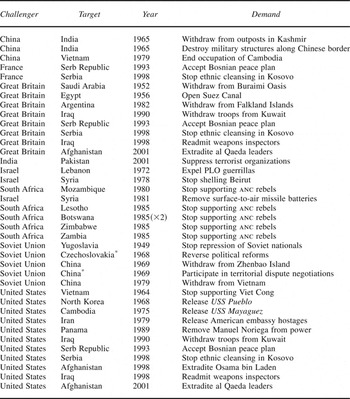
First, we examine the cases in the data set to determine whether failed compellent threats from nuclear states indeed tend to be over high-stakes issues. Table 2 lists all episodes in the MCT data set in which nuclear challengers failed to compel their adversaries according to our rules for coding compellence success.Footnote 49 This list provides little support for the selection effects hypothesis: most cases on the list are not high-stakes crises, but rather crises in which the target could have acquiesced without significantly harming its national security. For example, in the Pueblo, Mayaguez, and Iran embassy crises, U.S. threats failed to compel nonnuclear adversaries to release American hostages, even though their release would have had little material consequence for the target state. In these cases, the issue at stake was considerably more important to the challenger than the target, yet nuclear superiority did not make the challenger's compellent threats effective. This suggests that the failure of compellent threats by nuclear states has been due to the limited coercive potential of nuclear weapons rather than disproportionately difficult crisis conditions.
Partially or completely unsuccessful compellent threats from nuclear-armed challengers, 1945–2001

Note: Targets denoted with asterisks complied after minor military combat. These cases are recoded as successful threats under a looser definition of compellence success.
More concretely, we can measure the frequency of high-stakes demands—that is, demands over leadership or territory—in the MCT data set to evaluate whether nuclear powers are more likely to be involved in high-stakes crises. If crises involving nuclear challengers are disproportionately likely to involve high stakes, then the stakes variable would detect this trend. However, nuclear powers are actually less likely than nonnuclear states to make compellent demands over high-stakes issues: 53 percent of demands made by nuclear challengers in the estimation sample are related to territory or leadership, compared to 71 percent for nonnuclear challengers.
A second method for evaluating selection effects is to assess whether the coercive effects of nuclear weapons depend on the stakes of a crisis. If self-selection into high-stakes crises puts nuclear challengers at an inherent disadvantage, then the analysis should distinguish between high- and low-stakes crises in order to estimate properly the effects of nuclear possession. We therefore replicated Model 1 with an interaction term between nuclear challenger and stakes (Model 7). The insignificance of the interaction term indicates that the effect of nuclear challenger in high-stakes crises is statistically indistinguishable from its effect in low-stakes crises. This implies that nuclear states neither enjoy a consistent advantage in high-stakes crises (when nuclear threats might be most credible) nor in low-stakes crises (when the risk of nuclear punishment is most likely to outweigh the issue at stake).Footnote 50
Third, we explicitly model selection effects by using a bivariate probit model commonly known as a Heckman selection model.Footnote 51 The Heckman method uses a probit estimator to simultaneously model the initiation and outcomes of compellent threats. This approach is commonly used to adjust for possible selection effects in observational data and has been used in quantitative research about nuclear coercion.Footnote 52 We reestimated the models in Table 1 using the Heckman method to determine whether the results change when we account explicitly for selection effects. We find that they do not: states possessing nuclear weapons are not more likely to issue successful compellent threats, even when we adjust for factors that explain the onset of crises in the first place.Footnote 53
Limitations and Counterarguments
While these findings contain important lessons about the coercive limits of nuclear weapons, they should not be taken to imply that nuclear weapons have no political utility whatsoever. In particular, our analysis does not contest the view that nuclear weapons can be important tools of deterrence.Footnote 54 One of the central lessons of research about coercive threats in international relations is that the dynamics of deterrence and compellence may be very different.Footnote 55 Conclusions about the utility of nuclear weapons in one coercive context therefore may not necessarily apply to other forms of coercion.
Even with this caveat, however, one might object to these findings on several grounds. First, one could argue that the design of this study precludes a fair test of the nuclear compellence hypothesis because nuclear weapons were not explicitly invoked in most of the crises contained in the MCT data set. It is important to note, however, that recent literature on nuclear coercion asserts that nuclear weapons shape crisis outcomes even when they are not threatened.Footnote 56 Merely possessing a large nuclear arsenal, in this view, is sufficient to enhance one's compellent leverage.
This research note shows that there is little empirical support for these claims. Our analysis demonstrates that neither nuclear possession nor nuclear superiority enhance the effectiveness of compellent threats. A natural question, then, is whether explicit nuclear threats would be more likely to succeed than threats that do not mention nuclear punishment. However, we cannot evaluate this question empirically: to our knowledge, no leader has ever explicitly threatened the use of nuclear weapons in support of a compellent threat.Footnote 57 It might well be the case that explicit nuclear compellent threats would be more effective, but we currently lack the data to test this hypothesis.
A second objection might argue that while nuclear weapons may not help compellent threats succeed in most crises, under certain conditions they might be more effective compellent tools. For example, if a regime's survival depended on acquiring a prized territory or other important item, then one might expect nuclear weapons to be more credible tools of compellence. Put differently, this argument implies that the right conditions for successful nuclear compellence simply have not yet occurred. But this claim too is impossible to test because it relies on data that do not yet exist. As with all observational research, we can never be sure that the conditions generating our empirical data will recur in the future. Tomorrow's crises may not resemble the crises of the past, but since we cannot collect data about the future, we cannot know.
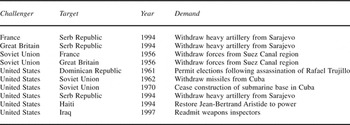
Nevertheless, our study demonstrates that across seven decades of the nuclear age and a wide variety of interstate crisis conditions, nuclear weapons have rarely, if ever, helped compellent threats succeed. Table 3 lists the cases in the MCT data set in which nuclear states made successful compellent threats. None of these cases provide unambiguous support for the view that nuclear weapons convey the ability to blackmail other countries. Even in the Suez and Cuban missile crises—two crises in which nuclear weapons are often believed to have played a role—historians disagree about whether nuclear weapons had a decisive impact on the outcome.Footnote 58 At the very least, then, we can conclude that the conditions favoring successful nuclear compellence are extremely rare.
Successful compellent threats from nuclear-armed challengers, 1945–2001

Conclusion
Do nuclear weapons improve the effectiveness of compellent threats? Using a data set of more than 200 militarized compellent threats from 1918 to 2001, we present new evidence that they do not. Compellent threats from nuclear states have not been more successful than threats from nonnuclear states, even after accounting for other factors that influence coercive diplomacy outcomes. Moreover, this finding is robust to a wide variety of measurements of nuclear superiority, threat effectiveness, and possible selection effects. Collectively, these results support the argument that nuclear weapons are not credible instruments of compellence in international politics.
Our analysis contributes to a decades-old theoretical debate about the coercive effects of nuclear weapons by addressing two problems with existing empirical research. First, it explicitly compares success rates for nuclear and nonnuclear states. This approach is distinct from most existing studies of nuclear coercion, which examine nuclear crises in isolation and therefore cannot determine whether nuclear challengers have a comparative advantage over nonnuclear challengers when issuing compellent threats. Second, it distinguishes victories achieved by force from victories achieved by fear. By treating battlefield victories as distinct from successful compellent threats, this study paints a more accurate picture of the coercive political effects of nuclear weapons.
These findings carry important theoretical implications in part because they underscore the coercive limits of military power in international politics. While scholars have long noted the imperfect ability of military power to achieve political objectives,Footnote 59 recent research has begun to explore the potentially perverse effects of military power in war fighting,Footnote 60 crisis bargaining,Footnote 61 and other contexts. The results of this study contribute to this literature by demonstrating that nuclear weapons do not have the coercive leverage that their extraordinary power might suggest. The ability to destroy does not necessarily convey the ability to coerce.
An unanswered question is whether the coercive limitations of nuclear weapons also apply during wartime. While our study considers whether nuclear weapons improve the effectiveness of compellent threats made in peacetime, the MCT data set does not include intrawar threats. This is an important limitation, especially given that the very first use of nuclear weapons in 1945 was designed to compel Japan to surrender to the United States in World War II. Moreover, many U.S. officials believed that nuclear weapons helped coerce China into ending the Korean War on terms more acceptable to the United States.Footnote 62 It might be the case, then, that while nuclear states enjoy no extra compellent leverage when threatening to initiate war, they may have an advantage in being able to threaten nuclear escalation once war has begun. Additional research is needed to evaluate this possibility.
From a practical perspective, our findings have important implications for nuclear nonproliferation policy. One reason many policymakers in the United States and elsewhere have expressed support for preventive military strikes against Iran is the fear that a nuclear Iran might blackmail its adversaries. For example, some analysts have argued recently that a nuclear-armed Iran could exploit the implicit coercive leverage of its arsenal to seize major oilfields and other territory from its nonnuclear neighbors. Iran “would not even have to use” its nuclear weapons to accomplish this, according to one commentator; “intimidation and blackmail by themselves would do the trick.”Footnote 63 Our analysis, however, suggests that there is little empirical precedent for these claims. The historical record indicates that nuclear states have not tended to make more successful compellent threats—even against nonnuclear adversaries. Although one might argue that Iran's ideological fervor makes it unique, it is worth recalling that U.S. officials voiced similar concerns about China in the early 1960s. Indeed, many officials believed that a nuclear China would compel an American military withdrawal from Southeast Asia and dominate the region.Footnote 64 Yet, in the end, these fears were not realized.Footnote 65 To be sure, nuclear proliferation may carry a variety of dangers,Footnote 66 but the historical record suggests that nuclear blackmail is not one of them.