1. The New Science and Its Values
Originally a central subject of philosophy, literature, art, and everyday life, well-being is now a respectable and a thoroughly entrenched object of social and medical science. The goal of the new science is, at least in part, to produce knowledge about how to improve well-being in the many contexts it studies.
In some ways, the development is not new. Modern social science began its life as a form of knowledge devoted to the advancement of well-being. However, now the situation is qualitatively different. Well-being is no longer just an abstract motivation for studying society but a direct focus of empirical and theoretical work in the disciplines of economics, gerontology, psychology, sociology, and beyond. Causes and correlates of well-being are now studied more than ever before all across the social and medical sciences. The search for “well-being” and “happiness” turns up almost 2 million entries on PubMed. Well-being is the second most popular keyword in all psychology articles cited in the Social Science Citation Index and the Science Citation Index between 1998 and 2005 (Zacks and Maley Reference Zacks and Maley2007). Journals focusing specifically on well-being multiply across disciplines, as do books and volumes. Even the traditional journals such as Science and Nature are joining in (Layard Reference Layard2010; Seaford Reference Seaford2011).
As well-being became the object of science, it acquired standard characteristics of scientific objects, or at least those in the nonfundamental sciences. It has various measures, each of which display respectable psychometric properties. It figures in many well-confirmed causal hypotheses and correlations. And there are even attempts to embed well-being in theoretical structures at various levels of inquiry: about economy at the macrolevel, about the psychology of judgment, and about human evolutionary development. Let us call the successes in measurement, confirmation of hypotheses, and theorizing ‘epistemic adequacy’. Exactly what counts as epistemic adequacy for so messy a science is a big question. Here I will not have much to say on this topic.
Crucially, epistemic adequacy is not enough to fulfill the core objective of the science of well-being—to justify policies, therapies, and other interventions. To be successful in this goal, the science of well-being also needs to be value adequate. I shall understand value adequacy of a scientific claim (or of a concept or even of an entire research program) as the fittingness of the nonepistemic values presupposed in this claim to the values at stake in the context in which this claim is made. For example, the claim “Unemployment is among the greatest impediments to well-being” is value adequate only if the referent of ‘well-being’ in this claim is indeed well-being, or that which we want to affect when we aim to help the unemployed to lead a better life for themselves. Value adequacy is necessary for evaluating the science of well-being because ‘well-being’, unlike, say, electric charge, denotes a state of the world that is intrinsically, and not merely instrumentally, valuable to human beings. It just would not be well-being if it was not. Philosophers call this value “prudential” to distinguish it from moral, political, aesthetic, or other values.
That science cannot be value free, at least in certain respects, is not news (Kincaid, Dupré, and Wylie Reference Kincaid, Dupré and Wylie2007; Douglas Reference Douglas2009). However, we do not yet have an account of value adequacy or procedures for how to evaluate it. To set up the basics of this procedure for well-being is the goal of this article. I examine two proposals for securing value adequacy. Obviously it must somehow involve philosophical theory of prudential value, which has occupied philosophers since Plato and Aristotle. But what exactly should the role of this theory be? On the Vending Machine model, the correct philosophical theory of well-being, along with various assumptions, should yield relevant scientific constructs of well-being. This view, hereafter the VM view, is widely presupposed by philosophers. Scientists who measure well-being in the tradition of psychological sciences do not adhere to the VM view. Rather they administer many questionnaires that roughly have to do with our pretheoretical notion of well-being and then run a lot of psychometric tests on the results. They then select whatever questions have survived these tests and call this a valid measure of well-being. I believe that neither the VM nor the psychometric approach is right. My goal here is to say why and to formulate the basic features of a better approach. On this approach, philosophy of well-being is as central as ever but a different philosophy to the one currently practiced.
2. Evaluating Value Adequacy
A typical claim investigated by the new science of well-being takes the following abstract form:
(F) A cause C affects well-being of a population P under circumstances C.
Researchers fill out this form in a variety of ways, depending on their focus and discipline. Some study economic causes such as unemployment or growth or other health related causes such as loss of mobility; sociologists may study the effect of social capital; psychologists, of optimism; and so on and so forth. The research on well-being is remarkably varied in its methods and foci.
Crucially, different fields of the science of well-being do not all use the same definition of well-being. Instead there are many different definitions and an even greater number of measures. Some researchers take well-being to be life satisfaction or happiness or another subjective indicator (Kahneman Reference Kahneman, Kahneman, Diener and Schwarz1999; Diener et al. Reference Diener, Lucas, Schimmack and Helliwell2008). Others adopt objective person-independent constructs such as access to health, consumption, and legal protection (Dasgupta Reference Dasgupta2001). Still others combine the two (Visser-Meily et al. Reference Visser-Meily, Post, Schepers and Linderman2005, among many others). Moreover, different subjective and objective indicators are chosen for different subjects of study: toddlers, the chronically ill, refugees, teenaged boys, and so on, each get to have their own unique measures, which often differ substantially in what they take well-being to consist in.
This complicates the task of evaluating the value adequacy of a given claim because it means that we cannot answer the question once and for all and forget about it. We need to evaluate the validity of the constructs of well-being for given circumstances every time we contemplate relying on claims involving a different construct. How should we do it?
3. The Vending Machine View
Perhaps the most straightforward method is to consult philosophical theories of well-being. We take the correct theory of well-being, we make assumptions that link theoretical claims about well-being with their empirical manifestations, and we use the operational definition as our measure of well-being.
I call this picture the VM view, borrowing the expression from Nancy Cartwright, who used it to describe a certain traditional view of scientific theories (Reference Cartwright1999, 185). On this view, we can feed certain inputs into the formalisms of a scientific theory, and it would spit out a representation of the specific phenomenon we are trying to study. Cartwright urged that this view ignores the realities of modeling, idealizations, and approximations in science. Analogously, I urge that this view overestimates the power of philosophical theories about well-being. Indeed the VM view about theories of well-being faces even more problems than the corresponding view of scientific theories.
First of all, philosophers disagree on the correct theory of well-being. The main divide in this debate is between subjectivists and objectivists, where the former believe that nothing can be good for an agent unless this agent has an appropriate attitude—desiring, preferring, endorsing—toward this good (see Parfit [Reference Parfit1984] for a classic exposition of options). Another divide is between sentimentalists and rationalists, where the former claim that something, say pleasure or good mood, is prudentially valuable to an agent just because it feels good, not because it forms part of the agent's rational life plan or is otherwise cognitively endorsed by the agent. Other points of contention include the importance of moral virtue or other excellent functioning (perfectionism), the importance of living in accordance with one's nature (eudaemonism), the value of having one's aims or desires realized (desire fulfillment views), or the value of having an overall pleasant life (hedonism).Footnote 1 As often happens in philosophy, many talented heads, all thinking about prudential value, produce many intricate versions of the existing theories but also elaborate counterexamples to each of these theories and further even more intricate versions of the original theories, each designed to capture all the essential features of well-being.
Never mind the disagreement, the VM theorist might react. Philosophers might disagree about the correct overall theory of well-being but still agree on enough core features of well-being to be able to advise our social scientist. Pleasure matters, goal achievement matters, and living within one's limits matters. Even if we cannot say precisely how much each matters, what we do agree on might be sufficient for purposes of science and policy. This may be a decent bet, but there is a second problem.
When philosophers work out a theory of well-being, they take the target concept to have a very precise meaning—what is good for a person overall, all things considered. Such a focus requires a general evaluation, taking into account all the relevant aspects, adding and weighing them appropriately. For example, for a hedonist, pleasures in all aspects on one's life count; for a desire theorist, fulfillment of all the desires in their order of importance counts, and so on. This is a question of the conceptual content of well-being and related terms. That this content encompasses general and not contextual evaluation is, as far as I can tell, never questioned even among philosophers who disagree on the correct substantive theory of well-being.
And this agreement on the target concept is a bigger problem, application-wise, than the disagreement on the referent of this concept. For in the social science and policy, we rarely operate at the level of such general evaluation. Far more frequently, we make context-specific judgments of well-being. How is a group of recently adopted toddlers with disabilities doing given their circumstances? How is a patient recovering from depression doing? How is a community doing in the aftermath of a financial crisis? In each of these cases, we are after not an all-things-considered evaluation but rather a contextual evaluation. It is contextual in the sense that the context in which we perform the evaluation helps us to pick out the constituents of well-being relevant for this context and to pass others as irrelevant. For example, a social worker out to evaluate the well-being of a toddler with Down syndrome and autism, recently adopted from an orphanage in a poor country, will plausibly be watching some well-being relevant things and not others. Is this child putting on weight and growing, trusting the new family, and trying to play? Does he hurt himself, make eye contact, and so on? These features will be different from if the social worker were evaluating a depressed middle-class father or an elderly single woman with fragile bones or a community struggling with unemployment, and so on and so forth. Implicit in these choices is a presupposition that different contexts invite different conceptions of well-being: one for an adopted toddler, another for a recent widow, yet another for a crisis-stricken community.
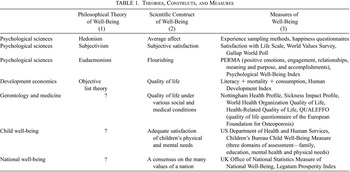
To illustrate the sheer scale of our problem, I submit table 1, which documents the variety of constructs and measures in the contemporary social, psychological, and medical sciences.Footnote 2 Each row represents an area of scientific research that uses a notion of well-being. The columns aim to give, respectively, a philosophical theory commonly assumed by this area of research (1), the constructs built on the basis of this theory (2), and the measures that are supposed to capture the construct (3). I use the term ‘construct’ in the standard sense used by psychologists, that is, the phenomenon or the attribute that is being studied, in this case, well-being.

| Philosophical Theory of Well-Being (1) | Scientific Construct of Well-Being (2) | Measures of Well-Being (3) | |
| Psychological sciences | Hedonism | Average affect | Experience sampling methods, happiness questionnaires |
| Psychological sciences | Subjectivism | Subjective satisfaction | Satisfaction with Life Scale, World Values Survey, Gallup World Poll |
| Psychological sciences | Eudaemonism | Flourishing | PERMA (positive emotions, engagement, relationships, meaning and purpose, and accomplishments), Psychological Well-Being Index |
| Development economics | Objective list theory | Quality of life | Literacy + mortality + consumption, Human Development Index |
| Gerontology and medicine | ? | Quality of life under various social and medical conditions | Nottingham Health Profile, Sickness Impact Profile, World Health Organization Quality of Life, Health-Related Quality of Life, QUALEFFO (quality of life questionnaire of the European Foundation for Osteoporosis) |
| Child well-being | ? | Adequate satisfaction of children's physical and mental needs | US Department of Health and Human Services, Children's Bureau Child Well-Being Measure (three domains of assessment—family, education, mental health and physical needs) |
| National well-being | ? | A consensus on the many values of a nation | UK Office of National Statistics Measure of National Well-Being, Legatum Prosperity Index |
Notice that in some rows I put a question mark in the theory column. Why? Because in these areas researchers use a context-specific, not a general, notion of well-being, and because of this it is not clear what philosophical theory is supposed to correspond to the choice of construct. It is time to pinpoint exactly the failures of the VM view.
On my reconstruction, the VM view encompasses the following commitments:
1. There is a single general theory of prudential value (hereafter GPV, for general prudential value).
2. GPV justifies the adoption of different constructs of well-being for different contexts of evaluation.
3. The justification relation takes the form of implication: GPV plus assumptions about the nature of a given context imply a context-appropriate construct of well-being.
For example, say that the correct theory of GPV is some version of the full information account—the prudential good is that which a fully informed agent desires or believes to be good for her lesser informed self. Say also, that QUALEFFO, the quality of life questionnaire of the European Foundation for Osteoporosis, is a good measure of well-being of the elderly with vertebral fractures and bone disease (Lips et al.Reference Lips, Cooper, Agnusdei, Caulin, Egger, Johnell, Reginster, de Vernejoul and Wiklund1997). (It gauges their pain; physical, mental, and social function; and perception of health with 48 questions.) Then, according to VM, the theory of GPV, plus assumptions about what sort of factors tend to cause (or correlate with) the valuable things specified by GPV in the population of elderly people with vertebral fractures, implies that well-being of this population should be conceived approximately as the QUALEFFO indicates. To secure this implication, the VM theorist trusts that there should be a single theory of GPV in table 1, column 1, not several as I have it. And the object of this theory, the VM view says, has a direct and straightforward connection to the phenomenon measured by QUALEFFO.
In my view, the most controversial ingredient of the VM view is 3—the claim that we can derive context-appropriate constructs of well-being from a theory GPV. Whichever theory of GPV we pick of the ones currently on offer, this derivability looks utterly mythical. We do not have the assumptions necessary to secure this derivability. Nothing remotely similar to this sort of derivation happens in real life and science, nor can we expect scientists to go through this process.
True, practical impossibility was never a compelling consideration to philosophers who, for the most part, are happy to operate on the faith that the theories of GPV they so carefully craft could in principle be connected constructs in the social and medical sciences. But we need to have some reason to sustain this faith, and these are the reasons I fail to see. We do not need to deny that there is some relationship between theories of GPV and the scientific constructs in table 1. This relation is likely one of inspiration—an Aristotelian theory of well-being inspires the eudaemonic approaches to well-being measurement in psychology, but these measures are certainly not derivable from this theory plus any set of known assumptions. If the VM view is wrong, what other options for justifying constructs of well-being do we have?
4. The Psychometric Approach
When social scientists talk of “validating” their measures, most of them, especially those in the psychological and medical sciences, refer to a procedure subjecting their measures to a battery of statistical tests to check these measure's “psychometric properties.” If these properties are good enough, then the measure (and the construct) is validated. Does this approach secure the sort of justification we are seeking?
Rather than attempting an overview of the psychometric approach, I will rely on a typical example, the validation of the famous Satisfaction with Life Scale (SWLS). The process is described in the much cited article by Ed Diener and his colleagues (Diener et al. Reference Diener, Emmons, Larsen and Griffin1985). The SWLS is a five-item questionnaire that elicits judgments about life as a whole (e.g., item 3 is “I am satisfied with my life”; 1 = strongly disagree, 7 = strongly agree).
Diener and his team developed and validated this questionnaire in three stages. In the first stage, they started with 48 questions all related to satisfaction with one's life and positive and negative affect. They eliminated affect questions because that is not what life satisfaction is about. This left them with 10 questions, five of which were eliminated because of “semantic similarity.”
The second stage tested psychometric properties of the remaining five-item scale. One hundred seventy-six undergraduates studying psychology at the University of Illinois took the test twice, with an interval of 2 months. This produced the data for Diener and his colleagues to analyze. Each SWLS question received a score called ‘factor loadings’ ranging from .61 to .84. These are summary values for a battery of statistical tests, which include the following items: test-retest correlation, Cronbach's alpha (which, roughly, measures correlation between the answers to different questions and thus is known as a measure of “internal consistency”), and factor analysis (which seeks to determine a single item that accounts for the most variance between answers). We do not need to go into details about the methodology of these tests for our purposes. The crucial assumption behind them is as follows: a measure is valid if the respondents’ answers indicate that they treat each of the questions as asking roughly the same thing.
In the second stage, Diener and his colleagues compared responses on the SWLS to responses on other existing measures of subjective well-being and related constructs such as affect intensity, happiness, and domain satisfaction. The findings confirmed their expectation that SWLS scores correlate highly with those measures that also elicit a judgment on subjective well-being and less so with measures that focus only on affect or self-esteem or other related but distinct notions.
In the third stage of testing, SWLS scores of 53 elderly people from the Urbana-Champaign area were compared to ratings this same population received in a structured in-depth interview that focused on “the extent to which they remained active and were oriented toward self-directed learning” (Diener et al. Reference Diener, Emmons, Larsen and Griffin1985, 73). Once the interview results were converted into a single score, this score was found to have .43 correlation with the SWLS. The results of all three stages were deemed “adequate,” and since 1985 all other psychometric tests on the SWLS have confirmed this initial judgment.
How does this approach compare to the VM view? First of all, the psychometric approach is not philosophical. The judgment of relevance of the initial questions to be included in the SWLS and subsequent measures to which SWLS should be compared uses philosophical reasons: life satisfaction is a cognitive judgment about life as a whole, this judgment can deviate from how we feel (our affect) but not by too much, and so on. And crucially this judgment is relevant to our well-being. However, once these initial philosophical judgments are made, the subsequent tests rely only on respondents’ behavior. If it indicates that they understand the questions to have a stable and fairly unified meaning, then this speaks in favor of the validity of the test.
Clearly, this procedure does not secure normative adequacy. That respondents treat the questions about life satisfaction as questions about life satisfaction does not show that life satisfaction has anything to do with well-being. A high score on the SWLS would only indicate well-being if we also assumed that life satisfaction either constitutes or indicates well-being, an assumption left untouched by the psychometric approach.
Normative adequacy of constructs cannot be just a matter of a little bit of philosophy in the beginning and then some statistics. We need genuine reasons to justify the constructs in column 2 of table 1.
5. A Third Way
Where does this leave us? Both approaches ignore the possibility that the notion of well-being as it is used in life and research is not univocal. It may not have a stable meaning, and there may not be a single substantive theory of well-being to cover all the notions we may need. A distinction is needed to put the point across.
5.1. Variantism versus Invariantism about Well-Being
A natural ally of the VM theorist is an invariantist about well-being. The invariantist is not perturbed by the sight of table 1, with all the many different constructs of well-being and the corresponding theories. She insists that it is just the measures of well-being that differ from context to context, not the constructs of well-being and certainly not the substantive theory of well-being. The invariantist believes in a single concept of well-being that applies to all—adopted disabled toddlers, elderly widows with fragile bones, depressed middle-class fathers, and so on. This concept has a stable meaning—that which is intrinsically good for one, irrespective of moral or other considerations. And there is a single correct theory that tells us what this concept refers to. I call this view invariantism about well-being because on this view the construct of well-being does not vary with circumstances.
Invariantism is a view about the stability and uniqueness of the concept of well-being, whereas the VM is a view about the justificatory power of the theory of well-being. So, strictly speaking, they are orthogonal to each other. Still, the invariantist is a natural ally for the VM theorist. If a single theory can yield us the necessary constructs of well-being, then the various constructs used by scientists all reflect a single concept of well-being.
Invariantism is a natural default picture: when there is a single term such as ‘well-being’, it probably refers to a single unified concept that serves the purpose in all contexts in which we apply the term. It is thus plausible to assume invariantism at the start of one's inquiry. But we should be ready to abandon if it does not earn its keep. For the social and medical sciences, at least, invariantism is of limited usefulness.
What if the actual stuff that gets called ‘well-being’, not just the measures, differs? This is variantism about well-being. According to this picture, in gauging well-being in different circumstances we naturally adjust the notion of well-being to the circumstances. We adjust it in two ways. First, we may require a different threshold of what it takes to be doing well under different circumstances. Doing well in a refugee camp might have a lower threshold than doing well in a middle-class Western community. Second, we might adjust the very constituents of well-being to the circumstances. Independent living might constitute well-being of an elderly person but not a child; it is the other way around with play. Whether or not a grand philosophical theory of well-being is possible and forthcoming, it is worth considering that such contextual adjustments are part and parcel of the study of well-being in the sciences. Elsewhere, I articulate and defend variantism in more detail (Alexandrova Reference Alexandrova and Kincaid2012). Variantism invites us to see the relationship between philosophical theory and constructs in science differently than the VM view.
5.2. The Distant Constraint View
On the distant constraint view (DC), the value adequacy of a claim about well-being is evaluated using local contextual judgments rather than the grand philosophical theory. The theory of GPV acts at best as a DC. The idea is best illustrated with an example.
Compare two measures of well-being, each prominent in its respective areas of research, one in gerontology and the other in research on national well-being. Many aging people care for their spouses with heavy chronic illnesses. This is frequently a time of great hardship in the life of the caregiver; they are at an increased risk of depression and complications with their own health. Gerontologists define well-being of caregivers to encompass subjective satisfaction with one's life and also freedom from Caregiver Strain (Visser-Meily et al. Reference Visser-Meily, Post, Schepers and Linderman2005). A caregiver is strained if her sleep is disturbed by the care recipient, if she is lonely and pushed around, or if her old life is gone and replaced with arguments, worry, fatigue, and so on.
As this article is being written, the UK Office for National Statistics is conducting a countrywide inquiry called “What Matters to You?” soliciting views and recommendations from the public, the experts, and communities all across the United Kingdom. The outcome of this exercise will be a measure of the United Kingdom's well-being, which would provide an alternative way than the traditional economic measures of evaluating how the country is doing. This measure will be made up of many elements, some reflecting subjective evaluation, some emotional state, and some objective indicators such as income, social capital, safety, and so on (Matheson Reference Matheson2011).
Why is it appropriate to conceptualize well-being of caregivers in one way and well-being of a nation in another? The DC theorist is skeptical that a theory of GPV, even the correct one, could provide a justification for these choices. How could it, if the categories theorized about by philosophers are so far removed from the practice of science? What sort of powerful assumptions could take us from, say, the fully informed self or the balance of pleasure and pain or the excellent human functioning to the specific scientific constructs? And are these assumptions not precisely what the science of well-being is investigating? In this case, on the VM view the science of well-being cannot even get off the ground.
The DC theorist does not maintain that the standard philosophical theory is useless. She merely treats it as a constraint that can sometimes lead us to one construct or another. For example, it is eudaemonic considerations that inspire psychiatrist Felicia Huppert to include sense of purpose, competence, and connectedness in her measure of flourishing (Reference Huppert2009).
If the theory of GPV cannot justify scientific constructs, what does? This is when the DC theorist turns to her natural ally the variantist about well-being. On the variantist view, there are many concepts of well-being, some general and some very contextual. National well-being and well-being of a caregiver are two distinct nongeneral concepts, and it is plausible that different substantive theories specify the referent of these concepts. The theory of well-being of caregivers must be particularly sensitive to dangers of loneliness, loss of connection with one's mate, and health complications. The theory of well-being of a nation, however, is primarily to reflect citizens’ fundamental priorities and their success in realizing these priorities.
These theories are context specific in their scope and narrow in their applicability, having at most a thin and tenuous connection to any of the prevailing theories of GPV. Sure, they can be recast in terms of hedonism, eudaemonism, or desire fulfillment, but recasting is no justification. Value adequacy of the science of well-being thus should await these new theories, which are less universal but actually usable.