In Indonesia, in the wake of the 1965 coup, General Suharto had the blessing of the provisional congress when he launched an anti-Communist campaign. The campaign quickly doubled as an anti-Chinese purge: an estimated 1.5 million were killed between 1966 and 1972. After fully assuming power, Suharto closed Chinese schools, prohibited all displays of the Chinese culture, and required all Chinese minorities to change their surnames (Bertrand 2003). In Thailand, the government was more Chinese friendly—but only slightly. Although the royal palace had given the Bangkok Chinese exclusive import/export licenses, it still restricted the use of the Chinese language. For example, all Chinese schools were required to teach in Thai; later, there was another law limiting the number of hours the Chinese language could be taught in schools (Keyes 2003). In addition, all Chinese-language newspapers save one were shut down. In neighboring Malaysia, when parliament reconvened in 1971—it had been closed for two years—the newly appointed prime minister promptly addressed the existing ethnolinguistic tensions. Subsequently, the United Malay National Organization (UMNO)-led coalition government passed language laws making it an offense to (1) question the special status of Malay and (2) advocate a multilingual policy (Ganguly Reference Ganguly2003).
Theoretically, if authoritarian regimes are characterized by their general limitations on political liberties, we would expect autocrats to deny minority groups the right to use their own languages. Empirically, however, this is not always the case. In Malaysia, the UMNO-led authoritarian government (1971–) was not able to completely ignore Chinese and Indian linguistic demands. In primary education, Mandarin and Tamil would remain mediums of instruction. Within the coalition government, Chinese and Indian interests—represented by the Malaysian Chinese Association and the Malaysian Indian Congress, respectively—prevented UMNO from completely stripping the minority languages. So, although the Malay-dominated government tried to show toughness in its language policies, it was forced to make concessions.
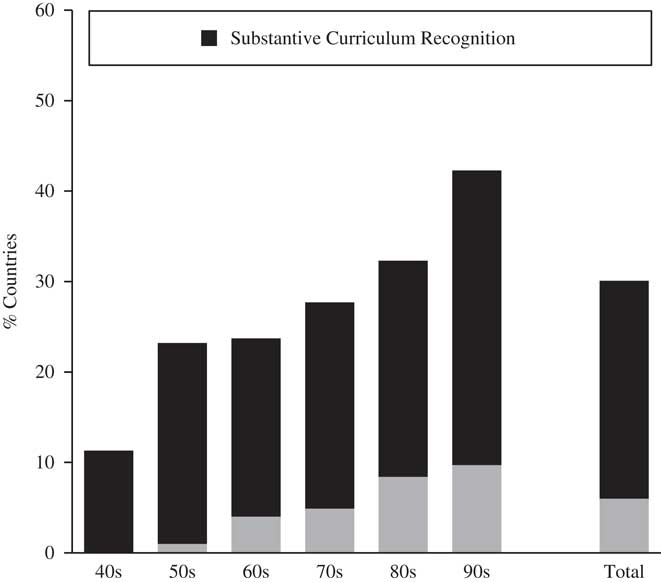
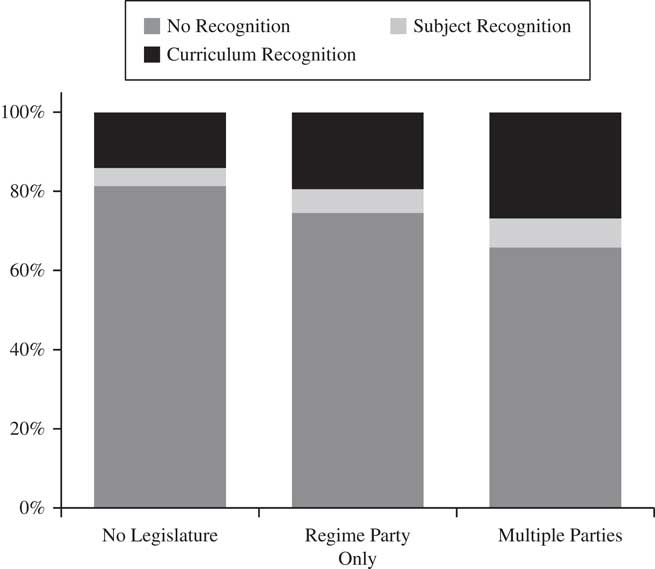
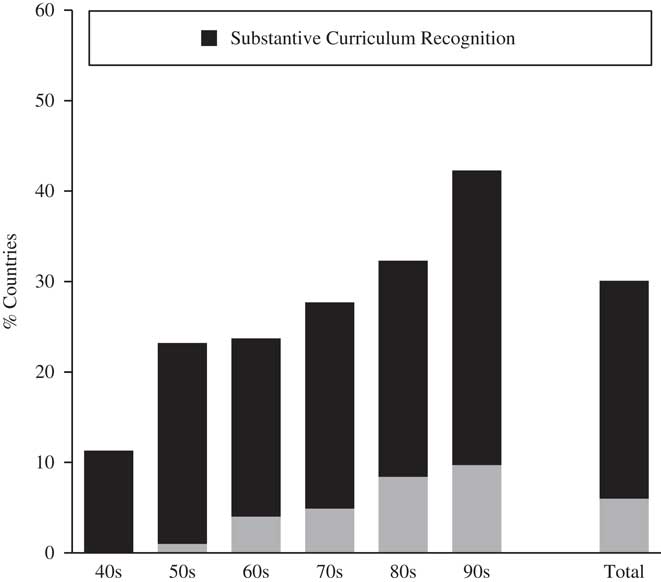
This story is by no means Malaysia specific. As illustrated in Figure 1, although it is common for authoritarian governments to restrict official use of minority languages, in almost one-third of the cases, they afford language recognition of some sort in the classroom (gray-shaded and black-shaded bars). Moreover, in the overwhelming majority of these cases, recognition levels are impactful, akin to Malaysia (black-shaded bars). This paper examines this pattern: What explains minority language recognition in dictatorships?
Minority language recognition in dictatorships (1940–2000)
We follow contemporary scholarship that emphasizes the importance of electoral institutions (i.e., legislative and partisan) for understanding policies in authoritarian regimes. Dictatorships vary in the degree to which they have nationally elected assemblies and allow societal interests to organize along partisan lines. Some of these institutions—most notably regime parties—solve problems among elites by generating the incentives necessary to hold elite coalitions together (Geddes Reference Geddes1999; Reuter and Remington Reference Posner2009). Other institutions are designed to direct opposition into institutionalized forums that the regime can control (Lust-Okar Reference Lust-Okar2005; Gandhi Reference Gandhi2008; Wright Reference Wintrobe2008). To neutralize threats from within the population at large, authoritarian leaders make concessions in the form of rents and/or policies. Policy concessions—including those of a linguistic nature—however require legislative and partisan institutions (Gandhi Reference Gandhi2008).
Where we depart from extant scholarship is shifting the focus from the aggregate national government (and its corresponding country-year unit of analysis) to that of the minority linguistic group. Doing so will allow us to identify whether and to what extent the presence of a minority party allowed to organize within the legislature can extract linguistic concessions from the regime. Using original group-level and over-time measures of minority parties in legislatures and minority language policies for all Asian dictatorships from 1980 to 2000, we find that minority groups organized along partisan lines are more likely to have their languages recognized than their less institutionalized counterparts. Moreover, the level of recognition is higher in the former than in the latter. These findings are consistent even when we generalize to the broader country-year unit of analysis and account for possible selection effects (i.e., weak regimes are more likely to make both political and linguistic concessions).
This paper contributes to our understanding of how non-democracies operate, particularly in the context of social diversity. Without private information about individuals (e.g., surnames, family history, neighborhood of residence), language becomes the easiest marker for determining individual ethnicity (see Brown and Ganguly Reference Brown and Ganguly2003). Relatedly, if governments are to make concessions, language is an easily identifiable one. Recognition of one group’s language by the government suggests that its speakers have some sort of legitimacy (Horowitz Reference Horowitz1985). Given the stakes, it is perhaps unsurprising that half of post-World War II civil conflicts have involved language in some capacity (Liu Reference Liu2011).
Minority Language Recognition
Like ethnic divisions, linguistic ones have been conceived as the product of sociological and demographic forces as well as man-made ones. Indeed, an older literature viewed language policy as a symptom of ethnic relations: the relative sizes of ethnic groups and their historic rivalries are manifest in the contentious language politics among contemporary groups (e.g., Geertz Reference Geertz1994). More sophisticated accounts recognize that language policy is determined by the state, primarily as a response to the exigencies of decolonization and subsequent nation-building. Linguistic divisions may be a legacy of colonial recognition (Tarling Reference Smith2004), but they also may be an attempt to defy colonial legacies and to construct national identities in newly independent states (Anderson Reference Anderson1991; Ganguly Reference Ganguly2003; Brown Reference Brown2009).
Although these accounts contribute to our understanding of linguistic divisions, their failure to conceive minority language recognition as distinct policy choices made by governments prevents them from explaining the variation we observe concerning language politics. Governments adopt different strategies for nation-building: some do it by rejecting the colonial lingua franca whereas others embrace it; some do it by recognizing linguistic diversity whereas others demand fealty to a single language. The emphasis on nation-building alone cannot explain the variance in the concrete policies about language use that states adopt in the areas of government services, mass media, and especially, public education. Moreover, language policies are formulated and changed at moments other than independence. Finally, accounts of language policy choice must consider the constraints governments face in making these choices. Governments do not choose language policies in an institutional vacuum. Whether governments grant or deny minority language recognition depends on the bargaining position of the opposition linguistic groups within society and whether these groups have channels through which they can influence policy choices.
As a starting point for understanding how the systematic features of states affect choices about language policy, researchers have begun looking at how political institutions affect linguistic policies. The empirical evidence shows that democracies with proportional electoral rules, parliamentary systems, and/or federal structures are actually less likely to recognize minority languages. This is because these power-sharing institutions bring to the table too many veto players, resulting in deadlock. However, if multiple actors can come to an agreement, the subsequent policy is one that recognizes minority languages to the fullest extent as opposed to one that is merely symbolic (Liu Reference Liu2011). Policies that appeal to ethnic or linguistic minorities may be “winning” when parties must build electoral coalitions comprised of different groups (Chandra Reference Chandra2004; Wilkinson Reference Verba2004).
Just as democratic governments vary in their institutional arrangements so do authoritarian ones. Authoritarian typologies abound, with Geddes’ (Reference Geddes1999) classification of party, military, and personalist regimes the most well known. Used to explain a wide number of outcomes, the typology makes distinctions on the basis of who constitutes the ruling group: the military (e.g., Indonesia), the royal family (e.g., Thailand), a political party (e.g., Malaysia), or none of the above. This distinction by ruling group, however, cannot wholly explain the differences in the treatment of the Chinese minority in the three Southeast Asian countries discussed earlier in this paper. In the case of Indonesia, the military, in fact, did not “return to the barracks” and instead brutally repressed demands for linguistic autonomy. Although the royal palace in Thailand was less violent, the outcome of interest was the same as in Indonesia: no minority language recognition. It is only in Malaysia where we see Chinese language recognition. We argue this is not because of the identity of the ruling group per se, but because of the institutions available for the Chinese to voice their demands and for the Malay-dominated government to respond.
Linguistic Effects of Electoral Institutions
Dictators face threats to their rule from political and economic elites (including the military), but also from the population at large. In governing the population, rulers must not only thwart rebellion, but also elicit cooperation with the regime. One available tool is repression. In Brunei, for instance, when the Brunei National Democracy Party called for elections and asked the sultan to give up his position as the prime minister, the leaders were arrested and the party was forcibly deregistered (Saunders Reference Przeworski, Alvarez, Cheibub and Limongi2002). Although the tool of repression is commonly used, it is neither cheap nor always effective (Wintrobe Reference Widner1998; Acemoglu and Robinson Reference Acemoglu and Robinson2005).
As an alternative, dictators—especially those in vulnerable non-democratic regimes—can make concessions (Bell Reference Bell2011). By distributing rents, non-democratic regimes can sometimes bolster regime support without altering the political system and undermining their authority. The Bruneian sultan, for instance, has used his country’s natural resource wealth to develop a cradle-to-grave welfare system: no income tax; free education and health care; and subsidies for rice, housing, cars, funerals, and pilgrimages to Mecca. Moreover, the government bureaucracy employs ~67 percent of the workforce (Dayley and Neher Reference Dayley and Neher2010). Buying support through such means can increase regime stability in the short term (Jensen and Wantchekon Reference Jensen and Wantchekon2004; Smith Reference Reuter and Remington2004; Smith Reference Saunders2005), but such dependence upon the state also increases the regime’s vulnerability during economic crises (Widner Reference Tilly1994).
Rents offered by the likes of Brunei serve as temporary stop-gap responses and may not be sufficient for inducing cooperation. When these efforts fail, authoritarian regimes must make longer-term concessions by changing policies affecting the discontented. In designing policies to appease particular groups, regimes often use legislative institutions (Kim and Gandhi Reference Kim and Gandhi2010; Malesky and Schuler Reference Malesky and Schuler2010). The advantage of legislatures in policy making are threefold: they enable autocratic governments to identify which groups should be targeted for cooptation, to control the policy-making process, and to divide the opposition. We discuss each of these advantages in the context of minority language recognition.
Identity, whether ethnic or linguistic, is often constructed (Chandra Reference Chandra2004; Posner Reference Pepinsky2005). Moreover, the politicization of identity is the product of deliberate actions (Kalyvas Reference Kalyvas1996). As a group, individual members may use their minority language within the home and other private spheres. But such practices, in and of themselves, do not constitute a “potential threat” to which any government must respond. It is only when members of distinct linguistic groups are able to act collectively within the political arena do governments need to pay them heed. For this reason, legislatures become important: when minority groups are able to form political parties and mobilize enough of their supporters to vote for them, their occupation of legislative seats becomes a signal to the regime. That members of the linguistic group vote for an identity-based party indicates the importance of the language issue to constituents. That the party is able to enter the legislature reveals that the group constitutes a potential threat. Consequently, characteristics of the linguistic group may influence both whether the group achieves legislative representation and whether it receives policy concessions from the government. Linguistic groups with a large demographic membership may have a better chance of organizing politically, but without having actually done so and achieved legislative representation, they are unlikely to receive policy considerations. Without having signaled their political strength, there would be no reason for autocratic governments to make concessions.
In addition, by allowing some parties to form and gain seats within the legislature, the regime divides the opposition. Groups that enter the legislature and “play by the rules” established by the dictatorship are publicly coopted, isolating, and delegitimizing more radical elements (Lust-Okar Reference Lust-Okar2005). Linguistic groups that receive policy concessions become vested in a regime that protects their interests. Minority groups are especially sensitive to their welfare relative to that of others (Gurr Reference Gurr1971; Gurr Reference Gurr2000; Esteban and Ray Reference Esteban and Ray2008; Østby 2008). Groups outside of the legislative arena, if they opt to act via extra-institutional means (i.e., protests), become a threat not only to the regime, but also to the linguistic groups that have been politically coopted. Finally, within a legislature away from the public’s glare, the regime can exert some control over the policy-making process and arrive at agreements without appearing weak (Gandhi Reference Gandhi2008). Policy making may reflect real compromises on the part of the authoritarian regime (i.e., policy outcomes deviate from the government’s ideal point). But dictators are constrained not by the legislature in and of itself, but by the political strength of the linguistic groups as revealed by their legislative participation as institutions are not independent of the regime (Pepinsky Reference Ostler2014).
For these reasons, we predict and test for a conditional relationship between minority group characteristics, legislative representation, and language recognition. Characteristics of a minority group may predict whether the group is able to obtain representation, but these attributes should not help minority groups achieve long-term concessions unless their interests are represented by a party in a legislature. Thus, minority group characteristics predict minority rights only through the intervening role of legislative representation in non-democratic regimes. The following hypotheses reflect this argument:
Likelihood hypothesis: Minority groups are more likely to have their languages recognized when they have parties in the legislature.
Level hypothesis: Minority groups have higher levels of language recognition when they have parties in the legislature.
Research Design
To test the above hypotheses, we employ an original group-level over-time measure of language-in-education policies for all Asian dictatorships from 1998 to 2000. Asia here is broadly conceived as a geographical concept, spanning from Turkey to Korea, from Russia to Sri Lanka. Absent in this sample is a common political or social denominator. There is no state-building legacy like Western Europe where “war made the state, and the state made war” (Tilly Reference Svolik1975). There is no linguistic or religious similarity as in Latin America, and there is no large-scale colonial commonality as in Eastern Europe or much of sub-Saharan Africa. The only defining characteristic across these countries is, in fact, its very diversity. This enables us to introduce controls for alternative explanations; it also ensures the findings are not subject to spurious correlations or biased due to some latent geographical factor. In all, the sample includes observations from 41 states. A linguistic minority group is included only if it comprises at least 1 percent of the state’s population and speaks a different language from that of the plurality according to either the Ethnologue (Lewis, Simons and Fenning Reference Lewis, Simons and Fenning2014) or the L’aménagement linguistique dans le monde (Leclerc Reference Leclerc2014) databases. The total number of minority group-country-year observations for this sample is >2500.
Minority Language Recognition
To measure minority language recognition, we focus on education—the most public and political arena for language politics (Fishman Reference Fishman1989). Governments use education to project their vision of the future (Albaugh Reference Albaugh2014). In fact, the education sector is always involved—sometimes even exclusively—in official language planning (Kaplan and Baldauf 1997). A minority language is defined as the language of an indigenous, non-plurality group. We operationalize the variable Minority Language Recognition as trichotomous, reflecting three possible types of recognition: no recognition whatsoever, recognition of the minority language strictly as a subject, and recognition of the minority language as a medium of instruction across the curriculum.
A language is coded as “subject recognition” (1) when there is instruction of the minority language. The entire education curriculum is taught using some other language (e.g., the majority’s or a lingua franca), but some portion of the curriculum is allocated to minority language teaching. Consider Indonesia: in 1994 the education ministry required 20 percent of instructional hours to be allocated to learning local languages (Bjork 2003). In contrast, a minority language is coded as “curriculum recognition” (2) if there is instruction in the minority language. It parallels another language as a medium of instruction. In this case, both languages are used throughout the curriculum. Parents can send their children to a school where history, math, and sciences are taught in either language. As an example, consider the status of Malay in Singapore. In the first decades after its separation from Malaysia (1965–1983), the Singaporean government led by the People Action Party allowed the Malay language to be a medium of instruction. Students could learn about Singapore’s history in Malay (Ganguly Reference Ganguly2003).
The variable Minority Language Recognition is in minority group-country-year format. Each observation corresponds with one of the three possible values. This setup allows us to identify minority language recognition status across multiple groups in one country. For example, we can differentiate between German and Russian in Kyrgyzstan. One has no recognition (German); the other has curriculum recognition (Russian). Moreover, we can examine recognition changes in any given year. In Singapore, for instance, Malay and Tamil were both languages of instruction (Minority Language Recognition=2) upon independence; but ever since a 1984 curriculum overhaul, the two have been relegated to subject recognition (Minority Language Recognition=1).
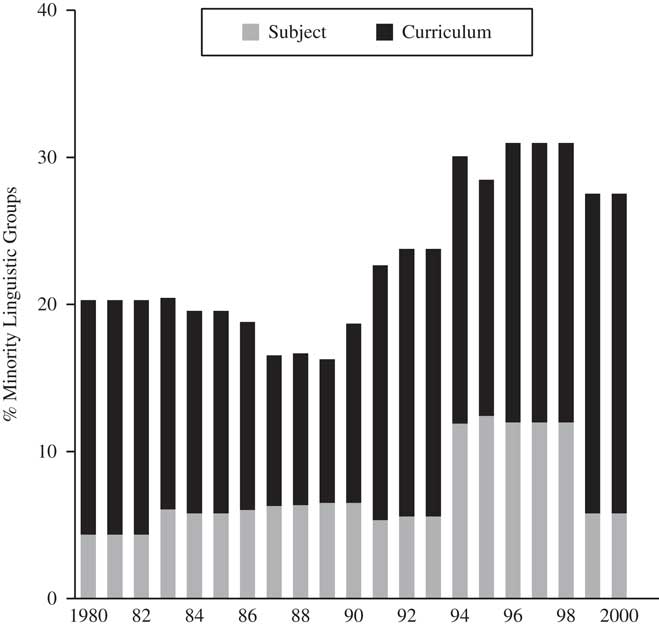
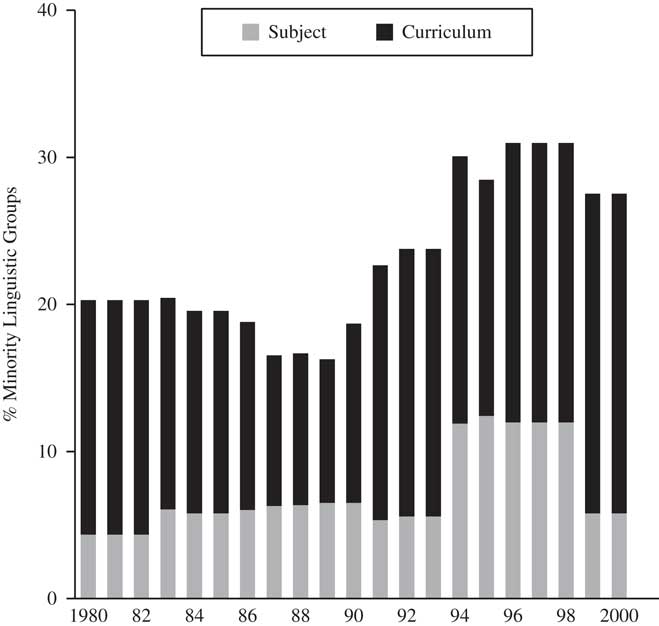
Leclerc’s database on language policies, which covers all countries, provided the initial information for most entries.Footnote 1 Examples of each recognition type are as follows. Note that the distribution of recognition type skews to the right—although as illustrated in Figure 2, there has been substantial fluctuation over the years.

Language recognition of minority groups in Asian dictatorships
Minority Party in Legislature
The explanatory variable, Minority Party in Legislature, is also trichotomous. It captures the degree to which minority parties are allowed to organize within the legislature of an authoritarian regime (Gandhi Reference Gandhi2008). If there is no legislature or if all the legislative members are non-partisan, the variable is assigned a 0; if the legislature is composed of only regime party members or members from multiple parties but none of which represent the concerned minority group, a 1; and if the legislature is composed of members of multiple parties, including ones that represent the interested group, a 2. The data source is Banks (Reference Banks2011). A simple means test shows that the value of the dependent variable is statistically smaller when there is no legislature (95 percent confidence interval (CI) (0.177, 0.237)) than when there is only a regime party (95 percent CI (0.454, 0.539)) or when the minority group is represented by a party (95 percent CI (1.5203, 1.783)). The correlation between Minority Party in Legislature and our dependent variable is 0.3089.
Note that the 0 category contains two situations that are conceptually equivalent: a non-existent legislature and a legislature without parties. Without parties, a legislature full of independents is unlikely to represent any interests other than those of the individual legislators. In contrast, having a single regime party (category of 1) implies that there are interests within the regime that are potentially strong enough to constrain the leader (Svolik Reference Smith2012). However, although the presence of other parties signifies that some groups can mobilize independently of the regime, there is no guarantee that these groups will represent any and all minority group interests.
Control Variables
Expectedly, there are other considerations aside from whether a minority group has a dedicated voice in an institutionalized forum. First, given the time-series nature of the data set, we include a lagged dependent variable to control for possible temporal autocorrelation. The remaining controls can be divided into two types: those at the country level and those at the group level.
Wealth
With widespread poverty, there is a tendency for the haves to denigrate the have-nots; but when there is wealth, “tolerance norms” (Lipset Reference Lipset1959, 84) develop and social cleavages correspondingly become less salient. Wealth is also important for another reason. Poorer countries may simply face a bigger challenge when allocating resources for minority language recognition. Recognition of any type requires money (Laitin Reference Laitin1988; Pool 1991). To the extent that a poor country does not want to and/or cannot recognize minority languages, we expect a positive relationship between wealth and recognition. We rescale gross domestic product (GDP) per capita to the 10,000 USD unit (Reference WrightPenn World Table).
Linguistic heterogeneity
We expect a large majority linguistic group to be able to withstand minority demands for recognition. We also expect pressures for minority recognition to increase as the number of groups increases. At some point, when there are just too many minority groups, it simply becomes too difficult for governments to withhold recognition. To measure linguistic—and only linguistic as opposed to “ethnic”—heterogeneity we employ two measures. The first is the size of the largest linguistic group (bounded between 0 and 1); the second, the logged number of linguistic groups. Both measures are from Leclerc (Reference Leclerc2014). The correlation between the number of linguistic groups and minority language recognition is −0.3181 (−0.3256 when logged).
Colonial legacy
Generally, the British favored multilingualism: initial teaching in an indigenous language and then a switch to English. In contrast, the French colonial government (and to a lesser extent the other continental European countries as well) banned the teaching of indigenous languages. Instead, the colonial language was the only one used in schools. We see this contrast not only in Asia (Brown and Ganguly Reference Brown and Ganguly2003; Kaplan and Baldauf 2003), but also in Africa (Albaugh Reference Albaugh2014) and Latin America (Ostler Reference Østby2006).
Authoritarian regime type
It is also possible that recognition is driven not by legislative and partisan institutions specifically but by the larger regime itself. Regime type matters in how struggles between competing factions develop (Geddes Reference Geddes1999). Taking this into consideration, we use Geddes’ (Reference Geddes1999) initial classification that has been updated by Wright (Reference Wintrobe2008). With that measure, regimes are coded as monarchy, military, party, personalist, or some combination of the latter three. Counting the hybrids, there are technically eight types. In our Asian sample, however, there are no coded observations of military–party or military–personalist hybrid regimes. Military–party–personalist hybrids are the reference category.
Minority group size
If demographics matter, then a smaller minority group is less likely to successfully demand recognition. In fact, it is more likely to fall prey to ethnic chauvinism on the part of the majority group. In contrast, a larger minority group poses greater threat to the regime if it can become politically organized. As this threat increases, the government is more likely to grant recognition. Correlation between this variable and the dependent variable is 0.3752. Data for group size come from Leclerc (Reference Leclerc2014).
Immigrant status
Minorities of immigrant status are more likely to be excluded from the political system. In fact, their status as immigrants hints at some selection effect: immigrants choose their destination. As such, the host country is unlikely to be motivated to extend political rights or social services to these groups (Geddes Reference Geddes2003). Conversely, when the minority group is a “son of the soil,” the government is more likely to extend some recognition. We follow Leclerc’s (Reference Leclerc2014) coding of minority groups as “immigrant.” This variable is negatively correlated with Minority Language Recognition (−0.0727).
Economic advantage
We also control for the economic status of the minority group. This allows us to identify whether countries with minority-favorable linguistic policies are also the ones where minority groups are systematically advantaged in other ways. To measure economic differential, we use the Economic Differential Index from the Minorities at Risk (MAR) database. The Index measures whether a minority group is economically advantaged or extremely disadvantaged on six indicators: income, land/property, higher education, presence in commerce, presence in professions, and presence in official positions. For ease of interpretation, we reconstruct this index into a trichotomous measure where 0 indicates economic disadvantage; 1, no economic disadvantage/advantage; and 2, economic advantage. Note that as only those at risk are included in the database, not all minorities identified in our sample appear in the MAR database (e.g., Chinese in Cambodia and Uzbeks in Kazakhstan). When a minority group is absent, we assign it a value of 1. Correlation with the dependent variable, while significant, is only at 0.3360.
Model Estimator
Given our theoretical argument, we estimate the following model:
 $$\eqalignno{ \Pr {\rm (}Minority\;Recognition{\rm )}\,{\equals}\, & f\,{\rm [}\alpha {\plus}\beta _{1} {\times}{\rm (}Minority\,Parties\,in\,Legislature{\rm )} \cr & {\plus}\beta _{C} {\times}{\rm [Country{\minus}Level}\,{\rm Controls]} \cr & {\rm {\plus}}\beta _{G} {\times}{\rm [Group{\minus}Level}\,{\rm Controls]} \cr & {\rm {\plus}}\beta _{4} {\times}{\rm (}Minority\,Recognition\,{\rm (}t{\minus}{\rm 1))}{\plus}{\epsilon}{\rm ]}{\rm .} $$
We expect the coefficient estimate β 1 to be positive when there is recognition. Because the dependent variable is trichotomous, we use ordered logit to analyze the sample. We estimate our baseline models with standard errors clustered around minority group-country. For robustness, we also estimate with multi-way clusters and multi-level modeling.
Empirical Evidence
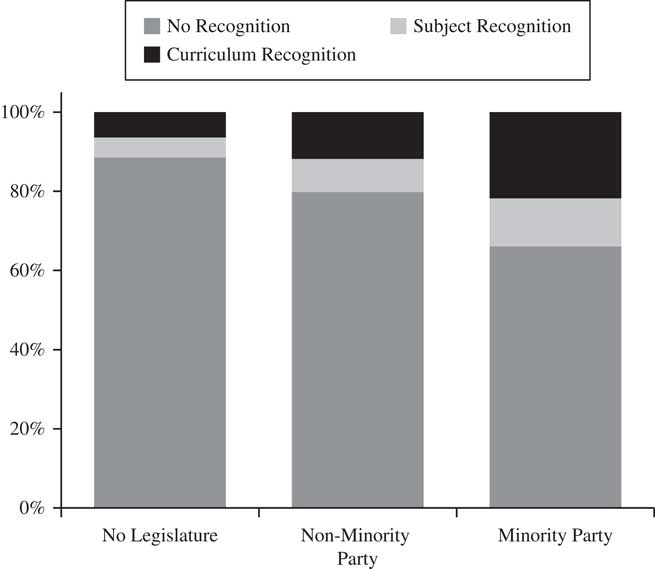
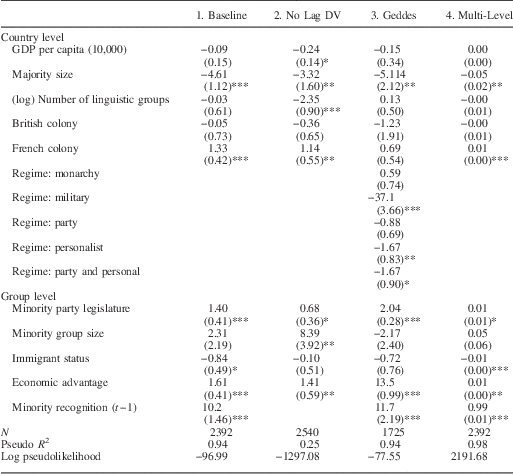
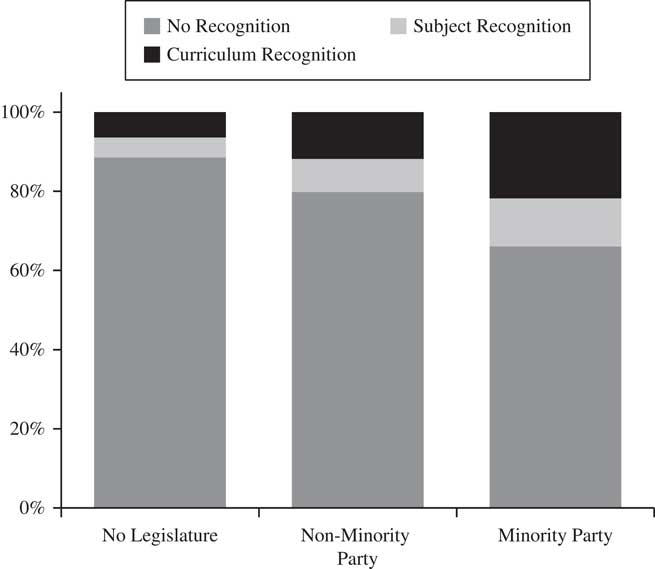
The results are presented in Table 1. Recall, larger values of Minority Language Recognition indicate greater extent of recognition in the education system. The first column (Model 1) is the baseline model. The coefficient for the concerned variable—Minority Party in Legislature—is both positive and significant at the 0.01 level. This is consistent with theoretical expectations: a minority group is more likely to have its language recognized when it has institutional representation within the regime. A minority group with a party representing its interest in an elected legislature is three times more likely to be linguistically recognized than a minority group with neither a party nor a legislature. In addition, recognition levels increase as representation increases. Specifically, as illustrated in Figure 3, the chances of getting medium recognition when there is a minority party (21.8 percent) are twice that of a non-minority party (11.8 percent) and thrice that of no party (6.4 percent).
Predicted probabilities of recognition by party representation
Effects of Minority Parties in Legislatures on Language Recognition

Note: Robust standard errors reported in parentheses.
GDP=gross domestic product.
*p≤0.10, **p≤0.05, ***p≤0.01.
We subject the findings to three alternative model specifications. In Model 2, we run the model without a lagged dependent variable. This is to ensure the said variable is not unduly influencing the estimates (Achen 2000). We see that although effect size does change, the significance itself does not. The coefficient for our variable of interest drops from 1.40 to 0.68 but the effect is still positive. In Model 3, we include the Geddes authoritarian measures. This is to test whether having a party in legislature is significant even when controlling for authoritarian regime type. The results strongly suggest that regardless of whether the government is ruled by a monarchy, the military, a hegemonic party, and/or a singular individual, what matters for minority recognition is whether the corresponding group has an organized voice (party) in an institutionalized forum (elected legislature). It seems that controlling for Geddes authoritarian measures actually increases the magnitude of the concerned coefficient by almost 50 percent. Finally, we relax the assumption that the unobserved randomness occurs within the group–state relationship and run a multi-level model (see Woolridge Reference Wilkinson2003). Like the previous models, this method considers how factors at different levels (i.e., country versus group) can affect minority language recognition. The results are presented in Model 4. The magnitude for the interested coefficient drops quite substantially to 0.01, but again, it remains significant. Across these four models, we can conclude that when autocratic governments face institutionally incorporated minority groups, they are more likely to recognize groups’ languages.
With respect to control variables, majority size is the only country-level variable that is significant in all four models. Again, this is consistent with expectations: demands for minority recognition—by any group—are more likely to fall on deaf ears in countries where the majority group is large. When the largest linguistic group is 58.3 percent of the population (sample mean), a minority group has about a 12.2 percent probability of getting its language recognized. But when the largest linguistic group is only a plurality, for example, 37.3 percent of the population (1 SD below the sample mean), the chances of the same minority group being recognized increase up to 26.6 percent.
The results also suggest that the presence of too many linguistic groups can actually undermine the recognition of any minority group. An increase from one minority group to two can decrease recognition of either type from 88.4 to 73.1 percent. An additional increase to three minority groups further drops the figure down to 55.9 percent. There are two possible scenarios that may account for this finding. The first is that the government can pit one minority group against another, and in doing so, repress all groups with the exclusive recognition of the majority language. The second scenario is that there is an upper limit to language concessions. When there are simply too many linguistic groups, the government can choose a lingua franca. The use of a third-party language (e.g., English) can be seen as fair to all parties. The positive “externalities” of another group’s recognition most notably reverse when there are more than seven linguistic groups. In the Asian sample, the only country with more than seven linguistic groups is Indonesia. Fittingly, during Suharto’s authoritarian rule, all languages were banned from the classroom except for one: a lingua franca (Indonesian).
Holding constant the number of groups within a country, however, there is evidence to suggest that once one minority group is able to extract recognition, it can pave the way for other groups. As the number of recognized languages increases, the likelihood of curriculum recognition correspondingly increases. Let us assume there are four minority groups in a country (i=1, 2, 3, 4). If groups 1, 2, and 3 all have their languages denied, the probability of group 4’s language meeting the same fate is 96.5 percent. But if group 1 were able to extract a linguistic concession, the same probability for group 4 drops to 77.5 percent. Now, if it were groups 1 and 2, the number further decreases to 49.4 percent. And finally, if all the other three groups had their languages recognized, group 4’s probability of rejection is only 28.4 percent.Footnote 2
Independent of minority parties in legislatures, authoritarian regime type matters as well. Recall that the reference category is Geddes’ military–party–personalist hybrid. Compared with this three-way hybrid, military, personalist, and party–personalist hybrid regimes are each less likely to extend recognition. The huge coefficient for military regimes has less to do with military regimes per se and more to do with the sample. Among Asian dictatorships during this time period, military regimes constitute the smallest number (<5 percent). Of the 98 observations, 60 are from Burma. In all 98 minority group-country-year observations, there is no recognition of any minority language.
Group characteristics are also important. First and foremost, wealth—specifically difference in wealth—matters. The variable Economic Advantage takes on a positive value when the minority group is economically advantaged. Given the large positive coefficient (β=1.61; SE=0.41), this suggests dictators are more likely to recognize wealthy minority groups. When the minority group is economically disadvantaged, the likelihood of recognition is around 11.4 percent. But if the minority group is advantaged, its economic influence—while it can be a source of resentment (Esman 1987)—can facilitate language recognition. Under such conditions, recognition likelihood increases to 72.6 percent. Second, whether the minority group is an immigrant population also matters. Not surprisingly, immigrants are less likely to have their languages recognized. Their very status as a non-indigenous population means authoritarian leaders have little incentive to extend social services or political rights. Finally, the coefficient for Minority Group Size is statistically significant in only one model. Although the positive signage would suggest that larger groups are able to press for recognition, the non-finding in the other three models is consistent with our larger argument. Specifically, mere demographics is not enough to warrant recognition. Instead, what is essential is the presence of a minority party in the legislature.
Generalizability: Countries as Units of Analysis
The results from the previous section clearly indicate that minority groups with party representation are more likely than their party-less counterparts to have linguistic recognition. These different minority interests can influence authoritarian leaders, but only when they are organized and politically powerful enough to achieve legislative representation. It follows that at the country level, dictators facing multiparty competition and legislative elections are more likely than their less institutionalized counterparts to recognize any minority language. Specifically:
Likelihood corollary: Dictatorships with legislative and partisan institutions are more likely to recognize minority languages.
Level corollary: Dictatorships with legislative and partisan institutions extend greater levels of minority recognition.
To test the two corollaries, we keep with extant studies that examine the general use of legislative and partisan institutions in authoritarian regimes (Gandhi Reference Gandhi2008; Wright Reference Wintrobe2008; Conrad Reference Conrad2011). We examine a cross-national sample of all dictatorships—not just those in Asia—that spans most of the post-World War II period (1946–2000). Because our corollaries are specific to authoritarian regimes, we limit our universe of cases to only those regimes that are identified as such by Przeworski et al. (Reference Pool2000). The unit of analysis is country-year. This sample consists of about 3000 observations.
The dependent variable Minority Language Recognition is again trichotomous: no recognition (0); subject recognition (1); or curriculum recognition (2). As our focus is now at the country level, a country-year observation is coded as having minority language recognition so long as a minority language is recognized. This is without regard to which minority language is recognized and how many languages are recognized. So, for example, in Kyrgyzstan, while the Germans do not have language recognition, the fact that the Russians (and Uzbeks) do means Kyrgyzstan-year is assigned a value of 2. The primary source is again Leclerc’s (Reference Leclerc2014) L’aménagement linguistique dans le monde database.
The key explanatory variable is now Parties in Legislature, which like the dependent variable is measured at the country level. Specifically, we are interested in whether the authoritarian leader governs with legislative and partisan institutions. The variable takes on a value of 0 if there is no legislature or if all legislative members are non-partisan; a value of 1 if the legislature is composed of only members from the regime party; and a value of 2 if the legislature is composed of members from multiple parties. The data source is Gandhi (Reference Gandhi2008).
With regard to control variables, we include many of the same controls from the minority group–country sample: wealth, linguistic heterogeneity, colonial legacy, and authoritarian regime type. But given the country-level analysis, we omit the group-level controls. We again include a lagged dependent variable to control for temporal autocorrelation. We also include six regional dummies to control for spatial autocorrelation: sub-Saharan Africa, Middle East/North Africa, Latin America, Eastern Europe, and industrialized countries. Asia is the reference category.
Results
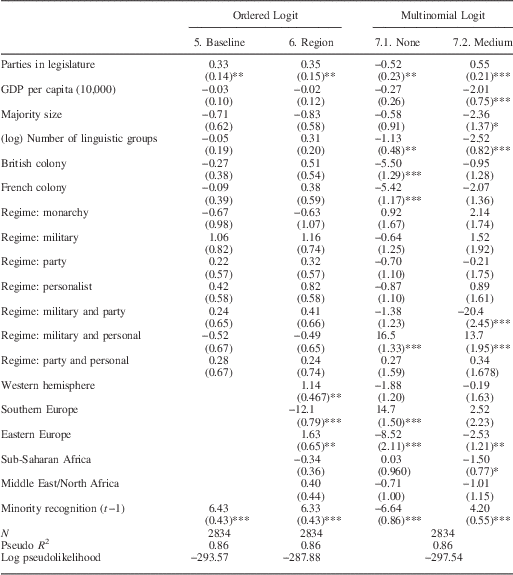
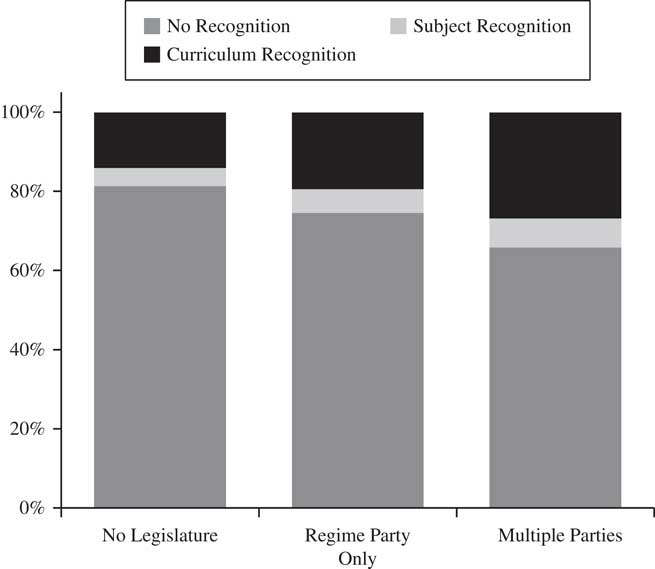
We estimate the sample using ordered logit with standard errors clustered by country. The results are presented in Table 2. The first column (Model 5) is the replica of the full model with Geddes’ authoritarian regime controls from the previous group-level analysis (minus the group-level controls). The second column includes the regional controls. The results for our concerned variable—Parties in Legislature—are in the predicted, positive direction. As illustrated in Figure 4, certain dictatorships are indeed more minority friendly. Dictatorships that allow for multiple parties to contest in a legislature are twice as likely to extend linguistic recognition as ones that prohibit parties and legislatures. The former is also 50 percent more likely to recognize a minority language than regimes that permit only their own hegemonic parties.
Predicted probabilities of recognition by institutionalization
Institutional Effects on Minority Language Recognition

Note: Robust standard errors reported in parentheses.
GDP=gross domestic product.
*p≤0.10, **p≤0.05, ***p≤0.01.
We subject this finding to alternative model estimators. We relax the assumption that the three categories of the dependent variable are ordered in a substantively meaningful way. To do this, we take the model with regional controls and re-estimate it using multinomial logit. The base category is subject recognition Pr (Y=1). So in Model 7.1, the dependent variable is about the likelihood of no recognition Pr (Y=0). Hence, a positive coefficient indicates a likelihood of a minority language being denied recognition; and conversely, a negative coefficient suggests a likelihood of a minority language being recognized. The interpretation for Model 7.2 (medium recognition) is more straightforward: a positive coefficient implies higher likelihood of medium recognition Pr (Y=2), and vice versa.
The results from the multinomial logit model lend support to our previous findings. In Model 7.1, the coefficient is negative (β=−0.52; SE=0.23), suggesting that when parties and legislatures are absent, dictators are more likely to withhold linguistic recognition from minority groups. Conversely, when nominally democratic institutions are present, dictators tend to be more minority friendly. In fact, not only are they more likely to recognize minority languages, but as evident by the positive coefficient in Model 7.2 (β=−0.55; SE=0.21), they also are inclined to extend this recognition to the highest levels. These findings corroborate the distribution of probabilities in Figure 4.
It seems that wealth has no bearing on recognition: it neither moderates social conflict nor makes minority language teaching possible. In fact, the only time GDP per capita is significant is in Model 7.2; and there it is actually negative. This suggests that wealthier dictatorships are actually less inclined to allow minority languages to be mediums of instruction. It is possible that in these scenarios, dictators are using rents to buy off the opposition as a cheaper alternative to more expensive, longer lasting policy concessions.
The threat of a tyrannical majority does not necessarily manifest in recognition likelihood itself, but in whether the minority group is afforded substantive recognition. In addition, the number of linguistic groups has an effect. The results in the multinomial model explain the non-findings in the first two models. As the number of groups increases, it becomes difficult for dictatorial governments to withhold recognition. However, as the number increases, it also becomes a challenge for governments to extend the fullest recognition to any minority group. On the one hand, it is not practical to recognize every minority group; on the other, to only recognize some subset can draw the ire of those groups that are excluded. A shift from the mean number of linguistic groups (seven) to 1 SD above (13) doubles recognition likelihood but also cuts the probability of medium recognition by half.
British colonies are indeed more likely to recognize minority languages. In fact, they are almost twice as likely to do so as non-British colonies. But this statistical difference is simply about the act of recognition. There is no actual difference when it comes to medium recognition. This would explain why the coefficient for British Colony is not statistically significant in either of the ordered logit models. Like their British counterparts, French colonies are also more likely to recognize minority languages. But again, the effect is applicable only to recognition likelihood and not levels.
On the whole, whether the dictator is constrained by a royal family, a military junta, and/or a regime party has neither a significant nor robust effect on minority language recognition. For instance, a pure military regime (e.g., Thailand 1948–1988) is no more likely to recognize a minority language than one that is a hybrid. Put differently, it is not about authoritarian regime type but fundamentally about the legislative and partisan institutions.
Among the regional controls, neither Western Hemisphere nor Middle East/North Africa is significant. Dictators in these regions are no more (or less) inclined than their Asian counterparts to extend linguistic recognition. Conversely, the coefficients for Southern Europe, Eastern Europe, and sub-Saharan Africa are significant. Dictatorships of Southern Europe were substantially less likely to recognize minority languages. These “western civilizations” (Huntington Reference Huntington1996) had state-building experiences where party systems developed before universal suffrage. Conversely, in non-Western civilizations, the two events often developed simultaneously (Lipset and Rokkan Reference Lipset and Rokkan1967). This difference in the “branching tree model of sequential development” (Verba Reference Tarling1965) has had an effect on whether and to what extent minority languages are recognized. Conversely, East European governments are more likely to recognize minority languages but restrict the levels to just that of a subject. The effects are similar in sub-Saharan Africa, where recognition levels are limited.
Spurious Correlates of State Vulnerability?
The evidence from the two previous sections suggests that when minority groups are represented by parties in the legislature, they are more likely to have their languages recognized—and to a greater extent. More generally, when authoritarian governments must deal with minority parties within the legislature, they are forced to extend linguistic recognition. Although the results corroborate our theoretical expectations, it is possible this relationship is spurious. For example, non-democratic leaders perceiving themselves to be more vulnerable to rivals may be more likely to make various types of concessions, including expanding political representation or conceding minority rights. If the representation of minority parties and the recognition of minority languages are two means to the same end, it is plausible that they are substitute mechanisms by which authoritarian leaders seek to secure support. We argue that the two are not spurious correlates of state vulnerability.
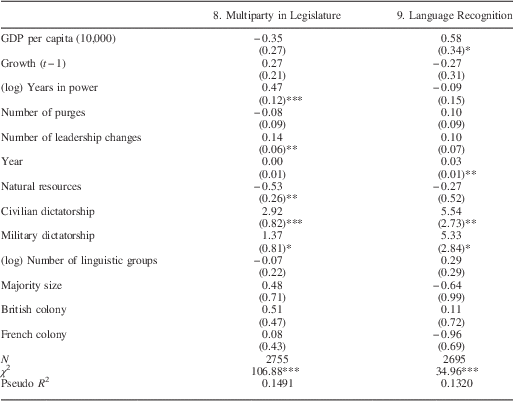
We test our argument with a three-prong approach. First, we begin by testing and comparing the effects of state vulnerability on both political representation and language recognition. Lacking a direct measure of state vulnerability, we instead employ five widely used correlates in the literature: GDP per capita, economic growth, number of years leader has been in power, number of recent military purges, and number of recent leadership turnovers. A priori, we expect states should become less vulnerable—and hence, less willing to make concessions—as GDP per capita, economic growth, and leader tenure increase. And conversely, state vulnerability should increase with military purges and leader turnover. Note that as counts of purges and leader turnovers will inevitably rise over time, we control for year. In addition, a large literature links a government’s willingness to make concessions to natural resource dependence. As such, we include a dichotomous variable that is equal to 1 when oil and minerals exceed 50 percent of a state’s total exports. Finally, we follow Gandhi (Reference Gandhi2008) and control for whether the dictatorship is a monarchy, military, or civilian.
When we compare Models 8 and 9, we find that different kinds of concessions are correlated with different aspects of state vulnerability. Multiparty systems are more likely to be implemented where leader turnover is more frequent and where governments cannot rely on natural resource wealth. The coefficient for (logged) leader tenure is also significant and positive—suggesting multiparty systems are most likely to be created when longer-serving leaders take power after a history of greater political turmoil. Yet in Model 9, we do not see similar effects between these measures of vulnerability and minority language recognition while representation and recognition are both less likely to occur in monarchies, there are no common significant correlates between the two concession types. Instead, only GDP per capita is weakly correlated with minority language recognition—and even then, this finding is sensitive to model specification (also see Models 2, 7.2, and 10). These results suggest that (1) representation and language recognition are concessions driven by different causes and (2) linguistic concessions are dependent upon the existence of multiparty legislatures (Table 3).
The Effects of State Vulnerability

Note: Robust standard errors reported in parentheses.
GDP=gross domestic product.
*p≤0.10, **p≤0.05, ***p≤0.01.
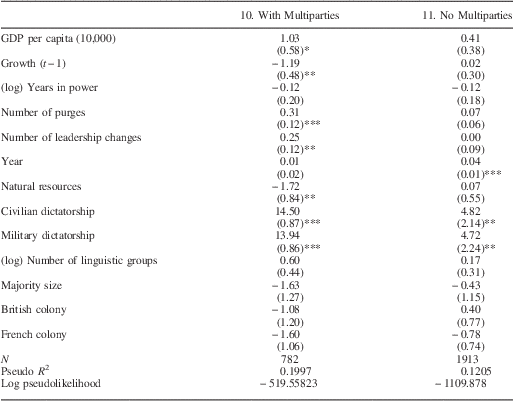
The paucity of strong relationships between state vulnerability indicators and minority language concessions is not surprising. This is in fact consistent with our argument. Multiparty legislatures greatly increase the likelihood that this concession kind will be used. Following this logic, we alternatively split the sample into two: multiparty representation in the legislature (Model 10) and no multiparty legislature (Model 11). Here, we expect to find much stronger relationships between vulnerability and linguistic concessions in Model 10. The difference is stark (see Table 4). In the absence of a multiparty legislature, minority language recognition is still less likely in monarchies. But otherwise, recognition is unaffected by economic crises or recent political stability. But when multiparty legislatures are present, linguistic recognition likelihood and levels increase when (1) there is a history of military purges and leader turnover, (2) natural resource wealth is lacking, and (3) economic growth is very poor.
Vulnerability With/Without Multiparties

Note: Robust standard errors reported in parentheses.
GDP=gross domestic product.
*p≤0.10, **p≤0.05, ***p≤0.01.
As a third and final step, we directly test the conditional role played by multiparty legislatures in a series of interaction models. If both political representation and linguistic recognition are caused by vulnerabilities that render states more likely to grant concessions of all kinds, then state weakness should increase the likelihood of minority language recognition regardless of whether groups have representation in the legislature. But if our argument is correct, then we should see the following conditional relationship:
Conditional prediction: State weakness increases the likelihood of minority recognition only when parties can participate in legislative institutions.
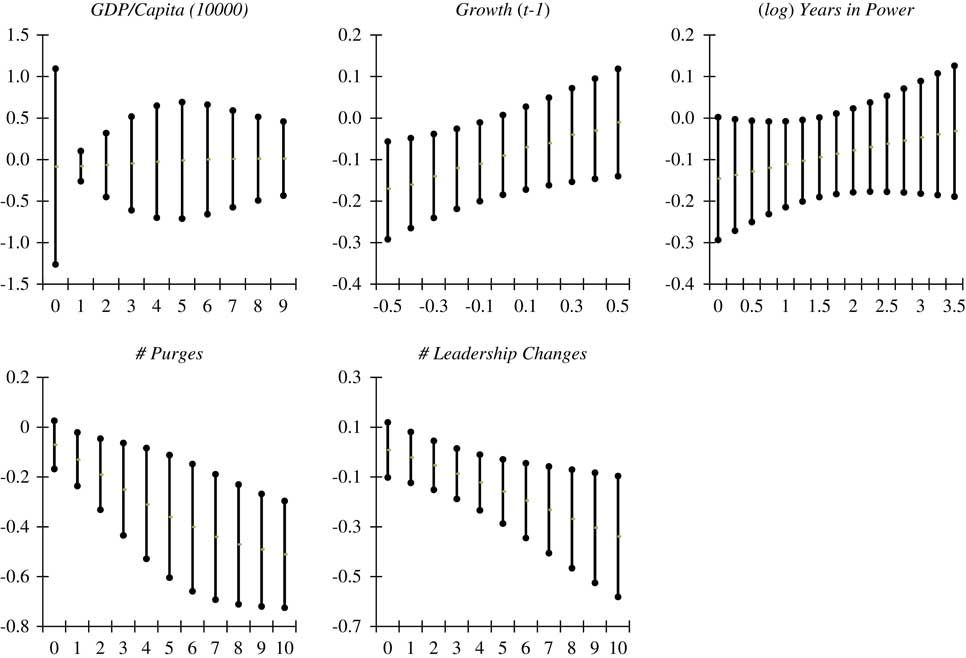
We interact each of the five aforementioned measures of state vulnerability (i.e., GDP per capita, economic growth, number of years leader has been in power, number of recent military purges, and a number of recent leadership turnovers) with a dichotomous variable that takes a value of 1 when legislatures include multiple parties and a 0 otherwise. As interactive effects in ordered logit models are not easily discerned from correlation tables,Footnote 3 we illustrate the marginal effect of a multiparty legislature on minority language recognition over the range of each vulnerability measure (see Figure 5). Note that minority language recognition is significantly more likely in the presence of a multiparty legislature only when the entire 90 percent CI falls below 0.
Marginal effects of multiparty with 90 percent confidence interval Note: GDP, gross domestic product
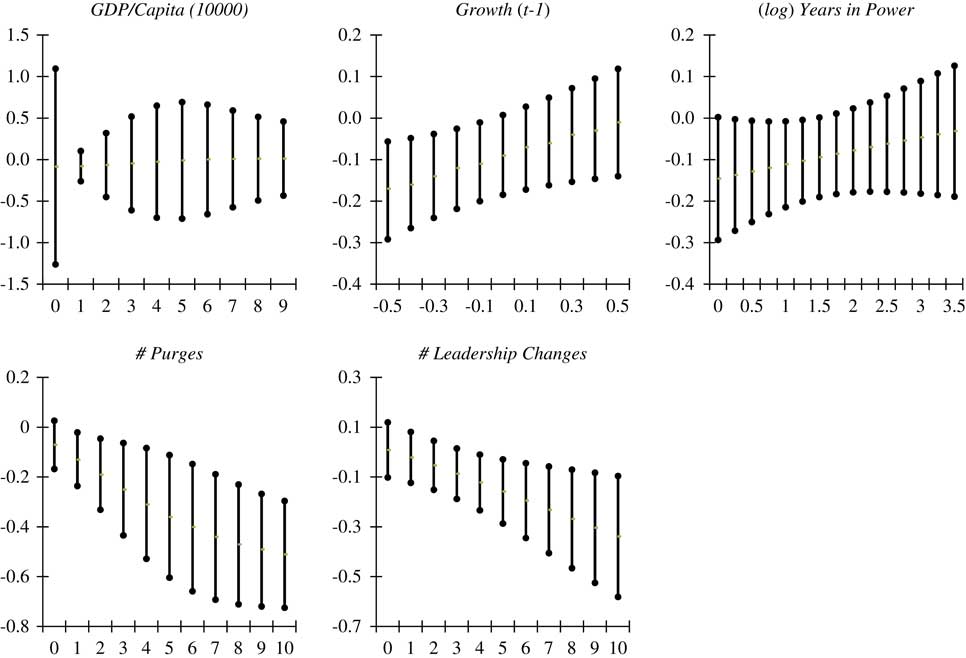
With one exception, these figures evince the conditional role of multiparty legislatures. We see that when the economy is growing, dictators are unlikely to concede recognition even if constituencies have gained representation in a multiparty legislature. But when economic growth is negative, dictators bound by multiparty legislatures are much more likely to grant language recognition than those who have not already conceded representation. We see a similar vulnerability–representation–recognition link with regard to government stability. When governments are stable (i.e., leaders have been in power for at least five years, fewer than two military purges, and fewer than four recent leader changes), minority language recognition is unaffected by representation in the legislature. But across each of these thresholds, the existence of a multiparty legislature significantly increases the likelihood and level with which a government will grant minority language recognition.
Conclusion
What explains minority language recognition in dictatorships? In this paper we argue that when authoritarian governments must make concessions, they do so in response to social pressures, but only as expressed through institutions. When minority groups are able to form political parties and mobilize their fellow linguistic speakers to vote for them, their occupation of legislative seats becomes a signal to the regime. That members of the linguistic group vote for an identity-based party indicates the importance of the language issue to specific parts of the citizenry. That the party is able to enter the legislature reveals that the group constitutes a potential threat to the regime’s political survival. Having signaled their political strength by forming partisan organizations and achieving legislative representation, these groups are more likely to obtain policy concessions. In this case, concessions come in the form of language recognition in education as these minority groups are mobilized along an identity-based cleavage. For authoritarian governments to ignore this potential threat and not make compromises would be foolhardy.
As a result, we observe a relationship between legislative and partisan institutions and minority language recognition in authoritarian regimes. Using newly coded measures at the group level and over time, we find that minority groups that are politically represented by a party in the legislature are more likely to have their languages recognized—and to a greater extent. Moreover, at the country level, dictatorships that allow for multiparty participation are more minority friendly. These findings are consistent even when we account for possible spurious effects.
With these results, we offer an explanation and the first systematic empirical analysis of linguistic arrangements in authoritarian regimes. In addition, we confirm the role of legislative and partisan institutions in influencing policies and outcomes in non-democracies (Gandhi Reference Gandhi2008; Wright Reference Wintrobe2008; Conrad Reference Conrad2011). Although these institutions may be important for solving collective problems among regime elites, they also play a significant role in mediating the relationship between state and society. In this particular instance, they aid authoritarian regimes in making concessions to important linguistic minorities and thus, in managing social diversity.
Although these results are suggestive, they also provide the impetus for future research. One possible avenue of future research is to expand the group-level analysis spatially to other regions and temporally before 1980. Another avenue is to consider a dynamic version of our account: Once linguistic accommodations are made to minority groups, what happens next? Do minority groups demand other forms of recognition? Related, is a sustained presence within the legislature necessary to maintain their linguistic privileges? A third avenue of research is to examine the instrumental effects of non-system groups like rebels groups and social movements. Although we are agnostic that such “non-legal” groups are able to extract meaningful concessions from the government, it is possible that their mere presence constrains the dictator to coopt a political, “legal” grouping of their co-ethnics. And with these groups then in the legislature, the dictator has an incentive to offer linguistic recognition. Answers to these questions will help provide a more complete picture of linguistic politics in authoritarian regimes.
Acknowledgement
The authors wish to thank Ericka Albaugh, Eric McLaughlin, and two anonymous reviewers for their helpful comments. A previous version of this paper was presented at the 2011 Midwestern Political Science Association Annual Meeting.