

The Chinese Securities Regulatory Commission (CSRC) has significantly revised its overall market supervision framework over the last two decades.Footnote 1 These changes are no small matter. China’s capital markets have grown dramatically over the last two decades, expanding from an initial market with just a dozen issuers in 1991Footnote 2 to one in which the Shanghai and Shenzhen stock exchanges combined had more than 2,000 issuers and an aggregate market capitalization in excess of US$ 4.2 trillion by the first quarter of 2011.Footnote 3 Moreover, China’s legislature tends to promulgate abstract commercial laws in order to avoid the uncertainty and costs associated with frequent modification, leaving the responsible enforcement agencies to fill in the terms by issuing regulations and developing working practices.Footnote 4 This combination of factors has given the CSRC significant power over the shape of a crucial aspect of the Chinese market economy.Footnote 5
One area over which the CSRC exercises significant influence is insider trading. The use of non-public information to trade public stock for gain represents a perennial problem for many jurisdictions.Footnote 6 China is no exception to this norm.Footnote 7 Indeed, while there is no convincing empirical evidence showing the exact extent of insider trading violations in China’s stock market, scholars generally believe that the issue is serious.Footnote 8 The CSRC has also shown growing concern over the effects of insider trading in recent years, increasing the frequency of calls to “enhanc[e] the enforcement of insider trading”Footnote 9 as well as the number of administrative actions taken against those suspected of insider trading.Footnote 10 These efforts are most likely the result of the authorities’ need to show that they are actively doing something to stave off the wrath of investors and restore confidence in the market and the fact that they now have more resources available to them and are thus better equipped to uncover securities fraud.
These efforts also raise important questions about the quality of enforcement standards and practices in the administrative sanctions regime. The purpose of this article is to assess the quality of the CSRC’s administrative sanctions regime for insider trading to determine how it functions and how it might be improved. It does this by analysing all of the published administrative sanctions cases, which the CSRC has published since the end of the 1990s.Footnote 11 In doing so, it raises a number of important questions about what constitutes a quality sanctions regime, whether the CSRC’s current regime meets these criteria, and, if not, what kinds of changes could be implemented to address any of its current shortcomings. After all, insider trading is unfair,Footnote 12 and better enforcement of the insider trading laws will improve market fairness and regulatory legitimacy so that domestic and foreign financial consumers alike are more comfortable with investing in the Chinese market.
I. THE ADMINISTRATIVE SANCTIONS FRAMEWORK: CONTENT, VAGUENESS, AND THE PROBLEM OF PREDICTABILITY
Generally speaking, insiders who engage in prohibited transactions face the possibility of both criminal and administrative sanctions under Chinese law.Footnote 13 The relationship between these two kinds of penalties is uncertain, with no clear standards for deciding which cases are subject to criminal sanctions and which are subject to administrative ones.Footnote 14 However, because criminal cases are not publicly available and criminal sanctions are only remotely connected to the CSRC, our research focuses solely on the administrative sanctions regime.
The major legal sources of administrative sanctions are the Securities Law of the People’s Republic of China (Securities Law) and the related regulations promulgated by the CSRC.Footnote 15 The key provision of the Securities Law is Article 202, which stipulates that those who violate the insider trading rules are subject to a range of pecuniary punishments:
Where an insider who has access to inside information of securities trading or any person who has obtained any inside information purchases or sells the securities, divulges relevant information or advises any other person to purchase or sell securities before the information regarding the issuance or trading of securities or any other information that may have any big impact on the price of the securities is publicized, he shall be ordered to dispose of the securities he illegally holds according to law. The illegal proceeds shall be confiscated and a fine of 1 up to 5 times the illegal proceeds shall be imposed. Where there are no illegal proceeds or the illegal proceeds are less than 30,000 yuan, a fine of 30,000 yuan up to 600,000 yuan shall be imposed. Where an entity is involved in any insider trading, the person-in-charge and any other person as held to be directly responsible shall be given a warning and be imposed a fine of 30,000 yuan up to 300,000 yuan. Any functionary of the securities regulatory body that conducts any insider trading shall be given a heavier punishment.Footnote 16
Although this part of the law has been in force for almost 16 years, it remains problematic in that it introduces at least three areas of vagueness and ambiguity into the administrative sanctions regime. The first is the issue of what constitutes “illegal proceeds” at the regulatory level. The CSRC has issued some internal guidance material on this question in the form of the Securities and Futures Law Enforcement Brochure (Enforcement Brochure), which includes an equation for calculating illegal gains.Footnote 17 Nevertheless, reliance on this material can be problematic. This is true not only because the Enforcement Brochure is not available to the public and therefore does not help them understand the CSRC’s approach to the issue,Footnote 18 but also because an analysis of past cases suggests that even the CSRC does not always follow its own internal guidance.Footnote 19
More fundamentally, the very act of measuring illegal gains remains a controversial issue.Footnote 20 Financial analysts currently recognize two distinct ways of measuring illegal gains: the Net Profit Approach, which considers the illegal gains to be the final profits or total increase in value and would be calculated by subtracting the purchase price of the shares from the total sale price of the shares, and the Market Absorption Approach, which considers an illegal gain to be the amount resulting from the offense and would be calculated by subtracting the purchase price of the shares from the stock price at the time the market (i.e. the public) absorbed the effects of the positive information.Footnote 21 These approaches see the issue very differently and can yield very different results even when applied to the same set of circumstances.
Assume, for example, that Manager A receives inside information about a potential merger deal. He then purchases 1,000 shares on Day One at $1 per share. On Day Two, the merger deal is announced to the public and the price of the stock goes up to $2 per share. Manager A, however, holds the shares for two more weeks, selling all his shares on Day 16 at $3 per share to realize a $2,000 profit (1,000 shares×($3-$1)=$2,000). Taking the Net Profit Approach would yield an illegal gain of $2,000, as 1,000 shares×($3-$1)=$2,000. However, using the Market Absorption Approach would lead to a significantly lower result, as 1,000 shares×($2-$1)=$1,000. For obvious reasons, this difference could lead to extremely large inconsistencies in enforcement results if one standard is not consistently used across all cases. And while the example magnifies the difference between the two approaches because the stock price continues to increase after the information is released, the two approaches can in fact diverge significantly in cases where the actual share price is highly volatile.
The second murky area in the administrative sanctions regime concerns the CSRC’s approach to regulating actions taken to avoid a loss. Generally speaking, insider trading activities can be classified into four possible scenarios: (1) insiders with positive information, such as news of a possible merger deal, buy and sell shares in order to make a profit, and succeed; (2) insiders with positive information buy shares but fail to make a profit, whether as a result of bad timing or other factors; (3) insiders with negative information, such as a large potential law suit or poor earnings, sell shares and avoid even bigger losses; or (4) the expected fall in price expected in scenario 3 does not in fact occur, so that the insiders needlessly sold their shares. Article 202 of the Securities Law clearly addresses the first and second scenarios. However, it is unclear how the Commission should apply its terms to activities falling in the third and fourth scenarios.Footnote 22
To be sure, making profits and avoiding losses are clearly analogous when considering one’s personal gains, and it follows that insiders who trade on positive information to gain profits and insiders who trade on negative information to avoid losses ought to be treated the same. Moreover, this equality of treatment should obtain even if the law uses the phrase “illegal proceeds” rather than “personal gains”. Viewed from this perspective, because the law requires the CSRC to confiscate the illegal profits and impose a fine of between one and five times the illegal proceeds in cases involving illegal gains,Footnote 23 it should also require the CSRC to order the perpetrator both to disgorge the amount that would have been lost but for the illegal trade and to require the perpetrator to pay a fine of between one and five times the loss avoided in loss evasion cases.Footnote 24 However, Article 202 only states that “[w]here there is no illegal proceeds or the illegal proceeds are less than 30,000 yuan, a fine of 30,000 yuan up to 600,000 yuan shall be imposed”. This raises the question of whether the term “illegal proceeds” includes losses avoided through insider trading. But while fairness suggests a positive answer, and the reasoning for extending the provisions to instances of loss evasion is theoretically sound, a number of actual loss evasion cases seem to contradict this reasoning by simply imposing a fine within the range of RMB 30,000 to RMB 600,000.
The third murky area of the administrative sanctions regime concerns the factors used to set fines within the statutory range. Of course, setting fines almost inevitably involves a measure of regulatory discretion, and indeed some discretion is needed for the law to function effectively. Nevertheless, there also clearly needs to be some relationship between the illegal action and the penalty imposed. Professor Stephen Bainbridge opines that fairness arguments and intangible property rights arguments do the most to illuminate the reasons for insider trading prohibitions.Footnote 25 From this observation it is safe to conclude that the amount of gain or loss actually received should serve as the major parameter for determining the sanction for insider trading.
There is currently very little literature that articulates a general framework for the qualitative assessment of sanctions regimes across jurisdictions for the simple reason that differences in their respective political economies have meant that there can be no one-size-fits-all standard for evaluating regulatory quality.Footnote 26 Nevertheless, it is possible to identify and measure whether specific regulations achieve some common objectives. Clearly one of the most important goals of any sanctions regime is deterrence. And according to rule of law theory, deterrence is always associated with predictability.Footnote 27 Predictability requires a number of things, including a clearly-defined set of parameters so that the actions which trigger sanctions, the factors used to judge the severity of such actions (such as the quantum of illegal gains or losses avoided or the blatancy of the action), and the sanctions themselves are easily understood. It also requires that the parameters in place be sufficiently, yet not unreasonably, severe and consistently applied to similar cases. Unfortunately, however, the lack of clarity provided by Article 202 ultimately degrades the predictability of the penalties imposed on those involved in insider trading, and has made clarifying these ambiguities the primary issue for improving China’s insider trading laws. Of course, clarity is not the only issue with the insider trading laws; a handful of scholars have even argued that the major normative shortcoming of Article 202 at present is that the fines are too light to usefully deter insiders from illegal action.Footnote 28 However, these arguments seem to ignore the fact that the sanctions imposed must also be clearly understood for the law to be efficacious. Indeed, if the legal consequences of insider trading are unclear, the profitability of such ventures will certainly lure many people to take their chances.
II. ENFORCEMENT PRACTICES AND THEIR IMPLICATIONS FOR PREDICTABLE AND EFFECTIVE REGULATION
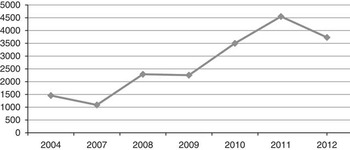
These issues also raise important questions about whether the Commission’s actual enforcement practices result in an effective and predictable administrative sanctions regime.Footnote 29 In this section, we analyse a large volume of data taken from the cases published by the CSRC in order to assess whether enforcement practices work to clarify the law or leave it unclear, unpredictable, and underdeveloped.Footnote 30 This data represents a statistically significant – and almost complete – record of all reported enforcement actions, with more than 95 percent of reported decisions generating enough data to use in our study.Footnote 31 Moreover, the trend has been towards issuing longer, more specific, and more sophisticated judgments (see Chart 1).Footnote 32
Average Words Per Decision Source: Compiled by Authors.

A. The Net Profit Approach v. The Market Absorption Approach
The first issue we approach here is whether the CSRC has adopted an optimal approach to calculating illegal proceeds. According to the explanations in the CSRC’s sanctions decisions and outlined in the internal guidance contained in its Enforcement Brochure, it would appear that the CSRC takes an approach very similar to the Net Profit Approach.Footnote 33 The first analysis we did, then, was to compare the approach used by the CSRC with the Market Absorption Approach to identify which differences affect enforcement and to determine whether the approach taken is actually superior to the Market Absorption Approach.
To do this, we gathered information related to illegal gains from 49 cases going back six years,Footnote 34 choosing to omit cases before 2007 due to deficiencies in data. We then used financial software to find out the specific prices of each share on the day the relevant information was released.Footnote 35 Finally, we determined the differences between the CSRC’s approach, which is similar to, if not perfectly aligned with, the Net Profit Approach, and the Market Absorption Approach.
It is not exactly clear why the CSRC has chosen to use the Net Profit Approach. The choice is particularly curious given that it appears to contradict the theory applied to penalties in Chinese administrative penalty theory.Footnote 36 Article 4 of the Administrative Penalty Law of the People’s Republic of China (Administrative Penalty Law) stipulates that:
Administrative punishments shall abide by the principles of being fair and just and open to the public.
The establishment and implementation of administrative punishments must take facts as the base and correspond to the facts, nature and seriousness of the illegal acts as well as to the extent of the harm thereby caused to the society…
Academics and practitioners generally point to Article 4 as an example of the application of the “proportionality principle”, which requires penalties set by administrative agencies to be based on the harm done to society,Footnote 37 in administrative law.Footnote 38 The problem with the Net Profit Approach is that it may exaggerate or underestimate illegal gains and thus fall foul of the proportionality principle. To be sure, it is trading on insider information, rather than other factors, that results in the illegal gain. The Efficient Market Hypothesis, for example, reflects this approach by calculating the benefit received from such a trade as the spread between the purchase price and the price at the time the information is released and incorporated into the market price.Footnote 39 For many reasons, however, those who violate the law often choose not sell their shares immediately after the information is released, and it seems unfair to put the volatility risk on the violator after the value of the information has been completely incorporated into the share price. Because the Net Profit Approach incorporates subsequent volatility risk into its calculations, it does not appear to accord with the proportionality principle and would therefore be illegal under the Administrative Penalty Law.
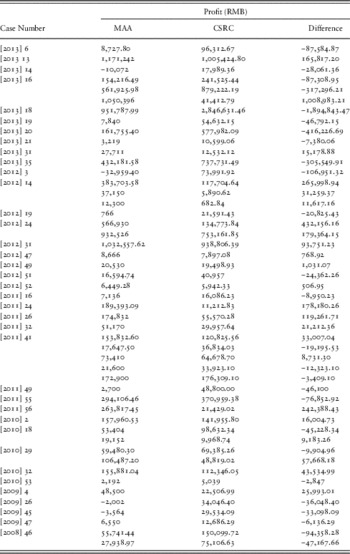
Some might argue that the Market Absorption Approach is more lenient than the Net Profit Approach. Indeed, many cases support such a proposition.Footnote 40 The research outlined in this article, however, proves that this worry is unwarranted in China. Of the 49 cases analysed, 23 show a positive difference (see Table 1), meaning that using a Market Absorption Approach would have resulted in the CSRC finding a higher illegal gain than by using Net Profit Approach almost half of the time. Moreover, the average illegal gain under the Market Absorption Approach was around 176,000 RMB, which is 17,000 RMB – or roughly 10 percent – more than the average gain under the CSRC’s current approach.Footnote 41 These statistical figures clearly show that the CSRC’s current approach is not necessarily stricter than the Market Absorption Approach, and that it is incorrect to presume that one approach is necessarily more lenient than the other.
Comparison of Profits by Case

Source: Compiled by Authors.
Furthermore, we also found that in the cases where those engaged in violating the prohibitions against insider trading did not sell all the shares purchased using inside information, the CSRC usually ignored any shares still held at the time of the enforcement action.Footnote 42 This absence is also present in the CSRC’s Enforcement Brochure, which does not mention how to calculate illegal gains related to unsold shares that result in unrealized profit.Footnote 43 Under the Market Absorption Approach, however, this issue is irrelevant, as all illegal proceeds are calculated at the point where the share price absorbs the relevant information. As a result, the Market Absorption Approach might provide a clearer basis that ensures that the entire transaction is taken into account.
B. Assessing CSRC Action in Loss Evasion Cases
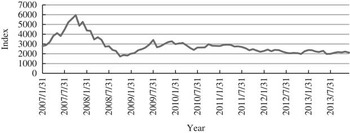
The second issue we address is the CSRC’s approach to loss evasion cases. Generally speaking, CSRC action on this issue has been rather weak. Indeed, out of the 100 violations of the insider trading laws in the past decade, only three involved recognized instances of actions designed to evade losses.Footnote 44 Moreover, the losses actually recognized in each case were nominal.Footnote 45 This low enforcement record is particularly striking given the fact that the Chinese equity market has been in decline since 2007, with the index shrinking by more than 60 percent over this period (see Chart 2).Footnote 46 This is true, moreover, even if some may argue that loss evasion cases may be less relevant to the broader market situation and should always be dealt with on a company-by-company basis.
Index of Market Changes, 2007-2013 Source: Compiled by Authors.

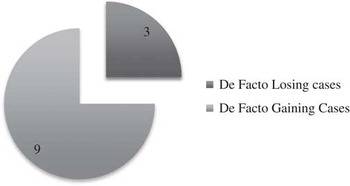
There are two possible explanations as to why actions against efforts designed to avoid losses have been so weak. The first is that the CSRC might have incorrectly categorized some loss evasion cases as other kinds of cases. This seems to have occurred, as a portion of the regular insider trading cases after 2008 show that those prosecuted had actually realized a negative gain (see Chart 3).Footnote 47 That the CSRC mischaracterized these cases is further demonstrated by the fact that taking the arithmetic mean of the price within 10 days after the sale in the cases where the CSRC reported that the trader lost money from the trade reveals that in fact nine out of the 12 cases actually evaded a significantly larger loss, the largest amounting to 1.7 million RMB.Footnote 48 The second possibility is that the CSRC simply has trouble discovering and prosecuting instances of loss evasion. While it would be practically, if not theoretically, impossible to prove this hypothesis, the paucity of CSRC cases suggests that there is at least some truth to it.
Breakdown of Cases Involving Negative Gains Source: Compiled by Authors.

Ultimately, the CSRC’s failure to strictly enforce the law where insiders act illegally to evade losses, whether because it does not require violators to disgorge the “gain” in an amount equal to the loss avoided or because it misses or miscategorizes many loss evasion cases, has meant that some illegal traders receive less punishment than they should, while others receive no punishment at all. Of course, the Commission is likely to excuse the unequal application of the law with claims that the Securities Law only gives it limited power to fine sellers who act to avoid losses. And this raises the issue of whether Article 202 of the Securities Law needs to be revised in order to equalize the punishments for illegal gains and loss evasion cases.Footnote 49 This is a question we believe should be answered in the affirmative
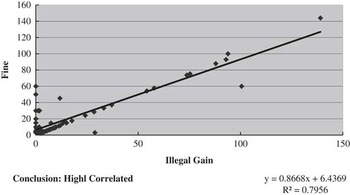
Correlation Between Fine Imposed and Illegal Gain, 2008-2013 Source: Compiled by Authors.

.
C. The Relationship Between the Illegal Gain and the Fine Imposed
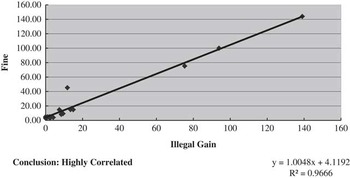
The third issue we address concerns the factors used to set fines within the statutory range. As mentioned in the previous section, the most important consideration in setting fines should be the amount of the illegal gain. Therefore, the best way to determine whether the CSRC is enforcing the insider trading law in a principled manner is to find out whether its decisions show a correlation between the amount of illegal gains and the amount of the fine imposed. To do this, we first removed all the loss evasion and zero gain cases from the data. We then ran a regression analysis in order to determine whether a correlation actually exists. Chart 4 indicates that sanctions imposed over a six year period are in fact highly correlated with the amount of illegal proceeds made from the trade under investigation. In other words, the CSRC mainly looks at the amount of the illegal gain when deciding what penalty to impose.
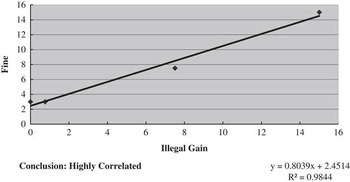
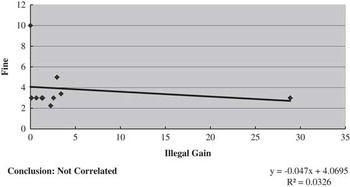
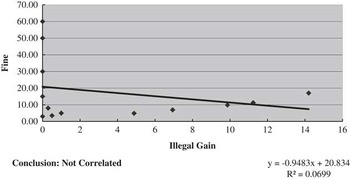
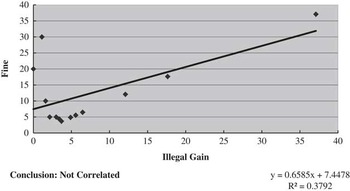
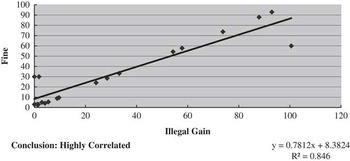
In order to examine whether the CSRC was consistent in its approach over the years, we also ran separate regressions across each of the six years considered here. In contrast to the overall trend, our findings, which are presented in Charts 5 through 10, indicate that the CSRC has not always followed the same approach.Footnote 50 Whereas the fines issued in 2008, 2012, and 2013 all demonstrate a significant correlation between the illegal gain made and the fine imposed, there was no such correlation in 2009, 2010, and 2011. Indeed, the CSRC consistently issued only nominal penalties throughout the latter period, in most cases around the minimum 30,000 RMB, even where those cases involved rather large gains.Footnote 51 These findings suggest that the CSRC valued the number of sanctions cases over the effects of the punishment during that period.Footnote 52 This approach, however, appears to have ended with the appointment of a new CSRC chairman in 2012.Footnote 53 Today, the Commission now attempts to catch more “tigers” than “flies”.Footnote 54 Indeed, the chart for 2013 shows a nearly perfect relationship between fines and illegal gains, indicating that illegal gains are the major factor in setting punishments.
Correlation Between Fine Imposed and Illegal Gain, 2008 Source: Compiled by Authors.

Correlation Between Fine Imposed and Illegal Gain, 2009 Source: Compiled by Authors.

Correlation Between Fine Imposed and Illegal Gain, 2010 Source: Compiled by Authors.

Correlation Between Fine Imposed and Illegal Gain, 2011 Source: Compiled by Authors.

Correlation Between Illegal Gain and Fine, 2012 Source: Compiled by Authors.

Correlation Between Fine Imposed and Illegal Gain, 2013 Source: Compiled by Authors.

III. CONCLUSION
To achieve optimal effectiveness, the rule of law requires that the law on the books and actual enforcement practices be consistent. Our research, however, clearly demonstrates that this harmony is lacking with respect to the CSRC’s enforcement of insider trading rules, including some of the Commission’s own self-prescribed regulations. While some cases clearly follow the standards laid out in the Enforcement Brochure, others clearly violate them. These discrepancies likely stem from a mix of insufficient resources and interference from both the public and private spheres;Footnote 55 whatever the reason, they have resulted in a lack of predictability when it comes to the enforcement of the insider trading regulations. Other aspects of the administrative sanctions regime have also limited its efficacy. The CSRC’s stated approach to calculating illegal proceeds from insider trading activity contains several flaws, including the fact that it is of questionable legality when viewed from the perspective of Chinese administrative lawFootnote 56 and the fact that the authorities have had demonstrable difficulties using this approach in cases where the trader involved chooses to hold onto the purchased shares. Moreover, the CSRC’s enforcement record in loss evasion cases has proven to be far from satisfactory, especially in light of years of bearishness.
Ultimately, the lack of predictability in the relevant enforcement standards and practices has significantly reduced the deterrence effect of China’s insider trading laws. And while the judgments ultimately fail to reflect the ultimate reasons for the CSRC’s choice or inconsistent application of the rules identified in the administrative sanctions regime,Footnote 57 our study has suggested a few ways to improve the regime as it stands today. An initial recommendation is to “cage” the CSRC’s discretion by making the sanctions regime more specific,Footnote 58 as an intervention at an appropriately high level (e.g. legislative) would work to narrow, if not cure, some of the deviations currently seen in the CSRC’s approach to administrative sanctions. Another improvement, given the fact that China’s current, Net Profit-like approach to calculating penalties for illegal trades is neither optimal nor legal, is to consider the Market Absorption Approach as an alternative to calculating the penalties for sanctioned conduct. Finally, given the fact that prosecutions for loss-evading actions are extremely rare in a period where such conduct would be expected to occur with some frequency, the CSRC should increase its efforts to enforce the sanctions regime in such cases.
Despite these issues, our research also suggests some positive developments in recent years. Most importantly, although it is hard to tease out the principles that the CSRC uses to set fines, it would seem that, since 2012, the Commission has begun to consider the amount involved in an illegal gains transaction as the primary factor in determining the penalty issued. This movement suggests that those considering engaging in prohibited activities should still pay attention to the enforcement of insider trading laws, because both the quality and quantity of the enforcement proceedings are improving. With the small changes to enforcement methodology and focus suggested here, it is hoped that the enforcement of Chinese insider trading laws will become even more reasonable and predictable.