

INTRODUCTION
Studies of economic voting have recently expanded in geographic scope to include newly democratized countries. Evidence of an economic rationale underpinning vote choice in these countries, however, is mixed at best (Lewis-Beck and Stegmaier Reference Lewis-Beck and Stegmaier2008). In general, making incumbents accountable for their performance can be more difficult in new democracies, as voters may lack sufficient information or struggle to evaluate the state of the economy (Anderson Reference Anderson2007). In a similar vein, the low level of party system institutionalization (Mainwaring Reference Mainwaring1999; Zielinski, Slomczynski, and Shabad Reference Zielinski, Slomczynski and Shabad2005) and an absence of programmatic links between parties and voters (Kitschelt Reference Kitschelt2000) in new democracies make it difficult for voters to determine to whom they should ascribe economic conditions.
South Korea is not an exception. Existing studies find only mixed evidence that voters in South Korea respond to economic conditions. For example, Kim (Reference Kim1993) and Pak (Reference Pak1993) find no significant effect of economic issues on the fourteenth presidential election races in 1992. On the other hand, Lee (Reference Lee2008) and Kwon (Reference Kwon, Lee and Kwon2008) claim that concerns about the national economy dominated other issues in the seventeenth presidential election in 2007. The lack of evidence of pocketbook and sociotropic voting, however, does not indicate that voters in South Korea are not concerned about economic conditions. Given that party competition in South Korea follows a regional cleavage, regions are likely to serve as a midway point of reference between the national economy and the personal economic circumstances that voters may consider in making their voting decisions. Therefore, efforts to examine whether voters respond to economic conditions should address whether or not they express concerns about the state of the regional economy.
It is not a novel suggestion that voters consider local economic conditions when deciding whether to vote for the government or the opposition (Cutler Reference Cutler2002, Reference Cutler2007). Geography is often the basis for interactions between voters and political agents. In a legislative body, representatives are often elected to represent the interests of constituents who reside within a certain geographic boundary. The executive branch forms and implements public policy based on administrative boundaries, meaning voters face systematically different economic and policy outcomes. From the perspective of voters, therefore, whether a representative brings resources to their place of residence is one of the most important considerations by which they can evaluate his or her performance (Levitt and Snyder Reference Levitt and Snyder1995). Thus, models of tactical targeting claim that governments tactically redistribute resources across different geographic units (Dixit and Londregan Reference Dixit and Londregan1996; Lindbeck and Weibull Reference Lindbeck and Weibull1993). Empirical studies of Korea present evidence that government resources are distributed in a manner that is geographically unequal (Horiuchi and Lee Reference Horiuchi and Lee2008; Kwon Reference Kwon2005).
In South Korea, ethnic, linguistic, and cultural homogeneity make geography the primary cleavage by which voters are classified into different groups. Moreover, the absence of programmatic links between parties and their constituents puts concerns about distributive benefits and local interests at the center of their interactions. Politicians often appeal to voters based on the voters’ concerns about possible gains or losses associated with electoral outcomes. Voters, on the other hand, often point to local interests as one of the most influential factors in their electoral choices. To the best of my knowledge, however, no study has explored how local economic conditions affect voters’ electoral decisions at the individual level, due to the difficulty of separating the impact of short-term economic changes at the local level from the impact of longer-term political affiliations between voters and parties that allegedly represent the interests of the voters’ region. This article utilizes a Bayesian multilevel strategy to address this issue.
The article is organized as follows. In the following section, we present two competing mechanisms that connect local economic conditions to voting behavior in nationwide elections. Under the Local Interest Voting model, voters are concerned about the economic well-being of the place in which they live, and they reward and punish incumbents based on the state of the local economy, independent of their personal finances and the national economy. Under the Indirect Sociotropic Voting mechanism, voters use the state of the regional economy as an information shortcut to ascertain the state of the national economy. In the empirical section, we explain the advantage of a multilevel approach in examining local interest voting. Next we present our empirical results. In particular, we show that voters who live in a province with stronger economic performance tend to reward the government party candidate, even after controlling for various individual-level covariates such as age, ideology, partisan attachments, and evaluations of the national economy, as well as the longer-term political orientation at the province level. The association is driven by a local interest voting mechanism rather than by indirect sociotropic voting.
THEORY
Local Interest Voting and the Development of Residence-Based Regionalism
While geography receives less attention than other social identities such as partisanship, race and ethnicity (Chong Reference Chong2000), it can be equally effective at dividing people into different social groups. A sense of common experience among residents who live in the same place can produce a source of attachment to that place (Cohen Reference Cohen1986). In fact, all else being equal, people are likely to feel closer to people who live nearby than to those who live farther away. Such connectedness among residents of the same geographic area may be amplified when a place is viewed as a ‘community of fate’ where individuals’ material interests and group well-being are strongly dependent on the conditions and prospects of the local area (Agnew Reference Agnew1987). Even the most fully self-interested person lives in a place with other people whose fortunes can affect his own local environment (Cutler Reference Cutler2007).
In South Korea, it was not until the 1987 presidential election that connectedness among residents living in proximity to each other developed into an enduring political cleavage. In pre-democratized Korea, electoral competition followed the democratic–authoritarian cleavage. Patterns of regional bloc voting appeared under the authoritarian regime, but when democracy was established regional voting doubled (Lee Reference Lee2011). In the 1987 presidential election that ended the military dictatorship, the democratic–authoritarian cleavage lost its significance, and voters instead used the birthplaces of the four major candidates as a cue to inform their vote choices. Voters felt closer to the candidate from their own birth region, in the way that people often feel solidarity with those of similar backgrounds. Since the 1987 election, however, the bond between regional parties and their constituents has consolidated, and the competition between parties with regional bases in Honam and Youngnam is considered the most salient feature of electoral politics in South Korea (Horiuchi and Lee Reference Horiuchi and Lee2008; Kwon Reference Kwon2005, Reference Kwon2010; Lee and Brunn Reference Lee and Brunn1996; Moon Reference Moon2005).
Lee (Reference Lee1997) suggests that there are two different types of regionalism that can result in regional bloc voting: birthplace-based regionalism and residence-based regionalism.Footnote 1 Birthplace-based regionalism attributes voters’ support for regional partiesFootnote 2 to psychological attachments to their place of birth, which promote favoritism toward people from the same region while reinforcing biases against people from other regions (Lee Reference Lee and Lee1998). In particular, combined with regional historical sentiments, birthplace-based regionalism has often appeared as a prejudice against Honam people by people from other regions, particularly Youngnam (Kim Reference Kim1987). Psychological distance between the Honam and Youngnam regions, or Honam and non-Honam regions, widened under the Park regime, which selectively favored people from Youngnam, where Park was born, while discriminating against Honam people both politically and economically (Kim Reference Kim1995; Park Reference Park2009). After democratization in 1987, an affinity or dislike for people from the Honam or Youngnam regions developed into support for a certain political party, even among people from other regions (Lee and Park Reference Lee and Park2011).
In contrast, residence-based regionalism puts more emphasis on voters’ rational motivations to maximize the benefits allotted to where they live (Cho Reference Cho1996). In post-democratized Korea, major parties have more similarities than differences in terms of their ideological orientations and policy preferences (Choi Reference Choi2002). In the absence of salient ethnic, linguistic, and cultural heterogeneity, politicians often appeal to voters for support based on the possible regional benefits or costs associated with a given electoral outcome.Footnote 3 Once in office, politicians cultivate regional favoritism by selectively appointing people from their home region to government positions and allocating government expenditures to favored regions to enhance their power base (Lee and Brunn Reference Lee and Brunn1996). The repeated practices of regional favoritism tended to shape a belief that the victory of a regional party would be accompanied by improvements in the political and economic status of a region, which might not directly enhance voters’ personal finances but might produce positive externalities that benefit residents of the same region in general (Moon Reference Moon2005). Moreover, the dominance of the central government over local governments, especially with regard to the implementation of social and economic policies, provides voters with a strong incentive to exploit elections as an opportunity to maximize anticipated benefits by considering the extent of the distributive benefits each party can bring into their region (Park Reference Park2009).
The two forms of regionalism have distinct ramifications in the context of economic voting. In birthplace-based regionalism, the link between voters and regional parties is based on enduring psychological traits. As long as a voter feels attached to his birthplace and people from the same birthplace, his support for parties that represent his birthplace will not fade even if he moves to other regions. Moreover, attitudes toward parties determine voters’ issue position and policy preferences (Lee Reference Lee2002). Regionalism from this perspective is degenerative and destructive to democratic accountability because support for parties is not conditional on their performance (Choi Reference Choi2002). Therefore, birthplace-based regionalism hampers any form of economic voting.
In residence-based regionalism, in contrast, the link between voters and parties is conditional on benefits and interests allotted to voters’ regions. Voters’ electoral decisions are based on rational choices to maximize benefits to their local community (Kang Reference Kang, Lee and Kwon2008). Thus, residence-based regionalism is a form of economic voting that holds parties accountable for their performance, in particular, the state of the local economy.
Note that the two types of regionalism are also distinct in the way they conceptualize the boundaries of a region. In studies that emphasize psychological attachments to a region, the boundary of a birthplace is set at the broader demarcation of regions such as Jeolla-do (Honam), Gyeongsang-do (Youngnam) and Chungcheong-do, reflecting similarities in social and political experiences. For example, Min (Reference Min, Choi and Kim1991) shows that stereotypes against people from other regions are formed at this level (e.g. Honam people are distrustful). In a similar vein, the regional identities of each administration and the major political parties are also defined at this level.Footnote 4
On the other hand, in studies emphasizing similarities in economic conditions, the unit of analysis is not limited to the aggregated region. For example, Hong and Park (Reference Hong and Park2016) show that in legislative elections, voters rewarded the ruling party under the Park regime for the construction of an industrial complex in their localities at the eupmyundong level. Similarly, Kim and Lee (Reference Kim and Lee2012) show that attracting large-scale projects funded by the central government improved the reelection odds of incumbent legislators (jiyeokgu) and mayors (sigungu) in elections during the 2000s in the areas where those projects were implemented. Park (Reference Park2009) and Choi and Park (Reference Choi and Park2012) also demonstrate that rising real estate values in local communities (eupmyundong) generate additional support for the incumbent party even among renters. Despite the fact that rising real estate values make it difficult for renters to purchase homes, renters seem to put more weight on how rising real estate values affect local economic development rather than their own personal finances.Footnote 5
An alternative mechanism: indirect sociotropic voting
The link between local economic conditions and electoral outcomes in nationwide elections may arise from an alternative mechanism. Ample empirical evidence suggests that voters are sociotropic. Their electoral choices are closely linked to their perceptions of the national economy. Also, various individual level covariates such as age, gender, income, partisanship, information, or political attentiveness influence the formation of national economic evaluations (Anderson and Roy Reference Anderson and Roy2011; Duch, Palmer, and Anderson Reference Duch, Palmer and Anderson2000; Kwon Reference Kwon2010).
However, the state of the national economy represents a summary of various economic indicators averaged out different regions, industries, and individuals. There is no single entity as the national condition. While the media often report that the national economy has improved or worsened, voters’ economic experiences might vary with local economic conditions, which would influence how voters evaluate aggregate economic performance (Reeves and Gimpel Reference Reeves and Gimpel2012).
Voters living in economically prosperous places are likely to form different impressions of the national economy than those who live in economically depressed places. While voters do not experience the state of the national economy, they do have personalized knowledge of economic conditions experienced through their daily lives such as changes in gas prices, number of stores opening or closing, situations in local real estate markets etc. Moreover, conversations with their family, colleagues, or neighbors also would affect how voters perceive the state of the economy differently because the local economic context influences the content of information flow (Books and Prysby Reference Books and Prysby1999).
DATA
To assess the effect of local economic context and other individual characteristics on perceptions of the economy and vote choices, we employ a multilevel model. Level one variables reflect data from individuals and are drawn from the South Korean Presidential Election Panel Study: Six Waves, 2007, conducted by the East Asia Institute. Level two variables are observed at the level of the sixteen provincial administrative units (provinces hereafter) and describe the economic conditions therein.Footnote 6
The main dependent variable is vote choice. Conventional tests of economic voting generally assume a situation in which two parties compete with each other. However, the 2007 presidential election does not fit this framework. Ten candidates competed in the election, and four candidates received more than five percent of the vote nationwide.Footnote 7 In this context, testing economic voting is not straightforward. If a voter decides to punish an incumbent for poor economic conditions by voting for one of the opposition candidates, this will benefit some candidates but not others. Voters vote for different opposition candidates for different reasons. Concerns about the economy may explain why a particular respondent prefers one of the opposition candidates to an incumbent, but it may not explain other respondents’ choices. When we analyze the impact of individual level covariates on vote choice using a multinomial logit estimation approach, it appears sociotropic evaluations of the economy had a significant effect on voters who voted for Lee Myung-bak over Chung Dong-young.Footnote 8 On the other hand, sociotropic evaluations of the economy had a smaller effect on the probability that a voter would choose Lee Hoi-Chang or another candidate over Chung Dong-young. Thus, we focus on those who voted for the two major candidates, Chung Dong-young and Lee Myung-bak, and examine the factors that explain these voters’ choices.Footnote 9
We include various individual-level covariates such as home ownership, gender, education level, age, income, personal ideology, information exposure, interest in politics, partisan attachment, and ideological distance from the candidates.Footnote 10 Due to the relatively short history of democratic competition in South Korea, voters have not developed partisan attachments comparable to those of voters in, for example, the United States. In order to control for voters’ attitudes toward each party, we create two indicator variables based on whether a respondent selects either the Grand National Party (GNP) or the Uri party as his favorite party. Refer to the Appendix for information on the wording of specific questions and waves in which the questions appeared.
To measure the impact of regional economic conditions, we employ changes in per capita Gross Regional Domestic Product (GRDP) and Housing Price Growth Rate (HPGR).Footnote 11 GRDP indicates the annual aggregate of the gross value added at each province divided by the population estimate. HPGR describes how housing sale prices have changed over time in each province, using the price in 2012 as a baseline. In particular, we are interested in the percentage change during the election year, as previous studies suggest that voters are more responsive to changes right before an election (Bartels Reference Bartels2008). We expect that increases in GRDP and HPGR are both positively associated with support for a government candidate. By definition, increases in GRDP indicate that the local economy is growing. Similarly, in South Korea, increases in housing prices are considered an indication that the local economy is developing (Park Reference Park2009).
We also include an indicator controlling for the political orientation of the region. As Park (Reference Park2009) points out, we need to control for the long-term political orientations of each province to understand how short-term fluctuations in the local economy affect voters’ electoral choices. To measure long-term orientations, we use the average level of support for the conservative party over the three previous presidential elections (Cons3MA). We focus on the conservative party because in South Korea conservative parties survive longer than liberal parties. As for the 2007 presidential election, this variable measures the average vote share of the New Korea Party (NKP) in the 1992 election and the GNP in 1997 and 2002 in each province. Table 1 provides the summary statistics for these variables.

EMPIRICAL STRATEGY
To analyze how regional economic conditions at the aggregate level affect voters’ perceptions of the economy and their vote choices, we adopt a multilevel approach. Regional clustering of votes indicates that individuals who live in geographical proximity to one another share more attributes than people who live farther apart. Existing studies often try to capture differences across regions by controlling for indicator variables that reflect residence in Honam and/or Youngnam. Yet, this approach ignores the possibility that voters in Youngnam may have different political orientations depending on whether they live in Busan or Daegu. Thus, we estimate sixteen different intercepts for each individual province and two group level variables, which induce perfect collinearity in a classical regression. To avoid the collinearity problem produced by estimating all these parameters in the same model, we instead use a random intercept model, which assumes that the sixteen intercepts are drawn from a normal distribution (Gelman and Hill Reference Gelman and Hill2007, 269).Footnote 12
For our application, we consider a varying intercept model with the following form:
Equation 1 A varying intercept model
 $$\eqalign{y_{ij} &= \alpha _j + X_{ij}B + \varepsilon _{ij}, \cr & \alpha _j &= \gamma _0 + \gamma _1 GRDP + \gamma_2 HPGR + \gamma_3 Cons3MA + u_j,} $$
where i denotes individuals and j indexes sixteen provinces. At the individual-level equation, intercepts for each province are assumed to be from a normal distribution, but coefficients for other individual-level predictors do not vary across provinces. Following Gelman and Hill (Reference Gelman and Hill2007), we use the term fixed effects when coefficients do not vary by province, and random effects when coefficients vary by province.Footnote 13 Thus, all individual-level predictors (X ij ) have fixed effects. On the other hand, α j captures varying characteristics of provinces that are not explained by a set of individual-level covariates. Using the level two equation, we model α j as a function of province-level economic indicators and a normal level of conservative party support. The main focus of our analysis is whether these economic indicators have significant effects on α j when the influence of individual-level predictors and the longer-term political orientation of each province are controlled.
Note that this approach clusters voters into sixteen different groups following the administrative boundaries of each province, which raises one theoretical concern and one empirical one. Conventionally, studies of regionalism in South Korea are based on birthplace. Thus, the boundary of what constitutes the “same” region often assumes a historical division between Honam and Youngnam that is reinforced through political mobilization during electoral competitions. However, distribution of benefits and economic circumstances in general may not adhere to this politically conceived regional boundary. Prior to the 2007 presidential election, for example, each of five provinces in the Youngnam region faced distinct economic situations. While the per capita GRDP in the North Gyeongsang province grew by only three percent, Ulsan and South Geyongsang provinces marked about eleven percent growth.Footnote 14
Since we explore whether similarities in economic experiences across geographically proximate places result in clustering of votes, voters should be grouped into administrative units in such a way that similarities in their economic experiences are captured. In this regard, a local administrative unit seems more appropriate for exploring variations in the local economic context than a historically conceived regional demarcation such as the one between Honam and Youngnam. Governors of metropolitan cities and provinces are granted a high level of autonomy to implement economic and social policies, as shown in the 2011 controversy over the construction of a new airport in the southeast region.Footnote 15
Empirically, the number of provinces (sixteen) raises concerns about whether a multilevel strategy is applicable to this context. The basis for the widely used maximum likelihood inference for multilevel models is asymptotic and assumes a large sample size. A small number of groups results in underestimation of standard errors and overstated levels of significance for estimated effects, leading to spurious significant effects (Maas and Hox Reference Maas and Hox2004). In this context, the existing literature provides rules of thumb indicating how many groups are necessary to properly test hypotheses in a multilevel framework. These range from eight or ten to 100 groups (Kreft and de Leeuw Reference Kreft and de Leeuw1998; Rabe-Hesketh and Skrondal Reference Rabe-Hesketh and Skrondal2008).
In this context, Stegmueller (Reference Stegmueller2013) demonstrates that the estimation strategy matters when the purpose of the multilevel models is to test the effects of group-level characteristics on individual-level outcomes. When the number of groups is fewer than twenty, maximum likelihood estimates are sharply biased upward while ninety-five percent confidence intervals are too narrow by five to fifteen percentage points. On the other hand, in any number of groups, Bayesian estimates are within five percent of the true population value and their ninety-five percent credible intervals are virtually congruent with their nominal model.Footnote 16 Thus, we estimate our model using Bayesian estimation strategies.
In particular, we use non-informative independent normal priors for the regression coefficients β and η with mean zero and variance 1,000. All models are estimated using a Metropolis-Hastings sampler run for 206,000 iterations, with the first 6,000 iterations discarded as burn-in. A chain is thinned by a factor of twenty to yield 10,000 posterior samples on which the following analysis is based.
EMPIRICAL ANALYSIS
Before we present our results from the multilevel analysis, we first examine the relationship between regional economic conditions and electoral outcomes at the province level. Figure 1 presents two scatter plots showing deviation from the expected level of conservative party support in the 2007 presidential elections, plotted against percent changes in per capita GRDP (Panel A) and HPGR (Panel B) between 2006 and 2007. The deviation from the expected level of conservative party support indicates how much more or less support the conservative opposition party candidate received compared to the average support received by the conservative party in the three previous elections in a given province. A positive value indicates that the opposition party candidate performed better than expected based on previous election outcomes, and a negative value indicates the opposite. The distribution shows that the opposition party candidate received more support than expected in every province except Busan and South Gyeongsang. The underperformance of the opposition party candidate in these two provinces results from the fact that votes against the government party were split between two conservative candidates.Footnote 17 Panel (A) in Figure 1 shows that the main opposition party candidate received a greater level of additional support in provinces with smaller growth in GRDP. In Panel (B), on the other hand, this candidate performed better in provinces where housing sales prices increased more substantially.
Province Economic Conditions and Economic Outcomes 2017

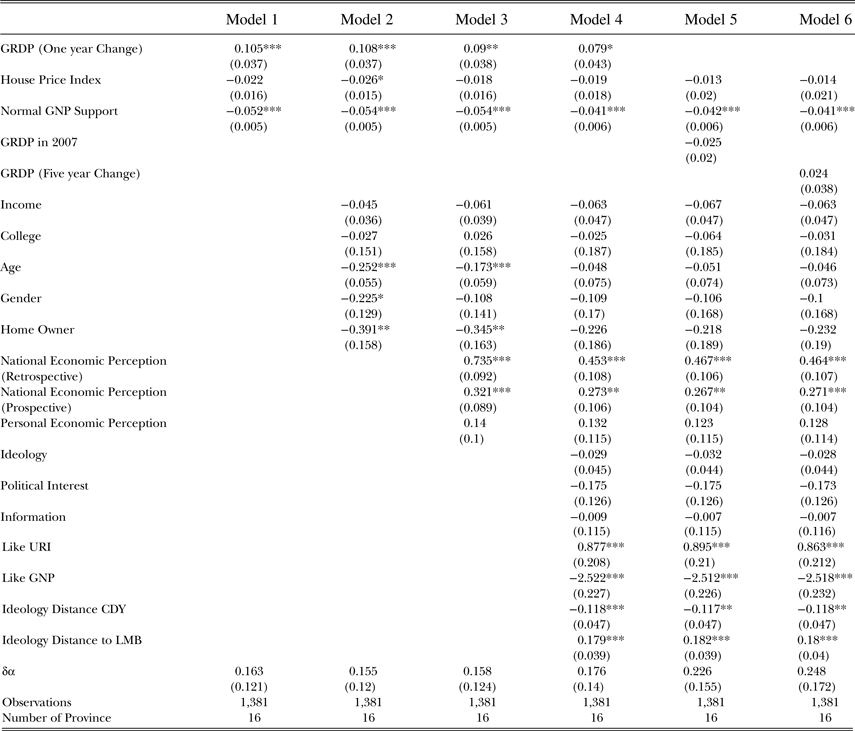
This aggregate level analysis suggests that province-level economic circumstances are related to electoral outcomes. To understand whether and how regional economic conditions affects voter decisions at the individual level, we turn to the results of the multilevel analysis. In Table 2, we explore the impact of local economic conditions on support for Chung Dong-young, a government party candidate, versus Lee Myung-bak, a main opposition candidate. In the survey, 1,484 respondents voted for one of the two candidates, and 1,381 voters are included in the analysis. Estimates indicate posterior means and their standard deviations are in parentheses.
Province Economic Conditions and Vote Choice
Note: Posterior means and posterior standard deviations (in parentheses) are from Bayesian multivel model. ***, **, or * indicates that the estimate is significant at 1 percent, 5 percent and 10 percent credible interval, respectively. The dependent variable is a binary variable, where 1 denotes a vote for Chung Dong-young, the government party candidate.
Models 1 through 4 examine the impact of growth in the provincial economy over a presidential election year on vote choices with different specifications. In Model 1, we consider the effects of province-level covariates only. In Model 2, we add socio-demographic variables. In Model 3, we add variables reflecting voters’ perceptions of both national and personal economic conditions. In Model 4, we add variables reflecting voters’ affinity for two major parties and other political attitudes. In Models 1 through 3, the estimated effect of GRDP remains positive at the ninety-five percent level, and it is significant at the ninety percent level in Model 4. Thus, growth in the local economy prior to the presidential election has a significant effect on voting decisions independent of various individual-level covariates as well as the long-term political orientation of each province. While the effect size of GRDP appears modest in Model 4, this estimate is conservative in that Model 4 includes various attitudinal variables such as similarity to each party and ideological distance from the two candidates, factors that are closely related to vote choice. In fact, individual level variables such as age, gender, and home ownership that have often been considered significant predictors of vote choice in previous studies are significant in Models 2 or 3 but lose significance in Model 4.
In Models 5 and 6, we examine the impact of nominal per capita GRDP and the impact of growth in province level GRDP over a five-year period (2003–2007). The GRDP indicators are not significant in either model, which is consistent with previous findings that voters are more concerned about recent changes in economic conditions than longer-term ones and reward or punish the incumbent accordingly.
The dependent variable is binary; thus we cannot interpret the coefficients of variables as marginal effects, as we could in a linear model. To better understand the estimated effects, we rely on a statistic called the “average predictive comparison.” For each set of coefficients in the posterior distribution generated based on the estimates in Model 4, we calculate an average difference in predicted probabilities across all observations by varying the variable of interest from its minimum to its maximum and holding all other variables at their actual value.Footnote 18 Then we calculate the mean and the ninety-five percent credible interval of the average difference across 10,000 sets of coefficients in the posterior distribution. Figure 2 depicts these quantities graphically.
Predicted Changes in the Probability to Vote for Chung Dong Young

Shifting from the minimum change in GRDP to the maximum change in GRDP increases the probability of voting for Chung Dong-young by an estimated 7.4 percentage points, and this estimate is significant at the ninety percent level. Figure 2 shows that the effect of local economic conditions is substantial compared to other variables typically thought to influence voters’ electoral decisions in Korea. The effect is larger than the difference due to age, home ownership, and personal ideology, ceteris paribus. Furthermore, the size of the effect approximates that of likability to the URI Party (8.1 percentage points), ideological distance from Chung Dong-young (8.7 percentage points) or prospective evaluation of the national economy (9.4 percentage points). The greatest difference in predicted probabilities is generated by normal support for the GNP, at 26.1 percentage points.
Existing studies often suggest that the link between local economic conditions and electoral outcomes in nationwide elections arises due to indirect sociotropic voting. In Figure 2, changes in retrospective evaluations of the national economy generate a 16.3 percentage point difference in the probability of voting for Chung Dong-young, twice as large as the estimated effect of prospective evaluation of the national economy. Furthermore, the comparison of Models 2 and 3 in Table 2 shows that the introduction of variables related to perceptions of national and personal economic conditions reduces the absolute value of the GRDP coefficient. Thus, our findings can be interpreted as support for a mechanism running from local economic conditions through perceptions of the national economy to voters’ electoral decisions.Footnote 19
To further explore the validity of this mechanism, we explore whether local economic conditions affect voters’ perceptions of the economy in Table 3. In particular, we consider retrospective evaluations of the national economy (Model 1), prospective evaluations of the national economy (Model 2), and retrospective evaluations of personal finances (Model 3). All variables are coded from 1 to 5, where 1 reflects an opinion that the situation has “gotten much worse,” and 5 reflects an opinion that the situation has “gotten much better.” Thus, a positive coefficient in the estimation results indicates that a variable is positively correlated with evaluations of the economy.
Province Economic Conditions and Economic Evaluations

Note: Posterior means and posterior standard deviations (in parentheses) are from Bayesian multivel model. ***, **, or * indicates that the estimate is significant at 1 percent, 5 percent and 10 percent credible interval, respectively.
Table 3 presents qualified evidence of indirect sociotropic voting in South Korea. In Model 1, the coefficient of the GRDP is 0.022, which indicates that the higher the growth rate over a presidential election year, the more favorably voters in a given province tend to evaluate the national economy. However, the coefficient is only significant at the ninety percent level, which suggests that the association between local economic conditions and vote choice is driven by a local interest voting mechanism rather than by indirect sociotropic voting.Footnote 20
On the other hand, the Housing Price variable has a coefficient of -0.012. Thus, an increase of one standard deviation in the Housing Price (σ = 5.7) decreases positive evaluations of the economy by about 0.07. Since the dependent variable is a five-point measure from 1 to 5, a movement of 0.07 on the scale approximates a 1.7 percentage point change in evaluations of the national economy. Note that existing studies of the impact of the real estate market and election outcomes on vote choice posit that voters take increases in housing prices as a sign of local economic development. The negative association between Housing Price and perceptions of the national economy suggests that the influence of this variable on voting behavior is more nuanced than previously suggested. Finally, Normal GNP Votes has little significant impact on perceptions of the national economy. Thus, the longer-term political orientation of a region does not affect how people perceive the national economy.
Existing studies of the regional economy's effect on vote choice generally focus on how the regional economy affects retrospective evaluations of the national economy. It is possible, however, that regional economic conditions affect evaluations of other aspects of the economy. Thus, we examine the effect of the regional economy on prospective evaluations of the national economy and on retrospective evaluations of personal finances. GRDP and Housing Price are non-significant in Models 2 and 3, showing that no such relationship exists.
The effects of individual-level covariates generally corroborate the findings of existing studies. Personal financial circumstances are positively associated with evaluations of the national economy. Predispositions such as ideology and feelings toward parties also have the anticipated effects. Conservative respondents make negative evaluations of the national economy when it is managed by a liberal government party. Those who favor the Uri Party evaluate the economy positively, while those who favor the GNP evaluate it negatively. Female and older individuals tend to evaluate the economy negatively, as do those with higher incomes. Interestingly, those with a greater interest in politics tend to evaluate the economy more favorably, controlling for other individual-level covariates. We leave explanations of those findings for future research.
CONCLUSION
This article sheds new light on the debate regarding regionalism and economic voting in South Korea. Regionalism is one of the most salient characteristics of Korea's contemporary politics. Existing studies on this topic generally consider regional bloc voting as evidence of birthplace-based regionalism, assuming that voters base their electoral choices on an intrinsic affinity for parties that represent the regions where they were born. However, the analysis in this article suggests that the regional clustering of votes also reflects voters’ current concerns about the economic well-being of place in residence. Given that economic conditions at the local level are similar in geographically proximate places, voting based on local economic conditions also leads to clustered votes at the aggregate level.
The analysis of the province-level economic conditions and election outcomes in 2007 is consistent with this expectation. The main opposition party candidate received a greater level of support in provinces with smaller economic growth or in provinces with rapid increase in housing prices. Similarly, a Bayesian multilevel analysis of the individual-level survey data shows that short-term changes in province-level economic conditions affected voters’ decisions in the 2007 presidential election independent of long-term political affinities between parties and constituents. The positive association between economic growth in each province and support for the government party candidate remains significant when individual level covariates such as age, home ownership and political attitudes are controlled.
The idea that regionalism in South Korea results from inequalities in patterns of growth between regions is not new (e.g. Choi Reference Choi1998). However, an empirical scrutiny of the relationship between unequal development and the emergence of regional cleavages has been qualified. The evidence in this article, while it focuses on the short-term economic change in the 2007 presidential election, shows that voters care about regional economic performance in elections. Moreover, a recent study suggests that government parties in South Korea reward their core supporters in the allocation of government subsidies (Kang Reference Kang2015). In this sense, future studies on the historical origin of regionalism and its continuation in South Korea should focus more on the impact of unequal development over the longer run.
Last but not least, findings from this study have mixed implications for the literature on regional bloc voting and democratic accountability in South Korea. Conventionally, regionalism has been criticized as provincial, anachronistic, or regressive, because support for regional parties has been considered an expression of regional sentiment or identity, discouraging voters from holding parties accountable for their performance. In residence-based regionalism, on the other hand, the link between parties and their constituents depends on the interests of voters residing in a particular place. Voters reward parties when they improve local economic conditions, and punish them otherwise. Compared to birthplace-based regionalism, therefore, residence-based regionalism has more positive ramifications for democratic accountability, in that electoral support for parties is conditional on their performance. Along these lines, Kang (Reference Kang, Lee and Kwon2008) suggests that the development of residence-based regionalism would contribute to establishing a more programmatic link between parties and voters if parties were forced to garner support by formulating policies to improve local economic conditions.
At the same time, however, local economic voting and the development of residence-based regionalism may also limit democratic accountability. When parties pay more attention to the interests of those voters who play a more important role in their reelection prospects, their policy choices may not be consistent with the optimal policy decision at the national level. In this sense, local economic voting encourages parties to be accountable locally, but not universally.
APPENDIX
Characteristics of Sixteen Provinces



