INTRODUCTION
Brisingidan asteroids (Echinodermata: Asteroidea: Brisingida) are a predominately deep-sea (>200 m) class of echinoderms that occur worldwide. The distinctive morphology of brisingidans superficially resembles that of crinoids (Asteroidea: Crinoidea), as brisingidans have many (always more than five) long, spined arms that are often raised into the water column for suspension feeding (Downey, Reference Downey1986; Emson & Young, Reference Emson and Young1994). Characteristic taxonomic features of brisingidans include a fused oral ring, crossed pedicellariae, and hourglass-shaped ambulacral ossicles (Clark & Downey, Reference Clark and Downey1992). Although the Brisingida have been known since the mid to late 19th Century (Downey, Reference Downey1986), they remain poorly understood due to their deep distributions and fragile bodies that are badly damaged on retrieval by trawls (Tyler et al., Reference Tyler, Pain, Gage and Billett1984). Many species are known only from a small number of individuals or only from fragments, making estimates of their geographical and bathymetric ranges difficult.
Although there is a long history of trawling and fishing in eastern Canada, relatively little is known about non-commercial invertebrates such as asteroids in the region. Gale et al. (Reference Gale, Gilkinson, Hamel and Mercier2014) recently studied species assemblages involving asteroids off Newfoundland and Labrador (NL) using a combination of field sampling and video data from remotely operated vehicles (ROVs). In addition, examination of samples obtained from routine fisheries surveys by Canada's Department of Fisheries and Oceans (DFO) has revealed new records of asteroid species for the region (e.g. Mah et al., Reference Mah, Mercier, Hamel and Nizinski2012). Here we report on new geographical and bathymetric ranges for several species of brisingidan asteroids in NL: Brisinga costata Verrill, Reference Verrill1884, Freyella microspina Verrill, Reference Verrill1894, Novodinia americana (Verrill, Reference Verrill1880), and a new eastern Canada record for Freyella elegans (Verrill, Reference Verrill1884).
MATERIALS AND METHODS
Asteroids were collected during routine fisheries surveys led by DFO, which were carried out over the NL shelf and slope including the Laurentian Channel, Grand Banks and into Labrador as far as 56°N. Specimens were collected by trawl between 2005 and 2011 at depths between 471 m and 1375 m. After collection, specimens were either preserved in ethanol or were frozen at –20°C. Specimens were photographed and the disc radius of most individuals was measured using imaging software ImageJ. Additional specimens and in situ images were collected in 2007 during surveys conducted by the remotely operated vehicle ROPOS along the Scotian Shelf and southern Newfoundland shelf at depths between 354 and 2243 m. Although identifying brisingidans from images is difficult and definitive identifications require examination of voucher specimens, records from the in situ images are included here to provide additional information on these poorly known species. To standardize identification, we determined several easily visible morphological features for each brisingidan species known to occur in our ROV survey range. Poor quality or ambiguous observations (i.e. identifying features not visible) were excluded. Brisinga costata (reported here as B. cf. costata, see Results below) was identified by the presence of distinct costae (raised ridges, Figure 2A) on arms, sometimes only visible as a darker orange section of arms; a lighter disc; and 6–8 thin arms, usually flat against substrate, that did not touch each other at connection to disc. Freyella elegans was identified by a disc clearly raised above plane of arms; visible long arm spines; and 9–12 arms, always raised vertically, that narrowed at connection to disc. Freyella microspina could not be differentiated from F. elegans in the videos. Novodinia americana was identified based on visible papulae; visible arm spines; and 11–15 arms, always raised vertically, that had strongly swollen gonadal regions.
RESULTS
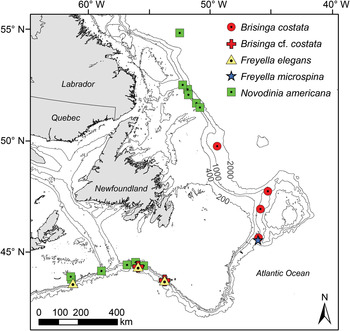
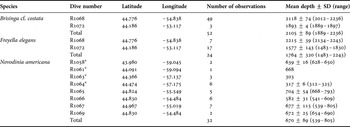
Five specimens of Brisinga costata, one of Freyella elegans, one of F. microspina, and seven of Novodinia americana were identified in our trawl-caught collection (Table 1; Figures 1 & Figure 2). With the exception of F. elegans, these species have not been formally reported (i.e. in the primary literature) north of Nova Scotia. Brisinga cf. costata, Freyella elegans and Novodinia americana were also observed in ROV in situ imagery (Table 2; Figure 3).
Locations of brisingidan asteroid specimens collected in eastern Canada between 2005 and 2011. Bathymetric contours are shown in m. All specimens south of 45°N were collected or observed by remotely operated vehicle; those specimens north of 45°N were collected via trawl.

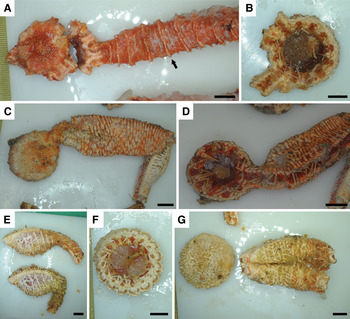
Brisingidan asteroid specimens collected from eastern Canada: (A) Brisinga costata, aboral view of disc and proximal section of arm. Black arrow indicates costa (raised ridge) characteristic of this species; (B) B. costata, oral view; (C) Freyella microspina, aboral view of oral disc and proximal section of arm; (D) F. microspina, oral view; (E) Novodinia americana, lateral view of gonadal (proximal) region of arms; (F) N. americana, oral view of oral disc; (G) N. americana, aboral view of oral disc and gonadal region of arms. All scale bars = 1 cm.

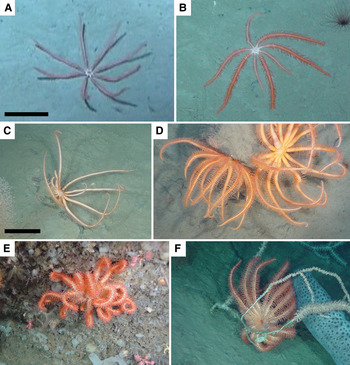
In situ observations of brisingidan asteroids on the southern Newfoundland and Labrador continental shelf and eastern Scotian Shelf, eastern Canada: (A) Brisinga cf. costata at 2112 m; (B) B. cf. costata at 2207 m; (C) Freyella elegans at 2244 m; (D) F. elegans at 1829 m; (E) Novodinia americana at 628 m: (F) N. americana at 719 m. Scale bars for A and C = 10 cm; scale not available elsewhere because remotely operated vehicle lasers were not on (photographs courtesy of DFO/ROPOS).

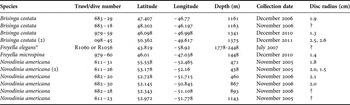
Brisingidan asteroid specimens collected in Newfoundland, Labrador and Nova Scotia (eastern Canada).

*, specimen collected during remotely operated vehicle dive; ?, measurement not available.
Details of in situ observations of brisingidan asteroids during remotely operated vehicle dives in July 2007 on the southern Newfoundland and Labrador continental slope and eastern Scotian Shelf. For dives marked *, only opportunistic still photographs were examined. For all other dives both still photographs and complete video surveys were examined. Coordinates shown are the starting latitude and longitude of each dive's video surveys.

SD, standard deviation.
Brisinga costata
We identified five specimens (mean disc radius = 2.1 cm) of B. costata from depths of 1161–1375 m (Table 1; Figure 2A, B). Three specimens were collected in the Flemish Pass, east of the Grand Banks, and two were collected on the north-east Newfoundland shelf. From the ROV video surveys we recorded 52 specimens on the southern NL continental slope between 1889 and 2236 m that we identified as Brisinga cf. costata (Table 2; Figure 3A, B). The in situ imagery of this species was generally poor, precluding an unambiguous species identification. No voucher specimens were collected during the ROV survey; however, in all observations the characteristic costae of this species (Figure 2A) were evident. Brisinga costata has previously only been reported as far north as George's Bank (to 42°N, Maine, USA) at depths of 1514–2173 m (Clark & Downey, Reference Clark and Downey1992) and has not been recorded in Canadian waters. Our Newfoundland specimens occur 139–353 m shallower than published records and extend the geographical range by 8° northward. Additionally, our in situ observations occur up to 63 m deeper than previous records for B. costata.
Freyella elegans
We identified one specimen of F. elegans from an ROV collection in the Gully in Nova Scotia between 1778 and 2448 m (Table 1). From the ROV video surveys we recorded 24 unambiguous specimens of F. elegans (Table 2; Figure 3C, D) between 1483 and 2243 m on the southern NL continental slope and eastern Scotian Shelf. In the western Atlantic, Freyella elegans is found from Greenland south to North Carolina (Clark & Downey, Reference Clark and Downey1992), but to our knowledge it has not been reported in Canada. It is also found in the north-east Atlantic and may be a cosmopolitan species (Clark & Downey, Reference Clark and Downey1992). The depth for our collected specimen (1778–2448 m) is within the published depth range of 1600–4500 m (Clark & Downey, Reference Clark and Downey1992), although the ROV observations are up to 117 m shallower.
Freyella microspina
We identified one specimen (disc radius = 1.4 cm, Table 1; Figure 2C, D) of F. microspina from the Flemish Pass at 1448 m. This species has been recorded from Cape Cod (Massachusetts, USA) to Guyana (South America) at depths of 1847–2734 m (Clark & Downey, Reference Clark and Downey1992). Freyella microspina has also been recorded from Bear Seamount off of New England (between 35 and 40°N; Moore et al., Reference Moore, Vecchione, Collette, Gibbons, Hartel, Galbraith, Turnipseed, Southworth and Watkins2003), but has not been recorded from Canadian waters. This Newfoundland specimen was collected 6° to the north and 298 m shallower than previous records. This species was not recorded during ROV observations, but may have been mistaken for Freyella elegans.
Novodinia americana
We identified seven specimens (mean disc radius = 1.9 cm; Table 1; Figure 2E–G) of N. americana collected between 471 and 1143 m on the Labrador shelf, north of 52°N. We recorded an additional 32 unambiguous specimens of N. americana (Figure 3E, F) between 539 and 805 m during ROV video surveys on the southern NL continental slope and eastern Scotian Shelf. Novodinia americana has been recorded from Nova Scotia (~44–46°N) and off Colombia (~12°N) at depths of 320–576 m (Clark & Downey, Reference Clark and Downey1992); our specimens were recorded about 10° to the north and up to 567 m deeper than previous records.
DISCUSSION
Although the four species of brisingidan asteroids reported here have not been formally recorded in Newfoundland, Canada's DFO uses the visual category ‘Novodinia americana’ in its multi-species research surveys to group similar-looking species (i.e. all brisingidans). However, our results indicate that Brisinga costata occurs within the geographical range of N. americana and may be mistaken for it in these surveys. Novodinia americana occurs almost 600 m deeper in NL than in other areas (maximum NL depth 1143 m), while Brisinga costata occurs up to 350 m shallower (minimum NL depth 1161 m). The ranges of these two species may therefore overlap in eastern Canada and present identification challenges. Because of their fragility, both N. americana and B. costata are recovered in trawls with discs and arms separated. A number of morphological characters differ between B. costata and N. americana; N. americana can be identified by the distinctive club-shaped spines and the strongly developed basal arm regions around the disc, while B. costata has prominent costae (raised ridges) on the arms that are less evident in N. americana (Downey, Reference Downey1986).
Another species of brisingidan, Hymenodiscus coronata, has been recorded in a canyon off the Grand Banks between 1380 and 2290 m (Haedrich & Maunder, Reference Haedrich, Maunder, Keegan and O'Connor1985), bringing the number of brisingidan species known in eastern Canada to five. Despite extensive work previously conducted in the North Atlantic (e.g. Haedrich & Maunder, Reference Haedrich, Maunder, Keegan and O'Connor1985; Clark & Downey, Reference Clark and Downey1992), our results suggest there remains further undiscovered diversity of deep-sea asteroids in eastern Canada. Additional in situ surveys and samplings are needed to fully describe the asteroid diversity off the coast of eastern Canada.
ACKNOWLEDGEMENTS
We thank the crews of the CCGS ‘Teleost’, CCGS ‘Templeman’, CCGS ‘Needler’ and CCGS ‘Hudson’, the ROPOS team, S. Baillon and others involved with the collection of data and specimens. We also thank anonymous referees for their helpful comments on an early draft of the manuscript. This work was funded by NSERC Discovery, NSERC Ship Time, and Canada Foundation for Innovation grants to A.M. and an NSERC postgraduate scholarship to K.S.P.G.