Introduction
Environmental, social, and governance (ESG) investments refer to voluntary managerial initiatives that transcend traditional economic profit maximization, aligning with the urgent imperative for sustainable development (McWilliams & Siegel, Reference McWilliams and Siegel2001). Firms contemplating ESG investments often face a crucial intertemporal choice – a decision where the costs and benefits are spread across different timeframes (Berrone, Fosfuri, Gelabert, & Gomez-Mejia, Reference Berrone, Fosfuri, Gelabert and Gomez-Mejia2013; Choi, Kim, & Shenkar, Reference Choi, Kim and Shenkar2023; Kim, Bansal, & Haugh, Reference Kim, Bansal and Haugh2019; Zhao, Qu, Wei, Yin, & Xi, Reference Zhao, Qu, Wei, Yin and Xi2023). Specifically, these investments may not immediately translate into short-term financial gains or contribute to immediate operational results, and the considerable time lag in realizing the benefits of these investments poses a dilemma for firms, thus creating a trade-off between short-term financial performance and long-term sustainable growth (Bansal, Kim, & Wood, Reference Bansal, Kim and Wood2018; Desjardine & Bansal, Reference Desjardine and Bansal2019; Kim, Bansal, & Haugh, Reference Kim, Bansal and Haugh2019).
However, under severe short-term resource constraints, firms often lack the capacity to defer investments, compelling them to prioritize immediate operational survival at the expense of long-term sustainability. In such contexts, firms frequently exhibit divergent prioritization across ESG investments. Overemphasis or neglect of any single ESG dimension risks creating imbalances that undermine sustainable development trajectories. Consequently, identifying antecedent variables that influence firms’ investments across ESG three dimensions emerged as a critical issue for both organizational research and sustainable development practice.
The understanding of CEOs’ temporal perceptions has become increasingly recognized as critical in strategic decision-making (Flammer & Bansal, Reference Flammer and Bansal2017; Gamache & McNamara, Reference Gamache and Mcnamara2016; Martin, Wiseman, & Gomez‐Mejia, Reference Martin, Wiseman and Gomez‐Mejia2016; Miller & Xu, Reference Miller and Xu2020; Nadkarni & Chen, Reference Nadkarni and Chen2014; Nadkarni, Chen, & Chen, Reference Nadkarni, Chen and Chen2016; Zheng, Shen, Zhong, & Lu, Reference Zheng, Shen, Zhong and Lu2020). These perceptions serve as temporal filters that shape how CEOs plan and assess decision-making scenarios, prioritize business resources, and respond to the urgency of strategic activities (Das, Reference Das1987; Das & Teng, Reference Das and Teng2001). Temporal focus, which signifies an individual’s emphasis on past, present, or future issues, is particularly relevant in strategic decisions because a CEO’s temporal focus not only molds their cognitive patterns and personal behavioral styles but also determines the direction of the firm’s endeavors (Nadkarni & Chen, Reference Nadkarni and Chen2014). In addition, temporal focus involves an individually asymmetrical allocation of attention across past, present, and future domains, each characterized by varying degrees of concern, emphasis, and interpretation (Shipp, Edwards, & Lambert, Reference Shipp, Edwards and Lambert2009; Zheng et al., Reference Zheng, Shen, Zhong and Lu2020).
Within the intertemporal framework of ESG investment decisions, CEOs with various temporal focuses exhibit distinct preferences for goal horizons, levels of loss aversion, and risk assessment frameworks, leading to heterogeneous responses to different stakeholder demands and divergent investment preferences across ESG dimensions (Hambrick & Mason, Reference Hambrick and Mason1984; Shipp et al., Reference Shipp, Edwards and Lambert2009). Specifically, past focus reflects CEOs’ reliance on historical organizational experiences and a tendency to interpret emerging ESG concepts through established cognitive frameworks, even when such frameworks are misaligned with contemporary sustainability challenges (Nadkarni & Chen, Reference Nadkarni and Chen2014; Slawinski & Bansal, Reference Slawinski and Bansal2015). Present focus makes CEOs more inclined to invest in governance activities that are short-term and more productive (Desjardine & Shi, Reference Desjardine and Shi2021; Shipp et al., Reference Shipp, Edwards and Lambert2009). Conversely, future-focused CEOs discount future benefits to the present, actively engaging in intertemporal investments characterized by upfront costs and deferred returns (Desjardine & Shi, Reference Desjardine and Shi2021; Fried & Slowik, Reference Fried and Slowik2004). Given the pivotal role, we contend that temporal focus exerts a profound influence on ESG investments. However, to date, little is known about how CEO temporal focus influences firms’ strategic emphasis of gravity across ESG activities.
Moreover, variations in CEOs’ current wealth may adjust their perceptions of E/S/G investment activities, as suggested by upper echelon theory (Hambrick, Reference Hambrick2007; Hambrick & Mason, Reference Hambrick and Mason1984). Heightened wealth sensitivity, implying a reluctance to risk accumulated assets, may reinforce a preference for ‘low-risk, low-cost’ investment principles (Coles, Daniel, & Naveen, Reference Coles, Daniel and Naveen2006). Thus, we propose that ESG investments, characterized by long-term commitments and inherent risks, are significantly influenced by CEO wealth sensitivity. We examine the above hypotheses using Chinese listed firms as the empirical context and find support.
Our study makes three key contributions. First, it represents one of the pioneering endeavors to investigate the influence of CEO temporal focus on firms’ ESG investments. We provide evidence for a new explanation based on time cognition for investment heterogeneity in three dimensions within ESG by revealing that time orientation affects firms’ priority trade-offs of E/S/G investment through attention allocation path. Second, our study contributes to the upper echelon theory by further exploring the moderating role of CEO wealth sensitivity, thus confirming the role of executive investing view on the primary relationship. Third, our study sheds light on the intersection of Chinese management practices and ESG strategy integration. While Chinese policy increasingly emphasizes the importance of ESG investments, it often lacks a detailed microlevel perspective. By examining the nuanced dynamics behind ESG investments within Chinese listed firms, this article provides a granular view of how individual CEO characteristics and decision-making processes influence the adoption of sustainable practices. This enhanced understanding could potentially guide policymakers and corporate leaders in refining strategies to bolster ESG investments effectively, aligning macrolevel policy objectives with microlevel executive actions to advance sustainable development in China’s unique business environment.
Theoretical Background
Firm Executives and ESG Investments
The concept of ESG, which emphasizes the integration of ESG factors into business operations alongside financial benefits for firms, was formally introduced by the United Nations in 2004 (Gillan, Koch, & Starks, Reference Gillan, Koch and Starks2021; Serafeim & Yoon, Reference Serafeim and Yoon2023). Confronted with ESG practice activities, firms invariably face limitations in their resources, necessitating a deliberate and strategic allocation of limited resources to high-impact projects that they believe can generate measurable returns (Kim et al., Reference Kim, Bansal and Haugh2019). This resource dilemma may explain the uneven development of the three dimensions of ESG within the market, stemming from variations in firms’ investment priorities and strategic preferences (Bansal et al., Reference Bansal, Kim and Wood2018; Chen & Miller, Reference Chen and Miller2011).
We regard that firms deliberating ESG investments encounter an intertemporal choice dilemma. For instance, the benefits of investment in environmental improvement projects exhibit a time-cumulative effect, characterized by gradual realization rather than accomplishing at one stroke (Choi et al., Reference Choi, Kim and Shenkar2023; Wang & Zajac, Reference Wang and Zajac2007; Wood, Reference Wood1991). Similarly, investments in social initiatives follow an analogous pattern. Hence, such choices necessitate the distribution of costs and benefits across varying timeframes, requiring firms to exhibit long-term strategic foresight and robust execution (Desjardine & Bansal, Reference Desjardine and Bansal2019; Kim et al., Reference Kim, Bansal and Haugh2019). In contrast, investing in corporate governance often yields more immediate returns, as they directly enhance operational efficiency (Eccles, Ioannou, & Serafeim, Reference Eccles, Ioannou and Serafeim2014; Liang & Renneboog, Reference Liang and Renneboog2020).
Investments in environmental or social initiatives may not yield immediate financial returns or contribute to short-term operational outcomes, whereas investments in corporate governance are more likely to generate them. Under such circumstances, the pursuit of balanced ESG development becomes a challenging endeavor. As a result, firms encounter a critical decision point in ESG investments: the strategic choice between immediate earnings and the prospect of future returns (Bansal et al., Reference Bansal, Kim and Wood2018; Desjardine & Bansal, Reference Desjardine and Bansal2019; Kim et al., Reference Kim, Bansal and Haugh2019).
Stakeholder theory suggests that firm executives have achieved all-encompassing participation in social responsibility activities, including pre-analysis, in-process guidance, and post-review (Donaldson, Reference Donaldson1999). Similarly, upper echelon theory highlights the significant influence of top executives, especially the CEO, on strategic decisions related to governance and social performance (Hambrick & Mason, Reference Hambrick and Mason1984; Tang, Qian, Chen, & Shen, Reference Tang, Qian, Chen and Shen2014). Given CEOs’ unique, irreplaceable authority and status, they possess considerable discretion in shaping strategic directions. Therefore, we argue that ESG investment activities are closely linked to executive characteristics, a connection also supported by existing research on ESG drivers (Datta & Iskandar-Datta, Reference Datta and Iskandar-Datta2014; Petrenko, Aime, Ridge, & Hill, Reference Petrenko, Aime, Ridge and Hill2016; Tang, Qian, Chen, & Shen, Reference Tang, Qian, Chen and Shen2014).
To be specific, the academic exploration of the nexus between firm executives and ESG activities has predominantly focused on their identifiable personal attributes, backgrounds, and experiences, including age, gender, tenure, education, duality, and political connections of CEOs (Lewis, Walls, & Dowell, Reference Lewis, Walls and Dowell2014; Lewis, Gong, Zhang, & Koh, Reference Lewis, Gong, Zhang and Koh2018; Marquis & Qian, Reference Marquis and Qian2014; Serfling, Reference Serfling2014). These findings underscore the impact of observable CEO characteristics on firms’ ESG investments. Moreover, a subset of studies diverges from conventional perspectives to investigate the influence of CEO psychological traits on proactive ESG engagement. For example, an analysis of 14,385 observations revealed that overconfident CEOs were less likely to engage in ESG investments (McCarthy, Oliver, & Song, Reference McCarthy, Oliver and Song2017). A longitudinal study of S&P 1500 Index firms from 2001 to 2010 explored the relationship between CEO hubris and corporate social responsibility (CSR) initiatives (Tang, Qian, Chen, & Shen, Reference Tang, Qian, Chen and Shen2014).
Despite these insights, studies have seldom integrated psychology with a ‘temporal lens’ to offer a comprehensive understanding of how CEO attention characteristics at the temporal level impact firms’ ESG investments. Considering the constraints on attention resources, firms usually fail to recognize issues as forward-looking and timely (Bansal et al., Reference Bansal, Kim and Wood2018). From this perspective, an issue is only salient if it resonates with and is prioritized by executives. We suggest that the lapses of executives’ logical extensions at the attentional level often lead firms to overlook critical decisions with organizational consequences. Moreover, given the intertemporal trade-off inherent in ESG investments, they are intricately linked to temporal attention, which is shaped by the CEO’s perspectives and insights across various time horizons. Thus, it is plausible to conjecture that the allocation of CEOs’ attention serves as a potent catalyst for firms in issue identification and engagement with practices.
Along this line, we discern a key clue – CEO temporal focus – the CEO’s attention allocation across timeframes. Specifically, CEO temporal focus implies the intensity of their emphasis on distinct time periods, and as a significant yet often unobservable psychological cognitive trait, it has a potential role for ESG investments (Desjardine & Shi, Reference Desjardine and Shi2021; Flammer & Bansal, Reference Flammer and Bansal2017; Nadkarni & Chen, Reference Nadkarni and Chen2014; Shipp et al., Reference Shipp, Edwards and Lambert2009). The following discussion will provide a more detailed exposition of CEO temporal focus.
CEO Temporal Focus
Information processing is intricately linked to an individual’s perception of time and often plays a crucial heuristic role in the judgment process (Skarlicki & Rupp, Reference Skarlicki and Rupp2010). Thus, time can be considered an implicit dimension in strategic planning (Das & Teng, Reference Das and Teng2001). Research on upper echelons theory has explored the impact of managers’ time perceptions on organizational strategic decision-making from various perspectives. These include temporal depth (Desjardine & Shi, Reference Desjardine and Shi2021; Nadkarni et al., Reference Nadkarni, Chen and Chen2016), temporal attitudes (Nuttin, Reference Nuttin2014), polychronicity (Chen, Reference Chen2022; Souitaris & Maestro, Reference Souitaris and Maestro2010), temporal dispositions (Chen & Nadkarni, Reference Chen and Nadkarni2016), and temporal orientation (Das, Reference Das1987; Martin et al., Reference Martin, Wiseman and Gomez‐Mejia2016; Miller & Xu, Reference Miller and Xu2020). A common focus among these studies is how executives’ attentional levels are influenced by temporal horizons (Shipp et al., Reference Shipp, Edwards and Lambert2009). Drawing on Lewin’s seminal work (Lewin, Reference Lewin1942), one study positions this type of attentional focus within a comprehensive framework of related constructs (Shipp et al., Reference Shipp, Edwards and Lambert2009). It defines ‘temporal focus’ as a scientifically validated concept that elucidates responses to explicit and implicit temporal cues.
Temporal focus is a specific category of attentional focus that reflects an individual’s emphasis on past, present, or future events. It is divided into three types: past focus, present focus, and future focus (Shipp et al., Reference Shipp, Edwards and Lambert2009). More specifically, CEO past focus means that they emphasize past events, individuals, or experiences, often engaging in retrospective analysis and using historical data to inform decisions (Mohammed & Harrison, Reference Mohammed and Harrison2013). CEOs with this focus draw parallels between past and present situations, guiding current strategies with historical insights (Eisenhardt & Martin, Reference Eisenhardt and Martin2000). However, this can lead to reluctance to adopt new methods, potentially missing technological advancements and market opportunities (Back, Rosing, Kraft, Dickler, & Bausch, Reference Back, Rosing, Kraft, Dickler and Bausch2020). It may also contribute to rigidity, technological lag, and reduced decisiveness in dynamic settings (Back et al., Reference Back, Rosing, Kraft, Dickler and Bausch2020).
CEO present focus involves attuning to immediate circumstances and relying on real-time information to assess current advantages and disadvantages (Eisenhardt & Martin, Reference Eisenhardt and Martin2000; Mohammed & Harrison, Reference Mohammed and Harrison2013). This orientation is linked to seizing opportunities and making spontaneous decisions (Nadkarni & Chen, Reference Nadkarni and Chen2014; Shipp et al., Reference Shipp, Edwards and Lambert2009). CEOs with a present focus use time-varying data to quickly understand emerging environments, integrating this into decision-making to meet immediate needs effectively (Song & Montoya-Weiss, Reference Song and Montoya-Weiss2001). They tend to act rapidly and decisively, enhancing process optimization and goal achievement (Shipp et al., Reference Shipp, Edwards and Lambert2009). However, this narrow focus may lead to short-term optimal but long-term suboptimal decisions, resulting in a tendency to ‘see the trees but miss the forest’ (Flammer & Bansal, Reference Flammer and Bansal2017; Martin et al., Reference Martin, Wiseman and Gomez‐Mejia2016; Wang, Lin, Jiang, Yang, & Zhao, Reference Wang, Lin, Jiang, Yang and Zhao2023).
CEO future focus is characterized by a primary tendency to anticipate future developments, formulate long-term plans, and proactively contemplate forthcoming occurrences (Mohammed & Harrison, Reference Mohammed and Harrison2013; Nadkarni & Chen, Reference Nadkarni and Chen2014; Shipp et al., Reference Shipp, Edwards and Lambert2009). This perspective helps minimize wasted resources by identifying new opportunities and overcoming potential barriers. However, accurately assessing future trends is complex and uncertain (Shipp et al., Reference Shipp, Edwards and Lambert2009). Cognitive biases, such as overoptimism or excessive caution, may distort strategic judgments, undermining the effectiveness of long-term orientation.
In conclusion, CEOs with different temporal focus preferences exhibit distinct cognitive patterns and behavioral styles, influencing their reactions and information processing in decision-making scenarios (Grant, Reference Grant1996). ESG initiatives involve inherent tensions among their dimensions. Governance investments often yield immediate outcomes, whereas environmental investments are long-term and intangible (Wang & Zajac, Reference Wang and Zajac2007; Wood, Reference Wood1991). Social investments have broad, less controllable impacts, involving complex societal and community effects. Thus, CEOs with different temporal focuses may prioritize various stakeholders, leading to distinct resource allocation patterns across ESG domains (David, Hitt, & Gimeno, Reference David, Hitt and Gimeno2001; Gamache & McNamara, 2019; Nadkarni & Chen, Reference Nadkarni and Chen2014; Zheng et al., Reference Zheng, Shen, Zhong and Lu2020). Specifically, past-focused CEOs often experience cognitive dissonance with ESG principles due to historical mental models. Present-focused CEOs tend to favor short-cycle governance investments emphasizing immediate returns and operational efficiency. Future-focused CEOs recognize the delayed value of environmental and social initiatives, particularly for sustainable competitive advantage and long-term resilience. Consequently, this study examines how CEOs’ temporal focus influences ESG decision-making motivations, shaping firm-level investment choices.
Hypotheses Development
CEO Temporal Focus and Firms’ ESG Investments
CEO past focus and firms’ ESG investments
ESG investments represent newly emerging, state-advocated initiatives aimed at advancing sustainable development goals (Longoni & Cagliano, Reference Longoni and Cagliano2015). For past-focused CEOs, ESG constitutes a novel concept akin to CSR but requires renewed information. CEOs with a strong past focus draw upon prior experiences and accumulated knowledge reserves to meticulously review preexisting experiences, constructing ESG strategic frameworks informed by historical insights (Mohammed & Harrison, Reference Mohammed and Harrison2013). However, they often give priority to short-term financial outcomes over long-term, uncertain initiatives (Hambrick, Reference Hambrick2007). Environmental investments, such as reducing carbon emissions or adopting renewable energy, typically require substantial upfront costs and yield benefits over extended periods (Wang & Zajac, Reference Wang and Zajac2007). CEOs with a past focus may perceive such investments as risky or misaligned with immediate financial goals, leading to lower prioritization of environmental initiatives. Thus, CEO past focus is expected to negatively influence firms’ E investments.
Past-oriented CEOs exhibit a propensity to replicate historically validated success patterns, disproportionately allocating resources to legacy operational arenas with proven efficacy in production optimization and cost containment. Such executives often relegate social investments to peripheral status, perceiving them as ‘noncore deviations’ from established strategic trajectories that introduce unwarranted organizational risks (Hambrick, Reference Hambrick2007). Moreover, chronic dependence on historical precedents systematically diminishes managerial sensitivity to emerging social imperatives (Hambrick & Mason, Reference Hambrick and Mason1984), prompting refusal to fine-tune antiquated resource configurations even when confronted with evolving stakeholder expectations in the social-relational landscape.
This cognitive inertia stems from heightened commitments to historical capital allocations, which engenders an over-preservation of existing operational architectures. Chronic dependence on historical precedents systematically diminishes managerial sensitivity to emerging social imperatives (Hambrick & Mason, Reference Hambrick and Mason1984), prompting rigid adherence to antiquated resource configurations even when confronted with evolving stakeholder expectations in the socio-relational landscape. Consequently, CEO past focus is hypothesized to negatively relate to firms’ social investments.
Given CEOs’ propensity to draw on past experiences, they often overestimate the universality of previous strategic frameworks and the efficacy of outdated paradigms in addressing internal challenges within their organizations (Moore & Healy, Reference Moore and Healy2008). In real market environments, factors such as technology, competitors, partners, and government regulations are unpredictable and change frequently (Nadkarni & Chen, Reference Nadkarni and Chen2014), obsessing over the past could lead to unnecessary misallocation of resources and loss of strategic direction (Donaldson & Preston, Reference Donaldson and Preston1995). Consequently, they may overlook the imperative for updating mental maps of firms amid evolving external conditions. Nevertheless, CEOs with a past focus may resist such changes, as they often require altering established structures and practices, which can disrupt organizational inertia (Hambrick & Mason, Reference Hambrick and Mason1984; Nadkarni & Herrmann, Reference Nadkarni and Herrmann2010). Furthermore, governance improvements are often perceived as constraints on executive autonomy, which past-oriented CEOs may view unfavorably. Therefore, CEO past focus is expected to negatively influence firms’ G investments.
In a nutshell, CEOs with a past focus are likely to prioritize social investments due to their alignment with historical practices and immediate benefits, while de-emphasizing environmental and governance investments, which require long-term commitments and structural changes. We thus hypothesize the following:
Hypothesis 1a (H1a): CEO past focus is negatively related to E investments of firms.
Hypothesis 1b (H1b): CEO past focus is negatively related to S investments of firms.
Hypothesis 1c (H1c): CEO past focus is negatively related to G investments of firms.
CEO present focus and firms’ ESG investments
CEOs’ present-focused orientation suggests a prioritization of the current timeframe in decision-making processes (Shipp et al., Reference Shipp, Edwards and Lambert2009), emphasizing recent outcomes over uncertain future consequences (Desjardine & Shi, Reference Desjardine and Shi2021). As a result, CEOs exhibit a stronger attachment to existing assets and resources when making decisions, demonstrating an aversion to actions that could lead to wealth loss (Reilly, Souder, & Ranucci, Reference Reilly, Souder and Ranucci2016).
CEOs with a strong present focus prioritize short-term profitability and are averse to initiatives that may jeopardize immediate financial performance (Reilly et al., Reference Reilly, Souder and Ranucci2016). Their discomfort with the uncertainty of long-term returns and their preference for immediate outcomes lead to a reluctance to invest in environmental initiatives (Flammer & Bansal, Reference Flammer and Bansal2017; Zimbardo & Boyd, Reference Zimbardo and Boyd1999). Additionally, environmental investments often involve complex, long-term commitments that conflict with the present-focused CEO’s emphasis on quick, tangible results. Thus, we hypothesize that CEO present focus will be negatively associated with the firms’ E investments.
Social investments often require sustained commitment and may not yield immediate financial returns (Lev, Petrovits, & Radhakrishnan, Reference Lev, Petrovits and Radhakrishnan2010). While these initiatives can enhance long-term stakeholder relationships and corporate reputation, present-focused CEOs prioritize short-term efficiency and cost reduction over long-term social benefits (Tang et al., Reference Tang, Qian, Chen and Shen2014). For example, firms led by present-focused CEOs may opt for exploitative labor practices to minimize costs rather than invest in employee well-being (Tang et al., Reference Tang, Qian, Chen and Shen2014). Their emphasis on immediate outcomes and aversion to long-term commitments discourages investments in social initiatives (Greening & Turban, Reference Greening and Turban2000). Therefore, we hypothesize that CEO present focus will be negatively associated with the firms’ S investments.
Conversely, present-focused CEOs may prioritize governance improvements as a means to mitigate short-term risks and maintain stakeholder trust (Lev et al., Reference Lev, Petrovits and Radhakrishnan2010). Unlike environmental and social investments, governance initiatives can yield relatively quicker and more measurable outcomes, aligning with the present-focused CEO’s emphasis on immediate results (Flammer & Bansal, Reference Flammer and Bansal2017). They care less about future wealth and are more likely to absorb damages with future wealth, showing less loss aversion (Zheng et al., Reference Zheng, Shen, Zhong and Lu2020). Additionally, governance improvements can enhance operational efficiency and reduce short-term liabilities, making them more appealing to CEOs with a present focus. Thus, we hypothesize that CEO present focus will be positively associated with firms’ G investments.
In summary, CEOs with a strong present focus exhibit a propensity to prioritize short-term financial outcomes, leading to reduced engagement in long-term sustainability initiatives such as environmental and social investments. However, their emphasis on immediate risk mitigation and compliance may drive greater alignment with governance improvements, which align with their short-term priorities. We thus hypothesize the following:
Hypothesis 2a (H2a): CEO present focus is negatively related to E investments of firms.
Hypothesis 2b (H2b): CEO present focus is negatively related to S investments of firms.
Hypothesis 2c (H2c): CEO present focus is positively related to G investments of firms.
CEO future focus and firms’ ESG investments
Future focus represents the degree of attention CEOs pay to future events that have not yet occurred, varying their expectations of upcoming developments as well as variability in subsequent planning. A profound future focus entails CEOs emphasizing long-term visioning and goal attainment (Fried & Slowik, Reference Fried and Slowik2004; Zimbardo & Boyd, Reference Zimbardo and Boyd1999), alongside a heightened concern for the firm’s continuity (Bertrand & Schoar, Reference Bertrand and Schoar2006).
Future-focused CEOs prioritize long-term sustainability over short-term gains, driven by their cognitive orientation toward mitigating future risks (Zimbardo & Boyd, Reference Zimbardo and Boyd1999). Therefore, future-focused CEOs, characterized by optimism and adaptability (Mohammed & Harrison, Reference Mohammed and Harrison2013), are more likely to perceive environmental initiatives as opportunities to secure competitive advantages in a sustainability-driven market (Flammer & Bansal, Reference Flammer and Bansal2017). Environmental investments, though requiring substantial upfront costs, are viewed as critical to achieving long-term benefits such as enhanced profitability, improved reputation, and reduced environmental liabilities (Wang & Zajac, Reference Wang and Zajac2007). A notable example is Neste, an energy firm whose CEO recognized the incompatibility of non-renewable energy consumption with global sustainability imperatives. Under this future-focused leadership, Neste underwent a strategic restructuring to prioritize renewable fuels and sustainable products, which now account for over two-thirds of its profits. This case exemplifies how a future-oriented strategic approach catalyzes transformative environmental investments, aligning business practices with ecological resilience (Desjardine & Shi, Reference Desjardine and Shi2021). Hence, we argue that CEO future focus will be positively associated with firms’ E investments.
Social investments align with future-focused CEOs’ emphasis on fostering stakeholder relationships and ensuring organizational longevity (Flammer & Bansal, Reference Flammer and Bansal2017). These leaders recognize that social initiatives, while incurring short-term costs, strengthen employee loyalty, customer trust, and community support – critical drivers of sustained growth (Greening & Turban, Reference Greening and Turban2000). Consequently, future-focused CEOs adopt a prosocial logic, prioritizing collective success over immediate financial metrics. For instance, investments in fair labor practices or diversity programs reflect their belief that social equity enhances innovation and long-term productivity (Wood, Reference Wood1991). Furthermore, their aversion to reputational risks motivates proactive social engagement to preempt crises. By integrating social investments with strategic foresight, these CEOs harmonize stakeholder needs with organizational resilience, positioning firms for enduring success.
Future-focused CEOs prioritize proactive, transformative strategies over compliance-driven governance, perceiving traditional governance frameworks as rigid constraints on innovation (Nadkarni & Chen, Reference Nadkarni and Chen2014; Rerup, Reference Rerup2009). These leaders reallocate resources toward environmental and social innovations that directly address systemic risks, such as climate change or energy transition, rather than incremental governance upgrades (Bansal et al., Reference Bansal, Kim and Wood2018). For example, investments in artificial intelligence–driven sustainability analytics or circular economy models often supersede initiatives like board structure optimization or compliance process enhancements. Furthermore, governance investments (such as board structure optimization and compliance processes) usually need to respond to short-term regulatory pressures, while future-oriented CEOs are more focused on solving systemic risks through innovation (such as energy transition) and may view traditional governance as a ‘binding tool’ rather than a strategic opportunity (Nadkarni & Chen, Reference Nadkarni and Chen2014; Rerup, Reference Rerup2009). This tension is exemplified by Tesla under Elon Musk’s leadership: while prioritizing battery technology innovation, the firm has faced criticism for weak governance transparency, resulting in persistently low G scores in ESG ratings (Bansal et al., Reference Bansal, Kim and Wood2018). Thus, CEOs with a strong future focus may systematically deprioritize governance investments, favoring instead bold, future-aligned environmental and social initiatives. We thus hypothesize the following:
Hypothesis 3a (H3a): CEO future focus is positively related to E investments of firms.
Hypothesis 3b (H3b): CEO future focus is positively related to S investments of firms.
Hypothesis 3c (H3c): CEO future focus is negatively related to G investments of firms.
The Moderating Role of CEO Wealth Sensitivity
Our primary hypotheses suggest that CEOs with different temporal orientations – past, present, and future focus – vary in their information processing capabilities and attention allocation to resources, leading to different emphases on ESG investments. Therefore, it is essential to explore factors that might influence CEOs’ concerns regarding ESG investments to deepen our understanding of the underlying logic behind the hypotheses. Although directly measuring how much CEOs value ESG investments is challenging, it is feasible to examine other related factors that might impact this valuation. Specifically, we argue that CEO wealth sensitivity can shape CEOs’ perceptions of ESG-related information and their resource endowments, thereby moderating the link between CEO temporal focus and firms’ E/S/G investment decisions (Fabrizio & Maber, Reference Fabrizio and Maber2013; Peng & Luo, Reference Peng and Luo2000). This nuanced understanding could guide firms in aligning their strategic objectives with the temporal perspectives of their leaders, thereby facilitating more effective implementation of ESG initiatives.
CEO wealth sensitivity refers to the responsiveness of a CEO’s compensation to fluctuations in the firm’s business performance (Coles et al., Reference Coles, Daniel and Naveen2006; Core & Guay, Reference Core and Guay2002; Leone, Wu, & Zimmerman, Reference Leone, Wu and Zimmerman2006). It captures the alignment of management incentives with the firm’s long-term financial performance. Considering the inherent characteristics of ESG investments, long-term commitment of intertemporal choice, and risk uncertainty, scholars have uncovered a nuanced relationship that CEOs’ perceptions of their wealth fluctuations subtly fine-tune their attention to ESG initiatives (Coles et al., Reference Coles, Daniel and Naveen2006; Guay, 1999; Hambrick, Reference Hambrick2007; Hambrick & Mason, Reference Hambrick and Mason1984). Consequently, we posit that as CEOs’ attitudes towards wealth accumulation or depletion have the potential to alter the optimal deployment and assessment of their firms’ resource base and informational capital, wealth sensitivity naturally emerges as a factor changing CEO’ original choice of firms’ E/S/G investments (Fabrizio & Maber, Reference Fabrizio and Maber2013).
CEO past focus, CEO wealth sensitivity, and firms’ E/S/G investments
The negative connection between CEO past focus and firms’ environmental investments is likely to be intensified by CEO wealth sensitivity, reflecting a synergistic reinforcement of risk-averse decision-making rooted in historical biases and short-term wealth preservation motives. CEOs with a past focus tend to deprioritize environmental investments due to perceived misalignment with proven, short-term operational efficiencies (Hambrick & Mason, Reference Hambrick and Mason1984; Nadkarni & Chen, Reference Nadkarni and Chen2014). This inherent reluctance is exacerbated when CEOs exhibit high wealth sensitivity, where a significant portion of their compensation is tied to immediate financial performance (Jensen & Murphy, Reference Jensen and Murphy1990). Moreover, high wealth sensitivity amplifies loss aversion and causes CEOs to face asymmetric utility outcomes. Specifically, the disutility of bonus loss from costly environmental initiatives for them exceeds the utility of equivalent benefits. Consequently, wealth-sensitive, past-focused CEOs are more likely to veto environmental initiatives.
Past-oriented CEOs inherently demonstrate conservative decision-making tendencies, a disposition that becomes exacerbated when coupled with elevated wealth sensitivity. On the one hand, CEO wealth sensitivity magnifies their tendency to avoid short-term losses (Berrone et al., Reference Berrone, Fosfuri, Gelabert and Gomez-Mejia2013). When the CEO’s personal wealth is highly dependent on short-term profits, social investments are frequently perceived as sunk costs jeopardizing immediate compensation security, rather than strategic commitments to long-term value creation. On the other hand, the loss aversion effect leads CEOs with high wealth sensitivity to assign a higher weight to the perceived risks of social investment and underestimate its long-term benefits (Duanmu, Bu, & Pittman, Reference Duanmu, Bu and Pittman2018).
The inhibiting effect of CEO past focus on governance investments may be attenuated by CEO wealth sensitivity. For past-focused CEOs, governance investments are typically viewed as disruptive to established hierarchies or redundant given historical operational success (Boyd, Reference Boyd1995). Despite the potential constraints imposed by their past focus, CEOs with heightened wealth sensitivity may be inclined, due to their acute awareness of personal wealth fluctuations, to undertake a more meticulous assessment of the benefits and drawbacks when making decisions. In particular, when governance investments are perceived as capable of enhancing a firm’s long-term stability and investor confidence, thereby protecting or even enhancing personal wealth, these CEOs may demonstrate a more open attitude towards governance investments.
We thus hypothesize the following:
Hypothesis 4a (H4a): CEO wealth sensitivity strengthens the negative relationship between CEO past focus and E investments of firms.
Hypothesis 4b (H4b): CEO wealth sensitivity strengthens the negative relationship between CEO past focus and S investments of firms.
Hypothesis 4c (H4c): CEO wealth sensitivity weakens the negative relationship between CEO past focus and G investments of firms.
CEO present focus, CEO wealth sensitivity, and firms’ E/S/G investments
The negative relationship between CEO present focus and environmental investment is intensified by CEO wealth sensitivity, reflecting a convergence of short-term operational myopia and compensation-driven risk aversion. High wealth sensitivity narrows the temporal horizon for decision-making, anchoring CEOs to projects with immediate payoffs. As a result, environmental investments are systematically sidelined as CEOs prioritize resource allocation to activities safeguarding short-term compensation, thereby strengthening the negative association.
Present-focused CEOs usually regard social investment as the consumption of short-term resources (Marquis & Qian, Reference Marquis and Qian2014), and wealth sensitivity further intensifies this contradiction through the amplification of conflicts of interest. When CEO compensation is highly dependent on short-term profits, the ambiguous returns of social investment (such as the lag of reputation improvement) will be perceived as ‘certainty loss,’ triggering risk-averse behavior. Therefore, the negative relationship between CEO present focus and social investment is further reinforced by wealth sensitivity, driven by a strategic misalignment between short-term financial rigidity and stakeholder-oriented commitments.
Unlike E/S investments, CEOs with a present focus may view governance investment as short-term risk mitigation tools. In order to avert immediate threats, CEOs with high wealth sensitivity tend to enhance governance investments to maintain operational stability. Such a robust governance structure minimizes volatility and prevents scandals that could erode equity-based compensation (Hambrick, Reference Hambrick2007). Consequently, wealth sensitivity highlights the positive relationship between CEO present focus and governance investment, reflecting a strategic alignment between short-term control priorities and incentive compensation linkage.
We thus hypothesize the following:
Hypothesis 5a (H5a): CEO wealth sensitivity strengthens the negative relationship between CEO present focus and E investments of firms.
Hypothesis 5b (H5b): CEO wealth sensitivity strengthens the negative relationship between CEO present focus and S investments of firms.
Hypothesis 5c (H5c): CEO wealth sensitivity strengthens the positive relationship between CEO present focus and G investments of firms.
CEO future focus, CEO wealth sensitivity, and firms’ E/S/G investments
CEOs with future focus might exhibit a propensity to invest in environmental initiatives, anticipating long-term benefits such as sustainability and regulatory compliance. However, wealth-sensitive CEOs, despite their future orientation, face cognitive dissonance: the long payback periods and uncertain returns of environmental projects conflict with the immediate financial risks to their compensation. In detail, environmental investments are framed as ‘losses’ due to their upfront costs, triggering risk-averse reallocations of resources toward safer, short-term projects. Consequently, wealth sensitivity weakens the translation of future-focused environmental intent into actionable investments, diluting the positive relationship.
The positive association between CEO future focus and social investment is similarly eroded by wealth sensitivity, driven by a misalignment between aspirational stakeholder commitments and compensation-driven pragmatism. Future-focused CEOs, oriented toward long-term societal impact, typically advocate for social initiatives. Yet, a heightened sensitivity to personal wealth obliges these leaders to prioritize ventures yielding immediate, measurable returns, thereby safeguarding their financial interests. Consequently, social investments, characterized by diffuse benefits and delayed outcomes, are deprioritized as CEOs reallocate resources toward cost-reduction strategies aimed at stabilizing short-term performance indicators. Additionally, wealth-sensitive CEOs, despite their future-oriented perspective, adhere to shareholder-centric norms that perceive social expenditures as indicative of inefficiency. Hence, CEO wealth sensitivity diminishes the positive relationship.
The negative relationship between CEO future focus and governance investment is counteracted by wealth sensitivity, reflecting a recalibration of long-term innovation priorities through compensation-aligned risk mitigation. Future-focused CEOs, emphasizing disruptive growth and agility, often perceive governance investments as constraints on strategic flexibility (Crossland & Hambrick, Reference Crossland and Hambrick2011). However, high wealth sensitivity, by tying CEO wealth to firm stability, compels even future-oriented CEOs to recognize governance’s role in safeguarding long-term value. This compensation-driven pragmatism alters their cognitive perspective, transforming governance from a perceived rigidity into essential investments aimed at mitigating risks to both organizational resilience and personal financial interests (Hambrick, Reference Hambrick2007). Consequently, wealth sensitivity dilutes the negative association, as future-focused CEOs align governance investments with their compensation-protection motives.
We thus hypothesize the following:
Hypothesis 6a (H6a): CEO wealth sensitivity weakens the positive relationship between CEO future focus and E investments of firms.
Hypothesis 6b (H6b): CEO wealth sensitivity weakens the positive relationship between CEO future focus and S investments of firms.
Hypothesis 6c (H6c): CEO wealth sensitivity weakens the negative relationship between CEO future focus and G investments of firms.
Methods
Data and Sample
Our study examines A-share listed firms on the Chinese Shanghai and Shenzhen Stock Exchanges from 2009 to 2021 as research samples. This period is chosen based on several considerations. Amid growing societal concerns, the Chinese government has significantly deepened and promoted ESG concepts (Liu, Reference Liu2020). This advocacy, coupled with the trend among firms to enhance their environmental and social performance under stringent environmental regulations, positions Chinese firms as highly representative in the ESG domain. Moreover, an examination of ESG scores reveals that many firms are still at the nascent stages of ESG implementation, and exhibit uneven development across the three dimensions. Specifically, few firms are aggressively pursuing environmental improvements, while others are still choosing to maximize their profits. Thus, analyzing a cohort of Chinese firms with varying degrees of ESG performance provides critical insights that could guide firms to develop strategies for the balanced development of E, S, and G and prevent potential investment failures. The starting year of 2009 is selected because it marks the earliest point at which ESG evaluators provided available data. To mitigate the potential biases introduced by sample selection, we ensure the inclusion of the most recent data available, extending the study period to 2021.
Data for this study were sourced from three primary locations. CEO temporal focus, the independent variable, was derived from the annual reports of listed firms, accessed via the China Securities Regulatory Commission website. In compliance with governmental regulations effective since 2006, all listed firms in China are mandated to submit their annual reports to this designated disclosure platform (Lu & Abeysekera, Reference Lu and Abeysekera2017). We screened these reports to ensure the integrity of our data. The dependent variable, firms’ investments in three dimensions of ESG, was extracted from the Wind database, which has been disclosing comprehensive ESG-related data since 2020 (Lian, Ye, Zhang, & Zhang, Reference Lian, Ye, Zhang and Zhang2023; Wang et al., Reference Wang, Lin, Jiang, Yang and Zhao2023). Last, the China Stock Market and Accounting Research Database (CSMAR) provided essential financial and basic information on all listed Chinese firms, a resource that has been extensively validated and utilized in prior research (Sun & Tong, Reference Sun and Tong2003; Zhao et al., Reference Zhao, Qu, Wei, Yin and Xi2023).
In preprocessing the initial experimental data, we applied the following criteria: (i) exclusion of firms missing relevant data; (ii) removal of entities within the financial sector, which are subject to unique statistical standards that could skew results; (iii) elimination of ST, *ST, and delisted firms due to their financial instabilities, rendering them noncomparable with other firms. Lastly, we winsorized the financial data of all firms at the 1% and 99% thresholds to curtail the influence of extreme outliers.
Measures
Dependent variables
The dependent variables in our research are environment investments (E), social investments (S), and governance investments (G), three aspects of ESG investments of firms. Currently, the widely recognized mature ESG investment rating systems include the MSCI score, Bloomberg index, Dow Jones Sustainability Indexes, and HUAZHENG index. We regarded that the evaluation criteria of the HUAZHENG index are the most suitable for the Chinese market as it is specifically tailored to assess the effectiveness of ESG practices of Chinese firms and is characterized by its wide coverage and timely disclosure. Compared with other common assessments, this method has three main advantages. First, in terms of framework structure, it is based on the core indicators of the international ESG system, while supplementing the indicators with localization characteristics, so as to construct a three-level indicator system in line with Chinese firms. Second, this method covers all A-share listed firms and measures their ESG investment situation. Its coverage is wider and its applicability is stronger. Third, it updates the score by combining quarterly periodic evaluations with dynamic tracking. Once major events occur to listed firms, it will quickly adjust the score, to reflect the variation of firms in a timely manner. Consequently, we have chosen the HUAZHENG ESG index as a proxy variable to evaluate our dependent variable. This measure has also received significant recognition and application in both industry and academia (Lian et al., Reference Lian, Ye, Zhang and Zhang2023; Wang et al., Reference Wang, Lin, Jiang, Yang and Zhao2023).
HUAZHENG ESG index is updated through a blend of regular evaluations and dynamic tracking, with assessments conducted quarterly. We sourced the HUAZHENG ESG index data from the Wind database and computed the annual score as the mean of the four quarterly scores (Huang, Li, Lin, & McBrayer, Reference Huang, Li, Lin and McBrayer2022; Lian et al., Reference Lian, Ye, Zhang and Zhang2023; Wang et al., Reference Wang, Lin, Jiang, Yang and Zhao2023). Therefore, E/S/Gi,t respectively represents the efforts in ESG aspects made by firm i in year t, with higher values indicating more E/S/G activities and lower values indicating lesser engagement with E/S/G practices.
Independent variables
The independent variable in our study is CEO temporal focus, which includes CEO past focus, CEO present focus, and CEO future focus. Commonly, CEO temporal focus is measured either through questionnaires or textual analysis methods (Nadkarni & Chen, Reference Nadkarni and Chen2014). However, CEOs of publicly traded firms often exhibit reluctance to participate in questionnaires, resulting in low response rates that could bias the results (Cycyota & Harrison, Reference Cycyota and Harrison2006). Additionally, direct interactions with CEOs are challenging (Morris, Reference Morris1994). Consequently, textual analysis of archival or big data has emerged as an effective alternative for assessing CEOs’ characteristics. This method is gaining popularity, particularly through semantic analysis, to evaluate CEO temporal focus more reliably (Chen & Nadkarni, Reference Chen and Nadkarni2016; Gamache & Mcnamara, Reference Gamache and Mcnamara2016; Nadkarni & Chen, Reference Nadkarni and Chen2014).
There are multiple advantages to this approach. Primarily, it is not constrained by the low response rates typical of surveys, as the data are readily accessible. Moreover, it allows researchers to collect data without disturbing the firms, thus maintaining objectivity and authenticity. The language used in firm communications often mirrors the personality, thought processes, or situational contexts of the speakers. By analyzing word frequencies across extensive text corpora, researchers can infer personal characteristics, social behaviors, and cognitive styles associated with the language used. Therefore, CEO temporal focus can be quantified by identifying keyword occurrences that indicate temporal preferences in firms’ annual reports, with the frequency of these keywords approximating the CEOs’ attention to various time periods (past, present, and future).
We observed that some studies employ the content of letters to shareholders for semantic analysis. However, this approach possesses several inherent limitations. For example, we noted that as the content of nonmandatory disclosure, only a small proportion of Chinese listed firms would take the initiative to write letters to shareholders. This poses significant challenges in terms of data collection and variable measurement. Furthermore, the content of these letters tends to be concise in length and language, lacking standardization and systematization, which hinders comprehensive and precise semantic analysis. In contrast, utilizing Management Discussion and Analysis (MD&A) as a source of textual analysis has several advantages as follows. First, as a crucial component of information disclosure for listed firms, MD&As cover diverse aspects such as firm operations, finance, and risk, thereby providing a broader and more standardized source of information. Second, MD&As offer an insightful perspective into the CEOs’ priorities and thought processes, owing to theirs detailed reflections on strategic directions and emotional tones (Gamache & Mcnamara, Reference Gamache and Mcnamara2016; Noble, Sinha, & Kumar, Reference Noble, Sinha and Kumar2002). Thus, this study utilized MD&As of firms’ annual reports to measure CEO temporal focus.
Specifically, we adapted the temporal focus measurement dictionary from the Language Inquiry and Word Count software to suit Chinese corporate discourse by translating it into Mandarin (Pennebaker & King, Reference Pennebaker and King1999), initially. We identified 82 terms indicative of temporal focus: 30 related to the past (e.g., review, last reporting period), 27 to the present (e.g., currently, at present), and 25 to the future (e.g., hope, plan, and wish). We converted all MD&As into text format and applied the JIEBA Python library for word splitting, ensuring statistical accuracy and semantic precision. By employing text mining techniques, we extracted and quantified the occurrences of these keywords. To control for the influence of text length, we then computed the ratio of CEO temporal focus, by dividing the frequency number of keywords associated with past focus, present focus and future focus with the text length of the MD&A in the annual report (Nadkarni & Chen, Reference Nadkarni and Chen2014; Qian, Crilly, Lin, Zhang, & Zhang, Reference Qian, Crilly, Lin, Zhang and Zhang2023). Last, we amplified this ratio by a factor of 100 as our final measure for independent variables to unify the statistical caliber of the data, respectively expressed as CEO past focusi,t, CEO present focusi,t, and CEO future focusi,t. To be specific, a higher ratio value means that the CEO’s attention is focused more strongly on a certain period, which may be the past, present or future, reflecting their time view.
Moderating variables
We measured CEO wealth sensitivity (Sensitivity) using delta, which represents the extent to which changes in CEO salary are associated with changes in firm performance. Consistent with prior studies about wealth sensitivity (Coles, Daniel, & Naveen, Reference Coles, Daniel and Naveen2006; Firth, Fung, & Rui, Reference Firth, Fung and Rui2006), we calculated the extent to which CEO salary varies with Earnings before Interest and Tax (EBIT) each year as a measure of CEO wealth sensitivity. In detail, we extract data on CEO compensation and EBIT from CSMAR and take the natural logarithm of these two variables to obtain LnCeosalary and LnPerformance, first. Then computed the value of delta using equation (1) referring to the ideas of previous research (Coles et al., Reference Coles, Daniel and Naveen2006; Firth, Fung, & Rui, Reference Firth, Fung and Rui2006). At last, Sensitivityi,t, assigned by delta, means the degree of CEO wealth sensitivity from firm i at year t.
 \begin{equation}delta = \frac{{LnCeosalar{y_{i,t + 1}} - LnCeosalar{y_{i,t}}}}{{LnPerformanc{e_{i,t + 1}} - LnPerformanc{e_{i,t}}}}\end{equation}
Control variables
We incorporated a comprehensive set of control variables to alleviate endogeneity issues potentially arising from omitted variables, as presented in Table 1.
Definition of variables

Firm age of the firm often reflects its maturity and is likely to influence its ESG practices (Adams & Hardwick, Reference Adams and Hardwick1998; Tang et al., Reference Tang, Qian, Chen and Shen2014). Older firms, having accumulated more resources and managerial experience, might adjust their developmental strategies accordingly (Coad, Segarra, & Teruel, Reference Coad, Segarra and Teruel2016). Thus, we included Firm age, measured as the natural logarithm of the number of years since the firm’s establishment.
Firm size is indicative of a firm’s financial capacity and potential for risk-taking (Petrenko, Aime, Ridge, & Hill, Reference Petrenko, Aime, Ridge and Hill2016; Wang et al., Reference Wang, Lin, Jiang, Yang and Zhao2023). Larger firms, with substantial capital reserves, are presumed to have a greater propensity for ESG investment. We quantified Firm size using the natural logarithm of total assets at year-end (Zheng et al., Reference Zheng, Shen, Zhong and Lu2020).
Firm performance significantly affects its capability to engage in ESG activities (Adams & Hardwick, Reference Adams and Hardwick1998). Firms with robust financial health are more likely to invest in ESG initiatives. We controlled for Firm performance by the return on assets.
Leverage reflects a firm’s financial risk exposure (Myers, Reference Myers1977). Firms with high leverage may adopt more conservative strategies, potentially dampening their enthusiasm for ESG investments. We measured Leverage as the ratio of total liabilities to total assets (Di Giuli & Kostovetsky, Reference Di Giuli and Kostovetsky2014).
Characteristics of the board of directors have been demonstrated to have a large weight of power over the firm’s decisions (Wang et al., Reference Wang, Lin, Jiang, Yang and Zhao2023; Zhang, Reference Zhang2006). In the meantime, CEOs will also consult the board of directors, facing ESG-related issues (Gillan et al., Reference Gillan, Koch and Starks2021). Therefore, board size (Board size), board independence (Board independence), and board gender diversity (Board gender diversity) are also controlled by our study. Among them, the Board size is measured by the total number of directors on the board (Cheng, Reference Cheng2008), the Board independence is measured as the natural logarithm of the ratio of independent outside to all directors in a firm (Rosenstein & Jeffrey, Reference Rosenstein and Jeffrey1990), and the Board gender diversity is calculated as the proportion of male directors on all board members (Eliwa, Aboud, & Saleh, Reference Eliwa, Aboud and Saleh2023).
In addition, we controlled CEO Gender, CEO Age, CEO Education, CEO Tenure, and CEO Duality. It has been suggested that CEOs’ personal characteristics, such as CEO gender and CEO age, influence their judgments of firm behavior (Tom & Cristina, Reference Tom and Cristina2023). Female CEOs may be more sensitive to environmental issues compared to males, and younger CEOs may be more interested in popular ESG topics compared to older ones (Zheng et al., Reference Zheng, Shen, Zhong and Lu2020). We set up continuous and dummy variables to measure CEO Age (measured by the natural logarithm of the CEO’s actual age in the year of the observation year) and CEO Gender (CEO Gender is 1 if the CEO is male, else it is 0), respectively. Additionally, CEOs’ education level also varies their perceptions of ESG investments to the extent that it affects firms’ ESG-related decisions (Shen, Lan, Xiong, Lv, & Jian, Reference Shen, Lan, Xiong, Lv and Jian2020). CEO Education is coded on a scale of 1 (junior college and below) to 4 (PhD), with an increase in the number representing the enhancement in the CEO’s degree. Then we also considered the effect of CEO Tenure on ESG investments. CEO Tenure (measured by the number of years the executive has been serving as CEO) is directly related to their level of knowledge and experience in the organization, which can cause diversity when CEOs practice ESG investments (Tang et al., Reference Tang, Qian, Chen and Shen2014). In detail, we count an aggregate number of consecutive months during which the CEO has served in the organization and then divide this figure by 12 to convert the data into a representation of years. This approach, in contrast to a direct measurement in years, offers a more nuanced reflection of the CEO’s actual tenure, particularly when it falls short of a complete year. Furthermore, it affords a more distinct portrayal of variations in CEO tenure, which may be overshadowed by a straightforward application of years as a metric. Finally, we add a dummy variable CEO Duality to control whether a firm’s chairman and chief executive officer are the same person (Petrenko et al., Reference Petrenko, Aime, Ridge and Hill2016). Accordingly, we coded CEO Duality as 1 if the CEO is also the chairman and 0 otherwise.
Empirical Model
We first verified the effect of CEO temporal focus on E/S/G investments. Our baseline equation (2) is follows:
 \begin{align}
E/S/{G_{i,t}} &= {\alpha _0} + {\alpha _1}CEO{\text{ }}temporal{\text{ }}focu{s_{i,t}} + {\alpha _2}Firm{\text{ }}ag{e_{i,t}} + {\alpha _3}Firm{\text{ }}siz{e_{i,t}} \nonumber \\
&\quad+ {\alpha _4}Firm{\text{ }}performanc{e_{i,t}} + {\alpha _5}Leverag{e_{i,t}} + {\alpha _6}Equity{\text{ }}natur{e_{i,t}} \nonumber \\
&\quad+ {\alpha _7}Board{\text{ }}siz{e_{i,t}} + {\alpha _8}Board{\text{ }}independenc{e_{i,t}} + {\alpha _9}Board{\text{ }}genderdiversit{y_{i,t}} \nonumber \\
&\quad+ {\alpha _{10}}CEO{\text{ }}Gende{r_{i,t}} + {\alpha _{11}}CEO{\text{ }}Ag{e_{i,t}} + {\alpha _{12}}CEO{\text{ }}Educatio{n_{i,t}} \nonumber \\
&\quad+ {\alpha _{13}}CEO{\text{ }}Tenur{e_{i,t}} + {\alpha _{14}}CEO{\text{ }}Dualit{y_{i,t}} + Yea{r_t} + Fir{m_i} + {\omega _{i,t}},
\end{align}
where dependent variables E/S/Gi,t are three aspects of ESG investments of firm i in year t, and the key independent variable CEO temporal focusi,t, including CEO past focusi,t, CEO present focusi,t, and CEO future focusi,t, represents the extent to which the CEO of firm i focus on such three periods in year t, respectively. Other control variables are included. We also included a set of fixed effects for the year (Yeart) and firm (Firmi).
Additionally, we further added the moderating variables Sensitivity and the interaction terms with independent variables based on benchmark models.
 \begin{align}
E/S/{G_{i,t}} &= {\theta _0} + {\theta _1}CEO{\text{ }}temporal{\text{ }}focu{s_{i,t}} + {\theta _2}Sensitivit{y_{i,t}} + {\theta _3}CEO{\text{ }}temporal{\text{ }}focus \nonumber \\
&\quad*Sensitivit{y_{i,t}} + {\theta _4}Firm{\text{ }}ag{e_{i,t}} + {\theta _5}Firm{\text{ }}siz{e_{i,t}} + {\theta _6}Firm{\text{ }}performanc{e_{i,t}} \nonumber \\
&\quad+ {\theta _7}Leverag{e_{i,t}} + {\theta _8}Equity{\text{ }}natur{e_{i,t}} + {\theta _9}Board{\text{ }}siz{e_{i,t}} + {\theta _{10}}Board{\text{ }}independenc{e_{i,t}} \nonumber \\
&\quad+ {\theta _{11}}Board{\text{ }}genderdiversit{y_{i,t}} + {\theta _{12}}CEO{\text{ }}Gende{r_{i,t}} + {\theta _{13}}CEO{\text{ }}Ag{e_{i,t}} \nonumber \\
&\quad+ {\theta _{14}}CEO{\text{ }}Educatio{n_{i,t}} + {\theta _{15}}CEO{\text{ }}Tenur{e_{i,t}} + {\theta _{16}}CEO{\text{ }}Dualit{y_{i,t}} \nonumber \\
&\quad+ Yea{r_t} + Industr{y_i} + {\eta _{i,t}},
\end{align}
where Sensitivityi,t means different attitudes of CEO of firm i towards variation in their own wealth in year t and CEO temporal focus * Sensitivityi,t represents the interaction items of CEO wealth sensitivity and different temporal focus.
Results
Descriptive Statistics and Correlation Analysis
Table 2 provides the descriptive statistics of the study variables. As shown in Table 2, the mean values of E, S, and G are 59.747, 73.400, and 79.405 respectively, demonstrating the uneven efforts undertaken by Chinese firms across these three dimensions as a realistic existing situation. We further observed that the mean values of these three variables are highly close to the median values, indicating a high concentration of the data and also indicating that the ESG investment performance of most Chinese firms is mediocre, without showing significant efforts to promote their green development. The mean values of CEO past focus, CEO present focus, and CEO future focus are 0.037, 0.138, and 0.580, respectively, suggesting that there are great differences in the temporal focus of CEOs of Chinese firms, with a clear tendency to attach less importance to historical events compared to the future and the present.
Descriptive statistics

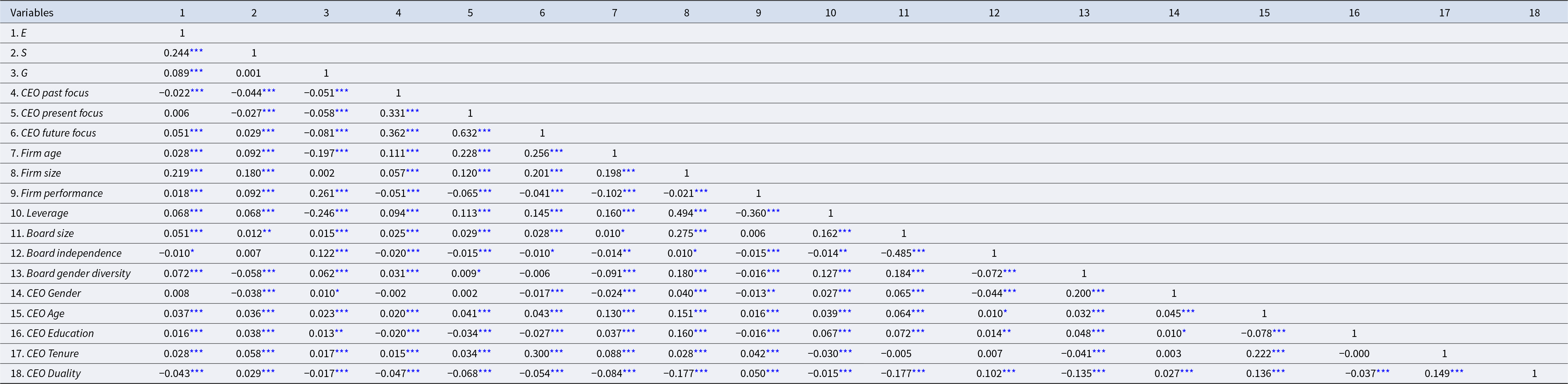
Then we made Table 3 to report the correlation analysis of such variables. Based on the results of Pearson’s test, we could initially verify that there is a significant correlation between independent variables and dependent variables. For instance, CEO future focus is positively and significantly correlated with E and S (r1 = 0.051, p < 0.01, r2 = 0.029, p < 0.01), whereas negatively and significantly correlate with G (r3 = −0.081, p < 0.01). Additionally, the correlation coefficients between dependent variables and most of the control variables are significant, which verifies the rationality of variable selection. Further, we calculated the mean variance inflation factor (VIF) to prevent potential multicollinearity among our variables. Subsequent result of VIF is 1.31, which is much smaller than the judgement standard value of 5. Therefore, we deem that there is no serious problem of multicollinearity, and all the variables can be taken into account by our study.
Correlation analysis

Notes: N = 31,474 firm-year observations. All variables are winsorized at 1% and 99%.
*, **, and *** indicate statistical significance at the 10%, 5%, and 1% levels, respectively.
Hypotheses Testing
Regression results for CEO temporal focus and firms’ E/S/G investments
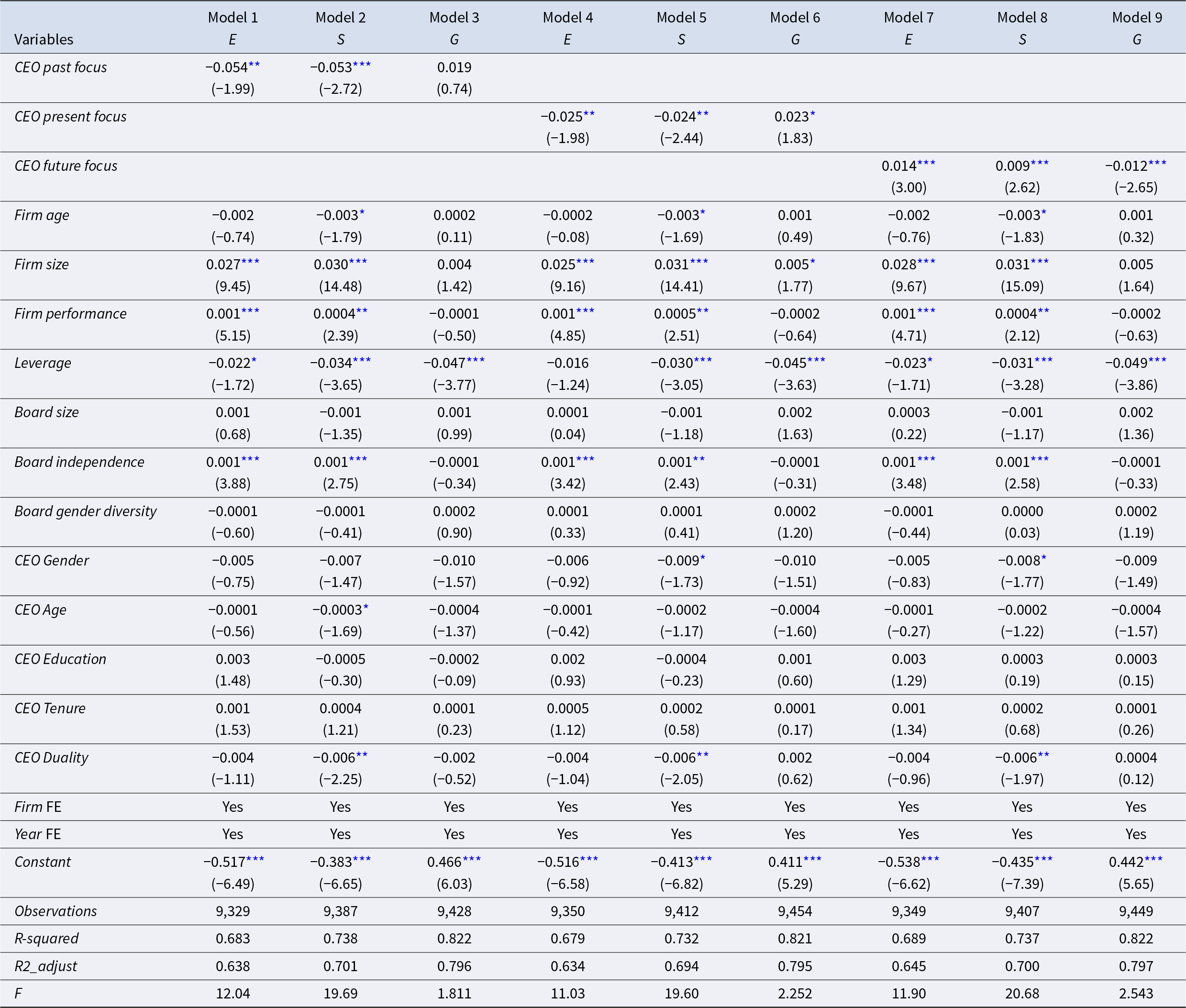
Table 4 presents the results of hypotheses predicting the impact of CEO past focus on E/S/G investments. Model 1, which includes only independent variables, shows a significantly negative coefficient for CEO past focus. Model 2 adds the impact of control variables, and the coefficient remains negative and significant, indicating that CEOs with a past focus are less likely to invest in environmental protection activities, supporting H1a. Models 3 and 4 examine the relationship between CEO past focus and social investments, with and without control variables. The negative coefficients suggest that CEOs with a past focus fail to maintain their firms’ social relationships, verifying H1b. Models 5 and 6 show that CEO past focus negatively and significantly inhibits governance investments, supporting H1c.
Regression results for the effect of CEO past focus on firms’ ESG investments

Notes: All variables are winsorized at 1% and 99%. All models include fixed year and firm effects. The t values are reported in brackets.
*, **, and *** indicate statistical significance at the 10%, 5%, and 1% levels, respectively.
Next, Table 5 shows the impact of CEO present focus on E/S/G investments. Models 1–4 reveal a negative and significant relationship between CEO present focus and environmental and social investments, validating H2a and H2b. Conversely, Models 5 and 6 show a positive relationship between CEO present focus and governance investments, confirming H2c, as CEOs with a present focus are more inclined to achieve governance investment outcomes.
Regression results for the effect of CEO present focus on firms’ ESG investments

Notes: All variables are winsorized at 1% and 99%. All models include fixed year and firm effects. The t values are reported in brackets.
*, **, and *** indicate statistical significance at the 10%, 5%, and 1% levels, respectively.
Finally, Table 6 examines the impact of CEO future focus on E/S/G investments. Models 1–4 indicate a significantly positive relationship between CEO future focus and environmental and social investments, supporting H3a and H3b. Models 5 and 6 show a negative relationship with governance investments, suggesting that future-focused CEOs tend to reduce such investments, corroborating H3c.
Regression results for the effect of CEO future focus on firms’ ESG investments

Notes: All variables are winsorized at 1% and 99%. All models include fixed year and firm effects. The t values are reported in brackets.
*, **, and *** indicate statistical significance at the 10%, 5%, and 1% levels, respectively.
Regression results for the moderating effect of CEO wealth sensitivity
To assess the moderating effect of CEO wealth sensitivity, we estimated equations (3), with results presented in Table 7. We mean-centered the explanatory and moderating variables by subtracting the average value from each, following the research specification (Echambadi & Hess, Reference Echambadi and Hess2007).
Regression results for the moderating effect of CEO wealth sensitivity

Notes: All variables are winsorized at 1% and 99%. All models include fixed year and firm effects. The t values are reported in brackets.
*, **, and *** indicate statistical significance at the 10%, 5%, and 1% levels, respectively.
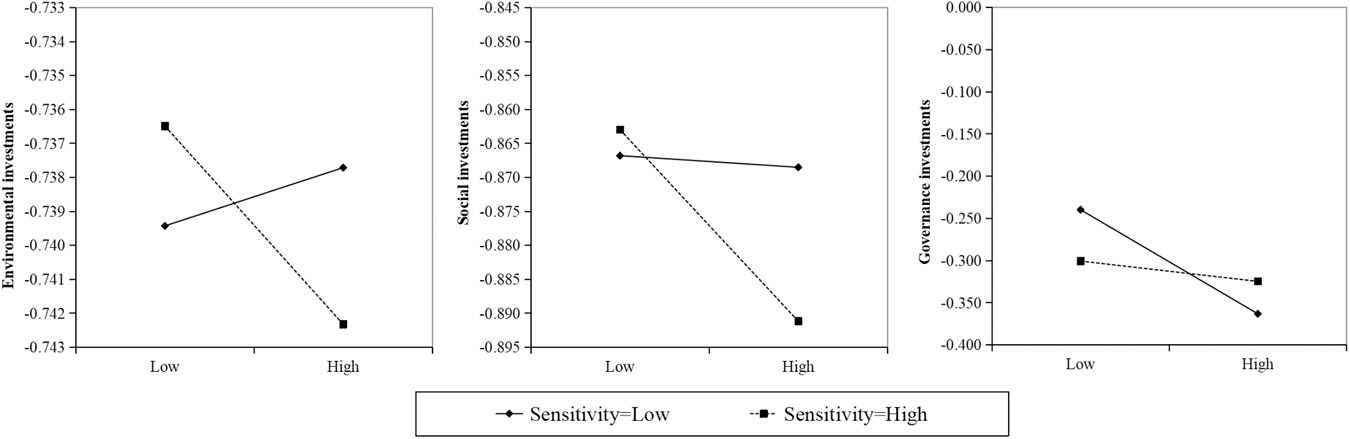
In Models 1 and 2, the interaction coefficient is negative and significant, indicating that CEOs with greater wealth sensitivity intensify the negative impact of CEO past focus on E/S investments, supporting H4a and H4b. Model 3 shows a positive interaction coefficient, aligning with H4c. Figure 1 illustrates that the negative effect of CEO past focus on these investments strengthens with higher wealth sensitivity and weakens with lower sensitivity.
Moderating effect of CEO wealth sensitivity on the relationship between CEO past focus and firms’ E/S/G investments

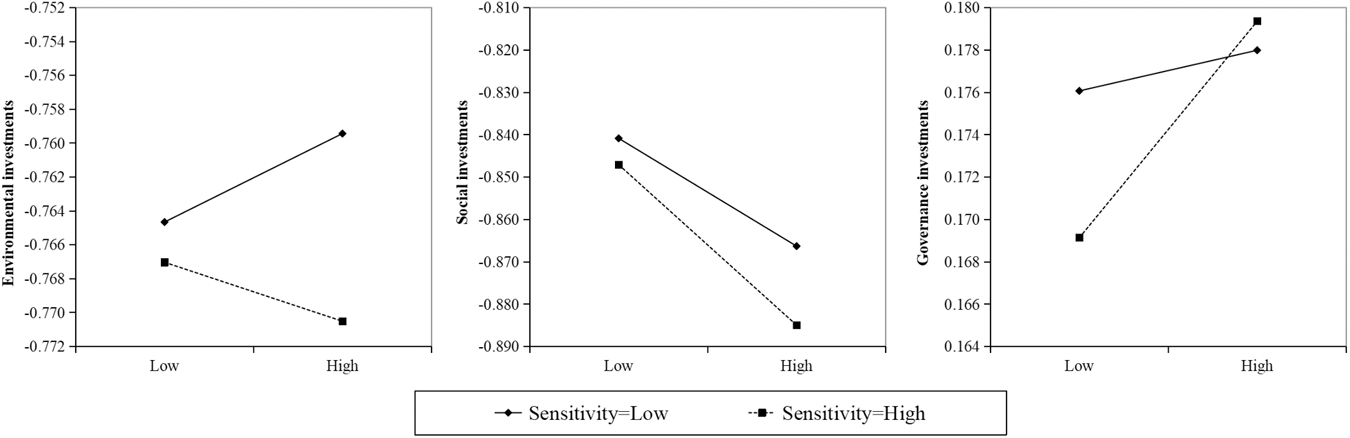
In Models 4 and 5, the interaction coefficients between CEO present focus and Sensitivity are negative and significant, indicating that higher wealth sensitivity amplifies the negative impact of CEO present focus on E/S investments, supporting H5a and H5b. Model 6 shows a positive interaction term, marginally significant, corroborating H5c. Figure 2 demonstrates that the positive association between CEO present focus and governance investments is more pronounced among CEOs with greater wealth sensitivity.
Moderating effect of CEO wealth sensitivity on the relationship between CEO present focus and firms’ E/S/G investments

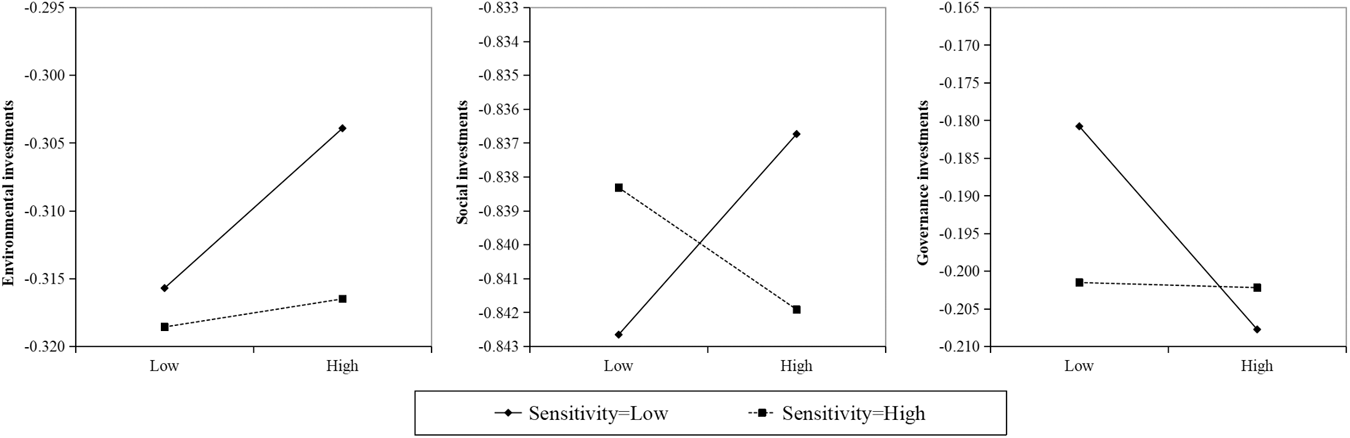
Models 7 and 8 reveal a negative and significant interaction between CEO future focus and Sensitivity, indicating that higher wealth sensitivity weakens the positive influence of CEO future focus on E/S investments, substantiating H6a and H6b. Model 9 shows a positive and marginally significant coefficient, consistent with H6c, suggesting that wealth sensitivity mitigates the negative impact of CEO future focus on G investments. Figure 3 summarizes these findings, confirming our predictions.
Moderating effect of CEO wealth sensitivity on the relationship between CEO future focus and firms’ E/S/G investments

Robustness Tests
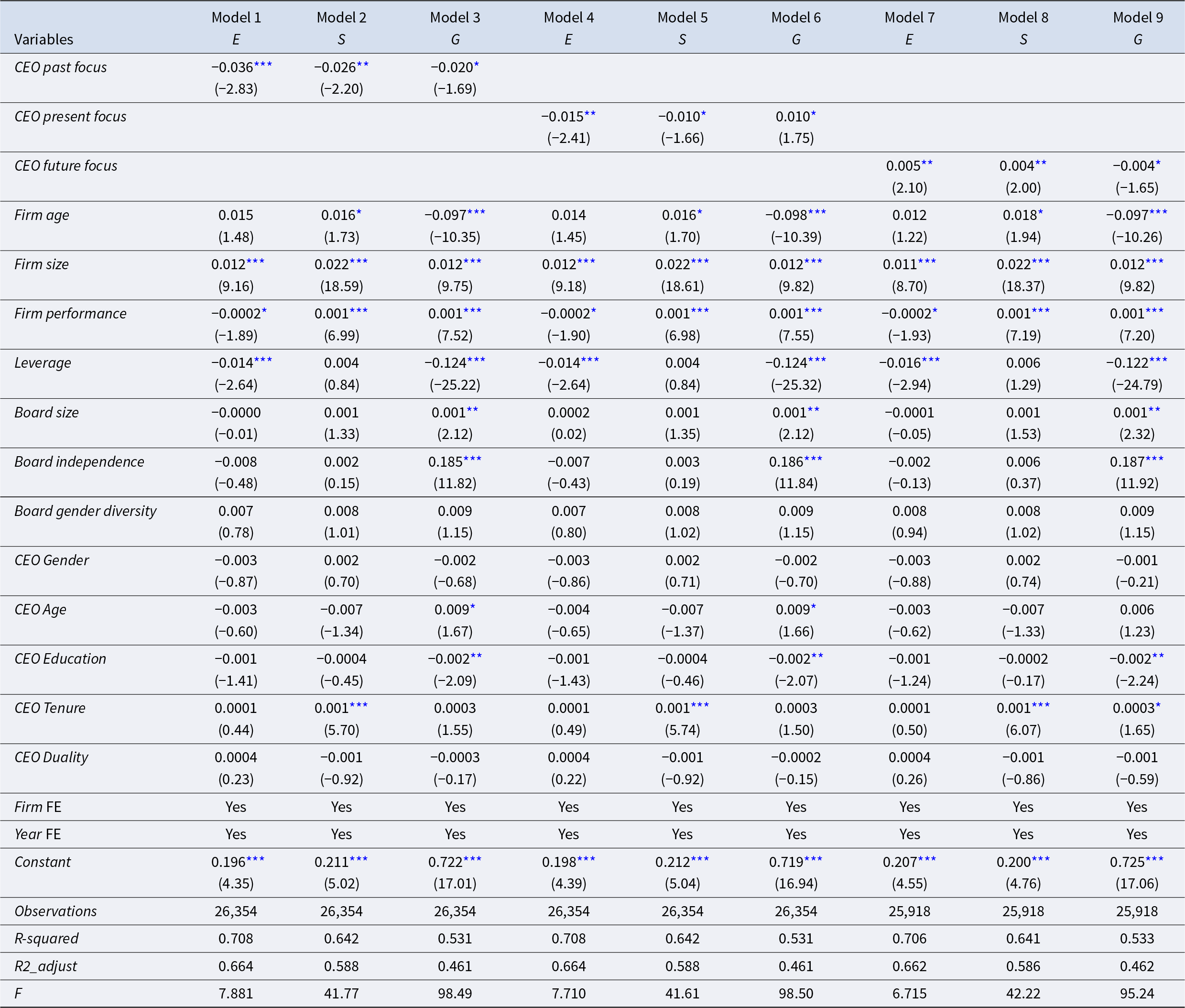
We conducted a series of supplementary analyses to ensure the robustness of our findings. First, to mitigate potential biases from data collection methods for dependent variables, we substituted the independent variables’ data source, using the Bloomberg index as an alternative to the HUAZHENG rating, which is more representative of Chinese firms’ ESG scores. This approach aligns with prior studies (Huang et al., Reference Huang, Li, Lin and McBrayer2022; Schiemann & Tietmeyer, Reference Schiemann and Tietmeyer2022). The results in Table 8 show that the inhibitory effect of CEO past focus on E/S investments remains significant, though its positive effect on G investments is not. Models 4–6 reaffirm the negative impact of CEO present focus on E/S investments and its positive impact on G investments. Models 7–9 replicate the relationship between CEO future focus and E/S/G investments, reinforcing our conclusions. The smaller Bloomberg index sample size further justifies using the HUAZHENG index as the primary data source.
Regression results of robustness analysis

Notes: All variables are winsorized at 1% and 99%. All models include fixed year and firm effects. The t values are reported in brackets.
*, **, and *** indicate statistical significance at the 10%, 5%, and 1% levels, respectively.
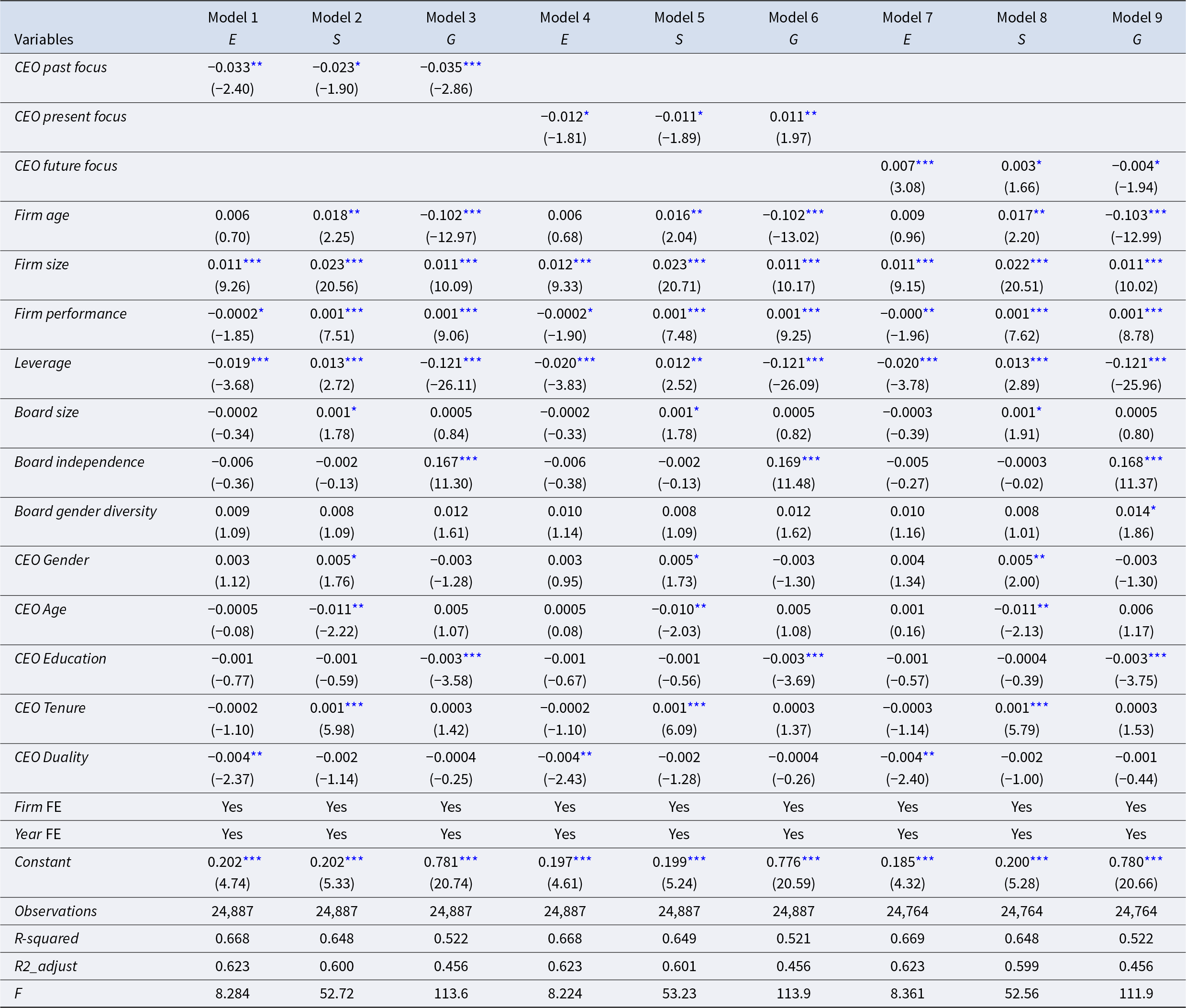
Second, we conducted a robustness check by adjusting the time window of our dataset, drawing on existing research (Liu, He, Men, & Sun, Reference Liu, He, Men and Sun2024; Zhang, Li, & Sun, Reference Zhang, Li and Sun2022). Since ESG is a nascent concept born in recent years, CEOs’ unfamiliarity with the notion could lead to ESG investments being ignored by firms. We therefore shorten the sample observation time to 2012-2021, exclude the earliest 3 years of data, and rerun the regression. The results are shown in Table 9, which are consistent with previous results.
Regression results of robustness analysis

Notes: All variables are winsorized at 1% and 99%. All models include fixed year and firm effects. The t values are reported in brackets.
*, **, and *** indicate statistical significance at the 10%, 5%, and 1% levels, respectively.
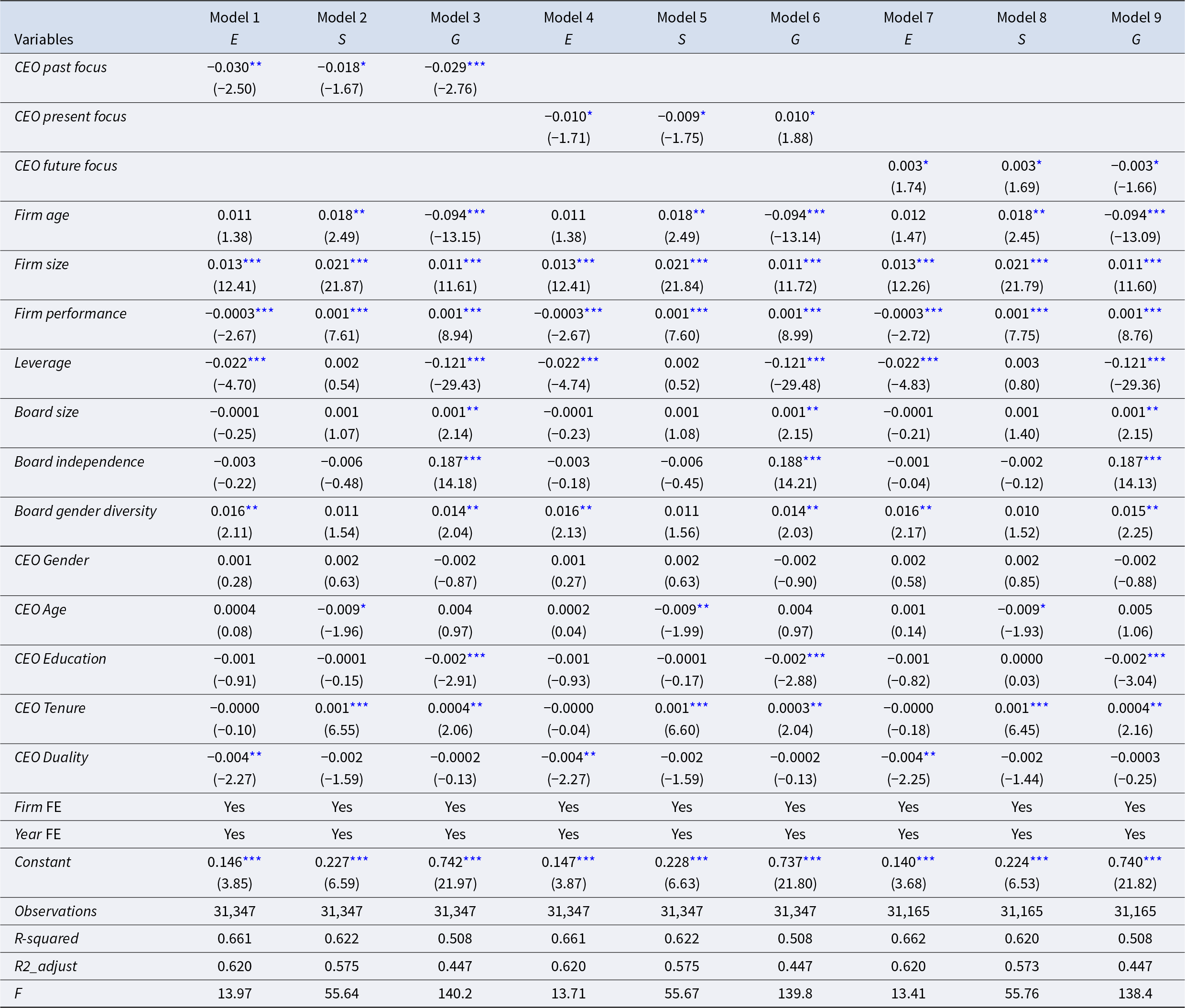
Third, we excluded the influence of heavy polluting firms from our sample. Our initial sample included firms in energy, chemical fiber manufacturing, rubber, and plastics, whose business orientations may deviate from sustainability goals, potentially skewing ESG investment results. To enhance our analysis of the relationship between CEO temporal focus and E/S/G, we rigorously excluded these firms using the classification standards set by the Ministry of Ecology and Environment of the People’s Republic of China. Table 10 presents the regression results after this exclusion. The coefficients remain significant, validating the robustness of our findings.
Regression results of robustness analysis

Notes: All variables are winsorized at 1% and 99%. All models include fixed year and firm effects. The t values are reported in brackets.
*, **, and *** indicate statistical significance at the 10%, 5%, and 1% levels, respectively.
In a nutshell, the evidence from the robustness tests is consistent with our prior conclusions. Additionally, we conducted other robustness tests including model substitution, converting continuous variables to discrete ones and excluding text length effects. These tests are detailed in the Appendix.
Endogeneity Tests
We address potential endogeneity concerns using propensity score matching (PSM). We divided the sample into ‘experimental’ and ‘control’ groups based on the mean value of CEO temporal focus, following the standard PSM approach (Rosenbaum & Rubin, Reference Rosenbaum and Rubin1983). Using the Logit model, we estimated E/S/G variables and used regression predictions as propensity scores, with CEO temporal focus as the explanatory variable, control variables for matching, and E/S/G as the explained variable. We matched the groups by year, controlling for industry effects. Retesting with matched samples, as shown in Table 11, the coefficients for CEO temporal focus remain consistent and statistically significant with our primary analysis. These findings confirm the robustness of our regression results, reinforcing the validity of our conclusions.
Results of endogeneity analysis

Notes: All variables are winsorized at 1% and 99%. All models include fixed year and firm effects. The t values are reported in brackets.
*, **, and *** indicate statistical significance at the 10%, 5%, and 1% levels, respectively.
Discussion
ESG investments are essential for sustainable growth but carry risks and uncertainties, leading CEOs to prioritize some ESG dimensions over others, exacerbating imbalances (Bansal et al., Reference Bansal, Kim and Wood2018; Neitzert & Petras, Reference Neitzert and Petras2021; Slawinski & Bansal, Reference Slawinski and Bansal2015). Prior research, based on upper echelon theory, has focused on quantifiable CEO traits, often overlooking nuanced, unobservable traits like temporal focus (Lewis, Walls, & Dowell, Reference Lewis, Walls and Dowell2014; Lim & Chung, 2021; Marquis & Qian, Reference Marquis and Qian2014; Serfling, Reference Serfling2014). Temporal focus, reflecting psychological orientation toward the past, present, or future, is critical yet understudied in ESG decision-making. We hypothesize that CEOs with different temporal orientations respond differently to stakeholder demands, shaping firms’ ESG strategies. This study examines how temporal focus variations influence CEO decisions on E/S/G activities.
Leveraging data from listed Chinese firms spanning from 2009 to 2021, we find significant associations between CEO temporal focus and E/S/G investment patterns. Specifically, CEOs with past focus show reduced E/S/G investments, suggesting hindrance from retrospective orientation. Present-focused CEOs invest less in environmental and social dimensions but more in governance, reflecting a prioritization of immediate operational and compliance concerns. Future-focused CEOs invest more in environmental and social activities, indicating long-term sustainability commitments, while reducing governance investments. Furthermore, this study also highlights the moderating role of CEO wealth sensitivity, emphasizing the interplay between individual wealth view and temporal focus in E/S/G decisions.
Theoretical Implications
This study provides valuable contributions in the following three aspects. First, it extends the ESG-related literature and answers the question ‘Where does this difference in CEOs’ divergent responses to various stakeholder demands come from’? by linking CEO temporal focus with firms’ ESG investments. While prior research acknowledges the inherent contradictions among ESG objectives (Neitzert & Petras, Reference Neitzert and Petras2021), we extend this discourse by demonstrating how temporal focus exacerbates these tensions. Specifically, governance investments often take effect much sooner, whereas environmental and social investments involve delayed returns and greater externalities (Eccles et al., Reference Eccles, Ioannou and Serafeim2014; Liang & Renneboog, Reference Liang and Renneboog2020). By disaggregating ESG into its constituent dimensions, we reveal that CEO temporal focus-past, present, or future-differentially shapes firms’ E/S/G investment behaviors. We provide the first empirical evidence that both CEO past focus and CEO present focus inhibit environmental and social investments, whereas CEO future focus promotes them. Conversely, both past-oriented and future-oriented CEOs deprioritize governance investments, while present-oriented CEOs enhance them. These findings challenge the prevailing assumption that ESG performance can be holistically captured through composite scores while highlighting the pivotal role of temporal cognition in strategic trade-offs of ESG.
Second, this study also advances upper echelon theory research by providing a comprehensive ESG investment decision-making model that is entirely influenced by CEO characteristics. Given that CEOs’ past and present focuses tend to inhibit ESG investments, it is crucial to identify boundary conditions that might mitigate this negative impact within the context of sustainability. While previous research has often discussed the moderating effects of external environmental factors such as uncertainty and complexity (Nadkarni & Chen, Reference Nadkarni and Chen2014), the significant role of CEOs’ own characteristics as moderators has been overlooked. We enrich this area of research by introducing CEOs’ attitudes towards wealth fluctuation, to comprehensively identify conditions that can fine-tune the effects of CEO temporal focus on ESG investment decisions. Remarkably, we discover that lower CEO wealth sensitivity amplifies the positive impact of CEO future focus on environmental and social investments while diminishing the negative effects of CEO past and present focuses. In addition, these moderating variables also influence governance investments. With slight wealth sensitivity, diluting the positive relationship between CEO present focus and governance investments, while simultaneously reinforcing the negative associations between both CEO past focus, CEO future focus with such investments.
Last, this study contributes to the understanding of an intertemporal equilibrium issue about ESG investments, particularly in the context of China. Amidst the recent surge in interest, China has shown a strong commitment to advancing ESG investments. While it has been demonstrated that the benefits of ESG investments for Chinese firms’ development become apparent over time, the sustainable performance of these firms has not always been encouraging. PricewaterhouseCoopers (PwC) investigated the performance of over 200 firms in China in implementing the Sustainable Development Goals, and revealed that only 26.6% of small- and medium-sized firms have taken green initiatives. In addition, the survey highlighted that approximately half of the participating firms perceived a lack of a mature, sustainable development management system (PwC, 2023). We try to comprehend the determinants that exert a decisive role in this intertemporal strategic decision-making process to reverse the endeavors undertaken by Chinese firms regarding ESG. By integrating Chinese practice management and ESG strategies and focusing on CEO-level factors, we extend beyond previous studies that have primarily emphasized macro-factors, such as capital markets or environmental dynamics, in explaining executives’ investment horizons. Our study reveals that CEO temporal focus plays a pivotal role in shaping the trajectory of ESG investments. These findings present a novel lens through which to comprehend the nuanced impact of Chinese managerial decisions within corporate strategic frameworks. As such, this research provides a more appropriate paradigm for studies focusing on China or other developing countries of the realm of upper echelon theory, enriching the existing literature in this domain.
Practical Implications
This article presents several important implications for ongoing managerial practices. First, our findings indicate a logical and viable direction for firms contemplating or already engaged in ESG-related investment activities. Extant research proved that firms’ ESG activities are primarily influenced by external supervision and internal drivers (Lewis et al., Reference Lewis, Walls and Dowell2014; Serafeim & Yoon, Reference Serafeim and Yoon2023; Serfling, Reference Serfling2014). Our results underscore the critical role of CEO temporal focus, a factor often overlooked previously. Given the global imperative for sustainability, firms must prioritize ESG investments to ensure long-term viability. Evaluating CEO temporal focus during CEO selection is, therefore, a strategic necessity in navigating ESG investment decisions. This assessment should not only encompass the CEO’s business competencies but also the time perspective that suggests their attention to different time stages. Incorporating this consideration can enhance the rigor and comprehensiveness of CEO selection criteria, ultimately improving decision-making outcomes. Hence, firms should assess CEOs across all temporal dimensions through background checks, tests, and interviews that gauge a candidate’s temporal orientation, thereby identifying the most suitable CEO for the organization.
Second, our findings not only reinforce the monitoring function of the board of directors, urging them to consider other dimensions of CEO variability apart from temporal focus, but also provide valuable insights into the importance of CEO self-monitoring. Understanding CEO wealth sensitivity is crucial for advancing ESG investments effectively, as reducing this sensitivity may support ESG investment objectives. Similarly, CEOs should develop an awareness of their impact on ESG decisions and cultivate a forward-looking mindset that aligns with the developmental goals of their firms. By continuously learning, adapting to new information, and using their authority to promote green initiatives, CEOs can ensure their organizations remain responsive to environmental and social challenges, thus fostering a more inclusive approach to corporate governance.
Finally, this study provides valuable references for policymakers. It is essential for policymakers and government practitioners to strengthen collaborations with firms, emphasize the importance of ESG investments in sustainable development through seminars and assessments, and advocate for supportive policies. Policymakers might also consider offering subsidies for green initiatives, lowering interest rates on green loans, or refining the ESG investment framework to enhance firms’ specific endeavors. Regular assessments of firms’ ESG investment progress, categorized into exploratory, advancing, and mature stages, can inform tailored evaluations of the robustness of ESG strategies, aiding in their effective adjustment to foster sustainable development.
Limitations and Future Research Directions
Our study, while comprehensive, is subject to certain limitations that also open avenues for future research. First, given that ESG investment is an emerging concept among the sample firms, their green governance levels are generally immature. This inexperience, combined with CEOs’ high sensitivity to wealth loss and a tendency to prioritize economic gains over environmental concerns, leads to reduced engagement in ESG investments. However, these outcomes could differ based on more nuanced factors, such as firms’ revenue growth rates. Therefore, future research should explore additional reliable moderators that could influence the effects of CEO wealth sensitivity, potentially offsetting or even reversing the negative impacts of CEOs’ past and present focuses.
Second, our methodology for measuring CEO temporal focus – though widely recognized – relies solely on MD&As in annual reports, which may not fully represent broader CEO behaviors and traits. Future studies should aim to gather more diverse data sources, such as recordings of CEO meetings, video footage of public speeches, or analyses of discourse across various social media platforms. A broader data collection approach, including the identification of keywords related to CEO temporal focus, could help reduce biases associated with relying on a single source.
Third, while our study is situated in China – a relevant context for examining ESG investments and CEO temporal focus – the findings’ applicability to other regions might be limited due to varying policy landscapes and cultural differences. Future research could replicate this study in different national contexts, such as the United States, Singapore, or European countries, to enhance the generalizability of our findings and verify their applicability across different regulatory and cultural environments.
Data availability statement
The data that support the findings of this study are openly available in the Open Science Framework at https://osf.io/vhxge/ Part of the derived data is available from the corresponding author on request.
Acknowledgements
We want to extend our gratitude to our editor and the anonymous reviewers for their valuable and constructive comments on this article.
Funding statement
We acknowledge financial support from the National Natural Science Foundation of China (Grant Numbers 72072046 and 72473142), the Social Science Foundation of Heilongjiang Province (Grant Number: 21GLB060), and Natural Science Foundation of Heilongjiang Province (Grant Number: LH2022G004).
Appendix
Other Robustness Tests
To further validate the robustness, we employed the method of replacing firm-year fixed effects with industry-year fixed effects, consistent with prior research (Zhao et al., Reference Zhao, Qu, Wei, Yin and Xi2023). We reevaluate the connection between CEO temporal focus and firms’ E/S/G investments, as presented in Table A1. The regression outcomes are highly consistent with our core findings. Specifically, the coefficients for CEO temporal focus remain statistically significant. Notably, the effect of CEO future focus on social investments is insignificant. The results demonstrate that the conclusions remain robust regardless of whether industry-year dual fixed effects or firm-year dual fixed effects are employed.
Regression results of robustness analysis

Notes: All variables are winsorized at 1% and 99%. All models include fixed year and industry effects. The t values are reported in brackets.
*, **, and *** indicate statistical significance at the 10%, 5%, and 1% levels, respectively.
We transformed dependent variables from continuous measures into discrete categorical variables to further assess the robustness of our findings. Given the relatively small variations in E/S/G scores across our sample, the use of discrete data allows for a more nuanced capture of differences between observations, as highlighted in prior research (e.g., Wang, Lin, Jiang, Yang & Zhao, Reference Wang, Lin, Jiang, Yang and Zhao2023). As shown in Table A2, the results remain consistent with our earlier conclusions, as evidenced by the statistically significant coefficients for CEO temporal focus across E/S/G investments, further verifying the robustness.
Regression results of robustness analysis

Notes: All variables are winsorized at 1% and 99%. All models include fixed year and firm effects. The t values are reported in brackets.
*, **, and *** indicate statistical significance at the 10%, 5%, and 1% levels, respectively.
To mitigate the potential influence of text length on our findings, we adopted an alternative measurement approach for CEO temporal focus. Specifically, we directly utilized the sum of keywords related to ‘CEO temporal focus’ identified in the MD&A section of annual reports, consistent with established practices in prior research (Gamache & Mcnamara, Reference Gamache and Mcnamara2016; Noble et al., Reference Noble, Sinha and Kumar2002). This approach helps to reduce biases that may arise from variations in the length or verbosity of the reports. As demonstrated in Table A3, the regression coefficients for the relationship between CEO temporal focus and firms’ E/S/G investments remain statistically consistent with our primary results. This reaffirms the robustness of our findings and underscores the reliability of the keyword-based measurement as a valid proxy for CEO temporal focus.
Regression results of robustness analysis

Notes: All variables are winsorized at 1% and 99%. All models include fixed year and firm effects. The t values are reported in brackets.
*, **, and *** indicate statistical significance at the 10%, 5%, and 1% levels, respectively.
Jianyu Zhao (jianyu64@sina.com) is a professor at the Harbin Engineering University. He got his PhD in Management Science and Engineering from Harbin Engineering University. His main research interests include strategic innovation, knowledge management, and innovation management.
Xinru Wang (m17766589649@163.com) is currently a PhD student at Harbin Engineering University. Her main research interests include corporate governance and firm sustainability. She primarily focus on the effect of digital intelligence transformation and these consequences, and related work has been published in the Internet Research.
Xinlin Yao (xinlinyao@nankai.edu.cn) is currently associate professor at the Business School of Nankai University. His research interests include digital commerce, human-computer interaction, and societal impact of information technology.