Introduction
What are the implications of patient personality for the reporting, detection, and recall of patient symptoms by friends or family members? Answers to this question are needed to enhance clinical care and inform strategies aimed at reducing the public health burden of depression. From a clinical perspective, older patients tend to discuss their health concerns with friends and family members (informants), who often accompany them on visits to primary care (Wolff and Roter, Reference Wolff and Roter2008). From a public health perspective, the identification of at-risk individuals is the responsibility both of trained professionals and ordinary people (Cowen, Reference Cowen1982; Pescosolido, Reference Pescosolido1992; Levine, Reference Levine1998). This study examined the accuracy – defined in terms of sensitivity and specificity (Gordis, Reference Gordis1996) – of informant-reported lifetime and current mood disorder diagnoses in a sample of primary care patients aged 60 years or older. Gold-standard diagnoses of minor depression and major depression were established at consensus conferences based on a review of medical charts and data collected in a structured interview with the patient. We focused on lifetime and active diagnoses because both are important in treatment planning and prevention.
Patient personality and depression: a public health paradigm focused on health decisions
Research on the relationships between personality and depression outcomes is typically conducted within a psychopathological paradigm: effects of personality on depression are thought to act through neurocognitive mechanisms. The current study is rooted in a public health paradigm, which is concerned less with pathophysiology and more with personality-based implications for health care decision-making by patients, family members, and health care providers. Some traits may lead patients and families to delay treatment-seeking; other traits may be associated with the tendency to seek inappropriate treatments (Goodwin et al., Reference Goodwin, Hoven, Lyons and Stein2002). In this paper, we raise the question of whether patient personality affects the capacity of family, friends, or providers to detect or recall the signal of mood disorder amidst the noise of personality and everyday life.
We hypothesized that patient personality affects informants' judgments about the presence of a mood disorder history. Personality is associated with self-reports of mental health (Domken et al., Reference Domken, Scott and Kelly1994; Hooker et al., Reference Hooker, Monahan, Bowman, Frazier and Shifren1998; Enns et al., Reference Enns, Larsen and Cox2000; Duberstein and Heisel, Reference Duberstein and Heisel2007) and physical health (Hooker et al., Reference Hooker, Monahan, Bowman, Frazier and Shifren1998; Duberstein et al., Reference Duberstein2003; Chapman et al., Reference Chapman, Duberstein, Sörensen and Lyness2006; Reference Chapman, Duberstein and Lyness2007; Krueger et al., Reference Krueger, Wilson, Shah, Tang and Bennett2006). Traits also influence health care utilization (Goodwin et al., Reference Goodwin, Hoven, Lyons and Stein2002; ten Have et al., Reference ten Have, Oldehinkel, Vollebergh and Ormel2005) and affect social processes (Krueger et al., Reference Krueger, Ham and Linford1996; Geerts and Bouhuys, Reference Geerts and Bouhuys1998) that are likely to cue observers effectively about the presence of a mood disorder or lead them astray.
Rationale for specific hypotheses
We hypothesized that informant reports would be characterized by poorer sensitivity when patients are higher in Extraversion. A prior study found that physicians were more likely to document depression when patients were low in Extraversion (McCray et al., Reference McCray, Bogner, Sammel and Gallo2007). These authors reasoned that the isolation associated with low Extraversion may be interpreted as symptoms of depression. We also hypothesized that sensitivity would be poorer when patients are lower in Openness, as they provide few signals to others about their internal state, and thus may be more likely to have their mood disorders go undetected (Duberstein, Reference Duberstein2001).
We hypothesized that informant reports would be characterized by poorer specificity when patients are higher in Neuroticism. These patients tend to over-report affective symptoms of depression in the context of clinical interviews (Domken et al., Reference Domken, Scott and Kelly1994; Enns et al., Reference Enns, Larsen and Cox2000; Duberstein and Heisel, Reference Duberstein and Heisel2007). We anticipated that informants would have difficulty distinguishing patient mood symptoms from the everyday distress associated with high Neuroticism, and would incorrectly attribute personality-related distress to a mood disorder. Hypotheses were tested in dyads consisting of older patients and their friends or relatives (informants) recruited from primary care settings.
Methods
Study design
We recruited friends and relatives of older adults enrolled in a study of mental disorders in primary care patients age 65 years and over. Ten primary care sites were selected, including clinics, university-affiliated practices, and private practices located in Rochester, New York and neighboring suburbs. Data collection and recruitment procedures for the larger study's patient sample have been described elsewhere (Cui et al., Reference Cui, Lyness, Tang, Tu and Conwell2008) and analyses of patient personality data have previously been reported (Chapman et al., Reference Chapman, Duberstein, Sörensen and Lyness2006; Reference Chapman, Duberstein and Lyness2007).
Sample
Between May 2001 and December 2004, 589 patients enrolled in the parent study were approached and asked to participate in a study on friends and relatives of primary care patients. Most were approached at their baseline interview, but seven were notified at the one-year or two-year follow-up. Patients were asked to provide the names, addresses, and telephone numbers for up to three potential informants aged 21 years or older whom they “feel close to” or with whom they talk with about their “feelings and personal situation.” Of the 589 patients approached, 299 (51%) provided at least one name. Reasons for refusal to provide the name of a potential informant included: (1) have no one to refer (n = 39; 13%); (2) friends and family are too busy (n = 22; 8%); and (3) do not want to impose (n = 25; 9%); and (4) a host of “other” reasons (n = 108; 37%), such as informants out of town and protecting privacy. Slightly more than one-third (n = 96) provided no reason. A multivariate logistic regression analysis revealed that men, those who lived alone, and single (vs. married) patients were less likely to grant permission to approach a potential informant.
Invitation letters were mailed to the patients' friends and relatives. Approximately three days later, these individuals were invited by telephone to participate in a study on “how people understand the moods, thoughts and beliefs of their friends and family members.” Of the 299 patients who allowed us to contact a potential informant, 212 (69%) had friends or family who were willing to provide informed consent. Of the remaining 87, 27 could not be reached, 55 indicated that they did not have time, and five cited other reasons. Three declined to complete the study after providing informed consent. The first seven interviews with informants were conducted as pilot tests; another 11 were eliminated due to missing or incomplete data. Of the 191 dyads included in these analyses, 52 were married couples, 65 were parent-child dyads, and 74 were other pairs.
Procedures
Primary care patients
After obtaining written informed consent, raters conducted semi-structured diagnostic interviews using the Structured Clinical Interview for DSM–IV (First et al., Reference First, Spitzer, Gibbon and Williams2002). Participants completed a battery of self-report questionnaires, and responded to orally administered assessments. Gold-standard psychiatric diagnoses (American Psychiatric Association, 1994) were established at consensus conferences based on the interview data and a review of the medical chart.
Friends and family members
After receiving written informed consent, a research assistant conducted a semi-structured interview, typically in the informant's home or at our offices. Nearly half (49.7%) of the informant interviews occurred within 21 days of the proband interview; the mode (n = 58) was 15–21 days. Two SCID interviews (Structured Clinical Interviews for DSM-IV-TR Axis 1 Disorders; First et al., Reference First, Spitzer, Gibbon and Williams2002) were conducted with each informant: (1) the informant-report version of the SCID yielded data relevant to the assignment of informant-derived diagnoses, and (2) the patient version of the SCID yielded data relevant to the assignment of diagnoses in the informants themselves. Best-estimate psychiatric diagnoses were assigned at diagnostic consensus meetings.
Measures
Hypothesized Predictors: Patient Personality Traits
Patients completed the NEO-Five Factor Inventory (NEO-FFI; Costa and McCrae, Reference Costa and McCrae1992), a 60-item self-report questionnaire measuring the so-called “Big 5”: Neuroticism, Extraversion, Openness to Experience, Agreeableness, Conscientiousness. The NEO-FFI has been validated (Costa and McCrae, Reference Costa and McCrae1992), and extensively used in research on older primary care patients. NEO-FFI domain scores were treated as continuous variables in multivariate analyses, with higher scores indicating higher levels of each trait. Although our a priori hypotheses focused on Neuroticism, Extraversion, and Openness, we also explored the contributions of Agreeableness and Conscientiousness as a secondary focus.
Covariates
There is inconsistent support for the idea that when informants are more familiar with the subjects – by virtue of how they are related to each other, or how long they have known each other – diagnostic sensitivity is improved (e.g. Heun et al., Reference Heun, Maier and Muller1997). Nonetheless, based on the recommendations of Funder (Reference Funder1995) for studying informant judgments, we controlled for dyad characteristics, patient characteristics (e.g. physical health, social support, cognitive function), and informant characteristics (e.g. mood disorder history, education) including their perceptions of their relationship with the patient.
Dyad Characteristics
Two variables were used to characterize the dyad: nature of the relationship (spouse vs. other), and dyad gender (same vs. mixed).
Patient Characteristics
Patient physical health was quantified via the Cumulative Illness Rating Scale (CIRS; Linn et al., Reference Linn, Linn and Gurel1968), a measure of medical burden based on data extracted from the medical chart and derived via history, physical exam, and laboratory findings. Its validity is well established (Conwell et al., Reference Conwell, Forbes, Cox and Caine1993). A physician (JML) completed the CIRS based on all available information. The mean (SD) CIRS score was 7.3 (2.9) and the median was 7.0. To assess social support, we combined the six perceived social support items and the satisfaction with social support item from the Duke Social Support Index (Landerman et al., Reference Landerman, George, Campbell and Blazer1989). Rated on a three-point scale (1 = hardly ever, 2 = some of the time, 3 = most of the time), the first six items concern the frequency with which the patient “feels useful” to family and friends and can talk about their “deepest problems” with them. The satisfaction item is rated on a three-point scale (1 = very dissatisfied, 2 = somewhat dissatisfied, 3 = satisfied). The mean (SD) social support score was 19.7 (1.9); median was 21. Other covariates were the Mini-mental State Examination (MMSE; Folstein et al., Reference Folstein, Folstein and McHugh1975) (M = 27.9; S.D. = 2.5; median = 29) and a dichotomous variable indicating whether patients lived alone (n = 58, 30.4%).
Informant characteristics, including perceptions of relationship with patient
In addition to completing a SCID interview designed to establish their psychiatric history, informants completed both the self-report and informant-report versions of the NEO-FFI (Costa and McCrae, Reference Costa and McCrae1992). Our focus here is on informant self-reported openness to experience. Given that people who are high in openness are presumed to be more attuned to others' moods (Costa and McCrae, Reference Costa and McCrae1992), multivariate analyses adjusted for this trait (M = 28.2 S.D. = 5.5; median = 29.0).
A principal component analysis revealed that three of six items assessing the patient-informant relationship explained 80% of the variance: “Do you live with (patient's name)?,” “How many days in the month before the interview did you see (the patient)?” and “How long ago before the interview did you last talk to (the patient)?” We labeled this composite contact intensity. Informants were also asked, “In general, how well would you say you know (the patient)?” Responses ranged from “Not at All” to “Extremely Well” and were rated on a five-point scale. This variable and the contact intensity composite were entered as covariates in multivariate analyses.
Statistical analysis
Agreement between two independent data sources (interview-based, informant-derived diagnoses and consensus-derived diagnoses) was operationally defined by the kappa statistic (Cohen, Reference Cohen1960), with modifications made as appropriate to make it more suitable for two-level categorical outcomes (Maxwell, Reference Maxwell1977; Lantz and Nebenzahl, Reference Lantz and Nebenzahl1996). We also report the sensitivity and specificity of informant-derived diagnoses of mood disorders. In the analyses reported here, sensitivity, or the true positive rate, refers to the proportion of patients with lifetime or current mood disorders (major depression or minor depression) correctly identified by informants. The false positive rate refers to the proportion of patients without a mood disorder incorrectly identified by informants
Specificity, or the true negative rate, refers to the proportion of patients who did not have a mood disorder correctly identified by informants. Multivariate analyses were conducted for lifetime mood disorder (sensitivity and specificity) and current mood disorder (specificity only). Multivariate analyses of sensitivity for current mood disorders could not be conducted due to sample size limitations. To examine correlates of the sensitivity of current mood disorder, we used Pearson correlations.
All hypotheses concerning differential sensitivities and specificities were tested by utilizing the generalized estimating equations (GEE) for correlated multivariate outcomes (Liang and Zeger, Reference Liang and Zeger1986). Analyses were conducted using the SAS GENMOD procedure (SAS/STAT Software, 2006). The (unstandardized) beta weight is the coefficient of each explanatory variable, from which we computed odds ratios via exponentiation. The Wald statistic with df = 1 was used to establish statistical significance (p < 0.05). To avoid problems with parameterizing the working correlation matrix (Pepe and Anderson, Reference Pepe and Anderson1994), we implemented the GEE under the working independence assumption. For the specificity analysis, the same approach was used. Multicollinearity was checked using the variance inflation factor to ensure that its value did not exceed the recommended threshold of 100.
Results
Given this paper's focus, it is important to note that differences in rates of lifetime mood disorders between patients with (34.0%) and without (34.5%) informant data were not statistically significant. Primary care patients for whom we have informant data scored higher in trait Openness (p = 0.001) than those without informant data; there were no differences in other traits.
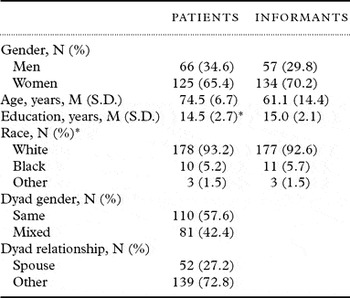
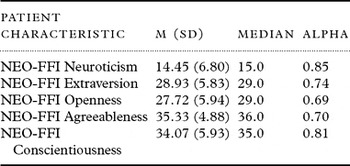
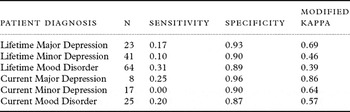
Demographic characteristics are reported in Table 1. Descriptive statistics for the five personality domains are shown in Table 2. Internal consistency coefficients are comparable to those reported in the manual (Costa and McCrae, Reference Costa and McCrae1992), which range from 0.68 to 0.86. Table 3 shows the number of patients diagnosed with current and lifetime mood disorders, and also reports modified kappas along with sensitivity and specificity statistics. Sensitivity is poor, particularly for minor depression. Modified kappas are higher for major depression (current and lifetime) than for minor depression.
Patient (n = 191) and informant (n = 191) demographics and relationship characteristics

Note: Age of patients ranged from 65 to 94 years; age of informants ranged from 34 to 90. Seventy-nine informants met criteria for lifetime mood disorder. Same gender dyads included male patients-male informants and female patients-female informants.
*Information provided for descriptive purposes only. Variable not included in multivariate analyses.
Patient personality: descriptive statistics (N = 191)

NEO-FFI = NEO Five Factor Inventory; M = mean; SD = standard deviation.
Summary of informant accuracy and informant-patient agreement statistics

Note: Lifetime Mood Disorder is the sum of Lifetime Major Depression and Lifetime Minor Depression. Current Mood Disorder is the sum of Current Major Depression and Current Minor Depression. Patients could be in more than one category (e.g. current minor depression and lifetime major depression).
Multivariate analyses of the accuracy of informant-derived lifetime mood disorder diagnoses
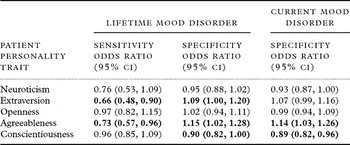
As shown in Table 4, specificity is better when patients are higher in Extraversion and in Agreeableness; specificity is worse when patients are higher in Conscientiousness. In other words, disagreeable patients, those who are more introverted, and those who are dependable and achievement-oriented were more likely to have friends and relatives who incorrectly believed that they have suffered from or are suffering from a mood disorder. There were no other significant predictors of lifetime specificity.
Patient personality predictors of the sensitivity and specificity of informant-reported mood disorders

Note: There were 64 cases of lifetime mood disorder and 25 cases of current mood disorder in the sample of 191 patients. Since generalized estimating equations use the asymptotic normal distribution, df = 1 for each variable. Values in bold are significant at p < 0.05, including those where the CI includes 1.00, rounded down. Values are adjusted for all the variables shown as well as patient characteristics (age, living arrangements, cognitive function (Mini-mental State Examination), perceived social support [Duke], physical illness burden [Cumulative Illness Rating Scale]), informant characteristics (education, openness to experience, presence of a mood disorder history), informant ratings of contact intensity and how well they know the patient, and dyad characteristics (dyad relationship [spouse vs. other], dyad gender [same vs. mixed]).
Turning to the sensitivity of lifetime mood disorder diagnoses, as hypothesized, the mood disorders of patients higher in Extraversion are less likely to be reported correctly. Worse sensitivity was also observed when patients were higher in Agreeableness. Sensitivity is not appreciably lower when patients are lower in Openness.
With respect to covariates, the sensitivity of informant-derived lifetime mood disorder diagnoses is better when patients live alone (Wald Z (1) = 3.41; p < 0.001) and when patients have higher MMSE scores (Wald Z (1) = 2.62; p < 0.01). Sensitivity of informant-derived lifetime diagnoses is also better when informants are spouses (Wald Z (1) = 3.60; p < 0.001) and higher in Openness (Wald Z (1) = 2.99; p < 0.005). No other covariate significantly influenced the sensitivity of informant-reported lifetime mood disorder diagnoses.
Multivariate analyses of the specificity of informant-derived current mood disorder diagnoses
As Table 4 reveals, specificity is worse when patients are higher in Conscientiousness; specificity improves with higher levels of Agreeableness. Patients with better cognitive function were more likely to have a friend or relative correctly believe that they were not suffering from a mood disorder (Wald Z (1) = 3.05; p < 0.005). In other words, the specificity of informant-reported current mood disorder diagnoses suffers with declining patient MMSE scores.
Bivariate analyses of the sensitivity of informant-derived current mood disorder diagnoses
Bivariate analyses reveal no statistically significant associations between sensitivity and patient Neuroticism (r = 0.20), Extraversion(r = −0.11), Openness (r = 0.04), Agreeableness, (r = −0.32), and Conscientiousness (r = 0.08). Sensitivity is associated with patient CIRS (r = 0.43; p = 0.04), but there were no significant associations with other covariates.
Discussion
Patient personality and diagnostic accuracy
Patient personality has significant implications for the reporting, detection, and recall of patient symptoms by friends or family members. Both the sensitivity and specificity of informant-derived mood disorder diagnoses are associated with Extraversion and Agreeableness. Findings for Conscientiousness are confined to specificity. Neuroticism and Openness were not independently associated with the accuracy of informant-derived diagnoses.
With respect to false negatives, this is not the first study to raise questions about the sensitivity of informant reports (e.g. Heun et al., Reference Heun, Hardt, Burkart and Maier1996). Of greater theoretical import, false negatives are not randomly distributed in the population of depressed patients: Patients who are higher in Extraversion and those who are higher in Agreeableness are more likely to be inaccurately considered non-depressed. The finding for Extraversion is conceptually consistent with prior research (McCray et al., Reference McCray, Bogner, Sammel and Gallo2007). Extraverted individuals might mask their suffering with high levels of energy, apparent desire to socialize, and optimistic bias. A study of mental health care utilization showed that extraverted women were less likely to use needed services (Goodwin et al., Reference Goodwin, Hoven, Lyons and Stein2002). The authors speculated that these women may be more likely to rely on social supports than to seek professional assistance. This is plausible, but it is also possible that differences in the phenomenological experience of depression vary with personality, which in turn has implications for self-identification and informant-recognition of depression. A qualitative study of depressed patients suggested that self-described extraverts were unaccustomed to experience gloominess or moodiness prior to their descent into depression. They were not attuned to the nuances of their own moods, and found it difficult to reconcile their self-image as outgoing and likeable with the experience of depression (Epstein et al., Reference Epstein2010). Family members and friends might similarly have difficulty reconciling their implicit models of depression with the reality of depression in extraverted individuals.
Acquiescence and amiability, characteristics of those high in Agreeableness, could also confound observers. Extraverted, agreeable people may be less socially isolated or prone to withdrawal during depression, which is a symptomatic cue most laypeople might consider in evaluating depression in others. If it is difficult for friends and relatives to discern the presence of a mood disorder history, it must be especially difficult for primary care physicians, many of whom spend less than two minutes dispensing with mental health issues (Tai-Seale et al., Reference Tai-Seale, McGuire, Colenda, Rosen and Cook2007).
The hypothesized association between poorer sensitivity and lower Openness was not observed, perhaps due to the relatively restricted range of Openness in this sample. Patients in the parent study who did not allow us to approach a potential informant were less Open than those who did. Alternatively, the mood disorders of Open people may not be as detectable as presumed (Colvin, Reference Colvin1993).
With respect to false positives, the specificity of informant-derived lifetime diagnoses of mood disorders suffers with decreasing Agreeableness and Extraversion. We speculate that observers ascribe chronic interpersonal irritability or shy and withdrawn behavior to mood symptoms. Patients who are high in Neuroticism are not mistakenly perceived to have had at least one episode of depression. This finding is inconsistent with our a priori hypothesis, though it is in the predicted direction (p = 0.07).
The finding that people who are high in Conscientiousness are more likely to be perceived erroneously to be suffering from an active mood disorder is unexpected. It may be a function of an age-related decline in high achievement strivings and characteristic behavioral patterns (work, hobbies, etc.) that are mistakenly presumed to be a consequence of depression. These findings conflict with a study showing that physicians were more likely to overlook the depression of patients high in conscientiousness (McCray et al., Reference McCray, Bogner, Sammel and Gallo2007), implying a problem with sensitivity, not specificity. The apparent discrepancy between the two studies can be ascribed to numerous methodological differences. For example, we collected data from informants and examined predictors of diagnostic accuracy, and they collected data from physicians and examined predictors of the documentation of depression.
Covariates and diagnostic accuracy
In this cognitively intact primary care sample, worse patient cognitive function, as indexed by the MMSE, was associated with both compromised sensitivity and specificity. We speculate that the very early stages of patient cognitive decline may confound friends and family members, who are unable to draw accurate conclusions about patient mood state or history. The relationship between informant Openness and sensitivity to the presence of a mood disorder underscores the importance for clinical assessment of the psychological characteristics of the individuals trusted to provide collateral information. Because open individuals are better attuned to emotions and to changes in their environment, they may be more likely to recognize and remember depressive symptoms. As open individuals may also be less judgmental, others in their social network may be more willing to confide in them. Our findings that spouses are more accurate than other informants is not surprising as they have access to more and better information about patients than adult children, friends, or other informants. Finally, sensitivity was better when patients live alone than when they live with others, perhaps because people who live alone but were able to locate a suitable informant for a study of this sort are more likely to confide in others.
Methodological considerations
Strengths of the study include the numerous controls built into the design to minimize methodological biases and to ensure that informants were not coached or cued. Their task was to be as difficult as it might be under real-world conditions. Patients and informants were interviewed by different teams of raters. Gold-standard diagnoses were established by a consensus team whose membership did not include raters or investigators from the informant study. Restrictions were placed on the sharing of information across teams. Interviewers for the two teams received identical training in diagnostic interviewing, joint training sessions were held with members of both teams to decrease rater drift, and procedures were established to ensure inter-rater reliability. The data reported here are thus reasonable estimates of what might be expected in “real-world” settings.
Nonetheless, several design considerations should be considered in the interpretation of findings and addressed in future research. The first concerns the reliance on patient interviews and chart data for determining diagnoses. Chart data reflect the vagaries of documentation and may also incorporate informant-reported material. This makes it impossible to ascertain that predictor and outcome share no method variance. In some research contexts, it is certainly preferable for formal diagnosis to incorporate informant data deliberately, but not in a study that is focused on the accuracy of informant diagnoses. Thus, it is possible that the apparently poorer specificity observed among patients higher in Conscientiousness may simply reflect the fact that informants are accurately observing the beginning of a mood disorder in dependable, task-oriented patients who are not yet prepared to acknowledge it themselves. In this context, it is worth noting that people high in Conscientiousness have been observed to underutilize mental health services (Goodwin et al., Reference Goodwin, Hoven, Lyons and Stein2002), perhaps because they do not see the need. As a novelist described aging: “. . .the first changes are so slow they pass almost unnoticed, and you go on seeing yourself as you always were, from the inside, but others observe you from the outside” (García Márquez, Reference García Márquez2006, pp. 9).
Second, sample limitations precluded us from conducting multivariate analyses of the sensitivity of informant reports for current mood disorders. Nor could we determine whether poor sensitivity for lifetime mood disorders is due to the difficulties inherent in recognizing current symptoms among patients high in Extraversion or Agreeableness or because these patients do not divulge or dwell on past episodes. Third, the recall of prior episodes by both patient and informant probably depends on how the episode was initially encoded. A prior episode that was treated by a health care professional might be encoded and recalled more easily than one that was untreated, but valid data on prior treatment history are unavailable. Similarly, informant recall of current episodes may depend on the interval between informant and proband interviews. Future studies should attempt to minimize the impact of memory decay, both by attempting to collect valid data on prior episodes and scheduling proband and informant interviews contemporaneously. Fourth, findings are of limited generalizability, as certain subgroups of patients, namely men, those who lived alone, and those who were single (vs. married) were less likely to allow our research team to interview a friend or relative. Non-random participation in family studies has been documented (Heun et al., Reference Heun, Burkart and Maier1995). Fifth, it is possible that the presence of a current mood disorder might affect patients' self-reported personality traits, but this is unlikely to have significantly influenced the findings, as few mood disorders observed here were severe (cf. Costa et al., Reference Costa, Bagby, Herbst and McCrae2005). Sixth, it might have been preferable to have had experienced mental health professionals conduct all the interviews as opposed to raters with less training and clinical experience. Acknowledging that no consensus exists concerning the added value to the diagnostic process of having experienced professionals conduct diagnostic interviews (Wittchen et al., Reference Wittchen, Üstün and Kessler1999; Brugha et al., Reference Brugha, Bebbington and Jenkins1999), there are some data to suggest that participants are more likely to express one symptom, thoughts of suicide, to a physician than to interviewers with less training (Skoog et al., Reference Skoog1996). Still, all interviewers had comparable skill sets and any differences between patient and informant report cannot be ascribed to differences in rater training and experience. A final limitation was the relatively low participation rate among minority primary care patients and their informants.
A public health paradigm focused on personality and health decisions: future research
Research on personality and mental health is typically informed by a psychopathology paradigm. This study illustrates the potential heuristic value of a public health paradigm, which presumes that patient personality traits are related to observer (e.g. clinician, family member, friend) judgments about current episodes of depression and memory of past conditions. Differences in observer judgment and memory that are driven by patient personality may contribute to differences in patient depression outcomes.
Future research should attempt to deepen understanding of how relatives, friends, and clinicians make judgments about the presence of mood symptoms and disorders that emerge in the context of different personality traits. Potential influences on this decision-making process include beliefs about personality, beliefs about aging, and beliefs about depression, including stigma (Sirey et al., Reference Sirey2001; Levy, Reference Levy2002; Sarkisian et al., Reference Sarkisian, Lee-Henderson and Mangione2003). Normalcy thresholds are also important because of the absence of societal consensus about the distinction between ordinary moods and clinical depression (Horwitz and Wakefield, Reference Horwitz and Wakefield2007). Individuals within a particular society and cross-culturally possess different thresholds for concluding that a particular mood state is truly “abnormal'”. Understanding and improving informant accuracy in identifying mood disorders might enhance the appropriate uptake of services for depressed older adults and improve the quality of treatment monitoring.
Conclusion
Our patients' personality traits influence their symptom reports and responses to standard health questions. Their traits also affect how they are viewed by their friends and relatives, which has implications for the quality of the collateral information we gather. The mood disorders of patients who are higher in Extraversion and higher in Agreeableness are more likely to be missed. Given that false negatives can have grave consequences, and that individuals who have experienced an episode of mood disorder in the past are at elevated risk for subsequent episodes, we recommend that practitioners be particularly vigilant when interpreting collateral information about their extraverted, agreeable patients.
Conflict of interest
None.
Description of authors' roles
P. R. Duberstein designed the study, co-supervised the data collection, and wrote the initial draft of the paper. Y. Ma conducted the data analyses and assisted in the writing and editing process. B. P. Chapman, J. C. Coyne, S. Sörensen and J. McGriff assisted in writing the paper. N. Franus assisted with data collection and with writing the paper. Y. Conwell assisted in study design, data collection and writing the article. M. J. Heisel co-supervised the data collection and assisted with paper preparation. K. A. Kaukeinen assisted with the data analyses. X. M. Tu supervised the data analyses and assisted in the writing process. J. M. Lyness designed the parent study, supervised data collection in the parent study, and assisted in study design and preparation of the paper.
Acknowledgments
This research was supported by the following grants from the National Institute of Mental Health, United States Public Health Service: R01MH-161429, K24MH071509, T32MH073452, K24-MH072712, R01MH64579, and a supplement for under-represented minorities to R01MH161429. Patricia Bamonti provided editorial assistance.