Introduction
There is extensive evidence suggesting that autoimmune processes may influence hearing and vestibular function. In 1979, McCabe was the first to describe a cohort of patients with progressive, bilateral hearing loss responding to corticosteroids and/or cyclophosphamide. An autoimmune mechanism was suggested, and McCabe termed this disorder autoimmune sensorineural hearing loss.Reference McCabe1 The diagnosis of autoimmune inner-ear disease is based on clinical findings and on responsiveness to steroid therapy. Autoimmune inner-ear disease has been reported in association with autoimmune diseases such as rheumatoid arthritis, systemic lupus erythematosus, Sjögren's syndrome, polyarteritis nodosa, relapsing polychondritis, Cogan's disease and Crohn's disease.Reference ten Cate and Bachor2
Immunosuppressive drugs have been used to halt the progression of such hearing loss, and in some cases have been found to improve hearing. The standard therapy for autoimmune inner-ear disease currently consists of daily high doses of prednisone.Reference Ryan, Keithley and Harris3 However, the disadvantages of systemic steroid treatment are well known, and include cataracts, gastrointestinal disturbance and aseptic necrosis of the femoral head. Recent progress in the development of novel therapies for autoimmune diseases offers the hope of better treatment for autoimmune inner-ear disease. Methotrexate has been proposed as an alternative agent which may assist reduction of corticosteroid dosages used to treat autoimmune inner-ear disease.Reference Sismanis, Wise and Johnson4–Reference Matteson, Tirzaman, Facer, Fabry, Kasperbauer and Beatty7
This study aimed to evaluate the safety of low-dose transtympanic methotrexate, as regards adverse local reactions and systemic side effects, in healthy rats.
Methods
Animals, animal care and animal housing
This study was approved by our institution's Committee for Ethics in Animal Experiments. The study was conducted in accordance with the requirements of the Helsinki Declaration of Research Ethics.
The study was conducted using 24 male Wistar rats (eight weeks old) weighing 230–280 g. Animals were maintained on a 12-hour light–dark cycle at a constant temperature (22°C) with free access to food and water. Every attempt was made to minimise both the number and suffering of animals used in this study.
All the animals' tympanic membranes were examined with an operating microscope (S88; Zeiss, Jena, Germany) to ensure normal middle-ear appearance. Animals with signs of active or recent infection were discarded. Cephazoline (17 mg/kg) was administered intramuscularly to all rats to reduce the possibility of a bacterial effusion confounding the experimental results.
Study design
The rats were randomly divided into three groups of eight rats each.
The rats were anaesthetised with intramuscular ketamine (45 mg/kg Ketalar; Eczacibasi, Istanbul, Turkey) and intraperitoneal xylazine (5 mg/kg Rompun; Bayer, Leverkusen, Germany). Parenteral methotrexate solution (25 mg/ml) was diluted to a concentration of 0.025 mg/ml. All infusions were performed slowly through a myringotomy in the anterosuperior quadrant, via a 28-gauge dental needle and under operating microscope guidance. The rats were kept in the same position for 30 minutes after each administration. All procedures were performed under sterile conditions.
In group one (n = 8), diluted methotrexate solution was administrated transtympanically to fill the middle-ear cavity (generally delivering approximately 0.1 ml, containing 2.5 µg methotrexate), twice a week for four weeks.
In group two (n = 8), diluted methotrexate solution was administered transtympanically to fill the middle-ear cavity (again, generally delivering approximately 0.1 ml, containing 2.5 µg methotrexate), three times a week for four weeks.
In group three (the control group; n = 8), Ringer lactate solution was administered to fill the middle-ear cavity (generally approximately 0.1 ml), three times a week for four weeks.
Outcome parameters
We examined the following outcome parameters: middle-ear histopathology; auditory function; liver function (via blood enzyme analysis); and haemoglobin levels.
Auditory brainstem response testing, performed under ketamine and xylazine sedation, was used to determine each animal's auditory threshold before the procedure and at the end of the fourth week. Under sedation, we tested auditory brainstem responses using 1500 click stimulus within a range of 100–3000 Hz. Auditory brainstem response was recorded using three platinum-iridium needle electrodes placed subdermally at the vertex (positive), mastoid (negative) and dorsum areas (reference or ground). Sound was presented through an earphone placed directly in the ear canal. Auditory brainstem response threshold testing began at 60 dB and decreased in 10-dB steps to 20 dB; each response was repeated.
The day after auditory brainstem response testing, the rats were anaesthetised and cardiac blood samples were collected for analysis of liver enzymes and haemoglobin levels. The rats were then injected with 3 per cent glutaraldehyde via the intracardiac route and decapitated. A retroauricular incision was made in the posteroinferior region. After blunt dissection of the muscles, the tympanic bulla was exposed and opened. Multiple biopsies were taken from the middle-ear mucosa under microscopic examination; these were fixed in 10 per cent buffered formaldehyde and kept in this solution at 4°C for 24 hours. Synchronously, a midline laparotomy incision was made and the liver of each animal was dissected out and preserved in formaldehyde. The incisions were sutured.
All specimens were then dehydrated, embedded in paraffin and serially sectioned into 4-μm slices. Sections were stained with haematoxylin and eosin, and were examined under light microscopy by the same pathologist.
The middle-ear mucosa biopsies were evaluated under the light microscope for oedema, acute inflammation, chronic inflammation, fibrosis and foreign body reaction. These pathological processes were scored between 1 and 3, except for fibrosis which was recorded as present or absent. Liver biopsies were also examined under light microscopy for any pathological findings.
Statistical analysis
Data were analysed using the NCSS 2007 and PASS 2008 statistical software programs (NCSS; Kaysville, Utah, USA). Results for blood parameters were expressed as means ± standard deviation. All results were assessed within 95 per cent reliance; a p value of less than 0.05 was taken to indicate statistical significance. The following statistical tests were performed: Kruskal–Wallis test (to compare blood parameters among groups) and chi-square and Fisher's exact test (to compare qualitative data).
Results
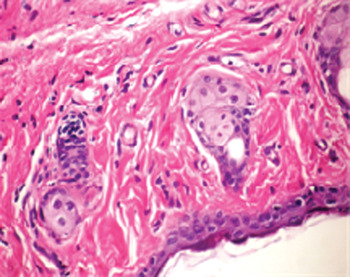
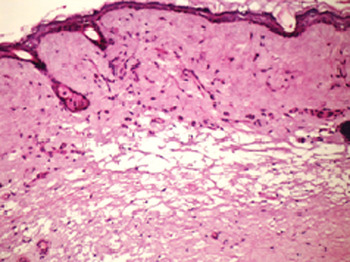
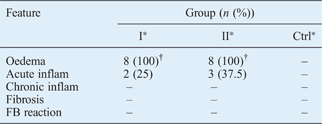
Methotrexate therapy was generally well tolerated. In the control group, the middle-ear mucosa biopsies revealed no pathological findings (Figure 1). Middle-ear mucosa biopsies showed oedema in all animals administered transtympanic methotrexate (Figure 2), but in none of the control animals (p = 0.001) (Table I). There was no statistically significant difference in acute inflammation, comparing study and control groups (p > 0.005) (Table I). No fibrosis, chronic inflammation or foreign body reaction was observed in either of the transtympanic methotrexate groups (Table I).
Photomicrograph of middle-ear mucosa from a control group animal, showing sebaceous glands beneath keratinised squamous epithelium, and surrounding subepithelial connective tissue. (H&E; ×100)

Photomicrograph of middle-ear mucosa from an animal administered transtympanic methotrexate, showing connective tissue containing loose, oedematous areas beneath keratinised squamous epithelium. (H&E; ×40)

Middle-ear mucosa histopathology results
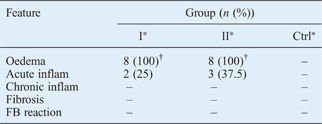
*n = 8. †p < 0,001, compared with control group (chi-square test and Fisher's exact test). Ctrl = control; inflam = inflammation; FB = foreign body; – = not seen
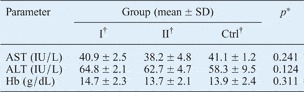
Table II shows the mean levels of serum alanine aminotransferase, serum aspartate aminotransferase and haemoglobin for each group. No statistically significant differences were observed between groups for these parameters (Kruskal–Wallis test).
Liver enzyme and haemoglobin results

*Kruskal–Wallis test. †n = 8. SD = standard deviation; Ctrl = control; AST = aspartate aminotransferase; ALT = alanine aminotransferase; Hb = haemoglobin
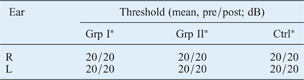
All animals had an auditory threshold of 20 dB nHL, consistent with normal hearing. There was no difference in hearing threshold levels before versus after the procedure (Table III).
Auditory brainstem response results
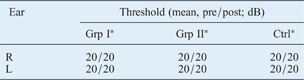
*n = 8. Pre/post = pre-procedure/post-procedure; Grp = group; R = right; L = left
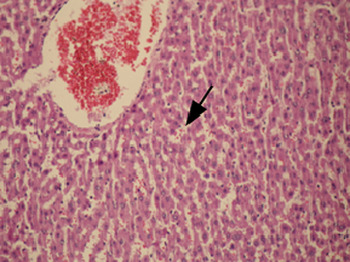
Histopathological examination of liver biopsies revealed mild hyperaemia in the portal areas and around the sinusoids in all animals (including the control group) (Figure 3).
Photomicrograph showing minimal oedema in the portal region of the liver, and sinusoidal dilatation (arrow). (H&E; ×40)

Discussion
The objective of this study was to evaluate the safety of low-dose transtympanic methotrexate, regarding adverse local and systemic side effects, in healthy rats. The results are encouraging enough to warrant further follow up and research in order to better determine the potential clinical utility of transtympanic administration of methotrexate.
The standard therapy for autoimmune inner-ear disease currently consists of daily high doses of steroids (1 mg/kg/day) for one month, with a subsequent slow reduction in dosage over several weeks. However, not all patients respond to corticosteroid therapy in the same manner: hearing loss may become refractory to steroids, or patients may develop adverse effects of steroid therapy. These patients may benefit from cytotoxic therapy. McCabe recommended cyclophosphamide in addition to steroids as first-line treatment.Reference McCabe1 Cyclophosphamide is a cytotoxic drug with serious adverse effects, including myelosuppression, haemorrhagic cystitis, infertility and increased risk of malignancy. Several studies have examined etanercept, a potent tumour necrosis factor antagonist, in the treatment of autoimmune inner-ear disease. Cohen et al. enrolled 20 patients in a 12-week, blinded, placebo-controlled, randomised trial of etanercept (25 mg subcutaneously, twice weekly) versus placebo, and found that etanercept was no better than placebo for the treatment of autoimmune inner-ear disease.Reference Cohen, Shoup, Weisman and Harris8 Finally, Matteson et al. studied 23 steroid-responsive patients who received etanercept (25 mg, twice weekly) for 24 weeks, in an open-label, pilot study.Reference Matteson, Choi, Poe, Wise, Lowe and McDonald9 Although there was no significant improvement in hearing loss, 87 per cent of patients with previously progressive hearing loss appeared to stabilise or improve, and 50 per cent of vertiginous patients noted an improvement in this latter symptom.
Methotrexate has been successfully used in low doses for the management of a number of autoimmune diseases, including rheumatoid arthritis, inflammatory bowel disease and Wegener's granulomatosis, with favourable results for both efficacy and toxicity.Reference Weinblatt, Coblyn, Fox, Fraser, Holdsworth and Glass10–Reference Ali, Salah, Rafea and Saleh12 Ercan et al. applied methotrexate intranasally to rats, and suggested that this might be an alternative to steroid therapy for nasal polyposis.Reference Ercan, Cakir, Başak, Ozbal, Sahin and Balci13 Methotrexate has also been employed to treat certain inner-ear disorders (e.g. vertigo and tinnitus) and nasal manifestations of autoimmune disease.Reference Papadimitraki, Kyrmizakis, Kritikos and Boumpas14 The beneficial effects of low-dose methotrexate for otolaryngological manifestations of autoimmune disorders have been demonstrated.Reference Papadimitraki, Kyrmizakis, Kritikos and Boumpas14–Reference Harris, Weisman, Derebery, Espeland, Gantz and Gulya16 Sismanis et al. used low-dose methotrexate to treat a small group of patients with autoimmune sensorineural hearing loss, and observed significant improvement in speech discrimination but not pure tone averages.Reference Sismanis, Thompson and Willis15 Harris et al. performed a randomised, double-blinded, placebo-controlled study of 67 patients with rapidly progressive, bilateral sensorineural hearing loss, across 10 tertiary centres.Reference Harris, Weisman, Derebery, Espeland, Gantz and Gulya16 Patients who had a response to a one-month prednisone challenge were randomised to receive either methotrexate (15–20 mg/wk) or placebo. Harris et al. found that methotrexate was not able to maintain the hearing improvements obtained by high-dose prednisone over time, any better than placebo. They suggested that patients may have benefited from fewer hearing fluctuations over time, but this was not specifically measured by the study. The present study examined middle-ear histopathology, auditory function, and levels of serum alanine aminotransferase, serum aspartate aminotransferase and haemoglobin, in rats treated with low-dose transtympanic methotrexate.
Intratympanic drug delivery offers the hope of freedom from unwanted systemic effects, and enables high drug concentrations in the middle and inner ear. In their animal study, Parnes et al. demonstrated that intratympanic administration of steroids resulted in higher concentrations in the inner ear, compared with intravenous administration.Reference Parnes, Sun and Freeman17 Yang et al. reported that round window membrane application of immunosuppressive agents (e.g. dexamethasone, cyclosporine, prednisolone acetate, fluorouracil and FK506) did not suppress inner-ear inflammatory infiltrates and hearing loss in experimentally induced labyrinthitis in a guinea pig model.Reference Yang, Song, Keithley and Harris18 Street et al. concluded that progressive autoimmune inner-ear disease may respond well to tumour necrosis factor alpha inhibition, whilst more difficult cases could benefit from combining such therapy with methotrexate.Reference Street, Jobanputra and Proops19 Intratympanic influximab has been evaluated for the treatment of autoimmune inner-ear disease, but methotrexate has not yet been studied.Reference Van Wijk, Staecker, Keithley and Lefebvre20 In the present study, the intratympanic injection method was used as described by Silverstein et al. Reference Silverstein, Arruda, Rosenberg, Deems and Hester21 All infusions were performed slowly through a myringotomy in the anterosuperior quadrant, with a 28-gauge dental needle under operating microscope guidance.
• Transtympanic methotrexate caused no adverse local effects on middle-ear mucosa or the inner ear, in this rat model
• There was no systemic effect on liver enzymes or haemoglobin level
Possible side effects of systemic methotrexate include anaemia, leucopenia, hepatotoxicity, oligospermia, gastrointestinal disorders, hyperazotaemia and depression.Reference Iagnocco, Cerioni, Coari, Ossandon, Masciangelo and Valesini11, Reference Ali, Salah, Rafea and Saleh12 No systemic side effects were observed in our study. There were no deaths or cases of severe morbidity. The rats showed very acceptable, anticipated adverse events. Mild submucosal oedema was not considered a major side effect.
Conclusion
These results are encouraging enough to warrant further follow up and research, in order to better determine the potential clinical utility of transtympanic administration of methotrexate.