Introduction
Climate change constitutes an essential environmental component that affects the survival, development, reproduction, and potential distribution of pests (Logan et al., Reference Logan, Regniere and Powell2003). Such changes in climate and weather can influence the population dynamics of many pests. Indeed, climate change is now a reality that we should take into account in risk assessment and management of crop pests. For over 20 years, many studies have shown that an increase in temperature disturbs the distribution and abundance of insect pests on crops (Cammell and Knight, Reference Cammell and Knight1992), as well as the food webs linking crop plants and pests (Hance et al., Reference Hance, van Baaren, Vernon and Boivin2006). Changes in temperature, rain, and relative humidity also alter the microclimate of pests and their abundance (Lövei and Sunderland, Reference Lövei and Sunderland1996). Abiotic factors are the principal mortality factors, because they damage certain stages of the pest life cycle (Davis et al., Reference Davis, Radcliffe and Ragsdale2006). Many insects lay their eggs on the fruit and leaves of plants and are vulnerable to abiotic influences.
The mango seed weevil Sternochetus mangiferae (Fabricius) (Coleoptera: Curculionidae) is a pest of economic importance for mango (Peña et al., Reference Peña, Mohyuddin and Wysoki1998; Grové et al., Reference Grové, Jourbert and de Beer2007). CABI/EPPO (2011) has identified S. mangiferae egg, larva and pupa, and adult stages, while Grové et al. (Reference Grové, Jourbert and de Beer2007), Braimah and van Emden (Reference Braimah and van Emden2010) and Louw (Reference Louw2013) have given valuable information on its biology. The adult of mango seed weevil is short, compact, ovoid, and grey-brown with clear spots and measures about 1 cm in length. Adults are active at night, fly short distances, and camouflage when touched or disturbed. Mango seed weevils are found on mango branches and stems, and under dead leaves (A. G. Dassou, personal observation). Oviposition occurs on the immature mango fruit, about two weeks after fruit setting (de Roffignac et al., Reference de Roffignac, Le Bellec and Herzog2007). Females carve out a cavity on the fruit surface and deposit an egg, which is immediately covered by fruit exudates elicited by the injury (Follett and Gabbard, Reference Follett and Gabbard2000). The female can lay up to 15 eggs per day on different fruit (Balock and Kozuma, Reference Balock and Kozuma1964). After hatching, the neonate larvae burrow through the pulp into the developing seed. Larvae feed within the seed and pupate in the seed cavity. Larval development takes 20−30 days (Balock and Kozuma, Reference Balock and Kozuma1964), up to 10 weeks according to Hansen and Armstrong (Reference Hansen and Armstrong1990). The infested seeds support one or two weevils, but five individuals have sometimes been observed in a single seed (Hansen et al., Reference Hansen, Armstrong and Brown1989).
The initial apparent damage depends on the number of eggs that hatch on the mango skin, because no externally visible signs on infested mango fruit are evident. Mature fruit is not adversely affected by infestation, except in rare cases where larvae feed and pupate within the pulp or upon their emergence from seeds (Joubert and Labuschagne, Reference Joubert and Labuschagne1995). Internally infected mango fruit rot from the outer surface of the stone. The stone becomes full of holes, and the cotyledons turn black and show symptoms of rotting. Infestations of young fruit by S. mangiferae lead to premature fall, and those that remain on the tree tend to spoil prematurely and fail to ripen properly. At postharvest, the emergence of adults results in unattractive fruit with holes, particularly in late-maturing fruits, reducing their quality and having a negative impact on sale at local markets and consumer acceptability (CABI/EPPO, 2005; Louw, Reference Louw2008). Also, the damaged seeds may fail to germinate and be a source of the pest when establishing new plantations or mango rootstock nurseries (de Roffignac et al., Reference de Roffignac, Le Bellec and Herzog2007).
Sternochetus mangiferae is now present in several tropical zones where mango is grown, and it is quite widespread in Africa (Joubert and Labuschagne, Reference Joubert and Labuschagne1995; CABI/EPPO, 2005; de Roffignac et al., Reference de Roffignac, Le Bellec and Herzog2007; Braimah and van Emden, Reference Braimah and van Emden2010). Agroecology may play a role in the distribution of this pest. Sternochetus mangiferae is native to India, but due to commerce, it is now widespread in Africa, Asia, Australia, and the Caribbean and Pacific islands (CABI/EPPO, 2005). In sub-Saharan Africa, this pest is of primary concern where mango is intensively produced (Rey et al., Reference Rey, Diallo, Vannière, Didier and Kéita2004). Mango fruit is a potential local and export market resource for developing countries (Braimah and van Emden, Reference Braimah and van Emden2010), and also has high nutritional value for rural populations (Tossou et al., Reference Tossou, Floquet and Sinsin2012). The mango seed weevil is a quarantine pest of pest-free producer countries, since its presence and damage on the mango seed compromises industrial processing, and infested mango fruits are unmarketable. However, it is challenging to detect infested mango, because the damage is inside of mango seeds and is invisible (Schoeman, Reference Schoeman1987; Joubert and Pasques, Reference Joubert and Pasques1994; Louw, Reference Louw2008; Braimah and van Emden, Reference Braimah and van Emden2010).
Despite its economic importance, investigators have conducted little research on the efficient management of the pest in the field (Grové et al., Reference Grové, Jourbert and de Beer2007; Louw, Reference Louw2008; Braimah and van Emden, Reference Braimah and van Emden2010). Indeed, the mango tree is the only known host plant of this pest whose life cycle occurs in the mango seed (Louw, Reference Louw2013). Since it appears to have no natural enemies or parasitoids, researchers have not considered biological control of the pest. Also, chemical control is difficult, because one must apply the treatments on time, i.e. at the onset of oviposition and of high activity of the adult, which means appropriately identifying the biology of the weevil under local conditions (Louw, Reference Louw2013). However, potentially efficient chemically active substances cited in the literature are banned in some countries, such as the French West Indies (de Roffignac et al., Reference de Roffignac, Le Bellec and Herzog2007). According to previous studies, combined sanitation practices (such as immature fruit bagging, removal of egg-infested fruit from the tree, and removal of fallen fruit) seem to mitigate pest infestation (De Villiers, Reference De Villiers1987; Joubert and Pasques, Reference Joubert and Pasques1994). Given that no cost-effective, practical, and environmentally friendly practices are available, the need to first understand the importance of mango infestation by the mango seed weevil and its population dynamics about specific conditions (climate, mango cultivation) exists.
The aims of this study are fourfold. First, the study aims to document the occurrence of the mango seed weevil and levels of infestation of mango on three marketed mango cultivars (Alphonse, Eldon, and a local variety) in Benin. Second, it aims to assess the oviposition periods of the female, to know which time would be most useful for mango seed weevil control. Third, it aims to determine the relationship between the infestation of mango and abiotic factors (such as temperature, rainfall, and relative humidity) in southern Benin. Last, it aims to investigate the level of mango infestation by the mango seed weevil in various agroecological zones in Benin.
Materials and methods
Study site
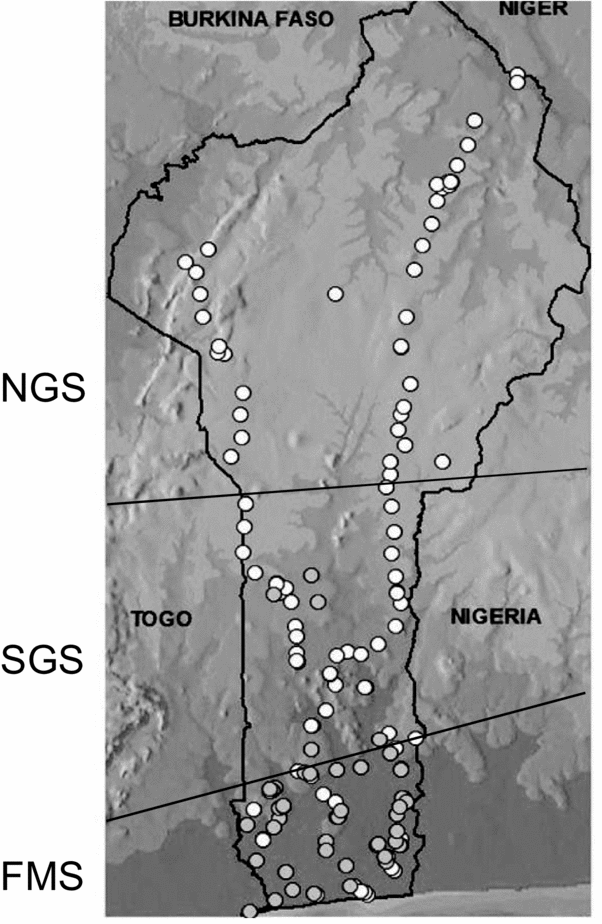
To investigate the level of mango infestation by the mango seed weevil in various agroecological zones in Benin, two countrywide surveys in 2007 and 2008 were undertaken throughout Benin in three agroecologies: Forest Mosaic Savanna (FMS), Southern Guinea Savanna (SGS), and Northern Guinea Savanna (NGS). At least two visits were made during each rainy season. The FMS has bimodal rainfall and secondary mango seasons, the NGS has unimodal rainfall, while the SGS shows a transition pattern.
The investigation of mango infestation levels was conducted on the experimental farm of the International Institute of Tropical Agriculture (IITA-Benin) from 2009 to 2011. The site is about 10 km NE of Cotonou, Benin (18 m altitude; 06°25′024″N; 02°19′840″E) in a Forest-Savanna Mosaic (FSM) area characterized by a subequatorial climate. The mean annual rainfall is 1200 mm. There are two rainy seasons (mid-February to end-July and mid-September to November) and two dry seasons (December to mid-February and August to mid-September), and the mean annual temperature ranges from 25 to 29 °C and the mean annual relative humidity from 62% to 97%.
Fruit sampling
During the countrywide surveys conducted in 2007 and 2008, mango trees were selected at intervals of 20 km along all primary and secondary roads, where necessary. At each stop, 10 fruits from the tree and 10 fruits from the ground were sampled from local and improved cultivars. About 17 mango cultivars, including three local varieties (Agboninkouin, Akohoundo, and the local) and 14 improved varieties (Adele, Alphonse, Bistole, Brooks, Camerounaise, Dabschar, Dupsol, Eldon, Gouverneur, Jules, Keitt, Kent, Rubby, and Smith) were sampled. A total of 7151 and 6603 fruits weighing about 1.5 metric tonnes were picked in 2007 and 2008, respectively.
For the investigation of mango infestation levels, three trees, approximately 25−30 years old, of each mango cultivar (Eldon, Alphonse, and a local variety) were used for the study. Fruit samplings were conducted during the first rainy season (mid-February to end-July) for three years, 2009–2011. Each tree was labelled with a red ribbon on which was written the name of the cultivar, the tree number, and the first sampling date. At each sampling date, we counted all fallen fruits from which 10 immature and mature fruits were randomly taken and kept in plastic bags. Fifteen additional immature and mature fruits were randomly picked in the canopy of each tree and also kept in plastic bags. The bags containing the samples were labelled indicating the name of the cultivar and the tree number as above, and the source of the fruit, i.e. whether from the tree or fallen fruit.
Fruit dissection and measurement of climatic factors
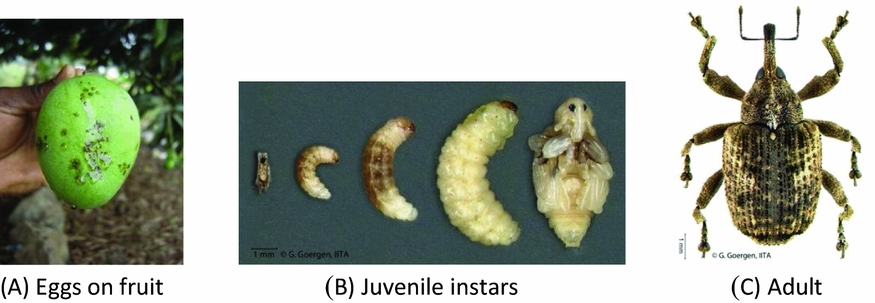
We weighed each mango fruit from the bags, measured the diameter and counted the number of hatched eggs on the skin (Fig. 1A). We then dissected the flesh and the seed of each fruit, to count the number of larvae, nymphs (Fig. 1B), and adults (Fig. 1C) of mango seed weevil on each part (flesh and seed). We preserved the live larvae, nymphs, and adults of the mango seed weevil in 70% ethanol-filled glass vials and incubated the dead ones in small plastic vials for possible emergence of parasitoids. Data of each year on temperature, rains, and relative humidity were collected from the database of the climatic station of IITA Benin.
Stages of the mango seed weevil, Sternochetus mangiferae. (A) Eggs on fruit. (B) Juvenile instars. (C) Adult.
Sources: (A) Dr Désiré Gnanvossou (IITA-Benin), (B, C) Dr Georg Goergen (IITA-Benin).

Data processing and statistical analysis
The percentage of infested fruit was calculated, including fruit that showed signs of infestation and those actually confirmed to be infected (eggs, larvae, or pupae). The average number of weevils (including larvae, nymphs, and adults per kg of fruit), was estimated by dividing the total number of mango seed weevils by the total weight of fruit. The number of eggs per kg of fruit was calculated by dividing the total number of collected eggs by the total weight of the fruit at each sampling date.
The Generalized Linear Mixed Models (GLMMs) (Bolker et al., Reference Bolker, Brooks, Clark, Geange, Poulsen, Stevens and White2009) with a Poisson error distribution model were used to: (1) measure the effect of mango cultivar and source (i.e. from the canopy and fallen to the ground) on the infestation of mango (i.e. the percentage of infested fruit); and (2) determine the relationship between the percentage of infested fruit and the abiotic factors, and other variables (number of weevils, number of eggs, number of fallen fruits, i.e. the percentage of damaged fruits and the weight of fruit). In this type of model, the linear predictor contains random effects in addition to fixed effects. We considered ‘sampling date’ as a random effect. We built GLMMs by the standard reduction method. At each step, the significance of each term was assessed by comparing models with and without that term. The Tukey HSD test was used to determine the difference of infestation means between the mango cultivars. The GLMMs were fitted by the Laplace approximation using the ‘glmer’ function in the ‘lme4’ package (Bates et al., Reference Bates, Maechler and Bolker2011) with statistical software R version 2.14.1 (R Development Core Team 2011).
Results
Mango infestation levels during the two-year countrywide surveys
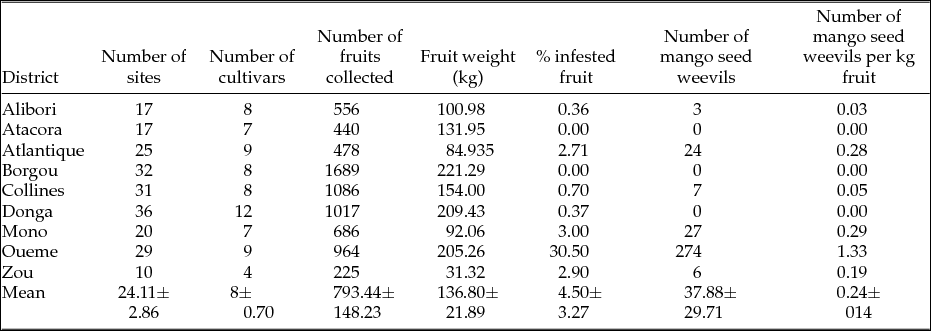
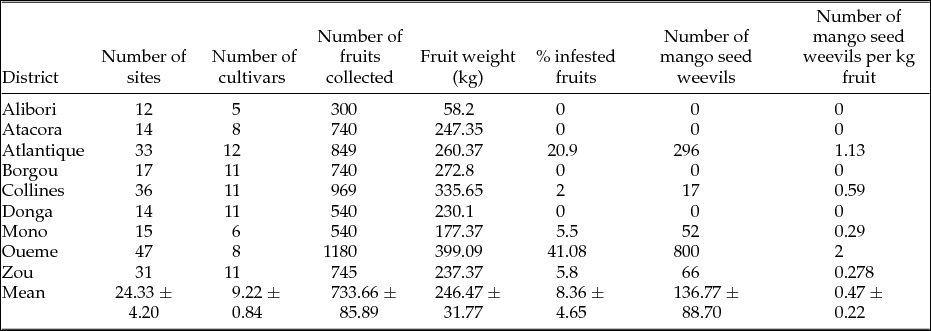
During the two-year (2007–2008) countrywide surveys, mango seed weevil was found primarily in more humid zones (FMS). There were a few occurrences of mango infestation in SGS. We observed no occurrences of mango infestation in the NGS, where most of the commercial mango is grown (Tables 1 and 2; Fig. 2).
Level of mango infestation by the mango seed weevil, 2007 countrywide survey in Benin

Level of mango infestation by the mango seed weevil, 2008 countrywide survey in Benin

Countrywide surveys of the distribution of mango seed weevil in Benin, 2007 and 2008. A map showing occurrence of mango weevil. Three agroecological zones were surveyed: Forest Mosaic Savanna (FMS), Southern Guinea Savanna (SGS), and Northern Guinea Savanna (NGS). White circles indicate the absence of mango seed weevil in surveyed sites; shaded circles indicate the presence of mango seed weevil in surveyed sites.

Infestation levels and population dynamics of S. mangiferae
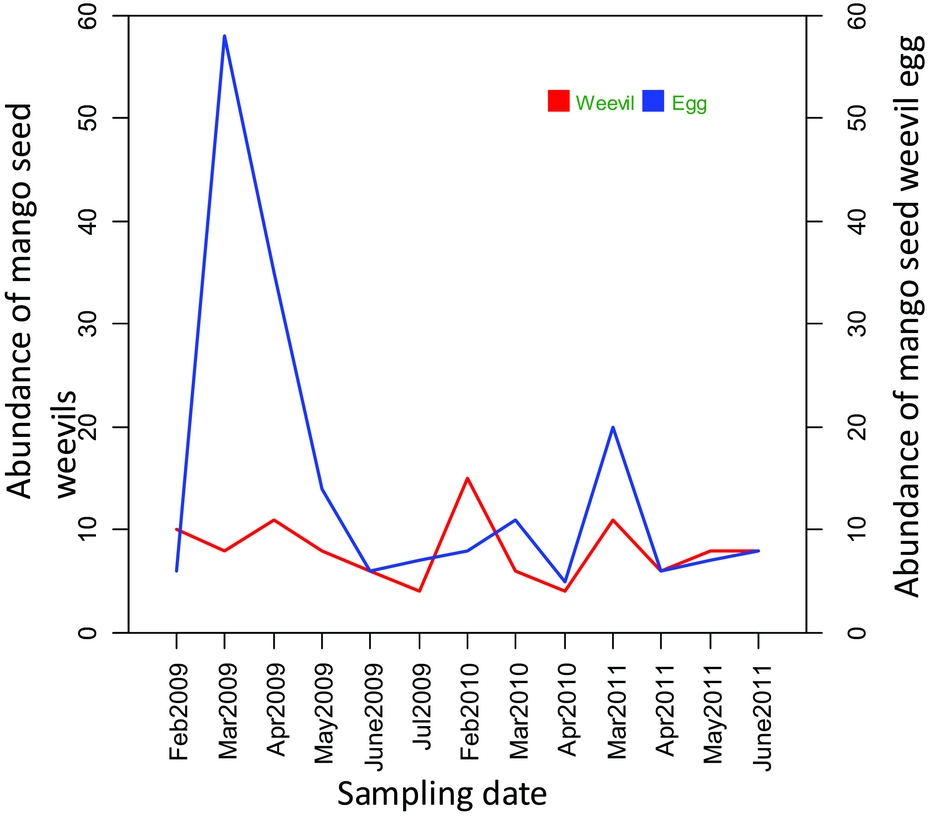
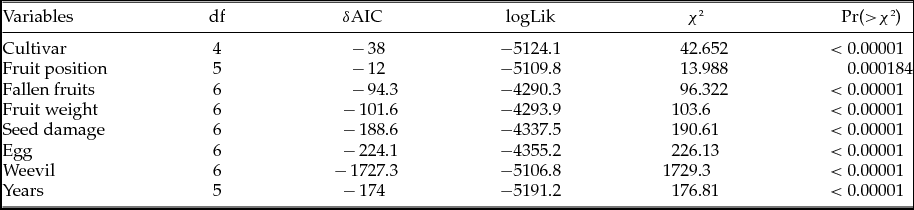
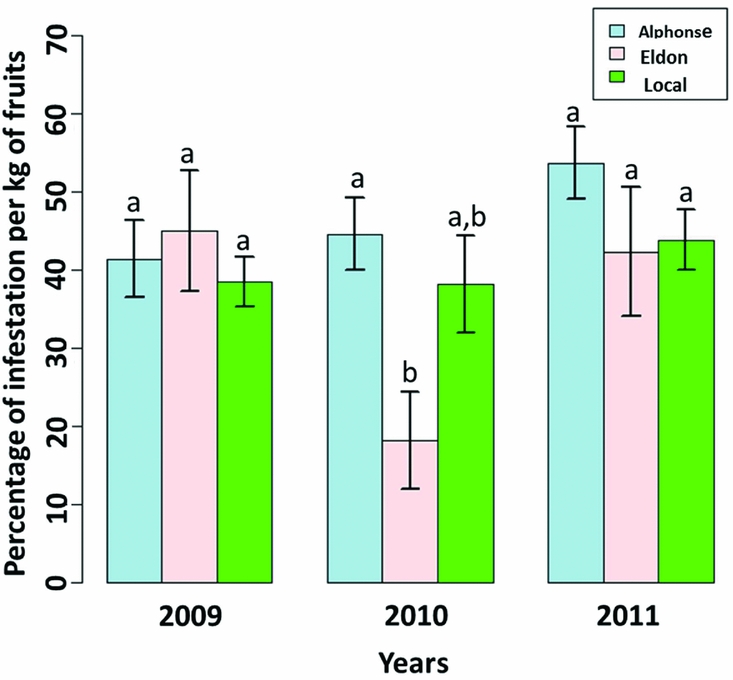
The abundance of both the mango seed weevil adults and eggs varied during the three-year study period, 2009–2011. The highest abundance of both the weevil and eggs was from March to May of each year (Fig. 3). The year of sampling and the mango cultivar had significant effects on the percentage of infested fruit (Table 3). In the course of the first year of sampling, the cultivar Eldon was more infested than the other two cultivars, while during the second and third years of sampling, the cultivar Alphonse was more infested than the cultivars Eldon and the local variety (Fig. 4). The years of sampling 2009 (P = 0.70; df = 2) and 2011 (P = 0.24; df = 2) did not have significant effects on mango infestation while the effect was significant for the year 2010 (P = 0.022; df = 2). There is a significant difference between the cultivars Alphonse and Eldon for the mango infestation of 2010 (P = 0.016), but the difference was not significant between the cultivars Alphonse and local (P = 0.65) and the cultivars Eldon and local (P = 0.11).
Time variation of the abundance of both mango seed weevils and mango seed weevil eggs during three years of mango production. Abundance of mango seed weevil (mean number of mango seed weevils per kg of fruit) and abundance of mango seed weevil egg (mean number of mango seed weevil eggs per kg of fruit) during 6 months for 2009, 3 months for 2010, and 4 months for 2011.

Effect of abundance of cultivar, fruit position, number of fallen fruits, mango seed weevil and mango seed weevil egg, fruit weight, years and percentage of seed damage on the infested fruits

Time variation of the mean percentage of fruit by cultivar during three years of mango production. Alphonse: Alphonse mango cultivar, Eldon: Eldon mango cultivar, Local: Local mango cultivar. A Tukey HSD test showed a significant difference only between the cultivars Alphonse and Eldon in 2010.

Relationship between the percentage of infested fruits, the abundance of mango seed weevils and their damage
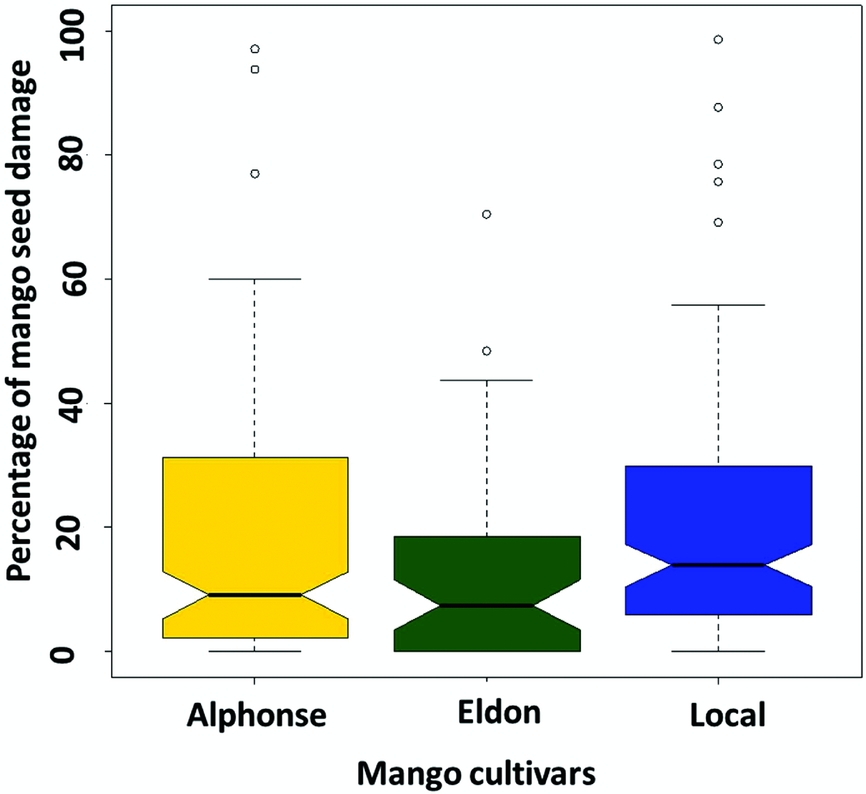
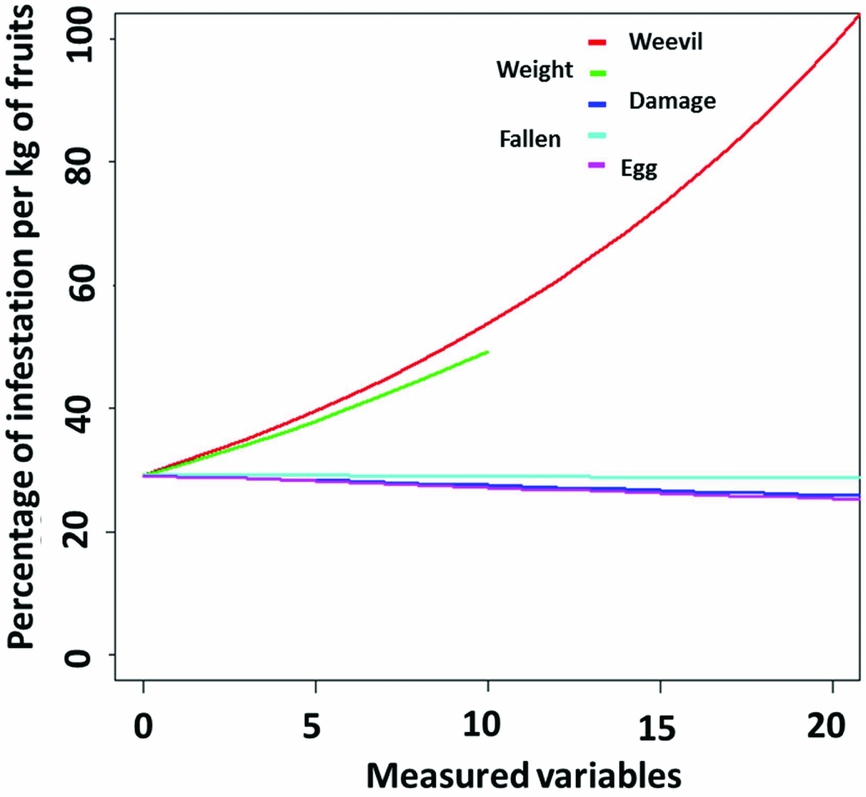
The abundance of both adults and eggs of the mango seed weevil, the number of fallen fruit, the weight of fruit and the percentage of damaged fruit had a significant effect on the percentage of infested fruit as shown in Table 3. Alphonse was the most infested cultivar during the three sampling years (Fig. 5). The percentage of infested fruits was positively correlated to the abundance of weevils and the weight of fruit. Inversely, the percentage of infested fruits was negatively correlated to the percentage of damaged fruits and the number of fallen fruits and the abundance of eggs of the mango seed weevil (Fig. 6).
Percentage of damage noted in the mango seeds for each mango cultivar showing the cultivar most infested.

Prediction model of percentage of infested fruits on number of mango seed weevil egg and mango seed weevils, number of fallen fruit, percentage of seed damage, and fruit weight during three consecutive years of mango production; weevil: number of mango seed weevil per kg fruit; egg: number of mango seed weevil egg per kg fruit; weight: weight of fruit; damage: percentage of seed damage; fallen: number of fallen fruits. This graph shows the variation of percentage of infestation per kg of fruit in function of measured parameters.

Influence of abiotic factors on percentage of infested fruits
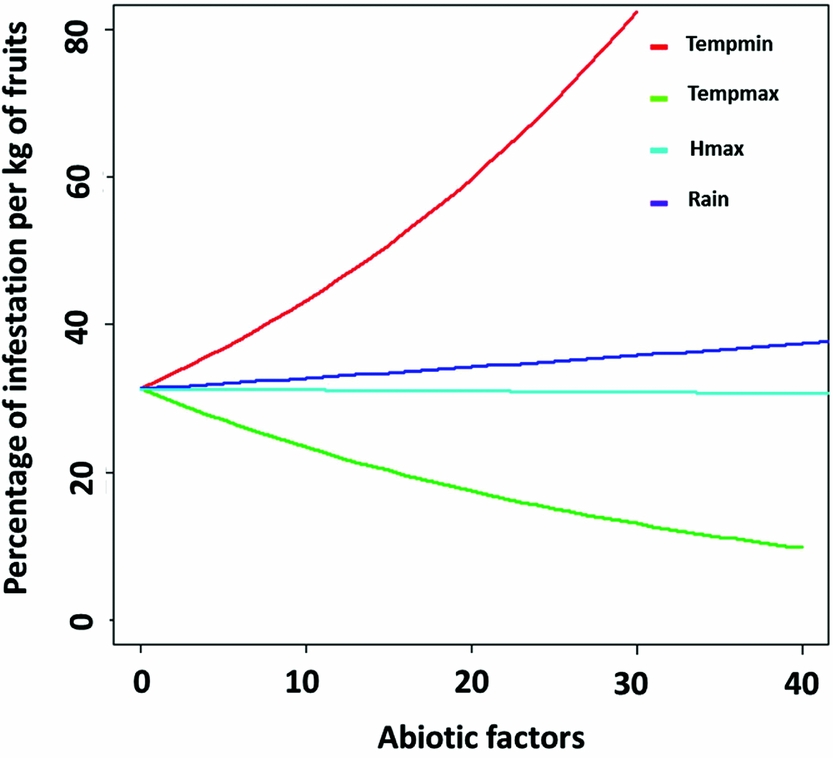
The minimum and maximum temperatures, maximum relative humidity, and rainfall had significant effects on the percentage of infested fruit while the minimum humidity had no effect on the percentage of infested fruits (Table 4). The percentage of infested fruits was positively correlated to the minimum temperature and rainfall. Inversely, the percentage of infested fruits was negatively correlated to the maximum temperature, but the relationship with maximum relative humidity was unclear (Fig. 7).
Effect of abiotic factors on the percentage of infested fruits

Prediction model of percentage infested fruit on abiotic factors during three years of mango production. tempmin: minimum temperature; tempmax: maximum temperature; hmax: maximum humidity; rain: rainfall. This graph shows the variation of percentage of infestation per kg of fruit in function of abiotic factors.

Discussion
Our results show that the abundance of both adults and eggs of the mango seed weevil was highest from March to May of each mango season. March to May is the period during which the females lay their eggs on mango cultivars. Identifying the oviposition period of the female weevils will help to determine the highest infestation period for the management of the mango seed weevil. Our results reveal that the cultivar and year had significant effects on the infestation of mango. Our results also show that the weevil-infested fruit of all three varieties, and the percentage of infested fruit, varied with the year and cultivar. Jarvis (Reference Jarvis1946), Bagle and Prasad (Reference Bagle and Prasad1985), Seleman (Reference Seleman2002), and Mulungu et al. (Reference Mulungu, Mpinga and Mwatawala2008) reported similar observations, indicating that mango seed weevil infests all susceptible cultivars. Nevertheless, Balock and Kozuma (Reference Balock and Kozuma1964) stated that the Itamaraca cultivar in Hawaii showed a little resistance to mango seed weevil attacks. Few mango cultivars are resistant to mango seed weevil attacks, and the management of the weevil using resistant varieties is less effective. It is possible to manage the weevil by cultivating off-season mango trees; however, this needs further investigation.
Our results reveal that mango infestation is positively correlated to the abundance of mango seed weevils and fruit weight, indicating that plenty of weevils increases the percentage of mango infestation. Many weevils are disadvantageous to mango production, due to mango infestation, while the increase in mango weight offers a broad skin surface for oviposition and infestation by the weevil. These fruits had a big seed, which implies availability of sufficient food resources for the mango seed weevil larvae. Inversely, our results show that mango infestation was negatively correlated to the percentage of weevil damage inside the mango seed, number of fallen fruits, and the abundance of weevil eggs. The endocarp of mango hardens quickly and likely protects the mango seed against attacks by weevil larvae, thus reducing the infestation of the mango seeds. The mango seed of the local cultivar is harder than that of other mango cultivars, and that may lead to less damage to the seed by the weevil. Many eggs hatched on local mango fruit, but few larvae entered the mango flesh and the endocarp to develop in the mango seed. During sampling, we collected and disposed of all fallen fruits, to create space and record newly fallen fruits. Collecting and disposing of all fallen fruits is a cultural practice known to decrease the abundance of weevils, leading to a reduction in the number of fallen fruits. Premature fruit drop cannot be linked to a severe attack of weevils, as reported by Van Dine (Reference van Dine1907) and Swezey (Reference Swezey1943). On the other hand, Peña et al. (Reference Peña, Mohyuddin and Wysoki1998) and Follett (Reference Follett2002) found that premature fruit drop was usually related to the severe attack of weevils. The eggs that weevils lay on the mango skin are exposed to abiotic factors, such as ants, which are generalist predators that destroy the eggs of the weevil (Peña et al., Reference Peña, Mohyuddin and Wysoki1998).
Results of the countrywide survey reported in 2007 revealed that the weevil was limited to the FSM but with a few recorded in the SGS and one in the NGS. The weevil was more prevalent in the FSM where the rain and the humidity are high, revealing that these two factors are vital to the abundance and infestation levels of the mango weevil. The NGS is usually dry and hot, which explains why the occurrence of the weevil was almost nil in this agroecological zone. Climatic conditions, especially temperature and humidity, can modify the development cycle of the mango seed weevil.
The mango seed weevil causes damage to the mango cultivar during the rainy season, while abiotic factors can influence the percentage of infested fruits. The results of our study reveal that the portion of infested fruits is positively related to minimum temperature and rainfall, which means that minimum temperature and precipitation favoured the development of the mango seed weevil. The oviposition of eggs by the female weevil is closely related to climatic conditions. Inversely, the percentage of infested fruits was negatively associated with maximum temperature; however, the relationship to maximum relative humidity is unclear. The maximum temperature was unfavourable to weevil development. The climate can substantially influence the development and distribution of insects and such increases in temperature could have some implications for temperature-dependent insect pests (Porter et al., Reference Porter, Parry and Carter1991). The rise in temperature can destroy the eggs of the weevil on the skin surface and alter its life cycle. Indeed, the increase in temperature reduced the fecundity of the weevil and affected the survival of immature stages. For example, Kersting et al. (Reference Kersting, Satar and Uygun1999) showed that in Aphis gossypii (Homoptera: Aphididae) temperatures over 30 °C showed continued development, reduced survivorship, shortened adult longevity, and reduced fecundity of the insect.
Conclusion
Abiotic factors have affected the population dynamics of the mango seed weevil and the infestation of the mango cultivar, indicating that climate change plays a crucial role in population dynamics of insect pests. In tropical zones, climate change affects atmospheric temperature, which causes a reduction in mango infestation by the mango seed weevil. The abundance of both adult and egg weevils was highest each year from March to May, and the percentage of mango infestation varied according to cultivar and year.
Acknowledgements
The authors thank Dr Georg Goergen from IITA-Benin for pictures B and C; Drs Muaka Toko from IITA-Benin, Bonaventure Omondi Aman from Bioversity-Benin, Cécile Rabot and Elsa Canard from CIRAD for providing comments on previous versions and Mrs Pierre Soglo and Alain Alowanou from IITA-Benin for field and laboratory assistance. This work was part of a project on Mango IPM funded by BIZ.