Introduction
It is well established that socioeconomic factors play a role in children's lexical development. Specifically, higher socioeconomic backgrounds are related to enhanced lexical skills, with the reverse reported when family environmental conditions are poor (see Hoff, Reference Hoff2006, for a review). Parental socioeconomic status (SES) bears directly on children's physical and psychological environments, affecting their language input and experiences, which in turn feed into their lexical skills (e.g., Hoff, Reference Hoff2003; Huttenlocher, Waterfall, Vasilyeva, Vevea, & Hedges, Reference Huttenlocher, Waterfall, Vasilyeva, Vevea and Hedges2010; Roy & Chiat, Reference Roy, Chiat and Marshall2013). Importantly, socioeconomic factors are characterised differently across studies, involving individual or combined measures of educational attainment, occupational status and income. It is not known to what extent different measures of SES, whether individual or composite, predict variability in children's lexical skills when other variables are kept constant. Moreover, when bilingualism is factored in, the relationship between socioeconomic background and children's language development becomes more complex. For example, socioeconomic level may relate to the bilingual proficiency of parents, who are likely to be highly dominant in the minority language if their SES is low (Gathercole, Reference Gathercole, Nicoladis and Montanari2016) or have good knowledge of the majority language if they are well educated (Miękisz, Haman, Łuniewska, Kuś, O'Toole, & Katsos, Reference Miękisz, Haman, Łuniewska, Kuś, O'Toole and Katsos2017). Such factors shape the amount and content of input that parents direct at their children as well as its distribution across one or two languages, with likely consequences for children's bilingual acquisition. Further, studies on socioeconomic influences often draw on contexts where bilingualism is confined to a geographical region or minority language community (e.g., Collins, O'Connor, Suárez-Orozco, Nieto-Castañon, & Toppelberg, Reference Collins, O'Connor, Suárez-Orozco, Nieto-Castañon and Toppelberg2014; Scheele, Leseman, & Mayo, Reference Scheele, Leseman and Mayo2010), so that socioeconomic differences become intertwined with cultural dimensions. For children raised in minority language low-SES homes, language exposure may be influenced not only by socioeconomic factors but also by the way in which bilingualism is construed in their environment. Separating the respective effects is often difficult (Gathercole, Kennedy, & Thomas, Reference Gathercole, Kennedy and Thomas2016; Hoff, Reference Hoff2013). Data from minority language children may therefore be limited in the contribution they can make towards the development of a universal theory of bilingual language acquisition.
The present study addresses these theoretical and methodological issues by investigating how different SES measures predict the bilingual lexical skills of a group of children aged 3;11–4;3 who came from Maltese-dominant homes and attended state preschools in Malta. Here, bilingualism in Maltese and English is the norm at the societal level. Thus, examination of socioeconomic effects in this context is strengthened by the sociocultural homogeneity it affords. Moreover, the presence of nationwide bilingualism sidesteps the confound between lower socioeconomic conditions and bilingual exposure that is frequent among children from language minority homes. For Maltese children, bilingual development takes place across all socioeconomic levels. Investigations of how SES factors predict Maltese children's bilingual skills may therefore add to our theoretical understanding of bilingual language acquisition. To this end, we consider children's receptive and expressive lexical performance in Maltese and English in relation to five SES measures, empirically identify the most powerful one, and then examine how this factor predicts participants’ receptive and expressive lexical skills in Maltese and English.
Socioeconomic predictors of children's lexical development
SES is a multifaceted construct that has educational attainment, occupational status, and income as its major indicators. These three factors influence one another reciprocally, with an individual's educational background influencing the type of occupation engaged in, which in turn determines the income level (Ganzeboom, De Graaf, & Treiman, Reference Ganzeboom, De Graaf and Treiman1992). Evidence also shows that education, occupation, and income each exert specific, non-interchangeable effects on individual, family, and community health status (Hernandez & Blazer, Reference Hernandez and Blazer2006). SES is linked to child development through parenting behaviours and child-rearing practices (Conger & Donnellan, Reference Conger and Donnellan2007). Socioeconomic influences on children's language learning are mediated through parental input, with SES impacting the quantity and quality of language that parents direct at their children (Hoff, Reference Hoff2006; Huttenlocher et al., Reference Huttenlocher, Waterfall, Vasilyeva, Vevea and Hedges2010). In general, conditions of poverty are associated with parental stress and with less warmth and responsivity in parenting style, making the home language environment less conducive to language learning (Evans, Maxwell, & Hart, Reference Evans, Maxwell and Hart1999; Perkins, Finegood, & Swain, Reference Perkins, Finegood and Swain2013). In contrast, higher-SES parents have more time for interpersonal investments with their children and more financial resources for material investments (Sohr-Preston, Scaramella, Martin, Neppl, Ontai, & Conger, Reference Sohr-Preston, Scaramella, Martin, Neppl, Ontai and Conger2013). Children from higher-SES families therefore have more opportunities for receiving linguistically rich input from their parents and are exposed to more literacy-related materials and practices, which support not only language acquisition but also educational achievement (Bradley & Corwyn, Reference Bradley and Corwyn2002; Hoff, Reference Hoff2006). Maternal education appears to be a preferred proxy measure of SES across studies (Hoff, Reference Hoff2006). This is linked to the fact that mothers’ language use with children and their knowledge of child development tends to vary according to their level of education (Hart & Risley, Reference Hart and Risley1995; Hoff, Reference Hoff2003; Pan, Rowe, Singer, & Snow, Reference Pan, Rowe, Singer and Snow2005; Rowe, Reference Rowe2008).
The relationship between SES and children's language environment holds despite wide variation in the definitions of SES employed in the research literature (Suskind et al., Reference Suskind, Leffel, Graf, Hernandez, Gunderson, Sapolich and Levine2016). Across studies, parents’ educational attainment, occupational status, and income are the key SES measures that have been employed, individually or in combination (Bradley & Corwyn, Reference Bradley and Corwyn2002). Other aspects of children's developmental environments have also been considered in composite measures. For example, the Index of Multiple Deprivation employed in the UK not only considers parental education, income, and employment but also health, training, access to services, living environment, and crime, among others (Law, Reference Law, Rescorla and Dale2013). Geographical areas of socioeconomic advantage or disadvantage thus identified are often employed in the recruitment of participants according to SES level (e.g., Roy, Chiat, & Dodd, Reference Roy, Chiat and Dodd2014; Bavin & Bretherton, Reference Bavin, Bretherton, Rescorla and Dale2013, using the Socio-Economic Indexes for Areas (SEIFA) in Australia). The Hollingshead Four-Factor Index of Socioeconomic Status, another composite measure used to estimate family SES, not only considers parents’ education and occupation level but also their employed/retired status and marital status (see Hurtado, Marchman, & Fernald, Reference Hurtado, Marchman and Fernald2008; Rescorla & Alley, Reference Rescorla and Alley2001). Other individual measures have also been employed as proxy measures for SES. For instance, Balladares, Marshall, and Griffiths (Reference Balladares, Marshall and Griffiths2016) determined Chilean children's SES on the basis of the type of school attended, with low-SES children recruited from public schools and children attending private schools assigned to a high-SES group. Suskind et al. (Reference Suskind, Leffel, Graf, Hernandez, Gunderson, Sapolich and Levine2016) considered mothers’ eligibility for state and/or federal support related to medical costs and mother–child nutritional programmes to be a marker of low SES. Locke, Ginsborg, and Peers (Reference Locke, Ginsborg and Peers2002) recruited children reared in poverty through schools having high proportions of pupils receiving free school meals.
Substantial evidence shows vocabulary learning to be particularly sensitive to socioeconomic background (e.g., Arriaga, Fenson, Cronan, & Pethick, Reference Arriaga, Fenson, Cronan and Pethick1998; Feldman, Dollaghan, Campbell, Kurs-Lasky, Janosky, & Paradise, Reference Feldman, Dollaghan, Campbell, Kurs-Lasky, Janosky and Paradise2000; Hart & Risley, Reference Hart and Risley1995; Hoff, Reference Hoff2003; Huttenlocher et al., Reference Huttenlocher, Waterfall, Vasilyeva, Vevea and Hedges2010; Rescorla & Alley, Reference Rescorla and Alley2001), with SES-related differences reported as early as 18 months and growing in magnitude within just six months (Fernald, Marchman, & Weisleder, Reference Fernald, Marchman and Weisleder2013). Children raised in favourable socioeconomic conditions are likely to receive input that is conducive to vocabulary growth. For example, Hoff (Reference Hoff2003) reported quantitative and qualitative differences in the child-directed input of higher- and lower-SES mothers. Mothers who had a college education and were employed in professional or managerial positions were more talkative with their two-year-olds than mothers having lower educational and occupational levels. Their input was also lexically richer and contained longer utterances. Rowe (Reference Rowe2008) reported that the amount, complexity, and type of utterances in parental input not only predicted children's vocabulary skills one year later but were also directly related to SES, prompting consideration of parental knowledge of child development as a mediating factor between SES and child-directed input. In their landmark study, Hart and Risley (Reference Hart and Risley1995) identified substantial discrepancies in the numbers of words sampled weekly from parent–child dyads in high- (professional), mid- (working class), and low-SES (welfare) families. The latter spoke less to their 18–36-month-olds, used fewer word types, and were more directive than those experiencing better socioeconomic conditions. These differences were expected to impact children's vocabulary production and rate of vocabulary growth. By age four, the difference in words heard by children in high- and low-SES families was estimated to be 30 million words on average. More recently, Sperry, Sperry, and Miller's (Reference Sperry, Sperry and Miller2019) attempt at replicating these results through a similar methodology was unsuccessful, with overheard language use, variation within socioeconomic levels, and methodological differences considered as factors potentially contributing to the mismatch in results. In a response to Sperry et al.'s (Reference Sperry, Sperry and Miller2019) work, however, Golinkoff, Hoff, Rowe, Tamis-Lemonda, & Hirsh-Pasek (Reference Golinkoff, Hoff, Rowe, Tamis-Lemonda and Hirsh-Pasek2019) criticised the excessive importance attributed to overheard speech and reiterated that quality input directed at children remained a crucial factor in determining their language outcomes. The fact that several investigations have confirmed the notion of children's vocabulary skills varying in relation to characteristics of their language exposure and the latter's association with SES bears testimony to the continued relevance of Hart and Risley's (Reference Hart and Risley1995) work (Fernald & Weisleder, Reference Fernald and Weisleder2015).
Although the link between SES, parental input, and vocabulary development may appear logical, it is actually highly complex. The research literature generally shows parental input to enhance children's lexical skills when socioeconomic conditions are favourable, but there is evidence that does not tally with this pattern. Reilly et al.'s (Reference Reilly, Wake, Bavin, Prior, Williams, Bretherton and Ukoumunne2007) population-based study in Australia reported that vocabulary measures at 24 months were not predicted by maternal educational qualifications. Similarly, Hurtado et al. (Reference Hurtado, Marchman and Fernald2008) did not identify a relationship between SES and expressive vocabulary size in US children aged 18–24 months who came from Spanish-speaking homes. There is also conflicting evidence relating to children's performance on language measures other than vocabulary in relation to SES. For example, lower- and higher-SES groups have been found to perform similarly on nonword repetition (e.g., Balladares et al., Reference Balladares, Marshall and Griffiths2016; Chiat & Polišenská, Reference Chiat and Polišenská2016; Meir & Armon-Lotem, Reference Meir and Armon-Lotem2017), but not consistently so (see Roy et al., Reference Roy, Chiat and Dodd2014). This heterogeneity in language outcomes may be explained by the varying representation of socioeconomic factors in the research literature, along with other methodological differences (Roy & Chiat, Reference Roy, Chiat and Marshall2013). Moreover, socioeconomic influences are likely to interact with inherited characteristics in shaping children's language development (Bishop, Reference Bishop2014; Hernandez & Blazer, Reference Hernandez and Blazer2006). Specifically, shared genes have been found to moderate the effects of parental input on children's vocabulary and grammar skills (Dale, Tosto, Hayiou-Thomas, & Plomin, Reference Dale, Tosto, Hayiou-Thomas and Plomin2015). Roy and Chiat (Reference Roy, Chiat and Marshall2013) reported that children from low- and high-SES backgrounds had similar language profiles, suggesting that environmental and genetic influences were not mutually exclusive. Further, variability in the input directed at children goes beyond that predicted by SES (Rowe, Reference Rowe2012), explaining why differences in parental input have been documented not only across SES groups but also within them (Hirsh-Pasek et al., Reference Hirsh-Pasek, Adamson, Bakeman, Owen, Golinkoff, Pace and Suma2015; Rowe, Pan, & Ayoub, Reference Rowe, Pan and Ayoub2005; Schwab & Lew-Williams, Reference Schwab and Lew-Williams2016; Weisleder & Fernald, Reference Weisleder and Fernald2013). Together, these findings imply that SES is only partly responsible for the mechanisms involved in word learning. Other household and community factors, as well as children's age, might add variability that interacts with SES influences (Schwab & Lew-Williams, Reference Schwab and Lew-Williams2016). Indeed, when bilingualism is present at family or community level, the influence of socioeconomic factors may become more complex (Gathercole, Reference Gathercole, Nicoladis and Montanari2016). Counter to a widely held assumption, the absolute amount of input in each language to young bilinguals may not necessarily be reduced when compared to monolingual children (see De Houwer, Reference De Houwer, Grüter and Paradis2014). This suggests that the contribution of broader socioeconomic factors to differences in adult–child dyads in bilingual settings may be more substantial than previously assumed. Empirical literature investigating SES influences on children's bilingual lexical development is reviewed next.
Socioeconomic status in relation to bilingual lexical skills
Much of the research on bilingual acquisition investigates socioeconomic influences in relation to the learning of a second language (L2) by children in minority language contexts. In the latter, maternal education level has been frequently employed as a proxy measure for SES. Mothers’ educational background has been found to contribute significantly to the variability in children's L2 English vocabulary scores (e.g., Golberg, Paradis & Crago, Reference Golberg, Paradis and Crago2008; Hammer, Komaroff, Rodriguez, Lopez, Scarpino, & Goldstein, Reference Hammer, Komaroff, Rodriguez, Lopez, Scarpino and Goldstein2012), although not consistently (Paradis, Reference Paradis2011). In minority language children, bilingual learning and low SES are often confounded (see Hoff, Reference Hoff2013, for a review). When children's L2 skills are compared to their monolingual peers’, they are inevitably lower. Parental proficiency in the majority language (L2) may be limited, constraining children's bilingual exposure and development (O'Toole et al., Reference O'Toole, Gatt, Hickey, Haman, Miękisz, Armon-Lotem, Rinker, Ohana, dos Santos and Kern2017). Negative attitudes towards bilingualism have also been reported among minority ethnic groups, which may perceive exposure to two languages as a potential cause of speech and language delay (Marshall, Harding, & Roulstone, Reference Marshall, Harding and Roulstone2017). Further, unfavourable socioeconomic conditions may impact first language (L1) and L2 development negatively.
Studies attempting to pull apart socioeconomic and bilingualism influences on the lexical skills of children raised in minority language contexts are sparse. Calvo and Bialystok (Reference Calvo and Bialystok2014) reported that the L2 receptive vocabularies of monolingual and bilingual children did not differ significantly in relation to SES, the latter categorised as working class when mothers’ education did not exceed high-school level. Chiat and Polišenská (Reference Chiat and Polišenská2016) found the interaction between language group (monolingual/bilingual) and SES neighbourhood (low/mid-high) to border on significance, leading them to suggest that bilingual children from low-SES neighbourhoods were “at a particular disadvantage” (p. 1185) in their L2 receptive vocabulary skills. In both studies, children having different minority language backgrounds were tested on standardised English language assessments. Meir and Armon-Lotem (Reference Meir and Armon-Lotem2017) attempted to control for ethnic and cultural diversity by involving bilinguals having the same home language and cultural background. Expressive vocabulary and verbal memory skills of bilingual Russian–Hebrew children were compared to their monolingual Hebrew peers’, with socioeconomic levels determined by years of maternal education. Hebrew expressive vocabulary, tested through children's naming of 15 objects of varying degrees of familiarity, varied significantly as a function of SES and language group (monolingual/bilingual), with no interaction.
Although a small number of studies have contributed towards isolating socioeconomic and bilingualism effects, theoretical explanations of bilingual acquisition thrive on ‘normative’ bilingual settings where bilingual individuals outnumber monolinguals (Montanari & Nicoladis, Reference Montanari, Nicoladis, Nicoladis and Montanari2016). In such contexts, monolingual-referenced comparisons become unnecessary. Gathercole et al.'s (Reference Gathercole, Kennedy and Thomas2016) analysis of the language and cognitive skills of Welsh–English children and adults in Wales is an important step in this direction, as the Welsh context allows cultural diversity to be controlled. The contributions of age, relative exposure to Welsh and English at home, and socioeconomic background were measured, with a composite proxy measure for SES derived from maternal and paternal education level and occupation. In four-year-olds, home language exposure emerged as the best predictor of receptive vocabulary in both Welsh and English, with SES appearing most influential among teenagers. O'Toole et al.'s (Reference O'Toole, Gatt, Hickey, Haman, Miękisz, Armon-Lotem, Rinker, Ohana, dos Santos and Kern2017) cross-linguistic study of expressive vocabulary size in 250 children aged 2;0–3;0, who were exposed to six different language pairs in contrasting bilingual contexts, also moves away from monolingual-referenced comparisons, documenting early bilingual vocabulary development and identifying markers for language delay. Here, higher maternal education levels were taken as a proxy measure for SES and were found to mediate larger expressive vocabularies.
The linguistic context in Malta is naturally conducive to the study of bilingual acquisition. Bilingualism is a nationwide phenomenon, with both Maltese and English having majority language status. The 2011 Census of Population and Housing reported the Maltese language to be spoken well by 93% of the Maltese population aged ten years and over, while just over 62% had good command of spoken English (National Statistics Office, Malta, 2014). Earlier statistical data identified Maltese as the preferred home language for 90% of the Maltese population aged ten years and over (National Statistics Office, Malta, 2007), documenting the dominant language status of Maltese among the absolute majority of the population. As a result, most young children would be expected to receive predominantly Maltese exposure in their homes. Those receiving consistent English exposure are likely to come from higher-SES families (Caruana, Reference Caruana, Lasagabaster and Huguet2007). It is also very unlikely for young Maltese children to receive strictly monolingual input (Vella, Reference Vella2013), since language contact at the societal level inevitably permeates adult–child dyads. Moreover, Maltese-dominant input contains an additional English component largely composed of English lexical borrowings and single-word code-switches that are specific to child-directed language use (Gatt, Grech, & Dodd, Reference Gatt, Grech and Dodd2016). Not surprisingly, therefore, young children raised in Maltese-speaking families have been reported to show bilingual expressive vocabularies between ages 1;0 and 2;6 (Gatt et al., Reference Gatt, Grech and Dodd2016). Further, higher maternal education level was found to contribute significantly to children's total vocabularies and Maltese word scores but not to their English word use between ages 1;11 and 2;10 (Gatt, Reference Gatt2017). Possibly, therefore, Maltese-dominant mothers’ provision of English input took place regardless of their educational level, with the scope of imparting any available English knowledge to their children. Nonetheless, the English input provided by better-educated mothers was thought to be more integrated and complete.
In Malta, the learning of English is considered desirable not only because of its status as a language of global communication, but also because it is a language of education alongside Maltese. A policy of bilingualism and biliteracy in Maltese and English is strongly advocated throughout the early years of education, consisting of two years of non-compulsory pre-primary education and the first two years of obligatory primary schooling (Ministry for Education and Employment, Malta, 2014). Accordingly, the Language Policy for the Early Years Consultation Document (Ministry for Education and Employment, Malta, 2015) encourages preschool educators to support the oral development of both languages. However, Maltese and English may be emphasised in different ways in the preschool context, depending on the school sector (state, church, or independent), and the language policy of each school, as well as children's language background and degree of proficiency in Maltese and/or English (Mifsud & Vella, Reference Mifsud, Vella and Schwartz2018). State schools, like church schools, are said to channel instruction through both Maltese and English, while independent institutions tend to favour English (Camilleri Grima, Reference Camilleri Grima2013). Nonetheless, recent evidence from Maltese children raised in Maltese-dominant homes and attending state preschools showed four-year-olds’ picture naming skills to improve significantly in Maltese but not in English when compared to three-year-olds’ performance on the same task (Gatt & Dodd, Reference Gatt and Dodd2019). This was taken to suggest that classroom exposure was more inclined towards Maltese, taking advantage of children's language dominance.
In the present study, we examined how different SES measures predicted receptive and expressive vocabulary outcomes for a single group of four-year-olds attending state preschools. We drew on the premise that an understanding of the influences of individual SES factors is called for, prior to examining their combined effects (Conger & Donnellan, Reference Conger and Donnellan2007; Zubrick, Taylor, Rice, & Slegers, Reference Zubrick, Taylor, Rice and Slegers2007). Accordingly, we examined the predictive value of four individual SES indicators and a composite SES variable in relation to the participants’ vocabulary skills in two languages, Maltese and English. We capitalised on the sociocultural uniformity resulting from the presence of nationwide bilingualism in Malta, the children's country of birth and residence. This sociolinguistic feature also allowed us to control for the socioeconomic bias that often permeates bilingual samples. The study addressed the following research questions:
1. How do different measures of SES relate to the Maltese and English receptive and expressive vocabulary skills of a group of four-year-old preschoolers?
2. Is there one SES measure that is more effective in explaining the variability in receptive and expressive vocabulary scores than the others? If so, how does this SES measure predict children's lexical performance? Does it interact with the language of testing in doing so?
Materials and methods
Participants
Participants were 58 typically developing children (30 girls) aged 3;11–4;3 (mean age = (49.38 months, SD = 1.15) attending their second year of preschool in 11 state Kindergarten Centres spread across the five geographical districts of Malta. In 2017, four-year-olds attending state preschools in Malta amounted to 2,886 (National Statistics Office, Malta, 2017). Accordingly, a sample of 58 four-year-old children would guarantee a margin of error of 12.74%, assuming a 95% confidence level. Recruitment of children receiving state-provided education was intended to enhance uniformity in their school language exposure. Parents reported home language exposure to be predominantly Maltese for every child. In line with local bilingual education policy, the participants were expected to engage in sequential bilingual development through formal English language exposure as from the previous year. Data were collected during the first four months of the scholastic year. Controlling broader variability in amount and timing of bilingual exposure at home and school aimed to minimise possible interactions with socioeconomic factors and reduce individual differences in bilingual lexical proficiency.
Procedure
Permission to carry out the study in the preschools was obtained from Malta's Directorate for Quality and Standards in Education, as well as from the school principals. Ethical approval was obtained from the University of Malta's Research Ethics Committee. Preschool teachers were informed of the participant selection criteria and asked to pass on information letters, consent forms, and questionnaires to the children's guardians. For 14 of the participants, the questionnaire only comprised items related to parental educational level and occupational status. For the rest of the sample, children's developmental and language background were also addressed in an adaptation of the Questionnaire for Parents of Bilingual Children (COST Action IS0804, 2011). For all guardians, completion of the consent form required them to indicate whether the child's home environment was primarily Maltese-speaking or otherwise.
Children were tested in a quiet room at school by the second author and trained research assistants. Maltese and English tasks were administered in separate assessment sessions 4 to 12 days apart. Language of testing was counterbalanced. Receptive judgement preceded naming in the testing protocol. In the receptive task, children were shown a picture and asked “Is this a … / Are these …/ Dan/din/dawn … ?” and required to say ‘yes’ or ‘no’ in response. Picture naming was elicited by asking “What do you see? / X'qed tara?” Each test began with two training items on which children received prompting and reinforcement related to accuracy and language use. No feedback was given on responses to the actual test items. Throughout each assessment session, children were addressed in the test language. Tasks were introduced and administered monolingually, following a set procedure that consisted of Maltese or English instructions. Since participants were likely to be in a bilingual language mode, because of the widespread language mixing expected in their language environment as well as the bilingualism of the persons administering the tasks (see Grosjean, Reference Grosjean and Nicol2001), this procedure cued them to the test language of the assessment session. Gathercole, Thomas, and Hughes (Reference Gathercole, Thomas and Hughes2008) point out that, since children raised in bilingual communities can often draw effortlessly on knowledge in two languages when tested, single-language assessment content and administration should be distinctly monolingual. In the present study, monolingual task administration attempted to activate the test language in order to tap as far as possible into the children's lexical abilities in that language. If children responded in the non-test language, they were not prompted to revert back to the language of testing. This minimised disruptions during test administration and potential variability across testers in the cueing strategies used. It also allowed insight on children's lexical mixing, which was analysed in a related study (see Gatt & Dodd, Reference Gatt and Dodd2019). Administration of tasks in each language lasted 20–30 minutes. Children who failed to respond to 10 consecutive items on at least one task were not included among the participants.
The receptive picture name judgement tasks
Picture name judgement addressed children's ability to judge the accuracy of phonological representations pertaining to familiar words. For ease of reference, we consider its focus to be on receptive lexical skills since it required children to process lexical phonology received in auditory input. This terminology should not, however, be equated with receptive lexical skills as assessed through picture identification. The latter tests children's knowledge of word phonology and corresponding meanings, whilst the receptive judgement task employed in this study tapped into the integrity of stored phonological representations of known words. To our knowledge, this aspect of receptive lexical knowledge has not yet been explored in preschool children. The receptive tasks in both Maltese and English used 40 concrete nouns that were age-appropriate. These were selected from word usage data for Maltese- and English-speaking children aged 2;6 to maximise the chance that three- and four-year-old children would know the words. Stimuli were presented as labels for 40 coloured photographic images, each appearing on an individual slide in a PowerPoint presentation. Word stimuli had to be picturable and pictures easily recognised. Test items were different for each language, except for seven that were common to both on the basis of the word usage data consulted. These common words were represented by different pictures in each language, to minimise interference between language tasks. Test items were trialled on five children to ensure familiarity of the words and prompt recognition of the pictures.
Maltese word usage data were derived from a bilingual Maltese–English adaptation of the vocabulary checklist in the MacArthur Communicative Development Inventories: Words and Sentences (CDI: WS) (Fenson et al., Reference Fenson, Dale, Reznick, Thal, Bates, Hartung, Pethick and Reilly1993). These data were obtained from 17 Maltese children aged 2;6, whose main caregivers completed a paper version of the checklist by ticking the words their children used spontaneously across daily contexts. This corpus was extracted from a larger dataset based on 60 children aged 1;0 to 2;6 (see Gatt et al., Reference Gatt, Grech and Dodd2016). Task items were Maltese common nouns used by 70% or more of the children. In line with Gathercole et al.'s (Reference Gathercole, Thomas and Hughes2008) recommendations for the design of single-language assessments for use with bilingual children, all items were ‘native’ Maltese words that excluded English borrowings and cognate terms. The English task drew on English word usage data obtained from the cohort of 17 Maltese toddlers referred to in Maltese task construction and on word frequency data for monolingual US English children aged 2;6 available in the Lex2005 Database, based on the CDI: WS norming sample (Dale & Fenson, Reference Dale and Fenson1996). Of the 40 words in the English task, 33 were used by both the Maltese cohort (≥ 70%) and the US sample (≥ 84.3%). The remaining seven words were selected from those used by over 63% of the Maltese toddlers.
Of the 40 task items in each language, approximately 50% (19 in Maltese and 21 in English) were presented as accurate picture labels. The rest were phonological foils that incorporated changes in voicing, manner, and place of production. Phonological substitutions were presented in word-initial position (12 for Maltese, 9 for English), word-medially (7 for Maltese, 5 for English) and word-finally (2 for Maltese, 5 for English). The phonological foils for the Maltese and English tasks are listed in Table 1. Eliminating data of children not responding to 10 consecutive items ensured that the phonological processing skills analysed were minimally influenced by restricted lexical repertoires and limited attention spans.
Phonological error stimuli presented in the Maltese and English receptive picture name judgement tasks

When coding the receptive judgement data, correct responses were assigned a score of 1, while incorrect responses received a score of 0. Incorrect responses consisted of phonological errors (undetected production errors in the stimuli), semantic errors (a ‘No’ response to a correct phonological stimulus or a semantically unrelated response), and language errors (a relevant reply given in the non-test language).
The picture naming tasks
The picture naming tasks elicited the production of 40 concrete nouns in Maltese and 40 in English. Of these, 40% (N = 16) were common to both language tasks, providing information on children's retrieval and production of translation equivalents, analysed as part of a related study (see Gatt & Dodd, Reference Gatt and Dodd2019). Stimuli selected for the picture naming tasks were photographic images of high-, mid-, and low-frequency words used by toddlers and lexical concepts tested in vocabulary assessments for preschoolers. Word usage data for Maltese children aged 2;6 generated 30 Maltese stimuli, none of which were English borrowings or cognates. For ten of these, equivalents were included in the English naming task. Two additional words were Maltese equivalents for words tested in the Clinical Evaluation of Language Fundamentals-Preschool-2 (CELF-Preschool-2; Semel, Wiig, & Secord, Reference Semel, Wiig and Secord2004). Another two words were Maltese equivalents for English words reportedly used by Maltese toddlers. The remaining six items were equivalents for words included in the English task. ‘Appendix 1’ shows the composition of the Maltese task. Thirty-eight English naming task stimuli were drawn from English word frequencies for US and Maltese children, items in the Expressive Vocabulary Test (2nd ed.) (EVT-2; Williams, Reference Williams2007) expected of children aged 4;0–4;5 and the US CDI-III (Fenson et al., Reference Fenson, Marchman, Thal, Dale, Reznick and Bates2007), an upward extension of the CDI: WS for children aged 2;6 to 3;1. Two additional items were equivalents for words included in the Maltese naming task. ‘Appendix 2’ illustrates the task's composition.
When coding children's performance on the picture naming task, semantically correct responses were assigned a score of 1. Proper nouns, onomatopoeic terms, and unintelligible productions were not coded. Non-coded responses were negligible in number (on the Maltese task, mean = 0.5 (SD = 0.70), range = 0–3; on the English task, mean = 0.18 (SD = 0.79), range = 0–5). Correct responses were further coded for test (correct) language or non-test (other) language use. For the purpose of the present study, only semantically correct responses in the test language were analysed.
Coding of socioeconomic characteristics
Questionnaire responses relating to highest educational level achieved and current occupational status for children's mothers and fathers were coded as ‘low’ or ‘mid-high’. Five indicators of SES, four individual and one composite measure, were derived. Two individual measures drew on maternal and paternal educational level, respectively. Education was coded as ‘low’ (score = 0) when it did not exceed upper secondary level, i.e., 13–14 years of schooling. Mid-high educational level (score of 1) comprised vocational/professional training, and undergraduate and postgraduate education. Lower maternal and paternal educational levels were significantly associated (Χ 2(1) = 27.720, p < .001). Two further SES indices were based on separate measures of mothers’ and fathers’ current occupational status. Occupational level was coded using Ganzeboom et al.'s (1992) International Socioeconomic Index of occupational status (ISEI), in which scores range between 90 (judge) and 10 (agricultural and animal husbandry worker). For mothers, the score range was 71–24; for fathers it was 85–22. Scores of 34 or lower, representing manual occupations, were assigned ‘low’ status. For 20 homemaker mothers (34.48%), occupational level was not coded. Occupational information was not reported for five fathers. For two of these, education data was also missing, suggesting that the children concerned came from single-parent families. Table 2 shows the educational and occupational levels of the participants’ parents. A significant association was identified between higher paternal education and maternal occupation levels (Χ 2(1) = 7.200, p = .007). A significant, and stronger, association resulted between fathers’ lower educational level and occupational status (Χ 2(1) = 12.533, p < .001). Finally, a composite SES measure that incorporated the categorical data on education and occupation for mothers and fathers was generated. Available scores (0/1) for maternal and paternal education and occupation were summed for every child. Composite SES scores ranged between 0 and 4, where 0 corresponded to ‘very low’ (N = 10, 17.2%), 1 to ‘low’ (N = 18; 31.0%), 2 to ‘moderate’ (N = 10, 17.2%), 3 to ‘high’ (N = 6, 10.3%), and 4 to ‘very high’ (N = 14, 24.1%).
Parental educational level and occupational status: frequency (%)

Results
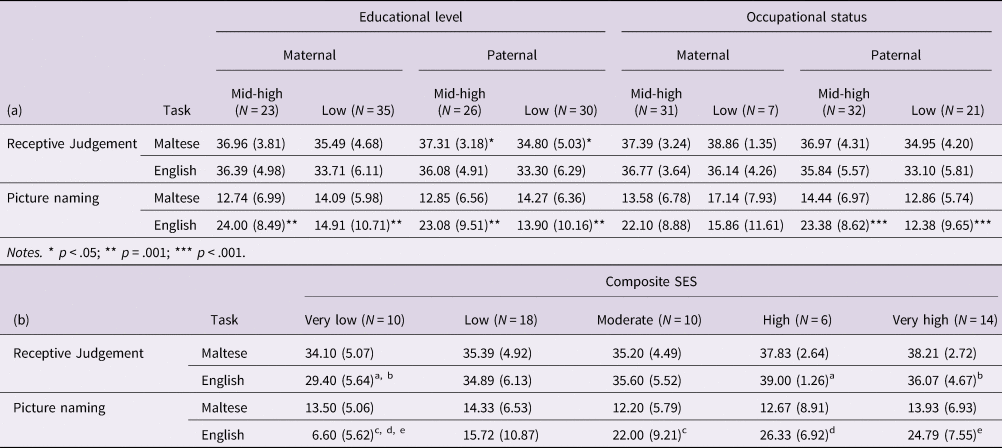
Descriptive statistics for participants’ receptive judgement and picture naming scores are presented in relation to maternal and paternal educational and occupational level in Table 3a. On the receptive task, children generally performed better in both Maltese and English when their mothers or fathers had a higher level of education or occupation. Nonetheless, independent-sample t-tests showed the difference to be significant only for Maltese mean scores in relation to paternal educational level (t(54) = –2.188, p = .033). The uneven distribution of mothers in the low and mid-high occupation groups might have contributed to a reversal of the overall trend for participants’ Maltese performance and to the minimal advantage of 0.63 that the higher-level group showed on the English task. On the naming task, children's performance was significantly more accurate when either parent had a higher level of education (mothers: t(56) = –3.419, p = .001; fathers: t(54) = –3.472, p = .001) and when fathers had a higher occupational status (t(51) = –4.332, p < .001). This suggests a trend towards English picture naming skills being facilitated in children whose parents had higher educational and occupational levels, with maternal occupational status again resulting as the exception. Conversely, lower status on all variables except paternal occupation was associated with better performance on picture naming in Maltese, although none of these differences were significant.
Mean correct responses (standard deviations) on Maltese and English versions of the receptive judgment and picture naming tasks by (a) maternal and paternal educational level and occupational status (b) composite SES

Notes. a, b, c p < .05; dp = .001; ep < .001.
For the individual SES factors associated with a significant difference in mean receptive and expressive scores, analyses of variance (ANOVA) tests determined the proportion of variance accounted for and the strength of the predictors, while elucidating main and interaction effects. Since receptive judgement raw scores were skewed to the left, individual scores were subtracted from the maximum value + 1 to shift skewness to the right. A logarithmic transformation (log (41 – receptive picture name judgement score) was then carried out to enable parametric analyses. In a two-factor (paternal education × language) ANOVA, educational level emerged as a significant predictor (F1, 108 = 7.425, p = .008, η 2 = .064), but there was no main effect of language (F1, 108 = 2.341, p = .129, η 2 = .021), showing that children's performance on Maltese and English receptive tasks together differed significantly in relation to fathers’ educational level. The interaction term was also non-significant (F1, 108 = 0.045, p = .832, η 2 = .000), indicating a similar improvement in Maltese and English receptive performance with increasing paternal education level. The proportion of variance explained by this model was 8.4%. For picture naming, a two-way ANOVA revealed significant main effects of mothers’ educational level (F1, 112 = 5.984, p = .016, η 2 = .051) and language (F1, 112 = 14.601, p < .001, η 2 = .115), as well as an interaction effect (F1, 112 = 10.873, p = .001, η 2 = .088), which showed that an ample difference in the naming skills of the lower and higher participant groups only emerged for English. The proportion of variance accounted for by this model was 19.2%. The lowest p-value resulted for the language factor, showing it to be the strongest predictor of variation in picture naming responses on its own. A two-way ANOVA that examined naming scores in both languages in relation to fathers’ educational background identified significant main and interaction effects (for education level, F1, 108 = 6.029, p = .016, η 2 = .053; for language, F1, 108 = 9.750, p = .002, η 2 = .083; for education level × language, F1, 108 = 11.254, p = .001, η 2 = .094). Here, the R2 value was 0.192 and variability in responses was best predicted by the interaction between fathers’ educational level and language of testing. Finally, a two-way ANOVA that considered fathers’ occupational level and language of testing showed significant main effects (fathers’ occupational status: F1, 102 = 16.155, p < .001, η 2 = .137; language: F1, 102 = 7.315, p = .008, η 2 = .067) as well as interaction effects (F1, 102 = 9.054, p = .003, η 2 = .082), with the two predictors together (paternal occupational status and language) accounting for 26.5% of the variability in scores and paternal occupation being the strongest predictor.
To summarise, therefore, the individual SES variables related in similar ways to children's receptive judgement skills in both languages, with significantly better scores only resulting in relation to higher parental education. On picture naming, children whose parents were better educated or in higher-level employment scored significantly better in English but not in Maltese. The similar outcomes evidenced for the four variables on the receptive and naming tasks, together with the relatively low proportions of variance explained, called for examination of the composite SES variable's effects. This also enabled further insight into the language-related differences in performance emerging between receptive and naming tasks. By aggregating mothers’ and fathers’ education and occupation levels, we expected to obtain a more comprehensive measure of children's SES backgrounds. Statistical analysis sought to investigate whether it predicted children's lexical performance more strongly than the individual SES measures. Figure 1 shows mean receptive judgement and picture naming scores in Maltese and English as a function of composite SES, while Table 3b presents the relevant descriptive statistics. Comparison of mean scores expressed as a function of the individual SES measures and the composite measure (Tables 3a and 3b, respectively) reveal outstandingly limited English naming performance by the very low SES group (level 0). The same subgroup also obtained unprecedentedly low scores on English and Maltese receptive judgement. Nonetheless, the most striking discrepancy in relation to mean scores derived for individual SES factors was for English naming. Although receptive judgement and naming performance in English improved with increasing composite SES level, SES level 3 (high) average scores exceeded those of children in level 4 (very high) on both tasks. This could have been an outcome of the relatively small size of the level 3 subgroup.
Mean receptive picture name judgement and picture naming scores for Maltese and English in relation to parental education and occupation levels (error bars: 95% confidence interval).

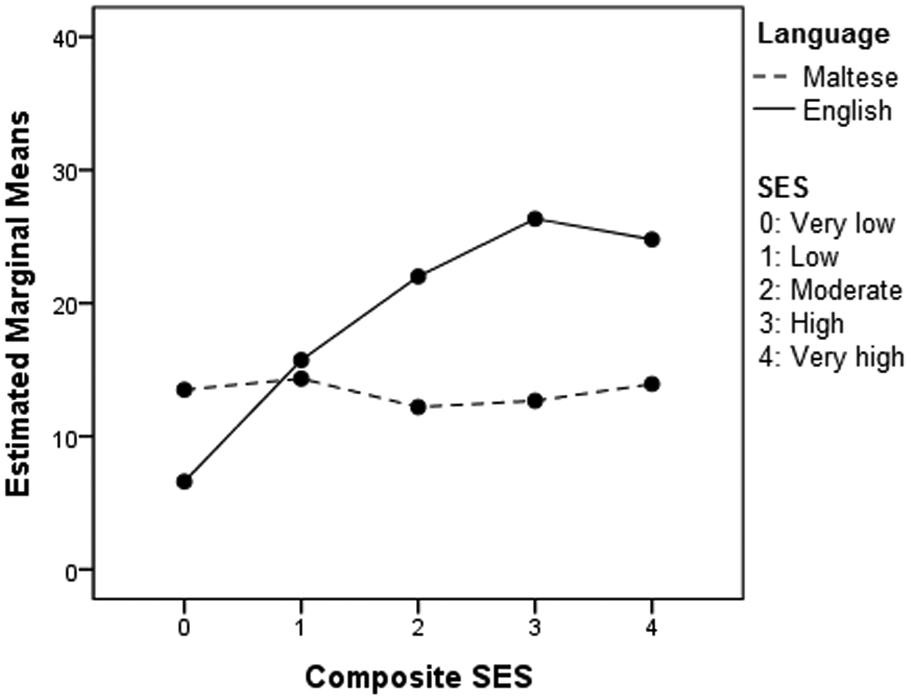
The composite variable was entered in a 2-way ANOVA with interaction along with language of testing. A main effect of the composite SES measure on receptive judgement performance (F4,106 = 5.463, p < .001, η 2 = .171) resulted. There was no main effect of test language (F1,106 = 0.901, p = .345, η 2 = .008). The interaction between parental SES background and language of testing was also non-significant (F4,106 = 1.374, p = .248, η 2 = .049), showing that children's receptive skills in relation to SES level did not differ significantly for Maltese and English tasks. This model explained 21.4% of the variation in receptive judgement scores. Pairwise post-hoc comparisons (Bonferroni tests with a significance level of p < .05) showed that the composite SES main effect arose from the significantly lower performance of children having a very low SES background (level 0) compared to the mean scores of the high (level 3) and very high (level 4) subgroups on Maltese and English receptive judgement combined. For picture naming performance, there were significant main effects of composite SES (F4, 106 = 5.155, p = .001, η 2 = .163) and test language (F1, 106 = 14.112, p < .001, η 2 = .117). The Maltese and English naming skills of children in very low, low, and moderate SES subgroups were significantly lower than those in the very high SES subgroup, the reference category (regression coefficients: –18.186 at level 0, –9.063 at level 1, –2.786 at level 2). Children in SES level 3 (high) showed a slight advantage in relation to those in subgroup 4 (very high). Overall, children performed significantly better in English than in Maltese (regression coefficient = –10.857 for Maltese). A significant interaction between the composite SES measure and language of testing also resulted (F4,106 = 5.899, p < .001, η 2 = .182). Figure 2 illustrates this interaction, whereby naming performance across SES levels improved significantly for English (regression coefficient = 17.757) but not for Maltese. R2 amounted to 0.347, showing that 34.7% of the variation in picture naming scores was jointly explained by composite SES and language of testing. A lower p-value for the composite SES × language interaction (p = .000252) compared to that for language of testing (p = .000282) and composite SES (p = .001) shows the interaction term to be more strongly predictive of the variation in scores. Pairwise Bonferroni post-hoc comparisons (p < .05) revealed significant differences in combined Maltese and English mean naming scores obtained by children in level 0 and those in levels 2, 3, and 4, pointing towards these differences as the source of the main effect of composite SES. More importantly, paired sample t-tests elaborated the main language effect to show that English performance was significantly better than Maltese (t(57) = –2.986, p = .004) when all the SES subgroups were considered together. Only children at SES level 0 performed significantly better in Maltese than in English (t(9) = 2.408, p = .039). English naming performance improved with increasing SES level, with SES level 3 average scores even exceeding those of children in level 4. For children in subgroup 1, English naming was only marginally better than Maltese, with the difference not reaching significance. English performance was consistently better than Maltese for the higher SES levels (level 2: t(9) = –3.178, p = .011; level 3: t(5) = –3.182, p = .024; level 4: t(13) = –4.153, p = .001).
Mean correct naming responses in the test language on the Maltese and English picture naming tasks by composite SES.

Discussion
The present study addresses a methodological issue that affects our understanding of socioeconomic influences on children's lexical skills. By investigating how socioeconomic background predicts children's receptive and expressive lexical abilities in two majority languages, it also contributes towards the formulation of a general theory of bilingual language acquisition. While substantial evidence documents the sensitivity of children's vocabularies to SES, there is marked heterogeneity in the nature of the socioeconomic factors considered. By exploring the predictive effects of different SES measures on the lexical performance of a single group of children, this study investigates whether SES-related findings vary as a function of the socioeconomic indicator employed. The impact of the SES factor most predictive of children's lexical skills is then examined in detail. Investigating socioeconomic impact in a broader context where bilingualism is the norm adds to current theoretical knowledge of bilingual language acquisition. Malta's linguistic landscape features widespread bilingualism in two majority languages, allowing the sociocultural differences often associated with minority language groups to be controlled. In addition, varying levels of bilingual proficiency in Maltese and English co-exist with a range of socioeconomic strata. Thus, the impact of SES on children's bilingual lexical skills is naturally distinguishable from that of bilingual input, avoiding the confound between children's SES backgrounds and their bilingual upbringing. Monolingual–bilingual comparisons, helpful in unravelling SES and bilingualism effects (see Meir & Armon-Lotem, Reference Meir and Armon-Lotem2017), are not relevant to the Maltese context, where the impossibility of monolingualism (Vella, Reference Vella2013) means that reference measures need to be bilingual. In this study, we attempted to minimise the variability in children's home and school language exposure, so that participants had similar levels of bilingual input. This allowed better insight into how different SES measures predicted their lexical proficiency. A narrow age-range controlled further for individual variability. Unexpected differences between receptive and expressive performance in relation to SES and, more specifically, between Maltese and English picture naming skills emerged. These are relevant to a better theoretical understanding of the mechanisms shaping bilingual language acquisition.
Lexical outcomes for different SES measures
Our first analysis, which examined four individual SES variables, revealed a general trend of enhanced receptive and expressive lexical performance with higher maternal education, paternal education, and paternal occupation. The increase in receptive scores as a function of the individual SES measures took place regardless of the language of testing, whereas picture naming improved significantly only in English. These findings showed the participants’ linguistic environments to be influenced by parental education and employment levels which, in turn, exerted an influence on their lexical skills in both languages. This is generally concordant with previous research showing robust influences of SES variables on children's lexical abilities (see Hoff, Reference Hoff2006, for a review). For picture naming, performance on the English task showed significant differences in relation to mothers’ and fathers’ educational level and fathers’ occupational status. In contrast, children's Maltese naming skills varied minimally as a function of SES measures. Relatively low proportions of variability explained by the significant predictors suggest that other factors, both external and internal, were contributing to children's lexical performance. The composite SES variable that brought together education and occupational level for mothers and fathers explained higher proportions of the variability in scores. Composite SES on its own explained 21.4% of the variability in receptive judgement performance; naming scores were jointly predicted by composite SES and language of testing, which together accounted for 34.7% of the variance.
These results have methodological implications. First, they show that, although diverse SES measures are predictive of children's lexical performance in broadly similar ways, they differ in the significance and strength of the relationship they bear. Thus, findings for different SES indicators are not interchangeable, implying that our current knowledge of SES influences is relative. This is understandable, given that each measure is merely an index of the interplay between social and economic factors. The contingency of results on the specific SES measure employed needs to be acknowledged, along with other methodological differences that are inevitable across studies (see Roy & Chiat, Reference Roy, Chiat and Marshall2013). The stronger predictive power of the composite SES measure compared to the individual measures was expected, since education, employment, and income components of SES are each influencing factors in their own right (Conger & Donnellan, Reference Conger and Donnellan2007; Hernandez & Blazer, Reference Hernandez and Blazer2006). It is logical, therefore, that when their combined effects are considered they tend to explain more of the variability in children's lexical performance. The aggregation of separate SES indicators to produce a composite measure is not novel to the bilingualism literature. For example, Gathercole et al. (Reference Gathercole, Kennedy and Thomas2016) similarly merged data on parental education and profession to produce a ‘composite SES’ score. Others (e.g., Fernald et al., Reference Fernald, Marchman and Weisleder2013; Reilly et al., Reference Reilly, Wake, Bavin, Prior, Williams, Bretherton and Ukoumunne2007) coded information from at least two SES markers according to published indices that combined information into a single measure. Nonetheless, obtaining information on the three key SES components may be problematic, particularly since parents might be reluctant to share income details. In fact, data on parental education and employment are used more extensively in research as parents tend to be more willing to provide this information rather than that related to their income (Noble, McCandliss, & Farah, Reference Noble, McCandliss and Farah2007). There might also be justifications for considering single measures as a more realistic index of SES and its impact on parental input. This has been the case in bilingual immigrant contexts, where occupational level might not tally with parents’ capabilities (e.g., Golberg et al., Reference Golberg, Paradis and Crago2008; Miękisz et al., Reference Miękisz, Haman, Łuniewska, Kuś, O'Toole and Katsos2017), prompting consideration of one or both parents’ educational level as a better measure of SES. Yet, the present results underscore the fact that variables that do not include more than one SES component may have intrinsic limitations in that they inevitably account for less variability in scores. Therefore, they need to be clearly presented as such. This also has implications for the widespread tendency to adopt maternal education level as a proxy measure of SES. Aggregating at least two measures compensates for some of the variability arising from other dimensions of SES. Together, these findings call for judicious interpretation of available evidence in the field, careful consideration of the SES markers to adopt in child language research, and realistic acknowledgement of their potential limitations.
The influence of composite SES on bilingual receptive judgement and picture naming skills
That children's lexical abilities tend to improve with higher SES backgrounds is not new to the research literature. Yet the present findings are novel because they document how SES predicts children's lexical performance in two majority languages that are spoken nationwide, unlike previous research in the field. Thus, they shed light on possible mechanisms shaping language acquisition in a normative bilingual context.
Findings for receptive judgement revealed a main effect of SES level. Significant differences between the lowest SES group and the two higher ones were somewhat expected, as they were congruent with other evidence for receptive vocabulary skills (e.g., Calvo & Bialystok, Reference Calvo and Bialystok2014; Gathercole et al., Reference Gathercole, Kennedy and Thomas2016). Nonetheless, the receptive task we employed differed from traditional lexical comprehension tasks as it tapped into words purposely selected for their familiarity among children. Our focus was on the recognition of errors embedded within known phonological representations. Familiarity of the words could partly explain why the language of testing did not bear any influence on the participants’ receptive performance. Across the five SES levels, children were capable of detecting phonological errors similarly in each language. Stored phonological representations therefore had comparable levels of intactness in Maltese and in English, despite the different phonotactic structures pertaining to each language (Grech & Dodd, Reference Grech and Dodd2008). This could imply that, within children's daily language exposure, Maltese and English task stimuli had been received with similar frequencies, enabling near-equivalent ability in each language for uptake, storage, and activation for comparison and subsequent judgement. The English mixing patterns that children growing up in Maltese-speaking families are exposed to, incorporating not only words and phrases commonly used among Maltese adults but also others specific to Maltese child-directed speech (Gatt et al., Reference Gatt, Grech and Dodd2016), may have contributed to the relatively balanced bilingual ability observed in receptive judgement.
Picture naming performance revealed an impact not only of SES level but also of language of testing, independently and in combination, with the interaction between composite SES and language being the strongest predictor of variation in scores. The finding of SES predicting children's Maltese and English naming skills in different ways was unexpected. English naming varied significantly by SES level, contrasting with Maltese skills. This outcome flags potential differences in the input children received. Maltese naming ability was similar for all groups, suggesting that the Maltese-dominant home exposure required for participant recruitment was largely consistent across groups, promoting a stable ‘core’ of L1 proficiency. In contrast, results suggest variation in English input. Based on the premise that Maltese-dominant exposure represented similar amounts of Maltese input across comparable numbers of waking hours, English exposure across groups would also be similar in quantity. The implication is, therefore, that enhanced naming skills might have drawn upon English input of higher quality, reflecting mothers’ and fathers’ enhanced proficiency in English that was in turn supported by their higher educational levels. Potentially, therefore, they could provide English input that was not only more integrated and less mixed (see Gatt, Reference Gatt2017) but could also go beyond basic conversational skills to support academically oriented activities, such as sharing of expository books and story-books, as well as story-telling. In a two-year longitudinal study, Golberg et al. (Reference Golberg, Paradis and Crago2008) reported better English L2 vocabulary skills in children followed between ages 5;4 and 7;4 whose mothers were highly educated, despite the latter's tendency to provide less English language input at home. Facilitative conversational strategies employed by mothers were considered to be a potential contributor. L1 vocabulary enhancement was also thought to provide a foundation for L2 vocabulary learning. The findings of the present study suggest a different scenario. The significant differences between Maltese and English naming skills at most SES levels indicate that generalisation of Maltese skills might have contributed only in part to children's English naming abilities. We cannot exclude that language-general conversational techniques might have also played a role. However, we propose the lexical richness of parents’ English exposure to be a more plausible contributor. Hoff (Reference Hoff2003) showed the child-directed input of higher-SES mothers to contain more topic-continuing replies, word types, and tokens than that of mid-SES mothers, mediating children's lexical growth. In the current study, children in higher-SES groups might have received English input that was more lexically diverse and contained more occurrences of specific words than their lower-SES peers. Possibly, this English input was relatively unified, containing more stretches of complete sentences than sporadic words and phrases. Together, these characteristics might have enhanced the uptake and storage of English lexical items, as well as their subsequent activation and retrieval through picture stimuli. This interpretation is also consistent with the fact that higher SES backgrounds did not support English naming skills at the expense of Maltese. It is noteworthy that receptive skills differed from naming in that the interaction between composite SES and language of testing was non-significant for the former. Compared to receptive judgement, the naming task's additional requirement of retrieving phonological representations for production that were not necessarily in children's lexical repertoires appeared to tap directly into children's varying levels of English lexical proficiency, channelling qualitative differences in the English exposure received in Maltese-dominant homes across SES levels. As such, therefore, it shows potential to detect children's varying levels of bilingual proficiency and, by extension, bilingual input, as a function of SES.
Limitations
There are aspects of the study's design which limit the generalisability of its findings. The relatively small sample size did not allow identification of the unique effects of the different SES variables which, inevitably, are highly correlated. The dichotomisation of individual SES measures into low and mid-high categories overlooked the continuous nature of parental education and occupation variables, besides involving subjective cut-off points. Occupational status was not coded for 20 mothers who were homemakers at the time of the study, limiting potential effects of the maternal occupation variable. Educational level data were missing for two fathers, while occupational status was not available for five fathers. These shortcomings were inevitably carried over to the composite SES variable. Although the latter accounted for relatively more variance compared to the individual SES measures, substantial proportions of variability remained unexplained, showing that other factors were at play. Children's lexical abilities were likely to be shaped not only by their parents’ educational and occupational backgrounds, but also by the genes they shared with them (see Bishop, Reference Bishop2014; Dale et al., Reference Dale, Tosto, Hayiou-Thomas and Plomin2015), the latter impacting their intrinsic language-learning capacity. Additional factors might have been at play. Schwab and Lew-Williams (Reference Schwab and Lew-Williams2016) highlight the influence that a range of factors, including parental knowledge of child development, parenting skills, maternal stress, and parental management of time and finances, are likely to exert on the relationship between SES, parental input, and children's language learning. Such family factors were not measured in the present study. Opportunities for bilingual lexical learning in the preschool environment may have also contributed to the results obtained. Although home language exposure has been found to be highly predictive of bilingual vocabulary skills even when children attend preschool (Gathercole et al., Reference Gathercole, Kennedy and Thomas2016), we cannot exclude that classroom language exposure interacted with SES effects. We attempted to control for differences in teachers’ bilingual input by selecting participants from state Kindergarten Centres. However, the language exposure these children were actually receiving in the preschool environment was not measured, so there is no certainty that this was identical across the participants. Differences in classroom exposure stemming from kindergarten assistants’ relative use of Maltese and English input and from the language ethos of 11 different schools might have contributed to the variability in lexical skills. Similarly, more detail on language use in the home with and by the child would have ensured further homogeneity across the participants. Kohnert (Reference Kohnert2010) noted that immense variability in bilingual exposure is expected even when its characteristics are matched within groups. In particular, it would have been interesting to gauge parents’ levels of Maltese and English vocabulary knowledge and to objectively examine whether differences in children's lexical performance derived also from this aspect, since parental bilingual proficiency would have likely played a role in the quality of English input provided. These limitations underscore the additional variability that needs to be factored in when considering this study's results. We need to emphasise that the present findings might not be due to the SES-related factors alone. Finally, another limitation concerns the instruments employed, in that cross-language comparison of children's performance may have been influenced by differences between Maltese and English task items, deriving from language-specific content.
Conclusions
The present study set out to investigate the ability of different SES measures to predict children's receptive and expressive lexical skills in two languages that have majority status nationwide. It adopted a hierarchical approach, first investigating how different SES measures predicted the lexical skills of a single group of children and then examining the relationship of the most powerful predictor. The study's implications are methodological and theoretical. Findings highlight the variation in receptive and expressive lexical performance as a function of the SES measure employed. The non-interchangeable nature of SES measures underscores the need for careful scrutiny of the measures employed across studies and the reported outcomes. These need to be interpreted relative to the methodological approach employed to determine SES. While the use of single SES measures might be justified, composite measures should be given priority as they are inherently better suited to accounting for greater proportions of variability in lexical scores. When considering the most powerful SES marker in the present study, results conform with those in the literature, namely that, the higher the level of parental SES, the better the child's lexical proficiency. The novelty of the present study lies in its consideration of children's lexical skills in two languages in a context where bilingualism is nationwide. Evidence that draws on normative bilingual contexts is scarce in the research literature (Montanari & Nicoladis, Reference Montanari, Nicoladis, Nicoladis and Montanari2016). The current findings show that, although receptive picture name judgement varied with SES level, it did so in similar ways across both languages. Similar performance on Maltese and English stimuli suggests that detection of phonological errors was not affected by the different phonotactic structures of the two languages. Possibly, the English language fragments frequently embedded in Maltese input ensured comparable levels of familiarity with Maltese and English test targets, supporting similar levels of phonological integrity across the two languages. SES-related picture naming, however, varied according to the language of testing, revealing significant improvement with increasing SES levels only in English. Picture naming in Maltese, the dominant language in the participants’ homes, emerged as relatively impervious to SES influences. These findings suggest that, while higher educational and occupational levels predicted better parental proficiency in English, in turn improving the quality of English input that children received, they did not bear an influence on parents’ Maltese language input. The theoretical implication is that bilingual children's naming skills in two majority languages may respond differently to variations in socioeconomic background. Since the results of this study originate within a normative bilingual setting, they do not necessitate monolingual-based comparisons. Nonetheless, this stable bilingual context can be exploited through future research that investigates the receptive and expressive lexical performance of children receiving exposure to other combinations of the same majority languages, namely balanced bilingual and English-dominant exposure. It will also be important to examine the full triad of SES indicators and the combined effects of different permutations. Larger sample sizes could increase the statistical power of the results, while allowing standardisation of the receptive and expressive tasks, thus facilitating their clinical use. The current findings contribute towards unravelling the complex process by which specific aspects of children's social contexts shape their bilingual outcomes. In so doing, they may assist the formulation of a general theory of bilingual language acquisition that realistically acknowledges the impact of social dimensions on children's language learning.
Acknowledgements
This work was supported by University of Malta Research Grants CMTRP01-01, CMTRP01-02, and CMTRP01-03. We would like to thank the participants, their guardians, and school staff for supporting this research. We are also grateful to Chantelle Bezzina, Vanessa Bezzina, Victoria Bonnici, Michelle Bugeja, Sarah Jayne Camenzuli, Diane Debattista, Estelle Farrugia, Maria Farrugia, Charlene Magri, Bianca Said, and Melissa Vassallo for collecting data, to Annabel Borg and Claudine Zerafa for their assistance in data coding and inputting, and to Professor Liberato Camilleri for statistical advice.
Declaration of interest
We declare no potential conflicts of interest.
Appendix 1
Lexical targets of the Maltese picture naming task, together with frequencies reported for Maltese 30-month-olds, items included in the CELF-Preschool-2 and those imported from the English naming task.

Appendix 2
Lexical targets of the English picture naming task, together with frequencies reported for Maltese and US 30-month-olds, items included in the EVT-2 and CDI-III and those imported from the Maltese naming task.