1. Introduction
Everything starts with sound, inherent in any movement. The universe itself is characterised by background noise, although this was long unsuspected; this cosmological diffuse background was discovered by chance in 1965 by two American physicists, Robert Wilson and Arno Penzias. ‘The phenomenon we ought to analyse here is the sound. What is it exactly? … it is constantly occasioned by the ambient air’ (Tomatis Reference Tomatis1974: 111; my translation). In acoustics, sound can be defined as the vibration able to arouse a hearing sensation: physics and sensory perception illustrate the interdisciplinarity associated with the notion of sound. Sonic immateriality is therefore intrinsically linked to practice materiality. Lecourt qualifies sound by its ‘runaway’, imperceptible side, by its immateriality and the difficulty of perceiving its limits. Which brings us to qualify sound in terms of temporality: according to Augoyard's words, ‘by nature, sound is qualified time’ (Augoyard Reference Augoyard1991: 54; my translation).
But the existence of sound is finally revealed only if the sonic signal is heard, perceived. It is precisely this sonic perception we will approach here.
Noise is indeed the subject of a selective distortion mechanism of sound message perception. Hearing a ‘noise’ is making a choice, a selection, and in a totally subjective and personal way.
Cultural aspects greatly determine the sonic field; we deliberately started the study using the word sound and not the word noise, which has many connotations. Moles emphasises that ‘one qualifies any unwanted signal as the generic word Sound’ and speaks about the concept of ‘intention’: ‘a noise is a signal “one” does not want to transmit’ (Moles Reference Moles1972: 129, 130; my translation).
This article firstly approaches the complexity of sonic perception, and then deals with the assessment of an urban sonic environment, to then discuss the concept of soundscape. In the second part, we present a tool for understanding urban sonic ambiances: the sonic mind map. This tool can be used to consider the impact of spatiality in representations of urban sonic environments. Finally, the article shows the results of a number of sonic mind-map analyses.
2. Detour via a theory of perception
2.1. Sonic perceptions and representations
The perceptive action of hearing is characterised by selection and intention: for Moles, ‘perceiving is selecting’ (Moles Reference Moles1972: 130; my translation).
The etymology of the term to hear itself shows this intentionality, because this verb conveys the concept of to aim at, the intention to (Schaeffer Reference Schaeffer1966). The verb to hear refers to a perceptive experience, whereas to listen makes reference to a perceptive state.
The perceiving subject is therefore an actor in the perception, and not merely a passive receiver of clarified and prebuilt information. The perceiving subject selects the information and thus organises it into percepts. The perception concept is applied to sound by Casati and Dokic (Casati and Dokic Reference Casati and Dokic1994). These percepts are therefore the fruit of perception and are close to representations, as they result from schemas acquired by each individual.
The very action of perceiving is an active process, since making a decision is a conscious action. The word perception has different meanings: it qualifies the action of perceiving, but also the mechanisms producing this same perception. Moreover, the word perception is also often used to describe the result of the perceiving action: the percept. The terminology of the word to perceive thus contains semantic ambiguity, because it can be the process as well as the result of this process.
Finally, perception is necessarily correlated to the perceiving subject and forms an integral part of him or her.
Perceived space has been used considerably in perception geography. Brunet (Brunet Reference Brunet2001: 377; my translation) thus defines perception as ‘the action of perceiving (per-capere) by means of sensations and through perceptive filters by means of sense organs and individual knowledge’. In this field, research makes it possible to evaluate the way an individual's perception of the environment determines and explains his or her behaviour. This approach comes from behavioural psychology and helps to evaluate a person's degree of satisfaction or attraction to a spatial entity, such as a district. We study the assessment of an urban sonic environment. In the methodology, thus, we aim to relate evaluations from a sonic aspect with other perceptive systems (visual and olfactory in particular).
This perceptive intentionality, be it conscious or unconscious, legitimates consideration of representations and the experience dimension in the analysis of perceptive mechanisms.
Memory is linked to perception: an object already observed will be recognised by the perceptive activity; in ‘Meditations on First Philosophy’, Descartes (Reference Descartes1901) interprets the thinking action within the perceptive mechanism as a judgement. Recognising an object observed before is a perceptive action which relies on memory, anticipation and judgement.
Perception as a spatial action is influenced by (abstract) representations and not only by sensorial perceptions.
Sonic perception is characterised by precurrent reactions,Footnote 1 or perception from a distance (as hearing introduces this notion of distance). But sensory perception, associated with sonic perception, must not obscure the impact of symbolism and representation on perceptive organisation. In this respect, perception can be defined as ‘informed and sensitive knowledge’ (Buytendijk Reference Buytendijk1958: 74; my translation).
The notion of perception thus turns out to be difficult: perception indeed depends on several factors. The acoustic features (sound level, number of events) are one of the factors influencing sonic perception. The first temptation to focus sonic perception on acoustic features is legitimate, but we observed that the physical measurement of a sound is not needed to explain the resulting perceptions. Which factors then, external or internal to the perceiving subject, have an effect on sonic perception mechanisms in public spaces, at the same time as the acoustics data? This question was the guiding force behind our investigations.
2.2. From perception to spatial assessment
Assessing an environment is defined by Moser and Weiss as ‘evaluating the individuals’ degree of satisfaction and effects in relation to a given environmental unit’ (Moser and Weiss Reference Moser and Weiss2003: 88; my translation). This concept of environmental assessment is relevant in space sciences, as part of public space evaluation in particular. One task facing urban planners is to understand and satisfy the expectations of users of the space. For that, researchers learn how to develop methods to analyse environmental experiences and the ensuing spatial assessments. The challenge of these methods lies in the transition from the experience of an in situ space, to assessment of this space.
Observing spatial behaviour can be an essential tool for researchers in the field of space sciences. Questioning users about their practices effectively does not mean they will reveal the spaces and the types of practices they are used to: observation is a way of avoiding this method. Observation is a triple work of perception, memorisation and notation whose correlation with interviews helps to avoid poor interpretations. Observing a public space requires the observer to note down the type of people going to this place, their spatial behaviours, their interactions, their activities. It is necessary to study the place at different temporalities, since practices often differ within the same day. Analysing the temporal variations (daily, weekly variations, etc.) is needed in order to know all the customs of the space. There can be two observation types. The first is observation from a distance realised in a spatial environment known by the observer, the difficulty being familiarity with the place. The second, with a change of scenery, is realised in an unknown field; the difficulty here is the lack of information, of contextualisation. In every observation task, the observer needs to be impartial in relation to his or her field. Behavioural mapping is a tool sometimes used in observation (in addition to the traditional diary). This tool enables the researcher to graphically represent the itineraries, walks and stopping zones of the public space being analysed. It particularly reveals the real uses of a space and allows the designers to consider spatial practices for an urban redevelopment, for example. Moser and Weiss put the emphasis on the intrinsically non-invasive nature (the researcher's influence being insignificant) of the observation techniques or behavioural mapping (Moser and Weiss Reference Moser and Weiss2003). The advantage of such methods is that they minimise the amount of bias associated with the researcher, unlike interviews, for example. The obstacle we did notice when using these methods is their lack of suitability with regard to the purpose of certain research and objects of study, for which other methods are sometimes necessary.
Evaluative and sensory walks are another kind of methodology. Sensory walks, introduced by Goodey (Reference Goodey1977) and developed in particular by Sanoff (Reference Sanoff1991), try to collect the in situ perceptions of the different walks successively. As for the evaluative walks, they have the same methodology as the sensory ones, but are often realised off site on the basis of maps or scale models (Moser and Weiss Reference Moser and Weiss2003). Couic used the commented walks technique in her thesis (Reference Couic2000), in order to observe the link between movement and perception as part of the study of the intersensory dimension of urban practices.
The tools used in studies concerning the assessment of various urban environments are usually questionnaires. The way of posing the questions and their order have an obvious influence on those answering, so the researcher needs to consider this point when developing the questionnaire. Directive or semi-directive interviews are another relevant tool for evaluative understanding. The context is essential for administering the questionnaires or for an interview: if it is an in situ interview taking place within the evaluated public space or an interview out of context (on the basis of maps or photographs), the connection with the space (direct or indirect, temporality, sensory perception) and thus the signification of its assessment are different.
Far from being the more neutral and controlled form of setting data, the questionnaire involves a lot of exclusions, not all chosen and which are all the more pernicious given that they are unconscious: to know how to establish a questionnaire and what to do with the facts involved, we must know what the questionnaire does; that is, among other things, what it cannot do’ (Bourdieu, Chamboredon and Passeron Reference Bourdieu, Chamboredon and Passeron1983: 65; my translation).
The limitations of the questionnaire encouraged us to combine it with other investigation tools.
But do the discussions on investigation techniques not idealise a paradigmatic realisation of impartiality? Can we really attain researcher impartiality? The non-directive interview is often shown as ideal researcher impartiality, but is it really? This debate on methodological impartiality enables us to look for new methods which combine and reformulate well-proven methods that researchers often deny. On this point, Bourdieu questions us about the glorification of the non-directive interview, which is, of all the data collection techniques, presented as impartiality in observation, at the expense of other techniques.
Other methods can be adapted to the assessment of a space, such as taking photos on site in order to define the space, or the realisation of mind maps (off site) defining the space itself but also revealing the individual's connection to that place.
2.3. Sonic environment assessment
Amongst other things, assessing a public space requires assessment of its sonic space, or, in other words, judgement about the sonic environment is part of the overall spatial assessment. Southworth, in a pioneer study of the matter (1969), explained the impact of the information underlying the sounds, the context in which they are perceived and their levels in the assessment of an urban environment (in this case, Boston). Moreover, a study based on three Spanish urban spaces shows that the sonic identity of different urban environments has an influence on the interviewees’ assessment of these spaces (Lopez Barrio and Carles Reference Lopez Barrio and Carles1995).
We have seen that mind maps are an evaluative tool; designing sonic mind maps (we will come back to this later) thus makes it possible to assess the sonic ambiance and sonic environment of a public space.
Like the sensory and evaluative walks, qualified listening walks ensure an in situ assessment of the sonic environment, thanks to a double recording system (amplified listening and recording of the interviewee's comments). Transcription of the comments is then essential as it helps to highlight important sound sequences and qualify the sound effects, listed in 1995 by Augoyard and Torgue in the Repertoire of Sound Effects (Reference Augoyard and Torgue1995). This qualified listening-walk technique makes it possible to consider sonic dynamics and the temporalities generated by urban walks (Thibaud Reference Thibaud2001). Rémy carried out two types of commented walks to study sonic perceptions of transition spaces in train stations (Reference Rémy2001): one consisting of observing the same place at different temporalities (variety in the sound sources) and the other consisting of studying two places with the same types of sound sources.
The reactivated listening session, which designates the reactivation of an ordinary listening, is a technique elaborated by Augoyard in 1979 and carried out off site. The researcher makes the interviewee listen to a sound sequence from his or her everyday environment and asks for reacts and comments on the recording being heard.
3. Sonic space assessment
3.1. From landscape to soundscape
The diversity of currents of research with landscape as a subject have sometimes led to a dual categorisation between naturalist approaches and culturalist approaches. Recently, Besse tried to elaborate another typological schema highlighting the five following elements of landscape: as a cultural and social representation, as a made and occupied territory, as a material environment living on human societies, as a phenomenological experience, or as a project (Besse Reference Besse2009). Looking for a consensual definition would thus be pointless, given the breadth of the conceptual polysemy of a landscape.
Schafer introduces the notion of soundscape in his reference book The Tuning of the World (1977) and in his works for the World Soundscape Project. This neologism, created from the contraction of the words landscape and sound, illustrates the image of a ‘sonic environment’. The introduction of this new concept reflects how the sonic field has progressively come to be considered in the scientific community; now the sonic aspect is not only understood as a simple environmental nuisance but also as a real daily sonic quality. The soundscape theory, as well as any classical landscape theory, has a complex connection to nature. In Schafer's book, natural sounds are mentioned from the first chapter of the first part; these natural sounds have a symbolic and archetypal value and are presented as bound to disappear. Let us note here that, for the author, natural sounds are endowed with profound symbolic representations. Yet archetypal sounds can change and depend on the societal context; Schafer is well aware of that as he describes the evolution of new sounds such as mechanical sounds. The evolving nature of sounds and the emergence of new tones are considered. When we read this book, we sense an intention that is not only descriptive (of new sounds, new connections to sounds), but also axiological and even prospective. This book indeed cites the possible ways to comprehend sonic changes, to respond to these changes when soundscape harmony or tuning is concerned. But Schafer's view, according to which the sounds resulting from post-industrial civilisation and the sounds linked to urbanisation are nearly systematically depreciated, is criticised by López in particular. In his essay entitled ‘Schizophonia vs l'Objet Sonore’ (Reference López1997), López questions Schafer's very idea of soundscape harmony, as post-industrial sounds are qualified by Schafer as lo-fi (low fidelity) as opposed to the natural context, hi-fi. López therefore gives the example of the equatorial forest, a dense soundscape where information collides for human sonic perception. Moreover, for López and other contemporaries, industrial sounds have an artistic potential; he thus follows in the footsteps of another thinker and founder of concrete music: Schaeffer. Furthermore, let us note that Schafer establishes the notion of soundscape on the basis of the visual landscape: the dialectic of the perceptive pair figure and background, which are notions taken from form psychology, reflects the visual perception in an underlying way. For Schafer, ‘ear cleaning’ learning is a process ensuring positive modelling of the soundscape. This will is illustrated in Schafer's thought about the soniferous garden image, based on the visual principle of landscape and art we can make with it. Here, the soniferous garden, like the garden, is harmonised nature, an ideal of sonic ecology. The soniferous garden image particularly well illustrates the parallel we can draw between visual and sonic imagination. Moreover, as a musician, he introduces a notion of soundscape that is in fact a recorded landscape, stuck in a time warp, and something we can listen to several times. The evolution of the initial notion reveals a use for timeless soundscapes. The notion can be used as a reference to existing environments, but also to abstract constructions (musical compositions in particular). In space sciences, the use of the word soundscape usually applies to the sonic environment of a determined subject. According to Schafer, acoustic ecology or sonic ecology is ‘the study of the relationship between living organisms and their environment’ (1977: 3). Researchers such as López continue this sonic ecology initiated by Schafer in a comprehensive vision of our daily relation to sound.
Our research on sonic perception and our daily and ordinary relation to sounds are part of this paradigmatic perspective.
Researchers in sound studies deal with the concept of sonic ambiances and urban ambiances. An ambiance is determined by its immediate perception in a public space. The ambiance of a place is characterised by light, sound, material, traffic, volume, presence and so on. The concept of ambiance is currently being investigated by researchers at CRESSON (Centre for Research on Sonic Space and the Urban Environment). The notion of urban and sonic ambiances requires a multidisciplinary approach contrary to notions of sonic environment or sonic space.
3.2. The sonic mind map or how to represent ordinary sounds
Mind maps are one of the tools used by researchers in the field of space sciences to understand spatial conceptualisation. On the basis of research studies by Lynch (Reference Lynch1960) about urban cognitive mind maps, a few researchers adapted this method to the sonic environment. The cognitive mind maps allow spatial conceptualisation. This technique can be appropriate for analysing other types of space conceptualisation – sonic, for example – and not only functional, symbolical or visual, as they traditionally are. But very few researchers have tested this method by associating it with the sonic field (Paquette Reference Paquette2004a; Fekih Reference Fekih2006). For this reason, ‘sonic mind maps seem to be a succession of types of isolated sounds, with little localisation in space; “it is a mess” organised according to mainly qualitative logic. For A. Moles, sonic perception of a street is like a hall full of windows’ (Roulier Reference Roulier2007; my translation): graphic transcription makes possible the spatialisation of sounds that are difficult to describe using words alone. Amphoux, one of the main researchers to have tested this method in the sonic field, qualifies the sonic mind map as
an effective way of defying the difficulties inherent in representing sound. It consists in putting the subject under strain, with a paradoxical order such as ‘please draw what we cannot draw’ (sound)! According to the well-known principles of the Palo Alto school, the subject must then change his logic, in order to succeed. The subject can certainly tense up, simulate a lack of graphic or other skills, but most often the researcher will know how to stimulate him. We thus see the person approached hesitating between an imperative graphic representation and the desire to express experienced phenomena. (Amphoux Reference Amphoux2003: 4; my translation)
As for the realisation of such a protocol, Amphoux notes that the sample must be between 20 and 50 people drawing these sonic mind maps; as the protocol aims to approach ordinary sonic representations, the only notable criterion for selecting people concerns their diversity (in terms of age, social category, education, knowledge and uses of the town, place of living and visited areas).
As early as 1976, Schafer developed urban sound maps. Southworth used the sound event maps on top of urban sensory walks, and then asked the interviewees to graphically represent the elements of the in situ route they followed. In his article ‘The Sonic Environment of Cities’ (Southworth Reference Southworth1969), he describes the methodology developed, which consists of making fifteen interviewees perceive the same route. The interviewees were divided into trios composed of an interviewee who could perceive this urban environment only with sight, the second only with hearing and the third with both sight and hearing. At the end of the route, each interviewee was asked to graphically represent the urban sequence. Southworth thus obtained an overall map which represents an urban sequence assessment with visual but also sonic elements.
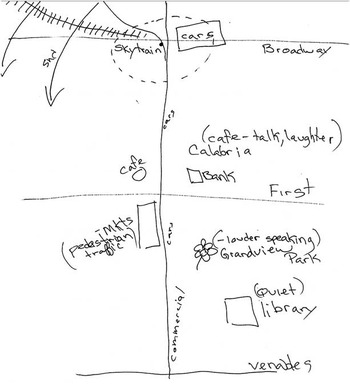
In his 2004 study on the contemporary sound environment, Paquette used the method he calls sonic mind map (Paquette Reference Paquette2004a); an example is presented in Figure 1. Like Southworth, Paquette used this method in the studied area asking passers-by, chosen at random in the public space, to realise sonic mind maps. Finally, Lopez Barrio and Carles used a third terminology: acoustic cognitive map (Lopez Barrio and Carles Reference Lopez Barrio and Carles1995). In their collaborative study with CRESSON, these researchers from the psychoacoustic laboratory at the Madrid Acoustic Institute used sonic mind maps with 226 individuals, in order to understand the representations of Madrid's soundscape; their results emphasise eleven typical places in Madrid's sonic identity. In his thesis, Maffiolo analysed Parisian sonic mind maps and systematised four types of representation of the urban sonic environment: particular places, mappings, schemas and sound sources (Maffiolo Reference Maffiolo1999).
Example of a sonic mind map used by D. Paquette (Paquette Reference Paquette2004b).

The spatial representation and localisation of sonic events are particularly interesting for sonic mind-map analysis. In the thesis by Leobon, who used mind maps, we found spatial distortion related to a sonic event interesting. When he analysed the mind maps made of Place Zix, he noted that ‘the sonic event “cars” distorts mental representations because of its strong spatial symbolism. … even if this space is pedestrian, a car going along in the far distance was enough to draw a street and place it side by side with the square itself’ (Leobon Reference Leobon1986: 154; my translation).
3.3. Parameters influencing sonic perception of public spaces
Which parameters influence sonic perception? This question was the guiding force of my investigations and is particularly hard to answer because of the number of determining variables influencing sound percepts. Would this not be due to the very complexity of the perceptive act? Perception is indeed ‘a sensory and cognitive activity the individual uses to constitute an inner representation (his mental image) of his world of experience’ (Lévy and Lussault Reference Lévy and Lussault2003: 701; my translation). The perceptive act is thus influenced by the exterior stimuli, the sensory organs getting the information, and the cerebral cortex interpreting them, their respective role being interpreted differently according to different schools of thought. The realists insist that the signs coming from objects are imprinted on human consciousness as in an empty receptacle; the idealists, on the contrary, think that it is man's mind that produces knowledge. Most geographers, architects and town planners believe that the perceptive process is a filter between the real (lived life) and the individual, but is phenomenological intuition – which defines perception as an intentional relation including the world experienced, sensory perception and the cognitive system – not acceptable? According to behaviourists, there are relations between stimuli, perception and behaviour-answer.
These percepts influencing action nevertheless have several parameters we will try to investigate. Lévy and Lussault claim that ‘the human being who perceives is affected by the multiple impacts from his affect, his expectations, cultural values and the positions which characterise him as an individual situated in a society's time and space’ (Lévy and Lussault Reference Lévy and Lussault2003: 701; my translation). We postulate that there are several other parameters influencing the perceptive process in the sonic field, but what are they?
The search for parameters influencing perception in the sonic field led us to consider a wide range of disciplines. Faced with this diversity of variables, we decided to categorise them. We obtained a very simple categorisation which helps to clarify our overall vision: trying to understand the parameters influencing sonic perception.
A 2004 study by the AFSSE (Agence Française de Sécurité Sanitaire Environnementale), today ANSES (Agence Nationale de Sécurité Sanitaire), classified the non-acoustic factors influencing annoyance (the notion of sonic annoyance is considered in this study, and not that of sonic ambiance, with its more neutral premise, which also interests us) into three categories: contextual factors, individual factors and cultural or social factors, using the research of Moch and Maramotti (Reference Moch and Maramotti1995), Guski (Reference Guski1999), and Miedema and Vos (Reference Miedema and Vos1999).
Other possibilities for categorisation of the parameters influencing sonic perception in the public space could be: temporality, spatiality, sensory perception, practices and individuality. But these main categories must not hide the multitude of subcategories and their interactions.
We are now going to detail only one of the parameters influencing sonic perception and representation: spatial distance (visual and auditory) from the sound source.
3.4. Consideration of the spatiality, distance and visibility of the sound source
Space is a concept that is difficult to define, and therefore a word that is difficult to explain. Lévy and Lussault give two definitions: ‘One of the dimensions of society, associated with the relations distance establishes between different realities’ and ‘Social object defined by its spatial dimension. A space is characterised by at least three attributes: metrical aspect, scale and substance. A spatial reality is often hybrid and at the same time material, immaterial and abstract’ (Lévy and Lussault Reference Lévy and Lussault2003: 325; my translation). Space is therefore not only material, but also abstract, which is why we study space perceptions and representations as a means of better understanding the relations individuals maintain with space.
As with time, space, as a spatial context, is intrinsic to every sonic perception; do we not speak about a space-time continuum? The relationship with place occurs between temporality and spatiality: ‘occurring is not only being part of space, but also lying in a time frame, existing’ (Godin and Mühlethaler Reference Godin and Mühlethaler2005: 43; my translation).
Experiments have shown that sonic perception is more or less influenced depending on the type of images presented to the subjects. For example, a picture of a natural and silent space associated with a high sonic level strongly influences the perception of this sonic environment (Ge and Hokao Reference Ge and Hokao2005).
When visual attention is sought, hearing acuity decreases and vice versa; for this reason, visual urban fittings can actually be effective in treating sound questions. It has been shown that when a demand for visual attention and a demand for sound attention are coupled, visual attention reduces the perceptive consciousness of the sounds, and vice versa (Yang, Kang Reference Yang and Kang2005). Visual planning is appropriate for influencing sonic perceptions, as the visual sense is dominant in comparison to sonic perception. Viollon's research showed that, in laboratory conditions, the visual parameter is the dominant variable in audiovisual interactions. We postulate that we can find this visual predominance in an urban context and that the visual sense influences in situ sonic perception. Faburel and Gourlot quantify this impact of the visual sense on sonic perception: according to them, ‘the effects of visual images reduce the negative feeling of sound quality, which is sometimes equivalent to a reduction of 10 dB in the SPL [sonic level]’ (Faburel and Gourlot Reference Faburel and Gourlot2009: 195; my translation).
Visual predominance leads us to question the interaction between senses and, more particularly, between visual perception and sonic perception. What impact can this unisensory pre-eminence have on sonic perception?
Vision has a direct impact on sonic perception and on the evaluation of sonic ambiances; much research has attempted to demonstrate that sensory interrelation evens out the impact of the direct view of a sound source on the sonic perception of that source (CRESSON 1991; Amphoux Reference Amphoux1996; Vroomen and De Gelder Reference Vroomen and De Gelder2000; Frize Reference Frize2002; Viollon, Lavandier and Drake Reference Viollon, Lavandier and Drake2002; Raimbault and Dubois Reference Raimbault and Dubois2005; Yang and Kang Reference Yang and Kang2005; Cox Reference Cox2008; Faburel and Gourlot Reference Faburel and Gourlot2009). Visual parameters therefore significantly influence the judgement and perception of sounds. Such conclusions have been drawn by the aforementioned research and others, of which several are based only on laboratory experiments (Parlitz and Colonius Reference Parlitz and Colonius1993; Stein and Meredith Reference Stein and Meredith1993). The visual impact on sonic perception is dual: whether it is about visually perceiving the sound source or not, or about visually perceiving a sound source that is appreciated or not.
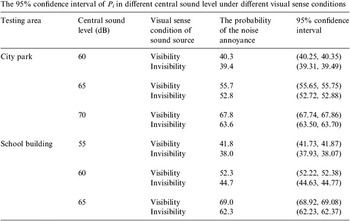
The influence of sound source visibility on annoyance also was the subject of research in psychoacoustics. It has been shown (Figure 2) that, in the same sonic environment, sonic annoyance is lesser when the source is not visible than when it is (Bangjun, Lili and Guoqing Reference Bangjun, Lili and Guoqing2003). The limitations of these experiment results, in order to apply them in an urban environment, lie in the places investigated: one is an urban park, the other an inside room.
Influence of the visibility or the invisibility of the source on the subjective sonic annoyance (Bangjun et al. Reference Bangjun, Lili and Guoqing2003: 1213).

When a source of sound is experienced negatively, it can be masked: the most eloquent example is the masking work on motorways (sometimes, noise-reducing walls can have a dual function: acoustic and visual, which has a dual impact on sonic perception).
4. Investigation results (experimental protocol)
4.1. Elaborate methodological protocol
The methodology is based on a qualitative survey and acoustic measurements in order to correlate perceptive and physical data. A preliminary test allowed us to develop the questionnaire and to confirm the field of study. The survey was conducted over six months from September 2009 to March 2010. This qualitative survey was split into two different parts: the on-site part was executed during two different seasons with the same participants, and the second part (off site) was carried out afterwards and consisted of individual interviews.
The elaborate methodological protocol focuses on twenty-nine individuals, considers two seasonalities and three public squares. Twenty-nine interviewees were selected representing variable age, gender, place of residence and means of transportation. Three groups of people were asked to rate the urban squares during two seasons. Participants of a group did the survey at the same time, and the three groups did the survey on the same day of the week. The first group was composed of people who live in houses, the second one of people who live in old collective housing and the third one of people who live in modern collective housing.
For this research, the field of study consists of three urban public squares. We chose three different types of squares. The parameters of choice were:
• their spatial morphology (size, form)
• their degree of urban centrality (geographical localisation), attractiveness, urban historicity, animation, reputation of the district)
• their urban environment (morphology of the district, the urban conception, the density of the fabric, the typology of housing environment)
• the characteristics of the place (vegetation, water).
The three squares are located in the historical urban centre, an urban regeneration zone and the university campus of the city of Grenoble in France.
The corpus of data obtained consists of the following material:
• 174 on-site questionnaires (all the 29 participants answered the questionnaire during both seasons and on each of the three squares)
• 513 photographs (interviewees were asked to take three photographs on each square for both seasons representing the global ambiance),
• 18 in situ focus groups (three groups of participants discussed together their feeling and appraisal on the three squares in September and in December),
• 22 acoustic measures (the global aim is to compare acoustic levels and types of environmental sounds to sound perception. This is why A-weighted equivalent sound levels (LAeq, 1s) were measured on each square. Twenty-two LAeq, 1s measurements were done on fixed points every 5 minutes, and every 10 minutes while travelling around the square writing down sonic events)
• 29 out-of-context individual interviews (after the on-site survey, every interviewee took part in an individual off-site in-depth interview for around one and a half hours, in particular about their memory of the three squares and their urban practices) composed of 145 sonic mind maps (five cognitive map tests per interviewee: related to the sonic environment of the three squares, the ideal sonic ambiance and the worse sonic ambiance of a square in general).
SPAD software was used in our study for quantitative data (questionnaires). Version 5 of the Software Sphinx was used in this research, particularly the Lexica edition, which allowed a lexical analysis of our corpus.
The chosen methodology led to a corpus of various types of data for which the software NVivo is well adapted for textual, iconographic, audio and video types. The analysis of the contents of the sonic mind maps was made with the NVivo software, a helpful tool for the analysis of qualitative data (textual but also iconographic). This software is only a tool but the analysis of photographs, mind maps and interviews was manually accomplished by the researcher.
The studied sonic mind maps focus on the sonic ambiance of each investigated square. We will present only some results of the sonic mind map analysis here.
4.2. Analysis of the field of study sonic mind maps
Further to two in situ investigations, each participant was individually interviewed again; they were asked to graphically represent the three squares investigated in the previous months as well as their sonic ambiance. The interviewees were also asked to represent the ideal sonic ambiance of a public square and the worst sonic ambiance of a square. The analysis of sonic mind map contents with NVivo software allowed us to manually code elements represented diagrammatically.
In this article, we will only develop the analysis of spatial sound representation.
Out of the 29 interviewees, 13 associate an ideal sonic ambiance with a closed square, and 5 associate it with a semi-open square. A boundary thus seems necessary, and, according to 6 people, it acts as protection from the motorised traffic. This desire to close the space is associated in 9 sonic mind maps with the distance, not only visual but also sonic, of the sound source.
Urban typology and sonic ambiance thus seem intrinsically connected in the sonic imagination of the interviewees; two of them explicitly established a link between the urban typology and sound. This link between urban form and sound is, however, more explicit on the sonic mind maps of the worst sonic ambiance; indeed, 11 sonic mind maps represent the negative impact of spatiality on the sonic ambiance. For 17 participants, an open square is associated with a negative sonic ambiance. The open space seems to be associated with the proximity of the (unwanted) sound source because 20 participants established a link between a bad sonic ambiance and the proximity of the sound source. One of the interviewees unambiguously indicated that ‘the sound is sent back by the building’.
The sonic mind maps of the fields of study show the value of sound spatialisation and thus the advantage of integrating the spatial dimension of sound, rarely expressed during the semi-directive but clearly distinct interviews on graphical representations.
The distance from the sound source or the representation of sounds in space is clearly shown on 39 sonic mind maps from the squares tested. All interviewees indicate relative distances. As such, the interviewee 26CRT's sonic mind map of the Place des Tilleuls (Figure 3) is clear; the representation of sounds in space shows their distance from the square and this representation in space comes with comments such as ‘near’ and ‘far’. Analysing the sonic mind maps helps us to consider the importance of the spatial dimension in the memory of an ordinary sonic space.
Sonic mind map of the Place des Tilleuls (interviewee 26CRT). [Legend: cloche: bell; lointain: far; tram: tramway; oiseau: bird; proche: near]

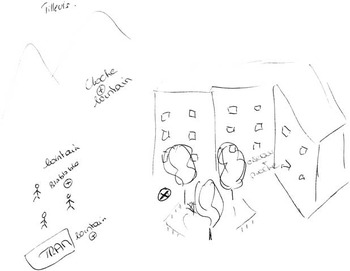
Thirty sonic mind maps represent sounds outside the square; the image of a public space sonic ambiance is composed not only of sounds whose source is situated in the space, but also those whose source is outside the spatial entity. The sonic mind map presented in Figure 4 explicitly shows the distance of the perceived sounds whose sources are outside the public space represented.
Sonic mind map of the Place des Tilleuls (interviewee 28CRM). [Legend: voiture: car; les gens: people; les cloches: bells; statue: statue; léger: soft]

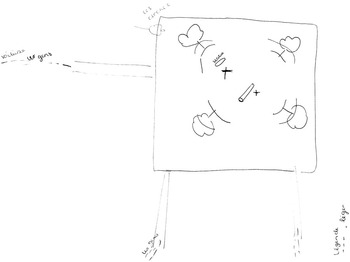
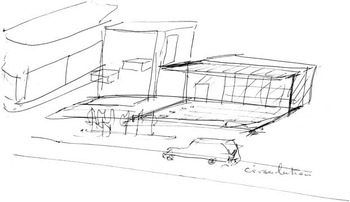
The closeness of traffic or roadwork is represented on 24 sonic mind maps; like the distance from the sound source, the closeness of the sound source is highlighted on the graphical representations of the sonic ambiances. The mind-map method helped us to detect the interviewees’ ability to represent sound sources in space and the importance they attach to this distance from the sound source. In this way, interviewee 2AMT explicitly shows through graphics the closeness of the traffic as a sound source with an influence on Place Mistral (Figure 5).
Sonic mind map of the Place Mistral (interviewee 2AMT). [Legend: circulation: traffic]

The analysis of sonic mind maps reveals the desire of a certain visual and sonic distance from the sound source in a public space and of a closed space. These evaluations could be used by urban planners in order to design urban public spaces, such as public squares. Sound perception should be considered as a significant aspect in urban public-space appraisal and should influence city planning and urban furniture design.
5. Conclusion
The study presented in this article is based on in situ qualitative investigations complete with off-site interviews during which sonic mind maps of the spaces investigated before were produced. The urban space soundscape was therefore understood, not through a discursive analysis but through spatial representations of memorised sonic ambiances. This analysis reveals a very clear representation of sounds in space. The distance from the sound source is indeed represented on each of the three public-square sonic mind maps. Analysis of the mind maps also revealed the sonic impact of vegetation and urban forms in particular, but we did not develop these here. Using a tool such as the sonic mind map in addition to field investigations (questionnaires, group interviews) with the same interviewees was shown to be particularly relevant, given the complexity of the subject studied: sonic perception. This tool is not commonly used in space sciences but seems to be particularly appropriate for research into the psychoacoustics of an urban environment.