An opening: a music captures my attention
In 2013 the Brooklyn-based jazz trio Dawn of Midi released Dysnomia, a recording for acoustic piano, bass and drums that sounded thoroughly unlike conventional jazz. When I first listened to it I was impressed by the focused power of its polyrhythms, its austere mood and the mysterious way in which the music seemed to withhold information about itself by saying more with less. Some of the expected signifiers were missing – I didn't hear jazz chords, improvising, solos, swing rhythms or theme and variations. Instead, the music was built from repeating rhythmic loops and interlocking melo-harmonic fragments, as one groove assemblage segued into the next like tracks in a DJ set. Dysnomia was hard to categorise but it reminded me of other musics I had heard and played, sounding equal parts minimal process music, sequenced techno and an adaptation of West African dance band drumming. Reading up on the group I learned that other listeners were hearing the music as I did. Critics praised its ‘colossal achievement in terms of performance’ (Bath Reference Bath2015) in which the musicians could be heard ‘dovetailing instrumental loops … for something spiritual and transformative’ (Larson Reference Larson2013), its ‘multiple time flows existing simultaneously’ (Abumrad Reference Abumrad2013) ‘dedicated to perpetual forward motion’ (Barton Reference Barton2013), and its aesthetic ‘as menacing as it is meditative’ (Hoby Reference Hoby2013) forged in ‘a kind of instrumental translation of electronic music’ (Ratliff Reference Ratliff2013). In their reviews on amazon.com, Dysnomia fans similarly admired the music as jazz that mimics and plays off experimental electronica, describing it as an acoustic trance hybrid that merges human capabilities with technological sounds. This recording, as one fan encapsulated the matter, is music that could only have been made now.
Inspired by the resonance between this critical talk and what I noticed in my own repeated listening I set out to write about the music. What struck me most about Dysnomia was the effect of its rhythms. As I listened I found the music playing with processes of rhythmic (mis)perception, sounding layers of conflicting and contrasting timelines and time feels that pulled my attention here and there and created a visceral sensation of instability. Metaphorically speaking, Dysnomia’s piano, bass and drum patterns suggested depth – a 3D adventure space of complex perceptual play in which rhythms rose and fell like shadows that eroded, surrounded and shifted my expectations (Merleau-Ponty Reference Merleau-Ponty2013, p. 234) as I got lost and then found my way while listening. Of course, writing about music – finding a way to turn the flow of listening into a 2D map of its experiential terrain – is a translation process fraught with difficulty since what happens when we listen may well be incommunicable. Popular music criticism has over many years addressed this gap between music as heard and described, notably through accounts of musical signification. However, for present purposes I am less concerned with meaning than with rendering the interplay of sound and listening action through my felt orientations within one musical performance's kaleidoscope expanse. So, thinking about how I might convey this depth quality in prose, I turned to the work of three other writers to assemble an interpretive toolkit and guide a pathway of speculative inquiry. The first part of this article considers works by Kodwo Eshun, Paul Morley and David Sudnow, idiosyncratic thinkers outside of the mainstream of academic music discourse who vividly approach writing about music through defamiliarising language and inventing concepts, generating associations based on comparative listening and describing the dynamics of musical process. In the second part of the article I draw on these writing techniques to direct my repeated listening encounters with Dysnomia and construct an interpretation modelled on the polyrhythms in the music. I conclude with a brief discussion of the phenomenological perspective on musical essences and suggest that music is a model for thinking through writing about music.
Defamiliarising language and inventing concepts: Kodwo Eshun's More Brilliant Than the Sun
The first work in my interpretive toolkit is Kodwo Eshun's (Reference Eshun1999) More Brilliant Than The Sun: Adventures in Sonic Fiction, a book of imaginative and critical provocation that charts a history of sonic Afrofuturism through the intersection of music, technology and science fiction. For Eshun, music's affecting presence is theorising in action – sounds are clues to direct our listening and hear the music ‘as the pop analysis it already is’ (−004). Drawing on examples spanning 1970s jazz fusion and funk to 1980s electro and techno to 1990s drum and bass, Eshun uses track names, album titles, techno-concepts and the talk of musicians as clues by which to reverse engineer meaning and as ‘devices to drill into the new sensory experiences’ (−003). ‘What I've done’, he says, explaining his methodology, ‘is extract these concepts and set them to work’ (Eshun Reference Eshun1999, p. 190). Most relevant to the concerns of this article is Eshun's dramatic theorisation of rhythm by setting to work its perceptual effects. For example, discussing the rhythmic qualities of echo in Jamaican dub, he explains how the music ‘confounds the process of pattern cognition by leaving the expected beat implied’ (Eshun Reference Eshun1999, p. 64); in dub the polyrhythm ‘wrongfoots you, tugs and pushes at expectation’ (Eshun Reference Eshun1999). Discussing drum and bass Eshun uses neologisms to capture its most salient attribute. The music is built upon ‘hyperrhythm, posthuman rhythm that's impossible to play’ (Eshun Reference Eshun1999, p. 68) as producers program ‘rhythmic timbreffects’ by sequencing samples of rapid breakbeats, ‘rhythmhacking the break until it becomes a passage into the drumtrip and the drumtrick’ (Eshun Reference Eshun1999). Confounding words like these identify concepts – e.g. posthuman rhythm, hacking rhythm, rhythm as perceptual trick – by which to understand the music. Eshun paints scenes to orient us within drum and bass's felt sensory world: listening is like hearing ‘knitting needles hitting electrified bedsprings at 180 bpm, crackling on impact with humps of atonal bass. Each beat recoils playing the nerves like a harp’ (Eshun Reference Eshun1999, p. 69); ‘Counter and cross rhythms tug the body into zigzags, dappling the ear with micro discrepancies between beats' (Eshun Reference Eshun1999, p. 76).
Eshun also extracts concepts from the sounds of electronic music technologies, hearing echo and delay effects of the recording studio as ‘acoustic prosthetics, audio extensions, sonic destratifiers, electric mutators, multipliers and mutagents' (Eshun Reference Eshun1999, p. 6) that enact the ‘the studio's ability to extend perception’ (Eshun Reference Eshun1999, p. 63). An instrument's sound is the ground upon which we construct its sense. For example, Eshun uses the signature frequency modulation sweep of the Roland TR-303 bassline sequencer to evoke listening to it: ‘a wavering sense of panic as the ear fails to resolve this slippage of overtones’ (Eshun Reference Eshun1999, p. 95). In these ways Eshun shows a music's impact on our writing about it as it ‘rinses out language, demands new terms’ (Eshun Reference Eshun1999, p. 75). In drum and bass and other electronic music styles the ‘atomization of rhythm’ (Eshun Reference Eshun1999, p. 79) by samplers and software runs ahead of our interpretations, creating a lag: ‘Language drags its flabby arse after sound’, ‘standard criticism is deaf to the sensory spectrum’ and it is ‘ordinary language that's dumb and which must be adapted’ (Eshun Reference Eshun1999, p. 71). The lesson of Eshun's hyper-animated describing is that music offers concepts that can be set to work, triggering new sensations and adaptations of thinking and writing through listening as it ‘snatches you into the skin you're in, abducts you into your own body, activates the bio-logic of thought’ (Eshun Reference Eshun1999, p. 149).
Generating associations and comparative listening: Paul Morley's Words and Music
If, for Eshun, music triggers new sensations that stretch and invigorate criticism's descriptive lexicon, for Paul Morley it triggers chains of subjective associations with earlier listenings and with other pieces. Morley's (Reference Morley2005) Words and Music is a sprawling history of creativity in twentieth-century popular music in which Kylie Minogue's pop ‘Can't Get You Out Of My Head’ (2001) and Alvin Lucier's avant-garde ‘I Am Sitting In A Room‘(1969) connect to hundreds of other pieces that Morley uses as coordinates for a fictional car trip with Minogue through music history that compresses different eras, styles and artists into a panorama of connected listening experience. Within his surreal story woven together from observation, historical fact and tangents onto off-road topics, Morley grounds his writing in comparative listening and musical genealogies. One technique he uses is to position one particular musician as the ‘missing link’ between two others to reveal the fissure between them. This directs us to the question of how to interpret the linked musics and how they might be related. For example, we encounter Missy Elliot as ‘the missing loop between Bessie Smith and Xenakis’ (Morley Reference Morley2005, p. 209), John Cage as ‘the missing link between Claude Debussy and Dr Dre … It's all about the spaces’ (Morley Reference Morley2005, p. 278), and in ‘a White Stripes sort of way, Lou Reed's Metal Machine Music [as] the missing link between Edgar Varèse and Aphex Twin’ (Morley Reference Morley2005, p. 312). Morley also sketches lines of influence through song and album lists – from tracks that illustrate the influence of Kraftwerk to recordings to listen to if you think Radiohead's Kid A is experimental. Morley's intuitive and cross-stylistic positionings open a space for thinking about possible conceptual – and not just surface-sonic – similarities between what might otherwise be considered disparate musics. For Morley, linkages and lists illustrate the quirky interconnections among musics as different as pieces by Minogue and Lucier, or Debussy, Cage and Dr Dre, showing style to be a vast relational matrix whose countless subtleties are ‘a shifting, evolving juxtaposition of elusive energies and experiences that can never settle down’ (Morley Reference Morley2005, p. 353).
Words and Music pursues two questions fundamental for writing about the elusive energies of music. First, Morley asks, how does a music ‘work in a way that it works at whatever it is working at?’ Second, is ‘it possible to write about the reasons?’ (Morley Reference Morley2005, p. 2) Most relevant here is how Morley plays with the musics he admires by identifying their linkages, journeying through them to find a stance ‘beyond the good and evil of pure descriptiveness … creating symbolic sensation with the words that match and catch the potential sensations of the music’ (Morley Reference Morley2005, p. 324). In its imaginative evocations of feeling, style and genealogy, Words and Music is an ‘attempt to match the otherness of music with an otherness in the writing about it’ (Morley Reference Morley2005, p. 328) – in other words, it is a narrative whose dual subject is music and writing about music. The lesson of Morley's book is that the writer undertakes a journey to complete the circuit of musical meaning. ‘You want to explain to yourself just what it is that is so enchanting about music’ (Morley Reference Morley2005, p. 274), and writing is a mode of sympathetic resonance that describes how it works on us. ‘As the listener I am the final element in the making of the music’, he says. ‘I have made the music useful’ (Morley Reference Morley2005, p. 2).
Evoking musical process: David Sudnow's Ways of the Hand
In contrast to the sensory-theoretical and associational-historical forays of Eshun and Morley, in Ways of the Hand David Sudnow (Reference Sudnow2001) grounds his writing in making music as he describes learning how to improvise jazz piano. Inspired by the phenomenology of Maurice Merleau-Ponty, Sudnow's auto-ethnography explains the problem-solving involved in moving about the keyboard in what he calls ‘paths’ by analysing the exploratory gestures he uses to create melodies in the moment of performance. Sudnow's granular prose takes its cues from his embodied experience at the piano, connecting the tactility of sound production with listening, description and analysis. ‘[H]ow the paths sounded to me was deeply linked to how I was making them’, he writes. ‘There wasn't one me listening, and another one playing along paths. I listened-in-order-to-make-my-way’ (Sudnow Reference Sudnow2001, p. 40). Sudnow's theorising, in other words, derives from his piano-playing hands. He speaks of the hands as having an assessing capacity – the hand ‘takes a bearing’, ‘appraising’ and ‘appreciating’ the topography of the keyboard (Sudnow Reference Sudnow2001, p. 52). The hands come to know their environment, ‘aiming for sounding spots’ as they move about the piano keys (Sudnow Reference Sudnow2001, p. 40), finding routes for melodies and discovering how to reach ‘places with a definiteness of aim’ (Sudnow Reference Sudnow2001, p. 71).
Considered as its own slowed-down prose performance, Sudnow's describing and theorising offer lessons for writing about music. Like the jazz improviser, the writer is similarly ‘alive to ranges of possibilities in its grasp of good ways always present’ (Sudnow Reference Sudnow2001, p. 102), exploring her subject matter ‘to do springboarding, do interweaving, change directions frequently, change paces frequently’ (Sudnow Reference Sudnow2001, p. 112) to reveal its expressive potentials. Just as the piano reminds the pianist of ‘having a soundful way right at hand’ (Sudnow Reference Sudnow2001), a listening encounter offers the writer a terrain, a ‘range of wayful reachings’ through which to describe relations in the music (Sudnow Reference Sudnow2001, p. 123). For Sudnow thought and musical gesture interact so that moving on his instrument is a thinking through, a reaching for understanding through sound-making. Like the musician, the writer reaches for sound understanding, although not always with reference to the tactility of playing music. Writing about music is nevertheless also an improvisation whose urgency is to translate relations in a heard terrain into a path of described insights. A turning point in Sudnow's study arrives when he comes to understand how a good body groove directs improvising and how melody, like speech, lives as practice. ‘For there is no melody (or talk) as an objective structure … There are practices of melodying (and talking), of soundful, articulated reaching’ (Sudnow Reference Sudnow2001, p. 126). In Sudnow's world, melodying and writing about it are real-time encounters with sound as a fluid unfolding, an engagement with the rhythms of playing, and ideally, a singing. In the same way playing jazz piano is ‘ways of moving from place to place’ so too is writing a ‘reflexive spark … dissipated as an inner saying into a singing’ (Sudnow Reference Sudnow2001, p. 127). Ways of the Hand concludes with the admission that underneath improvising lies an intuition that transcends post facto descriptions of it. ‘I don't think at all about where I'm going’, Sudnow says. ‘My hands make it up as they go along’ (Sudnow Reference Sudnow2001, p. 125).
Encountering Dawn of Midi's Dysnomia
Having considered some strategies for writing about music through Eshun, Morley and Sudnow, I return now to Dysnomia, a hard to categorise recording that sounds thoroughly unlike conventional jazz. I have been listening to it over and over again, each time trying to figure out how it works and how it is working on me. Why do I find the music's tensions, stasis and empty spaces so strangely absorbing? This section models itself on Dysnomia’s groove assemblages, tracking the music's shifting rhythmic feels by alternating between sounding foreground and unsounded background. As I listen I recall Eshun's setting to work music's perceptual effects, Morley's matching and catching music's potential sensations and associations that work at whatever they are working at, and Sudnow's focus on performance, the shape of the music suggesting a parallel unfolding of descriptive moves. How do I listen as the music goes along and what can I say about what it is doing?
The terrain of Dysnomia is a 45-minute space built upon polyrhythms that direct my attention here and there in multiple, simultaneous ways. Polyrhythms combine two or more rhythms into a composite (e.g. four against three) that is more than the sum of its parts (e.g. we can hear the four, the three or both at once). Their sound evokes two visual concepts from psychology: the figure-ground, a perceptual grouping that allows us to distinguish a figure from a background as demonstrated in the famous ‘Faces-Vase’ illusion, and the related concept of negative space, the space around and between the subjects of an image. Dysnomia incorporates these attention-bending principles into its designs, oscillating my attention between the unstable patterns in the music and the negative spaces around them. As Eshun says, in this music polyrhythm is a perceptual mutator and multiplier.
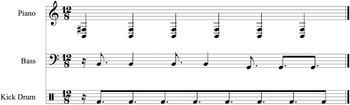
Although my after-the-fact transcription of its parts (Figure 1) suggests a this is how it works comprehension, as the first piece ‘Lo’ begins I am immediately lost – disoriented, having trouble making sense of how the music is organised, where it is going, where I am within its flow of moments. ‘Lo’ fades in with a descending plucked bassline – two pitches unevenly divided over seven notes, four on a b, then three on a lower g. The bass seems incomplete and repeats like a taunting – count-the-beats-and – un-der-stand – count-the-beats-and – un-der-stand – without context to help me subdivide and position its pattern on a grid of expectation. How does it repeat? I wonder as I count and tap. A repeating muted piano chord of f-sharp and b joins in, offering me locational clues by which to measure the landscape through its points of emphasis. Each piano chord point is two counts long, sounding six times in the time of the seven-note bass phrase. This leads me to a finer level of pulsation I count within the piano part: as background becomes foreground I hear the loop point of the 12-pulse meter that the bass danced around a moment ago. The kick drum's eight hits weave between the piano chords and the bass notes, creating a rhythmic tension and instability that invites me to locate the beat while simultaneously conspiring to keep its coordinates vague. As I count along with the kick drum's eight hits that produce a four feel over the piano's three, the musicians continue their travelling: the piano doubles into steady 8th notes and moves up an octave joined by the bass while the drum pattern adjusts, the snare drum rimshots now pinging on beats 5 and 11. Like a sample from jazz's lexicon, a fleeting seventh chord rings out twice – then is gone. The steady piano note shifts through harmonics, cueing continuous pattern adaptations in the bass and drums. Each repeating part dovetails with the others to create a ‘permanent sense of tension’ that draws me into the interior of their polyspace (Arom Reference Arom1991, p. 206). A ritual sound that doesn't sound like jazz reveals itself.
Initial bass, piano and drum patterns for Dawn of Midi's ‘Lo’.

Dysnomia points in many directions, ‘a shifting, evolving juxtaposition’ as Morley says, a sound assembled from various sources. I listen through my memories of those sources through my work as a musician, hearing traces of influences from the additive–subtractive steps of minimalism, the sheen and sharp angles of electronic music, to the timelines and inherent rhythms of West African drumming. Recalling these sources and influence-traces expands the frame of Dysnomia, situating it, footnoting it, wiring it to other stories and practices. ‘Sinope’ continues the 12-pulse meter as the bass moves to its higher register, playing a three-note, up–down pattern. The insistent piano figure is a timeline to keep everyone in sync, a short–short–long phrase I hear as a Ghanaian gankogui iron bell – tah-tee-tah tah-tee-tah – that unfolds a slow six feel over the even slower three notes per 12-pulse feel of the bass. Yet when the snare drum enters the groove becomes a shuffling four. Now the piano phrase feels different, as if an accent has appeared within it – tah -tee-tah tah-tee-tah. At once I feel the piece in three, in four and in six, as each meter is simultaneously present yet transparently so, depending on how I hear it, how I emphasise one feel instead of another. Dawn of Midi pianist Amino Belyamani, who grew up in Morocco, reveals the group's goal ‘to translate North and West African music into the western instruments we played’ (Belyamani in Segal Reference Segal2014). He hears what he calls the ‘deceptive rhythms’ of Berber and Gnawa musical traditions in which ‘the underlying pulse is where you least expect it, where the silences are’ (Segal Reference Segal2014). I begin filling this silence with my own juxtaposition, remembering how the composer Steve Reich was similarly inspired by the rhythmic design of Ghanaian drumming. ‘One can create a music with one's own sound’, he once said, ‘that is constructed in the light of one's knowledge of non-Western structures’ (Reich Reference Reich2004, p. 151).
‘Atlas’ begins with a single repeated piano tone left over from the previous piece joined by the bass in looping alternation: piano tone – [rest] – bass pluck. The music invites hypotheses about my location in its space: which sound is beat one? As the piano and bass notes repeat I hear the bass on one and the piano on three, but when the kick drum enters the merry-go-round conversation my perspective flips, pushing the piano to two and the bass to three. This metrical ambiguity shows the influence of time organisation principles widespread in sub-Saharan African musics (Arom Reference Arom1991, p. 211). Dysnomia uses a 12-pulse meter within which each musician repeats rhythmic figures that combine to create co-present groove feels: long slow cycles over short fast ones, sixes over fours over threes over twos. The figures conjure inherent rhythms, composite phantom beats whose figure-ground quality ethnomusicologist Gerhard Kubik describes as emerging ‘from the total musical complex, delighting the ears of both listeners and players, but which are not being played as such’ since they depend on how we hear sound gestalts rather than isolated sounds (Kubik Reference Kubik1962, p. 33). My listening produces its own effects not being played as such: as my perspective flips the beat, pushing around the piano, bass and kick drum, I recall Reich echoing Kubik's inherent rhythms idea. Reich described the listening wonders of a music (his own) in which the ‘mysteries are the impersonal, unattended, psycho-acoustic by-products of the intended process’ (Reich Reference Reich2004, p. 35). Belyamani says that the influence of the perceptual aspects of rhythm became clear when he and his bandmates studied Ewe drumming with Ghanaian master drummer Alfred Ladzekpo at the California Institute of the Arts. They learned to listen ‘to intervals of time and to really listen to different sounds and control tones in a drum’ (Belyamani in Eisinger Reference Eisinger2013). Bassist Aakaash Israni says that this emphasis on time and tone inspired the group to make music ‘in which all three of us are essentially playing drums’ (Israni in Carry Reference Carry2015), an idea which in turn echoes earlier jazz moments, perhaps nodding to pianist Cecil Taylor's percussive approach to the piano, once described as ‘eighty-eight tuned drums’ (Wilmer Reference Wilmer1992, p. 51).
‘Nix’ has a steady kick drum, off-beat hi hat, stop–start bass and four against three piano riff. It sounds like minimal techno and I'm nodding along to what sounds like a 4/4 beat. The techno timbres on Dysnomia are acoustic, but as Israni says, carefully prepared to sound synthetic and dry ‘as an homage to electronic music’ (NPR 2013). Belyamani plays his piano parts with his right hand while his left mutes strings inside the piano to create harmonic tone colours, a technique inspired by a Chick Corea recording on which he plays a ‘really rhythmic groove using his left hand to mute the strings … and using his right hand to play the keys’ (Belyamani in Eisinger Reference Eisinger2013). Another inspiration was West African harp instruments such as the kora from Mali and the ardin from Mauritania and ‘trying to emulate that sound with the piano’ (Eisinger Reference Eisinger2013). The bass and drum sounds complement this muted piano timbre: the bass uses harmonics and high-register playing to imitate African lutes while the drums and hi hat are muffled to impersonate a Roland TR-808 drum machine. However, timbre disguises form in that the African techno of ‘Nix’ is fluid-round, not rigid-square, the sound of 12/8 humans posing as a 4/4 machine. I notice the groove splintering as the hi hat disappears, replaced by drumstick clicks and snare hits on off-beats. Soon the piano changes its pattern, playing a falling fourth, and its quarter notes go half speed, taking a full measure until their downbeats align with the kick drum's six beat pattern. I focus on the piano, a two-note chord playing the bell timeline pattern from the Ewe dance drumming piece, ‘Agbekor’. The seven bold-underlined strikes of the piano-bell – 1 2 3 4 5 6 7 8 9 10 11 12 – suggest a 12-pulse grid without ever playing it.
By suggesting without sounding regular pulses, Dawn of Midi aim to draw the listener into a circuit of musical time. Belyamani explains the philosophy of this strategy with an image of listeners dancing to music ‘that never plays or outlines the regular pulse … [the dancing body] becomes a complementary instrument to the experience by completing the circuit in time’ (Belyamani in Tygiel Reference Tygiel2014). Israni suggests that the music has ‘everything to do with positive and negative space … in this music, a lot of times we're playing all the stuff around it, but the silences are the beat’ (Israni in Tygiel Reference Tygiel2014). On ‘Moon’ the instruments play around the beat, taking turns playing patterns on their respective tuned drums that flow like bell timelines. As the piano and bass patterns interweave their phrases into knots, filling one another's spaces, drummer Qasim Naqvi is freed from traditional timekeeping duties, unravelling the 12-pulse feel by fragmenting his part into accentual hits. ‘Moon’ is minor-hued, stately, the piano chords and drum rim clicks playing six slow notes per cycle beneath languid, free-floating piano tones, while the bass draws counter melodies inside the pulsation. Soon the piano timeline notes leap upwards an octave and double their speed: the straight 8th-note pattern bends in front of me, stretching and contracting to become another timeline – the fast four feel of the Ewe piece, ‘Gahu’. The bass joins it on the same high pitch, filling in the unsounded beats to make a call and response between the two instruments. Dysnomia’s ways of moving through its filigreed designs invite me to reach for descriptions as I listen to make my way but there is always a gap between what I can notice and the flowing poly-shifts of the music. How does one talk about a rhythmic stretching and contracting slight of sound where a timeline blurs into a melody, where a meter is suggested and played around yet unsounded?
In the gaps between the sounds and what I can notice I'm learning to listen to find my way as I aim for points of focused stillness within the music's fluid movement. ‘Ymir’ and ‘Ijiraq’ are dense with syncopated accents, high-register piano harmonics, rimshot drumming and staccato bass plucks in octaves. On ‘Ymir’ I zoom in on the piano harmonics, tiny timbre bombs that shine like reflective glass pieces – catching the refracted light, changing in volume, changing in resonance, changing in timbre-brilliance and timbre-mutedness. On ‘Ijiraq’ I notice unisons among the parts, and doubling within each instrument's high and low registers – octaves in the bass, kick drum and two-timbre snare sounds in the percussion, muted and ringing tones in the piano. How did the musicians approach this music? How did the music approach the musicians? Loosening my interpretive frame I imagine a rehearsal where the band experiments with their patterns. Less is more one of them says as the others hold steady. Let my pattern cue yours, wait until you hear it. In this way perhaps the musicians too found points of focused stillness within repetition, groove interplay taking the place of soloing, leaving space, as Israni says, for ‘the creation of certain atmospheres and emotional states as an ensemble’ (Israni in Roulette 2010). Learning this ensemble stance required a discipline to compose Dysnomia through trial and error over two years of weekly rehearsals. From the rhythms of discipline came an epiphany, emergent like Kubik's inherent rhythms and Reich's impersonal mysteries: although played on acoustic instruments, says Belyamani, the music evolved to show ‘this idea that humans can play and emulate what machines do’ (Belyamani in Tygiel Reference Tygiel2014).
The piano harmonics move higher still from the previous piece as ‘Algol’ sounds another seven-note bell pattern, fluttering along its shining overtones as the echo-doubled percussion rim clicks, snare drum and hi hat fill the spaces. I zoom in again on the Naqvi's fragmented drumming, its splintered sounds suggesting disconnected gestures. There are gaps instead of overlap between the hi hat and snare echo-hits, and no individual hand or foot rhythm is continuous: it is anti-idiomatic drumming. As I move along with the disconnected drumming gestures and notice the patterns stepping through their changes from moment to moment I hear a sequenced stance, the discipline of 12/8 musicians ventriloquising a 4/4 machine. The clues are in the sounds, but also outside of them, through my recollections and linkages that frame the music. Naqvi speaks of discipline as a
degree of precision in terms of having to play these parts over and over again – that I guess are almost like loops … And they have to be really perfect in order for the dialogues to be musical … In that sense, the repetition and perfecting [give] one a sense of electronic music. (Naqvi in Simonini Reference Simonini2013)
Israni connects the acoustic to the electronic: ‘we're just getting to the place now where we're wanting to learn [musical techniques] back from computers … and then do them ourselves’ (Israni in Simonini Reference Simonini2013). Another connection is that, as the visual ergonomics of digital audio software allows musicians to make music modular, configuring it into discrete loops that can be juxtaposed and triggered for seamless computer playback, so the looping logic of Dysnomia resides in its gradual and precise progressing. I flip back again to Reich – ‘pieces of music that are, literally, processes’, he said, describing patterns that evolve through notes added or removed, one at a time (Reich Reference Reich2004, p. 34) – and back again to the imagined rehearsal – Let my pattern cue yours – as one musician holds steady while the other two change by increments. Dawn of Midi's beat-matching technique says Belyamani, mimics ‘the quality of a DJ [who] can master a transition between two different songs and keep the same tempo and all of a sudden it morphs into something else’ (Belyamani in Carry Reference Carry2015). I hear it now: Dysnomia as a music of techno-emulation, the band triggering its circular patterns like a DJ playing loops in a laptop.
Like the tessellating infinite loops of M.C. Escher all of a sudden morphing into something else, the final title track ‘Dysnomia’ returns to the themes from its beginning – a seven-note descending bass figure, a repeating piano chord, a four against three kick drum. I have been listening over and over again, each time adding to my feeling of how the music works, what it is working at and how it is working on me. How do I listen as the music goes along and what can I say about what it is doing? My listening is variable and partial as each encounter reveals zooming in on micro-moment points of attention; my listening is adjectival as I describe sound timbres and their sensations; my listening is a moving-along-with as I navigate through the time of timelines and the plays of rhythm clash; and my listening is cumulative as each encounter reveals different details now imprinted in my mind's ear as I write about them, remembering their twists and turns, compressing their evolving juxtapositions into new loops, traces of which remain in my ever-expanding aural picture of the music and its connections to what I know. From one moment to the next the music's groove assemblages offer pathways for making sense through their figure-ground sound, interlocking polyrhythms and negative spaces. One by one on this final track the patterns and parts reduce and then disappear until only a single repeating piano tone remains.
A closing: music models writing about music
In his book Music as Heard, Thomas Clifton (Reference Clifton1983) outlines the fundamentals of a musical phenomenology. Guided by the question of how we are conscious of a piece of music and what its stream of sound events presents to our field of consciousness, Clifton re-directs our analytical focus from play-by-play accounts of musical facts to describing the play of musical essences such as movement, shape, duration, succession, colour, play and feeling. For Clifton, these essences – ‘What the music says is what it is’ (Clifton Reference Clifton1983, p. 19) – are the subject of writing about music as we search for sense in the sounds and render the presence of that sense with precision, systematic relevance and interest (Clifton Reference Clifton1983, p. 39). Yet musical description also involves folding ourselves into the mix by ‘observing the self observing the music’ (Clifton Reference Clifton1983, p. 22). The goal of our descriptions is thus inter-subjective: to provide others with a picture of how our reciprocal relationship with music's essences illuminates our listening as its own object of knowledge (Clifton Reference Clifton1983, p. 38). This article has similarly been concerned with describing musical essences and rendering one listener's awareness of them. Eshun said that music is latent with theory, how it rinses out language and demands new analytical terms; Morley grasped at the sensations of musics to interconnect them and pursue the sources of their enchanting powers; and Sudnow discovered through playing piano ways of listening to find his way through writing about it. I drew on these strategies to guide an encounter with Dysnomia that describes the interplay of musical and listening action.
This interplay suggests that Dysnomia models a way to write about music in which description is music's negative space, making audible the implied beats, celebrating the latent potentials of unsounded sounds, saying things the music elides, hearing something in music's silences. In this way writing is inspired to move the way music moves to reveal its inherent rhythms, unattended by-products and meaningful essences. Zooming in here and there on the flow of micro-moments I have tried to show how writing about music is a chance to embody what Clifton calls a feeling-with or attunement (Clifton Reference Clifton1983, p. 14), a moving along in sympathy with the soundflow to fill its negative spaces and complete the circuit of meaning between what we hear and how we interpret it. Moreover, just as Dysnomia incorporates rhythmic instabilities and ambiguities, so too can writing about it embrace open-endedness, getting lost and moving back and forth between phenomenal foreground and interpretative background as it drills into sensory experiences and dissipates the music's inner sayings into an audible singing. Dysnomia captured my attention through its polyrhythms, its austere mood, its mystery. The music never quite stabilises: it holds back and resists shared downbeats, it invites my repeated listenings and (mis)perceptions, and it weaves a tensile whole that sounds more than the sum of its parts. In this way, polyrhythms – perceptual gestalts born of interaction and four against three frisson – can be a model for writing about music. Through its hidden complexities playing across time, Dysnomia inspires me to think through it again and again.