

Introduction
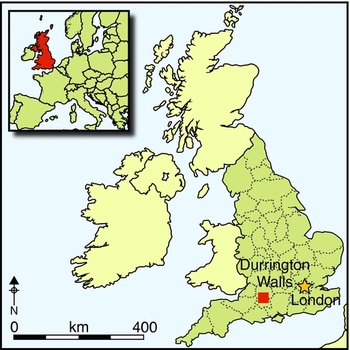
Henges are distinctive monuments of the Late Neolithic in Britain, defined as ditched enclosures in which a bank is constructed outside the ditch. The largest is Durrington Walls (Figure 1), a 17ha monument near Stonehenge. Excavations at Durringon Walls from 1966–1968 revealed the remains of two timber circles, the Northern and Southern Circles, within the henge enclosure (Wainwright & Longworth Reference Wainwright and Longworth1971). More recent excavations (2004–2007) have identified a settlement that pre-dates the henge by a few decades and is concurrent with the main construction phase of Stonehenge (Parker Pearson Reference Parker Pearson, Larson and Parker Pearson2007; Parker Pearson et al. Reference Parker Pearson, Ceal, Marshall, Needham, Pollard, Richards, Ruggles, Sheridan, Thomas, Tilley, Welham, Chamberlain, Chenery, Evans, Knuesel, Linford, Martin, Montgomery, Payne and Richards2007; Thomas Reference Thomas, Larsson and Parker Pearson2007). Middens and pits, with substantial quantities of animal bones, broken Grooved Ware ceramics and other food-related debris, accumulated quickly; the settlement has an estimated start date of 2535–2475 cal BC (95% probability) and a use-life of 0–55 years (95% probability). In the broadest sense, this new evidence confirms that Durrington Walls was a place of feasting (Richards & Thomas Reference Richards, Thomas, Bradley and Gardiner1984; Albarella & Serjeantson Reference Albarella, Serjeantson, Miracle and Milner2002). The non-uniform deposition of food remains and cooking apparatus within and between houses, in both domestic and public spaces, and between middens and pits, however, prompts a more detailed investigation of how foods were prepared and consumed.
A) plan of Durrington Walls and Woodhenge, showing areas excavated (red); B) plan of the east entrance of Durrington Walls (Trench 1), showing the distribution of the middens (green discs) and pits in the area of the houses. The green discs represent the density of worked flint in individual metre squares split into eight size classes varying in density from 1–20 flints m−2 to 210–296 flints m−2. Houses are numbered with hearths shown (shaded).

Here we aim to investigate culinary activities at Durrington Walls by conducting detailed analysis of food remains and pottery contents at a fine contextual resolution. This information is required to understand the role of the site in the Stonehenge monumental landscape and, more broadly, to expand our limited knowledge of Late Neolithic consumption practices, including more specific elucidation of different feasting activities (Dietler & Hayden Reference Dietler and Hayden2010). By investigating how different foodstuffs were prepared, consumed and deposited, we may also come closer to understanding how foods were valued and perceived in Neolithic Britain. Such information is missing from debates regarding the social and economic significance of foodstuffs during this period, which instead have tended to rank foods either in terms of their calorific or nominal prestige value.
Site context and background
Durrington Walls and the adjacent site of Woodhenge lie 2.8km north-east of Stonehenge. Dense occupation layers have been detected beneath the west, east and south arms of the henge bank at Durrington Walls (Farrer Reference Farrer1918; Stone et al. Reference Stone, Piggott and Booth1954; Parker Pearson Reference Parker Pearson2012), revealing the large extent of the pre-henge settlement. Beneath the east entrance of the henge were the remains of seven house floors (Parker Pearson et al. Reference Parker Pearson, Ceal, Marshall, Needham, Pollard, Richards, Ruggles, Sheridan, Thomas, Tilley, Welham, Chamberlain, Chenery, Evans, Knuesel, Linford, Martin, Montgomery, Payne and Richards2007; Figure 1b). These houses were small and square (c. 5.25 × 5.25m) with rounded corners. Remains of two house floors were found within the Western Enclosures (Thomas Reference Thomas, Larsson and Parker Pearson2007) and five small mini-henges within the henge interior; the two excavated mini-henges each contained a house within a circular palisade. Neither house was any larger than those beneath the east entrance. Immediately north-east of the Southern Circle there is a D-shaped building (c. 11 × 13m; not shown), originally interpreted as a fenced midden (Wainwright & Longworth Reference Wainwright and Longworth1971). It was plaster-floored but lacked a hearth, and has been reinterpreted as a meeting house or public building.
The dates for Woodhenge, the Durrington Walls settlement, the first phase of the Southern Circle and its avenue (connecting the henge to the river) are similar to those for the main stage of construction at Stonehenge (stage 2: when the sarsen circle and trilithons were erected), starting 2760–2510 cal BC and ending 2470–2300 cal BC (95% probability) (Darvill et al. Reference Darvill, Marshall, Parker Pearson and Wainwright2012). This supports the hypothesis that Stonehenge and Durrington Walls were built as a single complex, linked by avenues via a short stretch of the River Avon (Parker Pearson & Ramilisonina Reference Parker Pearson and Ramilisonina1998). There was a dichotomy in their use: Durrington Walls has no burials other than a single cremation at Woodhenge (and four loose human bones), whereas Stonehenge has 63 excavated cremation burials, out of a probable 120 or more (Parker Pearson et al. Reference Parker Pearson, Chamberlain, Jay, Marshall, Pollard, Richards, Thomas, Tilley and Welham2009). Furthermore, Durrington Walls was a place of habitation and feasting; Stonehenge clearly was not, having produced only 11 sherds of Grooved Ware and a limited amount of animal bones (Cleal et al. Reference Cleal, Walker and Montague1995: 350 & 437). Durrington Walls was most likely the village where the builders of stage 2 of Stonehenge lived.
The use of ceramic vessels
Large assemblages of Grooved Ware were recovered from Durrington Walls in 1966–1967 (5861 sherds; Wainwright & Longworth Reference Wainwright and Longworth1971) and 2004–2007 (6697 sherds). They derive from many hundreds of vessels of different sizes, made from a limited range of clays. Most were probably made locally but some contain fossil shell from Kimmeridge Clay sources over 20km away. Molecular and isotopic analyses of lipids are widely employed to investigate pottery use (Evershed Reference Evershed2008). Previous lipid analysis of British Late Neolithic ceramics has already shown that Grooved Ware was more closely associated with processing porcine products than other types of British Neolithic pottery (Mukherjee et al. Reference Mukherjee, Gibson and Evershed2008), but intra-site variation in the use and deposition of pottery has not yet been considered. Here, 317 Grooved Ware sherds from a range of contexts at Durrington Walls were sampled for lipid analysis. Care was taken to avoid repeated sampling of the same pots by considering the form, decoration and fabric of individual sherds selected for analysis. Lipids were extracted using a similar protocol to previous studies of pottery from Durrington Walls (Mukherjee et al. Reference Mukherjee, Gibson and Evershed2008) and analysed by gas chromatography (GC), GC-mass spectrometry (GC-MS) and GC-combustion-isotope ratio-MS (GC-C-IRMS). Full details of the extraction procedure and analytical methods are provided in the Supplementary Online Material.
Classification of lipids
Analysis by GC and GC-MS confirmed that 151 sherds (48%) contained interpretable amounts of lipids (<5μg g−1), with a mean lipid content of 341μg g−1 and a maximum of 9.8mg g−1. In all cases, the lipid profiles were dominated by fatty acids of mid-chain length (C16:0, C18:0) typical of degraded animal fats, although trace amounts of degraded vegetable waxes were detected in a small number of sherds (Supplementary Table S2). Tri-, di- and mono- acylglycerides with distributions typical of terrestrial animal fats were also detected as well as long-chain ketones (C31, C33 and C35) from the transformation of fatty acids through the exposure to heat (Raven et al. Reference Raven, van Bergen, Stott, Dudd and Evershed1997). To distinguish these animal fats further, GC-C-IRMS was carried out; this determined the δ13C values of C16:0 and C18:0 fatty acids in extracts from 122 sherds. These GC-C-IRMS data are combined with those (n = 20) previously reported (Mukherjee et al. Reference Mukherjee, Gibson and Evershed2008) and summarised in Figure 2. The difference in δ13C values for C16:0 and C18:0 fatty acids (Δ13C) from each vessel is shown against the approximate range for modern porcine, ruminant carcass and dairy fats obtained from animals reared in southern England (Copley et al. Reference Copley, Berstan, Dudd, Docherty, Mukherjee, Straker, Payne and Evershed2003). Together, these comprise the largest dataset of pottery use at a single site.
Overall distribution of vessel contents from Durrington Walls according to their Δ13C values.

The GC-C-IRMS data show a large variation in the Δ13C (Figure 2), which relates to the different origins of the fats present in the pottery. The lower Δ13C (i.e. < −3‰) are typical of ruminant dairy fats and some wild ruminant carcass fat (Craig et al. Reference Craig, Allen, Thompson, Stevens, Steele and Heron2012) although, given the near absence of deer in the faunal assemblage, the latter can probably be ruled out. The higher values (i.e. > −1‰) are more typical of porcine carcass fats, which would seem the most likely source given the abundance of pig remains found at the site. The dominance of pigs in the faunal assemblage (Figure 3) is not, however, reflected in the pottery use. Only 27% of the analysed sherds have Δ13C values that fall within the range for modern porcine fats (Figure 2). Rather, ruminant products were preferentially processed in pottery, even accounting for relative differences in carcass weights.
Variation in the use of pottery by context as determined from lipid residues. Inset: pie chart showing the proportion of cattle (grey) vs pig (black) bone specimens. Isotopic characteristics of fatty acids extracted from individual vessels are plotted against the ranges (median, maximum, minimum) in Δ13C from authentic reference fats.

Such simple assignations mask the complex process of mixing however, as well as any potential isotopic differences between modern and ancient values. It is worth noting that the large number of sherds (n = 72) with Δ13C values consistent with modern ruminant carcass fats could theoretically be produced by mixing pork and dairy fats, taking into consideration variation in fatty acid concentration and δ13C. If this were the case however, we would expect a consistently high number of vessels with Δ13C values that fall between ruminant carcass and dairy fat ranges, which is not observed (Figure 2). Instead, pots used for mixing dairy products and meat, either together or sequentially, are underrepresented, as demonstrated by the trough in the frequency distribution (Figure 2) between dairy and carcass fats. At the very minimum, it seems that some care was taken in manipulating dairy foods. There is less evidence of any separation of beef or pork in the Durrington Walls Grooved Ware assemblage.
Spatial variation in the use of pottery
The spatial distribution of food residues within the Durrington Walls settlement was largely patterned according to architecture and activities. For example, the distribution of Δ13C values of lipids from pottery deposited in pit features (n = 16) and the large midden (n = 58) located around the houses, and those within the various features associated with the Southern Circle (n = 22) are significantly different (Kruskal–Wallis Test, H = 12.9, P = 0.002; Figure 2). Of 16 sherds analysed from 10 separate pit features, 11 sherds had high Δ13C values consistent with pork fat, while only one sherd was used to process dairy products (Figure 3). In contrast, the majority (12/22) of sherds from contexts associated with the Southern Circle have values consistent with dairy fats. Pots from within the D-shaped structure north-east of the Southern Circle, now interpreted as a meeting hall, and the open area next to it in front of the entrance to the Southern Circle, were almost entirely used for dairy products. These areas were significant public spaces and are also associated with a slightly higher relative proportion of cattle bone (Figure 3). The residues on pottery from the large midden deposit (context 593) were more variable. Across the midden, discrete accumulations of pottery, flint and animal bone associated with different houses are evident (Chan Reference Chan2009), but there is little evidence for differences in the use of pottery between these separate deposits.
Variation in the use of pottery by vessel dimensions
Overall, there was a positive correlation between fabric thickness and rim diameter (r = 0.52, n = 237, p = 0.<001), confirming that larger vessels tend to have thicker walls. Sizes of pots varied according to what purpose they were used. There were significant differences in the distribution of vessel thicknesses between pots used predominantly to prepare ruminant carcass, porcine and dairy products (Kruskal–Wallis H = 13.5, n = 137, p = 0.001). Pots with porcine products were on average 2–3mm thicker than those used for dairy, which equates to c. 8–10cm wider rims. Pots used predominantly to process ruminant carcass fats were of intermediate size. Correspondence between vessel thickness (size) and use is not surprising, but it suggests that Grooved Ware pottery was deliberately produced or selected for distinct culinary uses. This may be because dairy products required different preparation methods to meat, involving more careful manipulation of small quantities for consumption by a limited number of people. In contrast, larger, bucket-sized vessels could be envisaged for processing the huge amounts of surplus carcass products produced after pigs or cows were slaughtered for consumption events on a larger scale.
Pots deposited in pits (n = 343) tend to be thicker walled than those deposited in the large midden (n = 2004) and on house floors (n = 979), and the distribution of fabric thickness is significantly different between these contexts (Kruskal–Wallis, H = 47, p = <0.001). This finding is consistent with the idea that larger pots were preferentially used for processing porcine products and that these were more commonly deposited in pits, although a three-way association between pottery use, vessel size and depositional context cannot be directly inferred due to the potential for co-variance.
The preparation and consumption of animals
In common with other Late Neolithic assemblages in southern Britain, the Durrington Walls material is dominated by the remains of pigs and, to a lesser extent, cattle. The remains of other domesticates, for instance, dogs and sheep, as well as wild animals, make up a very small proportion of the assemblage. The very large density of animal bones from the site, along with the way the carcasses were treated, led to the interpretation of the accumulated material as mainly feasting debris (Albarella & Serjeantson Reference Albarella, Serjeantson, Miracle and Milner2002).
Faunal remains from the 2004–2007 excavations were analysed using a heavily modified version of the method described by Davis (Reference Davis1992); see Supplementary Online Material. For both pigs and cattle, the skeletal element distribution is such that either live animals or complete carcasses were brought to the site, the former being much more likely for obvious logistical reasons. The presence of all parts of the cattle and pig skeleton makes it unlikely that joints of meat were brought to Durrington Walls. Parts of the body that carry more meat are well represented across the site. In addition, the near absence of neonatal bones of either species, despite 10mm sieving of the whole deposit, suggests that Durrington Walls was not a producer site, i.e. it is unlikely that the animals consumed on site were born and raised there. Strontium isotope analyses have shown that cattle deposited during the use of the site had a wide range of origins, with evidence for links with the west of Britain, perhaps including Cornwall, Wales and northern Britain (Viner et al. Reference Viner, Evans, Albarella and Parker Pearson2010).
Both pig and cattle bones showed evidence of butchery in the form of cutting or chopping. Butchery marks were not observed very frequently (c. 4% of countable specimens), but these are probably under-estimated due to the widespread poor preservation of the bone surface. Evidence of cooking, in the form of burnt or singed bones, was also encountered: c. 7% of countable specimens in the settlement area and c. 5% at the Southern Circle. Burnt specimens were found in a variety of different context types, with some individual contexts containing high levels of heavily burnt and calcined material, much of which could not be identified.
A number of distinctive carcass-processing patterns were observed in the material from the 1966–1968 excavations. A common pattern of butchery on cattle bones occurred on the mid-shaft portion of the major long bones (humerus, radius, tibia, femur and metapodials), which were frequently burnt and chopped, presumably to extract the bone marrow (Albarella & Serjeantson Reference Albarella, Serjeantson, Miracle and Milner2002). In pigs, burning patterns suggest the roasting of meat on the bone, evidenced by burning on specific parts of certain elements (the distal astragalus, distal humerus, calcaneum and proximal radius). These patterns, first observed in the earlier study, were confirmed in the more recent analysis, indicating that they were widespread, rather than confined to specific contexts. The consumption of meat, then, was a major activity at the site, resulting in the discard of animal remains on a very large scale. This is also supported by the low frequency of gnawing marks, indicating prompt burial, and the numerous bones found in articulation, suggestive of primary deposition. Clearly, a considerable refuse of meat consumed on site accumulated in a relatively short period of time.
The faunal remains, in particular those of pigs, have also provided useful information about the seasonality of feasting activities. Based on mandibular and maxillary tooth eruption and wear on pig teeth, animals could have been killed on site year round, but there was a substantial peak in the number of pigs that were killed during the late autumn and winter (Wright et al. Reference Wright, Viner-Daniels, Parker Pearson and Albarella2014). The evidence from tooth wear varies between different context types; most noticeably, the pigs deposited in midden contexts (especially those in context 593) were consistently killed before they were one year old, while those deposited in pits were more commonly killed during their second year. The pigs deposited in the midden were therefore killed before reaching their maximum meat weight, and provide the best evidence of autumn and winter slaughtering. They represent the clearest evidence of feasting-like consumption.
Evidence for plant foods
Evidence for the consumption of plant foods at Durrington Walls is generally sparse. A systematic sampling strategy was employed across the site for the recovery of charred plant material; see Supplementary Online Material. The most abundant and widespread class of charred plant material was hazel nutshell (Corylus avellana), but even this was found at significant density in only two of the house floor deposits. Also at generally low densities were the basal culm internodes of onion couch grass (Arrhenatherum elatius var. bulbosum). Other charred plant remains included crab apple seeds and endocarp fragments (Malus sylvestris), a sloe fruit stone (Prunus spinosa), indeterminate Rosaceae pericarp fragments, a tuber of lesser celandine (Ficaria verna) and indeterminate tuber or rhizome fragments.
The absence of any charred wheat or barley grains dated to this period, and of quern stones, suggests that there was no processing of cereals, a situation inferred for Britain as a whole by this stage of the third millennium cal BC (Stevens & Fuller Reference Stevens and Fuller2012). Yet we should not discount the unusual status of Durrington Walls as a short-term, consumption-dedicated gathering site when considering its paucity of plant foods vis-à-vis animal products. We cannot be sure that finished or semi-processed cereal products such as flour, bread or beer were not introduced to the site. Clean, processed cereal grain may also have been present but not preserved, as clean grain is unlikely to come into contact with fire (Jones Reference Jones and Fairbairn2000; Jones & Rowley-Conwy Reference Jones, Rowley-Conwy, Colledge and Conolly2007; Stevens Reference Stevens, Colledge and Conolly2007). Plant foods such as fruits and tubers are also less likely to have come into contact with fire during processing and may therefore be somewhat underrepresented.
Stable isotope evidence for diet
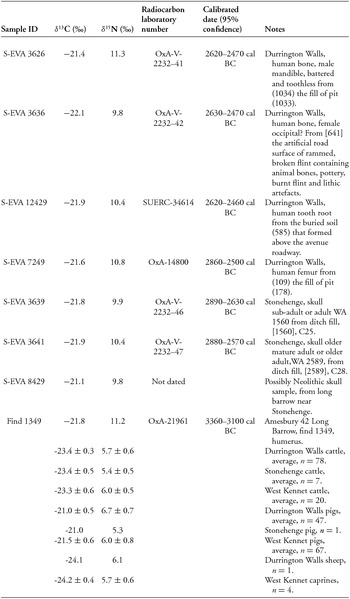
Unfortunately, our broader understanding of the habitual diets during this period is hampered by the paucity of human stable isotope values due to the rarity of non-crematory burial deposits. Just three fragments of loose human bone and a tooth were recovered from third millennium cal BC contexts at Durrington Walls and may not be directly derived from the inhabitants of the site. Nevertheless, isotope analysis of this small sample shows that these people were c. 3–5‰ enriched in 15N compared with herbivores and pigs from the site (Table 1), consistent with the regular consumption of ruminant milk and porcine meat. Without knowing the isotope values of cereal grains or other plant foods that were available, however, it is difficult to assess the relative dietary contribution of animal and plant products, and therefore whether the range of foods encountered at Durrington Walls were consumed on a regular basis.
Stable isotope data and radiocarbon dates.
The significance of culinary and consumption practices at Durrington Walls
On one level, consumption practices at Durrington Walls broadly reflect the Late Neolithic economy and its technologies of food production. On another, they derive from culinary appreciations and preferences that are likely to have conveyed symbolic meanings, related to perceptions of the value of foodstuffs or food combinations, and of how these were prepared and consumed (Parker Pearson Reference Parker Pearson2003; Saul et al. Reference Saul, Glykou and Craig2014). In broad terms, culinary practices at Durrington Walls correspond to one pole of Goody's (Reference Goody1982) binary characterisation of cuisine; class-based societies employ a differentiated ‘haute cuisine’ of complex and multiple gradations in courses, dishes and vessel forms, yet Neolithic Britain was nearer the other end of this scale in terms of its relative lack of such category distinctions. Nevertheless, a close analysis of food remains and associated material culture at Durrington Walls has revealed more internal variability than might be expected.
The selection, proportions and combinations of foodstuffs at Durrington Walls were different from what might be expected to have constituted everyday eating in the British Neolithic. The settlement has many characteristics of a feasting site: discard of masses of animal bones, many of which had not been fully processed for their nutrition; winter seasonal culling of animals, particularly pigs; and an emphasis on animal over plant foods. The scale and nature of feasting at Durrington Walls was, however, quite variable. The evidence from pit deposits is similar to that of other Late Neolithic sites (Serjeantson Reference Serjeantson, Serjeantson and Fields2006; Rowley-Conwy & Owen Reference Rowley-Conwy and Owen2011) and consistent with small-scale feasts in keeping with expectations for societies with undifferentiated cuisines (Goody Reference Goody1982). Many pits were dug into house floors on the abandonment of the house, suggesting a closing ritual in which the remains of ‘meals’ were buried as the house went out of use. Pig products were the main feature of these meals, with the animals culled in their second year, in keeping with normal patterns for meat exploitation.
In contrast, the large numbers of animals that were promptly disposed of in the middens that filled the space between the houses are in keeping with larger scale, less frequent feasts, which probably occurred in the winter. Notably, the pigs in the middens were killed at a younger age than those deposited in other contexts, including pits, often before reaching their maximum meat weight, which is indicative of careful planning for overt public consumption. Compared to the pits, the middens contained higher numbers of sherds from pots in which ruminant products—presumably beef and cows’ milk—had been cooked, the latter suggestive of additional activities during the summer or storage of fermented dairy products for winter feasts. There is little else to identify feasting activities, such as exotic foodstuffs or feasting paraphernalia, notwithstanding the larger pots and hearths. Feasting seems to have been characterised by quantity, in this case, of meat, rather than variety.
The two main methods of cooking, at least as evidenced by the archaeology, were in pots and roasting. While boiling or roasting in pots is most likely to have been undertaken on indoor hearths, barbeque-style roasting was most likely conducted outside. A 4 × 1m hearth located immediately outside the midwinter solstice, sunrise-oriented entrance of the Southern Circle (Wainwright & Longworth Reference Wainwright and Longworth1971: fig. 12) could be one such roasting installation. Cooking duties were probably not distributed equally throughout all dwellings. Although some houses were associated with pottery dumps, others were not. Within the East Entrance area, house 851 had only a small number of sherds in its midden in contrast to neighbouring houses 547 and 1360.
The concentration of vessel sherds with dairy product residues outside the Southern Circle raises an interesting question about why this foodstuff might be associated with public monumental space. Dairying had been widespread in Britain since the start of the fourth millennium cal BC (Copley et al. Reference Copley, Berstan, Dudd, Docherty, Mukherjee, Straker, Payne and Evershed2003), so milk, butter and cheese are unlikely to have been novelty foods. Although the extent of lactose intolerance in Late Neolithic British populations is unknown, fresh milk could have been perceived as a food on the margins of edibility, consumable only by a select few, or requiring highly skilled transformation into low-lactose yogurts and cheeses. Such careful control is evident in the choice of smaller vessels for milk, mirroring evidence from the earlier Neolithic in northern Germany (Saul et al. Reference Saul, Glykou and Craig2014) and Late Bronze Age in Britain (Copley et al. Reference Copley, Berstan, Straker, Payne and Evershed2005). Given the role of milk in so many cultures around the world as a symbol of purity and as a symbolic link between spiritual and earthly nourishment (Vernon Reference Vernon, Kiple and Ornelas2000: 693–94), it is perhaps no great surprise that such remains were deposited in front of this great timber circle. Whether they constituted offerings as opposed to merely discarded pots is uncertain, although sherd sizes were larger on average from this part of the Southern Circle than from the settlement area.
Wider implications
The Durrington Walls settlement, as the likely residence for the builders of Stonehenge stage 2, offers remarkable insights into the provision of resources for, and organisation of, Stonehenge's construction. The evidence for feasting accords well with accounts of feasting and voluntary labour mobilisation for megalith building in many different parts of the world (e.g. Layard Reference Layard1942; Hoskins Reference Hoskins1986). It does not fit expectations of a slave-based society in which labour was forced and coerced. The fact that animals were brought on the hoof to Durrington Walls from many different and distant parts of Britain (Viner et al. Reference Viner, Evans, Albarella and Parker Pearson2010) further reinforces the notion of voluntary participation.
Although it is often tempting to think of the building of Stonehenge as a prehistoric version of a ‘free festival’, of the sort held at the monument in the 1970s–1980s, the evidence for food-sharing and activity-zoning implies a degree of organisation perhaps not expected. While little overt hierarchy is visible in house size or shape, there were differences between houses in terms of their location with regard to culinary activities, and clear differences in consumption practices between public monumental and more private domestic spaces. Such consumption events must have been carefully planned and orchestrated; attention paid to ensuring that their scale and nature was appropriate to the circumstances and the company involved. Differences in what was cooked and served in certain sizes of ceramic vessels also signify shared understandings of culinary and cultural categorisation amongst a diverse group of people that probably numbered several thousand. Food was therefore critical to maintaining social relationships. Culinary practices enabled large-scale outdoor sharing of feasts together with small-scale indoor household consumption at intermediary levels too. As the integrity of households and smaller groups was maintained at one level, the sharing of foods across the community promoted unity amongst communities gathered from far and wide across Britain.
Acknowledgements
We thank the Arts and Humanities Research Council for funding (AH/H000879/1); Anu Thompson (University of Liverpool) for assistance with GC-C-IRMS; Jane Ellis (Salisbury Museum) for loaning sherds for analysis; and Jim Gunter (Alexander Keiller Museum) for his assistance in recording the pottery. Comments by Mark Edmonds and Hayley Saul were also very much appreciated.
Supplementary material
To view supplementary material for this article, please visit http://dx.doi.org/10.15184/aqy.2015.110



