Introduction
The mortality of Jews is different from the mortality of the populations that surround them. Demographers studying the mortality of the Jews living in North America in the second half of the twentieth century observed that, relative to the populations among whom they were living, Jews had high mortality at advanced ages and low mortality during childhood and young adulthood (Spiegelman, Reference Spiegelman1948; Fauman & Mayer, Reference Fauman and Mayer1969; Needleman, Reference Needleman1988; Rosenwaike, Reference Rosenwaike1990; Goldstein, Reference Goldstein1996). From the 1960s onwards the mortality of older Jews fell, so that Jews living outside Israel became characterized by lower mortality at all ages for both sexes than their host populations, a pattern that was observed in Europe as well as North America (Rosenwaike, Reference Rosenwaike1990; Shatenstein & Kark, Reference Shatenstein and Kark1995; Goldstein, Reference Goldstein1996; Haberman & Schmool, Reference Haberman and Schmool2005; Staetsky, Reference Staetsky2011a).
Low Jewish mortality in early and middle adulthood has been explained by the modest impact of smoking and drinking, communal cohesiveness, religious observance, increased health awareness, high social and economic status and possible genetic influences. Overnutrition, the possibility of survival of the less ‘fit’ to older ages as a result of low mortality at younger ages, the migrant origin of Jewish populations, and (again) certain genetic factors have been invoked to explain the relatively high Jewish mortality at advanced ages (Spiegelman, Reference Spiegelman1948; Schmelz, Reference Schmelz1971; Condran & Kramarow, Reference Condran and Kramarow1991; Shatenstein & Kark, Reference Shatenstein and Kark1995; Goldstein, Reference Goldstein1996; Shkolnikov et al., Reference Shkolnikov, Andreev, Anson and Mesle2004). No single explanation has become dominant, let alone decisive.
Outside of the context of Jewish mortality, research into ethnic and religious differences in mortality across the globe came up with a similar list of candidate explanations. Socioeconomic and cultural factors on one hand, and data artefacts and deficiencies on the other hand, have been typically central to empirical investigations of the observed differences between ethnic groups. In a number of instances mortality of ethnic and religious minorities have been found to be low relative to majority populations. The research typically attributed this to cultural factors conducive to lower mortality, which offset the competing force of socioeconomic status, frequently low in ethnic minorities when compared with the majority populations. For example, people of Hispanic origin in the United States, especially the first generation of migrants, have been shown to possess mortality similar to, or lower than, the American white population despite the higher socioeconomic status of the latter group. Under-registration of deaths due to out-migration, selection of migrants for health (selection for good health at entry to the United States and/or selection for poor health at departure from the United States), age overstatement, and some cultural factors, such as community cohesion and, possibly, some health-related behaviours, have been proposed as explanations (Elo et al., Reference Elo, Turra, Kestenbaum and Ferguson2004; Palloni & Arias, Reference Palloni and Arias2004; Markides & Eschbach, Reference Markides and Eschbach2005; Hummer et al., Reference Hummer, Powers, Pullum, Gossman and Frisbie2007). In the European context too, selection of migrants for good health was employed as a possible explanation of relatively low mortality of particular ethnic groups (foreign-born Black Caribbean, Indian, Pakistani and Bangladeshi groups in the UK, Turkish nationals in Germany, Moroccan men in France) when compared with the majority populations (Courbage & Khlat, Reference Courbage and Khlat1996; Razum et al., Reference Razum, Zeeb, Akgun and Yelmaz1998; Scott & Timaeus, Reference Scott and Timaeus2013). In non-migrant populations differences in mortality between ethnic and religious groups have been attributed to health-related behaviours and lifestyles, especially alcohol consumption and social ties (e.g. Kohler & Preston, Reference Kohler and Preston2011).
When ethnic and migrant mortality was found to be higher than mortality of the majority populations (for example, first- and second-generation Irish migrants and locally born Black Caribbeans in the UK, Irish and Polish migrants in Australia, Moroccan women in France, ethnic Russians and/or Slavs in Central Asian and Baltic republics), the explanation too was sought in factors such as adverse health-related behaviours (mainly smoking and drinking) and the lower socioeconomic status or negative health selection of migrants (Marmot et al., Reference Marmot, Adelstein and Bulusu1984; Young, Reference Young1991; Andreev et al., Reference Andreev, Dobrovolskaya and Shaburov1992; Courbage & Khlat, Reference Courbage and Khlat1996; Harding & Balarajan, Reference Harding and Balarajan1996; Cockerham et al., Reference Cockerham, Hinote, Abbott and Haerpfer2004; Leinsalu et al., Reference Leinsalu, Vagero and Kunst2004; Guillot et al., Reference Guillot, Gavrilova and Pudrovska2011; Scott & Timaeus, Reference Scott and Timaeus2013).
In sum, the vast body of research into ethnic differentials in mortality, of which Jewish mortality is a special case, has evolved around socioeconomic and cultural determinants. Genetic factors, though occasionally mentioned as having possible influences on the observed patterns, have made it neither into the empirical exploration nor the explanandum of the ethnic differences in mortality. More importantly, differences between subgroups of people belonging to the same ethnic group on one hand, and significant changes to the levels of mortality of these subgroups occurring within a relatively short time frame on the other hand, make it difficult to believe that genetic factors can play a major role. These points have been explicated by Pierce et al. (Reference Pierce, Foliaki, Sporle and Cunningham2004).
The study of the mortality of Jews in Israel has developed in parallel to the study of mortality of Jews living elsewhere (the Diaspora). Among Jews living outside Israel, Jewish mortality has largely been analysed and interpreted in terms of the relationship between the mortality schedules of Jews and non-Jews living in the same places. By contrast studies of Jewish mortality in Israel have focused primarily on differences between subgroups within the Jewish population (Peritz & Tamir, Reference Peritz, Tamir, Goodman and Motulsky1979). Jews of non-European origin have been shown to have higher mortality than those of European origin (Cohen, Reference Cohen1971; Peritz et al., Reference Peritz, Dreyfuss, Halevi and Schmelz1973; Goldbourt & Kark, Reference Goldbourt and Kark1982; Peritz, Reference Peritz, Schmelz and Nathan1986; Eisenbach, Reference Eisenbach, Friedlander and Tamir1994; Friedlander et al., Reference Friedlander, Schellekens and Sharashov-Cohen1995; Jaffe et al., Reference Jaffe, Neumark, Eisenbach and Manor2008), with social and economic conditions playing an important role in maintaining the gap (Manor et al., Reference Manor, Eisenbach, Peritz and Friedlander1999, Reference Manor, Eisenbach, Israeli and Friedlander2000, Reference Manor, Eisenbach, Friedlander and Kark2004). New immigrants originating from countries with high mortality exhibited higher mortality than Jews who had lived in Israel many years, or who had been born there (Peritz et al., Reference Peritz, Dreyfuss, Halevi and Schmelz1973; Goldbourt, Reference Goldbourt2002; Ott et al., Reference Ott, Paltiel, Winkler and Becher2008).
A consequence of this evolution of research into Jewish mortality is that cross-country comparisons of Jewish mortality have been limited. No attempt has been made, for example, to identify whether or not the mortality of Jews in Israel and the Diaspora exhibit common features, which might merit the label of a ‘Jewish pattern of mortality’. Comparisons of the mortality of Jews in Israel and non-Jews outside Israel have been mainly descriptive (World Health Organization, 1996, 2006) or restricted to specific causes of death (Thom et al., Reference Thom, Epstein, Feldman and Leaverton1985; Uemura & Pisa, Reference Uemura and Pisa1988; Thom & Epstein, Reference Thom and Epstein1994; Althuis et al., Reference Althuis, Dozier, Anderson, Devesa and Brinton2005).
However, recent studies by Shkolnikov et al. (Reference Shkolnikov, Andreev, Anson and Mesle2004), Staetsky & Hinde (Reference Staetsky and Hinde2009) and Staetsky (Reference Staetsky2011b), have reported low levels of mortality from avoidable causes among Israeli Jews of both sexes similar to those believed to be characteristic of American, Canadian and Russian Jewish communities (Rosenwaike, Reference Rosenwaike1994). These studies also observed relatively high female mortality at older adult ages among Jews living in Israel, similar to what was found in North American communities up to the mid-1960s. Shkolnikov et al. (Reference Shkolnikov, Andreev, Anson and Mesle2004), Staetsky & Hinde (Reference Staetsky and Hinde2009) and Staetsky (Reference Staetsky2011b) also compared the mortality of Jews living in Israel with the non-Jewish populations of Western counties and found that among males, Israeli Jews had lower mortality than their Western counterparts, but the reverse was the case among females. Staetsky & Hinde (Reference Staetsky and Hinde2009) and Staetsky (Reference Staetsky2011b) showed that several different causes of death contributed to the survival advantage of Israeli Jewish males and that many of these were smoking-related. On the other hand, they found that the rather high mortality of Israeli Jewish females compared with non-Jewish women in Western countries was unrelated to avoidable mortality. They suggested that the migrant origin of elderly Jews living in Israel in the late twentieth century, most of whom had been born in Eastern Europe and the Middle East, accounted for the survival disadvantage of Israeli Jewish females. The absence of such a survival disadvantage among non-migrant (i.e. Israeli-born) Israeli Jewish females was consistent with this hypothesis.
The first aim of the present paper is to identify common features of the evolution of Jewish mortality among Jews living in Israel and the Diaspora. The paper systematically compares the mortality of Jews in Israel with the mortality of the populations of developed countries and re-examines the findings of studies of mortality of Jews in selected Diaspora communities relative to their host populations. Thus it integrates empirical material from Israel and the principal Jewish communities of the Diaspora and provides an interpretative framework that explains the development of the mortality of these Jewish populations relative to the surrounding non-Jewish populations. The outcome is an re-formulation and extension of the notion of the ‘Jewish pattern of mortality’, which can be applied both to Jews in Israel and to the Diaspora communities with available mortality statistics. The second aim of the paper is to propose a general account of the evolution of Jewish mortality since around 1950. This account is based on the consistently low level of behaviourally induced mortality, the migration history of Jewish populations and the enduring influence of early-life conditions on mortality at older ages that individuals carry with them when they move from place to place.
Data and Methods
First, the mortality of Jews living in Israel is compared with that of the populations of a set of other countries. The levels of Israeli Jewish mortality and sex differentials in mortality are examined relative to those observed in a set of eighteen Western countries (Australia, Austria, Belgium, Canada, England and Wales, Finland, France, Italy, Greece, Denmark, Netherlands, New Zealand, Norway, Portugal, Spain, Sweden, Switzerland and the United States of America) and also a set of five Eastern European countries (Bulgaria, Czech Republic, Hungary, Poland and Ukraine). The choice of countries was motivated by a desire to create a set of comparators reflective of a wide range of mortality experiences in both Western countries and Eastern Europe, the latter being a principal area of Jewish settlement before the creation of Israel. In all comparisons the unweighted averages of sex- and age-specific death rates for the comparator countries are used.
Data on the mortality of Israeli Jews came from the official publications of the Israeli Central Bureau of Statistics (CBS), Peritz et al. (Reference Peritz, Dreyfuss, Halevi and Schmelz1973), or from a special data file received directly from the CBS. Data for other countries were obtained from the Human Mortality Database (2011). The original data from the Human Mortality Database (2011) were used for all countries but Ukraine and Greece. Data for Greece were taken from the United Nations Demographic Yearbook (United Nations, 2008). Data for Ukraine were taken from the Human Mortality Database but subjected to adjustments. Soviet mortality statistics have known deficiencies: underestimation of mortality at higher ages as a result of under-registration and misstatement of age, especially among females and in rural regions (Anderson & Silver, Reference Anderson and Silver1989, Reference Anderson, Silver, Bobadilla, Costello and Mitchell1997; Shkolnikov & Vassin, Reference Shkolnikov, Vassin, Lutz, Scherbov and Volkov1994). Available death rates for Ukraine in the 1950s–1980s are considered to be implausibly low and urban death rates are considered more reliable than rural death rates. Consequently, the death rates for Ukraine for the 1950s and 1970s were amended using the ratio of urban to total death rates observed in 1989, the only point in time for which information could be obtained on urban and rural death rates separately (United Nations, 1991, 1992).
Second, mortality patterns among various communities of Jews in the Diaspora are examined. Information on Jewish mortality in the Diaspora is scarce, mainly because of political sensitivities and the absence of strong traditions of data collection on Jewish religion and ethnicity. State census and vital registration systems do not necessarily register information on religious/ethnic affiliation for Jews or in general (Ritterband et al., Reference Ritterband, Kosmin and Scheckner1988; DellaPergola, Reference DellaPergola and Goodman2002a, Reference DellaPergolab; Southworth, Reference Southworth2005). Jewish community systems of data collection sometimes ‘fill in’ the missing data, but such community exercises are rarely sustained in the long-term. This analysis relies on a limited number of ‘snapshot’ life tables and subsets of mortality rates for different national or subnational communities. The paper summarizes published studies presenting age-specific rates for Jews compared with non-Jews in the host population for which reasonably detailed documentation of data collection procedures could be obtained. Further information on data collection and assessments of data quality can be found within the sources cited as well as in other publications (see, for example, Goldstein, Reference Goldstein1964; Mayer, Reference Mayer1967; Goldscheider & Goldstein, Reference Goldscheider and Goldstein1988; Torczyner & Brotman, Reference Torczyner and Brotman1995; Tolts, Reference Tolts, DellaPergola and Even1997; Bogoyavlenskiy et al., Reference Bogoyavlenskiy, Shkolnikov, Andreev, Shkolnikov, Andreev and Maleva2000; Shahar, Reference Shahar2004; Graham & Waterman, Reference Graham and Waterman2005).
In general, the estimates of mortality in the Diaspora share the following two features of other mortality estimates in population subgroups (e.g. ethnic and educational): (1) they often provide only small numbers of events/person-years; (2) in most cases they are based on unlinked data originating from independent sources (for example, current registration data for deaths and census data for the exposed-to-risk) and so are potentially prone to numerator–denominator incompatibility. A number of checks on the Diaspora data were performed, including a review of the sources of the denominators and numerators of rates; recalculation of the death rates on the basis of new and improved information on deaths/population counts or on the basis of the adjustment for known sources of undercount; examination of mortality trends, where available, to ensure the absence of gross intertemporal inconsistencies; and examination of age and sex structures of the relevant populations. Data that were considered of doubtful quality were subsequently excluded. The smallest permitted number of deaths in each age group was set at 10. In cases where the actual number of deaths was unknown (i.e. only death rates could be obtained from the original sources), only rates for ages 45 years and over are presented.
Mortality of Jews living in Israel compared with other countries
Western populations
In 2006–2008 the life expectancy at birth of Israeli Jewish males was approximately two years higher than that of males of Western countries (79.5 years versus 77.6 years). At the same time female life expectancy at birth among Israeli Jews was almost the same as the life expectancy of females in Western countries (83 years versus 82.8 years, respectively). The prominent survival advantage of Israeli Jewish males has persisted since the early 1950s, so the life expectancy of Israeli Jewish males has increased in parallel to that of their Western counterparts, with Israeli Jewish males enjoying consistently lower mortality. Compared with women living in Western countries, Israeli Jewish females displayed a survival disadvantage (up to 1.5 years in their life expectancy at birth) between the 1950s and the 1990s. Only in the last 20 years or so has the life expectancy at birth of female Jews living in Israel caught up with that of their counterparts in Western countries.
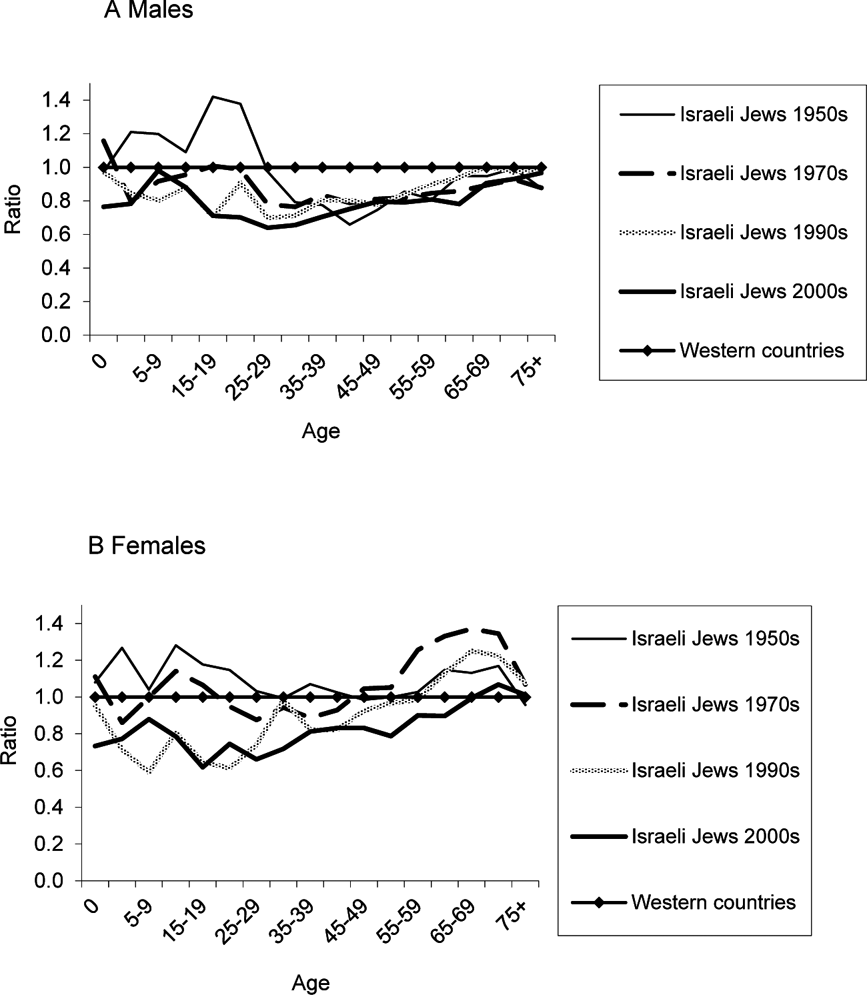
Tracing developments in life expectancy at birth obscures the relative mortality of Israeli Jews and Western populations in general at different ages. To capture this, the relationships between the age- and sex-specific mortality rates of Israeli Jews and those observed in Western countries at a few points in time are plotted (Fig. 1). This exercise reveals that the evolution of Israeli Jewish mortality is differentiated both by sex and by age. At younger ages (approximately up to age 30 years for males and age 55 years for females) mortality among Jews living in Israel was higher than that among Western populations in the 1950s. This elevated mortality largely disappears towards the 1970s and from that point onwards it is decisively replaced by relatively low mortality for both sexes. At ages over 55 years Israeli males continue to enjoy a mortality advantage over their Western counterparts, but this is rather less than the advantage enjoyed by men aged between 30 and 55 years. Among females aged over 55 years, however, Israeli Jews had higher mortality than Westerners until about 2000.
Ratios of death rates of Israeli Jews to the populations of Western countries, 1950s–2000s. Data for 1951–53, 1974–76, 1997–99 and 2006–08 were used for the 1950s, 1970s, 1990 and 2000s, respectively. The choice of specific years for presentation was informed by the desire to cover the entire Israeli history since the establishment of the state on one hand, and by the availability of published material on the other hand.

These findings suggest two defining features of an Israeli Jewish pattern of mortality. (1) Since the 1950s, mortality has become low relative to that of Western populations, though the process by which this has happened is differentiated in pace and intensity by age with older ages lagging behind younger ages. (2) Relative to their Western counterparts, Israeli males are in a more favourable position than Israeli females. This is a persistent feature observed at all times and most age groups, but it is especially pronounced at ages 55 years and over, where the mortality of male Israeli Jews has, at least since 1950, been equal to or lower than the mortality of Western males, while the mortality of female Israeli Jews was higher than that of females in the West until less than 10 years ago.
An implication of the results reported in this section is that the Israeli Jewish population is characterized by a smaller sex differential in mortality than European populations. This has attracted a considerable amount of scholarly attention. Most accounts, particularly the early ones, were mainly descriptive (Peritz et al., Reference Peritz, Dreyfuss, Halevi and Schmelz1973; Kark, Reference Kark1976; Preston, Reference Preston1976; United Nations Population Division, Reference Lopez and Ruzicka1983; United Nations, 1988; Leviatan & Cohen, Reference Leviatan, Cohen and Antonovsky1990; Shuval, Reference Shuval1992; Trovato & Lalu, Reference Trovato and Lalu1996; World Health Organization, 1996, 2006a; Sicron, Reference Sicron2004). More recently an interpretation focusing on the low levels of behaviourally induced mortality, and especially smoking-related mortality, among Israeli Jewish males has been offered to account for the observed patterns (Staetsky & Hinde, Reference Staetsky and Hinde2009; Staetsky, Reference Staetsky2011b). In contrast to sex differentials, age patterns in the relative mortality of Israeli Jews and European populations have been largely overlooked hitherto.
Eastern European populations
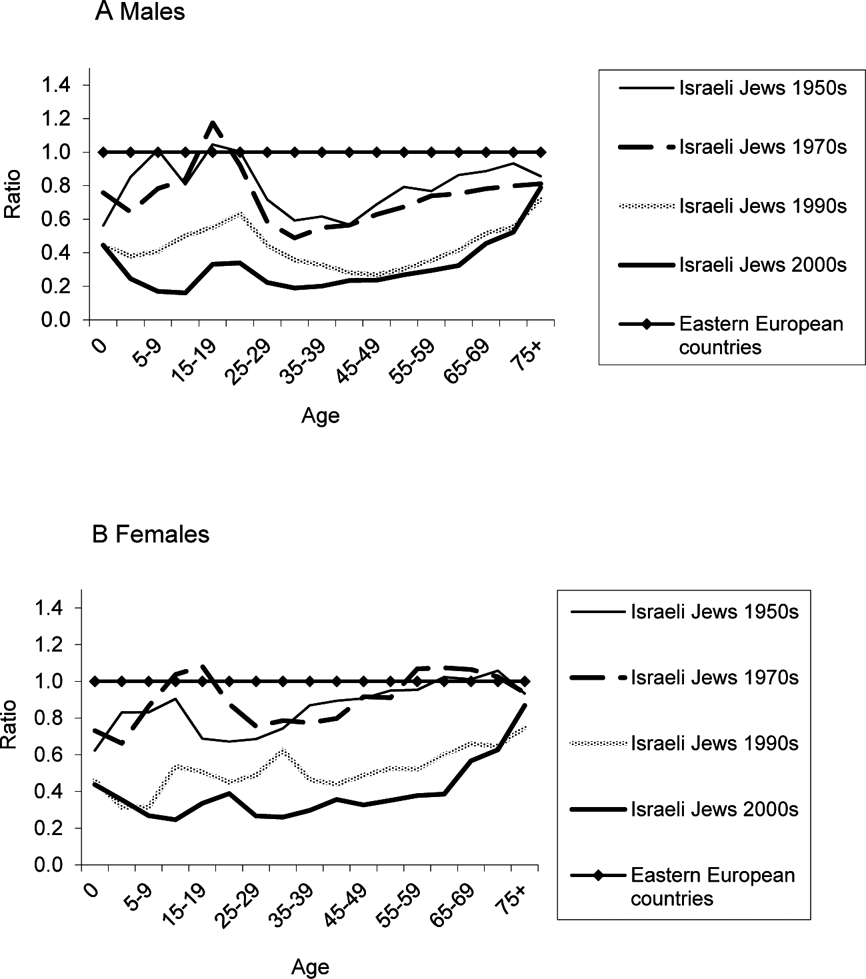
Israeli Jewish mortality has not been systematically compared with the Eastern European mortality schedules so far. This is unfortunate given that the current Jewish population of Israel largely originated through the migration of Jews from Eastern Europe. Such a comparison (Fig. 2) shows that already in the 1950s, when the majority of the Israeli Jewish population consisted of new immigrants, Israeli Jews displayed lower mortality than the populations of Eastern European countries for most age groups and for both sexes. Exceptions were Israeli Jewish females aged 60–74 years, who had mortality very similar to that of females of Eastern Europe.
Ratios of death rates of Israeli Jews to the populations of Eastern European countries, 1950s–2000s. Data for 1951–53, 1974–76, 1997–99 and 2006–08 were used for 1950s, 1970s, 1990, and 2000s, respectively. The choice of specific years for presentation was informed by the desire to cover the entire Israeli history since the establishment of the state on one hand, and by the availability of published material on the other hand.
Given that mortality in Eastern Europe was relatively high compared with Western populations, the expectation that shortly after immigration to Israel somewhat elevated mortality might be seen among Israeli Jews coming from Eastern Europe is not unreasonable (Peritz et al., Reference Peritz, Dreyfuss, Halevi and Schmelz1973; Shuval, Reference Shuval1992; Davies, Reference Davies, Waserman and Kottek1996; Hacohen, Reference Hacohen2003). This is especially true of old ages, at which mortality is often due to chronic conditions that express the accumulated effects of life conditions at younger ages and even before birth (Elo & Preston Reference Elo and Preston1992; Barker, Reference Barker1998; Barker et al., Reference Barker, Eriksson, Forsén and Osmond2002; Galobardes et al., Reference Galobardes, Lynch and Davey Smith2004). Therefore Jews migrating to Israel from relatively high-mortality environments in Eastern Europe are likely to have carried with them characteristics that elevated their mortality relative to Western populations. The comparison of Israeli Jewish mortality to that of Eastern European populations has shown that Israeli Jewish females ‘live up’ to this expectation, but this is not the case with Israeli Jewish males. The positioning of Israeli Jews relative to Eastern European countries improved dramatically after the 1970s, when a significant gap between these countries and Western Europe in the treatment and prevention of chronic diseases became apparent (Vallin & Mesle Reference Vallin, Mesle, Vallin, Mesle and Valkonen2001, Reference Vallin and Mesle2004; Nolte et al. Reference Nolte, Scholz and McKee2004).
Differences in mortality within the Israeli Jewish population
The purpose of this section is to establish whether the Israeli Jewish pattern of mortality, as previously described, is characteristic of all three subgroups of the Israeli Jewish population: foreign-born Jews originating from Europe (Ashkenazi), foreign-born Jews originating from Asia and Africa (Sephardi) and Jews born in Israel. The last of these groups presently forms the majority of Israeli Jews as a whole but only a minority among those aged 60 years and over. It is worth noting that the terms ‘Ashkenazi’ and ‘Sephardi’, used here to denote Jews born in Europe/America and Asia/Africa, are not precise as there are Sephardi Jews (a small minority) in European countries, and vice versa. It is employed here for brevity.
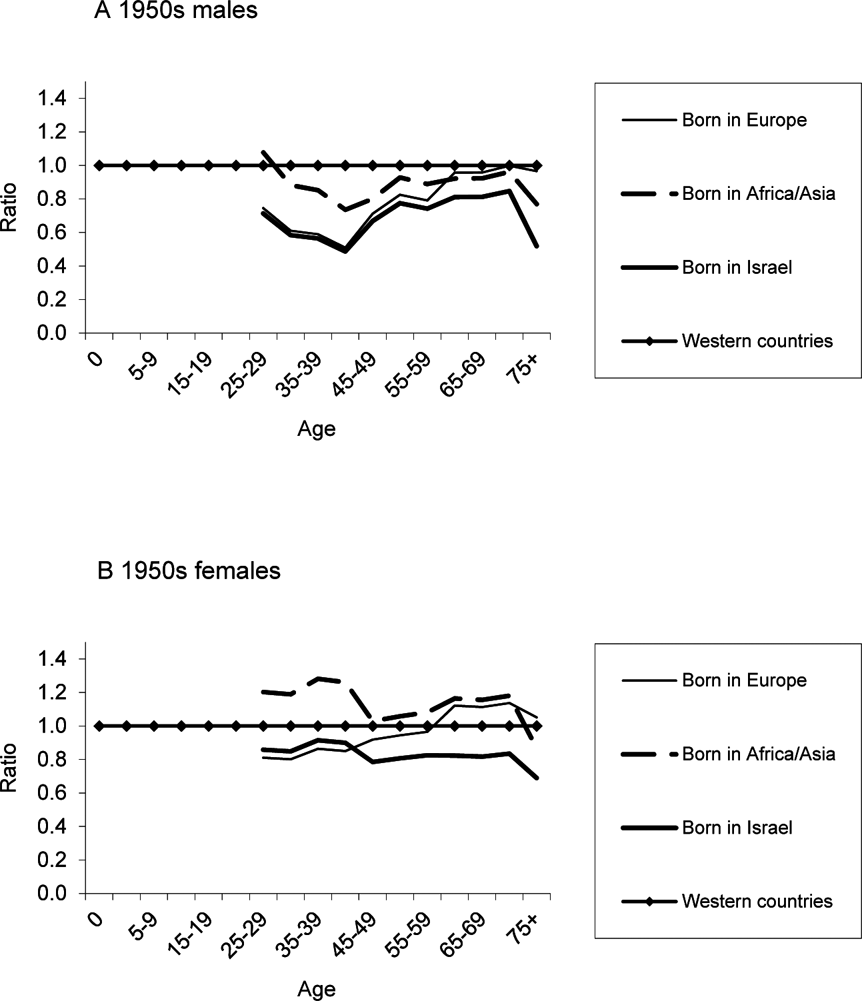
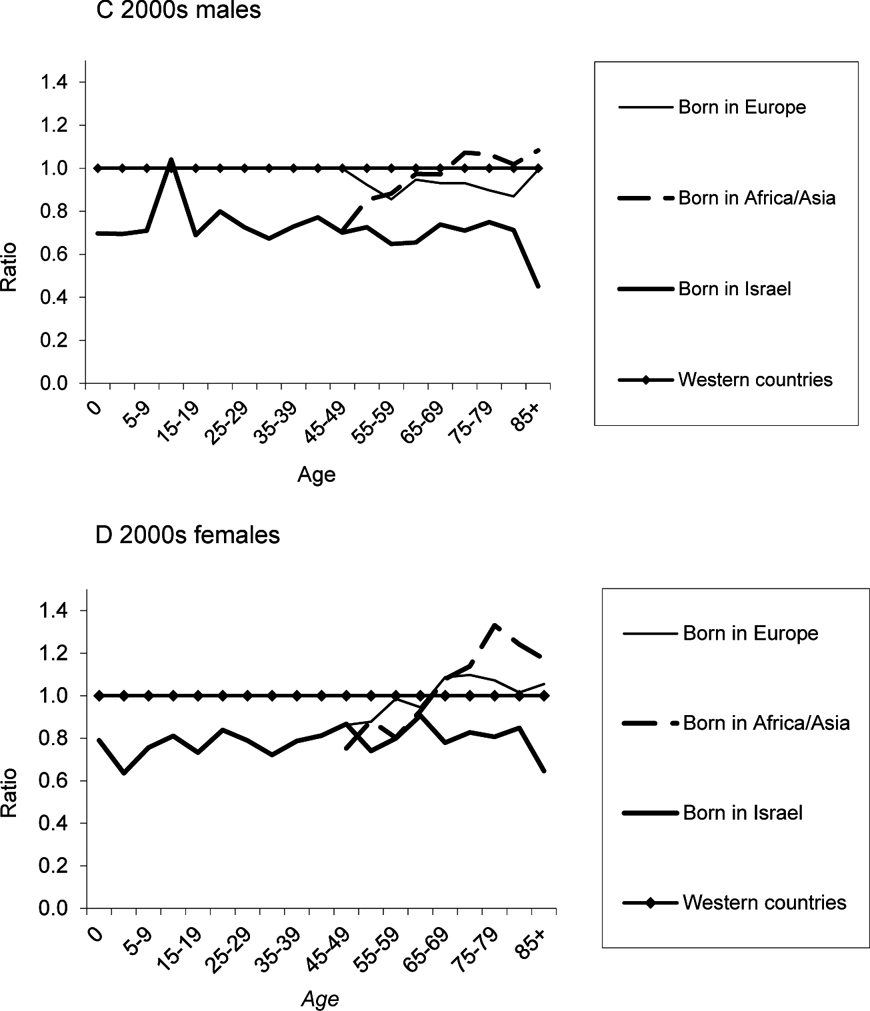
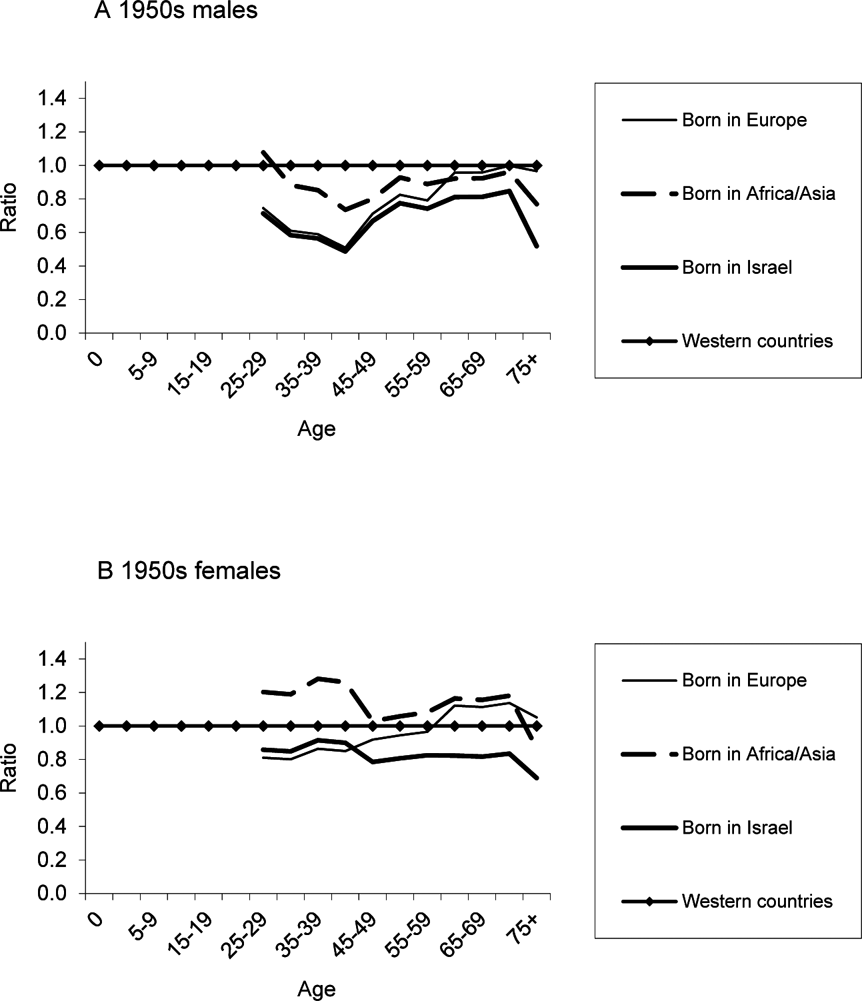
It is well documented that Ashkenazi Jews have lower mortality than Sephardi Jews (Peritz et al., Reference Peritz, Dreyfuss, Halevi and Schmelz1973; Eisenbach, Reference Eisenbach, Friedlander and Tamir1994; Friedlander et al., Reference Friedlander, Schellekens and Sharashov-Cohen1995; Manor et al., Reference Manor, Eisenbach, Peritz and Friedlander1999, Reference Manor, Eisenbach, Israeli and Friedlander2000). It is also clear that the mortality of Israeli-born Jews is, and has been, lower than among both foreign-born groups (Peritz et al., Reference Peritz, Dreyfuss, Halevi and Schmelz1973; Staetsky & Hinde, Reference Staetsky and Hinde2009). Rather than confine attention to within-Israel comparisons, however, this analysis examines the relationship of the mortality schedules of Ashkenazi and Sephardi foreign-born Jews, and of Israeli-born Jews, to the corresponding schedules of the comparator countries. The results for two periods, 1951–1953 and 2004–2005, are presented in Fig. 3. For all subgroups among Israeli Jews (European-born Jews, Jews born in Asia and Africa and Jews born in Israel) the positioning of Israeli males relative to the mortality schedules of Western countries is more favourable than that of Israeli females (Fig. 3, compare panel A with panel B, and panel C with panel D), confirming the second characteristic identified above.
Ratios of death rates of subgroups among Israeli Jews to Western countries, 1950s and 2000s. Data for 1951–53 and 2004–05 were used for the 1950s and 2000s, respectively. The choice of specific years for presentation was informed by the desire to cover as much as possible of Israeli history since the establishment of the state on one hand, and by the availability of published material on the other hand.
Continued
Let us look at male mortality separately. The most advantageous positioning is exhibited, overall, by Jewish males born in Israel, a well-defined feature already in the early 1950s. Ashkenazi males, as expected, display a more advantageous positioning than Sephardi males in relation to their counterparts in Western countries in most age groups. However, Sephardi males are not at a pronounced mortality disadvantage compared with men in Western countries, despite the fact that among Israeli Jewish males they have a rather low social and economic status. The first characteristic listed above – the trend by which Jewish mortality has become low relative to that of Western populations in general, with older ages lagging behind younger ages – is not observed among the Israeli-born Jews. In this subgroup relative positioning of older ages improves between 1951–1953 and 2004–2005 more than that of its younger ages. The first characteristic is partially confirmed, however, among male Jews born outside Israel. Relative to Western populations, in these foreign-born groups the mortality of males approximately above age 55 years mostly either remained stable or even rose between 1951–1953 and 2004–2005. Such a comparison was not possible for the younger ages since the number of deaths of foreign-born became too low for the Israeli statistical authority to publish.
And what of female mortality? Ashkenazi female mortality is higher in both 1951–1953 and 2004–2005 than mortality among females living in the West at ages 60 years and over (but not at ages 45–60 years). In 1951–1953 the mortality of Sephardi females at all ages is even higher relative to female mortality in the West. By 2004–2005 the excess mortality among Sephardi females is reduced at ages 65 years and over, and even reversed at ages 45–64 years. Israeli-born females exhibit lower mortality than both Ashkenazi and Sephardi females, and at all times Israeli-born females show significantly lower mortality than females in the West.
As with the males, the trend by which Jewish mortality improved relative to that of Western populations, with older ages lagging behind younger ages, is not observed among the Israeli-born Jewish females: relative positioning of older and younger ages improves between 1951–1953 and 2004–2005. Relative positioning of older ages among Jewish females born outside Israel also improves relative their comparators in the West, but it remains higher than in the West approximately after ages 60 years and over.
To sum up, while differentiated positioning of Israeli Jewish males and females relative to mortality schedules of their Western counterparts is a feature characteristic of all subgroups among Israeli Jews, differentiated evolution of mortality by age is not. It is not present among Jews born in Israel. For Jews born outside Israel this characteristic is not directly observable due to very low numbers of deaths at young ages in this group (a situation arising directly from the reduction in foreign-born population in these age groups, as will be shown shortly) and a subsequent decision of the Israeli statistical authority to discontinue publication of death rates for these groups, but this is meaningful in itself. This means that at young ages a shift to a more favourable positioning relative to Western mortality among Israeli Jewish population as a whole follows a compositional change, namely replacement of the foreign-born population by locally born. Smaller changes in positioning or stability at older ages, however, are the ‘responsibility’ of the subgroups of Jews born outside Israel.
Mortality of selected communities of Diaspora Jews
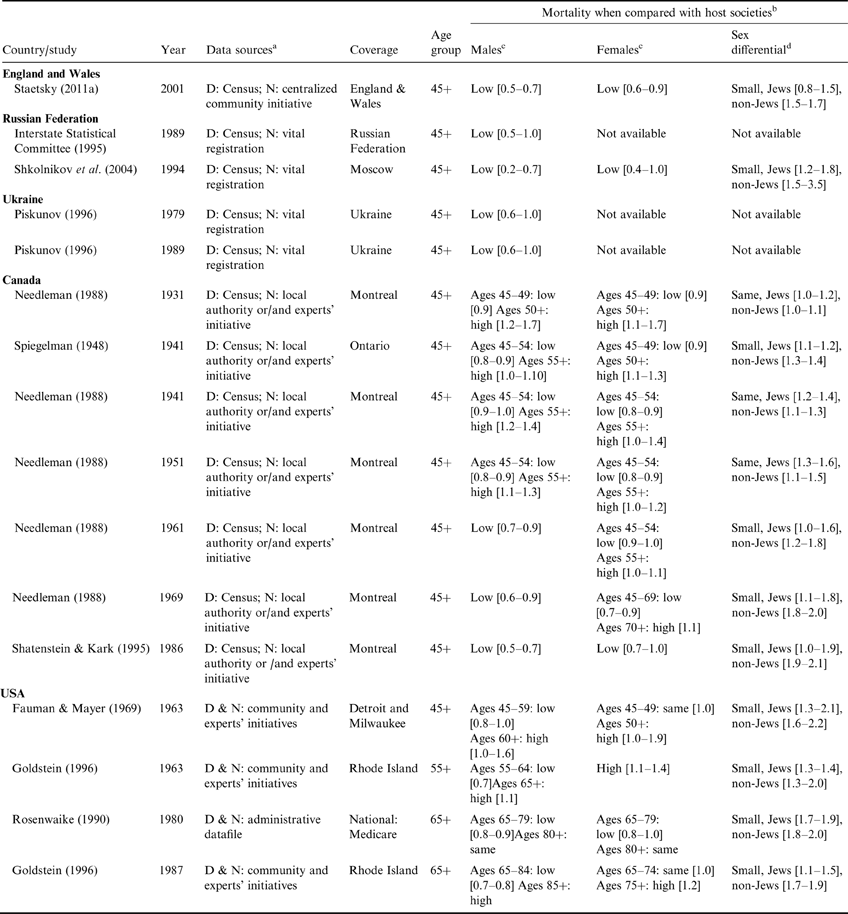
The major characteristics of the mortality of Diaspora Jews up to the 1970s – based largely on studies of North America – were relatively low mortality at young ages and relatively high mortality at older ages for both sexes, compared with the host populations (Spiegelman, Reference Spiegelman1948; Fauman & Mayer, Reference Fauman and Mayer1969; Needleman, Reference Needleman1988; Rosenwaike, Reference Rosenwaike1990; Goldstein, Reference Goldstein1996) (Table 1). In more recent studies (approximately since the 1970s) signs of a shift to a low level of mortality across young and old ages in males and females have been documented (Rosenwaike, Reference Rosenwaike1990; Shatenstein & Kark, Reference Shatenstein and Kark1995; Goldstein, Reference Goldstein1996; Staetsky, Reference Staetsky2011a).
Mortality of Diaspora Jews: summary of findings
a D, denominators; N, numerators.
b Age-specific mortality data for non-Jews can be found in the original sources except for the following cases: the Russian Federation, Moscow (data were received directly from V. Shkolnikov); Canada (data on mortality in provinces of Quebec and Ontario were obtained from the Canadian Human Mortality Database, 2007 (http://www.bdlc.umontreal.ca/chmd/index.htm), the United States of America, 1963 (data on the mortality of White Americans for comparison with the Jewish rates in Fauman & Mayer (Reference Fauman and Mayer1969) were obtained from Berkeley Mortality Database, 2006 (http://www.demog.berkeley.edu/~bmd/)). Age-specific mortality data for Jews came from the original sources, apart from the Russian Federation, Moscow (data were received directly from V. Shkolnikov); and Canada, Montreal (Jewish death rates were recalculated using population figures from Census 1991 provided by Charles Shahar, the Department of Community Planning, Federation Combined Jewish Appeal (CJA), Montreal, Canada).
c Ratios of Jewish to non-Jewish death rates appear in brackets.
d Ratios of male to female death rates appear in brackets.
Three facts, however, have not been given close attention in the literature on Jewish Diaspora mortality. First, the shift towards lower mortality than the host populations occurred earlier at all ages among males than females, and it occurred earlier in young age groups than at more advanced ages (Table 1, see the data for Canada and the USA). This somewhat resembles the development observed among Israeli Jews. Second, in nearly all instances, sex differentials in mortality observed among Jews are smaller than in the host populations. Moreover, small sex differentials in mortality across all ages existed both at the earlier and the later stages of evolution of the so-called ‘Jewish pattern of mortality’ in all Diaspora Jewish communities: they seem to have persisted under very different social, economic and political conditions, and under different levels of mortality. Again, this aspect of Diaspora Jewish mortality resembles the mortality patterns observed among Jews living in Israel. Finally, when Jewish mortality is compared with that of other Western populations, the shift from relatively high to low mortality at older ages took place later among Jews living in Israel than it did among the Jews of the Diaspora. While in North American Jewish populations it was achieved by the 1980s, it did not happen in Israel until the beginning of the twenty-first century.
Explaining Jewish mortality
What are the forces generating the observed pattern of mortality among Jews? In this section an explanation is proposed. The account starts from the observation that Jewish mortality is general low, and in particular, it is lower than that of most comparable Western populations. Another general observation is that the difference between the mortality of Jews and that of other Western populations is greater for males than females. It is proposed that this arises because Jewish men (and also women) protect their own health through their behaviour to a greater extent than do men (and women) in other populations, but that the impact is greater among men because of the greater tendency for men in other populations to engage in health-destructive behaviour. This accounts for the relatively low mortality observed among Jewish males in Israel, in Russia and the former Soviet Union, in North America from the 1970s, among Jewish females in North America from the 1980s, and among British Jews of both sexes in 2001.
A substantial amount of evidence has been accumulated to date in support of this claim. Staetsky & Hinde (Reference Staetsky and Hinde2009) showed that a significant part of the survival advantage of Israeli Jewish males over males in other Western countries is due to the lower mortality of the former from smoking-related cancers, cirrhosis of the liver (a cause strongly linked to alcohol abuse) and external causes. Staetsky (Reference Staetsky2011b) isolated the contribution of smoking-related mortality to the difference in life expectancy between Israeli Jews and the populations of Western countries. This exercise suggested that smoking-related mortality is largely responsible for the low mortality among Israeli Jewish males and that, if no-one smoked, mortality in this group would, in fact, be higher than male mortality in Western Europe. Staetsky (Reference Staetsky2011b) also indicated that intensity of smoking (quantity of tobacco consumed per unit of time) rather than prevalence of smoking was probably responsible for the modest impact of smoking on mortality of Israeli Jewish males.
Studies of Jewish mortality in North America and Russia have also documented relatively low mortality of Jews from causes linked to health-destructive behaviour. In Canada, Shatenstein & Kark (Reference Shatenstein and Kark1995) demonstrated relatively low Jewish mortality from diseases of the circulatory system for both sexes and from suicide for males. In the United States, Rosenwaike (Reference Rosenwaike1994), Herman & Enterline (Reference Herman and Enterline1970) and Seidman (Reference Seidman1971) reported relatively low Jewish mortality from lung cancer, chronic obstructive pulmonary disease and accidents. Shkolnikov et al. (Reference Shkolnikov, Andreev, Anson and Mesle2004) reported very similar findings within the context of the Jews of the Russian Federation. Numerous studies of Jews across the globe have reported a low prevalence and/or intensity of smoking and low levels of alcohol consumption both in the past and at present (Fishberg, Reference Fishberg1911; Snyder, Reference Snyder1958; Glassner & Berg, Reference Glassner and Berg1980; Baron-Epel et al., Reference Baron-Epel, Haviv-Messika, Tamir, Nitzan-Kaluski and Green2004; Staetsky, Reference Staetsky2011b).
There is significant evidence from the fields of anthropology and cultural history to suggest that Jews, and especially Jewish men, have adopted patterns of behaviour that can be considered relatively health-protective (Fishberg, Reference Fishberg1911; Hersch, Reference Hersch1948; Herman & Enterline, Reference Herman and Enterline1970; Horowitz & Enterline, Reference Horowitz and Enterline1970; Schmelz, Reference Schmelz1971; Seidman, Reference Seidman1971; Glassner & Berg, Reference Glassner and Berg1980; Condran & Kramarow, Reference Condran and Kramarow1991; Shuval, Reference Shuval1992; Boyarin, Reference Boyarin1997; Almog, Reference Almog2000; Becher et al., Reference Becher, Waterman, Kosmin and Thomson2003; Shkolnikov et al., Reference Shkolnikov, Andreev, Anson and Mesle2004). This incorporates non-involvement in anti-social activities, aversion to alcohol, especially binge drinking, moderate scope of smoking and relatively greater attention to health matters. Appearance of this type of behaviour has been linked to the lasting religious and socio-political conflict with the host societies, which marked hundreds of years of Jewish existence in Europe. It is, of course, possible that additional characteristics of Israeli Jewish society are conducive to low male mortality. Strong family structure and a significant social and family cohesiveness, enhanced by the long-term political and military conflict of Israel with its neighbours, might have a unique benefit for men preventing, for example, involvement in anti-social behaviour, encouraging the seeking of medical advice, providing emotional resources for coping with stress and disease, or facilitating health care (Shuval, Reference Shuval1992). Ultimately, however, both cultural and social explanations remain in the status of hypotheses as, to date, there has not been an empirical study formally trying to confirm or falsify these explanations. The question of why Jews exhibit more health-protective behavioural patterns, and, specifically, smoke less than non-Jews, is still open.
In general then, Jewish mortality is low. Where it is relatively high compared with Western populations in some age and sex groups, then it is being temporarily elevated by some ephemeral factor. The most important of these in the second half of the twentieth century was the migrant origin of Jews of certain ages. This paper's argument is that migrants retain, after their migration, essential features of the mortality of their origin populations, so that their mortality fails to converge completely with that of the host population. In the case of Jewish migrants the mortality of their origin populations was higher than of the host populations everywhere, and hence mortality in those age groups that were predominantly made up of migrants would be elevated by the legacy of the mortality regime in the countries of origin.
To facilitate evaluation of the evidence supporting this claim the lasting impact of migration on the population structure of Jews living in Israel and the United States in the twentieth century is illustrated. Throughout the whole of the second half of the twentieth century, old age mortality in Israel was dominated by the foreign-born population: at ages 60 years and over, for example, the proportion of Israeli-born Jews never exceeded 20%, and even for ages 45–59 years it never exceeded 45%. At younger ages (for example, up to 34 years), Israeli-born Jews became an absolute majority some time between the 1970s and the 1990s (Central Bureau of Statistics, Israel, various dates). In the United States the foreign-born became a definite minority (below 30%) for ages 65 years and over at some time after the 1970s, while among those below age 40 years the foreign-born became a minority (under 10%) already before the 1970s (Chenkin, Reference Chenkinno date). In sum, in both populations at all times the proportion of foreign-born was much greater at high ages than among the young but it also declined with time for all age groups, especially the young, and this decline with time happened earlier in the United States than in Israel. Migrants to both Israel and the United States came from populations where mortality was high relative to that in their destination, such as Eastern Europe, the former Soviet Union, the Middle East and North Africa. Life expectancy at birth in the Western world during the early 1950s was about 68 years, and it was about 65 years in Eastern Europe (Human Mortality Database, 2011).
What matters for the purposes of this article, however, is not so much the overall mortality in the origin population compared with that of the host population, but the likely mortality of Jews in the origin populations. Examination of infant and child mortality data compiled by Schmelz (Reference Schmelz1971) shows that although death rates characteristic of Eastern and Central European Jews were lower than the general or the non-Jewish population of these countries (by 30–60%) they were still 2–10 times higher, depending on the specific comparison, than the rates of Western European Jewish and non-Jewish populations. Equally, in the 1970s, the 1980s and the 1990s the death rates of Russian and Ukrainian Jewish males aged 45 years and over were lower than those of Ukrainian and Russian males and 20–40% higher than the corresponding rates in Western countries (Interstate Statistical Committee of the Commonwealth of Independent States, 1995; Piskunov, Reference Piskunov1996; Shkolnikov et al., Reference Shkolnikov, Andreev, Anson and Mesle2004). Life expectancy at birth for Jews of North Africa, Iran, Iraq and Turkey prior to migration to Israel was estimated to be in the range of 42–52 years and as low as 19–24 years for Jews of Yemen (Peritz et al., Reference Peritz, Dreyfuss, Halevi and Schmelz1973). In Tunisia the crude death rates of Jews were lower than those of Muslims but higher than among local communities of European origin (Cattan et al., Reference Cattan, Mallet and Feingold2007). In short, although the mortality of Jews living in Eastern Europe, the Middle East and North Africa prior to migration was somewhat lower than mortality among non-Jews in these regions, it was still higher than mortality in the Western world, and hence higher than that among Jewish populations living in Israel and the United States.
The contribution of elevated mortality among migrant Jews to an explanation of recent mortality patterns among the Jewish population of Israel is thus supported empirically by the following observations. First, the movement from elevated to low mortality among young ages parallels the reduction in proportion of foreign-born in this group. In the case of Israeli Jews this transition happened some time between the 1950s and the 1970s (Fig. 1) while among Canadian and American Jews relatively low mortality among young ages (dominated by the locally born populations) had been established already by the 1930s and the 1960s respectively (Table 1). The earlier timing of the transition in the North American Diaspora communities can be expected given the earlier evolution of these communities from the waves of Jewish migration originating in Eastern Europe. At old ages Jews retain elevated mortality in parallel with the high proportion of migrants. This phenomenon is most conspicuous among Jewish females. Indeed, Israeli Jewish females aged 65 years and over exhibited elevated mortality well into the first decade of the twenty-first century (Fig. 1). However, Staetsky (Reference Staetsky2011b) showed that smoking-free mortality of Israeli Jewish males is also higher than the average smoking-free Western European mortality – a finding that is consistent with the migration hypothesis, given that the majority of Israeli Jews in old age groups were first-generation migrants. In the North American Jewish populations the elevated mortality of females gradually disappeared somewhere between the 1960s and the 1980s (Table 1). Again, the difference between Israel and the North American Diaspora is understandable in view of the difference in timing of evolution of these communities from the waves of Jewish migration.
Second, the mortality of Israeli-born Jews residing in Israel is relatively low when compared with Western countries: this is observed at all times for males and since the 1970s for females. Staetsky & Hinde (Reference Staetsky and Hinde2009) showed that in the 1990s Israeli-born Jews residing in Israel exhibited relatively low mortality across all major groups of causes of death (cardiovascular diseases, cancer, external causes).
Third, among the populations of Jews residing in Russia, Ukraine and the Middle East/North Africa, the source countries of Jewish migration towards Israel and North America, mortality is low relative to the host populations. At the same time, mortality of these populations is higher than mortality in the West.
What is the mechanism maintaining elevated mortality of the first migrant generation? Research into the impact of pre-natal and early-life conditions on mortality at more advanced ages suggests that conditions experienced by an embryo at different stages of gestation might have an impact on later onset of certain chronic diseases, in particular cardiovascular disorders, metabolic disorders, respiratory conditions and cancer (Goldman, Reference Goldman1980; Elo & Preston, Reference Elo and Preston1992; Preston et al., Reference Preston, Hill and Drevenstedt1998; Noymer & Garenne, Reference Noymer and Garenne2000; Doblhammer, Reference Doblhammer2004; Galobardes et al. Reference Galobardes, Lynch and Davey Smith2004, Reference Galobardes, Lynch and Davey Smith2008; Gluckman & Hanson, Reference Gluckman and Hanson2004, Reference Gluckman, Hanson, Gluckman and Hanson2006; Hayward & Gorman, Reference Hayward and Gorman2004; Kuh & Ben-Shlomo, Reference Kuh, Ben-Shlomo, Kuh and Ben-Shlomo2004; Kuh & Davey Smith, Reference Kuh, Davey Smith, Kuh and Ben-Shlomo2004; Lawlor et al., Reference Lawlor, Ben-Shlomo, Leon, Kuh and Ben-Shlomo2004; Godfrey, Reference Godfrey, Gluckman and Hanson2006; Janssen et al., Reference Janssen, Kunst and Mackenbach2007). Examples of adverse conditions experienced by the mother during pregnancy and/or by the child in infancy and childhood include under- and overnutrition, nutritional imbalance and infectious diseases. All these might affect genes' expression, the formation of tissues, organs and metabolic processes at early stage in an irreversible way, creating predispositions to diseases through increased sensitivity to risk factors operating in later life or purely anatomical/physiological vulnerability. Poor nutrition in utero and during childhood years has been linked to subsequently increased mortality and morbidity from cardiovascular diseases and diabetes with poor insulin and lipid regulation, elevated blood pressure and inadequate heart functioning being major mechanisms (Galobardes et al., Reference Galobardes, Lynch and Davey Smith2004, Reference Galobardes, Lynch and Davey Smith2008; Kuh & Ben-Shlomo, Reference Kuh, Ben-Shlomo, Kuh and Ben-Shlomo2004; Lawlor et al., Reference Lawlor, Ben-Shlomo, Leon, Kuh and Ben-Shlomo2004). Exposure to infections in early life has been linked to certain types of cancer: most notably links have been established between early exposure to Helicobacter pilori and stomach cancer; between early exposure to hepatitis B virus and liver diseases, including cirrhosis and cancer; and between early exposure to streptococcal respiratory tract infection and rheumatic heart disease (Goldman, Reference Goldman1980; Parsonnet et al., Reference Parsonnet, Friedman, Vandersteen, Chang, Vogelman, Orentreich and Sibley1991; Elo & Preston, Reference Elo and Preston1992; Dos Santos Silva, Reference Dos Santos Silva, Kuh and Ben-Shlomo2004; Ott et al., Reference Ott, Paltiel, Winkler and Becher2008). Respiratory tuberculosis is often acquired in childhood and harboured for many years before the onset of active disease (Elo & Preston, Reference Elo and Preston1992; Noymer & Garenne, Reference Noymer and Garenne2000).
Israeli epidemiologists and demographers are increasingly admitting that the processes of change in migrants' imported predispositions to diseases can be slow (Goldbourt, Reference Goldbourt2002). Also, findings compatible with the possibility that adult mortality is influenced by conditions applying in early life (e.g. elevated mortality from chronic conditions associated with infectious diseases acquired early in life) were reported within the Israeli context by Parkin & Khlat (Reference Parkin and Khlat1996) and Ott et al. (Reference Ott, Paltiel, Winkler and Becher2008). These findings and conceptualizations have never been used, to the authors' knowledge, for systematic explanation of differences in mortality of Israeli Jews when compared with Western populations.
Conclusions
This paper has described and interpreted commonalities in mortality among Jews of Israel and major populations of the Jewish Diaspora. It presents a new account of trends and patterns in the mortality of Jews living in Israel and North America since 1950, though it may well be that this account is relevant to Jews living in other countries, such as Britain. Jewish mortality during this period is marked by two features: (1) the gradual evolution of low mortality relative to the mortality of the surrounding non-Jewish population in a process differentiated by age with older ages lagging behind younger ages, and (2) the more favourable positioning of Jewish males than Jewish females relative to the mortality levels of their Western counterparts.
This account is based on an underlying tendency for Jews to have low mortality compared with non-Jewish populations because of their low incidence of health-destructive behaviour. This tendency leads to the mortality differential between Jews and non-Jews being greater for males than females, because health-destructive behaviour is more common among males in non-Jewish populations. Superimposed on this general feature of Jewish mortality are distortions caused by specific ephemeral factors. The most important is the fact that Jewish populations in the second half of the twentieth century were substantially composed of migrants from higher mortality environments. This explains the existence of relatively high mortality among Jews in the earlier part of the period, the general shift to low mortality as the first migrant generation died, and longer preservation of relatively high mortality among Jewish females than males.
Jewish history of the last 150 years can be likened to a demographic laboratory, in which a natural experiment was set up. The dominant development of this period was a mass relocation of the Jewish communities of Central and Eastern Europe and the Middle East to North America and Israel. In the course of relocation two features were common for different migrant groups among Jews: (1) a shared genetic pool and (2) the nature of transition: from relative poverty in Eastern Europe and the Middle East to conditions of relative affluence and high-quality health care in the West and Israel. What differed was the actual timing of relocation: the late nineteenth and early twentieth centuries for migrants to North America, and the mid-twentieth century for migrants to Israel. The shift from relatively high to low mortality in the course of the twentieth century, a process differentiated by age and sex, is present in both instances, and only the timing is different: it happened earlier among in the Diaspora communities and somewhat later in Israel.
This account excluded genetic factors and it is appropriate to briefly consider their role in shaping the patterns of Jewish mortality. There is ample literature on genetic peculiarities of Jews and the impact it may have on their longevity. Feldman (Reference Feldman2001), Kedar-Barnes & Rozen (Reference Kedar-Barnes and Rozen2004), Lynch et al. (Reference Lynch, Rubinstein and Locker2004), Rubinstein (Reference Rubinstein2004) and Shkolnikov et al. (Reference Shkolnikov, Andreev, Anson and Mesle2004) reviewed studies in clinical and population genetics that enabled them to establish that gene alleles predisposing to certain disorders, and specifically to cancer (breast, ovarian and colorectal), are more prevalent among Jews, and especially, Ashkenazi Jews, than in other populations. Hasin et al. (Reference Hasin, Aharonovitch, Liu, Mamman, Matseoane, Carr and Li2002) presented findings supporting the idea that Jews are protected against alcoholism due to higher prevalence of particular replica of a gene responsible for alcohol metabolism.
It is not easy to quantify the effects of the existing genetic predisposition, given that both cancer and cardiovascular diseases are notoriously multifactorial. To estimate the effects of certain genotypes at the level of populations we need information on the frequency of risk-carrying alleles in populations and probabilities of genes' expression, conditioned on various environmental factors, by age and sex. In cases where partial knowledge of the required nature exists, the effect of genetic conditions has proved to be rather small at the population level and they are unlikely to explain much of the variation across societies (see, for example Rahman & Stratton, Reference Rahman and Stratton1998).
Another way of evaluating the importance of genetic arguments is to examine mortality in various Jewish collectives largely sharing the same genetic pool but subject to different cultural, social and environmental conditions, such as Jewish Diaspora communities. Indeed, great variation in levels of mortality from cardiovascular diseases and cancer is found. The elevated levels of cardiovascular mortality characteristic of Israeli females are not found in other Jewish collectives, at least since the 1970s. Elevated mortality of Jewish females from cancer, including breast cancer, characterizes certain populations (Russia) but not others (Canada and the United States of America). Significant variation is found also in relation to colon cancer, diabetes and cerebrovascular disease, for males and females alike (Rosenwaike, Reference Rosenwaike1994; Shatenstein & Kark, Reference Shatenstein and Kark1995; Feldman, Reference Feldman2001; Shkolnikov et al., Reference Shkolnikov, Andreev, Anson and Mesle2004). This is not to say that genetic factors have no impact on Jewish mortality patterns, but rather to emphasize that, given the extent of the observed variation, it is difficult to see how they can play a major role (Potter, Reference Potter2003; Pierce et al., Reference Pierce, Foliaki, Sporle and Cunningham2004).
Thus, the authors maintain that the migrant origin and the low level of avoidable mortality are two chief forces ‘competing’ for expression in the mortality schedules of Jews. In the second half of the twentieth century, the migrant origin operated to inflate Jewish mortality while the low level of avoidable mortality operated in the opposite direction. This explanatory framework allows us to understand commonalities and differences seen in levels and trends in mortality of Jews in Israel and the major Diaspora communities as manifestations of the same process.