Major depressive disorder (MDD) represents a significant public health concern, with estimates of lifetime MDD ranging from 13% to 16% in the United States (Hasin, Goodwin, Stinson, & Grant, Reference Hasin, Goodwin, Stinson and Grant2005; Kessler, et al., Reference Kessler, Berglund, Demler, Jin, Koretz, Merikangas and Wang2003). Women are more likely to experience depression than men (Kessler, Reference Kessler2003), with the highest rates of depression occurring among women of childbearing and child-raising years (Heneghan, Silver, Westbrook, Bauman, & Stein, Reference Heneghan, Silver, Bauman, Westbrook and Stein1998; Kessler, Reference Kessler2003; Kessler, McGonagle, Swartz, Blazer, & Nelson, Reference Kessler, McGonagle, Swartz, Blazer and Nelson1993). Moreover, racial and ethnic minority women and economically disadvantaged women are especially vulnerable to depression (Andrade et al., Reference Andrade, Caraveo-Anduaga, Berglund, Bijl, Graaf, Vollebergh and Wittchen2003; Siefert, Bowman, Heflin, Danziger, & Williams, Reference Siefert, Bowman, Heflin, Danziger and Williams2000) and often experience more barriers and less access to quality mental health treatment (Alegria et al., Reference Alegria, Chatterji, Wells, Cao, Chen, Takeuchi and Meng2008).
Research has demonstrated that offspring of depressed mothers are at heightened risk for a variety of negative outcomes throughout development. These include insecure attachment, depression and anxiety, behavior problems, social and cognitive difficulties, academic problems, and physical illness (Atkinson et al., Reference Atkinson, Paglia, Coolbear, Niccols, Parker and Guger2000; Beardslee, Versage, & Gladstone, Reference Beardslee, Versage and Gladstone1998; Campbell, Morgan-Lopez, Cox, & McLoyd, Reference Campbell, Morgan-Lopez, Cox and McLoyd2009; Cicchetti, Rogosch, & Toth, Reference Cicchetti, Rogosch and Toth1998; Cicchetti & Toth, Reference Cicchetti, Toth, Cicchetti and Cohen1995; Cummings, Keller, & Davies, Reference Cummings, Keller and Davies2005; Goodman & Gotlib, Reference Goodman and Gotlib1999; Goodman et al., Reference Goodman, Rouse, Connell, Broth, Hall and Heyward2011; Gunlicks & Weissman, Reference Gunlicks and Weissman2008; Lieb, Isensee, Hofler, Pfister, & Wittchen, Reference Lieb, Isensee, Höfler, Pfister and Wittchen2002; Martins & Gaffan, Reference Martins and Gaffan2000; Weissman, Wickramaratne, et al., Reference Weissman, Wickramaratne, Nomura, Warner, Pilowsky and Verdeli2006). Meta-analytic results indicate that the effect sizes for associations between maternal depression and children's internalizing and externalizing symptomatology and general psychopathology were all statistically significant, but small in magnitude (Goodman et al., Reference Goodman, Rouse, Connell, Broth, Hall and Heyward2011). Effect sizes for the relations between maternal depression and children's symptomatology and negative affect are stronger for younger children (Connell & Goodman, Reference Connell and Goodman2002; Goodman et al., Reference Goodman, Rouse, Connell, Broth, Hall and Heyward2011), suggesting that children with early developmental exposure to maternal depression are at particular risk for negative outcomes.
Interpersonal psychotherapy (IPT) is a manualized psychosocial intervention for MDD that has repeatedly been shown to be efficacious (i.e., Elkin et al., Reference Elkin, Shea, Watkins, Imber, Sotsky, Collins and Parloff1989; Hollon & Ponniah, Reference Hollon and Ponniah2010; Persons, Thase, & Crits-Christoph, Reference Persons, Thase and Crits-Christoph1996; Toth et al., Reference Toth, Rogosch, Oshri, Gravener-Davis, Sturm and Morgan-Lopez2013). IPT targets interpersonal aspects of depression with possible focus areas including interpersonal transitions, disputes, grief, or interpersonal deficits (Klerman, Weissman, Rounsaville, & Chevron, Reference Klerman, Weissman, Rounsaville and Chevron1984; Stuart & Robertson, Reference Stuart and Robertson2003; Weissman, Markowitz, & Klerman, Reference Weissman, Markowitz and Klerman2000). The efficacy of IPT also has been demonstrated with diverse populations, including socioeconomically disadvantaged and minority women (Krupnick et al., Reference Krupnick, Green, Stockton, Miranda, Krause and Mete2008; Talbot et al., Reference Talbot, Conwell, O'Hara, Stuart, Ward, Gamble and Tu2005; Toth et al., Reference Toth, Rogosch, Oshri, Gravener-Davis, Sturm and Morgan-Lopez2013).
Given the evidence that IPT is efficacious for reducing depressive symptoms among mothers (Toth et al., Reference Toth, Rogosch, Oshri, Gravener-Davis, Sturm and Morgan-Lopez2013), the aim of the present study was to expand on this previous work and determine whether successfully treating maternal depression via IPT may lead to more widespread positive adaptation for children and mothers. The notion that changes in outcomes for one family member as a result of an intervention may subsequently affect changes for other family members has been described as “collateral change” (Patterson, Forgatch, & DeGarmo, Reference Patterson, Forgatch and DeGarmo2010, p. 950). Patterson et al. (Reference Patterson, Forgatch and DeGarmo2010) regard this continued spreading or expanding of positive change to other family members as “a bonus of the intervention” (p. 950). For example, Peltz, Rogge, Rogosch, Cicchetti, and Toth (Reference Peltz, Rogge, Rogosch, Cicchetti and Toth2015) demonstrated collateral change in their study of child–parent psychotherapy. The results indicated that mothers who received child–parent psychotherapy to improve attachment security with their child also experienced improvements in their marital relationship. Collateral change is consistent with a developmental cascades theoretical framework. A developmental cascades framework refers to the way in which changes in one system, domain, or level may spread to other systems, domains, or levels over time and contribute to the development of adaptive behavior (Masten & Cicchetti, Reference Masten and Cicchetti2010). Thus, our goal was to determine how reducing maternal depression as a result of IPT may be the first step in a progression of positive outcomes for the broader family context including improved mother–toddler attachment, improved maternal parenting efficacy, and improved toddler temperament.
Maternal Depression, Attachment Quality, and Parenting
As described above, children of depressed mothers are at risk for myriad negative developmental outcomes. Insecure mother–child attachment (Cummings & Cicchetti, Reference Cummings, Cicchetti, Greenberg, Cicchetti and Cummings1990) and suboptimal maternal parenting beliefs and behaviors (Downey & Coyne, Reference Downey and Coyne1990; Gelfand & Teti, Reference Gelfand and Teti1990; Turney, Reference Turney2011) are theorized to underlie this risk process. Establishing a secure attachment relationship with a parent is a critical developmental task during the early years of life. A considerable body of research has documented associations between maternal depression and disruptions in offspring attachment security (e.g., Carter et al., Reference Carter, Garrity-Rokous, Chazan-Cohen, Little and Briggs-Gowan2001; Cummings & Davies, Reference Cummings and Davies1994; Hayes, Goodman, & Carlson, Reference Hayes, Goodman and Carlson2013; Lyons-Ruth, Connell, Grunebaum, & Botein, Reference Lyons-Ruth, Connell, Grunebaum and Botein1990; Martins & Gaffan, Reference Martins and Gaffan2000; Murray, Reference Murray1992; Teti, Gelfand, Messinger, & Isabella, Reference Teti, Gelfand, Messinger and Isabella1995; Toth, Rogosch, Manly, & Cicchetti, Reference Toth, Rogosch, Manly and Cicchetti2006; Toth, Rogosch, Sturge-Apple, & Cicchetti, Reference Toth, Rogosch, Sturge-Apple and Cicchetti2009). For instance, in a study of toddlers of depressed mothers, 43.5% of toddlers of depressed mothers evidenced insecure attachment, compared to 18.2% of toddlers of nondepressed mothers (Cicchetti et al., Reference Cicchetti, Rogosch and Toth1998). Meta-analysis of this literature has revealed a significant overall effect of maternal depression on attachment security, with larger effect sizes found among clinical samples of maternal depression, rather than among nonclinical samples (Atkinson et al., Reference Atkinson, Paglia, Coolbear, Niccols, Parker and Guger2000). Moreover, meta-analytic results also indicate a consistent effect of maternal depression on disorganized attachment (Martins & Gaffan, Reference Martins and Gaffan2000). Mothers’ expressed emotion has been identified as a mechanism underlying the association between maternal depression and toddler attachment security (Gravener et al., 2011).
Disorganized attachment early in development places children at heightened risk for future maladaptation. When in stressful situations, individuals with disorganized attachment have been theorized to lack a consistent organized approach to emotion regulation and may experience dissociative states, thus increasing risk for psychopathology and aggressive behaviors (Carlson, Reference Carlson1998). Previous research has shown that infants with disorganized attachment are more likely to develop maladaption, especially externalizing symptomatology and aggressive violent behaviors (Groh, Roisman, van IJzendoorn, Bakermans-Kranenburg, & Fearon, Reference Groh, Roisman, van IJzendoorn, Bakermans-Kranenburg and Fearon2012; Fearon, Bakermans-Kranenburg, van IJzendoorn, Lapsley, & Roisman, Reference Fearon, Bakermans-Kranenburg, van IJzendoorn, Lapsley and Roisman2010; MacDonald et al., Reference MacDonald, Beeghly, Grant-Knight, Augustyn, Woods, Cabral and Frank2008; van IJzendoorn, Schuengel, & Bakermans-Branenburg, Reference van IJzendoorn, Schuengel and Bakermans-Kranenburg1999), and are more likely to experience difficulty with peer relations (Jacobvitz & Hazan, Reference Jacobvitz, Hazen, Solomon and George1999). Therefore, interventions to mitigate disorganized attachment are critical to fostering adaptive development. Whether reducing maternal depressive symptoms via IPT may have the additional benefit of improving toddler–mother attachment has yet to be determined.
In addition to disruptions in secure attachment among offspring of depressed mothers, maladaptive parenting beliefs and behaviors also function to mediate risk associated with maternal depression (Cummings et al., Reference Cummings, Keller and Davies2005; Downey & Coyne, Reference Downey and Coyne1990; Gelfand & Teti, Reference Gelfand and Teti1990; Goodman & Gotlib, Reference Goodman and Gotlib1999, Reference Goodman and Gotlib2002; Hoffman, Crnic, & Baker, Reference Hoffman, Crnic and Baker2006; McConley et al., Reference McConley, Mrug, Gilliland, Lowry, Elliott, Schuster and Franklin2011; Turney, Reference Turney2011). Coercive behavior, hostility, inconsistency, and less responsivity and engagement have all been identified as parenting behaviors associated with maternal depression (Lovejoy, Graczyk, O'Hare, & Neuman, Reference Lovejoy, Graczyk, O'Hare and Neuman2000). Moreover, parental efficacy beliefs, or the degree to which parents perceive themselves as able to master the varied tasks associated with parenting a child, have emerged as a strong, direct predictor of positive parenting practices (Ardelt & Eccles, Reference Ardelt and Eccles2001; Izzo, Weiss, Shanahan, & Rodriguez-Brown, Reference Izzo, Weiss, Shanahan and Rodriguez-Brown2000). Research has identified a link between higher levels of maternal depression and lower levels of maternal parenting efficacy (Jones & Prinz, Reference Jones and Prinz2005; Kohlhoff & Barnett, Reference Kohlhoff and Barnett2013; Michl, Handley, Rogosch, Cicchetti, & Toth, Reference Michl, Handley, Rogosch, Cicchetti and Toth2015). Taken together, it is evident that depressed mothers are vulnerable to maladaptive parenting beliefs and behaviors, both of which heighten risk among offspring. Whether successfully treating maternal depression via IPT may contribute to improvements in mothers’ beliefs about their parenting abilities remains unknown.
Maternal Depression and Offspring Temperament
Early temperamental characteristics have also been linked with a number of developmental outcomes, including the development of maladaption (Bijttebier & Roeyers, Reference Bijttebier and Roeyers2009; De Pauw & Mervielde, Reference De Pauw and Mervielde2010; Muris & Ollendick, Reference Muris and Ollendick2005; Nigg, Reference Nigg2006; Rothbart & Posner, Reference Rothbart, Posner, Cicchetti and Cohen2006). Rothbart and Posner (Reference Rothbart, Posner, Cicchetti and Cohen2006) define temperament as “constitutionally based individual differences in reactivity and self-regulation, as observed in the domains of emotionality, motor activity, and attention” (p. 466). For instance, early childhood negative emotionality has been shown to enhance risk for the development of externalizing and internalizing symptoms 2 years later (Eisenberg et al., Reference Eisenberg, Valiente, Spinrad, Cumberland, Liew, Reiser and Losoya2009).
Furthermore, research indicates that mothers’ depressive symptoms shape their own perceptions and ratings of their infants’ temperament (McGrath, Records, & Rice, Reference McGrath, Records and Rice2008) such that mothers with higher levels of stress and depressive symptoms tend to view their offspring more negatively. Pauli-Pott et al. (Reference Pauli-Pott, Mertesacker, Bade, Bauer and Beckmann2000) did not find a relation between maternal depression and observer ratings of offspring temperament, suggesting depressed mothers may view their children differently than do outside observers. However, it is evident that mothers’ perceptions of their children's temperament should not be discounted. Specifically, research indicates that parents’ views of their infants’ temperaments are predictive of future observer assessment of infants’ temperament (Pauli-Pott, Mertesacker, Bade, Haverkock, & Beckmann, Reference Pauli-Pott, Mertesacker, Bade, Haverkock and Beckmann2003), thus indicating that the way in which parents’ perceive their infants’ temperament actually shapes the future development of the infants’ temperamental characteristics. Therefore, although depressed mothers may not provide objective reports of their children's temperament, this negative bias is important because it may heighten children's risk for future maladaptation. Interventions targeting maternal depression may have the added benefit of not only improving mothers’ depression but also subsequently reducing the bias in mothers’ appraisals of their children, which may contribute to their children's positive adaptation later in development. Understanding whether reducing maternal depression by way of IPT may foster more positive maternal perceptions of toddler temperament has yet to be determined.
Remission of Maternal Depression and Child Outcomes
Although it is clear that maternal depression may negatively impact offspring in a variety of critical developmental domains, there is also empirical evidence that remission of maternal depressive symptoms may function to reduce offspring risk (Cuijpers, Weitz, Karyotaki, Garber, & Andersson, Reference Cuijpers, Weitz, Karyotaki, Garber and Andersson2015; Garber et al., Reference Garber, Clarke, Weersing, Beardslee, Brent, Gladstone and Iyengar2009; Gunlicks & Weissman, Reference Gunlicks and Weissman2008). For example, the Sequenced Treatment Alternatives to Relieve Depression study has shown that among children of depressed mothers, children of mothers whose depression remitted experienced fewer current psychiatric symptoms and diagnoses compared to children of nonremitting mothers (Weissman, Pilowsky, et al., Reference Weissman, Pilowsky, Wickramaratne, Talati, Wisniewski, Fava and Rush2006). Study results also indicate sustained benefits in children a year after their mothers’ depression remitted (Wickramaratne et al., Reference Wickramaratne, Gameroff, Pilowsky, Hughes, Garber, Malloy and Fava2011). In a sample of depressed and nondepressed parents and their children, Garber, Ciesla, McCauley, Diamond, and Schloredt (Reference Garber, Ciesla, McCauley, Diamond and Schloredt2011) found significantly different trajectories of children's depressive symptoms between children of remitted and children of nonremitted depressed parents such that children of remitted parents had a steeper drop in depressive symptoms over time. Finally, there is also evidence that reductions in maternal depressive symptoms may mediate the positive effects of a family-based intervention (i.e., Family Check Up; an intervention not specifically targeting maternal depression) on offspring development of conduct problems (Shaw, Connell, Dishion, Wilson, & Gardner, Reference Shaw, Connell, Dishion, Wilson and Gardner2009).
In addition to effects of parental depression remission on children's psychopathology, prior research also suggests that parental remission from depression affects parent and offspring perceptions of parenting (Cuijpers et al., Reference Cuijpers, Weitz, Karyotaki, Garber and Andersson2015). Specifically, Weissman et al. (Reference Weissman, Wickramaratne, Pilowsky, Poh, Hernandez, Batten and Blier2014) demonstrated differences in perceived parenting among remitted mothers, remitted and then relapsed mothers, and nonremitted mothers. Similarly, Garber et al. (Reference Garber, Ciesla, McCauley, Diamond and Schloredt2011) showed that decreases in parental depressive symptoms were related to increases in children's perceptions of parental acceptance, which in turn affected decreases in children's depressive symptoms. Together, these findings are consistent with the notion that maladaptive parenting partially mediates the impact of maternal depression on offspring outcomes. The studies described above provide evidence that the alleviation of maternal depressive symptoms is related to improvements in not only maternal parenting behavior but also children's mental health.
IPT for Mothers
It is evident that IPT is an efficacious treatment for adult depression; however, the cascading effects of reducing maternal depression via IPT on offspring are only beginning to emerge, and with mixed results. For example, in a randomized controlled trial, Mulcahy, Reay, Wilkinson, and Owen (Reference Mulcahy, Reay, Wilkinson and Owen2010) examined the efficacy of a group IPT intervention for mothers with postnatal depression and found that women assigned to group IPT perceived significant improvements in the mother–infant relationship at postintervention compared to mothers who received treatment as usual. In addition, Swartz et al. (Reference Swartz, Frank, Zuckoff, Cyranowski, Houck, Cheng and Shear2008) identified improvements in children's depressive symptoms among children already receiving psychiatric treatment whose mothers underwent IPT-MOMS, a 9-session IPT adaptation designed specifically for mothers of children with psychiatric disorders. Similarly, Verdeli et al. (Reference Verdeli, Ferro, Wickramaratne, Greenwald, Blanco and Weissman2004) examined IPT for mothers of offspring receiving treatment for depression. The results of this pilot study showed that improvements in mothers’ depressive symptoms as a result of IPT were associated with children's improvement in overall functioning, but not specifically with reductions in children's symptomatology. Contrary to results on positive outcomes for offspring associated with IPT treatment for mothers, Forman et al. (Reference Forman, O'Hara, Stuart, Gorman, Larsen and Coy2007) found that although depressed mothers randomized to IPT reported improvements in parenting stress, these mothers continued to view their children as lower in attachment security, and higher in behavioral problems and negative temperament compared to nondepressed mothers.
Together these studies provide some preliminary support for the hypothesis that reducing maternal depressive symptoms via IPT may contribute to positive benefits for the family. However, the results are mixed, and the studies are limited in a number of critical ways. Specifically, much of the research has utilized small sample sizes and/or employed samples of children currently undergoing psychiatric care, thus limiting generalizability. Furthermore, racially and ethnically diverse mothers and low-income mothers have been underrepresented within this literature. In addition, most of these studies have relied on self-report measures of children's attachment security and psychopathology. Whether improvements in maternal depression through IPT may lead to a spreading of positive adaptation for young offspring including reducing disorganized attachment among toddlers, enhancing adaptive maternal beliefs about parenting, and alleviating maternal perceptions of offspring temperament remains unknown.
Current Study
Using data from a randomized controlled trial (RCT) of IPT for a sample of racially and ethnically diverse, socioeconomically disadvantaged mothers of infants, we sought to investigate whether effects of IPT on maternal depression (Toth et al., Reference Toth, Rogosch, Oshri, Gravener-Davis, Sturm and Morgan-Lopez2013) may contribute to less toddler disorganized attachment characteristics, less maternal perceptions of difficult toddler temperament, and improved maternal parenting efficacy. In doing so, we extend current knowledge regarding the links between alleviating maternal depression and toddler attachment and temperament. Using the current sample, Toth et al. (Reference Toth, Rogosch, Oshri, Gravener-Davis, Sturm and Morgan-Lopez2013) demonstrated that IPT was related to greater reductions in maternal depression at postintervention compared to an enhanced community standard (ECS) control group. We hypothesized that this alleviation of maternal depressive symptoms would predict less toddler disorganized attachment and difficult temperamental characteristics and greater maternal parenting efficacy.
Method
Participants
The participants for this investigation included 125 racially and ethnically diverse low-income urban mothers (aged 18–40 years, mean age = 25.43, SD = 5.01; 54.4% African American, 22.4% Caucasian, 20.8% Hispanic, 2.4% other race/ethnicity) with an infant. Mean ages (months) of children at each assessment were as follows: M age at baseline = 13.23 (SD = 0.99), M age at posttreatment = 19.81 (SD = 1.83), and M age at follow-up = 26.88 (SD = 1.10). Informed consent for participation was obtained from mothers prior to the initiation of data collection, and the research was conducted in accord with the Institutional Review Board approval. All women met criteria for MDD. We recruited a community sample of nontreatment-seeking women from primary care clinics serving low-income women and from Women, Infant and Children clinics. Seventy-eight percent of the sample was at or below the US Department of Health and Human Services definition of poverty level, and 96% met Women, Infants, and Children criteria (185% of the poverty level). A project recruitment coordinator initially screened women with the Center for Epidemiologic Studies Depression Scale (CES-D; Radloff, Reference Radloff1977), and those scoring above 16 were targeted for further assessments to determine eligibility for inclusion. Women who subsequently scored 19 or higher on the Beck Depression Inventory II (BDI-II; Beck, Steer, & Brown, Reference Beck, Steer and Brown1996), and who met MDD diagnostic criteria based on the operational criteria on the Diagnostic Interview Schedule for DSM-IV (DIS-IV; Robins, Cottler, Bucholz, & Compton, Reference Robins, Cottler, Bucholz and Compton1995) were eligible to participate. Following confirmation of diagnoses on the DIS, women were randomized to IPT or ECS (see Intervention Groups section for details on interventions).
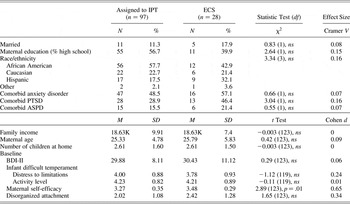
For all but 6.5% of the women, the onset of their first major depressive episode preceded the infant's birth. Accordingly, the current sample was not composed of women with depression restricted to the postpartum period, but rather was of longer standing duration. Regarding comorbid DSM-IV diagnoses, 50.4% of women met criteria for an anxiety disorder (nonposttraumatic stress disorder), 32.8% met criteria for posttraumatic stress disorder, and 16.8% met criteria for antisocial personality disorder. No statistically significant differences were found in rates of comorbid disorders between the IPT and ECS groups (see Table 1).
Between group differences in baseline demographic, maternal depression and infant difficult temperament

Note: IPT, Interpersonal psychotherapy; ECS, Enhanced Community Standard; PTSD, posttraumatic stress disorder; ASPD, antisocial personal disorder; BDI-II, Beck Depression Inventory—II.
Although scores on the Hamilton Rating Scale for Depression of 14 or higher are generally considered indicative of MDD, utilization of this cutoff criteria for study admission has been criticized because individuals may be erroneously excluded (Bagby, Ryder, Schuller, & Marshall, Reference Bagby, Ryder, Schuller and Marshall2004; Morris et al., Reference Morris, Rush, Jain, Fava, Wisniewski, Balasubramani and Trivedi2007). Therefore, the Hamilton Rating Scale for Depression was not used to exclude participants in the current investigation. Women meeting diagnostic criteria for lifetime bipolar disorder or for any lifetime psychotic spectrum disorder were excluded. Women with mood disorder due to a general medical condition and substance-induced mood disorder also were excluded, as were women with any current alcohol or substance abuse disorder, as defined by DSM-IV criteria. Women with other comorbid disorders were not excluded.
Procedures
Assessments were conducted at baseline, at postintervention, and at an 8-month postintervention follow-up. All assessments were conducted by trained interviewers who were unaware of group condition or study hypotheses. Due to possible variations in literacy and reading ability, all self-report measures were read to participants while they followed along and marked their answers. Following confirmation of diagnostic status, women were randomized to the IPT or to the ECS group, using a progressive block randomization procedure over the extended period of participant recruitment. Demographic variables including age, race, ethnicity, education, and number of children were used as blocking variables. Because the clinical trial involved women who were not seeking treatment, we expected that there would be a number of participants who would not be interested in the active IPT arm when offered, and thus, would decline treatment, thereby not complying with their random assignment to receive the intervention (Little & Yau, Reference Little and Yau1998). Accordingly, the ratio of random assignment to IPT versus ECS was adjusted over time in order to ensure that sufficient numbers of women would receive IPT, the active intervention under evaluation. Thus, more women were randomized to receive IPT (n = 97) than the ECS condition (n = 28). Group assignment was not revealed until completion of the baseline research assessments, at which time participants were informed of their group assignment by the recruitment coordinator. As described in detail below, complier average causal effect modeling (CACE) was employed to handle the rate of noncompliance with randomization (n = 39 mothers were classified as noncompliers).
Intervention groups
IPT
IPT was delivered in accord with the treatment manual (Weissman et al., Reference Weissman, Markowitz and Klerman2000) and included the provision of 14 1-hr sessions on a weekly basis. Although traditionally provided in clinic settings, flexibility of delivery site (home vs. clinic) was offered to reduce the possible stigma associated with receiving mental health services for low-income, racially and ethnically diverse participants and to increase receptivity to services. Depression was explained to participants as common feelings that can be associated with the many challenges parents face with childrearing. At times, language focused more on “feeling overwhelmed, stressed, and down” because it was difficult for some clients to acknowledge feeling “depressed.” Therefore, psychoeducation around depression that therapists typically provide in the initial phase sometimes was provided later in treatment once therapeutic rapport was established. Therapists included master's- or doctoral-level practitioners who were trained in IPT in accord with credentialing recommendations. Therapists had a minimum of 10 years of experience with the provision of psychotherapy to low-income populations and at least 2 years of supervised experience in the provision of IPT. Weekly individual and group supervision was provided by supervisors who also met credentialing requirements for the supervisory level. Fidelity was closely monitored using a number of methods, including questionnaires completed by the therapist and reviewed by supervisors, and the review of audiotaped sessions by an expert IPT clinician and supervisor (see Toth et al., Reference Toth, Rogosch, Oshri, Gravener-Davis, Sturm and Morgan-Lopez2013, for details).
ECS
Because it is not ethical to withhold treatment from women who have been identified as depressed, all women in the ECS arm were actively offered referral to services typically available in the community (n = 28). However, these women were not required to be in treatment unless they chose to do so. Overall, 66.2% elected to be involved in treatment for depression, and all of these women received individual counseling or psychotherapy. All women in the ECS group also had access to a project staff member who provided periodic informational newsletters, basic education about MDD, support, and referrals to community mental health centers to assist them with accessing treatment, as requested. Thus, treatment received in the ECS group varied from no active intervention to psychotherapy plus additional services. Please see Toth et al. (Reference Toth, Rogosch, Oshri, Gravener-Davis, Sturm and Morgan-Lopez2013) for details on the specific types of treatment women in the ECS group received.
Measures
CES-D
The CES-D (Radloff, Reference Radloff1977) is a frequently used, well-validated 20-item scale to screen for depression. Scores of >16 predict a high likelihood of MDD.
DIS-IV
The DIS-IV (Robins et al., Reference Robins, Cottler, Bucholz and Compton1995) is a structured interview designed to assess diagnostic criteria for Axis I disorders, as well as for antisocial personality disorder, as outlined in DSM-IV (American Psychiatric Association, 1994). The DIS-IV ascertains diagnoses present in the past year, the past 6 months, and those that are current or remitted. The DIS has been shown to be reliable and valid for use in psychiatric epidemiological field studies (Robins, Helzer, Croughan, & Ratcliff, Reference Robins, Helzer, Croughan and Ratcliff1981; Robins, Helzer, Ratcliff, & Seyfried, Reference Robins, Helzer, Ratcliff and Seyfried1982). Robins et al. (Reference Robins, Helzer, Croughan and Ratcliff1981) compared DSM diagnoses made using the DIS to those made by psychiatrists and reported mean κ = 0.69, sensitivity of 75%, and specificity of 94%. Given the forced choice structured format of the DIS, interviewers do not need to be trained clinicians. All interviewers were trained to criterion reliability in the administration of the DIS, and computer-generated diagnoses were utilized.
BDI-II
The BDI-II (Beck, Steer, & Brown, Reference Beck, Steer and Brown1996) is the most widely used self-report instrument for measuring the severity of depression. It includes 21 questions in a multiple-choice format, and scores of 19 or above indicate levels of depression with clinical significance. Previous studies report that the BDI-II demonstrates good internal consistency (coefficient α = 0.91) and validity (Dozois, Dobson, & Ahnberg, Reference Dozois, Dobson and Ahnberg1998; Storch, Roberti, & Roth, Reference Storch, Roberti and Roth2004). In the current study, the average internal consistency of the BDI-II was α = 0.94.
Offspring difficult temperament
The Infant Behavior Questionnaire (IBQ; Rothbart, Reference Rothbart1981) was used to assess infant difficult temperament. Mothers reported the frequency of specific infant behaviors in the past week on a scale of 1 = never to 7 = always. Specifically, two subscales were utilized: distress to limitations and activity level subscales. The distress to limitations subscale was composed of 20 items regarding the infant's fussing, crying, or showing distress while engaging in activities (e.g., waiting for food, being dressed and undressed, and confined to a place or position) and demonstrated good internal consistency (coefficient α = 0.85). The activity level subscale was compose of 17 items regarding the infant's gross motor activity, squirming, and locomotor activity and evidenced adequate internal consistency (coefficient α = 0.73). Distress to limitations and activity level subscales were significantly correlated (r = .54, p < .001) and employed as indicators of the latent construct “infant difficult temperament.”
Given marked developmental changes between infancy and toddlerhood, the same exact measure of temperament at both time points was not possible. Therefore, we employed the IBQ in infancy and measured difficult temperament with the distress to limitations and activity level subscales. We employed the Toddler Behavior Assessment Questionnaire (TBAQ; Goldsmith, Reference Goldsmith1996) in toddlerhood and measured difficult temperament with the anger proneness and activity levels subscales. These subscales were chosen because they measure aspects of temperament that may be difficult for parents and because empirical evidence provides these developmentally analogous subscales from infancy on the IBQ to toddlerhood on the TBAQ.
For the TBAQ, mothers reported on the frequency of specific child behaviors in the past month using a scale of 1 = never to 7 = always. The anger proneness subscale is composed of 28 items related to crying, protesting, or other signs of anger in situations involving conflict with another child or caregiver and has demonstrated good internal consistency (coefficient α = 0.85). The activity level subscale is composed of 20 items designed to assess locomotor movement during a variety of daily situations and has evidenced adequate internal consistency (coefficient α = 0.61). Anger proneness and activity level subscales were significantly correlated (r = .64, p < .001) and employed as indicators of the latent construct “toddler difficult temperament.”
Maternal Efficacy Questionnaire (MEQ)
The MEQ (Teti & Gelfand, Reference Teti and Gelfand1991) is a 10-item questionnaire that assesses a mother's feelings of self-efficacy in relation to specific demands of the parenting role. The items are designed to tap the mother's sense of her ability to understand her child's wants and needs, get her child's attention, engage in positive interaction with her child, appreciate and respond to the child's preferences, and take care of the child's basic needs. Internal consistency for the MEQ is 0.79–0.86 (Teti & Gelfand, Reference Teti and Gelfand1991) and good construct validity has been demonstrated with the competence subscale of the Parenting Stress Inventory (0.75). The MEQ evidenced good reliability in this study (α = 0.78).
Disorganized Attachment Characteristics (DAC) questionnaire
The DAC questionnaire was adapted from John Kirkland (personal communication) and consists of 21 items designed to address characteristics of disorganized attachment among interactions between infants/toddlers and mothers (see Appendix A). Sample items include “Child is confused, e.g., unsure about what to do next when with mother,” “There is little apparent organization in the child's interactions with its mother,” and “Child seems afraid of mother.” Following a 3-hr home observation including a feeding and a free play session between mother and child, independent observers rated the 21 items using a Likert scale of 1 = extremely uncharacteristic to 9 = extremely characteristic. The mean of the 21 items was calculated to index the level of disorganized attachment characteristics observed during the mother–child interaction. Reliability (α) ranged from 0.95 to 0.96 across waves using our complete sample of depressed mothers who underwent IPT or ECS and nondepressed comparison mothers.
To validate this novel measure, the Strange Situation Procedure (Ainsworth, Blehar, Waters, & Wall, Reference Ainsworth, Blehar, Waters and Wall1978) was coded for 10% of the sample by two independent raters (F.A.R. and S.L.T.). The standard Strange Situation was conducted with mothers and infants at baseline to assess infant's attachment organization. Ainsworth et al.’s (1978) criteria for the insecure-avoidant (A), secure (B), and insecure-resistant (C) classifications were used. D classifications were based on the Main and Solomon (Reference Main, Solomon, Greenberg, Cicchetti and Cummings1990) criteria. Each rater coded tapes of the Strange Situation sessions, and raters were unaware of the diagnostic and group status of the mother–child dyads. The coders were trained by an expert coder who himself was trained and obtained reliability in Ainsworth Strange Situation coding by Alan Sroufe and Everett Waters and in coding of the disorganized attachment style (D) by Mary Main. Reliability (intraclass correlation) on the Strange Situation classifications was 0.93.
Because the DAC questionnaire results in a continuous mean score of disorganized behaviors, and the Strange Situation results in a classification, scores on the DAC were dichotomized for validity analyses only. This allowed for an examination of the convergence of the DAC in characterizing disorganized behaviors with the Strange Situation D classification. Among the sample of infants of nondepressed mothers, the mean DAC score was 1.62 (SD = 0.80, range = 1.00–5.57). Scores above 1 SD above the mean were considered to index disorganized attachment. The association between the binary DAC classification and the binary Strange Situation D classification indicated convergence between the two measures (intraclass correlation = 0.85). Because the DAC only assesses disorganized behaviors, we were unable to determine agreement of this novel scale with other attachment group classifications.
Analytic plan
Our data analytic plan consisted of first examining differences between IPT and ECS groups on baseline maternal and infant demographic and study-related variables. Intent to treat (ITT) analyses were then conducted to examine the effect of randomization to IPT on maternal depression posttreatment, as well as to test the direct effect of randomization to IPT on toddler attachment, toddler temperament, and maternal parenting efficacy at 8 months posttreatment. CACE modeling was used to examine treatment effects while incorporating treatment engagement within Mplus Version 7.11 (Muthén & Muthén, Reference Muthén and Muthén1998–2013). We used the robust maximum likelihood (Yuan & Bentler, Reference Yuan and Bentler2000) estimator in analyses involving a structural equation mixture modeling framework (e.g., CACE modeling) under the assumption that missingness was related to variables that were observed, but unrelated to the missing values themselves (i.e., missing at random; Schafer & Graham, Reference Schafer and Graham2002); no variable had a rate of missingness greater than 3.20%.
CACE modeling
We employed CACE modeling because of the proportion of nontreatment-seeking mothers who were randomly assigned to the IPT condition but who failed to reach a sufficient level of treatment engagement (i.e., fewer than three sessions), as is common in randomized encouragement trial designs (Connell, Reference Connell2009). Although other analytic approaches and frameworks exist for addressing noncompliance (e.g., per protocol analysis, as-treated analysis, and ITT analysis), each may lead to bias in treatment effect parameter estimates relative to what the true causal effect of receiving treatment would have been in the population (Jo, Reference Jo2002). ITT analyses, the more commonly used framework among these options, evaluate the effect of the treatment by comparing individuals assigned to the treatment group to individuals assigned to the control group, regardless of their actual compliance, or participation in the treatment. Ignoring compliance with the treatment can lead to an underestimate of treatment effects. Accordingly, the treatment effect estimate in ITT analyses is referred to as the “average causal effect of treatment as treatment was assigned” but not as treatment was actually received (Jo, Reference Jo2002, p.180).
CACE estimation is an analytic approach for randomized trials that considers treatment engagement in the analysis of the treatment effect. Specifically, CACE analysis jointly models the impact of treatment assignment and treatment receipt and focuses on the treatment effect when treatment is actually received (Connell, Reference Connell2009; Jo, Reference Jo2002, Reference Jo2008a, Reference Jo2008b; Little & Yau, Reference Little and Yau1998). CACE analysis allows for an unbiased estimate of the difference in outcomes for treatment “compliers” compared to those who would have complied with treatment in the control group. Compliance with the treatment can never be observed in the control condition, because control participants never have the opportunity to comply with the active treatment. Compliers in the control group are estimated based on the probability of compliance in the treatment group, as well as on information from covariates in the analyses (e.g., demographics). Treatment effects can then be estimated using the treatment compliers and control compliers (Jo, Reference Jo2002).
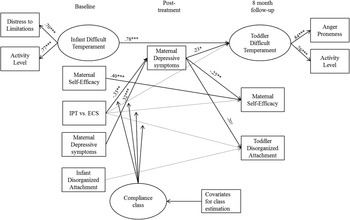
In CACE modeling, engagement is considered a moderator of the effect of random assignment on the outcomes (see Figure 1). Model fit is assessed using entropy, which represents the probability of membership in the most likely class for each individual (complier or noncomplier). Entropy values range from 0 to 1.0, and higher values indicate better classification (Muthén & Muthén, 1998–2013).
The results of complier average causal effect model. IPT, interpersonal psychotherapy; ECS, enhanced community standard. IPT versus ECS is coded 0 = ECS, 1 = IPT. Standardized path coefficients are presented. Nonsignificant paths are dotted. †p = .05. *p < .05. **p < .01. ***p < .001.

Results
Table 1 presents the results of the comparison between the IPT and ECS groups at baseline on demographic and study variables. The results indicated that groups did not differ on demographic characteristics, including maternal marital status, age, education, race/ethnicity, family income, and number of children in the home. Moreover, groups did not differ on baseline depression scores, dimensions of infant difficult temperament, and infant disorganized attachment characteristics. The results did suggest that mothers in the ECS condition had significantly higher baseline maternal self-efficacy compared to mothers in the IPT condition, t = 2.89 (123), p = .01, d = 0.65. We included baseline levels of the three outcome variables (i.e., toddler difficult temperament, maternal self-efficacy, and toddler disorganized attachment at follow-up) as statistical controls; therefore, we modeled IPT effects on change in outcomes over and above baseline pretreatment levels of the constructs.
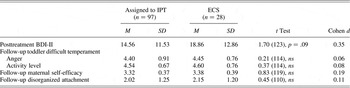
Table 2 provides an ITT comparison of posttreatment maternal depression, 8-month follow-up, toddler disorganized attachment characteristics, maternal parenting efficacy, and maternal perception of toddler difficult temperament. It is important to note that these ITT analyses compared those randomly assigned to IPT with those randomly assigned to ECS. ITT analyses do not take into consideration engagement, or compliance, with randomization. Thus, 39 mothers who did not engage in treatment were included in the IPT group for these analyses (n = 97). The results indicated a marginally significant posttreatment difference in maternal depression between those randomly assigned to IPT (M = 14.56, SD = 11.53) and those randomly assigned to ECS (M = 18.85, SD = 12.86), t (123) = 1.70, p = .09, d = 0.35. No significant differences between groups were found for toddler disorganized attachment characteristics, toddler difficult temperament, and maternal parenting efficacy at follow-up.
Intent to treat analyses

CACE modeling
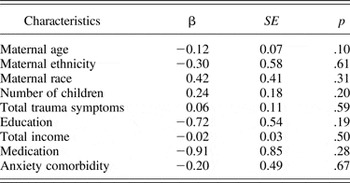
ITT analyses can underestimate treatment effects due to the lack of consideration of compliance with treatment (Jo, Reference Jo2002). Because the current RCT was a randomized encouragement trial of non-treatment-seeking mothers, taking into account compliance or engagement with treatment was critical. Therefore, CACE modeling was conducted, which allowed for an examination of treatment as received (rather than as assigned, which is the case with ITT). An initial recommended step in CACE analysis is to define participant “engagement” in treatment (Connell, Reference Connell2009). We adopted a stringent definition of engagement whereby attending at least 12 sessions was defined as “compliance,” whereas attending 0–3 sessions was defined as “noncompliance” because of minimal clinical engagement. If participants could not be engaged through active outreach efforts or declined all participation, they were not pursued further. As a result of these treatment compliance definitional criteria, participants attended 12 or more sessions (compliers, n = 58) or 3 or fewer sessions (noncompliers, n = 39; M = 0.67, mode = 0), thereby providing the strongest CACE estimates (Connell, Reference Connell2009). The compliance rate (adjusted for the covariates shown in Table 3) was 61.6% based on the estimated posterior probabilities. Table 3 presents covariates predicting the complier group. Overall, none of the examined covariates was significantly related to the estimated complier status groups (class membership). The compliance rate in the control group is expected to be equal to that in the IPT group (by virtue of randomization). Thus, given that the observed probability for compliance in the IPT group was 0.616 (62/99), the rate of compliance in the control group was estimated at 62%, resulting in 17 compliers in the ECS group. With this compliance definition, entropy, a measure of model fit for CACE modeling, was very good (0.84).
Characteristics predicting the complier class

The results of the CACE model are presented in Figure 1. Consistent with a prior study with the same sample (Toth et al., Reference Toth, Rogosch, Oshri, Gravener-Davis, Sturm and Morgan-Lopez2013), we found that adjusted for noncompliance and baseline levels of maternal depressive symptoms, mothers in the IPT condition experienced significantly fewer depressive symptoms at postintervention compared to mothers in the ECS condition, b = –0.33 (0.13), p = .01. A standardized beta of this magnitude can be interpreted as a medium effect size of IPT on maternal depression (Cohen, Reference Cohen1988). Fewer maternal depressive symptoms at posttreatment predicted greater maternal self-efficacy at follow-up, b = –0.25 (0.10), p = .008, over and above baseline levels of maternal self-efficacy. The results also indicated that lower levels of maternal depressive symptoms at posttreatment predicted lower levels of difficult temperament among toddlers at follow-up, b = 0.23 (0.09), p = .01, controlling for baseline difficult temperament during infancy. Finally, fewer maternal depressive symptoms also predicted lower levels of toddler disorganized attachment characteristics at follow-up, b = 0.20 (0.11), p = .05, controlling for baseline infant disorganized attachment characteristics. The standardized betas for the paths from posttreatment maternal depression to the 8-month follow-up outcomes are all indicative of small/medium size effects (Cohen, Reference Cohen1988).
Discussion
The aim of the current study was to investigate how reducing maternal depression as a result of IPT may be the first step in a progression of positive outcomes for young offspring and their mothers. Our results did not show an effect of maternal receipt of IPT on child outcomes 8 months posttreatment; rather, our results indicated associations between the reduction of maternal depression for those receiving IPT and subsequent benefits to children and their mothers. More specifically, improvements in maternal depression following IPT were related to less toddler disorganized attachment characteristics and less toddler difficult temperament 8 months after the completion of IPT for depressed mothers. Moreover, lower levels of maternal depression at postintervention were associated with improved maternal parenting self-efficacy at the 8-month follow-up. These results add to the emerging literature documenting that the reduction of maternal depressive symptoms is beneficial not only to the mother but also to her offspring.
The present study advances the current knowledge base by being the first to show that improvements in maternal depression are related to observer perceptions of reductions in disorganized attachment characteristics among toddlers. Reducing disorganized attachment behaviors among young offspring is critical given the well-documented association between disorganized attachment and the development of externalizing behavior in general, and aggression more specifically (Fearon et al., Reference Fearon, Bakermans-Kranenburg, van IJzendoorn, Lapsley and Roisman2010). Moreover, that improvements in maternal depression contributed to less disorganized attachment in toddlerhood specifically has important developmental implications. Because of the cognitive, social, and emotional development that marks toddlerhood, it has been identified as a particularly sensitive period for the onset of depressotypic organization (Cicchetti & Toth, Reference Cicchetti, Toth, Luthar, Burack, Cicchetti and Weisz1997, Reference Cicchetti and Toth1998). Fostering more secure attachment during this period may alter this trajectory. Our results suggest that although offspring of depressed mothers are vulnerable to the development of disorganized attachment, which may in turn heighten susceptibility for the subsequent development of psychopathology, this risk may be mitigated by the successful treatment of maternal depression.
In addition to fewer disorganized attachment characteristics among toddlers as a result of reductions in maternal depression, we also found that reductions in maternal depression were associated with improvements in mothers’ perceptions of their toddlers’ difficult temperament. As described earlier, mothers’ evaluations of their children's temperament have implications for offspring development. For instance, Pauli-Pott et al. (Reference Pauli-Pott, Mertesacker, Bade, Haverkock and Beckmann2003) showed that 8-month-old infants who were viewed as high in negative emotionality by their mothers were more likely to be judged as high in negative emotionality by observers at 12 months, suggesting that mothers’ negative perception of their offspring may actually shape offspring behavior. Given the associations between early temperament characteristics and the development of subsequent psychopathology (Bijttebier & Roeyers, Reference Bijttebier and Roeyers2009; De Pauw & Mervielde, Reference De Pauw and Mervielde2010; Muris & Ollendick, Reference Muris and Ollendick2005; Nigg, Reference Nigg2006; Rothbart & Posner, Reference Rothbart, Posner, Cicchetti and Cohen2006), reducing mothers’ perceptions of their offspring's difficult temperament qualities may reduce risk for children's future maladaptation. Thus, successfully treating maternal depression may deter offspring early in development from traversing a developmental pathway marked by a difficult temperament and future psychopathology.
It is important to note that our findings differ from those of Forman et al. (Reference Forman, O'Hara, Stuart, Gorman, Larsen and Coy2007), who did not find significant effects of IPT for maternal depression on mothers’ perception of child attachment quality and mother and observer ratings of child temperament. Methodological differences in measurement may account for the inconsistencies. For instance, Forman et al. (Reference Forman, O'Hara, Stuart, Gorman, Larsen and Coy2007) relied on maternal reports of attachment security broadly using the Attachment Q-Set. In contrast, we focused on disorganized attachment characteristics specifically, using observer ratings following a 3-hr home observation. It is plausible that independent observers may more readily perceive improvements in attachment compared to mothers themselves. Moreover, it may be that the effect of IPT on offspring attachment is more specifically related to disorganized attachment, rather than more broadly defined attachment security. Clearly, more research is necessary to continue to uncover the ways in which successfully treating maternal depression may improve attachment quality and temperament characteristics among young children.
Regarding parenting self-efficacy, consistent with previous research (Jones & Prinz, Reference Jones and Prinz2005; Kohlhoff & Barnett, Reference Kohlhoff and Barnett2013; Michl et al., Reference Michl, Handley, Rogosch, Cicchetti and Toth2015), we found an association between maternal depressive symptoms and mothers’ beliefs regarding their efficacy as parents, such that lower levels of maternal depression were related to more positive parenting self-efficacy beliefs. Parenting self-efficacy is a critical construct for child development given its well-documented association with parenting competence and child adjustment (Jones & Prinz, Reference Jones and Prinz2005). Our findings are striking for two reasons. First, from a developmental perspective, it is noteworthy that we found this association during toddlerhood, a developmental period marked by changing and increasing parental demands. It has been shown that parents’ pleasure in the parenting role decreases from the first to the second year (Fagot & Kavanagh, Reference Fagot and Kavanagh1993). That reductions in maternal depression was associated with improvements in mothers’ beliefs about their parenting efficacy during a time of increased parenting challenge is important. Second, our sample of mothers was racially and ethnically diverse and socioeconomically disadvantaged, and the vast majority of the women in our study were single mothers. Thus, mothers in this study were faced with numerous stressors and parenting challenges. Our findings suggest that even within the context of the myriad risks associated with socioeconomic disadvantage, alleviating symptoms of maternal depression may function to bolster mothers’ sense of parenting competence, therefore potentially initiating a cascade of positive parenting practices and offspring well-being.
IPT and child outcomes
The results of CACE modeling, which allowed for a consideration of compliance with treatment, revealed a cascading model of events such that mothers who engaged in IPT reported significant reductions in depressive symptoms at posttreatment, and this symptom reduction was subsequently associated with family-wide benefits 8 months after the completion of IPT. Thus, our results are consistent with the notion of “collateral change” (Patterson et al., Reference Patterson, Forgatch and DeGarmo2010) and a developmental cascade framework in which changes to one system (i.e., maternal depressive symptoms) is related to subsequent changes in other systems (i.e., attachment, temperament, and parenting efficacy). In other words, maternal engagement in IPT initiated a progression of positive adaption for mothers and their children by reducing maternal depressive symptoms, which in turn was associated with a spreading of positive adaptation for the family system.
These findings are also consistent with those of a recent meta-analysis of nine studies examining the effects of treating maternal depression on offspring. Specifically, Cuijpers et al. (Reference Cuijpers, Weitz, Karyotaki, Garber and Andersson2015) found a small to moderate effect of maternal depression treatment on offspring outcomes. We advance this emerging body of work in a number of important ways. To our knowledge, the current study is the first RCT with low-income, racially and ethnically diverse mothers to examine the cascading effects of IPT for maternal depression on young offspring. Verdeli et al. (Reference Verdeli, Ferro, Wickramaratne, Greenwald, Blanco and Weissman2004) showed promising results with a small-scaled uncontrolled pilot study of ethnically diverse mothers of children undergoing treatment for depression. Our rigorous RCT design with CACE modeling to handle treatment noncompliance bolsters and extends these preliminary findings. Moreover, prior studies examining maternal IPT effects on offspring have relied on very specific samples of families, limiting generalizability. For instance, prior studies on the topic have employed either a sample of mothers with postpartum depression or a sample of mothers whose children are currently undergoing psychiatric care. For approximately 94% of the mothers in our sample, the onset of depression occurred prior to the birth of their child. Thus, our sample was not limited to women with postpartum depression, but rather represents a sample of mothers for whom depression was more chronic.
It is worth nothing that ITT analyses with this sample of non-treatment-seeking mothers resulted in an underrepresentation of treatment effects. It was not until we considered compliance with treatment that the effect of IPT on maternal depression become evident. Thus, our results also highlight how crucial it is to statistically model noncompliance with randomization with RCT designs, especially among a sample of non-treatment-seeking participants.
Limitations and conclusions
The current investigation contributes to the literature by demonstrating that improvements in maternal depression via IPT are associated with fewer disorganized attachment characteristics among offspring, less maternal perception of offspring difficult temperamental qualities, and increased maternal parenting self-efficacy. Together, our results highlight that IPT, an intervention designed to alleviate adult depression through its focus on the interpersonal context, does more than successfully treat maternal depression. Rather, reducing maternal depressive symptoms appears to begin a cascade of positive adaptation for both mothers and offspring. By alleviating maternal depression, mothers may become more confident in their parenting, which will likely result in more adaptive parenting practices and less risk for offspring. Moreover, improvement in maternal depression contributes to mothers’ viewing their offspring's temperament more favorably, a perception that will likely benefit their children. Finally, successfully treating maternal depression also appears to allow mothers the ability to foster a more healthy attachment relationship with their offspring, a change that may also positively benefit the child over the course of development.
Despite these contributions and implications, there are limitations worth noting. First, although we assessed families 8 months after the completion of the intervention, we did not have a school-age or adolescent follow-up of the sample. Because of this, we were unable to examine whether the results found would be sustained later in development and how these benefits might spread to affect other domains of development. How does a decrease in disorganized attachment characteristics in toddlerhood affect the developmental trajectory of these offspring throughout the school years and beyond, for example? Future research investigating the long-term impact of successful treatment of maternal depression on offspring will be vital to attaining a more complete understanding of the potential benefits to children. Second, our measure of disorganized attachment is novel and has not been validated with other samples. Our preliminary work validating the DAC with the Strange Situation (Ainsworth et al., Reference Ainsworth, Blehar, Waters and Wall1978) among an available subsample of mother–child dyads indicated much promise as a naturalistic observational method for assessing disorganized attachment characteristics. However, more psychometric work is needed to continue to substantiate this measure.
In summary, results of the current study suggest that successfully treating maternal depression functions to improve broader child and maternal outcomes, including attachment quality and temperament, and mothers’ parenting efficacy. Our findings contribute to the growing body of literature documenting the potential benefits to children of successfully treating maternal depression. Our findings highlight the utility of a relationship-based intervention for the treatment of maternal depression, by showing benefits not only to the mother posttreatment but also to her child. Alleviating maternal depression appears to initiate a progression of positive adaptive outcomes among both mothers and offspring, which are likely to alter the at-risk developmental course often associated with maternal depression.
Appendix A
DAC
Please rate how characteristic each of these statements is of the child you have observed.
1 = extremely uncharacteristic 6 = somewhat characteristic
2 = quite uncharacteristic 7 = fairly characteristic
3 = fairly uncharacteristic 8 = quite characteristic
4 = somewhat uncharacteristic 9 = extremely characteristic
5 = relatively neutral
-
1. ______ Child has bland, flat emotional expression when with mother.
-
2. ______ Child is confused, e.g., unsure about what to do next when with mother.
-
3. ______ Child is nervous with mother.
-
4. ______ Child seems afraid of mother.
-
5. ______ Child tends to self-calm by rocking or swaying in one place.
-
6. ______ Child is tense and anxious when in mother's company.
-
7. ______ Child keeps a safe working distance from mother, taking care not to touch her intentionally.
-
8. ______ Child often approaches strangers more readily than approaches own mother.
-
9. ______ Child is unsure and hesitant when moving toward mother.
-
10. ______ Mother is unsure about what the child's likely to do next.
-
11. ______ Child shows flashes of fear toward mother.
-
12. ______ Child is uncertain about what to do when within mother's arm reach.
-
13. ______ When held by mother, child attempts to get away from her grasp.
-
14. ______ Child pulls at mother's clothes as if to get attention.
-
15. ______ Child has sudden outbursts even when apparently calm and settled.
-
16. ______ Child often holds something close to mouth (e.g., soft toy, cloth) when near mother, almost as if hiding it from her.
-
17. ______ Child appears disoriented and finds it hard to concentrate in mother's presence.
-
18. ______ Child approaches mother carefully as if to avoid physical contact.
-
19. ______ Child will act in a contradictory manner, for example, if approaching mother may stop unexpectedly and not go any closer.
-
20. ______ Child squirms to be set down when held by mother.
-
21. ______ There is little apparent organization in the child's interactions with its mother.