1 INTRODUCTION
Recent work on acquisition of temporal morphosyntax in a range of second languages (e.g. English, French, German, Chinese, Afrikaans) by speakers of other languages (e.g. English, Turkish, Swedish, Russian, French, German) has focused on complementary domains, namely verb morphology (Howard, Reference Howard2006; Ionin & Wexler, Reference Ionin and Wexler2002; Prévost, Reference Prévost2003, Reference Prévost2007; Rule & Marsden, Reference Rule and Marsden2006; White, Reference White2003b) and temporal syntax of verb raising (Ayoun, Reference Ayoun2003; Conradie, Reference Conradie2005, Reference Conradie2006; Håkansson et al., Reference Håkansson, Pienemann and Sayehli2002; Haznedar, Reference Haznedar2003; Yuan, Reference Yuan2001). Within a UG approach, the two domains are not unrelated because sometimes verbal morphology licenses syntactic movement (Koeneman & Neeleman, Reference Koeneman and Neeleman2001) of the inflected verb to higher I[nflection] and C[omplementizer] nodes.Footnote 1 Languages differ in their repertoire of verbal morphology and in syntactic reflexes linked to it—parameters determining word order—with two central parametric variations concerning verb raising to functional categories I/T (Inflection/Tense, the so-called Opacity Parameter, Pollock, Reference Pollock1989) and C (complementizer, the so-called Verb Second or V2 Parameter). To master target sentential construction, acquisition of both verbal morphology and its syntactic counterpart is crucial to the second language (L2) learner.
Under the assumption that uninterpretable features in functional categories determine parameter setting (Chomsky, Reference Chomsky1995, Reference Chomsky, Martin, Michaels and Uriagereka2000, Reference Chomsky and Kenstowicz2001), a major point of debate in recent L2 research in the UG framework has been whether or not parameters can be reset (Hawkins, Reference Hawkins2001; Herschensohn, Reference Herschensohn2000; White, Reference White2003a). Interpretable features necessary for semantic interpretation persist at Logical Form (LF); uninterpretable features must be valued and deleted before Spell-Out. In adult native grammars, temporal morphosyntax is virtually flawless, whereas L2 learners’ production often manifests morphology errors, an explanation of which could provide insight into acquisition processes. Two UG accessible approaches to L2A propose different views of parameter resetting, depending on the capacity of interlanguage grammars to gain new values for uninterpretable functional features. The Representational Deficit/Interpretability hypothesis (RD/I, e.g., Franceschina, Reference Franceschina2001; Hawkins, Reference Hawkins2003; Tsimpli & Dimitrakopoulou, Reference Tsimpli and Dimitrakopoulou2007) maintains that uninterpretable features are limited to L1 values after the critical period, whereas Full Access accounts (FA, e.g., Lardiere, Reference Lardiere and Archibald2000; Prévost & White, Reference Prévost and White2000) posit full UG availability and, consequently, the possibility of resetting parameters to values different from those of the native language.
Most L2 studies are synchronic snapshots revealing properties of an interlanguage grammar at a given moment, often with a cross-sectional component that suggests the developmental path of phenomena under consideration. Long (Reference Long, Doughty and Long2003: 497) points out shortcomings of these studies for assessing progress and ultimate attainment by L2 learners and says ‘true longitudinal studies are needed,’ like, for example, Lardiere's (Reference Lardiere1998, Reference Lardiere and Archibald2000, Reference Lardiere2007) documentation of her subject Patty over an eight-year span (cf. Lakshmanan & Selinker, Reference Lakshmanan and Selinker2001; Lardiere, Reference Lardiere2003). Robust naturalistic input as in an immersion environment is important to L2 development. However, Long argues that it is only with sufficient data from subjects who are exposed to an L2 over a period of years that one can evaluate issues of attainment or fossilisation.
To respond in part to the call for longitudinal studies, and to reevaluate the two theoretical approaches, this article examines L2 French production and grammaticality judgment of three advanced anglophone learners of L2 French interviewed over a period of seven to nine months in the target environment, focusing on verb morphology and syntax. One subject, Chloe, who has been studied at an earlier stage of development (Herschensohn, Reference Herschensohn2001, Reference Herschensohn2003, Reference Herschensohn, Prévost and Paradis2004), provides a long-term longitudinal view. We also address theoretical questions of how best to test for L2 parameter resetting and mastery of morphology, specifically whether our data support RD/I or FA. Finally, we consider whether the subjects show acquisitional changes related to their immersion experience or if—like White's (Reference White2003b) subject—their interlanguage grammars do not vary over the immersion period.
We begin with a description of the theoretical framework, first of the L2 approaches mentioned above, and then of parametric variation between English and French. We next present the subjects, the data collection and the results. The final section examines the data in terms of the two approaches, considering the issues of input and longitudinal development. We conclude that the results generally support FA over RD/I, in that the learners show strong evidence of parameter resetting. As for short-term L2 development, we conclude that the immersion has a limited advantage for advanced learners near ceiling for temporal morphosyntax, but that there is definite long-term progression for Chloe, whose earliest production (Herschensohn, Reference Herschensohn2001; Reference Herschensohn2003) shows extensive morphological deficits.
2.0 THEORETICAL FRAMEWORK
2.1 Current second language acquisition theory
White (Reference White2003a) argues convincingly that L2A is guided by UG, a position that we adopt here. However, even amongst researchers who believe that L2A is guided by UG, there is an ongoing debate as to whether or not parameters can be reset in L2A. Parametric variation, often related to uninterpretable features of functional categories, shows reflexes in both syntax and morphology. Consistently correct morphological inflection should be diagnostic of correct feature specification of the functional category in question. However, L2 learners frequently make morphological errors (cf. Prévost, Reference Prévost2007; Nadasdi, Reference Nadasdi2001; White, Reference White2003), something which must be accounted for in any L2 theory, as it forms part of the L2 developmental process. Two views of L2 parameter resetting are examined in this section.
2.1.1 The Representational Deficit/Interpretability Hypothesis
Proponents of RD/I—see, for example, Franceschina (Reference Franceschina2001), Hawkins (Reference Hawkins2001, Reference Hawkins2003), Hawkins and Chan (Reference Hawkins and Chan1997), Hawkins and Franceschina (Reference Hawkins, Franceschina, Prévost and Paradis2004), Hawkins and Liszka (Reference Hawkins, Liszka, van, Hulk, Kuiken and Towell2003)—generally claim that uninterpretable functional features are restricted to the values of the native language in L2A.Footnote 2 Hawkins (Reference Hawkins2001) claims that early L2 grammar has in principle only lexical projections linked to incomplete morphology, with functional projections acquired at a later stage (cf. Vainikka & Young-Scholten, Reference Vainikka and Young-Scholten1996; Myles, Reference Myles and Dewaele2005; Rule & Marsden, Reference Rule and Marsden2006).
Following a proposal by Tsimpli and Roussou (Reference Tsimpli and Roussou1991) and Smith and Tsimpli (Reference Smith and Tsimpli1995) that parameter setting is limited to a critical period, the Failed Functional Features Hypothesis (Franceschina, Reference Franceschina2001; Hawkins & Chan, Reference Hawkins and Chan1997) claims that adults cannot acquire functional features or feature values that differ from those of their native language. This maturational deficit is evident in surface morphology errors. Tsimpli and Roussou attribute superficially correct forms to misanalysis, transfer of an L1 grammatical strategy that happens to yield target L2 forms, while Franceschina (Reference Francheschina2005: 198) attributes correct forms to cognitive (non-grammatical) compensatory strategies.
Hawkins and colleagues have elaborated the RD approach in recent articles dealing with L2 English acquired by speakers of Arabic, Chinese, French, German, Japanese and Spanish. Hawkins and Liszka (Reference Hawkins, Liszka, van, Hulk, Kuiken and Towell2003: 36) claim that ‘where parametrized syntactic features are not present in a speaker's L1, they will not be accessible in later L2 acquisition.’ They compare advanced learners of L2 English whose L1s possesses varying specifications for the [+/-past] feature of Tense: Chinese has no uninterpretable functional feature for Tense, [upast], whereas Japanese and German do. On an oral production task, Chinese learners reached 62.5% suppliance of regular past while Japanese learners reached 91.9% and German learners 96.3%. Presumably, the Chinese learners were unable to acquire [upast] in L2 English, resulting in misuse or non-use of past tense in English.Footnote 3 Any target-like responses are assumed to be rote learned lexical items. Absence or misuse of English tense morphology is regarded as providing evidence for a syntactic deficit, since acquisition of syntax is dependent on acquisition of morphology, given this perspective. It should be noted that Hawkins (Reference Hawkins2003) concludes that neither success on an L2 property non-existent in L1, nor approximation to target performance on an L2 uninterpretable feature property constitutes counter-evidence to RD/I. Only converging evidence from a variety of data sources (e.g. production, grammaticality judgement, interpretation, targeted tasks) could serve as counter-evidence.
In a similar vein, Tsimpli and Dimitrakopoulou (Reference Tsimpli and Dimitrakopoulou2007: 224) formulate the Interpretability Hypothesis whereby interpretable features remain accessible to (older) L2 learners while ‘uninterpretable features are subject to critical period constraints and, as such, they are inaccessible to L2 learners [. . .] L1 parametric values associated with these features resist resetting in L2A.’Footnote 4
2.1.2 Full Access approaches
FA is, like RD/I, a cover term we use that encompasses a range of hypotheses which generally agree that L2 learners can reset parameters, i.e. that they can gain L2 functional feature values that differ from the values instantiated in their L1s. On this view inaccurate L2 inflection is a function of surface realization phenomena such as phonetic mapping or default morphology, rather than impaired syntactic competence.Footnote 5 FA approaches include Schwartz and Sprouse's (Reference Schwartz and Sprouse1996) proposal that L2 learners initially transfer morphosyntactic parameter settings of L1 (full transfer), with full access to UG (FTFA). Accordingly, learners may eventually reset parameters to L2 values through gradual restructuring, as they fail to parse primary linguistic data and must revise their interlanguage grammars as a consequence.
For FA, L2A is similar for children and adults, so no maturational deficit exists. Syntactic competence is not directly reflected by mastery of morphological inflection; for example, Lardiere (Reference Lardiere1998, Reference Lardiere and Archibald2000) shows that despite stable use of nominative case (indicating morphological mastery of case and syntactic checking of nominative by T), her sinophone L2 English subject produces tense errors at a rate greater than 50% (indicating problems with realisation of tense morphology). Lardiere uses the idea of Missing Inflection (Haznedar & Schwartz, Reference Haznedar, Schwartz, Hughes, Hughes and Greenhill1997) that attributes errors to matching difficulties between syntactic terminal nodes and surface morphology. L2 French production by adult learners has also been reported as indicating the use of underspecified morphology (infinitive forms as default finite) with correct word order, as in the case of Zahra (Prévost & White, Reference Prévost, White, Friedemann and Rizzi2000a: 212) producing a non-finite null subject CP (1) with fronted pourquoi, or Emma (Herschensohn, Reference Herschensohn2001: 290) using a negated infinitive with nominative subject and post-verbal negation (2).
(1) et Malika, pourquoi [null subject] téléphoner à toi à la maison?
(2) Je ne continuer pas.
Another avenue that has been explored within FA is the idea that missing inflection is caused by an inability to reset prosodic parameters (Goad et al., Reference Goad, White and Steele2003; Goad & White, Reference Goad and White2006), and more recently Lardiere (Reference Lardiere, Dekydtspotter, Sprouse and Liljestrand2005) has proposed a Feature-Reassembly Approach whereby L2A may involve remapping L1 features into new or different configurations in L2. Prévost (Reference Prévost2007) points out that L1 morphological similarities may also impact the exact morphological forms selected as default, as evidenced by the production of verbal inflection by hispanophone learners of L2 French.
Summarising, RD/I argues for transfer of L1 lexical and functional features; there is no acquisition of uninterpretable features that differ from L1 after a critical period and thus no possibility of resetting parameter values related to them. FA, on the other hand, allows the possibility of gaining new L2 functional feature values. For RD/I, morphological errors indicate a deficit in L2 syntactic competence, but for FA, such errors indicate a performance problem in L2 morpho-lexical realisation. The following questions can be asked to evaluate the two approaches:
i) What is the source of L2 morphological errors, syntactic deficit (RD/I) or morphological mapping (FA)?
ii) What is the explanation for L2 correct forms, misanalysis (RD/I) or parameter resetting (FA)?
iii) What evidence is deemed acceptable proof for success or failure to reset parameters, single or multiple measures of assessment?
iv) Is there a maturational limit for the acquisition of uninterpretable functional features, hence parameter resetting (RD/I, yes; FA, no)?
v) What do data reveal about the (im)possibility of parameter resetting?
We return to these questions below in Section 4, but we first discuss theoretical analyses of temporal morphosyntax and review L2A studies of verb raising in French.
2.2 Parametric differences between English and French TP
English and French differ not only in the morphology of their verbs, but also in the syntactic configurations in which the verbs are situated. Lasnik (Reference Lasnik and Lasnik1999) proposes that the lexical entry for main verbs in English is their bare form, with the bare form and T joined at Phonetic Form (PF) by ‘affix hopping.’ In contrast to bare English forms (3), French verbs start out fully inflected, with Tense specified as a feature (4).Footnote 6
(3) Weall/often/never read the newspaper.
(4) Nous (ne) lisonstous/souvent/jamais le journal.
As we see in (3), there is no overt agreement marker in English, whereas French displays the –ons ending for first person plural in present (4), as well as in other tenses. With the exception of present tense, which has no overt marker in French, tense is usually indicated by an additional morpheme such as [j] <i> in past lisions. These distinctions between the two languages reflect the well-accepted difference in morphology that is significant in determining the verb raising parameter (Emonds, Reference Emonds1978; Koeneman & Neeleman, Reference Koeneman and Neeleman2001; Pollock, Reference Pollock1989). French, with ‘richer’ morphology, requires raising of all finite verbs to T to check agreement, whereas in English only auxiliaries and modals raise.Footnote 7 A diagnostic for locating the position of the tensed verb is the placement of what Conradie (Reference Conradie2005) refers to as ‘left-edge markers’—negation, adverbs and quantifiers—assumed to be in a left adjoined position to VP in both English and French. In English they precede the main verb (3), but in French they follow the inflected verb (4), indicating that all verbs and auxiliaries move upward and leftward to T. In contrast, French thematic verbs without tense generally do not raise, as evidenced by the fact that they usually follow negation and adverbs (5).Footnote 8
(5) French unraised infinitives
Ne pas/Souvent lire le journal serait un supplice
Another diagnostic of verb raising in French is the presence of nominative pronouns which must be checked for case by the inflectional projection, such as nous in (4). Thráinsson (Reference Thráinsson and Hendrick2003: 166) defines inflection and raising in terms of IP projections: morphological richness shows ‘clearly separable tense and agreement morphemes in the verbal inflection,’ his Split IP Parameter. [+SIP] languages have separate AgrSP and TP, while [-SIP] ones have unsplit IP. [+SIP] French requires verb raising since VP is not in the checking domain of AgrSP (due to intervening TP), whereas [-SIP] English can check the verb in situ since VP is in the checking domain of AgrSP (IP). In both English and French nominative case on the raised subject is checked by I/T.
In the bare phrase structure framework (Chomsky, Reference Chomsky and Kenstowicz2001, Reference Chomsky2002), two kinds of features are significant for a syntactic derivation, interpretable and uninterpretable. The former are necessary for semantic interpretation and persist at LF; the latter must be valued and deleted before Spell-Out. Uninterpretable features include, for example, nominative Case [uNom] on subject DPs (checked by a finite verb) or the uninterpretable person feature on AgrS that requires verb agreement, [upers]. In this framework, the verb raises in [+SIP] languages to check the uninterpretable feature on T, which is subsequently deleted by the interpretable [+/- past] of the inflected verb; the inflected verb then raises to AgrS to check that uninterpretable feature against interpretable person features. The raising of the subject results in deletion of its uninterpretable nominative Case feature in the match (Pesetsky & Torrego, Reference Pesetsky, Torrego and Kenstowicz2001).
We adopt a Distributed Morphology approach (Halle & Marantz, Reference Halle, Maranz, Hale and Keyser1993), whereby syntactic terminal nodes are separated from phonological realisation. Underspecified forms may enter agreement relations as long as they are non-distinct from the agreeing item (Lumsden, Reference Lumsden1992), and there is no other candidate that is more explicitly inflected (cf. Carstens, Reference Carstens2000). For example, in French, the first, second and third person singular forms of most verbs are non-distinct in having an identical spoken form (je/tu/il parle(s) [parl]), whereas second person plural always has a distinct spoken inflection [e] (vous parlez [parle]).
Summarising, main verbs in French are fully inflected, raised and checked for tense/person inflection in TP and AgrSP, while English main verbs do not raise (only auxiliaries are checked in TP). Uninterpretable features are crucial to both tense and person agreement in French, with interpretable features overtly marked on the verb valuing uninterpretable ones in T and AgrS.
2.3 L2 studies of verb raising
A solid body of L2 research has been devoted to the investigation of verb raising parameters, SIP, and V2 in French, German and Afrikaans (For overviews, see Hawkins, Reference Hawkins2001; Herschensohn, Reference Herschensohn2000; White, Reference White2003. See also Ayoun, Reference Ayoun1999, Reference Ayoun2003, Reference Ayoun and Ayoun2006; Conradie, Reference Conradie2005, Reference Conradie2006; Håkansson et al., Reference Håkansson, Pienemann and Sayehli2002; Hawkins et al., Reference Hawkins, Towell and Bazergui1993; Hulk, Reference Hulk1991; Myles, Reference Myles and Dewaele2005; Prévost, Reference Prévost, Prévost and Paradis2004; Schwartz & Sprouse, Reference Schwartz and Sprouse1996; Vainikka & Young-Scholten, Reference Vainikka and Young-Scholten1996, 2002; Walsh, Reference Walsh2005 inter alia). Many studies of verb raising (VR) in L2 French conclude that L2 learners eventually reset the VR parameter, although individual variation exists. For example, Hulk (Reference Hulk1991), in a cross sectional study of L1 Dutch-speaking learners of L2 French, finds that learners gradually reset VR, going through interlanguage stages disallowed in both L1 and L2 (cf. Håkansson et al., Reference Håkansson, Pienemann and Sayehli2002). In cross sectional studies, Hawkins et al. (Reference Hawkins, Towell and Bazergui1993), Herschensohn (Reference Herschensohn2000) and Walsh (Reference Walsh2005) observe graduated mastery of verb raising in L2 French, with differences noted in terms of the type of left edge marker involved, verb raising across negation and adverbs being mastered by advanced learners and verb raising across floating quantifiers not being mastered. Hawkins et al. (Reference Hawkins, Towell and Bazergui1993: 221) suggest a misanalysis account, but note that ‘subjects appeared to have made considerable progress in resetting the [+/–opacity] parameter.’ Herschensohn (Reference Herschensohn2001) examines temporal morphosyntax of two anglophone adolescent learners of L2 French. The intermediate level learners produce nonfinite verbs and other morphological errors, although their verbal syntax (e.g. postverbal negation and nominative subjects) is accurate by the last of three interviews. She concludes that the subjects’ morphological errors are therefore a result of missing inflection instead of a syntactic deficit. Conradie (Reference Conradie2005, Reference Conradie2006) looks at L2 acquisition of [+SIP] [+V2] in Afrikaans by speakers of English ([–SIP] [–V2]) and German ([+SIP] [+V2]); and of French ([+SIP] [–V2]) by speakers of Afrikaans. She concludes that the Afrikaans learners of L2 French, who had reset the V2 parameter, provide evidence for full access.
Overall, research in L2 acquisition of verb raising in French indicates eventual mastery of core syntax by Anglophones, but with some variation in morphological accuracy, and even proficient end-state speakers seem to have residual indeterminacy in certain properties such as mastery of quantifier placement in verb raising constructions. Previous L2 research leaves open the question of whether inflectional morphology is a crucial diagnostic of syntactic deficit (RD/I) or parameter resetting (FA). We now turn to our own data.
3.0 DATA
In this section we compare the L2 French production of three Anglophones, ‘Chloe’ (age at onset of acquisition (AOA) 13), ‘Eleanor’ (AOA 17) and ‘Max’ (AOA 48) in oral interviews, to examine whether or not they have reset the VR parameter to its correct (French) setting. Our data include oral and written comprehension and production as we examine morphological accuracy, grammaticality judgments (GJs) and written tasks that they have completed. We chose to follow these subjects for the following reasons: 1) they were more advanced than the instructed learners who had been the subjects of most previous studies; 2) they were spending seven to nine months in an immersion environment; and 3) we could compare Chloe's current interlanguage grammar with her earlier documented abilities (Herschensohn, Reference Herschensohn2001, Reference Herschensohn2003, Reference Herschensohn, Prévost and Paradis2004). The designation of ‘advanced’ is based on the characteristics of Bartning and Schlyter's (Reference Bartning and Schlyter2004: 296) ‘stade avancé supérieur’ of stable inflection, highly embedded sentences, and complex discourse. Our L2 learners manifest AOAs well past a critical period threshold (Herschensohn, Reference Herschensohn2007), although their AOAs vary from 13 to 48 years; while both Eleanor and Chloe began learning French in teenage years, Chloe had substantially more naturalistic input as a teenager than did Eleanor. The study qualitatively focuses on three individual grammars rather than generalising statistical characteristics of numerous learners. We begin with a description of the subjects and the data collection procedure, and then present the results of our analysis of the learners’ temporal morphosyntax.
3.1 Subjects
The three subjects were interviewed before, during and after their stay abroad. Chloe, interviewed at age 22–23, had studied French for nine years, including two years in high school, before she spent six months immersion at age 16 in France (Herschensohn, Reference Herschensohn2001, Reference Herschensohn2003). Subsequently, she studied French at university level, spent four months in France at age 20, and then became an assistante d'anglais in the French overseas department of Réunion for nine months. Max began his French studies at age 48, independently completing the French in Action video program of first year French. By the time of the interview, he had studied French for twelve years on his own and with help from a native French tutor who met with him and his wife Eleanor one hour weekly for conversational exchanges over a period of 11 years prior to the interviews. Eleanor had studied for two years in high school, had a university minor in French and had spent two months with a family in France at age 28; moreover, she and Max spend two to three week vacations annually in France. Both Eleanor and Max do extensive reading, independent vocabulary/grammar study, audio listening and television viewing in French for 16–18 hours per week when at home. They also speak French to each other at dinner three nights a week. At the time of the interviews (August–September, December, April-May), Max and Eleanor were spending four months in Paris and three months in Lyon, where they had daily contact with French in a variety of contexts. Table 1 summarises these points.
Subject information

Max and Eleanor's L2 learning experience outside the target environment consists of informal but very structured explicit training—independent grammar and vocabulary study, weekly tutorials, audio input through tapes and video, and crafted conversations—supplemented by annual stays in France. Strictly speaking, only their weekly native tutorial hour could be considered primary linguistic data (PLD), although for listening comprehension and speaking practice, their crafted acquisitional input options seem to serve the same function as PLD. Their seven months in France represented exposure to substantially more oral French spoken by a range of speakers in various kinds of situations; it represented more PLD than they had ever been exposed to in the same period of time. Earlier vacation sojourns did not entail the everyday commercial interactions required by life in a rented apartment during the described stay, and both Max and Eleanor independently established social networks with French speakers as part of their daily routines. For example, as an academic, Max did research (interacting with French scholars), while Eleanor had numerous organised activities with French speakers (e.g. neighbourhood tours, exercise classes). It is difficult to compare the quality of their social interactions to those of Chloe, whose age and social networking are quite different.
Chloe's experience with PLD was more extensive than Max and Eleanor's during the year under consideration and also in earlier periods when she lived in the target environment. While in Réunion, she shared a rental house with a French roommate and spent her workday dealing with French students. The group of friends with whom she socialised included many French speakers. Her written French is weaker (e.g. spelling errors, failure to write final consonants as in verb paradigms) than that of Max and Eleanor, but her spoken French is more rapid and more colloquial in its use of fillers and more appropriate in terms of register. Furthermore, she uses a broader range of verb tenses than Max and Eleanor.
The oral interviews, conducted by one of the authors, began with generalities about the here and now, moved to past and future narration, raised abstract topics (often cultural or political), engaged debate, and included a role play, such as introducing a keynote speaker or returning shoes to a shoe store. The interviews were transcribed and verified by a second linguist fluent in French.
3.2 TP morphology
We begin our presentation of the data by reviewing these advanced L2 learners’ morphology, specifically, examining their productive use of nonfinite and finite inflection. While only finite verbs in French undergo verb raising, it is important to look at both nonfinite and finite forms to verify that the learners understand the distinction. The three subjects use a range of tenses of regular and irregular verbs in their interviews (see Appendix 3). For example, in the third interview Max uses 89 different thematic verbs, Chloe 81 and Eleanor 72; they all use present, passé composé, imperfect, conditional and varying additional tenses. To compare these learners to less advanced ones who frequently use infinitival forms, we first consider finite inflection in opposition to infinitival forms (cf. Herschensohn, Reference Herschensohn2001, Prévost & White, Reference Prévost and White2000). We are not concerned with choice of tense or aspect, which is a problematic area for L2 learners (e.g. Howard, Reference Howard2006; Labeau & Larrivée, Reference Labeau and Larrivée2002) that we consider in a separate study. Therefore, we do not consider, for example, non-target uses of imperfect or pluperfect for passé composé, errors of lexical form, auxiliary choice or pragmatic errors. Instead, we focus on the accurate use of finiteness, since earlier studies of intermediate learners demonstrate the use of nonfinite forms in finite environments (cf. Herschensohn, Reference Herschensohn2001, Reference Herschensohn2003; Prévost, 2007; Prévost & White, Reference Prévost, White, Friedemann and Rizzi2000a, Reference Prévost and Whiteb), and since RD/I proposes that person/number (p/n) agreement (hence [upers]) should be unattainable by anglophone learners. Herschensohn (Reference Herschensohn2001, Reference Herschensohn2003) provides data from Chloe's verb production showing clear uses of nonfinite for finite forms in her early intermediate interlanguage. The subjects’ use of nonfinite verbs is presented in Table 2, where roman numerals indicate interview number and “TOC” represents the total number of contexts of obligatory nonfinite.
Production, nonfinite verbs, Total Obligatory Contexts (TOC), Suppliance in Obligatory Context (SOC)

As can be seen in Table 2, the subjects make virtually no errors with nonfinite forms.
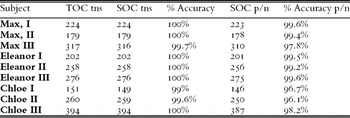
Table 3 indicates the L2 learners’ production of finite verb forms in the three interviews. TOC represents total number of contexts of obligatory finiteness (i.e. tensed forms as opposed to nonfinite forms), and p/n indicates accuracy of person-number marking on the verb. The learners’ errors (see Appendix 1 for a complete list) include use of default forms, incorrect suppletive forms and null subjects.
Production, finite verbs and person/number (p/n) accuracy by interview

Unlike less advanced L2 learners, these subjects make almost no substitutions of nonfinite forms in finite contexts. One example of this rare error type is provided in (6) (an utterance from Interview III with Max). (The accurate target form follows the utterance in parentheses.)
(6) *pas problème, revenir mardi prochain (= revenez)
The learners make few errors in person-number agreement, the main type of error involving substitution of default third singular (3 sg) for third plural (3 pl) especially with suppletive verb forms as in (7).
(7) Examples of p/n mistakes
a. Max, III
*Deux profs m'a rencontré à la gare (= m'ont rencontré)
b. Chloe, III
* Ils prend [prã] un examen (= ils prennent/passent)
The errors of (6)–(7) are not ‘grammatical with respect to the learners’ systems,’ as one reviewer suggests; rather, they are clearly performance problems that stand out as mistakes among hundreds of tokens of correct inflection. These errors pattern similarly (but not identically) to what was found in Howard (Reference Howard2006), in that most (20/30) involve substitution of 3sg for 3pl in suppletive verbs. These irregular verbs have distinct spoken forms for third person singular and plural and are always distinguished by native speakers. It is important to note that the vast majority of our L2 subjects’ errors involve production of analogical forms based on the dominant morphological pattern in French. In Modern spoken French, verb forms for all persons except the first and second plural are homophonous in -er verbs, the largest morphological verb class.
Four of Chloe's errors involve relative qui, which we believe she has either analysed as singular in all contexts (e.g., *les gens qui devient for les gens qui deviennent) or has difficulty with because of long distance agreement (cf. Howard, Reference Howard2006). Two other error types involve null subjects and overregularisation, error types also observed in L1A (Clahsen et al., Reference Clahsen, Aveledo and Roca2002). Three of the four null subjects accompany impersonal verbs (e.g. [ce n’] était pas la peine, Eleanor III). The regularisation of irregular verb forms is in line with the dominant conjugation patterns in French as, for example, Chloe's use of ils prendent [prãd] (cf. ils rendent) for ils prennent. The overall accuracy rate with respect to p/n inflection is almost at ceiling, nearly 99% for all three. We next consider another aspect of French verbal morphosyntax, namely verb raising.
3.3 Verb raising
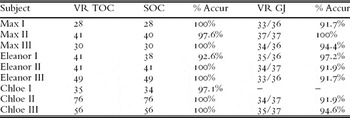
In Table 4, using the placement of the verb relative to left edge markers (negation, adverbs and quantifiers) as a diagnostic for verb raising, we see that the three subjects have a high rate of accuracy for verb raising (VR), oral production data that is corroborated by their grammaticality judgments and a written production task.Footnote 9
Verb Raising (VR) oral production with neg/adv/quant diagnostics, by interview; Grammaticality Judgment (GJ) accuracy

The GJ task is adapted from Hawkins et al. (Reference Hawkins, Towell and Bazergui1993) and includes 40 sentences related to verb raising (plus distracters)—half grammatical, half ungrammatical—with negations (pas, jamais, rien), adverbs (e.g. rapidement, prudemment, souvent) and tout floated from the subject (8). This adapted GJ task (and the original one) had been tested with native French speakers who judged the target interpretations as expected at 100% (Hawkins et al., Reference Hawkins, Towell and Bazergui1993; Herschensohn, Reference Herschensohn2000). The test included only finite verbs.
(8) Sample GJ sentences
a. *Marie souvent va au cinéma.
b. Elles ont traversé rapidement la rue.
The learners were asked to correct all ungrammatical sentences. Table 4 presents the number of verbs preceding left edge markers (and, hence, taken to have raised to TP/AgrS) in the oral interviews (cf. Appendix 1, 2).
As shown in Table 4, in virtually all contexts where diagnostics of negation, adverbs and quantifiers appear in the interview, Max and Chloe raised verbs with near perfect accuracy. Indeed, all subjects produced several tokens of negation, adverbs and quantifier placement postverbally, which serve as clear diagnostics for VR as exemplified by (9)-(10).
(9) (9) Max, III
quelqu'un qui parle bien anglais
(10) Eleanor, III
Il me reste encore le piano
The subjects made only five errors with respect to verb raising in oral production (four of them in the first interviews). Eleanor made three of the errors. An example of one of her errors is provided in (11), where she failed to raise the verb over the modifying adverb. Max and Chloe each made one error only. Max, for example, raised the infinitive over the adverb (see (12), while Chloe failed to raise the verb across aussi (13).
(11) *Sa fille maintenant travaille (= travaille maintenant)
(12) *La possibilité de manger bien (= de bien manger)
(13) *qui aussi traversaient (= traversaient aussi)
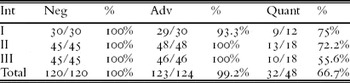
With respect to grammaticality judgment, GJ aggregate numbers reported in Table 4 mask the fact that all but one of the GJ errors involves the quantifier tout. In Table 5 we see scores on the GJ tasks by diagnostic.
Accuracy of GJs, Max, Eleanor, Chloe, left-edge markers

Over three interviews, 16 of the 17 errors involve the following grammatical sentence type presented in (14a), which is grammatical only under the reading that tous modifies ils, but for which all three subjects repeatedly corrected the sentence so that tout modified (with correct gender) the direct object following the verb (14b):
(14) tous modifying subject pronoun ils [tus]
a. Ils relisent tous [DP leurs notes] [tus]
tous modifying NP [tu]
b. Elles relisent [DP tous leurs livres] [tu]
In other words, the learners’ first interpretation was sentence type (14b); they rejected (14a). Since they correctly placed/judged tout in other contexts, at issue here seems to be that their preferred interpretation of this sentence type was not native-like, instead of a VR error per se. The fact that these errors almost exclusively involve quantifiers, mirrors a pattern previously observed by Hawkins et al. (Reference Hawkins, Towell and Bazergui1993) and Herschensohn (Reference Herschensohn2000), as noted above. The three subjects do not show native-like interpretation of the lexical item tout, but their placement of verbs with respect to negation and adverbs is target-like. We agree with a reviewer's suggestion that they may have misanalysed the data, for example, assigning the incorrect phrase structure for the quantifier's referent. The higher percentage of quantifier errors in Interview III suggests that their command of tout is variable and does not improve over term.
In summary, all three learners’ nearly perfect accuracy scores for verb placement relative to left-edge markers after the first interview reveals that they have mastered the correct setting for verb raising, while their indeterminacy on GJs indicates a specific problem with the lexical item tout.
The written production tasks involved composing 30 sentences with negation (pas, jamais) and adverbs (quality adverbs bien, mal and frequency adverbs souvent, rarement) from subjects and verbs that were provided. For example, three agents (e.g. Paul, je, vous) with three adverbial phrases involving frequency (e.g. 0, 7, 2/week) were provided for boire du lait; the task involved writing one sentence for each agent. Max and Eleanor (90 tokens each) scored 100% on the three tasks; Chloe, who only completed the task in one of the three interviews, had much lower accuracy (20/30 sentences): two omitted, two ‘corrected,’ six wrong and 20 correct). The low score was due in large part to the fact that she ‘corrected’ (crossed out and rewrote) her original placement of the frequency adverbs souvent and rarement. (15a) to place them all sentence finally as in (15b).Footnote 10 In contrast, she ordered all the quality adverbs post-verbally (15c).
(15) Examples, VR written production, Chloe, III
a. Jeanne boit souvent du jus d'orange. (crossed out)
b. *Jeanne boit du jus d'orange souvent. (inaccurate corrected token)
c. Marc, il lit mal ce poème.
Once again we see a difference related to specific lexical items. In her oral production, Chloe consistently uses correct post-verbal placement of adverbs, a difference between oral and written production that has been noted (Bialystok, Reference Bialystok1997). In this case, the additional reflection devoted to the written task seems to have led Chloe to overcorrect. The final set of results we consider in this section concern longitudinal development.
3.4 Input, short-term and long-term L2 development
Extensive studies (within different research paradigms) growing out of the European Science Foundation studies of naturalistic L2 learning in the 1980s and 1990s (cf. Klein & Perdue, Reference Klein and Perdue1992, Reference Klein and Perdue1997) often considered naturalistic input to be the crucial component of L2A, but research has also highlighted the role of additional factors such as learning strategies, feedback and explicit instruction (Carroll, Reference Carroll2001; Doughty & Long, Reference Doughty and Long2003; Herschensohn, Reference Herschensohn2003; Truscott & Sharwood Smith,Reference Truscott and Sharwood Smith2004).
With respect to French verbal morphosyntax (finiteness, verb raising), our three subjects do not appear to show dramatic progression in temporal morphosyntax over the immersion period, since their accuracy levels are nearly at ceiling for all three interviews. Clearly, the immersion experience has not played a significant role here since the subjects are already stabilised in their ability to use finite forms and correct verbal word order. Likewise, we see no clear development with respect to p/n accuracy, either, as their production is fairly stable in all interviews. Max and Eleanor hover around 99%, while Chloe ranges from 96% to 98% (Table 3). Finally, VR data also show only slight variability, not longitudinal progression (Table 4).
In contrast to the near perfect accuracy of inflection and word order, the GJ data does not show improved interpretation of tout over the period of time investigated here for any of the subjects. They persist in the misanalysed phrase structure, eschewing the interpretation of the quantifier as floated from the subject. Furthermore, their production in other aspects of French (beyond the scope of this study) such as verbal aspect is more flawed. For example, Max, when asked what he habitually did on a daily basis (cued by imperfect with imperfect response expected), responded with multiple sentences in the inappropriate passé composé.
Indeed, the fact that these learners are at ceiling for verbal morphosyntax does not, however, mean that they are native-like in their overall production. Putting aside their non-native phonology and slow rate of speech, their nominal morphosyntax (gender and number concord between nouns, determiners and adjectives), for example, is far less accurate than is their verbal morphosyntax (Herschensohn & Arteaga-Capen, Reference Herschensohn and Arteaga-Capen2007); furthermore, they have a limited range of tenses and moods. As is often the case for second language learners, they avoid what they do not easily produce (cf. Gass & Selinker, Reference Gass and Selinker2001), rather choosing to say what they know how to say, resulting in performance that may be accurate but is not native-like. The important point here is that they clearly have well established the French morphosyntactic values of TP and AgrSP—that is, they have reset the verb raising parameter—despite very obvious weaknesses in other aspects of their grammars and lexicons.
In terms of long-term longitudinal development, if we compare Chloe's performance in the interviews reported here to her performance in earlier studies (Herschensohn, Reference Herschensohn2001, Reference Herschensohn2003) when she was 17 years old, we see little change in accuracy rate from the final interview conducted at age 17 (accuracy rate 98% after 6 months spent in a totally francophone environment in France) to the interviews reported here (likewise 98%).Footnote 11 Once again, the high score obscures differences between age 17 and age 22 with respect to her mastery of French. Although Chloe appears to have stabilised at around 98% verbal accuracy, she has a far greater command of vocabulary and varied tenses in the later interviews than in the earlier ones, so a simple comparison of the percentages is misleading. While p/n agreement does not seem to change in Chloe's long-term development, her command of discourse implementation and a much broader range of tenses does mark a difference in her performance from her earlier interviews. Whereas her final interview at age 17 contained 91 accurate verbal tokens; her final interview at age 23 contained 387 tokens and demonstrated her ability to discuss, narrate and debate extended discourse in the past, present, and future tenses. It appears from the data that verbal morphosyntax can be solidified in L2 French earlier than other grammatical phenomena such as clitic pronouns (cf. Herschensohn, Reference Herschensohn, Prévost and Paradis2004).Footnote 12 Lexical or semantic details—such as infrequent forms of irregular verbs or native-like interpretation of quantifier float—may continue to be variable even at a more advanced stage.
We do not mean to claim that immersion had no effect on our L2 learners; for example, there is a clear improvement with respect to pragmatic and lexical factors, fluency, colloquial use of language, breadth of vocabulary, and range of verb tenses among other factors. However, given the high level of accuracy at the start of the study, there was little opportunity to show further development on an already acquired feature.
In summary, Max, Eleanor and Chloe generally inflect all verbs for tense and p/n, using all persons, with nearly perfect accuracy. As for verb raising, their accuracy rate is generally 97–100% in oral production. Their written production further indicates that they have a very strong grasp of VR with negation and adverbs, and their GJ results confirm this. Their GJ scores also indicate that they have persistent difficulty with the use of quantifier float with the adverb tout, a characteristic of advanced learners that has been noted in previous studies (Hawkins et al., Reference Hawkins, Towell and Bazergui1993, Herschensohn, Reference Herschensohn2000).
4.0 DISCUSSION
Given the minimalist framework we are assuming, anglophone L2 learners of French need to gain uninterpretable features of T and AgrS. In this section, we first review assumptions of the two theoretical approaches to L2 parameter resetting/morphology mastery, RD/I and FA, and the assumptions about the acquisition of morphosyntax that follow from these approaches. We evaluate the hypotheses in terms of data presented in section 3 by considering answers to the questions posed above in section 2.
4.1 Reviewing Representational Deficit and Full Access
The parametric difference between English and French with respect to VR is a reflex of the functional projections in the verbal domain. French is a [+SplitIP] language in that it projects functional categories associated distinctly with tense (T) and p/n agreement (Agr), while English is a [-SIP] language in that it only has tense inflection and is, therefore, taken to project only one functional category (I). According to RD/I, an adult L2 learner will not be able to acquire an uninterpretable feature if it is not realised in his/her L1. This is precisely the case for anglophones learning L2 French: they could presumably gain tense features since English has tense, but would fail to gain p/n agreement according to RD/I, because English lacks uninterpretable [upers] on AgrS. For RD/I, the deficit is indicated by morphological errors, while target-like morphosyntax is due to misanalysis, cognitive strategy (Franceschina, Reference Franceschina2001, Reference Francheschina2005) or rote learning (Hawkins & Liszka, Reference Hawkins, Liszka, van, Hulk, Kuiken and Towell2003).
According to FA, on the other hand, parameter resetting is possible in adult L2A, and the adult L2 learner can, thus, acquire functional projections and feature values that differ from those of his/her L1. Learners may restructure their interlanguage grammars as they learn from parsing failures (cf. Carroll, Reference Carroll2001). Since they have access in principle to UG, they may eventually gain L2 values of functional features non-existent in the native language. On this view, default morphology is not indicative of syntactic failure.
The next section reconsiders the two approaches in terms of questions posed in section II, using our data as a reference point:
1) What is the source of L2 morphological errors?
2) What is the explanation for L2 correct forms?
3) What evidence is deemed acceptable proof for success or failure to reset parameters?
4) Is there a maturational limit for acquisition of uninterpretable functional features (parameter resetting)?
5) What do data reveal about parameter resetting?
4.2 Evaluation of RD/I and FA
4.2.1 Morphological accuracy
Answers to the first questions—what are the reasons for L2 morphological errors and what is the explanation for correct morphological forms—follow from core differences between RD/I and FA, and depend on whether morphological errors are regarded as diagnostic of a syntactic deficit or as the result of a (syntax-morphology) mapping problem. Recall that under RD/I, parameter settings are transferred from L1 to L2, but learners are unable to acquire new parameter settings that differ from native values if L2 is learned past the critical period; this deficit is the cause of morphological errors in L2. Under FA, on the other hand, parameters may be reset in adult L2A (since there is no critical period for parameter resetting in L2A) and non-target inflection is due to factors other than incorrect parameter settings (namely problems with syntax-to-morphology mapping). Both approaches adopt Distributed Morphology with differing interpretations: RD/I points to the distinction between syntactic and vocabulary agreement (natives use the former, learners the latter because L2 syntax is flawed), while FA appeals to underspecification to explain use of default forms for specific morphology.
Underspecification allows FA to account for the fact that while L2 learners have isolated surface morphological errors in TP, they nonetheless inflect verbs for tense, and for p/n. This clearly suggests a surface mismatch rather than an underlying syntactic deficit, and it is especially well accommodated by underspecification since most errors use default 3-sg form. Furthermore, errors are unidirectional, meaning that underspecified forms are used for more specified forms, and not vice versa; we do not see a random distribution of both default and specified forms.
According to RD/I, learners should transfer finite inflection from English with its [upast], but not p/n, which is characteristic of French [upers]. Under this view we should find p/n errors but virtually no finiteness errors. Moreover, there should be no reason for errors to follow a pattern under RD/I, particularly not a pattern found in L1 acquisition (e.g., analogical regularisation of verb conjugations, Clahsen et al., Reference Clahsen, Aveledo and Roca2002). Although the few p/n errors do slightly outnumber finiteness errors, both types of errors are minimal, ranging from nearly zero for finiteness accuracy, and amounting to 3.9% (Chloe II), 2.2% (Max) and 2.8% (Eleanor) for p/n errors. Considering p/n agreement, in virtually all cases learners assigned a p/n feature to the verb, although it is in a few cases the wrong p/n feature, suggesting a mapping problem, particularly because the few errors they did make are not random, but demonstrate a mastery of the most dominant morphological patterns in French. Under the FA approach, these L2 learners have acquired [upers] on T and AgrS and are able to make agreement with interpretable tense and p/n features of the verb.
The second question—what are the reasons for L2 correct forms—is the complement of the first. Target-like production is accounted for under RD/I as misanalysis, cognitive compensatory strategy or lexical memorisation. For FA, consistent use of correct forms, corroborated by additional morphosyntactic evidence, is an indication of target-like L2 morphosyntax. The FA analysis is then actually more straightforward. In the absence of evidence to the contrary, it makes sense to assume that target-like performance is generated by target-like competence, not misanalysis.
The RD/I approach cannot account for the data we have presented for several reasons. First, the advanced L2 learners’ morphosyntactic production gives no indication of misanalysis, conscious strategies or rote learning, one exception being the clear indication of misanalysis in GJs of tout, where the learners correct the sentences to a different phrase structure with unfloated quantifier. Rather, our L2 data show that learners’ accuracy regarding TP morphology and syntax is generally quite high, with error rates that are inconsequential, as we have noted earlier. There is clear p/n agreement and inflection, meaning that their L2 grammar evinces a clear mastery of tense and p/n. We suspect that Max and Eleanor—in their scholarly systematicity—may indeed have initially used cognitive strategies or rote learning to gain declarative knowledge, but they have automatised their morphology and now have clearly procedural command of French inflection (cf. Paradis, Reference Paradis2004). A reviewer questions the difference between (i) parameter resetting/UG-driven acquisition (interlanguage grammar) and (ii) declarative knowledge that becomes automatised. Our study is mainly a snapshot of the three advanced learners’ competence, not their L2 development (since they show little change over eight months’ immersion). A discussion of Gregg's (Reference Gregg, Ritchie and Bhatia1996) distinction of property vs. transition theory (i.e. interlanguage grammar vs. its development) is beyond the scope of this article. We presume that parameter resetting is not exclusively driven by UG, but rather bootstrapped by a coalition of resources including cognitive strategies and lexical learning (cf. Herschensohn, Reference Herschensohn2000). Under this scenario, cognitive strategies are ancillary to UG, not contradictory to it. Finally, the three L2 learners score quite high in terms of production and GJs with respect to verb raising. It is unclear how one could justify postulating the exclusive use of alternative L2 strategies (rather than parameter resetting) in the face of accuracy averaging 98% and above on a range of tasks. In other words, why would ‘misanalysis’ be so felicitous?
The subjects also demonstrate competence in a range of verbs, tenses and persons in spontaneous online production, a competence that is unexpected if one assumes the rote learning suggested by the RD/I approach. As noted above, the subjects use all six persons of the verb and a range of tenses including present, passé composé, imperfect, pluperfect, future, conditional, as well as an extensive range of verb types in rapid and spontaneous conversation. Even if the verb conjugations were originally learned as declarative knowledge, they are here automatised in procedural knowledge (cf. Paradis, Reference Paradis2004). Note that we are not claiming that our subjects’ production is target-like in all aspects, as we have mentioned earlier, but our concern here is simply with the limited area of verbal morphosyntax involved in the parametric distinction between English and French.
4.2.2 Parameter resetting
The data concerning verb raising also disfavor RD/I and favor FA, since the subjects’ spoken production, written production and grammaticality judgments, are near ceiling (left-edge diagnostic). On GJs the subjects made only one error with adverb placement (none with negation); their accuracy with the quantifier tout is only 67%, indicating that they have mastered verb raising with negation and adverbs, but have not yet mastered quantifier float from the subject with tout. The data could thus be interpreted as indicating that all three subjects have reset the VR parameter to its correct (French) setting but are still having problems with tout (a problem that is probably not related to VR specifically). It could not be the case—as RD/I might argue—that learners have simply memorised the right word order based on instruction or negative evidence, since they clearly have implicit knowledge brought online to use basically correct morphology and word order in fairly rapid conversation (cf. Truscott & Sharwood Smith, Reference Truscott and Sharwood Smith2004). Paradis (Reference Paradis2004, Chapter 2) argues that explicit metalinguistic knowledge does not become implicit, but rather that implicit automatised knowledge develops independently, sometimes in parallel to explicit knowledge. ‘The very nature of what is represented in metalinguistic knowledge differs from what underlies implicit linguistic competence (an explicit rule vs. a set of implicit computational procedures)’ (ibid: 45).
RD/I fares less well than FA because learners show a very high general level of accuracy with respect to TP morphology and syntax in spontaneous production, GJs and written tasks. The facts that they near ceiling on their accuracy, make no consistent errors and are able to conjugate verbs in a range of persons and tenses strongly suggest that they have mastered these aspects of temporal morphosyntax of French. The few random errors that they do commit appear to be related to what could be a mapping problem. We believe that the data show that these learners have gained split IP and have [upers] on T and on AgrS.
The third question—what evidence is deemed acceptable proof—is comparably addressed by both approaches. For Hawkins (Reference Hawkins2003), target L2 performance (on properties linked to parameters that have different values in the L1 and L2) does not in and of itself constitute counter-evidence, unless the evidence comprises different tasks. Similarly, FA also requires a range of corroborating evidence to confirm parameter resetting. We believe that our data meet the burden of proof required by either theory, for while our subjects do demonstrate apparent L2 success and high approximation to target performance on finite morphosyntax and verb raising, it is not their spontaneous production alone that we have examined. They also perform comparably on GJs and on written production tasks. We therefore conclude that FA better describes the data we have collected on advanced learners of L2 French than does RD/I, that they do not have defective uninterpretable agreement [upers] and unsplit IP [-SIP], but rather have a [+SIP] setting for L2 French that allows them to make target-like morphological matches with finiteness and p/n, and to raise the verb to TP/AgrSP.
Our response then to the fourth question—is there a maturational limit for acquisition of uninterpretable functional features and parameter resetting—is dependent on our view that these adult subjects have, indeed, reset the VR parameter.Footnote 13 As all three of our subjects were past the critical age of acquisition, the acquisition of uninterpretable features in functional categories non-existent in native English indicates no maturational limit. The lack of critical period effects in our data argue for FA over RD/I.
As for the final question, we do not observe longitudinal development of verbal morphosyntax in that the subjects are already at ceiling for temporal inflection in the initial interview. In our view, the subjects’ lack of longitudinal progression also argues for FA over RD/I. If we assume that L2 parameter values can be gained, we would expect little longitudinal change in advanced subjects under FA. Once L2 speakers have gained [upers] and split IP [+SIP], we would expect production to be fairly stable, as with our data. In contrast, for RD/I, we would expect consistent and persistent morphosyntactic errors reflecting the representational deficit, a pattern that we do not find in our data.Footnote 14
5.0 CONCLUSION
In summary, then, the data we have presented argue against RD/I, because it seems clear that our advanced L2 learners seem to have reset the parameters related to TP syntax and morphosyntax (tense, p/n, VR). We fail to see longitudinal progression, as expected under FA, finding instead that the learners’ performance is at ceiling from the beginning of data collection and that their performance does not change over time (i.e. from the first to the final sets of data). What remains to be addressed in further studies, however, is the L2 speakers’ accuracy within other morphosyntactic domains, such as determiner phrases and verbal aspect where the accuracy of their production appears lower. While the idea that grammatical deficits depend on age of acquisition is appealing in its simplicity, the deficits that we document relate far less to parameter resetting than to mastery of lexical subtleties (e.g. use of tout) and to discourse appropriateness (e.g. aspect). Advanced speakers of an L2 may be near-native in their accuracy (cf. Franceschina, Reference Franceschina2001), but they will never be native; less than 100% achievement is to be expected, with more fragility of the grammar anticipated at the interfaces of syntax with other linguistic/pragmatic systems (cf. van Hout et al., Reference Van Hout, Hulk, Kuiken and Towell2003).
Acknowledgements
Portions of this article have been presented in earlier versions at the following conferences: GALA 2005 (Sienna), SLRF 2005 (New York), BUCLD 2005 (Boston), LSRL 2006 (Rutgers) and PacSLRF 2006 (Brisbane), Colloque international Recherches en acquisition et en didactique des langues étrangères et secondes 2006 (Paris). The authors have profited from the comments and suggestions of members of these audiences and extensive comments from Martha Young-Scholten. Errors are of course our own.
APPENDIX 1
Errors by type: Max, Eleanor, Chloe
A. Morphological errors
1. finite/non finite errors
revenir-inf mardi (= revenez-2-pl) (Max III)
le mettre-inf en bouteille (= on le met-3-sg) (Chloe I)
Ça créer-inf plus de problèmes (= crée-3-sg) (Chloe I)
pas demande-3-sg (= pas demander-inf) (Chloe I)
je lire-inf (= je lis-1-sg) (Chloe II)
essaie-3-sg (= essayer-inf) (Chloe III)
2. 3-sg for 3-pl
tous les boulevards a-3-sg (= ont-3-pl) (Max III)
deux profs m'a-3-sg rencontré (= m'ont rencontré) (Max III)
[ils] m'a-3-sg conduit (= m'ont-3-pl conduit/emmené) (Max III)
mes jours à Leipzig est-3-sg (= mes jours sont-3-pl) (Max III)
ils veut-3-sg voir (= ils veulent-3-pl voir) (Eleanor I)
les voitures qui aussi traversaient la rue dans l'autre sens a-3-sg écrasé (= ont-3-pl écrasé) (Chloe I)
tous les trois ne va-3-sg pas marcher. (= ne vont-3-pl pas) (Chloe I)
des gens qui vient-3-sg (= viennent-3-pl) (Chloe II)
des chaussures qui me plaît-3-sg (= plaisent-3-pl) (Chloe II)
ils prend-3-sg (= ils prennent-3-pl) [3 repetitions] (Chloe II)
eux, ils peut-3-sg pas parler (= peuvent-3-pl) (Chloe II)
ils revient-3-sg (= reviennent-3-pl) (Chloe II)
ils prend-3-sg (= ils prennent-3-pl) (Chloe III)
des sujets qui doit-3-sg être (= doivent-3-pl) (Chloe III)
les gens qui devient-3-sg (= deviennent-3-pl) [2 repetitions] (Chloe III)
qu'ils, qui veut-3-sg (= veulent-3-pl) (Chloe III)
les cyclones a-3-sg passé (= ont-3-pl passé) (Chloe III)
3. Null subject
sont pas les pays francophones (= ce sont) (Max III)
pas vaut la peine (= ça ne vaut pas la peine) (Eleanor II)
où habitait (= où il habitait) (Eleanor II)
était pas la peine (= ce n'était) (Eleanor III)
4. Other
la comité d'éducation sont-3-pl élus (= est-3-sg) (Max I)
[la possibilité] se sont-3-pl diminué (= a-3-sg diminué) (Max II)
toi et lui ont-3-pl fait (= toi et lui vous avez-2-pl fait) (Max III)
les Palestiniens ont remet (= ont remis) (Chloe I)
cette paire de chaussures sont-3-pl (= est-3-sg) (Chloe II)
ils prendent (= prennent) (Chloe II)
on étude (= étudie) (Chloe III)
B. Verb raising errors
la possibilité de manger bien (= de bien manger) (Max II)
sa fille maintenant travaille (= travaille maintenant) (Eleanor I)
personne m'a dit rien (= m'a rien dit) (Eleanor I)
les Américains toujours voudraient (= voudraient toujours) (Eleanor I)
qui aussi traversaient (= traversaient aussi) (Chloe I)
APPENDIX 2
Verb Raising
Oral production, VR as indicated by negation, adverbs and quantifiers