After France, Greece and Spain, Italy is the fourth country in the EU for goats' milk production, ca. 115 000 t per year (FAOSTAT, 2004). Goat-farming is located mainly in the Alps, Centre-Southern and the major islands (Sardinia and Sicily) of Italy. As a consequence of these locations in heterogeneous zones, many different goat breeds are present. Except for minor local production of goats' milk yogurt or pasteurized goats' milk, all the milk is transformed into cheese, alone or mixed with cows' and/or ewes' milks. Semi-hard varieties, made from predominantly rennet-coagulated curd, are larger than soft cheeses, have a cylindrical shape and a dry rind, and consumers' demand is increasing rapidly owing to typical texture and flavour.
Contrary to some of the most popular French and Spanish goats' cheeses which have a Protected Denomination of Origin (PDO) and were characterized in a number of studies (Medina & Nuñez, Reference Medina, Nuñez, Fox, McSweeney, Cogan and Guinee2004), none of the Italian goats' cheese has PDO status and studies are few. The few reports have considered the microbial characterization of fresh (Casalta et al. Reference Casalta, Noël, Le Bars, Carré, Achilleos and Maroselli2001) or semi-hard goats' cheese (Suzzi et al. Reference Suzzi, Caruso, Gardini, Lombardi, Vannini, Guerzoni, Andrighetto and Lanorte2000) and the use of various levels of rennet and of mesophilic starters to increase the cheese yield (Caponio et al. Reference Caponio, Pasqualone and Gomes2001). Studies on the compositional, microbiological, biochemical, volatile profile and sensory characteristics of the most important Italian semi-hard goats' cheeses may have the following objectives: (i) to differentiate cheeses; (ii) to establish the effect of selected technological parameters on specific differences in the microbiota and related biochemical activities; and, in general, (iii) to identify the most appropriate characters suitable for obtaining a ‘denomination of origin’. This study characterizes four major typical Italian semi-hard goats' cheeses, Flor di Capra, Caprino di Valsassina, Caprino di Cavalese and Capritilla.
Materials and Methods
Cheese samples
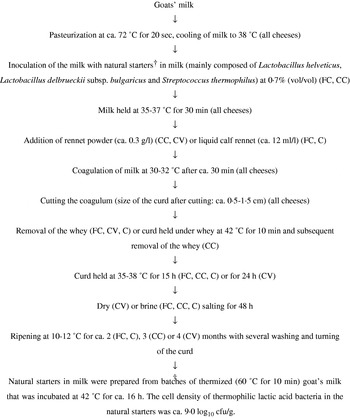
Flor di Capra (FC; from milk of the Sarda breed, Sardinia region); Caprino di Cavalese (CC; Saanen breed, Trentino Alto Adige region); Caprino di Valsassina (CV; Orobica breed, Trentino Alto Adige region); and Capritilla (C; Alpina breed, Piemonte region) were supplied in triplicate (different batches from the same factory) (Fig. 1). Cheeses were manufactured during spring and milk was from the early lactation. Cheese manufacture was according to specific guidelines for each variety (http://www.formaggio.it). The gross compositions of the goats' milks were: protein, 2·9 (Saanen) – 4·2% (Sarda); fat, 2·9 (Orobica) – 4·0% (Sarda); and lactose, 4·3–4·5%. The pH was 6·6–6·7. All cheeses had cylindrical shape with a diameter of 19–21 cm, height of 6–9 cm and weight 2–3 kg. All the analyses were carried out in duplicate for each batch of cheese.
Protocols for the manufacture of the four Italian goats' cheeses. FC, Flor di Capra; CC, Caprino di Cavalese; CV, Caprino di Valsassina; C, Capritilla.

Compositional and microbiological analyses
Moisture, NaCl, pH and the pH 4·6-soluble nitrogen (expressed as a % of total nitrogen in the cheese) were determined as described by Di Cagno et al. (Reference Di Cagno, Banks, Sheehan, Fox, Brechany, Corsetti and Gobbetti2003). Protein and fat were determined as described by Gobbetti et al. (Reference Gobbetti, Folkertsma, Fox, Corsetti, Smacchi, De Angelis, Rossi, Kilcawley and Cortini1999).
Thermophilic streptococci were enumerated on M17 (Oxoid Ltd, Basingstoke, Hampshire, England) at 42°C for 72 h. Mesophilic and thermophilic lactic acid bacteria (LAB) were enumerated on MRS agar (Oxoid Ltd) after incubation at 30 or 42°C for 72 h. At least 15 colonies of presumptive mesophilic LAB were isolated from the plate of the highest dilution of each type of cheese and subjected to genotypic identification. Extraction of genomic DNA and primers, LacbF/LacbR and LpCoF/LpCoR (Invitrogen Life Technologies, Milan, Italy), used to amplify 16S rRNA gene fragment were as described by Coda et al. (Reference Coda, Brechany, De Angelis, De Candia, Di Cagno and Gobbetti2006). The expected amplicons of about 1400 and 1000 bp were eluted from the gel and purified by the GFX™ PCR DNA and Gel Band Purification Kit (Amersham Pharmacia Biotech AB, Uppsala, Sweden). Taxonomic strain identification was carried out by using the Basic BLAST database. Strains showing homology of at least 97% were considered to belong to the same species.
Assessment of proteolysis
The pH 4·6-soluble fractions of the cheeses were prepared as described by Gobbetti et al. (Reference Gobbetti, Folkertsma, Fox, Corsetti, Smacchi, De Angelis, Rossi, Kilcawley and Cortini1999) and analysed by Reverse-Phase Fast Protein Liquid Chromatography (RP-FPLC) with a Resource RPC column, using an ÄKTA FPLC equipment with a UV detector operating at 214 nm (Amersham). Peptide profiles were analysed by multivariate statistical techniques. The data for factor reduction analysis were obtained by visually recognizing the peaks and taking peak heights as variables (Pripp et al. Reference Pripp, Shakeel-Ur-Rehman, McSweeney and Fox1999). Total and individual free amino acids (FAA) in the pH 4·6-soluble fraction were analysed using a Biochrom 30 series Amino Acid Analyzer (Biochrom Ltd., Cambridge Science Park, England) as described by Coda et al. (Reference Coda, Brechany, De Angelis, De Candia, Di Cagno and Gobbetti2006).
Determination of volatile components
Simultaneous steam distillation-extraction (SDE) was conducted to extract volatile compounds from cheese followed by gas chromatography mass spectrometry (GC/MS) for compound identification. Prior to analysis, the rind was trimmed and a wedge cross-section of cheese was taken. Samples were shredded and stored at −20°C until extraction. Ten grams of frozen, grated cheese was mixed with 40 ml of deodorized water and boiling chips in a 100 ml steam distillation flask. SDE was carried out for ca. 2 h into dichloromethane containing 10 ppm methylnonadecanoate as internal standard (Chrompack UK Ltd, Millharbour, London). An Agilent 6890 with 5973N mass selective detector, equipped with a fused silica capillary column (DB-5MS 30 m length×0·25 mm i.d.×0·25 μm df, J&W Scientific), was used for GC-MS analysis (Karagul-Yuceer et al. Reference Karagul-Yuceer, Drake and Cadwallader2001). Based on MS results, relative concentrations of the compounds were calculated. The area ratio (area of internal standard/area of compound) was multiplied by the concentration of the internal standard to determine the relative abundance of the compounds. For positive identification, retention indices and mass spectra were compared with those of authentic standard compounds. For the calculation of retention indices, an n-alkane series was used.
Sensory analysis
For sensory analysis, the rind was trimmed from each cheese and cross-sectional wedges were taken. Cheeses were then sliced into 2×2 cm cubes such that each panellist received at least 3 cubes that represented the entire cross-section of the wedge at each tasting session. Samples were evaluated by a trained cheese sensory panel (n=8) using a previously published lexicon for cheese flavour (Drake et al. Reference Drake, McIngvale, Gerard, CadWallader and Civille2001) with specific descriptors for goats' cheeses added (Carunchia-Whetstine et al. Reference Carunchia-Whetstine, Karagul-Yuceer, Avsar and Drake2003). Flavour and taste intensities were scaled using a 15-point universal intensity scale.
Results and discussion
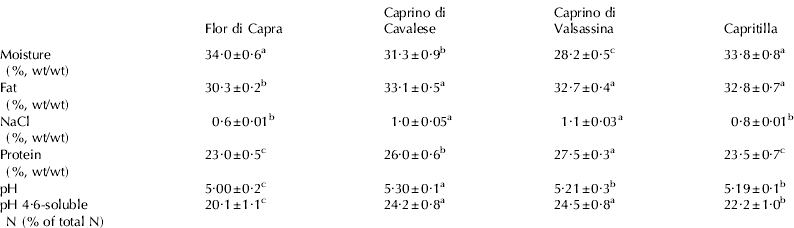
The lowest and highest levels of moisture were found for CV and FC, which mainly agreed with the time of ripening (Table 1). The protein content varied by 4·5% between the four cheese types. Only FC had significantly lower fat than the other cheeses (Table 1). These ranges agreed with those of other semi-hard goats' cheeses (Medina & Nuñez, Reference Medina, Nuñez, Fox, McSweeney, Cogan and Guinee2004) and reflected the chemical composition of the raw goats' milk. The pH values varied by 0·3 between the four cheeses, indicating that this is not influenced by the thermophilic starters used. The level of NaCl ranged from 0·6–1·1% (wt/wt); it was highest for the dry salted CV. Overall, for this and the further analyses the same cheese type from different batches did not differ significantly (P>0·05) showing the reproducibility of the protocols for the manufacture.
Gross composition of the four Italian goats' cheeses at the end of ripening
Values are means±sd for three batches of each type of cheese, analysed in duplicate
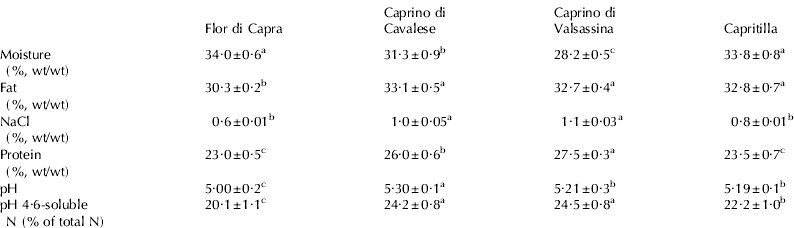
a–c Means within a row with different superscript letters are significantly different (P<0·05).
Numbers of thermophilic lactobacilli and streptococci in FC and CC cheeses that used thermophilic natural starters varied from 5·10±0·35−4·38±0·14 and 4·54±0·20−4·92±0·36 log10 cfu/g, respectively. Thermophilic LAB in the other two cheeses were less than 3·0 log10 cfu/g. Numbers of presumptive mesophilic LAB were similar between cheeses and varied from 7·98±0·22 (FC) to 8·51±0·18 log10 cfu/g (CV). The microbial composition was also similar and the following species were identified: FC, Lb. paracasei (12 isolates) and Lb. casei (3); CC, Lb. paracasei (12), Lb. casei (1), Lb. plantarum (1), and Pediococcus pentosaceus (1); CV, Lb. paracasei (6), Lb. plantarum (5), Lb. rhamnosus (3), and Lb. casei (1); and C, Leuconostoc pseudomesenteroides (6), Lb. plantarum (5), Lb. paracasei (3), and Lb. casei (1). Lb. paracasei, Lb. plantarum and Lb. rhamnosus were also found as the dominant species in several Spanish goat' cheeses (Mas et al. Reference Mas, Tabla, Moriche, Roa, González, Rebollo and Cáceres2002; Sánchez et al. Reference Sánchez, Seseña, Poveda, Cabezas and Palop2005). Pediococcus and Leuconostoc sp. were identified in Ibores (Mas et al. Reference Mas, Tabla, Moriche, Roa, González, Rebollo and Cáceres2002) and other Spanish goats' cheeses (Fontecha et al. Reference Fontecha, Peláez, Juárez, Requena and Gómez1990).
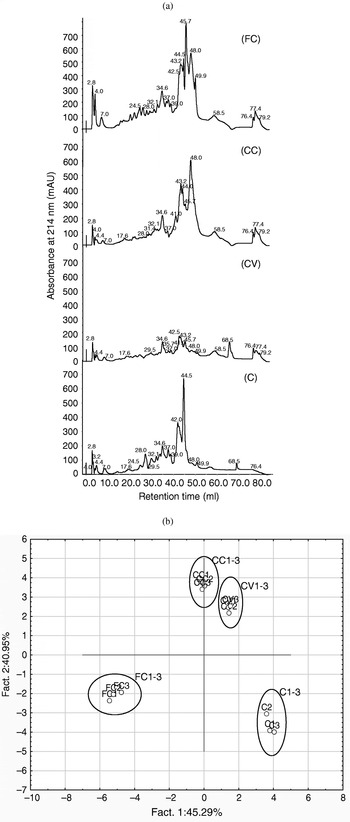
The level of pH 4·6-soluble nitrogen (% of total nitrogen) varied by 4·4% between the four cheese types (Table 1). These values agreed with those found for the Italian Bastelicaccia and Spanish Ibores goats' cheeses (Casalta et al. Reference Casalta, Noël, Le Bars, Carré, Achilleos and Maroselli2001; Mas et al. Reference Mas, Tabla, Moriche, Roa, González, Rebollo and Cáceres2002) and were markedly higher than those found for the Spanish and French goats' cheeses Babia-Laciana, Armada and Sainte Maure (Fresno et al. Reference Fresno, Tornadijo, Carballo, Bernardo and Gonzàlez-Prieto1997; Le Quéré et al. Reference Le Quéré, Pierre, Riaublanc and Demaizières1998; Franco et al. Reference Franco, Prieto, Gonzàlez and Carballo2001). The pH 4·6-soluble fractions were analysed by RP-FPLC (Fig. 2a) and subjected to Principal Component Analysis (Fig. 2b). CC and CV grouped together while FC and C were located in separated zones of the plane. The concentration of FAA was highest for CV (17·94±2·2 mg/g) and CC (15·76±3·5 mg/g), intermediate for FC (10·39±2·7 mg/g) and lowest for C (5·39±1·2 mg/g). These concentrations were higher than those found for the Spanish and French varieties Babia-Laciana (ca. 4 mg/g; Franco et al. Reference Franco, Prieto, Gonzàlez and Carballo2001), Armada (ca. 3·6 mg/g; Fresno et al. Reference Fresno, Tornadijo, Carballo, Bernardo and Gonzàlez-Prieto1997) and Bouton de Culotte (ca. 2·6 mg/g; Salles et al. Reference Salles, Hervé, Septier, Deimazières, Lesschaeve, Issanchou and Le2000). Ser, Glu, Val, Ile, Leu, Tyr, Phe, Lys and Pro were found at the highest concentrations in the four Italian cheeses. This profile did not agree with that of Babia-Laciana cheese, mainly characterized by γ-amino butyric acid, Val and Leu (Franco et al. Reference Franco, Prieto, Gonzàlez and Carballo2001). Only the concentrations of 5 FAA (Glu, Cys, Tyr, His and Trp) statistically (P<0·05) differentiated the profiles of CV and CC. Since these cheeses showed the highest level of pH 4·6-soluble nitrogen (24·2–24·5%) and the less abundant peptide profile, especially CV (Fig. 2a), a higher degradation of peptides to FAA during ripening was suspected. CV and CC were manufactured by rennet powder, subjected to curd cooking (CC) or to curd held at 35–38°C for the longest time (CV), ripened for 3 or 4 months (Fig. 1) and contained the large spectrum of NSLAB species.
Reverse-Phase Fast Protein Liquid Chromatography (RP-FPLC) of the pH 4·6-soluble fractions of the four Italian goats' cheeses (a) and related Score plot of first and second principal components after Principal Component Analysis (b). FC, Flor di Capra; CC, Caprino di Cavalese; CV, Caprino di Valsassina; C, Capritilla. Numbers 1–3 refer to different batches of cheese.

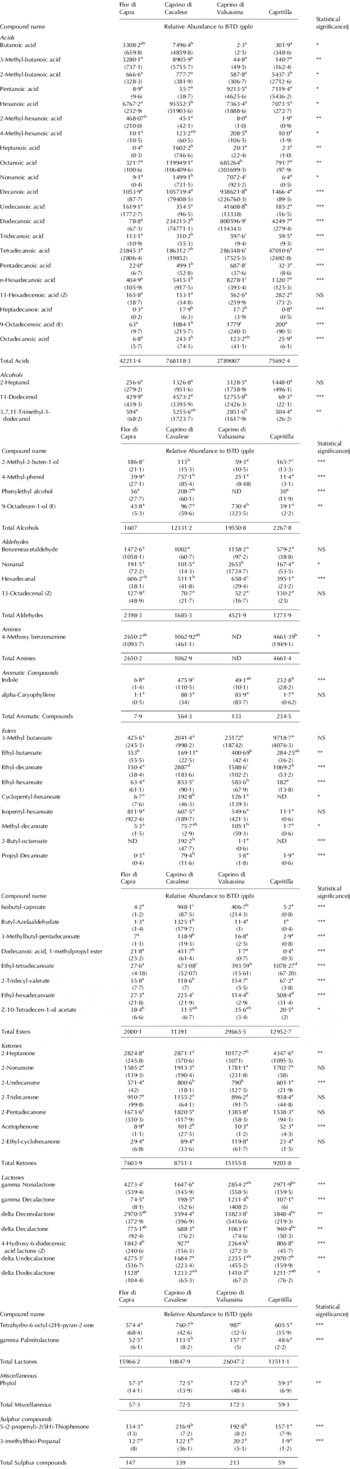
Compared with headspace techniques, SDE showed the ability to recover also higher molecular weight volatiles (e.g., fatty acids larger than decanoic acid and lactones) (Larrayoz et al. Reference Larrayoz, Addis, Gauch and Bosset2001). Solid Phase Micro-Extraction was used with some success for cheese volatile analysis but it lacks the ability to extract the above high molecular weight volatiles (Coda et al. Reference Coda, Brechany, De Angelis, De Candia, Di Cagno and Gobbetti2006). Dynamic headspace (Purge and Trap) noted fewer total recovered volatiles in Manchego cheese when compared with SDE (Gomez-Ruiz et al. Reference Gomez-Ruiz, Ballesteros, González, Cabezas and Martínez-Castro2002). Seventy-two volatile components were identified in the four Italian goats' cheeses by SDE (Table 2). Acids formed the most important group by concentration (21 components) (Table 2). The typical goat cheese aroma is attributed to short- and medium-chain linear, and branched-chain free fatty acids (FFA) (Medina & Nuñez, Reference Medina, Nuñez, Fox, McSweeney, Cogan and Guinee2004). The concentrations of butanoic, nonanoic, decanoic, dodecanoic, tridecanoic, tetradecanoic, pentadecanoic, n-hexadecanoic and 9-octadecanoic acids differentiated CV from the other cheeses. Almost the same components, together with 3-methyl-butanoic, hexanoic, heptanoic and octanoic acids, statistically differentiated CC. Overall, a high variability characterized the qualitative profile of FFAs of Spanish goats' cheeses (Guillen et al. Reference Guillen, Ibargoitia, Sopelana, Palencia and Fresno2004b; Poveda & Cabezas, Reference Poveda and Cabezas2006). When rennet paste or other exogenous lipases are not used, the liberation of hexanoic to dodecanoic FFA is attributed to milk endogenous lipoprotein lipase (LPL) (Medina & Nuñez, Reference Medina, Nuñez, Fox, McSweeney, Cogan and Guinee2004). LPL has a specificity towards fatty acids located at the positions sn-1, 3 of the triglyceride, and medium- and, especially short-chain fatty acids are predominantly esterified at the sn-3 position (Juárez et al. Reference Juárez1986). Besides, shorter chain triglycerides are more readily hydrolyzed by LPL than long-chain triglycerides because of higher solubility and mobility at the emulsion-water interface (Deckelbaum et al. Reference Deckelbaum, Hamilton, Moser and Bengtsson-Olivecrona1990). Although the pasteurization included in the manufacture of all four goats' cheeses might reduce the activity of the LPL, its effect during milk storage and, especially, during prolonged ripening should be suspected (Morgan & Gaborit, Reference Morgan and Gaborit2001). The concentration of acids in CV was markedly higher than in the other Italian cheeses. Although technological traits such as curd held at 35–38°C for 24 h and the longest time (4 months) of ripening had an influence, differences in the LPL activity due to the type of goats' milk breed might not be excluded. As shown for the goats' Palmero cheeses (Guillen et al. Reference Guillen, Ibargoitia, Sopelana and Palencia2004a, Reference Guillen, Ibargoitia, Sopelana, Palencia and Fresnob), a low number of alcohols were also identified in the four Italian cheeses (Table 2). 11-Dodecenol, 2-methyl-2-buten-1-ol and 9-octadecen-1-ol statistically differentiated the profile of CV. The same was found for 2-methyl-2-buten-1-ol, 4-methyl-phenol and phenylethyl alcohol in CC. A few aldehydes were identified (Table 2) which agreed with those reported in Palmero smoked goats' cheese (Guillen et al. Reference Guillen, Ibargoitia, Sopelana and Palencia2004a). Esters, comprising 17 components, were the second most numerous chemical class (Table 2). Ethyl-hexanoate, 2-butyl-octanoate, isobutyl-caproate and 2-tridecyl-valerate statistically differentiated CV. Twelve of the 17 esters statistically differentiated CC from the other cheeses. Esters, especially those containing few carbon atoms, contribute in a synergistic way to the fruity aroma of cheese (Preininger & Grosch, Reference Preininger and Grosch1994). Among ketones, only 2-heptanone and acetophenone statistically distinguished CV and CC from the other cheeses, respectively (Table 2). All the 5 aliphatic linear ketones identified in the Italian goats' cheeses were also found in Palmero goats' cheese (Guillen et al. Reference Guillen, Ibargoitia, Sopelana, Palencia and Fresno2004b). γ-Nonalactone, δ-decenolactone and δ-undecalactone were the most abundant lactones in all four goats' cheeses (Table 2). These compounds, probably resulting from oxidation of FFA and subsequent cyclation of the formed hydroxyacids, are cheese flavour components giving pleasant, buttery and fruity sensory attributes (Guillen et al. Reference Guillen, Ibargoitia, Sopelana and Palencia2004a). Quantitatively, CV also contained alcohols, esters, ketones and lactones at the highest concentrations. The occurring enzymatic and chemical reactions seemed to be mainly related to the indigenous microbiota and, especially, to the time of ripening. This was confirmed by FC cheese (1 month of ripening) that instead of the use of primary starters had the poorest volatile profile.
Volatile components [area ratio (area of internal standard (ISTD)/area of compound)] found in the four Italian Goats' cheeses at the end of ripening. ISTD was nonadecanoic acid, methyl ester
Values are means (sd) for three batches of each type of cheese, analysed in duplicate

a–d Means within a row with different superscript letters are significantly different at the P value in the last column.
§ Statistical significance between the four Italian goats' cheeses: *** P<0·001; ** P<0·01; * P<0·05; NS not significant (P >0·05).
ND, not detected.
The variability of the volatile components among the three batches of each type was not significant (P>0·05).
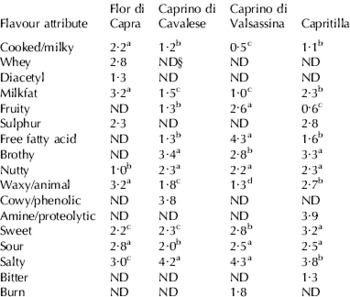
Salty taste was scored between 3·0 and 4·3 (Table 3) and mirrored the differences found for the concentration of NaCl. FC was the only cheese with 7 flavour attributes not detectable and with appreciable intensities of whey and diacetyl, which are typical of fresh young cheeses (Drake et al. Reference Drake, McIngvale, Gerard, CadWallader and Civille2001). Besides, FC received the highest score for milk/fat and waxy/animal. This cheese was characterized by the lowest concentration of FFA and other volatile components (Table 2), shortest duration of ripening (Fig. 1) and less heterogeneous NSLAB composition. CC was characterized mainly by the attributes cowy/phenolic and brothy (aromatics associated with boiled meat). This cheese contained the highest amount of sulphur and aromatic compounds, including indole (Table 2) and was the only one subjected to curd cooking (Fig. 1). The attribute FFA was indubitably the characterizing flavour for the CV cheese. Indeed, its concentration of medium chain FFA was markedly higher than the other cheeses (Table 2). Due to the highest concentration of esters, especially with few carbon atoms, this cheese had also the highest score for fruity flavour. The flavour attribute amine/proteolytic received the highest score for C cheese. The only amine (4-methoxy benzenamine) identified among the volatile components statistically differentiated it from the other cheeses (Table 2).
Sensory profiles of the four Italian goats' cheeses at the end of ripening
Values are means for three batches of each type of cheese, analyzed in duplicate. Intensities were scored on a 15-point universal intensity scale using the Spectrum™ method

a–d Means within a row with different superscript letters are significantly different (P<0·05).
§ ND, not detected.
First this study gave a complementary characterization of four major Italian semi-hard goats' cheeses. This characterization permitted cheeses to be differentiated and to establish relationships between technology, biochemical process and sensory attributes.