INTRODUCTION
Audit studies investigating discrimination have demonstrated that employers are much less likely to invite testers with criminal records for call-backs and interviews, compared to those not identifying a criminal record. What is more, hiring managers do so in a manner that exacerbates ongoing discrimination against people of color as a group (regardless of racial minorities’ involvement with the criminal justice system) (e.g., Decker, et al. Reference Decker, Ortiz, Spohn and Hedberg2015; Pager Reference Pager2003; Pager, Western, and Bonikowski Reference Pager, Western and Bonikowski2009; Pager, Western, and Sugie Reference Pager, Western and Sugie2009; Uggen, et al. Reference Uggen, Vuolo, Lageson, Ruhland and Whitham2014).Footnote 1
Despite their importance in terms of both empirical research and policy/law, audit studies are limited to investigating, experimentally, the external barriers faced by people with criminal records. Complementing this approach, there is also a growing cluster of research using ethnography and/or interviews to understand people’s experiences and narratives around seeking employment during the days, weeks, months, and years after they get out of jail or prison or otherwise are involved with the criminal justice system (e.g., Augustine Reference Augustine2019; De Giorgi Reference De Giorgi2017; Gurusami Reference Gurusami2017; Harding Reference Harding2003; Hlavka, Wheelock, and Cossyleon Reference Hlavka, Wheelock and Cossyleon2015; Leverentz Reference Leverentz2014; Miller Reference Miller2014; Purser Reference Purser2012). Such research centers individuals’ experiences within particular social contexts and interrogates how people manage and navigate the stigma of a criminal record.
In this article I urge more sociolegal research of this latter sort—specifically, how people narrate their experiences of reentry, the stigma of criminal records, and involvement with criminal justice actors. Such scholarship is particularly well-situated to illuminate the consequences of reentry struggles for individuals and communities. In particular, I argue that formerly incarcerated men and women in the Greater Toronto Area utilize a diverse set of strategies intended principally to maintain dignity, carve out (some) autonomy, and manage the flow of potentially stigmatizing information to people around them. While some want (conventional, law-abiding) jobs, they want to do so on their own terms, with many refusing to sacrifice their core identities and selfhood in pursuit of a paycheck.
Through this case study, I advocate for the utility and generativity of putting data on non-American empirical contexts in conversation with existing research (much of which is, to date, US-based). To this end, I draw on interviews with forty formerly incarcerated Canadians (thirty-five men and five women), living at the time of their interview in the Greater Toronto Area. I organize findings around three key clusters: (1) accounts of selective disclosure of criminal records as stigma management; (2) former prisoners’ narratives regarding their use of diverse strategies to obtain paid, legal employment; and (3) stories of wanting to talk about the past. The overarching theme here is that scholars need to investigate not just discrimination committed against fictitious record holders but also how real people navigate and articulate situations that affect them, their identity, life trajectory, and, by extension, their place in the world.
Building on these empirical findings and arguments, in the penultimate section I argue that Canada and the United States (and, perhaps, other jurisdictions as well) should implement an extension and adaptation of Ban the Box (BtB) that I term “selective, voluntary disclosure” (SVD). SVD incorporates some elements of BtB—such as prohibitions on “sledgehammer”-style application questions meant to systematically exclude job-seekers with a criminal record of any sort—while also innovating in key ways. Those innovations, or adaptations, include: (1) regulating all forms of the solicitation, collection, and sale of criminal record information, and not just at the initial application stage; (2) increasing the flow of appropriate or socially beneficial information, by facilitating conversation between employers and employees when the latter want to talk about their past involvement with the criminal justice system; and (3) rewarding employers for developing best practices in nondiscriminatory hiring and employee support (including removing liability and torts when employers follow protocol).
RESEARCH AND POLICY CONTEXT
Narratives of Reentry, Stigma Management, and Everyday Life
Audit studiesFootnote 2 have compellingly demonstrated that US companies discriminate, sometimes lawfully,Footnote 3 against people with criminal records (Pager Reference Pager2007). Yet, audit studies are not designed to be windows into the everyday, microlevel lives of actual former prisoners and others with criminal records.Footnote 4 For such a window, we need other methods and other data to better understand how criminal record holders narrate their lived experiences. When we combine research on barriers with investigations into how people talk about their experiences, we gain a richer picture of prisoner reentry and life after criminal justice enmeshment. We also secure important clues regarding how we might create more effective and nuanced social and legal policy, thus investing wisely in reentry successes.
From existing studies—many of which are based on US samples and rely on interviews and/or ethnography—we are starting to learn about the lives of formerly incarcerated people and others navigating the world with the markFootnote 5 of a criminal record. Two themes are of special relevance.
First, people with criminal records experience considerable, often long-lasting hardship and struggle (e.g., De Giorgi Reference De Giorgi2017; Gurusami Reference Gurusami2017; Morenoff and Harding Reference Morenoff and Harding2014; Leverentz Reference Leverentz2014; McNeill Reference McNeill2018; Purser Reference Purser2012; Stuart Reference Stuart2016; Werth Reference Werth2012). This can include poverty, precarious housing and homelessness, strained family and social relationships, and, particularly relevant for the present analysis, under- and unemployment. In the “Boston Re-entry Study,” for example, Bruce Western and colleagues studied 122 people (12.3 percent of whom were women) released from state prison to the greater Boston area (for more methodological detail, see Western, Braga, and Kohl Reference Western, Braga and Kohl2017). The results are arresting: Western, et al. find that “steady full-time work was rare.” Among those who do manage to secure jobs, many work in precarious employment such as “day labor often doing construction, home improvement, and, in the winter, snow removal” (Western, et al. Reference Western, Braga, Davis and Sirois2015, 1529–30; see also Purser Reference Purser2009). The researchers summarize: “incarceration creates a stress of transition. Prison release is a disruptive event that is often unpredictable and unfolding in a context of severe hardship. The high level of material deprivation we observed was combined with feelings of anxiety, isolation, and unease with criminally involved peers immediately after prison release” (Western, et al. Reference Western, Braga, Davis and Sirois2015, 1540).
Despite these hardships and structural barriers, it is equally clear that people with criminal justice involvement exhibit considerable agency as they seek autonomy and dignity (see especially Contreras Reference Contreras2013; Gurusami Reference Gurusami2019; Fader Reference Fader2013; Haney Reference Haney2010; Stuart Reference Stuart2016). In his ethnographic study of American parolees, for example, Robert Werth found that some people violate the conditions of their parole not to be deviant or commit crime but because the rules can make it difficult to “put their lives in order through their own efforts. They were committed to going straight, but in their own way” (Reference Werth2012, 339–40; see also McNeill Reference McNeill2018). Similarly, in her ethnography of formerly incarcerated Black women in Los Angeles, Susila Gurusami argues that some women engage in “hypervigilant motherwork” to help their children, even when those practices mean risking reincarceration (Reference Gurusami2019). Thus, many people with criminal records manage stigma and carve out some autonomy and fulfillment by navigating structural constraints in ways that simultaneously put them at risk of further criminal justice enmeshment and poverty.
Second, research has found that many people with criminal records have modest or limited expectations and aspirations when it comes to jobs, especially compared to their noncriminally involved peers (e.g., De Giorgi Reference De Giorgi2017; Ray, Grommon, and Rydberg Reference Ray, Grommon and Rydberg2016). This is often due to a complex admixture of poor job prospects, discrimination, uneven job history, and so forth (e.g., Western Reference Western2018). The result is that many people with criminal records aim for some sporadic work—often “under the table” or in informal and relatively unregulated sectors. Some seek to couple these irregular wages with government benefits and/or financial assistance from friends and family (e.g., La Vigne, Shollenberger, and Debus Reference La Vigne, Shollenberger and Debus2009). David Harding and colleagues, for instance, traced the lives of about two dozen former prisoners in Michigan. Even among the subset of people who manage to achieve stability (and, in a few cases, even upward social mobility), most first work through precarity and instability, hoping and praying that hard work and good luck will somehow help them achieve their medium-term goals (Harding, et al. Reference Harding, Wyse, Dobson and Morenoff2014; Herbert, Morenoff, and Harding Reference Herbert, Morenoff and Harding2015). Thus, while many people with criminal records aspire in the medium- or long-term for a stable working-class (or middle-class) life, few will achieve it. Unlike the cohort of young men studied by criminologists such as the Gluecks in the wake of World War II (Glueck and Glueck Reference Glueck and Glueck1957; see also Sampson and Laub Reference Sampson and Laub1993), many people with criminal records today thus have no choice but to rely on an unstable mixture of erratic work and social support, hoping that somehow things will get better (when, research suggests, it typically will not).
Having modest aspirations is something that staff at many reentry programs explicitly preach (e.g., Halushka Reference Halushka2016; Miller Reference Miller2014; Purser Reference Purser2012).Footnote 6 In his ethnography of a community-based reentry program, for instance, John Halushka argues that staff try to “teach former prisoners how to ‘walk the walk’ and ‘talk the talk’ of the middle-class workplace in order to mitigate the stigma associated with their repertoire of non-dominant cultural capital and facilitate interactions with employers” (Reference Halushka2016, 86). While the impact of these efforts on “clients” (such as former prisoners) is hard to deduce, there is certainly pressure on criminal record holders to perform a keenness to secure paid, legal employment, especially in jobs and industries that are perceived as conventional and stable, even if they pay poorly. The fact that many former prisoners will not be competitive for such jobs does not appear to dampen pressure from control agents and service providers (see also Hallett Reference Hallett2012; Miller Reference Miller2014).
In terms of the criminal record holders themselves, scholars have noted that people’s job seeking strategies reflect larger patterns of stigma management. In their analyses of nearly forty men and women with felon status in the US Midwest, Heather Hlavka and colleagues find four different ideal types of job search narratives: professional job-seeking, reinvention, waiting, and redemption (Hlavka, Wheelock, and Cossyleon Reference Hlavka, Wheelock and Cossyleon2015). These narratives correspond to the ways people perceive challenges (personal or structural) and to their subjective dispositions (realist or optimist). More generally, scholars conclude that job search narratives are “used to manage a variety of situations and relationships such as a stigmatized criminal identity” and to protect “the self from denigration” (Hlavka, Wheelock, and Cossyleon Reference Hlavka, Wheelock and Cossyleon2015, 230). Put differently, the stories people tell about themselves and their efforts to secure employment are intertwined with how they view the world and their position in it (cf. Blumer Reference Blumer1969). Or, as Dallas Augustine writes, people with criminal records work around the law, using creative and extralegal strategies, in order to reach conventional, law-abiding goals and aims (Reference Augustine2019).
With this overview in place, I turn in the next subsection to a brief overview of the Canadian context vis-à-vis punishment and criminal records.
The Canadian Context
A full primer on Canadian penality is, of course, well outside the scope of the present article (for starting points, see, e.g., Doob and Webster Reference Doob and Webster2006; Meyer and O’Malley Reference Meyer, O’Malley, Pratt, Brown, Brown, Hallsworth and Morrison2005; Moore and Hannah-Moffat Reference Moore, Hannah-Moffat, Pratt, Brown, Brown, Hallsworth and Morrison2005). Nonetheless, a few topics are essential in order to understand the interviews discussed below, as well as any effort to develop legal policy relevant to both Canadian and US contexts.
First, there is a sizeable gap between the rosy claims made by many Canadian politicians and criminal justice actors regarding “second chances” and “redemption” and the on-the-ground realities faced by people with criminal records.
On the progressive side of the proverbial ledger, Canada’s overall incarceration rate is about one-sixth that of the United States and has remained relatively stable since the end of World War II (Reitano Reference Reitano2017). Records of criminal justice contact have not generally been considered part of the public record; even today, the general public cannot easily find Canadian records online (Bailey and Burkell Reference Bailey and Burkell2017). In the last few years there has been some effort to monetize and aggregate Canadian criminal justice data (e.g., Maurutto and Hannah-Moffat Reference Maurutto and Hannah-Moffat2019). Nonetheless, this movement is partial and lags considerably behind the United States, where the sale of criminal justice data by private, for-profit companies is a multibillion dollar business that has existed for more than a decade (see also, Lageson Reference Lageson2017).
On the other side of the ledger, there are many reasons to be skeptical regarding the progressivism of Canadian penal policy and practice. To start, while Canada’s incarceration rates appear low compared to its neighbor to the south, rates are, in fact, on par with most of continental Europe and many industrialized nations throughout the world (Walmsley Reference Walmsley2018). Furthermore, Canada, like many other countries (including the United States) vastly overincarcerates people of color and other marginalized groups. Canadian incarceration disparities are such that First Nations, Inuit, and Métis people are as, or more, overpoliced and disproportionately present in the criminal justice system in Canada as are Black Americans in the United States (Office of the Correctional Investigator 2013). Specifically, Indigenous Peoples people constitute more than a quarter of the admissions to federal and provincial correctional facilities, yet only about 4 percent of the country’s total population (Malakieh Reference Malakieh2018).
Canada’s scorecard is also bleak when it comes to a narrower focus on criminal records and employment. Although the sale of criminal record data in Canada lags behind the states (for the moment, anyway), Canadian employers can ask first-round job applicants whether they have a criminal record. In the Greater Toronto Area, many application forms ask specifically whether applicants have been convicted of an indictableFootnote 7 offense for which they have not received a pardon or suspension. What is more, when employers conduct more invasive types of record checks, often through the local police service, they may receive information about “non-conviction” records. These records frequently include calls for assistance, disputes that do not result in an arrest or charge, unproven allegations, and so forth (Canadian Civil Liberties Association 2014).Footnote 8 Some Canadian employers also ask on application forms and/or during interviews whether candidates are “bondable.” Bondable refers, ostensibly, to whether an insurance company will agree to extend its policy to the worker in question. In practice, my interviewees suggest that given applicants cannot reasonably be expected to know the details of insurance companies’ metrics and algorithms, the question is really a disingenuous way to ask people about all of their untoward history, not just indictable offenses for which no suspension has been granted.
Pardons (or record suspensions, as they were renamed in 2012 by the federal Conservative government) provide an illustrative case. Although some researchers have lauded Canadian pardons for allowing people to live without the mark of a criminal record (cf. Ruddell and Winfree Reference Ruddell and Winfree2006), the system’s drawbacks are substantial. For one thing, current wait times mean that when someone is finally eligible to apply for a suspension (a decade for an indictable offense, half that for a summary conviction), they are past what some criminologists refer to as the “redemption point”—the moment when, statistically speaking, people with criminal records are no more likely than those without a record to be arrested for a crime (e.g., Blumstein and Nakamura Reference Blumstein and Nakamura2009). In this sense, suspensions are given to those who, actuarially speaking, need them the least.Footnote 9 Additionally, the cost of applying for a record suspension is prohibitive: $631 (about $500 USD), plus the time and expense of gathering materials (and, in some cases, paying a third party to assist). Perhaps it is no surprise, then, that some of my respondents indicated that in their opinion the real purpose of a record suspension in Canada is to allow wealthy, privileged people with criminal records to more easily travel to the United States and other countries (i.e., navigate border restrictions successfully).
SAMPLING AND INTERVIEWING
Research for this project consisted of forty interviews with formerly incarcerated men (n = 35) and women (n = 5) living, at the time of their interview, in the Greater Toronto Area.Footnote 10 At least one interview was conducted with each participant; eight people were interviewed for a second time, and three people for a third time (because these follow-up interviews were conducted with a nonrandom subset of the sample, they are not formally analyzed for this article).Footnote 11 Participants received a thirty-five-dollar gift card to a local grocery store, or similar establishment, as a token of appreciation.
Recruitment took place at one of four community-based agencies. Twenty-five of the participants were recruited from a halfway house for men in the suburbs of Toronto. Most, but not all, of the men living at that halfway house had served their most recent sentence in a federal facility. They tended, therefore, to have been convicted of an indictable (more serious) crime. The halfway house offered a number of services and programs; in terms of employment, the main program was the direct hire of some residents in a commercial cleaning and lawn maintenance company (see findings section, below). Halfway house staff usually connected our research team to possible subjects informally, then we then chatted with the individuals to gauge their interest in sitting for an interview.
The remaining fifteen participants were recruited from organizations offering various services in the community, including to people on parole supervision. To recruit these individuals, we attended programs at the organizations, inviting anyone who had “served time” in the last year or two to sign up for an interview. Five people were recruited from a nonprofit that offers services to criminally involved women near downtown Toronto. This organization is known for its advocacy for criminal justice reform, especially as it affects women. Another five participants were recruited from a faith-based organization that provides services to men recently released from a local provincial jail. This provincial jail is a treatment facility, and many incarcerated there are serving a sentence for a sexual offense (although drug-related crimes are also common). The last five people were recruited from a large organization with several offices throughout the Greater Toronto Area; these men were participating in a multiweek anger-management program.
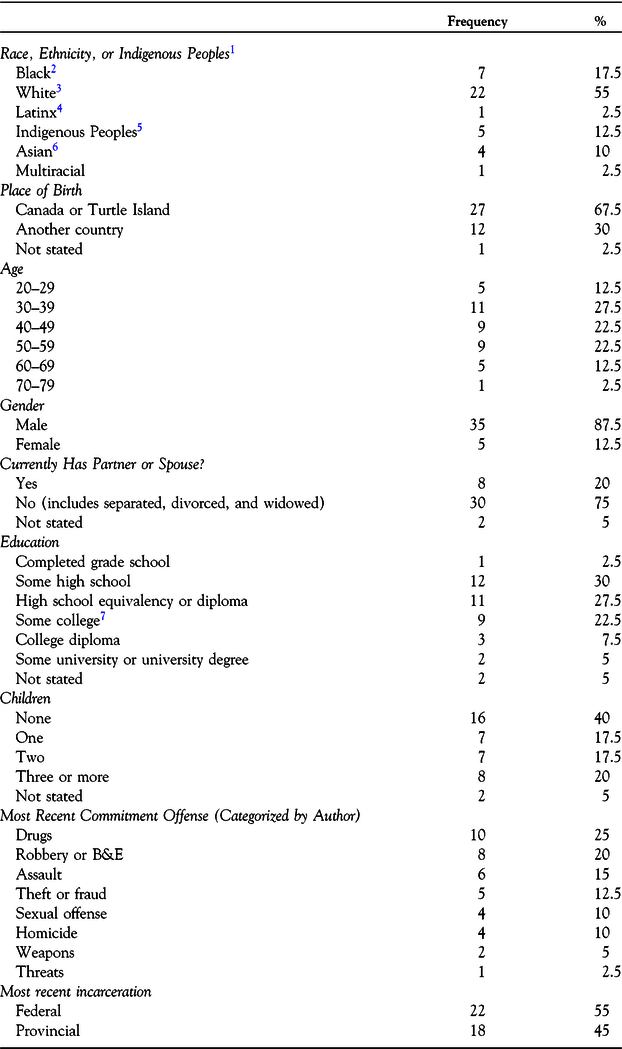
In summary, although the sample is neither random nor representative of people incarcerated in Ontario, it is fairly diverse. Table 1 delineates a variety of participant characteristics. Overall, the sample includes more men than women (as does Canada’s incarcerated population). The sample includes people with a range of commitment offenses, a mixture of provincial and federal sentences, and considerable variety in terms of race/ethnicity/Indigenous Peoples, place of birth, age, education, and number of children. There was less variation in terms of partners; at least three-quarters of the sample was single at the time of their first interview.
Participant Characteristics

1 Respondents were asked, “So, what do you consider your background in terms of race, ethnicity, nationality?” The exact wording varied slightly. People replied with an array of answers. I have imputed their racial/ethnic category here based on my own interpretation of common usage. Given identity is constructed, intrinsically political, and fluid, I also list in the notes (immediately below) the full array of verbatim answers under each category. Aggregate results should be considered with care.
2 Verbatim answers: African Canadian; Black; Jamaican (4); and West Indian and German.
3 Verbatim answers: Canadian (6); Canadian and Greek; European; French Canadian (2); Malta; Mutt or North American; Roman Catholic; Scottish-Canadian; Ukrainian; White (6); and White, Canadian.
4 Verbatim answer: Dominican.
5 Verbatim answers: Half Inuit, Half Métis; Half native, half white; Métis; Native; and Swampy Cree.
6 Verbatim answers: Filipino; and Vietnamese (3).
7 In Canada, colleges are typically career- or trade-oriented (some do offer four-year bachelor’s degrees).
Most interviews lasted between one to one and a half hours. Topics included demographic and background information; experiences with crime and the criminal justice system; daily life before and after their most recent incarceration; challenges they and others face when looking for work; experiences in the workplace and navigating barriers to employment; services or organizations that proved useful to them; how they see their lives unfolding in the short-, medium-, and long-term; and policy proposals or other ideas they believe might help them and others like them. Although interviewers (either the author or a research assistant) carried a list of prepared questions into interviews, in practice, we allowed participants considerable latitude to talk more (or less) about what interested them and what they thought was particularly relevant to their situation. In doing so, we intended to balance depth and breadth in the interview data.
FINDINGS: SEARCHING FOR WORK, MAINTAINING SELFHOOD
Selective Disclosure Techniques in the Absence of “Ban the Box”
Selective disclosure in this Canadian sample took three principal forms: (1) strategically lying about a criminal record to certain people; (2) temporarily avoiding disclosure by leaving application questions about criminal histories blank; and (3) dancing a sort of tango with would-be-employers when hiring managers ask applicants whether they are “bondable.” These disclosure moves vary in the extent to which the details seem specific to the Canadian context, but all represent attempts to manage stigma and maintain some semblance of privacy and dignity.
Lying about a criminal record is not unique to this Canadian sample: it has been found in research interviewing former prisoners living in the United States as well. Most recently, Dallas Augustine reports that twelve of thirty participants (40 percent) with felony records interviewed in Orange County, California, “intentionally lied to employers about their felony records during the application process, either by withholding information or by falsely marking that they did not have any prior criminal convictions” (Reference Augustine2019, 736; see also Harding Reference Harding2003). In the present sample, about a dozen people indicated that they sometimes or always lie about their criminal record by, for instance, checking the box that they have not been convicted of an indictable offense (even though they have). Augustine deems this as a strategic move—pointing out, for instance, that whereas lying risks future termination, many criminal record holders are convinced that being honest is worse, for it means not even being considered for employment in the first place (Reference Augustine2019, 736–37). While such strategies were mentioned by people in my sample, I focus herein on lying as a form of stigma management.
Angelo, a middle-aged, working-class, white man recently released from federal prison for a bank robbery admitted that he routinely lies on application forms. Yet he expressed considerable guilt about the practice and articulated a desire to show people that he was a good worker (and, by extension a good person):
I tell so many lies, I don’t remember what’s truth and what’s a lie anymore. Um, I lied about my incarceration [on job application forms]. But I also try to make a good impression [on the job]. … It’s one thing to not be truthful about it [and] another to go there and not be a good worker.
Here, and throughout his interview when discussing lying, Angelo rarely mentioned strategic aims, despite the evidence that this strategy partially worked. Angelo had secured two jobs in the months before his interview by lying about his criminal record on the initial application forms. One job kept him on as an employee, even after managers found out about his criminal record, and, therefore, discovered that he had lied. Angelo focused instead on how he would rather be honest and how he felt guilty lying. He overcame this guilt through his desire to signal to his coworkers, bosses, and to himself that he was a good person (and not the criminal that he used to be). In this sense, Angelo understood selective lying not as an indication of deviance, but as a way to demonstrate rehabilitation in the only way he felt he could.
The second selective disclosure move widely articulated by my sample is less commonly noted in previous (US-based) research: about a dozen people said that they frequently leave the application question about criminal records blank. This is, at first consideration, a beguiling strategy. Employers likely to exclude anyone checking the box indicating a criminal record are presumably similarly likely to discount applications on which the criminal record question is left blank. So why do some people skip the question?
One common answer is that, just as lying on the application leaves the door open for a later conversation about past mistakes and transgressions (if and when an employer conducts a criminal record check), leaving the record question blank communicates a willingness to talk about the past, just not via a hyper-impersonal and decontextualized checkbox on an application form. Late Night, an Indigenous Métis man who served a federal sentence for armed robbery, explained that he prefers to talk about his criminal record one-on-one with a hiring manager. He likes to offer context, not excuses. Others, like Sen, a Vietnamese man convicted most recently of breaking and entering, said he leaves the criminal record question blank because he applies for jobs that he believes ought not to care about his criminal record, such as factory work (more on this strategy in the next subsection). Thus, while Sen is distinctly less eager than Late Night to talk about his criminal past, it is because Sen thinks it is not relevant to those jobs. If applying to a job that had access to money, in contrast, Sen explained he would be very willing to talk about his crime and try to convince the hiring manager that it should not exclude him from consideration.
In this sense, many described leaving the criminal record question blank as a way to feel in control of their lives, demonstrating that they have agency over at least some aspects of their identities. Doing so helps control who learns about their past, how they learn, and when they learn. It may be a poor strategy for maximizing callbacks or interviews, but it is sometimes an effective form of stigma management. Both lying and leaving the record question blank allow some people with criminal records to tell certain people (e.g., close friends, family, and select people at work) about their past penal enmeshment. These moves are about balancing the odds of securing employment with privacy, autonomy, and their own views regarding when and how a criminal record should matter.
The third form of selective disclosure appears, at least in its details, to be particular to the Canadian context: about half a dozen people explicitly mentioned being vague and unforthcoming when asked whether they are “bondable.” As explained above, bondability is technically about whether an insurance company will include a worker in their coverage. Yet, many described it as a practice used by hiring managers and employers to ask about assorted indiscretions (including, but not limited to, actual crimes) that normally would not be included in a standard criminal record question. As with lying and leaving record questions blank, a typical strategy among those in my sample was to respond with some information, but also to minimize how much is disclosed on impersonal application forms to hiring managers who do not (yet) know the applicant well. Shay, a multiracial man in his early forties whose most recent commitment offense was an assault, explained with a chuckle:
I know […] that it’s at least a three-, four-month question. So, it’s going to take them that long to get around to it, and to send it off to the insurance company, and the insurance company to send back, “No, he’s not bondable,” or, “He’s a high bond”—this and that.
Note especially Shay’s mention of a “high bond,” meaning that an insurance company can bond him (i.e., put him on its policy), but it might mean higher premiums, as another interviewee Joanne, explained. The fact that higher premiums are only possible was interpreted as a justification for not revealing more information than necessary when asked bonding questions.Footnote 12
Cutting across these various decisions—including lying, leaving questions blank, and withholding information—is the desire for selective disclosure. Interviewees described using various techniques to control who knows what about their past, and when and how they come to know it. Since neither the city of Toronto nor the province of Ontario has BtB legislation, we can read into these actions broad support for outlawing “sledgehammer”-style questions that indiscriminately call out everyone with a criminal record (more on respondents’ desires and policy suggestions below). We can also see that few want to erase their (criminal) past; they simply want a job, ideally one they can secure by highlighting how they are a different person today than when they were involved with the criminal justice system. If that is not possible, some are prepared to lie, instead. These techniques and agentic moves constitute an admixture of agency, harsh constraints, and adaption in crafting reentry success.
Navigating Success and Failure
Pulling back from the specifics of how people fill out application forms—and how they respond when asked about bondability—this subsection describes some of the diverse strategies people in the sample used to seek employment. People talked about these strategies—such as working for family or friends, signing up with temporary agencies, becoming a “professional-ex” (see also LeBel, Richie, and Maruna Reference LeBel, Richie and Maruna2015), or getting placed into jobs by parole, probation, or halfway house staff—as ways to increase the odds of securing employment. Yet here too interviewees simultaneously articulated how these strategies allow them to seek employment on their own terms, in a manner that works for them. Most people wanted bosses, managers, and coworkers to see them as hard workers and as good people. These strategies, like the application form techniques discussed above, are about stigma management as people navigate success and failure.
One such strategy—explicitly mentioned by about a dozen people (and implied by others) —is seeking out jobs in which the common assumption, or so they believe, is that most people working there have a criminal record. People felt that they fit in at such jobs, and so their criminal records could be uninteresting and unnoteworthy. Exactly how many workers at these sites have criminal records matter less, presumably, than people’s perceptions that it is common. For example, Jack, a white man in his twenties who had recently served a provincial sentence for assault, gravitated toward relatively unskilled construction jobs because he believed many of the laborers would have records and no one at such jobs would care (much) about his criminal record (see also Purser Reference Purser2009; Reference Purser2012). One such recent construction job, Jack mentioned, asked only whether he owned a hard hat. While general labor jobs pay relatively poorly and have little-to-no job security, Jack explained he would rather be known as a man with a safety helmet willing to carry heavy loads than known, forever, as an “ex-offender” or a “criminal.”
Additionally, while jobs like these are, by definition, seasonal or temporary, Jack believed that they fired people when the work was slow, not because of the results of criminal record checks. Thus, if and when Jack loses the job, he does not feel that it is his fault or due to his criminal past:
The second company that had hired me, they did want to do a criminal background check on me, but I don’t believe that was the reason they let me go. Because [if so], they would have told me that was the reason. They told me the reason was because they thought they would have more contracts or had more bids; they did put [in] the bids, but they didn’t win the bids.
A second common job acquisition strategy was seeking bosses who know about the interviewee’s criminal past but do not view it as a liability. These supervisors look past the conviction or, in other instances, value the introspection and reform it took for the employee to “go straight.” Included in this cluster are so-called professional exes: people who work for criminal justice nonprofits, often in a peer-mentoring role (see also Quinn Reference Quinn2019). Esther, a middle-aged white woman convicted of theft, for example, worked on and off for the nonprofit from which we recruited her. The pay was not very good, and there was little job security or upward mobility. Yet Esther stayed, in part because staff told her that she was valued for her first-hand knowledge of criminal justice and her ability to easily connect with clients.
Similarly, John—a white man in his thirties recently released from provincial custody for an assault charge—recalled having a choice between a well-paying sales job that he had secured by lying on his application form or working as a landscaper for a small business run by an acquaintance. Despite making less money, John chose the latter because his boss knew he was on provincial parole, knew his parole officer personally, and routinely congratulated him on working hard and staying sober. John explained:
When I was a landscape[r]/arborist, my boss knew [that] once a week, I [had] to go check-in for bail. … I had a really good bail officer—she knew I worked. … She was just very relaxed with me and easy going with me because she knew my boss, he really didn’t care [about my record]. …. He looked past all that, to me as a person.
John’s long-term goal was to go back to school. In the meantime, he wanted to work mostly for small companies where the boss knew about his criminal record and saw him as a reformed or better person for it.Footnote 13
Despite the fact that many respondents indicated that they would prefer to be celebrated for their rehabilitated self, that was not always possible—especially given the harsh stigma of a criminal record and a tight job market (worse, naturally, for people who lack marketable skills and who have uneven job histories). People sometimes described settling for being seen as willing to work difficult or dirty jobs for little money, as long as they could also be viewed as a hard worker trying to make something of themselves.
While this can be interpreted as settling for “bad” work (Augustine Reference Augustine2019, 740–42; see also Bumiller Reference Bumiller2015), the people I interviewed were somewhat more rosy: as bad as some of these jobs were, it also meant not having to lie about their past. Even a bad job was sometimes seen as better than no job. At the halfway house, for example, staff sometimes hired residents on an “as needed” basis to work in a commercial cleaning company.Footnote 14 At the community agency providing services to criminalized men, some people were trained and then hired by private companies to remove asbestos from commercial buildings. Because such jobs trade so explicitly on people’s desperation and precarity, it is telling that interviewees felt compelled to take them (or preferred them over their otherwise limited options).
Lastly, about a fifth of my sample indicated that they had given up entirely on the project of finding work. Those giving up were disproportionately men, tended to be somewhat older (but often in their forties or fifties, rather than of a more typical retirement age), often were able-bodied, and often had been employed, at least sporadically, prior to their most recent incarceration. Many were living at the halfway house when we interviewed them, and over half had been convicted of a more serious offense for which they had served a federal prison sentence.
Notably, several interviewees who had partially or fully given up on reentering the formal employment sector explained that halfway house staff actually encouraged this decision, advising them to seek out government assistance (welfare). Some interviewees speculated that this was a way to better “keep an eye” on them. Father Brown, for instance, a French-Canadian man in his fifties convicted of sexual abuse against a child (for which he served a provincial sentence) was increasingly coming to terms with the possibility of a lifetime of collecting social assistance:
I would love to have a courier delivery job. I love driving … but many of these courier jobs shut the door…. I know my case is [bad. It’s not] a normal crime type of thing. But I’ve lived a lie all my whole life [about my pedophilia]. I’m going to live a lie all my life no more. If it means being on welfare for the rest of my life and not having a job, so be it. I’d like to make a contribution, but. …
Government assistance is ungenerous in Ontario (as it is in most places) and means, therefore, a life of relative deprivation and poverty. Yet welfare struck some respondents as their only viable choice in a world that overtly discriminates against and shames people with criminal records (and sex offenders in particular).
Viewed as an economic game of securing employment and maximizing wages, the actions of the sample might seem perplexing. On average, people in my sample sent out fewer than one application per week, and many sought out what, in US parlance, have been referred to as “felon-friendly” jobs (Bumiller Reference Bumiller2015; Ray, Grommon, and Rydberg Reference Ray, Grommon and Rydberg2016). In a world of constrained opportunities, many opted to work for people who either did not care about their criminal record or saw them as a better person for it. Sometimes this meant choosing lower paid jobs or becoming a “professional ex.” Others felt obliged to give up on working entirely. As opposed to popular notions of “criminals” as lazy or crass opportunists, however, many said they wanted conventional jobs; some were sufficiently desperate to take on precarious, marginal work. While it would be a mistake to romanticize these efforts (after all, many were unemployed or employed in “bad” jobs), it was a price they were willing to pay, which speaks to the lengths people are willing to go to avoid constantly disclosing stigmatizing details to strangers.
Policy Reform and Wanting to Talk About the Past
Most people in my sample want the same sorts of things that family, friends, parole agents, halfway house workers, and others want for them: a steady job that allows them to earn a living, pay taxes, and avoid crime. Similarly, Augustine found that people released from jail in California wanted what one participant referred to as “a good job where [they could] pretty much pay taxes” (Reference Augustine2019, 735). The question I put to people was how best to achieve these—relatively conventional and modest—aspirations. For most, the answer was greater freedom and discretion in exercising control over information from their past. Few wanted to fill out applications with blanket questions about criminal records, thus constantly reduced to a crime-offense category that says little of their presents and hopes for the future. But fewer still sought silence about past crimes.
Only a fewFootnote 15 people in my sample suggested they might like to have their criminal record wiped completely clean or otherwise sealed. Instead of wanting to have their criminal record forever hidden from coworkers and bosses, the majority of people interviewed wanted to be recognized as both former prisoners and full citizens working hard to lead decent lives.Footnote 16 Shay was one of the few people who advocated for making his criminal record forever off-limits:
You’ve already done the time, you’ve paid for your mistakes. … Society should let you off the hook … you have done the sentence and that [hands strike table] should be the end of it. Unless it’s habitual things, like sexual assaults or sexual abuse … it should be left at the prison gates.
Although Shay’s position on leaving criminal records “at the prison gates” was unusual among the sample, his aspirations and beliefs about fairness were typical: almost everyone felt that people with criminal justice experience should be helped to move forward with their lives, rather than forever weighed down by past transgressions.
Unlike Shay, then, most people described moving forward in life through redemption, not forgetting or redacting. Defiant, a white high school graduate in his late thirties convicted of robbery-assault, explained:
Now’s a time where you have to live your life by how you live your life. If people want to know your story, you gotta tell your story…. I go to NA and AA. Eventually, you have to “work” your story … at least you were honest about your story, right?
The connections Defiant makes to Narcotics Anonymous (NA) and Alcoholics Anonymous (AA) are astute: those programs share similarities with the ways people in my sample described navigating stigma and barriers. People want to talk to supportive peers familiar with their past. They want to be seen as holistic individuals—imperfect, but not detritus. This can mean, as Defiant suggested, talking to people at work, whether bosses or coworkers, or sharing stories and advice with compatriots at NA meetings. The goal for many people is to avoid romanticizing the past but also not to wallow in guilt or past transgressions. Instead, Defiant, and many others in the sample, want to learn from the past and lead a calmer, more conventional life moving forward.
Venus, a Black woman in her forties convicted most recently of drug possession, had some college credits and was living in an apartment with a boyfriend at the time of our interview. She spoke at length about the importance of support at work:
… people just need support. ‘Cuz I know what I’ve been through, and I’ve talked [emphasis in original] to people that have been through it. … I’ve gotten feedback from how [others at work] look at things and [they] say, “Well, maybe you should look at it this way.” … If somebody wants to change their life, and [you] want to give them that chance, you can’t tell them, “Get out of your environment” and then [not] give them the capabilities of getting out of that environment.
Like Esther, Venus worked for the nonprofit where we recruited female participants. She had also held jobs, before and after incarceration, in sex work, accounting, and at a call center. The best of her gigs, she said, was a restaurant job where the boss learned about her criminal record but hired her anyway (despite, Venus noted, the fact that they stocked expensive bottles of wine). Some of these jobs paid decently, but ultimately Venus chose the irregular and low-paying nonprofit position, where her managers knew her full story, valued her as someone with criminal justice experience (rather than in spite of it), routinely talked to her about her past, and gave her advice and support in terms of building, and believing in, who she is today.
In closing this subsection, it is worth noting some respondents went out of their way to say that while they wanted to talk about their past—and to be recognized for how they have changed—they realized it would take time and that not everyone around them would be ready to accept their new self. Wayne, a white man in his late twenties who had been recently convicted of drug possession, put it this way:
Well, I see it from all sides. … [I] understand that they don’t want to take a risk on you, because they think you’re going to go back to jail. … But other people are like, “I’m not going back, ever,” and they make that constant, conscious decision to try to change their life. … Like, if we had a [way to indicate], “This is a changed person” … to not only build a skill … but to prove to the company that they’re committed and are capable of staying out of trouble.
Each in their own way, Shay, Defiant, Venus, Wayne, and others in the sample all advocate for allowing people with criminal records greater control over who knows what about their past. They believe this allowance could lead to significantly better life outcomes, including in the employment arena. Most want to talk to some people, some of the time, about what they have done; they believe this approach of honest communication and, reciprocally, understanding, empathy, and second chances, could help them land a good job in which they are recognized as a person who has transcended a difficult or less-than-ideal past.
DISCUSSION: SELECTIVE, VOLUNTARY DISCLOSURE (SVD)
To help make the dignified vision of interviewees a reality, I propose a new legal policy—or, more precisely, an assemblage of new practices and adaptations of existing policies—“Selective, Voluntary Disclosure” (SVD). SVD builds on some of the strengths of existing BtB laws, in conversation with Canadians who have experience managing the stigma and structural barriers surrounding criminal justice involvement.Footnote 17
One strength of BtB laws is outlawing “sledgehammer”-style questions on job application forms. Such questions demand applicants indicate their criminal histories, shorn of nuance, context, explanation, or humanization. The present research suggests people go to great lengths to avoid checking that box. They take other pathways, including: lying on the application form; leaving the criminal record question blank; applying only for marginal or low-paying jobs in which the criminal record is seen as irrelevant; seeking employment with a criminal justice service provider where staff view their past as an asset; and giving up on working altogether.Footnote 18 Getting rid of these first-round questions on job application forms, as BtB laws require, means that people with criminal records can, hopefully, seek out a wider variety of jobs and have a chance to discuss their records with prospective employers. Such laws aim to afford people the possibility of being judged on their merits as a worker, rather than exclusively or excessively by their past transgressions (see also Minor, Persico, and Weiss Reference Minor, Persico and Weiss2007; Soothill, Humphreys, and Francis Reference Soothill, Humphreys and Francis2013).
On the other hand, BtB laws have two main disadvantages or limitations that SVD aims to address. The first is so-called statistical discrimination. This is when some applicants—in particular, visible minorities—fare worse as a result of BtB laws. Although research is still emerging (and findings are not uniform, see especially Craigie (Reference Craigie2019)), the pattern seems to be that when those in charge of hiring are not able to inquire on application forms about criminal records, they “instead rely on race-based assumptions about who is likely to have criminal records” (Agan and Starr Reference Agan and Starr2018, 192) (see also Doleac and Hansen Reference Doleac and Hansenforthcoming; Sugie Reference Sugie2017).Footnote 19 SVD, as I explain just below, attempts to do the precise opposite: give hiring managers information, but in a way that facilitates and balances employment, privacy, dignity, and rehabilitation. In particular, people applying for jobs should have the chance to articulate, on their own terms, how they have changed into a “better,” more law-abiding person. With luck, employers will feel more confident making individualized assessments that are not primarily about race and SVD will help reduce statistical discrimination (a crucial measure for any enacted policy in this area).
A second major limitation of BtB has not, to my knowledge, been addressed by scholars: BtB laws encourage a type of silencing, or closeting, of information—and do so in a manner that is out of line with what people (if my sample proves typical) want, need, and actually do on an everyday basis as they search for work and navigate life after criminal justice contact. As my findings make clear, at least some people with criminal records want to talk about their past; closeting could increase social isolation as it communicates that criminal records are insurmountable and permanently deserving of shame and opprobrium.Footnote 20 Few people in my sample were proud, per se, of the actions for which they had been punished, yet the vast majority were proud of having overcome the obstacles and structural challenges in transitioning to law-abiding lives. To ignore this rehabilitation or personal change—even in ways that, like BtB laws, are well-meaning—is to overlook what many see as among their greatest accomplishments.
With these critiques and the interviews analyzed above in mind, I propose SVD. SVD has three central components: (1) regulate all forms of the collection and use of problematic criminal record information; (2) increase the flow of socially beneficial conversations; and (3) reduce liability and remove torts for employers who adopt best practices.
The first component, borrowing from BtB laws, is that jurisdictions throughout Canada and the United States (and, perhaps, elsewhere) should pass laws prohibiting all employers (private and public sector) from including application questions asking about candidates’ criminal records. There is ample research, including the present study, to conclude that these questions palpably harm employers, employees, and society at large.
But we ought to go further. Jurisdictions should consider regulating all forms of the solicitation, collection, distribution, aggregation, and sale of criminal record information, and not just at the initial application stage. Most employers should not, for most employees and potential employees, be allowed to ever initiate a disclosure. By extension, companies should not be allowed to purchase criminal record data or hire other companies to run record collections on their behalf.Footnote 21 Instead, criminal record disclosure—like other workplace disclosures, such as those pertaining to disabilities and chronic illness—should be treated as an intensely personal decision and one that deserves respect, regulation, and careful consideration by employer and employee alike (see, more generally, Brohan, et al. Reference Brohan, Henderson, Wheat, Malcolm, Clement, Barley, Slade and Thornicroft2012; Dalgin and Gilbride Reference Dalgin and Gilbride2003; von Schrader, Malzer, and Bruyère Reference Schrader, Malzer and Bruyère2014).
Lest this seem politically implausible, note that exceptions could be granted. My participants acknowledged as much: some people might reasonably be considered ineligible for certain jobs (for instance, consider the quotes, above, by Sen, Shay, and Father Brown). The key legal test could be one of tight fit between the past criminal offense and the particular job. Only when there is concrete evidence of actual risk of harm would an exception be warranted. Banning all “sex offenders” from entire industries, for instance, is overly broad and would therefore be impermissible, given the diversity of actions that fall under that umbrella.Footnote 22 The overarching principle is that the ability of an employer to inquire about a criminal record—and then discriminate on the basis of that record when making hiring and retention decisions—should be the exception, not the norm.
If employers cannot inquire on the application form about a criminal record, how could these exemptions be implemented under SVD? One answer is inspired by current law and practice in British Columbia, Canada. The provincial government there is involved when people apply for jobs that are located in the so-called “vulnerable sector.” Vulnerable usually refers to a child or other person deemed at risk (e.g., due to a cognitive or physical impairment).Footnote 23 For these vulnerable sector jobs, the provincial government reviews the applicants’ criminal records and then makes an independent judgment as to the suitability of the candidates. The province, in turn, reports back to the employer the assessment, not the criminal record itself (Canadian Civil Liberties Association 2014, 15).
Jurisdictions seeking to implement SVD should adopt a version of this process for all jobs that are granted an exemption to warrant scrutiny of criminal records, not just the vulnerable sector. (Details will vary, of course, depending on local circumstances, including whether the jurisdiction is municipal, county, state, provincial, or federal). Employers with jobs that they believe might warrant an exemption could request consideration to the appropriate government agency. If granted, they could then be allowed—again, only for a select number of jobs—to have the jurisdiction to conduct the record check on applicants, after a conditional offer has been made, and report a decision regarding suitability. Again, the overarching goal here is to create a scenario in which the vast majority of employers never inquire about a criminal record for the vast majority of current and would-be employees but that space is left open for exceptions, where warranted.
Insofar as the first component of SVD expands from BtB to constrict the flow of problematic information, the second component attempts the opposite: to increase the flow of appropriate or socially beneficial information. Specifically, efforts should be made to bring together employers, employees, and potential employees who wish to talk about their past involvement with the criminal justice system. Recall that while people avoided general application form questions about criminal records, many saw their experiences with crime and punishment as part of who they are: they wanted to be seen as someone who is now, as a result of their experiences, a different person.
Implementation of this second component will require that policymakers, politicians, advocates, criminal record holders, and other key actors collaborate. There are likely manifold ways to increase the flow of information in a positive or productive manner. Drawing on existing scholarship, these could include, among others: (1) certificates of relief and other rituals of rehabilitation; (2) workplace ambassadors who could liaise and coordinate between employees with criminal records and management; and (3) specialized employment fairs.
Certificates of relief come in various formats and flavors (so to speak), but at their core all are a signal that a person with prior experience of criminal justice ought to be considered “treated” or “rehabilitated.” In an essay on reentry, ritual, and rehabilitation, Shadd Maruna advocates for “reintegration rituals”: “Former outcasts would be welcomed into a society, and welcomed with excitement and enthusiasm—whether or not participants were completely positive they had anything to be enthusiastic about. The idea is to communicate a message of hope or a point of view in the hopes that this message will become a self-fulfilling prophesy” (Reference Maruna2011, 16). The audience for such rituals, Maruna points out, must be society at large—not just the harmed and the person who did harm. In a more recent empirical study, Peter Leasure and Tia Stevens Andersen research the impact of certificates of relief by adapting the classic audit study. Such certificates do not seal a record, but, instead, declare that the person is rehabilitated and also remove some formal barriers to employment such as licensing requirements (Reference Leasure and Andersen2016, 14). The authors find that these certificates greatly increase the likelihood that a fictitious applicant receives a positive response for an entry-level job; indeed, those with certificates fare about as well as testers without criminal records (Reference Leasure and Andersen2016). Although more research is needed to confirm the effectiveness of certificates of relief and similar interventions, the fact that communication of information to potential employers seems to possibly benefit at least some applicants bodes well for SVD.
Another way to increase the flow of socially beneficial information might be to create a kind of workplace ambassador tasked with advocating for the hiring, retention, and support of people who chose to disclose a criminal record. Such ambassadors could work directly with applicants and employees with criminal records who are considering disclosing before or during a period of employment. Ambassadors could also monitor and evaluate the performance of management and/or those in human resources and labor relations. They would be the proverbial eyes and ears ensuring that managers and others are implementing training on how to respond appropriately to criminal record disclosures.
Finally, it might be helpful to reimagine the traditional employment or recruitment fair, in light of SVD principles. Currently, there are sometimes job fairs where “felon-friendly” companies explicitly try to recruit people with criminal records (e.g., Boykin Reference Boykin2018). In places with SVD, such fairs would look different: since most employers would not know if applicants have criminal records, they would, instead, use the space to highlight how people with criminal records have, in the past, successfully integrated into their company and how those choosing to disclose to coworkers and managers their past penal enmeshment are treated with respect. Any of these fora (existing or new) could, in turn, enjoy government subsidies, justified given the public interest in employing people with criminal records.
Details aside, to make the second component of SVD effective, it seems wise to leverage the language of privacy, dignity, and “second chances.” These are concepts that can appeal to politically diverse audiences (cf. Simon Reference Simon2016). Doing so could reframe discourse around work, criminal records, and prisoner reentry in ways that focus conversation on the social good of helping people with criminal records become healthy, legally employed, and socially connected peers (see, more generally, Leavitt Reference Leavitt2001). Messaging might focus on the fact that, like everyone else, justice-involved individuals are more than the sum total of their past mistakes.
The third component of SVD pivots from employee to employer. Arguably, debates and conversations surrounding BtB laws have neglected the influence of such laws on private companies. Some critics, for instance, have complained that BtB laws do not sufficiently protect employers from torts related to wrongful hiring; others have noted situations in which companies need to reduce the risk of violence or try to protect vulnerable clients (e.g., Fisch and Goldstein Reference Fisch and Goldstein2018; Pager Reference Pager2006; Sondik Reference Sondik2016). SVD goes a long way to mitigate these concerns. Centralizing the process of deciding narrow exemptions for certain jobs and certain crimes would reduce or eliminate the liability of privately held companies by placing the burden of suitability decisions on the government. And while government agencies will no doubt vary in the extent to which such decisions are made on an evidence-based, progressive manner, it is presumably still superior to having individual hiring managers do that work, given managers are likely less-equipped to think systematically, transparently, in a racially nondiscriminatory manner about risk, criminal records, and workplace safety. Related, any employer that hires and retains someone in keeping with the processes laid out above could be absolutely indemnified against negligent hiring torts. Indeed, in the context of SVD, no such tort should exist.
Also related to employers, my findings and analyses suggest that it may be beneficial to rework and expand grants and tax credits awarded to companies that hire people with criminal records (see, more generally, Holzer, Stoll, and Raphael Reference Holzer, Raphael and Stoll2002; Holzer, Raphael, and Stoll Reference Holzer, Raphael and Stoll2003). Under SVD, employers would neither routinely nor systematically inquire or know whether an employee has a criminal record, so the financial incentive could not be pragmatically tied to the total number of people with criminal records hired or employed. Instead, incentives might be based on the degree to which companies develop and implement standards for handling disclosures. The overarching principle is that employers should be rewarded for developing best practices in this arena.
By removing “sledgehammer”-style questions from application forms and regulating the flow of criminal record information; by facilitating conversations between employers and employees when the latter want to talk about past criminal convictions and how they have changed in the interim; by rendering existing torts moot and rewarding best practices by employers, SVD would help society. This includes helping people who have experienced enmeshment in the criminal justice system reintegrate more successfully.
In closing this section, note that the degree and nature of support for SVD (were a version of it to be implemented) is an empirical matter. But there are some reasons to be optimistic. Research on punishment and criminal justice reform suggests that coalitions of actors matter, and that progressive policies can enjoy support from political moderates (even some social and fiscal conservatives) when they are framed as frugal, when they appear to offer those considered “deserving” a second (or even, perhaps, third) chance, and when they seem to hold people “accountable,” even if they do not permanently incapacitate them (see, more generally, Campbell Reference Campbell2007; Goodman, Page, and Phelps Reference Goodman, Page and Phelps2017; Green Reference Green2015; Phelps Reference Phelps2011). To this end, those advocating for SVD should consider how social progressives might be interested in themes of inclusion, helping marginalized people and communities, and fairness and justice. Conservative actors, for their part, might be excited by the prospects of higher employment rates and a richer tax base. Companies could be seduced by the possibility of positioning themselves as good corporate “citizens.” Some employers might seek positive public relations through advertising campaigns that position themselves as giving people second chances, not unlike how some for-profit companies now champion their efforts to hire diverse workers and/or people with disabilities. In conclusion, given SVD allows criminal record holders to position themselves as having done wrong, but learned from it—and, more generally, given that SVD pays attention to the needs, desires, and aspirations of employers and employees alike—there is, therefore, the possibility of broad appeal.
CONCLUSIONS
This project has aimed to achieve two principal goals. First, I advocate for the continued expansion of an important area of research and policy: the intersection of employment, criminal records, and stigma management for people with criminal justice experience, including the formerly incarcerated (the focus of this study). This means speaking with and/or observing people as they navigate barriers to life after imprisonment. Using interviews with forty formerly incarcerated people living in the Greater Toronto Area, I find that people with criminal records utilize a variety of techniques when filling out application forms and when interviewing. These various techniques function to limit their exposure to stigmatizing situations in which they must confess personal shortcomings and transgressions to relative strangers, shorn of nuance and context. I further find that people strategically seek out jobs in which their criminal record is likely to be seen as irrelevant (or, less commonly, as an asset); in so doing, they limit themselves in terms of what jobs they apply for. They likely also hurt their prospects of achieving the stability and financial well-being that many desire. But, in doing so, many manage to preserve a strong(er) sense of self. Lastly, I argue that one would be wrong to conclude from these findings that people want to seal their past and pretend it never happened. Instead, many are eager to share aspects of who they used to be and some of the mistakes and errors they made. They want to share on terms that allow them to demonstrate how they have learned and grown from their past.
Secondly, I have begun to sketch the contours of a new set of policy configurations that I coin “Selective, Voluntary Disclosure.” My policy analyses recognize the innovations and successes of Ban the Box laws, while also arguing that the time is ripe for reworking the legal terrain in Canada and the United States. SVD, I argue, is well-attuned to the actions, desires, and aspirations of former prisoners and their potential employers. Key features include regulating the flow of problematic and decontextualized information; facilitating (or, at minimum, not blocking) meaningful and boundary-reducing conversations between employers and employees; and rewarding companies that develop progressive policies that take into account the details of the lives of people with criminal records.
And yet there are limitations and cautions both of the empirical research analyzed herein as well as the policy recommendations that flow from those data. In terms of the research, the main caveats pertain to: (1) the size and nature of the sample; (2) geography and variation across place and jurisdiction; and (3) the focus herein on the formerly incarcerated.
In terms of the sample, there is substantial diversity on key variables, including place of recruitment, commitment offense, race/ethnicity, Indigenous Peoples, age, and education. Yet the sample is, notwithstanding, both nonrandom and only moderate in size (n = 40). As always, more research is needed—including studies utilizing different methodologies—to determine which findings are generalizable, and in what ways. By extension, future research with larger samples could perhaps investigate how strategies, aspirations, beliefs, etc. vary across and within key demographic groups. (Doing so might mean sacrificing some depth in favor of breadth (cf. Augustine Reference Augustine2019, 745).)
Next, there are issues or cautions surrounding geography and possible national differences. A Canadian (Toronto area) sample, I have argued, brings fresh insights and a chance to rethink what we know about how people navigate barriers and the accompanying stigma. But it also raises questions about how to to use research conducted in one place to inform policy and knowledge in another. In terms of the usefulness of the data, note that there are many similarities in the arenas of barriers and criminal records, including struggles among record holders to secure employment; laws and practices that allow many employers to discover untoward facts about candidates in unhelpful or decontextualized ways; and gaps between progressive rhetoric and punitive realities.
Yet there are also important differences, some of which may prove consequential in limiting the exportation of these findings. It could be, for example, that the vast majority of my sample wanted to talk about their past criminal involvement because, as hostile as the situation is in Ontario for the formerly incarcerated, it has not (yet) reached the levels observed in many US states. In that sense, perhaps, the proportion explicitly eschewing record sealing would be lower in some US contexts (though there is American research indicating that people there also seek chances to perform rehabilitation by talking about their past or former selves (see, e.g., Comfort Reference Comfort and Carlen2008; Hlavka, Wheelock, and Cossyleon Reference Hlavka, Wheelock and Cossyleon2015; LeBel, Richie, and Maruna Reference LeBel, Richie and Maruna2015; Maruna Reference Maruna2001)). This, and the other findings analyzed herein, should be investigated in the United States (and beyond), including, ideally, research that uses a mixed sample of people living on both sides of the border.
Lastly, it is worth acknowledging that my sample is composed entirely of people who have been incarcerated (either in federal or provincial custody). The focus on the formerly incarcerated, in my judgment, is warranted because those individuals face particularly acute barriers and especially significant consequences if they cannot manage to secure employment and stability. Yet the majority of people with criminal records in Canada, like in the United States, have not been confined in a penal institution (Phelps Reference Phelps2017). It is entirely possible that some people with criminal records, especially for less serious crimes, are more in favor of sealing the past forever than the women and men interviewed herein (see, e.g., Ispa-Landa and Loeffler Reference Ispa-Landa and Loeffler2016). This, too, ought to be the subject of future research.
Pivoting to cautions about the policy analysis and SVD, statistical discrimination is arguably the thorniest issue. Footnote 24 As discussed earlier, there is a growing consensus among researchers that BtB laws may especially hurt people of color without criminal records, as employers working under restrictions and prohibitions rely on racist stereotypes and assume all or most candidates who are racial minorities are criminals (e.g., Doleac and Hansen Reference Doleac and Hansenforthcoming). Recall that SVD aims to open conversations, where appropriate. This could help those with criminal records. But what about racialized people who have no involvement with crime or the criminal justice system? Insofar as SVD does not require disclosure (and, indeed, regulates and restricts what employers can know, and when, just like BtB), there remains no way for a candidate without a record to effectively distinguish themselves. Thus, while the hope is that everyone will benefit from SVD, the impact on all groups needs to be examined carefully. SVD may be an improvement, but it is no panacea for racism and racialized inequality.
There are also important questions, or caveats, with respect to the implementation of SVD. Today, BtB laws in the United States are a patchwork of regulation at the municipal, county, state, and federal levels. The policies vary in key details, such as the extent to which they apply to the private sector, at what stage the employer can conduct a criminal record check, whether the laws directly reference federal Equal Employment Opportunity Commission (EEOC) criteria, whether they mandate an appeals process, and so forth (Avery Reference Avery2019, 101–07). This patchwork nature may have made it easier for some jurisdictions to innovate in progressive ways, as compared to the larger counties or states in which they are located. But this variation also means that there is little coordination and consistency across locales. As a consequence, BtB laws may not effectively regulate the entire suite of criminal record holders’ experiences before, during, and after their search for work. Given that Canada’s federalist system of government differs in important ways from its more populous neighbor to the south, advocates and policy-shapers will want to apply these lessons to SVD: Given the political expedience of a balance between local variation and national coordination, which parts of SVD should be assembled together, and which should be presented as core (“nonnegotiable”)? What parts might be advocated for at later times?
While these limitations matter, it remains the case that the present research has offered some broad, and possibly portable, lessons. For instance, the research suggests that many people with criminal records want the same things as their noncriminalized peers: respect, dignity, and the opportunity to be understood as more than the sum of their past decisions. Understanding what criminal record holders do and what they say they want—and carefully facilitating conversations between record holders and their future bosses and employers—creates more knowledge and the potential for better policy. This can, in turn, improve the lives of people with criminal records; given a veritable explosion in the twentieth century in the numbers of people with criminal records (Jacobs Reference Jacobs2015), we would all benefit from that.