‘What?’ some will say, ‘Monsieur Berlioz has composed mélodies? How odd indeed!’ Yes, Monsieur Berlioz has indeed composed mélodies, even romances – agreeable, pure, tender, majestic and melancholic, they express with truth and nobility a particular state of mind.
—Joseph d'OrtigueFootnote 1
Asked to list the first Berlioz works that come to mind, most classical music lovers would mention monumental, groundbreaking pieces: programmatic symphonies like the Symphonie fantastique, Harold en Italie and Roméo et Juliette; the Requiem; La Damnation de Faust; perhaps Les Troyens (if a Berlioz opera gets mentioned at all). These works have come to be seen as definitively ‘Berliozian’, and not just by lay listeners. Scholars and critics have also perpetuated an image of Berlioz as a brazen revolutionary who painted with the broadest brush possible.
There is truth to this image: Berlioz placed great stock in his large works and left a legacy of bold, colourful and imaginative orchestral music that has had a lasting impact on those who followed him. But it obscures as much as it reveals, enough to have led such prominent Berliozians as Julian Rushton and the late Jacques Barzun to plead for a more balanced view of the man and his music that emphasizes his conservatism as well as his radicalism, his vocal music as well as his programmatic symphonies and his small works as well as his large ones.Footnote 2
Perhaps the most overlooked of Berlioz's works are his songs – the mélodies and romances referenced by Joseph d'Ortigue in the quotation that opens this essay, taken from an 1852 review of some of Berlioz's song collections. D'Ortigue knew full well that listeners would be surprised to learn that Berlioz composed songs at all. Today, 160 years later, the situation has improved. Berlioz's cycle Les Nuits d’été has found its place within the canon of nineteenth-century vocal music and been treated to some degree of analytical scrutiny,Footnote 3 and a number of his other songs are beginning to receive the attention they deserve by scholars such as Julian Rushton, Annegret Fauser and Jorge Arandas.Footnote 4 Yet many of Berlioz's roughly 50 songsFootnote 5 remain understudied and virtually unknown outside the Berlioz community. There are still riches to be mined in this remarkable repertoire and questions to be answered about the place of song in Berlioz's oeuvre.
To a certain extent, it is understandable that research on Berlioz's songs has lagged behind research on his larger works. His songs are outliers, oddities, miniatures of a monumentalist. Les Nuits d’été, often cited as the first great cycle of French mélodies, may be relatively easy to reconcile with the standard view of Berlioz as an innovator and readily absorbed into a teleological narrative that stresses the compositional ‘advancements’ that led to the late-century mélodies of Fauré and Duparc. But most of Berlioz's songs are more allied with the French romance, the genre that grew out of eighteenth-century opéra comique and was wildly popular in the 1830s and 1840s. (I use the term ‘romance’ here to describe songs that exhibit the hallmarks of the genre – graceful lyricism, naturalness of expression, strophic form, unadventurous style and naïve and sentimental tone – even if they happen to be called something else: ballades, chansonnettes, chansons or even mélodies. As almost all writers on French song agree, the terms in Berlioz's day were vague and inconsistent. The commonly held distinction between romance and mélodie, for example, is blurry at best, particularly in the 1840s.Footnote 6 Berlioz used both terms interchangeably, and a number of his works entitled mélodie nonetheless draw upon the traditions of the romance genre, even as they extend them.Footnote 7) Some of Berlioz's romances were even published in popular journals geared toward the middle class – a far cry from the massive works of a musical revolutionary.Footnote 8 In all, they seem too conventional – some might even say too backward – to be afforded the critical attention reserved for his more ‘ambitious’ works.
Yet the romance occupies a more important place in Berlioz's body of work than one might first suspect. His first moving musical experience, described in the first chapter of his Memoirs, was hearing a chorus of girls sing the tune to Dalayrac's romance ‘Quand le bien-aimé reviendra’ during his first communion.Footnote 9 As a child he copied romances from comic operas and collected them in a set of 35 songs with guitar accompaniment. He frequently reused romance melodies in his instrumental pieces, recasting them as songs without words, and incorporated entire texted romances into large-scale works (and not just operas). In 1850 he gathered together several of his romances and published them in two volumes, Fleurs des landes and Feuillets d'album, the very collections reviewed by d'Ortigue two years later. And in 1863, just before retiring from composition and criticism, he assembled many of his songs, including numerous romances, in one large volume, to ensure that they would not be forgotten.Footnote 10
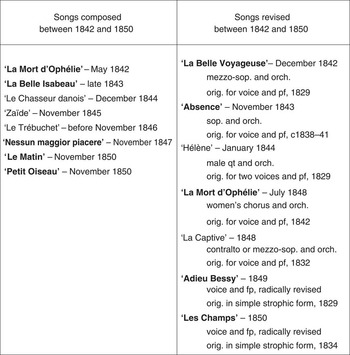
How are we to understand these pieces in the context of Berlioz's overall output? What did the romance mean to him? And how do his romances relate to the larger works on which his reputation rests? This article addresses these questions to some of the most neglected Berlioz songs, the romances he composed between 1842 and 1850. I choose this time-period because, although it is often regarded as a rather fallow one for Berlioz, it nonetheless represents something of a surge of songwriting activity. He completed few large-scale works apart from La Damnation de Faust, written in 1845–46, and the Te Deum, begun in 1848 but not performed until 1855, but he composed eight songs and revised seven, ‘mining a valuable vein’, in Hugh Macdonald's words.Footnote 11Figure 1 provides a list of these songs; the bold-faced songs will be discussed below. (I count ‘La Mort d'Ophélie’ twice since it was composed in 1842 and later revised in 1848.) This level of song production may not seem noteworthy until we consider that in these years Berlioz wrote or revised more songs than in any comparable time span in his career, save his earliest years when romances formed the bulk of his compositional efforts. Then, with the publication of Fleurs des landes and Feuillets d'album in 1850, he stopped composing songs altogether. Though he continued to include arias in his larger works, he never wrote another isolated song.
Berlioz's songs, 1842–50

Berlioz's diminished production of ‘significant’ works has often been attributed to the upheavals in his life, including professional and financial uncertainties, extensive foreign travel, the deaths of his father and sister and the dissolution of his marriage with Harriet Smithson. As a consequence, the songs he wrote during this period have all too easily been dismissed as the scattered afterthoughts of a composer too preoccupied to write anything of note, even as retreats into conventionality after the forward-looking Les Nuits d’été, composed in 1840–41, or meagre attempts to satisfy popular taste and make some money when his production of large-scale works was on the decline. A.E.F. Dickinson, for example, offers nary a kind word for these pieces: ‘La Mort d'Ophelie’ is ‘somewhat labored’ and ‘its pathetic tone hardly stands up to the fourfold statement’ of its opening strophe, ‘Le Matin’ is ‘commonplace’, ‘Petit Oiseau’ is ‘a pleasant diversion of no consequence’ and ‘La Belle Isabeau’ is ‘confused, absolutely didactic’.Footnote 12 But the romances from 1842–50 can be regarded differently. When taken seriously and put in proper biographical context, they emerge not as compositional steps backward but as turns inward. They show Berlioz responding musically to his personal struggles and returning to an intimate and direct style – and to the genre he associated with his childhood – during one of the most introspective and nostalgic periods of his life.
The songs from these years, in other words, are intertwined with Berlioz's life just as his larger works are. The question of how Berlioz's work reflects his life has been of central importance in studies of his music, but it has been addressed almost exclusively to his programmatic pieces – the Symphonie fantastique with its lovesick jeune musicien fashioned after Berlioz himself, Harold en Italie with its semi-autobiographical Byronic wanderer and so on.Footnote 13 Yet the aura of autobiography surrounding these works is strong enough to suggest that Berlioz's urge toward self-reflection was not confined to the programmatic and the large-scale.
Drawing upon recent theories about the ‘autobiographical construction’ of Berlioz's music and considering when these songs were written or revised, to whom they were dedicated, what images were associated with them and how their texts relate to the events of Berlioz's life, I argue that their conventionality belies a deeply personal resonance, and also a musical ingenuity, uncommon to the romance genre. The romances from these years are obviously not a collection like Berlioz's early set of songs Neuf Mélodies, and still less a cycle like Les Nuits d’été, which set texts of a single poet, trace a musical and poetic narrative and are unified by recurring musical ideas. But they deserve to be regarded as a group, similar in style and born from the same wellspring of feeling. As a whole, they suggest that the romance was more meaningful to Berlioz than has hitherto been acknowledged and that his miniatures and monuments have more in common than they seem to. More generally, they encourage us to rethink certain biases that we bring to the analysis of so much Western art music – that the most progressive pieces have the most value, that popular works do not demand as much study as ‘serious’ ones.Footnote 14 And they show that the marginalized works of any composer often have as much to teach us as the works at the centre.
In the pages that follow I establish the context within which Berlioz wrote, revised and published these romances. I then examine three pieces that typify the kinds of life-work relations found in the songs from this period – ‘La Mort d'Ophélie’, Berlioz's setting of a poem by Ernest Legouvé paraphrasing Gertrude's speech about Ophelia's death from Hamlet, and ‘Le Matin’ and ‘Petit Oiseau’, two settings of the same poem by Adolphe de Bouclon. Finally, I offer some thoughts about why the romance may have provided Berlioz with not just any venue to express himself, but an ideal venue.
A Period of Crisis and Self-Reflection
Berlioz's woes during these years were both professional and personal. A recurring strain in his letters is his frustration with his career and an increasing sense that it might be coming to an end. He wanted to write an opera but could not find a subject or a libretto that suited him.Footnote 15 His most significant work from this time, La Damnation de Faust, was generally received well by critics after its premiere in 1846, but the financial losses Berlioz suffered from its first performances and the wound from the public's indifference to the work were profound.Footnote 16 Foreign tours to Germany, England and Russia helped to boost his spirits and introduce his music to new audiences, but they could not quite alleviate his anxieties about work and money. Even after his successful first tour of Germany, which occupied roughly the first five months of 1843, he returned to Paris only to find himself compelled, as he put it in his Memoirs, to ‘scratch feuilletons for a living’.Footnote 17 He even contemplated suicide, if we are to believe what he wrote in a passage about the agony of sitting down to write yet another feuilleton:
a feeling of despair surged over me. Two pistols stared down at me from the chimney-piece with round, dark eyes. For a long time I stood contemplating them. I beat with my fists against my skull. At last, like a schoolboy who cannot do his composition, I tore my hair and wept in a fury of rage and vexation. The salt tears seemed to relieve me a little. I took the pistols, which still stared at me, and turned their barrels to the wall.Footnote 18
Berlioz vied for several jobs that would improve his financial state – conductor at the Opéra, chair at the Academy of Fine Arts, inspector of singing in primary schools – but with little success. And though he found audiences eager to hear his music outside of France, he continued to feel rebuffed by his home country, where he received only ‘snubs and insults more or less ill disguised’,Footnote 19 and out of place in Paris, which he described in a letter from 11 July 1848 to his sister Nancy, written on the eve of his return to Paris from London, as a ‘living hell’.Footnote 20 Berlioz had gone to London in November 1847, after signing a contract to work with the impresario Louis-Antoine Jullien as music director of the Drury Lane Theatre, but the venture soon proved disastrous and ultimately fell apart because of Jullien's mismanagement. Returning home meant returning to even greater instability, uncertainty and despair.
The 1848 February Revolution exacerbated Berlioz's fears about his professional and financial situation. The events of 1848 cost Berlioz his two sources of regular income: he lost his sinecure at the Conservatory library, and the Journal des Débats, where he had worked since 1835 (and would until 1863), experienced extreme financial strain. Even more, these political events destroyed his faith in his future as a musician and in the future of music itself. Nowhere is this dejection more apparent than in the preface to his Memoirs, dated ‘London, 21 March 1848’, less than a month after Louis-Philippe's abdication. ‘Who knows what will become of me in a few months?’ Berlioz writes, pondering the political and financial tremors all around him. ‘I have no means of support for myself and my dependants.’Footnote 21 There follows the image of Berlioz as one of the Niagara Indians in their canoes who, having fought so bravely against the raging current, give in to it and let it hurl them into the abyss, singing on ‘till the very moment the cataract seizes them and whirls them to infinity.’Footnote 22 That Berlioz would begin setting down his life story at this moment, just as he felt the current was about to swallow him up, is not coincidental, as almost all Berlioz scholars have noted. He knew that his life and the world at large were changing, he believed that his career might be over and he wanted to set the record straight before it was too late.
Above all, Berlioz's miseries stemmed from the upheavals in his personal life, including the unexpected deaths of his father in 1848 and his sister Nancy in 1850 and the long and heartrending breakdown of his relationship with Harriet Smithson, whom he had married in 1833. The last of these was particularly painful. Relations with Harriet were already growing strained by 1839. The actress who had captured Paris and Berlioz with her portrayal of Ophelia in 1827 was now excluded from the artistic world in which Berlioz busily circulated. She was plagued by illness and later alcoholism and prone to late-night rants that disturbed Berlioz terribly. These tirades may initially have been born out of a jealousy without foundation, but eventually Harriet had reason to question Berlioz's fidelity. Berlioz's affair with the singer Marie Récio (born Marie Martin) possibly began in the summer of 1841, just before the period under question here. By all accounts the affair was as much a source of strain as a source of comfort, partly because Marie maintained a strong hold on him and his affections for Harriet did likewise, even as his life moved beyond hers. After the autumn of 1844, Berlioz stopped living with Harriet and started using Marie's address as his own. But he continued to care for Harriet until her death in 1854, nursing her through a stroke she suffered in 1848 after a bizarre shooting accident and, in 1849, following four more strokes, through an illness attributed to a cholera epidemic. If anything, his grief over the loss of his ‘poor Ophelia’Footnote 23 intensified as her suffering intensified and as Marie came to supplant her as his permanent companion.
How do we register the musical traces of these crises in the music Berlioz wrote? How do these works reflect some aspect of his life? As I noted above, questions like these have typically been posed of his programmatic symphonies, which are generally accepted to be self-referential. Recently, however, a number of scholars have broached the idea that some of Berlioz's vocal music is also semi-autobiographical. Frank Heidlberger has treated L'Enfance du Christ and the Te Deum as ‘artistic biographies’ that show signs of Berlioz's mental state at the time he composed them – a ‘post-1848 condition’ brought about by, among other things, the death of his father and the uncertainties of the February revolution, some of the very events that contributed to his diminished production of large works during these years.Footnote 24 In a fascinating study Hector Berlioz: Autobiographie als Kunstentwurf, Klaus Heinrich Kohrs has explored the role of memory and ‘autobiographical construction’ in Berlioz's oeuvre, noting that where romances appear in his larger works (as with the ‘Chanson d'Hylas’ from Les Troyens and ‘Strophes’ from Roméo et Juliette) they are signs of ‘recollection and self-exploration’ (Erinnerung und Selbstvergewisserung).Footnote 25 More generally, Kohrs argues that the ‘autobiographical scenes’ from Berlioz's life – as found in his stories, Memoirs, reviews and other writings – are ‘concealed programs’ that are there for critics to decipher.Footnote 26 Like Kohrs, Annegret Fauser has shown how certain of Berlioz's songs contain layers of autobiographical meaning similar to those found in his larger programmatic works.Footnote 27
None of these authors goes so far as to claim that Berlioz's pieces recount the events of his life in musical tones. His songs, no less than the Fantastique or Harold, should not be seen as confessions but instead as what Fauser calls (borrowing from literary theorist Suzanne Nalbantian) ‘aesthetic autobiographies’ as opposed to literal ones.Footnote 28 Reading these ‘autobiographies’ requires regarding the ‘work’ as something bigger than the music itself – an intertextual web that also includes the dedications and epigraphs on the music, the images associated with it, Berlioz's writings about it and the different versions of the music published at different times and in different contexts.
Curiously, neither Kohrs nor Fauser has much to say about Berlioz's romances from the period under study here. Yet these songs are just as bound up with Berlioz's ‘aesthetic autobiography’ and just as indicative of an impulse toward ‘recollection and self-exploration’. Again, the implication is not that they are records of his thoughts his feelings. Rather, like his Memoirs and other writings, they are documents that offer a glimpse, however incomplete, of the person who created them – ‘fragment[s] from the past whose context the reader may or may not (re-)create’, as Fauser puts it.Footnote 29
‘La Mort d'Ophélie’: An Elegy to a Lost Love
‘La Mort d'Ophélie’ provides a useful starting point from which to examine the meanings of these ‘fragments’ and the myriad ways that they relate to Berlioz's biography. Legouvé's poem, like Shakespeare's lines, describes Ophelia's mental collapse and death – how in her distress she gathers flowers on the banks of a river, makes them into garlands and, while hanging them on the branches of a tree, falls into the water and drowns, singing a ‘mélodieuse chanson’ as the current sweeps her under.

Given the song's text and title, it is no surprise that a number of Berlioz scholars have suggested in passing that he associated the piece with Harriet's deteriorating condition and the end of his marriage.Footnote 31 The song's date of composition reinforces this biographical connection: Berlioz wrote the piece in May 1842, when his relationship with Harriet was in the midst of decline and she had become a shadow of her former self. (The song was not published, however, until January 1848, when it appeared in the annual Album de chant de la Gazette musicale.) It seems likely that many who saw the published song in 1848 or played through it when they received the Gazette's album would also have linked the Ophelia of the song with Harriet. As Peter Raby has shown in his excellent biography of Smithson, the public continued to associate Harriet with the role of Ophelia, and to see her 1827 performance as a benchmark years after her career had ended.Footnote 32 The critic Henri Blanchard, for one, noted in an announcement preceding the song's 1848 publication that it portrays ‘Hamlet's melancholy lover, which Madame Berlioz herself, almost twenty years ago – at that time Miss Smithson – admirably performed for us in the troupe of English actors that came to give performances in Paris.’Footnote 33
The web that connects ‘La Mort d'Ophélie’ to Berlioz's personal circumstances extends much further than the song's subject matter and date of composition, however. Its dates of republication and revision are equally important. A year after publishing the song in the Album de chant, Berlioz included it in a set of pieces called Tristia, or ‘sad things’, which also contained an arrangement of a choral work he first wrote in 1831, the Méditation religieuse. Three years later he came out with an expanded version of Tristia, now including the grim Marche funèbre pour la dernière scène d'Hamlet and a new version of ‘Ophélie’ for women's chorus and orchestra.Footnote 34 The full printed score of the 1852 version had on its cover lines from Ovid's poetic epistle, also titled Tristia: ‘he who sees them will feel that they were caused by my tears’ (qui viderit illas,/De lacrymis factas sentiet esse meis).Footnote 35 And on each of the pieces in this version of Tristia was printed, unusually, a specific place and date of composition: ‘Rome, 4 August 1831’ for the Méditation, ‘London, 4 July 1848’ for ‘Ophélie’ and ‘Paris, 22 September 1848’ for the Marche funèbre. These places and dates give these ‘sad things’ a specific autobiographical context. In the case of ‘Ophélie’, they make us think of Berlioz despairing in London – like Ovid, exiled from his home and his wife.Footnote 36
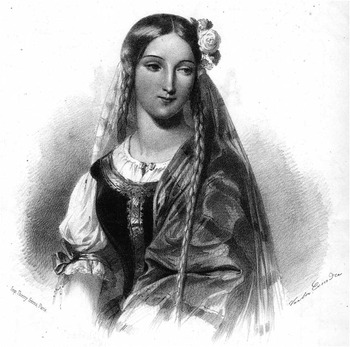
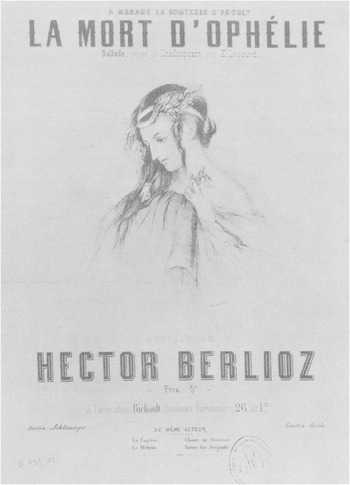
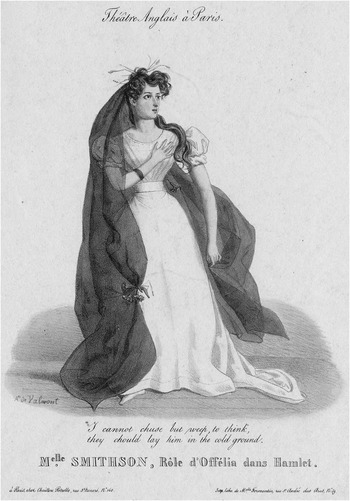
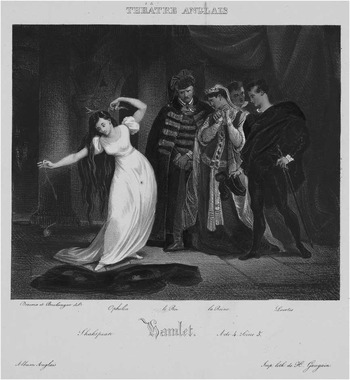
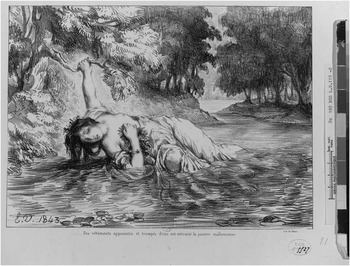
The images printed with the various versions of the song strengthen its autobiographical associations. The portraits that appeared with the Gazette musicale's 1848 Album de chant (Figure 2) and on a separate edition of the piano-vocal score from 1848 (Figure 3) resemble portraits of Harriet herself. Figures 4 and 5 reproduce two 1827 lithographs of Harriet as Ophelia for comparison, the first by A. de Valmont and the second by A. Devéria and L. Boulanger. Note in particular the long dark hair and white dress in these two lithographs, seen also in Figure 3, an image that one of Berlioz's earliest biographers, Adolphe Jullien, described as an ‘ideal portrait of Miss Smithson’.Footnote 37Figure 2 also depicts Ophelia with a long, translucent veil, very much like the one pictured in Figure 4. Considering the ongoing effect on French art of the 1827 performances of Harriet and her company, it is hard to imagine that many who saw these title vignettes would not have thought immediately of Harriet. As Peter Raby notes, the Devéria and Boulanger lithographs are important for being some of the first French illustrations of Shakespeare, and they spawned a wave of similar Ophelia images, several of which were inspired by Harriet's performance.Footnote 38 Eugène Delacroix's famous 1843 lithograph La Mort d'Ophélie is a perfect example – again depicting Ophelia with a flowing white dress and dark hair (Figure 6). In an obituary of Harriet, Jules Janin claimed that she was the inspiration for Delacroix's image.Footnote 39 Berlioz even referenced the lithograph and Janin's comments about it in his Memoirs.Footnote 40
Album de chant de la Gazette musicale. Lithograph of Ophelia, 1848. By permission of the Library Koninklijk Conservatorium-Conservatoire royal, Brussels

‘La Mort d'Ophélie’. Title page of separate edition of piano-vocal score, 1848. By permission of the Bibliothèque nationale de France

Harriet Smithson as Ophelia in Hamlet. Lithograph by A. de Valmont, 1827. By permission of the Folger Shakespeare Library

Harriet Smithson as Ophelia in Hamlet. Lithograph by A. Devéria and L. Boulanger, 1827. By permission of the Folger Shakespeare Library

La Mort d'Ophélie. Lithograph by Eugène Delacroix, 1843. By permission of the Bibliothèque nationale de France

Even the dedication on the printed versions of the piano-vocal score of ‘Ophélie’, including the version in the Gazette album – ‘à Madame la Comtesse d'Agoult’ – is not as inconsequential as it might first seem. Marie d'Agoult eloped with Liszt in 1835, but her affair with him ended in 1844, four years before Berlioz made ‘La Mort d'Ophélie’ public. As D. Kern Holoman has written, Berlioz's dedication of the song to a friend likewise undergoing a difficult separation cannot have been coincidental.Footnote 41
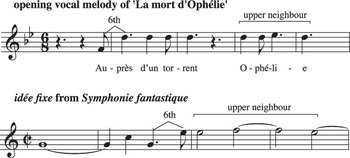
Finally, the music presents its own evidence. David Cairns has pointed out that the opening nine notes of ‘Ophélie's’ vocal line recall the contours of the idée fixe of the Symphonie fantastique (Example 1).Footnote 42 The song thus evokes a memory not only of the role Harriet played but also of the feelings Berlioz had for her when he wrote the Symphonie fantastique. The idée fixe melody may have originated before 1830, appearing in several contexts in Berlioz's 1828 cantata Herminie, but to nineteenth-century ears unfamiliar with Berlioz's cantata and the extent of his self-borrowings – and arguably to anyone who knows Berlioz's music at all – this is the melody of the Symphonie fantastique's famous beloved, and hence of Berlioz's beloved. Like the idée fixe, the opening ‘Ophélie’ melody features an upward leap of a major sixth followed by an upper neighbour. The motive appears in the same tonal context (leaping from the fifth scale degree up to the third and decorating that third with a diatonic upper neighbour), if in a different key. The reference is all the more unmistakable because Berlioz sets that upper neighbour – the idée fixe's most characteristic motive – to the word ‘Ophélie’, and also because the leap of a sixth appears only at the beginning of this strophe, when Ophelia's name is first uttered. The other strophes begin with no anacrusis, something perhaps necessitated by the rhythm of the text, but just as likely a deliberate choice on Berlioz's part – a means of highlighting this particular melody and establishing from the start of the song a connection with the idée fixe and the woman it represents.
‘La Mort d'Ophélie’ melody and idée fixe compared

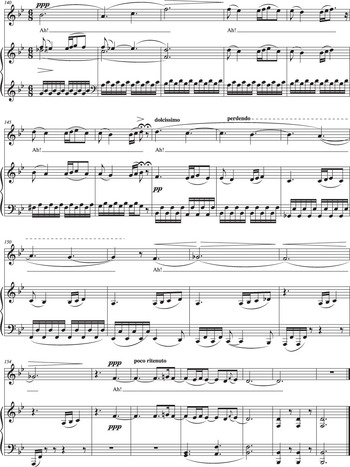
Aside from this thematic allusion, the sheer emotional depth of ‘La Mort d'Ophélie’ gives us a sense of the sentiment behind the song and the aura of real-life tragedy that surrounds it. The song clearly draws upon romance conventions: its harmonies are more diatonic and its modulations more conventional than those in Les Nuits d’été; its melody, however dramatic and long-breathed, is not beyond reach of an amateur singer; its accompaniment is by no means too challenging for an amateur pianist; and its form is strophic, if successively elaborative. Yet this particular romance is more affecting and musically inventive than any other piece in the Gazette album, more indeed than many mid-century examples of the genre.Footnote 43 The haunting ‘Ah!’ vocalise that ends the first and last strophes (an addition by Berlioz not found in Legouvé's poem) gives Ophelia a voice and lends her suffering an immediacy. We hear not just the narrator's account of her death but the sound of her death, the ‘mélodieuse chanson’ she sings as she drowns, which seems to go on after she is gone (see Example 2).Footnote 44
‘La Mort d'Ophélie’, ending (bars 140–160)

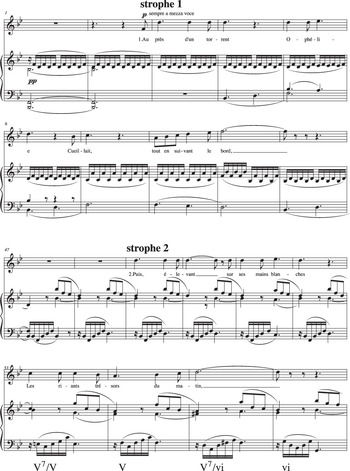
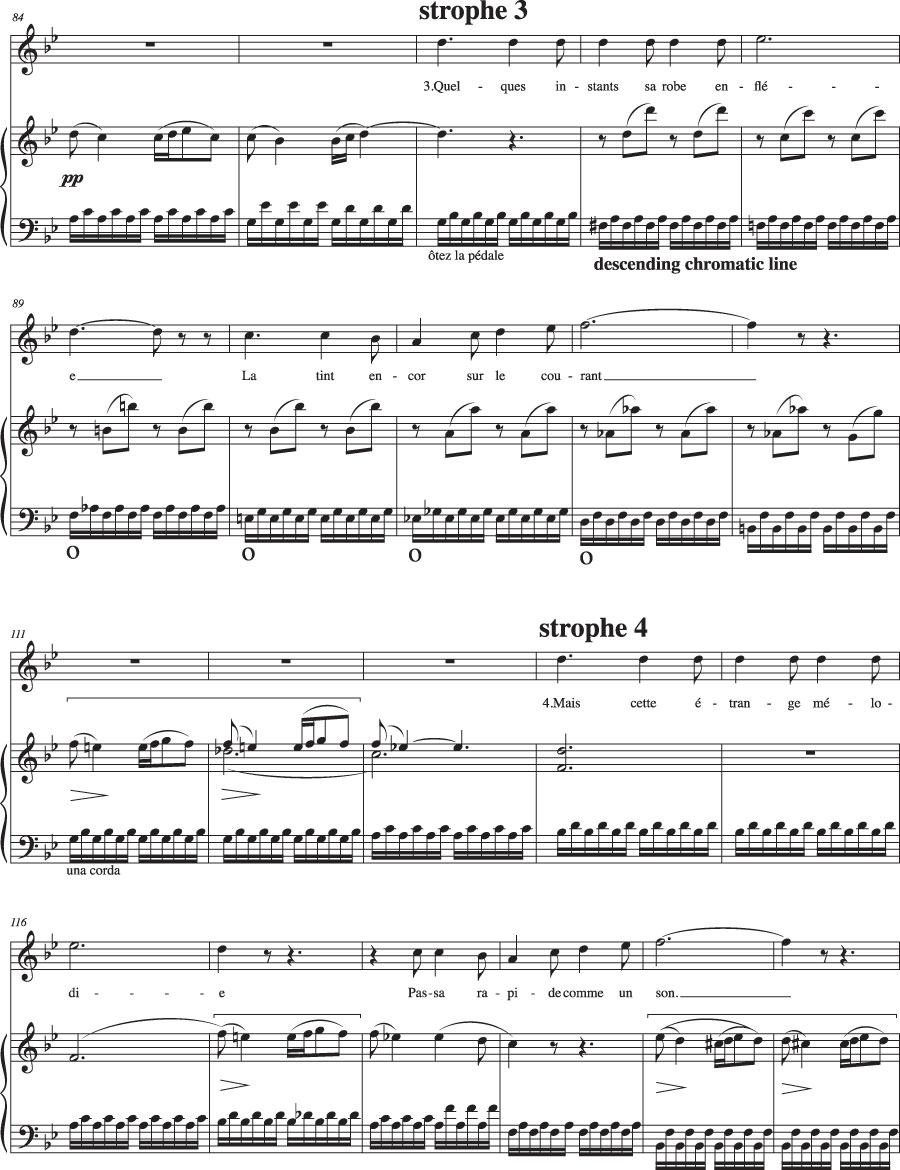
The varied strophic form of the song is equally expressive – not just an innovation for innovation's sake but a musical device that renders perfectly the swirling current that pulls Ophelia under.Footnote 45 The transitions between the strophes in ‘Ophélie’ get shorter and shorter. The effect is one of acceleration, pressing on to each new strophe with ever more intensity. And also disintegration: as Ophelia loses grip, so does the music, since Berlioz incorporates either more rhythmic activity or more chromaticism or both as the song progresses. Example 3 presents the beginning of the song's four strophes. The first starts entirely diatonically. The second features a more rhythmically active accompaniment and touches of chromaticism (tonicizing F major and G minor). The third starts not in the tonic B♭ major but in G minor, with a long descending chromatic line in the bass and a series of chromatically descending diminished triads (see the ‘o's in this example). And the fourth, though now back in B♭ major, compresses one of the accompaniment's recurring motives and adds a new chromatic pitch, C#. Compare the bracketed motives in bars 111–112 and 117, which span a minor third from E♮ to G, with those in bars 120–121, which span a diminished third from C# and E♭. Note also that the voice-leading context changes in bar 120: in bar 117 the downbeat F was the focal pitch and E and G were neighbours to it; here the downbeat E♭ is an upper neighbour itself. The motive is not just compressed, it is contorted. And it sinks, as Ophelia does.
‘La Mort d'Ophélie’, strophe beginnings

continued
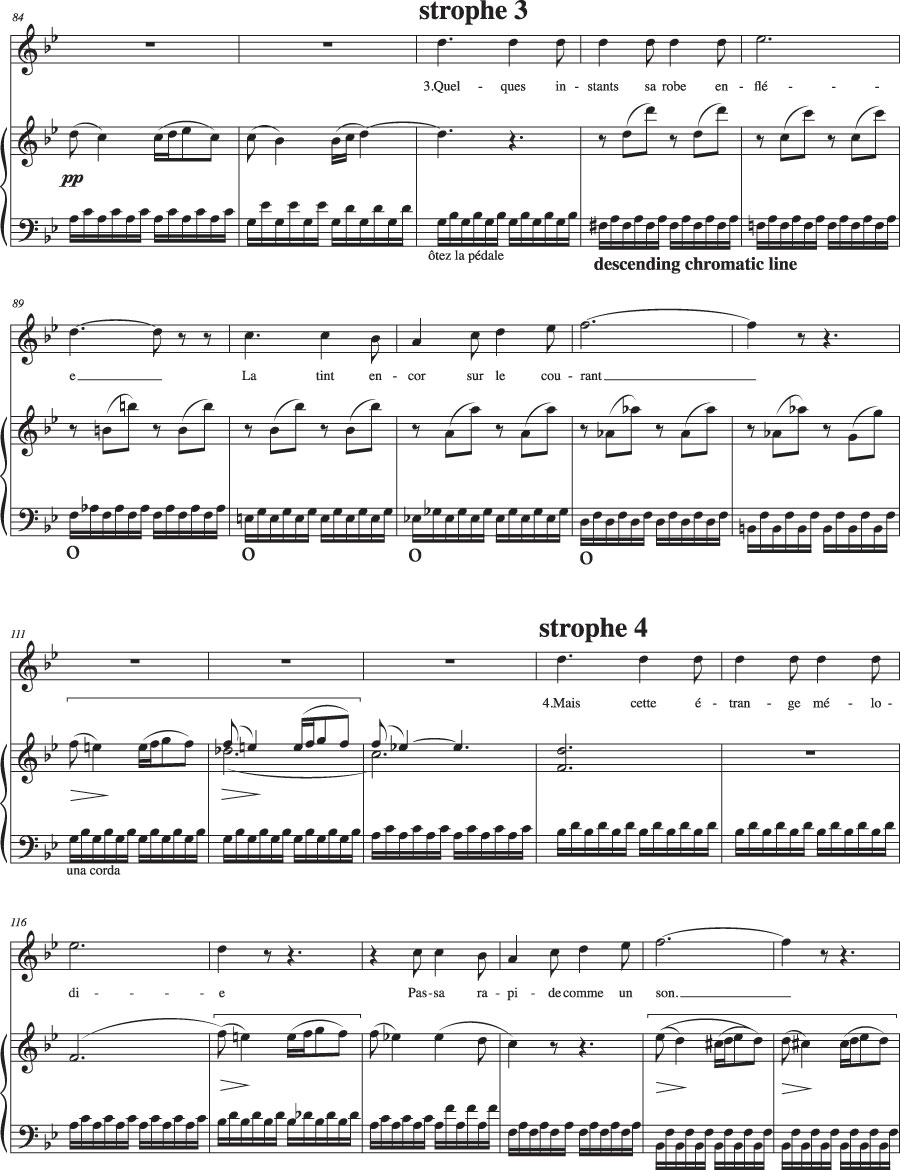
In sum, ‘La Mort d'Ophélie’ is not just a well-crafted and moving song but a song that is all the more moving because of the many strands that connect it with Berlioz's life – its dates of composition and republication, its accompanying images, its dedication, its reference to the idée fixe and its aura of ‘recollection and self-exploration’, to return again to Kohrs. Considering these many autobiographical associations, it is difficult not to hear the work as Berlioz's elegy to Harriet and an artistic response to one of the most significant losses of his life.
Other Autobiographical Fragments
‘La Mort d'Ophélie’ may be a particularly striking example of art imitating life, but it is only one of many. Nine of the fourteen songs from 1842–50 relate to Berlioz's life in some substantive way (these are the bold-faced songs in Figure 1). Several of these songs deal with themes of loss, nostalgia and memory – the very themes suggested by ‘La Mort d'Ophélie’ and the very ones that echo through Berlioz's writings from the period. Take ‘Le Matin’ and ‘Petit Oiseau’, for example. Both songs are reflections on the passage of time and wistful paeans to nature and the countryside, and both were written during a time when Berlioz returned to his rural birthplace after the death of his father. As we shall see below, ‘Le Matin’ contains a stanza not present in ‘Petit Oiseau’, which may have had personal meaning to Berlioz.
The little-known song ‘Nessun maggior piacere’, from 1847, and a revised version of ‘Adieu Bessy’, completed in 1849, are also songs about the past, seemingly inspired by Berlioz's personal circumstances. Berlioz wrote ‘Nessun’ after arriving in London with such high hopes for his Drury Lane directorship and before learning how unstable Jullien and his enterprise were. Its text can be roughly translated as ‘There is no greater pleasure than to recall, in good fortune, an unhappy time’Footnote 46 – a parody of lines from Dante's Inferno, which express the opposite sentiment (‘There is no greater sorrow than to recall, in wretchedness, a happy time’).Footnote 47 Might Berlioz have dashed off this light-hearted piece because his spirits were finally up and he was far from the miseries of Paris? And might he have recalled that falsely optimistic moment when, in an 1850 letter to his sister Adèle, he quoted Dante – correctly this time – while describing the distress he caused Harriet by showing her a copy of a portrait of her in her youth?Footnote 48 ‘Adieu Bessy’ recollects both happy and unhappy times – ‘Plaisirs passés que je déplore’ and ‘le mal qui nous dévore’, which will only be ‘un souvenir’. Originally written in 1829 as a part of Neuf Mélodies, it was overhauled in 1849 for a new edition of the set, entitled Irlande; no other song in the collection was recomposed so thoroughly. Berlioz's return to Neuf Mélodies seems to have been prompted by an impulse to gather together all of his works for publication, an impulse not unrelated to his anxieties about his future.Footnote 49 But we should not forget that he initially wrote the set when Harriet and his burgeoning affections for her were on his mind and before their relationship had begun to fade. For Berlioz to rewrite a song about remembered joys and sorrows at a time when his relationship with Harriet had become all but a faded memory is thus not insignificant, for it may mean revisiting this earlier chapter, even bidding an old love farewell.
While ‘Adieu Bessy’, like ‘La Mort d'Ophélie’, seems to be bound up with Harriet, four other songs from this time seem to be bound up with Marie: ‘Absence’, ‘La Belle Voyageuse’, ‘La Belle Isabeau’ and ‘Les Champs’. ‘Absence’ was the first song from Les Nuits d’été that Berlioz orchestrated, and he did so, in February 1843, specifically so that Marie could perform it.Footnote 50 The autograph manuscript of the song – arguably the most romance-like of the cycle, with its straightforward rondo form with identical refrains – bears an inscription in Berlioz's hand, ‘H. B. To Marie!!’Footnote 51 ‘Absence’ became ‘her’ song, and she sang it more frequently than anyone else. ‘La Belle Isabeau’, composed in December 1842 and published a month later in Le Monde musical, was also dedicated to Marie; in fact, Berlioz insisted that the dedication be printed with the published score.Footnote 52 The dedication takes on greater significance when we consider that the song, which Berlioz wrote while he was preoccupied with his forbidden relationship with his mistress, is about the obstacles separating two lovers, a knight and a girl who has been imprisoned by her father.
Around this time Berlioz also orchestrated a sweet and lilting romance from Neuf Mélodies about a fair Celtic woman, ‘La Belle Voyageuse’, which Marie performed on 25 January 1843 in Weimar.Footnote 53 The first version of the song, written in 1829, may evoke Harriet – she was of course Irish, and Berlioz wrote the song at the height of his infatuation with her – but the version in orchestral dress from December 1842 seems to have had special meaning for Berlioz and Marie. A week before the January performance Berlioz left Marie without warning in Frankfurt, possibly frustrated by her insistence on performing at all his concerts and the poor quality of her singing. She found him soon enough, however, and they were reconciled. David Cairns has called the song a ‘symbolic gesture of apology and reconciliation’.Footnote 54 Might we then interpret the ‘belle voyageuse’ of its title as Marie, Berlioz's travelling companion on this journey and many thereafter, who was determined enough to find her way to Weimar to be reunited with him?
Finally, ‘Les Champs’, another song revised during these years, brings to mind Marie not because of a dedication or performance but because Berlioz's revisions highlight lines about a secret affair. Originally written in 1834 and published in a fashion magazine La Romance, ‘Les Champs’ was radically recomposed in 1850 for inclusion in Fleurs des landes. The text alone – about two lovers who hide their relationship from envious eyes and escape Paris where they can be together in secret – is suggestive enough. But it is the text in conjunction with Berlioz's musical revisions that raises deeper questions about the song's autobiographical meaning: What prompted Berlioz to return to the song 16 years later? Why does he modify passages as he does? Do his revisions suggest a different reading of certain lines of text, or a different identification with them?Footnote 55 Consider, for example, how the music of the final strophe is altered to emphasize the lines, ‘Rose, let us hide from the envious/the sweet secret of our life’ (Rose, dérobons à l'envie/Le doux secret de notre vie). The 1850 version sets these words to the same chromatically rising melody used in the 1834 version, but the texture and dynamics are reversed: whereas the passage in 1834 begins softly and thinly and then crescendos as the texture thickens, in 1850 it begins with a crescendo and driving triads, only to shift suddenly to a piano dynamic and a more delicate accompanimental pattern. The change is obviously motivated by a concern for text painting (the sweet music matches the ‘sweet secret’ mentioned in the poem), but the net effect of this change is to focus the listener's attention on the most potentially autobiographical lines of the poem – those about clandestine love.
‘Le Matin’ and ‘Petit Oiseau’: A Search for Lost Time
‘La Mort d'Ophélie’ is the first song Berlioz wrote in the years 1842–50. It seems only natural, then, to close with two of his last songs, ‘Le Matin’ and ‘Petit Oiseau’, his two settings of Adolphe de Bouclon's poem ‘Pour chanter le retour du jour’.

Berlioz published ‘Le Matin’ and ‘Petit Oiseau’ as songs 1 and 2 in the collection Fleurs des landes. We do not know exactly when the songs were composed, or which was written first, but Macdonald believes that Berlioz probably wrote them between 1847 and 1849.Footnote 57 Why he would have set the same poem twice is a mystery. As we have seen, he was in the habit of revising songs for different purposes, whether personal or practical or both. But to offer two different musical interpretations of the same poem, and to publish them side by side in the same collection, is altogether unprecedented for Berlioz.
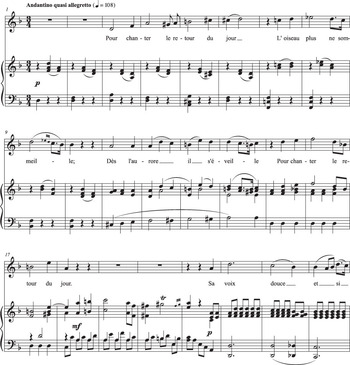
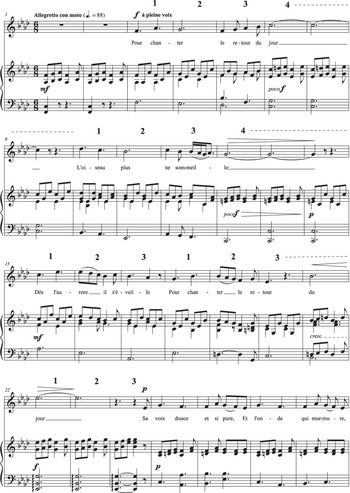
Both settings draw upon the conventions of the romance, even more than ‘Ophélie’ does, with strophic forms, an air of graceful simplicity and a fairly conventional tonal and harmonic language. ‘Le Matin’ is in fact titled ‘romance’; ‘Petit Oiseau’ is called a ‘Chanson de paysan’ (Peasant's song). ‘Le Matin’, however, is somewhat more complex and dramatic than its pair, owing to its more varied and ambitious accompaniment and more overt text painting. Example 4 shows the first strophe of the song. Note how many different accompanimental patterns are used in these 45 bars: an ‘oom-pah-pah’ rhythm with dyads in the right hand (bars 1–10), a more homophonic texture (bars 11–17), an arpeggiated left hand with right-hand octaves (the interlude in bars 18–21), repeated right-hand triads above a singing left-hand bass line (bars 22–25, inverted in bars 26–29), a single-line melody above sustained dyads (bars 31–35), and finally a thick chord (bars 37–38) followed by a rhythmic acceleration and a rapid tremolo (bars 40ff.). Note as well the trill in bar 20 that depicts the bird's song, the snaking melodic line in bars 30ff. that suggests the ‘murmuring stream’ and the outburst of D major in bar 37, as nature explodes to life. This climactic passage – reminiscent of the eruptions that end the strophes of ‘La Belle Isabeau’, another modified strophic song with a contrasting third strophe – is almost operatic in its intensity.
‘Le Matin’, first strophe

continued

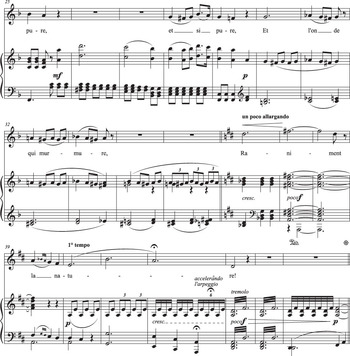
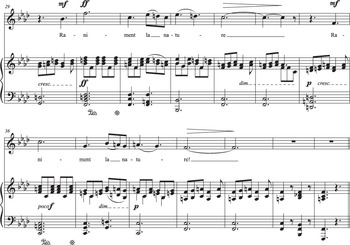
Not so with ‘Petit Oiseau’, where restraint is Berlioz's modus operandi (Example 5). The song does not so much erupt as blossom at the moment the poet speaks of ‘le retour du jour’ (bars 19–24): the texture thickens, and voice and piano crescendo into a higher register and a cadence in E♭ major, but with only half the drama of ‘Le Matin’. The same goes for the passage that sets the lines about nature being restored to life (bars 29ff.). The repetition of ‘Raniment la nature’ in bars 35ff. gives more weight to the final cadence in F major, but the cadence grows naturally out of the tonicisation of B♭ major that precedes it and eases the melody down into the comfortable register where it began. And rather than mimic the bird's song with trills and short note values, Berlioz only implies it in the motive first heard in bar 1, a motive that serves double duty since it is also used to evoke the murmuring stream several bars later. If Berlioz set himself the challenge of approaching the same text from different vantage points, then the specific challenge of ‘Petit Oiseau’ seems to have been to say as much as possible with as few musical materials as possible – to wring expressive meaning from a simple form with devices that are quieter than those in ‘Le Matin’, but no less effective. Most impressive is Berlioz's subtle manipulation of phrase rhythm. ‘Le Matin’ moves mostly in four-bar hypermeasures, but ‘Petit Oiseau’ moves in less regular units. The vocal melody begins with two six-bar phrases (bars 3–8 and 9–14), each resulting from the extension of a four-bar hypermeasure by two bars (see the numbers above the staff in Example 5; the dotted lines indicate hypermetrical extensions). The phrases are given room to breathe, and we are given time to listen to the piano's motive as the poet listens to the bird's song. Thereafter come two three-bar units in sequence (bars 15–17 and 18–20), the last of which is extended by one bar, leading to the hypermetric downbeat on the E♭ chord in bar 22, which initiates another three-bar segment (bars 22–24). These uneven units lend ‘Petit Oiseau’ a freedom and flexibility, not to mention a gentle disorderliness appropriate to a poem about waking up to the distant murmurings of nature.
‘Petit Oiseau’, first strophe

continued

The most striking difference between the two settings, however, is that in ‘Le Matin’ Berlioz sets Bouclon's entire poem, whereas in ‘Petit Oiseau’ he omits the third stanza. In this stanza, for the first and only time in the poem, the poet does not address the bird and describe what it does; instead, he addresses his ‘good old mother’ (bonne et vieille mère), whom he entreats to come listen to the bird's melody, and describes what he himself will do – ‘May my affection constantly enrich the days of your old age!’ (Que pour toi ma tendresse/Embellisse sans cesse/Les jours de ta vieillesse!). This tender promise to an aging parent adds another layer of meaning to the poet's ‘farewell’ to the bird in the final stanza. Without the third stanza, the final stanza seems merely to describe the end of the day, but with it, the last lines hint at a more significant end: just as the poet must bid adieu to the bird, so must he someday bid adieu to his mother.
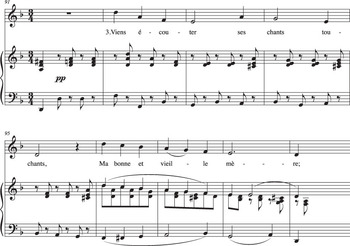
Why did Berlioz omit this stanza from ‘Petit Oiseau’? And why did he keep it in ‘Le Matin’? We can of course never know for certain, but one possible explanation has to do with the shift in tone in the third stanza of the poem. The final lines of the other stanzas speak of nature's noises – the stream's burbling, the bird's warbling – but the end of this stanza is about human comforts, not natural ones, feelings as opposed to sounds. Such a shift would seem to demand music different from that of the other strophes – in other words, a modified strophic form. Berlioz may well have found such a form ill suited to ‘Petit Oiseau's’ air of naïveté, and thus opted to leave out the stanza altogether. In a more dramatic, modified strophic setting like ‘Le Matin’, a contrasting third strophe makes more musical sense. Even so, the degree of contrast Berlioz employs is unexpected. The second and fourth strophes vary the first only slightly, but the third begins with an entirely new melody (see Example 6).
‘Le Matin’, beginning of third strophe

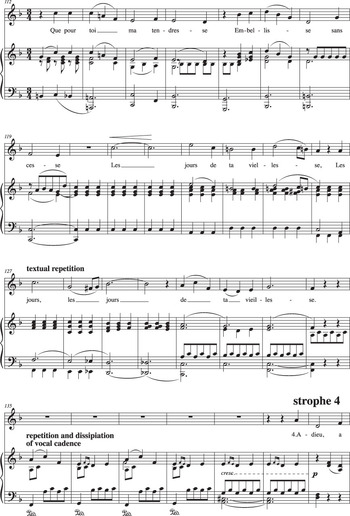
It also ends differently: while the other strophes explode from D minor into D major, the third closes quietly in F major (Example 7), with gentle rocking accompaniment strongly reminiscent of ‘La Mort d'Ophélie’ (compare bars 131ff. of ‘Le Matin’ with the opening of ‘Ophélie’). This is the only time in the song that Berlioz repeats an entire line of text for emphasis – the poet's promise to his mother, ‘Que pour toi ma tendresse/Embellise sans cesse/Les jours de ta vieillesse! Les jours, les jours de ta vieillesse! [my italics]’ (May my affection constantly enrich the days of your old age! The days, the days of your old age!). The repetition and dissipation of the vocal cadence in the piano in bars 135–139 is also something new. In the other strophes the piano part echoed the cadences in the vocal line, but only loosely, retracing the contour and rhythm of the melody. In the ‘added’ third strophe, the piano repeats the vocal line exactly, omitting only its last two pitches, G and F – and not once, but twice, before dissolving into the beginning of the final strophe. The last words of the stanza, ‘de ta vieillesse’, thus become almost incantatory. They reverberate in memory as the piano repeats the vocal melody, and they make the end of this strophe sound more reflective than rapturous, and all the more poignant.
‘Le Matin’, end of third strophe

Clearly, Berlioz's treatment of the third stanza and its final lines reflects a sensitive understanding of the shift in focus and emotional register at this moment Bouclon's poem. But it may also suggest a personal identification with its text and subject matter. As was previously noted, Berlioz likely wrote the song during a time when he returned home after the death of his father. Cairns has argued that Berlioz's tragic Hamlet march, revised around this time, could be associated with this grievous loss.Footnote 58 The same could be said of ‘Le Matin’. The song might be interpreted as Berlioz's symbolic farewell to his father and the countryside of his youth, considering its tender added strophe that pleads for a parent (here of course a mother, not a father) to come and be revived by the beauty of the bird's song and its final strophe that bids farewell to the bird with a hint of a more significant type of leave-taking. Berlioz may have been attracted to Bouclon's song in praise of nature and decided to set it two times over because he was at the time overwhelmed with memories of his distant past and of his lost parent.Footnote 59 Again, we have no way of knowing which version came first, but we can easily imagine two possible scenarios: Berlioz wrote ‘Le Matin’ first, finding deeper meaning in its third stanza and setting these lines to his most touching music, and then felt compelled to omit this stanza from the simpler ‘Petit Oiseau’; or he wrote ‘Petit Oiseau’ first, leaving out the third stanza, and only afterward devised a more elaborate setting into which it could be rightfully incorporated. No matter their order of composition, the songs’ order of presentation in Fleurs des landes is important. ‘Le Matin’ precedes ‘Petit Oiseau’, an arrangement that heightens the sense of loss projected by ‘Le Matin's’ third strophe, for the lines that carried so much meaning in the first song are ‘missing’ in the second – like ‘chants touchants’ that have vanished.
To suggest that Berlioz sat down and wrote ‘Le Matin’ and ‘Petit Oiseau’ (in whatever order) as a response to a particular stimulus – his return home that autumn of 1848, for instance, or his father's death – is too reductive and at any rate unverifiable given the scant information about the composition of the two songs. Yet when we consider how these songs deal with themes of reminiscence, an admiration for the natural world and the passage of time, and that Berlioz was overcome by what Cairns has called a ‘search for lost time’Footnote 60 that did indeed take him on this pivotal journey home, his choice to set this text in a style that he would have associated with his childhood seems more than coincidental.
In his Memoirs, Berlioz describes his return to Meylan in lines that echo the sentiments of Bouclon's text:
Estelle must have come here. Perhaps I stand in the very portion of air where her enchanting form once stood. Now – look! I turn and my gaze takes in the entire picture: the blessed house, its garden, its trees, below it the valley and the winding Isère and beyond, the Alps, the glaciers, the far-off gleaming snow – everything her eyes looked on. I breathe in the air that she breathed … Ah! A cry such as no human language can convey re-echoes from the Saint-Eynard. Yes, I see, I see again, I worship. The past is before me, I am a boy of twelve. Life, beauty, first love, poetry without end! … Farewell! Beloved tree, farewell! Valleys and hills, farewell! … Farewell, my romantic childhood, last glimmers of an ideal, untarnished love!Footnote 61
This section of his Memoirs is believed to have been written in the early 1850s, but David Cairns argues that the immediacy of this passage suggests it might have been written earlier, when the experience was still fresh in his mind: ‘He could well have felt the need to put his experience on paper at once; and where better to do it?’Footnote 62 Is it possible that Berlioz also felt the need to put his experience on staff paper? To record an experience in journal-like fashion and to refract some essence of that experience through the prism of poetry and music are two different acts, and the traces of that experience are bound to be more veiled and scattered in the latter case. But they are no less indicative of Berlioz's urge toward self-expression. In this ‘post-1848 condition’, crushed by news of his father's passing, disturbed by the political instability in France and elsewhere and doubtful about his future as a composer, Berlioz was more introspective and reminiscent than ever before. The composition of ‘Le Matin’ and ‘Petit Oiseau’ may well represent an effort to work through those feelings of disillusionment, loss and nostalgia in a simple and direct style Berlioz had known all his life.
Turning Points
No public performances of ‘Le Matin’ and ‘Petit Oiseau’ are known to have taken place during Berlioz's lifetime. The same goes for almost all of the songs mentioned in this article. ‘Absence’ and ‘La Belle Voyageuse’ are exceptions; Berlioz programmed them widely and they became well known and well loved in their orchestral versions. But not all reorchestrated songs fared so well. Berlioz attempted several times to have the choral-orchestral version of ‘La Mort d'Ophélie’ performed, but he would never get to hear it; it was first performed in 1875, six years after his death.
However, as I have argued throughout this essay, we should not therefore conclude that songs like ‘La Mort d'Ophélie’, ‘Le Matin’ and ‘Petit Oiseau’ are unimportant to our understanding of Berlioz – or, for that matter, to Berlioz himself. Admittedly, their importance was partly financial. Song collections like Fleurs des landes and Feuillets d'album would have brought Berlioz some welcome income as well as public attention to some of his small-scale works. Yet Berlioz was at pains to demonstrate that he did not publish songs only to pad his pocketbook. In an 1852 letter he asked Joseph d'Ortigue to write a review of his song collections: ‘I only want people to know that they exist, that they are not shoddy goods [la musique de pacotille], that I in no way have sales in mind, and that these “petites compositions”, which have nothing formally or stylistically in common with Schubert's, require for proper execution singers and pianists – musicians – of consummate artistry.’Footnote 63 The words from d'Ortigue's review, quoted at the outset of this essay, are fitting: the pieces ‘express with truth and nobility a particular state of mind’ – not just that of a generic poetic persona but Berlioz's own state of mind, reflecting on his life and career and preparing for the chapter that lay ahead. In the romance Berlioz may have found an ideal forum for that type of reflection and reminiscence, a genre that appealed because of its straightforward style that would not confuse or offend, as so much of his music had.
The romance's popularity also guaranteed that his songs would get heard. It is true that most of Berlioz's romances were not performed in public, but they did reach an audience – not in the concert hall but in the salon, in the home, in private performances that we can never tally, done by those who received Berlioz's retrospective song collections or the annual song albums in which his romances appeared. Berlioz could in fact be more sure that these pieces would get heard than those that required more substantial performing forces, not to mention suitable performance venues and sufficient backing. Berlioz's revealed his frustration with such grand ventures in a letter from 1856, where he expressed his gratitude that Baron Wilhelm von Donop was impressed with the full orchestral score of Les Nuits d’été. ‘The only pieces I've ever heard from this collection’, he told him, ‘are “Le Spectre de la rose” and “Absence” and those rarely played well. I've also written another collection entitled Tristia, containing a hymn for six voices on a text by Moore [the Méditation religieuse], a ballade for women's chorus on the death of Ophelia, and the Marche funèbre with invisible chorus and large orchestra for the final scene of Hamlet; I've never heard a bar of it. It's published in full score, but who's interested in that?’Footnote 64 At least he knew the Gazette's 1848 album would see light of day. At least the piano-vocal version of ‘La Mort d'Ophélie’ would be played, and maybe even understood.
Berlioz did of course return to writing large-scale works. The ‘sacred trilogy’ L'Enfance du Christ, composed on and off between 1850 and 1854, would be the first to reach an audience; it was premiered in 1854 to widespread acclaim. Many heard in this piece a new style for Berlioz, one that was more intimate, restrained and delicate. Berlioz denied outright the claims that his music was headed in a different direction, partly, one wonders, because of the double-edged nature of the praise he received: Congratulations on your beautiful score, the critics said, and for finally getting things ‘right’. To assert that he would have written L'Enfance no differently 20 years earlier, as he does in the postscript to his Memoirs,Footnote 65 is not only to assert a stylistic consistency but also to defend his earlier works as more than mere bombast, the racket of an enfant terrible who had not yet learned to rein it in.
But L'Enfance du Christ does exhibit an overall lyricism and intimacy – not to mention an introspective and nostalgic quality – that are if not ‘new’ then more consistently applied and undeniably related to the style of the songs written in the years leading up to its composition. It is hard not to hear echoes of ‘La Mort d'Ophélie’, for example, in the supple strophic variations of the duet ‘O mon cher fils’, the accompanimental rhythm, melodic contour and straightforward harmonic language of Mary and Joseph's duet in the town of Saïs (no. 11) and the rising and falling female voices in the Chorus of the Ismaelites, so reminiscent of the female voices from the choral-orchestral version of the song. This may provide yet another reason to take these miniatures seriously. With all their musical, biographical and historical interest, they begin to sound less like halting points in Berlioz's personal and compositional evolution and more like turning points.