INTRODUCTION
Brain maturation during adolescence appears to mirror developments in cognition, suggesting the overwhelming importance of healthy brain maturation processes during this critical time (Fryer et al., Reference Fryer, Frank, Spadoni, Theilmann, Nagel, Schweinsburg and Tapert2008; Nagel, Barlett, Schweinsburg, & Tapert, Reference Nagel, Barlett, Schweinsburg and Tapert2005; Sowell, Delis, Stiles, & Jernigan, Reference Sowell, Delis, Stiles and Jernigan2001). Given the confluence of neuromaturational activity (Giedd et al., Reference Giedd, Blumenthal, Jeffries, Castellanos, Liu, Zijdenbos and Rapoport1999; Gogtay et al., Reference Gogtay, Giedd, Lusk, Hayashi, Greenstein, Vaituzis and Thompson2004; Paus et al., Reference Paus, Zijdenbos, Worsley, Collins, Blumenthal, Giedd and Evans1999) and initiation of alcohol and marijuana use during adolescence, the potential impact of these substances on neurocognitive development is important to understand. Alcohol and marijuana are drugs of particular concern since they are the most commonly used among adolescents. Over 68% of U.S. high school seniors report having tried alcohol and 46% have tried marijuana (Johnston, O’Mally, Miech, Bachman, & Schulenberg, 2014), and in the past month, alcohol was used by 39% and marijuana by 22% (Johnston et al., Reference Johnston, O’Malley, Miech, Bachman and Schulenberg2014). Heavy episodic drinking (i.e., attaining a blood alcohol concentration of .08 or higher, which is typically achieved with ≥5 drinks for males or ≥4 drinks for females within a 2-hr period; National Institute on Alcohol Abuse and Alcoholism, 2002) occurred among nearly a quarter of seniors in the prior 2 weeks, and 7% endorsed daily marijuana use (Johnston et al., Reference Johnston, O’Malley, Miech, Bachman and Schulenberg2014).
The extant animal literature suggests that adolescents experience heightened vulnerability to the deleterious effects of both ethanol and cannabis (Cha, White, Kuhn, Wilson, & Swartzwelder, Reference Cha, White, Kuhn, Wilson and Swartzwelder2006; Roehrs, Beare, Zorick, & Roth, Reference Roehrs, Beare, Zorick and Roth1994; Schneider, Schomig, & Leweke, Reference Schneider, Schomig and Leweke2008; Silveri & Spear, Reference Silveri and Spear1998; Slawecki & Roth, Reference Slawecki and Roth2004; Stiglick & Kalant, Reference Stiglick and Kalant1982). In general, the animal literature suggests a more widespread impact by ethanol on the hippocampus (Nixon, Tivis, Ceballos, Varner, & Rohrbaugh, Reference Nixon, Tivis, Ceballos, Varner and Rohrbaugh2002; Slawecki, Betancourt, Cole, & Ehlers, Reference Slawecki, Betancourt, Cole and Ehlers2001; Ward et al., Reference Ward, Colivicchi, Allen, Schol, Lallemand, de Witte and Dexter2009) and frontal–anterior cortical areas (Crews, Braun, Hoplight, Switzer, & Knapp, Reference Crews, Braun, Hoplight, Switzer and Knapp2000), which leads to persistent structural and functional abnormalities into adulthood (Slawecki, Reference Slawecki2002; Slawecki & Roth, Reference Slawecki and Roth2004; White, Ghia, Levin, & Swartzwelder, Reference White, Ghia, Levin and Swartzwelder2000). Adolescent rats also show reduced sensitivity to ethanol-induced motor impairing and sedative effects (Roehrs et al., Reference Roehrs, Beare, Zorick and Roth1994; Silveri & Spear, Reference Silveri and Spear1998; Slawecki & Roth, Reference Slawecki and Roth2004), which may theoretically enable youth to drink greater quantities of alcohol and attain higher blood alcohol concentrations with less sedation than would be expected in adulthood. Similar to effects seen in adolescent rats exposed to ethanol, long-lasting effects on learning, memory, and object recognition have been shown in adolescent rats with chronic cannabis exposure (Cha et al., Reference Cha, White, Kuhn, Wilson and Swartzwelder2006; Schneider & Koch, Reference Schneider and Koch2003; Schneider et al., Reference Schneider, Schomig and Leweke2008; Stiglick & Kalant, Reference Stiglick and Kalant1982), which have been attributed to a reduction in quality or efficiency of synaptic connections in the hippocampus (Rubino et al., Reference Rubino, Realini, Braida, Guidi, Capurro, Vigano and Parolaro2009).
While most existing studies examine the impact of alcohol or marijuana use separately, understanding the impact of concomitant use is also highly relevant. One study found that use of cannabinoids in a neonatal rat brain enhanced sensitivity to damage from ethanol (Hansen et al., Reference Hansen, Krutz, Sifringer, Stefovska, Bittigau, Pragst and Ikonomidou2008). The combination of THC and mildly intoxicating doses of ethanol produced widespread and severe neuronal degradation similar to levels observed from much higher doses of ethanol administration. In sum, animal literature has linked both independent and concurrent alcohol and marijuana use to microstructural and macrostructural changes that likely contribute to observed behavioral and cognitive differences, including poorer neuropsychological functioning.
The extant human literature also suggests that heavy and recent alcohol exposure in adolescence is associated with poorer neuropsychological outcomes relative to those of non-drinkers (Brown et al., Reference Brown, McGue, Maggs, Schulenberg, Hingson, Swartzwelder and Murphy2008; Brown & Tapert, Reference Brown and Tapert2004). A recent study that examined community youth of heavy episodic drinkers relative to their nondrinking peers found that even after 1 month of monitored abstinence, adolescent drinkers still showed differences in prospective memory, cognitive switching, inhibition task accuracy, verbal memory, and visuospatial construction (Winward, Hanson, Bekman, Tapert, & Brown, Reference Winward, Hanson, Bekman, Tapert and Brown2014). Such decrements are consistent with a vast number of other studies on adolescent drinkers (Brown, Tapert, Granholm, & Delis, Reference Brown, Tapert, Granholm and Delis2000; Giancola & Mezzich, Reference Giancola and Mezzich2000; Giancola & Moss, Reference Giancola and Moss1998; Giancola, Shoal, & Mezzich, Reference Giancola, Shoal and Mezzich2001; Goudriaan, Grekin, & Sher, Reference Goudriaan, Grekin and Sher2007; Hanson, Medina, Padula, Tapert, & Brown, Reference Hanson, Medina, Padula, Tapert and Brown2011; Moss, Kirisci, Gordon, & Tarter, Reference Moss, Kirisci, Gordon and Tarter1994; Sher, Martin, Wood, & Rutledge, Reference Sher, Martin, Wood and Rutledge1997; Tapert & Brown, Reference Tapert and Brown1999; Tapert, Granholm, Leedy, & Brown, Reference Tapert, Granholm, Leedy and Brown2002; Tapert et al., Reference Tapert, Schweinsburg, Barlett, Brown, Frank, Brown and Meloy2004; Weissenborn & Duka, Reference Weissenborn and Duka2003). More specifically, numerous studies examining neuropsychological impact of drinking among adolescents with alcohol use disorders (AUD) suggest deficits in verbal memory and recognition discriminability (Brown et al., Reference Brown, Tapert, Granholm and Delis2000; Tapert et al., Reference Tapert, Brown, Kindermann, Cheung, Frank and Brown2001) and in recall of nonverbal information (Brown et al., Reference Brown, Tapert, Granholm and Delis2000) such as delayed recall of a complex figure (Squeglia, Spadoni, Infante, Myers, & Tapert, Reference Squeglia, Spadoni, Infante, Myers and Tapert2009).
Similar to alcohol use, marijuana use during adolescence may also disrupt the normal neuromaturational processes that take place during this time period (Benes, Turtle, Khan, & Farol, Reference Benes, Turtle, Khan and Farol1994; Gogtay et al., Reference Gogtay, Giedd, Lusk, Hayashi, Greenstein, Vaituzis and Thompson2004; Jernigan & Gamst, Reference Jernigan and Gamst2005; Pfefferbaum et al., Reference Pfefferbaum, Mathalon, Sullivan, Rawles, Zipursky and Lim1994). After at least 3 weeks of abstinence, adolescent marijuana users still show decrements in memory, attention, psychomotor speed, and planning and sequencing (Medina et al., 2007; Millsaps, Azrin, & Mittenberg, Reference Millsaps, Azrin and Mittenberg1994; Schwartz, Gruenewald, Klitzner, & Fedio, Reference Schwartz, Gruenewald, Klitzner and Fedio1989); increased errors on a speeded visuomotor sequencing task; and more intrusions on word list learning (Tapert et al., Reference Tapert, Schweinsburg, Drummond, Paulus, Brown, Yang and Frank2007). One study that tested adolescent marijuana users once per week over 3 weeks of sustained abstinence found initial differences in verbal memory and verbal working memory that improved with 3 weeks of sustained abstinence, but not to levels of controls (Hanson et al., Reference Hanson, Winward, Schweinsburg, Medina, Brown and Tapert2010). Deficits in accuracy on a visual attention task were seen at the first assessment and across time (Hanson et al., Reference Hanson, Winward, Schweinsburg, Medina, Brown and Tapert2010). Another study found that MJ-using teens continued to show poorer functioning in complex attention, sequencing ability, verbal story memory, and psychomotor speed following 1 month of monitored abstinence (Medina et al., 2007).
While multiple studies report neuropsychological deficits in alcohol and marijuana using teens, even after 1 month of abstinence, one major limitation across these studies is the high rate of comorbid substance use among participants. Many alcohol-using populations have moderate to high levels of marijuana use; similarly, many marijuana-using teens have significant exposure to heavy drinking. Therefore, much of the existing literature cannot report confidently if cognitive decrements are primarily related to alcohol, to marijuana, or to use of both substances. Additionally, few studies have compared directly alcohol users to marijuana users. One study comparing non-using peers to alcohol-using and to marijuana-using youth used a 12-hr abstinence protocol and 9th grade scores as indications of pre-morbid academic functioning (Solowij et al., Reference Solowij, Jones, Rozman, Davis, Ciarrochi, Heaven and Yucel2011); another study used marijuana users who had consumed alcohol up to 810 times and other drugs up to 70 times (Mahmood, Jacobus, Bava, Scarlett, & Tapert, Reference Mahmood, Jacobus, Bava, Scarlett and Tapert2010). Therefore, there is a great need to distinguish the impact of alcohol, marijuana, and concomitant use on neuropsychological outcomes using extended abstinence protocols, indicators of premorbid functioning that predate initiation of substance use, and group eligibility criteria to limit exposure to other substances much more stringently. These limitations are addressed in the current study.
Current Study
We examined the effects of alcohol and marijuana use during adolescence in a sample of substance using teens and demographically similar non-using teens using a neuropsychological battery after 4 weeks of monitored abstinence. Using strict criteria to differentiate groups, we compared neuropsychological performance among (1) alcohol users, (2) marijuana users, (3) concomitant users of marijuana and alcohol, and (4) non-using controls. Based on prior adolescent research, we hypothesized that even following 1 month of sustained abstinence, users of marijuana and alcohol would show poorer performance relative to non-users. Poorer executive functioning and visuospatial ability were expected in the alcohol group, but not in the marijuana group. Poorer task accuracy and psychomotor speed were expected to be most notable among the marijuana users. Given previous animal and human research (Hansen et al., Reference Hansen, Krutz, Sifringer, Stefovska, Bittigau, Pragst and Ikonomidou2008; Hanson et al., Reference Hanson, Medina, Padula, Tapert and Brown2011), we expected youth who use both marijuana and alcohol to show poorest performance in the same domains as heavy users of alcohol or marijuana, while also possibly showing unique changes attributable to concomitant use.
METHOD
Participants
In accordance with the University of California, San Diego (UCSD) Institutional Review Board and high school district policies, written informed assent (adolescent participant) and consent (parent/legal guardian) were obtained before participation. The current study examined 128 adolescents (ages 16–18 years) who were classified into four groups: (1) heavy episodic drinking adolescents (HED; n=24; >100 heavy episodic drinking episodes, <25 marijuana episodes), (2) protracted marijuana users (MJ; n=20; >100 marijuana episodes, <25 drinking episodes), (3) heavy alcohol and marijuana using teens (HED+MJ; n=29; >100 marijuana episodes and >100 heavy episodic drinking episodes), and (4) control teens (CON; n=55; <10 drinking episodes, <5 marijuana episodes). Specifically, we used “episode” to describe the number of days on which a substance was used in a participant's lifetime and “heavy episodic drinking episode” to describe the number of days on which a male participant consumed five or more drinks and a female participant consumed four or more drinks within a 2-hr period (National Institute on Alcohol Abuse and Alcoholism, 2002). Also, in the 3 months before starting the study, MJ youth reported 0 heavy episodic drinking episodes and 0 alcohol withdrawal symptoms. The HED and HED+MJ groups, however, reported 5–20 heavy episodic drinking episodes per month and 3–9 alcohol withdrawal symptoms in the 3 months before study initiation.
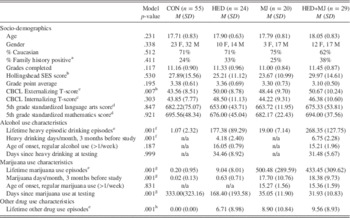
All participants were drawn from the same schools, and groups were similar on socio-demographic factors including age, gender (35% female), ethnicity (75% Caucasian), grades completed, grade point average (GPA), socioeconomic status (Hollingshead, 1965), family history of substance dependence, and 5th grade California Achievement Test, 6th Edition (CAT-6) language arts and mathematics scores (Table 1). Groups who used similar substances (e.g., HED and HED+MJ both used alcohol heavily and MJ and HED+MJ both used marijuana heavily) were matched on their common substance in the following areas: lifetime episodes, frequency of recent use (i.e., 3 months before study initiation), days since use at study initiation, and age of onset of regular use (i.e., more than 1 day per week). HED and HED+MJ had a heavy episodic drinking experience 4.18 and 6.75 days per month, respectively; MJ and HED+MJ smoked marijuana 17.70 and 18.38 days per month, respectively (Table 1).
Demographic and substance use characteristics for control (CON), heavy episodic drinking (HED), protracted marijuana Using (MJ), and heavy episodic drinking and marijuana using (HED+MJ) adolescents (ages 16−18)

Note. Groups were matched on socio-demographic characteristics and differed in their substance use history consistent with how the groups were recruited.
a Family history positive= Having a first-degree biological relative with alcohol or drug related dependence.
b Hollingshead (1965) SES (socioeconomic status): Higher scores= lower SES.
c CBCL: Child Behavior Checklist.
d Scaled score on California Achievement Test, 6th Edition (CAT-6).
e “Episodes” refers to the number of days on which a substance was used in a participant's lifetime.
f (CON, MJ) ≠(HED, HED+MJ) using p <.05 in Tukey's HSD post hoc tests.
g (CON, HED) ≠(MJ, HED+MJ) using p <.05 in Tukey's HSD post hoc tests.
h CON ≠(HED, MJ, HED+MJ) using p <.05 in Tukey's HSD post hoc tests.
Participants were recruited from San Diego high schools and colleges via mailings and fliers that advertised an “Adolescent Development Project.” No information regarding alcohol or drug use criteria was described in the flier or discussed before screening. Participants responding by phone were informed of the study protocol and assessment schedule, potential risks and benefits, and the confidentiality of their participation. All interested teens and their guardians underwent an extensive screening process to determine eligibility, and those potentially eligible were mailed consent packets. After completing the assents/consents, teens and their guardians participated in more detailed, structured clinical interviews.
To minimize confounds, exclusionary criteria included history of a DSM-IV Axis I disorder other than substance abuse; extensive other drug use (i.e., greater than 25 combined lifetime use of other drugs); head trauma (i.e., loss of consciousness over 30 s); a learning disorder; neurological dysfunction; serious medical illness; family history of bipolar I or psychotic disorder; significant prenatal alcohol or drug exposure; sensory problems; use of psychoactive medications; and substance use during the abstinence protocol.
Measures
Structured clinical interview and substance use history
After providing their assent/consent, adolescent participants and their parents were separately administered confidential structured clinical interviews assessing demographics, social and academic functioning (Brown, Vik, & Creamer, Reference Brown, Vik and Creamer1989), family history of psychiatric disorders using the structured clinical interview of Family History Assessment Module Screener (Rice et al., Reference Rice, Reich, Bucholz, Neuman, Fishman, Rochberg and Begleiter1995), and personal history of Axis I psychiatric disorders using the Computerized Diagnostic Interview Schedule for Children (DISC; Shaffer, Fisher, Lucas, Dulcan, & Schwab-Stone, Reference Shaffer, Fisher, Lucas, Dulcan and Schwab-Stone2000). Parents completed the Child Behavior Checklist (CBCL; Achenbach & Ruffle, Reference Achenbach and Ruffle2000) and teens completed the Youth Self Report (YSR; Achenbach & Ruffle, Reference Achenbach and Ruffle2000) to assess levels of internalizing and externalizing psychopathology.
Teen substance use history was documented using the Customary Drinking and Drug Use Record (CDDR; Brown et al., Reference Brown, Myers, Lippke, Tapert, Stewart and Vik1998), which assessed both lifetime and recent tobacco, alcohol, and drug use (12 classes), withdrawal symptoms, DSM-IV abuse and dependence criteria, and other negative consequences associated with heavy drinking. Good inter-rater reliability, internal consistency, and test–retest ability have been demonstrated with the CDDR among adolescent participants (Brown et al., Reference Brown, Myers, Lippke, Tapert, Stewart and Vik1998; Stewart & Brown, Reference Stewart and Brown1995). The Timeline Followback (TLFB; Sobell & Sobell, Reference Sobell and Sobell1992) modified to include other drugs was used to collect frequency and quantity of alcohol, marijuana, and other drug use for the 4 weeks before initiating protocol and for the 4 week duration in the study.
Neuropsychological battery
Following at least 1 month of monitored abstinence in all participants, a 150-min neuropsychological (NP) battery was administered by extensively-trained neuropsychometrists to assess five domains: (1) executive functioning, (2) learning and memory, (3) visuospatial construction, (4) working memory, attention, and psychomotor speed, and (5) language and achievement. Standardized neuropsychological tests included the Wechsler Abbreviated Scale of Intelligence (WASI; Wechsler, Reference Wechsler1999) Vocabulary and Block Design subtests; Wechsler Adult Intelligence Scale-III (WAIS-III; Wechsler, Reference Wechsler1997): Arithmetic, Digit Span, and Digit Symbol Coding subtests; California Verbal Learning Test - Second Edition (CVLT-II; Delis, Kramer, Kaplan, & Ober, Reference Delis, Kramer, Kaplan and Ober2000); Rey-Osterrieth Complex Figure copy and 30-min delayed recall (Osterrieth, Reference Osterrieth1944); Delis-Kaplan Executive Functioning System (D-KEFS; Delis, Kaplan, & Kramer, Reference Delis, Kaplan and Kramer2001) Trail Making subtest; and the Wide Range Achievement Test-4 (WRAT-4; Wilkinson & Robertson, Reference Wilkinson and Robertson2006) Reading subtest.
Mood/affect measures
At the NP testing session, teens completed the Hamilton Depression and Anxiety Rating Scales (Hamilton, Reference Hamilton1996) and the state scale of the Spielberger State Trait Anxiety Inventory (Spielberger, Gorsuch, & Lushene, Reference Spielberger, Gorsuch and Lushene1970), both of which have well-established psychometric properties (Hamilton, Reference Hamilton1996; Spielberger et al., Reference Spielberger, Gorsuch and Lushene1970).
Procedures
All eligible participants who initiated the study protocol were monitored for abstinence from substance use for 4 weeks and then assessed using neuropsychological tests at the completion of their abstention period. Before the NP testing session, participants provided a urine sample, submitted a Breathalyzer reading (Intoximeter, St. Louis, MO), and completed emotional state measures. To minimize the possibility of substance use during the 4-week abstention period, supervised urine and breath samples were collected three times weekly to assess for recent use of alcohol with ethyl glucuronide (EtG) and ethyl sulfate (EtS) metabolites and use of methamphetamines, cocaine, THC (cannabis), benzodiazepines, methadone, barbiturates, MDMA (ecstasy), opiates, PCP, and oxycodone. We used an observed sample collection procedure to minimize the likelihood of participant tampering. Samples were analyzed by Redwood Toxicology (Santa Rosa, CA) using cloned enzyme donor immunoassay kits. If abstinence maintenance was confirmed via subject self-report, Breathalyzer, and quantitative toxicology results, participants continued to be scheduled for appointments. Abstinence was also facilitated using a standardized Motivational Interviewing protocol (Miller & Rollnick, Reference Miller and Rollnick1991) demonstrated to encourage the maintenance of abstinence for adolescents in prior research (Brown, Anderson, Schulte, Sintov, & Frissell, Reference Brown, Anderson, Schulte, Sintov and Frissell2005; Schweinsburg et al., Reference Schweinsburg, Schweinsburg, Cheung, Brown, Brown and Tapert2005). To minimize the impact of study participation on subjects’ daily lives, research staff worked closely with enrolled youth to select a 1-month period that did not conflict with birthdays, school events, or breaks. As this was not a treatment-seeking sample (i.e., “nonclinical”), eligibility was not contingent upon a teen’s expressed desire to quit substance use. Instead, participants were motivated by financial compensation and the opportunity to contribute to research.
HED, MJ, and HED+MJ youth started the study protocol within 3 weeks of exposure to the substance of interest (i.e., HED had a heavy episodic drinking episode within 21 days of study initiation but their last exposure to marijuana did not impact eligibility). At the time of assessment following 1 month of monitored abstinence, average days since exposure to the substance of interest ranged from 31–35 days in HED, MJ, and HED+MJ youth (Table 1). Eleven HED youth, 1 MJ youth, and 4 HED+MJ youth initiated the study but were unable to complete the 1-month abstinence protocol so their data were excluded from analyses.
Data Analyses
We used χ2 tests (for categorical variables) and analysis of variance (ANOVA; for continuous variables) to compare demographic characteristics among groups. We used multivariate analysis of covariance (MANCOVA) to test for group effects on neuropsychological task performance after 1 month of monitored abstinence. Given that poor externalizing behavior has been linked to academic underachievement, impulsivity, poor decision making, and neurocognitive deficits (Ernst et al., Reference Ernst, Grant, London, Contoreggi, Kimes and Spurgeon2003; Giancola & Moss, Reference Giancola and Moss1998; McGue, Iacono, Legrand, & Elkins, Reference McGue, Iacono, Legrand and Elkins2001), CBCL externalizing behavior was used as a covariate in the analyses since the three groups of substance using teens scored higher on this trait. Post hoc contrasts were examined using Tukey’s HSD tests. Secondary analyses examined the associations between alcohol and marijuana use characteristics (i.e., lifetime episodes, age of onset of regular use, quantity of recent withdrawal symptoms, days since last use) and performance on tasks of executive functioning, learning and memory, visuospatial construction, attention and psychomotor speed, and language and achievement. Due to non-normal distribution of substance use characteristics, Spearman’s correlations were calculated to describe these relationships. A false discovery rate (FDR) correction for multiple comparisons was used to recalculate p-values from the outputs (Benjamini & Hochberg, Reference Benjamini and Hochberg1995). All reported p-values were generated from the FDR correction.
RESULTS
Demographics, Substance Use, and Mood
As mentioned previously, the groups were similar on socio-demographic characteristics and on their pre-substance use academic performance (Table 1). Participants were typically from lower-middle to upper-middle class families (Hollingshead, 1965) and of average to above-average intelligence (based on WASI Vocabulary T-Scores). Both HED and HED+MJ drank alcohol heavily, approximately 1–2 times per week. Both MJ and HED+MJ smoked marijuana approximately 4–5 days per week. Lifetime exposure to drugs other than alcohol and marijuana was modest (<10 on average) and similar among the three substance using groups (Table 1).
Substance using participants (i.e., HED, MJ, and HED+MJ) self-reported slightly higher CBCL externalizing behavior than control teens (F(3,107)=4.53; p=.007), although still within normal range, on average. CBCL externalizing behavior was used as a covariate in the analyses. STAI anxiety and Hamilton depression ratings were similar and within the normal range for all groups following 1 month of monitored abstinence (p’s>.05).
Neuropsychological Performance
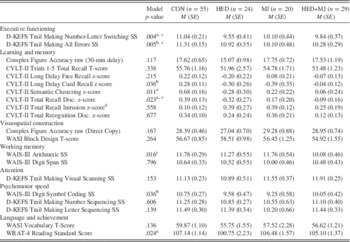
The following results summarize the differences in neuropsychological performance among CON, HED, MJ, and HED+MJ youth following 1 month of monitored abstinence (Table 2). There was a statistically significant difference in neuropsychological test performance based on a participant’s substance use history group classification (F(72,243)=1.93; p<.001; Wilks’ Λ=0.26, partial η squared=0.36). Descriptive information for the statistically significant findings is provided as the means and standard error estimates from the MANCOVA model, p-value from the Tukey’s HSD post hoc contrast, and 95% confidence interval for the model’s mean estimates.
Marginal means (SE) demonstrate differences in neuropsychological performance after one month of monitored abstinence in control (CON), heavy episodic drinking (HED), protracted marijuana using (MJ), both heavy episodic drinking and heavy marijuana using (HED+MJ) adolescents (ages 16–18)

Note. Statistically significant (p<.05) Tukey's HSD post hoc contrasts for aCON vs. HED, bCON vs MJ, and cCON vs HED+MJ.
d Item is reverse-scored, so higher scores indicate poorer performance.
SS= scaled score; Complex Figure= Rey-Osterrieth Complex Figure copy and 30-min delayed recall (Osterrieth,Reference Osterrieth1944); D-KEFS= Delis-Kaplan Executive Functioning System Trail Making Test (Delis et al., Reference Delis, Kaplan and Kramer2001); CVLT-II= California Verbal Learning Test - Second Edition (Delis et al., Reference Delis, Kramer, Kaplan and Ober2000); WASI= Wechsler Abbreviated Scale of Intelligence (Wechsler, Reference Wechsler1999); WAIS-III= Wechsler Adult Intelligence Scale-III (Wechsler, Reference Wechsler1997); WRAT-4= Wide Range Achievement Test-4 (Wilkinson & Robertson, Reference Wilkinson and Robertson2006).
Executive functioning
Statistically significant group differences were identified for D-KEFS Trail Making Number-Letter Switching (F(3,124)=5.09; p=.002), with both HED (M=9.55(SE=0.41); p=.006; 95% CI [8.70, 10.40]) and HED+MJ (M=9.84(SE=0.37); p=.024; 95% CI [9.09, 10.59]) performing 11–14% worse than CON (M=11.04(SE=0.21); 95% CI [10.62, 11.45]) teens. On D-KEFS Trail Making all errors (F(3,124)=4.62; p=.004), accuracy rates (i.e., fewer set loss and sequencing errors) were 10% higher in CON (M=11.31(SE=0.15); 95% CI [11.00, 11.61]) as compared to both MJ (M=10.10(SE=0.48); p=.015; 95% CI [9.09, 11.01]) and HED+MJ (M=10.28(SE=0.29); p=.020; 95% CI [9.68, 10.87]) youth.
Learning and memory
An overall group difference was identified on the semantic clustering Z-score (F(3,124)=3.85; p=.011) with HED (M=−0.28(SE=0.30); p=.011; 95% CI [−0.89, 0.34]) performing 0.96 standard deviations poorer than CON (M=0.68(SE=0.16); 95% CI [0.36, 1.00]) when recalling a verbal list. An overall group difference was also found for CVLT-II total recall discriminability Z-score (F(3,124)=3.28; p=.023), with HED (M=−0.32(SE=0.27); p=.024; 95% CI [−0.87, 0.23]) performing 0.71 standard deviations below CON (M=0.39(SE=0.13); 95% CI [0.13, 0.65]), and HED+MJ (M=−0.09(SE=0.16); p=.049, 95% CI [−0.42, 0.23]) performing 0.48 standard deviations below CON. An overall group difference was identified on the long delay cued recall Z-score (F(3,124)=2.95; p=.036) with MJ (M=−0.39(SE=0.35); p=.031, 95% CI [−1.13, 0.25]) performing 0.67 standard deviations poorer than CON (M=0.28(SE=0.11); 95% CI [0.05, 0.50]) when recalling a verbal list with category cues. No group effects were found for verbal word-list learning in Trials 1–5 on the CVLT-II task (F(3,124)=1.13; p=.338), long delay (20-min) free recall of the CVLT-II word list (F(3,124)=1.51; p=.215), CVLT-II total recognition discriminability (F(3,124)=0.51; p=.677), CVLT-II intrusion rate (F(3,124)=0.69; p=.558), or for accuracy on a 30-min delayed recall of the Rey-Osterrieth complex figure (F(3,124)=1.67; p=.177).
Visuospatial construction
No statistically significant group differences were found on the two visuospatial tasks: Rey-Osterrieth complex figure copy (F(3,124)=1.72; p=.167) and WASI Block Design T-score (F(3,124)=1.34; p=.264).
Working memory, attention, and psychomotor speed
A group difference was found on WAIS-III Arithmetic, a task that requires working memory, attention, and numerical reasoning while mentally solving math problems (F(3,124)=3.58; p=.016), with HED+MJ (M=10.08(SE=0.46); p=.012; 95% CI [9.14, 11.03]) performing 14% worse than CON teens (M=11.78(SE=0.29); 95% CI [11.21, 12.36]). An overall group difference was identified for WAIS-III Digit Symbol Coding (F(3,124)=2.94; p=.036), with MJ (M=9.25(SE=0.58); p=.027; 95% CI [8.03, 10.47]) performing 14% more slowly than CON youth (M=10.75(SE=0.27); 95% CI [10.20, 11.29]) on this visual-motor speed/coordination and visual working memory task. No statistically significant group difference was identified on the WAIS-III Digit Span task (F(3,124)=0.34; p=.796), the visual scanning condition of the D-KEFS Trail Making Test (F(3,124)=1.79; p=.153), or on the D-KEFS Trail Making Number (F(3,124)=0.62; p=.606) or Letter (F(3,124)=1.87; p=.139) Sequencing tasks.
Language and achievement
On the WRAT-4 Reading task, a group effect was found (F(3,104)=3.26; p=.024) with HED (M=100.75(SE=2.23); p=.018, 95% CI [96.13, 105.37]) performing 6% worse than CON teens (M=107.14(SE=1.14); 95% CI [104.83, 109.45]). No overall group effect was found for WASI Vocabulary (F(3,124)=1.88; p=.136).
Associations between Substance Use Characteristics and Neuropsychological Performance
We combined the three substance use groups (i.e., excluded controls) and found associations between cognitive performance and lifetime alcohol use episodes, number of recent alcohol withdrawal symptoms (i.e., sum of reported typical withdrawal symptoms including headaches, heart racing, shaking, anxiety, trouble sleeping, etc.) lifetime marijuana use episodes, and age of onset of regular marijuana use (i.e., greater than 1 time per week), as described below. No associations were found for days since use of alcohol or of marijuana.
Alcohol
We found that more lifetime alcohol use was associated with lower WAIS-III Arithmetic scores (rho=−.26; p=.004), and having more alcohol withdrawal symptoms was associated with lower performance on D-KEFS Trail Making Number-Letter Switching (rho=−.35; p=.001). In addition, having more alcohol withdrawal symptoms was related to a higher error rate on the D-KEFS Trail Making visual scanning task (rho=.31; p=.003). While statistically significant group differences were not found using MANCOVA for visuospatial construction or verbal learning, more alcohol withdrawal symptoms were associated with worse 2-dimensional visuospatial construction copying (rho=−.28; p=.042), worse performance on the 30-min delay of the same complex figure (rho=−.24; p=.012), and worse verbal learning on the CVLT-II task (rho=−.28; p=.014) among the combined groups of substance users.
Marijuana
More lifetime marijuana use was associated with having a higher false positive error rate on a verbal memory task (rho=.21; p=.028), and an earlier age of onset of regular marijuana use was associated with slower psychomotor speed on the D-KEFS Trail Making Motor Speed subtest (rho=.35; p=.018). While a statistically significant group difference was not found in reading achievement among MJ-using youth, worse performance on WRAT-4 Reading was associated with an earlier age of onset of regular marijuana use (rho=.27; p=.042).
DISCUSSION
We examined neuropsychological differences following 1 month of monitored abstinence among adolescents with limited substance use history compared to those who predominantly use alcohol, marijuana, or both substances. This study features the design strengths of matching groups on premorbid academic functioning, lifetime and recent substance use characteristics, and recency of use at time of testing. While the performances for each group were predominantly in the average range and no group means suggested clinical impairment, subtle differences were evident between groups, with substance-using groups scoring lower than non-using controls in multiple domains. Importantly, these differences were observed after 1 month of abstinence, on average, which is sufficient time for acute withdrawal symptoms to abate and for THC to be eliminated from the body. Our results suggest that use of alcohol and/or marijuana produces unique and shared cognitive differences in teens that seem to emerge in youth before the onset of clinical dependence and in the midst of ongoing brain development. It remains to be determined if these differences might resolve with abstention periods longer than 1 month.
Alcohol Findings
Teens with histories of heavy drinking showed poorer cognitive flexibility, recall and semantic organization of verbal information, and reading achievement relative to non-using controls. Worse performance among HED youth on the D-KEFS Trail Making Number-Letter Switching task suggests poorer cognitive flexibility (e.g., ability to rapidly switch between categories). Importantly, greater alcohol withdrawal frequency among HED youth was associated with their diminished performance on this cognitive flexibility task. HED youth showed worse recall discriminability scores, suggesting poorer recall of target words relative to intrusion rate, and they also showed poorer organization of verbal information into semantic categories when learning a word list. Importantly, these differences in cognitive flexibility and verbal recall were also seen in teens who used both alcohol and marijuana, but not in those who predominantly used marijuana. This overlap suggests that heavy alcohol use may be linked to these executive and verbal weaknesses; furthermore, this finding is consistent with prior research (Brown et al., Reference Brown, Tapert, Granholm and Delis2000; Hanson et al., Reference Hanson, Medina, Padula, Tapert and Brown2011). Differences in executive functioning appear consistently among heavy drinking youth and may be related to more volume reduction and white matter abnormalities in prefrontal brain areas (DeBellis et al., Reference Brown, Anderson, Schulte, Sintov and Frissell2005; McQueeny et al., Reference McQueeny, Schweinsburg, Schweinsburg, Jacobus, Bava and Frank2009; Medina et al., Reference Medina, McQueeny, Nagel, Hanson, Schweinsburg and Tapert2008).
Alcohol dependent adolescents have frequently demonstrated significantly lower verbal IQ and reading achievement scores (Brown et al., Reference Brown, Tapert, Granholm and Delis2000; Giancola et al., Reference Giancola, Shoal and Mezzich2001; Moss et al., Reference Moss, Kirisci, Gordon and Tarter1994). Our finding of poorer reading scores in nonclinical, heavy drinking youth is consistent with such prior research. Given that the drinkers and nondrinkers had comparable math and language scores in 5th grade, it is possible that the poorer reading skills observed in adolescence may be at least partially due to associated environmental, brain, or behavior changes occurring after the onset of heavy drinking. And while a statistically significant group difference did not emerge for visual scanning among drinking youth in this sample, greater alcohol withdrawal symptoms were associated with increased error rate on a visual scanning task.
Discordant with prior research on teens with alcohol use disorders (Hanson et al., Reference Hanson, Medina, Padula, Tapert and Brown2011; Squeglia et al., Reference Squeglia, Spadoni, Infante, Myers and Tapert2009), our findings on a nonclinical sample of heavy episodic drinkers did not suggest weaknesses in visuospatial construction, visuospatial recall, or verbal learning. While statistically significant group findings did not emerge in these areas, importantly, associations were observed between worse performance and increased alcohol withdrawal symptoms. It is, therefore, possible that the level of withdrawal experience from alcohol use is not yet severe enough to detect group differences. Longer lasting and heavier drinking patterns among adolescents have been linked to disruptions in the hippocampus, a brain structure critical for learning and memory, with adolescent heavy drinkers showing smaller hippocampal volumes and disturbed hippocampal white matter integrity (De Bellis et al., Reference De Bellis, Clark, Beers, Soloff, Boring, Hall and Keshavan2000; Medina et al., 2007; Nagel, Schweinsburg, Phan, & Tapert, Reference Nagel, Schweinsburg, Phan and Tapert2005). Our study involved youth earlier in their drinking careers, suggesting that cognitive decrements in visuospatial recall and verbal learning could emerge after continued involvement in heavy drinking.
Marijuana Findings
Youth with heavy marijuana use showed a different pattern of neuropsychological outcomes than those evident among heavy drinking teens. Consistent with prior research (Hanson et al., Reference Hanson, Winward, Schweinsburg, Medina, Brown and Tapert2010; Medina et al., 2007; Millsaps et al., Reference Millsaps, Azrin and Mittenberg1994; Schwartz et al., Reference Schwartz, Gruenewald, Klitzner and Fedio1989), marijuana users evidenced poorer task accuracy, verbal memory, and psychomotor speed than non-using teens. Specifically, MJ-using youth demonstrated more errors on the D-KEFS Trail Making Task, and this group difference in inhibition task accuracy was also seen in those using both alcohol and marijuana. Although their verbal learning and delayed free recall were similar to those of other groups, MJ-using teens showed worse performance when recalling a verbal word list with cues following a 20-min delay. Their lower verbal memory was associated with more lifetime and recent marijuana use. MJ-using teens also demonstrated slower performance on a digit symbol copying task that requires visual-motor coordination, short-term memory, and visual working memory. Furthermore, slower digit symbol performance was correlated with an earlier age of onset of regular marijuana use. These findings among both marijuana users and concomitant users might suggest that marijuana use disrupts brain mechanisms that maintain focus and enable one both to process efficiently and to follow instructions on tasks that challenge executive systems. Prior observations in marijuana-using teens of abnormal cerebellar volumes and disrupted white matter integrity in both frontal and hippocampal regions may partly explain these differences in sustained attention, psychomotor speed, and verbal memory among marijuana-using youth (Ashtari et al., Reference Ashtari, Avants, Cyckowski, Cervellione, Roofeh, Cook and Kumra2011; Churchwell, Lopez-Larson, & Yurgelun-Todd, Reference Churchwell, Lopez-Larson and Yurgelun-Todd2010; Cousijn et al., Reference Cousijn, Wiers, Ridderinkhof, van den Brink, Veltman and Goudrian2012; Medina et al., Reference Medina, Nagel and Tapert2010; Yucel et al., Reference Yucel, Zalesky, Takagi, Bora, Fornito, Ditchfield and Lubman2010).
Concomitant Use of Alcohol and Marijuana Findings
As mentioned previously, the youth who heavily used both alcohol and marijuana showed overlap with alcohol users in terms of poorer cognitive flexibility and verbal recall, and they showed overlap with marijuana users on poorer task accuracy relative to non-using teens. In addition to showing overlap with the alcohol-using and marijuana-using groups, the concomitant users showed impairment on an arithmetic task that challenges working memory, attention, and mathematical abilities by asking youth to mentally solve math problems. It is possible that concomitant use of alcohol and marijuana has a unique influence on working memory abilities, which are thought to be modulated by the dorsolateral prefrontal cortex (Barbey, Koenigs, & Grafman, Reference Barbey, Koenigs and Grafman2013; Crews et al., Reference Crews, Braun, Hoplight, Switzer and Knapp2000). Importantly, greater lifetime exposure to alcohol was associated with worse performance on the mental arithmetic task in concomitant alcohol and marijuana users, so in line with prior research, use of cannabinoids may enhance sensitivity to the cumulative effects of alcohol exposure (Hansen et al., Reference Hansen, Krutz, Sifringer, Stefovska, Bittigau, Pragst and Ikonomidou2008).
CONCLUSIONS
This study featured many design strengths but has several limitations. While the study used carefully designed and selected groups to establish a relationship between heavy episodic drinking, marijuana use, concomitant alcohol and marijuana use, and neurocognitive differences among adolescents, the samples were modest in size; therefore, findings should be interpreted with care and replicated with larger samples. Additionally, the study design did not include a baseline cognitive assessment (before abstinence onset), which prevented exploration of any possible recovery of cognitive functioning during the first month of abstinence. Specifically, we were unable to examine differential rates of recovery or baseline functioning between heavy drinkers and heavy marijuana users. While we made substantial effort to ensure similarity of groups on their premorbid academic functioning, there is a strong need for studies to use prospective designs to collect data on participants in their late childhood or early adolescence, before their initiation of substance use. Such longitudinal investigations can better determine directionality and causality between adolescent substance use and neurocognitive functioning. Also of note, statistically significant group differences did not emerge for gender, yet the group of teens who predominantly used marijuana was mostly male (3 females, 17 males). While running the analyses with gender as a covariate did not have a statistically significant impact on findings, follow-up studies could prioritize acquiring a more gender-balanced sample for marijuana users, though most existing studies on marijuana-using teens are predominantly male (Hanson et al., Reference Hanson, Winward, Schweinsburg, Medina, Brown and Tapert2010; Harvey, Sellman, Porter, & Frampton, Reference Harvey, Sellman, Porter and Frampton2007; Medina et al., 2007). Future studies should also consider including validity measures to ensure adequate effort among groups on the neuropsychological battery.
In summary, consistent with previous studies and our hypotheses, 16- to 18-year-old alcohol- and marijuana-using adolescents who drink alcohol heavily one to two times per week or smoke marijuana four to five times per week, on average, exhibited poorer neurocognitive functioning even following 1 month of sustained abstinence. Though requiring replication, the current and previous findings suggest a possible 10–14% or 0.5–0.75 standard deviation reduction in neuropsychological functioning among adolescents with recent histories of heavy episodic drinking and marijuana use relative to their non-using peers. While average performance for the substance-using groups was not in the “impaired” range for the tasks, a relative weakness in cognitive flexibility, verbal recall and semantic organization, and reading skills may be related to heavy alcohol use during adolescence, whereas poorer task accuracy, verbal memory, and psychomotor speed may be associated with protracted marijuana use. Furthermore, working memory may be uniquely impacted by concomitant use of marijuana and alcohol. Poorer performance was correlated most strongly with greater number of heavy episodic drinking episodes, greater number of marijuana use episodes, greater number of alcohol withdrawal symptoms, and younger age of onset of marijuana use. The presence of differences even after the substances are no longer present suggests a possible, more chronic alcohol- and marijuana-induced impact to underlying brain systems including the prefrontal cortex, hippocampus, and cerebellum, particularly given that groups were comparable on academic test performance before onset of substance use. This possibility coincides with evidence in the animal literature that adolescence is a time of enhanced sensitivity to the neurotoxic effects of alcohol and marijuana.
This study has the potential to contribute to improved methods for measuring changes on important neurocognitive domains associated with heavy use of alcohol and marijuana during adolescence. Our findings underscore the importance of methodological components of adolescent substance use research by using strict group eligibility criteria, ensuring similar premorbid functioning before the onset of substance use, controlling key risk factors, and using strict abstinence protocols. Possible decrements in executive functioning and language among heavy drinkers; in task accuracy, verbal memory, and psychomotor speed in heavy marijuana users; and in executive functioning, task accuracy, verbal memory, and working memory in concomitant users may have a significant impact on adolescents' daily experiences in academic, occupational, or personal settings (Anderson, Ramo, Cummins, & Brown, Reference Anderson, Ramo, Cummins and Brown2010). Given the currently high rates of alcohol, marijuana, and concurrent use, it is important that potential users and their parents and educators better understand the unique influence of each drug and the additive impact of concomitant use to a developing brain.
ACKNOWLEDGMENTS
This study was supported by the following NIAAA and NIDA awards: R21 AA017321 (PI: S. Brown), 5R01 DA021182 (PI: S. Tapert); 5R01 DA021905-04 (PI: S. Brown). This project was supported in part by the VA Center of Excellence for Stress and Mental Health, San Diego (K. Hanson). The authors have no conflicts of interest to report. The authors thank Chase Wagner, Rachel Carter, Sidney Bennett, Michael Zamost, Anthony Scarlett, Rachel Thayer, M.J. Meloy, and the undergraduate lab volunteers for their assistance with data collection. We also sincerely thank the participants and their families for their time and efforts.