A. MONUMENTAL
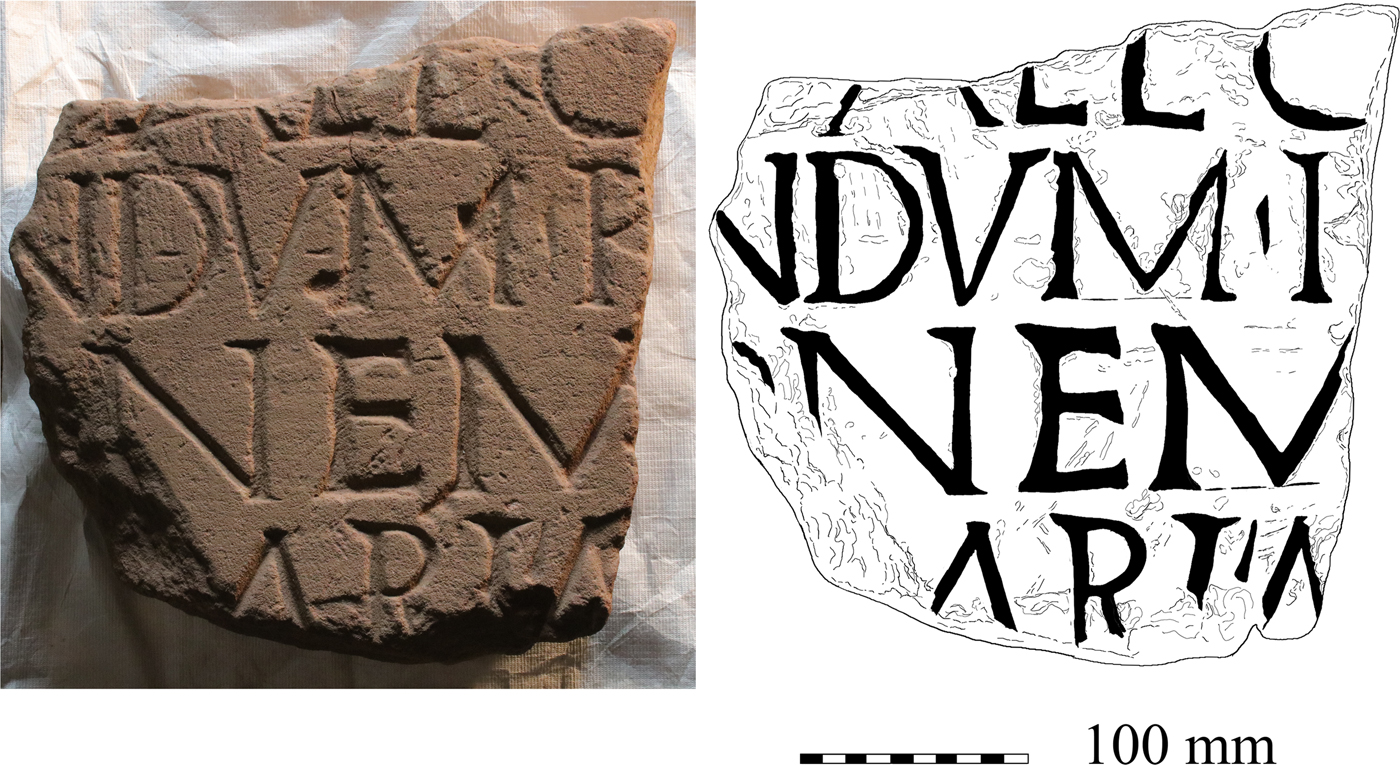
1. Ravenglass (Itunocelum, SD 087 957), Roman fort, Muncaster, Cumbria (fig. 1). Fragment of a red sandstone slab, 0.293 by 0.285 m, ranging from 0.08 to 0.09 m thick, foundFootnote 2 in 2017. The thickness is original, but all the edges are broken. Inscribed: […] | […]ẠẸL C̣[…] | […]NDVM Δ I[…] | […]ỌNEM[…] | […]ẠRỊ Δ Ạ[…], [dis deabusque] | [coh(ors) I] Ael(ia) C [lassica] [secu] ndum i [nterpre|tati] onem [oraculi | Cl] ari A[ pollinis] | […].Footnote 3 ‘To the gods and goddesses, the First Aelian Cohort Classica (set this up) according to the interpretation of the oracle of Clarian Apollo.’Footnote 4
Ravenglass, inscribed stone fragment (No. 1). (Photo and drawing: R.S.O. Tomlin)

B. INSTRUMENTUM DOMESTICUM
BEDFORDSHIRE
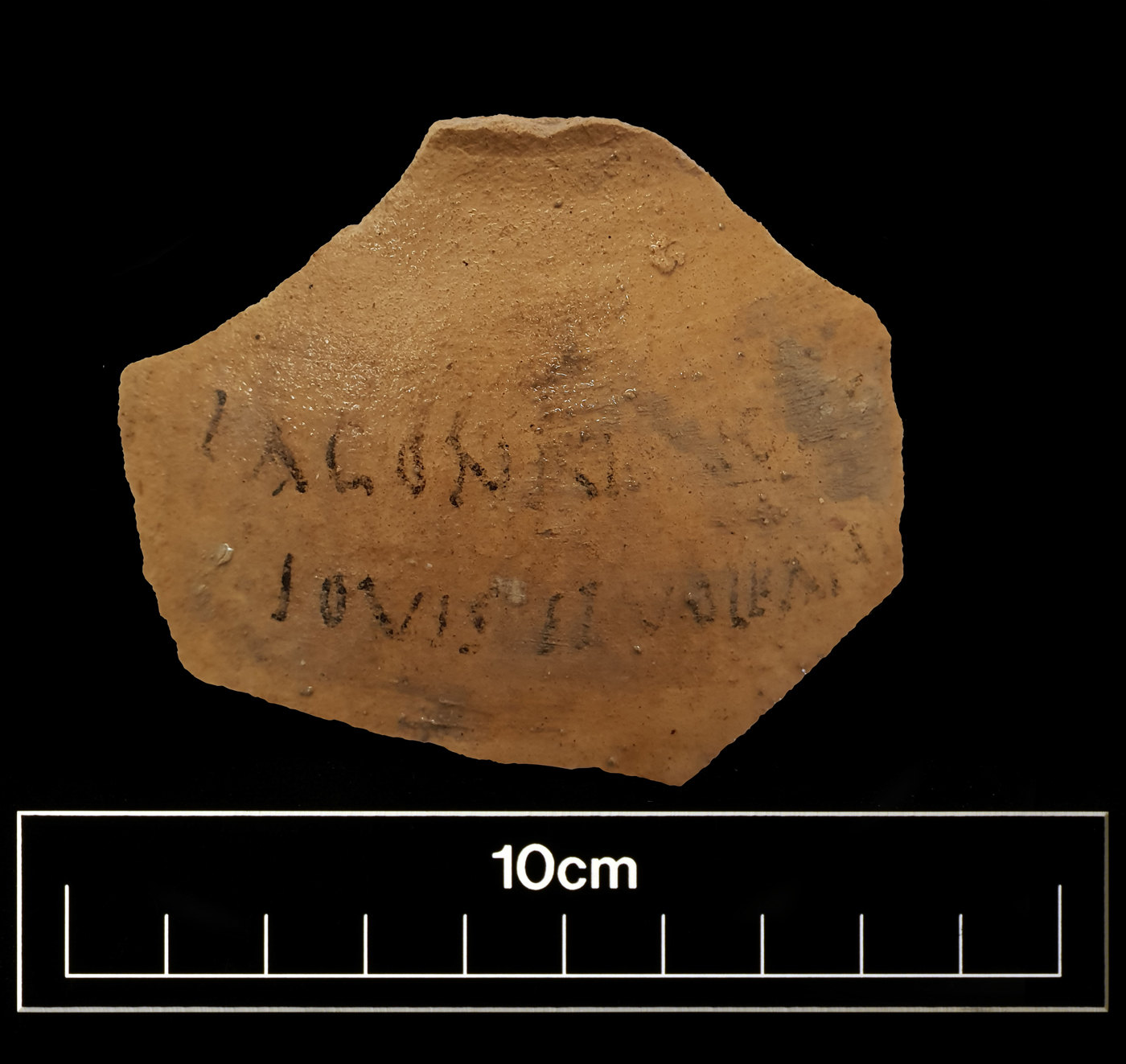
2. North of Houghton Regis (TL 0160 2543) (fig. 2). Wall sherd of a creamy-buff flagon (Bedfordshire Fabric R03, second/third-century) foundFootnote 5 in 2018 with other second/third-century pottery in the fill of a pit. In capital letters neatly written with a pen in black ink: LAGONẠẸ [.]ẸỌ[.]Ṿ[…] | IOVIS ET VOLKANI, lagonae [d] eo [r] u [m] | Iovis et Volkani. ‘For a flagon of the gods Jupiter and Vulcan.’Footnote 6
Houghton Regis, ink text (No. 2). (Photo: Albion Archaeology)

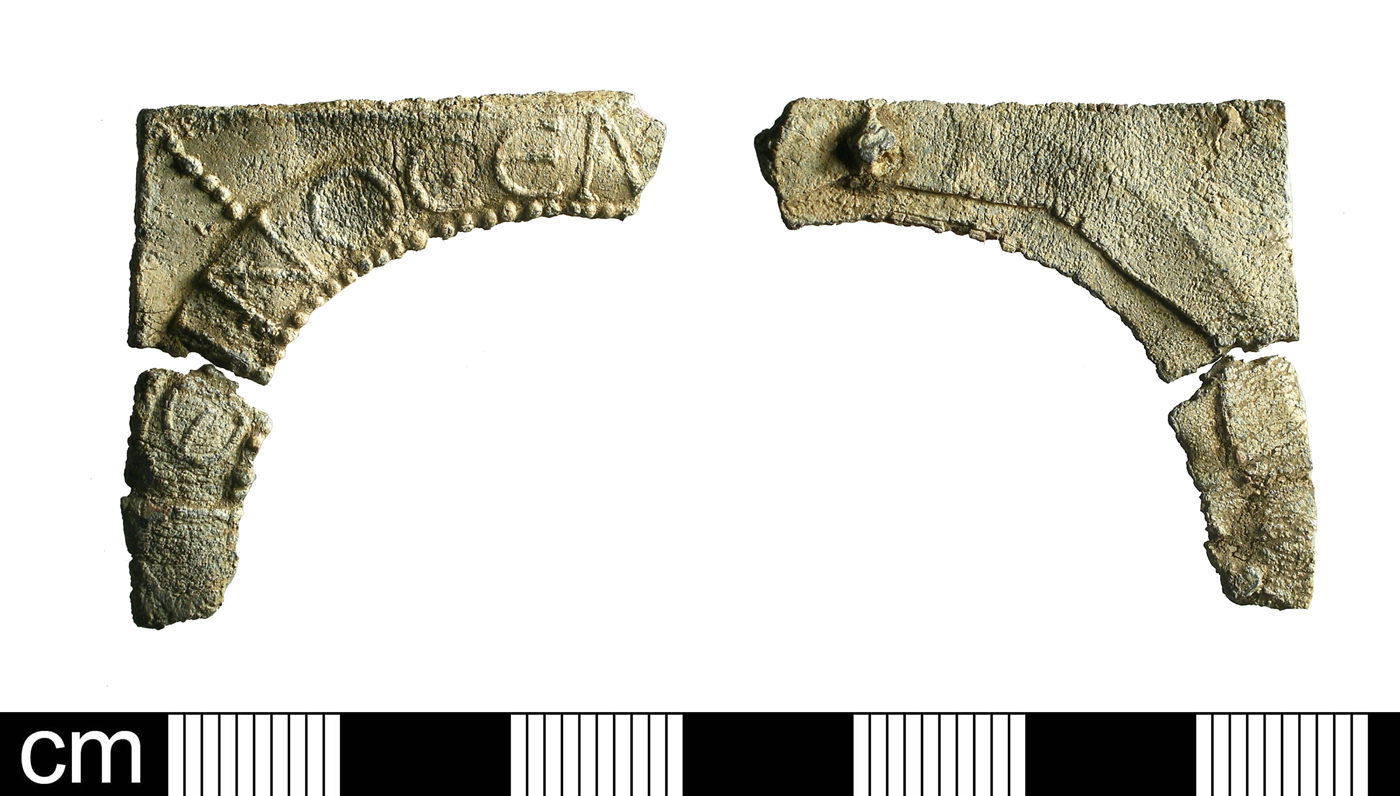
3. ‘North Bedfordshire’ near Irchester Roman town (SP 92 67) (fig. 3). Two pairs of lead-alloy fragments, 31.5 by 32.6 mm, 2.1 mm thick, each pair forming about one quarter of a small mirror-frame; foundFootnote 7 in 2011. Moulded in low relief along the curve of the beaded inner border, in Greek capitals c. 5–6 mm high: […]Υ̣Τ̣ΕΙΝΟϹ o ΕΝ[…], [Κύ(ιντοϲ) Λικ(ίνιοϲ) Το]υτεινοϲ ἐν [Ἀρελάτω(ι) πο(ι)εῖ]. ‘Quintus Licinius Tutinus makes (this) in Arles.’Footnote 8
Near Irchester, lead mirror-frame (No. 3). (Photo: PAS)

BERKSHIRE
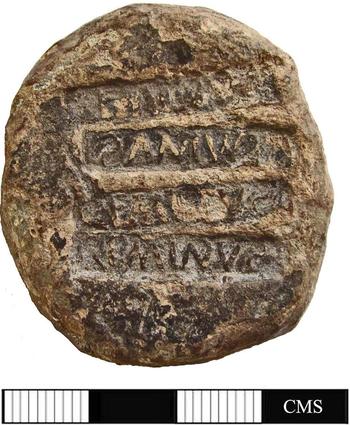
4. Kintbury (SU 38 67) (fig. 4). Sub-circular lead-alloy weight, 35 by 38 mm, 16 mm thick, weight 148.6 gm, recordedFootnote 9 in 2010. Stamped four times with a rectangular die: GEMINVƧ | GEMINVƧ (inverted) | GEMINVƧ | GEMINVƧ. ‘Geminus’ (four times).Footnote 10
Kintbury, lead weight (No. 4). (Photo: PAS)

CAMBRIDGESHIRE
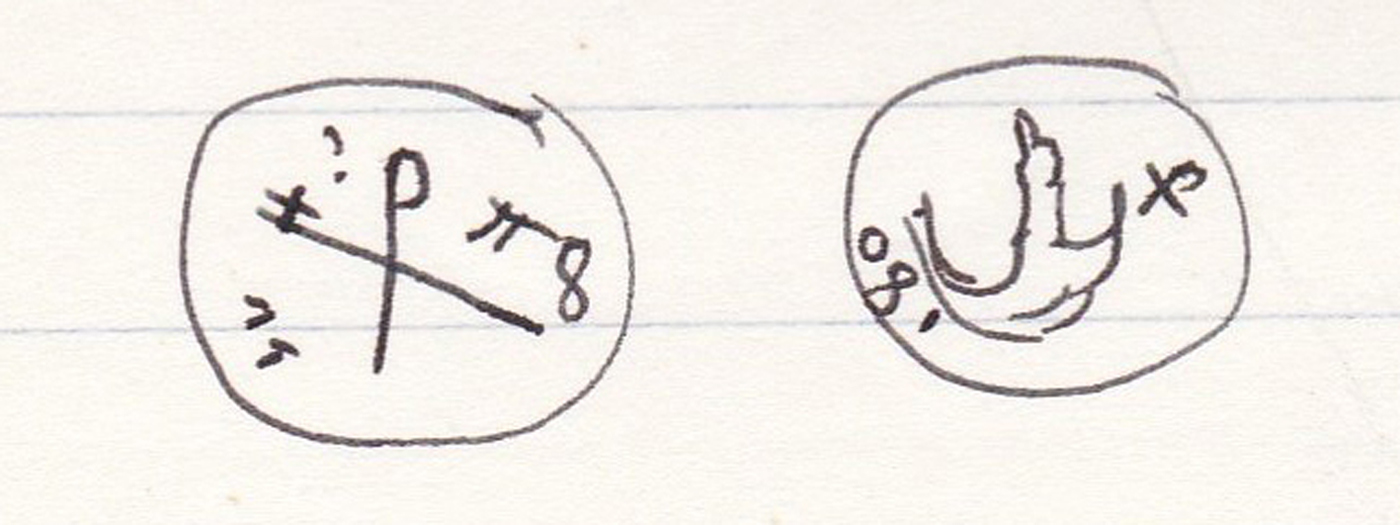
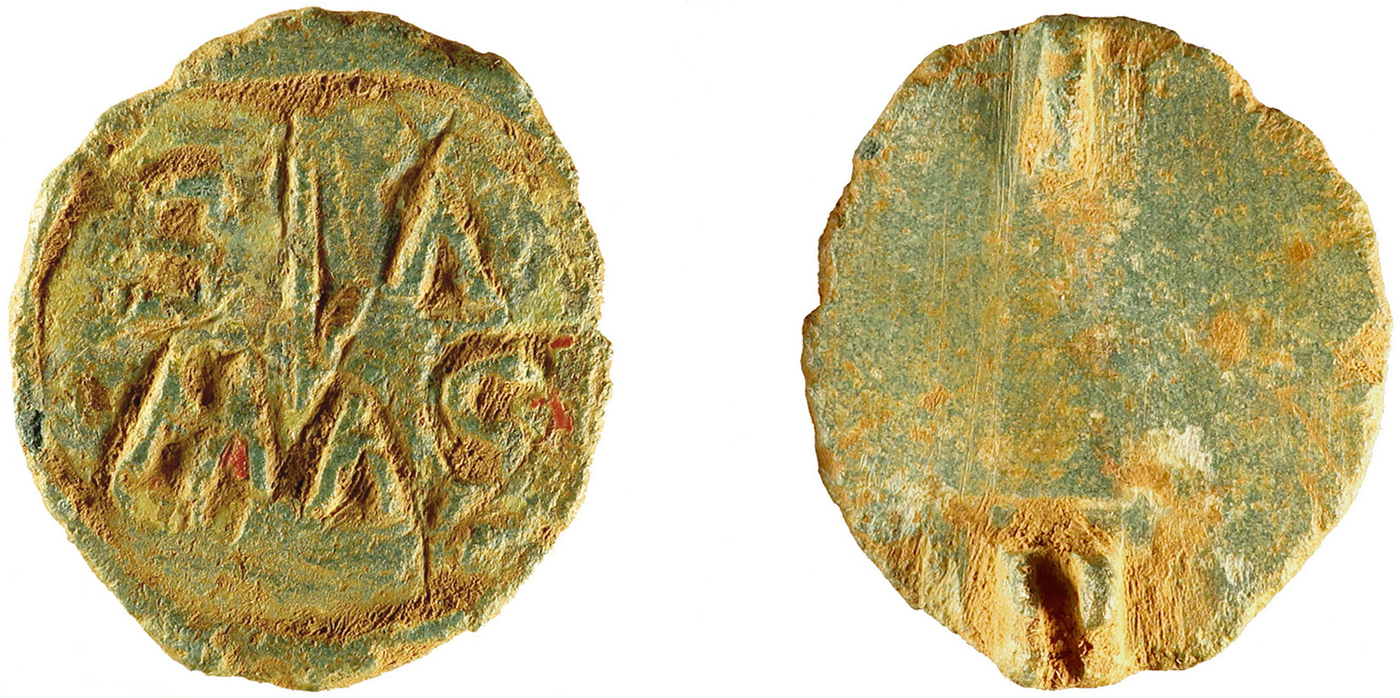
5. Marholm (TF 150 026), just north of the Castor praetorium (fig. 5). Lead sealing foundFootnote 11 in 1975. Obverse: Chi-Rho and lettering. Reverse: eagle.Footnote 12
Marholm, sketch of lead sealing (No. 5). (Photo by courtesy of G. Dannell)

CO. DURHAM
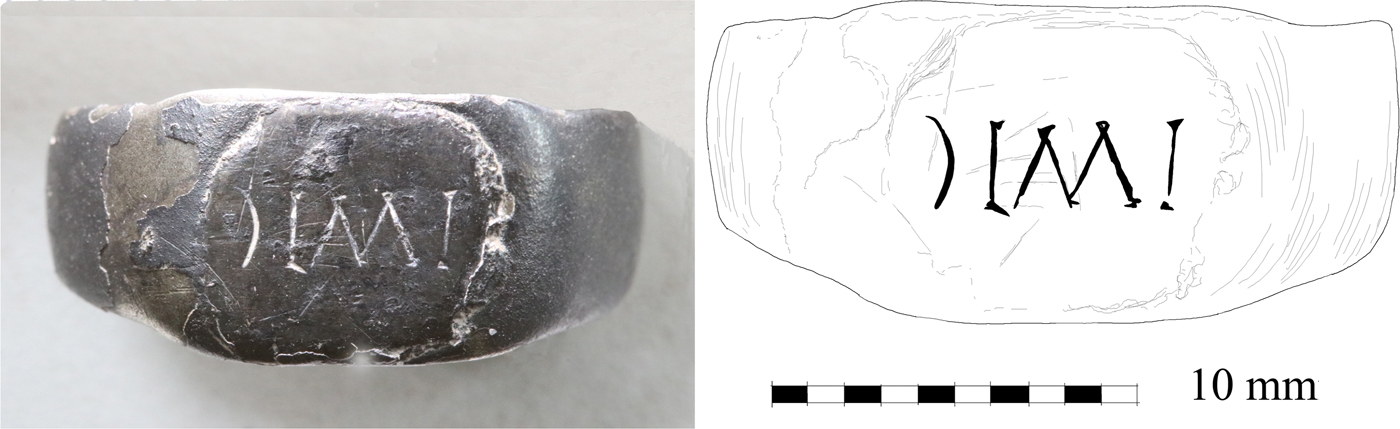
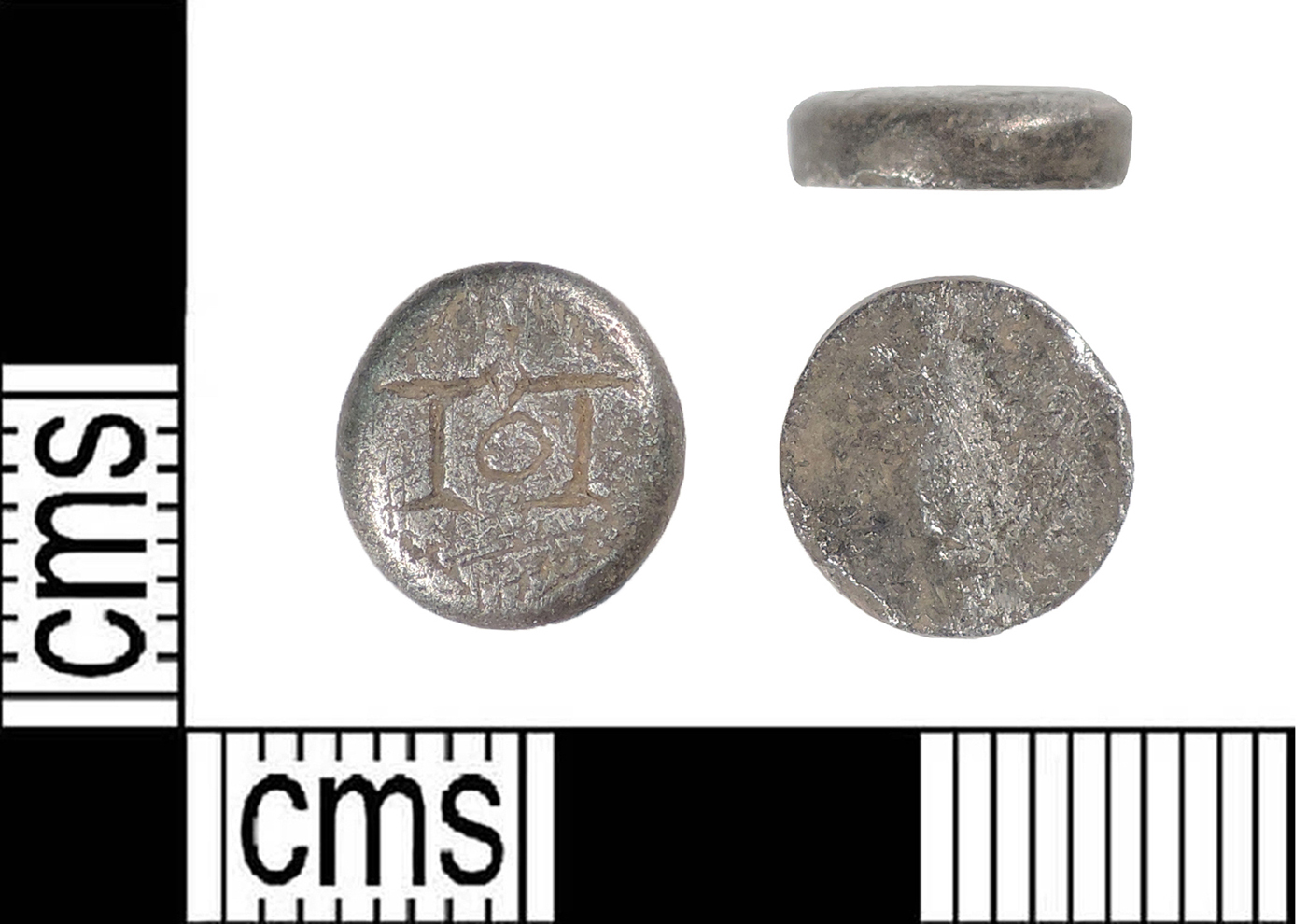
6. Piercebridge (NZ 214 156) (fig. 6). Silver-plated finger-ring (Henig type V, probably late second-century), only 20 mm in diameter, foundFootnote 13 in the river Tees at the site of the Roman bridge. Neatly incised rectograde within the oval bezel: ϽLMI, (centuria) L(uci) M(…) I(…). ‘The century of Lucius M(…) I(…).’Footnote 14
Piercebridge, silver ring (No. 6). (Photo and drawing: R.S.O. Tomlin)

GLOUCESTERSHIRE
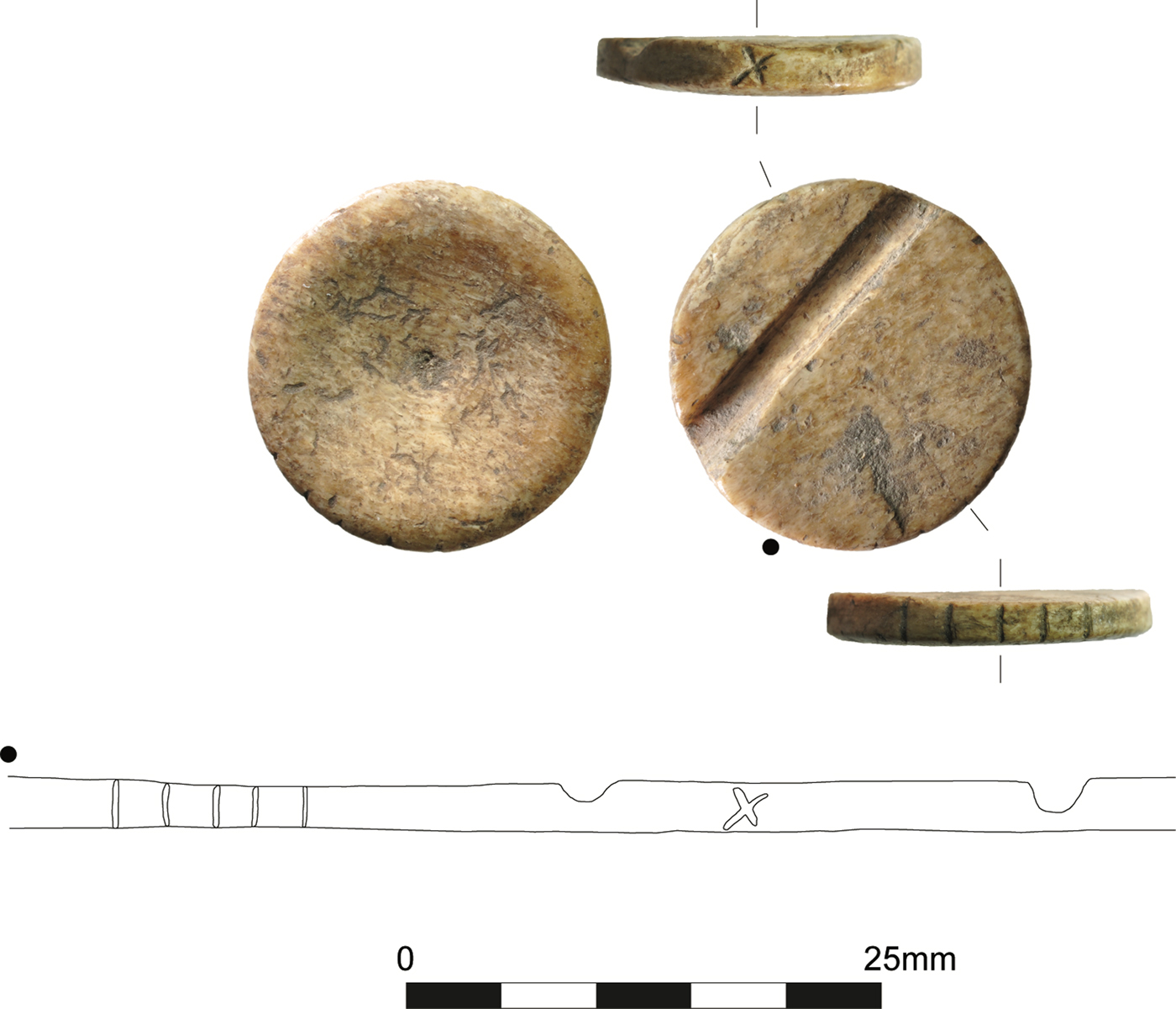
7. Cirencester (Corinium, SP 02616 01426), Paternoster School (fig. 7). Bone roundel foundFootnote 15 in 1994. Two numerals have been notched into the rim: X and IIIII, ‘10’ and ‘5’.Footnote 16
Cirencester, bone roundel (No. 7). (Photo: Paul Nichols; drawing: GCCAS)

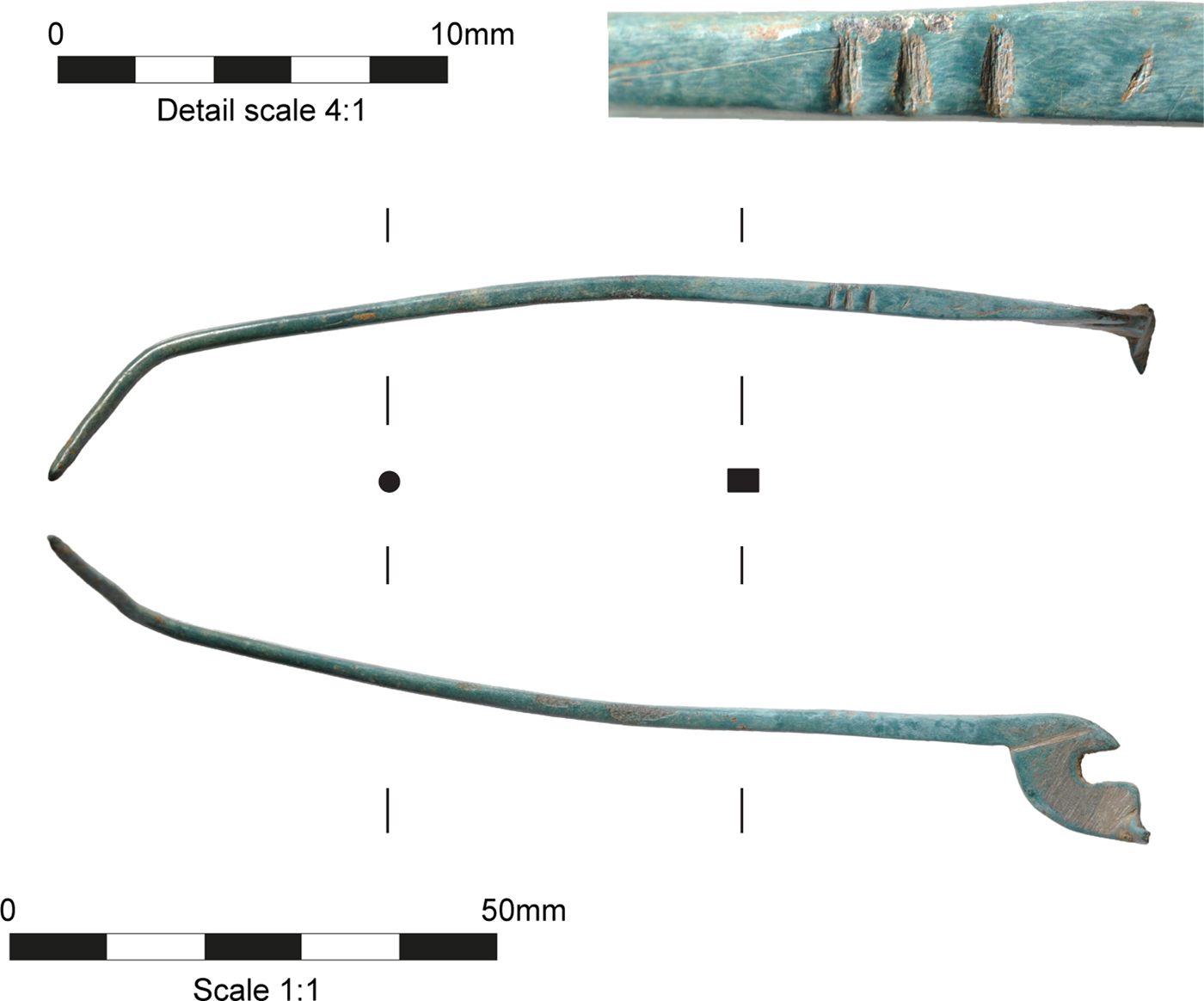
8. Lansdown, Bourton-on-the-Water (SP 1620 2210) (fig. 8). Handle of a fourth-century silvered copper-alloy spoon, foundFootnote 17 unstratified in 1993. Incised with a small oval point and three transverse lines: o III, ‘3’.Footnote 18
Lansdown, copper-alloy spoon handle (No. 8). (Photo: Paul Nichols)

HAMPSHIRE
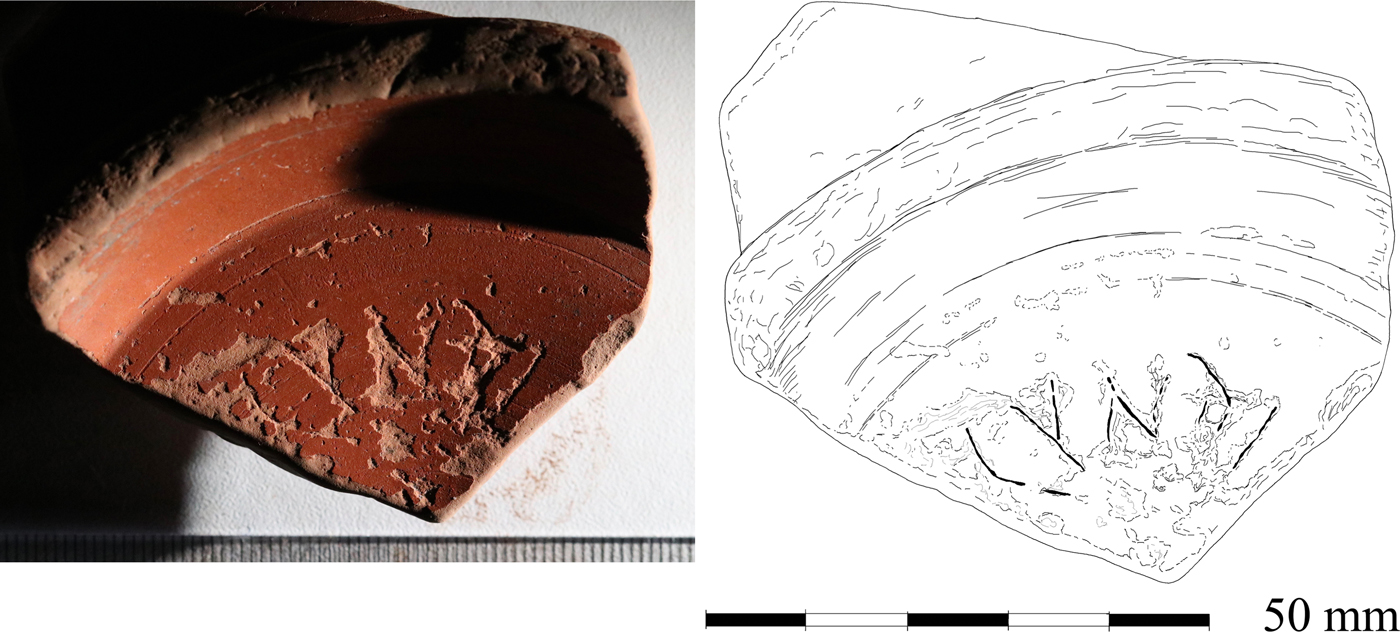
9. Silchester (Calleva Atrebatum, SU 64 42), Insula IX (fig. 9). Two conjoining base sherds of a samian cup (Drag. 24/25) stamped EXOṚ[…] (Exoremus of Lezoux, c. a.d. 35–70), foundFootnote 19 in 2013. Crudely incised after firing underneath, within the foot-ring: C̣ | OC, probably C|oc(…) Footnote 20
Silchester, samian graffito (No. 9). (Drawn by R.S.O. Tomlin)

10. Ibid. (fig. 10). Base sherd of a samian platter (Drag. 18/31, Lezoux, Hadrianic/Antonine), found in 2014. Coarsely incised after firing underneath, within the (now missing) foot-ring, a series of at least five irregular letters, subsequently deleted: .ẠVỊ.Footnote 21
Silchester, samian graffito (No. 10). (Drawn by R.S.O. Tomlin)

11. Ibid. (fig. 11). Two conjoining sherds from the rim of an Alice Holt storage jar, found in 2011. Incised after firing on the wall, below the rim: +IIII, ‘4’.Footnote 22
Silchester, coarseware graffito (No. 11). (Drawn by R.S.O. Tomlin)

KENT
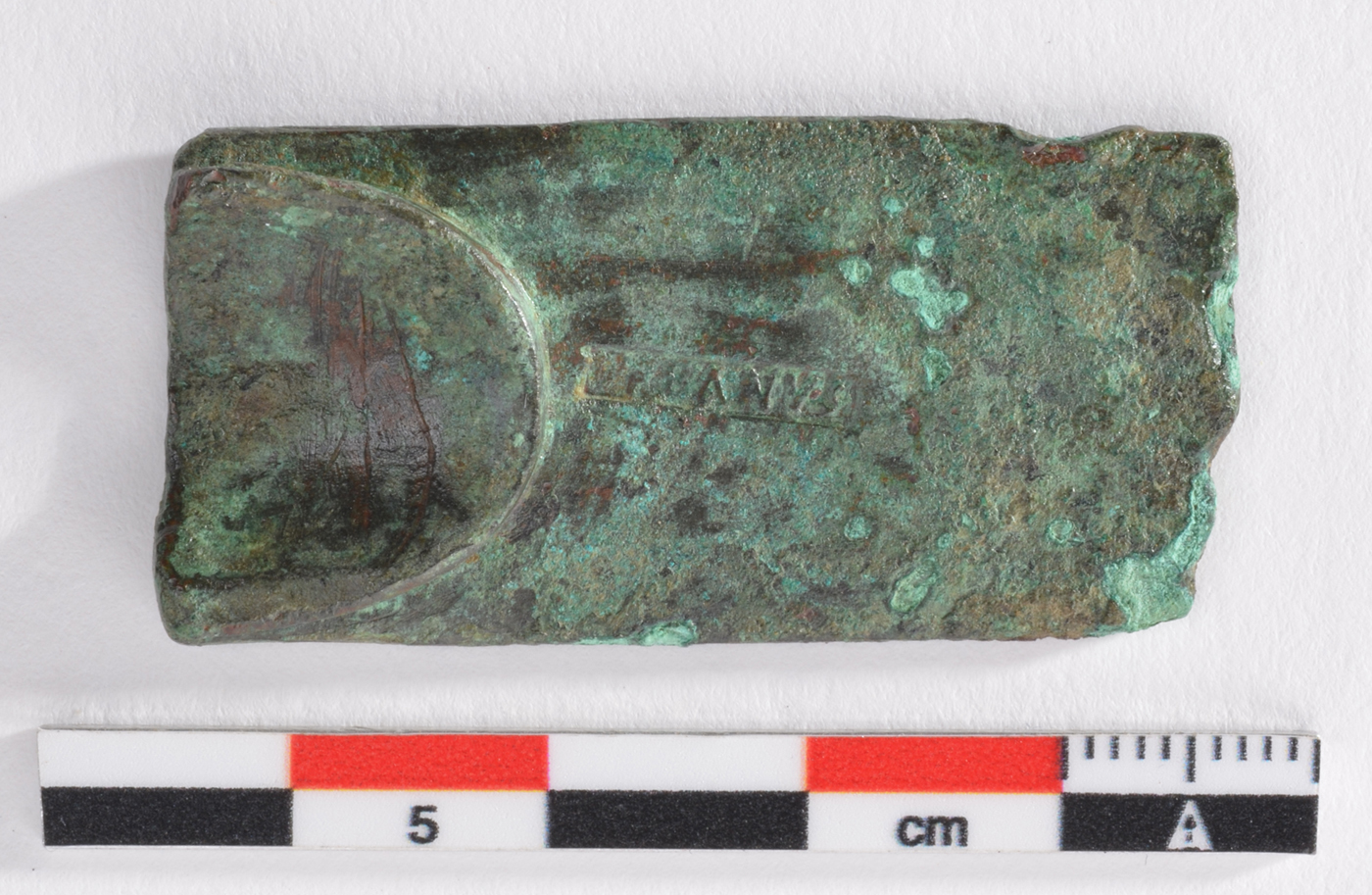
12. Richborough (Rutupiae, TR 32174 59964) (fig. 12). Copper-alloy cast decorative fragment, 42 by 21 mm, 5 mm thick, foundFootnote 23 between 1922 and 1938. The back is plain. On the face an impressed rectangular stamp reads: VṚBANVS, Urbanus
Richborough, stamped copper-alloy fragment (No. 12). (Photo: English Heritage)

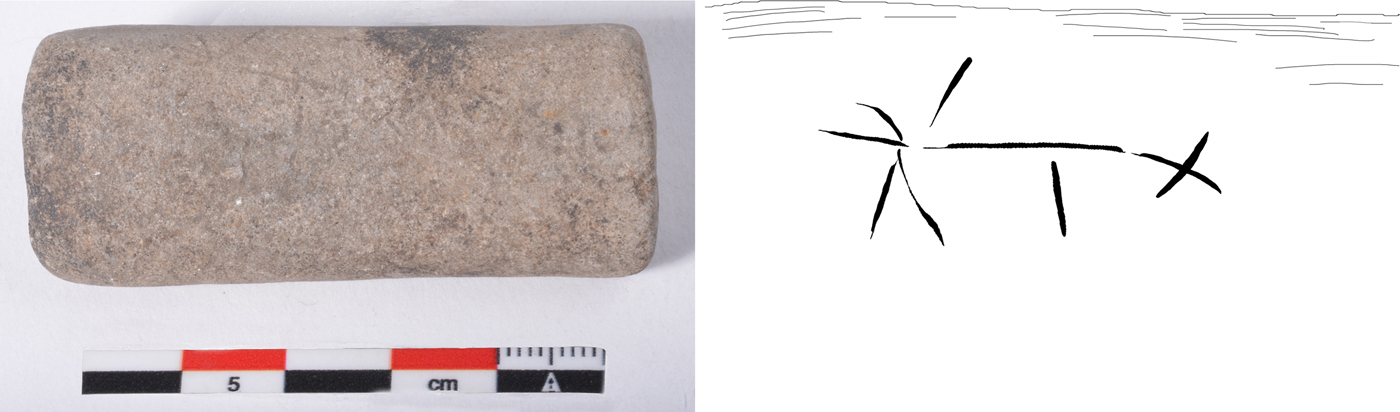
13. Ibid. (fig. 13). Whetstone of schist, 67 by 20 mm, 20 mm thick, foundFootnote 24 in 1937. Faintly incised along one edge: ✶IX, probably ‘9’.Footnote 25
Richborough, whetstone (No. 13). (Photo: Chaz Bedford and English Heritage; detail drawn from photos: R.S.O. Tomlin)

14. East Farleigh (TQ 7242 5358). Base sherd of a coarseware pot found in 2010. Inscribed before firing underneath in cursive letters: ạṣ mea me docuit cuṇc̣tiṣ | [?bene] ḍiceŗẹ semper | [ ]c̣ḷaue dicere de | [ ]us. ‘My training has taught me always to speak [?politely] to everyone; … to say “greetings” …’Footnote 26
LEICESTERSHIRE
15. Narborough (SP 54 97). Copper-alloy finger-ring foundFootnote 27 in 2007. Engraved on the bezel: ‘XP’, Chi-Rho.
LINCOLNSHIRE
16. Sleaford area (TF 06 38). Silver finger-ring (Henig type VIII), external diameter of hoop 25 mm, with an integral raised circular bezel 10 mm in diameter, weight 7.14 gm; foundFootnote 28 in 2018. The bezel is inscribed: TOTFootnote 29
17. High Toynton (TF 28 69). Silver finger-ring (Henig type VIII), 26 mm in length, 9 mm wide, 11 mm thick, weight 2.22 gm; foundFootnote 30 in 2018. The flat oval bezel is crudely inscribed: TOTFootnote 31
18. Sleaford area (TF 06 38). Fragment of a silver finger-ring (Henig type VIII) reduced to its shoulders and the slightly raised circular bezel, worn and damaged; foundFootnote 32 in 2018. The bezel is inscribed: ToTFootnote 33
19. Branston and Mere (TF 00 65) (fig. 14). Circular silver bezel, 11 mm in diameter, 4 mm thick, weight 1.98 gm, detached from a finger-ring; foundFootnote 34 in 2018. Incised: ToTFootnote 35
Branston and Mere, silver ring-bezel (No. 19). (Photo: PAS)

LONDON
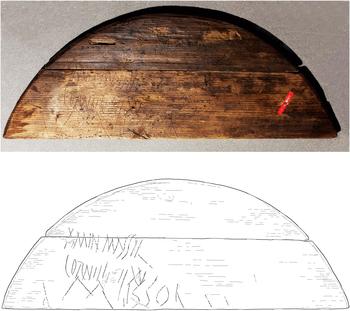
20. City of London (L ondinium, TQ 32549 81002), Bloomberg London (fig. 15). Two conjoining planks, 0.78 by 0.29 m overall, 33 mm thick but chamfered at the edges, forming almost one-third of a barrel-head; foundFootnote 36 in 2010–14. Two graffiti have been scored into the outer face. (a) AMIN MASSIL | CORNILII [.]II XV (b) Ạ MIISSOṚỊỊ, (a) Amin(eum) Massil(iense) | Corn(e)lii [C] II XV (b) a Messore. ‘Aminean (wine) of Massilia. (Product) of Cornelius. 102 (modii), 15 (sextarii) [899.26 litres]’. ‘By Messor.’Footnote 37
City of London, barrel-head (No. 20). (Photo: MoLA; drawn by R.S.O. Tomlin)

21. Ibid. (Londinium, TQ 32724 81534), 56–62 Moorgate and 41–42 London Wall (fig. 16). Sherd from the shoulder of a South Spanish oil amphora (Dressel 20, sf 258), foundFootnote 38 in 2018. A rectangular panel of white slip, poorly preserved, carries traces of one line of letters inscribed in black ink or pigment, too abraded to be read with certainty: ṂẸṂ4–5Ṿ.[…], probably Mem[mior] u [m M(arci) et M(arci)]. ‘(Product) of the Memmii, Marcus and Marcus.’Footnote 39
London, amphora dipinto (No. 21). (Photo: R.S.O. Tomlin)

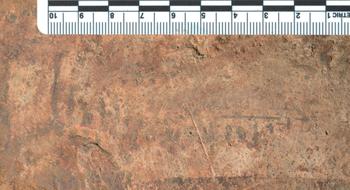
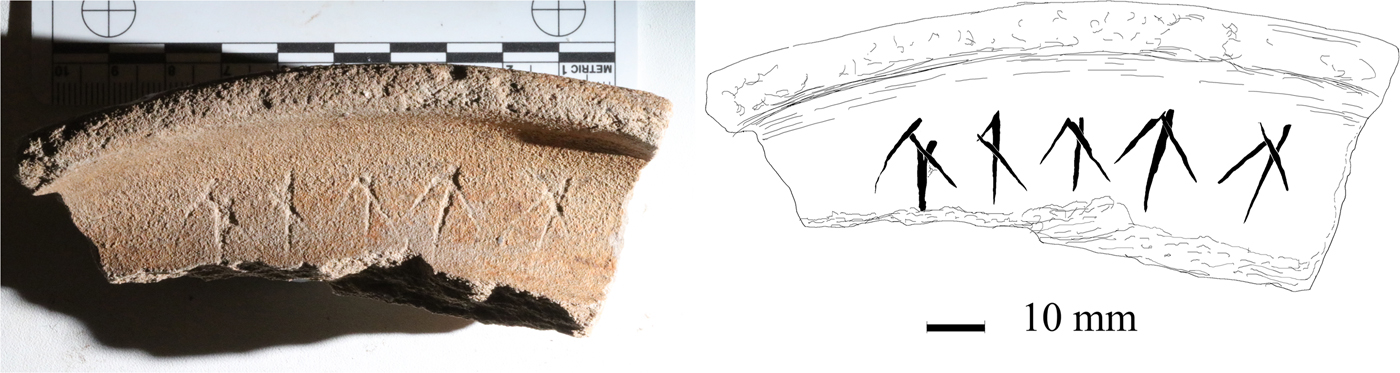
22. Ibid. (fig. 17). Rim sherd of a mortarium (Verulamium/London region white ware, sf 250), scored after firing on the underside of the lip with five ‘arrow-heads’.Footnote 40 They are not letters, but may have been intended to look like letters by an illiterate owner inscribing a mark of identification.
London, mortarium graffito (No. 22). (Photo and drawing: R.S.O. Tomlin)

23. City of Westminster (TQ 30796 81121), Houghton Street (fig. 18). Upper left-hand corner of a brick, 85 by 130 mm, 35–40 mm thick, foundFootnote 41 in 2016. Crudely incised before firing: IIIN[…] | IV[…] | […], probably III N[on(as)] Iu[lias] | […], but perhaps III N[ on(as)] Iu[ nias] | […]. ‘3 (days before) the Nones of July (5 July)’, or perhaps ‘3 (days before) the Nones of June (3 June)’.Footnote 42
Westminster, brick graffito (No. 23). (Photo: Archaeology South-East)

24. Southwark (TQ 3241 7982), Brandon House, 170–94 Borough High Street (fig. 19). Base sherd of a samian dish (sf 1109), foundFootnote 43 in 2015. Scratched after firing underneath, within the foot-ring: […]ẠLIINṬ[…], probably [V] alent [is]. ‘(Property) of Valens.’Footnote 44
Southwark, samian graffito (No. 24). (Drawn by R.S.O. Tomlin)

25. Ibid. (fig. 20). Rim sherd of a black jar (sf 742, Highgate Wood Ware C). Neatly incised after firing on the wall just below the rim, in somewhat sinuous letters: […].NIAḶ, [Ge] nial(is). ‘Genialis.’Footnote 45
Southwark, samian graffito (No. 25). (Drawn by R.S.O. Tomlin)

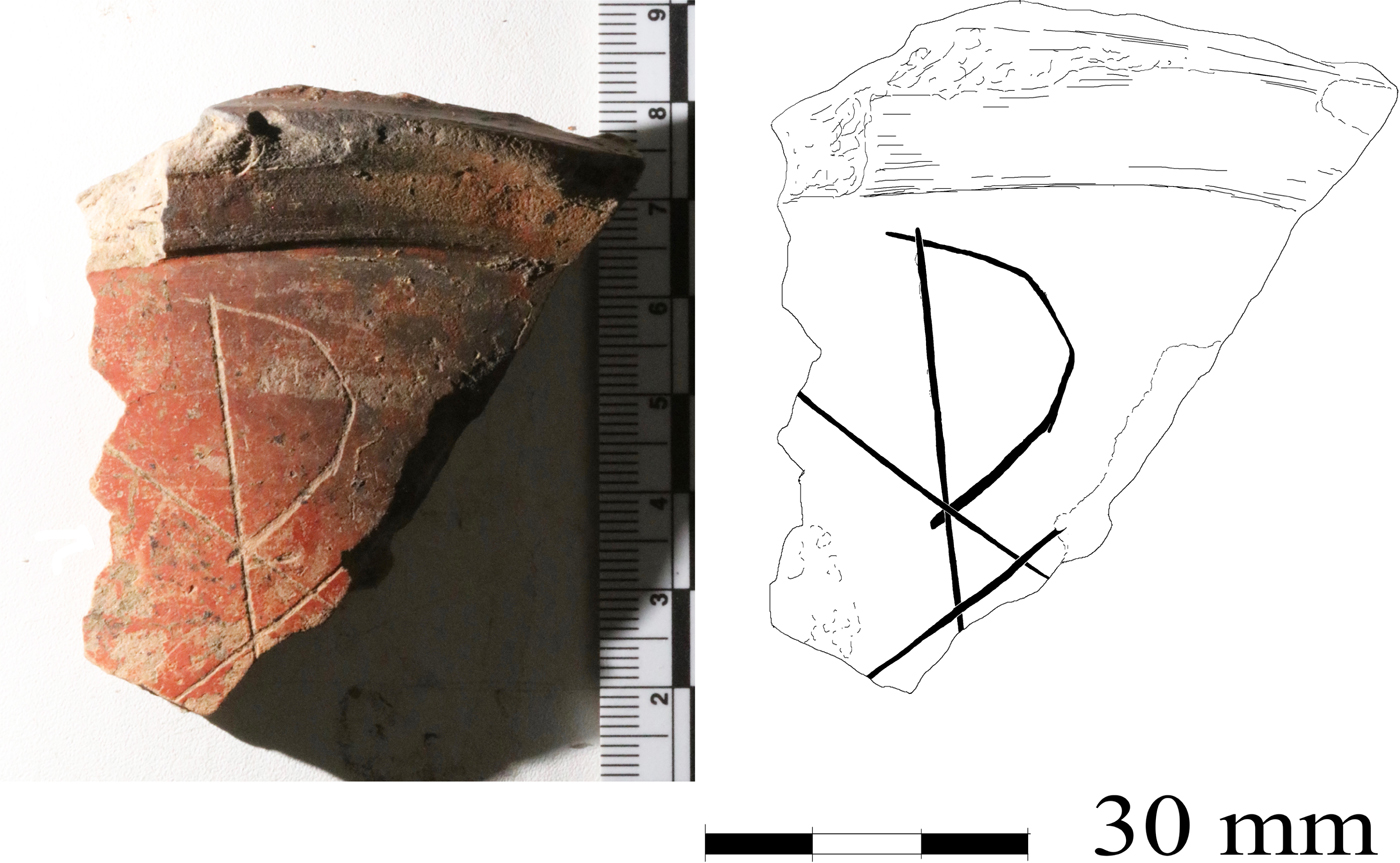
26. Ibid. (fig. 21). Rim sherd of a mortarium (sf 976, Oxfordshire red/brown colour-coated ware). Scratched after firing on the wall, the Greek letter ρ (now incomplete) crossed by two straight lines (also now incomplete) which cut each other almost at right-angles: ‘XP’, Chi-Rho.Footnote 46
Southwark, samian graffito (No. 26). (Photo and drawing: R.S.O. Tomlin)

GREATER LONDON
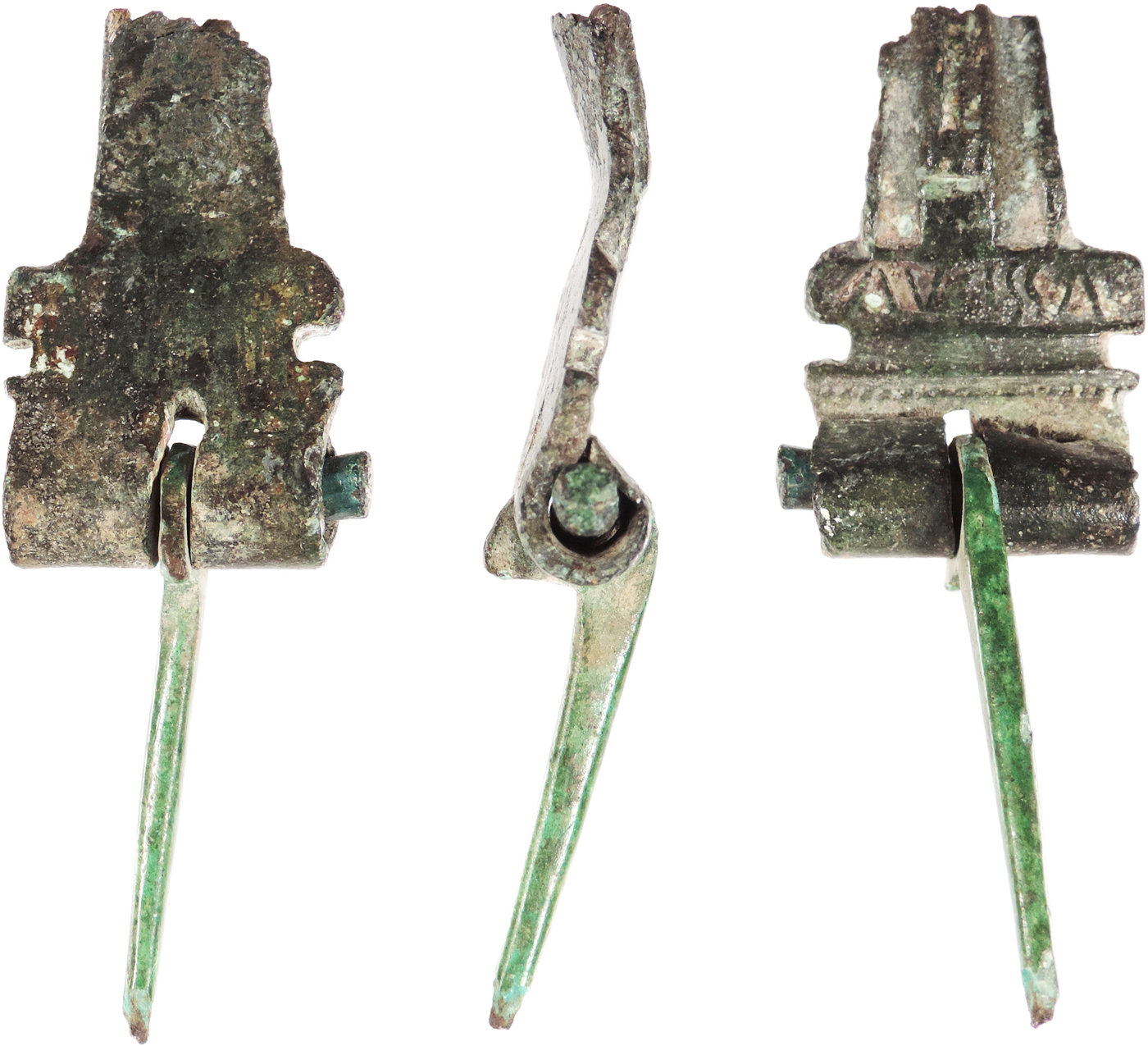
27. Thamesfield (TQ 24 75) (fig. 22). Part of a copper-alloy brooch with moulded inscription: ΛVCISSΛFootnote 47
Thamesfield, copper-alloy brooch (No. 27). (Photo: PAS)

NORTHAMPTONSHIRE
28. Orton (SP 80 79) (fig. 23). Almost circular face of an incomplete copper-alloy disc brooch, 19.65 mm in diameter, 5.13 mm thick, weight 2.15 gm; foundFootnote 48 in 2018. There are traces of red enamel around the raised letters: SI Λ|MΛS, si a|mas. ‘If you love (me) …’Footnote 49
Orton, copper-alloy brooch (No. 28). (Photo: PAS)

NORTHUMBERLAND
29. Vindolanda (NY 768 663). Four of the ink tablets found in 2017 have been published with photographs and commentary.Footnote 50 They are letters written by or to Iulius Verecundus, prefect of cohors I Tungrorum.
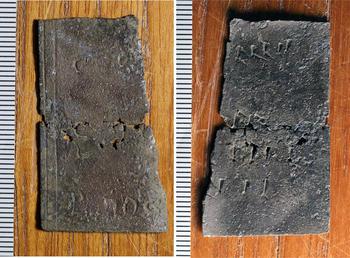
30. Ibid. (fig. 24). Almost rectangular fragment, 26 by 43 mm, of a copper-alloy military diploma of a.d. 156/8 (sf 21663), foundFootnote 51 in 2018. It preserves the bottom left corner of the outer face of the second leaf (Tabella II), which reads: […] | C BẸ[…] | C PO[…] | P OC[…], G(ai) Be [lli Urbani], G(ai) Po [mponi Statiani], P(ubli) Oci [li Prisci].Footnote 52 Overleaf is the bottom right corner of the inner face, not the upper left corner as might have been expected. It carries the end of the last five lines: […].. | […]ẠLLII | [binding hole] | […]ẠẸṚ | […]…. | […]ṚV..Footnote 53
Vindolanda, diploma fragment (No. 30). (Left) Outer face. (Right) Inner face. (Photos: R.S.O. Tomlin)

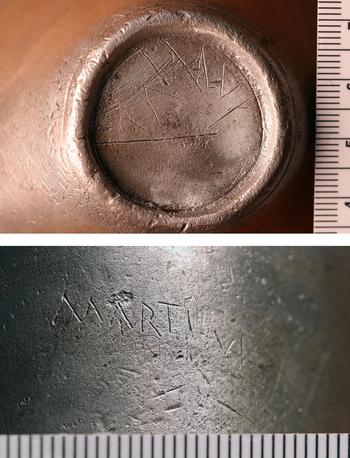
31. Ibid. (fig. 25). Sub-conical pewter cup (sf 21648), now pressed out of shape but originally c. 42 mm high; 38 mm diameter at the base, c. 85 mm at the rim. Two graffiti have been incised by different hands, the names of successive owners. (a) Underneath, within the foot-ring, in angular capitals c. 7 mm high: PRIMVṢ, Primus.Footnote 54 (b) On the wall, at two-thirds height, in small neat capitals 3 mm high: MARTINI, Martini. ‘(Property) of Martinus.’Footnote 55
Vindolanda, pewter cup (No. 31). (Above) Base graffito. (Below) Wall graffito. (Photos: R.S.O. Tomlin)

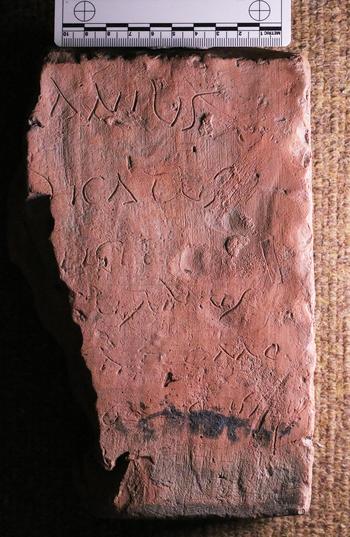
32. Ibid. (fig. 26). Major fragment of a brick (sf 21821), 140.8 by 208 mm, 65.2 mm thick, found in 2018. The left edge is all broken, the top and bottom edges are original but incomplete, the right edge is original and complete: this would suggest a bessalis c. 200 mm square intended for a hypocaust pillar, now missing the left one-third. Inscribed before firing with six lines of cursive letters, the last two lines damaged by horizontal scoring: […]ANIVS | […]DICATVS | […]IICIT | […].VRṆIVS | […]A.ỌMO | […]Q̣ḌẸỊSS[.].Ṣ, […] anius | [?Vin] dicatus | [f] ecit | [?Calp] urnius | … | … ‘[…]anius Vindicatus made (this). Calpurnius …’Footnote 56
Vindolanda, brick graffito (No. 32). (Photo: R.S.O. Tomlin)

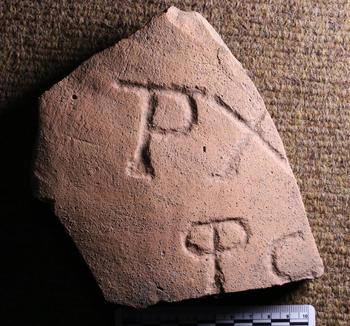
33. Ibid. (fig. 27). Wall sherd of a South Spanish oil amphora (Dressel 20, sf 21549), incised after firing:  $\mathop{{\hbox{TP}}}\limits^\frown$X[…] |
 $\mathop{{\hbox{PP}}}\limits^\frown$C̣[…], t(esta) p(ondo) X […] | p(lena) p(ondo) C […]. ‘Vessel by weight, 10 (or more) … | weight full, 100 (or more) …’Footnote 57
Vindolanda, amphora graffito (No. 33). (Photo: R.S.O. Tomlin)

34. Ibid. (fig. 28). Wall sherd of a South Spanish oil amphora (Dressel 20, sf 16153), scratched after firing: DΛX.IFootnote 58
Vindolanda, amphora graffito (No. 34). (Drawn by R.S.O. Tomlin)

35. Ibid. About one-third of a samian dish (Drag. 36, sf 21565), including half the base and foot-ring. Neatly incised after firingFootnote 59 underneath within the foot-ring: K, K(…) Footnote 60
36. Ibid. Wall sherd of a samian vessel (probably Drag. 18/31, sf 16048), incised above the (now missing) foot-stand, and inverted as to the vessel: KΛ.[…], probably Ka [rus] or (genitive) Ka [ri] Footnote 61
37. Ibid. (fig. 29). Base sherd of a samian platter (Drag. 18/31, sf 21688), scratched underneath within the foot-ring: LIIV[…], perhaps Leu [basnus].Footnote 62
Vindolanda, samian graffito (No. 37). (Photo: R.S.O. Tomlin)

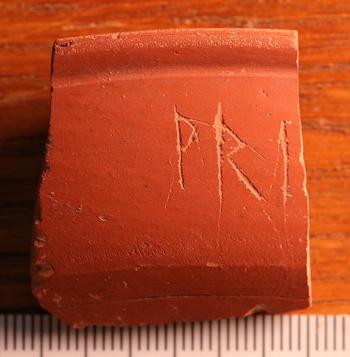
38. Ibid. (fig. 30). Rim sherd of a samian cup (Drag. 27, sf 16703), found in 2012. Scratched in neat capitals below the rim: PRI[…], Pri [mus].Footnote 63
Vindolanda, samian graffito (No. 38). (Photo: R.S.O. Tomlin)

39. Ibid. Rim sherd of a samian cup (Drag. 33a, sf 21596), scratched in crude capitals on the wall: […]RIM[…], probably [P] rim [us].Footnote 64
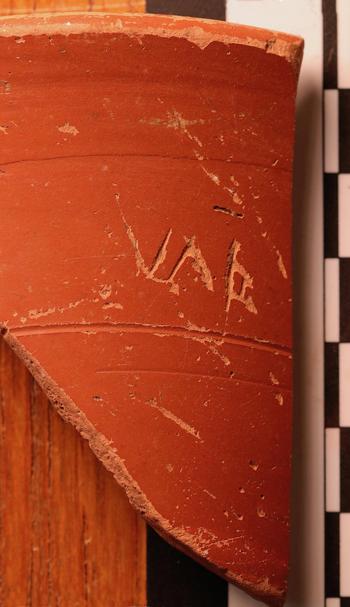
40. Ibid. (fig. 31). Rim sherd of a samian cup (Drag. 33, sf 21709), scratched in capitals after firing on the wall below the rim: VΛṚ, Var(us).Footnote 65
Vindolanda, samian graffito (No. 40). (Photo: R.S.O. Tomlin)

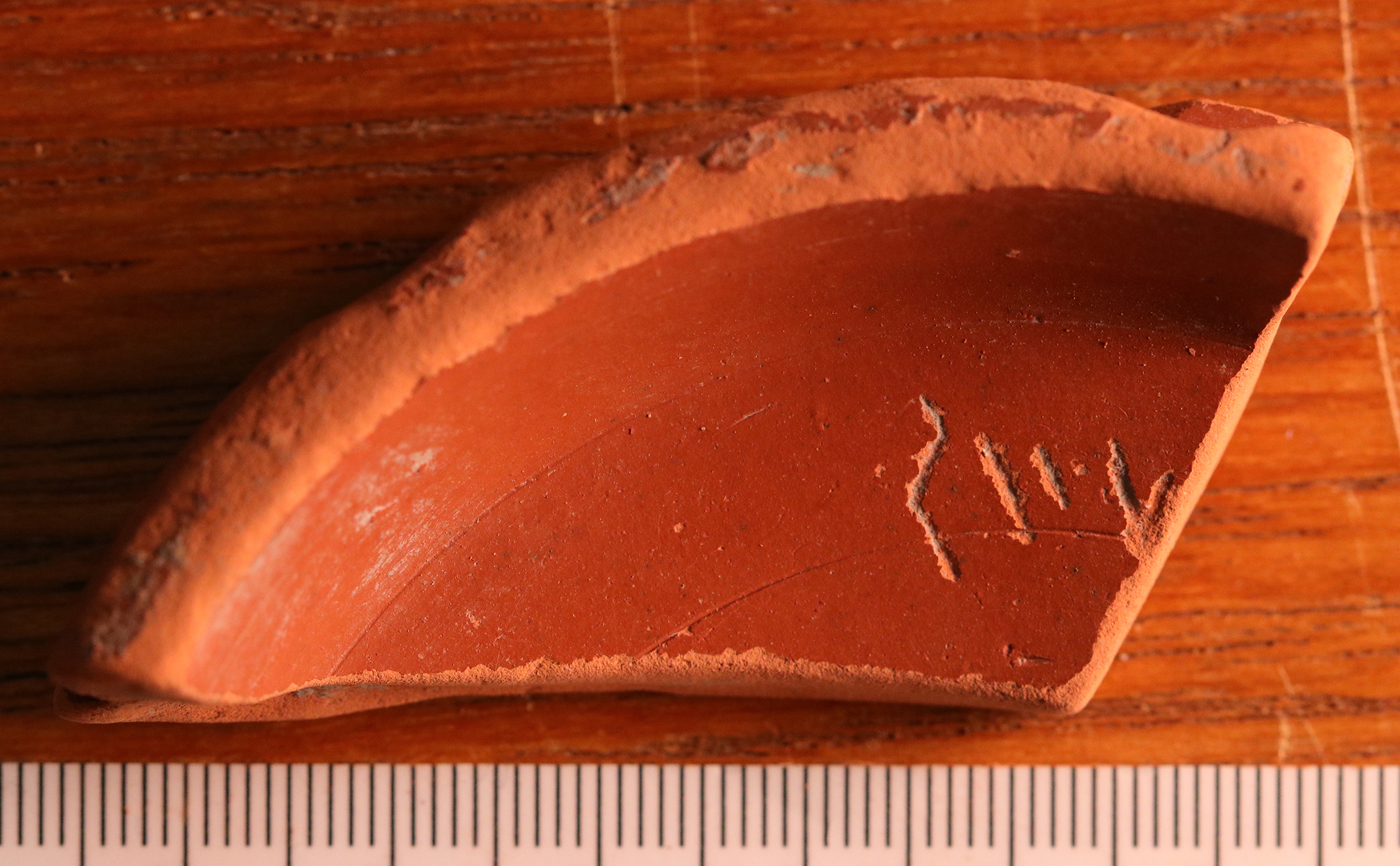
41. Ibid. (fig. 32). Samian rim sherd (probably Drag. 33, sf 21826), scratched in capitals on the wall: VIIṚ.[…], probably Ver [us].Footnote 66
Vindolanda, samian graffito (No. 41). (Photo: R.S.O. Tomlin)

NORTH YORKSHIRE
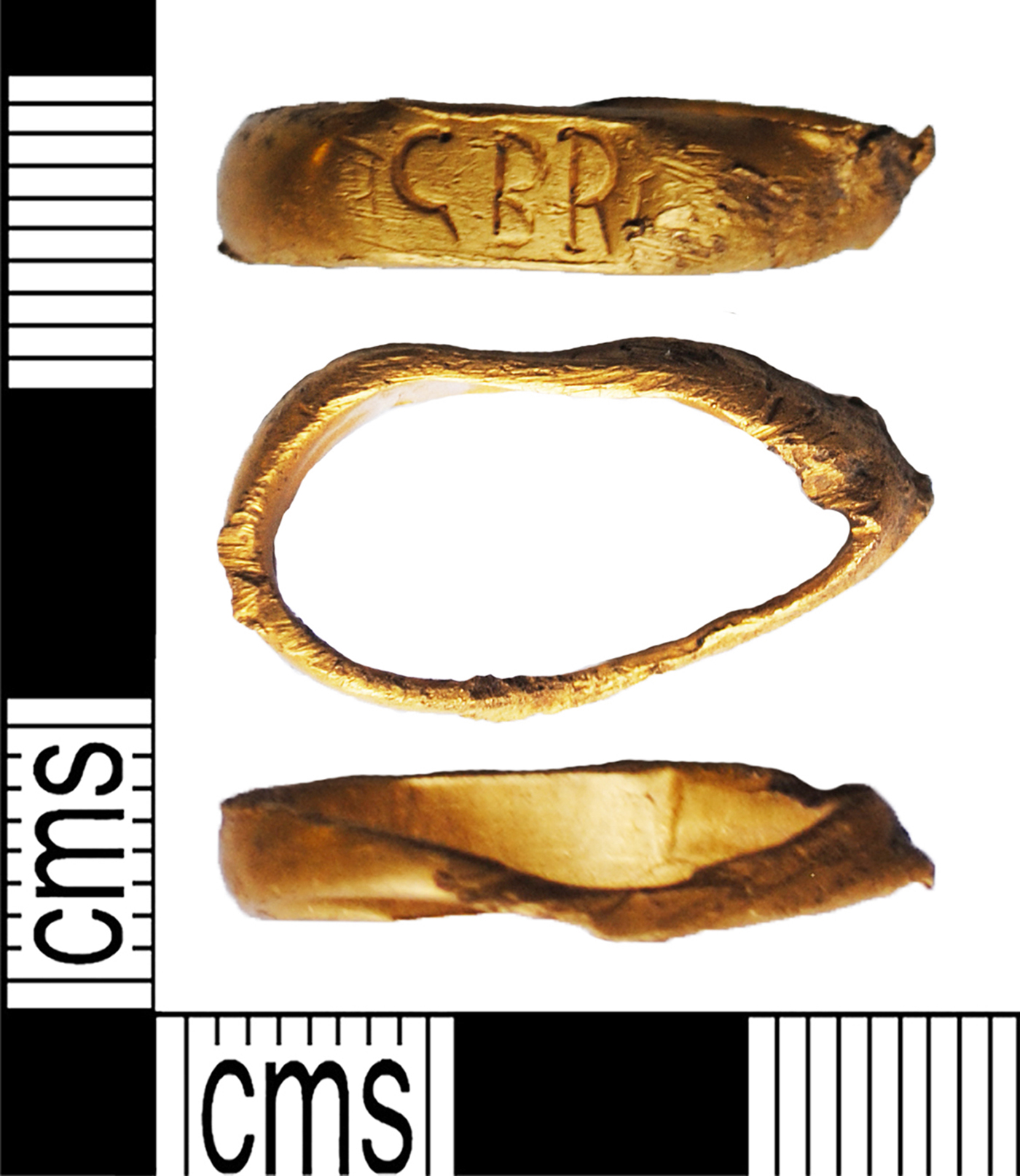
42. Arkendale (SE 40 61) (fig. 33). Gold finger-ring, original diameter c. 20 mm, weight 6.14 gm, foundFootnote 67 in 2018. The hoop widens to a flat, rectangular bezel on which are incised three ill-proportioned capitals: G B R, probably G(aius) B(…) R(…) Footnote 68
Arkendale, gold finger-ring (No. 42). (Photo: PAS)

SUFFOLK
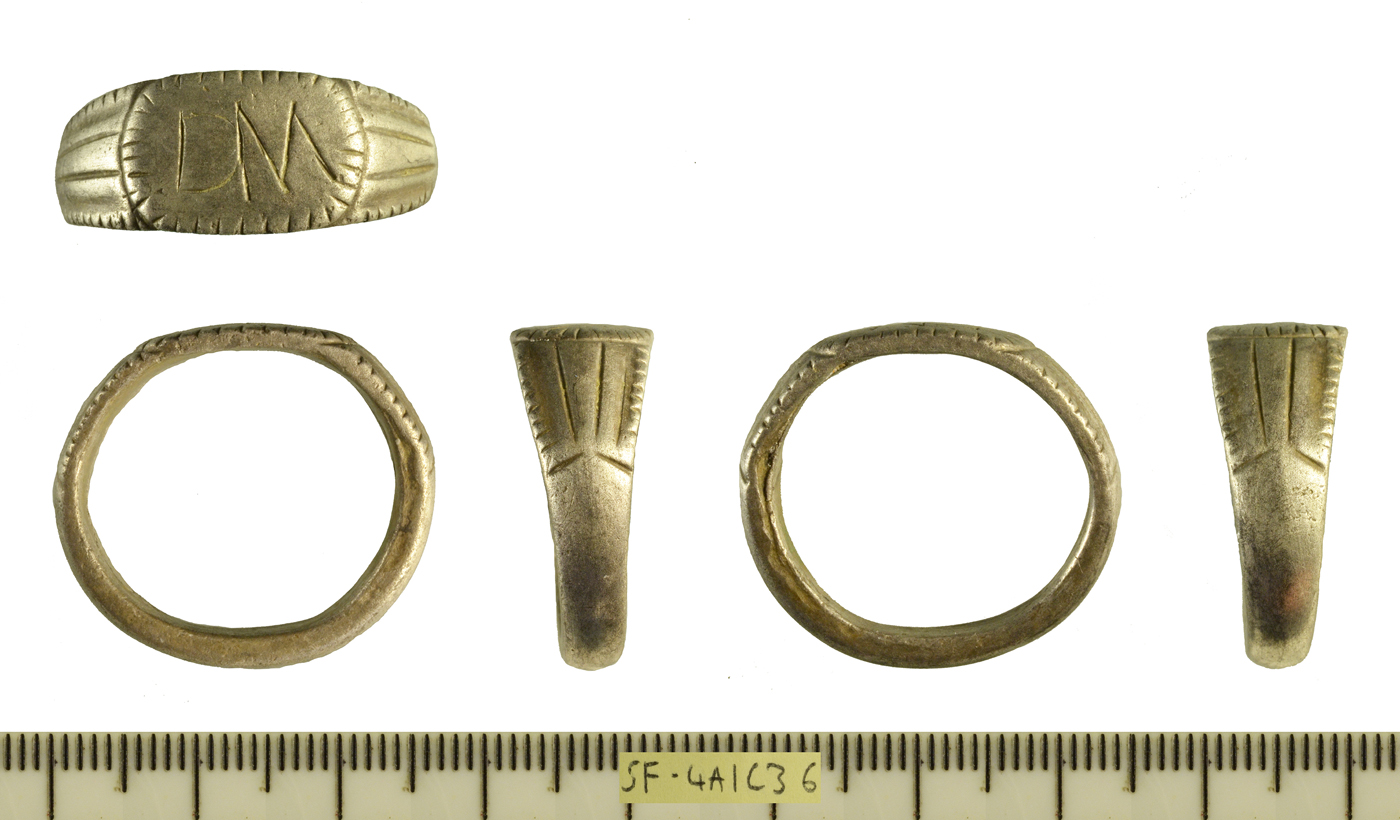
43. Cretingham (TM 22 62) (fig. 34). Silver finger-ring (Henig type VIII, third-century), 25.46 mm in diameter, weight 5.22 gm, foundFootnote 69 in 2017. Incised on the sub-oval bezel within a nicked border-pattern: DM, probably d(eo) M(…). ‘To the god M(…).’Footnote 70
Cretingham, silver finger-ring (No. 43). (Photo: PAS)

WARWICKSHIRE
44. Allesley (SP 297 807) (fig. 35). Part of a roof-tile (tegula), 140 by 95 mm, 20 mm thick, foundFootnote 71 in 2018. Crudely incised before firing: TΛLLI[…], probably Talli. ‘(The work) of T(h)allus.’Footnote 72
Allesley, tile graffito (No. 44). (Drawn by R.S.O. Tomlin from photo)

WALES
MONMOUTHSHIRE
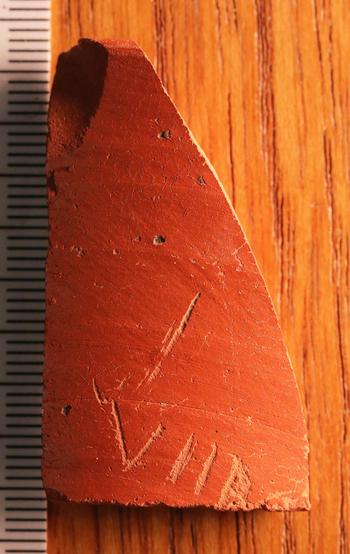
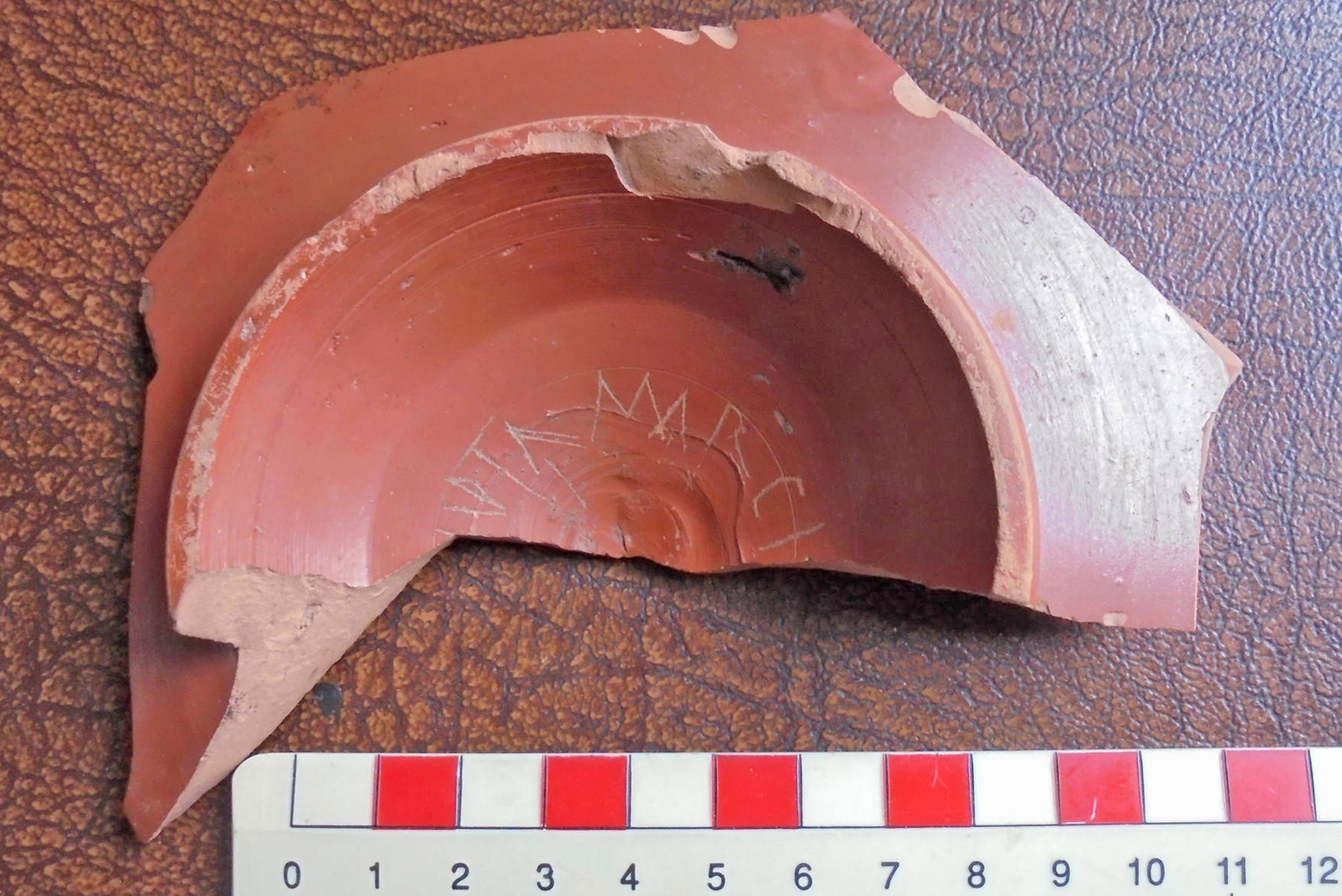
45. Monmouth (Blestium, SO 5097 1272) (fig. 36). Base sherd of a samian platter (Drag. 18/31) stamped PATNA (Les Martres de Veyre, c. a.d. 130–60), foundFootnote 73 in 2012. Incised after firing underneath, within the foot-ring: […]ỊIPTA MARCI[…], […] epta Marci […]. ‘[…]epta … of Marcus.’Footnote 74
Monmouth, samian graffito (No. 45). (Photo: GGAT)

SCOTLAND
FALKIRK
46. Mumrills (NS 9163 7942), Roman fort annexe (fig. 37). Base sherd of a samian dish (Drag. 18/31R), foundFootnote 75 in 2018. Scratched after firing underneath, within the foot-ring: […]CVNḌI, [?Iu] cundi. ‘(Property) of Iucundus.’Footnote 76
Mumrills, samian graffito (No. 46). (Photo and drawing: R.S.O. Tomlin)

ADDENDA ET CORRIGENDA
(a) RIB II.2, 2414.12 (Traprain Treasure), small silver bowl.Footnote 77 There is a third graffito (c) on the upper surface of the rim, just within the beaded border (fig. 38). The scribe tilted it towards him so as to hold it firmly against a horizontal surface while he wrote an angular New Roman Cursive, lifting the stylus as little as possible: deuormi Footnote 78
Traprain, silver bowl graffito (Add. (a)). (Drawn by R.S.O. Tomlin)

(b) RIB II.2, 2414.15 (Traprain Treasure), base fragment of a small silver bowl. The graffito BRI is dot-punched on the inner face of the footstand, rather than ‘inside’ it. A second graffito (b) was incised on the underside of the base, but only part of four strokes survives, one of which is angled. Perhaps: […].[.]ICI, the genitive (–ici) of a name in –icus.
(c) RIB II.3, 2422.31 (silver finger-ring). The place of discovery should be ‘Eastwood near Ashover, Derbyshire’.Footnote 79
(d) RIB III, 3528* (alienum, CIL vi 13740). Line 2 should read: ET o Ͻ o L o FLORVS o
(e) Britannia 47 (2016), 410, no. 28 (Healam Bridge). This fragment of a military diploma has now been fully published.Footnote 80 It was certainly issued in a.d. 140 to a veteran of the Second Cohort of Gauls, whose name is now lost, but the suffect consul [.] Antonius […] by which it is dated cannot be Q. Antonius Isauricus, former legate of the Sixth Legion at York (RIB 644).Footnote 81