



Depression is the second leading cause of global disability. 1 First-line depression treatments listed in most guideline recommendations include either antidepressants or psychotherapy. Reference Herrman, Patel, Kieling, Berk, Buchweitz and Cuijpers2,Reference Simon, Moise and Mohr3 Psychotherapies have fewer risks than antidepressants and may thus be perceived as being more desirable to patients. Yet, psychotherapy can be more expensive for some and may be viewed as more burdensome as it demands more time and effort on the part of the patient. Moreover, many people improve without treatment (natural recovery), Reference Kendrick, Chatwin, Dowrick, Tylee, Morriss and Peveler4,Reference ten Have, Penninx, Tuithof, van Dorsselaer, Kleinjan and Spijker5 and some may not believe that antidepressant pharmacotherapy or psychotherapy is worthwhile, given the associated burdens (i.e., harms, expenses and inconveniences). Both benefits and burdens need to be considered in relation to treatment alternatives when considering the best approach for individualised treatment planning. Psychotherapy includes many different modalities for depression treatment. A meta-analysis reported equivalent efficacy across all commonly provided modalities. Reference Cuijpers, van Straten, Andersson and van Oppen6,Reference Cuijpers, Quero, Noma, Ciharova, Miguel and Karyotaki7 These modalities include behavioural therapy, cognitive therapy, cognitive–behavioural therapy (CBT), mindfulness-based cognitive therapy, interpersonal psychotherapy, psychodynamic therapies and supportive therapy, provided as individual face-to-face, individual online or group therapy, typically lasting between 8 and 24 weeks. 8,9 Through shared decision-making for personalised depression treatments, many of the benefits and burdens associated with each treatment option should be evaluated using a meaningful metric.
Measures of patient importance
The minimal important change (MIC) can aid in selection of treatment options by determining the importance of improvements in health outcomes. The MIC (also known as the minimal important difference or minimal important clinical difference), is the smallest post-treatment change in a health outcome perceived as important. Reference Jaeschke, Singer and Guyatt10 The MIC is used to interpret patient-reported outcome measures. Reference Carrasco-Labra, Devji, Qasim, Phillips, Wang and Johnston11 However, the MIC is only applicable to a particular outcome measure or instrument, Reference Devji, Carrasco-Labra, Qasim, Phillips, Johnston and Johnston12,Reference Ferreira, Herbert, Ferreira, Latimer, Ostelo and Nascimento13 is not associated with a specific intervention, Reference McNamara, Elkins, Ferreira, Spencer and Herbert14 and lacks assessment of both the benefits and burdens relative to treatment options. Reference Ferreira, Herbert, Ferreira, Latimer, Ostelo and Nascimento13,Reference McNamara, Elkins, Ferreira, Spencer and Herbert14 Thus, a more patient-perceived determination of the value of psychotherapy, given the treatment benefits and burdens, is warranted.
The smallest worthwhile difference (SWD) represents a conceptually different method for estimation of patient-perceived importance, accounting for both treatment benefits and burdens. The SWD is ‘the smallest beneficial effect of an intervention that justifies the costs, risks and inconveniences of that intervention’. Reference Ferreira, Herbert, Ferreira, Latimer, Ostelo and Nascimento13 It is determined by a between-treatments assessment and reflects the average benefit/burden trade-off when considering two treatment options. The SWD estimate is patient-derived and intervention-specific, and provides an absolute difference between two treatment options. Reference Ferreira, Herbert, Ferreira, Latimer, Ostelo and Nascimento13,Reference McNamara, Elkins, Ferreira, Spencer and Herbert14 The benefit/harm trade-off method (BHTM) of SWD determination queries individual preferences for clinical scenarios, varying the benefits while leaving the burdens static. The BHTM thus represents the benefits people are willing to accept, given the expected burdens of one intervention compared with another. Reference Barrett, Brown, Mundt and Brown15 The BHTM is easy to understand and has been used to estimate the SWD in antidepressant treatments for depression. Reference Sahker, Furukawa, Luo, Ferreira, Okazaki and Chevance16 The SWD is the only metric that enables interpretation of results from trials and meta-analyses from the patient perspective. However, the SWD for depression psychotherapies has never been estimated.
In the present study, we estimated the SWD for recommended depression psychotherapies 8,9 compared with a no-treatment alternative. The findings could help mental health providers to understand differential patient preferences with respect to psychotherapy and establish an evidence-based benchmark for clinical trials.
Method
Study design
We conducted two studies: study 1, the primary study to estimate the SWD for psychotherapy; and study 2, a secondary study providing a replication of the SWD for antidepressants. Participants meeting the inclusion criteria were randomly assigned at a 3:1 ratio to the primary psychotherapy study or secondary antidepressants study, respectively. The primary study was the focus; the results of the secondary study are briefly presented for qualitative comparison. We conducted a cross-sectional survey using Prolific 2024 for Windows (Prolific, London, UK; see https://www.prolific.com), a research participant crowdsourcing service (RPCS), representing a general internet population. In general, RPCS participants demonstrate high test–retest reliability and high convergent and concurrent validity in psychological tests. Reference Chandler and Shapiro17 Participants recruited through RPCSs tend to be younger, more educated and report greater psychopathology compared with the general population. Reference Mortensen and Hughes18 However, RPCSs produce greater generalisability than convenience samples Reference Mortensen and Hughes18 and are becoming a common survey recruitment strategy. 19 Participants choose studies they find interesting and can only see studies for which they fit the inclusion criteria, which can increase the risk of selection bias. We invited participation through Prolific and linked participants meeting the inclusion criteria to an online survey. We included participants aged 18 years or older, living in the UK or USA. The compensation was £1.20 GBP (or equivalent USD for USA participants), commensurate with similar-length RPCS studies Reference Sahker, Furukawa, Luo, Ferreira, Okazaki and Chevance16 based on time to completion. We selected the UK and US to provide greater generalisability than would be possible when limiting to one country. We chose these two countries because they are among the most represented countries in Prolific; this improved recruitment efficiency, as well as interpretability, given that we were familiar with the relevant medical systems. The authors assert that all procedures contributing to this work comply with the ethical standards of the relevant national and institutional committees on human experimentation and with the Helsinki Declaration of 1975, as revised in 2013. All procedures involving human participants were approved by the Kyoto University Graduate School of Medicine Ethics Committee (R4578-2), and written informed consent was obtained from all participants. The protocol for this study was published in advance and is available via medRxiv. Reference Sahker, Luo, Omae, Tajika, Ferreira and Chevance20
Demographic and clinical variables
Demographic information included gender, age, race/ethnicity, education, employment, residence (USA or UK) and insurance status. Insurance was categorised as Affordable Care Act (USA only), Medicare or Medicaid (USA only), national healthcare service (National Health Service; UK only), private health insurance, other or uninsured. Clinical variables queried participants’ lifetime depression diagnoses, family history of depression, lifetime antidepressant treatment, lifetime psychotherapy, current antidepressant treatment, current psychotherapy and treatment preference (antidepressants versus psychotherapy). Current depression symptom severity was collected with the Patient Health Questionnaire-9 (PHQ-9). Reference Kroenke and Spitzer21 Supplementary Material 1, available at shows all survey questions.
Clinical groups
We were primarily interested in a general population of people experiencing moderate-to-severe depressive symptoms, not currently in treatment and willing to initiate psychotherapy. This clinical group most closely resembled potential treatment seekers, enabling us to obtain clinically meaningful SWD estimates for a major depressive episode. To further explore how different experiences with depression and treatment could be associated with SWD estimates, we included four clinical groups in total: (a) moderate-to-severe depressive symptoms but not in treatment: PHQ-9 ≥ 10 and not receiving any treatment; (b) currently in treatment: ongoing antidepressant therapy or psychotherapy; (c) absent-to-mild depressive symptoms with treatment experiences: PHQ-9 < 10, no current treatment, with previous psychotherapy and/or antidepressant treatment; and (d) absent-to-mild depressive symptoms without treatment experiences: PHQ-9 < 10 and history of psychotherapy and/or antidepressant treatment.
Primary outcome and its measurement
Our primary outcome was the SWD for people with moderate-to-severe depressive symptoms who were not in treatment and were willing to initiate psychotherapy. This estimation represents the patient-preferred increase in efficacy of psychotherapy for depression that would be deemed worthwhile compared with no treatment, given the treatment burdens (harms, expenses and inconveniences). The measure of efficacy was treatment response, defined as a 50% or greater reduction in depression symptom severity after 8 weeks. We described this response to participants as ‘feeling much better’, corresponding with the Clinical Global Impressions Scale and the standard 50% symptom reduction response. Reference Busner and Targum22 We defined psychotherapy as the modalities and formats recommended by the American Psychological Association and National Institute for Health and Care Excellence for treatment of depression; these included behavioural therapy, cognitive therapy, CBT, mindfulness-based cognitive therapy, interpersonal psychotherapy, psychodynamic therapy and supportive therapy consisting of individual face-to-face, individual online or group therapies. 8,9
We assumed that 30 of 100 people without treatment would experience a minimum 50% reduction in depression symptoms after 8 weeks, based on extant literature. Reference ten Have, Penninx, Tuithof, van Dorsselaer, Kleinjan and Spijker5,Reference Cuijpers, Quero, Noma, Ciharova, Miguel and Karyotaki7,Reference Kendrick, Chatwin, Dowrick, Tylee, Morriss and Peveler23,Reference Furukawa, Cipriani, Atkinson, Leucht, Ogawa and Takeshima24 We estimated the individual participant preference through the BHTM algorithm (Supplementary Material 2). The BHTM follows four steps: (a) presentation of a major depressive episode symptom summary; (b) explanation of the no-treatment alternative benefit being a 30% response after 8 weeks; (c) explanation of potential burdens 8,9 of psychotherapies recommended by the American Psychological Association and/or National Institute of Health and Care Excellence in terms of risks, Reference Linden and Schermuly-Haupt25 treatment length, Reference Cuijpers, Sijbrandij, Koole, Andersson, Beekman and Reynolds26 fees Reference Benson and Song27,Reference Woods28 and wait times; Reference Baker and Kirk-Wade29,30 and (d) presentation of varying treatment benefits compared with the no-treatment alternative of 30% response after 8 weeks Reference ten Have, Penninx, Tuithof, van Dorsselaer, Kleinjan and Spijker5,Reference Cuijpers, Quero, Noma, Ciharova, Miguel and Karyotaki7,Reference Kendrick, Chatwin, Dowrick, Tylee, Morriss and Peveler23,Reference Furukawa, Cipriani, Atkinson, Leucht, Ogawa and Takeshima24 (Supplementary Material 3). In step d, we asked participants, ‘Given the potential drawbacks after 8 weeks, if x/100 people going to psychotherapy felt much better (instead of 30/100 from no treatment), would you think the treatment is worthwhile?’. When participants believed psychotherapy was worthwhile at the hypothetical response rate, given the burdens, they advanced to a lower response rate. When they did not believe it was worthwhile, they advanced to a higher response rate. The process was continued until the smallest worthwhile response rate was identified. Finally, the difference between the 30% no-treatment response rate and the smallest psychotherapy response rate considered worthwhile equalled the individual participant SWD.
Secondary outcome
To provide a robust comparison with the existing SWD for antidepressants for depression, Reference Sahker, Luo, Omae, Tajika, Ferreira and Chevance20 we conducted a secondary study replicating the SWD for antidepressant treatments for depression compared with no treatment. The secondary study followed the same process as the psychotherapy SWD study, but the BHTM clinical scenario was focused on the benefits and burdens of antidepressants.
Sample size
The sample size was set to achieve the expected precision in the estimate of the SWD. We assumed that the standard deviation of the SWD would resemble that estimated in our previous study using the same proposed sample with an interquartile range (IQR) of 10–35 (approximate s.d. = 20) for SWDs of 20%. Reference Sahker, Furukawa, Luo, Ferreira, Okazaki and Chevance16 To obtain a 95% confidence interval within ten percentage points, we needed approximately 62 participants in each of the four groups described above. Estimates of depression incidence in RPCSs vary but are demonstrably higher than in the general population. Reference Chandler and Shapiro17 Based on our previous distribution, Reference Sahker, Furukawa, Luo, Ferreira, Okazaki and Chevance16 we estimated that 12% of the sample would comprise the primary interest group (moderate-to-severe depressive symptoms but not in treatment) and approximately 518 participants would be necessary to reach N = 62 for the primary psychotherapy study (Supplementary Material 4). As we allocated one-quarter of the participants to the secondary antidepressant SWD study, we recruited 701 participants in total.
Data analysis
We first determined the SWD with its distribution for people with moderate-to-severe depressive symptoms but not in treatment (n = 87) and estimated its median and IQR. We then examined the SWD by participant group for comparison using box-violin plots (n = 502). Finally, we used exploratory methods to analyse the SWD for the entire sample willing to initiate psychotherapy (n = 502), with a single multivariable regression to investigate SWD predictors using a generalised linear model (n = 502). Participants who reported that they would not accept psychotherapy at 100% treatment response were removed from the analysis, because they did not represent real-world candidates for the treatment (n = 24). Reference McNamara, Elkins, Ferreira, Spencer and Herbert14,Reference Sahker, Furukawa, Luo, Ferreira, Okazaki and Chevance16 To examine the effect of this decision, we conducted sensitivity analysis with the full sample (N = 526) by assigning non-accepting participants an SWD value representing a psychotherapy response rate over 100% (SWD = 71). Cohen’s d equivalents to response rates were also calculated (Supplementary Material 5). Reference Chinn31 Statistical analyses were conducted using R 4.2.2 for Windows (R Core Team, Vienna, Austria; see https://www.R-project.org).
Patient and public involvement
We piloted the BHTM script with two members of the PPI group at the Oxford Precision Psychiatry Lab of the University of Oxford, who are also co-authors of this paper (S.M. and R.E.). PPI members reviewed the study descriptions of a DSM-5 major depressive episode, and the benefits and burdens of psychotherapy. These experts by experience provided feedback on clarity, inclusivity and accuracy of patient experiences, and helped to modify the scripts accordingly. They further collaborated in the interpretation and write-up of the manuscript.
Results
In all, 701 participants were included and randomised 3:1 to study 1 and study 2, respectively. Figure 1 shows the study allocation and clinical group determination based on clinical survey questions.
Smallest worthwhile difference (SWD) study allocation flowchart and clinical group representations. Participants reporting that they would not initiate psychotherapy (study 1) or accept antidepressants (study 2) were removed from clinical groups and main analyses but included in sensitivity analyses. Clinical groups (dotted border) were determined through self-report of treatment experiences and PHQ-9 scores of 10+ for moderate-to-severe depressive symptoms.

Study 1: estimation of the SWD for psychotherapy
Sample characteristics
The total sample for the primary psychotherapy SWD included 526 participants. Participants had a mean age of 36.7 years (s.d. = 12.5), and most were from the USA (76%), were women (54%), were White (61%), had a four-year degree (38%) and were employed full-time (54%). They had a mean PHQ-9 of 8.4 (s.d. = 6.5), with 47% reporting lifetime depression, 48% lifetime antidepressant treatment and 64% lifetime psychotherapy. Of the full sample, 24 participants reported that they would not consider psychotherapy, even with a 100% response rate. Detailed descriptions of participant characteristics for the full sample (N = 526) and for those with moderate-to-severe symptoms but not in treatment and willing to initiate psychotherapy (n = 87) are provided in Supplementary Material 6.
SWD by clinical group
Participants in the ‘moderate-to-severe symptoms but not in treatment’ clinical group (n = 87) had a mean age of 33.5 years (s.d. = 11.4); 60% were female and 57.5% were White. They reported a mean PHQ-9 score of 15.2 (s.d. = 4.3), 43.7% had previous antidepressant treatment, 58.6% had previous psychotherapy and 71.3% reported that they would prefer psychotherapy over antidepressants if given the choice.
The median SWD was 20% (IQR: 10–35) for participants willing to initiate psychotherapy who had moderate-to-severe symptoms but were not in treatment (n = 87). Given a 30% response of no treatment, those who had moderate-to-severe symptoms but were not in treatment expected commonly provided psychotherapies to offer a 50% response rate (corresponding to a Cohen’s d ≈ 0.47). Figure 2 shows the distribution and percentile rank of the SWD for the with ‘moderate-to-severe symptoms but not in treatment’.
Frequency distribution of the smallest worthwhile difference (SWD) for people with moderate to severe depressive symptoms but not in treatment (n = 87). SWD represents the expected increase in response with psychotherapy compared with no treatment. The top row shows the cumulative percentage of the distribution. The stripped bar represents the median SWD. Previous meta-analyses estimated the risk difference in response with psychotherapy versus no treatment to be 15% (dotted bar).

Figure 3 shows the clinical group distributions with individual SWDs, medians and IQR values. The participants currently in treatment showed the smallest SWD, with a 15% expected increase in response with psychotherapy compared with no treatment. For participants currently in treatment, 77% were receiving antidepressants and 60% were receiving psychotherapies. The ‘moderate-to-severe depressive symptoms but not in treatment’ group demonstrated the same SWD as both groups reporting absent-to-mild depression symptoms. Those with absent-to-mild depressive symptoms with treatment experiences demonstrated the most variability in SWD ratings, but these were still skewed positive, as for all clinical groups.
Box-violin plots of the smallest worthwhile difference (SWD) distributions for four participant clinical groups. Boxes represent the first and third quartiles, with the median line in the middle. Whiskers represent the range. Violins represent the frequency distribution, enhanced with raw data points. Data include participants willing to initiate psychotherapy (N = 502), excluding 24 participants who reported that they would not initiate psychotherapy for depression even if the response were 100%.

As a sensitivity analysis, we assigned an SWD of 71% to participants unwilling to ever accept psychotherapies. This analysis demonstrated an expected increase in the median SWD for the people with moderate-to-severe symptoms but not in treatment (median: 25%, IQR: 15.0–43.8, n = 98) and for the entire sample (median: 20%, IQR: 10–30, n = 526).
Variables associated with SWD for psychotherapy
To further investigate potential correlates of the SWD, we conducted an exploratory multivariable linear regression between all baseline covariates predicting SWD for those willing to initiate psychotherapy (N = 502). Among predictor variables, current antidepressant treatment (β = −0.26, 95% CI: −0.46, −0.06) and a preconceived preference for psychotherapy (β = −0.23, 95% CI: −0.39, −0.07), age (β = −0.01 per year, 95% CI: −0.01, −0.01), being Black (versus Asian, β = −0.44, 95% CI: −0.71, −0.17), being White (versus Asian, β = −0.23, 95% CI: −0.56, -0.08) and having doctoral education (versus 2-year degree, β = −0.38, 95% CI: −0.73, −0.03) predicted a lower SWD. Supplementary Material 7 provides a detailed description of the regression model.
Study 2: estimation of the SWD for antidepressant drugs
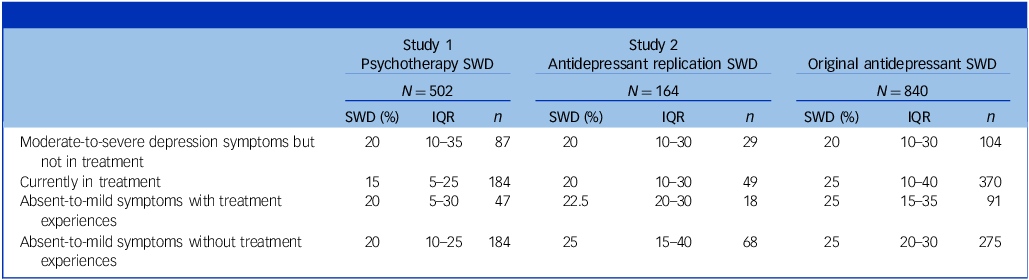
The total sample allocated to the estimation of the SWD for antidepressant drugs consisted of 175 participants. Of those, 11 (6.3%) reported that they would not take antidepressants even if they provided 100% response. The SWD was estimated for the remaining 164 participants willing to accept antidepressants. A comparison of estimates for the study 1 psychotherapy SWD, study 2 antidepressant replication SWD and previously reported antidepressant SWD Reference Sahker, Furukawa, Luo, Ferreira, Okazaki and Chevance16 is provided in Table 1.
Comparison of the smallest worthwhile difference (SWD) for psychotherapy versus no treatment by clinical groupa

IQR, interquartile range.
a. SWD indicates the median difference in smallest worthwhile response percentage between depression psychotherapy and no treatment. Data represent participants willing to accept the treatment under investigation for the study. Data for the original antidepressant SWD study were from Sahker et al (2024).Reference Sahker, Furukawa, Luo, Ferreira, Okazaki and Chevance16
Discussion
One-third of those experiencing moderate-to-severe depression symptoms would find commonly provided psychotherapies worthwhile, given the expected burdens. Using the BHTM, we estimated the SWD for initiation of commonly provided, empirically supported psychotherapies for depression using a general population cross-sectional sample. The SWD for participants who had moderate-to-severe depressive symptoms but were not in treatment was 20% (IQR: 10–35%) over the no-treatment response rate of 30%. In other words, people acutely in need of relief from depression symptoms believed that psychotherapies should have a 50% (IQR: 40–65%) response rate to be considered worthwhile, considering all treatment burdens. Both clinical groups with absent-to-mild depression symptoms also reported the same SWD with different dispersion profiles, regardless of previous treatment experiences. Those currently in treatment required the lowest response rate threshold (SWD = 15%, IQR: 5–25%). Furthermore, an exploratory regression model revealed nominal predicted relationships in SWD change with little clinical meaningfulness. Findings from the present study should be interpreted in the context of a 30% no-treatment response comparison and a 45% real-world psychotherapy response.
The no-treatment, or natural recovery, response rate for acute-phase major depression was conservatively estimated to be 30%, in line with previous estimates of the SWD. Reference Sahker, Luo, Omae, Tajika, Ferreira and Chevance20 The true response rate experienced by patients not receiving treatment is difficult to estimate from clinical trials and observational data. In psychotherapy trials, waitlist controls have the lowest response at about 17%, compared with 20–30% for treatment-as-usual controls. Reference Cuijpers, Quero, Noma, Ciharova, Miguel and Karyotaki7 In antidepressant trials using pill placebos, the control event rate is higher, at 35–40%. Reference Furukawa, Cipriani, Atkinson, Leucht, Ogawa and Takeshima24 The estimates closest to the true natural recovery response rate come from trials that employ watchful waiting controls; these have estimated that 29% naturally recover after 8 weeks, Reference Kendrick, Chatwin, Dowrick, Tylee, Morriss and Peveler4 consistent with epidemiological observations. Reference ten Have, Penninx, Tuithof, van Dorsselaer, Kleinjan and Spijker5 We took the lowest (17%) and the highest (40%) effects and assumed the true unbiased response rate would be 30%, between biased estimations and in line with watchful waiting and epidemiological findings. Although no treatment is not a common option for patients being assessed for treatment, it represents an absolute comparison for understanding the patient significance threshold for psychotherapy.
The psychotherapy response rate for acute-phase depression treatment is estimated to be 45%. This estimate is equal to the established antidepressant response and was derived from a large meta-analysis of commonly administered psychotherapies for depression (331 randomised controlled trials, 34 285 patients). Reference Cuijpers, Quero, Noma, Ciharova, Miguel and Karyotaki7 Furthermore, the bulk of the up-to-date and robust evidence is for CBT; this demonstrates that patients experience greater treatment response with individual CBT than care as usual (odds ratio: 2.13), waitlist (odds ratio: 4.00), pill placebo (odds ratio: 1.60–2.08) and no treatment (odds ratio: 2.07). Reference Cuijpers, Quero, Noma, Ciharova, Miguel and Karyotaki7 These odds ratios correspond to response rates of 38–55%. Given the overestimated effects in waitlist controls, underestimated effects of placebo controls and non-superiority findings in comparisons of common psychotherapies with antidepressants, Reference Cuijpers, Noma, Karyotaki, Vinkers, Cipriani and Furukawa32 we set 45% response as a reasonable estimate of the acute-phase psychotherapy response rate for depression.
About one-third of participants who had moderate-to-severe depressive symptoms but were not in treatment were willing to initiate psychotherapy at the presently available efficacy level of 45% response (SWD = 15%, Cohen’s d ≈ 0.36). The average worthwhile effect of psychotherapy was deemed to be 50% response (SWD = 20%, Cohen’s d ≈ 0.47), which is close to the available therapeutic benefits. When patients are provided with reasonable informed consent that accurately describes the benefits and burdens of their treatment choices, they may opt for less burdensome options. Notably, participants currently in treatment (either psychotherapy or antidepressants) were willing to accept much lower efficacy or were more tolerant of the burdens of psychotherapy. This may indicate bias from the type of person who accepts treatment, or a perceptual change concerning treatment burdens after beginning a therapy. Both clinical groups demonstrated significant variability in their individual SWD ratings, meaning shared decision-making is needed to select individualised treatment plans. In addition, nearly 5% of participants with moderate-to-severe depressive symptoms but not in treatment reported that they would not initiate psychotherapy, even if 100% response were guaranteed. These findings were from comparisons between psychotherapy and no treatment, which may be a consideration people make without a clinical consultation. However, the typical clinical consultation includes treatment options for antidepressant pharmacotherapy and psychotherapy.
We replicated our previous findings regarding the SWD for antidepressant treatments for depression, Reference Sahker, Furukawa, Luo, Ferreira, Okazaki and Chevance16 with the same SWD and dispersion in both evaluations of people with moderate-to-severe depressive symptoms but not in treatment (SWD = 20%, IQR: 10–30%). This replication adds strength to the established patient perspective on antidepressants. Moreover, this finding provides a meaningful and trustworthy comparison for the patient preference for psychotherapy. Overall, the findings increase the generalisability of the SWD for antidepressants, strengthen the credibility of the RPCS sample and provide a reference value for evaluation of the SWD for psychotherapies.
People with moderate-to-severe depressive symptoms but not in treatment expected similar efficacy for both psychotherapy and antidepressants, given the benefits and burdens. The patient-perceived worthwhile effect of antidepressant treatment for depression has been recently estimated to be 55% (IQR: 40–75%), when considering potential benefits and burdens. Reference Sahker, Furukawa, Luo, Ferreira, Okazaki and Chevance16 This is useful information, given the considerably different types of burden for each treatment option, and suggests that patients may view both treatment options as equally burdensome regardless of the type of burden.
The present findings are only representative of short-term treatment effects, where patients may wish for fast symptom relief. In the long term, psychotherapy is more efficacious for sustained response than antidepressant treatment alone. Reference Furukawa, Shinohara, Sahker, Karyotaki, Miguel and Ciharova33 Therefore, acute-phase treatment burdens and longer-term outcomes may require more candid discussions in shared decision-making regarding patient treatment options. In addition, decreasing time and effort burdens via telehealth could make psychotherapy a more attractive option compared with antidepressants. Reference Furukawa, Tajika, Toyomoto, Sakata, Luo and Horikoshi34 As both psychotherapy and antidepressant treatment options demonstrate very similar efficacy profiles in acute-phase treatment, the burdens are the primary differential in patient decision-making. The two treatment options need to be evaluated head-to-head to determine the SWD for psychotherapy compared with antidepressants to understand the true patient preference with respect to these first-line treatments.
Limitations
Some limitations of the present study should be noted. First, we used an internet sample from an RPCS, which may not be truly representative of the general population. Reference Chandler and Shapiro17 The SWD of a clinical sample might report a different SWD. However, it is equally important to consider those with previous depression diagnoses and those with subthreshold symptoms to cover the spectrum of people with lived experiences. The present study was primarily concerned with individuals who had moderate-to-severe depression symptoms but were not in treatment, representing people acutely in need of care who would comprise a clinical sample. Moreover, this method also included those who should be in a clinical sample but might never seek treatment (treatment gap).
Second, we excluded participants who reported that they would not accept psychotherapy even if the response rate were 100%. This strategy followed established methods of eliminating bias from those who would not be candidates for treatment. Reference McNamara, Elkins, Ferreira, Spencer and Herbert14,Reference Sahker, Furukawa, Luo, Ferreira, Okazaki and Chevance16 Although this could have produced an SWD unrepresentative of the general population, we were primarily interested in a general population willing to initiate psychotherapy. Furthermore, we conducted a sensitivity analysis including these people, which raised the estimate by only five percentage points. Third, participants with moderate-to-severe symptoms but not in treatment demonstrate potential for a major depressive episode that had not been formally diagnosed. We assumed that they would provide thoughtful SWD estimates because of their symptomology and potential for treatment needs. Finally, there are myriad differences in depression treatment burdens depending on health policy, location, mobility, finances and insurance coverage. Variable burdens are largely due to systemic differences among countries, states, communities and families. We could not accurately account for all these variables. However, we structured our clinical scenario using an idiographic framework, providing typical burden sources and asking participants to consider their personal situations, with scenarios reviewed by people with lived experiences. To evaluate these differences, we conducted an exploratory regression and found no appreciable association between the SWD and variables including country of residence, insurance coverage, or employment. It should also be noted that the present findings represent the patient-perceived importance of psychotherapy in a UK and US context. As psychotherapy burdens vary across cultures, our findings are specific to the burdens present in the UK and USA and should be interpreted accordingly.
Future implications
The similar SWDs for psychotherapy and antidepressant therapies for depression obtained here represent a meaningful benchmark for future depression trials and highlight the acceptability of both treatment types for evaluation of combination therapies. Detailed descriptions of trial psychological interventions, which are crucial for identifying treatment components, are warranted. Greater consideration of the patient perspective on depression treatments is needed in treatment planning and informed consent discussions. Our findings provide insight into what patients may expect from depression therapies and could help to establish evidence-based targets for future research.
Supplementary material
The supplementary material is available online at https://doi.org/10.1192/bjp.2025.10453
Data availability
The data that support the findings of this study are available from the corresponding author, E.S., upon reasonable request. Access to records of materials and the analytic code associated with this manuscript is available upon reasonable request for purposes of reproducing results or replicating procedures.
Acknowledgements
E.S. is supported by the Japan Society for the Promotion of Science (grant 24K20239). A. Cipriani is supported by the National Institute for Health Research (NIHR) Oxford Cognitive Health Clinical Research Facility, by an NIHR Research Professorship (grant RP-2017-08-ST2-006), by the NIHR Oxford and Thames Valley Applied Research Collaboration, by the NIHR Oxford Health Biomedical Research Centre (grant NIHR203316) and by the Wellcome Trust (GALENOS Project). The views expressed are those of the authors and not necessarily those of the UK National Health Service, the NIHR or the UK Department of Health. M.L.F. holds a National Health and Medical Research Council of Australia Investigator Fellowship.
Author contributions
E.S. and T.A.F. conceived the study. E.S., T.A.F., Y.L., K.O., A.T. and G.S. designed the study; all authors contributed to the design during protocol development. E.S. collected and analysed the data; all authors provided interpretation of the data. In addition, all authors substantially contributed to critical review of the work with respect to important intellectual content and drafting of the manuscript, and gave final approval of the current version of the paper. All authors agree to be accountable for all aspects of the work in ensuring that questions related to the accuracy or integrity of any part of the work are appropriately investigated and resolved.
Funding
Funding was provided by the Kyoto University Graduate School of Medicine.
Declaration of interest
T.A.F. reports personal fees from Boehringer-Ingelheim, DT Axis, Kyoto University Original, Shionogi, SONY and UpToDate, and a grant from Shionogi, outside the submitted work. In addition, T.A.F. has patents 2020-548587 and 2022-082495 pending, and intellectual properties for Kokoro-app licensed to Mitsubishi-Tanabe. A. Cipriani has received research, educational and consultancy fees from INCiPiT (Italian Network for Paediatric Trials), CARIPLO Foundation, Lundbeck and Angelini Pharma outside this project. In the past 3 years, S.L. has received honoraria as a consultant and/or advisor and/or for lectures and/or educational material from Alkermes, Angelini, Eisai, Gedeon Richter, Janssen, Lundbeck, Medichem, Medscape, Merck Sharpp and Dome, Mitsubishi, Neurotorium, NovoNordisk, Otsuka, Recordati, Roche, Rovi, Sanofi Aventis and TEVA. A. Chevance is a member of the British Journal of Psychiatry editorial board, but she did not take part in the review or decision-making process for this paper.






eLetters
No eLetters have been published for this article.