


Introduction
Attention deficit/hyperactivity disorder (ADHD) is the most common developmental disorder, affecting 3–5% of school-aged children (Barkley, Reference Barkley1998). This early-onset condition is characterized by persistent and impairing symptoms of inattention, hyperactivity and impulsivity. In the majority of cases, the disorder persists into adolescence and adulthood (Biederman et al. Reference Biederman, Wilens, Mick, Faraone and Spencer1998). ADHD is a major mental health issue because of its association with a range of adverse psychosocial outcomes through the lifespan, including psychiatric co-morbidity, antisocial behaviours and substance use disorders (Spencer et al. Reference Spencer, Biederman and Mick2007).
As recently reviewed by Loe & Feldman (Reference Loe and Feldman2007), several studies have found a significant link between ADHD and negative academic and educational outcomes. In particular, children with ADHD have been shown to display poor academic functioning with poor reading and arithmetic test scores (Biederman et al. Reference Biederman, Faraone, Milberger, Guite, Mick, Chen, Mennin, Marrs, Ouellette, Moore, Spencer, Norman, Wilens, Kraus and Perrin1996; Barry et al. Reference Barry, Lynam and Klinger2002), increased rates of grade retention (Barkley et al. Reference Barkley, Fischer, Edelbrock and Smallish1990), and low rates of high school graduation and post-secondary education (Mannuza et al. Reference Mannuzza, Klein, Bessler, Malloy and LaPadula1993). However, those surveys were somewhat limited. First, many reports used samples of clinic-referred ADHD children and adolescents, thus introducing a selection bias and limiting the generalizability of the findings. Second, most of the investigations examined populations with young age ranges, precluding consideration of long-term academic outcomes. Third, a circularity bias might have arisen from numerous studies. Indeed, the clinical definition of ADHD in the DSM-IV demands the presence of functional impairment, generally defined in terms of performance and behaviour at home and/or school. Even if DSM criteria do not necessarily include school problems, there is a possibility that in some instances school problems are associated with the definition of caseness. If school problems are considered at baseline, they are more likely to be present at follow-up and subsequently to produce spurious associations. Finally, possible confounding variables such as co-morbidity and environmental conditions have not always been well addressed in the available reports.
In addition to ADHD, other risk factors are likely to contribute to academic impairment. Conduct disorder (CD), which is characterized by persistent patterns of violence and rule-breaking behaviours, and is frequently co-morbid with ADHD, has been linked to academic underachievement, especially during adolescence (Hinshaw, Reference Hinshaw1992). Nevertheless, a controversy remains in the literature because some reports have shown that once co-morbid ADHD is taken into account, the specific association between CD and underachievement may disappear, suggesting that links with academic problems may be mediated by attentional difficulties (Fergusson & Horwood, Reference Fergusson and Horwood1995; Rapport et al. Reference Rapport, Scanlan and Denney1999). Internalizing problems such as anxiety and depression might also heighten the risk of negative academic outcomes (Van Ameringen et al. Reference Van Ameringen, Mancini and Farvolden2003; Maughan & Carroll, Reference Maughan and Carroll2006). Environmental risk factors, including low family socio-economic status (SES), parental psychopathology and parental separation, may also increase the likelihood of academic underachievement (Weissman et al. Reference Weissman, Warner, Wickramaratne, Moreau and Olfson1997; Ackerman & Brown, Reference Ackerman and Brown2006). Identifying risk factors for academic underachievement is of major importance because poor academic achievement is a persistent correlate of low self-esteem, interpersonal difficulties and antisocial behaviours, which put individuals on adverse trajectories and lead to lower occupational insertion, higher use of social welfare, higher rates of incarceration and a greater burden to society (Stone & La Greca, Reference Stone and La Greca1990; Karoly et al. Reference Karoly, Kilburn and Cannon2005).
In this longitudinal community study, our aim was to examine the link between childhood hyperactivity-inattention symptoms (HI-s) and academic achievement 8 years later, controlling for baseline psychiatric co-morbidity and environmental risk factors. We hypothesized that childhood HI-s would be an independent risk factor for subsequent negative academic outcomes and that other factors, particularly CD symptoms, would independently contribute to negative academic outcomes.
Method
Participants
Subjects were drawn from the GAZEL Youth cohort study set up in 1991 to investigate mental health and psychosocial factors in a large, nationwide sample of French youths. All participating youths had a parent participating in the GAZEL cohort study, a long-term longitudinal survey of the health of employees of France's National Electricity and Gas Company (EDF-GDF, abbreviated to GAZEL) (Fombonne & Vermeersch, Reference Fombonne and Vermeersch1997a; Goldberg et al. Reference Goldberg, Leclerc, Bonenfant, Chastang, Shmaus, Kaniewski and Zins2007).
The GAZEL Youth cohort sample was selected to represent the sociodemographic characteristics of French youths. The sample was stratified by SES and family size according to 1991 census data using the official social class codification system (see Fombonne & Vermeersch, Reference Fombonne and Vermeersch1997a). Data were collected through questionnaires mailed to the parents in 1991 and at follow-up in 1999. In 1991, data were obtained on 2582 (aged 4–18 years) of the 4335 eligible youths (62.2%). Eligible youths and study sample youths were found to be comparable for most sociodemographic background characteristics (Fombonne & Vermeersch, Reference Fombonne and Vermeersch1997a). In 1999, 1264 parents (49%) provided follow-up data on their children. Response rates are comparable to other mental health surveys conducted in France (Alonso et al. Reference Alonso, Angermeyer, Bernert, Bruffaerts, Brugha, Bryson, de Girolamo, Graaf, Demyttenaere, Gasquet, Haro, Katz, Kessler, Kovess, Lépine, Ormel, Polidori, Russo, Vilagut, Almansa, Arbabzadeh-Bouchez, Autonell, Bernal, Buist-Bouwman, Codony, Domingo-Salvany, Ferrer, Joo, Martínez-Alonso, Matschinger, Mazzi, Morgan, Morosini, Palacín, Romera, Taub and Vollebergh2004). There were no significant differences between follow-up participants and non-participants with regard to baseline HI-s (t=0.68, p=0.50), anxious/depressed symptoms (t=−1.42, p=0.15), CD symptoms (t=1.61, p=0.11), oppositional defiant disorder (ODD) symptoms (t=−0.17, p=0.87), total behaviour problems on the Child Behavior Checklist (CBCL) (t=−0.36, p=0.72), parental marital status (χ2=1.44, p=0.23), and parental psychopathology (χ2=1.87, p=0.17). However, participants came from higher socio-economic backgrounds (χ2=4.98, p<0.03), were younger (t=3.76, p<0.001) and were more often female (χ2=7.05, p<0.01). An overview of the methodology and previous research findings can be found elsewhere (Fombonne & Vermeersch, Reference Fombonne and Vermeersch1997a, Reference Fombonne and Vermeerschb; Galéra et al. Reference Galéra, Fombonne, Chastang and Bouvard2005, Reference Galéra, Bouvard, Messiah and Fombonne2008a, Reference Galéra, Bouvard, Encrenaz, Messiah and Fombonneb; Fedorowicz & Fombonne, Reference Fedorowicz and Fombonne2007; Melchior et al. Reference Melchior, Chastang, Goldberg and Fombonne2008).
Measures
Childhood psychopathology at baseline
Childhood psychopathology was assessed in 1991, when parents completed the CBCL (Achenbach, Reference Achenbach1991). The French version of the CBCL was validated in previous clinical and epidemiological studies (Fombonne, Reference Fombonne1991, Reference Fombonne1994) and in a direct US–French comparative study (Stanger et al. Reference Stanger, Fombonne and Achenbach1994). This widely used tool includes 118 items on behaviour problems in the preceding 6 months. Each problem item is coded from 0 to 2. The CBCL makes it possible to construct two types of scales: (1) empirically based scales (based on factor analyses that identify syndromes of co-occurring problem items); and (2) DSM (APA, 1994) oriented scales (constructed from problem items that resemble DSM criteria for categorical diagnosis). DSM-oriented scales were proposed by Achenbach & Rescorla (Reference Achenbach and Rescorla2001) as proxies of DSM diagnostic categories. They are constructed with items that do not include all DSM criteria but they are viewed as satisfactorily consistent with DSM categories. By summing scores of the item scales, it is possible to generate quantitative scores for specific dimensions of child and adolescent psychopathology. As described previously (Galéra et al. Reference Galéra, Fombonne, Chastang and Bouvard2005), among participants with less than one-third of items missing on each CBCL scale, we imputed missing data by using the mean score on present items.
HI-s were ascertained using the empirically based scale for attention problems. We kept a single combined variable because factor analysis of the CBCL did not yield separate factors for inattention and HI (Achenbach, Reference Achenbach1991). Table 1 lists the specific items used to create the HI-s variable and provides Cronbach's α. The item ‘poor school work’ was dropped from the original scale to avoid a circularity bias when examining the link between HI-s and subsequent academic outcomes. We generated a dichotomous variable (high and low symptom levels) by using the 90th percentile of the score distribution, which is the recommended cut-off to differentiate cases and non-cases in community samples (Bird et al. Reference Bird, Canino, Gould, Ribera, Rubio-Stipec, Woodbury, Huertas-Goldman and Sesman1987; Fombonne, Reference Fombonne1989).
Child Behavior Checklist (CBCL) subscales at baseline: items and Cronbach's α

To take into account potential confounders and effect modifiers, we also accounted for baseline psychiatric co-morbidity using the following measures: (1) symptoms of CD using the DSM-oriented scale; (2) symptoms of ODD using the DSM-oriented scale; and (3) symptoms of anxiety/depression using the corresponding CBCL empirically based scale. We gave preference to CD/ODD DSM-oriented scales rather than the aggressive/delinquency empirically based scales. Indeed, aggressive/delinquency empirically based scales reflect a distinction between aggressive and non-aggressive conduct problems. By contrast, the DSM combines aggressive and non-aggressive conduct problems into the single category of CD (Achenbach et al. Reference Achenbach, Dumenci and Rescorla2003). As we wanted to assess the moderating role of CD symptoms on the relationship between HI-s and academic outcomes, it seemed appropriate to use the CD/ODD DSM-oriented scales. Table 1 details each scale used in this study.
Youths' school difficulties previous to baseline
A CBCL question assessed the presence of school difficulties prior to baseline (has had any academic or other problem in school: yes versus no).
Parental characteristics at baseline
Data on parental characteristics (marital status: divorced/separated/widowed/single versus married/cohabiting; SES: familial income of <5200 euros per year per capita versus ⩾5200 euros per year; psychological problems: frequently depressed or treated for depression or sleep-related problems: yes versus no) were obtained from the GAZEL cohort study files.
Youths' academic outcomes at follow-up
Participants' current situation (in secondary school, in university/college, in technical/professional training, job seeker, employed or other) and also academic outcomes were reported by the parents in 1999. In this study, we used the following outcomes: (1) grade retention assessed during the participant's entire schooling (ever repeated a grade versus never repeated a grade); (2) secondary school graduation examination (‘baccalaureate’) (yes versus no); (3) educational underachievement (no diploma or technical/professional diploma versus general secondary school diploma or above); (4) global academic performance (performance between ages 12 and 16 years in each of the subjects ‘reading, French, or language arts’, ‘arithmetic or mathematics’, ‘sciences’ and ‘foreign language’ was assessed as ‘failing’, ‘below average’, ‘average’ or ‘above average’, coded 1–4; these dimensions were then summed and the score was standardized to a score varying from 0 to 10). We distinguished technical/professional education from general education because in France general education is considered superior to vocational training. We studied grade retention in the entire sample because the outcome considered was a lifetime history of grade retention. General secondary school diploma and educational underachievement were only studied among participants aged 18 or older at follow-up, as this is the typical age of secondary school graduation in France. We studied academic performance between ages 12 and 16 in the entire study sample.
Ethical approval
The GAZEL Youth study was reviewed and approved by the French National Committee for data protection (CNIL: Commission Nationale Informatique et Liberté). This committee guarantees that protocols of epidemiological investigations comply with ethical and legal criteria for human research.
Statistical analyses
We first described sample characteristics and prevalence estimates for academic outcomes. We then performed multivariate regressions (logistic or linear models) for each dependent variable. We estimated the strength of the association between childhood HI-s and academic outcomes 8 years later, controlling for potential confounders, using odds ratios (ORs) in logistic models and β scores in linear models. A first set of models was systematically adjusted for low family income, age and gender. A second set of models was systematically adjusted for low family income, age, gender, and school difficulties prior to baseline. To determine whether to consider age in a qualitative or in a continuous fashion, we tested the log-linearity hypothesis for each outcome. Age was then considered either continuously or as a dummy variable. To select predictors to be included in the models, we estimated bivariate relationships between independent and dependent variables (Wald χ2/two-tailed analyses). Variables with p<0.25 were subsequently entered into the initial models. Backwards selection (variables deleted when p>0.05) with control for confounding factors was then conducted. Finally, we tested relevant interactions between HI-s and independent variables kept in the final model. Multicollinearity diagnostics were tested using the criteria of Belsley et al. (Reference Belsley, Kuh and Welsch1980). The Hosmer & Lemeshow (Reference Hosmer and Lemeshow2000) goodness-of-fit statistic was used to estimate the goodness of fit of each logistic model. The model fit of linear models was assessed through graphical examination of residuals. Because of missing data in the outcomes, we performed sensitivity analyses for the logistic models (Rubin, Reference Rubin1987) to test the robustness of the findings when applicable (i.e. HI-s significantly related to the outcome). Sensitivity analyses included multiple imputation models (number of imputations=10) under missing at random (MAR) (δ=0) and not missing at random (NMAR) [δ=±log(2)] non-response mechanisms. Statistical significance was determined with an α level of 0.05. All calculations were carried out using SAS version 9.1 (SAS Institute Inc., Cary, NC, USA).
Results
At follow-up the sample included 1264 participants aged on average 19.3 years (range 12.3–25.9 years). The descriptive sociodemographic information for the sample is presented in Table 2. Table 3 provides educational and academic outcomes by level of HI-s. Academic performance was systematically lower in the group with high HI-s. Grade retention was higher in the group with high HI-s. Regarding the situation of the youth at follow-up, HI participants were more often in technical or professional training and less often in college or university than youths with no history of such symptoms. Among participants aged over 18, a high level of HI-s was associated with failure in secondary school graduation examination and educational underachievement.
Sociodemographic features of sample (n=1264)
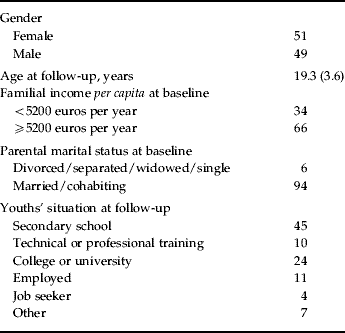
Values given as percentage or mean (standard deviation).
Educational and academic outcomes by level of hyperactivity-inattention symptoms (HI-s)

Values given as percentage or mean (standard deviation).
a Each academic subject performance varied from 0 to 10.
b Secondary school graduation examination in general education setting or post-secondary/university diploma versus no diploma or technical/professional diploma.
Table 4 shows the results of regression analyses for grade retention. Model 1 was significant (Wald χ2=176.71, p<0.0001) and the fit was good (p=0.99). Model 2 was also significant (Wald χ2=182.92, p<0.0001) and the fit good (p=0.95). Anxious/depressed symptoms, ODD symptoms, parental marital status and parental psychopathology were initially entered into the model and were then removed from backwards selection. The interaction terms HI-s×CD symptoms, HI-s×low familial income, HI-s×age, and HI-s×gender were not statistically significant. HI-s and CD symptoms were significantly related to grade retention. When we restricted analyses to youths over 18 at follow-up, the results were similar to what was found in the whole sample before (HI: OR 3.12, 95% CI 1.75–5.58; CD: OR 2.14, 95% CI 1.05–4.35) and after adjustment on school difficulties previous to baseline (HI: OR 2.65, 95% CI 1.46–4.80; CD: 2.01, 95% CI 0.99–4.14).
Childhood hyperactivity-inattention symptoms and other covariates: multiple logistic regression models of grade retention

OR, Odds ratio; CI, confidence interval; CBCL, Child Behavior Checklist.
Model 1 (n=1209) was adjusted for age and gender. Model 2 (n=1182) was adjusted for age, gender and school difficulties prior to baseline.
Because of the occurrence of grade retention prior to baseline in 153 subjects, we conducted further analyses to test the robustness of our findings:
(1) When we restricted analyses to subjects without prior grade retention at baseline, the results remained significant before (HI: OR 3.09, 95% CI 1.99–4.80; CD: 1.74, 95% CI 1.11–2.74) and after adjustment on school difficulties prior to baseline (HI: OR 2.49, 95% CI 1.58–3.94; CD: OR 1.69, 95% CI 1.07–2.68).
(2) When we adjusted the models on grade retention prior to baseline, the results remained significant before (HI: OR 3.16, 95% CI 2.05–4.86; CD: OR 1.61, 95% CI 1.03–2.52) and after adjustment on school difficulties prior to baseline (HI: OR 2.50, 95% CI 1.60–3.90; CD: OR 1.58, 95% CI 1.00–2.48).
*** p<0.001, ** p<0.01, * p<0.05.
Table 5 provides the results of regression models of failure to graduate from secondary school among youths over 18 at follow-up. Model 1 was significant (Wald χ2=127.11, p<0.0001) and the fit was good (p=0.68). Model 2 was also significant (Wald χ2=135.69, p<0.0001) and the fit good (p=0.13). Anxious/depressed symptoms and parental marital status were initially entered into the model, and then removed from backwards selection. The interaction terms HI-s×CD symptoms, HI-s×low familial income, HI-s×age, and HI-s×gender were not statistically significant. HI-s, CD symptoms and low familial income were significantly related to failure in secondary school graduation.
Childhood hyperactivity-inattention symptoms and other covariates: multiple logistic regression models of failure in secondary school graduation examination in youths over 18 at follow-up
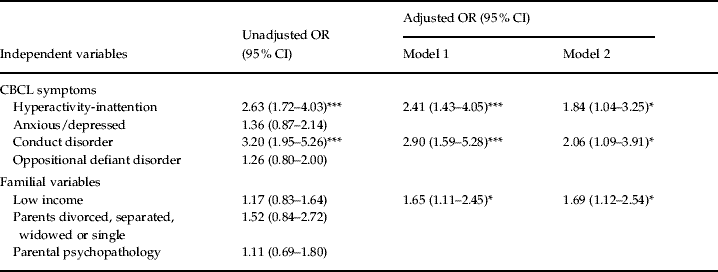
OR, Odds ratio; CI, confidence interval; CBCL, Child Behavior Checklist.
Model 1 (n=718) was adjusted for age and gender.
Model 2 (n=714) was adjusted for age, gender and school difficulties prior to baseline.
*** p<0.001, ** p<0.01, * p<0.05.
Table 6 gives the results of regression analyses for educational underachievement in youths aged over 18 at follow-up. Model 1 was significant (Wald χ2=92.88, p<0.0001) and the fit was good (p=0.47). Model 2 was significant (Wald χ2=105.39, p<0.0001) and the fit was good (p=0.36). Anxious/depressed symptoms and Oppositional defiant disorder symptoms were initially entered into the model, and then removed from backwards selection. The interaction terms HI-s×CD symptoms, HI-s×low familial income, HI-s×age, and HI-s×gender were not statistically significant. HI-s, CD symptoms, and low familial income were significantly related to educational underachievement.
Childhood hyperactivity-inattention symptoms and other covariates: multiple logistic regression models of educational underachievement in youths over 18 at follow-up

OR, Odds ratio; CI, confidence interval; CBCL, Child Behavior Checklist.
Model 1 (n=718) was adjusted for age and gender.
Model 2 (n=714) was adjusted for age, gender and school difficulties prior to baseline.
*** p<0.001, ** p<0.01, * p<0.05.
Table 7 shows the results of multiple linear regression models of global academic performance. Model 1 (global F=33.49, p<0.0001, r 2=0.1226) and model 2 (global F=37.73, p<0.0001, r 2=0.1619) were both significant. Graphical examination of residuals indicated that the hypotheses of normality and homoscedasticity were acceptable. Anxious/depressed symptoms and ODD symptoms were significantly negatively associated with global academic performance in the univariate models but were no longer statistically related to the outcome in the adjusted models. In the final models, standardized β values for HI-s, CD symptoms and low family outcome were significantly negatively related to global academic performance. When we restricted analyses to youths over 18 at follow-up, the results were similar to what was found in the whole sample before (HI: β=−1.12, p<0.0001; CD: β=−1.36, p<0.0001) and after adjustment on school difficulties previous to baseline (HI: β=−0.85, p<0.0001; CD: β=−1.02, p<0.0001).
Childhood hyperactivity-inattention symptoms and other covariates: multiple linear regression models of global academic performance

s.d., Standard deviation; CBCL, Child Behavior Checklist.
Model 1 (n=1203) was adjusted for age and gender.
Model 2 (n=1178) was adjusted for age, gender and school difficulties prior to baseline.
*** p<0.001, ** p<0.01, * p<0.05.
All final predictive models were without multicollinearity (all condition index numbers were <20).
The risk estimates hardly changed with sensitivity analyses. HI-s still predicted negative academic outcomes under MAR assumptions, before (grade retention, p<0.0001; failure in secondary school graduation examination, p=0.0016; educational underachievement, p<0.0001) and after considering school difficulties prior to baseline (grade retention, p<0.0001; failure in secondary school graduation examination, p=0.0416; educational underachievement, p=0.0002). HI-s remained a predictor of negative academic outcomes under NMAR assumptions before (grade retention, p<0.0001; failure in secondary school graduation examination, p=0.0011; educational underachievement, p<0.0001) and after considering school difficulties prior to baseline (grade retention, p<0.0001; failure in secondary school graduation examination, p=0.0488; educational underachievement, p=0.0006).
Discussion
The initial aim of this study was to replicate the finding of a positive link between HI-s in childhood and subsequent academic underachievement in young adulthood. We sought to replicate and extend this finding to a large French population-based sample by using a longitudinal design and limiting the spurious logical bias of circularity. Our results corroborate previous research findings showing a significant relationship between ADHD and poor academic achievement (Loe & Feldman, Reference Loe and Feldman2007). We found evidence of a positive and sizeable association between childhood and adolescent HI-s and negative academic outcomes 8 years later. Children with high levels of HI-s were more than two to three times more likely than those with low levels of symptoms to display negative academic outcomes. This was a robust and consistent pattern of association throughout a large series of measures of underachievement (i.e. grade retention, failure in secondary graduation examination, lower diploma achievement, and lower performance in academic subjects). Of note, this association was independent of other predictors (particularly CD symptoms and low SES) but also remained present after considering school difficulties prior to baseline. This is a methodological strength of our study because it affords inference of causal precedence of risk factors on academic outcomes.
CD symptoms accounted for the risk of poor academic achievement in bivariate analysis and after controlling for other risk factors. Our data provide evidence for a link between CD and academic underachievement beyond ADHD. CD core symptoms such as serious violations of rules could lead to school failure through non-compliance to basic social and academic rules, truancy from school, and repeated exclusions. Other potential causal mechanisms between CD and poor academic performance could be found in the correlates of CD such as a subaverage verbal intelligence, substance use disorders, and environmental risk factors (Moffit & Lynam, Reference Moffit, Lynam, Fowles, Stutker and Goodman1994; Armstrong & Costello, Reference Armstrong and Costello2002). Our finding of a link between CD and academic underachievement is consistent with some previous studies (Hinshaw, Reference Hinshaw1992) but discrepant with other research reports suggesting that, after adjustment for ADHD, CD is no longer a predictor of poor academic outcomes (Fergusson & Horwood, Reference Fergusson and Horwood1995; Rapport et al. Reference Rapport, Scanlan and Denney1999). The latter surveys argued that CD is unrelated to academic underachievement except through its correlation with ADHD. Our results do not support this view. In his review, Hinshaw (Reference Hinshaw1992) suggested that only adolescent and not childhood antisocial behaviour and delinquency could be related to academic failure. A possible explanation for the discrepant results could lie in the age range considered because our sample was older than those of the negative studies. Finally, both externalizing disorders contributed independently to heighten the risk of academic underachievement. This finding should be examined in the French context of the study because there is still controversy in France regarding the validity of these two disorders.
Hypotheses on causal mechanisms for the association between ADHD and academic underachievement have been proposed. It has been posited that ADHD could be related to subsequent poor scholastic achievement through a dual pathway involving behavioural and cognitive mechanisms (Rapport et al. Reference Rapport, Scanlan and Denney1999; Barry et al. Reference Barry, Lynam and Klinger2002; Mash & Barkley, Reference Mash and Barkley2003; Raggi & Chronis, Reference Raggi and Chronis2006). First, and most importantly, ADHD core symptoms of poor concentration, inattention, high distractibility, hyperactivity, impulsivity and motivational deficits seem to play a substantial and direct role in the development of school and academic underachievement. The behavioural core symptoms of ADHD might lead to classroom difficulties through failure to listen to instructions, inability to remember to complete school work, frequent shifting around, excessive verbal and motor activity, and failure to inhibit responses. Of interest, the negative impact of ADHD core symptoms on academic functioning seems to be independent of executive functioning deficits. Second, the cognitive pathway might involve executive functioning deficits such as inabilities in delay response, working memory and self-regulation of behaviours. These mechanisms could contribute to our findings but we could not test them in our data.
It should be stressed that anxious/depressed symptoms and ODD symptoms did not confer a higher risk for negative academic outcomes in the adjusted models. Considering anxious/depressed symptoms, this result is consistent with previous research showing that a link between early depression and later educational underachievement reflects the effect of confounding factors (Fergusson & Woodward, Reference Fergusson and Woodward2002). Regarding ODD, little is known about its link with academic achievement, although the bivariate relationship may be overlooked by the association with CD symptoms.
Parental psychopathology was not a predictor of subsequent academic failure. This might be due to the weakness of our construct of parental psychopathology. It may also correspond to an actual absence of association. Indeed, a recent survey suggested that adult children of depressed parents do not present a higher risk of low academic attainment (Timko et al. Reference Timko, Cronkite, Swindle, Robinson, Turrubiartes and Moos2008).
The study has some methodological limitations. First, attrition was high in this longitudinal data set. However, comparisons between eligible youths and study sample youths in 1991, and comparisons between participants and non-participants in 1999, did not reveal significant baseline differences between participants and non-participants, which lowers the possibility of systematic bias. Hence, our finding of an association between symptoms of HI and poor academic outcome is likely to apply to other community-based populations. Second, participants were recruited among employees of a large state-owned company, which led to the under-representation of individuals with a low SES in our sample. As families with a higher SES were more likely to participate at follow-up, our study represents a rather privileged population. As a result, in other, more varied populations, associations between symptoms of HI and academic achievement may be stronger than we report. Third, a measurement bias might have arisen from the use of self-reported questionnaires. However, self-reporting is known to involve less desirability bias than face-to-face questionnaires (Tourangeau & Yan, Reference Tourangeau and Yan2007), implying that such bias is likely to be negligible. Fourth, we used CBCL scores to obtain proxy DSM diagnoses. Consequently, we had no formal diagnosis of ADHD or psychiatric co-morbidity because symptom duration and associated impaired functioning could not be considered through the empirically based and DSM-oriented scales. However, DSM-oriented scales have shown high levels of validity in terms of significant associations with DSM clinical diagnoses (Achenbach et al. Reference Achenbach, Dumenci and Rescorla2003). Particularly for CD and ODD, DSM-oriented scales have shown a good level of predictive power of DSM-IV diagnoses (Krol et al. Reference Krol, De Bruyn, Coolen and van Aarle2006), showing respectively for CD/ODD problems the following figures: positive predictive power (0.80/0.58), negative predictive power (0.97/0.64), sensitivity (0.88/0.55), specificity (0.86/0.86), and coefficient ϕ (0.64/0.42). In addition, the measure of HI symptomatology allowed us to avoid, at least partially, a circularity bias (by dropping the item ‘poor school work’), which was a strength of our study. Nevertheless, it must be acknowledged that our study, as with any study that investigates the association between ADHD and school performance, is subject to residual circularity. Indeed, the clinical definition of ADHD symptoms includes concentration problems, which are typically appreciated in school situations and often reported by teachers to parents. Hence, a reported concentration problem might directly reflect poor school performance. However, poor concentration per se is an important causal precedence of risk factor on academic outcome, especially because HI-s are generally present in pre-school years. Overall it cannot be entirely excluded that GAZEL Youth study participants with high levels of HI-s had some school-related difficulties prior to baseline. Fifth, we could not consider ADHD subtypes (i.e. inattentive, hyperactive/impulsive or combined), which precludes our ability to explore symptom profiles specifically related to academic outcomes. Sixth, there was a slightly higher female ratio in the follow-up participants. As females are known to exhibit the inattentive ADHD subtype more often, this could have introduced a potential bias. However, we controlled for gender in the statistical analyses. Finally, we controlled for environmental risk factors (i.e. SES, parental psychopathology and parental marital status) and child co-morbid psychopathology (i.e. CD symptoms, ODD symptoms, and anxious/depressed symptoms). However, other factors such as IQ levels, learning disability, executive functioning deficits, bipolar disorder status, adult ADHD status, treatment status, and genetic or biological factors, which might also play a confounding role, were not considered in the present study. Such factors should be controlled for in future studies.
Caution is required regarding the external validity of the results, especially because our sample was potentially biased towards healthier subjects. Nevertheless, because of the consistent repeated positive link between HI-s and academic underachievement, and given the importance of the adverse outcomes related to low academic attainment, children with HI-s should be identified and constitute a target for early interventions. In this connection, stimulant medication has shown a significant effect on classroom measures of attention, cognitive tasks and academic efficiency (Carlson et al. Reference Carlson, Pelham, Swanson and Wagner1991; DuPaul & Rapport, Reference DuPaul and Rapport1993; Elia et al. Reference Elia, Welsh, Gullotta and Rapoport1993). With regard to studies of long-term treatment of ADHD by stimulant medication, recent papers suggested a significant reduction in ADHD core symptomatology and a small effect size of stimulants on academic outcomes (Schachar et al. Reference Schachar, Jadad, Gauld, Boyle, Booker, Snider, Kim and Cunningham2002; Barbaresi et al. Reference Barbaresi, Katusic, Colligan, Weaver and Jacobsen2007; Van der Oord et al. Reference Van der Oord, Prins, Oosterlaan and Emmelkamp2008). In addition, there is little research in ADHD children with respect to the effect of non-pharmacological interventions (such as school support programmes, cognitive behavioural therapy, or supportive therapy) or combined interventions (medication plus psychosocial treatment) on academic outcomes. However, preliminary findings suggest some value of academic interventions such as peer tutoring, computer-assisted instruction, task/instructional modifications, self-monitoring, strategy training, or homework-focused interventions (Raggi & Chronis, Reference Raggi and Chronis2006). Further research is required to determine what type of intervention would benefit ADHD children at risk of academic failure.
Childhood hyperactivity-inattention symptoms are associated with academic underachievement in young adulthood. This finding may lead to better detection of ADHD and academic difficulties at school, so that adequate school support may be given and children may be referred to health professionals. It may guide clinicians in detecting and managing interventions in children and adolescents with ADHD, especially when academic difficulties and conduct problems are present.
Acknowledgements
We thank the EDF-GDF, especially the Service des Etudes Médicales and the Service Général de Médecine de Contrôle, and the ‘Caisse centrale d'action sociale du personnel des industries électrique et gazière’. We also acknowledge the Risques Postprofessionnels (Cohortes de l'Unité mixte 687 Inserm) CNAMTS team responsible for the GAZEL database management. We thank P. Goldberg from INSERM Unit 687, and Dr Johnston from the Institute for Survey Research, Ann Arbor, MI. The GAZEL Cohort Study was funded by EDF-GDF and INSERM, and received grants from the Association de la Recherche sur le Cancer and from the Fondation de France. Funding for this study was provided by a Direction Générale de la Santé grant and a Mission Interministérielle de Lutte contre la Drogue et la Toxicomanie grant to Dr Fombonne.
Declaration of Interest
In the UK, Dr Fombonne provided advice on the epidemiology and clinical aspects of autism to scientists advising parents, to vaccine manufacturers, and to several government committees between 1998 and 2001. Since 2004, Dr Fombonne has been an expert advisor to vaccine manufacturers and the US Department of Health and Social Services with regard to autism thimerosal litigation. None of his research has ever been funded by industry.



