INTRODUCTION
Succession is described by Odum (Reference Odum1969) as an orderly and directional process, in which a set of species changes the physical environment until reaching a stable climax. Vance (Reference Vance1988) and Souza (1979a, b) agree with this description for benthic communities on rocky coasts. However, Sutherland & Karlson (Reference Sutherland and Karlson1977) argue that the initial colonization process of empty spaces and the invasion of later species are determined by larval recruitment and the ability of the host community to resist these invasions. Thus, the composition of the community is always changing, with multiple stable points, and the succession process can be continuously initiated by a disturbance.
The intertidal rocky substrate is a dynamic habitat where empty space is continuously created by wave impact (Sousa, Reference Sousa1979a; Little & Kitching, Reference Little and Kitching1996; Raffaelli & Hawkins, Reference Raffaelli and Hawkins1999), predators (Little & Kitching, Reference Little and Kitching1996) or even by the death of individuals due to desiccation (Sousa, Reference Sousa1979a; Little & Kitching, Reference Little and Kitching1996). These local disturbances, according to Souza (1979a), may be important to determine temporal patterns of species replacement. Farrell (Reference Farrell1991) points out that the colonization sequence and the recovery of a given community to a disturbance is essential for the understanding of its structure.
Most studies on the successional process of benthic communities have been performed on natural rocky substrates (Farrell, Reference Farrell1991; Breves-Ramos et al., Reference Breves-Ramos, Lavrado, Junqueira and Silva2005; Aguilera & Navarrete, Reference Aguilera and Navarrete2007) or on artificial ones (Nandakumar, Reference Nandakumar1996; Zalmon et al., Reference Zalmon, Gamma and Leta1993; Zalmon & Gomes, Reference Zalmon and Gomes2003; Krohling & Zalmon, Reference Krohling and Zalmon2008). Monitoring of the initial colonization and development of benthic communities on granite piers or boulders is scarce, for example, Sousa Reference Sousa(1979a, Reference Sousab) on the coast of California (USA), Tanaka & Magalhães (Reference Tanaka and Magalhães2002) and Tanaka (Reference Tanaka2005) on the coast of São Paulo, Brazil. On the northern coast of Rio de Janeiro studies with this type of substrate are mainly related to general methodological comparisons (Macedo et al., Reference Macedo, Masi and Zalmon2006), zonation (Masi et al., Reference Masi, Macedo and Zalmon2009a) and spatial and temporal variation of the local benthic community (Masi & Zalmon, Reference Masi and Zalmon2008; Masi et al., Reference Masi, Macedo and Zalmon2009b).
Masi et al. Reference Masi, Macedo and Zalmon(2009a) pointed out that anthropogenic alterations such as breakwaters and boulders modify the landscape by adding new habitats and favouring benthic species' recruitment and colonization. However, a recent study by the authors on the area (Masi et al., Reference Masi, Macedo and Zalmon2009b) showed the absence of significant seasonal differences on the community structure despite the high wave exposure mainly in summer months. Within this context, we tested the hypothesis that up to six months after an experimental removal of the intertidal benthic organisms on both Superior and Inferior fringes, the composition and structure of the respective assemblages would be similar to that on undisturbed areas at the same height of the substrate.
Thus ecological succession refers to the sequence of changes in a community that is initiated after a disturbance (sensu Connell & Slatyer, Reference Connell and Slatyer1977).
MATERIALS AND METHODS
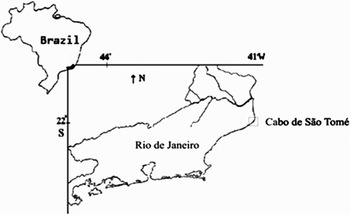
The study was conducted on a breakwater at Farol de São Tomé beach (22°04′S 41°07′W), northern coast of the State of Rio de Janeiro (Figure 1), which has several oil platforms and consequently with potential disturbance events. The rocky substrate is 10 m from the coastline, with a total length of approximately 30 m and has an inclination of 50°. The north-east wind is prevalent in the region throughout the year and winds from the south-west quadrant occur mainly during the passage of cold fronts. Surveys were conducted on the western rocky surface where wave action is less intense.
Study site area at Farol de São Tomé beach, northern coast of Rio de Janeiro.

Experimental design
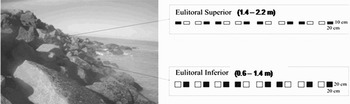
A sampling programme was carried out in two horizontal fringes on the rocky intertidal zone: Inferior Eulittoral (0.6 to 1.4 m above the tide level) and Superior Eulittoral (1.4 to 2.2 m above the tide level) (Figure 2), with the highest and lowest species richness and diversity (according to Masi et al., Reference Masi, Macedo and Zalmon2009a). The experimental design was based on the minimum pre-determined sample size for the study area (Barbiero, Reference Barbiero2009), with quadrats of 400 cm2, 80 sampling points and eight vertical profiles in the Inferior fringe and 200 cm2 with 40 points and eight profiles in the Superior fringe.
Schematic representation of the experimental design with randomized blocks in the Inferior (0.6 to 1.4 m) and Superior Eulittoral fringes (1.4 to 2.2 m) (sensu Masi et al., Reference Masi, Macedo and Zalmon2009a). Black quadrats, control treatment; white quadrats, removal treatment.

In each fringe two quadrats per profile (N = 8) were marked and photographed, one for the removal treatment of all benthic organisms (N = 8), which corresponded to an experimental disturbance and the other to the one without removal (N = 8). A randomized block design was used to reduce the probability of the segregation risk of treatments (Hurlbert, Reference Hurlbert1984) (Figure 1). Scraping with a spatula and wire brush constituted the removal process in December 2007. All quadrats were photographed and sampled prior to scraping before removal (BR) for future reference. Samples were taken by photo-quadrat in February, April and June 2008 and will be cited as T2, T4 and T6, corresponding to 2, 4 and 6 months of succession, respectively.
All quadrats (control and removal) in the sample profiles were analysed with the CPCe v. 3.5 software program (Coral Point Count for Excel), which estimates bare spaces and the species percentage cover applied to a digital grid of the scanned photographs. The distinction between primary and secondary canopy was not considered.
Data analysis
The benthic assemblages at the different fringes (Inferior and Superior Eulittoral) and treatments (control and removal) were evaluated through taxonomic composition, richness, average species cover percentage, Brillouin diversity (loge) and Pielou evenness in each profile. Temporal differences in community structure parameters were tested by one-way analysis of variance for repeated measures (ANOVA-RM) with α = 0.05 (Zar, Reference Zar1996), since the same local was examined during the study, followed by the Tukey test. Differences between treatments (control and removal) were tested by t-test for dependent samples. The normality and homogeneity of variances of the data were tested a priori by Shapiro–Wilk W and Cochran test, respectively. The values were log-transformed to minimize heteroscedasticity (Zar, Reference Zar1996).
The comparative analysis of the benthic assemblages at both treatments and periods at the different fringes included a multi-dimensional scaling (MDS) with Bray–Curtis similarity coefficient for percentage data. The adequacy of the configuration of the samples for MDS was obtained from stress value (Clarke & Warwick, Reference Clarke and Warwick2001). The analysis of similarities (ANOSIM) permutation test (one-way) was used to evaluate the significance of group differences from the MDS method. The similarity matrices included the percentage cover of the organisms present at each successional period of each treatment on each fringe. The units sampled at the same fringe (each treatment and period) were treated separately to increase the permutations possibility and, consequently, the power of the test (Clarke & Warwick, Reference Clarke and Warwick2001). The similarity percentages procedure (SIMPER) defined the contribution of the most abundant species between and within groups for the MDS. A cut-off of cumulative dissimilarity of 80% was applied (Masi & Zalmon, Reference Masi and Zalmon2008). Data analysis was performed with PRIMER 6 software.
RESULTS
Inferior Eulittoral zone (0.6 to 1.4 m above the tide level)
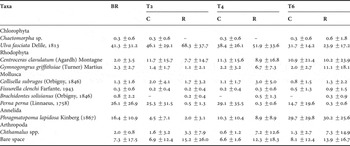
Before the removal of all organisms (BR) in December 2007, we recorded ten epibenthic species, six invertebrates and four algae (Table 1), predominantly the chlorophyte Ulva fasciata (41%), the bivalve Perna perna (26%) and the polychaete Phragmatopoma lapidosa (16%). The other species covered less than 2.5% and bare space corresponded to 7% of the total.
Species composition, bare space and percentage cover average values ± SD on control (C) and removal (R) treatments in the Inferior Eulittoral fringe (0.6 to 1.4 m), Farol de São Tomé beach. BR, before removal; T2, 2 months; T4, 4 months and T6, 6 months after removal. Quadrats of 400 cm2 with 80 sampling points (N = 8 profiles).

During the succession process study in the control treatment, U. fasciata and Perna perna predominated until month 4, the latter being replaced in dominance by Phragmatopoma lapidosa. The remaining species recovered less than 3% of the substrate, except the rhodophyte Centroceras clavulatum with constant abundance of about 11% (Table 1). In the removal treatment U. fasciata also prevailed until month 4, together with P. lapidosa in the sixth month. The scarcity of Perna perna in this treatment but the most abundant in control should be noted. An increasing tendency was observed for the cirripede Chthamalus spp. and for rhodophytes C. clavulatum and Gymnogongrus griffithsiae. The other species presented an average abundance below 3% and empty space accounted for approximately 14% of the sampled area (Table 1).
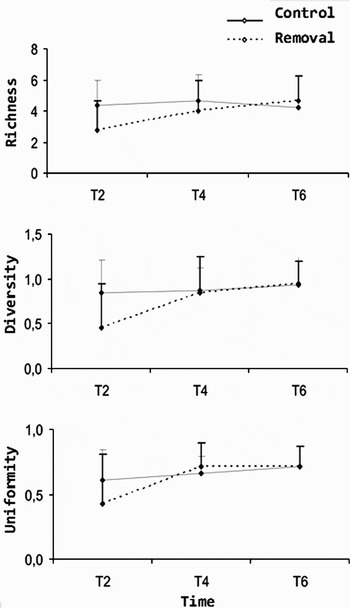
Community parameters showed a stable temporal pattern in the control quadrats for richness, diversity and evenness values (Figure 3), with no significant differences (P > 0.05). In the removal treatment, an increasing tendency followed by stabilization was observed (Figure 3), with significant lower values on T2 for richness (F = 7:24, P < 0.01) and diversity (F = 9:41, P < 0.01). Higher values were recorded on control treatment in T2 but with no significant differences between treatments.
Inferior Eulittoral fringe (0.6 to 1.4 m): average values (±SD) of species richness, Brillouin diversity and Pielou uniformity of the benthic assemblages on control and removal treatments in each successional period, Farol de São Tomé beach. Quadrats of 400 cm2 with 80 sampling points (N = 8 profiles).

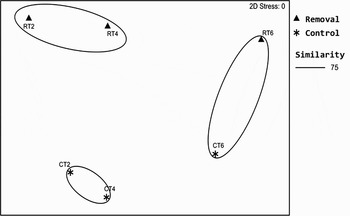
The MDS analysis at the different succession periods including both treatments showed three main groups with 75% similarity: Group 1 with T2 and T4 of the removal treatment, Group 2 with T2 and T4 of the control one and Group 3 with T6 for both treatments (Figure 4), showing the high similarity of the sixth month assemblages. The zero stress value indicates a good graphic representation (Figure 4). The ANOSIM revealed a significant difference between the groups (R = 0.944, P: 0.1%).
Inferior Eulittoral fringe (0.6 to 1.4 m): MDS representation (Bray–Curtis similarity) of the benthic assemblages in each successional period (T2, T4 and T6) on control (C) and removal (R) treatments, Farol de São Tomé beach. Quadrats of 400 cm2 with 80 sample points (N = 8 profiles).

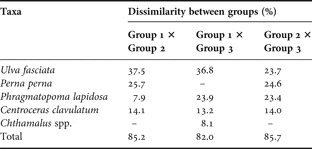
The SIMPER analysis revealed that Ulva fasciata was the species that contributed most to the similarity of Group 1 (T2 and T4 of removal—85.4%) and Group 2 (T2 and T4 of control—59.8%), and Perna perna (21.5%) in the latter. In Group 3 (T6 of removal and control quadrats), U. fasciata (48.5%) and Phragmatopoma lapidosa (38.4%) were the main components for the similarity in this succession period.
The dissimilarity of >80% between groups was mainly due to the co-dominance of Ulva fasciata–Perna perna in the control treatment in T2–T4 (Group 2) and U. fasciata–Phragmatopoma lapidosa in T6 in both treatments (Group 3) (Table 2).
Inferior Eulittoral fringe (0.6 to 1.4 m): SIMPER analysis with the species percentage contribution to the dissimilarity between treatments and sucessional periods on each group of the MDS method, Farol de São Tomé beach.

Superior Eulittoral fringe (1.4 to 2.2 m above the tide level)
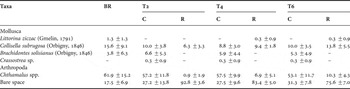
Before the removal of all organisms (BR) we recorded only four epibenthic species of invertebrates: Chthamalus spp. (62%), the gastropod Collisella subrugosa (16%), the bivalve Brachidontes solisianus (4%) and the gastropod Littorina ziczac (1%). Bare space represented approximately 17% of the total (Table 3).
Species composition, bare space and percentage cover average values ± SD on control (C) and removal (R) treatments in the Superior Eulittoral fringe (1.4 to 2.2 m), Farol de São Tomé beach. BR, before removal; T2, 2 months; T4, 4 months and T6, 6 months after removal. Quadrats of 200 cm2 with 40 sample points (N = 8 profiles).

During the successional process study in the control treatment, Chthamalus spp. prevailed in all periods with average coverage of ~55%, followed by Collisella subrugosa and B. solisianus, both with constant abundance of ~10% and 6%, respectively (Table 3). Bare space accounted for approximately 27–31%. In the removal treatment, more than 75% of the substrate was empty from T2 to T6, and B. solisianus was recorded just prior to the removal. Only C. subrugosa and Chthamalus spp. tended to increase in abundance, reaching an average coverage of approximately 14% and 10%, respectively, at T6 (Table 3).
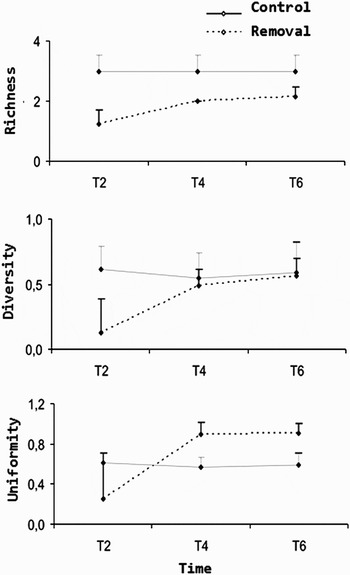
Community parameters showed a stable temporal pattern in the control plots for richness, diversity and evenness values with no significant differences (Figure 5). In the removal treatment, it was observed an increasing tendency followed by stabilization in T4 (Figure 5). Significant temporal differences were recorded for richness (F = 14:33, P < 0.01), diversity (F = 17:53, P < 0.01) and evenness (F = 18:07, P < 0.01), mainly between T2 and the other periods. Significantly higher richness (t = −8.20, P < 0.01) and diversity values (t = −2.56, P = 0.01) were recorded in the control treatment.
Superior Eulittoral fringe (1.4 to 2.2 m): average values (±SD) of richness, Brillouin diversity and Pielou uniformity of the benthic assemblages on control and removal treatments in each successional period, Farol de São Tomé beach. Quadrats of 200 cm2 with 40 sample points (N = 8 profiles).

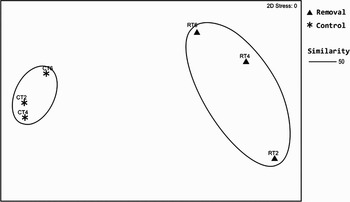
The MDS analysis at the different succession periods of both treatments showed two main groups including each treatment separately, which indicates the dissimilarity between the two assemblages on all studied periods (Figure 6). The zero stress value indicated a good representation of the true multivariate pattern (Figure 6). The ANOSIM evidenced significant differences between the groups (R = 0.99, P: 0.1%).
Superior Eulittoral fringe (1.4 to 2.2 m): MDS representation (Bray–Curtis similarity) of the benthic assemblages in each successional period (T2, T4 and T6) on control (C) and removal (R) treatments, Farol de São Tomé beach. Quadrats of 200 cm2 with 40 sample points (N = 8 profiles).

The SIMPER analysis revealed that Chthamalus spp. (81.8%) was the taxon that contributed the most to the similarity in the control Group 1, while in the removal Group 2 Collisella subrugosa (74.8%) was the main component for the similarity. As for the dissimilarity between the groups, the cirripede (82.2%) was the main contributor to the differences between treatments in the three successional periods, due to its dominance only at the control treatment.
DISCUSSION
Inferior Eulittoral fringes
Ulva fasciata corresponded to the dominant colonizing species after total organisms' removal, covering about 70% of the substrate. The rapid colonization of Ulva spp. was documented on temperate (Sousa, Reference Sousa1979a, Reference Sousab) and tropical shores (Dye, Reference Dye1993; Breves-Ramos et al., Reference Breves-Ramos, Lavrado, Junqueira and Silva2005; Aguilera & Navarrete, Reference Aguilera and Navarrete2007). Sousa Reference Sousa(1979a) stated that chlorophytes are usually the first to occupy and dominate the available space due to opportunistic characteristics such as production of large numbers of mobile seedlings with rapid growth to maturity. In this study, the dominance of U. fasciata up to four months reflected in lower richness and diversity values. Raffaelli & Hawkins (Reference Raffaelli and Hawkins1999) and Miyamoto & Noda (Reference Miyamoto and Noda2004) stated that the dominance in intertidal habitats strongly affects the community, contributing to the lower structural indicators (Clarke & Warwick, Reference Clarke and Warwick2001).
The results indicate that when space is opened in the Inferior Eulittoral fringe, the dominant species prior to the disturbance have the ability to recolonize the substrate in up to two months. In the lower intertidal zone, shorter emersion periods reduce the stress from desiccation and allow the continuity of several organisms. Underwood & Chapman (Reference Underwood and Chapman2000) found that environmental conditions are less drastic and the number of animals is often highly variable due to the fluctuations in recruitment, predation and competition processes, which occur more quickly on this shore level. Among the ten species present prior to the scraping of the substrate below this zone, nine were already recorded in T2.
The species U. fasciata, Perna perna and Phragmatopoma lapidosa were the most abundant before the scraping, and only the bivalve was not considered to be a pioneer species since three individuals (<1%) were recorded from T2 to T6, while in the control treatment its coverage ranged from 15 to 30% over the six-month study. Rocha (Reference Rocha2002) did not observe a significant recruitment of Perna perna in south-east Rio de Janeiro, even when there was available substrate, and attributed this to the preference of the bivalve for recruitment on conspecifics, where the juveniles would have greater protection against wave action and predators. Lasiak & Barnard (Reference Lasiak and Barnard1995) suggested that the dispersal phase of P. perna increases the likelihood of loss of recruits by not finding suitable substrates. McQuaid & Lindsay (Reference McQuaid and Lindsay2005) observed that intense wave action could contribute to a secondary non-feasible pelagic phase. The preference for conspecifics on recruitment, the intense exposure to waves (Masi et al., Reference Masi, Macedo and Zalmon2009b), or even a low availability of larvae at the time of the disturbance event might explain the non-recolonization of P. perna.
The other dominant species, Ulva fasciata and Phragmatopoma lapidosa showed, respectively, a reduction and an increase in their abundances over the six month period of succession, with the same tendency in both control and removal treatments. The chlorophytes, as opportunistic species, present a short life cycle (Sousa, Reference Sousa1979a) with an initial predominance followed by a reduction over time. The polychaetes of the Sabellariidae family settle on aggregation of adults' tubes (according to Zamorano et al., Reference Zamorano, Moreno and Duarte1995) and expand themselves by lateral migration. Such a behaviour on P. lapidosa would contribute to the competitive success of the species. Moreover, U. fasciata may have facilitated the colonization (according to the classical definition used by Connell & Slatyer, Reference Connell and Slatyer1977) of the sandstone forming polychaete, making the environment more accessible for P. lapidosa colonization.
Considering the algal succession, it is common for chlorophytes to be replaced by rhodophytes (Sousa, Reference Sousa1979a, Reference Sousa1984; Moysés, Reference Moysés2005). In this study, the initial sequence corresponded to those in other intertidal communities, with a greater abundance of U. fasciata in the first stage and the subsequent population increase of rhodophytes as Gymnogongrus griffithsiae and Centroceras clavulatum.
The recolonization of the substrate to 90% coverage two months after scraping, combined with (ii) no significant differences in richness, diversity and uniformity values between treatments, and especially (iii) the 75% similarity between control and removal assemblages on the fourth to sixth months showed a tendency of convergence on the community composition and structure in the Inferior Eulittoral fringe. Thus, it is suggested a directional and orderly succession process (sensu Odum, Reference Odum1969) in a time scale of four to six months after a disturbance event with a total organisms' removal in this lower intertidal zone on the studied breakwater. However, it is emphasized that this stability tendency recorded in T4–T6 may also reflect one of the multiple stable points (sensu Sutherland & Karlson, Reference Sutherland and Karlson1977) of the local benthic community.
Superior Eulittoral fringe
The Superior Eulittoral fringe is the higher intertidal level, where the organisms are submitted to greater physical stress due to longer air exposition and higher temperatures (Little & Kitching, Reference Little and Kitching1996; Underwood & Chapman, Reference Underwood and Chapman2000). The cirripede Chthamalus spp. prevailed at this level with >50% coverage prior to the scraping and over the six-month study in the control treatment. In the removal quadrats, the successional process started with the colonization of the substrate by the herbivorous gastropod Collisella subrugosa followed by Chthamalus spp.; they both remained as the main taxa in the sixth months. The initial colonization in the Superior intertidal fringe by grazers, gastropods and barnacles, is also observed worldwide by Menge (Reference Menge1976), Sousa (Reference Sousa1984), Farrell (Reference Farrell1991) and Tanaka & Magalhães (Reference Tanaka and Magalhães2002), who showed that these organisms are usually tolerant to physical stresses at higher levels. Collisella subrugosa colonized the empty substrate by lateral migration of adults, staying mainly at the edges. This behaviour was also observed by Tanaka & Magalhães (Reference Tanaka and Magalhães2002) and has been interpreted as a defence or as a refuge from desiccation and wave impact (Sousa, Reference Sousa1984). The earlier colonization by barnacles is due to their increased tolerance to heat stress and intense hydrodynamic processes (Menge, Reference Menge1976; Kawai & Tokeshi, Reference Kawai and Tokeshi2004).
Chthamalus spp. showed a slow colonization process, since it covered only 10% of the substrate after six months compared to the control with 50–60% coverage. According to Rodriguez et al. (Reference Rodriguez, Ojedal and Inestrosa1993) and Ross (Reference Ross2001), several factors acting during the settlement and post-settlement periods may affect the survival and determine the recruitment patterns of barnacles. A high post-settlement mortality may have contributed since the scraping process of the substrate occurred in December, early summer on a tropical coast, thus subjecting the potential newly settled organisms to higher air temperatures (highest mean temperatures: 29°C, http://www.mar.mil.br/dhn/chm/meteo).
Grazing activity of herbivore gastropods is also an important factor for understanding the recruitment patterns on intertidal shores (Moysés, Reference Moysés2005). According to Wahl & Hoppe (Reference Wahl and Hoppe2002), these organisms can affect the recruitment by the removal of recruits, including their own, either directly by accidental ingestion during grazing activity, by the occupation of available space or by the secretion of mucus in displacement, which makes the substrate unsuitable for the larvae settlement. Once the herbivorous gastropod Collisella subrugosa was the only one observed colonizing the bare substrate, it also may have affected the cirripede recruitment.
Several authors recognize that the larvae availability interferes in recruitment, colonization and abundance of epibenthic species (Forde & Raimondi, Reference Forde and Raimondi2004; López & Coutinho, Reference López and Coutinho2008). Brachidontes solisianus was recorded before the removal process and subsequently over the six months, but only in the control treatment. Moysés (Reference Moysés2005), by monitoring the intertidal benthic community succession in southern Rio de Janeiro, observed that B. solisianus preferentially recruited in gaps or inside empty shells after the scraping of quadrats. Petersen (1984, in Tanaka, Reference Tanaka2005) stated that recruitment of mussels depended on the availability of local features, mainly secondary substrates such as algae, barnacles or even adult mussel stock. In our removal treatment, the substrate remained with at least 75% of empty space until the sixth month and the only species in addition to Chthamalus spp. with a maximum of 10% coverage, were ‘crawlers’ such as Collisella subrugosa and Littorina ziczac, so that the substrate possibly did not present favourable characteristics for colonization.
The substrate heterogeneity may have an important role in the larvae settlement according to several authors, especially Blanchard & Bourget (Reference Blanchard and Bourget1999), Skinner & Coutinho (Reference Skinner and Coutinho2005) and Lopéz & Coutinho (Reference López and Coutinho2008). The environment studied is a granite jetty with a high topographic complexity (Masi & Zalmon, Reference Masi and Zalmon2008). These systems provide greater availability of microhabitats (Murray et al., Reference Murray, Ambrose and Dethier2006), retaining moisture during low tide and serving as a refuge from desiccation, mechanical impact from waves and predators (Blanchard & Bourget, Reference Blanchard and Bourget1999; Raffaelli & Hawkins, Reference Raffaelli and Hawkins1999; Skinner & Coutinho, Reference Skinner and Coutinho2005). In the upper substrate level, where conditions are more stressful, we observed the preference of Chthamalus spp. Collisella subrugosa and L. ziczac for living in cracks and crevices (personal observation), which may have contributed to the empty space availability over the six months after scraping the substrate.
Besides the physical stress in the highest intertidal zone, intraspecific competition may also limit the ability to live in this upper zone of the substrate, influencing the benthic community structure (Connell, Reference Connell1961; Menge, Reference Menge1976; Little & Kitching, Reference Little and Kitching1996; Raffaelli & Hawkins, Reference Raffaelli and Hawkins1999). Throughout the study period, competition for space was not a limiting factor in the Superior Eulittoral fringe, given the abundant empty space (>75% of the quadrat), probably due to local physical stress, heightened by the wave exposure. Tidal oscillation, wave action and temperature are important limiting factors to benthic community structure on rocky shores (Little & Kitching, Reference Little and Kitching1996; Murray et al., Reference Murray, Ambrose and Dethier2006). Masi et al. Reference Masi, Macedo and Zalmon(2009b) studying the benthic community on the same breakwater recorded an average summer air temperature of 25–30°C, that added to the 100% emersion period from 1.4 m tide level may have provided a very limiting environment with increased stress caused by heating and drying.
In the present study it was possible to show the differences on the succession process over six months in two fringes of a rocky intertidal zone. In the Inferior Eulittoral fringe the composition and structure of the benthic community showed a convergence tendency in relation to the control one. The same was not observed in the Superior Eulittoral fringe, where the substrate colonization was slower, with >75% empty space in the scraped quadrats versus ~25% in the control ones. The control and removal quadrats showed a high dissimilarity in all succession periods and suggest that after a six-month time scale at this superior intertidal height, the benthic community remained at an earlier succession stage. In the Inferior Eulittoral fringe with less stressful environmental conditions, the local benthic community showed a stability tendency on a time scale less than six months. Thus, the hypothesis that after an experimental removal of benthic organisms the assemblages will be similar in composition and structure to an undisturbed area on a time scale of six months was only accepted for the Inferior Eulittoral fringe. Such information is essential for the understanding of the community structure and the recovery time in relation to a given disturbance and should be applied routinely on areas with potential disturbance events such as the studied one, which has several oil platforms.
ACKNOWLEDGEMENTS
To CAPES and FAPERJ (Brazilian Research Foundations) for the financial support; and to Dr Jean-Christophe Joyeux (Universidade Federal do Espírito Santo) for the assistance with statistical analysis.