Introduction
Social anxiety is characterised by an intense fear of negative evaluation and judgment in social situations that often leads to the avoidance of a range of socially evaluative situations (American Psychiatric Association, 2013; Rapee & Spence, Reference Rapee and Spence2004). Social anxiety can impair occupational, educational, and interpersonal functioning, even when it is not at diagnosable levels (Porter & Chambless, Reference Porter and Chambless2014; Ruscio et al., Reference Ruscio, Brown, Chiu, Sareen, Stein and Kessler2008; Sparrevohn & Rapee, Reference Sparrevohn and Rapee2009; Wittchen & Fehm, Reference Wittchen and Fehm2003). Further, social anxiety severity has been shown to be predictive of romantic relationship status (e.g., Schneier et al., Reference Schneier, Heckelman, Garfinkel, Campeas, Fallon, Gitow and Liebowitz1994; Wittchen, Fuetsch, Sonntag, Mueller, & Liebowitz, Reference Wittchen, Fuetsch, Sonntag, Mueller and Liebowitz2000). Yet there is limited research investigating social anxiety and the detrimental impacts on intimate relationships, particularly in romantic relationships (Afram & Kashdan, Reference Afram and Kashdan2015; Alden & Taylor, Reference Alden and Taylor2004). Alden and Taylor (Reference Alden and Taylor2004) highlighted in their review that more research was needed into the specific interpersonal behaviours demonstrated by those with high social anxiety symptoms, and how these behaviours may influence the development of romantic relationships. The interpersonal effects of clinical and sub-clinical social anxiety are broad and include being less likely to have close friends; poorer friendship quality; impaired family relationships; fewer dating, committed, and sexual relationships; and less likely to be married than individuals with other anxiety disorders or the general population (e.g., Alden & Taylor, Reference Alden and Taylor2004; Lampe, Slade, Issakidis, & Andrews, Reference Lampe, Slade, Issakidis and Andrews2003; Montgomery, Haemmerlie, & Edwards, Reference Montesi, Conner, Gordon, Fauber, Kim and Heimberg1991; Rodebaugh, Reference Rodebaugh2009; Schneier et al., Reference Schneier, Heckelman, Garfinkel, Campeas, Fallon, Gitow and Liebowitz1994; Schneier, Johnson, Hornig, Liebowitz, & Weissman, Reference Schneier, Johnson, Hornig, Liebowitz and Weissman1992; Wittchen & Beloch, Reference Wittchen and Beloch1996; Wittchen & Fehm, Reference Wittchen and Fehm2003; Wittchen et al., Reference Wittchen, Fuetsch, Sonntag, Mueller and Liebowitz2000). To date, the reasons why individuals high on social anxiety are less likely to be in romantic relationships are not well understood.
For those with social anxiety who are in committed romantic relationships, many report high levels of interpersonal difficulty in these relationships (Porter & Chambless, Reference Porter and Chambless2014). It has been proposed that the quality of romantic relationships appears to be jeopardised for individuals with social anxiety (Cuming & Rapee, Reference Cuming and Rapee2010). For example, socially anxious people rate their relationships as lower in emotional intimacy than non-anxious controls, indicating feelings of being neglected, lonely, and as though their partner does not listen or understand (Wenzel, Reference Wenzel, Harvey and Wenzel2002). Individuals with social anxiety are also more likely to be critical of partners during negative interactions (Wenzel, Graff-Dolezal, Macho, & Brendle, Reference Wenzel, Graff-Dolezal, Macho and Brendle2005), experience reduced closeness to partners when mutual pain/distress is expressed (Kashdan, Volkmann, Breen, & Han, Reference Kashdan, Volkmann, Breen and Han2007), and experience greater rejection concern following a rejection induction with their partner (Afram & Kashdan, Reference Afram and Kashdan2015). Further, individuals with social anxiety report lower relationship satisfaction in their intimate relationships (Schneier et al., Reference Schneier, Heckelman, Garfinkel, Campeas, Fallon, Gitow and Liebowitz1994; Sparrevohn & Rapee, Reference Sparrevohn and Rapee2009). Despite this evidence, the relationship-related processes associated with romantic relationship satisfaction for those experiencing social anxiety are not well known. It is possible that there may be several factors that could be linked to why the quality of relationships is less satisfying for those with social anxiety, yet only a few studies have begun to examine these factors (e.g., Beck, Davila, Farrow, & Grant, Reference Beck, Davila, Farrow and Grant2006; Davila & Beck, Reference Davila and Beck2002; Montesi et al., Reference Montesi, Conner, Gordon, Fauber, Kim and Heimberg2013).
The present study adds to this literature by investigating whether differences in relationship process variables — namely self-disclosure, perceived social support, conflict initiation, and trust — may help explain relationship satisfaction for individuals with higher social anxiety. Research suggests that individuals with social anxiety disorder self-disclose less personal information to their romantic partners than non-anxious individuals (Cuming & Rapee, Reference Cuming and Rapee2010; Sparrevohn & Rapee, Reference Sparrevohn and Rapee2009). They also perceive social support from intimate partners differently when compared to non-anxious individuals (Cuming & Rapee, Reference Cuming and Rapee2010; Porter & Chambless, Reference Porter and Chambless2014). For example, socially anxious women reported desiring less social support than their less anxious counterparts (Porter & Chambless, Reference Porter and Chambless2014). Findings are mixed, however, about the effect of higher levels of partner support on outcomes; with Beck et al. (Reference Beck, Davila, Farrow and Grant2006) finding that higher support was linked to higher distress for socially anxious women, whereas Porter and Chambless (Reference Porter and Chambless2014) showed that higher support was associated with increased relationship satisfaction for highly socially anxious individuals. Thus, further research is needed to clarify how perceived social support relates to relationship satisfaction for individuals with higher social anxiety. In relation to conflict initiation, individuals with high social anxiety tend to avoid conflict (Davila & Beck, Reference Davila and Beck2002), and conflict avoidance has been associated with higher relationship satisfaction for those high in social anxiety (Kashdan et al., Reference Kashdan, Volkmann, Breen and Han2007). Further, scant research has been conducted examining trust, particularly dyadic trust, in populations experiencing social anxiety symptoms. Yet preliminary evidence shows that high levels of social anxiety symptoms are associated with increased interpersonal dependence in intimate relationships (Darcy, Davila, & Beck, Reference Darcy, Davila and Beck2005), and individuals with social anxiety disorder have lower mean levels of generalised trust than those without social anxiety disorder (Bienvenu et al., Reference Bienvenu, Nestadt, Samuels, Costa, Howard and Eaton2001). As dyadic trust includes beliefs about the trustworthiness of an intimate partner, it is possible that it may be particularly relevant for those with higher social anxiety. Further research examining dyadic trust in romantic relationships for those with high social anxiety symptoms is therefore warranted.
As depression commonly co-occurs with social anxiety disorder, a shared internalising factor is purported to underlie both disorders (Mewton, Hobbs, Sunderland, Newby, & Andrews, Reference Mewton, Hobbs, Sunderland, Newby and Andrews2014). Both social anxiety and major depression have a markedly increased onset in the pre-adolescent to adolescent years (Rapee et al., Reference Rapee, Oar, Johnco, Forbes, Fardouly, Magson and Richardson2019). Cuming and Rapee (Reference Cuming and Rapee2010) suggested that it is possible that a self-protective communication style in romantic relationships may be one mechanism through which social anxiety may contribute to the development of depression. Interpersonal theories of depression, such as Coyne (Reference Coyne1976) and Lewinsohn (Reference Lewinsohn, Friedman and Katz1974), indicate that an unwillingness to provide personal information in romantic relationships may amplify the risk of depression through greater conflict and lower social support. Social anxiety and depression also share a number of risk factors and both have negative emotionality as a core symptom (Rapee et al., Reference Rapee, Oar, Johnco, Forbes, Fardouly, Magson and Richardson2019). Similarly, there are cognitive biases in social information processing present for both disorders (Klein, de Voogd, Wiers, & Salemink, Reference Klein, de Voogd, Wiers and Salemink2018; Spithoven, Bijttebier, & Goossens, Reference Spithoven, Bijttebier and Goossens2017). There is also considerable evidence that social anxiety and depression are discrete disorders with different psycho-social outcomes (Daneel et al., Reference Danneel, Geukens, Maes, Bastin, Bijttebier, Colpin and Goossens2020; Rapee et al., Reference Rapee, Oar, Johnco, Forbes, Fardouly, Magson and Richardson2019). For example, anxiety in social situations is central to social anxiety disorder, but is not necessarily experienced by those who are depressed (Daneel et al., Reference Danneel, Geukens, Maes, Bastin, Bijttebier, Colpin and Goossens2020). Further, individuals experiencing depression may experience negative affect in multiple areas in life, which may not impact their social relationships (Daneel et al., Reference Danneel, Geukens, Maes, Bastin, Bijttebier, Colpin and Goossens2020). Due to the comorbidity of social anxiety and depression, researchers have suggested that depression may be an important confound when understanding the links between social anxiety and relationship satisfaction, as depression is strongly associated with decreased relationship satisfaction (e.g., Porter & Chambless, Reference Porter and Chambless2014). Although some studies have attempted to clarify the association between social anxiety and relationship satisfaction by controlling for depression in their analyses (e.g., Cuming & Rapee, Reference Cuming and Rapee2010; Porter & Chambless, Reference Porter and Chambless2014), findings remained mixed. Thus, further research is needed to help clarify whether social anxiety independently contributes to relationship satisfaction above and beyond depression symptomology.
To address these issues, the current study was conducted to explore associations between social anxiety and romantic relationships. The first aim of this study was to replicate the existing literature (e.g., Schneier et al., Reference Schneier, Heckelman, Garfinkel, Campeas, Fallon, Gitow and Liebowitz1994; Wittchen et al., Reference Wittchen, Fuetsch, Sonntag, Mueller and Liebowitz2000) that demonstrates that social anxiety severity is predictive of relationship status. It was therefore hypothesised that social anxiety severity would be associated with relationship status, with individuals who were currently in a relationship reporting lower levels of social anxiety than those who had never been in a relationship. The second aim of this study was to identify the extent to which the association between social anxiety severity and relationship satisfaction is independent of depression. As Cuming and Rapee (Reference Cuming and Rapee2010) found that social anxiety was related to relationship satisfaction even when controlling for depression, it was hypothesised that social anxiety severity would be a unique predictor of relationship satisfaction, over and above depression. The third aim of this study was to explore whether social anxiety severity may interact with any of the relationship-related processes to predict relationship satisfaction for those in a current committed romantic relationship. It was hypothesised that social anxiety severity would interact with one or more of the relationship-related process variables (i.e. self-disclosure, social support, trust, and conflict initiation) to predict relationship satisfaction.
Methods
Procedure
This study was approved by the Macquarie University's Human Ethics Committee (#5201500052). All participants completed informed consent, demographic questionnaires, and an assessment of social anxiety severity (Liebowitz, Reference Liebowitz1987). Individuals in current relationships completed the satisfaction sub-scale (SS) of the Investment Model Scale (Rusbult, Martz, & Agnew, Reference Rusbult, Martz and Agnew1998), depression sub-scale of the Depression Anxiety Stress Scales (DASS-D; Lovibond & Lovibond, Reference Lovibond and Lovibond1995), Revised Self-Disclosure Scale (RSDS; Wheeless, Reference Wheeless1978), Significant Other Sub-scale of the Multidimensional Scale of Perceived Social Support (Zimet, Dahlem, Zimet, & Farley, Reference Zimet, Dahlem, Zimet and Farley1988), Dyadic Trust Scale (DTS; Larzelere & Huston, Reference Larzelere and Huston1980), and Initiator Style Questionnaire (ISQ; Denton & Burleson, Reference Denton and Burleson2007).
Participants
A convenience sample of 564 Australian adults was recruited using two strategies: (1) students recruited through Macquarie University's psychology undergraduate course with an incentive of course credit and (2) community participants were recruited through advertisements posted on social media accounts and in social anxiety online forums, as well as printed fliers posted in Australian shopping centres. Community participants were incentivised by entry into a prize draw for one of two $50 gift cards. Inclusion criteria were that participants were aged 18 years or over and currently residing in Australia. Due to likely random responding, 106 individuals (18.79%) were excluded. A further 14 participants (2.48%) were excluded as they had over 10% of missing data (in accordance with Bennett, Reference Bennett2001). Table 1 shows demographic information for the final 444 participants.
Demographic Information and Chi-square Test Results for Current Relationships, Previous Relationships, and No Relationships

Note: n = 188 for current relationships, n = 101 for previous relationships, and n = 155 for no relationships. Items in bold indicate significance at Bonferroni-adjusted alpha of p = .05/5 = <.01. Eastern religions = Buddhism, Hinduism, and Islam.
Measures
Relationship status
Participants were divided into three groups based on their relationship status. Groups included those in a current relationship lasting longer than 3 months (current relationships: n = 188, 42.34%), those not currently in a relationship but with a previous relationship lasting longer than 3 months (previous relationships: n = 101, 22.75%), and those who had never been in a relationship longer than 3 months (no relationships: n = 155, 34.91%). A 3-month duration cut-off was selected to be consistent with Beck et al. (Reference Beck, Davila, Farrow and Grant2006) who examined romantic relationship factors with socially anxious women and their partners. Beck et al. (Reference Beck, Davila, Farrow and Grant2006) indicated that this benchmark had been selected based on an examination of the literature examining dating samples in the Journal of Personality and Social Psychology since 1987, and it was demonstrated that individuals selected with this duration cut-off indicated that they experienced their relationships as intimate and reported being highly committed.
Social anxiety symptoms
The Liebowitz Social Anxiety Scale – Self-Report Version (LSAS; Liebowitz, Reference Liebowitz1987) consists of 24 social situations against which participants self-report their fear (0 = none to 3 = severe) and avoidance (0 = never 0% to 3 = usually 67−100%). Combined summed scores (both fear and avoidance) reflect social anxiety severity, with scores of 30 and above reflecting a likely diagnosis of social anxiety disorder (Mennin et al., Reference Mennin, Fresco, Heimberg, Schneier, Davies and Liebowitz2002). A total of 75% of the final sample exceeded this cut-off. The LSAS has exhibited high internal consistency, good convergent validity with other measures of social anxiety, and divergent validity with measures of depression and general anxiety (Heimberg et al., Reference Heimberg, Horner, Juster, Safren, Brown, Schneier and Liebowitz1999). Internal consistency in the current sample was excellent (α = .96).
Relationship satisfaction
The five-item SS of the Investment Model Scale (Rusbult et al., Reference Rusbult, Martz and Agnew1998) was used in this study. This sub-scale assesses satisfaction in a relationship, rated from 1 = don't agree at all to 9 = agree completely. The SS has been demonstrated to have high internal consistency, and good convergent, divergent, and predictive validity (Rusbult et al., Reference Rusbult, Martz and Agnew1998). In this study, internal consistency was excellent (α = .94).
Depression symptoms
The sub-scale of the DASS-D (Lovibond & Lovibond, Reference Lovibond and Lovibond1995) measures depressive symptoms experienced over the past 1 week. Items are rated from 0 = did not apply to me at all to 3 = applied to me very much, or most of the time. The DASS-D has shown excellent internal consistency, adequate test–retest reliability, adequate convergent validity, and adequate divergent validity (Brown, Chorpita, Korotitsch, & Barlow, Reference Brown, Chorpita, Korotitsch and Barlow1997; Crawford & Henry, Reference Crawford and Henry2003; Lovibond & Lovibond, Reference Lovibond and Lovibond1995). Internal consistency was found to be excellent (α = .96).
Self-disclosure
The RSDS (Wheeless, Reference Wheeless1978) is a 31-item scale measuring self-disclosure to a specified person along five dimensions, including the amount of disclosure, intended disclosure, honesty/accuracy of disclosure, depth/intimacy of disclosure, and positivity/negativity of disclosure. Items are rated from 1 = strongly disagree to 7 = strongly agree. Higher scores reflect higher levels of self-disclosure. The scale has exhibited good internal consistency and convergent validity (Wheeless, Reference Wheeless1978). Internal consistency was found to be good (α = .86).
Perceived social support
The Significant Other Sub-scale of the Multidimensional Scale of Perceived Social Support (MSPSS-SO; Zimet et al., Reference Zimet, Dahlem, Zimet and Farley1988) assesses social support from a Significant Other. The scale consists of four items rated from 1 = very strongly disagree to 7 = very strongly agree. Higher scores reflect increased support. The MSPSS-SO has exhibited high internal consistency, good test–retest reliability, strong factorial validity, and good construct validity (Zimet et al., Reference Zimet, Dahlem, Zimet and Farley1988; Zimet, Powell, Farley, Werkman, & Berkoff, Reference Zimet, Powell, Farley, Werkman and Berkoff1990). Internal consistency in the current study was excellent (α = .97).
Dyadic trust
The DTS (Larzelere & Huston, Reference Larzelere and Huston1980) measures trust in a romantic relationship. This scale consists of eight items rated from 1 = disagree strongly to 5 = agree strongly. Higher scores represent increased trust. In this study, internal consistency was good (α = .85).
Conflict initiation
The ISQ (Denton & Burleson, Reference Denton and Burleson2007) is a 10-item scale assessing conflict initiation. Participants rate items from 1 = strongly disagree to 9 = strongly agree. Higher scores reflect greater conflict initiation. Internal consistency in this study was excellent (α = .90).
Data Analysis
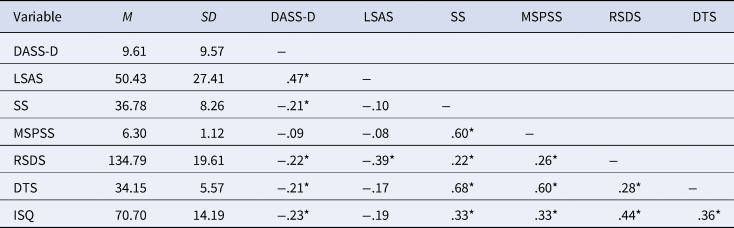
Little's (Reference Little1988) missing completely at random test was conducted. It was found that 0.34% of responses were missing with no systematic patterns of missing data, which supported imputation using the expectation-maximisation method. All total scores were calculated following imputation. Assumptions for parametric analyses were tested to identify any concerns with outliers, normality, linearity, and homoscedasticity. Relationship satisfaction, social anxiety, depression, social support, trust, and conflict initiation were not normally distributed, and thus square root transformations were conducted to normalise the variables. Output using raw and transformed data was compared, with no differences being found between patterns of significance. Consequently, raw data were used for ease of interpretation. The mean and standard deviation of study variables are presented in Table 2. Next, to determine whether social anxiety was predictive of relationship status (n = 444), a multinomial logistic regression was conducted with relationship status as the dependent variable. To examine the second aim, Pearson's correlations were used to examine the associations between relationship satisfaction, depression, social anxiety, and the relationship-related process variables for those in current relationships (n = 188). Finally, hierarchical multiple regression was used to predict relationship satisfaction for those in current relationships.
Means, Standard Deviations, and Pearson's Correlations Between Study Variables for Participants in a Current Relationship (n = 188)

Note: N = 188.
* Correlations significant at Bonferroni-adjusted p = .05/7 = <.007. All correlations are based on raw scores. DASS-D = Depression Anxiety Stress Scales – Depression Sub-scale; LSAS = Liebowitz Social Anxiety Scale; SS = Satisfaction Scale; MSPSS = Multidimensional Scale of Perceived Social Support; RSDS = Revised Self-disclosure Scales; DTS = Dyadic Trust Scale; ISQ = Initiator Style Questionnaire.
Results
Assessing the Association Between Social Anxiety Severity and Relationship Status
To determine whether social anxiety was predictive of relationship status (n = 444), a multinomial logistic regression was conducted with relationship status as the dependent variable. The current relationship group was used as the reference category. The difference in chi-square between the intercept-only model and the model with social anxiety entered was significant [χ2 (2) = 8.73, p = .01]. Nagelkerke R 2 indicated that the model explained 2.2% of the variance in relationship status and correctly classified 44.10% of cases. A one-unit increase in social anxiety was related to a 1.20% greater likelihood of being in no relationship, compared with a current relationship. Despite the small odds ratio (1.012, CI = 1.00–1.02), this result was significant, Wald χ2 (1) = 8.38, p = .004. A comparison of previous and current relationships revealed no significant differences in social anxiety severity.
Examining Potential Mechanisms for the Association Between Social Anxiety and Relationship Satisfaction When Controlling for Depression
For those in current relationships (n = 188), Pearson's correlations were used to examine the associations between relationship satisfaction, depression, social anxiety, and the relationship-related process variables (see Table 2).
Hierarchical multiple regression was used to predict relationship satisfaction for the 188 participants in current relationships (see Table 3). In step 1, depression was entered in the first step to control for the shared variance between social anxiety and depression, and a dummy code was entered to account for demographic differences that were observed between the two samples. This accounted for 9.4% of the variance in relationship satisfaction, F(2, 185) = 9.56, p < .001. Social anxiety severity was entered in the second step, and results showed that it did not significantly explain any additional variance in relationship satisfaction. In the third step, the relationship-related process variables were entered and accounted for 44.3% of variance in relationship satisfaction, F(4, 180) = 43.03, p < .001. Squared semi-partial correlations revealed that social support uniquely predicted 5% of the variance in relationship satisfaction, and trust uniquely predicted 13% of the variance. To determine whether the impact of social anxiety differed at different levels of the relationship-related process variables, interactions between social anxiety and each of the relationship-related process variables were entered in the fourth step. The interaction terms explained an additional 1.10% of variance in relationship satisfaction; however, this step was non-significant.
Hierarchical Multiple Regression Analyses Predicting Participants’ Self-reported Romantic Relationship Satisfaction

Note: N = 188.
* Significant at Bonferroni-adjusted p = .05/11 = <.004. Sample = coded 1 for undergraduate sample and 0 for community sample; DASS = Depression Anxiety Stress Scales; LSAS = Liebowitz Social Anxiety Scale; SS = Satisfaction Scale; MSPSS = Multidimensional Scale of Perceived Social Support; RSDS = Revised Self-disclosure Scales; DTS = Dyadic Trust Scale; ISQ = Initiator Style Questionnaire; LSAS × MSPSS = Interaction term between Liebowitz Social Anxiety Scale and Multidimensional Scale of Perceived Social Support; LSAS × RSDS = Interaction term between Liebowitz Social Anxiety Scale and Revised Self-disclosure Scales; LSAS × ISQ = Interaction term between Liebowitz Social Anxiety Scale and Initiator Style Questionnaire; LSAS × DTS = Interaction term between Liebowitz Social Anxiety Scale and Dyadic Trust Scale. β = standardised regression coefficient. Sr 2 = squared semi-partial correlation.
Discussion
The first aim of this study was to examine whether social anxiety severity was related to romantic relationship status. In accordance with expectations, higher social anxiety was significantly related to a greater likelihood of being in no relationship, compared to being in a current relationship. This finding aligns with previous literature that demonstrates that social anxiety severity is predictive of relationship status (e.g., Schneier et al., Reference Schneier, Heckelman, Garfinkel, Campeas, Fallon, Gitow and Liebowitz1994; Wittchen et al., Reference Wittchen, Fuetsch, Sonntag, Mueller and Liebowitz2000).
The second aim of this study was to identify the extent to which the association between social anxiety severity and relationship satisfaction was independent of depression. Dissimilar to our hypotheses and findings from previous studies (Cuming & Rapee, Reference Cuming and Rapee2010; Porter & Chambless, Reference Porter and Chambless2014; Sparrevohn & Rapee, Reference Sparrevohn and Rapee2009), our results revealed that social anxiety was not correlated with relationship satisfaction, and it did not explain any additional variance in relationship satisfaction over and above depression. Thus, the current study provides evidence that it may be the variance that social anxiety shares with depression, rather than social anxiety itself, that is associated with relationship satisfaction. Although some researchers have controlled for depression when examining relationship satisfaction for those with social anxiety (Cuming & Rapee, Reference Cuming and Rapee2010; Porter & Chambless, Reference Porter and Chambless2014; Sparrevohn & Rapee, Reference Sparrevohn and Rapee2009), others have not (e.g., Montesi et al., Reference Montesi, Conner, Gordon, Fauber, Kim and Heimberg2013). Results from the present study suggest that depression symptomology needs to be controlled in research when examining relationship satisfaction and social anxiety. There are a few possible interpretations for these findings. First, it is possible that lower relationship satisfaction may be simply due to depression and it is associated with sequalae. Second, it is possible that lower relationship satisfaction may be related to the common aspects of social anxiety and depression, such as negative emotionality, cognitive biases in social information processing, or some other common underlying vulnerability (Sparrevohn & Rapee, Reference Sparrevohn and Rapee2009). Thus, aspects common to both disorders could also be treatment targets and warrant further investigation. Regardless of the exact mechanisms at play, the findings from the present study are suggestive that depression symptomology may be a better target for treatments for socially anxious individuals wishing to improve romantic relationship satisfaction. Further research is needed to examine the clinical utility of addressing depression symptoms in socially anxious individuals and the impact on relationship satisfaction.
The third aim of the study was to investigate whether self-disclosure, social support, dyadic trust, and conflict initiation influenced the strength of association between social anxiety and relationship satisfaction. Although social anxiety was significantly negatively correlated to self-disclosure, results showed that after controlling for depression and the other relationship-related process variables, self-disclosure did not interact with social anxiety to predict relationship satisfaction. Previous studies have suggested that people with higher social anxiety are less likely to disclose personal information to their romantic partners than non-anxious individuals (Cuming & Rapee, Reference Cuming and Rapee2010; Sparrevohn & Rapee, Reference Sparrevohn and Rapee2009). This appears to be true, but does not seem to impact the individuals’ perception of their relationship satisfaction. It would be interesting to further examine romantic partners of socially anxious individuals’ relationship satisfaction and whether this varied as a function of self-disclosure from socially anxious individuals; that is, whether partners also found that low levels of disclosure were beneficial to relationship closeness and satisfaction.
Results also showed that social anxiety also did not correlate with any of the other relationship-related process variables. Porter and Chambless (Reference Porter and Chambless2014) had previously found that women with high levels of social anxiety symptoms desired less support from romantic partners. Yet a lack of perceived social support from intimate partners was related to reduced relationship satisfaction for individuals with high levels of social anxiety (Porter & Chambless, Reference Porter and Chambless2014). In this study, social anxiety symptoms were not associated with perceived social support across the sample. Conflict initiation and social anxiety also were not significantly correlated. Conflict initiation also did not interact with social anxiety to explain variance in relationship satisfaction for those in current relationships. These findings are contrary to expectations and previous research. For example, Kashdan et al. (Reference Kashdan, Volkmann, Breen and Han2007) found that conflict avoidance was related to higher relationship satisfaction in highly anxious women. Similarly, Davila and Beck (Reference Davila and Beck2002) had found that individuals with higher social anxiety tended to avoid conflict. In relation to trust, our findings show that for those in current relationships, dyadic trust is not reduced for those reporting high levels of social anxiety when compared to those with low levels of social anxiety. Although it did not interact with social anxiety, dyadic trust was found to be the strongest predictor for romantic relationship satisfaction when controlling for depression symptoms, social anxiety symptoms, and the rest of the relationship-related process variables. Thus, dyadic trust is an important factor for relationship satisfaction over and above mental health symptomology. When these findings are compared to previous research with socially anxious adults, it seems that dyadic trust does not act in the same way as generalised trust (Bienvenu et al., Reference Bienvenu, Nestadt, Samuels, Costa, Howard and Eaton2001). This study, therefore, provides evidence that dyadic trust and generalised trust are independent constructs, in accordance with suggestions by Campbell, Simpson, Boldry, and Rubin (Reference Campbell, Simpson, Boldry and Rubin2010).
The results from this research are important as they suggest that depression symptomology, or common elements between social anxiety and depression, needs to be targeted in treatments. This differs from suggestions from Cuming and Rapee (Reference Cuming and Rapee2010) where it was suggested that clinicians should ‘encourage socially anxious individuals in treatment to consider the extent to which they adopt safety behaviours, such as restricting disclosure of their thoughts and feelings, in their close relationships’ (p. 94). Rather, treatments may need to focus on ways to reduce depression symptoms and common aspects of social anxiety and depression. Further, treatment recommendations may differ depending on whether the socially anxious individual has not had any romantic relationships or is either in a current relationship or has been in a previous relationship over 3 months. Our results suggest that those who have not been in any romantic relationships may have higher social anxiety symptoms, which may be exacerbated by low exposure from being in romantic relationships, and/or high distress or high avoidance of these intimate relationships.
Although this study has a number of notable strengths, it also has a few limitations. First, fewer males participated in this study than females, which may limit the generalisability of the results. Second, this study was cross-sectional and no causal conclusions can be drawn. While it has been assumed in the interpretation of the results that social anxiety and depression lead to poor relationship satisfaction, it is also plausible that poor relationship satisfaction results in social anxiety and depression symptoms. Future research may wish to disentangle the direction of these effects using a longitudinal design, particularly to further explore the role of depression symptoms. Third, it is possible that the lack of significant relationship-related process findings may be attributable to the narrow range of responding due to ceiling effects. That is, all participants in this study scored highly on questionnaires for social support, trust, and relationship satisfaction. The narrow range of scores may have made it more difficult to detect variation; measures may not have been adequately sensitive and possibly failed to discriminate between individuals. It is possible that the current findings (i.e. social anxiety was not significantly correlated with relationship satisfaction) may be due to the lack of sensitivity of the relationship satisfaction measure. Alternatively, it is possible that our sample was too homogenous. In order to maximise the likelihood of recruiting participants with a range of demographics and study variables, a broad recruitment strategy using two samples was conducted. Future research should attempt to use a more varied sample in an attempt to further understand the extent to which social support, trust, and relationship satisfaction may be related to relationship satisfaction for individuals experiencing social anxiety symptoms.
Overall, participants who reported higher social anxiety were less likely to be in a relationship, yet social anxiety did not appear to be uniquely related to relationship satisfaction once depression was controlled. Results from this study suggest that research focus should be directed away from the unique aspects of social anxiety that may influence relationship satisfaction. Rather, the focus should be directed towards identifying the common features of depression and social anxiety that may contribute to reduced relationship satisfaction for those with social anxiety. Although it was proposed that self-disclosure, social support, trust, and conflict initiation might influence romantic relationship satisfaction, none of these mechanisms interacted with social anxiety to explain additional variance in relationship satisfaction. Findings from this study advance the field by indicating that depression symptomology may be a better target for treatments for socially anxious individuals wishing to improve romantic relationship satisfaction. Future longitudinal research is needed to examine whether depression symptoms predate or follow dissatisfaction in romantic relationships for those experiencing social anxiety.
Funding
E.C.'s contribution to this study was supported by the National Health and Medical Research Council Centre of Research Excellence grant (APP1041129).
Conflict of interest
No potential conflict of interest was reported by the authors.