1. Introduction
There has been a proliferation of projects in recent years which aim to ensure that rural communities participate in, benefit from and support the sustainable management of natural resources (IIED, 1994). Towards this end, community-based natural resource management (CBNRM) as a conservation and development program has attracted increasing support worldwide. This approach, also known as co-management, common pool resource (CPR) management and community-based conservation, emphasizes the need for mutually beneficial co-management partnerships between rural communities, the state and other stakeholders in place of the antagonistic relations and resource-use conflicts caused by protectionist conservation strategies. CBNRM provides local people with controlled access to natural resources and generates resource-based employment to encourage people's participation in co-management. These institutional changes from coercive state-based protection to community-based conservation are considered to be more inclusive and sensitive to community needs.
In India, joint forest management (JFM) as a co-management program has been implemented since the early 1990s to rectify the social costs associated with the failed forest policy of the state and foster positive conservation attitudes among the locals through empowerment and decentralization. However, India's JFM program is subject to controversies over the real extent of women's participation. In recent years, a consensus has emerged in policy-making arenas within JFM that, due to the nature of women's work, women should be fully involved in conservation efforts (Hobley, Reference Hobley1996: 19). Although this is increasingly reflected in some of the provisions of JFM legislation, these policy experimentations have ignored women's interests and concerns in JFM. Moreover, the CBNRM literature virtually lacks a gender perspective and neglects an important issue relating to gender-specific attitudes (Agarwal, Reference Agarwal2010b).
Attitude is a human psychological tendency expressed by evaluating a particular object with favor or disfavor (Ajzen and Fishbein, Reference Ajzen and Fishbein1980). It consists of beliefs, which are associations people establish between the attitude object and various attributes. For example, in the phrase, ‘a wetland is a part of a country's wealth’, ‘wetland’ is the attitude object, while ‘country's wealth’ is an attribute, and ‘is a part of’ is a relational term. In the context of this study it may simply refer to how people like JFM or dislike it. Evidence suggests that understanding people's attitudes may help to achieve cost-effective co-management (Ostrom, Reference Ostrom1990; Ray and Bhattacharya, Reference Ray and Bhattacharya2011, Reference Ray, Bhattacharya, Banerjee and Chakrabarti2013).
A nascent literature emphasizes that a gender perspective of conservation and stakeholder attitude is imperative in co-management on several counts (Agrawal, Reference Agrawal2006; Agarwal, Reference Agarwal2010b; Ray and Bhattacharya, Reference Ray, Bhattacharya, Banerjee and Chakrabarti2013). A community holds gender, economic, social, cultural and political characteristics that give some groups more power and more claim over resources and over how they are managed and for what purpose. This may de facto exclude the women (Guijt and Shah, Reference Guijt and Shah1998), although women are the principle users of local forests and the significant repositories of knowledge about their local CPRs (Agarwal, Reference Agarwal2010b). This may make women less conservationist. Apart from class, men and women can differ in their dependence on local forests according to their economic endowment, their needs and preferences, prevailing social norms and, most particularly, the gender division of labor which assigns particular responsibility to women for collecting firewood and fodder. Therefore, the relationship of a community to its local forests can be characterized by multiple interests, which differ especially by gender. How these interests play out can impinge on men's and women's attitudes towards conservation and sustainable forestry.
In CPR management, social norms define which tasks men and women should perform. Men's tasks mainly include agricultural and other non-forestry income-generating activities, while women's primary responsibility is the domestic chore in addition to farm-centric tasks. Despite these constraints to their participation, women often play an active role in the protection efforts, keeping an informal lookout or forming patrol groups parallel to men's (Agarwal, Reference Agarwal2000). Significantly, men's participation in rule making is often driven by their own preferences relative to the interests of the commons and the commoners (Sarin, Reference Sarin1998; Agarwal, Reference Agarwal2001). On many occasions, these rules favor men. Moreover, Mukherjee et al. (Reference Mukherjee, Ray and Bhattacharyaforthcoming) find that men's participation in co-management is induced more by status concerns than by conservation interests. However, while men have sometimes successfully managed commons, women occasionally cut green branches for their survival (Agarwal, Reference Agarwal2010b).
Therefore, these arguments at best suggest that gender inequalities within community institutions affect collective action mechanisms (Baland et al., Reference Baland, Bardhan and Bowles2007) and thus constitute the centerpiece of the mosaic of attitudes and cooperation that lies behind the successes and failures of forest governance (Agarwal, Reference Agarwal2010b). Nevertheless, there is little research devoted to gender and conservation attitudes in the CPR literature. Consequently, we know rather little about whether men and women hold different attitudes in community-based conservation and whether these attitudinal differences, if any, help or hinder in sustaining the commons. These gaps in the literature raise an important query on the commons: does gender matter in people's attitudes and cooperation in governing commons? To find a plausible answer to this question, several related questions crop up. Do men and women hold different interests and attitudes in governing the commons? If so, how do gender differences in attitudes impinge on sustainable co-management? Extant literature suggests that because of their everyday reliance on local commons, women tend to be more conservationist than men (Agarwal, Reference Agarwal1992, Reference Agarwal2000, Reference Agarwal2001, Reference Agarwal2010b). Does this imply that inclusion of more women as decision makers leads to more effective co-management? What happens when women have less favorable attitudes towards conservation? To address these questions, we conducted psychometric surveys and economic experiments in the co-managed forest areas of West Bengal, India. The answers to these questions may be significant for understanding gender relations and effective conservation of commons.
The rest of the paper is structured as follows. Section 2 describes women's socio-economic status vis-à-vis their environmental attitudes in the forest-dependent rural areas of India. Section 3 presents the study perspective and the hypotheses of this research. Study sites, data collection and methods are explained in section 4. In section 5 results and discussions are presented. Section 6 concludes this study.
2. Women's status and attitudes towards joint forest management in India
In JFM programs, the local forest user communities manage their forests broadly through a two-tier organizational structure called a joint forest management committee (JFMC) or forest protection committee (FPC), consisting of a general body with members comprising the head and his/her spouse of the households drawn from the whole community/village and an executive committee (EC) of 7-15 members. This EC is the core decision-making body which interacts with the general body members to define and amend rules for forest use and benefit sharing, to penalize for rule violation, to devise methods of protection, and the like. While women's presence on the co-management committee can have an impact on various aspects of institutional functioning such as participation, forest conservation and welfare (Agarwal, Reference Agarwal2010b), most of the ECs include either no women or only one woman, with varying degrees of mixed gender groups in between.
West Bengal was the first Indian State to initiate JFM successfully in the 1990s. The state now has 4,300 JFMCs with 4.5 million members protecting about 53 per cent of the forest area of the State (GoWB, 2011). Yet, in the state government's forest policy there was no specific mention of women's participation as decision makers until recently. In 2008, the Government of West Bengal implemented the policy of a 33 per cent quota of women on the ECs of the JFMCs (GoWB, 2008). However, the gender composition in the ECs is still male dominated. Besides, male members and forest officials seldom consult with women about designing conservation rules or preparing micro-plans for forest development (Guhathakurta and Roy, Reference Guhathakurta and Roy2000). They also underestimate women's ecological knowledge and efficiency in governing forests. So women are given much smaller plots of inferior forestlands than men for protection (Agarwal, Reference Agarwal2001).
Further, women's effacement, shyness and soft speech make their participation in male-dominated JFMCs more difficult (Agarwal, Reference Agarwal2010b). Gendered behavioral norms also restrict women by creating subtle hierarchies in community spaces (Agarwal, Reference Agarwal2001). These instances foster forest user communities’ low expectations about women's performance in public forums. These accentuate women's marginalization in CBNRM and adversely influence women's attitudes towards co-management.
3. Study perspective and hypotheses
This study draws on the literature on environmental attitudes (Firey, Reference Firey1960; Infield, Reference Infield1988; Agrawal, Reference Agrawal2006; Ray and Bhattacharya, Reference Ray, Bhattacharya, Banerjee and Chakrabarti2013) and on gender and forest governance (Agarwal, Reference Agarwal1992, Reference Agarwal2001, Reference Agarwal2009, Reference Agarwal2010b; Guijt and Shah, Reference Guijt and Shah1998; Sarin, Reference Sarin1998). The attitude literature argues that ecology, economics and culture interact with one another to determine stakeholder attitudes towards a resource system. Since social groups like women and men often differ in their culture, needs and perceptions of natural resource management, the literature asserts that each group views a resource system differently within its own frame of reference. Consequently, their support for natural resource management relies on the factors belonging to their respective domains.
The literature also suggests the condition under which cooperation stems from attitude. According to Ajzen and Fishbein (Reference Ajzen and Fishbein1980), a single behavior like cooperation for conservation is determined by a person's intention to cooperate, which in turn depends on his attitude towards performing the behavior and his subjective norm. Therefore, cooperation follows from conservation attitudes if there is a high correlation between intention and behavior. In incentivized programs like co-management, cooperation is more likely to follow from conservation-friendly attitudes (Ray and Bhattacharya, Reference Ray, Bhattacharya, Banerjee and Chakrabarti2013). However, the literature remains unclear about whether women are more conservationist and cooperative than men.
Feminist environmentalism fills this gap. This school of thought recognizes that, depending on context, both women and men have a stake in environmental protection that could make women be more conservationist than men (Agarwal, Reference Agarwal1992, Reference Agarwal2010b). According to this approach, gender differences in conservation attitudes can stem especially from (i) the gender division of economic resources, and (ii) the gender division of labor. The former affects the extent of women's dependence on non-privatized local natural resources, and the latter affects the nature of that dependence. Moreover, rural women with much less access to private property resources and markets become more forest dependent (Agarwal, Reference Agarwal2010b).
The nature of women's dependence on communal resources is predicated on their specific responsibilities within the household. Rural women, for example, tend to be more affected by and concerned with scarcities of fuelwood and fodder, which they are mainly responsible for collecting, and men with scarcities of small timber for implements and house repairs, etc. While women need to collect firewood often daily, men's needs for small timber are more sporadic. Because of these differences, forest degradation affects women more adversely than men, specifically in terms of time, income, nutrition, health, social support networks and knowledge systems (Agarwal, Reference Agarwal2010b). Accordingly, ‘women often seem to have a more responsible attitude towards the forest …. They can be motivated by the thought of the additional hardship they and their children would face as a result of depleted forest reserves’ (Agarwal, Reference Agarwal2000: 299). These would make women's stake in forest protection more immediate, and could translate into their being more conservationist. These arguments lead to the following hypothesis.
Hypothesis 1. Conservation attitudes are gender-sensitive, and the female members of the forestry organizations are more conservation oriented than the males.Footnote 1
Forest conditions and forest-related incomes may not improve unless the resource appropriators are aware of the objectives and benefits of JFM and accordingly become conservation friendly (IIED, 1994). In forestry organizations, where people have high JFM awareness, women's participation in local forest governance appears less nominal (Agarwal, Reference Agarwal2015) and collective action more cost effective due to an all-round positive environmental attitude of the locals (Ray and Bhattacharya, Reference Ray, Bhattacharya, Banerjee and Chakrabarti2013). JFM awareness may also be gender sensitive because men and women can have different understandings of sustainable forestry (Agarwal, Reference Agarwal2010b). Women's frequent visits to their local forests also help them to explain the attributes of trees and types of resource extraction better than men. Through their everyday informal social networks, ‘[women] spread awareness among women of the need to conserve forests, monitor forest use, and exert social pressure on women who violate usage rules’ (Agarwal, Reference Agarwal2000: 289). This may not only enhance women's JFM awareness more easily than men's but also encourage women to sustain both the local commons and their subsistence based on those commons (Agarwal, Reference Agarwal2010b).
Because of these gender differences in co-management, women's presence as decision makers matters considerably in JFM. Westermann et al. (Reference Westermann, Ashby and Pretty2005) find that CPR groups with more women have greater solidarity and better conflict resolution. Besides, higher female participation in decision making may also significantly decrease firewood extraction in community forestry and, thereby, improve forest condition (Agarwal, Reference Agarwal2010b). Above all, women are efficient managers of community forests (Agarwal, Reference Agarwal2009).
Behavioral economics too indicates that gender matters in cooperation (Eckel and Grossman, Reference Eckel and Grossman1998; Croson and Gneezy, Reference Croson and Gneezy2009). Further, females rarely fail to reach an agreement (Eckel and Grossman, Reference Eckel and Grossman1998) and groups with a female majority tend to be more generous and egalitarian in distributing benefits (Dufwenberg and Muren, Reference Dufwenberg and Muren2006). This varied body of research jointly suggests that women tend to be more cooperative and that women's proportional strength can significantly affect decision making in a group and lead to choices that are more other-regarding and public-goods promoting. Hence we postulate the following hypothesis.
Hypothesis 2. Conservation-friendly attitudes and women's presence as decision makers in the JFMCs enhance women's participation and sustainable forestry (defined later).
4. Study sites, data, methods and measurement
4.1. Study areas
Our study sites are located around the Buxa Tiger Reserve (BTR) of Jalpaiguri districtFootnote 2 and West Midnapore (WMP) district in West Bengal. (For a map of the locations, see online appendix A1, available athttps://doi.org/10.1017/S1355770X16000358.) These two districts have a century-old history of forest management and, particularly, WMP played a pioneering role in JFM in India (Ray and Bhattacharya, Reference Ray and Bhattacharya2011). The households in the study sites manage dry deciduous tropical forest, mainly Sal (Shorea robusta). Agriculture is the mainstay of the two sites. However, local people face different earning opportunities in the two study areas. People residing around BTR have fewer non-farm and off-farm employment opportunities. Besides agriculture, local households depend on animal husbandry (Ray and Bhattacharya, Reference Ray and Bhattacharya2011). By contrast, the people of WMP are more exposed to outside opportunities. A sizable number of WMP households work in formal and informal sectors. Yet, an important source of livelihood of the two sites is non-timber forest products. On average 0.30 million people collect them from the study areas (GoWB, 2009) and average forest income of the local households constitutes 60–70 per cent of their total incomes (Ray and Bhattacharya, Reference Ray and Bhattacharya2011). Multiple constraints such as social and economic exclusion and persistent institution–people conflicts make it difficult for many households to sustain their subsistence livelihoods (Ray and Bhattacharya, Reference Ray and Bhattacharya2011). These constraints may affect the conservation attitudes and behaviors of the locals where forest management is an integral part of their livelihood.
4.2. Data collection
4.2.1. Selection of forestry organization
The field study was administered during December 2009–August 2010. We used a two-stage sampling method to select the JFMCs. First, we conducted a pilot survey and, based on the trends in forest conditions (defined later), divided all the registered JFMCs of the study areas into three types: committees with improving forests, those with stable forests, and the organizations having declining forests. Then we selected every fourth JFMC from each category, shortlisting 49 JFMCs so that the sampled JFMCs contain at least 15–20 per cent of the total number of JFMCs operating in the study areas. These JFMCs exhibit variations in: (1) degree of women's participation in the EC activities following the typology of participation developed by Agarwal (Reference Agarwal2001, Reference Agarwal2010a); (2) forest conditions; (3) size of the forests; (4) size (number of members) of the JFMCs; and (5) household characteristics. Seven of these 49 JFMCs were randomly selected for survey. Of these, Panialguri, Poro-Basti and Kalkut-Cheko, located around the BTR (where JFM is practiced), represent the northern JFMCs, while Chharadhan, Mahuldanga, Salboni and Banschati, the southern JFMCs, are located in WMP.
4.2.2. Household surveys
For surveys, we selected every third household from the relatively large committees (with >50 members) and every second household from the smaller committees. We continued this strategy until we ended up with a reasonably balanced representation of male-headed and female-headed households in our sample. Subsequently, we interviewed the selected household heads using a pretested questionnaire on issues concerning household characteristics, co-management perceptions and attitudes, institutional issues, forest attributes and collective actions. We also used secondary sources of information on the local conservation and development issues affecting the attitudes of the locals.
4.3. Key study variables
4.3.1. Dependent variables and their measurement
4.3.1.1. Household's overall conservation attitude
We measured a household's conservation attitude using a two-stage procedure.Footnote 3 First, we used Likert-type scales to measure the attitudes of the households based on two dimensions of conservation: local people's attitudes towards JFM or co-management attitudes and their attitudes towards Forest Department and EC members of JFMCs or simply attitudes towards forest management organization. To construct the two scales, we created 21 different statements following participatory appraisal and the concept of preference-based held values (Manning et al., Reference Manning, Valliere and Minteer1999). In co-managed forestry, Manning et al. (Reference Manning, Valliere and Minteer1999) define held values as the values to forest resources and co-management that are assigned through human preference contrary to social obligation. In co-management, these values depict the value of environmental protection. Of the statements thus created, we used those which were mentioned more often by the locals. Each attitude scale comprised five responses, where 1 represents ‘strongly disagree’, 2 ‘disagree’, 3 ‘no opinion’, 4 ‘agree’ and 5 ‘strongly agree’ (described later in table 2). The two scales appeared to be highly correlated (Pearson's correlation coefficient (r)=0.87, p<0.01), which indicates that people with favorable attitudes towards JFM also hold positive attitudes towards the local forestry organizations. Hence we merged the two scales to create an ‘overall conservation attitude’ scale following Tukey's additivity test (H0: individual statement scores are additive, F(1, 975)=2.57, p=0.11). The minimum and maximum attitude scores of a household on the overall scale were 6 and 30, respectively. Because respondents often tend to look good before researchers, we examined the reliability of household attitudes based on Cronbach's Alpha (Cronbach, Reference Cronbach1951). Conventionally, if alpha is above 0.70 (implying that 70 per cent of the attitudes captured via the scales are true attitudes), then we treat respondents’ attitudes as reliable (see Ray and Bhattacharya, Reference Ray, Bhattacharya, Banerjee and Chakrabarti2013, for details). Moreover, the households’ responses on a similar conservation attitude scale developed by Mehta and Heinen (Reference Mehta and Heinen2001) and the responses generated by our overall conservation attitude scale appeared correlated (r=0.70, p<0.001). Thus the scales used in this research were both valid and reliable.
4.3.1.2. Household's pro-social behavior
JFM is mainly a collective conservation program, so it is difficult to capture the individual household's contribution to co-management through field surveys. A vast literature posits that trust and other related behaviors such as reciprocity enhance collective action and lack of them ruins co-management institutions (Pretty and Ward, Reference Pretty and Ward2001; Bouma et al., Reference Bouma, Bulte and van Soest2008).Footnote 4 Hence, we consider respondents’ pro-social behaviors/attitudes (comprising households’ trust, reciprocity and cooperation) as an important proxy for understanding household-level conservation behaviors/attitudes in the study sites. Accordingly, we conducted a trust experiment Footnote 5 as in Berg et al. (Reference Berg, Dikhaut and McCabe1995) in several sessions in the selected sites to measure households’ pro-social behaviors/attitudes, the second dependent variable of this study. In this game, senders are given a certain amount of money to decide how much of it to send to receivers and how much to retain. Any positive amount sent is tripled (to make sending socially efficient) before it reaches receivers, who then decide how much of the tripled amount of money received is to be sent back. Fractions of the endowment thus sent are treated as the measures of the individual player's trust, while the fractions returned to the senders indicate the player's reciprocity.
The way in which we conducted the above experiment follows (for instructions, see appendix A2 in the online appendix). The participants played in groups rather than as individuals. Since decision making and conservation behaviors are affected substantially by bargaining between men and women (Agarwal, Reference Agarwal2010a), we employed the playing groups with varying proportions of females (0, 33, 50, 67 and 100 per cent, respectively) to examine whether women's proportional strength matters in pro-social preferences. Each group comprised two/three members and the members of each group played as both senders and trustees with prior knowledge about the roles. The objective of playing both roles was to generate more data from the experiment. Based on ex ante matching, the sender groups anonymously paired with the responder groups played the game once. Neither the experimenter nor the players knew the identity of the groups they were paired with.
In JFM, women are often discriminated against. Hence, we informed each group about the gender composition of its paired group to examine whether the group sent/returned less to its partner group when it knew that the group it was paired with had more female members. The stake size was 50 Indian Rupees (INR) (US$1=INR48 during the experiment) per member, a half day's wage in the study site. To measure cooperation, each group was given 10–15 minutes to take decisions on the amounts to be sent or returned. It was told that the amount sent and the amount received would be shared equally.
Finally, we set up an index of pro-social behaviors as the average of the index of the fraction sent plus the index of the fraction returned plus (1-index of time taken for decision making). All the indices used were calculated by the formula: {(actual-minimum)/(maximum-minimum)} and then averaged across households to arrive at a group or a JFMC-level index. The index of conservation attitudes was similarly calculated.
4.3.2. Independent variables and their measurement
4.3.2.1. Trends in forest income and trends in forest condition
In this study, we consider two indicators of sustainability – trend in forest condition (ecological indicator) and trend in forest income (economic indicator). To measure the former, we rely on the narratives of the locals, the foresters’ evaluations and authentication by our experts on the state of crown density, the relative abundance of forest products, disappearance of tree species and changes in forest area. Like Varughese and Ostrom (Reference Varughese and Ostrom2001), we define a trend in forest condition as improving/stable/declining if vegetation (tree species) and forest cover thus assessed were expanding/unchanged/degrading. Households were asked to state whether their forest incomes had increased after the introduction of JFM in their villages. Based on their perceptions, trends in forest incomes under a JFMC were labeled significantly increasing/moderately increasing/not increasing if >75 per cent/50–75 per cent/<50 per cent of the households of that JFMC perceive an overall increase in their forest use. We considered those households which have derived forest benefits in both the initial (1991–1992) and the survey periods (2009–2010).
4.3.2.2. Household income, forest dependency and livestock holdings
Among the socio-economic variables considered in this study, total earnings of a household comprise earnings from non-forest sources like farm activities and wage labor, and forest incomes (imputed value of domestic uses and sales of forest resources), livestock holdings and other sources. We define households below/above the rural poverty-line income (INR26 (US$0.43) per day per capita spending during the survey) as poor/ non-poor. Household forest dependency is measured by its forest income as a proportion of total income. Utilizing the market value of an adult cattle's feed intake, we calculate livestock holdings using one adult cattle/buffalo=four goats/pigs.
4.3.2.3. Institutional variables
Household constraints to CPR and rule-making
We consider two gender-sensitive institutional variables – household constraints to CPR and rule-making. Household constraints to CPR are negative externalities, which arise from excessive harvesting of CPRs leading to increased harvesting costs, physical interference between resource users, and resource users’ fight over control of the most productive areas in a resource (Ostrom, Reference Ostrom1990).Footnote 6 We quantify it as number of times a household confronts such constraints in the last year. Rule-making here implies mainly forest conservation and use rules and rule-making by women is interpreted as the impact of women's presence both on the rules made and (implicitly) on the process by which they are made (Agarwal, Reference Agarwal2009).
JFM awareness, perceived JFM benefits and transaction costs
We define household perception about JFM benefits as positive/negative if the households feel that JFM has given them more benefits/less benefits than before. Further, households’ JFM awareness is defined as high if the households know the objectives and net benefits of JFM, the resource condition and its use pattern. Otherwise, this awareness is low.
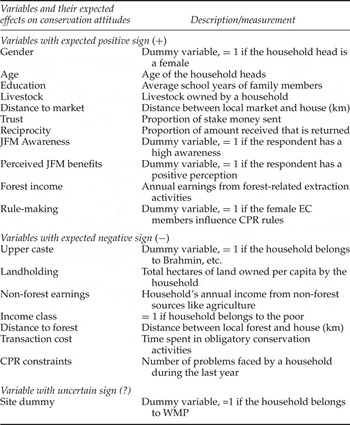
We also consider transaction costs (TCs) to examine how the stated attitudes and experiment-induced behaviors of the forest users influence performance of the organizations. North (Reference North1990) defines TCs as the costs of defining, protecting and enforcing the property rights to goods and services. In natural resource co-management, property rights are the key issues in defining and interpreting TCs, and TCs imply obligatory participation. Thus, we measure it as the number of labor days spent in obligatory forestry activities like information gathering and sharing, implementing and monitoring of conservation activities, attendance at the JFM meetings and conflict resolution for managing local forest. An overview of the variables is given in table 1.
Overview of the variables grouped by expected signs

4.4. Estimation strategy and the estimated models
In this section, we analyze the role of gender on households’ conservation attitudes and then address how household attitudes influence pro-social behavior. Therefore, equations (1) and (2) are of interest in this study.
 $$CA_{ik} =\beta _0 +\beta _1 F_{ik} +\beta _2 X_{ik} +\varepsilon _{ik}$$
 $$PB_{ik} =\beta_0 + \beta_1 F_{ik} + \beta_2 CA_{ik} + \beta_3 Z_{ik} + \varepsilon _{ik}$$
In equation (1), i indexes the household i in JFMC k. The dependent variable CA ik is the aggregate attitude score measuring overall conservation attitude of the head of household i, who is a member of the k th JFMC. F ik indicates whether the head of the i th household in village k is a female and X ik is the vector of all other household characteristics described in table 1 that affect the household's conservation attitudes. Finally, ε ik is an error term. On the other hand, in (2), PB ik is the pro-social behavior of the head of household i in JFMC k. In this case, it is the value of an index based on trust, reciprocity and cooperation as measured earlier by the trust game. Z ik is a vector of the explanatory variables of table 1, excluding trust, reciprocity and TCs.
It may be noted that TC, trust and reciprocity are interconnected and they influence households’ attitudes and cooperation. Greater TC implies more time spent in obligatory conservation activities that may make people less conservationist (Ray and Bhattacharya, Reference Ray, Bhattacharya, Banerjee and Chakrabarti2013). Also, trust and reciprocity may reduce TCs and improve resource users’ attitudes since they help to achieve reduced monitoring costs and a sustainable flow of forest resource benefits to the locals that would not be attainable otherwise (Ostrom, Reference Ostrom1990; Pretty and Ward, Reference Pretty and Ward2001). Hence we consider these variables as important determinants of conservation attitudes.Footnote 7
These equations pose some challenges. First, we anticipate that equations (1) and (2) may be subject to endogeneity bias due to the possible correlation between explanatory variables and the error terms in (1) and (2). In case of (1), we assume that participants who have positive attitudes are more likely to trust and reciprocate others and vice versa. On the other hand, positive attitudes may also foster collective behavior and thus reduce TCs. Similarly, people holding positive attitudes tend to contribute more in collective action, and as expected they derive forest benefits more than those who contribute less to forest conservation (Adhikari, Reference Adhikari2005). Therefore, we expect conservation attitude to be positively correlated with forest income, trust and reciprocity and negatively correlated with TCs in equation (1). Thus, forest income, trust, reciprocity and TC might be the possible endogenous variables in (1). There is also evidence that households’ pro-social behaviors increase household forest and non-forest incomes through social interactions (Bouma et al., Reference Bouma, Bulte and van Soest2008). Hence, forest and non-forest incomes are the possible choice variables in (2). In such circumstances, the estimate of the effects of these variables on conservation attitudes would be biased and the estimated coefficient would not be reliable. Secondly, several unobservable factors such as institutional arrangements may vary across the selected JFMCs that may affect both attitudes and behaviors of the households (Ray and Bhattacharya, Reference Ray and Bhattacharya2011). Therefore, to obtain the estimates closer to the true causal effects of the explanatory variables, our estimation strategy is three-fold. We first consider JFMC-specific fixed effects estimation strategy to control for the unobserved heterogeneity. Since we have seven JFMCs, we insert six dummy variables (excluding the Banschati JFMC) to remove all the JFMC-specific unobservables. Then, endogeneity bias may be less severe. Accordingly, these equations with the JFMC-level fixed effects can be shown as:
 $$CA_{ik} = \beta_0 + \beta_1 F_{ik} +\beta_2 X_{ik} +\pi_k J_k + \xi_{ik}$$
 $$PB_{ik} =\beta_0 +\beta_1 F_{ik} + \beta_2 CA_{ik} + \beta_3 Z_{ik} +\pi_k J_k + \xi_{ik}$$
where ξ ik consists of a vector of unobservable factors affecting household attitudes and behaviors and ε ik , while J k represents the JFMC-level fixed effects in both equations. Equations (3) and (4) are the estimated equations of this study. Next, we use the instrumental variable (IV) Tobit estimation technique for (3) because the dependent variable in (3) has a minimum and a maximum score (in this case, 6 and 30, respectively), and the standard IV estimation approach for (4). In our context, while the absence of lagged values reduces the possibility of candidate instruments, there is also no previous attitude study available that has identified some possible instruments. Despite these limitations of the IV estimation approach here, we find the following excluded instruments in the first stage of estimation of (3) and (4): prior organizational experience, attendance at community meetings, political participation, good-quality land, debt per capita and occupational pattern. The appropriate implementation of the IV estimator requires that these instruments be uncorrelated with the disturbance terms, but correlated with the endogenous variables in both equations. A test of exogeneity (Wald χ2=6.778, p=0.034 in case of equation (3) and Durbin–Wu–Hausman F=7.71, p=0.021 in case of (4)) strongly signals the endogeneity of the above suspected variables. Moreover, an over-identification test (Amemiya–Lee–Neway minimum χ2=0.892, p=0.27 for (3) and Hansen J=0.143, p=0.69 for (4)) reveals that the instruments used are correctly excluded in the second stage of the respective IV estimations. Finally, Anderson LR statistics (=18.436, p=0.002 for (3) and=9.516, p=0.033 for (4)) show that the instruments used in both the equations are relevant. That is, these instruments are correlated with the endogenous regressors. These tests therefore confirm the use of an IV Tobit estimate for (3) and the standard IV estimation method for (4). From an economic standpoint the IV approach seems appropriate because, if we fail to tackle the endogeneity problem, any policy intervention to promote people's attitudes and consequently pro-social behavior may be misleading and may make cooperation costly.Footnote 8
We also scrutinized all explanatory variables using a scatter plot and examined multicollinearity among them based on a co-variance matrix of independent variables, which revealed that income class was highly correlated to both landholding and non-forest earnings, so it was dropped in the regression analysis for all empirical equations.Footnote 9
Finally, we estimate four models based on equations (3) and (4). To explicitly understand the impacts of gender on conservation attitudes and pro-sociality, we first estimate the gender-only model. The other three models are estimated by the IV approaches with fixed effects. The second model is a full model that uses all samples to find the factors affecting the overall conservation-related attitudes and behaviors of the households. The last two models use the male-headed and the female-headed samples to examine whether the determinants of attitudes and behaviors are gender sensitive. For a stringent specification, we include only the significant determinants of the second model in the latter two models.
5. Results and discussion
5.1. Household characteristicsFootnote 10
Respondents in our study areas belong mostly to the ‘Reserved’ category (comprising scheduled caste, scheduled tribes, and other backward classes), which constitutes the economically marginalized sections in India (Ray and Bhattacharya, Reference Ray and Bhattacharya2011). We notice significant socio-economic heterogeneity between men and women, and also between the poor and non-poor households. Specifically, both females and poor are more asset constrained due to lack of landholding, livestock endowment and non-forest earnings and, thus, are more dependent on natural resources. This is reflected in men's and women's TC data. Women spend 61 labor days annually for collective action compared to only 37 labor days spent by men. However, the households headed by male members benefit more from the local co-managed forests than those with female heads (INR3916 versus INR2883 per capita per annum, p=0.034) and their gains from local forest are strongly correlated to their landholding (r=0.80, p<0.01) and livestock assets (r=0.71, p<0.01).
5.2. Stakeholder attitudes towards co-management and forestry organization
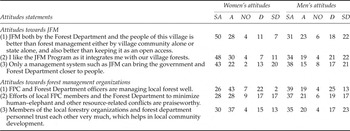
Table 2 reports gender differences in conservation-related attitudes. We find that more than 75 per cent of women either strongly agree or agree with the first statement of the JFM attitude scale. According to them, JFM is a more well-practiced forest management model than the state-led forestry or forest protection by the community alone (without any assistance from the government), because state-based forest protection may ignore local people's forest dependence, while forest protection alone by the local communities may be less effective due to lack of technical and other expertise of the communities. Seventy-six per cent of respondents believe that JFM takes care of both aspects and thus improves local conservation and development. Almost an equal percentage of women perceive that the JFM program integrates them with their village forests. Seventy-five per cent of the women support the JFM program since it can bring the government and the Forest Department closer to people. On the other hand, the percentage of male respondents supporting JFM and FPCs is not as high as that of female respondents. On average, 53 per cent of them hold positive attitudes towards JFM; at the same time, 59 per cent of them like the local FPC and Forest Department staff and their conservation-related activities. Therefore, women are apparently more conservationist than men (average attitude scores of males versus females: 3.30 versus 4.40, p<0.01 and 3.60 versus 4.5, p<0.05, respectively, on the above two scales). Besides, the values of Cronbach's alpha for women's attitudes towards JFM and local JFM organizations are 0.82 and 0.91, respectively, while the alpha values for men's attitudes are only 0.72 and 0.69, respectively. Therefore, women's attitudes are more reliable than men's attitudes.
Gender differences in attitudes towards joint forest management and forestry organizations (in %)

Notes: All percentage figures are rounded off to the nearest whole number. JFM: joint forest management; FPC: forest protection committee; SA: strongly agree; A: agree; NO: no opinion; D: disagree; SD: strongly disagree. Overall, around 60% of households have positive attitudes (with above-average attitude score).
The reasons for women's positive attitudes may depend on different contexts (Mehta and Heinen, Reference Mehta and Heinen2001; Ray and Bhattacharya, Reference Ray, Bhattacharya, Banerjee and Chakrabarti2013). In our present context, based on the TCs and non-forest earnings, women are closer to the environment and materially more dependent on forests (see online appendix A5). These factors may encourage women with regard to forest conservation.
5.3. Pro-social behaviors of resource users: a gender-based comparison
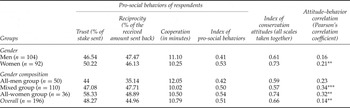
Table 3 highlights households’ social preferences (i.e., trust, reciprocity and cooperation) as revealed in the experiment, and the consistency between these behaviors and their attitudes based on the Pearson's correlation coefficients given in the last column of table 3. Overall, the indices of these pro-social behaviors and attitudes are significantly correlated (r=0.14, p 0.05). This shows that the households with positive attitudes trust and reciprocate others more and, therefore, cooperate for conservation. This does not, however, explain why some communities fail to conserve natural resources. Perhaps, resource users’ behaviors are shaped not only by their attitudes but also by other social attributes such as gender (see table 3). In our study, women are more consistent in their attitudes and behaviors (r=0.21, p<0.05) than men (r=0.16, p=0.062). Thus, gender matters in conservation attitudes and behaviors.
Households' pro-social behaviors differentiated by gender and its composition

Notes: The data in the table are obtained from the trust experiment. Statistical significance of correlation between any two variables has been examined on the basis of t-test. *** and ** represent significance levels at 1% and 5%, respectively.
Table 3 also demonstrates that respondents’ pro-social behaviors depend on gender composition. All women's groups appear to be the most trusting and reciprocating groups. Perhaps homogeneity in the women's groups may have made this possible (Ray and Bhattacharya, Reference Ray, Bhattacharya, Banerjee and Chakrabarti2013). By contrast, the mixed groups are the most consistent groups (r=0.34, p<0.01). Although mixed groups perpetuate female subordination and restrict female participation in collective actions, men and women in mixed groups often interact effectively because women enter masculine social spaces and establish contacts, and capture some of the male resources that help them to access information and help in need more than the all-women and all-men groups (Gotschi et al., Reference Gotschi, Njuki and Delve2009). Thus, the findings from tables 2 and 3 together suggest that the first hypothesis cannot be rejected.
5.4. Gender differences in determinants of conservation attitudes and behaviors
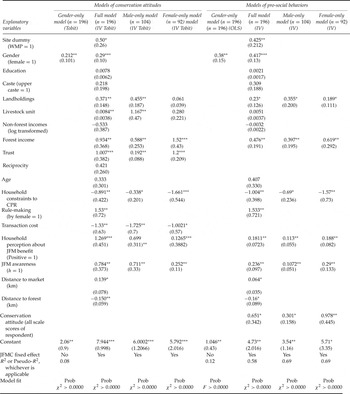
The estimation results for determinants of household-level conservation attitudes and pro-social behaviors are given in table 4. Several observations are noteworthy. First, gender has a significant bearing on household attitudes and pro-sociality. More specifically, women have positive attitudes and they are more pro-social compared to men. Secondly, institutional factors like TCs have the greatest impacts on attitudes. Since TC here indicates obligatory participation in co-management, greater TCs lead to negative attitudes among the local households, thereby hindering collective action. Thirdly, social capital like trust is positively and significantly correlated to household attitudes. In our study, households’ conservation attitudes are context specific since they are measured by the statements of table 2 that clearly show that the less (more) conservationist households hold negative (positive) perceptions about the institution and people associated with the local forest conservation (see the statements of the second scale in table 2) and hence trust others less (more). Consequently, they tend to participate less (more) which may also make them less (more) trustworthy. The less (more) trustworthy people tend to trust others less (more). Alesina and La Ferrera (Reference Alesina and La Ferrera2002: 209–210) confirm this explanation. However, for generalization further research is needed. Fourthly, perceived benefits of JFM shape people's attitudes and behaviors. Finally, the determinants of attitudes and behaviors are similar.
Determinants of conservation attitudes and pro-social behaviorsa

Notes: aRobust standard errors are reported in the parentheses. ***, ** and * represent level of statistical significance at 1, 5 and 10%, respectively.
These results indicate that these determinants are very much gender sensitive. For example, the male-only model of table 4 shows that the men's attitudes and behaviors are influenced more by those factors that usually belong to men's domain (like legal landholdings and livestock endowment). In the study areas, landed households are surprisingly more conservation friendly and pro-social because they control the JFM rules in their favor and, thus, derive larger benefits from the protection of local forests.
Analogously, forest income and household constraints to CPR matter more to women because women rely more on forest resources. Such factors distinguish women from men and thus belong more to women's domain in community-based conservation (Gotschi et al., Reference Gotschi, Njuki and Delve2009; Agarwal, Reference Agarwal2010b). Consequently, fewer constraints and greater access to forest commons improve women's conservation attitudes more than men's attitudes (see the female-only model of table 4). Therefore, these findings corroborate that (wo)men's attitudes are influenced by those factors that belong more to (wo)men's own domain.
Moreover, since women hold more information about village forests, their JFM awareness significantly positively affects household's attitudes to conservation and social preferences. So, when we compare the effects of conservation attitudes on the male-headed and female-headed households’ pro-social behaviors, we notice that women's behaviors are correlated to their conservation attitudes more significantly than men's behaviors (see the last three columns of table 4). Table 4 also provides the plausible reasons for the validity of hypothesis 1.
5.5. Attitudes of the JFMC members and sustainable forestry
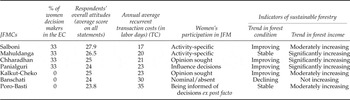
In this section, we test the second hypothesis based on table 5. First, we find a strong inverse relationship between attitudes and TCs (r=−0.79, p=0.034, n=7 JFMCs), which can be attributed to the presence of various conflicts in co-management in the study areas (Ray and Bhattacharya, Reference Ray and Bhattacharya2011). This reflects that cooperation is costly in the absence of pro-environmental attitudes. Consequently, forest conditions and forest benefits derived by the households vary across the seven JFMCs. While Salbani, Chharadhan, Kalkut-Cheko and Panialguri have an improving forest, Banschati is the only JFMC with a declining forest. Secondly, in the conservation-friendly organizations like Panialguri, households’ forest incomes are increasing more than in the less-friendly organizations (e.g., Banschati and Poro-Basti). We identify socio-economic inequality, resource-related conflicts and lack of quality leadership as the main reasons for greater TCs in Banschati and Poro-Basti. Even if Banschati and Poro-Basti have the same attitude scores as that of Panialguri, they lack mutual trust and reciprocity that might have led to greater TC. The lower values of the index of pro-social behaviors of Banschati (0.29) and Poro-Basti (0.40) compared to that of Panialguri (0.62) confirm this (not shown in table 5). Thirdly, as Adhikari and Lovett (Reference Adhikari and Lovett2006) found, forest conditions and trends in forest incomes are interrelated. Perhaps successful co-management of commons depends on perceived incentives of tangible benefits and costs.
Households' attitudes, women's participation and sustainable forestry across the surveyed joint forest management committees

Moreover, in JFMCs where women are excluded from decision making and consequently women's participation is either nominal or passive, neither forest conditions nor forest incomes are improving (e.g., Poro-Basti and Banschati). We further note that females benefit more from the forests in Salbani, Mahuldanga, Chharadhan, Panialguri and Kalkut-Cheko (INR4,350) than in the Banschati and Poro-Basti forests (INR3,577). The mean income difference is also statistically significant (t=2.98, p=0.032). Table 5 shows that women in the first five JFMCs are more empowered than those in the Banschati and Poro-Basti JFMCs. Chattopadhyay and Duflo (Reference Chattopadhyay and Duflo2004) find that female decision makers in rural West Bengal tend to implement women-centric policies including their easy access to local commons. Thus women's greater presence in terms of numbers in the forest areas of the first five JFMCs (unlike Banschati and Poro-Basti) may have made women's forest access easier and thus enabled them to derive greater benefits. Women's proportional strength in the EC of the JFMCs may affect sustainability in two possible ways. First, as is evident in the first four organizations, women's presence as decision makers enhances the overall attitudes and reduces TCs due to women's greater pro-sociality (table 3). Secondly, women can express their concerns and interests in co-management before the female decision makers more easily through informal village networks which further enhances cooperation (Agarwal, Reference Agarwal2000). So, we find a clear positive relationship between women's proportional strength in the EC and conservation attitudes of the households in the studied JFMCs. However, in some of the improving forest areas (e.g., Salbani and Chharadhan), women's participation is still activity specific or their opinions are sought without any guarantee of incorporating them into policy decisions. Since women's proportional strength in the EC does not significantly vary across the studied forestry organizations, much cannot be predicted from table 5.
5.6. The impacts of women's negative attitudes on sustainable forestry
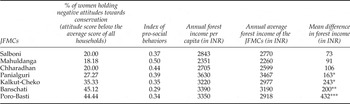
From table 2, we note that 18–45 per cent of the women either disagree or strongly disagree with the attitude statements and thus hold negative attitudes towards conservation across the seven JFMCs. The female-only model in table 4 shows that these less conservationist women confront more constraints to CPR in the sense of greater intensity and frequency of occurrence of different constraints than women in general face – e.g., constraints due to shortages of time and labor (Agarwal, Reference Agarwal2010b), male-biased rules (Agarwal, Reference Agarwal2001) and stringent access opportunities imposed due to low participation (Ray and Bhattacharya, Reference Ray and Bhattacharya2011) – and thus derive less income from local forest, hold low JFM awareness and negative perception about JFM benefits and trust others less.
We present the profiles of those female-headed households in table 6 to explain counterfactuals and find that, as the proportion of those women increases, their social preferences deteriorate (r=−0.84, p=0.02). Since these women are less conservation friendly, they tend to trust others less and so, motivated by their self-interests, they may extract forest resources significantly more than others. They tend to over-extract forest resources as their proportion in a JFMC increases (see the last column of table 6). This may adversely affect forest conditions (table 6). However, we do not find any JFMCs where the majority of the women hold negative conservation attitudes, or any female-managed JFMC that has failed to conserve forest. Due to this constraint, we fail to pose and explain counterfactuals fully and capture possible impacts of women's negative environmentality on sustaining the commons.Footnote 11
Women's negative attitudes and forest resource extraction in the study areas

Note: JFMCs: joint forest management committees. Average attitude score of all households=25.20. The data belong to only those women holding less conservationist attitudes to local forest management. Mean difference tested by t-test.
6. Conclusion and policy implications
CBNRM has emerged as a leading paradigm for achieving inclusive conservation with development. However, biases ingrained in community norms and expectations within co-management institutions have led to women's near exclusion from decision making (Baland et al., Reference Baland, Bardhan and Bowles2007). This might adversely affect women's conservation interests and attitudes and, consequently, make co-management less effective. Unfortunately, the CPR researchers have paid little attention to these issues. So, our knowledge about the roles gender plays in determining people's conservation attitudes and cooperation in community-based conservation is limited (Agarwal, Reference Agarwal2010b). These research gaps motivate the present study to address the following principle query: does gender matter in people's attitudes and cooperation in co-management?
To this end, we conducted surveys in seven joint forest areas of India and posit that gender influences local people's attitudes and cooperation in JFM. To test this main hypothesis, we identify two related hypotheses embedded in it. We use the psychometric techniques and field experiments to test the first hypothesis concerning gender differences in conservation attitudes, while we test the remaining hypothesis regarding the impacts of conservation attitudes and women's presence on co-management by statistical and econometric methods.
The results from our surveys support these hypotheses. As expected, we find that women in the study areas are more constrained by productive assets and bear a greater amount of TCs. Greater costs borne by women may imply their immediate and greater dependence on local commons (Ray and Bhattacharya, Reference Ray and Bhattacharya2011). Surprisingly, women, although more reliant on local forest, derive significantly less forest benefits than men. This finding goes against the traditional view that collection of forest products is mainly a female activity. This distributive inequality might be the consequence of the ways in which community resource management and the local organizations have been institutionalized.
In several ways, this study extends the existing discourse on gender and co-management. Most importantly, conservation attitudes of the locals are significantly gendered and women are more conservationist and pro-social than men. Noticeably, the dominant attitudes of the JFMCs rely on who the majority members are, in terms of gender. In those JFMCs (e.g., Salbani) where women's proportional strength as decision makers is significant (33 per cent), more positive attitudes prevail among the members. These reduce TCs and hence lead to an overall improvement in women's participation and forest conditions. By contrast, if women hold negative attitudes, their social capital deteriorates causing over-extraction of forest commons. Therefore, sustainable commons management is significantly gender based, perhaps due either to gender inequality in costs and benefits of conservation or to the gender sensitivity of conservation attitudes and trust-induced pro-social behaviors or to all of these.
The results show significant gender differences in asset holding, forest benefits, conservation attitudes, pro-social behaviors and TCs. Consequently, sustainable forestry hinges on how effectively common property institutions reduce inequality and fosters cooperation (Baland et al., Reference Baland, Bardhan and Bowles2007). One feasible option to reduce gender and wealth disparities could be to enforce an equitable and efficient system of voluntary exchange of forest use rights with overall restriction of resource use which may allow the marginal households to benefit from commons (Adhikari, Reference Adhikari2005). The existing JFM model, however, does not allow this. As the mixed groups are more consistent in their attitudes and behaviors, inclusion of a critical proportion of women in the decision-making body of the management institutions, if determined contextually, may make women's participation in co-management meaningful (Agarwal, Reference Agarwal2010a). For example, women on the EC may be proportional to their numbers in the community. Because women seem more positive towards conservation issues and the factors influencing households’ attitudes are gendered, due importance should also be given to female resources and institutional issues like women's greater access to CPRs and participation in rule making. The larger the inequalities in these aspects, the more costly will be the collective action and the less enduring will be the CPR organizations.
Supplementary material and methods
To view supplementary material for this article, please visit https://doi.org/10.1017/S1355770X16000358.