Introduction
The lichen genus Cresponea was erected by Egea & Torrente (Reference Egea and Torrente1993a) to accommodate the Lecanactis premnea (Ach.) Arnold group. It shares with Lecanactis the salient features of a chiefly crustose thallus containing a trentepohlioid photobiont, apothecioid, lecideine ascomata where the dark excipular tissues react a shade of green or olive green in KOH, simple to sparingly branched paraphysoids, a hemiamyloid hymenium, 8-spored, abietina-type asci (terminology after Egea & Torrente Reference Egea and Torrente1994) and transversely septate, fusiform, hyaline ascospores. Cresponea differs from Lecanactis s. str. by having typically epruinose apothecia and, when a pruina is present, it is usually confined to the disc and inner edge of the exciple, and is typically greenish, orange or reddish; in contrast, the apothecia of Lecanactis species are usually entirely and persistently greyish or pale yellowish pruinose. In addition, Cresponea has relatively thick-walled ascospores. Further differences between the two genera, pertaining to secondary chemistry, exciple anatomy and pycnidia, were noted by Egea & Torrente (Reference Egea and Torrente1993a) although these features tend to be less consistent and reliable. Cresponea has now been widely taken up by lichenologists and DNA-sequence data suggest that it is only distantly related to Lecanactis (Ertz et al. Reference Ertz, Tehler, Irestedt, Frisch, Thor and van den Boom2015).
The genus comprises c. 20 species (Index Fungorum Partnership 2019) and is chiefly corticolous and tropical or subtropical in distribution, although there are taxa known from cool temperate zones (e.g. C. premnea (Ach.) Egea & Torrente and C. chloroconia (Tuck.) Egea & Torrente) and from the Subantarctic (C. sorediata Elix et al.). McCarthy (Reference McCarthy2018) lists six species for Australia, with most found in Queensland and New South Wales. In Tasmania, the name C. plurilocularis (Nyl.) Egea & Torrente, a widespread species ranging from south-eastern Australia to New Zealand, the western Pacific and Malesia, has been generally applied, albeit with some misgivings (Kantvilas Reference Kantvilas2004). The recent discovery of a second Tasmanian species, described here as new, has prompted a reappraisal of the genus in Tasmania.
Materials and Methods
The study is based chiefly on material collected by the author in Tasmania and eastern mainland Australia, and housed in the Tasmanian Herbarium (HO). Anatomical and morphological observations were undertaken using light microscopy, with thin hand-cut sections mounted in water, 10% KOH, lactophenol cotton blue, Lugol's iodine after pretreatment with KOH, and ammoniacal erythrosin. Ascospore measurements are presented in the format: 5th percentile–average–95th percentile, with outlying values given in brackets and n being the number of measurements. Routine chemical analyses using thin-layer chromatography follow standard methods (Elix Reference Elix2014).
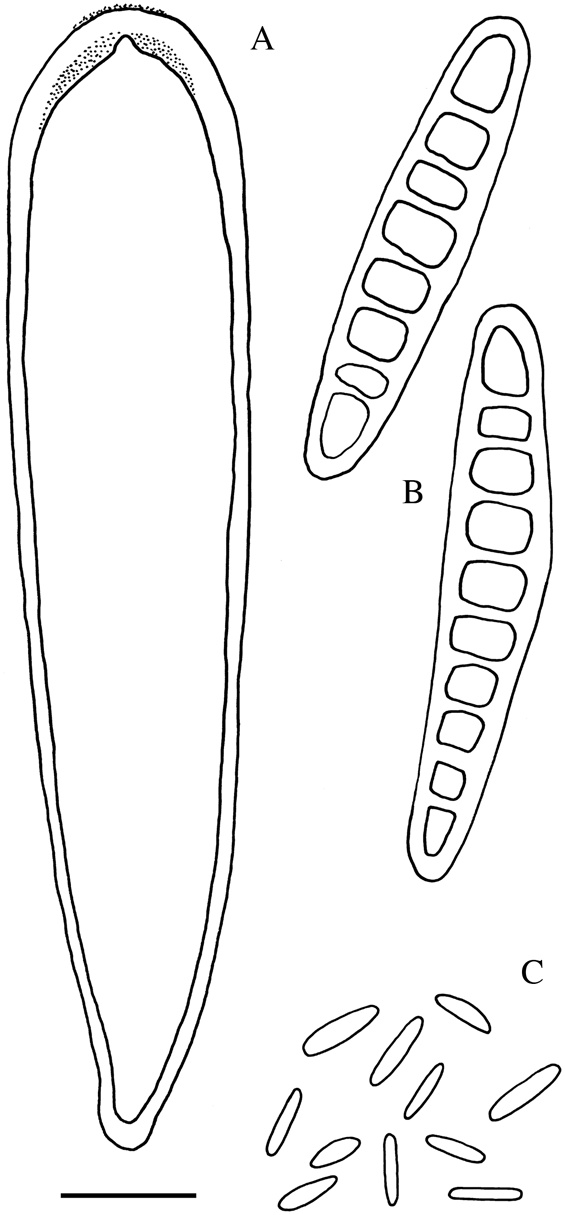
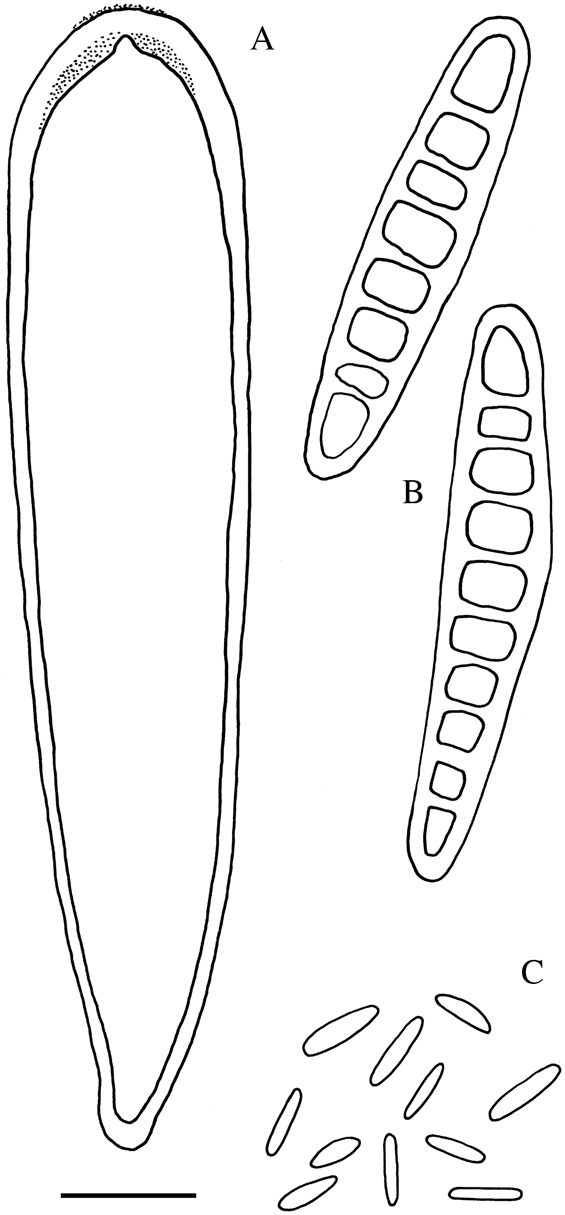
The abietina-type ascus was first recognized by Egea & Torrente (Reference Egea and Torrente1994). It is hemiamyloid, reacting I+ brownish, but with pretreatment in 10% KOH, distinct, bluish amyloid reactions can be observed. The walls and tholus are non-amyloid apart from a very thin outer cap at the apex of the ascus, and faintly amyloid ‘shoulders’ at the sides of a short, blunt ocular chamber. Of the Roccellaceae genera recorded for the Australian region, the abietina-type ascus is found in Cresponea and Lecanactis and is illustrated by Kantvilas (Reference Kantvilas2004) and in Fig. 2A below.
Ascospore size is critical in species delimitation in Cresponea (see Egea & Torrente Reference Egea and Torrente1993a; Kantvilas Reference Kantvilas2006). In this study, measurements and illustrations of ascospores were made exclusively in water, as elution in dilute KOH may shrink or strip away the spore wall. Size also varies with age, and young ascospores retained within the asci tend to have very thin walls and septa, and cylindrical locules. Measurements given below were made on clearly mature ascospores, preferably free of the ascus, where the typical thick walls and septa, as highlighted by Egea & Torente (Reference Egea and Torrente1993a), were clearly developed. The identification key provided below is based strongly on ascospore size and septation and a caveat for using the key is that multiple observations are required.
The Species
Cresponea graemeannae Kantvilas sp. nov.
MycoBank No.: MB 835129
Cresponeae pluriloculari similis sed thallo saxicola, tenuissimo vel destituto, apotheciis margine crassa, radiatim fissa, disco tenuiter pruinoso, hypothecio guttulis olei insperso et ascosporis (25–)25.5–39(–40) μm longis, 6–8 μm latis, 5–9-septatis differt.
Typus: Australia, Tasmania, Spring Bay Mill, Cresponea Cliffs, 42°33′S, 147°56′E, 15 m elev., in sheltered crevices on sandstone boulders in Allocasuarina-dominated coastal woodland, 21 November 2019, G. Kantvilas 316/19 (HO—holotypus; CANB, S—isotypi).
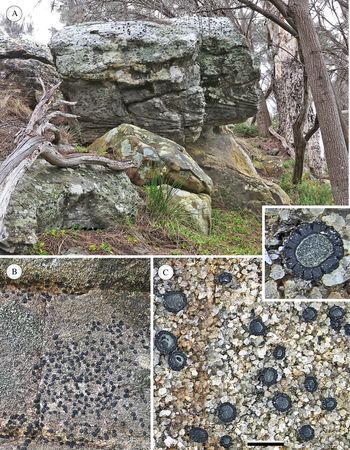
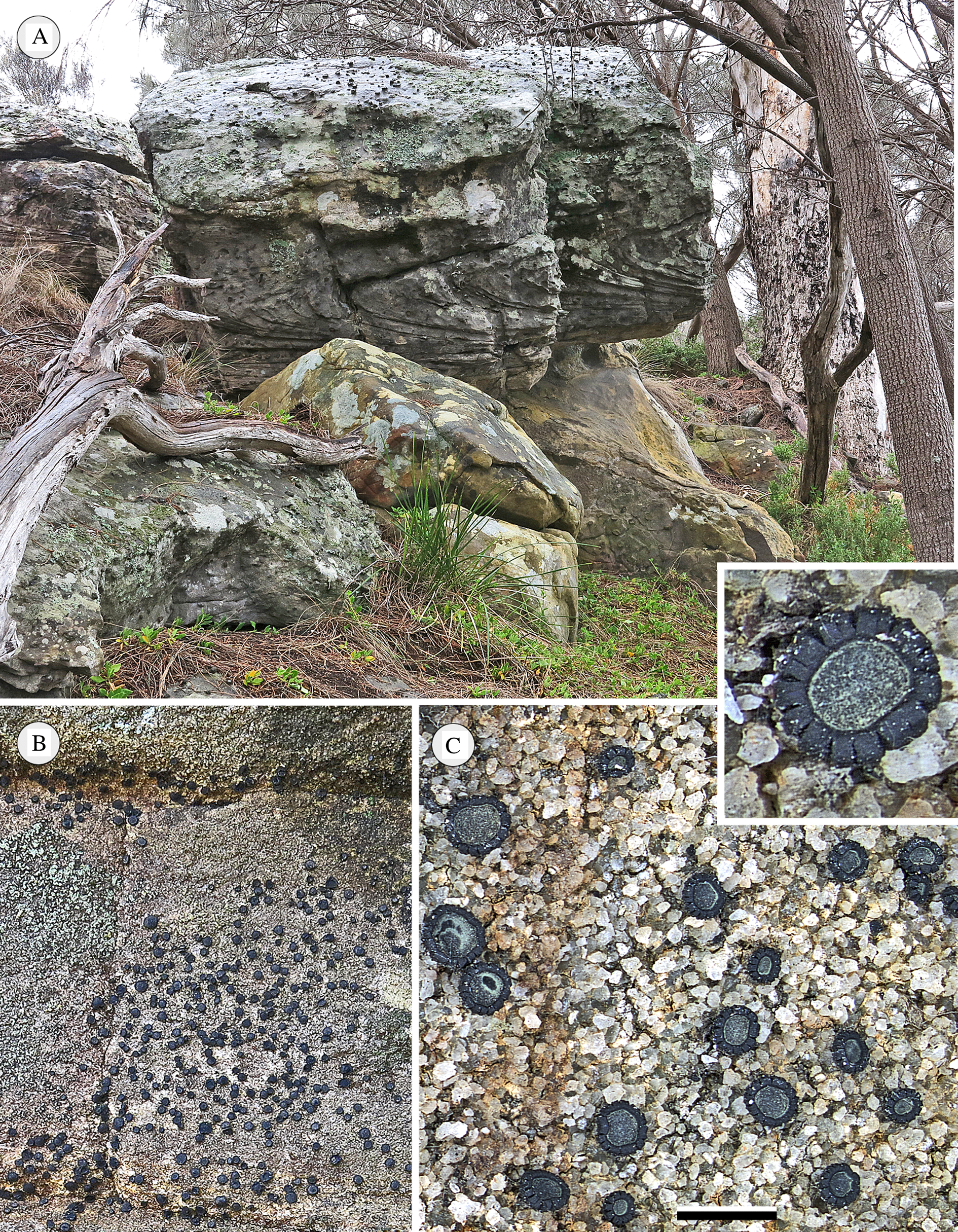
Cresponea graemeannae. A, habitat, on vertical and overhanging surfaces of sandstone rock outcrops in dry sclerophyll forest. B, habit, showing thin, patchy and effuse thallus. C, habit, with inset showing detail of an apothecium with a radially split exciple. Scale: C = 2 mm.
Cresponea graemeannae. A, abietina-type ascus, with amyloid parts stippled (after pretreatment with dilute KOH). B, ascospores. C, microconidia. Scale: A–C = 10 μm.
Thallus ±absent, or very thin, patchy and effuse, and barely discernible as a greenish or somewhat pinkish green discoloration of the substratum, forming extensive, undelimited patches to 30 cm wide; photobiont trentepohlioid, with cells subglobose to oblong-ellipsoid, 7–15 × 6–11 μm, occurring singly or in irregular clusters.
Apothecia 0.7–2 mm wide, markedly basally constricted to sometimes almost substipitate; disc brown-black to black, thinly pale greyish pruinose, concave only when very young, becoming plane to a little convex and sometimes epruinose when old, occasionally with a central ‘plug’ of sterile tissue or excavate and eroded; exciple prominent and persistent, inrolled and markedly radially split, especially in younger apothecia, in section opaque dark brown, K+ greenish (mainly at the edges), 90–150 μm thick laterally, 150–350 μm thick basally, composed of amorphous, cellular hyphae. Hypothecium hyaline to pale yellowish, 30–50 μm thick, inspersed with oil droplets. Hymenium 80–110 μm thick, hyaline in the lower part, dark orange-brown to brown, K+ strongly olive-yellow in the upper 10–20 μm; paraphysoids 1.5–2 μm thick, internally olive-brown in the uppermost part, with apices expanded to 2.5–5 μm wide and with a distinct external cap; asci 70–90 × 14–20 μm. Ascospores fusiform, 5–9-septate, (25–)25.5–32.5–39(–40) × 6–6.9–8 μm (n = 75); locules cylindrical, rounded or rhomboid; wall to c. 2 μm thick.
Pycnidia superficial on the substratum, black, 0.1–0.3 mm wide; conidia (microconidia) bacilliform to fusiform, 4–6 × 1–1.2 μm.
Chemistry
No substances detected by TLC.
Etymology
The new species is named in honour of the philanthropists Graeme Wood and Anna Cerneaz, in appreciation of their sponsorship of the 2019 TMAG ‘Expedition of Discovery’, when this species was discovered and collected.
Ecology and distribution
The new species was discovered on Tasmania's east coast in a narrow, c. 300 m-long band of remnant coastal Allocasuarina verticillata-dominated woodland at the edge of a south-facing sea cliff. It occupies a highly specialized ecological niche, growing in sheltered overhangs and clefts on large boulders and outcrops of relatively soft, very coarse-grained Triassic sandstone (Fig. 1A). It forms extensive patches, as large as 30 cm across, but is not common; a search of the area revealed only six well-spaced populations. Other saxicolous lichens occurring in this habitat, although not necessarily in immediate juxtaposition to the new species, include Buellia halonia (Ach.) Tuck., Diploicia canescens (Dicks.) A. Massal., Lecanora margarodes (Körb.) Nyl., Ochrolechia apiculata Verseghy, Porina corrugata Müll. Arg., P. leptalea (Durieu & Mont.) A. L. Sm., P. whinrayi P. M. McCarthy, Rinodina murrayi H. Mayrhofer, Verrucaria fusconigrescens Nyl., Xanthoparmelia subprolixa (Nyl. ex Kremp.) O. Blanco et al. and unidentified species of Buellia, Opegrapha s. lat. and Porpidia. An additional, smaller collection of the new species, previously tentatively identified as C. plurilocularis, is known from a coastal pinnacle some 100 km to the north. Overgrown with Cystocoleus ebeneus (Dillwyn) Thwaites, this specimen grew in underhangs of Jurassic dolerite in sclerophyllous scrub.
Remarks
Saxicolous species of Cresponea are few and all differ markedly from the new species. Cresponea ancistrosporelloides Sparrius & Sipman, described from south-western Western Australia differs by its well-developed, grey, areolate thallus and its markedly attenuated ascospores, (30–)45–50 × 5 μm, where the ‘tail’ of the spore is c. 20 μm long (Lumbsch et al. Reference Lumbsch, Ahti, Altermann, de Paz G, Aptroot, Arup, Bárcenas Peña, Bawingan, Benatti and Betancourt2011). Another saxicolous taxon, C. premnea var. saxicola (Leight.) Egea & Torrente, is known from the cool temperate Northern Hemisphere and differs from the new species by its shorter, narrower ascospores with fewer septa (18–25 × 4.5–6(–7) μm, (4–)5-septate; Wolseley et al. Reference Wolseley, Purvis, Rose, Smith, Aptroot, Coppins, Fletcher, Gilbert, James and Wolseley2009).
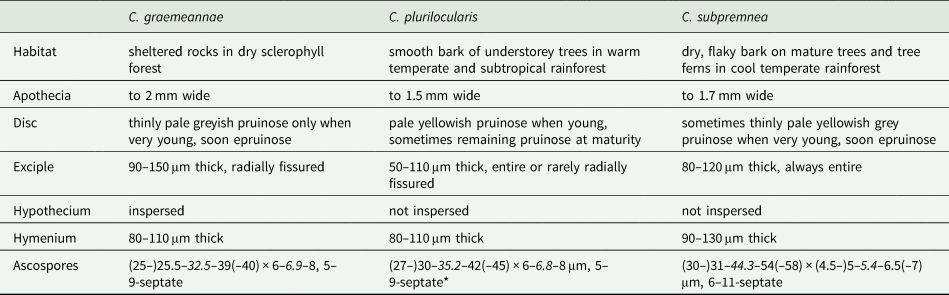
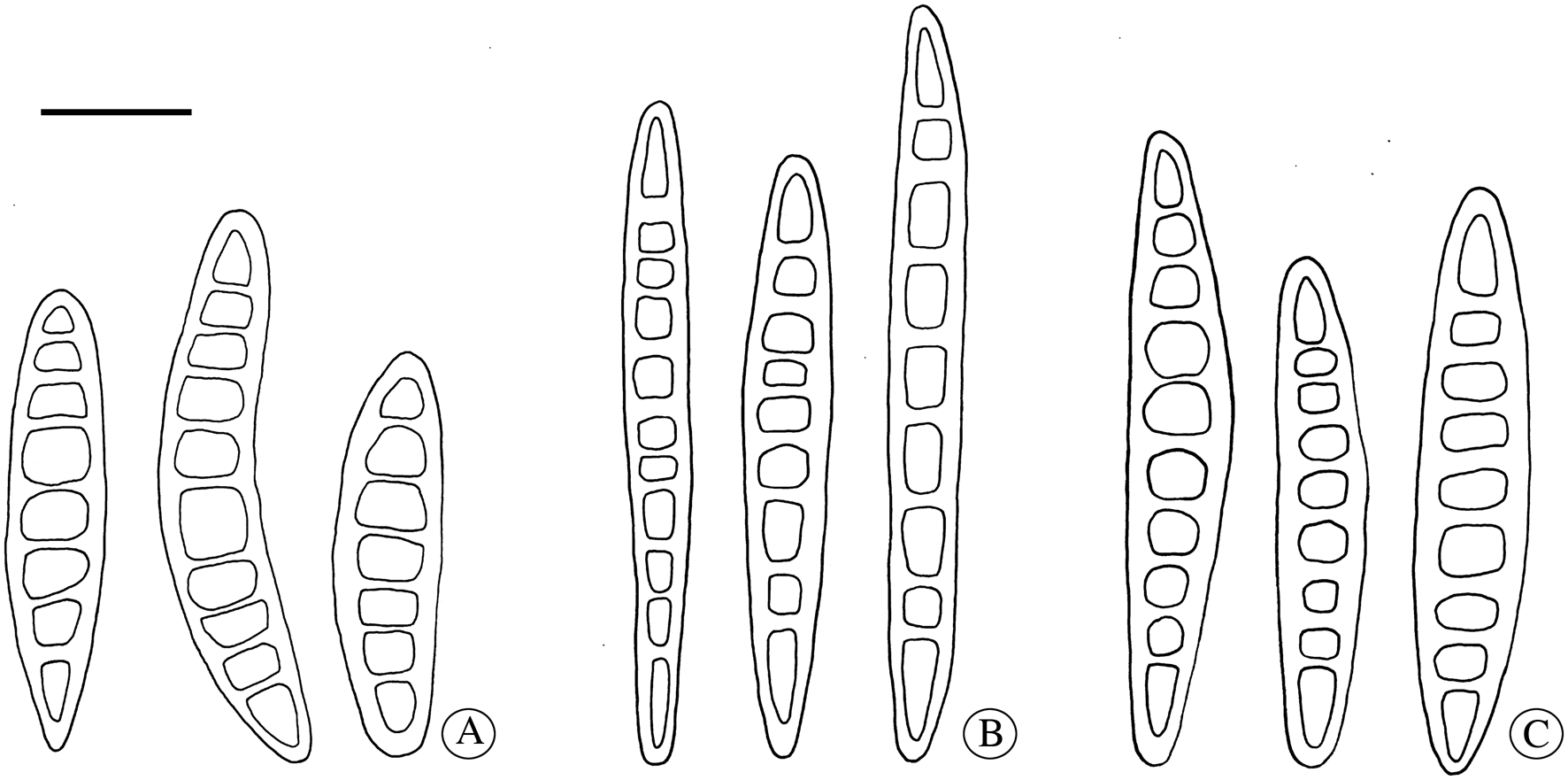
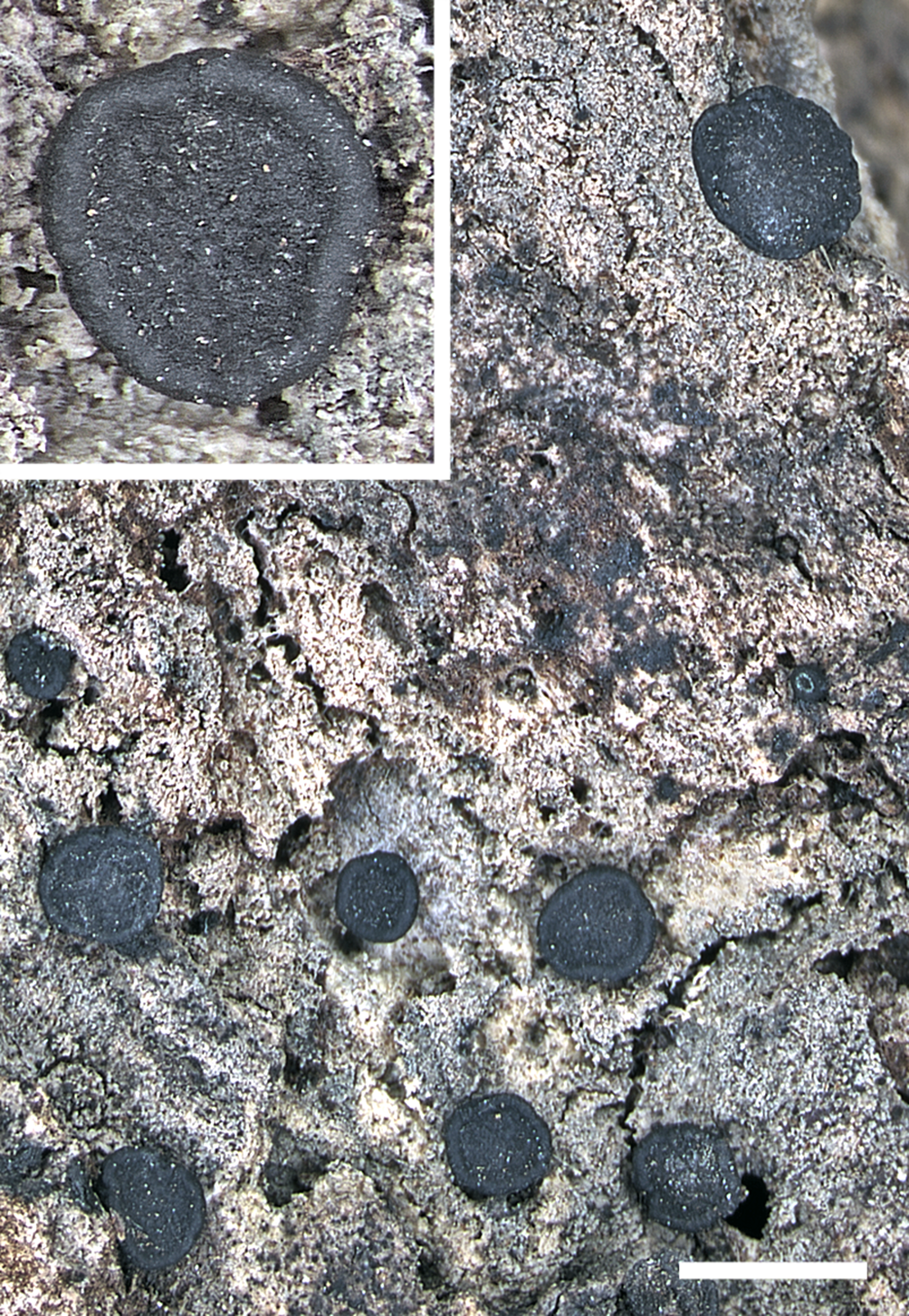
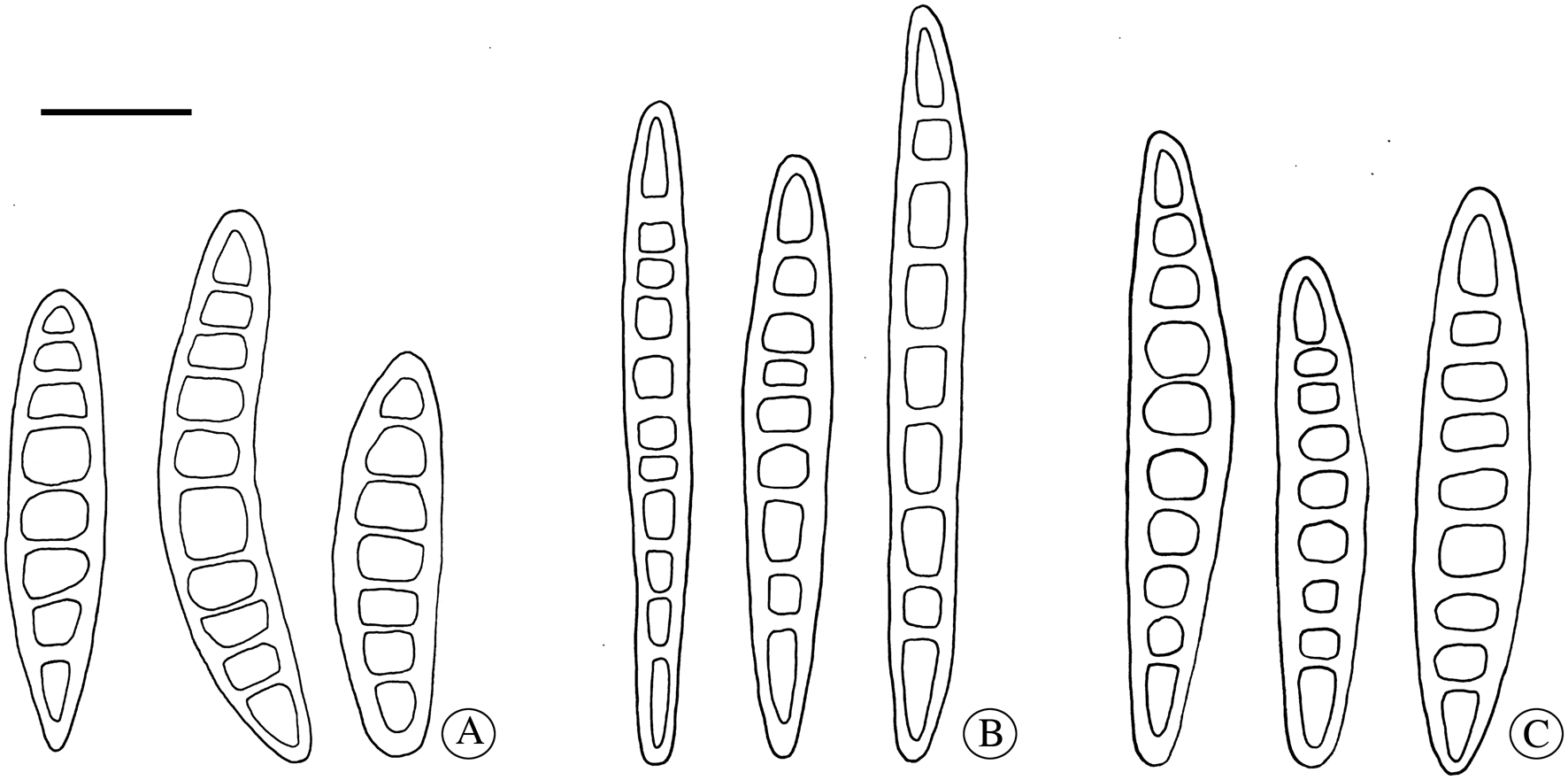
The only other species of Cresponea known from Tasmania is C. subpremnea, which is exclusively corticolous in cool temperate rainforest. It is not unknown in Tasmania for some normally epiphytic lichens to occasionally occur in sheltered microhabitats on rocks, especially away from their usual rainforest environment. However, in the case of C. subpremnea, apart from habitat ecology, it differs clearly from the new species by its longer, narrower ascospores, non-inspersed hypothecium and entire, somewhat thinner exciple (Table 1; Fig. 4).
Comparison of salient features of Cresponea species.
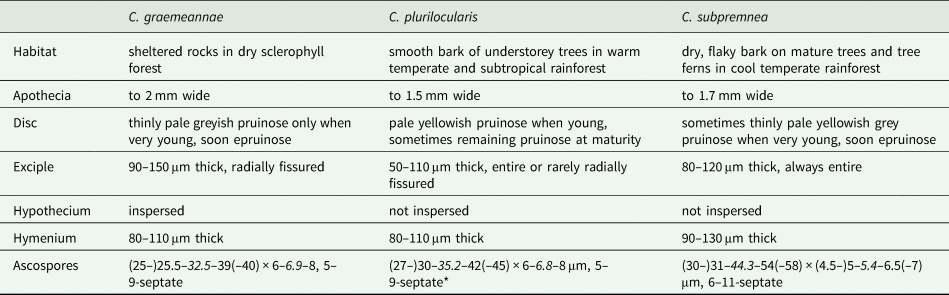
* this study; Egea & Torrente (Reference Egea and Torrente1993a) cite 30–43(–45) × 6–8(–9) μm, with 7–10(–11) septa.
Cresponea graemeannae was also compared with the warm temperate-tropical, corticolous species C. plurilocularis, which has served as something of a placeholder in Australian herbaria for numerous collections of Cresponea. The two species have similar ascospores (Fig. 4) but C. plurilocularis differs by being a far more delicate species, with a well-developed, grey-green thallus, smaller apothecia with a thinner, usually entire exciple and frequently a yellowish-pruinose disc (Table 1). Interestingly, the sterile plug of tissue in the apothecial disc of C. graemeannae is occasionally seen in C. plurilocularis; it appears to be a secondary exciple, developing in the centre of the disc of older apothecia.
Additional specimens examined
Australia: Tasmania: South Sister, 41°32′S, 148°10′E, 750 m, 2004, G. Kantvilas 425/04 (HO); Spring Bay Mill, Cresponea Cliffs, western end, 42°33′S, 147°56′E, 10 m, 2019, G. Kantvilas 362/19, 366/19 (HO).
Cresponea subpremnea (Kantvilas & Vĕzda) Kantvilas comb. nov.
MycoBank No.: MB 835128
Lecanactis subpremnea Kantvilas & Vĕzda, Telopea 4, 688 (1992); type: Australia, Tasmania, Corinna Road, c. 6 km W of Waratah, on old trunk of Nothofagus cunninghamii in rainforest, 600 m elev., 9 February 1982, G. Kantvilas 71/82 (holotype—HO!; isotypes—GZU!, PRA-V!, WELT!).
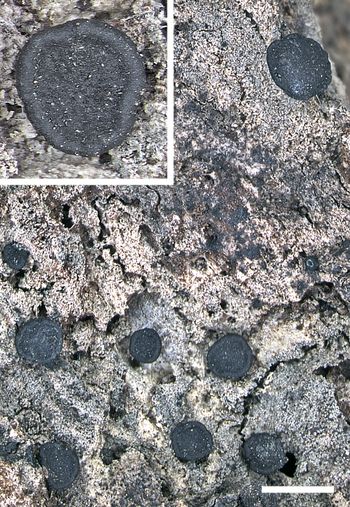
Cresponea subpremnea habit, with inset showing detail of an apothecium with an intact exciple. Scale = 2 mm.
Comparison of ascospores of Cresponea species. A, C. graemeannae. B, C. subpremnea. C, C. plurilocularis. Scale: A–C = 10 μm.
Descriptions of this species were provided by Kantvilas & Vĕzda (Reference Kantvilas and Vĕzda1992; as Lecanactis) and, subsequently, by Kantvilas (Reference Kantvilas2004; under the name Cresponea plurilocularis). Salient features are repeated here, modified on the basis of additional collections and study.
Thallus effuse, scurfy, dull olivaceous grey-green, very thin and sometimes patchy to absent, forming extensive, undelimited patches 10–30 cm wide; photobiont trentepohlioid, with cells subglobose to oblong-ellipsoid, 8–14 × 7–13 μm.
Apothecia to 1.7 mm wide; disc brown-black to black, plane to concave, sometimes eroded when old, rarely with a very thin, cobweb-like, pale yellowish grey pruina when very young but soon epruinose; exciple prominent and persistent, entire, in section 80–120 μm thick laterally. Hypothecium hyaline to pale yellowish, 60–110 μm thick, not inspersed. Hymenium 90–130 μm thick, hyaline, overlain by a dark yellow-brown, K+ olive-yellow epithecial layer 6–20 μm thick; asci (65–)80–100 × (13–)16–18 μm; paraphysoids 1.2–1.5 μm thick, with apices usually expanded to 2.5–5 μm wide, hyaline or internally pigmented olive-brown. Ascospores fusiform, straight or a little curved, (30–)31–44.3–54(–58) × (4.5–)5–5.4–6.5(–7) μm (n = 67), 6–11-septate; locules mostly cylindrical, occasionally rounded or rhomboid; wall to c. 1.5 μm thick.
Pycnidia uncommon, immersed, visible as minute black specks; conidia (microconidia) bacilliform to fusiform, 3.5–5.5 × 0.5–1 μm.
Chemistry
No substances detected by TLC.
Remarks
Cresponea subpremnea was first described in Lecanactis but was not considered in the study that led to the erection of the genus Cresponea by Egea & Torrente (Reference Egea and Torrente1993a). Kantvilas (Reference Kantvilas2004) synonymized it with C. plurilocularis, albeit with considerable reservations after noting the narrower, longer ascospores. Since then, study of further Tasmanian collections, as well as of collections of C. plurilocularis from eastern mainland Australia, have reinforced the previously noted differences between these taxa and, consequently, L. subpremnea is brought out of synonymy and combined into Cresponea. Salient differences between the two species are summarized in Table 1. Cresponea plurilocularis differs chiefly by having wider and shorter ascospores, generally with fewer septations (Fig. 4). In addition, the apothecial disc of C. plurilocularis is frequently pruinose. The shape of the ascospore locules (rounded versus cylindrical), a character applied by Egea & Torrente (Reference Egea and Torrente1993a), is likely to be an artefact of age.
Professor Jack Elix (unpublished annotations) recorded consimonyellin, with traces of isosimonyellin, from two collections of C. subpremnea, and simonyellin in one of C. plurilocularis, suggesting a possible chemical difference between the two taxa. However, these results could not be repeated in the present study and no secondary compounds were detected by thin-layer chromatography in the specimens examined.
Ecology and distribution
Cresponea subpremnea occupies a narrow, specialized ecological niche and colonizes dry, sheltered, shaded habitats, exclusively on the flaky bark of the oldest trees (typically Nothofagus cunninghamii) in cool temperate rainforest. This habitat is where calicioid lichens, Lecanactis abietina (Ach.) Körb., L. mollis (Stirt.) Fritsch & Ertz and species of Lepraria and Micarea occur, although the Cresponea forms such extensive, widely spreading thalli that few associated lichens tend to be ‘captured’ on herbarium specimens. The tree fern Dicksonia antarctica may also be colonized where its fibrous trunk provides a similarly dry microhabitat. Cresponea subpremnea is very conspicuous because it forms very large thalli, but at the same time it is rather rare and known from just a small number of collections. All Tasmanian specimens are from the west and north-west of the island, where the most extensive tracts of cool temperate rainforest occur. These rainforests are known for supporting several lichen species that are rare or absent elsewhere in Tasmania. Examples include Arthothelium subspectabile Vĕzda & Kantvilas, Bactrospora granularis Kantvilas, B. homalotropa (Nyl.) Egea & Torrente, Hypotrachyna laevigata (Sm.) Hale, Lecanographa nothofagi Kantvilas, Menegazzia tarkinea Kantvilas and Notoparmelia tarkinensis (Elix & Kantvilas) A. Crespo et al. It is also known from cool temperate rainforest in Victoria. In contrast, C. plurilocularis has been collected from smooth bark on small-diameter trees and shrubs in warm temperate and subtropical rainforest in New South Wales and Queensland. Egea & Torrente (Reference Egea and Torrente1993a) also list collections from the Malesian region, New Caledonia (including the type), Lord Howe Island and New Zealand.
Specimens examined
Australia: Tasmania: near Delville Saddle, 41°43′S, 145°00′E, 140 m, 1982, G. Kantvilas s. n. (HO); Anthony Road, 41°49′S, 145°38′E, 450 m, 1991, G. Kantvilas 215/91 (HO, LSU, PRA-V); Anthony Road, 41°50′30″S, 145°37′30″E, 540 m, 1992, G. Kantvilas 553/92 (HO); Savage River Pipeline at 22 mile peg, 41°15′S, 145°20′E, 1993, G. Kantvilas 316/93 (HO); Savage River NP, E side of Baretop Ridge, 41°18′37″S, 145°26′51″E, 580 m, 2015, G. Kantvilas 61/15 (HO); Savage River Pipeline Road near Rapid River, 41°16′S, 145°20′E, 450 m, 2015, G. Kantvilas 202/15 (HO). Victoria: Cement Creek, 1983, G. Kantvilas s. n. (HO); Yarra Ranges NP, Cement Creek Reserve, 1995, S. H. Louwhoff s. n. (HO).
Comparative material of C. plurilocularis examined
Australia: Queensland: Bunya Mountains, between Westcott Picnic Area and Long Plain Bald, 26°51′S, 151°35′E, 1050 m, 1995, 165/95 (BRI, HO); Lovedays Road, Mt Mee State Forest, 1996, G. Kantvilas 45/96 (BRI, HO); D'Aguilar Range, Western Windows Walk, 27°19′46″S, 152°45′27″E, 680 m, 2014, G. Kantvilas 458/14 (BRI, HO). New South Wales: Mt Wilson, 1988, G. Kantvilas s. n. (HO); Mt Allyn Forest Park, track to Burraga Swamp, 32°07′S, 151°25′E, 980 m, 1988, G. Kantvilas 174/88 (HO, NSW); Blue Mtns, trail to Cathedral Creek, 33°30′S, 150°24′E, 1030 m, 2002, G. Kantvilas 197/02 (HO).
Also studied
In the course of this study, other species of Cresponea, especially those known to occur in the Australasian region, were also examined. One such species, Cresponea litoralis Elix (Elix Reference Elix2007), has Bactrospora-type asci (after Torrente & Egea Reference Torrente and Egea1989), a hymenium that is very lax and separates easily in water, Patellarioides-type, filiform, multiseptate ascospores (after Egea & Torrente Reference Egea and Torrente1993b) and belongs in the genus Bactrospora. These ascus and ascospore types are illustrated by Kantvilas (Reference Kantvilas2004). The formal synonymy follows.
Bactrospora myriades (Fée) Egea & Torrente
Lichenologist 25, 245 (1993).—Cresponea litoralis Elix, Australasian Lichenology 60, 15 (2007); type: Australia, Queensland, Forrest Beach, 18 km ESE of Ingham, 18°43′02″S, 146°17′50″E, on dead stump in remnant strand vegetation with Pandanus and Allocasuarina, 23 July 2006, J. A. Elix 36792 (holotype—BRI; isotypes—CANB, HO!).
Descriptions of this species are provided by Egea & Torrente (Reference Egea and Torrente1993b) and Elix (Reference Elix2007). It is widespread in the tropics, ranging from Central America and the Caribbean Islands to South America, the Seychelles, India and South-East Asia (Sobreira et al. Reference Sobreira, Aptroot and Caceres2015). This species was first reported for Australia by Rogers (Reference Rogers2018).
Key to Cresponea in Australia
1 Thallus saxicolous ……… 2
Thallus corticolous or lignicolous ……… 3
2(1) Thallus well developed, areolate; apothecia with a thin margin not extending above the disc; ascospores (5–)7-septate, (30–)45–50 × 5 μm, attenuated at the distal end into a tail c. 20 μm long……… C. ancistrosporelloides
Thallus ± inapparent; apothecia with a thick, prominently inrolled, radially fissured margin; ascospores 5–9-septate, 25–40 × 6–8 μm; apices not attenuated……… C. graemeannae
3(1) Ascospores 3–4(–5)-septate, 14–24 × 4–6 μm……… C. flava
Ascospores invariably more septate and longer……… 4
4(3) Ascospores to 7(–8)-septate, 25–40 μm long……… C. proximata
Ascospores generally more septate, 30–65 μm long……… 5
5(4) Ascospores 5–9-septate, 27–45 × 6–8 μm……… C. plurilocularis
Ascospores up to 14-septate, 30–65 × 5–7 μm……… 6
6(5) Ascospores 8–14-septate, 34–65 × 5–7 μm; found in tropical latitudes ……… C. leprieurii
Ascospores 6–11-septate, 30–58 × 4.5–7 μm; found in cool temperate latitudes ……… C. subpremnea
Acknowledgements
I thank Jean Jarman for the close-up photographs of the species treated and for preparing all figures for publication. For their generous support of the 2019 TMAG ‘Expedition of Discovery’, when the new taxon was collected, I thank Graeme Wood, Anna Cerneaz and the staff of Spring Bay Mill, and the Friends of the Tasmanian Museum and Art Gallery. The companionship in the field of other expeditioners, in particular Matthew Baker, Lyn Cave and Miguel de Salas, and of Brigitte de Villiers, is greatly appreciated.
Author ORCIDs
Gintaras Kantvilas, 0000-0002-3788-4562.