Mastitis is a painful disease for dairy cows and among the most costly diseases on dairy farms (Halasa et al. Reference Halasa, Nielen, Huirne and Hogeveen2009). Clinical mastitis (CM) treatment protocols are an important part of mastitis control programmes and are generally aimed at maximising bacteriological cure (BC). The majority of antimicrobial products approved for CM treatment have a dosing regimen of 1–2 d. This dosing scheme is sometimes perceived to be too short for antibiotics that are frequently used in mastitis treatment. To enhance BC of persistent IMI extending the duration of treatment to 5 d or even 8 d has been proposed and shown to be effective for subclinical mastitis caused by streptococci and Staphylococcus aureus (Gillespie et al. Reference Gillespie, Moorehead, Lunn, Dowlen, Johnson, Lamar, Lewis, Ivey, Hallberg, Chester and Oliver2002; Oliver et al. Reference Oliver, Gillespie, Headrick, Moorehead, Lunn, Dowlen, Johnson, Lamar, Chester and Moseley2004b, Deluyker et al. Reference Deluyker, Van Oye and Boucher2005; Roy et al. Reference Roy, DesCôteaux, DuTremblay, Beaudry and Elsener2009). For CM, extended treatment (ET) has particularly been advocated for Streptococcus uberis (Oliver et al. Reference Oliver, Almeida, Gillespie, Headrick, Dowlen, Johnson, Lamar, Chester and Moseley2004a; Milne et al. Reference Milne, Biggs, Barrett, Young, Doherty, Innocent and Fitzpatrick2005; Krömker et al. Reference Krömker, Paduch, Klocke, Friedrich and Zinke2010). The reported effects of ET on Staph. aureus CM vary ranging from beneficial (Truchetti et al. Reference Truchetti, Bouchard, Descôteaux, Scholl and Roy2014), only beneficial for β-lactamase negative strains (Jarp et al. Reference Jarp, Bugge and Larsen1989; Sol et al. Reference Sol, Sampimon, Barkema and Schukken2000) to no difference (Pyörälä & Pyörälä, Reference Pyörälä and Pyörälä1998; Swinkels et al. Reference Swinkels, Cox, Schukken and Lam2013a). This variability in effect may be due to differences in study design, type of antibiotics used and route of application. Studies on the added value of ET compared with standard treatment (ST) of Escherichia coli CM are scarce, probably because intramammary Esch. coli infections are considered transient, self-limiting and thus an additional effect of antibiotic therapy is not expected (Pyörälä & Pyörälä, Reference Pyörälä and Pyörälä1998). However, in trials including more persistent Esch. coli infections, ET has been shown to be more effective than no treatment (Schukken et al. Reference Schukken, Bennett, Zurakowski, Sharkey, Rauch, Thomas, Ceglowski, Saltman, Belomestnykh and Zadoks2011).
If cows with CM are perceived not to respond clinically to ST, farmers usually extend treatment, thereby expecting a higher rate of cure. That type of CM cases may be due to clinical flare-ups of persistent subclinical intramammary infection (IMI). These persistent IMI have been reported as difficult to cure (Deluyker et al. Reference Deluyker, Van Oye and Boucher2005) and to show clinical flare-ups during the course of an IMI (Lam, Reference Lam1996). It is likely that persistent IMI can be identified through a prolonged elevated SCC before the onset of clinical signs (De Haas et al. Reference De Haas, Barkema and Veerkamp2002). Using information on elevated SCC before the onset of clinical symptoms may therefore be a valuable tool in advising dairy farmers to choose extended therapy. However, convincing evidence of a beneficial effect of ET of CM cases in cows with persistent high SCC (CMPHS) is lacking. This lack of evidence is particularly true when the causal pathogen is unknown, which in practice is usually the case when a CM treatment is started. Cefquinome is a broad-spectrum β-lactam antibiotic, licensed throughout Europe for the intramammary treatment of CM caused by all major mastitis pathogens. In practice, in the absence of previous identification of the causative pathogen, the aetiology can be diverse and may justify a broad-spectrum antibiotic for first treatment of CM. The objective of this trial was to compare the effect of standard 1·5-d vs. extended 5-d cefquinome treatment of CMPHS.
Material and methods
Animal welfare
Ethical use of animals approval was requested and approved in August 2010 by the Lower-Saxony consumer protection and food safety State Office, under number 10A062.
Study design
This was a non-blinded, systematically allocated and controlled CM trial comparing two treatment groups. The study was conducted on 20 dairy farms from August 2010 to August 2012. The efficacies of a standard, 1·5-d, and an extended, 5-d, intramammary cefquinome treatment were compared. Only cows with CM preceded by at least two consecutive monthly elevated SCC >200 000 cells/ml were included. Primary efficacy criteria were BC and CC, while SCC cure was considered secondarily. The definitions of the efficacy criteria are described below.
Herds
To be able to identify farm effects and to finish the study in a reasonable time, 20 dairy farms were selected. These farms were located in the German federal states of Saxony-Anhalt, Lower Saxony and North Rhine-Westphalia. They were all free-stall farms with the ability to demonstrate compliance with the study protocol. For inclusion, cows had to be easily identifiable by ear tag or freeze branding. Farms needed to monthly record individual cow SCC, for at least 12 months before the start of the study. No specific requirements related to bulk milk SCC or CM incidence were necessary for inclusion in the study.
Inclusion of cows
First inclusion criterion called only for lactating cows with CM signs in one quarter. Cows with clinical signs in more than one quarter were not included in the study. Of these CM cases, only those immediately preceded by at least two consecutive monthly milk recordings after calving, showing high cow SCC (>200 000 cells/ml), described as CMPHS, were included. The first SCC recording for all cows was at or after 3 d post calving (Barkema et al. Reference Barkema, Deluyker, Schukken and Lam1999). CM was defined as a quarter with changes in the appearance of milk, with or without clinical signs of the affected quarter (swelling, heat, pain) and with or without associated general clinical signs.
Following identification of CM by a trained milker, cows were assessed for exclusion criteria. Cows were excluded if they did not fulfil the SCC criteria, had quarters with significant udder, teat and teat orifice lesions, had had CM in the immediately preceding month, were treated with other products in addition to the intramammary antibiotic or had concurrent diseases at the time of CM. Additionally, farmers were allowed to decide whether to exclude cows for additional parenteral treatment in severe CM cases. Parity, affected quarter location, days in milk at CM occurrence, milk production, cow SCC measured at the two most recent milk recordings before CM, and relevant clinical data were collated. The first day of treatment constituted initiation of the study for each included cow (d0). Cows were only included once in the study. If ⩽2 pathogens were cultured in both (duplicate) pre-treatment samples, a case was included in the study. If in one of the duplicate samples >2 pathogens were cultured and not in the other, the same pathogen found in both samples, was considered the causative mastitis pathogen and the case was included.
Post-admission withdrawal
For practical reasons, farmers were allowed some flexibility and had the right to withdraw a cow from the study post admission after consultation with the veterinarian. These cases were carefully documented. In the case of adverse events, the protocol included that the cows were carefully checked for by the milker and monitored by the herd veterinarian. If in both (duplicate) samples >2 pathogens were cultured, a case was considered contaminated and excluded from the analysis. For further details, see laboratory methods.
Number of cows
The tested hypothesis was that ET resulted in a higher BC rate (65%) than ST (50%). Based on a one-sided Chi-square test with type I error α=0·05 and type II error β=0·20, a total of 175 animals were needed per treatment group. Assuming that approximately 10–15% of cows drop out of the trial post admission, approximately 200 cows were needed per treatment group, in total 400 cows with CM.
Randomisation
After sampling, cows were systematically allocated to each treatment group based on the last ear tag or freeze brand number. Ear tag or freeze brand numbers were consecutively allocated to individual cows at the moment they joined the herd. Cows with odd numbers received ST while cows with even numbers received ET.
Data recording
At the cow level, data were either recorded cow-side onto data capture forms or retrieved onto data forms from on-farm software at the time of treatment. Any disease or concurrent treatments were recorded for a period of 25 d after enrolment.
Milk sampling
Before the start of the study, farms were provided with all sampling materials. One pre- and 2 post-treatment milk samples were taken, according to the CVMP guideline for efficacy studies of intramammary products (CVMP, 2013). Milk sampling of CM cases was performed by the milkers after specific instructions given by the herd veterinarian. Duplicate quarter samples from the clinically affected quarter were collected aseptically before treatment and sent by post to the microbiological laboratory at the University of Applied Sciences, Hannover. Post-treatment quarter milk samples were taken in duplicate at 14 (±2) and 21 (±2) d post enrolment, bacteriology and SCC measurement by a trained veterinarian.
Laboratory methods
Microbiological methods were based on National Mastitis Council recommendations (NMC, 1999) as cited by the German Veterinary Association (GVA, 2009). All milk samples collected were cooled (at or below 8 °C), but were never frozen. Samples were kept in the refrigerator or in cooling boxes or bags during transport. The interval between sampling and analysis was <36 h for CM samples and <8 h for post-treatment samples. One hundred μl of milk from each duplicate sample was plated onto an aesculin blood agar plate (Oxoid, Germany) and on Chromocult® Coliform Agar (Merck, Germany). Both plates were incubated aerobically at 37 °C and examined after 24 h. The aesculin blood agar plates were also examined after 48 h (GVA, 2009). Definitions of culture status were according to GVA (2009) procedures. Bacterial cultures of cow-associated pathogens (Staph. aureus, Str. agalactiae, Streptococci type C, Trueperella pyogenes) were considered positive if ⩾10 cfu/ml were isolated in both (duplicate) samples. Bacterial cultures of environment associated pathogens [Str. uberis, Esch. coli, Klebsiella spp., other coliforms, Enterococcus spp., coagulase-negative streptococci (CNS), Pseudomonas spp.] were considered positive only if ⩾100 cfu/ml were isolated in both (duplicate) samples. Categories of the number of cfu/ml of the isolated pathogens were documented as 1: 10–100 cfu/ml; 2: 101–500 cfu/ml or 3: >500 cfu/ml. Of every CM, both (duplicate) samples were cultured. If 2 pathogens were cultured in both duplicate samples, it was considered a mixed infection. In the case of 2 distinct pathogens being cultured from one of the duplicate samples, while from the second duplicate sample only one of these pathogens was cultured, the pathogen that was cultured in both samples was identified as the causative pathogen. If >2 pathogens were cultured in both (duplicate) samples the case was considered contaminated. After isolation of bacterial species, bacterial strain typing was performed using randomly amplified polymorphic DNA analysis (RAPD) as described earlier (Pacheco et al. Reference Pacheco, Guth, de Almeida and Ferreira1996; Vogel et al. Reference Vogel, Jories, Tviep, Koek and Dijkshoorn1999; Gillespie & Oliver Reference Gillespie and Oliver2004; Naffa et al. Reference Naffa, Bdour, Migdadi and Shehabi2006). Directly after isolation of bacteria, the samples were stored at −80 °C. At the end of the study, the samples were thawed, the bacterial strains re-cultured and at the same time, the RAPD test was performed on the same agar gel. RAPD was done on one of the bacteriologically positive duplicate pre-treatment samples and on one of the duplicate post-treatment samples at days 14 and 21. Interpretation of the RAPD was done as described earlier (Munoz et al. Reference Munoz, Welcome, Schukken and Zadoks2007).
Quarter foremilk samples for SCCwere collected in tubes containing boric acid and were cooled in the refrigerator at 4 °C during transport to the laboratory. Immediately after arrival in the laboratory, SCC was determined by flow cytometry with the Somascope Smart (Delta Instruments, The Netherlands).
Treatment
Treatment was performed by the milkers. Two different intramammary treatment regimens with 75 mg cefquinome (Cobactan® LC, MSD Animal Health) were investigated in this study, either an on label, 1·5-d treatment with 3 tubes at 12-h intervals (ST), or an off-label, 5-d treatment with 6 tubes, 3 tubes at 12-h interval, followed by 3 tubes at 24-h interval, 1 each day (ET). These intervals are in compliance with pharmacokinetic characteristics of the intramammary product to maintain appropriate drug concentration.
Clinical evaluation
Before the start of the study, milkers were trained by the veterinarian in evaluation and documentation of clinical signs. Clinical evaluation was done by the milkers at the onset of CM. At day 1·5 (36 h after the start of treatment) and day 5 (120 h after the start of treatment) clinical evaluation was also performed by the milkers and at days 14 and 21 by the same herd veterinarian. Clinical evaluation consisted of a classification of severity of disease as Grade 0; normal, Grade 1; mild, only clots in the milk, Grade 2; moderate, symptoms of Grade 1 and heat, pain and/or swelling of the udder, rectal temperature <39·5 °C and Grade 3; severe, symptoms of grade 2 and depression, anorexia, recumbency, rectal temperature >39·5 °C. At least 2 generalised symptoms needed to be present for grade 3 classification.
Definitions
BC was defined as the absence of the bacterial strain isolated pre-treatment, based on both bacteriological culturing and RAPD strain typing, in both (duplicate) post-treatment samples at days 14 and 21. The objective of including RAPD strain typing in the definition of BC was to get a more accurate diagnosis. For example, when the same bacterial species was identified in the bacterial culture pre- and post-treatment, but RAPD typing revealed a different strain pre- and post-treatment, the case was defined as a BC. CC was defined as the absence of any clinical sign of mastitis (grade 0) after treatment and was defined at 4 different time points: at days 1·5, 5, 14 and 21. SCC cure was defined as a quarter SCC being <200 000 cells/ml both at day 14 and day 21.
Blinding
By virtue of the differences in treatment regime it was not possible to blind the study personnel or the farmer or herdspersons to product administration. The personnel at the laboratory, culturing milk samples, were unaware of the treatment given.
Statistical analysis
To test homogeneity of data of the two treatment groups, normally distributed metric data were tested statistically with Student's t test. Nominal data, i.e. clinical score, were compared as proportions with a χ2-test.
Although the affected quarter was the unit of observation for BC, only one quarter per cow was included and therefore cow and quarter analysis are identical. In the case of BC, if 2 different pathogens were isolated, each pathogen was analysed separately and two data lines were included in the analysis for BC. BC, CC and SCC cure were evaluated using mixed model logistic regression analysis where parity, treatment duration (treatment), pathogen group (enterobacteriaceae, streptococci, staphylococci, no growth and other), quarter position (front/hind), cow SCC pre-treatment (measured at the most recent milk recording before CM occurrence), days in milk (DIM) and cfu category (1, 2 or 3) were included as fixed effects and farm was included as random effect. SCC cure was categorised according to the cut-off value of 200 000 cells/ml as mentioned earlier. For the statistical analysis, SAS, version 9.2 (SAS Institute, Inc., Cary NC, USA) was used. The full model, including possible confounders and interaction term, was given by:
 $$\eqalign{{\rm Logit}\,{\rm (BC,}\,{\rm CC,}\,{\rm SCC)} = \ & {\rm Lactation} + {\rm DIM} + {\rm quarter}\,{\rm position} \cr &+ {\rm pathogen {\hbox -} group} + {\rm treatment} \cr&+ {\rm pre} {\hbox -} {\rm treatment}\,{\rm cow\, SCC} \cr &+ {\rm cfu\,category} \cr &+ {\rm treatment} \times {\rm pathogen} {\hbox -} {\rm group} \cr &+ {\rm Herd}\,{\rm (random)} + {\rm e}}$$
A stepwise-backwards analysis was performed using P<0·05 for inclusion and P>0·10 for exclusion and controlling for potential confounding. Essentially, the interaction term allowed us to test the pathogen-group specific effect of ET vs. ST.
Results
Farms
The cows came from herds with a wide range of herd sizes (100–1261 cows/farm), 305-d milk production (7840–12 202 kg), and most recent bulk milk SCC before the start of the study (164 000–368 000 cells/ml). All farms milked twice daily, used gloves during milking and a single tissue per cow for cleaning teats before milking, applied post-milking teat disinfection and blanket antibiotic dry cow treatment to all cows throughout the study.
Cows
A total of 435 cows met the inclusion criteria. Sixteen cows were excluded from the study owing to additional parenteral treatment in severe CM cases. A total of 419 cows were enrolled and sampled pre-treatment for bacteriological examination. No adverse events of treatment were seen. Seven cows were withdrawn post-admission owing to missing data. Three cases were withdrawn post-admission owing to off-protocol treatment; 2 cases owing to additional parenteral treatment and 1 case owing to treatment with another intramammary antibiotic. Finally, 409 cows, 203 in the ST and 206 in the ET group, completed the study and were included in the analyses.
Homogeneity of treatment groups
No significant differences were found in parity, DIM, milk production, pre-treatment cow SCC, enrolment quarter SCC, enrolment bacteria count (cfu/ml) and clinical score at the start of treatment between the ET and the SOT group (P>0·05, Table 1).
Descriptive cow level data of groups of standard (n=203), 1·5-d, and extended (n=206), 5-d intramammary cefquinome treatment of clinical mastitis in cows with persistent high SCC from 20 different herds in Germany. Most parameters were compared with a Student's t test and are presented as the mean with sd in parentheses

† Days in milk at the day of clinical mastitis occurrence
‡ Milk production at the last milk recording before clinical mastitis
§ Cow somatic cell count measured at the last milk recording before clinical mastitis
¶ Bacterial count of the clinical mastitis causing pathogen; 1: 10–100 cfu/ml; 2: 101–500 cfu/ml or 3: >500 cfu/ml
†† χ2-test (likelihood ratio statistic) for proportions
Isolated bacterial species
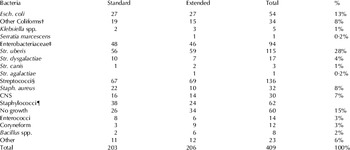
The most frequently isolated pathogens were Str. uberis (n=115; 28%), Esch. coli (n=54; 13%), other coliforms (n=34; 8%), CNS, including CNS from mixed infections (n=34; 8%) and Staph. aureus (n=32; 8%) (Table 2). Sixty samples showed no growth (15%). Four quarters showed mixed infections and there were no quarters with duplicate contaminated samples.
Bacteriological culture results of milk samples of 409 clinical mastitis cases in cows with persistent high SCC from 20 different herds in Germany. Results are presented in total and in groups of cows with standard, 1·5-d, and extended, 5-d, intramammary cefquinome treatment

† Coliforms other than Esch. coli, Klebsiella spp. and Serratia marcescens
‡ Esch. coli, Klebsiella spp., Serratia mercescens and other coliforms
§ Str. uberis, Str. dysgalactiae, Str. agalactiae, Str. canis
¶ Staph. aureus and CNS (coagulase-negative streptococci)
Bacteriological cure
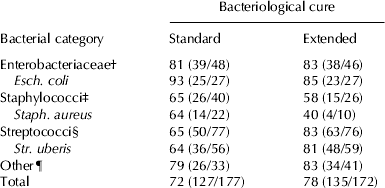
The overall BC of all CMPHS cases at day 21, was 78% (135/172) after ET and 72% (127/177) after ST (Table 3). At the pathogen level, streptococci, mainly Str. uberis, showed a better BC after ET (83%) than after ST (65%), while BC of Staph. aureus was lower after ET (40%) than after ST (64%) (Table 3).
Descriptive data of bacteriological cure (%) by bacterial group after standard (n=203), 1·5-d, and extended (n=206), 5-d, cefquinome treatment of 409 clinical mastitis cases in cows with persistent high SCC from 20 different herds in Germany. Numbers of cures divided by the number of cases are presented in parenthesis

† Esch. coli, Klebsiella spp. and other coliforms
‡ Staph. aureus and CNS (coagulase-negative streptococci)
§ Enterococci, Str. uberis, Str. dysgalactiae, Str. agalactiae, Str. canis
¶ Coryneforms, Bacillus spp., Trueperella pyogenes, Pseudomonas spp., Yeasts, Prototheca spp.
Least square means of BC after ST was 72% and was 79% after ET. In the final model, BC after ET was significantly different from ST for streptococci, mainly Str. uberis, but not for other pathogens (Table 4). Cases associated with streptococci were 3-times more likely to cure bacteriologically after ET compared with ST (P=0·04). At the bacterial group level, BC of staphylococci was significantly lower than BC of ‘other pathogens’. There was no significant difference between the BC of streptococci (P=0·08) and of enterobacteriaceae (P=0·98) vs. ‘other pathogens’. The random farm effect was not significant (P=0·19) but was kept in the model as a design variable.
Final mixed logistic regression model for bacteriological cure of clinical mastitis in cows with persistent high SCC (n=409) from 20 different herds in Germany. Cows were either treated with a 1·5-d standard (ST), or a 5-d extended (ET), intramammary cefquinome treatment. Herd was included as a random effect

Clinical cure
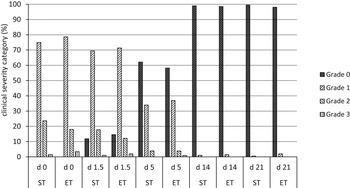
The evolution of CM signs during the trial is presented in Fig. 1. At enrolment, 77% (314/409), of CM cases were mild (Grade 1), 21% (85/409) moderate (Grade 2) and 2·5% (10/409) severe (Grade 3). At 1·5 d after enrolment, 13% (54/409) was clinically cured, 70% (288/409) had mild, 15% (61/409) moderate and 0·7% (3/409) severe signs. At 5 d after enrolment clinical signs had significantly improved (P<0·01) and 62% (126/203) of the cows in the ST group and 58% (120/206) in the ET group were clinically cured. At 14 and 21 d after treatment almost 100% of CM cases were clinically cured.
Percentage of clinical mastitis cases in severity categories Grade 0, 1, 2, and 3 † at the time of first treatment (day 0) and at day (d) 1·5, 5, 14 and 21 after treatment of cows with persistent high SCC from 20 different herds in Germany. Cows were either treated with a 1·5-d standard (ST, n=203), or a 5-d extended (ET, n=206), intramammary cefquinome treatment. †Grade 0: healthy, no clinical signs of mastitis, Grade 1: mild, only clots in the milk, Grade 2: moderate; heat, pain and/or swelling of the udder, rectal temperature <39·5 °C, Grade 3; severe, symptoms of Grade 2 and depression, anorexia, recumbency, rectal temperature >39·5 °C. At least 2 generalised symptoms needed to be present for Grade 3 classification.

In the final model for CC, ET was not significantly different from ST (P=0·21). Cows affected with CM within the first 100 DIM had a significantly lower CC compared with cows affected after 200 DIM (P=0·02).
Somatic cell count cure
The development and cure of SCC are shown in Table 5. Overall SCC cure rate was 22%, being 19% after ST and 25% after ET. SCC cure of the different pathogens or pathogen groups was: enterobacteriaceae (30%), culture negative (25%), staphylococci (17%), Str. uberis (17%) and others (22%). Least square means of SCC cure was 19% after ST and 25% after ET. In the final model, SCC cure after ET was not significantly different from ST (P=0·15), nor was the interaction term of treatment×pathogen (Table 6). SCC cure was significantly higher only for enterobacteriaceae (P=0·047) compared with staphylococci. Random farm effect was not significant (P=0·41) but was kept in the model as a design variable.
Development and cure of mean log quarter somatic cell count (SCC, cells/ml), after treatment of clinical mastitis cases of cows with persistent high SCC, from 20 different farms in Germany, with intramammary cefquinome, either standard (n=203), 1·5-d, or extended (n=206), 5-d, treatment. In addition to the mean log quarter SCC, sem(±) is indicated for pre-treatment (cow level), and of clinical mastitis cases at day 0, day 14 and day 21 (quarter level) in the standard and extended treatment groups. Differences between treatment groups were not significant (P>0·05)

† Cow SCC recorded at the most recent milk recording before the occurrence of the clinical case
‡ Quarter SCC <200 000 cells/ml at both days 14 and 21 after enrolment
Final mixed logistic regression model for somatic cell count cure of clinical mastitis in cows with persistent high SCC (n=409) from 20 different herds in Germany. Cows were either treated with a 1·5-d standard, or a 5-d extended, intramammary cefquinome treatment. Herd was included as a random effect

Discussion
In practice, farmers frequently extend CM treatment if clinical signs persist after completion of ST, expecting better BC and CC. Our study showed that ET with cefquinome of CMPHS cases improved BC when streptococci were cultured, but not for other pathogens (P=0·57, Table 4). The non-significant results of the comparison of ST and ET irrespective of the underlying pathogen is in contrast with a recent study (Truchetti et al. Reference Truchetti, Bouchard, Descôteaux, Scholl and Roy2014), that showed an overall difference in BC after extended CM treatment compared with standard treatment. Although the latter study also included mild to moderate CM as was mainly the case in our study, the duration of extended treatment was 8 d compared with 5 d in our study. This suggests further prolongation of treatment duration beyond 5 d may improve BC compared with standard treatment in mild to moderate CM. We were interested in the effect of CMPHS treatment without prior knowledge of the underlying pathogen, because that reflects the situation in daily practice. Power calculations were therefore based on finding effects at the overall treatment level rather than at the underlying pathogen level. When analysing the data at the pathogen level, lack of power may be an important cause of non-significant results. A minimum of 175 cases of each pathogen would have been required to show an increase of 15% cure assuming a 50% cure with ST. Another possible reason for the lack of significance is that the ST group showed a higher cure rate than expected (72%), leaving limited room for improvement.
We found BC after ET of streptococcal CMPHS, mainly due to Str. uberis, to be significantly higher (P=0·04) compared with ST. This is in line with previous research (Oliver et al. Reference Oliver, Almeida, Gillespie, Headrick, Dowlen, Johnson, Lamar, Chester and Moseley2004a; Milne et al. Reference Milne, Biggs, Barrett, Young, Doherty, Innocent and Fitzpatrick2005; Krömker et al. Reference Krömker, Paduch, Klocke, Friedrich and Zinke2010) suggesting ET may have added value for treatment of CM caused by Str. uberis. It is in contrast, however, with findings of Truchetti et al. (Reference Truchetti, Bouchard, Descôteaux, Scholl and Roy2014) who could not find an improved BC after extended treatment of streptococcal CM, which may have been caused by lack of a statistical power. For pathogens such as Esch. coli, we did not expect an additional effect of ET because these are generally considered to be transient, self-limiting infections. This expectation was confirmed by the very high BC rate (93%) of Esch. coli after ST. For staphylococcal CM, we expected a positive effect of extended treatment of Staph. aureus CM, recently shown by Truchetti et al. (Reference Truchetti, Bouchard, Descôteaux, Scholl and Roy2014) and previously by Jarp et al. (Reference Jarp, Bugge and Larsen1989) or Sol et al. (Reference Sol, Sampimon, Barkema and Schukken2000) for Staph. aureus CM caused by β-lactamase-negative strains. We could not, however, prove a beneficial effect of ET compared with ST in Staph. aureus CMPHS, putting our findings in line with previous work from our group (Swinkels et al. Reference Swinkels, Cox, Schukken and Lam2013a), indicating that CMPHS cases probably are different from CM cases in general. We even found a lower BC after ET (40%) of Staph. aureus CMPHS as compared with ST (64%). This may be a spurious finding, due to the low number of Staph. aureus cases in the ET group (n=10). Another cause for the discrepancy between the effect of ET on Str. uberis and Staph. aureus CMPHS may be the capabilities of Staph. aureus to invade mammary epithelial cells (Hensen et al. Reference Hensen, Pavicić, Lohuis, de Hoog and Poutrel2000; Kerro Dego et al. Reference Kerro Dego, van Dijk and Nederbragt2002) or to survive in neutrophils (Mullarky et al. Reference Mullarky, Su, Frieze, Park and Sordillo2001). Thus Str. uberis IMI may be more sensitive to extended exposure of antibiotics than Staph. aureus. The ability of Staph. aureus to protect itself from antibiotics could also have contributed to the significantly lower BC after both treatments of staphylococci as compared with other pathogens (P=0·03, Table 4).
Strain typing is usually not performed in treatment efficacy trials because it is laborious and costly. Strain typing, however, does increase reliability of results, because the identification of a different bacterial strain after treatment, does provide additional information on BC. Although misclassification may occur, sensitivity and specificity of RAPD testing in streptococcal species, the most frequently isolated pathogens in our study, is relatively high (90 and 92% respectively; Gillespie et al. Reference Gillespie, Jayarao and Oliver1997) suggesting reliable results. Based on the RAPD results, overall BC increased by approximately 4–5% in the ST and by 3% in the ET group compared with the BC without RAPD (data not shown), indicating that antibiotic treatment may lead to a higher cure rate than usually reported (Schukken et al. Reference Schukken, Bennett, Zurakowski, Sharkey, Rauch, Thomas, Ceglowski, Saltman, Belomestnykh and Zadoks2011).
It has been suggested that correlations between SCC patterns and CM occurrence can be used in mastitis control (De Haas et al. Reference De Haas, Barkema and Veerkamp2002, Reference De Haas, Veerkamp, Barkema, Gröhn and Schukken2004). We could not prove that ET of CMPHS cases increased BC as compared with ST. For this reason, and because ET cannot easily be justified economically (Steeneveld et al. Reference Steeneveld, van Werven, Barkema and Hogeveen2011), routine cefquinome ET protocols for CMPHS cases is not recommended. An exception may be the use of ET for cows known to have a streptococcal IMI or on farms where mastitis is caused predominantly by streptococci.
We expected to isolate predominantly pathogens known to cause persistent IMI, such as Staph. aureus and Str. uberis. Interestingly, after Str. uberis, Esch. coli was the most frequently isolated pathogen. This suggests that clinical Esch. coli cases either occurred as a mixed infection or as an opportunistic infection in other quarters than those with an already elevated SCC. Other possibilities are that Esch. coli infections occurred in a quarter that cured from the previous infection between the last DHI test and the CM caused by Esch. coli, or that an Esch. coli infection itself causes elevated SCC, confirming that Esch. coli also causes persistent IMI, as previously reported (Döpfer et al. Reference Döpfer, Barkema, Lam, Schukken and Gaastra1999; Bradley & Green, Reference Bradley and Green2001; Dogan et al. Reference Dogan, Klaessig, Rishniw, Almeida, Oliver, Simpson and Schukken2006).
In practice, farmers judge treatment success on the disappearance of all clinical signs. At day 1·5, 85% of CM cases still had clinical signs, probably perceived as ‘treatment failure’, encouraging ET. At days 5, 14 and 21, the percentage of cows with clinical signs had decreased significantly, irrespective of treatment protocol, suggesting CC simply needs more time instead of more antibiotic exposure time. These findings suggest that after cefquinome treatment, removal of the visible debris of inflammation takes more time than the duration of treatment as indicated on the label. The apparent gap between overall CC (99%) both at days 14 and 21 and BC (75%) at the same time points may indicate that, after initial cure, re-infection occurs with the same bacterial strain, or that a substantial part of CMPHS cases turn back to a subclinical status, with possible clinical flare-ups later on. Cows not cured from CM cases caused by contagious pathogens could therefore be at risk for spreading the infection to healthy herd mates. These findings emphasise that CM treatment protocols are only a limited part of mastitis control programmes and can benefit from being combined with other mastitis control measures, such as teat dipping, milking hygiene and proper milking machine maintenance, to reduce transmission rate and have an optimal effect (Barlow et al. Reference Barlow, White, Zadoks and Schukken2009; Halasa, Reference Halasa2012).
SCC cure is important to the dairy farmer because SCC, rather than BC is routinely used by the milk processing industry as a measure of milk quality. ET did not result in significant further reduction of SCC compared with ST. The overall reduction of quarter log SCC after treatment was limited (approximately 6·7 to 5·8 log units) and the overall SCC cure was low (22%), especially when compared with BC (76%) and CC (99%). This is in line with findings of others (St.Rose et al. Reference St Rose, Swinkels, Kremer, Kruitwagen and Zadoks2003) and suggests that short-term benefits of treatment of CMPHS cases are the elimination of bacteria and clinical signs rather than reduction of SCC. SCC cure for both treatments, however, was significantly higher for enterobacteriaceae (mainly Esch. coli cases), than for staphylococci (P=0·047). This is line with De Haas et al. (Reference De Haas, Veerkamp, Barkema, Gröhn and Schukken2004) who showed that Esch. coli CM has only a short peak in SCC, whereas Staph. aureus CM showed a long term increased SCC.
Owing to practical limitations of a field trial in commercial herds, farmers were allowed to exclude cows fulfilling all the inclusion criteria, from entering the study. Sixteen clinically severe CM cases (3·6% of all CM cases) that met the inclusion criteria, were left out of the study, because milkers decided to treat them with an additional parenteral treatment. In 10 (2·5%) CM cases, that were judged as severe (Grade 3) by the milkers, 4 (1·0%) in the ST group and 6 (1·5%) in the ET group, the milkers decided to treat only intramammary. These cases were included in the study. Exclusion of most severe cases has contributed to a considerably lower percentage of severe cases (2·5%) in our study than the 10 and 7% previously reported in Germany (Krömker, Reference Krömker2013) and in the UK (Swinkels et al. Reference Swinkels, Lam, Green and Bradley2013b). Thus, our conclusions mainly relate to mild and moderate CMPHS cases and reflect the field situation where severe cases are often treated parenterally. The added value of parenteral treatment on BC, CC and SCC cure was not evaluated in our study and would need specific attention.
Another practical limitation was that milkers could not be blinded. For CC at days 1·5 and 5 it was the same milker, and at days 14 and 21 the same veterinarian who performed the clinical scoring. The milker was aware of the treatment given but the veterinarian was not. Because the milkers knew the treatment protocol of cows at clinical scoring, we cannot fully exclude bias at that point. However, we consider it unlikely that this affected the outcome of the study because results of milkers did not differ from those of the veterinarians, showing no difference in CC between treatment groups. Additionally, CC results were in the same direction as BC and SCC results.
In conclusion, intramammary cefquinome ET as compared with ST in cows with CMPHS improved BC when caused by streptococci, specifically Str. uberis. This could not be shown for other pathogens, suggesting ET with cefquinome of CMPHS cases may be appropriate only to farms with predominantly streptococci, such as Str. uberis, as the causative mastitis pathogen and shows no advantage when no information on bacteriological causes of mastitis is available. Specifically farms with on-farm culture programmes may benefit from these findings (Lago et al. Reference Lago, Godden, Bey, Ruegg and Leslie2011a, Reference Lago, Godden, Bey and Leslieb).
This study was sponsored by MSD Animal Health. We thank Dr Ynte Hein Schukken for his assistance in the statistical analysis and the farmers and herd veterinarians participating in the study for their excellent cooperation.