1. The issues: Theory and data
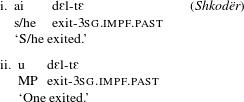
Modern Greek (henceforth Greek) and Albanian have a middle-passive voice (MP), with passive, anticausative, reflexive, or (in Albanian only) impersonal interpretation, and several morphosyntactic instantiations in each language, depending on tense, aspect, mood.Footnote [2], Footnote [3] These include specialized inflections (in Greek and Albanian) and (in Albanian only) a specialized clitic or a specialized auxiliary. In other words, there is a many-to-many mapping between morphosyntax and semantics. The core Greek and Albanian empirical evidence is relatively well-known to formal linguists (Rivero Reference Rivero1990, Joseph & Smirniotopoulos Reference Joseph and Smirniotopoulos1993). In general, the approach at the LF interface has been to start from the different meanings (polysemy) and postulate a one-to-one mapping between interpretive primitives and structural positions (the cartographic model), including a non-active/middle head – and at the PF interface to start from one structure and go for a realizational model of the lexicon as in Distributed Morphology (DM) (see e.g. Kallulli & Trommer Reference Kallulli and Trommer2011, Alexiadou & Doron Reference Alexiadou and Doron2012 for different versions). Although it is possible to adequately describe middle-passive morphology in Greek and Albanian by adopting a point-to-point mapping of interpretive primitives to syntactic positions, we show that such accounts are descriptively enriched to an extent that they are difficult to falsify. A new functional head can always be added, and given the adoption of a realizational conception of the lexicon, arbitrary variation in the morphosyntactic mapping is in principle possible (through devices such as default, impoverishment, etc.).
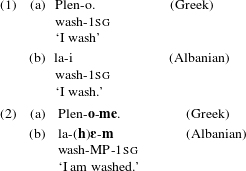
In this section we introduce the fundamental facts, and explain our intent in addressing them. In terms of morphology, both Greek and Albanian can form middle-passives with specialized inflections, namely -me and - $m$ respectively for 1st person singular, as in (2), in comparison to the active -
 $o$ and -
 $i$ respectively in (1). In addition, Albanian in (2b) makes use of the affix -(h)ɛ- attached to the verb base, whereas Greek only has a specialized ‘thematic vowel’.
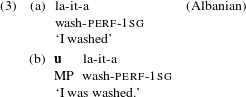
In the aorist, Albanian and Greek switch to a different morphology. In Albanian, as (3b) shows, the middle-passive is formed with the clitic  $u$, while the person inflection generally is the same with that of the active voice in (3a).Footnote [4]
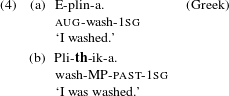
The Greek aorist in (4) parallels the Albanian one in (3) in that both the active and the middle-passive voice use the same set of person inflections, specialized for the aorist, though the middle-passive voice forms in (4a) have the affix -th- attached to the perfective base, which is characterized as the ‘passive affix’ in a series of morphological and syntactic works (see Matthews Reference Matthews1967, Philippaki-Warburton Reference Philippaki-Warburton1973, Tsimpli Reference Tsimpli1989, Rivero Reference Rivero1990, among others).
Albanian has a third morphosyntactic instantiation of the middle-passive voice in the perfect tenses, namely with the auxiliary jam ‘be’ followed by the participle, as in (5b). The same participle is also used in the active voice, as shown in (5a), but crucially in this case the auxiliary is kam ‘have’.
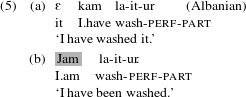
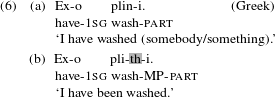
Thus the switch from active to middle-passive voice is given by auxiliary choice, i.e. kam ‘have’ vs. jam ‘be’, with the verbal form (participle) remaining the same. This contrasts with Greek, where all perfect tenses are formed with the auxiliary exo ‘have’, as shown in (6a) and (6b) for active and middle-passive voice respectively. The middle-passive voice is realized by the -th- affix on the participle (present also in (4b) above).
The data in (1)–(6) raise the classical problem of multiple morphosyntactic realizations of a property traditionally considered to be constant, here middle-passive. Conversely, as is well-known in the literature (Chierchia Reference Chierchia2004 [1989], Reinhart Reference Reinhart1997, Reinhart & Siloni Reference Reinhart and Siloni2005, Alexiadou & Doron Reference Alexiadou and Doron2012), even if there is a unified middle-passive category, a variety of interpretations stems from it. Thus the out-of-the blue examples in (1)–(6) can be associated not only with a passive reading (indicated in the English examples) but also be interpreted as reflexives. For example, Plenome in (1b) can mean either ‘I am washed’ or ‘I wash myself’. A further, anticausative reading may not be readily available (but is possible) with the particular verb ‘wash’, but appears very productively in other contexts, as in (7), for example.

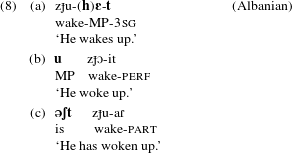
The examples in (8) illustrate a typical anticausative (with inchoative aspect) in Albanian, showing that it arises with all different kinds of morphology reviewed above.
This differs from the passive, which allows an implicit or explicit agent (the ‘by’-phrase), illustrated in (9). In the anticausative there is no agent present, but the weaker notion of causation is implicated (see Levin & Rappaport Hovav Reference Levin and Rappaport Hovav1995).
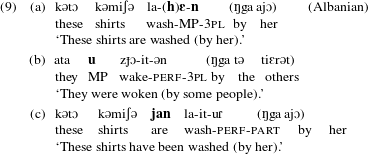
The same morphological realizations can also give rise to a generic (impersonal) reading in Albanian, which is particularly apparent with unaccusative verbs, for instance the motion verb in (10).
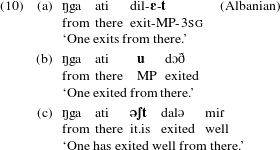
It should be noted that the standard unaccusativity tests employed for a language like Italian, such as ne-cliticization and auxiliary selection (Burzio Reference Burzio1986) are unavailable in Albanian, exactly as in English. At the same time, the participial forms of English unaccusatives can serve as prenominal modifiers, e.g. the fallen leaf, a born soldier, etc., while this is not the case with unergatives, e.g. *a slept man. Verbs that independently qualify as unaccusatives in a language like Italian can also form prenominal modifiers in Albanian; this is shown in (11) (standard orthography is employed here).
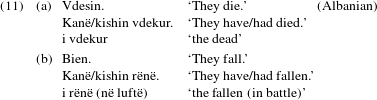
In short, in the examples in (7)–(10) above, each attested middle-passive morphosyntax (inflectional, clitic, auxiliary) can lexicalize different meanings. Combining this with the preceding observation that each meaning (say, passive) can have several different morphosyntactic realizations, as in (1)–(6), we conclude that Albanian and Greek middle-passives are characterized by a many-to-many mapping between LF (interpretation) and PF (externalization).
This empirical conclusion presents a prima facie challenge to current trends in formal linguistics, characterized by Culicover & Jackendoff (Reference Culicover and Jackendoff2005: 6) in terms of Uniformity, whereby ‘the same meaning always maps onto the same syntactic structure’. Uniformity means that we do not expect the same meaning to correspond to different (morpho)syntactic structures, as in (1)–(6). The standard answer to this problem is Late Insertion, after the syntactic derivation, as in DM, along with the postulation of a functional hierarchy. At the same time, under Uniformity, we expect that each well-individuated meaning will have its own dedicated syntax, a trend aptly characterized by Cinque & Rizzi (Reference Cinque and Rizzi2008: 53) as ‘an attempt to “syntacticize” as much as possible the interpretive domains’. In fact, given sufficient availability of abstract structure (cartographic functional hierarchies or silent categories à la Kayne Reference Kayne2010), disambiguation in the syntax will always prove possible with the auxiliary assumption of realization morphology, as in DM. As we can see, the considerable opacity at PF induced by a realizational morphological component and the perfect transparency at LF deriving from cartographic assumptions go hand in hand.
The aim of this article is to argue in favor of an alternative (non-Uniformity) view. In learnability terms, the child is able to construct middle-passives on the basis of a ‘poor’ universal grammar (UG), which contains the bare necessities, namely the recursive processor Merge and the conceptual component, supported by evidence from PF, taken to be non-opaque. In other words, syntax is projected from the lexicon (an instance of ‘early insertion’), which means that (i) there is no morphological component opacizing the PF interface, and (ii) abstract functional categories and their hierarchies are considerably restricted. In both respects, the model is much closer to Chomsky’s (Reference Chomsky1995) actual minimalist implementations, where functional categories are limited to the C–T–v–V sequence, and syntax is projected from the lexicon.
Our test case is the particularly complex mapping between LF and PF found in Albanian and Greek middle-passives. So far, the mapping itself has been largely left unstudied, since the literature has focussed either on the interpretation (taking the morphological realization as given) or less often on the morphological realization (taking the interpretation as given). In this respect, our goal is to show how one could go from the syntax to the PF interface without passing through a DM component and from the syntax to LF without passing through abstract functional hierarchies or silent architectures. Empirically, we suggest that combining PF (near-)transparency with a particularly sparse UG yields a grammar better suited to capturing variation than more structured (more rigid) models.
The paper is structured as follows: Section 2 presents the theoretical background, starting with a brief literature review and moving on to our claims about the role of the middle-passive morphology. Section 3 introduces our assumptions about the range of interpretations associated with middle-passives and Sections 4–6 show how they can be obtained by morphosyntactic means. Finally, Section 7 concludes the discussion.Footnote [5]
2. Previous literature
The standard generative analysis of passives in a language like English goes back to Chomsky (Reference Chomsky1981). The idea is that the participial verb form cannot assign accusative Case, the external argument is demoted (remaining implicit as in short passives or realized as a by-phrase), and movement becomes both necessary (due to Case requirements) and possible (due to the availability of the subject position). The passive affix -en absorbs the external theta role and the accusative Case. The analysis is illustrated in (12) (Jaeggli Reference Jaeggli1986, Baker, Johnson & Roberts Reference Baker, Johnson and Roberts1989):

Whatever its intrinsic merits or demerits, this analysis applies to a relatively simple, one-to-one mapping between PF and LF. There is one PF (the -en affix) and one syntax/LF (demotion/arbitrarization of the external argument and promotion of the internal argument), and the mapping between the two is achieved by imputing to the -en affix properties (theta role and case absorption) with the relevant syntactico-semantic consequences.
Still in the GB framework, the possibility of applying (12) to an instance of one-to-many mapping was investigated. That was the case of the Romance se/si morphology with the set of interpretations it displays, namely (short) passive in (13a) and (13b), reflexive in (13b), and anticausative also in (13a). The examples are from Italian.
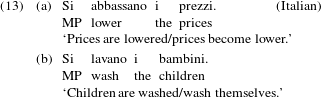
Grimshaw (Reference Grimshaw and Bresnan1982) and Marantz (Reference Marantz1984) proposed that the Italian middle clitic si plays the same role as English -en in (12). In other words, the passive, the anticausative, but also the reflexive readings derive from promotion of the object to the subject triggered by the si clitic. However, there are at least two reasons why the standard (GB) passive derivation of the si data cannot work: In Italian, si morphology can be applied to unaccusative verbs (based on familiar tests such as auxiliary selection), as in (14a), and even to transitive verbs with an overt accusative object (the clitic), as in (14b). The latter example is synonymous to (14b $^{\prime }$), which is technically a passive, since the internal argument of ‘eat’ has been promoted to the EPP position and agrees with the verb in the plural.
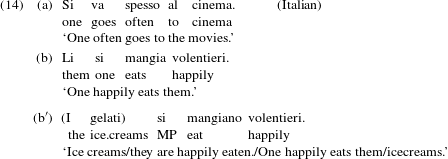
The Italian data forced Burzio (Reference Burzio1986) to postulate two sis, namely an impersonal one (which appears in passives and impersonals) and a reflexive one (in reflexives and anticausatives). The main reason why Burzio’s solution does not work is because Italian si is not isolated; its distribution is replicated in Albanian, as well as in the Balto-Slavic languages, illustrated by Blevins (Reference Blevins2003). In other words, there really is a single si. We conclude then that the one PF(si)-to-many-LFs problem does not admit of a solution within the framework in (12).
2.1 Interpretation
In an influential work on middle-passives, Chierchia (Reference Chierchia2004 [1989]) abandons the mapping problem and concentrates on the interpretation. In the same spirit, Reinhart (Reference Reinhart1997) introduces as many separate operations on argument structure as there are basic meanings of the middle-passive; namely, reflexive bundling, which bundles the external theta role with some other theta role, saturation/arbitrarization (responsible for passives/impersonals), which saturates the external theta role through existential closure, and decausativization (responsible for anticausatives), which reduces (i.e. suppresses) an external [+cause] theta role. In Reinhart & Siloni (Reference Reinhart and Siloni2005), the unification of these various rules by a single morphology is imputed to Case theory. The assumption is that the arity-reduction (or: valency-reduction) operations mentioned do not affect the Case properties of the verb, leaving an accusative (or a nominative in arbitrarization contexts) potentially unchecked; ‘the clitic (or its equivalent) reduces Case’ (Reinhart & Siloni Reference Reinhart and Siloni2005: 402). However, this cannot work for the Italian (14b) above, with impersonal si, since there is no unchecked Case to be reduced by the clitic si, as in all respects this looks like a transitive construction. On the other hand, Chierchia (Reference Chierchia2004 [1989]) severs the links with the classical analysis more completely. The various processes of arbitrarization, reflexivization and suppression are all n-arity-reduction rules; the si morphology of Italian simply provides an overt realization for them.
This stance is shared by much of the subsequent literature dealing with the interpretive evidence regarding middle-passives, since the morphological realization is not discussed, or is discussed in an explicitly realizational framework of PF like Distributed Morphology (see also Section 2.2 below). Here we will briefly review some work on Greek and Albanian in recent approaches. With respect to Greek, Tsimpli (Reference Tsimpli, Unsworth, Parodi, Sorace and Young-Scholten2005) argues that reflexives are syntactically formed through a mechanism that associates the two argument slots (theta roles) with a single DP; passive and anticausative readings, on the other hand, are not syntactically distinguished with respect to each other, and their disambiguation arises as a combination of semantic and pragmatic factors. Only the readings of middle-passive voice are considered, not its morphology.
Alexiadou & Anagnostopoulou (Reference Alexiadou and Anagnostopoulou2004) argue that the different readings of the Greek middle-passive are syntactically encoded through the projection of different v heads; a passive has a VoiceP above VP with no specifier, while an anticausative has a Result vP embedding the passive VoiceP structure. Alexiadou & Doron (Reference Alexiadou and Doron2012) distinguish five different LF interpretations carried by the morphological middle, say in Greek, namely passive, anticausative, reflexive, what they call middle-passive, plus dispositional middles (compare the English This book reads easily).Footnote [6] In the anticausative, the middle head  ${\it\mu}$ ‘modifies’ the root R so that no external argument is inserted. In the reflexive, the middle head
 ${\it\mu}$ combines with v introducing the external argument and theta-unification applies, in the sense of Higginbotham (Reference Higginbotham1985), between the internal and the external argument. As far as we understand, dispositional middles have the same structure, i.e. what here is called a passive. In their terms the relevant structure has both the middle head
 ${\it\mu}$ and v introducing the external argument with varying results, e.g. in the dispositional middle ‘the external argument is eventually bound in the scope of a possibility modal’ (Alexiadou & Doron Reference Alexiadou and Doron2012: 27).Footnote [7]
Kallulli (Reference Kallulli, Bonami and Hofherr2006, Reference Kallulli2007) working on Albanian, argues that middle-passive morphology corresponds to valency reduction executed by means of feature deletion on the light v node, which is responsible for introducing the external argument. The passive is derived through suppression of a [+activity] feature from underlying activity structures, the anticausative through suppression of a [+cause] feature from underlying causative structures, and the reflexive through suppression of a [+intent] feature in underlying agentive structures.
In general, a syntactic disambiguation of all or some of the available readings is achieved through the postulation of abstract features or positions that encode the interpretative differences. The assumption that interpretations are encoded syntactically, specifically in the form of constituent structure hierarchies, is generally not spelled out; the adoption of a realization model of PF is only occasionally acknowledged. Although these are perceived as necessary assumptions and zero cost ones, it is not obvious that they are, contrasting with basic assumptions of minimalism (Chomsky Reference Chomsky1995) – such as projection from the lexicon (not realization by it).
Another interesting property of the more recent literature just reviewed is that Chierchia’s (Reference Chierchia2004 [1989]) impersonals are not considered, even in the discussion of languages that have them, like Albanian, in (9) above. This may mean one of two things. One is that, as in Chierchia’s work, the impersonals rule is just the same as in passives (arbitrarization); the other is that impersonals are a partially different matter from (middle-)passives. Blevins (Reference Blevins2003) argues in favor of this latter conclusion from a rather different formal perspective (Head-driven Phrase Structure Grammar, HPSG). Following Comrie (Reference Comrie, Cole and Sadock1977), he argues that passives and impersonals have in common arity-reduction operations on the subject (while in GB terms the view is that the object is promoted); however different structural levels are relevant for arity reductions with unaccusative syntax (passives) and with impersonal syntax (including the possibility of assigning accusative). Apart from the richness of his model, it seems to us that minimal pairs like Italian (14b–b $^{\prime }$) would force Blevins to go the two sis way. However, not only PF but also LF argues against such a move, since the two sentences have exactly the same interpretation (generic, human) independently of the fact that (14b) is an accusative sentence and (14b
 $^{\prime }$) displays passive promotion.
2.2 Morphology
In a seminal work on Greek and Albanian middle-passives, Rivero (Reference Rivero1990) argues that there is just one morphological instantiation of middle-passive in Greek, namely by inflection, which can be picked up by a simple verb or by the participle in compound tenses, as seen in (6); this evidently makes the paterns in (2) and (4) unaccounted for. Leaving this aside, the problem in Albanian is how to predict which tense/mood/aspect will trigger which morphology (inflection, clitic, auxiliary). Rivero’s general idea is that voice morphology must be adjacent to the lexical verb and that the verb has a maximum of three suffixes. In the present tense (2), both constraints are simply met by a middle-passive suffixation; in the aorist (3) it becomes necessary to employ analytical morphology (the clitic), while in the perfect tense (5) the latter option does not work (because the clitic would be adjacent to the auxiliary and not to the verb) so that the specialized auxiliary has to appear.
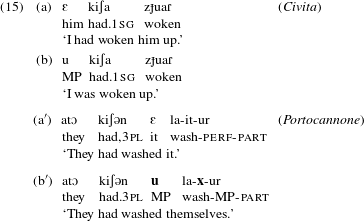
Rivero herself notes that she cannot explain why in the Albanian perfect, a middle-passive inflection is not simply associated with the participle, mimicking Greek. Other empirical problems arise when we consider variation internal to Albanian. In the Arbëresh dialects spoken in Southern Italy (considered here are Civita and Portocannone), the perfect tenses take the auxiliary kam ‘I have’, exactly as in the active, while non-active voice is lexicalized through the  $u$ clitic, as in (15b–b
 $^{\prime }$), violating adjacency in Rivero’s terms. The variety of Portocannone further displays the -
 $x$- affix internal to the participle (an allomorph of -(h)ɛ-), as in (15b
 $^{\prime }$), violating the complementary distribution predicted by Rivero’s system – essentially an optimization one.
Ralli (Reference Ralli2005: 130), working on Greek, proposes a morphological constraint that blocks the co-occurrence of two affixes with the same feature, here middle-passive voice. This predicts that when -th- is present, specialized inflection (-ome (1st singular, –past, –perfective) and -omun (1st singular, +past, –perfective)) must be absent (*pli-th-ome, *pli-th-omun), and vice versa. In other words, -th- creates an illicit context for the specialized inflection. The same problems apply here as those noted in connection with the complementary distribution of middle-passive kinds of morphology predicted by Rivero, see (15) above; moreover, this constraint cannot predict how the different morphological realizations will distribute along the tense, mood and aspect spectrum.
Kallulli & Trommer (Reference Kallulli and Trommer2011) also assume that the distribution of different middle-passive kinds of morphology in Albanian responds to an optimization device, based on Agree (Chomsky Reference Chomsky and Kenstowicz2001). Their argument is as follows. Suppose the Non-active head in the functional hierarchy in (16) carries an interpretable na (non-active) feature, while the Perfect, Tense and Clitic head carry an uninterpretable na counterpart.

Agree predicts that the closest head will check the feature; so Perfect if it is instantiated, otherwise Tense, otherwise the clitic. Uninterpretable na features that are not checked do not make the derivation crash (contrary to Chomsky Reference Chomsky1995), because they are deleted by Impoverishment. The auxiliary ‘be’ is the exponent for Perfect na, the -(h)ɛ- affix for na on Tense and the  $u$ clitic for na on Clitic.
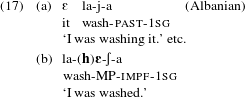
Kallulli & Trommer (Reference Kallulli and Trommer2011) correctly account for the standard Albanian distribution, which is aspect-based. Thus aorist is realized by clitic morphology, as in (3b) above, while a different morphology (inflectional) characterizes not only the present, as in (2b), but also the imperfective past, as in (17b).
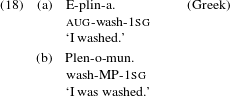
Greek is similar in this respect to Standard Albanian. As seen in (18), in Greek also, it is specialized person inflections that carry middle-passive voice in the imperfective past, exactly as in the present (2a).
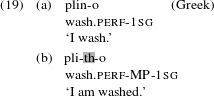
Incidentally, in Greek, aspect (perfective and imperfective) and mood (present, past) cross freely, so that the language has not only a perfective past (aorist) but also a morphological perfective present, illustrated in (19), which takes -th- plus active person endings, exactly like the aorist.Footnote [8]
However, variation internal to Albanian poses a certain number of questions that Kallulli & Trommer’s approach does not immediately answer. For instance, how would the system accommodate the parameter between standard Albanian and Arbëresh in (15b) above? If in Arbëresh Perfect is not a possible locus for uninterpretable na, why do we not see the -(h)ɛ- morphology on the imperfective auxiliary in (15b)? And if the -(h)ɛ- morphology is present on the participle as in (15b $^{\prime }$), why do we still need the clitic? Consider further examples from Geg Albanian, in (20).
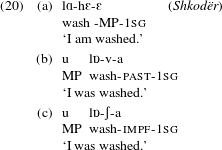
Specialized morphology and clitic realizations of the middle-passive voice split not according to aspect (perfective vs. imperfective/progressive), but according to tense; while the present has middle-passive inflections (20a), as in Tosk Albanian (recall the present tense (2b) above, for example), the  $u$ clitic characterizes not only the aorist (20b), but also the imperfective past (20c). What parameter accounts for this? Given (16), we would not expect aorist to pattern with imperfective past, contrary to what happens in Geg.
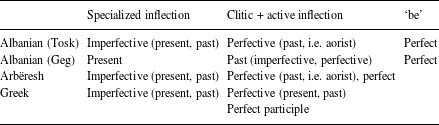
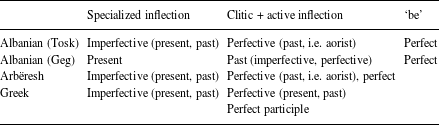
In short, no matter how appealing optimization devices (including those based on minimalist Agree) may be, they are not ideally suited to capturing microvariation – unless perhaps they are supplemented by extrinsic ordering of the Optimality Theory type. Thus the analyses of Rivero (Reference Rivero1990) and Kallulli & Trommer (Reference Kallulli and Trommer2011) cannot fully capture the facts discussed above. Minimal distance (under Agree) does not seem the correct characterization for them, since functional hierarchies like (16), which are required for it to work, seem too rigid to encompass the observed variation, as summarized in Table 1.
Distribution of different middle-passive kinds of morphology in Albanian varieties and Greek.
A more general observation is that in the literature just reviewed, the issue of the several middle-passive kinds of morphology of Albanian or Greek is taken to be how to map a voice head/feature into several realizations. The problem that concerns us here – namely how sets of morphology can map to a set of meanings and vice versa – is thus addressed only in what concerns its PF half.
3. LF representations
The literature reviewed in Section 2.1 motivates the existence of a certain number of LF interface interpretations corresponding to the available evidence. Can a logical space be defined on the basis of commonly accepted primitives, which encompasses all and only these interpretations? Let us assume that the argument slots of a predicate correspond to variables at the predicate/VP level introduced by  ${\it\lambda}$-abstraction (see Adger & Ramchand’s Reference Adger and Ramchand2005) ‘
 ${\rm\Lambda}$’ feature, Butler (Reference Butler2004) on theta roles as variables). The EPP is just a specialized lambda abstraction (Butler Reference Butler2004) introduced by the tense, mood and aspect sentential projection(s). Our hypothesis is that middle-passive morphology corresponds to the presence of an open (unsaturated) variable in argument structure, for which some interpretation has to be supplied at the LF interface.Footnote [9]
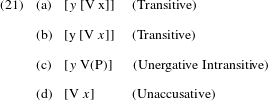
Given the conventional distinction between transitive, unergative and unaccusative predicates, four logical possibilities arise. The open variable (marked by italics) can correspond to the external argument  $y$ or the internal argument
 $x$ of a transitive, as in (21a) and (21b) respectively, or to the external argument of an unergative as in (21c), or to the internal argument of an unaccusative as in (21d). In (21) we abstract away from whether the external argument is attached to a v projection.
Consider first (21a), reproduced as (22), and the options that arise at LF.

If the (italicized) variable  $y$ is quantificationally closed, we derive arbitrarization, as in (22i). Alternatively, it can be reflexivized, by identifying it with the
 $x$ variable, as in (22ii). It can also be identified with the object of a PP (agent/causer), yielding a long passive (22iii). Finally, if it is not interpreted, we obtain the anticausative reading.
As it turns out, choices regarding the LF interpretation of the open variable interact with choices regarding the EPP. The fact that the external argument is not interpreted, or identified with the internal argument, or demoted to an oblique causer/agent, or quantificationally closed means that passives, reflexives and anticausatives allow for an unaccusative construal with promotion from object to subject position. However, this is merely possible; accusative case assignment is equally possible at least when the external argument is quantificationally closed and it results in impersonal constructions, e.g. Italian si in (14b) above.
Let us concentrate more on (22) in relation to the external argument  $y$. In (22i) we indicated two possible operator closures for the variable, namely the existential and the generic. Accounts of the English passive, for instance (12) above, typically associate it with an existential closure, while accounts of the impersonal, as in Albanian (9), associate it with a generic reading. Some clarity is brought into the issue by Chierchia’s (Reference Chierchia, Bach, Jellinek, Kratzer and Partee1995) discussion of Italian, where a generic si proper is distinguished from an episodic one. Consider the examples in (23).
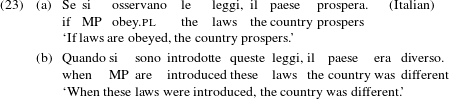
In modal, temporally indefinite, or imperfective contexts, a generic reading is favored for si, as illustrated in (23a) (‘by people’, ‘by everybody’). However, temporally definite, perfective contexts induce an episodic reading, as in (23b), which is in fact the ‘by somebody’ reading typically associated with the English passive. Comparison between the English translations in (23) shows that the two interpretations are in fact available in English short passives as well. In what follows we will therefore not worry about the exact nature of the quantificational closures involved under middle-passive voice.
According to (22ii) above, in the reflexive reading, arity (valency) reduction is derived by identifying the internal and external argument. What we have here then is the availability of a relation/operation capable of assigning not one but two distinct variables to the same argument. Several operations to this effect have been proposed in the literature. Higginbotham (Reference Higginbotham1985) proposes an operation of theta-unification identifying the argument slots of the noun and of the adjective in complex noun phrases such as big butterfly, where the determiner ultimately saturates both of them. Along similar lines, Manzini & Roussou (Reference Manzini and Roussou2000) analyze obligatory control in terms of theta-unification, namely two argument slots unified by being assigned to the same DP referent.
Let us next turn to the oblique realization in (22iii). As is well-known from discussions of periphrastic passives like (12), the external argument can either be existentially/generically closed (short passives) or be introduced as an oblique, i.e. as the object of by in English (nga- in Albanian, apo in Greek). Collins (Reference Collins2005) points out the complexities involved in assuming that the external theta role of the verb is transmitted to the preposition, as in Jaeggli (Reference Jaeggli1986). Instead he proposes the structure [ $_{\text{Voice}}$by [y [v VP]]]: by is the head of a VoiceP generated only with passives. Voice selects vP, and the ‘object’ of the preposition is merged in the external argument position inside the vP, namely in Spec,vP (hence it does not form a constituent with by). This structure ensures that the external argument always occupies the same position in vP irrespectively of (active or passive) voice.
Note that Collins’ alternative is at least as complex as theta-transmission. The idea that voice may be encoded in one or more specialized heads is in itself quite more complex than what Jaeggli assumed (or in fact we assume here). Another potential difficulty is that by is taken to be deprived of any interpretable properties (contra Chomsky Reference Chomsky1995 on projecting heads); it is not obvious why it could not at least have an interpretable Voice feature. In either instance there must be two by prepositions in English, one corresponding to Voice and one instrumental (e.g. The book was written by hand) – the same in the other languages considered here, where the preposition introduces source (Italian Vengo da Roma ‘I come from Rome’, Albanian Vij nga shkolla ‘I’m coming from school’, Greek Erxome apo to sxolio ‘I’m coming from school’).
We maintain that there are no semantically vacuous heads, and that by (da in Italian, etc.) has source/instrumental predicative content that allows it to appear in passive contexts as well, with no need to postulate two homophonous items. Specifically, we assume that in long passives, there is no external argument generated within the v/VP. At the same time instrumental by can introduce a causer and therefore an agent; locative da (Italian), apo (Greek) or nga (Albanian) can introduce a source and hence a causer/agent again. If so, no theta-transmission or dummy prepositions seem to be necessary.
Turning next to (22iv), the theoretical problem that arises concerns the exact way in which the agent comes not to be interpreted, yielding the anticausative reading. One way to obtain the correct result is of course not generating the external argument  $y$ at all. In Chomsky’s (Reference Chomsky1995) terms this means that the v projection is not generated; in any event there is no external argument represented in the core predicative (VP/vP) domain. This account, which has become standard in minimalist frameworks, is deeply consonant with a constructionist view of syntax, much in the sense of Borer (Reference Borer2005). Although the matter is not often discussed (but see Sportiche Reference Sportiche2013), constructionist and lexicalist (projectionist) views conflict to some extent. Under a constructionist view, the fact that v combines with certain lexical Vs, but not others, cannot be an intrinsic property of the Vs themselves. Conversely, if we assume that it is an intrinsic lexical property of, say, break that it establishes a relation (two arguments) – then in the anticausative derivation we are faced with an argument variable (the external one) projected but not interpreted (not associated with referential material), as implied by (22iv). The standard way to construe anticausatives (
 $y$ not projected) has an advantage when it comes to Full Interpretation, which is never faced with a free variable. Under the alternative view (
 $y$ projected), we must assume that Full Interpretation, faced with a free variable, can ignore it (no interpretation), unless other requirements intervene.
Faced with these alternatives it is worth recalling that Manzini & Savoia (Reference Manzini and Savoia2011a, Reference Manzini, Savoia, di Sciullo and Boeckxb) on whose work on Albanian we partially depend, distinguish just the passive/impersonal interpretation ( $y$ arbitrary or oblique) from the reflexive/anticausative one. This coarser interpretive distinction corresponds to the descriptive generalization that anticausatives and reflexives do not seem to differ in any LF respect, but only (roughly) in the degree of intentionality (agentivity) imputed to the sole argument. Consider again Greek (7) above or Italian (24).
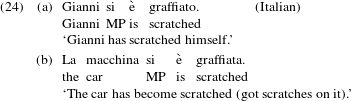
The example in (24b) has an anticausative reading – with all of the usual diagnostics holding (e.g. ‘The car became scratched by itself’). The example in (24a) seems to be ambiguous between the anticausative and the reflexive reading – yet reflexivity correlates entirely with the animacy of the sole argument. The same is true of Greek (7).
According to Manzini & Savoia (Reference Manzini and Savoia2011a) both the reflexive and the anticausative readings depend on the absence of the external argument; this does not seem correct, given the clear agentive interpretation available for the reflexive in (24a). On the other hand, the similarity between anticausatives and reflexives is a deep-seated conclusion in the literature on Italian, reflected for instance by the fact that the two sis of Burzio (Reference Burzio1986) split impersonals/passives from reflexives/anticausatives. Another way to derive this conclusion is to assume that in the anticausative interpretation,  $y$=
 $x$ (i.e. there is theta-identification), as in the reflexive; however, only ‘causer’ properties are attached to
 $y$. In other words, what the anticausative conveys is self-causing (see also Tsimpli Reference Tsimpli, Unsworth, Parodi, Sorace and Young-Scholten2005 for a rough assimilation of the two readings). Importantly, this is not a paper about the semantics of middle-passive – it is about how it comes to be embodied by morphosyntax (see Section 1). For the purposes of our discussion, we will adopt the quadripartite schema in (22).
Let us now turn to (21b) above, which reflects a logical possibility different from (22), namely that the  $x$, rather than the
 $y$, variable is left open. In practice, leaving aside the reflexive reading, which is logically indistinguishable from the reflexive reading obtained in (22ii), the phenomena that we may expect are not observed in the range of (European) languages we are considering. For instance, object arbitrarization is not available with the case array/the middle-passive morphology of the languages under consideration here. As already discussed by Burzio (Reference Burzio1986) for Italian, generic/existential reading in the middle-passive can correspond to the external argument but not to the internal one, as in (25).

We therefore conclude that the generalization in (26) holds, to the effect that the inner argument of V is insulated from arity (valency) reduction.

We may think of (26) as the technical implementation of the general idea that the internal argument of a verb is obligatory. At this point, we should explain why we choose the term ‘inner’ in (26). In what follows, ‘inner’ and ‘outer’ express relative positions of arguments, while ‘internal’ and ‘external’ refer to absolute positions with respect to the predicate. In terms of phases, an ‘outer’ argument is accessible to T (a phase by inheritance from C), either by being at the edge of the vP (as an external argument of intransitives and unergatives) or the complement of a defective v phase (internal argument of unaccusatives). An ‘inner’ argument is the complement set, inaccessible to T, being in the complement of the v phase (internal argument of transitives). We may think of (26) as the technical implementation of the general idea that the internal argument of a verb is obligatory.
An apparent problem is that other language families (non-Indo-European) have been reported in the literature to yield antipassive, described in terms of obliquization or arbitrarization of the internal argument. Although antipassives (or antipassive-like behavior) are outside the scope of the present work, it is worth noting that they are attested in ergative-absolutive languages, where the Agent (external argument) is ‘promoted’ to the object realization in unergatives but also in antipassives; the latter further involve the oblique realization of the internal argument (Baker Reference Baker1998). Tentatively, we could say that in these languages, (26) has to be stated from the perspective of the outmost argument. We will try to explain why (26) should hold in the languages that we are considering, Albanian and Greek, when we discuss the specific kinds of morphology through which the interpretations in this section are implemented.
Consider next one-place predicates, like the unergative intransitive structures in (21c) and the unaccusative in (21d), repeated as (27a) and (27b) respectively.

In both cases, a reflexive reading is logically excluded, as is non-interpretation, on the assumption that each predicate must have at least one argument. What remains is the so-called impersonal passive option, in (28i) and (28iii), with or without an expressed agent/causer.

With respect to the unaccusative in (27b), the question is why (28i) does not represent a violation of (26). Lexical unaccusatives are characterized by an internal argument which is at the same time the outmost one. Therefore (26) does not apply, because we were careful to state it in terms of an inner, as opposed to an internal, argument. Obliquization is not logically excluded; in practice in the languages we work with we only know of obliques lexicalizing agents/causes, not themes.
In the next section, we turn to how the middle-passive LFs outlined in this section map to the kinds of morphology presented in Section 1 and vice versa. As part of our account, we also need to explain why middle-passive morphology is sufficient to bring the relevant interpretations into being, but also why it is necessary, i.e. why we could not have them with active morphology.
4. The Albanian uclitic and the Greek -th- affix
As discussed in Sections 1–3, two main issues contribute to blurring the picture of middles and passives even in relatively familiar languages like Italian or Greek and Albanian (or for that matter English). One issue is the many-to-many PF–LF mapping. In this respect, what we need to explain next is how the kinds of morphology in Table 1, when combined with lexical predicative bases (and various argumental materials) yield the range of interpretations reviewed in Section 3 or vice versa. An even deeper issue is that according to the conclusions of Section 3, the overall semantic effect of middle-passive is an arity reduction on the external/outer argument. Yet, consider the  $u$ clitic morphology of Albanian perfective tenses; as we will argue in this section, this is an object clitic both morphologically and distributionally. In other words, arity reduction on the external/outer argument is obtained by applying special lexicalization not to it directly, but rather to the internal/inner argument.Footnote [10]
4.1 Albanian
Albanian formations with the  $u$ clitic are reminiscent of the 3rd person middle-passive clitic formations of Romance with se (Italian si, etc.), as we noted already in Section 1. Dobrovie-Sorin (Reference Dobrovie-Sorin1998) for Romanian and Manzini & Savoia (Reference Manzini and Savoia2007) for Italian argue that the distributional and morphological properties of Romance se/si can only be accounted for if it is treated as a pronominal object clitic (as opposed to an affix or a subject clitic), and in fact an accusative clitic in Romanian. Since Romanian has overt case alternations of DPs and a fortiori for pronouns, it can be clearly seen that the middle-passive clitic alternates between direct (accusative) case in (29a) and oblique (dative) case in (29b).Footnote [11]

As for Albanian  $u$, enclisis vs. proclisis alternations in Arbëresh varieties show that
 $u$ is sensitive to exactly the same conditions as other object clitics, such as accusative ɛ ‘him/her’ or dative
 $i$ ‘to him/to her/to them’, down to very fine dialectal variation. Within the object clitic string,
 $u$ appears in the lowest position, i.e. in the same position where the accusative clitic, with which it is in complementary distribution, is found. For instance,
 $u$ follows the 3rd person dative or the 1st person one in (30).

This is an anticausative, where the dative adds a benefactive/malefactive argument (see Kallulli Reference Kallulli, Bonami and Hofherr2006).
Unlike Italian si,  $u$ is not restricted to 3rd person. Another difference is that
 $u$ is sensitive to the temporal or aspectual properties of the clause, while si is not; indeed
 $u$ is either restricted to the perfective (in Tosk Standard Albanian) or to the past (in Geg dialects), as in Table 1 above. Precisely because of this variation, it is all the more striking that what remains constant in the morphosyntax of
 $u$ and si is that they behave like object clitics; evidently this is a central property of such forms and not merely an accidental one.
The object clitic nature of  $u$ suggests an obvious treatment of the reflexive interpretation. We could say that exactly like accusative ɛ,
 $u$ is a lexicalization of the internal argument of the verb, with the difference that while ɛ is pronominal,
 $u$ is reflexive, hence anaphorically dependent on the EPP argument. This is the theory proposed by Burzio (Reference Burzio1986) for Italian reflexive si, whose limitations were discussed in Section 2. Briefly, if reflexive si is the clitic counterpart of an accusative anaphor, then a separate entry appears to be needed for passive/anticausative si (where there is no possible binding by an external argument) – leading to the postulation of at least two sis. As already discussed in Section 2, it is possible to unify passive and anticausative si with reflexive si, along the lines of Marantz (Reference Marantz1984), by assuming that si is the counterpart of the be -en morphology of English, as discussed for (12) above – hence that it absorbs the external theta role, triggering movement of the internal argument to the EPP position. This, however, comes at a cost – namely of not explaining the fact that si is itself an object/accusative in morphosyntactic terms. It is true that one could try to save this potential contradiction by claiming that cliticization, vacating the canonical object position, is sufficient to introduce the variable required by chain formation (Dobrovie-Sorin 1998). Even so, another problem arises, namely the impersonal reading, associated notably with unaccusatives, as in (14b) above. In Marantz (Reference Marantz1984) and in other attempts at unification (more recently, Reinhart & Siloni Reference Reinhart and Siloni2005), the possibility of associating si morphology (here
 $u$) with unaccusatives (yielding an impersonal reading) is not considered.
On the basis of these considerations, we argue for a single element si/ $u$ which is an object clitic. As such, si/
 $u$ gives rise to a transitive syntax. In particular,
 $u$ occupies the same position as ɛ (i.e. the accusative ‘him/her’ clitic) in the active sentence, and the verb takes an active inflection in either case, as shown in (31) below.
A few clarifications regarding the schematic representations of the structures we adopt are necessary at this point. Throughout this article we display morphosyntactic structure at the PF interface. Finite verbs are displayed in their I position (for Greek, Albanian); for the purposes of our discussion it is irrelevant whether head movement is syntactic (Roberts Reference Roberts2010) or at PF (Chomsky Reference Chomsky and Kenstowicz2001). Clitics are taken to be dedicated heads in the I domain, though they may be connected to canonical argument positions. Next, since Greek and Albanian are typical pro-drop languages, they allow for referential null subjects whose content is recovered through verb inflections (Rizzi Reference Rizzi1982). We assume that finite inflections in fact satisfy the EPP (see Borer Reference Borer1986 and Alexiadou & Anagnostopoulou Reference Alexiadou and Anagnostopoulou1998 on expletive subjects, and Manzini & Savoia Reference Manzini and Savoia2007 on referential and expletive subjects).
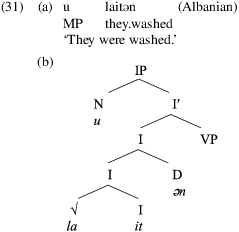
Semantically, we adopt the view that  $u$ is a free variable, following Manzini (Reference Manzini and Borer1986) on all sis and Chierchia (Reference Chierchia, Bach, Jellinek, Kratzer and Partee1995) on at least impersonal si. We argue that it is the presence of an object free variable that forces arity (valency) reduction in the sense defined in Section 3 above. Consider first (22), repeated here as (32) for ease of reference.

The clitic  $u$ satisfies the internal argument slot (
 $x$) in (32). Since by hypothesis
 $u$ is a variable, it must be bound if it is to be interpreted at all. Suppose that
 $u$ satisfies this requirement through chain formation with the EPP argument. The direct effect of this chain binding is promotion from the object to the subject position; the object (
 $u$) contributes the internal argument slot, while the EPP position contributes referential content. The indirect result is that the external argument slot (
 $y$), which cannot become associated with the EPP argument, must be subject to one of the arity-reduction mechanisms in (32).
In the passive reading, the external argument may be an existentially/generically bound variable, as in (33), yielding an implicit agent interpretation.
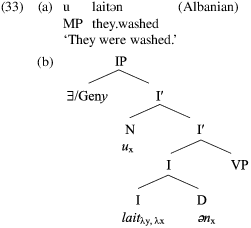
Alternatively, the external argument may be assigned to an oblique (the object of a preposition in the languages we are considering). This counts as an arity-reduction operation to the extent that the agent is no longer directly attached to the predicate structure of the verb.
In the reflexive reading, the two argument slots are unified by being assigned to the same referent (DP), as schematized in (34b).
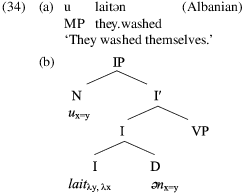
Recall that in the passive reading the implication is preserved that the event takes place through an external agency (or cause), corresponding to the external argument of the (transitive) verb. The same is true in the reflexive, so that the reflexive reading is available only with EPP arguments capable of a mental state. These interpretations differ from the anticausative reading where the implication is that the theme is not acted upon by another agent/cause.
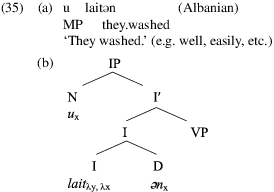
In the anticausative reading, the external argument ( $y$) is not interpreted, in any event not interpreted as an agent. In accordance with the discussion in Section 3, it may be the case that
 $y$ is not assigned to referential material, as schematized in (35b) – though another possibility is that it is really a reflexive sui generis, i.e. a self-causation, in which way the structure is in fact (34b).
If we were considering a language like Greek, (33)–(35) (passive, anticausative and reflexive respectively) would exhaust the range of observable middle-passive structures. There is however one last reading of Albanian  $u$ sentences that we need to consider, namely the impersonal one. In (10) above we provided examples involving unaccusative predicates. Middle-passive morphology also attaches to unergative verbs, yielding an impersonal interpretation, illustrated by examples like (36a). Given the line of explanation pursued here, one is led to conclude that in the absence of distributional or morphological evidence to the contrary, the structure of (36a) is similar to the one already indicated for the other interpretations of
 $u$, as in (36b):
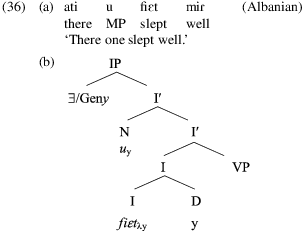
The arity reduction affects again the external argument; what differs is that  $u$ itself lexicalizes it and it is read in the scope of the generic/existential operator.
The impersonals of unaccusatives, as in (37), compare (10b) above, share the essential properties of the impersonals in (36)Footnote [12] since the  $u$ variable is itself read in the scope of existential/generic closure.
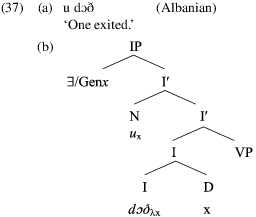
However,  $u$ fills an internal, rather than an external argument slot. This is compatible with constraint (26) above, though, as we have already discussed in Section 3, the option of reducing n-arity via arbitrarization of the internal argument in a transitive structure is not available under (26).
On the basis of our present understanding of middle-passive clitic morphology, we may want to go back to the interpretive generalization in (26). The key data concern transitive structures like (33b) above, as illustrated with Italian examples in (25) (repeated below). The fact that we now know that the si clitic in (25) or the  $u$ clitic in (33) are object variables only apparently makes (26) look like a stipulation. In particular, consider that in (33) (recalling (22) above) the
 $u$ variable (the internal argument
 $x$) finds itself in the scope of the external argument
 $y$, before any closure operator can be inserted. If such an operator is inserted, it will close
 $y$, freeing the way for promotion of
 $x$ (binding of the internal argument variable by the EPP argument); the same happens if
 $y$ is removed by obliquization. If
 $y$ binds
 $x$ we have the reflexive reading (i.e. theta-unification takes place). In other words, we surmise that the morphosyntactic instantiation of arity reduction by an object clitic variable and the interpretive generalization under which only the external argument is affected by the reduction are connected by a causal link. In essence, the adoption of the morphosyntax corresponding to the
 $u$ clitic in Albanian implies that (26) holds.
4.2 Greek
The -th- formations of Greek, specifically the aorist (4b), repeated here as (38b), are like the  $u$ formations of Albanian in that they display an active voice inflection. Drawing on their similarity, we argue that -th- is the inflectional counterpart to the
 $u$ clitic, hence also the realization of the internal argument as a variable, albeit word-internally. Before we proceed to illustrate our proposal, the previous literature on the -th- morphology is worth reviewing in some more detail. Note preliminarily that in both the active and the passive voice in (38), perfective aspect is marked through a raised vowel in the lexical base (plen
 ${\sim}$pli (
 $n$));Footnote [13] in the past tenses of the active voice, as in (38a), the prefix
 $e$- (the traditional ‘augment’) is obligatory in bi-syllabic forms (1st, 2nd, 3rd singular and 3rd plural) to yield stress on the antepenultimate; see Spyropoulos & Revithiadou (Reference Spyropoulos and Revithiadou2009), van Oostendorp (Reference van Oostendorp2012).
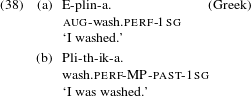
In previous analyses (Ralli Reference Ralli2005), endings such as - $a$ (compare -
 $o$ of the present in (1a)), have been considered to be ‘portmanteau’ morphemes marking both tense (past) and agreement (person and number), or as fused terminal nodes in terms of Distributed Morphology (Spyropoulos & Revithiadou Reference Spyropoulos and Revithiadou2009). We take the much weaker view that these morphemes include only agreement properties. Their apparent tense properties are in reality the result of a selectional restriction. Thus Greek, like other languages (for instance the Romance languages), has different sets of personal inflections selecting different temporal/aspectual environments. Each given set selects a particular temporal/aspectual specification, and hence constrains the interpretation to such a specification. Selection is the general way in which we account for the ‘portmanteau’ morphemes of traditional morphology.
According to Ralli (Reference Ralli1988, Reference Ralli2005), -th- and -thik- are allomorphs of a single passive perfective morpheme, the latter occurring in the past tense in (38b), the former in the present (compare (19b) above). On the other hand, a few passive aorists have only -ik- (e.g. Ka-ik-a ‘I was burnt’, Kop-ik-a ‘I was cut’, see Joseph & Smirniotopoulos Reference Joseph and Smirniotopoulos1993), a fact which may suggest that -thik- and -ik- are also allomorphs. Rivero (Reference Rivero1990) analyzes -th- and -ik- as two separate morphemes, taking -ik- as an aspectual affix. However, Joseph & Smirniotopoulos (Reference Joseph and Smirniotopoulos1993) argue against the aspectual characterization of -ik- observing that grammatical aspect is independently marked through vowel change in the base (see also footnote 13 above).
On the grounds of an obvious distributional criterion (i.e. the independent occurrence of both -th- and -ik-), we take -th- and -ik- to be separate morphemes, as Rivero does. Moreover, following Joseph & Smirniotopoulous we conclude that -ik- does not lexicalize perfective aspect. Rather, as implied by our glosses, -ik- has past reference, selecting perfective aspect and middle-passive voice. This selection property is compatible with -ik- joining to a -th- affix, but it is also compatible with it joining with a bare perfective verb base; at a first approximation it seems that this is possible as long as the latter has the interpretive properties of middle-passive voice. In other words, though -ik- is intrinsically associated with past properties only, by selecting middle-passive voice it effectively forces whatever category -th- lexicalizes to be present. Needless to say, a listing of the verbs with which -ik- directly attaches to the perfective verb base is necessary, but a similar list is necessary under any account, including the -th-/-thik- allomorphy account of Ralli.
As already briefly mentioned, a further wrinkle on the -ik- problem is that the same morphology appears in the active voice as well with a small class of verbs, such as ben-o ‘enter’ vs. b-ik-a ‘entered’ (without augmentation and stress shift due to the presence of -ik-), vjeno ‘get out’ vs. vjika ‘got out’; aneveno ‘go up’ vs. anevika ‘went up’, kateveno ‘go down’ vs. katevika ‘went down’. On the one hand, this fact provides evidence in favor of the present conclusion that -ik- really marks past tense (and is not an allomorph of passive voice), as argued by Spyropoulos & Revithiadou (Reference Spyropoulos and Revithiadou2009). On the other hand, we may wonder where this leaves our idea about -ik- selecting middle-passive voice. We note that verbs forming the past perfective with -ik- in the active are all of the unaccusative type.Footnote [14] We know that in other languages (for instance familiar Romance languages like Italian or French) passives and unaccusatives form a natural class, picked up in particular by the well-known phenomenon of be-auxiliary selection (Burzio Reference Burzio1986). We surmise that -ik- does not really select voice, but for the same natural class involved in Italian auxiliary selection (recall the brief discussion of the latter in Section 6).
In short, the internal structure of the Greek (38b) above is as in (39).
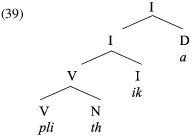
The discussion so far clarifies the content we impute to the agreement inflection, i.e. D in (39), and to the temporal affix -ik-; our main goal in this section is to fix the properties of the middle-passive morphology -th-. Recall that Greek parallels Albanian closely in that both resort to active inflections in the perfective. We take the general parallelism between the two languages as an indication that Greek -th- is like Albanian  $u$Footnote [15] in that it has the content of a free variable and provides a morphological-level saturation of the internal argument of the verb. So -th- is also notated as N, just like Albanian
 $u$. Furthermore, the implication is that Greek -th- forms will have the same range of interpretations as Albanian
 $u$.
Note that, as seen in (19b), the present tense has the same structure, minus -ik-. Once again we argue that syntactic structure straightforwardly mirrors morphology.
Consider then (40), on the assumption that the free variable -th- is associated with the internal argument slot (N).
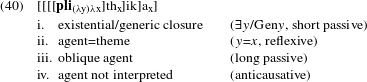
Following the discussion of Albanian, chain binding of the variable -th- by the EPP argument (here the finite verb inflection) licenses it. The external argument in turn is amenable to three possible interpretations (passive, reflexive, anticausative) along the lines in (40i)–(40iv). In other words, it can remain uninterpreted (anticausative), or it can be identified with the internal argument slot (theta-identification, reflexive reading), or finally it can be existentially/generically closed (short passive) or lexicalized by an oblique (long passive).
More interestingly, there is an important difference between Greek and Albanian, namely that Greek does not allow for the impersonal reading, in connection with unaccusative or unergative verbs. In other words the -th- variable can be associated only with internal argument slots of transitive verbs, i.e. with inner arguments, in the sense of (26). As (39) above shows, -th- selects the verb base, before temporal inflections like -ik- are added. This is sufficient to ensure that it takes the closest argument. In order to ensure that the latter is an inner argument, it is sufficient to have -th- select transitive (two argument slot) verbs. Despite the fact that it is syntactically, rather than morphologically, merged we take it that Albanian  $u$ also obligatorily merges as the first argument of the root. However, there are no restrictions as to the set of verbs it may combine with; it can combine with any of the major classes. The result is that it can yield arity reduction either via promotion to the EPP position (as in Greek) or via arbitrarization (impersonal) with unaccusative and intransitive verbs.
In short, despite the overall parallelism, the middle-passive kinds of morphology of Greek and Albanian have a partially different range of application. In Greek, -th- associates only with the internal argument of transitive verbs, while in Albanian,  $u$ associates with the single argument of intransitives as well. By contrast, a completely unrestricted distribution of the si morphology seems to characterize Italian, in examples like (41) (= (14b) above), where si cooccurs with an accusative clitic.

Since the latter satisfies the internal argument of the verb, we must assume that si (interpreted as an impersonal, i.e. by arbitrarization) is associated with the external argument slot, even with transitive predicates. Generalization (26) is respected in all instances.
The final question is why the middle-passive morphology is at all necessary. For instance in Greek, -th-, by hypothesis, introduces a variable, corresponding to the internal argument of a transitive predicate. When the variable is closed by the EPP argument, the effect is that of promotion from the internal argument to the EPP position. Why could the same promotion not be obtained by movement (copy and deletion) without any special morphology?
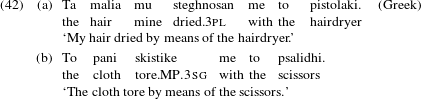
As it turns out, in languages with specialized middle-passive morphology (whether inflectional, clitic, or other), we find that at least the non-interpretation of the external argument, yielding anticausatives, is perfectly compatible with active morphology, as in Greek (42) (from Alexiadou, Anagnostopoulou & Schäfer Reference Alexiadou, Anagnostopoulou, Schäfer and Frascarelli2008).
Similarly in the Romance languages we know that active–anticausative pairs can either be associated with ordinary active morphology or with si middle-passive morphology (Burzio Reference Burzio1986, e.g. affondare ‘sink’, transitive and unaccusative vs. spegnere ‘put off’, spegnersi ‘go off’).
As far as we can tell, which of the options is taken by any given language and for any given verb is essentially learned (see also Roussou & Tsimpli Reference Roussou, Tsimpli, Picchi and Pona2007). We may want to list those verb bases that maintain the active form in the causative–anticausative alternation as taking an external argument optionally, thus alternating between a transitive and an unaccusative syntax even if there is no variable forcing arity reduction in the syntactic structure.
5. Specialized person inflections
As already mentioned, we take the person inflection of finite verbs to satisfy the EPP in so-called null subject languages like Greek or Albanian. This will of course be true of active inflections – like the ones we have examined so far – and of specialized middle-passive inflections. Active inflections can pick up any argument: external, as in (43a), internal, as in (43b), or expletive, as in (43c). In the active voice then, D inflections are insensitive to thematic properties.
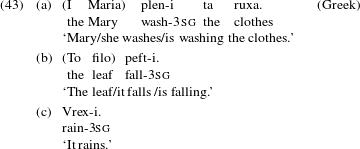
Specialized middle-passive inflections also realize the EPP argument. However, they crucially differ from the active ones in that they consistently pick up the internal argument, or to put it differently, they exclude the external argument. Consider again the following Greek examples. With the verb pleno ‘wash’, the most salient readings in (44a) below are the passive (‘by their mother’) and the reflexive (‘themselves’). The most salient reading in (44b) is the passive; the reflexive is out, on the assumption that cars do not perform self-washing.
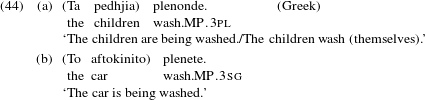
Leaving differences in interpretation aside for the moment, the middle-passive inflections -( $o$)nde or -(
 $e$)te in (44) are essentially a realization of the internal argument. They therefore give rise to an intransitivized syntax precisely in that they are realizations of the internal argument promoted to the EPP position (see Roussou Reference Roussou, Baltazani, Giannakis, Tasngalidis and Xydopoulos2009). In the structures in (45),
 $y$ and
 $x$ are the two thematic slots provided by the verb pleno ‘wash’.
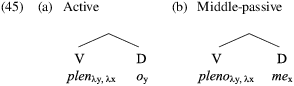
The active inflection picks up the external argument  $y$ which comes to be associated with the EPP argument, as in (45a). The middle-passive inflection on the other hand, picks up the internal argument
 $x$, as in (45b).
The above morphosyntactic structures contain an unassociated argument (internal and external respectively). Take the active first. Following standard assumptions, the variable  $x$ corresponding to the internal argument slot, is satisfied in the syntactic derivation by a D(P) first merged inside the predicate’s projection. The middle-passive structure has the external argument
 $y$ unassociated, taking us back to the LF structure in (22), repeated here once again, in (46) for ease of reference.
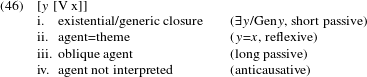
One option is for  $y$ to be existentially bound, thus qualifying as an implicit argument at the interface. This is the interpretation we get in short passives. In this reading, the two event participants are kept distinct. If, on the other hand,
 $y$ is not bound, the reading is anticausative with one participant (the affected argument) present and no cause/agent interpreted. Finally, if
 $y$ associates with the D/EPP referential content as well, then the two participants in the event are identified (
 $x$=
 $y$). This is nothing else but the reflexive reading. In short, the structure in (45b) is ambiguous.
A verb like ‘wash’ has a salient reflexive reading, while a verb like ‘read’ does not – so lexical properties of the predicate do play a role. But even with a verb like wash, the reflexive reading does not arise if the expressed subject is inanimate, as in (44b) above; furthermore the subject can be animate (e.g. ‘the baby’) and not amenable to a reflexive reading (as far as we know babies lack the ability to wash themselves). So, which reading is derived will depend on the interaction of semantic and pragmatic factors, as argued by Tsimpli (Reference Tsimpli, Unsworth, Parodi, Sorace and Young-Scholten2005). The various readings are disambiguated if a ‘by’-phrase is present, since in this case the external argument takes the form of an oblique argument and the reflexive and anticausative readings are excluded.
For all we know, the active and passive structures of a language like Albanian are exactly parallel to those of Greek. On the other hand, while a core of interpretations is associated with middle-passive morphology both in Greek and Albanian, namely those just reviewed for (46) (reflexive, anticausative and passive), Albanian also has the impersonal interpretation associated in particular with unaccusatives like (47b) (recall (10a) above); the active is displayed in (47a).
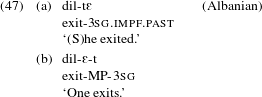
In the active voice, for instance in (47a) with the structure in (48a), the single argument slot of the unaccusative, i.e. the internal argument, is assigned to the EPP argument. There is no other possibility but to have the same assignment in the middle-passive voice, as in (47b), with the structure in (48b).
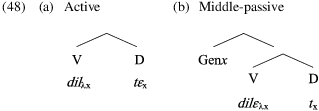
The difference is that middle-passive morphology is associated with generic closure of the sole argument; i.e. the 3rd person singular EPP inflection is interpreted as an expletive.
5.1 An ergativity split?
Having now reviewed the fundamental morphological split in both Greek and Albanian, between perfective tenses (Section 4) and imperfective tenses (in this section), we are in a position to go back to the attempts made in the literature to predict the morphological distribution (recall Section 2.2). The approach taken by both Rivero (Reference Rivero1990) and Kallulli & Trommer (Reference Kallulli and Trommer2011) is based on an optimization pattern. Yet we have seen that these approaches face empirical problems, specifically with respect to fine (dialectal) variation. Rivero acknowledges the problem with the Albanian periphrastic perfect – and the problem is underscored by the fact that the morphology she predicts (‘have’ auxiliary and middle-passive particle inflection) is attested in Arberësh (Italo-Albanian varieties). Similarly Kallulli & Trommer build a model that excludes a split along temporal (rather than aspectual) lines which is exactly what we find in Geg Albanian. At a more basic level, even the complementary distribution predicted by Ralli (Reference Ralli2005) does not hold, since selected Arberësh varieties combine the  $u$ clitic with an inflectionally middle-passive participle.
Ideally, one would like to be able to uphold Rivero’s and Kallulli & Trommer’s conclusion that the distribution of the different kinds of morphology in Albanian is not merely arbitrary – i.e. it could not be reversed. The parallel with Greek strengthens this desideratum, since we are assuming that, despite their other differences (inflectional vs. clitic middle-passive morphology), Greek and Albanian perfective tenses pattern together in displaying active person inflections. From the present point of view, the basic alternation is between active person inflections in the perfective (or in the past in Geg Albanian) and specialized middle-passive inflections in the imperfective (or in the present in Geg). We suggest that it may be relevant that perfective vs. imperfective tenses provide a context for ergativity splits, specifically in Indo-European languages (Indo-Aryan, Iranian).Footnote [16] In both instances certain aspectual properties (possibly result vs. non-result) trigger certain changes that ultimately involve case alignment of argument structures. If the parallel is on the right track, then the perfective, which triggers the ergative alignment in Indo-Iranian languages, has no specialized person inflections for active vs. middle-passive in Greek and Albanian. The imperfective, which has the accusative alignment in ergativity split languages, has specialized inflections for active vs. middle-passive. This matter is obviously too complex to be pursued here, but is worth considering in future research. As things stand, we are forced to state that the distribution of the various types of middle-passive voice morphemes depends on selectional restrictions.
6. The ‘be’ auxiliary
Perfect tenses in both Greek and Albanian are formed periphrastically by auxiliary–perfect participle sequences, although they differ in the auxiliary used. In Greek and Arbëresh, the auxiliary of the perfect is ‘have’ both in the active and in the middle-passive voice while the latter is marked on the lexical verb by the affix -th- in Greek, and by the  $u$ clitic in Arbëresh;Footnote [17] therefore ‘have’ plus a perfect participle yield the perfect reading, independently of the internal constituency of the participle itself. In other words, we may assume that the internal structure of the participial sentence in Greek and Arbëresh follows the same lines as in Section 3. Auxiliary selection is straightforward, since ‘have’ is invariably selected in these languages.
In mainland Albanian (Tosk and Geg), a more complex auxiliary distribution is observed, since middle-passive voice is characterized by the auxiliary jam ‘be’ though the active voice has kam ‘have’. On the other hand, both auxiliaries are followed by the same participle. In the Albanian perfect therefore, middle-passive voice is effectively carried by the auxiliary ‘be’ and active voice by the auxiliary ‘have’. In other words, there appears to be a third strategy for lexicalizing middle-passive morphology in Albanian, via the selection of the perfective auxiliary ‘be’ for middle-passives, whereas ‘have’ is selected for actives.
At this point our review of the PF–LF mapping of middle-passives crosses another major topic in theoretical literature, namely auxiliary selection, which is logically independent of middle-passives. Reviewing the entire matter of auxiliary selection is beyond the scope of the present article. Fortunately, the existing literature concentrates on languages which have a very different auxiliary split from that observed in standard Albanian. Specifically in Italian (Burzio Reference Burzio1986), ‘be’ associates with active unaccusatives, as well as with all middle-passives (si forms). In Dutch (Reinhart & Siloni Reference Reinhart and Siloni2005), ‘be’ associates with active unaccusatives, but not with middle-reflexives, taking zich to be the exponent for middle-passive morphology. More clearly Manzini & Savoia (Reference Manzini and Savoia2011a) discuss Romance varieties where the se form associates with ‘have’, as opposed to active unaccusatives with ‘be’.
The pattern attested in Albanian is quite different since it separates actives from passives. What we are talking about in examples like (49) (compare (5) and (9) above), is not the ‘be’ auxiliary of periphrastic passives in languages like English; rather it is the auxiliary of the perfect. Thus ‘be+V–participle’ is not interpreted as a periphrastic present (compare English I am washed), but as a perfect ‘have+V–participle’ (compare English I have been washed).
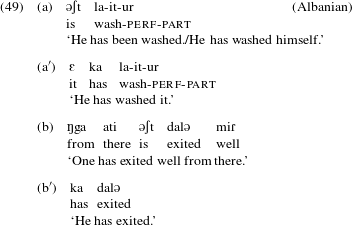
The constituent structure itself of an auxiliary–perfect participle structure is open to discussion. The standard generative approach is mono-clausal and therefore the auxiliary is a functional category in the extended projection of the verb. Correspondingly, the lexical verb selects the auxiliary, as in Burzio (Reference Burzio1986). On the other hand, Kayne (Reference Kayne1993) assumes that both the auxiliary and the participle have their own sentential projection and their own argument structure. There is considerable evidence that participles are not mere predicate projection, since they can have sentential interpretation, at least as adjuncts. A case in point is the so-called absolute (i.e. independent) participle of Latin in (50a) or Italian in (50b), see Belletti (Reference Belletti1990).
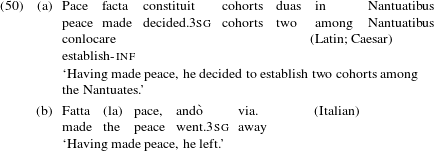
What is directly relevant here is that in terms of a bi-clausal conception of auxiliary–past participle structures, it becomes more natural to think of the auxiliary as selecting the embedded participial clause. In fact, this way of looking at auxiliary selection is the natural one also under a mono-clausal view. Normally one speaks of the complementizer selecting a certain type of embedded sentence, as opposed to the reverse. In other words, selection appears to be from ‘functional’ projections to lexical. So, given this perspective, the question is why in Albanian ‘be’ selects middle-passive participles, while ‘have’ selects active ones.
We cannot assume that Albanian jam ‘be’ simply selects middle-passive morphology, since the participle has identical morphology in both examples of active and middle-passive voice, for instance in (49). Therefore what the ‘be’ auxiliary selects is a certain type of embedded structure. The conclusions of Section 3 above make clear predictions as to the structure embedded under ‘be’. Consider first a transitive verb, with the structure in (51); we indicate the projection of the participial structure with the purely descriptive label of Participle Phrase. In (51), as in all other morphological instantiations of the middle-passive, we expect that arity is reduced by the operations on the external argument listed in (i)–(iv).
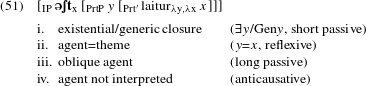
All of the operations in (51i–iv) are ways of closing a structure that would otherwise present an open variable. The interpretive operations in (51) are essentially invisible to the syntactic component; all middle-passive structures are ambiguous because the morphosyntax is insensitive to which of the possibilities in (i)–(iv) exactly applies. Therefore it is tempting to conclude that what ‘be’ selects is simply a predicate, i.e. an open argument structure. The same is true with intransitive predicates, where the variable corresponding to the sole argument of the predicate is interpreted via quantificational closure, as with the unaccusative in (52).

In short, jam ‘be’ selects an open argument structure in its participial complement. Thus jam restricts the interpretation of the embedded participial clause to what is conventionally known as middle-passive voice, without middle-passive morphology being instantiated on the participle. By contrast, kam ‘have’ selects a closed argument structure, in the sense that no free variables are instantiated within it – as sketched in (53) for examples (49a $^{\prime }$) and (49b
 $^{\prime }$).

An obvious question raised by the present discussion is why ‘be’ could not select a complete argument structure and ‘have’ an incomplete one; in other words why the split couldn’t be reversed. We suggest that selection for a predicate is consistent with the main context of occurrence of ‘be’, as the copula (a raising predicate; see Moro Reference Moro1997). On the other hand ‘have’ as a possession verb is a transitive predicate, taking two arguments. The same is true of have as a modal (e.g. English I have to go), where its internal argument is sentential. This is consistent with its selection properties as an aspectual auxiliary under the account sketched so far. It is worth noting that the picture suggested here is that ‘have’ and ‘be’ as auxiliaries are to be unified with ‘have’ and ‘be’ main verbs (see in particular Kayne Reference Kayne1993, Haider Reference Haider2010). This in turn means that ‘be’, as the copula, will select more elementary structures than the transitive predicate ‘have’ – including open predicates (middle-passive voice, as here), but also in other languages, like Italian, elementary events (unaccusatives) as opposed to causative events (transitives and unergatives).
These conclusions are not necessarily contradicted by the observation that both active and middle-passive participles are embedded under the aspectual auxiliary ‘have’ in both Greek and Arberësh. Quite simply these are languages where no auxiliary split is observed in participial embedding. We can then just assume that ‘have’ selects participle phrases in these languages independently of their internal make-up. This correlates with the fact that middle-passive morphology (-th- for Greek or the  $u$ clitic for Albanian) is independently lexicalized in these languages, licensing arity reduction in the way reviewed in the preceding sections.
Returning to Albanian, we are well aware that in generative frameworks there is a much more conventional approach to the data in (49), already sketched in the discussion in Section 2 above. This is to assume that though the perfect participle does not overtly encode voice, it does so abstractly, through a silent voice head, visible for selection by the matrix auxiliary (see Anagnostopoulou Reference Anagnostopoulou, Alexiadou, Rathert and von Stechow2003 on Greek). In fact, as far as we can tell, the discussion of this and similar matters assumes that no alternative to the abstract head encoding is even possible. In this respect, our main aim has been to show that basic consistency with mainstream generative frameworks can be maintained without recourse to the encoding of semantic ambiguity in the syntax. Note that we do not need the auxiliary to inspect embedded configurations – something presumably barred by cyclicity/phases (Chomsky Reference Chomsky and Kenstowicz2001). Rather it is sufficient for the selecting head (the auxiliary) to check at the root node of the participle whether all of the thematic roles have been discharged/closed. Suppose then that it is granted that no syntactic encoding of interpretive properties by an abstract voice head is necessary; then obvious simplicity considerations exclude such a device.
7. Conclusions
In the present paper we have considered the morphosyntax of middle-passive voice in Greek and Albanian. These formations are interesting for two reasons. First, middle-passive voice keeps exactly the same range of interpretive properties even though it surfaces in different morphosyntactic shapes (conditioned by aspect or tense),Footnote [18] namely as a specialized agreement inflection, or as clitic/affix with active voice agreement inflections, or as auxiliary selection. Second, each morphosyntactic realization is compatible with the same range of middle-passive interpretations, including the passive, the reflexive, the anticausative, and in the case of Albanian the impersonal. We argued that interpretively middle-passive voice corresponds to the presence of an open argument position, which can be LF-interpreted by existential/generic closure (short passives, impersonal), by unification with the closed argument (reflexives), by an oblique realization (long passives, impersonal), or not interpreted (anticausatives, but see the discussion in Section 4 above). Specialized person inflections, clitic  $u$ and affix -th- lexicalize the internal argument (or the sole argument of intransitive in Albanian) which gets bound by the EPP – yielding promotion from object to subject. Finally, perfect tenses in Albanian encode middle-passive through auxiliary selection; jam ‘be’ selects a participle with an open position (consistent with its raising properties), while kam ‘have’ selects a participle with closed argument structure (consistent with its transitive nature). We have argued that real ambiguity is at stake in the various interpretations and is resolved at the LF interface, without postulating hidden features that predetermine interpretation.