Scenario: A senior medical student enters the room and sees a patient already positioned on her side with her lower back (L3-4 area) prepped and draped. The student greets the patient and asks her to bring her knees up to her chest and bend her head down to optimize the procedure.
Feeling the space between the spinal processes, the student marks it and injects local anesthetic, while talking continuously with the patient. The student then carefully inserts the needle into the interspace, feels a slight “pop” as the needle enters the spinal canal, and withdraws the obturator that occludes the needle.
The assistant hands the student a manometer to measure the opening pressure, and then the student collects the spinal fluid into tubes, handing them off to the assistant. Still talking with the patient, the student withdraws the needle, puts pressure on the insertion site, and covers it with a bandage.
“Congratulations,” says the technician as she removes the special hood and gloves the student is wearing. As she turns on the lights, the “patient” and “assistant” avatars disappear and the visual reality (VR) simulation room again becomes a large closet with bare white walls and a tray with electronic “medical” equipment.
Teaching and testing scenarios such as the advanced VR system described will probably not occur until a decade or more in the future. Eventually, the explosive progress in computer technology will enable trainees to learn clinical procedures using VR. The questions that should be asked are: Why is it needed? What beneficial and adverse changes might result from introducing VR teaching and testing? And how do we in the medical field prepare now for such changes in our near future?
Today, new medical school graduates often lack the skills needed to function at an appropriate clinical level when entering graduate medical education (GME). This results in physicians in GME programs having variable skill levels, sometimes putting patients at risk. Footnote 1 Those paying for GME, the at-risk patient population, medical educators, and government overseers, are demanding substantive changes to our outmoded educational model. Footnote 2,Footnote 3 Recognizing this, in 2004, the United States Medical Licensing Examination (USMLE) introduced a clinical skills test and in 2014, the Association of American Medical Colleges (AAMC) introduced the Core Entrustable Professional Activities for Entering Residency curriculum. Footnote 4,Footnote 5
Because technological breakthroughs often outpace the ability to understand, react to, and assimilate them, it behooves us as medical educators to consider the ethical and societal implications associated with the looming introduction of VR into medical education and licensure before it is implemented.
What is VR?
Although a 2014 literature review found no clear consensus on how to define VR in medicine, Footnote 6 the following description contains its basic concepts. VR uses computer systems to generate extremely realistic pseudoenvironments. These systems provide users with visual, tactile (haptic feedback), auditory, and, where relevant, olfactory sensations. A similar construct, augmented reality (AR), has the simulation overlying the user’s surrounding real environment.
Widely used in video gaming, VR systems are now an integral part of training, testing, and operations in multiple sectors, including the military, transportation, public safety (police and fire), engineering, and construction. Footnote 7 Sophisticated computer programs generate scenarios that emulate the real world, and participants generally wear special equipment, such as a multisensory visor or helmet and sensory gloves. The equipment tracks the head, eye, body, and hand positions, altering what the participant sees, smells, hears, and feels as the scenario progresses.
As in the scenario described, the computer program and the simulated VR equipment (e.g., scalpels, tubes, catheters, scopes, and probes) sense the participant’s position in space and track the examinee’s sequence of actions. The program then generates participants’ perception of, for example, “blood” and “air” emanating from a “wound” after their “skin incision.” Individuals react and interact with these simulations as they would in the real world. After making a chest incision, participants would feel the “lung” when they inserted their finger, to be certain that they were inside the thoracic cavity. A technician would alter the scenario depending on the desired complexity.
In 1957, Morton Heilig invented a VR precursor, the “Sensorama Machine,” which supplemented a three-dimensional (3D) motion picture with smell, stereo sound, seat vibrations, and blowing air. Footnote 8 In 1987, Jaron Lanier coined the term “virtual reality” to describe a computer system capable of allowing people to have a realistic experience with the feeling of “being there.” Footnote 9 Basic VR systems now exist in the videogame and adult entertainment industries and in systems used to train personnel in the military and in other high-risk areas, such as the airlines and nuclear plants.
In the early 1990s, surgeons began exploring VR to visualize and plan for complex operations. Footnote 10 Since then, use of VR has increased in all areas of medicine, Footnote 11,Footnote 12,Footnote 13,Footnote 14 although such systems are still relatively rudimentary. However, driven by the formidable videogame industry, VR systems are rapidly achieving the ability to accurately emulate reality (fidelity). Enhanced graphic cards have led to better image resolution, and system speeds have doubled approximately every 18 months (in accordance with Moore’s Law), resulting in better image continuity. With increased system power has come a decrease in the delay between a participant’s action and the result that person sees and feels (latency). Footnote 15 This rapid technological growth suggests that high-fidelity VR systems capable of accurately emulating complex medical procedures will be common within the coming decades.
Applying VR to Medical Education and Licensure: Ethical and Social Issues
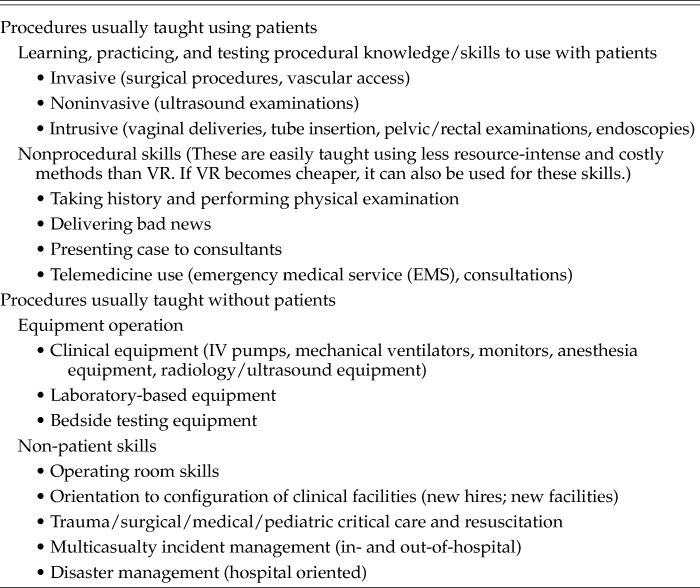
Although VR has many potential uses in medicine, this article examines the beneficial and adverse ethical and social consequences of using it to teach and test clinical procedures, both those that normally require patient participation and those that do not. The latter include equipment operation, performing laboratory tests, and team and situational management (Table 1). Footnote 16,Footnote 17 These potential consequences seem to fall into two categories, discussed below: safety and economics.
Uses for Enhanced Virtual Reality (VR) in Medical Education

Safety Issues
Patient Safety
Increased patient safety and societal confidence in the medical profession will be the most telling changes produced by introducing VR procedural testing and teaching.
When VR procedural training becomes available, educators will be able to abandon the traditional clinical teaching paradigm (i.e., “see one, do one, teach one”). Footnote 18 Inexperienced students, residents and practicing physicians, nurse practitioners, and physician assistants will no longer need to use living and newly dead patients or animals as teaching fodder. Footnote 19,Footnote 20 Alternative and safer training methods, although much less sophisticated than VR, are available now, but they have not been widely used. Footnote 21,Footnote 22
Medical errors are the third leading cause of death in the United States. Footnote 23 Although it is unclear how many of those deaths result from errors in performance or from a reluctance to perform a necessary procedure because of lack of training and experience, uniform VR-based teaching protocols could lessen the chance of error and enhance experiential learning.
Clinican Competence
Widely adopting GME training using VR would allow all medical students to have basic competence in required procedures before graduating and entering residency training. Residents would be able to demonstrate advanced competency in procedures required to graduate from their programs and to take their specialty examinations, and specialty boards would be able to use completion of VR testing to ensure that certified clinicians have the requisite skills to practice. Appropriate national bodies would determine the procedure lists for medical school and residency graduation; it might be worthwhile to begin compiling these lists now.
Clinician Licensing
Such changes would precipitate major alterations in physician testing and licensing methods. Procedural assessment would move from the current reliance on indirect information, such as residency completion or general letters from the residency director or colleagues, to the use of VR-based competency testing. Healthcare institutions (i.e., hospitals, outpatient medical facilities), specialty boards, and licensing agencies would need to incorporate clinician competence, based on VR testing and teaching, into their credentialing processes. At present, clinical facilities ask new clinicians what procedures they are able to perform and then may forward the list to clinician colleagues for verification. Unless there are extenuating circumstances, these facilities rarely evaluate procedural competence independently. Specialty boards and licensing agencies rely on applicants’ graduation from training programs and practice history to assess clinicians’ procedural competence.
Global Medicine
VR procedural teaching and testing has the potential to greatly enhance the quality of global health practitioners in rural and remote settings, who often must perform procedures in which they have received little or no training. If they have access to VR, they may be able to acquire the skills that they need. However, this would necessitate either traveling to VR facilities or having access to portable VR systems.
Unintended Consequences
Although introducing VR systems into medical education could solve some obvious safety issues, it might also generate others. Trainees often take justifiable pride after successfully performing a clinical procedure. However, the major contribution to the patient’s well-being is the faculty member who decides whether a particular procedure is necessary. As faculty clinicians often tell trainees, deciding whether and when to perform a procedure, as well as knowing how to treat any complications, are the “doctor parts”; the rest is purely technical. By stressing procedural competence over decisionmaking and other treatments, an unintended consequence of using VR may be that trainees neglect vital components of medical care. VR training also may cause some clinicians (and their patients) to assume that they have gained required knowledge and skills even if they have not, and to become overconfident in their abilities. This delusion may be difficult to overcome.
Economics
Shorter Training Times
Traditional GME (i.e., residency, fellowship) programs are very long, especially in procedure-heavy specialties such as surgery and its subspecialties, obstetrics/gynecology, emergency medicine, and interventional radiology and cardiology. Potentially, VR technology could shorten this training by reducing the time needed to learn procedures. This might ease the financial burden on the trainees (i.e., loss of professional-level income and increased accrued debt on medical student loans during training) and on the agencies that subsidize this training. It could also shorten the training time of other healthcare professionals, such as nurse practitioners, physician assistants, dentists, podiatrists, and physical therapists. However, as will be described, it might also increase financial burdens in inequitable ways.
Financial Discrimination
Introducing VR systems into medical education and licensure will incur significant costs. These costs include the system hardware and software, space allotment for the laboratories, and wages for the highly trained technicians who run the simulations. Invariably, any costs will be passed on to the teaching institutions and trainees, and, ultimately, will result in higher medical costs for those who pay for medical education and health care (i.e., government, insurance companies, patients, trainees).
Costs associated with VR systems could further stratify medical students, residents, and educational institutions based on wealth. These additional costs will disadvantage poorer medical students, other healthcare professions students, and less financially secure medical schools and residency programs. GME programs and hospitals that cannot afford to purchase (or lease) up-to-date systems and make them readily accessible to their trainees would be less attractive to the best candidates. Many may close, especially those serving economically disadvantaged populations.
Poorer trainees, including those from resource-poor countries, would suffer the most. Introducing VR, especially if there is pressure to use personal resources to access private VR centers, may add to the already significant medical education debt. Such private centers would offer training, testing, and official completion certificates for many resident-level procedures. These trainees could use their added qualifications to become more competitive residency and fellowship applicants, skewing the applicant pool in the most competitive and procedure-oriented specialties.
Industry Influence
Introducing VR systems into medical education may have the unintended, but predictable, consequence of biasing clinicians toward using newer (but perhaps more costly or not optimal) equipment and procedures in lieu of older and less expensive equipment, driving up the cost of medical care. As they do now with educational videos and models, medical equipment companies will develop proprietary VR systems to teach clinicians how to use their newest diagnostic and therapeutic equipment. Continuing medical education (CME) conferences would employ these VR systems as an underwritten, high-visibility attraction. Ultimately, patients, the government, and insurance companies would pay for the latest technology through increased medical costs.
What Should Be Done To Prepare?
If VR development stays on course, it could radically transform medical education, specialty certification, and the professional licensure process over the next decades. However, advance planning related to new technology is difficult, because we typically focus on incremental advances, such as those to our smart phones or computers, rather than recognizing the giant leaps that will foreseeably occur in the coming decades. The question naturally arises: What should be done to prepare for the changes that VR in medical education and licensure would bring? Quite simply, we as medical educators must accept that major changes will occur, even if we are slow to recognize them, and encourage those guiding and paying for medical education to plan ahead.
Looking forward, we should applaud the potential benefits of improved patient safety resulting from better assessment of procedural competence, less use of patients to teach invasive techniques, and a reduction in the lengthy undergraduate and specialty medical education processes. However, these improvements may by stymied by academic politics, a reluctance to reorganize medicine’s current structure, and hospitals’ need for a low-paid resident physician workforce.
It is evident that substantial costs will accrue from using VR systems in medical education. In planning future medical education funding, it will be necessary to guard against the financial discrimination that will affect not only trainees, but also the institutions that treat the least fortunate populations in our society. As medical clinicians and educators, we should be looking to our medical leaders to see how we can amplify VR’s benefits to patients and trainees while diminishing its adverse effects on medical education and the poorest healthcare institutions.
The future is not always surprising; occasionally, we can predict what will occur, and this article may serve as a wake-up call for healthcare leaders. As medical education inevitably incorporates VR into its training programs, further issues, and their ethical implications, will emerge. At this point, however, there is an opportunity to shape future interactions with VR technology in ways that will benefit both society and the medical profession. If we ignore it, the onus is on us.