





Introduction
Ascaris lumbricoides, an ancient human companion parasite (Cox, Reference Cox2002; Steverding, Reference Steverding2020) whose eggs have been identified in sediment layers dating back more than 24 000 years (Bouchet et al., Reference Bouchet, Baffier, Girard, Morel, Paicheler and David1996), remains a major global health burden. Currently, it infects an estimated 700 million people worldwide with a global prevalence of 11%, causing over 60 000 deaths annually, mostly in children living in developing countries (Holland, Reference Holland2013; Wang et al., Reference Wang, Zhang, Dong, Wang, Liang, Suo, Cheng, Zhang, Guo, Jiang, Guan and Zhao2020; Holland et al., Reference Holland, Sepidarkish, Deslyper, Abdollahi, Valizadeh, Mollalo, Mahjour, Ghodsian, Ardekani and Behniafar2022; de Lima Corvino et al., Reference de Lima Corvino, Carmona, Tobin and Horrall2026). The time from ingestion of infective eggs to oviposition by females is 2–3 months, and adult worms live 1–2 years in the human host (Holland, Reference Holland2013; Wang et al., Reference Wang, Zhang, Dong, Wang, Liang, Suo, Cheng, Zhang, Guo, Jiang, Guan and Zhao2020). In young children, ascariasis can cause malnutrition, growth impairment, abnormalities in cognitive development and life-threatening intestinal obstruction or suffocation episodes due to the vomiting of large quantities of worms (Husain et al., Reference Husain, Zubairi, Sultan, Beg and Mehraj2009; de Lima Corvino et al., Reference de Lima Corvino, Carmona, Tobin and Horrall2026). In adults, the infection is usually pauci-symptomatic and well-tolerated, even though allergic pulmonary phenomena can occur. A severe course of the disease is reported in adolescents and young adults suffering from cognitive abnormalities (Holland, Reference Holland2013; Wang et al., Reference Wang, Zhang, Dong, Wang, Liang, Suo, Cheng, Zhang, Guo, Jiang, Guan and Zhao2020; Schindler-Piontek et al., Reference Schindler-Piontek, Chaubal, Dehmani, Cui, Dong, Sharma and Dietrich2022).
The key to limiting Ascaris transmission lies in the safe disposal of human feces (Rendle-Short, Reference Rendle-Short1957). Although the disease remains rare in contemporary Europe and is predominantly imported (Holland, Reference Holland2013; de Lima Corvino et al., Reference de Lima Corvino, Carmona, Tobin and Horrall2026), historical evidence suggests it was more prevalent in earlier periods. Soil samples from the pelvic regions of individuals buried between 680 and 1700 CE at 7 archaeological sites – 2 in the Czech Republic, 2 in Germany and 3 in the UK – revealed a prevalence of Ascaris spp. eggs or DNA exceeding 20% in all but 1 of them, comparable to that observed in modern populations living in endemic regions (Flammer et al., Reference Flammer, Ryan, Preston, Warren, Přichystalová, Weiss, Palmowski, Boschert, Fellgiebel, Jasch-Boley, Kairies, Rümmele, Rieger, Schmid, Reeves, Nicholson, Loe, Guy, Waldron, Macháček, Wahl, Pollard, Larson and Smith2020). High prevalence was also found in Roman (27 BCE–476 CE) and Lombard (6th–8th centuries CE) burial sites (Ledger et al., Reference Ledger, Micarelli, Ward, Prowse, Carroll, Killgrove, Rice, Franconi, Tafuri, Manzi and Mitchell2021), and in a mass grave recently found in Florence under the Uffizi Gallery, dated between the second half of the 4th and the beginning of the 5th centuries CE, where 5 out of 18 buried individuals (27.8%) tested positive for Ascaris eggs (Roche et al., Reference Roche, Pacciani, Bianucci and Le Bailly2019). Once more in Florence in the years 1424–1425 and in 1430, the deaths with worms (DWWs), reported as with ‘bachi’, were numerous, especially in children (Diana, Reference Diana2002). The widespread prevalence of the disease has been documented since the 11th century in Milan, where it was believed that a bronze serpent – a gift from the Byzantine Emperor still preserved in the Basilica of Sant’Ambrogio – had ‘the ability to cure children of worms’ (Verri, Reference Verri1962).
Due to its clinical manifestations, including the expulsion of large amounts of adult parasites, ascariasis is easy to identify and has been described in chronicles and medical writings since ancient times (Hoeppli, Reference Hoeppli1956; Cox, Reference Cox2002; Trompoukis et al., Reference Trompoukis, German and Falagas2007; Jirsa and Winiwarter, Reference Jirsa and Winiwarter2010). Moreover, worms were frequently reported as the cause of death in the Bills of Mortality of London since the end of the 16th century (Graunt, Reference Graunt1662). Analysis of the Mortuorum Libri of Milan (Galli et al., Reference Galli, Oreni, Ridolfo, Formenti, Luconi, Boracchi, Antinori, Biganzoli and Vaglienti2023a,Reference Galli, Oreni, Ridolfo, Formenti, Luconi, Boracchi, Antinori, Biganzoli and Vaglientib; Luconi et al., Reference Luconi, Boracchi, Nodari, Comandatore, Marano, Vaglienti, Galli and Biganzoli2023; Nodari et al., Reference Nodari, Fois, Luconi, Vaglienti, Comandatore and Galli2024) identified several deaths attributed to or with worms, the descriptions of which were consistent with the clinical presentation of ascariasis.
The aims of the present study were to assess the prevalence of DWWs recorded in the Mortuorum Libri, to evaluate temporal variations in their occurrence, to investigate possible associations with historical events that may have influenced urban life, such as plague epidemics, and to examine the spatial distribution of cases across different areas of a large European city during the Renaissance and early modern period.
Materials and methods
Historical data collection
The Mortuorum Libri of Milan are a collection of registers established by Francesco I Sforza, Duke of Milan, to record all the deaths occurring every day in the city. To promptly identify plague cases, all deaths in the city were inspected, and the causes of each death were recorded, along with the deceased person’s demographic information (name, surname, age, gender, titles or particular status of the deceased person), and the parish (i.e. territorial entity comparable with modern city neighbourhoods) of the city in which the deceased person resided. The reporting and certification of deaths were entrusted to physicians or public health officials (Vaglienti, Reference Vaglienti2013).
Previous research based on data extracted from the Mortuorum Libri of Milan, focused primarily, though not exclusively, on plague years (Galli et al., Reference Galli, Oreni, Ridolfo, Formenti, Luconi, Boracchi, Antinori, Biganzoli and Vaglienti2023a, b; Luconi et al., Reference Luconi, Boracchi, Nodari, Comandatore, Marano, Vaglienti, Galli and Biganzoli2023; Nodari et al., Reference Nodari, Fois, Luconi, Vaglienti, Comandatore and Galli2024), repeatedly identified DWWs. Building on these observations, the present study examined the frequency and characteristics of DWWs across different historical periods. The entire collection of Mortuorum Libri (1452–1801) is preserved at the Archivio di Stato di Milano (ASMi), Atti di Governo, Popolazione, Parte Antica. This study is based on the records contained in registers n. 75–76 (1480); n. 82 (1510–1512); n. 117 (1629); n. 118–119 (1630); n. 120 (1631); n. 132 (1667) and n. 144 (1698).
Each entry includes name, surname, age, gender, titles or social status, date of death, parish and Porta (i.e. the administrative precinct in which the individual lived) and the causes of death (Figure 1). The terms vermen, vermini, vermum, vermibus, verminibus and lumbricis were searched for within the contents of each examined register. All deaths in which these parasitic terms were recorded were subsequently classified as DWWs and included in Table 1 for further analysis.
A page of the register of 1512 (Archivio di Stato di Milano, Atti di Governo, Popolazione, Parte Antica, b. 82). The case highlighted in red reads as follows: P. H(orientale), par. S. Babille for(is). Righina filia Symonis de Fontana, an(norum) VI, multitude(n)e v(er)mi(ni), no(n) suspect(ta), iud(icio) m(agistri) Ant(onii) (Oriental Gate, Parish of St. Babila outside [the walls]. Righina daughter of Simon de Fontana, aged 6, [died for] a mass of worms without suspect [of plague], according to magister Antony’s assessment).

Deaths with worms in Milan in the years chosen as a sample (15th–17th century)

Table 1 Long description
Rows list sampled years and columns report total deaths, deaths with worms split by males and females, age for deaths with worms as median and range in years, and three percentage measures. In 1480 there were 1933 total deaths and 42 deaths with worms, 24 males and 18 females, median age 5.5 years with a range from 0 to 20, and 2.17 percent of total deaths. In 1510 there were 2964 total deaths and 34 deaths with worms, 19 males and 15 females, median age 4 years with a range from 2 to 11, and 1.15 percent of total deaths; in 1511 there were 3395 total deaths and 39 deaths with worms, 27 males and 12 females, median age 4.5 years with a range from 1 to 28, and 1.15 percent of total deaths. In 1512 there were 5187 total deaths and 226 deaths with worms, 113 males and 113 females, median age 2 years with a range from 0 to 34, and 4.36 percent of total deaths. Later years show lower counts: 1629 has 5996 total deaths and 13 deaths with worms, 6 males and 7 females, median age 3 years with a range from 0 to 52, and 0.22 percent; 1630 has 8154 total deaths and 19 deaths with worms, 8 males and 11 females, median age 4 years with a range from 0 to 12, and 0.23 percent, with the children one to under six percentage marked by an asterisk at 1.55 percent. In 1631 there were 1670 total deaths and 7 deaths with worms, 4 males and 3 females, median age 5 years with a range from 0 to 23, and 0.42 percent; in 1667 there were 2363 total deaths and 11 deaths with worms, 5 males and 6 females, median age 2 years with a range from 0 to 9, and 0.47 percent; in 1698 there were 3002 total deaths and 9 deaths with worms, 2 males and 7 females, median age 7 years with a range from 1 to 17, and 0.30 percent. The percent of deaths with worms in children one year or older and under six years on total deaths ranges from 0.43 percent in 1698 to 21.72 percent in 1512, and the percent of those children on total deaths with worms ranges from 33.33 percent in 1698 to 74.78 percent in 1512.
a 3.27% after excluding the 442 children who died from plague in the same age group.
Data analysis
Relevant data extracted from the Mortuorum Libri were organized in a tabular dataset and analysed using R software (R Core Team, 2021).
Results
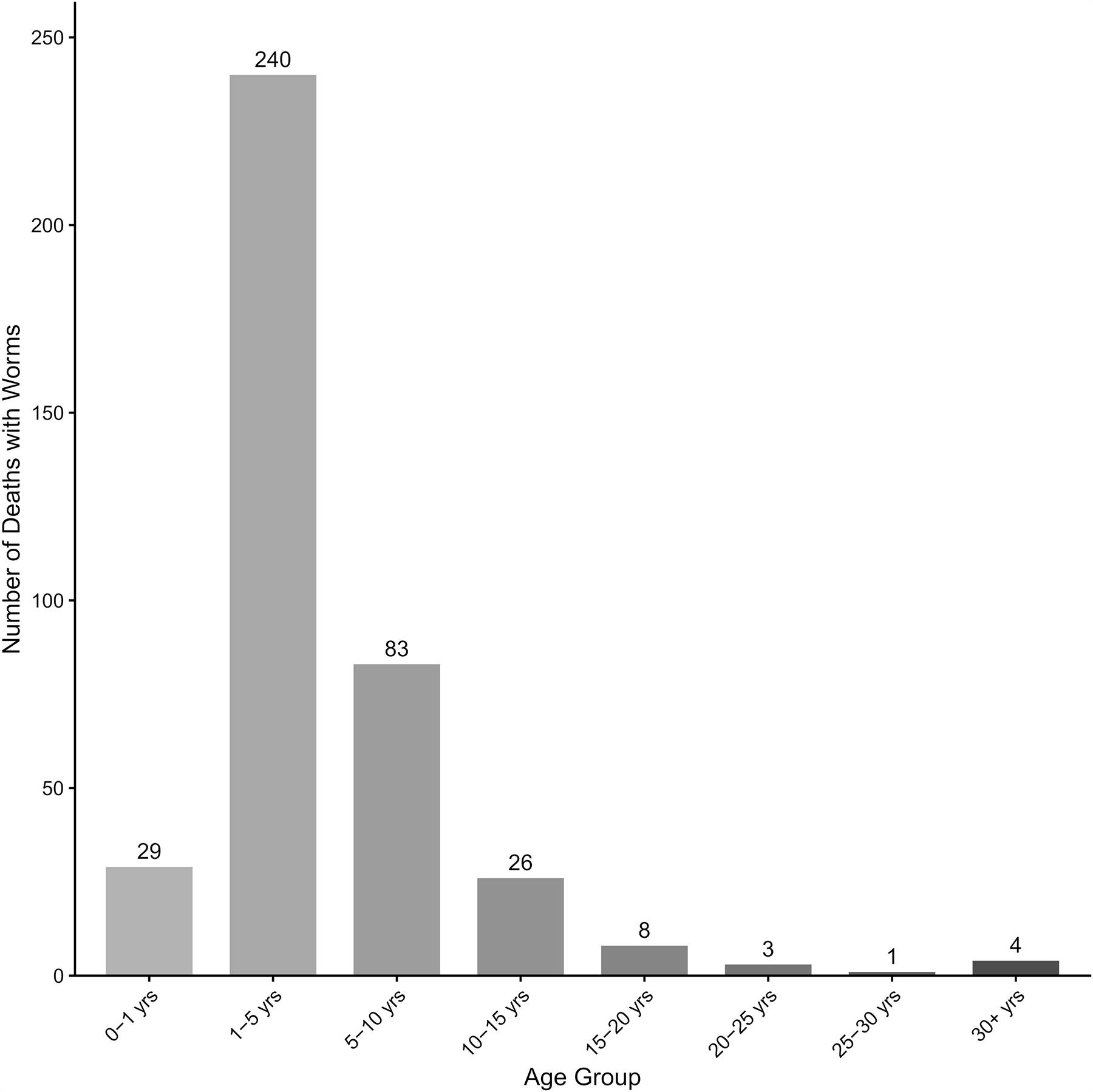
DWWs in the years examined are summarized in Table 1. The prevalence of DWWs varied considerably across the study period, ranging from 0.22% in 1629 to 4.36% in 1512, with notably higher rates in children aged 1–5 years (Table 1; Figure 2).
Age group distribution of deaths with worms (DWWs) recorded in the registers of deaths for the 9 years considered in the study. Out of the 400 recorded DWWs, 6 cases have no age information; 88% occurred in individuals younger than 10 years; 60% occurred in children aged 1–5 years.

In 1480, worms were recorded as the determining cause of death in 42 cases, representing 2.17% of all deaths registered that year. Only 4 of these cases involved individuals over 10 years of age. Fever preceded death in 32 cases (76.2%), and epilepsia was documented in 14 cases (33.3%) (Table 2). Notable cases included a 5-year-old boy who died with severe intestinal manifestations (reported as ‘malignant worms’), convulsions, abdominal distension and what was likely splenic involvement (‘blackness around the spleen’). A 6-year-old girl died with lethargy and worms (described as cum vermibus). Neurological involvement was documented in a 20-year-old male recorded as having dementia, and a 15-year-old girl who survived multiple episodes of worm-induced suffocation before ultimately succumbing to the infection.
Clinical conditions reported in association with worms in the death certificates

Table 2 Long description
Counts are listed by year for total deaths with worms and associated conditions: any fever, epilepsia, suffocation or respiratory disorders, gastroenteric disorders, cognitive disorders, dropsy or malnutrition, plague, syphilis, TB, and none. The total row reports 400 deaths with worms, with 119 any fever, 228 epilepsia, 3 suffocation or respiratory disorders, 36 gastroenteric disorders, 2 cognitive disorders, 2 dropsy or malnutrition, 4 plague, 1 syphilis, 2 TB, and 34 none. Year 1512 has the highest total deaths with worms at 226, with 179 epilepsia, 31 any fever, 9 gastroenteric disorders, 4 plague, 1 syphilis, 1 TB, 1 suffocation or respiratory disorders, and 11 none. Earlier years show totals of 42 in 1480, 34 in 1510, 39 in 1511, and later years range from 7 in 1631 to 19 in 1630. Any fever is highest in 1480 at 32 and in 1512 at 31, while epilepsia is highest in 1512 at 179 and is 16 in 1510 and 12 in 1511. Gastroenteric disorders are 13 in 1480, 1 in 1510, 12 in 1511, 9 in 1512, and 1 in 1630, with zeros in the other listed years. The none column is highest in 1667 at 7 and is 5 in 1510 and 1630, 3 in 1511, 11 in 1512, and 1 in 1629, 1631, and 1698.
In 1510, worms were the main cause of death in 34 cases (1.15% of total deaths), with only 5 cases in which worms were the sole reported cause. Fever was recorded in 15 cases (11 as febre continua). Epilepsia was recorded in 16 cases, 3 of which also involved concurrent fever. Gastroenteric complications (fluxus ventris) were documented in only 1 case (Table 2).
The following year, 1511, showed a similar pattern with 39 worm-related deaths (1.15% of total deaths). Fever occurred in 17 cases (12 as febre continua), while neurological manifestations were more prominent: epilepsia was noted in 12 cases, and an unusual condition called spasmus humidus in 3 additional cases (all recorded by the same physician). Gastroenteric disorders (fluxu ventris, dissenteria) were documented in 12 cases, including 1 complicated by dropsy. A single case presented urinary retention.
In stark contrast, the year 1512 witnessed a dramatic surge in worm-related deaths: 226 cases representing 4.36% of all registered deaths, approximately 8 times the previous 2 years’ total. Worms were the sole reported cause in 11 cases. Fever was present in 31 cases (15 as febre continua). Epilepsia was reported in 179 DWWs and spasmus humidus in 2 additional cases. This represented 79.6% of all worm-related deaths that year. Other complications included gastroenteric disorders in 9 cases, starvation in 1 case and suffocation in 1 case. Notably, 4 individuals who died from plague also had worms.
In the register of 1629, 13 DWWs were recorded (0.22%). After excluding deaths due to the epidemic (probably enteric fever) that occurred in the summer (Grove, Reference Grove1990), the percentage of DWWs rises to 0.39%. Fever was documented in 13 cases, with 3 specifically noted as acute. A single 3-year-old child had concurrent epilepsia (Table 2). The 1630 registers are incomplete; August is missing, probably due to the impossibility of recording all deaths or the loss of the register (Trompoukis et al., Reference Trompoukis, German and Falagas2007). Nevertheless, 19 DWWs were recorded (0.23% of the total). Fever was recorded in 10 cases (1 noted as acute, 1 as malignant). Epilepsia was reported in 3 cases, and gastroenteric complications in 1. After excluding the deaths from plague, the percentage of DWWs in the remaining cases rises to 0.44%. Among the 1296 children aged 1–5 years, 10 died with worms (1.55%, rising to 3.27% after excluding the 442 children who died from plague).
In 1631, with Milan’s population estimated to have declined by more than half, the absolute number of worm-related deaths also halved to 7 cases (0.42% of total deaths). However, the percentage remained stable. Fever is documented in 6 of 7 cases, with 1 described as continua. Among 192 children aged 1–5 years, 3 died with worms (1.32%).
Of the 2363 total deaths recorded in 1667, 11 were with worms (0.47%). Among 442 children aged 1–5 years, 6 died with worms (1.35%). Fever was present in 3 cases, 1 of which was described as acute.
In 1698, 9 DWWs were recorded (0.30% of total deaths). Fever was present in 5 cases (1 described as continua, 1 as acute). Epilepsia was documented in 3 cases. Among 669 children aged 1–5 years, 3 died with worms (0.43%).
Out of 400 total worm-related deaths, fever was documented in 119 cases (30%) and epilepsia in 228 cases (57%), with this diagnosis likely encompassing both true seizures and febrile phenomena. Gastroenteric complications were documented in approximately 25 cases in the entire period studied. Other associated conditions, including suffocation, dropsy/malnutrition and cognitive disorders, occurred less frequently. Two cases of concurrent tuberculosis were recorded, respectively, in 1512 and 1619, and a single case of concurrent syphilis in 1512 (Table 2).
Discussion
Ascaris lumbricoides received this denomination in 1758 by Carolus Linnaeus (Linnaeus, Reference Linnaeus1758). In choosing this name, however, the father of the modern scientific classification of living organisms had not paid much attention to the previous, rather contradictory, use of the term Ascaris, well described in the recent review by Peter Murray Jones (Jones, Reference Jones2025). When Hippocrates, in the 5th century BCE, classified intestinal parasites into flatworms, roundworms and ascarids, he reserved the term for pinworms (Grove, Reference Grove1990; Trompoukis et al., Reference Trompoukis, German and Falagas2007). Galen (129–201 CE), also dividing intestinal worms into taeniae, strongyles and ascarides, stated that the latter live near the anus and therefore continued to use this term to describe pinworms (Cox, Reference Cox2002). To add further confusion, Petrocellus (Petrus Clericus, died after 1050), a member of the Salerno medical school, stated that the worms called ascarides by the Greeks are large and resemble pumpkin seeds, thus transferring this term to indicate tapeworm proglottids (Renzi, Reference Renzi1856). It is therefore not surprising that the most illustrious Italian parasitologist of the 15th century, Giovanni Michele Savonarola (1385–1468), in his Tractatus de Vermibus kept calling ascarides the proglottids of tapeworms, even though he was aware of the existence of human infestations caused by lumbrici longi, rotundi et graciles (Savonarola, Reference Savonarola1498). Thus, even if differently named, ascariasis was undoubtedly well known to Renaissance physicians, including in its clinical manifestation. For example, Antonio Benivieni, a Florentine physician who lived from 1443 to 1502, described several clinical cases in which worms were implicated in a small treatise published in 1507 (Benivieni, Reference Benivieni1529). In particular, the cases of a man suffering from a persistent cough who expelled worms from the mouth and that of a 7-year-old child who expelled 148 lumbrici through the anus can be considered as typical ascariasis cases.
While the historical nomenclature used by Milanese physicians did not permit species-level parasitic identification, the age distribution of cases (predominantly children aged 1–5 years), the clinical presentation (fever and epilepsia) and the documented descriptions are consistent with A. lumbricoides infection, which remains the most common helminthic infection in human populations. It should be underlined that the term epilepsia in children was intended, in the Mediaeval and Renaissance treatises, as an intrinsic neurological weakness of childhood that could potentially manifest as fever and seizures (Mercuriale, Reference Mercuriale1588). On the other hand, the observed fevers were probably attributable to the underlying diseases rather than to the worms themselves. Notably, Rendle-Short (Reference Rendle-Short1957) reported that worms were frequently observed or passed during febrile illnesses, an association that historically led physicians to attribute the fever to the presence of worms.
Today, in endemic areas, the prevalence of ascariasis increases sharply during the first 2–3 years of life, reaches a maximum between the ages of 4 and 14 years and declines in adults (Khuroo, Reference Khuroo1996). The estimated burden of intestinal ascarides sufficient to cause intestinal obstruction is more than 60, and most obstructions due to ascariasis, up to 90%, occur in children aged 1–5 years (Silva et al., Reference Silva, Guyatt and Bundy1997), which corresponds almost perfectly to the age at death of the cases reported by Milanese physicians, which include only 2 persons aged over 40 years.
Although A. lumbricoides infestations are still the cause of more than 60 000 deaths worldwide each year, the lethality of the disease is considered relatively low (Holland, Reference Holland2013; de Lima Corvino et al., Reference de Lima Corvino, Carmona, Tobin and Horrall2026). In a prospective study of children with symptomatic intestinal infestation, a 1% lethality was observed (Wani et al., Reference Wani, Rather, Naikoo, Amin, Mushtaq and Nazir2010). In the past, their appearance in febrile patients led to the idea that worms could cause fever and even smallpox (Rendle-Short, Reference Rendle-Short1957). It is therefore possible that, at least in some of the reported cases in Milan Mortuorum Libri, A. lumbricoides infestation caused debilitation and malnutrition, thus reducing the chances of surviving to intercurrent infections. In fact, a fever is reported in 119 out of 400 cases identified. Probably febrile were also the children reported to have epilepsia (228 out of 400). Although it cannot be excluded that many of these children showed febrile convulsions at the time of death, it is important to underline that the term epilepsia was mostly used to indicate a sort of intrinsic cerebral weakness of children (Croce, Reference Croce1603), so much so that it was often used as a convenient diagnosis in death declarations. In 1503, for example, the reported cases of death from epilepsia are 257 out of 3156 registered deaths (8.14%) (Zanetti, Reference Zanetti1976), and a convenient diagnosis of epilepsia is indicated as a cause of death in 340 out of 870 children (39.1%) who died in 1629 at less than 8 years of age (Galli et al., Reference Galli, Oreni, Ridolfo, Formenti, Luconi, Boracchi, Antinori, Biganzoli and Vaglienti2023a). For epilepsy, as intended today, the terms mostly used in the registers were mal caduco or morbus comitialis (Zanetti, Reference Zanetti1976). It is possible that, in the cases in which the presence of worms is reported, the Milanese health officials considered them as a determinant, if not the main, cause of death. Only in a limited number of cases, such as that of a child who died in 1480 with a clinical picture strongly evocative of intestinal obstruction with intussusception or that in which suffocation caused by worms is described, it is reasonably sure that ascariasis was the actual ultimate cause of death.
It is not possible to estimate the actual prevalence of ascarid infestation in Milan in past centuries using death certificates. Moreover, the vast majority of ascarid infestations are asymptomatic or pauci-symptomatic (Khuroo, Reference Khuroo1996). Nevertheless, the number of DWWs observed in 1480 suggests a possible hyperendemic of ascariasis at the end of the 15th century. Ascaris lumbricoides infestation was common in 15th-century Europe, mirroring the poor hygienic conditions of European cities (Flammer et al., Reference Flammer, Ryan, Preston, Warren, Přichystalová, Weiss, Palmowski, Boschert, Fellgiebel, Jasch-Boley, Kairies, Rümmele, Rieger, Schmid, Reeves, Nicholson, Loe, Guy, Waldron, Macháček, Wahl, Pollard, Larson and Smith2020), and was not limited to the lower classes. A recent study on the remains attributed to Richard III shows that even the King of England himself was infested with roundworms (Mitchell et al., Reference Mitchell, Yeh, Appleby and Buckley2013). In the second half of the 15th century, Milan was frequently visited by plague and other epidemic diseases. This was not the case in 1480, a plague-free year, when deaths from epidemic diseases could not compete with those from other causes, such as ‘worms’ (Luconi et al., Reference Luconi, Boracchi, Nodari, Comandatore, Marano, Vaglienti, Galli and Biganzoli2023).
Milan had a rich, easily accessible groundwater table, and since ancient times, clean drinking water has come from wells scattered throughout the city (Fantoni, Reference Fantoni1990). Much less safe was the disposal of domestic sewage, which was entrusted to drainage channels (destri), a system unable to avoid large sewage contamination of public streets and domestic courtyards. The implementation of cisterns for sewage collection, ordered by Duke Francesco Sforza in 1455 as part of a broad political plan for public health, brought a slight enhancement (Santoro and Meda, Reference Santoro and Meda1961; Fantoni, Reference Fantoni1990). The construction of these cisterns, continued by Francesco’s heir Galeazzo Maria, likely improved hygienic conditions and reduced fecal contamination, as evidenced by the reduction in worm-related deaths in 1510–1511 compared with those in 1480. However, an earthquake occurred in March 1511, and a rainy autumn may have further weakened the drainage system (Corradi, Reference Corradi1867), which suffered a final blow after the Battle of Ravenna (April 1512) and the invasion of the duchy, when the movements of the opposing armies pushed many people from the countryside into the city and its boroughs (Shaw and Mallett, Reference Shaw and Mallett2018). Despite the critical situation and the concurrent significant plague epidemic, the registration of deaths continued with great accuracy, with a ‘multitude of worms’ also being found in 4 children who died from plague. In the meantime, deaths from morbus Gallicus, the term commonly used at that time for cases of syphilis, were also increasing (Galli and Fois, Reference Galli and Fois2025).
The data from the 3-year period 1629–1631 offer the opportunity to evaluate the impact of the worst plague epidemic in the history of Milan on other causes of death, including DWWs. Interestingly, the number of deaths from ‘worms’ was identical in 1629 and 1630, and the proportions relative to both total mortality and child mortality remained unchanged after excluding plague-related deaths. In 1631, with the city’s population estimated to have more than halved, the absolute number of cases of DWWs also halved, without decreasing as a percentage.
In 1665, the Bills of Mortality of London reported a total of 97 306 burials, including 68 596 deaths from plague and 2614 from ‘teeth and worms’ (Birch, Reference Birch1759), thus confirming that the number of DWWs was probably related to the hygienic and sanitary conditions of the affected city and remained high even during the worst plague epidemic. Interestingly, the association between teething fever and worms, rooted in British popular and medical culture (Cox, Reference Cox2002), was absent in Milan, where physicians frequently associated worms with epilepsia. The number of cases and percentages of worm-associated deaths were substantially unchanged in 1667, a year without plague. At the end of the century, in 1698, there appears to have been a modest reduction, if not in the absolute number of cases, then in the proportion of cases relative to the total number of deaths and to deaths in children, suggesting a certain improvement in hygienic conditions.
A limitation of the study lies in the fact that, in cases examined only post-mortem, health officials may not have directly observed the presence of worms, which may have been described by the deceased’s relatives, possibly reducing the quality of the diagnoses. However, given how easily the presence of worms can be observed, their mention in death diagnoses can be considered reliable. Finally, it should be noted that the diagnoses of DWWs reported in the past cannot be compared to modern ones based on definitive biological evidence and methods. Thus, it is not possible to be certain that each reported DWW was specifically caused by A. lumbricoides rather than by other soil-transmitted helminths. Nevertheless, the descriptions of large numbers of worms, together with the historical context and the clinical features of A. lumbricoides infection, support its identification as the most likely cause of the reported DWWs.
In conclusion, DWW remained a constant presence in Milan over the course of 200 years, with a high frequency at the end of the 15th century, with a large manifestation in a critical year for the city, 1512. Even the plague epidemics of 1512 and 1630 did not prove capable of influencing the number of DWWs, which remained consistent or even increased. These data provide a significant contribution to the impact of A. lumbricoides infestation in the early modern era.
Data availability statement
The data that support the findings of this study are available from the corresponding author upon reasonable request.
Acknowledgements
We want to thank the Archivio di Stato di Milano for the permission to publish one page of one of the registers as Figure 1.
Author contributions
Conceptualization, M.G.; Investigation, M.G., R.N. and E.L.; Resources, C.M., F.V. and L.F.; Data curation, R.N., C.M., F.C., F.V. and L.F.; Writing – original draft, MG; Writing – review and editing, R.N., E.L., C.M., F.C., C.B., F.V., E.B. and L.F.; Supervision, F.C., E.B. and L.F.
Financial support
This research received no specific grant from any funding agency, commercial or not-for-profit sectors.
Competing interests
The authors declare that there are no conflicts of interest.
Ethical standards
Not applicable.




 Open access

