Implications
Forages are major components of the diet of growing horses. In practice, better knowledge of their digestive use in young horses will help the equine nutritionist to maintain their optimal allowances for growth. Here we show that weaning did not induce major digestive disturbances in foals previously adapted to eat solid feed. After weaning, the increase in forage intake and in digestibility coefficients of fibre components between 6 and 12 months could reflect a higher fibre-degrading capacity in response to the age-related increase in energy demand for growth.
Introduction
In adult horses, plant cell wall carbohydrates are major energetic components of the diet. They are degraded and fermented by the hindgut microbiota into volatile fatty acids (VFAs) that are absorbed across the intestinal wall, providing energy for the animal (Argenzio et al., Reference Argenzio, Southworth and Stevens1974). The hindgut microbial balance is essential for optimizing fibre degradation (Julliand et al., Reference Julliand, de Vaux, Villaro and Richard2001) and depends greatly on the horse diet (Daly et al., Reference Daly, Proudman, Duncan, Flint, Dyer and Shirazi-Beechey2012).
In suckling foals, forage intake probably rises with age, as suggested by the linear increase of grazing time (Crowell-Davis et al., Reference Crowell-Davis, Houpt and Carnevale1985). At 5 months of life, suckling foals and mares spent respectively around 50% and 70% of their daily time grazing (Crowell-Davis et al., Reference Crowell-Davis, Houpt and Carnevale1985). Thus solid food progressively replaces milk before weaning, as weaning generally occurs around 6 months of life in equine species. In young rabbits (Combes et al., Reference Combes, Michelland, Monteils, Cauquil, Soulié, Tran, Gidenne and Fortun-Lamothe2011) and in human babies (Magne et al., Reference Mackie and Heath2006), such gradual feeding changes have been reported to limit the negative impact of abruptly stopping milk consumption on digestive physiology. Similarly, such progressive feeding diversification could also prevent modification of the hindgut ecosystem of foals, especially the fibre-degrading capacity, but this is currently unknown.
After weaning, forage intake increases rapidly and forages become the major source of energy (Cymbaluk et al., Reference Cymbaluk1989). Nevertheless, data on fibre-degrading capacity are scarce and controversial in young horses. Cymbaluk (Reference Cymbaluk, Christison and Leach1990) noted lower digestibility in weanlings compared with mature ponies, whereas no difference was reported by Earing et al. (Reference Earing, Hayes, Brummer, McCown, Parks and Lawrence2013), and digestibility coefficients were found to be higher in yearling horses than in mature horses (Earing et al., Reference Earing, Lawrence, Hayes, Brummer and Vanzant2010). These data suggest an increase in diet digestibility in weaned foals between 6 and 12 months of age, but this has never been investigated using the same growing animals. The present study was aimed at evaluating the age-related changes in fibre-degrading capacity in the same foals immediately after weaning and 6 months later.
Material and methods
The experiments were conducted at the experimental barn of Agrosup Dijon following approval from the Burgundy University ethics committee (agreement nos B1710 and C0711).
Animals, diets and experimental design (Figure 1)
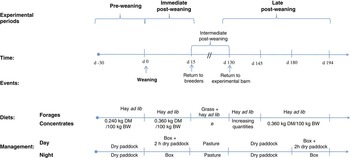
Figure 1 Five Haflinger foals born at the experimental barn were used. From days 30 to 1 before weaning, foals were in a dry paddock with their dams. Foals had free access to the meadow hay fed ad libitum to the mares. Concentrate pelleted feed was individually given to each mare and foal using canvas feed bags. For foals, pellets (0.24% BW; DP Evolution, Invivo NSA, 71 500 Louhans, France) were distributed in one meal at 1700 h. The quantity was calculated to cover the nutritional requirements of suckling foals (Martin-Rosset and Younge, Reference Martin-Rosset2006).
Experimental periods, events, diets and management used in the experiment. d=day; DM=dry matter.

Foals (on average 191±15 days old and 244±22 kg BW) were abruptly weaned from their dams on day 0. From days 0 to 14 (first period of measurements), they were kept in individual free stalls bedded with wood shavings (Doulit, Sud Ouest Absorbants, Anglet, France) and were allowed access to a dry paddock for 2 h daily. They were fed the same meadow hay and the same pelleted concentrate as before weaning. Meadow hay was offered ad libitum and pellets in one meal at 1700 h (0.36% BW).
From days 15 to 129, weanlings returned to their respective owners. On day 130, weanlings came back to the experimental barn and were adapted for 50 days to their environment and feeds. They received the same batch of feeds as in the immediate post-weaning period; meadow hay was offered ad libitum and pelleted concentrate (0.36% BW) was fed in one meal at 1700 h, with quantities weekly adapted to BW, outside periods of digestibility measurements. A second period of measurements was performed from days 180 to 194 in the same conditions as those of days 0 to 14.
Hay was offered ad libitum and corresponded to 120% of the average voluntary hay intake measured individually during the immediate (days 1 to 4) and late (days 180 to 183) post-weaning periods. Hay was provided in a plastic hay feeder that was regularly filled throughout the day. All refused hay from the previous day was collected immediately before the next feeding period.
All hay bales had been produced at the same location and harvested at the same time. For each experimental period, samples of hay and concentrate were taken for analysis every 15 days and every month, respectively.
Throughout the experiment, weanlings had free access to water and a block of trace mineralized salts. Weanlings were wormed at day 30 with fenbendazole (Panacur®; Intervet, Beaucouzé, France) and at day 130 with ivermectin (Eraquell®; Virbac, Magny-en-Vexin, France).
Measurements and sampling
Animals were weighed in the morning at days −30, −1, 1, 4, 7 and 14, and every week from days 131 to 194. Total tract apparent digestibility of DM, organic matter (OM), NDF and ADF was assessed using a 4-day partial collection of faeces (Goachet et al., Reference Goachet, Philippeau, Varloud and Julliand2009) from days 8 to 11 and from days 188 to 191. Faecal samples (100 g) were taken manually in the rectum every day at 0900 h and 1630 h. The amounts of feed offered and refused were weighed daily during 4 consecutive days starting the day before each period of digestibility measurements. The average daily feed intake (ADFI) and the forage/concentrate ratio were then individually calculated for each period of digestibility measurements.
To assess the hindgut microbial ecosystem, faecal samples were collected manually from the rectum between 1000 h and 1100 h on days −1, 1, 3, 7, 14 and 180. A first subsample of about 30 g of faeces was kept in an O2-free CO2-saturated flask for immediate microbial analysis. A second subsample of about 10 g of faecal material was immediately frozen at −20°C in hermetically sealed plastic boxes for further molecular analysis. Around 100 g of faeces was filtered (Blutex 100 µm) and the pH of the filtrate was immediately measured (electronic pH-meter 340i/SET, WTW Wissenschaftlich-Technische Werkstätten, Weilheim, Germany). One millilitre of the filtered content mixed with 0.1 ml of a preservative solution (0.05 v/v H3PO4 and 0.01 g/ml HgCl2) was frozen (−20°C) for further analyses of VFA concentrations. Finally, around 100 g of faeces was used for DM determination.
Bacterial functional group analysis
One gram of each faecal sample was serially diluted in an anaerobic mineral solution (Bryant and Burkey, Reference Bryant and Burkey1953) under O2-free CO2 for inoculation on specific enumeration media. Total viable anaerobic bacteria were cultured for 48 h at 38°C at the 10−5, 10−6, 10−7 dilutions under anaerobic conditions in roll-tubes, in a non-selective medium (Leedle and Hespell, Reference Leedle and Hespell1980; Julliand et al., Reference Julliand, de Vaux, Millet and Fonty1999). Lactic acid-utilizing bacteria were cultured in the same conditions at the 10−3, 10−4, 10−5 dilutions on a selective medium containing 2% (vol/vol) lactate (Mackie and Heath, Reference Martin-Rosset and Younge1979; Julliand et al., Reference Julliand, de Vaux, Millet and Fonty1999). Amylolytic bacteria were cultured at the 10−3, 10−4, 10−5 dilutions for 48 h at 38°C in plates with an adapted medium containing 1% (w/v) soluble starch as the main energy source (Varloud, Reference Varloud2006). Cellulolytic bacteria were cultured at the 10−5, 10−6, 10−7 dilutions under anaerobic conditions for 14 days at 38°C in a complex liquid medium (Halliwell and Bryant, Reference Halliwell and Bryant1963; Julliand et al., Reference Julliand, de Vaux, Millet and Fonty1999) containing filter cellulose paper strips as the sole energy source. For each enumeration medium, three replicates were made at each dilution.
All colonies were counted for total anaerobes and lactate utilizers. For amylolytic counts, only colonies with circular discolouration after the addition of iodine solution were enumerated. The most probable number of cellulolytic bacteria was determined using McGrady’s tables (Clarke and Owens, Reference Clarke and Owens1983). The bacterial concentration was expressed as colony-forming units (CFU) per g of fresh faeces and the mean of the three replicates was calculated before logarithmic transformation.
Bacterial deoxyribonucleic acid extraction and quantitative polymerase chain reaction
Total DNA was extracted from 0.25 g of pure bacterial cultures and each faecal sample according to the bead-beating procedure described by Yu and Morrison (Reference Yu and Morrison2004). The DNA extracted from pure culture of Fibrobacter succinogenes was diluted in serial decimal dilution and further quantified by real-time PCR using the primer set targeting F. succinogenes species. The standard curve was generated by plotting the observed threshold cycle values v. bacterial concentration (log10 cells/ml). The standard curve for the absolute quantification of total bacteria was generated using the same procedure with the primer set targeting total bacteria. Standard curves were linear over the range of cell concentrations from 2.4 log10 to 6.4 log10 cells/ml (data not shown).
DNA extracted from faecal samples was diluted 100-fold in sterile redistilled water before quantitative PCR analysis to reduce inhibition. DNA amplifications were performed in duplicate using a BioRad iCycler iQ5 (BioRad, Marne-La-Coquette, France) with fluorescence detection of SYBR green dye. Primer sequences were as follows: total bacteria (forward, 5' CGGCAACGAGCGCAACCC; reverse, 5' CCATTGTAGCACGTGTGTTAGCC) and F. succinogenes (forward, 5' GTTCGGAATTACTGGGCGTAAA; reverse, 5' CGCCTGCCCCTGAACTATC) (Denman and McSweeney, Reference Denman and McSweeney2006). Amplification was carried out in a total volume of 25 µl containing 1× IQ SYBR Green Super Mix (BioRad), forward and reverse primer (1 µM each) and DNA template (5 µl). All the samples were prepared in duplicate. After an initial denaturation step at 95°C for 3 min, the amplification and quantification programme was repeated 45 times (95°C for 30 s, 60°C for 30 s, 72°C for 1 min). Amplification was followed by the melting curve programme (72°C to 95°C for 23 min) with a continuous fluorescence measurement. Negative controls without DNA template were run with every assay. Extracted DNA of faecal samples being diluted 100 times for PCR, the detection limit was 4.4 log10 cell/g fresh faeces.
Chemical analysis
VFA concentrations in faecal samples were assayed by GLC (Gas chromatograph model 437 A, United Technologies Packard, Zurich, Switzerland) (Jouany, Reference Jouany1982).
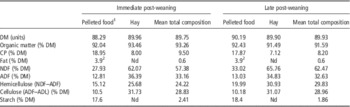
Offered and refused feed samples and faecal samples collected during the digestibility trials were dried in a forced draft oven at 75°C to constant weight for DM determination. Samples of the digestibility trial were ground to pass a 1 mm screen. Daily samples of the 4 days were pooled for offered feed. Similarly, daily samples of faeces were pooled for each horse and period. Offered feed and faecal samples were analyzed for OM by incineration for 5 h at 550°C and NDF, ADF and ADL fractions (Van Soest et al., Reference Van Soest, Robertson and Lewis1991). Feed samples analyses are presented for each period in Table 1.
Dry matter (DM) content and composition of experimental feedstuffs given to foals during digestibility measurements (%, DM basis)

Nd=non-determined.
1 The pelleted food contained (%, as-fed basis): wheat bran (38%), barley (18%), soybean meal (11%), alfalfa (8%), wheat shorts (10%), sugar beet molasses (5%), oat husks, malt sprouts, vitamin and mineral premix.
2 Given by the manufacturer.
All chemical analyses were performed in duplicate and the mean was calculated for each parameter before statistical analysis or calculation.
Average daily gain and digestibility calculation
The average daily gain (ADG) was estimated from the following periods: from days 30 to 1 (pre-weaning), from days −1 to 7 and from days 7 to 14 (immediate post-weaning), from days 14 to 131 (intermediate post-weaning) and from days 131 to 194 (late post-weaning).
The coefficients of total tract apparent digestibility of the dietary components were determined using ADL as indigestible marker and calculated according to the following equation: CAD D =1−(DC F ×I D )/(DC D ×I F ) where CAD D is the coefficient of total tract apparent digestibility of a dietary component, DC F and DC D are the concentrations of the dietary component in faeces and diet, respectively, and I F and I D are the concentrations of the indigestible marker in faeces and diet, respectively.
Statistical analysis
The normal distribution of all data was previously evaluated using the NORMAL option in PROC UNIVARIATE. For digestibility coefficients, the difference was evaluated using a paired t-test as data were normally distributed. For average daily feed intake and hay proportion in the diet differences were evaluated using a signed rank test as data were not normally distributed.
The mixed procedure (SAS Institute Inc., Cary, NC, USA) was used to analyze normal distributed data (BW, ADG, concentrations of bacterial functional groups and of F. succinogenes after log transformation, total VFA concentration, VFA profile) with a model including the animal as a random effect and time as a repeated measure.
When the effect of time was significant, statistical differences between groups were assessed using a Tukey–Kramer procedure for multiple comparisons. For non-normally distributed data, differences between days of sampling were tested with a non-parametric Friedman’s test using PROC FREQ of SAS with the CMH option. Statistical significance was accepted at P<0.05.
Results
Throughout the study, all animals were successfully weaned and did not suffer from any digestive disorder.
Average daily gain depended on the period of measurements (P<0.05). It was on average 0.76±0.27 kg/day before weaning and decreased during the 1st week after weaning (on average ADG =−0.10±0.94 kg/day). During the 2nd week after weaning, it increased to the mean initial value (ADG=0.71±0.39 kg/day). At the intermediate post-weaning period, ADG was lower (on average 0.14±0.04 kg/day) and increased again to the initial mean value during the late post-weaning period (on average 0.71±0.14 kg/day).
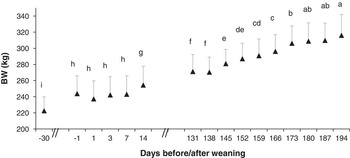
At the immediate post-weaning period, BW did not change significantly from days 1 to 7 and increased from days 7 to 14 (P<0.05, Figure 2). At the late post-weaning period, BW increased linearly (P<0.05).
Foal BW at pre-weaning and post-weaning periods. Values are means±SD (n=5). a,b,c,d,e,f,g,hMeans with different letters differ (P<0.05).

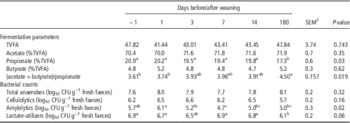
Faecal concentrations of cultivable total anaerobes and cellulolytic bacteria remained stable from days −1 to 180, whereas an effect of time was detected for the amylolytic and of lactate utilizer counts (Table 2). At the immediate post-weaning period, the amylolytic count significantly decreased between days 1 and 7. Between days 14 and 180, the lactate utilizer count tended to decrease (P=0.06).
Fermentative parameters and faecal bacterial counts measured in foals at pre and post-weaning periodsFootnote 1 , Footnote 2

TVFA=total volatile fatty acids; CFU=colony-forming units.
a,b,cWithin a row, means with different superscript letters differ (P<0.05).
1 Values are least squares means (n=5).
2 Foals were weaned at 180 days of age.
3 Pooled standard error of mean.
Real-time quantitative PCR revealed no effect of the day of sampling on the faecal concentration of total bacteria and F. succinogenes (on average, 9.70±0.20 log10 CFU/g and 8.02±0.40 log10 CFU/g, respectively). The proportion of F. succinogenes in the faeces was on average 2.6±1.6% of the total bacteria.
The faecal dry matter and pH did not change from days −1 to 180 (on average 20.6±2.6% and 6.9±0.3%, respectively). The VFA concentration remained stable from days −1 to 180 (on average 44.5±8.0 mmol/l), but the VFA profile was affected by the day of sampling (Table 2). Whereas the acetate and butyrate molar proportions did not significantly change from days −1 to 180 (on average 71.2±1.6% and 4.9±0.5%, respectively), the molar proportion of propionate significantly decreased (P<0.05) from days 14 to 180. As a consequence, the (acetate+butyrate)/propionate ratio increased between days 14 and 180 (+16.1%, P<0.05).
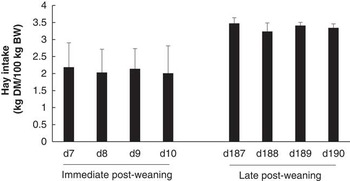
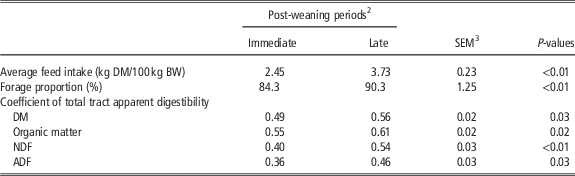
Whatever the period of digestibility measurements, the daily hay intake remained stable during the 4 consecutive days of measurements (Figure 3) and was on average 2.09 kg and 3.37 kg DM/100 kg BW, respectively, at the immediate and late post-weaning periods. Hay proportion and the ADFI in the diet increased (P<0.05) between the immediate and late post-weaning periods (Table 3). Apparent total tract digestibility coefficients of DM and DM constituents increased (P<0.05) between the immediate and late post-weaning periods (Table 3).
Daily hay intake at immediate (from days 7 to 10) and late (from days 187 to 190) post-weaning periods. Values are means±SD (n=5). Within a period, no effect of day was detected (P>0.05). d=day; DM=dry matter.

Average daily feed intake (kg dry matter (DM)/100 kg BW), forage proportion in the diet and total tract apparent digestibility coefficients of dietary components measured in weanlings 1 week (immediate post-weaning period) and 6 months (late post-weaning period) after weaningFootnote 1

1 Values are means (n=5).
2 Foals were weaned at 180 days of age.
3 Pooled standard error of mean.
Discussion
This study evaluated the fibre-degrading ability of weanlings at different ages. As BWs were recorded throughout the trial, information was provided about growth of the Haflinger foals. Before weaning at 6 months of age, foals had an average BW of 262.3±20.1 kg, representing 47.6% of the BW of their dams, which is in accordance with predicted values reported in other similar equine breeds (Martin-Rosset, Reference Magne, Hachelaf, Suau, Boudraa, Mangin, Touhami, Bouziane-Nedjadi and Pochart2005; National Research Council (NRC), 2007). In accordance with a previous study (Warren et al., Reference Warren, Lawrene, Parker, Barnes and Griffin1998), a slight decrease of BW was observed during the 1st week after weaning, resulting in a negative ADG. Then ADG increased to pre-weaning values the 2nd week after weaning, which was faster than the 3 weeks previously reported by Warren et al. (Reference Warren, Lawrene, Parker, Barnes and Griffin1998).
At the intermediate post-weaning period, ADG declined to 0.12 kg/day when weanlings were raised on pasture. Such a depressed growth rate has previously been mentioned in pasture-raised weanlings between 7 and 10 months of age (Ringler and Lawrence, Reference Ringler and Lawrence2008), and was associated with the low grass availability and quality during winter. At 1 year of age, when weanlings came back to the experimental farm, the ADG increased to 0.78 kg/day, a level similar to that obtained in thoroughbred yearlings (Ringler and Lawrence, Reference Ringler and Lawrence2008). Moreover, the average BW was 316.0±25.9 kg and reached 63.4% of potential mature BW, in accordance with predicted values given for similar breeds (Martin-Rosset Reference Magne, Hachelaf, Suau, Boudraa, Mangin, Touhami, Bouziane-Nedjadi and Pochart2005; NRC, 2007). As the age-related changes in BW were in agreement with the literature data, our experimental model appeared suitable for studying the fibre-degrading capacity of young growing horses.
Fibre-degrading capacity results from both the fibrolytic microbial activity and the retention time in the hindgut. The fibrolytic microbiota has been described in the hindgut of adult horses (Julliand and Grimm, Reference Julliand and Grimm2016) and the major cellulolytic bacterial species found in adult horses are Ruminococcus flavefaciens, Ruminococcus albus and Fibrobacter succinogenes (Julliand et al., Reference Julliand, de Vaux, Millet and Fonty1999; Hastie et al., Reference Hastie, Mitchell and Murray2008). In foals, there is evidence that cellulolytic bacteria and F. succinogenes appear during the 1st week of life and reach adult values at 30 and 60 days of life, respectively (Julliand et al., Reference Julliand, De Fombelle, Drogoul and Jacotot1996; Faubladier et al., Reference Faubladier, Julliand, Danel and Philippeau2013). Regarding microbial fermentative activity, a recent study on the age-related changes in faecal VFA concentration in foals has suggested that the fibrolytic activity begins during the 2nd week of life and is established from 2 months (Faubladier et al., Reference Faubladier, Julliand, Danel and Philippeau2013).
In accordance with horse nutrition recommendations (Martin-Rosset and Younge, Reference Martin-Rosset2006), foals had access to hay and concentrate pellets from 105 days of life before weaning. Thus, solid food replaced milk progressively. During the 1st week after weaning, a numerical decrease in the faecal molar proportion of propionate was observed in accordance with a previous study (Swanson et al., Reference Swanson, Kronfeld, Hoffman and Splan2003), but no other fermentative parameter was modified. Concomitantly, the amylolytic count slightly decreased in the faeces. These results could illustrate the rapid adaptation of microbiota to the cessation of milk without affecting other bacterial groups such as fibrolytic bacteria. In foals, very few data are available regarding the digestive ecosystem at weaning. The limited alteration seen in the hindgut ecosystem was probably due to the fact that foals had undergone a gradual dietary transition from milk to solid feed before weaning. Such conclusions were also reported in young rabbits (Combes et al., Reference Combes, Michelland, Monteils, Cauquil, Soulié, Tran, Gidenne and Fortun-Lamothe2011) and in human babies (Magne et al., Reference Mackie and Heath2006). Therefore, in foals the decrease in ADG at the immediate post-weaning period may not be related to alteration in gastrointestinal function as reported in early-weaned animals like piglets (Montagne et al., Reference Montagne, Boudry, Favier, Le Huëron-Luron, Lallès and Sève2007). It could be due to an increase in physical activity due to the psychological stress of weaning, as previously reported in foals (Xiao et al., Reference Xiao, Zhang, Tuohut, Shi and Li2015).
The voluntary hay intake increased on average 1.6-fold between 6 and 12 months of age. Such an increase was previously reported in growing horses fed ad libitum (Cymbaluk et al., Reference Cymbaluk1989) and could be explained by the age-related increase in energy demand for growth as suggested by Aiken et al. (Reference Aiken, Potter, Conrad and Evans1989). In relation to the increase of voluntary hay intake, the proportion of hay in the diet increased from 86% to 90% DMI at 6 and 12 months of age, respectively. To our knowledge, this slight difference may have had a limited impact on digestibility in the total tract.
The 4-day partial faecal collection and the use of ADL as an internal marker were chosen for welfare considerations and also due to the non-availability of collection harnesses adapted to foals and of metabolism stalls in our experimental station. Moreover, ADL appeared to be a suitable marker for comparing digestibility values between two periods of measurements (Goachet et al., Reference Goachet, Varloud and Julliand2010).
Very few data are available regarding the variation in the ability of young horses to digest the carbohydrates of plant cell walls according to age and in most studies total tract digestibility in growing horses was compared with measurements on adult horses receiving the same level of intake (Cymbaluk, Reference Cymbaluk, Christison and Leach1990; Earing et al., Reference Earing, Lawrence, Hayes, Brummer and Vanzant2010 and Reference Earing, Hayes, Brummer, McCown, Parks and Lawrence2013; Silva et al., Reference Silva, Rezende, Saliba, Costa, Lima and Pereira2012). The present study provides new data concerning digestibility monitored in the same weaned foals at 6 and 12 months of age. Although our digestibility coefficients of DM and OM determined in weanlings and in yearlings were slightly lower than those previously reported by Earing et al. (Reference Earing, Lawrence, Hayes, Brummer and Vanzant2010 and Reference Earing, Hayes, Brummer, McCown, Parks and Lawrence2013) using the total faecal collection method, our digestibility values of NDF were higher (+10% and +6% points, respectively). This high value of NDF digestibility coefficient appeared inconsistent with previous results because using ADL as internal marker normally leads to underestimation of the digestibility values compared with total faecal collection (Goachet et al., Reference Goachet, Philippeau, Varloud and Julliand2009; Sales, Reference Sales2012). The hay we used in this study contained 34.8% to 36.4% ADF, whereas ADF content of forage used in comparable studies ranged from 43.9% (Earing et al., Reference Earing, Hayes, Brummer, McCown, Parks and Lawrence2013) to 38.0% (Earing et al., Reference Earing, Lawrence, Hayes, Brummer and Vanzant2010). This difference in ADF concentration in the forage may account for the higher dNDF in the present study. In addition, as long-stem hay was offered, foals may have sorted it. Further digestibility trials providing chemical analyses of the refused feeds could shed light on this question.
Concerning the age-related effect, the total tract apparent digestibility of DM, OM, NDF and ADF increased significantly between 6 and 12 months of life. The variation amplitude (on average +14.3%, +10.1%, +33.6% and +27.8% for DM, OM, NDF and ADF, respectively) largely exceeded the reproducibility variations reported in digestibility measurements obtained from a 4-day partial faecal collection using ADL as marker in horses (Goachet et al., Reference Goachet, Varloud, Philippeau and Julliand2012). The increase we measured could therefore be the result of an increase in fibre-degrading capacity in growing foals. Nevertheless, the effect of age on total tract digestibility may be confounded with some dietary changes between 6 and 12 months. Indeed, the increase in the concentration of NDF and hemicellulose (+5.1 and +5.6% points, respectively) in total feed between the immediate and late post-weaning periods could contribute to an increase in digestibility at 12 months of age compared with 6 months. Further studies are required to confirm the increase in fibre-degrading capacity in growing foals.
The age-related increase in digestibility of fibre-rich diets may also come from an increase in the hindgut retention time of digesta. Indeed, the intestinal volume may increase in relation to the growth of the hindgut determined between 6 and 12 months of life (Smyth, Reference Smyth1988). In 6-month-old weanlings, the mean retention time (MRT) of the particulate phase of digesta was similar to that measured in adult horses fed the same diet (Earing et al., Reference Earing, Hayes, Brummer, McCown, Parks and Lawrence2013), whereas in 12-month-old weanlings the MRT was higher than in adults (26.2 v. 22.7 h) (Earing et al., Reference Earing, Lawrence, Hayes, Brummer and Vanzant2010). These results suggest that the MRT could increase in weaned foals between 6 and 12 months of age leading to an increase in the time for bacterial adhesion and thus degradation of plant cell walls. In our study, no shift in the fermentative parameters was detected, as shown by the post-weaning stability in total VFA concentration and acetate proportion in the faeces of foals, suggesting no alteration in microbial activity. We hypothesized that the VFA concentration we measured in the faeces at this period of growth could be modulated by shifts in VFA absorption in the hindgut. Indeed, as reported in growing rabbits (Yu and Chiou, Reference Yu and Chiou1997), the increase in hindgut length between 6 and 12 months of age (Smyth, Reference Smyth1988) may be associated with an increase in the total surface of intestinal epithelium. Thus, the absorption of nutrients through the intestinal wall could increase between the immediate and late post-weaning periods. Further investigations on foals are required to confirm our hypotheses.
Acknowledgements
The present work was supported by the Regional Council of Burgundy, the Fonds Eperon (Encouragement aux Projets Equestres Régionaux et Nationaux) and Original Process. The authors thank Marie-Claire De Vos Franzin and Emmanuel Jacotot for technical assistance.