In March 2017, the Museo Egizio in Turin, Italy opened an exhibition called Missione Egitto 1903–1920, exploring the history of the archaeological excavations from which much of the museum's impressive (and impressively displayed) collection derives. Known as the Missione Archeologica Italiana, the excavations were overseen by the museum's then-director, Ernesto Schiaparelli—an esteemed Egyptologist and prominent Catholic philanthropist. “Mission” was one of several terms archaeologists used to identify their work in the colonial Middle East, including Egypt: the Institut Français d'Archéologie Orientale in Cairo originated in 1880 as the “Mission archéologique,” to take just one example (Reid Reference Reid2002, 175).
The name of the Turin exhibition got me thinking about the long reach of European (and latterly American) archaeology in Egypt from the nineteenth century to the present day. Indeed, mission is a word still widely used to identify projects carried out by foreign teams in the country—French, Japanese, Polish, and Dutch, plus English-language communiqués within the antiquities ministry. A mission carries the general sense of going out into the world with a purpose, to carry out a specific, often onerous, task (OED 2017). But the origin of the word, and a meaning it still bears, is tied to Christian proselytizing: missions were for missionaries, whether Jesuits of the seventeenth century or evangelicals of the twentieth, like the Presbyterians who founded the American University in Cairo (Sharkey Reference Sharkey2013). Ernesto Schiaparelli certainly was not alone in seeing research and religion as branches of the same sheltering tree. With its undertones of both vocation and salvation, the persistence of the archaeological mission likens the study of ancient Egypt to a calling, and implies that someone, or something, is in need of salvation—but from whom or what? And does this zeal now stand in the way of more critical historical awareness and heritage preservation debates?
To the curators’ credit, Missione Egitto goes beyond the conventional narrative of splendid discovery and noble sacrifice typically used to present histories of Egyptology. The exhibition achieves this by delving into museum and excavation archives in a more detailed, ambitious, and extensive way than I have yet seen. It opens by positioning European archaeological endeavors in the Middle East within the context of colonialism and imperialism—and in particular, the context of the young Italian nation (whose invasion of Libya is featured) and the city of Turin itself, home to the Risorgimento, the royal family, and Italy's industrial revolution. Citing the work of Egyptologist Stephen Quirke, both the exhibition and its accompanying catalogue also emphasize the role of the Egyptians whose labor and local knowledge were fundamental to archaeology (Del Vesco and Moiso Reference Del Vesco and Moiso2017; Quirke Reference Quirke2010). For instance, Schiaparelli and his younger colleagues—Virginio Rosa and Francesco Ballerini—relied on Boulos Yatta, a Coptic Christian who was, in effect, the mission's operations manager. Since Yatta wrote fluent Italian, dozens of letters exchanged between the Egyptologists and Yatta offer a rare glimpse of such conversations from both sides.
More commonly, the voices of Egyptians are absent from archaeological archives, narratives, and histories, although their faces and bodies are ever-present in photographs (Riggs Reference Riggs2016). Among the many photographs used in the exhibition, both as historical objects in display cases and as enlargements within the installation, two in particular struck me because they do not represent the usual ruins, artifacts, or digging-in-action shots that have given archaeology its ready visual repertoire. Nonetheless, they are part of the historical and intellectual “baggage” of Egyptian archaeology, and I would like to use them here to challenge the notions of salvation and vocation that continue to block more critically informed analysis of Egyptology's histories—and of contemporary heritage debates. On its mission to discover, record, and preserve antiquity, Egyptology evades confronting the full impact of its own past (Riggs Reference Riggs2014). Photographs, both in their content and in the context of their making, should make such evasion more difficult, yet the plenitude of photographic images makes them easy to overlook.
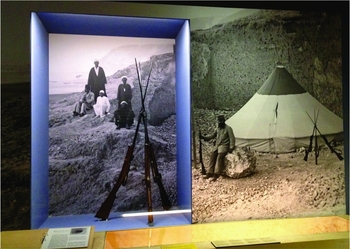
While the exhibition makes copious use of images from the Italian-led excavations, it stops short of analyzing the photographs as photographs—why they were taken, how they were used, or what archival lives they now lead, beyond being “evidence” for this or that artifact's point of origin. Most are primarily scene-setting, like my first example (Figure 1). Taken at a site encampment, the enlarged image forms the backdrop to a glazed case that displays three rifles propped against each other—recreating the pyramidal pose in which they appear in the photograph, next to one of the tents the Italian archaeologists used. An armed European perches on a rock, confronting the camera; at left and behind, five Egyptian men and boys, unarmed, variously face the camera or gaze away.
Installation view, Missione Egitto 1903–20, Museo Egizio, Turin. Photo by Christina Riggs.

The presence of the rifles in the gallery neatly echoes the past captured in the photograph: or does it? Texts tell us that site security was important, suggesting that the mission and its artifacts were under threat. In the nineteenth and early twentieth centuries, security everywhere in rural Egypt was a concern—chiefly in relation to livestock. The ghaffirs, or guards, familiar to tourists at ancient sites today were not devised for “heritage protection.” They are the remnants of village-based policing in Ottoman Egypt, re-organized under Lord Cromer in 1896 as part of a longer-term British strategy to strengthen—and control—security on every level (Tollefson Reference Tollefson1999). Cattle rustling, petty theft, physical attacks: these were the crimes that worried Egyptians, and threats against archaeologists were as likely to involve theft of money and supplies as antiquities.
But seen today against extensive press coverage of destruction in Syria and Iraq, those rifles, real and represented, easily invite the conclusion that the site needed protection from an unspecified “Other”—Arabs? Bedouin?—intent on stealing, damaging, or destroying what we would now call cultural heritage. In the same month the Turin show opened, antiquities officials in Egypt had to defend themselves against criticism around the unearthing of a colossal ancient statue in an impoverished Cairo suburb, where children scampered around the “site” and posed for selfies (Nader Reference Nader2017). As a historian concerned with colonial archaeology and its legacies, I hear uncomfortable echoes in such news stories and flinch a little at installations like those guns. Without clear details and specific contextualization, the idea of “security” for antiquities throughout the Middle East is worryingly ahistorical. It ignores vast differences in the kinds of threat that might exist, except to imply that the region's modern inhabitants are to blame.
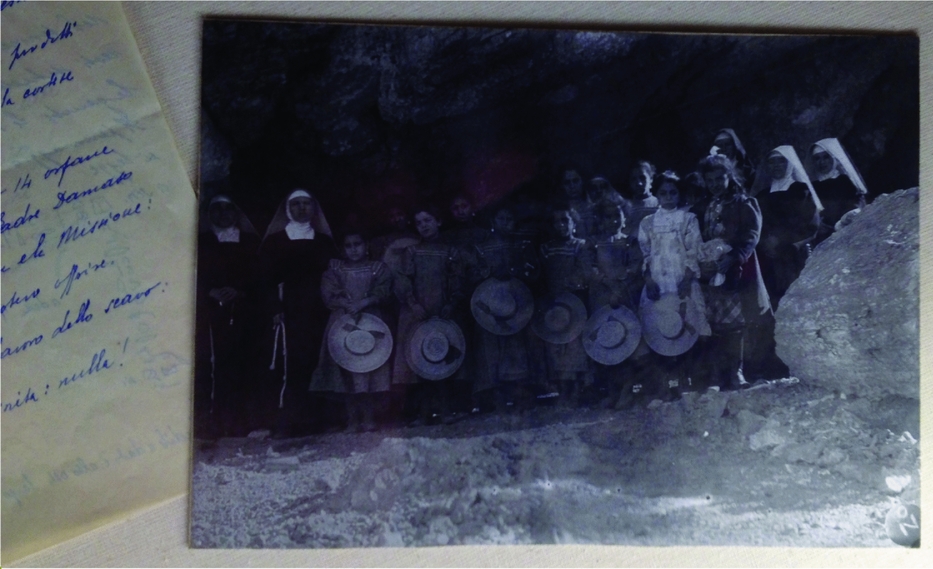
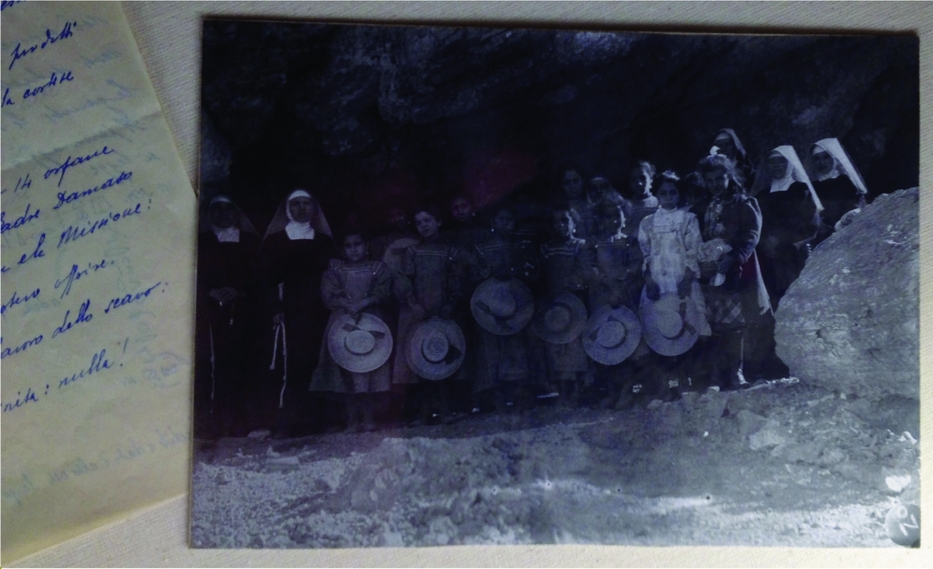
Admittedly it is difficult, in a gallery space, to acknowledge or predict the affective qualities of photographs: the emotional engagements, unexpected responses, and silent histories the image may capture or coax out (Edwards Reference Edwards2015). Towards the end of the exhibition my eye was caught by my second example, a half-plate print displayed alongside a letter Rosa wrote to Schiaparelli from Gebelein, some 40km south of Luxor, on March 5, 1911 (Figure 2). I found myself squaring my shoulders like the dozen or so Egyptian girls in the photograph, each wearing a puff-sleeved, high-necked, ruffle-hemmed dress and clutching a beribboned straw hat in her hands. On either side of the girls stood several Franciscan nuns in white wimples, with the order's knotted rope around their waists. Rosa's letter gives the context: “Yesterday 14 orphans and the seven Sisters and Father Damaso came from Luxor to visit Gebelein and the Missione: I offered them as much as I could offer” (my translation). The area excavated thus far, he explains to his boss, frustrated, had yielded nulla—nothing.
Print, dated c. 1911, of a photograph probably taken in March that year, on display in the Turin exhibition. Photo by Christina Riggs.
We know, or should know, by now that archives must be read “against the grain” to recover the lived experiences of the colonial and imperial mission (Stoler Reference Stoler2009), in every sense of that word. Whether carried out by Franciscans or archaeologists, tourists or industrialists, diplomats or soldiers, mission work had an immeasurable impact in the countries on its receiving end, via the accommodations and concessions, impossibilities and opportunities, comminglings and juxtapositions, that it created within an inherently unequal, and not infrequently violent, system. The guns were as important as the nuns, in other words: Schiaparelli's devout Catholicism, and his concern for the conditions in which religious orders were working in Egypt, led him to establish a charitable organization to support them, several years before he founded his archaeological mission (ANSMI 2017). This allowed the Franciscans to expand their numbers at Luxor and establish girls’ and boys’ schools for local children, which continue to operate today. So far, so admirable, of course: but my affective response to that photograph made me wonder what it was like to be one of those orphan girls at the time (what did they make of the archaeologists, the guns, the nuns?), and what happened to them later on in life.
Historians of archaeology often write about the trial-and-error development of field techniques, professional and personal networks of knowledge exchange, or the disciplining of objects into artifacts and evidence. But archaeology disciplined people and communities as well—and this is as much its legacy as any temple, tomb, or tour bus. Schiaparelli's charity eventually supported Franciscan schools throughout North Africa and the Middle East, and silent film footage included in the Missione Egitto exhibition shows uniformed pupils performing sing-a-longs or visiting Karnak Temple under the charity's banner. In one scene (perhaps in Libya), a girl with a long, dark braid writes Viva l'Italia neatly on a blackboard while a Sister watches, nodding at a child chalking praise to a country she might never see.
I watched that footage twice through before I left the exhibition. Stepping out into Turin's elegant streets, I dropped my shoulders and took a deep breath. Nuns and guns are difficult to shake when they have been made so visible through the act of photography. If, that is, we really look at photographs as photographs, together with their making, circulation, and archiving. For archaeologists trained to see photographs only as documenting artifacts, sites, or heroic scholarly predecessors, this is a challenge: recently, I have foregrounded excavation photographs when speaking to audiences of Egyptologists about the discipline's history, with mixed results. Surprise or confusion often greets any attempt to interrogate the motivations, the politics, and the record-keeping or technical wizardry of archaeologists in colonial Egypt. All those photographs, all those drawings—and Missione Egitto makes rich use of both—can so readily be marshaled as proof that archaeologists saved what otherwise would have been lost, or worse (to this way of thinking), never known about, period. The successful mission is one that saves, after all: who am I to suggest otherwise?
This is one of several challenges facing scholars and curators aiming to present a critically informed history of archaeology in the Middle East. Since the 2003 invasion of Iraq, intense media scrutiny has followed various forms of site destruction, theft, and “iconoclasm” in the region's conflicts and revolutions—often without follow-up to correct misapprehensions, and with little analysis of why groups such as “Islamic State” might see threats to antiquities as a means to their own desperate ends. In the face of such complex and sensitive issues, however, many heritage professionals, archaeologists, and commentators have promulgated, rather than questioned, the heritage doctrine that antiquities have a universal and enduring value, to be saved and preserved at all costs—a value higher, in some rhetoric, than human life. In this environment, trying to situate the practice of archaeology and photography within imperial history, or point out the existence of preservation practices other than those sanctioned by archaeologists, feels like singing from the wrong hymn sheet.
Missione Egitto is an impressive exhibition, yet it confirms how difficult it is to display and discuss the history of archaeology without evoking colonial nostalgia for a Middle East more acquiescent to the missions of Western scholars—and how difficult it is to make present, beyond a blurry photograph or film reel, the extent of the social changes archaeology wrought in indigenous communities. Photographs and films seem so easy to look at—and to look away from, without seeing the alienation that shadowed the archaeological mission, and still does. The exhibition made me wonder, not for the first time, what the entire discipline of Egyptology would look like if it took its history more seriously, more critically. If it read its archives backwards and in raking light, like a hieroglyphic inscription. Not nulla, as Rosa feared, but diversa, different. I could chalk its outlines; I could almost sing its praises. But I fear it is a country I might never see.